What does it mean to be a conservative, especially among Republicans? Though we know that most citizens are not terribly ideological (Campbell et al. Reference Campbell, Converse, Miller and Stokes1960; Converse Reference Converse and Apter1964) many have noted that the two parties have become more sorted along ideological lines in recent years while still retaining some of the characteristics of previous eras (Nie, Verba, and Petrocik, Reference Nie, Verba and Petrocik1976; Lewis-Beck et al. Reference Lewis-Beck, Jacoby, Norpoth and Weisberg2008). Still, the conflict among Republican elected officials, conservative media outlets, and voters surrounding the nomination and election of President Trump suggests fissures and divisions in the party about what it means to be a conservative. In 2016 a number of Republicans were unwilling to vote for the party’s eventual standard-bearer. This type of internal partisan struggle is quite unusual. In the American National Election Study (ANES), among Republicans who voted in the primary and general elections, there were literally no cases of voters who refused to support McCain in both the primary and general election in 2008. In 2012, among such voters, just over 1% of Republicans refused to support Romney in both stages. In 2016, however, almost one in ten Republican voters refused to support Trump in both the primary and the general election. This fracture provides political science an opportunity to study the ideological differences within a party that contains voters who are consistent Trump loyalists, those who only supported him in the general election, and a small but significant group of Never Trumpers who were active in both the primary and general elections, refused to support Trump in either election, but retain their Republican allegiance and identity.
Previous studies of the development and persistence of ideological coalitions suggest that the issues, values, and groups that compose the two parties change over time as competing interests vie for power within the parties (Sundquist Reference Sundquist1983; Bawn et al. Reference Bawn, Cohen, Karol, Masket, Noel and Zaller2012; Noel Reference Noel2013), and that the two parties should be thought of as different coalitions and studied separately (Grossmann and Hopkins Reference Grossmann and Hopkins2016). Given the tumult of the 2016 nomination process, what did the ideological coalition of the Republican Party look like as it nominated Donald Trump to be its standard bearer and carried him into the presidency? Though much evidence still remains to be gathered, and only time can tell how successful a revised Republican coalition will be in future presidential elections, the rise of Donald Trump is a critical time to map the ideological fractures in the GOP. We seek to understand how different groups of Republicans define conservatism—both for themselves and more broadly as an ideological movement. The election of President Trump, whose path to the Republican nomination and presidency was filled with objections and protests within the party, provides a unique opportunity to both see how different factions within the party have different views of the term “conservative,” but also to show how ideology is multi-faceted and the different types of ideology are reflected in the Republican fissures and divisions.
The Conflict over Trump and Ideology
When Donald J. Trump first began his campaign, nearly everyone treated him as an unserious candidate. As his path to the nomination became clearer, a number of conservative actors and institutions reacted to his campaign by strongly condemning him and the issues he endorsed. One line of attack centered around the argument that Trump was not actually conservative, and that Republicans—the party of conservatism—should abandon Trump for a true conservative. Conservative commentators such as Glenn Beck, Jennifer Rubin, Charles Murray and Bill Kristol lined up to (and to this day still do) repeatedly argue and warn against Trump as the standard-bearer of the conservative party.Footnote 1 Trump’s distance from traditional conservatism even motivated Evan McMullin to run an independent presidential campaign as a “conservative alternative to Donald Trump.”Footnote 2 While it is important not to overstate Trump’s innovations—he is conservative on many dimensions such as immigration, tax cuts and in other areas where he prefers a very authoritarian style of government—the key point is that Trump’s ideological inconsistencies raised questions in the minds of many Republican Party stalwarts and conservative standard bearers.
Perhaps the apex of this anti-Trump attitude within the Republican Party was exemplified at the Republican National Convention by Ted Cruz, Trump’s most serious challenger, who did not cleanly endorse Trump during his keynote address. Indeed, many people interpreted passages near the close of his speech as a direct rebuke of Trump:
We deserve leaders who stand for principle. Unite us all behind shared values. Cast aside anger for love. That is the standard we should expect, from everybody. And to those listening, please, don’t stay home in November. Stand, and speak, and vote your conscience, vote for candidates up and down the ticket who you trust to defend our freedom and to be faithful to the Constitution.
Despite the booing in the convention hall, Cruz stuck by his critiques . . . until late October. Several weeks before the election Cruz eventually endorsed Trump. And while it is true that he and other Republicans occasionally express reservations about the new president, by and large many have been willing to see Trump’s brand gain traction in the GOP, while many have embraced him wholeheartedly. By the time of the general election, roughly half of sitting Republican senators had explicitly endorsed Trump, with more than 150 sitting House members endorsing his campaign. Others have gone a step further than simply endorsing Trump by suggesting that he represents a new brand of conservatism—one that shares much with previous definitions, but emphasizes new and different issues and ideas.
The tumult surrounding the nomination and election of Trump was not only felt among party elites, but by the rank and file voters in the party as well. Partisan and ideological coalitions are about who is included and who is excluded (Bawn et al. Reference Bawn, Cohen, Karol, Masket, Noel and Zaller2012), and with the election of Trump it is important to carefully map those differences as they existed at the beginning of, and throughout, the Trump presidency. Lee Drutman has already shown that the parties are quite divided and that Republicans “are more clearly split” than are Democrats.Footnote 3 Drutman’s work highlights the importance of looking at different types of citizens such as those who vote occasionally and mostly in the general election, those committed to primary elections, and the donor class of activists. We cannot map all of these dimensions, so we focus here on the group of Republicans who voted in both the primary and general elections of 2016. Though primary elections do not always show deep divisions, in the case of the 2016 election the different camps were characterized by an unusual level of vitriol within the party. And, again, we note that in this election almost one in ten Republican voters refused to support the nominee in the general election compared with numbers one tenth that size (or less) in previous elections.
To that end, we use two different surveys of voters to uncover how different groups of Republican voters understand conservatism. In both surveys we focus on individuals who self-identify as Republican and who voted in both the primary and general elections of 2016. In this way, our respondents are active and embedded in the Republican Party—much more so than those who only participate in the general election or do not self-identify as a member of the GOP. Our results paint a picture of a party in flux. Republican voters who supported Trump in the primary and general elections have a different ideology than those who opposed Trump in the primary but supported him in the general election. Both of these groups are also markedly different than those Republicans who consistently opposed Trump in both the primary and general elections in 2016.
Documenting this requires understanding that ideology is multi-faceted and can be expressed in a number of different ways. First, there is the question of how different groups symbolically identify themselves. A separate expression of ideology relates to contemporary issue positions and is often called “operational ideology” or “issue consistency.” Finally, we consider how different groups conceptualize what it means to be a conservative more generally. We consider each of these different facets of ideology among three key groups of Republican voters—those who supported Trump in the primary and general election, those who opposed Trump in the primary but supported him in the general election, and those who opposed Trump in both the primary and general elections. The results of our multi-pronged measurement of ideology reveal that the Republican Party of late 2016 and early 2017 was made up of a group of Trump loyalists who think of themselves as “conservatives” but are less likely to hold the classic Republican positions than general election supporters of Trump. These core Trump supporters are, on average, also significantly less capable of conceptualizing what it means to be a conservative. In contrast, the Never Trump Republicans—while self-identifying as members of the Republican Party—are largely symbolic and operational moderates, though they are significantly better than Trump’s core supporters in their ability to conceptualize what it means to be a conservative.
While the rise and success of Trump within the Republican Party came as a shock to many, it is not unusual for issues and ideologies within the parties to shift over time. As Noel (Reference Noel2013) has shown, over the course of the twentieth century both party coalitions changed and realigned with new ideological principles. And while the overlap is not perfect, it is now relatively rare to find liberal Republicans or conservative Democrats whereas this was much more common fifty years ago. This raises the question of how President Trump’s new style and set of issue positions might continue to shift people’s understanding of conservatism and conservative issues. To understand how those conflicts play out in the Republican Party we must first understand the theory behind the levels and types of ideology found in American politics.
Levels and Types of Ideology
Campbell et al. (Reference Campbell, Converse, Miller and Stokes1960) first discussed the concept of ideological sophistication and labelled the public as fitting into various levels from ideological to lacking in issue content. Converse (Reference Converse and Apter1964) followed this typology in his study of ideological conceptualization claiming that less than one in five members of the public were either ideologues or near-ideologues. A group of similar size, he claimed, had no issue content to their opinions whatsoever. The rest of the public fell between these poles.
The claim, favored by many scholars today (Greene Reference Greene1999; Green, Palmquist and Schickler Reference Green, Palmquist and Schickler2004; Achen and Bartels Reference Achen and Bartels2016), is that aside from a small group of heavily interested political participants, most citizens are better described by their party attachments than they are by any set of political positions, what we might call operational ideology or the frequency with which individuals hold consistently conservative or liberal issue positions. Converse called this “constraint.” Broockman (Reference Broockman2016) goes further in arguing that the very concept of ideological consistency is a flawed way of thinking about how people conceptualize politics.
While operational ideology looks at the set of issue positions held by an individual, there is an alternative form of ideology to consider. Another form of ideology is essentially “symbolic” in the sense that it expresses a group affliation or a label that can serve, for at least some people, as an identity (Conover and Feldman Reference Conover and Feldman1981). Ellis and Stimson (Reference Ellis and Stimson2012) go further in showing how this kind of symbolic conservatism represents a kind of commitment to traditional values but often lacks deep policy content. Many of the self-styled “conservatives” are really quite operationally liberal on government spending. Mason (Reference Mason2018a) shows how symbolic ideology can create strong negative feelings against the other party (affective polarization) even when policy issues are not at all consistent. They simply take up the label and the identity of being a conservative or a liberal without much consideration of the issue positions that typically go with that label. Grossmann and Hopkins (Reference Grossmann and Hopkins2016) introduce a further complication and suggest that Republicans are different from Democrats in the sense that Republicans care a great deal about the conservative identity or label, while Democrats remain only interested in group benefits.Footnote 4
These are not the only types of ideology worth considering. Neither of these versions of ideology—operational or symbolic ideology—pushes the concept of ideology to its most abstract form. Noel (2013, 2) argues that both concepts fall short of what ideology really is. Referencing Converse (Reference Converse and Apter1964), Noel writes that ideology is the product of a “creative synthesis,” often driven by academics, journalists, and public intellectuals that “ties policy ideas into packages that we come to know as liberal or conservative.” And while issue constraint among elites may be based on these abstract first principles and logical connections between ideas, for citizens who think far less about these logical connections “the sources of constraint are much less logical in the classical sense than they are psychological—and less psychological than social” (Converse Reference Converse and Apter1964, 209). This form of conceptual ideology is the most stringent in that it requires not merely accepting a label or even taking the correct set of issue positions, it requires explaining the coherence, connections, and reasons for the full set of positions. Why is a conservative simultaneously against government intervention in the economy but for government intervention on issues like abortion? Only a person with the ability to strongly conceptualize conservative ideology can explain these abstract reasons.Footnote 5
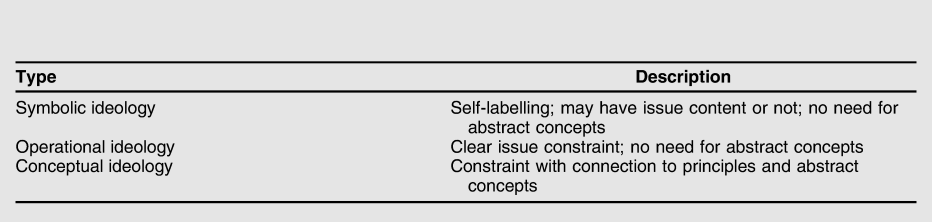
Thus, we are left not with a single picture of ideology in the mass public but one where ideology is a term being used in multiple ways: first as constraint, second as symbolic labelling, and in the most abstract way, as a conceptual framework. Which version best characterizes any given citizen depends on the sophistication of that citizen (Knight Reference Knight1985). These three forms of ideology are captured in table 1 which describes the content of each type.
Types of ideology in use in the literature

It is important to note that these three types of ideology are distinct from one another in important ways. Symbolic ideology is rooted in identity and group attachment. This is the least difficult form of ideology for anyone to adopt. All that is necessary is a knowledge of the two available ideological camps and a willingness to self-identify as either a conservative or a liberal. Indeed, the self-label may carry no further issue content or deeper understanding of what the label entails.
Operational ideology technically requires no such identity because it is about a set of positions and beliefs. However, it sets a more stringent standard in that it requires a set of positions that are internally consistent across time and correlated with the relevant positions of the dominant political parties. Without doubt there is a range of operational ideology within the public—ranging from completely constrained to ideologically innocent (Kinder and Kalmoe Reference Kinder and Kalmoe2017). Indeed, some of the people who Campbell et al. (Reference Campbell, Converse, Miller and Stokes1960) and Converse (Reference Converse and Apter1964) labelled as simply group-interested would probably be able to satisfy a weak version of operational ideology so long as they were somewhat more consistently taking conservative or liberal positions. Perhaps even some people they considered “nature of the times” voters would exhibit at least some issue consistency as well.
Finally, in the case of conceptual ideology, one must go beyond the “what” of the issues of the day to grasp the “why” of these different policies. Knowing “what goes with what and why” (Convers 19664) requires not only knowing about a number of different contemporary issues, but also knowing how to connect those issues together using broader concepts and first principles. This is much more demanding than simply a self-identification or even holding a constrained set of beliefs. Conceptual ideology is also unique because a person could, technically, be quite capable of understanding the connections underlying ideology without actually subscribing to that particular belief system. In other words, one could speak the language of ideology without using it to describe oneself. Though we suspect that most of the people in the following sample who use these abstractions do care about them and believe their own version of the abstract ideas they are expressing. Perhaps it would be better to say that the highest form of conceptual ideology is to use the concepts and abstractions in a way that is consistent with the commonly accepted definitions and mean such things to identify one’s own positions and views. As Noel writes, ideology “organizes politics for many, not just for one” (Noel Reference Noel2013, 41).
There has long been an implicit assumption in some of the literature on ideology that these levels represent a monotonic scale. Certainly, the Michigan School authors spoke about ideology in this way. Someone capable of conceptual connections should, the argument goes, be highly constrained on operational ideology and certainly would be the most likely to label themselves with the right symbolic label. And there is some evidence for the idea that self-identification and issue constraint go together (Stimson Reference Stimson1975; Levitin and Miller Reference Levitin and Miller.1979; Jacoby Reference Jacoby1991, Reference Jacoby2000; Rudolph and Evans Reference Rudolph and Evans.2005). What has not been attempted, to our knowledge, is to differentiate these ideological types within a political party.
As long as a particular party is united, these distinctions between different forms of ideology are unlikely to matter. Symbolic conservatives perhaps join with operational or conceptual conservatives in support of a candidate for different reasons, but they support the candidate all the same. However, with the tumult in the Republican Party in 2016 it is worth considering how different groups in the party reflect these different types of ideology, described in table 1. Our findings here are surprising, in some ways. Rather than finding a monotonic scale where certain voters are simply more or less ideological across all three different types of ideology, we find the different dimensions of the concept are distinct and not simply reflections of one another. While those Republican voters who consistently opposed Trump are less likely to score highly on their use of symbolic ideology and operational ideology, they are quite capable of coherently explaining the conservative enterprise, and thus have high levels of conceptual ideology. Trump’s general election supporters are much better described as conservatives in the symbolic and operational senses than the Never Trump group. And finally, Trump’s core supporters who voted for him in both the primary and general elections are the least likely to be able to describe conceptual conservatism. They are also less operationally conservative than are Trump’s general election-only supporters. However, they are equivalent in levels of symbolic conservatism with general election Trump supporters. These differences show that different factions of the Republican Party are dramatically different in their views of conservatism, their identity with the label of conservatism, and their likelihood of holding conservative issue positions. We now turn to the data to show these differences.
Data and Empirics
Before turning to our key question of Republican ideology, we begin by describing the data we use to investigate ideology and how we identify the three groups laid out earlier. We use two surveys, the 2016 Cooperative Congressional Election Study and an original survey conducted by YouGov in January of 2017. We keep only those respondents who self-identify as Republicans.Footnote 6 The period of time immediately prior to the election and presidential transition is an optimal moment for these surveys as Donald Trump’s lack of conservative history brought forward a vigorous discussion of conservatism and its relationship with the Republican Party. However, recent research shows that this struggle persists inside of the Republican Party and Trump coalition.Footnote 7 Thus, this time period provides a moment when Republican voters were grappling with these issues more so than other times in the past. We also only consider those Republicans who voted in both the primary and general elections.Footnote 8 We only include primary and general election voters because these are the Republicans who are most engaged and involved in the electoral process, representing the group of Republicans who compose key internal party coalitions. We also exclude non-primary voting Republicans because the primary election process is the venue by which the different factions of a party can decide which candidate best represents the policies and ideologies of the dominant faction within that party (Hill Reference Hill2015).
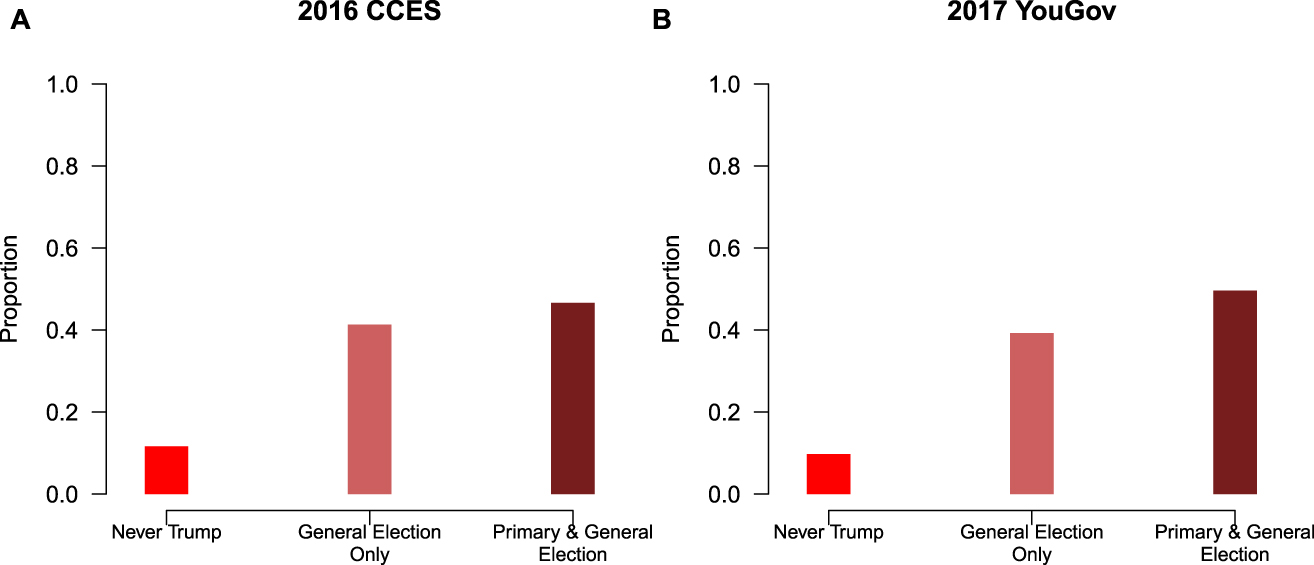
Figure 1 displays our three different profiles, and their proportion among voting Republicans. The first are voters who did not support Trump in either the primary or general elections. We find that these Republicans who opposed Trump in both the 2016 primary and the general elections are the smallest group. Approximately one in ten Republican voters refused to support Trump in the course of the campaign (0.11 CCES, 0.09 YouGov).Footnote 9 While by far the smallest group, this still represent a meaningful proportion of the party as a shift in the Republican coalition of 10 percentage points would have significant electoral consequences up and down the ballot. The next largest group represents a bit over four in ten Republican voters—those who supported Trump in the general election, but opposed him in the primary and backed a different candidate (0.41 CCES, 0.39 YouGov).Footnote 10 Finally, the largest group of Republicans is the group that supported Trump in both the primary and the general elections. In both surveys, half or nearly half of all Republican voters who participated in both the primary and general elections supported Trump in both elections (0.47 CCES, 0.50 YouGov).
Distribution of three groups of Republicans in the 2016 CCES and 2017 YouGov surveys.
Note: Never Trump Republicans voted in the 2016 primary and general elections, but did not support Trump in either election. “General election Only” Republicans opposed Trump in the primary election but voted for him in the general election. “Primary and General Election Republicans” supported Trump in both elections in 2016.

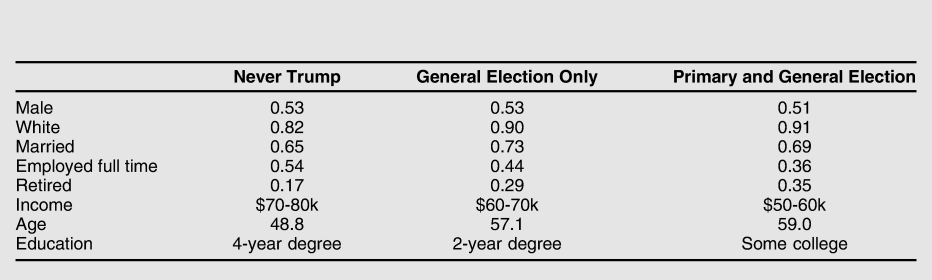
What differences exist between these three groups? Table 2 gives a roster of the general demographic characteristics of each group. Overall, there are relatively few differences between the three categories. All are overwhelmingly white (though the Never Trump category is slightly less so). There are no significant gender or marital status differences. What is true is that Trump’s core supporters are less likely to be employed full time and are more likely to be retired. In fact, the proportion of the retired in Trump’s core supporters (0.35) is twice as large as the proportion of retired persons in the Never Trump category (0.17). This makes sense given that Trump’s core supporters are also much older than the other two groups, nearly 10 years older on average, than the Never Trump Republicans. Finally, there are significant differences between the three different groups in income and education. Primary-election Trump supporters have less education and lower average incomes than those who supported Trump only in the general election. Moreover, the Never Trump voters are the most highly educated and have the highest incomes of all three groups. While we are confident that these demographics differ in important ways that correlate with ideology (Baldassari Reference Baldassari2008; Abramowitz Reference Abramowitz2010; Kinder and Kalmoe Reference Kinder and Kalmoe2017), we will show that ideological differences remain across these three groups even after accounting for demographic differences (see table 3).Footnote 11
Demographics of each group

Note: With the exception of income, age, and education, numbers are proportions. Income shows median category and age displays average age of each cohort. Education shows the median outcome of a 6-point scale. Data from 2016 CCES.
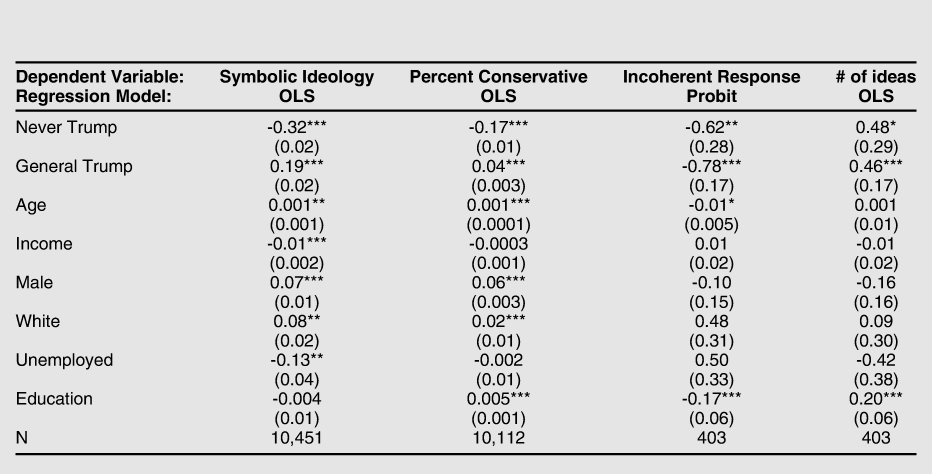
Regression results

Note: Model 1 measures predictors of self-placed ideology on a 5-point scale with 5 being “very conservative”. Model 2 measures the proportion of times a respondent took a conservative position on 22 different policy votes contained in the CCES survey. Model 3 measures predictors of whether or not the respondent gave an incoherent response when asked to define conservatism. Model 4 measures the number of different issues/ideas/principles mentioned when asked to define conservatism. In each model, Republicans who voted for Trump in the primary and general elections are the omitted, comparison group. Models 1 and 2 come from CCES data. Models 3 and 4 come from the 2017 YouGov survey. Significance codes *p < 0.1, **p < 0.05, ***p < 0.01, two-tailed tests.
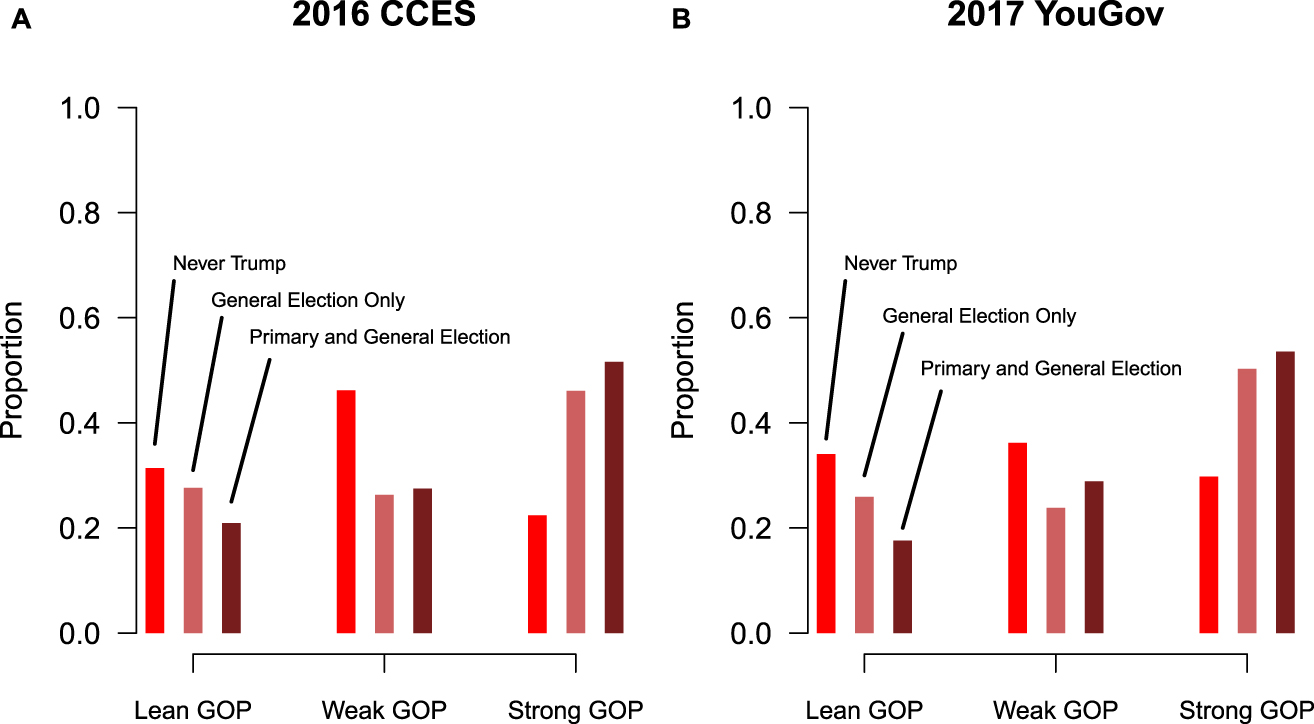
It is also important to establish that these three categories of voters capture something about ideological attitudes that is different from partisanship. If it is simply the case that strong Trump supporters are also strong Republicans while Never Trump Republicans are all weakly attached to the Republican Party, ideological differences between the groups may simply be a result of partisan attachment.Footnote 12 Figure 2 shows the distribution of each group by partisan strength for both the CCES and the 2017 YouGov survey. The pattern is similar across the two surveys in that Trump’s primary and general election supporters are more likely to identify as strong Republicans. In both surveys, approximately half of these voters identify as strong Republicans. However, that pattern is far from overwhelming. There are different stripes of Republicans—leaners, weak Republicans, and strong Republicans—across all three groups. In fact, more than two-thirds of each group identify as being either weakly or strongly affiliated with the Republican Party, and nearly 20% of each group considers themselves to only lean towards the Republican Party. The exception to this is the Never Trump group where closer to one-third of these voters only lean towards the Republican Party.Footnote 13 So, while we do find patterns of demographic and partisan strength related to Trump support, those patterns do not tell the full picture of how the different facets of ideology are reflected in these different Republican groups. To that end, we now turn to considering the set of ideological questions across these different groups of Republicans.
Distribution of partisan attachment among the three groups of Republicans

Symbolic Ideology
If our theory is correct, measuring ideology requires several different strategies. We first consider symbolic, or self-identified, ideological differences. We then consider policy consistency, or operational ideology, and then finally consider conceptual ideology. Given these different groups’ differential support of Donald Trump combined with Trump’s inconsistent relationship with conservatism, we expect to find differences across these groups of voters in their willingness to adopt the label of conservatism, their views of conservative policies, and their overall understanding of what it means to be conservative. Support for Trump—or any other Republican in a time of such internal partisan debate—should be reflected in the ideological stances of the voters. Of course, one could maintain a null hypothesis that there will be no difference, though that is not at all what we find.
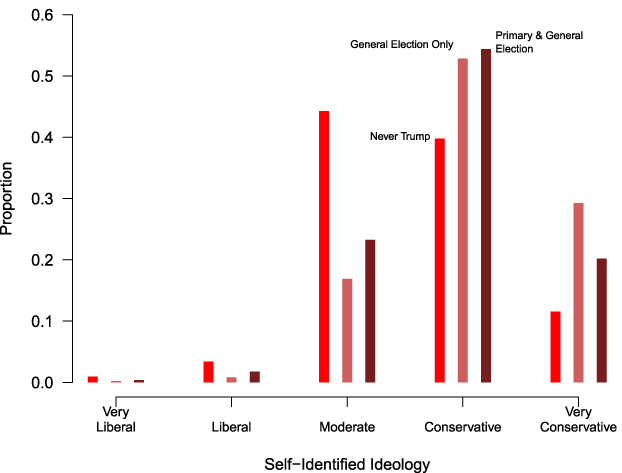
Figure 3 displays the distribution of self-labelled symbolic ideology across the three different type of Republican voters in the CCES sample. A dramatic difference is immediately clear: Never Trump Republicans in the CCES are significantly more likely to eschew the label of conservative in favor of self-identifying as “moderate.” It is the modal category for the Never Trump group: approximately four in ten of these voters identify as moderate (0.44). A nearly equal proportion then identify as “conservative” (0.40) while a dramatically smaller number see themselves as “very conservative” (0.12). On the other hand, Republican voters who supported Trump in the primary and general elections are much more similar in their ideological self-placement to those who opposed Trump in the primary election but eventually supported him in the general election, although the group most likely to label themselves as “very conservative” are the Republicans who only supported Trump in the general election. About three-quarters of voters in the groups that supported Trump in some way self-identify as being either conservative or very conservative (0.82 General Only, 0.75 Primary and General). Interestingly, primary and general election Trump supporters are actually more likely to self-identify as being moderate (0.23) than they are as “very conservative.” Similar trends exist in the 2017 YouGov survey as well as in the 2016 ANES.Footnote 14
Distribution of self-placed ideology among the three groups of Republicans
Note: Republicans who opposed Trump in both the primary and general elections stand out as being much more likely to identify as moderate. While many of them identify as conservative, much fewer identify as very conservative. Data: 2016 CCES

On the whole, for self-identified symbolic ideology, there is a clear difference between the Never Trump Republicans and the other two groups. Never Trump Republicans are clearly less comfortable with the label “conservative,” instead favoring the label of “moderate.” It is also important that nearly 25% of primary election Trump supporters prefer to call themselves moderate. This elevated proportion of primary Trump supporters who call themselves moderate could be because during the campaign, Trump was actually perceived as one of the more moderate candidates in the race, both in the primary and general elections.Footnote 15 Across a number of surveys, respondents placed Trump further towards the center than other Republican presidential candidates at the time and other former Republican officeholders.Footnote 16 Thus, it may not come as a surprise that a large share of Trump’s core supporters also see themselves as “moderate” voters. But, overall, Trump supporters in the general election and the consistent Trump supporters look relatively the same for this facet of ideology. The same broad pattern will turn out to be true with respect to operational ideology.Footnote 17
Operational (Policy) Ideology
While symbolic ideology can be measured with a simple question, operational ideology requires some kind of measure of issue positions. To measure operational ideology, we take twenty-five different policy questions that were asked on the CCES survey and code respondents for whether or not they expressed a conservative or liberal position on the issue. These issues cover a broad range of contemporary issues and include gun control, abortion policy, environmental issues, health care, immigration, crime, minimum wage, infrastructure, and gay marriage. Given the shifting definitions of what is or is not conservative, we take as our point of reference the position of the majority of legislators in the Republican Party in 2016 as an indication of whether a position is conservative or liberal.Footnote 18 Using these questions, we scale them together to find the proportion of the time that a respondent indicated support for a conservative policy.Footnote 19
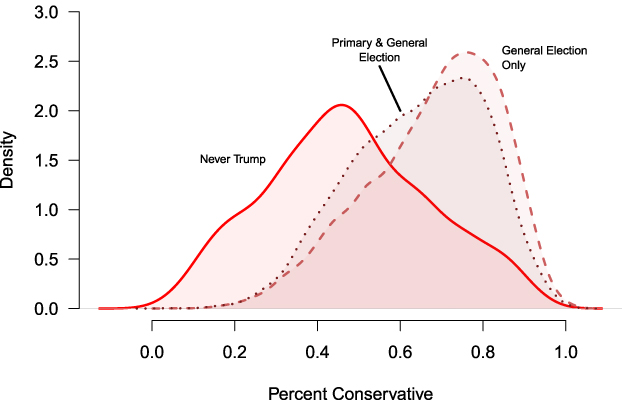
Figure 4 shows the distribution of issue consistency, or operational ideology, among the three different groups of Republican voters. As with symbolic ideology, an immediate difference appears between the Never Trump Republicans and the other two groups. Republicans who opposed Donald Trump in both the primary and general elections are significantly more likely to express liberal policy positions on a variety of policy questions.Footnote 20 This is reflected in figure 4 by the leftward shift of the Never Trump distribution compared to the other two distributions. The median Never Trump voter supports conservative positions about half of the time (48%) while the median general election Trump supporter endorsed conservative policies 72% of the time. In fact, the Never Trump Republicans look nearly the same as pure independents in their policy preferences. Figure A8 in the online appendix plots the distribution of operational ideology among pure independents and shows that the distribution is nearly the same as the distribution of issue consistency among Never Trump Republicans. While Never Trump Republicans are much more symbolically conservative than pure independents (refer to figure A5), they are much closer to independents on policy than to their fellow Republicans.
Distribution of policy preferences among the three groups of Republicans
Note: Never Trump Republicans are more likely to hold a mix of conservative and liberal issue positions. Those who supported President Trump in both the primary and general elections are slightly less consistently conservative than those who opposed Trump but supported him in the general election. Scores are based on percentage of time a respondent took a conservative position on twenty-five different issue questions.

Primary election Trump supporters are also slightly less conservative on policy issues than those who opposed Trump in the primary but voted for him in the general election. The median primary Trump supporter endorsed conservative policies 64% of the time, making this group the most operationally conservative group of Republican voters on policy questions as well as the most likely to embrace the symbolic identify of being “very conservative.”
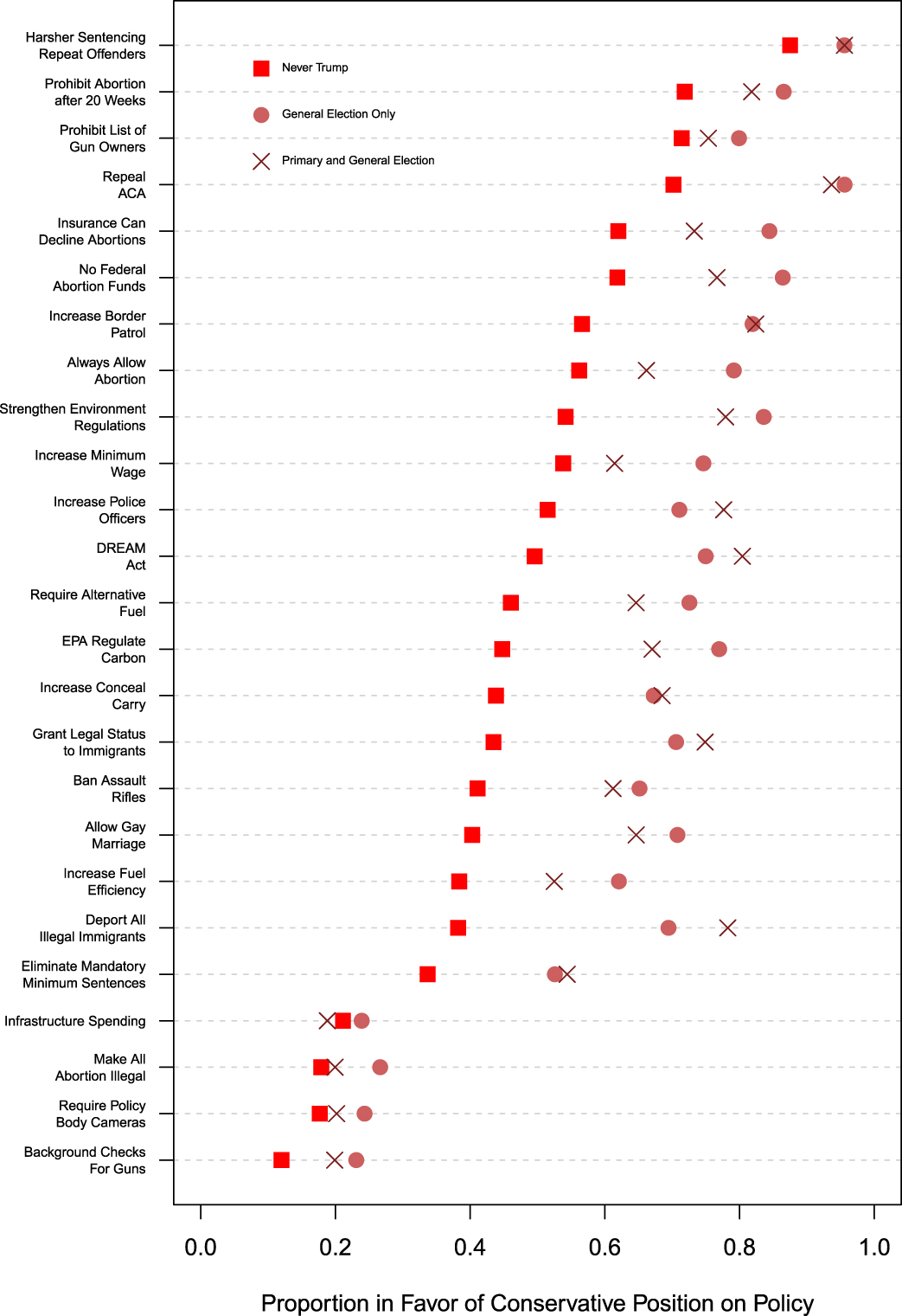
Much of the 2016 primary election centered around whether or not Donald Trump was truly a conservative, let alone truly a Republican. Given this, the slightly more moderate distribution we observe in figure 4 between those who supported Trump in the primary election and those who only supported him in the general election is consistent with the disagreements that arose surrounding Trump’s conservatism during the nomination process. Given that Trump was perceived as a less conservative candidate, we should expect to see those who supported him in the primary to also endorse a less consistently conservative suite of issues.Footnote 21 In figure 5 we show the proportion of voters who supported each of the twenty-five issues used from the CCES to create the measure of operational ideology. The square points show the proportion of Never Trump Republicans who supported each policy. The circles show the level of support among Trump’s general election supporters. Finally, the X’s show support for each policy among Trump’s primary and general election supporters. We see that on most issues, the general election supporters hold similar preferences to the primary and general election supporters. However, on a few issues the differences are much larger. The largest difference is on whether or not to increase the minimum wage to $12 per hour (a 13-point difference). Thereafter, we see that the disagreements between primary and general election supporters center around a variety of issues. On abortion, the environment, and gay marriage the primary election supporters appear to be moderately more liberal than those who only supported Trump in the general election. The two issues on which the primary supporters are more conservative is on policies related to illegal immigration and increasing the number of police officers. This unique pattern suggests that Trump’s primary supporters are somewhat more liberal on economic and certain social issues (gay marriage and abortion) than those who opposed Trump in the primary election. However, they hold distinctively more conservative positions on immigration, a central issue to Trump’s campaign.
Proportion supporting conservative policies
Note: This figure shows the proportion of respondents who take the conservative position on each of the twenty-five policies used in the operational ideology measure. Respondents are divided into the three different groups of Republicans considered here. We see that on many policies, the Never Trump Republicans are substantially more liberal than the other two groups. While the primary and general election groups are quite similar, there are a few issues on which their opinions diverge, but rarely by more than ten percentage points. The largest difference is on whether or not to increase the minimum wage to $12 per hour (a 13-point difference).

The differences between Trump’s primary and general election supporters, however, are small when compared to the differences between the Never Trump Republicans and the other two groups. Never Trumpers are, on average, much less conservative on many of the issues (a 40-point difference on deporting all illegal immigrants, for example). And while there are some issues on which the party appears to be united (clustered towards the top of the figure), on many of these issues the Never Trump group stands out as holding starkly different views than the rest of Republican voters. The Never Trump crowd is more liberal on the environment, immigration, gun laws, gay marriage, and the Affordable Care Act.Footnote 22
Thus far, the results of symbolic and operational ideology seem to suggest that there are really only two groups of Republicans: Never Trumpers, who shy away from the label of conservatism and hold a mixture of liberal and conservative issue positions, and all other Republicans, who at some point voted for Trump and happily embrace both the symbols and policy issues associated with conservatism. However, we have not yet looked at the final facet of ideology, a conceptual understanding of the ideas and first principles of conservatism. When we shift to that frame of reference, the picture changes significantly.
Conceptual Ideology
We now turn to a consideration of conceptual ideology, or the first principles, deeper concepts, and ideas that may (or may not) support symbolic self-identification and policy positions of the electorate. This is the most difficult measurement task and requires the most judgement on the part of the researchers. When Republicans talk about being “conservative” or not being “liberal”, what do they mean? What significance do these terms have for the contemporary Republican Party and its position as the party of conservatism? While it is tempting to think of ideology as a fixed set of principles, issues, and interests, scholars note that the significance of the terms “conservative” and “liberal” change over time, adjusting and shifting with the different coalitions that compose these two large camps (Noel Reference Noel2013). The development of the concepts, identities, and policies that compose an ideology are a “creative synthesis” of shared psychological predispositions, interests, cultural preferences, and political and institutional factors (Noel Reference Noel2013, 42). In this way, ideology is far from exogenous, and 2016 represented a tumultuous, divisive election where that synthesis saw significant tension. Different factions within the party have different views of what parts of conservatism should be emphasized, or in some cases, how it should be altogether defined. Given this, we may expect that the factors that shape what it means to be conservative or liberal are different across different segments of the Republican electorate. To understand this facet of ideology we have to know what concepts are in voters’ heads.
While a number of studies of ideology have looked at the distribution and correlates of symbolic and operational ideology (Luskin Reference Luskin1990; Lupton, Myers, and Thornton Reference Lupton, Myers and Thornton2015; Freeder, Lenz, and Turney 2016), there are few, if any, studies of conceptual ideology since Converse’s open-ended interviews of voters in the mid-1950s.Footnote 23 The basic idea of conceptual ideology is not only related to the work cited earlier (especially Converse and Noel) but it is also implicitly related to Zaller and Feldman (Reference Zaller and Feldman1992) and their Receive-Accept-Sample (RAS) model. People have a range of considerations in their heads that they have selectively accepted from various sources. They construct the meaning of conservatism or liberalism, if they do it at all, based on these considerations they have already encountered. At any given moment that definition is fluid, but it is, in the mass public, based on the considerations they have sampled from media, political elites, and their social connections. Our survey was designed to provide a look into how contemporary ideology is understood in the American public at a pivotal moment in the Republican Party’s history. In order to measure conceptual ideology, we simply sampled those considerations by asking survey respondents the following open-ended question:
Please tell us, in a few sentences, what you believe it means to be a [liberal/conservative]?
Respondents were randomly assigned to either the liberal or conservative condition. Thus, half of respondents wrote about their understanding of conservatism while the other half wrote about their understanding of liberalism.
After asking people to explain their understanding of conservatism or liberalism, we then coded these open-ended responses to classify various themes, ideas, policies, and statements that were common across responses. To do this, we use a common text classification software, Linguistic Inquiry and Word Count (LIWC). LIWC uses a dictionary of words and terms that classify text as belonging to different categories or topics. Users can provide their own dictionary of terms or use a generic dictionary. Given the specialized topic of ideology that we asked respondents to discuss, we provided the LIWC program with a list of words and their associated topics that could be mentioned by respondents in their open-ended answers. For example, we anticipated that many respondents would discuss the proper size of the government as a core concept of both conservatism and liberalism. Thus, we included words and phrases like “less government”, “limit”, “reduce”, and “big government” as words that fall in the size of government category. In total, respondents’ answers touched on thirteen different categories for concepts related to conservatism and thirteen categories for principles of liberalism.Footnote 24 The dictionaries that contains the various words and phrases for each category (one for conservatism and one for liberalism) are included in the online appendix.
For example, one respondent wrote the following about conservatism: “Less government, lower taxes, upholding the Constitution.” This response was coded as addressing the broad concepts of the size of government, fiscal issues, and the Founding/Constitution. As another example, a respondent wrote the following about conservatives: “Someone who believes the government should provide for a strong national defense and then leave us alone. Follow the Constitution and don’t try to run the lives of everybody.” This particular response was coded as addressing the issues of national defense/military, individualism, and the Founding/Constitution. Some responses mentioned several different concepts, symbols, and motivating principles. Others were quite brief (or, in some cases, non-responsive to the question). All of the responses varied in topics mentioned, and some were very well formed descriptions of the first principles and beliefs behind conservatism and liberalism. Others, however, were significantly less articulate.
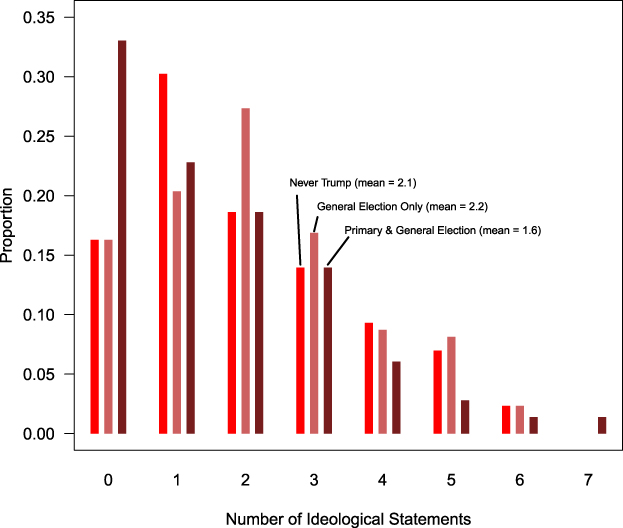
We begin our analysis of these open-ended responses by simply considering the number of unique topics people incorporated in their answer when discussing conservatism or liberalism. As before, we consider the three different groups of Republicans separately. Figure 6 displays the distribution and average number of statements that each group made when asked the question about what it means to be a conservative or a liberal. The distribution shows that most respondents, regardless of category, provided relatively few different principles or concepts in their responses. The group of Never Trump Republicans included slightly more than two ideas, on average, in their responses, as did Trump’s general election supporters. Trump’s primary and general election supporters were slightly less verbose, averaging one-and-a-half ideas in their responses. However, it is noteworthy that the modal number of ideas expressed by Trump’s core group of supporters was zero. This contrasts with the rest of the Republicans who averaged about two ideas per response, with modal responses of one (among Never Trump Republicans) or two ideas (among general election only supporters).
Number of concepts mentioned in conceptual open-ended questions

The fact that respondents’ answers in general did not include much content should not imply that all respondents were incapable of articulating what it means to be conservative or liberal. For example, one respondent gave a highly developed answer regarding conservatism: “Small government is better than large. Less regulations and taxes. More states’ rights. Bigger military spending. Pro-life. Pro second amendment.” Though short, this is quite a good statement of what it means to be a conservative, at least in recent years.Footnote 25
Overall, the relative paucity of content in these responses aligns with Converse’s finding that only a small segment of the population is highly ideologically developed, but it is noteworthy that the most conceptually developed group is clearly not Trump’s core supporters. The conclusion to draw is that while Trump’s base in the Republican Party may have a strong identity as a conservative, and even be relatively consistent in expressing conservative positions (though not as good as his general election-only supporters, as previously provided) they may not really comprehend the concepts that have traditionally been used to connect and motivate the various policies that de ne conservatism. To put this in terms consistent with Zaller and Feldman (Reference Zaller and Feldman1992), Trump’s primary supporters simply have sampled fewer considerations and therefore have less ability to generate a meaningful response to the question of what it means to be a conservative. They may be committed to conservatism as an identity (Grossmann and Hopkins Reference Grossmann and Hopkins2016) or even have a set of issue positions, but they have less to say about it, and it shows in the type of responses they gave.
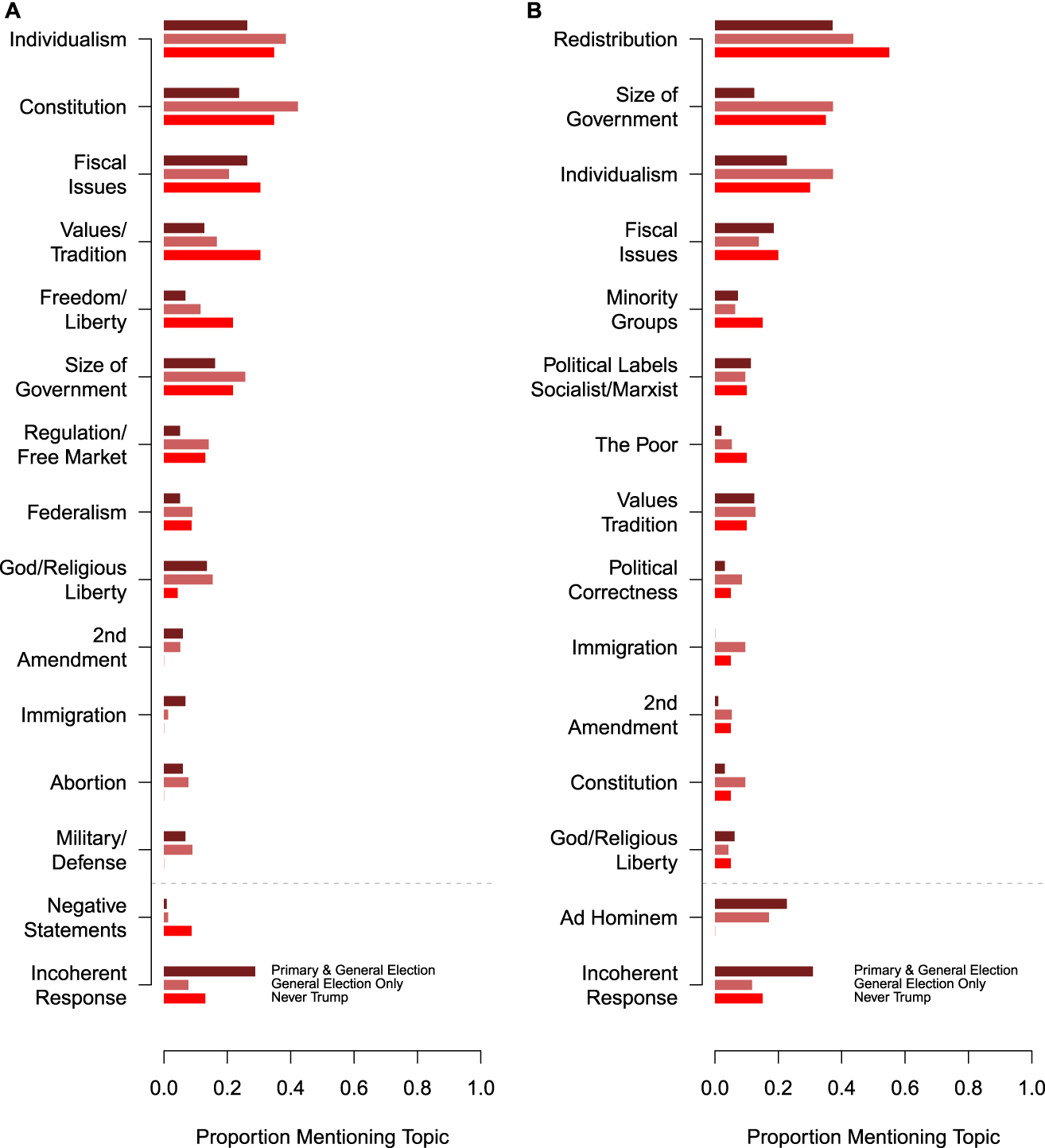
Figure 7 shows the relative frequency with which certain topics were mentioned by the three groups of Republicans we are studying here. The left panel of the figure shows the topics mentioned when asked about conservatism. The right panel shows the results for those who were asked about liberalism. The group that stands out is Trump’s core supporters. While in general there are relatively few differences in the rate of responses given by the Never Trump Republicans and the general election Trump supporters, those who supported Trump throughout both elections are consistently less likely to give any responses (with one set of exceptions discussed shortly). Taking the meaning of conservatism first, this is especially true in terms of the number of times they reference the Constitution, freedom or liberty, the size of government, and market regulation. Looking at liberalism, the difference is most pronounced there with respect to the size of government and individualism, but is apparent in a few other categories as well.
Issue content in open-ended questions among three groups of Republicans
Note: This figure shows the proportion of responses containing particular ideas or issues. The left panel shows the most common statements when asked to define conservatism. The right panel shows the most common statements when asked to define liberalism.

In essence, the largest group of Republicans in this sample, Trump’s core supporters, are less likely than other Republicans to connect conservatism to such core considerations as respect for the Constitution, the importance of liberty, and free markets. When critiquing liberalism, Trump’s core supporters are much less likely to argue that liberalism is about an expansive government or stifling individualism. The areas where Trump’s core supporters are near parity with the other groups are a connection of fiscal issues and religious liberty to conservatismFootnote 26 and the connection of pejorative political labels and the lack of values or tradition to liberalism.
Below the dashed line in each panel is a set of categories that were coded directly by the authors. A number of responses to the question took forms that were, in the case of conservatism, essentially non-responsive: “not sure how to describe what it means to be conservative” or “nah” are examples. In some cases, the sentences provided were not devoid of meaning, but were not clearly responsive to the question of what it means to be a conservative: “seeing everyone as a whole” or “to be smart” or “seek balance in all things.” Occasionally, the responses were simply restatements of how conservatism was “good” or “reasonable” or to “have higher standards.” When such responses did not trigger any of the categories listed earlier and when in the judgement of the authors the response had no content beyond a general positive vibe, we coded the response as incoherent. While there were a few such responses from the other groups, about three in ten of the Never Trump Republican responses fit this coding of incoherence, about three times as often as was true for the other groups. It was among the most common responses given by Trump’s core supporters. This group was likely to describe conservatism as “common sense” or “a smart American. Someone that is trying to do the best for all the folks not just the ones that they can get to vote for them.” While these responses were not incoherent in the sense of being incomplete sentences, they say little to nothing about ideology, issues, or political values that we would think of as a part of a coherent ideology. Finally, we note that a number of negative or even ad hominem statements were offered by the respondents. While this lack of civility did not characterize all Republicans, it did seem to characterize many, especially of the sort that support Trump when referencing liberalism. Such ad hominem attacks as “the destruction of America”, “air head; doesn’t think; only uses her ‘heart.’ No capacity to reason”, and “scum.” came from Trump’s core supporters (23% of their responses) and his general election supporters (17%). Interestingly, these types of ad hominem statements were absent from responses by the Never Trump Republicans when discussing liberalism. However, when referencing conservatism, the negative statements tended to come from the Never Trump group.
These results are consistent with the claim that the three groups of Republicans have different abilities to discuss the underlying principles and policies of conservatism, stemming from their available considerations. Of course, one might suspect that the differences in conceptual conservatism are simply a manifestation of ideological self-identities or some other factor. So, do the differences in ideology persist even after accounting for the demographic differences between the various levels of Trump support among Republican voters? Previous research shows that certain demographic features correlate with ideological constraint and consistency (Baldassari Reference Baldassari2008; Abramowitz Reference Abramowitz2010; Kinder and Kalmoe Reference Kinder and Kalmoe2017). We might, therefore, expect that the differences are purely a result of education, age, or income.Footnote 27 In table 3 we find that the general ideological differences discussed earlier persist even after accounting for these demographic factors. Column 1 regresses respondent self-placed ideology (on a 5-point scale, with very conservative being 5 and very liberal being 1) on dummy variables for being a Never Trump Republican or a Republican who opposed Trump in the primary but supported him in the general election. Trump’s primary election supporters are omitted as the comparison group. We see that after accounting for differences in age, income, gender, race, employment, and education that the results are consistent with the bivariate comparisons. Never Trump Republicans are still more likely to provide more moderate ideological self-placements while those who opposed Trump in the primary but not the general are more likely to identify as very conservative. We obtain similar results in column 2, which models a respondent’s level of operational ideology. Here the dependent variable is the proportion of issues on which a respondent took a conservative position. Again, after including demographic controls, we see that Never Trump Republicans are more likely to hold moderate or liberal policy positions and general election Trump supporters are slightly more likely to hold conservative policy views than Trump’s primary supporters.
Finally, columns 3 and 4 replicate the results of our conceptual ideology questions. Column 3 shows the results of a model where providing an “incoherent” response is the dependent variable. Column 4 uses the number of ideas included in a respondent’s open-ended answer as the dependent variable. In both models we see that both groups are more ideologically fluent. They are less likely than the primary Trump supporters to provide incoherent responses and more likely to provide greater detail in their responses. These results suggest that Trump’s core group of supporters are conservative in their identity, less so in their issue positions, and are not nearly as likely to have ideological fluency that comes from a wide set of considerations and ideas like the ones that Zaller and Feldman (Reference Zaller and Feldman1992) imply one needs to form coherent belief systems.
Taken together, these different types of ideology help us identify who, if any group, is the most ideological within the contemporary Republican Party. Table 4 provides a stylized summary of our results and shows the basic split within the party. What we find is that each group differs from the other two groups on at least one dimension. Additionally, each group scores “high” on one of the dimensions, but never across all three. For example, Never Trumpers are relatively less committed to the symbolic label and are clearly more moderate in their operational ideology (they are less constrained). However, while they eschew the conservative label, they are the best group at explaining the abstract content of conservatism and liberalism. Moreover, this is not just a function of their education. Trump’s core supporters, on the other hand, are a near mirror image of this group. While they are committed to the label of conservative and provide conservative issue positions most of the time, they are the least sophisticated when considering the abstract concepts of conservatism. They are, by far, the most likely to provide incoherent responses to the question of what it means to be a conservative. They are also the group most likely to have negative, affective responses to liberalism. These core Trump supporters are conservative in the sense that they like and use the label of “conservative,” even if they are not very good at describing what that label means, or do not always endorse all of the policies that traditionally come with that label (Ellis and Stimson Reference Ellis and Stimson2012; Mason Reference Mason2018b). Finally, Republican voters who opposed Trump in the primary but supported him in the general election are strongly attached to the symbolic label of conservatism and are the group most likely to hold consistently conservative issue positions. Furthermore, they are also able to articulate what it means to be a conservative, but not quite as well as the Never Trumpers. In this way, they represent the core of conservatism as an identity, as a set of issue positions, and as an intellectual movement.
Uses of ideology in the Republican Party in the age of Trump

Discussion
What does this mean for ideology among Republicans in the age of Trump? Based on these results we offer some speculation for what these results may suggest about the future of the Republican Party and the future of conservatism.
First, the fissures in the contemporary Republican Party’s ideology seem to be reflected across all three of the different types of ideology—symbolic, operational, and conceptual—and perhaps in surprising ways. The Never Trump Republicans are not terribly ideological in the symbolic label or their own set of issue positions. They clearly defect from the conservatism of the contemporary Republican Party on several issues more often than do the other groups we studied here. But, despite their non-ideological nature, they are the group that seems to score the highest on understanding the concepts and abstract principles of conservatism (though Trump’s general election supporters are not far behind). These Never-Trump citizens are, however, by far the smallest portion of the party. The largest group of the Republican Party, Trump’s core supporters, stands as direct contrast to the Never Trumpers: strong on the label, relatively committed to a set of conservative positions, but weak in their ability to use conceptual ideology to motivate those positions. And it should be noted that they are a group disposed to treat liberals and liberalism with a lack of civility, something Mason (Reference Mason2018b) notes goes hand in hand with a strong ideological identity.
While the Never Trump group represents by far the smallest cohort of Republican voters in this study, they represent an important group for a number of reasons. First, in 2016 this group, while small (∼12% of active Republicans), represents enough people that had they been on board with Trump in the general election, he may have been able to claim the popular vote majority in addition to an Electoral College victory. Secondly, this is a significantly larger group of voters than have been present in previous Republican contests. While most presidential nominations involve a fierce contest between competing factions of the party, there were dramatically fewer Republicans (< 5%) who abstained from voting for John McCain in 2008.Footnote 28 The 2016 contest is unique for the duration and intensity of that contest and the fact that a meaningful proportion of the party refused to reconcile with the eventual party standard bearer.
How could the triumph of Trump over the Republican Party in 2016 affect the future of the Republican Party? It stands to reason that future Republican candidates may try to combine their appeals to symbolic identity with a greater negative affective stance towards liberalism and the Democratic Party (indeed for many Republicans this is already the dominant strategy). One might argue based on these results that one way to appeal to Republicans is to offer a kind of “negative ideology” that is mostly about not being liberal or simply not being seen as on the left. Our results suggest that this sort of appeal will work well with the largest group in the party and therefore could represent the future of conservatism, a future that downplays philosophical appeals and even moves in a more liberal and populist direction on many issues. The group of those most favorable to Trump was more likely to support raising the minimum wage, allowing gay marriage, and moving in a harsher direction on immigration. The question is whether or not this group will be able to really move the party and, therefore, eventually the party system.
It is possible that the underlying principles of conservatism may become harder to articulate as these issues become more dominant stars in the constellation of issues that define conservatism. If those most likely to identify as conservative are also the least likely to be able to explain what exactly it means to be conservative, then a new suite of issues, ideas, and policies could easily replace the existing framework. The difficulty in this path will be in bringing along the middle group of Republicans, those who supported Trump in the general election, but opposed him earlier. They represent a connection to the past understanding of what issues go in the conservative “basket”, but also clearly connect to the identity of conservatism in a way that is similar to Trump’s core supporters. If this group accepts a new version of conservatism that stands at odds with issue positions that have traditionally been held by conservatives, this would represent a major change in the landscape of American politics, a change that is high on symbolism, highly emotional, and more populist in policy content—though only time can reveal if this trend will persist.
Finally, a lesson for political science is that beliefs about the structure of politics should probably not be thought of as a monotonic scale. In contrast, we see a multidimensional version of ideology where different groups score higher on some concepts versus others. As it applies to ideology in the age of Trump, what we see is that those with the ability to discuss ideology at the highest levels—conceptual ideology—are not necessarily applying those principles in the same way as other groups in the Republican Party at this time. Furthermore, this group appears to be in decline as another group of Republican, one motivated more by identity than abstract principle or particular issue content, is ascendant.
Supplementary Materials
1. The proportion of Republicans in the three different categories when including general election abstainers in the never Trump category (Figures A1 and A2).
2. Including general election abstainers in the Never Trump category does not dramatically change our interpretation of that group’s demographics (Table A1).
3. The partisan affiliation of each category when including general election abstainers in the never Trump category (Figure A3).
4. The distribution of symbolic ideology among respondents to the 2017 YouGov survey (Figure A4).
5. The distribution of symbolic ideology among Never Trump Republicans compared to pure independents (Figure A5).
6. The distribution of symbolic ideology among different categories of Republican voters in the 2016 ANES survey (Figure A6).
7. The distribution of operational ideology when including general election abstainers in the Never Trump category (Figure A7).
8. The distribution of operational ideology of Never Trump Republicans compared to pure in- dependents (Figure A8).
9. The distribution of operational ideology of the three groups of Republican voters in the 2016 ANES survey (Figure A9).
10. Replication of the regression table in the main paper, but including partisan strength as a covariate in each model (Table A2).
11. Questions used in the CCES to create the measure of operational ideology, or issue consistency.
12. Dictionaries used in the LIWC text classification to generate measures of conceptual ideology.
13. Correlation between symbolic and operational ideology in the CCES (Figure A10).
14. The distribution of Republican primary and general election voters by candidate preference in 2008.
15. The distribution of symbolic ideology among Republican primary and general election voters in 2008.
To view supplementary material for this article, please visit https://doi.org/10.1017/S153759271900077X