


Old Persian first appeared in writing two and a half millennia ago, in the aftermath of conquest. Our story begins with the conqueror Cyrus of Anshan and the usurper Darius the Persian.
Cyrus was the royal heir of a little kingdom called Anshan, located in a large, relatively sheltered endorheic mountain basin of interconnected valleys in what is today southwestern Iran. This region is the one most properly called Persia, which ancient Greek geographers later called “Basin Persia.”Footnote 1 Cyrus of Anshan created a coalition of warriors – among whom speakers of Iranic languages were prominent – and overthrew his master, the king of the Medes, an Arya people to the north. Taking control of Median treasure and resources, he conquered many other kingdoms in a series of successful and far-reaching military campaigns. Cyrus’ armies marched into Anatolia and Babylonia, to the Mediterranean coast, and as far east as the steppes of Central Asia. By military force he and his son Cambyses, who subsequently added the bounteous river valley of Egypt to the conquered territories, created the largest empire ever seen by that time and adopted the ancient Assyrian and Babylonian title “king of kings.” In political conditions marked by conspiracy over the dynastic succession to Cambyses, Darius, son of Hystaspes, became the Persian king of kings, ruler over lands of many peoples, as he himself declared, through a coup d’état carried out in 522 bce. To legitimize his seizure of power, he married into the family of his predecessors, Cyrus and Cambyses, making those previous kings his in-laws, and he furthermore insisted on his sharing a patrilineal family relationship to them through his great-great-great-grandfather. The common ancestor he claimed for both families was a putative Achaemenes (Old Persian Haxāmaniša). We still call the dynasty of Cyrus and Darius “the Achaemenids,” even though it is impossible to verify that Cyrus and Darius really did share the same distant patrilineage.
Darius immediately faced several attempts by local leaders to reassert their regions’ independence in the wake of his coup. Some of them claimed to represent the local monarchies recently overthrown by Cyrus. Darius’ violent and successful suppression of these many efforts to reassert independence is commemorated and justified as the defeat of imposters and military victory against rebels in a gigantic trilingual royal inscription. This appears together with his victory monument, a sculptural relief carved high on the conspicuous face of a mountain called Bisitun (or Behistun), situated along a major route through the Zagros range linking the Tigris region with the Iranian plateau, near modern Kermanshah. The relief depicts Darius victorious before captive “rebel” leaders while Ahuramazdā, the god to whom he gives credit for his success, hovers overhead. At first, only the two major written languages of the region, initially Elamite and then Babylonian, were used to write Darius’ first-person account of his triumph over all his opponents and his legitimacy ordained by Ahuramazdā. Both Elamite and Babylonian had their own ancient literary traditions and had long been used for public inscriptions and records. Elamite was the language written in the kingdom of Anshan, from which Cyrus had emerged, and in the region of Elam, roughly modern Khuzistan in the southwestern part of Iran. Babylonian was the major literary dialect of Akkadian, a Semitic language prevalent in ancient Mesopotamia. It was the medium for literary traditions in the wealthy, internationally prestigious neighboring kingdom of Babylon, now a subject domain.Footnote 2 These two languages were therefore the obvious choices for a monumental commemorative inscription of a ruler from a region that used Elamite in writing after the conquest of Babylon. About a year later, however, Darius had his account etched beneath the rock relief of Bisitun in a new register, this time in his own Persian language, with some additional, supplementary information at the end of the text.Footnote 3 Most scholars agree that the simple cuneiform script used for Old Persian was an invention devised for this occasion, with thirty-six signs for sounds and several additional special characters.Footnote 4 The Old Persian cuneiform functioned rather like the simple Aramaic script and is much easier to learn than the hundreds of cuneiform signs used for Babylonian, or the 113 signs then used for Elamite.
The Persian inscription of the Bisitun monument, created and augmented with addenda from about 520 to 518 bce, is the oldest physically surviving document written entirely in an Iranic language. Because it was the language of a self-designated Persian king and his successors, who came from the southwestern part of Iran called Persia, we call that language today Old Persian, though they called it simply “Arya” (Old Persian ariyā), the language of the Aryas, an ethnic designation that is the etymological ancestor to the term “Iranian.”Footnote 5 The Persians were one subgroup of the Aryas, like the Medes whose reign Cyrus usurped. Each Arya subgroup evidently had its own dialect of the same ancient linguistic stock. Linguists today call all the languages derived from that prehistoric ancestor language the Iranic family of languages, in turn a branch of the Indo-European language family. Because of the success of ancient Persian dynasties among Iranic-language-speaking peoples, the term Persian has often been generalized, imprecisely, for all speakers of Iranic languages and their subjects, in antiquity as often also today.
For 200 years after the Bisitun inscription, Darius’ royal descendants and successors continued to employ the Old Persian cuneiform script for inscriptions in their Old Persian language that echoed Darius’ words and those of his son and immediate successor, Xerxes (regn. 486–465). The Old Persian (OP) royal inscriptions after Xerxes are mostly formulaic statements emphasizing the continuity of the Achaemenid family’s powerful monarchy and their devotion to the creator god Ahuramazdā, whom Darius and his descendants credited with bringing them to power. Here is an example of one of the formulae from the inscriptions.Footnote 6
|
inscription DSf, lines 1−5, at Susa, Iraq, in OP, Elamite, and Akkadian |
Xerxes I inscription XEa, entire, at Alvand, Iran, in OP, Elamite, and Akkadian |
Artaxerxes III (regn. 358−338), inscription A3Pa, lines 1−8, at Persepolis, Iran, in OP only |
| The great god is Ahuramazdā | The great god is Ahuramazdā | The great god is Ahuramazdā |
| who created this earth | who created this earth | who created this earth |
| who created that sky | who created that sky | who created that sky |
| who created man | who created man | who created man |
| who created happiness for man | who created happiness for man | who created happiness for man |
| who made Darius king | who made Xerxes king | who made Artaxerxes king |
| one king of many | one king of many | one king of many |
| one commander of many. | one commander of many. | one commander of many. |
Here is an example of another, much shorter, prayer formula, expanded slightly with the passage of time to name other gods of the ancient Persians.
| Darius I inscription DNa, lines 51−53, at Naqš-i Rustam, Iran, in OP, Elamite, and Akkadian | Xerxes I inscription XPh, lines 57−59, at Persepolis, Iran, in OP, Elamite, and Akkadian | Artaxerxes II (regn. 404−358) inscription A2Ha, lines 6−7, at Hamadan, Iran, and A2Sd, lines 3−4, at Susa, Iraq in OP, Elamite, and Akkadian |
| May Ahuramazdā protect me from what is foul and (may he also protect) my house and my country. | May Ahuramazdā protect me from what is foul and (may he also protect) my house and my country. | May Ahuramazdā, Anahita, and MitraFootnote 7 protect me from what is foul and (may they also protect) what I have done. |
The extant inscriptions are most plentiful for the early kings Darius I and Xerxes. Smaller numbers of generally shorter inscriptions survive for the later Achaemenid kings. The latest extant inscriptions are from the reign of Artaxerxes III (regn. 358–338). When the military conquest of Alexander of Macedon destroyed the dynasty two centuries after Darius I, in the 330s bce, the Old Persian cuneiform script may have already been going entirely out of use but, whatever the real cause of its demise, it soon definitely became obsolete. The knowledge necessary to read the script was forgotten. The meaning of some of the inscriptions was summarized to a few Greek observers in that time – proving that the inscriptions were not merely symbolic, as a few scholars have supposed – but soon nobody could read the Old Persian inscriptions again until its nineteenth-century decipherment by European scholars.Footnote 8
The Character of Old Persian Grammar
The problem addressed in this study is that the grammar of the Persian language changed drastically in the Achaemenian period. To understand this, it is not necessary to learn to read Old Persian, but a sketch of the systems of its grammar is necessary. The Old Persian language of the early inscriptions of Darius I and his son Xerxes was characterized by a complicated system of word inflections. It was similar to its contemporary, distant cousins in the Indo-European language family, such as Latin, Greek, and Sanskrit, and very close to the ancient Iranic language of the Zoroastrian corpus of liturgy and hymns, the Avesta, particularly in its later linguistic stratum, called today Young Avestan.Footnote 9 Compared to its probably older close cousins Old Avestan and Vedic Sanskrit, Old Persian was slightly reduced in morphological complexity. For example, in Old Persian the ancient dative case was lost, and its function was taken over by the inherited genitive case. Nevertheless, Old Persian remained quite complex in the same ways as its contemporary relatives. In the earliest Old Persian inscriptions, the role of nouns in the sentence was expressed by inflections according to as many as six different case endings that varied in three grammatical genders between several different classes of nouns. Each noun belonged to one of these classes and each class had its own slightly different pattern of inflectional endings. Verbs were inflected from often unpredictable (i.e., irregular) verb-stems for different tenses and temporal aspects and with a range of special suffixes expressing person, number, mood, and diathesis. Some classes of verbs exhibited regular variation in the verb stem between the singular active and the rest of the forms. Though few in their attested instances, the ancient aorist and perfect verb systems, accounting for two of the three major ancient Indo-European verb stem types, are still somewhat in evidence – the perfect verb stem only once in the Bisitun inscription.Footnote 10 Nouns and verbs had not only singular and plural forms, but also dual forms when referring to pairs of individuals. Many different prefixes to verbs (preverbs), related to the prepositions, connoted various directions of activity or nuances of meaning special to each verb stem.
The following table of noun endings is suggestive of this complexity, but does not come close to doing justice to the intricacy of the noun inflection in this system. The biggest problem for this table is that no noun or noun class is found in all its possible forms in the limited Old Persian inscriptional corpus. Not one declension is completely known. I am sure that specialists may quibble with the way I have presented it, and they would be right to do so. That said, none of them have attempted to compile a single table to account for all the noun endings – for the good reasons I am about to explain – and it is only to demonstrate visually the complexity of Old Persian nominal inflection that I provide it in Tables 1.1a, b, and c.
| Singular | Thematic nouns | ā-stem nouns | Athematic nouns (many subtypes) |
|---|---|---|---|
| vocative | -Ø | -ā | -Ø |
| nominative | -s/-Ø, neuter -am | -ā | -h/-s/š/-Ø |
| accusative | -am | -ām | -(a)m |
| genitive-dative | -ahyā | -āyā | -as, -h/-š |
| instrumental-ablative | -ā | -āyā | -iyā/-auš/-āuš/-ā |
| locative | -ai/-ayā | -āyā | -i |
| Dual | Thematic nouns | ā-stem nouns | Athematic nouns (many subtypes) |
|---|---|---|---|
| voc./nom./acc. | -ā | *-ay | *-ā |
| dat./instr./loc. | -aibiyā | -āyā | *-biyā |
The asterisks refer to unattested forms. We can assume that actual forms corresponded to each of these cells in the time of Darius I. The major way in which this table simplifies the reality is that the third column of the nouns, called athematic (a technical term in Indo-European linguistics), includes several distinct types that vary according to specific rules of sound combination between the final consonant or vowel of the noun stem and the endings added to those stems. Moreover, some athematic nouns exhibit variations by case and number not just in the inflectional endings, but also in the changeable stems to which inflectional endings are added in different cases and numbers. Table 1.1 therefore does not display the real variety of several such noun class subtypes under the athematic category. Despite my somewhat reckless shortcuts in presenting it, it does give a sense of the complexity of Old Persian noun morphology through the number of cells available for noun forms. Old Persian nominal morphology formed a heterogeneous system. Even within that complex system, some attested words seem to have exceptional inflections. In addition to the streamlined pattern of noun endings presented here, pronouns had somewhat different endings in some cases, too. Personal pronouns for first and second person followed their own patterns. Third-person pronouns had pronominal endings often different from those of nouns, varying by the three grammatical genders, not to mention their application on near- and far-deictic demonstrative pronouns that had stems varying by case. The reader who wants to take in all the endings and attested forms should consult a reference work.Footnote 11
The complexity of languages like these makes them a challenge for those who study them. That is, we adult learners experience the complexity in Old Persian morphology as a relative difficulty in learning them. These many inflectional endings must correspond grammatically to other words likewise with corresponding forms in different parts of a sentence: verbs and subjects agree in person and number, objects and indirect objects are marked to show their function in the sentence, adverbial usages are inflected in different ways, and so on. Some of these forms are not predictable by the normal patterns, being irregular. Learners of Old Persian must memorize many inflectional paradigms and irregular forms. Students today, of course, have no access to native speakers of these dead languages and learn them as adults from books only or from teachers, most of whom learned them from books. Two factors make learning Old Persian in a short period feasible today. First is the relatively small size of the extant corpus of inscriptions. Only a narrow range of the grammatical possibilities of the language actually occurs in these limited texts, almost the whole corpus of which easily fits, together with a translation into a modern language, into a single volume of 200 pages.Footnote 12 Second, most students today who undertake to learn Old Persian, as I have seen, already have expertise in related fields. Usually, they have already studied closely related languages, such as ancient Greek or Sanskrit, or are Assyriologists already quite familiar with inscriptions of this type. Teaching Old Persian to students without such background – another experience I have enjoyed – shows that comprehending the grammar of Old Persian, even in its limited corpus, is far from intuitive and is indeed quite difficult.
The Old Persian royal inscriptions were displayed as symbols of Persian power and the legitimacy of the Achaemenid dynasty and commemorations for the future. Their contents were considered important, enough to be deliberately disseminated in different media. Not only were they carved in plain sight on many walls and column bases of Persian palaces at Persepolis and Susa; we know also that they circulated at least sometimes in translation. For example, a fragmentary Aramaic translation of two of Darius’ inscriptions was discovered at Elephantine in southern Egypt, written on papyrus and preserved by the dry Egyptian climate, at the site of a remote garrison serving the Persian government.Footnote 13 More famously, Herodotus, in the late fifth century bce, in the third scroll of his Greek Histories, a work mainly about the fraught relations of the Persian kings with the polities of Greeks, relates a version of the contents of Darius’ first inscription as he knew its story and chose to retell it with other information added.
As just shown, descendants of Darius and Xerxes used and reused the same formulae and turns of phrase in their own inscriptions, with a few variations and new statements interspersed among them. Skilled masons and scribes carved Old Persian royal statements and tags elegantly into the walls and column bases of palaces, on commemorative plaques buried in foundations, and on rock faces in private parks of the kings. Such inscriptions demonstrated royal continuity. An inscription was put up in the name of Darius’ predecessor, Cyrus, to buttress the idea of an Achaemenid dynasty that started with the famous conquerors whose kingdom Darius had usurped. Old Persian inscriptions in the name of antecedents of Darius I were made after the Bisitun inscription, and in a few instances, as it turns out, are modern forgeries.Footnote 14
Only 100 years after Darius, however, the Persian language of the inscriptions had changed. Already by the 420s bce, just one century after the first Old Persian inscription at Bisitun, the inscriptions seem to be getting the grammar wrong by the standard of the language expressed by Darius and Xerxes. This has long been noted. E. H. Sturtevant (1875–1952) wrote that ancient “highly inflected languages are remarkably free from gross errors in the use of case forms … in all save one: … The single Indo-European language which appears to form an exception is Old Persian.”Footnote 15 Historical linguist E. A. Hahn (1893–1967) likewise noticed this, singling out the later Old Persian inscriptions. She wrote that “by the time of the three kings named Artaxerxes, especially the last one, something peculiar has happened to the language, or at least to those users of it, whether the kings in question or their ghost-writers, who composed the inscriptions purporting to come from these monarchs.”Footnote 16 First, the range of nominal inflection in use conspicuously diminished. As noted by Cantera, from the reign of Artaxerxes I (regn. 465–424) onward, the range of noun cases used in the inscriptions diminished almost entirely to three (nominative, genitive-dative, accusative). The exceptions are very few: there is one locative-case noun that appears lexicalized (fixed as wiθiyā, “in the house”), from the reign of Artaxerxes I, and one ablative-case ending in a formulaic prayer, following a preposition that already determined the meaning (hačā wispā gastā, “from all that is foul”), occurring three times in the reign of Artaxerxes II (regn. 404–358 bce).Footnote 17 Second, and at least as important as the reduction in the range of inflection, the texts begin to exhibit what have appeared to many modern scholars to be mistaken forms, with respect to phonology, syntax, and morphology, especially in the morphology of inflectional noun and verb endings. These occur even in formulaic expressions that could easily have been copied verbatim from known earlier versions less than a century old and on display at the same royal sites.Footnote 18 For example, by the time of Artaxerxes II and thereafter, the nominative and accusative cases seem not to be clearly distinguished, and the final syllables -ā, -aiy, -am, and -ām, word endings hitherto serving as distinct grammatical markers for different specific purposes, were sometimes omitted in various nouns, pronouns, and verbs. In some instances, the inscriptions exhibit the wrong word-endings (non-etymological endings). Grammatical gender in nouns and relative pronouns seems confused. The scribes, or the authors who composed the inscriptions, were evidently aware that there should have been a specific correct ending because at times they employed hypercorrections, aiming at a perceived correct form. For example, the ending -ām, which was formerly the accusative singular ending of the ā-stem nouns, came to be used on some nouns and pronouns that would not have taken such an ending before, regardless of the older inflection or the grammatical role of the nouns and pronouns in question. Artaxerxes III (regn. 358–338) sponsored the creation of four different beautifully and conspicuously displayed copies of an inscription at the palace complex of Persepolis, A3Pa.Footnote 19 In the formula beginning with “The great god is Ahuramazdā,” we find non-etymological endings on the nouns for “earth,” “sky,” “happiness,” and “for man.” The ancient accusative ending on the noun “kings” is missing in one instance, but not the other, and the word for “commander” is spelled with a different vowel quantity word-internally. One quarter of the words taking nominal and pronominal endings exhibit different kinds of grammatical problems, and they do so in all four copies of this inscription, where legible, showing that they were based on a common master-copy exhibiting these grammatical features. Scholars represent the Old Persian words of this formula in Roman letters as follows.Footnote 20 I have boldfaced the apparent oddities in the inscription of Artaxerxes III.
This is just one striking example out of the whole extent of the grammatical variations of the late Old Persian inscriptions. In some late inscriptions, case endings are abstracted and superadded agglutinatively on the nominative form, as far as the spelling is concerned, creating thereby apparently unetymological word forms that had never existed before.Footnote 21 For example, in the early Old Persian inscriptions of Darius I and Xerxes I, the name of the king Darius is dārayawahuš in the nominative case, dārayawahauš in the genitive-dative. This proper name belongs to the ancient Indo-European athematic noun class called u-stems and these inflections were formed regularly according to consistent inherited ancient grammatical patterns. In the time of Artaxerxes II, the early fourth century bce, however, the genitive-dative form occurs as dārayawahuš-ahyā, a form derived by adding -ahyā, the genitive-dative ending of the most widespread noun class, a-stems, the ancient Indo-European thematic class of nouns, over the nominative ending of the u-stem proper name.Footnote 22 The same occurs with Artaxerxes’ name already in the time of Darius II (regn. 423–405): the old nominative form was ǝrtaxšaçā, the old genitive-dative form ǝrtaxšaçahyā; but a new, etymologically irregular form ǝrtaxšaçā-hyā appears in later inscriptions.Footnote 23 In such forms as these, the most frequently occurring genitive-dative ending in the language (-[a]hyā), from the a-stem nouns, has been abstracted and reanalyzed as an independent suffix added to the nominative. The English equivalent would be something like writing “she’s” instead of English “her” or “he’s” for “his”; in both of these mistaken forms, the English genitive marker, -’s, would be added to the subject pronoun, rather than using the genitive her, his. Not only noun endings, but verb endings and syntax were affected. In different fragments of copies of a column-base inscription of Artaxerxes II at Susa (A2Sd), the ancient form of the imperfect verb akunawam, “I made,” shows up with unetymological variants akunawām and akuwnašāš (?).Footnote 24 This inscription was available for copying from formulae in publicly visible inscriptions, but the endings are not correct by the older standard.Footnote 25
The later the inscription, the more such inconsistencies in grammatical inflections one finds. The late inscriptions show that the authors of these texts had an idea that some word ending should be there, but they did not know which ending to apply, or at least which signs to write, in different grammatical contexts. Finally, an author of one of the latest of the extant Old Persian inscriptions, writing in the 350s bce, partly gave up on attempting the inflectional word endings used in the inscriptions of Darius I. In one portion of the inscription on behalf of Artaxerxes III (A3Pa §2), from which the comparative sample just given is drawn, proper names in the dynastic genealogy are strung together with no inflection, written entirely in the old forms of the nominative case, except for an unexpected appearance of the genitive case, intelligible to us mainly because of the text’s simplicity and because we know from the ancient recurrent formulae what the later texts are supposed to say. Compare these fluently inflected genealogies from the early kings Darius I and Xerxes with the late inscription of Artaxerxes III. Words in parentheses in the English translation represent words required in English but not in the Old Persian. Note also that the Roman and Greek letters used to illustrate Persian sounds create a scholarly ideal, based on the reconstructions of ancestral Iranic word forms, and do not adequately represent the changing pronunciation of the Persian words. The later inscriptions were not pronounced as shown here; the point here is to show the change in inflectional morphology.Footnote 26
| Darius I, Bisitun (DB §2 1.3−7)Footnote 27 | |
|
θātiy dārayawahuš xšāyaθiya manā pitā wištāspa wištāspahyā pitā ǝršāma ǝršāmahyā pitā ariyāramna ariyāramnahyā pitā čišpiš čišpaiš pitā haxāmaniš |
King Darius declares: My father (is) Hystaspes. Hystaspes’ father (is) Arsames. Arsames’ father (is) Ariaramnes. Ariaramnes’ father (is) Teispes. Teispes’ father (is) Achaemenes. |
| Xerxes, Persepolis (XPf §3)Footnote 28 | |
|
θātiy xšayaršā xšāyaθiya manā pitā dārayawahuš dārayawahauš pitā wištāspa nāma āha wištāspahyā pitā ǝršāma nāma āha |
King Xerxes declares: My father (is) Darius. Darius’ father was Hystaspes by name. Hystaspes’ father was Arsames by name. |
| Artaxerxes III, Persepolis (A3Pa §2)Footnote 29 | |
|
adam ǝrtaxšaçā xšāyaθiya puça ǝrtaxšaçā dārayawahuš xšāyaθiya puça dārayawahuš ǝrtaxšaçā xšāyaθiya puça ǝrtaxšaçā xšayāršā xšāyaθiya puça xšayāršā dārayawahuš xšāyaθiya puça dārayawahuš wištāspahyā nāma puça wištāspahyā ǝršāma nāma puça haxāmanišiya |
“I (am) King Artaxerxes, son Artaxerxes, King Darius son. Darius (is) King Artaxerxes son. Artaxerxes (is) King Xerxes son. Xerxes (is) King Darius son. Darius (is) Hystaspes’ by name son. Hystaspes’ (is) Arsames by name son, (an) Achaemenid.” |
The literal English translation of the last of these does not capture fully the effects of the uninflected words and missing syllables in the last Old Persian inscription, because all that is missing in the English, a much less inflected language, is the apostrophes used to indicate the genitive case in writing. There is also the use of the genitive Hystaspes’ where the nominative is apparently wanted. Nevertheless, the reader of the English translation will sense the uninflected and incorrect English that a direct translation of each word produces.
Earlier Scholarly Explanations
The change in the language of the inscriptions has long been noted and studied. It calls for an explanation, and different explanations have been offered. A typical response of scholars of the past has been simply to describe the Old Persian of the late inscriptions as “corrupt” and “erroneous,” signs of a language “in decline.”Footnote 30 They were said to be merely bad compositions, or it was a language itself gone wrong. This is evidently not quite an explanation, but rather a value judgment, cohering with the once-widespread idea of historians that the state of the Achaemenids had gradually become morally decadent. Linguistic “corruption” could be related implicitly to social corruption. A few influential ancient Greek sources, which were for generations the basis of European scholars’ knowledge of ancient Persian history, and which will enter discussion in Chapter 3, attributed moral corruption to the later Achaemenian Persians and their kings, perhaps predisposing modern historians to evaluate linguistic changes in this context in a similar way. The linguist Antoine Meillet, followed by several others, offered a more practical explanation. He regarded the Old Persian of the late Achaemenian inscriptions merely as the results of barbarous and partly failed attempts at Old Persian, in which the language is composed by nonnative speakers, foreigners who did not know the language well. He therefore even excluded the late inscriptions from his grammar of the language, refusing to treat them as a meaningful part of the corpus for the purposes of historical linguistics.Footnote 31 In effect, this is to explain the linguistic differences of the late Old Persian inscriptions as merely profuse mistakes with respect to a correct language that had otherwise ceased to be documented. The late Achaemenian Persian inscriptions would thus not actually represent the authentic language of real Persians, but foreigners attempting and failing to write in Persian. This explanation cannot be wholly accepted, either. It is highly unlikely that the composition of a formal royal inscription conspicuously presented at a major palatial site or garden park of the kings would be assigned to somebody who did not really know the language of the king in which it was to be written. For example, inscription A3Pa of Artaxerxes III, as mentioned, existed in at least four copies on walls at Persepolis (the others being A3Pb, c, and d). The contents of these copies are identical although b has different line divisions. Therefore, the variations in the grammar were not due to sloppiness by the masons or momentary errors by a careless person. They were a part of the composition in Persian of the final draft of the master-copy, a text with which somebody took special care. The author could copy older inscriptions and get quite a few of the ancient forms right by the older standard but did not control the inflectional morphology of that earlier form of Persian enough to write even a simple new composition with the same grammar.
Some scholars have assumed that these large, beautiful inscriptions were only for showy decoration, and that nobody could really read them, anyway.Footnote 32 Perhaps then such grammatical variation or misspellings would simply not matter. Yet this is an odd assumption. Nobody would assume that Greek or Latin inscriptions, even fancy ones, were only for show and not intended also as actual declarations and memorials. Our unfamiliarity with the language does not mean it was obscure for those who encountered it. My modern students of Old Persian read its simple cuneiform letter-signs easily within a week of practice before they know even the basics of the grammar. Surely native speakers of Old Persian could learn to read these signs with equal ease, if they had a little time and the interest to know what they said, especially when the signs ostentatiously ornamented the palatial walls and columns right in front of them or even the objects in their hands: fine drinking bowls, standard weights used in scales, or glass post-sockets, to mention only inscribed portable objects that we know about because the durability of their material preserved them. We can only guess how much Old Persian writing has been lost, written on less durable objects that have not survived the centuries, but it is clear that Old Persian writing was not limited to buried foundation tablets or inaccessible mountainsides. It was visible wherever the very many followers of the kings might be.Footnote 33
From Old Persian to Middle Persian
There is a more effective explanation of the grammatical variation just described: what changed was the living language itself, as spoken by the generality of speakers, and not merely the competence of the scribes as the language in which they were supposed to be literate. Several leading scholars have already convincingly explained the changes in the Old Persian in this way. Already in 1877, Friedrich Müller suggested that the spoken vernacular Persian no longer matched the “learned” language of the inscriptions,Footnote 34 and in 1878 Friedrich von Spiegel concluded that the late Old Persian inscriptions represented “actual degeneration in the language, not mere errors,” meaning that the inflectional endings were lost in actual speech. Although von Spiegel used value-laded terms like “degeneration” (as mentioned), he considered the language itself to have changed: “Apparently Old Persian did not long survive the Achaemenid dynasty.”Footnote 35 In short, native speakers of Persian in the fourth century bce did not speak the highly inflected Persian of Darius I in the late sixth century bce. As Schmitt put it much later, “spoken Persian had evolved into a somewhat different form, so discrepancies between everyday speech and the traditional language of the inscriptions had arisen.”Footnote 36 Marco Mancini’s perspicacious article of Reference Mancini, Badalkhan, Basello and De Chiara2019 goes furthest in convincing us that the late Achaemenian inscriptions really represent a subsequent phase of the Persian language “masked” by archaic and conventional spellings.Footnote 37
What was really happening to Old Persian becomes evident when we consider that Middle Persian, the next attested stage of Persian, exhibits most of the same features already appearing as “errors” in late Old Persian inscriptions, particularly the loss of most of the inflectional endings on nouns. This has been obvious to some specialists in ancient forms of Persian for some time. They have not hesitated to describe Middle Persian grammar as reduced and simplified. Such terms appear controversial to linguists, and this will be important in the next chapter, so I present here several statements by specialists in Iranic languages in anticipation of that discussion. Karl Geldner (1852–1929) wrote of Middle Persian that “The abundant grammatical forms of the ancient language are most reduced in number.”Footnote 38 Oswald Szemerényi regarded the nominal and verbal systems of Middle Persian as “severely simplified.”Footnote 39 Rüdiger Schmitt wrote of Western Middle Iranic (including Middle Persian) that “The grammatical system of these dialects appears to have been transformed from the ground up, since the entire inflection of nouns, pronouns, and verbs has been considerably simplified and reduced and very few of the inherited forms have survived as such.”Footnote 40 Judith Josephson remarked that “Middle Persian is a language with an extremely reduced morphology.”Footnote 41 Nicholas Sims-Williams put it in relative terms: “As compared with the complex morphology of Old Iranian, or even of Eastern Middle Iranian languages …, the morphological system of Middle Persian has undergone drastic simplification. Nominal morphology was particularly severely affected.”Footnote 42 Ludwig Paul observed that “Middle Persian … had already lost almost all morphological distinctions of case and gender that had characterized Old Persian as an ancient Indo-European language.”Footnote 43 These specialists have stated as a matter of plain fact that Middle Persian is quite distinctly a grammatically simplified and reduced descendant of Old Persian.Footnote 44 It has not been controversial, but rather a consensus to use such neutral descriptors.
Sketching the general pattern of this simplification is necessary for the nonspecialist; specialists may wish to skip ahead. As mentioned, each Old Persian noun belonged to one of three grammatical genders in one of several distinct declensions, and each declension possessed as many as six or seven distinct nominal cases in singular, plural, and less common dual forms. The evolution of Middle Persian, however, entailed the loss of all final syllables in a pattern evidently conditioned by a strong penultimate or antepenultimate stress accent (among other phonetic changes).Footnote 45 This, in turn, facilitated the eradication of distinctions of grammatical gender and of declensional noun classes, which had been most often distinguished formally in the lost final syllables. It was not just the less common inflectional forms that disappeared, such as inflections for the dual number, which was alive with its own productive noun and verb forms still in the time of Xerxes I.Footnote 46 Nouns in Middle Persian have two grammatical cases instead of the six of Darius’ Old Persian, and they nearly all belong to one simple pattern of inflection, or declension. Evidence from the orthography of Middle Persian suggests that an oblique singular inflectional ending occurred, at least on some words, as -ē (derived from the old genitive-dative singular), at the time in which the orthography of Middle Persian was established, but this was gone in pronunciation by the third century ce, leaving only a fixed, nongrammatical orthographic trace in the traditional spellings.Footnote 47 The eventual loss of the singular oblique ending resulted in a situation in which grammatical case is distinguished in nouns in the plural only, in all but a very small class of nouns mostly pertaining to family relationship. That nonnominative plural is formed almost entirely regularly, with one ending for all nouns, -ān (remaining from the ancient genitive plural), a few rare exceptions aside.Footnote 48

Table 1.2a Long description
The table consists of seven columns: man, nominative, genitive-dative, accusative, instrumental-ablative, locative, and vocative. It reads the following data. Row 1. Singular: martiya, martiyahya, martiyam, martiya, martiyai, martiya, Row 2. Dual: martiya, blank, blank, martiyaibiya, blank, blank. Row 3. Plural: martiya, martiyanam, martiya, martiyaibiš, martiyaišu, martiya.
| “man” | nominative | oblique |
|---|---|---|
| Singular | mard | mard(ē) |
| Plural | mard | mardān |
The example of this one word is striking but it does not adequately illustrate the collapse of inflectional complexity from Old to Middle Persian, because it represents only one of several noun classes and it does not illustrate the loss of grammatical gender. All the many ancient noun systems of Old Persian – not just a-stems but ā-stems, i-/ai-stems, u-/au-stems, the rarer ī-stems, r-stems, and different kinds of athematic consonant stems, each of these with its own partially attested paradigms in the extant inscriptions – were reduced to this simple, single Middle Persian paradigm alone, with only a few slightly exceptional nouns, none of which are inflected for more than these two cases and two numbers.
It is not normally mentioned in studies of the historical phonology of Persian that the omission of final syllables does not account for all the losses of grammatical inflection in the development of Middle Persian. Nominal case endings like -aibiš (instrumental plural a-stem) should have given the form *-aib if the loss of syllables was the only factor. Expressions like hadā kamnaibiš asabāraibiš, “together with a few horsemen,”Footnote 50 occurring in the Bisitun inscription, should have resulted eventually in *had kamnaib asabāraib, other regular sound changes pending – but such forms never occur. Clearly there was more at work in the formation of Middle Persian morphology than the loss of final syllables. Rather, it is evident that the entire system of forms was reduced not merely by the loss of final syllables, a phonological change, but also by the disappearance of whole grammatical possibilities (“paradigm cells” in the jargon of morphological theory).Footnote 51 These are two distinct kinds of loss in change.Footnote 52 As mentioned, cases apart from the nominative, accusative, and genitive disappeared from productive use from the time of Artaxerxes I onward – except a few other noun cases in fixed expressions after prepositions.Footnote 53 Then there was also the systematic loss of final syllables.
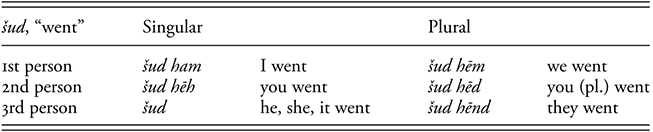
The morphology of the Old Persian verb likewise became radically simplified. The aorist verbal system, which was represented infrequently in early Old Persian, is not found after Xerxes (apart from the aorist verb adā, “he created,” occurring in the common inscriptional formula introduced previously until the end of the Achaemenian Persian record), but the ancient imperfect verb, the normal form used in Old Persian for ordinary past narration, disappeared in Middle Persian with very few exceptions: an originally imperfect form of “to be” and the survival of a few examples of imperfect verbs, some disputed, in two third-century-ce Middle Persian inscriptions.Footnote 54 Besides these rare late survivals of the imperfect, possibly reflecting a more insular dialect, Middle Persian verbs have two stems each, one for present (imperfect aspect) and modal verbs, one for preterit verbs based on the ancient verbal adjective (perfective participle of the patient) formed from the ancient suffix -ta-. In place of many different ancient Iranic verb classes with different patterns of endings, thematic and athematic, only one of several ancient Persian classes of verb endings, with the suffix -áya-, has been generalized in Middle Persian to nearly all indicative present verb stems, regardless of their etymological verb class.Footnote 55 The preterit (past-tense) verb itself is completely uninflected for all persons and numbers, as shown in Table 1.3. Nothing else is required if the patient of the verb is third-person singular or inanimate plural; otherwise, the auxiliary verb “to be” is needed to agree with the patient of the verb to indicate the patient of the action, and even this verb “to be” bears forms created by analogy to make it accord regularly with other verb forms regardless of their etymological class.
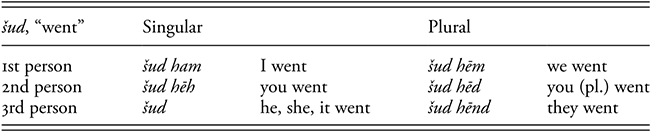
Table 1.3 Long description
The table consists of three columns: šud, went; singular, and plural. It reads the following data. Row 1. First person: šud ham, I went; šud hem, we went. Row 2. Second person: šud heh, you went; šud hed, you (plural) went. Row 3. Third person: šud, he, she, it went; šud hend, they went.
The verb “to stand” can be used for a copula instead to give the preterit perfective sense.Footnote 56 It is the simple copula, however, and not the main verb, that is inflected. Furthermore, the Old Persian derivational affixes such as preverbs have become fused with their stems in Middle Persian through various regular sound changes, losing their status as independent morphemes and greatly reducing the derivational flexibility of Persian. Indeed, Middle Persian productive derivational morphology, unlike that of Old Persian, is exclusively a matter of transparent noun compounds and a very few verb suffixes added agglutinatively (i.e., without change to the basic word stem within one of the two tenses).Footnote 57
In short, Middle Persian, compared with Old Persian, was paradigmatically quite transparent.Footnote 58 It had one completely regular verb conjugation,Footnote 59 one class of nouns exhibiting two nominal cases, no distinctions of grammatical gender, and nouns showing only two case distinctions, without case distinction in the singular noun by the third century ce.Footnote 60 One general suffix marked oblique nouns in the plural: -ān.Footnote 61 The inflections of Middle Persian are, as the many scholars just cited already have attested, extremely simple as compared with the Old Persian of Darius I.
The Symptoms of Middle Persian in Late Achaemenian Royal Inscriptions
The changes in usage and spelling, and especially the hypercorrections, in the late Achaemenian Persian inscriptions demonstrate in two ways that, with respect to its grammar, Old Persian was well on its way to becoming Middle Persian already during the Achaemenid period. This is also the consensus of current scholarship. The language of the late Achaemenian Persian inscriptions is correctly understood as Proto-Middle Persian, a term already employed by several scholars for this stage of the language.Footnote 62 First, the choices of scribes writing Old Persian show that the living Old Persian language had indeed lost its final syllables by the time of Artaxerxes III. This is the simplest and strongest explanation for the irregular omission of final syllables together with the application of various and irregular nonetymological final-syllable inflectional endings as well as the simple omission of such endings. Second, the irregularity of the grammatical word endings applied in late Old Persian inscriptions demonstrates that their scribes really were trying to achieve an older epigraphic form of language in writing by copying some formulae and spellings of words from older inscriptions. That they did so incorrectly so often, by the pattern of the more ancient grammar, shows that they did not know those word forms intuitively or fluently. It is equally important, however, though less often remarked, that they often did use them correctly, from the point of view of the older texts. This means that the late Old Persian inscriptions were to an extent based on a perceived orthographic standard, and that when the scribes achieved that standard, they have hidden from us other changes affecting the language at their time. That is, their inconsistency indicates that the late inscriptions do not adequately and transparently represent the regular changes that had occurred in the living language. For it is a principle of historical linguistics that the sounds of a language change regularly and not haphazardly within a language, bearing ordered ramifications for the whole language according to specific conditions.Footnote 63 It is certain, therefore, that the living state of Persian in the time of Artaxerxes III had changed even more considerably than is evident from the inconsistently archaizing representation of the words in the late Old Persian cuneiform signs.Footnote 64 The morphology of Persian was more radically simplified by then than the writing shows. Mancini argues that the cuneiform spellings of the late Achaemenian Persian inscriptions are regular “masks” for a Proto-Middle Persian word-forms, in effect historical spellings of individual morphemes. Thus, unexpected written forms that modern scholars have read as, such as dārayawahuš-ahyā, “of Darius,” represented by the letters <d-a-r-y-w-u-š-h-y-a>, would represent, in Mancini’s interpretation, a Proto-Middle Persian from “/dāraywē/” or the like. The nominative spelling stands for the Proto-Middle Persian direct-case form, putatively “Dārayw,” with the letters in the word-ending <-h-y-a> representing the Proto-Middle Persian singular oblique case -ē shown in Table 1.2.Footnote 65 This is certainly possible. It would mean that the scribes of the late Achaemenian Persian inscriptions were not so much making mistakes as they were consciously employing a conventional and somewhat conservative orthography for their present language. The evaluations of late Achaemenian Persian inscriptions as “corrupt” or “barbaric” would thus be doubly wrong.
Some of the expected evolutionary changes show through against the scribes’ general successes. Middle Persian entailed simplifications of Old Persian not just with respect to morphology, but also changes in phonology, which provides a few examples. Take the word for “king,” Old Persian xšāyaθiya, or rather the more conservative, trisyllabic form not attested directly in the Old Persian inscriptions, *xšāyaθya.Footnote 66 In Middle Persian this became šāh (the form retained in modern Persian to this day) through a combination of three regular sound changes. The regularity of sound changes means that they affect all Persian words with the same features. (1) The initial consonant cluster xš- was simplified to š-.Footnote 67 (2) The sequence -āya- regularly contracted to -ā-.Footnote 68 (3) The consonant θ regularly became h.Footnote 69 As mentioned, another change affecting not just this word, but the entire language, was the loss of all final syllables. In this word, the ending -(i)ya- was furthermore lost without a trace.Footnote 70 Thus, a word of three syllables beginning with a peculiar consonant cluster became one syllable with no consonant cluster. Simplification is a suitable word for the sum of such changes. Complex features were lost, and syllables were reduced, although the loss of inflectional endings is the most crucial change of all.
The relative chronology of these changes remains a problem, but there is strong evidence that many of them had taken place before the end of the Achaemenid dynasty.Footnote 71 For example, even as the scribes of the late Achaemenian inscriptions sought to write something like the standard that they could see in earlier inscriptions, the second of the three regular phonological changes just mentioned was clearly underway by the time of Artaxerxes III. For in one of his inscriptions, one word clearly shows that -āya- was already being reduced to -ā-. The “misspelling” of the word for “happiness” in an inscription of Artaxerxes III was already mentioned. In the accusative singular, the old form was šiyātim (or rather šyātim) but here it is spelled as šāyat-ām (the letters š-a-y-t-a-m). The generalization of the ending -ām is one of the symptoms of the loss of final syllables, and consequent hypercorrections, already discussed, but the anomalous noun form šāyat- calls for further remark. The noun š(i)yāti- actually evolved to šāt-, written in the conventional historical spelling of Middle Persian of the first century bce, šʾt- (as the first component of a noun compound);Footnote 72 the pronunciation by the third century ce was šād, as represented clearly in the Manichaean script of that time; the word still survives as šād in New Persian;Footnote 73 Armenian and Greek borrowings of Persian words likewise exhibit the earlier stage with the voiceless dental consonant t in šat-, σατ-, also with one syllable.Footnote 74 Schmitt rightly infers that this late Old Persian spelling šāyat was a scribal back-formation in which -āya- represents -ā-.Footnote 75 That is, the scribe has interfered with the spelling in an attempt to represent the actual word-internal sound -ā- with a pseudohistorical spelling. This is a kind of hypercorrection, too. The only reason that -āya- would have been used to represent -ā- is that the Old Persian standards of spelling in the inscriptions already entailed writing the sound -ā- word-internally by the signs for -āya- in other words. Xšāyaθiya is a conspicuous word of this kind, but the evolution of Middle Persian demonstrates that the change -āya- to -ā- was a regular rule. The Persian language in the time of Artaxerxes III must therefore already have undergone that change, otherwise no scribe would have written unetymological and otherwise inexplicable -āya- to represent -ā-. Now, if the word ending had been lost, as well, as the evidence already discussed makes practically certain, and the initial xš was pronounced as plain š, and θ was pronounced h, then the word for “king” had already become šāh by the time of Alexander’s invasion beginning in 334 bce.Footnote 76 The late Achaemenian Persian form would therefore be, in effect, almost the same as if not identical to the Middle Persian form and, in this case, even the modern Persian form. Nevertheless, an attempt to establish the chronology of the sounds changes from Old to Middle Persian raises thorny questions. They deserve further detailed investigation, but they are not the object of the present study, so I set them aside here.Footnote 77
The point with this difficult but decisive technical example is that the apparent misspellings in late Old Persian inscriptions sometimes allow us to infer that specific phonological changes characteristic of Middle Persian, and not merely an abbreviation of the word-final inflectional morphology, had already occurred in the language before the end of the Achaemenid dynasty. We can be certain, therefore, with the benefit of hindsight, from the point of view of Middle Persian, that the changes that show through the late Old Persian inscriptions represent the direction in which the Old Persian language was evolving as used by native Persian-speakers themselves, not only incompetent foreigners, under Achaemenid rule.Footnote 78 The late Old Persian inscriptions therefore do not present just a case of scribes becoming sloppy or misunderstanding grammatical rules of composition, or of “barbarians” producing “improper” Old Persian. This was, rather, Persian well on its way in evolving into what we know as Middle Persian as spoken by all Persians. Other scholars have made similar remarks since the nineteenth century.Footnote 79 Schmitt, who has devoted more effort to the analysis of such features in the late inscriptions than any other, put it just so: “By [the late Achaemenian period], spoken Persian had evolved a somewhat different form, so discrepancies between everyday speech and the traditional language of inscriptions had arisen.”Footnote 80 What the changes in the grammar of the Old Persian inscriptions show is that the living Persian language really changed, and changed drastically, in just over one century of Achaemenid rule.
All this is well established by the few specialists in this area of research. The remarkable fact here – and, in a sense, the main problem addressed in what follows – is not that the Persian language had changed. All languages are changing all the time. Rather, it is that this drastic transformation, entailing the loss of most inflectional endings and the consequent restructuring of the syntax, the birth of an entirely new form of Persian language, apparently occurred in no more than four generations after Darius I (d. 486 bce), glaringly evident in inscriptions from the reigns of Artaxerxes II (regn. 405–358) and Artaxerxes III (regn. 358–338), with the onset of such changes showing through not much more than a half century after the first Old Persian inscription. The scribes of the later inscriptions or those who dictated to them simply no longer spoke the same Persian language as Darius I and his son Xerxes. The complexity of the inflectional endings of Old Persian was lost, for the most part, dropped from ordinary usage, so that young users could no longer produce the old forms or understand them as they had been just a few generations before.Footnote 81 The language had rapidly undergone extensive morphological reduction. In this sense, the later scribes were not getting the language wrong, strictly speaking. The scribes were using a form of Persian as they knew it, but they could not create inscriptions with the same inflectional endings and forms that had been used when Old Persian was first written, older inscriptions still easily available to them.Footnote 82 Again, the texts make it clear that they were, however, sometimes making genuine mistakes, in the form of hypercorrections, when they attempted to use the old-fashioned language as it was in the time of Darius I, and superadded inflectional oblique endings wrongly to nominative endings, or generalizing the accusative singular ending -ām from certain specific nouns for all nouns. This is because they did not know the archaic form of language fluently any longer, as their forefather Darius I had used it.
A Simpler Form of Persian
The low level of inflectional complexity in Middle Persian, as compared with the language of Darius I, is evident from how one studies ancient languages today for the purposes of research. I can give personal examples. To learn Greek and Latin, for example, I needed, for each, one year of university instruction, exercises, and drilling in forms of grammatical inflection before I could begin to read real, original, extensive texts slowly with the aid of a dictionary. There were hundreds of inflected word forms to learn, and they required constant review. By contrast, when I first studied Middle Persian under the instruction of Stanley Insler, he gave the students a one-page handout presenting the few inflections in the language, concisely explained the major elements of the historical phonology within an Indo-European and Indo-Iranic framework, and we started reading original texts in the same session. I had to learn the rules of Middle Persian syntax. Beyond that, it was a matter of looking up and memorizing the minimally inflected words, trying to discern the conventions and idioms of the language, and understanding passages that were preserved in a fragmentary state or were ambiguous because they were without known parallels. The main hindrance was not the language itself, but the small size of the surviving corpus of texts and the innumerable questions about particulars left unanswered because only a small number of scholars had studied it before, not to mention the relative inaccessibility of much of the research on ancient Iranic languages, especially before the availability of texts in electronic format.Footnote 83 There was no comprehensive dictionary and there was no adequate reference grammar at the time. The script, too, is notoriously difficult because of its ambiguity and the use of Aramaic words as allographs, virtually as logograms. The inflectional morphology of Greek and Latin slows the acquisition of those languages, solely for the purposes of reading, by months, but for Middle Persian inflectional morphology was scarcely a consideration by comparison.
The study of the evolution of Old Persian into Middle Persian is hindered by the long gap of time in documentation. After the Achaemenids, the earliest extant clearly Persian texts are two short Middle Persian inscriptions made in pointillé on silver bowls in a style archaic by comparison with the later corpus of Middle Persian. These have been dated to the first century bce. Sims-Williams has dubbed the inscriptions Persis 1, which labels its ownership by Persian princes,Footnote 84 and Persis 2, which commemorates its bestowal as a gift by the holders of some Persian office.Footnote 85 Both exhibit archaic Middle Persian orthography in Aramaic letters. In the period of these two early inscriptions, after Alexander, new dynasties of local kings ruled the different formerly Achaemenian territories. Pārs, in the southwest of Iran – roughly the modern province of Fārs – where Darius had originated, had its own local dynasty that had to contend with the overlordship of Macedonian Seleucid and Parthian Arsacid kings. We know little about these local Persian rulers, one line of which were called by the title frataraka.Footnote 86 Their independently minted coins are almost the only historical source about their reigns. Although the two bowl-inscriptions are short and difficult to read, and hint at features of the language that would go extinct in later Middle Persian, they are nevertheless distinctly Middle Persian texts, characteristically lacking complex ancient word-inflections such as those used by Darius I in his Old Persian. It is not until the early third century ce, however, that we begin to find more extensive Middle Persian texts, when a new Persian dynasty, the Sasanids, usurped overlordship from the Parthian Arsacids. When they achieved Persian hegemony over a vast territory, then they began to create new royal inscriptions of their own.
The discontinuity of the textual record of Persian between the Achaemenids and the fratarakas of Persis is one reason that the rapidity of the change in Old Persian itself has not been immediately obvious. The later Achaemenian inscriptions are few, and they are shorter than the early ones of Darius I and Xerxes. Their formulaic character allowed their scribes to copy older models and thereby often to get it right, so to speak, by an older grammatical standard obsolete in ordinary Persian speech in their own time. In those specific formulae, it is rare to find endings that are “wrong” by the standard of the old inscriptions. By the time of the inscribed silver bowls just mentioned, however, it is clear that Middle Persian was practically as different from the Old Persian of Darius I as early modern English was from the Old English of Beowulf. Leading Iranologists have made similar comparisons several times, but no convincing explanation for this special situation has been offered.Footnote 87 As already mentioned, the Middle Persian language by this time had become grammatically among the simplest known of the ancient Indo-European languages. It is far simpler in its inflection than ancient Greek or Latin or even than standard modern varieties of Spanish, German, French, Dutch, and Italian.
All languages change over time, but what makes the problem here especially striking is the rapidity of the drastic change within Persian. One might have guessed that the five centuries in which Persian was not well documented, between the end of the Achaemenid dynasty and the beginning of the Sasanid dynasty with its royal inscriptions, was the period in which the language underwent such radical simplification. One might imagine that a half millennium should be ample time for these changes to accrue gradually as a matter of random drift toward simplicity. One might suppose that even the three centuries between Alexander and the two Middle Persian silver bowl-inscriptions just mentioned could be enough time for incremental changes to accumulate that would turn Old Persian into Middle Persian. As just explained, however, the consensus is that the Old Persian inscriptions themselves show that changes leading to Middle Persian were advanced by the end of Achaemenid rule. The radical trimming of noun and verb endings was probably substantially complete, entailing the restructuring of Persian syntax. By the time of Alexander’s invasion in the 330s, Persian-speakers were evidently already speaking an early stage of Middle Persian, a form of the language shorn of most of the grammatical inflection that had characterized the language about 520 bce, in the time of Darius I.Footnote 88 Whether we use Schmitt’s term “late Old Persian” (Spätaltpersisch) to designate the later Achaemenian inscriptions as on the verge of transition,Footnote 89 Skjærvø’s “Pre-Middle Persian,” emphasizing that the language of the later Achaemenian inscriptions “is neither Old nor Middle Persian,”Footnote 90 or the “Proto-Middle Persian” of others on analogy with the naming of earliest attested samples of other corpus languages,Footnote 91 the meaning is the same. I would rather avoid imposing on ourselves the need to designate specific grammatical differences by which we classify categories that are, in the first place, primarily descriptive and conventional. My purpose is not to classify in grammatical terms but to explain grammatical change. Therefore, I propose the designation late Achaemenian Persian, which I have been using already. Terminology aside, it is generally agreed that language of the latest Achaemenian inscriptions was near to the Middle Persian known from later centuries, a highly simplified species of ancient Iranic language.
How did this drastic simplification happen to the Persian language in a period less than two centuries, while the Persians were at their most powerful, controlling a vast empire? The answer to this question is accessible with answers and insights from linguistics developed in recent decades, long after the genesis of historical linguistics. As I will show in Chapter 3, applying these gains in linguistic science does more than explain the grammatical changes to Persian. It illuminates an aspect of the history of the Persian Empire otherwise overlooked.


 Open access