Introduction
Globalization and technological changes have reshaped the organizational landscape. The workforce is more diverse than ever, with employees of various skills, genders, ages, cultures, and religions (Podsiadlowski, Gröschke, Kogler, Springer, & Van Der Zee, Reference Podsiadlowski, Gröschke, Kogler, Springer and Van Der Zee2013). The impact of a diverse workforce on organizational and individual outcomes has received significant attention in the literature (Van Knippenberg, De Dreu, & Homan, Reference Van Knippenberg, De Dreu and Homan2004; Williams & O'Reilly, Reference Williams, O'Reilly, Cummings and Staw1998). Although diversity has the potential to produce both positive and negative outcomes, this scholarship aims to identify factors that engender positive work outcomes and minimize the adverse outcomes associated with a diverse workforce (Mitchell, Boyle, Parker, Giles, Chiang, & Joyce, Reference Mitchell, Boyle, Parker, Giles, Chiang and Joyce2015). Inclusion and inclusive practices have been found to hold immense promise as an integral approach to managing diversity (Roberson, Reference Roberson2006; Shore et al., Reference Shore, Chung-Herrera, Dean, Ehrhart, Jung, Randel and Singh2009). More specifically, leaders are significant in promoting and implementing inclusion at work (Brannen & Thomas, Reference Brannen and Thomas2010; Nembhard & Edmondson, Reference Nembhard and Edmondson2006), with inclusive leadership being the most impactful relational leadership style (Nishii & Mayer, Reference Nishii and Mayer2009).
Nembhard and Edmondson (Reference Nembhard and Edmondson2006) coined the term inclusive leadership, which refers to leader behaviors that invite and appreciate inputs from others and thus help shape team members' beliefs that ‘their voices are genuinely valued’ (p. 948). Leaders who engage in inclusive behaviors exhibit openness, accessibility, and availability while interacting with their followers. Although inclusive leadership shares some conceptual similarities with related styles such as servant leadership, transformational leadership, and supportive leadership, it is conceptually distinct from these styles (Tran & Choi, Reference Tran and Choi2019). Inclusive leaders demonstrate openness toward and actively listen to followers' needs (Van Dierendonck & Patterson, Reference Van Dierendonck and Patterson2010). However, unlike other relational styles (i.e., servant, supportive, and transformational leadership), they actively encourage followers' uniqueness by hearing new ideas and strategies. Additionally, they are readily available and accessible for offering professional advice or dealing with ongoing work-related problems, thus making inclusive leadership more specific and idiosyncratic in its approach (Carmeli, Reiter-Palmon, & Ziv, Reference Carmeli, Reiter-Palmon and Ziv2010; Nishii & Mayer, Reference Nishii and Mayer2009). With this in mind, inclusive leadership, compared to other relational leadership styles, holds significant promise, as it offers new and relevant insights from a diversity management perspective (Korkmaz, van Engen, Knappert, & Schalk, Reference Korkmaz, van Engen, Knappert and Schalk2022; Roberson & Perry, Reference Roberson and Perry2022; Thompson & Matkin, Reference Thompson and Matkin2020).
In this study, we aim to explore how inclusive leaders can tackle the challenges of diversity and promote a sense of belongingness, closeness, openness, and respect in a diverse workforce (Ashikali, Groeneveld, & Kuipers, Reference Ashikali, Groeneveld and Kuipers2021; Roberson & Perry, Reference Roberson and Perry2022; Thompson & Matkin, Reference Thompson and Matkin2020). This study builds on the limited research regarding how leaders can engage in inclusive practices to cope with diversity (Ashikali, Groeneveld, & Kuipers, Reference Ashikali, Groeneveld and Kuipers2021; Randel et al., Reference Randel, Galvin, Shore, Ehrhart, Chung, Dean and Kedharnath2018; Roberson & Perry, Reference Roberson and Perry2022; Thompson & Matkin, Reference Thompson and Matkin2020) and how such practices can improve employee performance (Boekhorst, Reference Boekhorst2015; Dwertmann & Boehm, Reference Dwertmann and Boehm2016). Additionally, recent research has highlighted the need for researchers to examine how inclusive leaders utilize a diverse mindset and perspectives while managing followers (Ashikali, Groeneveld, & Kuipers, Reference Ashikali, Groeneveld and Kuipers2021; Minehart, Foldy, Long, & Weller, Reference Minehart, Foldy, Long and Weller2020; Van Knippenberg & Van Ginkel, Reference Van Knippenberg and Van Ginkel2022).
To our knowledge, no studies have examined the pivotal role of relational dynamics and social identity theory in explaining the indirect impact of inclusive leadership on employees' positive behavioral and attitudinal outcomes (Jin, Lee, & Lee, Reference Jin, Lee and Lee2017; Randel et al., Reference Randel, Galvin, Shore, Ehrhart, Chung, Dean and Kedharnath2018; Roberson & Perry, Reference Roberson and Perry2022; Rodriguez, Reference Rodriguez2018; Thompson & Matkin, Reference Thompson and Matkin2020). A recent systematic review by Korkmaz et al. (Reference Korkmaz, van Engen, Knappert and Schalk2022) concluded that most research has focused on the outcomes of inclusive leadership (e.g., Hassan & Jiang, Reference Hassan and Jiang2021; Tang, Li, Jing, & Chen, Reference Tang, Li, Jing and Chen2017; Xiaotao, Yang, Diaz, & Yu, Reference Xiaotao, Yang, Diaz and Yu2018; Ye, Wang, & Li, Reference Ye, Wang and Li2018). Far fewer studies have identified mechanisms that help to explain the link between inclusive leadership and its consequences in the shape of relational mediators (Korkmaz et al., Reference Korkmaz, van Engen, Knappert and Schalk2022). In this context, we employed the social identity perspective (Tajfel & Turner, Reference Tajfel, Turner, Austin and Worchel1979) to unveil how the ‘relational dynamics’ effects underlying inclusive leadership materialize in different outcomes (Korkmaz et al., Reference Korkmaz, van Engen, Knappert and Schalk2022). Two identity-related processes deemed pivotal in fostering positive relationships through developing a sense of belonging and uniqueness are perceived insider status (Stamper & Masterson, Reference Stamper and Masterson2002) and relational coordination (Lee & Kim, Reference Lee and Kim2020).
Perceived insider status refers to the extent to which an individual employee perceives themselves as an insider within a particular organization and thus reflects the employee's perceived identity (Stamper & Masterson, Reference Stamper and Masterson2002). According to Stamper and Masterson (Reference Stamper and Masterson2002), perceived insider status incorporates ‘the personal space’ employees have earned or their acceptance inside their work organization as full-fledged members. Additionally, perceived insider status, as an identity-related process, emerges from employees' sense-making of their social comparisons of status, prestige and worth in their organization (Lapalme, Stamper, Simard, & Tremblay, Reference Lapalme, Stamper, Simard and Tremblay2009).
Relational coordination, the second mediating mechanism we examine, entails the process whereby individuals' communication and role relationships characterized by shared knowledge, shared goals, and mutual respect shape their relational self-concept and, ultimately, social identity (Gittell, Reference Gittell2002). Recently, Lee and Kim (Reference Lee and Kim2020) highlighted the prominence of relational coordination in diverse workforces and the relevance of exploring factors that foster relational coordination. Furthermore, research has noted that the role of leadership in generating an environment where employees exhibit high-quality communication and share mutual goals must be examined in more detail (Nasr, El Akremi, & Coyle-Shapiro, Reference Nasr, El Akremi and Coyle-Shapiro2019). In response to these calls, the current study attempts to bridge a significant gap in the diversity and leadership literature by proposing inclusive leadership behaviors as a pertinent predictor of employees' relational coordination and perceived insider status.
In general, previous research has suggested that perceived organizational support (Stamper & Masterson, Reference Stamper and Masterson2002), pro-diversity practices, the delegation from supervisors, perceived coworker support, and idiosyncratic deals (Ding & Chang, Reference Ding and Chang2020; Guerrero, Sylvestre, & Muresanu, Reference Guerrero, Sylvestre and Muresanu2013) are likely to inculcate perceptions of insider status among diverse individuals. Although positive leadership has been observed to indirectly promote perceived insider status (Armstrong-Stassen & Schlosser, Reference Armstrong-Stassen and Schlosser2011; Chen & Aryee, Reference Chen and Aryee2007), the role of inclusive leaders' in nurturing insider status holds immense promise. As perceived insider status emphasizes individuals' identity as organizational members and recognizes them as valued parts of the organization (Masterson & Stamper, Reference Masterson and Stamper2003), we contend that inclusive leadership can be instrumental in creating higher levels of perceived insider status, which in turn result in employees' organizational identification, task performance, and leader-directed helping behavior. In this inquiry, we adopt Ashforth and Mael's (Reference Ashforth and Mael1989) conceptualization of organizational identification, which encompasses employees' feelings of oneness with and belongingness to their organization (Ashforth & Mael, Reference Ashforth and Mael1989). The second outcome variable, task performance, entails the degree of employees' effectiveness in completing their job responsibilities and duties (Kehoe, Lepak, & Bentley, Reference Kehoe, Lepak and Bentley2018). Finally, the third dependent variable, leader-directed helping behavior, involves all optional/extra role behaviors aimed at helping supervisors/leaders with their work-related tasks (Podsakoff, MacKenzie, Moorman, & Fetter, Reference Podsakoff, MacKenzie, Moorman and Fetter1990).
In addition to exploring the direct and indirect effects of inclusive leadership on employees' behavioral and attitudinal outcomes, contemporary research highlights the need to map the boundary conditions of how the positive impact of inclusive leadership behaviors on employees' attitudes and behaviors can be reinforced or undermined (Mitchell et al., Reference Mitchell, Boyle, Parker, Giles, Chiang and Joyce2015; Randel et al., Reference Randel, Galvin, Shore, Ehrhart, Chung, Dean and Kedharnath2018). In this regard, a synergy diversity climate, which refers to human resource (HR) policies integrating diverse employees (McKay, Avery, & Morris, Reference McKay, Avery and Morris2008), may provide insight regarding when inclusive leaders can be beneficial. Considering the principles of social identity theory, a synergy diversity climate in the presence of an inclusive leader can help employees become more integrated, thus enabling a sense of belongingness and identity through the processes of perceived insider status and relational coordination.
This study makes two crucial contributions to the literature on diversity management and inclusive leadership. First, drawing from social identity theory (Tajfel & Turner, Reference Tajfel, Turner, Worchel and Austin1986), we justify the core relationships in our research model and extend the nomological network of inclusive leadership with a focus on relational dynamics (Korkmaz et al., Reference Korkmaz, van Engen, Knappert and Schalk2022; Roberson & Perry, Reference Roberson and Perry2022; Thompson & Matkin, Reference Thompson and Matkin2020). More specifically, relying on the social identity theory framework, we elaborate on how inclusive leaders build a more robust organizational identity and trigger positive behaviors in followers through two relational-based identity processes (i.e., perceived insider status and relational coordination). By proposing both processes as mechanisms in inclusive leadership and outcomes, our study adds to the understanding of the mechanisms and effects of inclusive leadership, which to date, have been incomplete (Korkmaz et al., Reference Korkmaz, van Engen, Knappert and Schalk2022; Roberson & Perry, Reference Roberson and Perry2022). Because managers in today's organizations have to manage a diverse workforce by demonstrating inclusive behaviors, our study will enable managers to understand the relational dynamics through which inclusive leaders inculcate positive employee behaviors and attitudes. Second, the present study contributes to the diversity management literature by investigating how a synergy diversity climate operates as a boundary condition in shaping the impact of inclusive leadership on identity-related processes. In this sense, our study will assist managers in gaining insights into when inclusive leaders can promote increased insider status and relational coordination and devise strategies to promote a diversity-friendly climate where the positive effects of inclusive leaders can be fully realized.
Theory and hypotheses
Inclusive leadership and employee outcomes: the mediating role of perceived insider status
Based on social identity theory (Tajfel & Turner, Reference Tajfel, Turner, Austin and Worchel1979), we explain how inclusive leaders can successfully shape employees' organizational identification, task performance, and helping behavior directed toward leaders. Social categorization, a core tenet in social identity theory, entails how individuals classify themselves into social groups based on their unique demographic characteristics, such as age, gender, ethnic background, social class, religion, and organizational affiliation (Tajfel & Turner, Reference Tajfel, Turner, Austin and Worchel1979). Once people have categorized themselves into groups, they compare themselves with other groups (i.e., social comparison). Through this social comparison, individuals focus on information that helps illustrate their group's superiority over other groups (Tajfel & Turner, Reference Tajfel, Turner, Austin and Worchel1979). As a result, individuals develop feelings of self-enhancement (e.g., considering oneself and one's group better than others) and uncertainty reduction (e.g., removing ambiguity about one's identity). Eventually, these processes promote a sense of belonging and finally lead to social identification with the group (Tajfel & Turner, Reference Tajfel, Turner, Austin and Worchel1979, Reference Tajfel, Turner, Worchel and Austin1986).
In this context, inclusive leaders trigger the identity process of perceived insider status in diverse individuals. This mitigates perceived ambiguity among members and ultimately enhances organizational identification and performance outcomes. Recent reviews and studies highlight organizational, leader, and team identification as mediators in the relationship between inclusive leadership and outcomes (Korkmaz et al., Reference Korkmaz, van Engen, Knappert and Schalk2022; Roberson & Perry, Reference Roberson and Perry2022; Thompson & Matkin, Reference Thompson and Matkin2020). Furthermore, limited studies in the organizational psychology literature treat perceived insider status as a process mechanism. For instance, perceived insider status has been found to mediate the impact of employees' corporate social responsibility on unethical pro-organizational behaviors (Yin, Zhang, & Lu, Reference Yin, Zhang and Lu2021).
Additionally, Tu, Zhang, Wang, and He (Reference Tu, Zhang, Wang and He2017) observed that an organization's trust climate promotes perceived insider status among employees, promoting higher in-role performance. Another study illustrated that the indirect effect of perceived supervisor support on interpersonal facilitation could be explained through perceived insider status (Lapalme et al., Reference Lapalme, Stamper, Simard and Tremblay2009). In brief, the above studies support the role of perceived insider status as a process variable in organizational behavior research. Additionally, research has established that perceived insider status is significantly and positively related to multiple employee behaviors and attitudes, such as organizational commitment (Lapalme et al., Reference Lapalme, Stamper, Simard and Tremblay2009), organizational citizenship behavior (Stamper & Masterson, Reference Stamper and Masterson2002), task performance (Wang & Kim, Reference Wang and Kim2013), promotion focus (Horng, Tsai, Hu, & Liu, Reference Horng, Tsai, Hu and Liu2016), and intention to remain with the organization (Armstrong-Stassen & Schlosser, Reference Armstrong-Stassen and Schlosser2011). Despite the growing interest in studying perceived insider status as a process variable in organizational psychology, its potentially pivotal role in explaining how inclusive leadership translates into employee behaviors and attitudes has yet to be explored.
Considering the principles of social identity theory (Tajfel & Turner, Reference Tajfel, Turner, Austin and Worchel1979), we propose that inclusive leaders instill in their followers a feeling that they are respected and valued (Nembhard & Edmondson, Reference Nembhard and Edmondson2006), which helps them develop a sense of belonging despite their diversity. Moreover, by showing genuine support for followers' feelings and interests and establishing open communication, inclusive leaders can invoke this sense of belonging and insider status among diverse employees (Choi, Tran, & Park, Reference Choi, Tran and Park2015). Hence, when diverse individuals become insiders triggered by inclusive leadership actions, they feel more attached and are more likely to identify with their organization. We thus hypothesize the following:
Hypothesis 1a: Perceived insider status mediates the relationship between inclusive leadership and organizational identification.
In support of social identity theory, inclusive leaders enrich their relationships with their followers (Nishii & Mayer, Reference Nishii and Mayer2009; Shore, Randel, Chung, Dean, Holcombe Ehrhart, & Singh, Reference Shore, Randel, Chung, Dean, Holcombe Ehrhart and Singh2011) by embracing followers' divergent perspectives in decision-making (Mitchell et al., Reference Mitchell, Boyle, Parker, Giles, Chiang and Joyce2015; Nembhard & Edmondson, Reference Nembhard and Edmondson2006). This amplifies the self-enhancement motive and contributes to followers' insider status within the group. Furthermore, because inclusive leaders give their coworkers a voice (Alang, Stanton, & Rose, Reference Alang, Stanton and Rose2022; Guo, Zhu, & Zhang, Reference Guo, Zhu and Zhang2022; Qi & Liu, Reference Qi and Liu2017), the trust established by leaders and the sharing of knowledge and information through open communication reduce uncertainty and failures in decision-making, yielding better task performance by insiders. We thus hypothesize the following:
Hypothesis 1b: Perceived insider status mediates the relationship between inclusive leadership and task performance.
Finally, when inclusive leaders involve followers in decision-making, employees with diverse backgrounds feel more confident communicating with their coworkers and participating in decision-making. This openness and trust help eliminate boundaries between coworkers, thus promoting perceived insider status. Inclusive leaders tear down walls among individuals by embracing diversity and fostering employees to identify with their leader and colleagues. As a result, employees develop a feeling of intimacy and acceptance in the form of perceived insider status. Consequently, insiders feel more confident in sharing their ideas and feelings, which motivates them to engage in leader-directed helping behavior. Hence, we hypothesize the following:
Hypothesis 1c: Perceived insider status mediates the relationship between inclusive leadership and leader-directed helping behavior.
Inclusive leadership and employee outcomes: the mediating role of relational coordination
A critical organizational challenge is to promote coordination in a diverse workforce (Bond & Haynes, Reference Bond and Haynes2014). Effective teamwork takes more than a group of individuals performing diverse and often specialized skill sets. It requires cohesion, coordination, and understanding of how employees' work intersects and contributes to the team's success (DeChurch & Mesmer-Magnus, Reference DeChurch and Mesmer-Magnus2010). This coordination contributes to building a sense of relational identity. It enables employees to recognize the need to rely on each other's diversity in skills, knowledge, and backgrounds to resolve problems more successfully (Sluss & Ashforth, Reference Sluss and Ashforth2007). Inclusive leaders can play a prominent role in inculcating this relational coordination.
Since inclusive leaders show an active interest in followers' needs, feelings, and potential (Hollander, Reference Hollander2009), this level of support motivates diverse individuals to share information, resulting in enhanced relational coordination. This environment where employees mutually respect each other and develop a shared understanding of goals fosters relational coordination (Gittell, Reference Gittell2011), strengthening employees' identification with the organization. In brief, this type of leader enables inclusion by instilling a feeling of belongingness and uniqueness among diverse individuals (Randel et al., Reference Randel, Galvin, Shore, Ehrhart, Chung, Dean and Kedharnath2018). This diversity-friendly belief (Guo, Zhu, & Zhang, Reference Guo, Zhu and Zhang2022; Leroy, Buengeler, Veestraeten, Shemla, & Hoever, Reference Leroy, Buengeler, Veestraeten, Shemla and Hoever2022) enhances employees' relational self-concept, alleviates confusion, and creates relational coordination, fostering organizational identification. We thus hypothesize the following:
Hypothesis 2a: Relational coordination mediates the relationship between inclusive leadership and organizational identification.
Keeping in mind the principles of social identity theory (Tajfel & Turner, Reference Tajfel, Turner, Austin and Worchel1979), we believe that through their openness and transparency in communication, inclusive leaders increase employees' willingness to share their knowledge and goals (Gittell, Reference Gittell2002), which helps to eliminate ambiguity and thus promotes relational coordination. Past research has noted that relational coordination is an essential mediator between workforce diversity and organizational performance (Lee & Kim, Reference Lee and Kim2020). Following this line of inquiry, we assert that inclusive leaders invite followers to participate and simultaneously express appreciation for their leaders (Randel et al., Reference Randel, Galvin, Shore, Ehrhart, Chung, Dean and Kedharnath2018; Rodriguez, Reference Rodriguez2018). This involvement of followers in decision-making (Chen, Liang, Feng, & Zhang, Reference Chen, Liang, Feng and Zhang2023; Roberson & Perry, Reference Roberson and Perry2022) improves relational coordination, further facilitating task performance. We thus hypothesize the following:
Hypothesis 2b: Relational coordination mediates the relationship between inclusive leadership and task performance.
As inclusive leaders encourage individuals to share unique and new ideas (Randel, Dean, Ehrhart, Chung, & Shore, Reference Randel, Dean, Ehrhart, Chung and Shore2016), employees can provide enriched perspectives on solving problems and task completion. Through this, interacting and sharing perspectives enhance relational coordination. Moreover, inclusive leaders' active presence in the group, their availability for providing professional guidance, and their ongoing assistance to their followers (Carmeli, Reiter-Palmon, & Ziv, Reference Carmeli, Reiter-Palmon and Ziv2010; Nembhard & Edmondson, Reference Nembhard and Edmondson2006) create an environment where employees can communicate more frequently and accurately with others in the group, facilitating relational coordination. Thus, an inclusive leader's supportive behaviors encourage followers to participate fully with others, enabling relational coordination that incites these employees to exhibit helping behavior toward their leaders. Research has corroborated that inclusive leaders enable employee trust (Hollander, Reference Hollander2009). Hence, based on social identity theory (Tajfel & Turner, Reference Tajfel, Turner, Austin and Worchel1979, Reference Tajfel, Turner, Worchel and Austin1986), as inclusive leaders are open to hearing followers' thoughts and provide active assistance in helping them complete their tasks (Nishii & Mayer, Reference Nishii and Mayer2009), such leaders are likely to promote relational coordination through followers' active contribution that stimulates employees to engage in helping behavior directed toward their leaders. We thus hypothesize the following:
Hypothesis 2c: Relational coordination mediates the relationship between inclusive leadership and leader-directed helping behavior.
The moderating role of a synergy diversity climate
Drawing from social identity theory (Tajfel & Turner, Reference Tajfel, Turner, Austin and Worchel1979, Reference Tajfel, Turner, Worchel and Austin1986), we anticipate that a synergy diversity climate moderates the relationships between inclusive leadership and perceived insider status and between inclusive leadership and relational coordination. Organizational climate represents a set of rules, values, and beliefs that develop because of employees' shared perceptions about their work environment (Martin & Cullen, Reference Martin and Cullen2006; Mulki, Jaramillo, & Locander, Reference Mulki, Jaramillo and Locander2008; Richard, Avery, Luksyte, Boncoeur, & Spitzmueller, Reference Richard, Avery, Luksyte, Boncoeur and Spitzmueller2019). Different types of climates have been identified (Bronkhorst, Tummers, Steijn, & Vijverberg, Reference Bronkhorst, Tummers, Steijn and Vijverberg2015); however, one that is particularly relevant to the context of this inquiry is the diversity climate, or the extent to which employees perceive their work environment as fair and inclusive for all members of the workforce (McKay, Avery, & Morris, Reference McKay, Avery and Morris2008). A synergy diversity climate incorporates employees' common perception of their organization to promote listening to, valuing, and integrating diverse individuals for collective performance and learning (Dwertmann, Nishii, & Van Knippenberg, Reference Dwertmann, Nishii and Van Knippenberg2016).
The synergy aspect of a diverse climate is a relatively underexplored territory, with most diversity climate research emphasizing elements of fairness and discrimination (Dwertmann, Nishii, & Van Knippenberg, Reference Dwertmann, Nishii and Van Knippenberg2016; Richard et al., Reference Richard, Avery, Luksyte, Boncoeur and Spitzmueller2019). Studies integrating diversity climate into their designs have usually treated it as a boundary condition (e.g., Randel et al., Reference Randel, Dean, Ehrhart, Chung and Shore2016; Richard et al., Reference Richard, Avery, Luksyte, Boncoeur and Spitzmueller2019; Rodriguez, Reference Rodriguez2018). For instance, a recent study examined the synergy diversity climate as a moderator between employee seniority and creative job performance (Richard et al., Reference Richard, Avery, Luksyte, Boncoeur and Spitzmueller2019). Furthermore, two other recent studies show that diversity climate operates as a boundary condition shaping the relationships between leader inclusiveness and helping behavior (Randel et al., Reference Randel, Dean, Ehrhart, Chung and Shore2016) and between inclusive leadership and employee work engagement (Rodriguez, Reference Rodriguez2018). In line with this stream of research, we purport that a diverse workforce that embraces a climate of synergy diversity sends employees signals of fairness and importance (Guerrero, Sylvestre, & Muresanu, Reference Guerrero, Sylvestre and Muresanu2013) and thus influences their perception that they belong to an in-group. Thus, a synergy diversity climate in combination with an inclusive leader reinforces perceived insider status rather than outsider status among members of a diverse workforce. We thus hypothesize the following:
Hypothesis 3a: A synergy diversity climate moderates the relationship between inclusive leadership and perceived insider status, such that the positive relationship is stronger when the climate is characterized by high-synergy diversity.
Another important observation is that leaders adopting a synergy perspective to manage diversity enable employees to share ideas and information despite their differences, facilitating performance (Richard et al., Reference Richard, Avery, Luksyte, Boncoeur and Spitzmueller2019). The basic idea is that within a synergy diversity climate, employees develop a sense of valence and, as a result, are more confident in openly communicating and sharing their knowledge with others, which eventually contributes to improved organizational learning (Dwertmann, Nishii, & Van Knippenberg, Reference Dwertmann, Nishii and Van Knippenberg2016). Consistent with this line of reasoning, a synergy diversity climate can significantly moderate the connection between inclusive leadership and relational coordination. When operating in a synergy diversity climate, inclusive leaders, who typically embrace and express appreciation for diverse individuals in their workforce (Dwertmann & Boehm, Reference Dwertmann and Boehm2016; Nembhard & Edmondson, Reference Nembhard and Edmondson2006), are likely to promote open communication among diverse individuals more quickly. They thus reduce ambiguity (Carmeli, Reiter-Palmon, & Ziv, Reference Carmeli, Reiter-Palmon and Ziv2010; Nishii & Mayer, Reference Nishii and Mayer2009), making task integration and coordination smoother and leading to more pronounced relational coordination. A synergy diversity climate is characterized by an environment where employees' perspectives are respected and valued (McKay, Avery, Tonidandel, Morris, Hernandez, & Hebl, Reference McKay, Avery, Tonidandel, Morris, Hernandez and Hebl2007, Reference McKay, Avery and Morris2008; Roberson, Reference Roberson2006); such a climate, along with an inclusive leader who is available and attentive, might be conducive to the development of shared goals among employees and reinforce mutual respect, thus supporting relational coordination. As a synergy diversity climate motivates employees to integrate the expertise of diverse coworkers (Dwertmann, Nishii, & Van Knippenberg, Reference Dwertmann, Nishii and Van Knippenberg2016), the presence of inclusive leadership in such an environment may persuade employees to communicate more openly with one another regarding their tasks and goals, promoting relational coordination. Based on the above, we thus hypothesize the following:
Hypothesis 3b: A synergy diversity climate moderates the relationship between inclusive leadership and relational coordination, such that the positive relationship is stronger when the climate is characterized by high-synergy diversity.
Accordingly, it is plausible that a synergy diversity climate conditionally influences the strength of the indirect relationship between inclusive leadership and employee outcomes through perceived insider status and relational coordination, highlighting a pattern of moderated mediation. In this context, we thus hypothesize the following:
Hypothesis 4: A synergy diversity climate moderates the positive indirect effects of inclusive leadership on (a) organizational identification, (b) task performance, and (c) leader-directed helping behavior, such that the indirect effects through perceived insider status are stronger when the climate is characterized by high-synergy diversity.
Hypothesis 5: A synergy diversity climate moderates the positive indirect effects of inclusive leadership on (a) organizational identification, (b) task performance, and (c) leader-directed helping behavior, such that the indirect effects through relational coordination are stronger when the climate is characterized by high-synergy diversity.
Methods
Participants and procedures
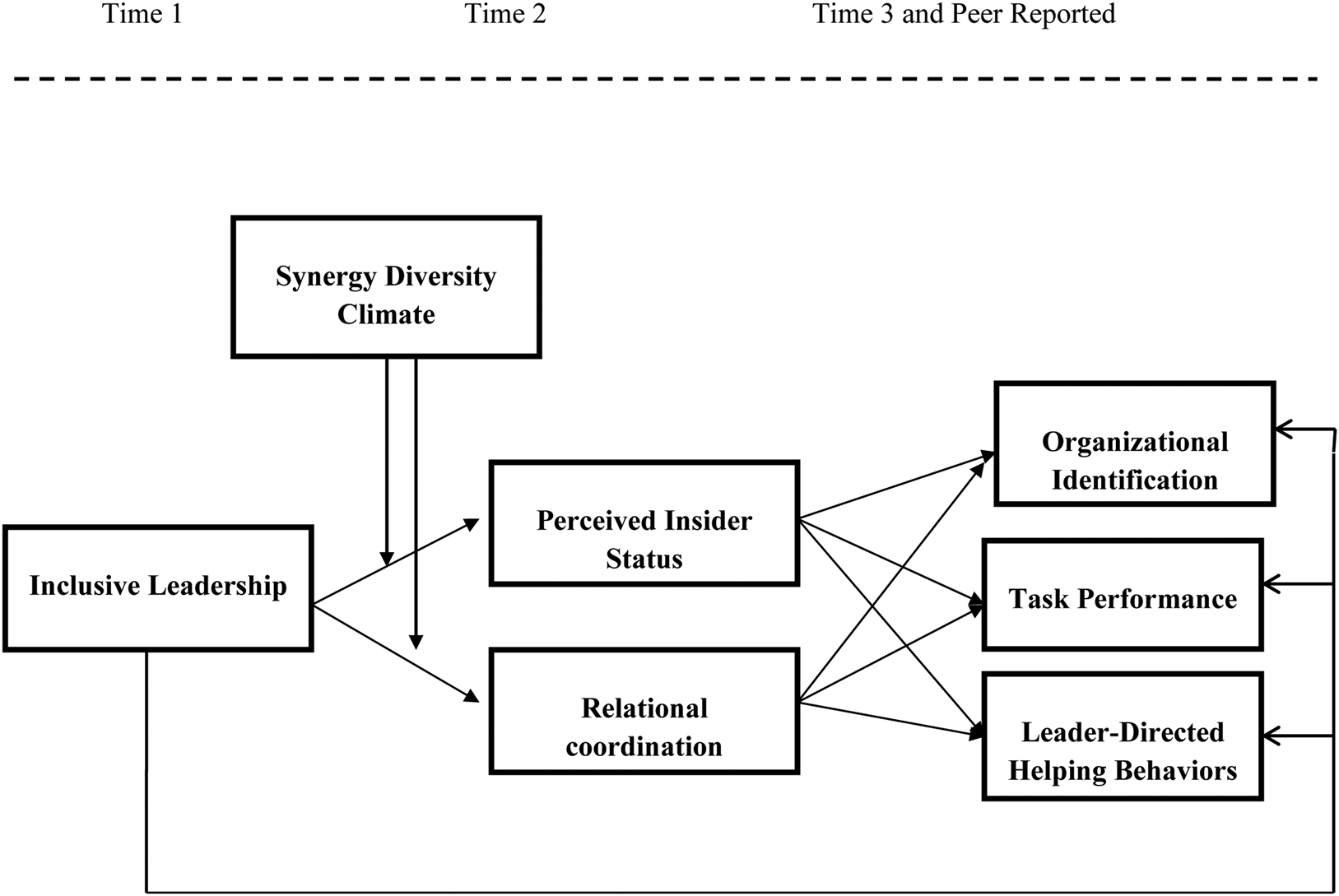
To test our hypothesized model (see Figure 1), we collected data from employees working in Pakistan's banking, telecom, and education sectors. By investigating employees from organizations that operate in different sectors, we ensure broad coverage of business activities in the Pakistani economy, increase data heterogeneity, and enhance the external validity of the empirical results. The research team's principal investigator leveraged existing professional contacts to gain access to organizations for administering the surveys. The purpose of the study was explained to the participants, and the confidentiality of their data was ensured. Participants were randomly selected from employee lists from the participating organizations' HR departments. All randomly selected candidates received a personal invitation to participate.
Research model. This figure shows a temporally segregated moderated mediation model in which perceived insider status and relational coordination mediate the relationships between inclusive leadership and outcomes (organizational identification, task performance, and leader-directed helping behaviors) at high levels of a synergy diversity climate.

The data collection process incorporated a multi-wave (i.e., three measurement points with a time lag of 2 weeks between measurement points) two-source research design. The study's independent (i.e., inclusive leadership) and moderator (i.e., synergy diversity climate) variables were measured at time 1. At time 2, the mediator variables (e.g., perceived insider status and relational coordination) were measured. Finally, at time 3, the dependent variables (i.e., organizational identification, task performance, and leader-directed helping behavior) were measured. When relying on a temporally segregated research design, it is essential that the independent variable, the mediators, and the dependent variables are collected at different measurement points (Law, Wong, Yan, & Huang, Reference Law, Wong, Yan and Huang2016; Maxwell, Cole, & Mitchell, Reference Maxwell, Cole and Mitchell2011). Temporally separating variables at different measurement points helps to address the reverse causality issues arising from cross-sectional research designs (Lindell & Whitney, Reference Lindell and Whitney2001; Selig & Preacher, Reference Selig and Preacher2009). Furthermore, temporal segregation in our study allowed us to separate cause and effect between the independent and mediator variables and between the mediator variables and outcomes.
All data collected at times 1 and 2 came from self-reports by employees. At time 3, organizational identification was based on employees' self-report, whereas employees' peers measured task performance and leader-directed helping behavior. The 2-week time lags between data collection waves was long enough to minimize the possibility of reverse causality but short enough to reduce concerns that significant organizational events might have occurred during the study.
Surveys were administered in English, which is not an unusual protocol for data collection through a survey design from employees in companies in Pakistan (e.g., Abbas, Raja, Darr, & Bouckenooghe, Reference Abbas, Raja, Darr and Bouckenooghe2014; De Clercq, Khan, & Haq, Reference De Clercq, Khan and Haq2023; Naseer, Raja, Syed, Donia, & Darr, Reference Naseer, Raja, Syed, Donia and Darr2016; Raja & Johns, Reference Raja and Johns2010). Each questionnaire was assigned a different identification number and attached to respondents' data to ensure data matching. The identification numbers were used only to match the responses at the three different time points. Furthermore, the respondents were asked to identify a coworker with whom they had worked for at least 6 months to collect information about the outcome variables. To avoid data nesting issues, each peer rated only one employee.
Of the 550 surveys administered initially at time 1, 400 were returned in the first round, for a response rate of 73%. After 2 weeks, in the second wave of data collection, 350 of the 400 respondents completed the survey, with a response rate of 85% compared to time 1. Finally, in round 3, collecting data from our original respondents and their coworkers yielded 300 matched employee–peer surveys, resulting in an overall response rate of 55% compared to the initial surveys administered. These matched employee–peer surveys were used for the statistical analyses. Given the dropout at times 2 and 3 in comparison to time 1, we checked for selective attrition by using logistic regression to estimate the probability of completing times 2 and 3 surveys (i.e., stayers vs. dropouts) based on all variables of interest measured at time 1 (Goodman & Blum, Reference Goodman and Blum1996). No significant differences were observed between the dropouts at time 2 and the stayers at time 2 for the key variables measured at time 1 (i.e., inclusive leadership and synergy diversity climate). Additionally, no differences were observed between time 3 dropouts and time 3 stayers for these same variables measured at time 1. Thus, selective attrition in this study may have had a limited impact on our findings.
Among the respondents, 66% were male and 34% were female. The average age for all respondents was 33 years. The respondents had worked for their organization for an average of approximately 3.5 years and had a total average work experience of 6 years. Most respondents held a master's degree (65%). Half of the respondents were employed in the private sector (50%), whereas 32.7% were government sector employees, and 17.3% were from semi-government organizations. Most of the participants were middle-level management (56%), followed by entry-level management (23%), technical employees (11%), and top management (10%). Finally, 33% of the respondents identified as working for the marketing department in their organization, 31% were from the HR management department, 21% were from the accounting and finance department, and 15% represented their information technology department.
Measures
The scales used to measure the core constructs in this study were found to demonstrate good reliability and validity. All scales were 5-point Likert scales with response anchors including ‘strongly disagree’ and ‘strongly agree’; an exception was the relational coordination measure, which had scale anchors ranging between 1 = ‘never’ and 5 = ‘constantly’.
Inclusive leadership
Inclusive leadership was measured by a 9-item scale developed by Carmeli, Reiter-Palmon, and Ziv (Reference Carmeli, Reiter-Palmon and Ziv2010). Sample items are ‘The manager is open to hearing new ideas’ and ‘The manager is open to discussing the desired goals and new ways to achieve them’ (Cronbach's alpha = .84).
Synergy diversity climate
Employees' perception of synergy diversity climate was measured by a 3-item scale adopted from McKay et al. (Reference McKay, Avery, Tonidandel, Morris, Hernandez and Hebl2007). Sample items are ‘My organization maintains a diversity-friendly work environment’ and ‘My workgroup has a climate that values diverse perspectives’ (Cronbach's alpha = .77).
Perceived insider status
We used a 4-item scale to measure perceived insider status adopted from Stamper and Masterson (Reference Stamper and Masterson2002). Sample items are ‘I feel very much a part of my work organization’ and ‘I feel I am an “insider” in my work organization’ (Cronbach's alpha = .82).
Relational coordination
Relational coordination was measured with a 7-item scale adopted from Gittell et al. (Reference Gittell, Fairfield, Bierbaum, Head, Jackson, Kelly and Zuckerman2000). Sample items are ‘How frequently do people in each of these groups communicate with you about work?’ and ‘Do people in these groups share your goals for work?’ (Cronbach's alpha = .79).
Organizational identification
We adopted a 6-item scale developed by Mael and Ashforth (Reference Mael and Ashforth1992) to measure this construct. Sample items are ‘This organization's successes are my successes’ and ‘When someone praises this organization, it feels like a personal compliment’ (Cronbach's alpha = .82).
Task performance
Task performance was measured by a 5-item scale adapted from Williams and Anderson (Reference Williams and Anderson1991). Following the established guidelines (Sharma, Reference Sharma1996), we removed two items from the original 7-item scale with factor loadings lower than .30. Both dropped items were reverse-coded. Sample items include ‘Adequately completes the assigned duties’ and ‘Performs tasks that are expected of him or her’ (Cronbach's alpha = .79).
Leader-directed helping behavior
Leader-directed helping behavior was measured using a 5-item measure developed by Podsakoff et al. (Reference Podsakoff, MacKenzie, Moorman and Fetter1990). Sample items are ‘Helps his or her supervisor even though it is not required as part of his or her job’ and ‘He or she often helps his or her supervisor when he or she has a heavy workload’ (Cronbach's alpha = .73).
Confirmatory factor analysis
We conducted confirmatory factor analyses (CFAs) to ascertain the discriminant validity of variables measured simultaneously and from the same source. We conducted CFAs for each possible pair, as Anderson and Gerbing (Reference Anderson and Gerbing1988) suggested. We paired two or multiple-factor models with the one-factor model. The results showed that a two-factor model comprising inclusive leadership and synergy diversity climate as separate latent variables demonstrated better fit (χ2 = 77.35, df = 40, p < .001; CFI = .97, RMSEA = .06) than a single-factor model where the items of both constructs were loaded onto a single-latent variable (χ2 = 501.72, df = 54, p < .001; CFI = .63, RMSEA = .17). Similarly, a two-factor model for perceived insider status and relational coordination displayed better fit (χ2 = 113.22, df = 39, p < .001; CFI = .93, RMSEA = .08) than a single-factor model (χ2 = 314.93, df = 41, p < .001; CFI = .73, RMSEA = .12). Finally, a two-factor model of task performance and leader-directed helping behavior demonstrated better fit (χ2 = 64.05, df = 32, p < .001; CFI = .96, RMSEA = .06) than a one-factor model (χ2 = 289.24, df = 33, p < .001; CFI = .70, RMSEA = .16).
Results
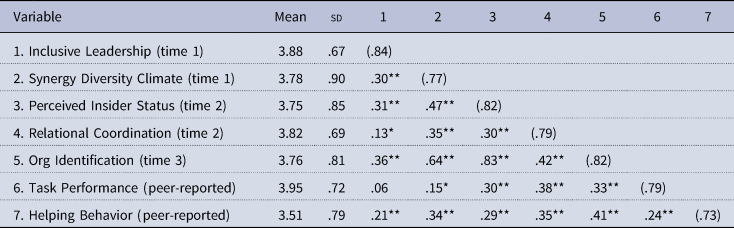
Table 1 summarizes the means, standard deviations (sd), bivariate correlations, and Cronbach's alpha reliabilities of the study's core variables. Before testing our hypotheses, we conducted a one-way analysis of variance to identify the study's controls. For instance, we found a significant difference in our dependent variables based on one department. Therefore, we created a dummy coded variable to control for the significant effect of this department.
Means, sd, correlations, and reliabilities of study variables

n = 300. Control variable is one department; one dummy code variable was created (deptt2 = 1, all others = 0). Cronbach's alpha reliabilities are given in parentheses.
*p < .05, **p < .01, ***p < .001.
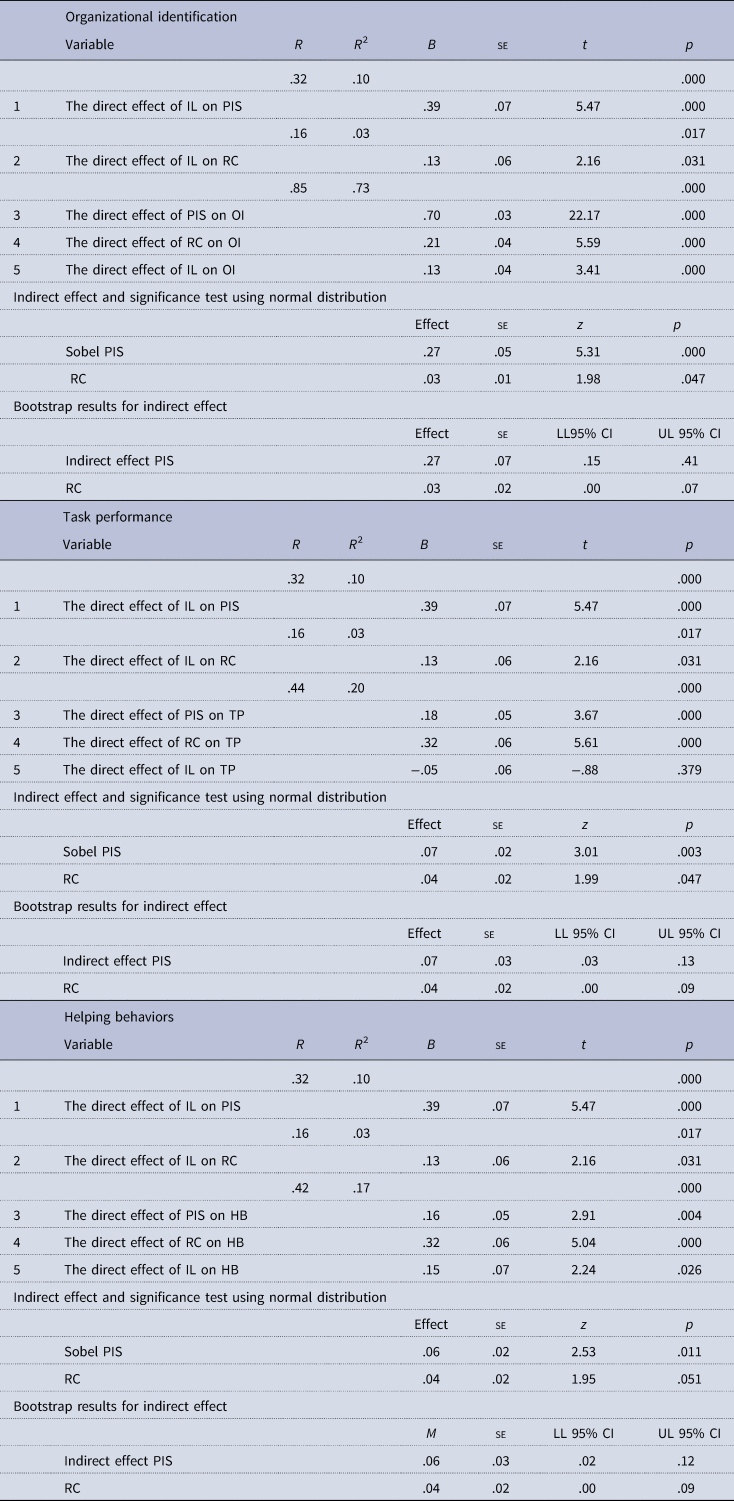
Bootstrapping was used to test our moderation, mediation, and moderated mediation hypotheses (Preacher & Hayes, Reference Preacher and Hayes2004). The bootstrapping approach avoids the statistical power problems caused by asymmetric and other non-normal sampling distributions. Specifically, we ran models 1, 4, and 7 to test the moderation, mediation, and moderator mediation hypotheses. For the moderation analysis, we mean-centered our independent and moderator variables. We plotted significant interaction plots based on simple slope analysis for +1 sd and −1 sd above and below the mean for all significant interactions. Table 2 shows our mediated regression analysis findings. Supporting hypotheses 1a–1c, the formal two-tailed significance test showed that inclusive leadership had a significant and positive indirect effect via perceived insider status on organizational identification (Sobel effect = .27, z = 5.31, p < .001), task performance (Sobel effect = .07, z = 3.01, p < .01), and leader-directed helping behavior (Sobel effect = .06, z = 2.53, p < .05). The bootstrap findings corroborated the Sobel test with a bootstrapped 95% confidence interval (CI) not containing zero for organizational identification [.15, .41], task performance [.03, .13], and leader-directed helping behavior [.02, .12].
Mediated regression analysis

N = 300. Control variable is one department; one dummy code variable was created (deptt2 = 1, all others = 0). Bootstrap sample size = 5,000.
IL, inclusive leadership; PIS, perceived insider status; RC, relational coordination; OI, organizational identification; TP, task performance; HB, helping behavior; LL, lower limit; CI, confidence interval; UL, upper limit.
In support of hypotheses 2a–2c, we observed that inclusive leadership through relational coordination was positively and indirectly related to all three outcomes: organizational identification (Sobel effect = .03, p < .05), task performance (Sobel effect = .04, p < .05), and leader-directed helping behavior (indirect effect = .04, p < .05). Bootstrap findings corroborated the Sobel test with a bootstrapped 95% CI not containing zero for organizational identification [.00, .07], task performance [.00, .09], and leader-directed helping behavior [.00, .09].
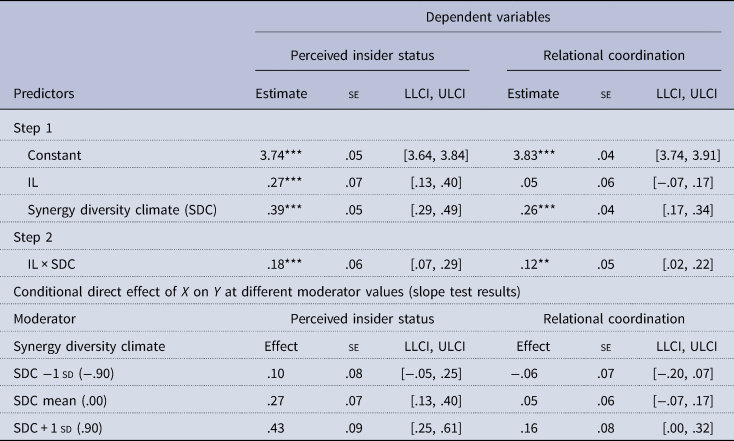
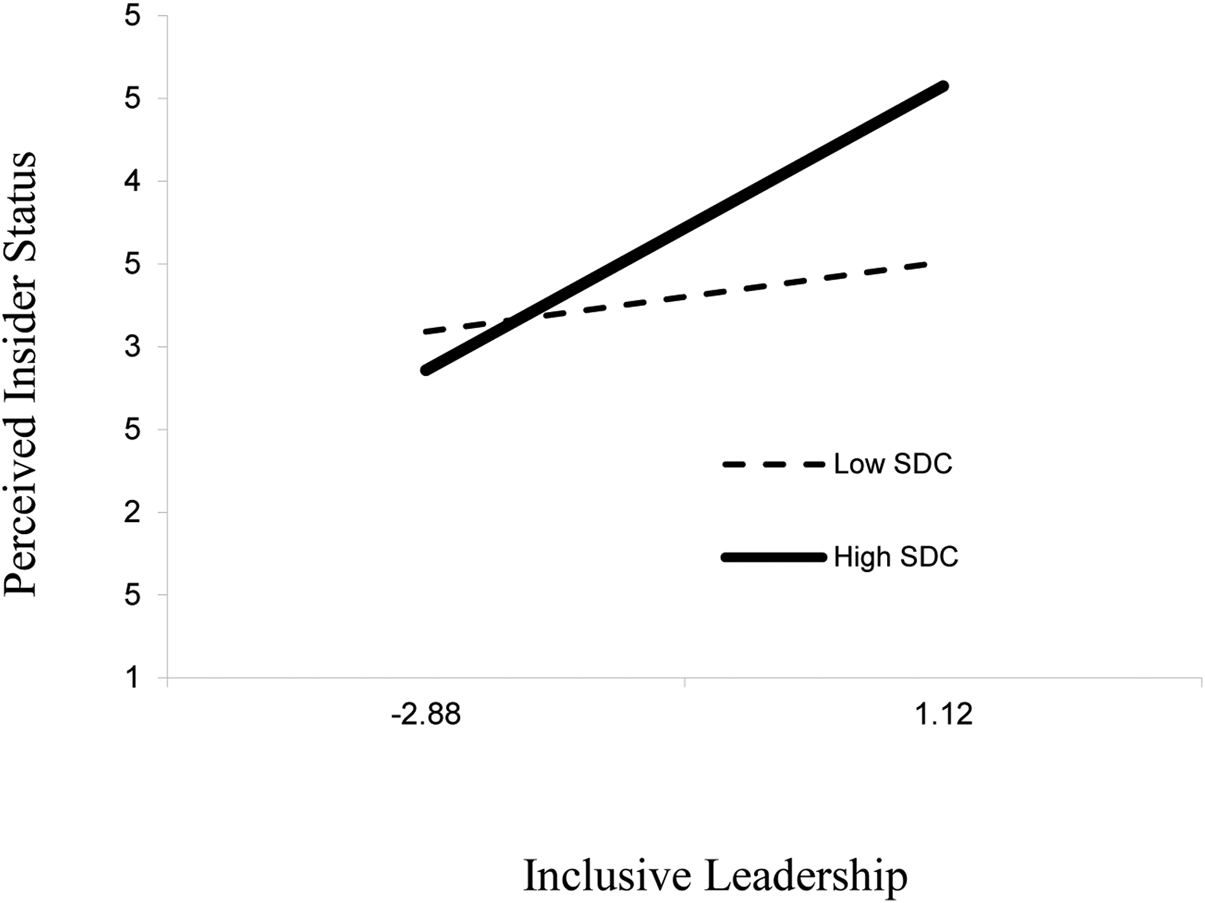
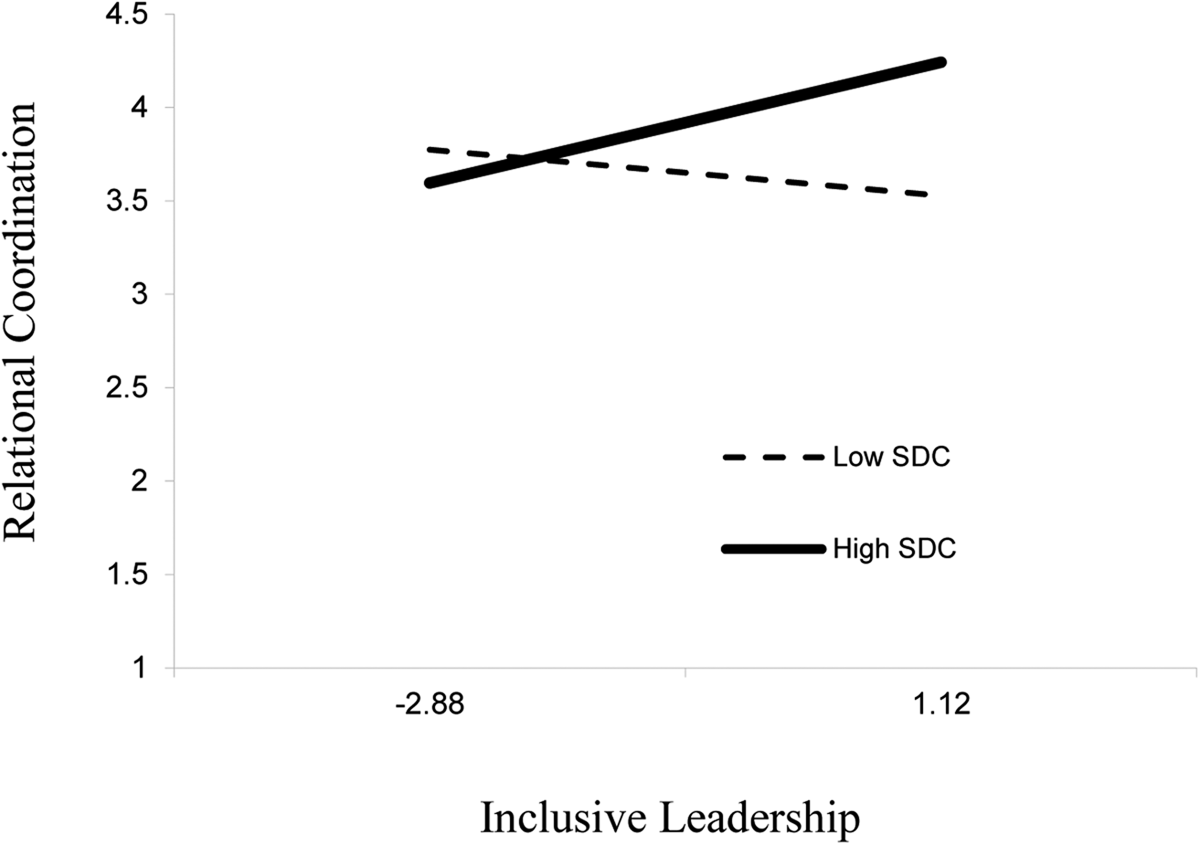
The results of our moderated regression analysis are displayed in Table 3. The findings show that the interaction between inclusive leadership and synergy diversity climate was significant for perceived insider status (β = .18, p < .001). Figure 2, in support of hypothesis 3a, confirms that the relationship between inclusive leadership and perceived insider status was positive, significant, and substantial when the synergy diversity climate was high (simple slope = .43, t = 4.73, p < .001) and weak when the synergy diversity climate was low (simple slope = .10, t = 1.30, p = n.s.). Similarly, the interaction term of inclusive leadership and synergy diversity climate was significant for relational coordination (β = .12, p < .05). Figure 3, in support of hypothesis 3b, shows that the relationship was positively significant and strong when the synergy diversity climate was high (simple slope = .16, t = 2.00, p < .05) and weak when the synergy diversity climate was low (simple slope = −.06, t = −.90, p = n.s.).
Moderated regression analysis results

N = 300. Control variables: department. Bootstrap sample size = 5,000.
IL, inclusive leadership; LL, lower limit; CI, confidence interval; UL, upper limit.
*p < .05; **p < .01; ***p < .001.
Interactive effects of inclusive leadership and synergy diversity climate on perceived insider status.
Note: N = 300. SDC, synergy diversity climate. Slope for low synergy diversity climate (β = .10, p = n.s.). Slope for high-synergy diversity climate (β = .43, p < .000).

Interactive effects of inclusive leadership and synergy diversity climate on relational coordination.
Note N = 300. SDC, synergy diversity climate. Slope for low synergy diversity climate (β = −.06 p = n.s.); Slope for high-synergy diversity climate (β = .16, p < .05).

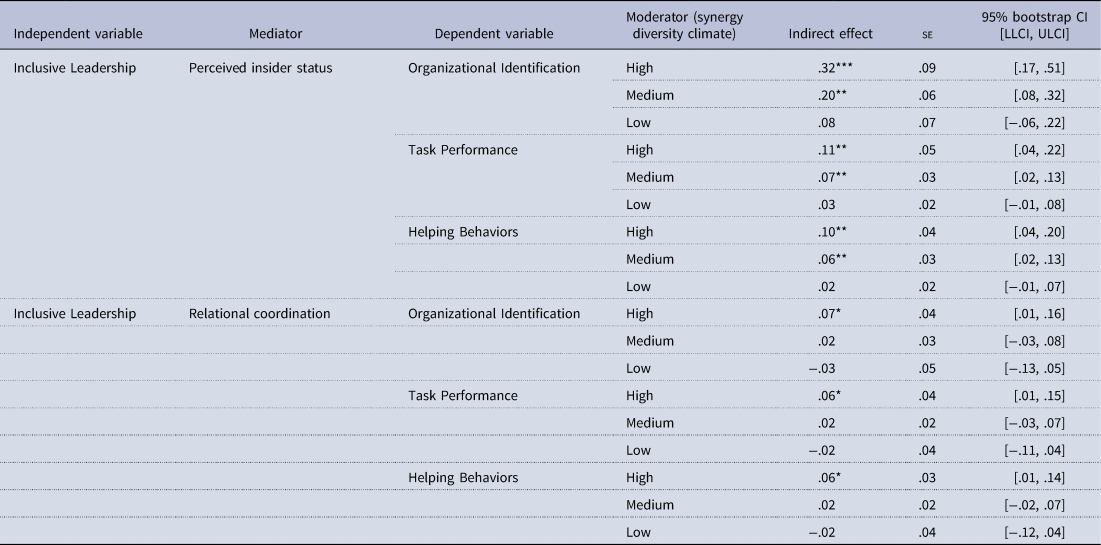
Table 4 exhibits the results for the conditional indirect effects of inclusive leadership on outcomes (i.e., organizational identification, task performance, and leader-directed helping behavior) through perceived insider status and relational coordination under different synergy diversity climate conditions. We verified the moderated mediation effects of inclusive leadership on outcomes at three different values of synergy diversity climate: +1 sd above the mean (.90), at the mean (.00), and −1 sd below the mean (−.90). Our analyses demonstrated that the moderated mediation effects (based on moderator values +1 sd above the mean) were positive, more potent, and did not contain zero. Bootstrap CIs verified these results. The indirect positive effects of inclusive leadership on organizational identification [.17, .51], task performance [.04, .22], and leader-directed helping behavior [.04, .20] through perceived insider status were stronger for a climate of high-synergy diversity and less pronounced for a climate of low synergy diversity. These results support hypotheses 4a–4c. Similarly, the indirect positive effects of inclusive leadership on organizational identification [.01, .16], task performance [.01, .15], and leader-directed helping behavior [.01, .14] through relational coordination were stronger for a climate of high-synergy diversity and weaker for a climate of low synergy diversity. Thus, we found support for hypotheses 5a–5c.
Moderated mediation analysis

N = 300. Control variable is one department; one dummy code variable was created (deptt2 = 1, all others = 0). Bootstrap sample size = 5,000.
IL, inclusive leadership; PIS, perceived insider status; RC, relational coordination; SDC, synergy diversity climate; LL, lower limit; CI, confidence interval; UL, upper limit.
Discussion
Global changes in the 21st century have forced organizations to incorporate diverse workforces at all organizational levels (Boekhorst, Reference Boekhorst2015; Dwertmann & Boehm, Reference Dwertmann and Boehm2016). To manage this growing diversity effectively, leaders at all levels must be inclusive in their interactions with employees of different cultures, genders, ages, areas of specialization, etc. (Randel et al., Reference Randel, Dean, Ehrhart, Chung and Shore2016, Reference Randel, Galvin, Shore, Ehrhart, Chung, Dean and Kedharnath2018). Past research has already investigated the effects of inclusive leadership in promoting positive employee outcomes (Brimhall, Mor Barak, Hurlburt, McArdle, Palinkas, & Henwood, Reference Brimhall, Mor Barak, Hurlburt, McArdle, Palinkas and Henwood2016; Mitchell et al., Reference Mitchell, Boyle, Parker, Giles, Chiang and Joyce2015). However, there is a scarcity of research on the underlying processes of how inclusive leadership unfolds and impacts employees' behaviors and the conditions that facilitate or mitigate the positive effects of inclusive leadership on workplace behaviors and attitudes in diverse workforces (Jin, Lee, & Lee, Reference Jin, Lee and Lee2017; Korkmaz et al., Reference Korkmaz, van Engen, Knappert and Schalk2022; Mitchell et al., Reference Mitchell, Boyle, Parker, Giles, Chiang and Joyce2015; Randel et al., Reference Randel, Galvin, Shore, Ehrhart, Chung, Dean and Kedharnath2018; Roberson & Perry, Reference Roberson and Perry2022; Rodriguez, Reference Rodriguez2018; Thompson & Matkin, Reference Thompson and Matkin2020).
Past reviews and thematic analyses highlight the importance of studying the impact of inclusive leadership on outcomes. However, despite these studies, minimal attention has been given to the role of relational dynamics through which inclusive leadership fosters its beneficial effects (Hassan & Jiang, Reference Hassan and Jiang2021; Korkmaz et al., Reference Korkmaz, van Engen, Knappert and Schalk2022; Roberson & Perry, Reference Roberson and Perry2022; Tang et al., Reference Tang, Li, Jing and Chen2017; Thompson & Matkin, Reference Thompson and Matkin2020; Xiaotao et al., Reference Xiaotao, Yang, Diaz and Yu2018; Ye, Wang, & Li, Reference Ye, Wang and Li2018). With this inquiry, we contribute to the leadership and diversity literature by answering how and when inclusive leaders foster employee outcomes. Relying on social identity theory as our overarching theoretical framework for explaining the relationships between our core variables (Tajfel & Turner, Reference Tajfel, Turner, Austin and Worchel1979), we examined a moderated mediation model in which perceived insider status and relational coordination mediate the role of inclusive leadership in creating employee outcomes (i.e., leader-directed helping behavior, task performance, and organizational identification) under a climate of high-synergy diversity. Our data offered support for most of our hypotheses.
This study provides numerous theoretical contributions. First, this study is one of the few studies to examine the impact of inclusive leadership on distinct outcomes such as leader-directed helping behavior, task performance, and organizational identification. Second, this study explains how an inclusive leader can foster employees' positive behaviors by valuing each member and accepting his or her uniqueness. Our findings suggest that inclusive leadership helps members embrace differences by instilling a perception of insider status. In particular, the pivotal role of inclusive leaders in helping employees perceive an insider status is explained by drawing from social identity theory (Tajfel & Turner, Reference Tajfel, Turner, Worchel and Austin1986). Third, our findings suggest that inclusive leaders motivate employees to value each other, facilitating relational coordination. By actively encouraging employees to come up with new ideas and being more open to diverse perspectives, inclusive leaders can promote more frequent and accurate communication among employees, which fosters relational coordination. Fourth, our inquiry extends the diversity literature by examining the role of the synergy diversity climate in reinforcing the positive relationships between inclusive leadership and perceived insider status and between inclusive leadership and relational coordination. In particular, our study's findings bridge the leadership and diversity literature by suggesting that in an organizational climate characterized by employees who feel that their organization respects and values diverse perspectives (i.e., synergy diversity), inclusive leadership can capitalize on such a climate by triggering insider status and relational coordination in followers.
Several important implications for managers and organizations can be inferred based on observations made from the data collected in this study. Organizations characterized by a synergy diversity climate along with inclusive leadership generate relational coordination and cultivate insider status perceptions, which in turn help foster positive organizational behaviors. Hence, our findings suggest that organizations and personnel responsible for diversity management should focus their actions and resources on training and the alignment of performance assessment systems with an inclusive leadership approach (Choi, Tran, & Park, Reference Choi, Tran and Park2015). Put differently; they should train and encourage their employees to coordinate with each other to create a positive environment in which members identify themselves with their organization and ultimately perform better.
Inclusive leaders act as role models for their followers and facilitate inclusion perceptions among organizational members (Randel et al., Reference Randel, Galvin, Shore, Ehrhart, Chung, Dean and Kedharnath2018). Therefore, managers must engage in behaviors that help employees obtain positive experiences at the workplace. Leaders should value each member by facilitating belongingness and uniqueness and encouraging diverse contributions. Hence, management should consider investing in recruiting and selecting inclusive leaders at all levels in their companies. Leadership development programs should be instituted and implemented so that leaders have ample training opportunities to develop their inclusive leadership skills. Furthermore, to promote a synergy diversity climate, managers should put effort into establishing a positive climate that focuses on educating employees about diversity benefits and the importance of inclusiveness in fostering employee creativity (Richard et al., Reference Richard, Avery, Luksyte, Boncoeur and Spitzmueller2019). In this context, diversity management programs should be established in which employees can understand and address diverse ideas and issues and resolve any problems or conflicts that may arise from surface-level and deep-level diversity.
Even though the present study has various strengths, it has limitations. Although this study used temporally segregated data collected at three time points, it does not entail a cross-lagged model in which the independent variable, the mediator(s), and the dependent variables are measured at all periods (Cole & Maxwell, Reference Cole and Maxwell2003). Compared to our segregated data collection, a cross-lagged approach is better equipped to approximate the mediation's effect size and test for reverse causality or reciprocal relationships (Cole & Maxwell, Reference Cole and Maxwell2003; Maxwell & Cole, Reference Maxwell and Cole2007). With this in mind, future studies could consider adopting a cross-lagged design, including our core variables.
Another limitation is that inclusive leadership and synergy diversity climate were measured simultaneously through the same source, thus potentially creating common source bias. More specifically, followers were asked to rate their perceptions of how inclusive their leaders are, which is the standard protocol for collecting data about inclusive leadership behaviors (Al-Atwi & Al-Hassani, Reference Al-Atwi and Al-Hassani2021; Carmeli, Reiter-Palmon, & Ziv, Reference Carmeli, Reiter-Palmon and Ziv2010; Nishii & Leroy, Reference Nishii and Leroy2022). In addition, employees also rated the degree to which they perceived a synergy diversity climate. In this case, employees can accurately state how well their organization favors a climate where diverse perspectives are valued and respected. Despite the concern for common source bias in this study, the strong support for our CFA and moderation effects suggest that common source bias is not a concern.
A final limitation concerns that our study's sample came from a country with less pronounced variation in terms of religion, culture, and other surface-level diversity characteristics. However, this does not pose a serious concern to our study's findings, as our variable of synergy diversity climate highlights the degree to which employees perceive that the organization respects and values diverse perspectives in the organization from different individuals, which lie at the heart of deep-level diversity. Furthermore, our sample was reflective of differences that pertain to individuals in terms of gender, age, management levels, functional backgrounds, and experience levels, which encompasses elements that mirror both surface and deep-level diversity. Nonetheless, future researchers should make substantial efforts to identify samples from organizations that have variations in terms of deep-level diversity and surface-level characteristics to be as comprehensive as possible in their research of diversity existing in organizations.
Our study showed the importance of inclusive leadership in fostering three pertinent positive employee outcomes. Nonetheless, there is a need to examine the impact of inclusive leadership on other possible outcomes, such as organizational commitment, social integration, and innovative performance. Furthermore, studies should investigate alternative underlying mechanisms in explicating the effects of inclusive leadership. For example, future studies should examine the mediating role of positive affective tone in the relationship between inclusive leadership and outcomes. Future research also could analyze other relevant contextual variables, such as leader–member perceived similarity or role clarity, that may enhance the effectiveness of inclusive leadership in promoting perceived insider status and relational coordination. It also would be interesting to study the role of employees' dispositional traits, such as positive affectivity or core self-evaluations, in the relationship between inclusive leadership and mediators. This line of research might elucidate the types of employees for whom an inclusive leader might foster insider status and relational coordination. To conclude, future studies could simultaneously examine other conceptually related leadership styles alongside inclusive leadership, such as servant, transformational, and supportive leadership, and control for the effects of these leadership styles to establish the potency of the effects of inclusive leadership on its mechanisms and outcomes.
Conclusion
In conclusion, as organizations become increasingly diverse, leaders should focus on enhancing individuals' performance and organizational identification (Randel et al., Reference Randel, Galvin, Shore, Ehrhart, Chung, Dean and Kedharnath2018) by managing diversity more effectively. Our findings offer insights into how and under what conditions leaders adopting an inclusive perspective can manage diversity in their workforce, organization, and the team. Furthermore, our findings bridge the leadership and diversity management literature by unveiling perceived insider status and relational coordination as dynamic processes through which employees enhance their identification with their organization, demonstrate higher task performance, and engage in leader-directed helping behavior. In summary, with these novel insights, we offer practitioners and scholars a platform to explore further the conditions and mechanisms of how and why inclusive leadership invokes positive outcomes in diverse workforces, organizations, and the teams.
Funding statement
The current research did not include formal financial funding and/or support. The authors declare that preparation of this manuscript was not supported by any external funding and is mere effort of the authors included.
Competing interests
The authors declare no potential conflict of interest with respect to the research, authorship, and/or publication of this article. Moreover, the submitted work was not carried out in the presence of any personal, professional, or financial relationships that could potentially be construed as a conflict of interest.
Ethical standards
The International Islamic University Islamabad constitutes departmental Ethics Approval Committees. The FMS Research Ethics Board reviewed ‘The power of inclusive leadership: exploring the mediating role of identity-related processes and conditional effects of synergy diversity climate in nurturing positive employee behaviors’ research proposal and considered the procedures, as described by the applicant, to conform to the University's ethical standards and IIUI guidelines. Clearance granted on 02/20/2019. Moreover, the participation in the survey was voluntary and study participants were first explained about the details of the project and it was assured to them that their responses will be kept in strict anonymity and will be reported as aggregate results.
Dr. Saima Naseer is currently serving as an associate professor at the Goodman School of Business (GSB), Department of Organizational Behavior, Human Resources, Entrepreneurship and Ethics (OBHREE), Brock University, Canada. She joined the GSB, Brock University as an assistant professor in February 2021. Before that she worked in the Faculty of Management Sciences (FMS), International Islamic University (IIUI) from 2007 to 2021. She completed her PhD in management/OB from the FMS, IIUI in 2015. Her current research interests include workplace bullying, despotic leadership, abusive supervision, transformational leadership, organizational identification, dark triad personality, emotions, and organizational cynicism. Dr. Naseer has around 24 research papers published in impact factor journals such as Leadership Quarterly, Journal of Business and Psychology, Human Resource Management, Journal of Business Research, Personnel Review, Asia Pacific Journal of Human Resource Management, etc.
Dr. Dave Bouckenooghe is currently serving as a professor at the Goodman School of Business, Department of Organizational Behavior, Human Resources, Entrepreneurship and Ethics (OBHREE), Brock University, Canada. He earned his PhD, MSc, and BSc from Ghent University, Belgium. He teaches courses in the areas of organizational behavior and human resources. His research interests include organizational change and failure, leadership (i.e., abusive leadership, authentic leadership, servant leadership, etc.) and positive resources (i.e., work engagement, psychological capital, and emotional intelligence) in shaping in-role job performance, extra-role behaviors (Organizational citizenship behaviors, creativity, etc.), and counterproductive behaviors.
Dr. Fauzia Syed completed her PhD in management/OB from the Faculty of Management Sciences (FMS), International Islamic University (IIUI) in 2015 and is also serving as an assistant professor at the FMS, IIUI. Her current research interests include dark triad personality, workplace bullying, despotic leadership, abusive supervision exploitative leadership, and facades of conformity. Dr. Syed has currently more than 19 research papers published in impact factor journals such as Leadership Quarterly, Personnel Review, Journal of Business & Psychology, and Journal of Positive Psychology.
Aisha Haider is a PhD scholar at the Faculty of Management Sciences (FMS), International Islamic University (IIUI). Her research interests include change management, positive leadership, diversity, and career development and growth.