In many Indo-European languages, like English, a syntactic distinction is made between mass and count noun phrases. These languages are called mass–count languages. In English, the mass–count distinction is made by obligatory singular/plural specification on count nouns and the lack of it on mass nouns, as in (1):
-
(1)
-
a. Mari bought [a book/books/*book].
-
b. Mari bought [sugar/*a sugar/*sugars].
-
As shown in (1), count nouns like book can be used in either the singular (a book) or plural (books), but not in their bare form (book), whereas mass nouns like sugar can be used in their bare form (sugar), but not in the singular (a sugar) or plural (sugars).
In contrast, many languages, like Japanese, lack a mass–count distinction and the corresponding obligatory number marking (Muromatsu, Reference Muromatsu, Li and Simpson2003), as shown in (2):Footnote 1
-
(2)
-
a. Mari-wa hon-o katta.
Mari-top book-acc bought
“Mari bought [a book/books].”
-
b. Mari-wa satoo-o katta.
Mari-top sugar-acc bought
“Mari bought sugar.”
-
As (2) shows, Japanese nouns that correspond to English count nouns, such as hon “book”, as well as those that correspond to English mass nouns, such as satoo “sugar”, can appear in their bare forms and be interpreted as singular (“a book”) or plural (“books”).
This does not mean, however, that Japanese has no means to distinguish the singular and the plural. It has the option of using a numeral classifier to specify the number of the entity denoted by the noun (Muromatsu, Reference Muromatsu, Li and Simpson2003; Tsujimura, Reference Tsujimura2007), as in (3):
-
(3)
-
a. Mari-wa hon-o is-satu katta.
Mari-top book-acc one-cl bought
“Mari bought a book.”
-
b. Mari-wa hon-o san-satu katta.
Mari-top book-acc three-cl bought
“Mari bought three books.”
-
Numeral classifiers consist of a number expression (iti “one”, ni “two”, san “three”, yon “four”, etc.) combined with a classifier (e.g., -satu). In (3a) and (3b), the numeral classifiers is-satu “one-cl” (is being a variant of iti “one”) and san-satu “three-cl” appear immediately after the noun (hon “book”) that they modify, thereby specifying the number of books as one and three, respectively. There are a variety of classifiers in Japanese and the classification is based on the shapes, animacy, or functions of the entities that are counted (Muromatsu, Reference Muromatsu, Li and Simpson2003). For example, -satu is used for “book-like” objects as in (3), -hon for long objects like enpitu “pencil” (e.g., enpitu ni-hon “two pencils”), and -hiki for small animals like inu “dog” (e.g., inu yon-hiki “four dogs”). Thus, Japanese is called a classifier language, characterized by non-obligatory number marking of nouns with classifiers. Note, however, that, unlike the obligatory number marking on count nouns in English, number marking by classifiers is not obligatory and is used only when there is a need to specify the number of entities.Footnote 2 , Footnote 3
Interestingly, acquiring the English mass–count distinction is notoriously difficult for Japanese adults, and errors like (4) (drawn from the writing of Japanese university students) are quite common:
-
(4)
-
a. *I have a news for you.
-
b. *He gave me many advices.
-
c. *She finally found a happiness.
-
This difficulty with the mass–count distinction is related to problems that Japanese speakers have when acquiring English articles (a, the, Ø) particularly in indefinite contexts, as in (5):
-
(5) What did you have for lunch? I had (Ø/*a) pasta.
In an indefinite context like (5), the choice between Ø and a is determined by the mass–count status of the following noun: One must know that pasta is a mass noun to correctly select Ø. As Thomas (Reference Thomas1989, p. 354) suggests (on the basis of her data on the acquisition of English articles by Japanese speakers), “[t]he biggest source of errors in Ø contexts is a, and vice versa, which may be evidence that L2 [second language] learners are confusing mass and count nouns”. She also compared her L2 English data with existing first language (L1) English data and noted that L1 children do not have similar difficulties. This raises the possibility that Japanese learners’ difficulty with the mass–count distinction may be due to the L1 (since Japanese does not feature obligatory number marking on nouns).
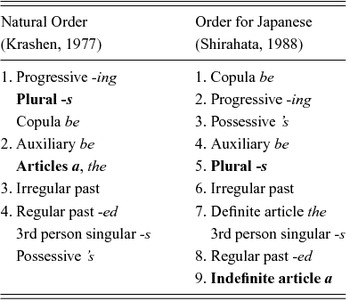
In addition, Shirahata's (Reference Shirahata1988) classic work on the order of acquisition of several English morphemes among Japanese learners suggests L1 influence. According to Krashen (Reference Krashen, Brown, Yorio and Crymes1977), a Natural Order exists in the acquisition of morpho-syntactic features, which is impervious to L1 influence when individuals acquire a second language. In this Natural Order, the features relevant to the mass–count distinction are plural -s, which Krashen predicts should be among the earliest acquired features, and the articles a and the, which Krashen predicts should also emerge very early. However, against this Natural Order, Shirahata (Reference Shirahata1988) presented data from Japanese high school students learning English (see Table 1 for a comparison with Krashen's Natural Order). Shirahata found that the indefinite article a was among the last forms to be acquired by Japanese learners. Also, he found that plural -s was acquired much later than predicted by Krashen. These deviations from the Natural Order indicate that acquiring the mass–count distinction may be susceptible to L1 influence, and thus may be especially difficult for Japanese learners of English.
Deviations from the Natural Order. Bold indicates the items which are relevant to the mass–count distinction.

Several past studies have suggested that these difficulties with mass–count syntax may be related to the complex relationship between mass–count syntax and semantics. First, evidence for a role of semantics comes from a study by Hiki (Reference Hiki1990), in which Japanese college sophomores were given written passages as in (6) and were asked to check the forms of the underlined noun phrases and correct them if necessary.
-
(6) Example items from the editing test (from Hiki, Reference Hiki1990, pp. 33–35)
-
a. Tom keeps snake at home and thinks it is cute . . .
-
b. . . . It [Tokyo] is also very noisy and has a dirty air . . .
-
c. . . . Well, if you can't find a pleasure in what you do, try doing something else.
-
According to Hiki, when count nouns denoted objects (e.g., snake in (6a)), subjects correctly altered sentences to provide an indefinite article. Also, when presented with mass nouns that denoted substances (e.g., air in (6b)), subjects correctly deleted indefinite articles. However, when mass and count nouns were abstract (e.g., pleasure in (6c)), subjects had difficulty deciding whether indefinite articles were appropriate or not.Footnote 4
A second study, by Yoon (Reference Yoon1993), found similar results. In her study, Yoon investigated Japanese learners’ countability judgments for English nouns, and how these related to their choice of Ø or a in indefinite contexts. According to Yoon, although the learners judged the nouns in her stimulus sets to be countable roughly as often as native speakers when they were presented without a context (L2 learners: 73%, L1 speakers: 82%), the learners supplied the article a in obligatory contexts only 61% of the time, whereas native speakers did so 95% of the time. Critically, Yoon found that many of these errors could be explained by semantics. First, whereas countability judgments were strongly correlated with article choice in learners, there was only a weak correlation in native speakers. Second, she found that most of the nouns that were judged to be countable by the learners were concrete (farm, person, servant, etc.), while those judged as non-countable were more likely to be abstract nouns (defiance, appreciation, burden, etc.), suggesting that concreteness mediated their use of mass or count syntax.
Finally, Snape (Reference Snape2008) also found evidence that L2 acquisition of the mass–count distinction may be slowed by difficulties with semantics. In his study, Snape investigated the acquisition of the mass–count distinction by Japanese learners at intermediate and advanced levels using a grammaticality judgment task.Footnote 5 Subjects were asked to judge the well-formedness of mass and count nouns preceded by different quantifiers with different selectional restrictions (e.g., some shirts/information/*butters, many tickets/*money/*sweet, much *roses/paper/*cookie, few tourists/*cyclist/*sunshines). Although advanced learners performed well for both mass and count nouns, Snape found that intermediate learners had greater difficulty with mass nouns, and especially with abstract mass nouns like evidence, for which almost no subjects provided correct responses.Footnote 6
Together, these past studies suggest that the challenge that the mass–count distinction poses to L2 learners of English whose L1, like Japanese, has no obligatory number marking on nouns, may be related to the fact that some nouns, like pleasure and thought, can be used as either count or mass nouns in English,Footnote 7 and other nouns, like advice and information, are mass nouns in English but count nouns in another language like French (i.e., conseil “advice”, renseignement “information”).Footnote 8 However, although these studies have established that the difficulties of L2 learners are somehow related to the semantics of nouns, the precise grammatical nature of this confusion remains unclear. In this paper, I propose that the confusion derives from the difficulty Japanese learners of English experience in mapping syntax to semantics. To do so, the nature of syntax–semantics mappings in the English mass–count distinction needs to be clarified first. Below, I consider two alternative accounts of the mass–count distinction and discuss recent psycholinguistic evidence to adjudicate between these two views.
Syntax–semantics mappings in the mass–count distinction in English
Past discussions of the mass–count distinction in linguistics, philosophy, and psychology suggest two distinct possibilities. One possibility, emanating out of the Whorfian tradition and the work of Quine (Reference Quine1960), is that language plays a causal role in determining how speakers conceptualize objects in the world. In his discussion of the mass–count distinction, Quine suggested that the acquisition of mass–count syntax in childhood leads children to “divide reference” such that individual objects are differentiated and quantified according to number, while materials like water are not (Quine, Reference Quine1960, pp. 90–95). According to this view, language and cognition are tightly related: Count nouns denote countable individuals and mass nouns denote uncountable stuff (see also Bloom, Reference Bloom and Levy1994, Reference Bloom, Jackendoff, Bloom and Wynn1999; Gordon, Reference Gordon1985, Reference Gordon1988; Landman, Reference Landman1991; Link, Reference Link1998; Macnamara, Reference Macnamara1982, Reference Macnamara1986; Wisniewski, Imai & Casey, Reference Wisniewski, Imai and Casey1996). A key consequence of the Quinian view, advocated by some psychologists (e.g., Athanasopolous, Reference Athanasopoulos2006; Imai & Gentner, Reference Imai and Mazuka1997; Lucy, Reference Lucy1992), is that children who acquire a mass–count language like English should be more likely to perceive entities as countable individuals, relative to children who learn a classifier language like Japanese. This is because, on this view, nouns in classifier languages do not individuate since they lack mass–count syntax.
Another possibility is that both count and mass nouns can denote sets of individuals, as proposed by Bale and Barner (Reference Bale and Barner2009), Chierchia (Reference Chierchia and Rothstein1998a), and Gillon (Reference Gillon1992, Reference Gillon and Viegas1999). In fact, recent psycholinguistic experiments have provided evidence for this proposal, casting doubt on the Quinian hypothesis. Using a quantity judgment method, Barner and Snedeker (Reference Barner and Snedeker2005) showed that, while all count nouns (e.g., shoe) denote individuals, some mass nouns (e.g., mustard) denote non-individuals, and others (e.g., furniture) denote individuals. In their study, English-speaking adults and 4-year-olds judged that six small shoes were more shoes than two large shoes (thereby quantifying over number), but that two large portions of mustard were more mustard than six small portions (thereby quantifying over volume). Also, for mass–count flexible nouns like string and stone, quantity judgments were based on number when the words were presented to participants in count syntax (Who has more strings?) but on volume when presented in mass syntax (Who has more string?). Finally, for mass nouns like furniture and jewelry, both children and adults based quantity judgments systematically on number, judging that six small pieces of furniture are more furniture than two large pieces. Thus, while count syntax (shoes, strings) always led to judgments based on number, mass syntax did not force one particular dimension of comparison and permitted judgments based on either number (furniture) or volume (string, mustard). Subsequent studies have found this same asymmetry between mass and count interpretations by testing subjects with novel words using quantity judgment and a word extension task (Barner & Snedeker, Reference Barner and Snedeker2006; see also Imai & Mazuka, Reference Imai and Mazuka2007). Also, similar results have been found with action words that can be used in either mass syntax (e.g., more jumping) or count syntax (e.g., more jumps) (Barner, Wagner & Snedeker, Reference Barner, Wagner and Snedeker2008). In each case, participants based quantity judgments on number for nouns used in count syntax. However, they are more likely to base judgments on number for mass nouns that denote complex objects relative to those that denote simpler ones, and for mass nouns that denote punctual events (e.g., more jumping), relative to those that denote durative events (e.g., more dancing).
These findings have important implications for understanding the relationship between mass–count syntax and individuation. Specifically, because count syntax is not necessary for individuation, nouns in classifier languages like Japanese may individuate, much like English count nouns. As a result, Japanese speakers may not differ in how they perceive individuals in the world, nor in how likely they are to encode individuals with nouns.
To examine this idea, Inagaki and Barner (Reference Inagaki, Barner, Inagaki, Hirakawa, Hirakawa, Sirai, Arita, Morikawa, Nakayama and Tsubakita2009) tested L1 Japanese speakers using the quantity judgment task of Barner and Snedeker (Reference Barner and Snedeker2005). Among the test items were count nouns (e.g., kutu “shoe”), substance-mass nouns (e.g., karasi “mustard”), object-mass nouns (e.g., kagu “furniture”), and mass–count flexible nouns (e.g., himo “string”), which corresponded to the four categories of English nouns tested by Barner and Snedeker. A group of English speakers completed the English version for comparison. In addition, Inagaki and Barner tested participants with another category of nouns, which they called “cross-linguistic variable nouns”, such as hoorensoo “spinach” and pasuta “pasta”. These nouns were selected on the basis of their different mass–count status across different languages. Specifically, these words were mass nouns in English (e.g., spinach) but count nouns in French (e.g., épinards “spinaches”). Results showed that the quantity judgments of Japanese speakers did not differ from those of English speakers for words that were count nouns in English (e.g., kutu “shoe”), for words that were object-mass nouns in English (e.g., kagu “furniture”), or for words that were substance-mass nouns in English (e.g., karasi “mustard”). Thus, they concluded that Japanese nouns are able to encode individuation to the same degree as nouns in English, despite lacking overt count syntax (for similar results using a larger set of items, see Barner, Inagaki & Li, Reference Barner, Inagaki and Li2009).
Still, Inagaki and Barner did find important differences between Japanese and English judgments. For mass–count flexible nouns (e.g., himo “string”), while English quantity judgments shifted as a function of mass–count syntax (i.e., based on number when used in count syntax, but on volume when used in mass syntax), approximately 50% of Japanese quantity judgments were based on number, falling between English mass and count judgments. For cross-linguistic variable nouns (e.g., hoorensoo “spinach”), which were “mass” in English but “count” in French (e.g., épinards), quantity judgments shifted as a function of syntax between these languages (i.e., based on volume in English, but on number in French), but Japanese judgments were based mostly on number, similar to the French judgments. These findings again indicate that Japanese nouns can refer to individuals in absence of count syntax. Also, they suggest that, for words that have both number-based and volume-based interpretations available (i.e., mass–count flexible nouns like string/himo and cross-linguistic variable nouns like spinach/hoorensoo), in English mass–count syntax acts to select between the two interpretations, whereas in Japanese in absence of mass–count syntax, the interpretation of these words is determined by item-specific information (the perceptual properties of referents, real world knowledge, etc.) and therefore may differ on an item-by-item basis.Footnote 9
The present study
The results of recent psycholinguistic studies support the view that count syntax is not necessary for individuation: Japanese speakers, like speakers of English, are capable of encoding objects as countable individuals. Mass–count syntax, in this context, is not a Quinian invitation to individuation, but rather serves to disambiguate the interpretation of nouns that can refer to either individuals (strings, épinards) or non-individuals (string, spinach).
A critical consequence of this conclusion is that, when Japanese learners of English acquire the mass–count distinction, they cannot use reference alone to identify which words are mass and which are count. For some nouns, like furniture, the assumption that only count nouns can denote individuals would lead learners to posit count status. For other words, using reference alone would lead to indecision about mass–count flexible words like string, or words that vary cross-linguistically, like spinach. Still, it is possible that early in the acquisition process, before learners are able to use syntactic cues reliably to identify mass and count nouns, they make semantic assumptions of precisely this kind. Although Barner and Snedeker (Reference Barner and Snedeker2005) showed that mass nouns can denote individuals, it is nonetheless true that most individuating nouns in English are count nouns, and all nouns that do not individuate are mass. Thus, at the early stages of L2 acquisition, using semantics to infer the mass–count status of a noun might nonetheless make sense, and might explain why Japanese learners of English make the errors that they do.
To investigate this question, the present study used the quantity judgment method to test Japanese learners of English. Using this method, I asked whether the errors of L2 learners would be predicted by the conceptual semantics of corresponding Japanese nouns, and thus by speakers’ spontaneous judgment of whether the nouns may denote discrete individuals. To do this, I compared the quantity judgments of L2 speakers tested in English to the L1 judgments of participants tested in either English or Japanese. If semantics guides L2 judgments, then the judgments for English nouns should reflect the judgments found in L1 Japanese. Specifically, following Inagaki and Barner (Reference Inagaki, Barner, Inagaki, Hirakawa, Hirakawa, Sirai, Arita, Morikawa, Nakayama and Tsubakita2009), five classes of nouns were targeted: count nouns (e.g., shoe) and object-mass nouns (e.g., furniture), which denote individuals; substance-mass nouns (e.g., mustard), which denote non-individuals; and mass–count flexible nouns (e.g., string) and cross-linguistic variable nouns (e.g., spinach), which denote either individuals or non-individuals. If L2 learners use semantics to determine the reference of these nouns, their judgments for count, object-mass, and substance-mass nouns would conform to the L1 judgments of English and Japanese speakers, whereas their judgments for mass–count flexible and cross-linguistic variable nouns would fluctuate between number-based and volume-based interpretations, thus conforming to the L1 judgments of Japanese speakers but differing from those of English speakers. Three experiments were conducted, testing this prediction. The participants were newly recruited for each experiment; none of them participated in more than one experiment or had participated in the earlier L1 study (i.e., Inagaki & Barner, Reference Inagaki, Barner, Inagaki, Hirakawa, Hirakawa, Sirai, Arita, Morikawa, Nakayama and Tsubakita2009).
Experiment 1
The first experiment examined how Japanese-speaking learners of English interpreted count nouns that denote objects (e.g., shoe), mass nouns that denote non-solid substances (e.g., mustard), and mass nouns that denote solid objects (e.g., furniture) and compared the results to those of English and Japanese native speakers in Inagaki and Barner (Reference Inagaki, Barner, Inagaki, Hirakawa, Hirakawa, Sirai, Arita, Morikawa, Nakayama and Tsubakita2009).
Method
Participants
The participants were 20 undergraduate students, half of them at Osaka Prefecture University majoring in physical therapy and the other half at Osaka University of Foreign Studies majoring in foreign languages (other than English). Their age ranged from 18 years to 22 years (M = 19.40, SD = 0.88). Most of them began learning English in junior high school or a “cram school” in Japan around age 12 (M = 11.10, SD = 2.94) and had studied English formally since then. None of them had stayed in an English-speaking country for longer than five weeks (M = 1.04, SD = 1.40). Thus, their level of English could be considered intermediate.
The L1 comparison groups from Inagaki and Barner (Reference Inagaki, Barner, Inagaki, Hirakawa, Hirakawa, Sirai, Arita, Morikawa, Nakayama and Tsubakita2009) consisted of 22 Japanese-speaking undergraduates at Osaka Prefecture University and 20 English-speaking undergraduates at Harvard University.
Materials
I used a quantity judgment task (Barner & Snedeker, Reference Barner and Snedeker2005) containing three classes of English nouns, which are provided in (7) along with their Japanese counterparts used in Inagaki and Barner (Reference Inagaki, Barner, Inagaki, Hirakawa, Hirakawa, Sirai, Arita, Morikawa, Nakayama and Tsubakita2009).
-
(7)
-
a. Count nouns
shoe/kutu, candle/roosoku, plate/sara, cup/kappu
-
b. Substance-mass nouns
mustard/karasi, ketchup/ketyappu, toothpaste/hamigakiko, peanut butter/piinattubataa
-
c. Object-mass nouns
furniture/kagu, jewelry/hoosekirui, mail/yuubinbutu, clothing/irui
-
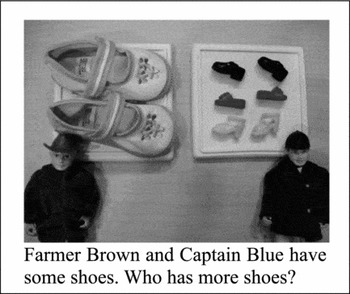
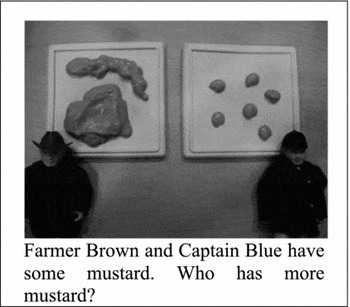
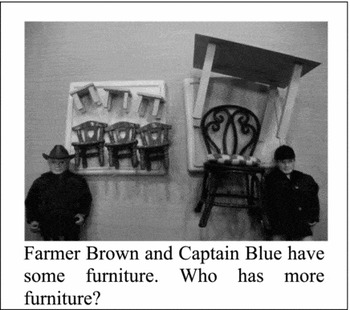
These nouns were presented with either mass or count syntactic cues, depending on the word class: Count nouns were presented in count syntax (e.g., more shoes), and substance- and object-mass nouns in mass syntax (e.g., more [mustard/furniture]). Japanese nouns, on the other hand, were presented without any syntactic cues (since they are absent in Japanese), as in yori-ookuno [kutu/karasi/kagu] “more [shoe/mustard/furniture]” (Inagaki & Barner, Reference Inagaki, Barner, Inagaki, Hirakawa, Hirakawa, Sirai, Arita, Morikawa, Nakayama and Tsubakita2009). Each item was accompanied by a photo containing two characters, one who had two large objects or two large portions of stuff, and the other who had six tiny objects or six tiny portions of stuff. The two large objects/portions always had a greater overall volume than the six tiny objects/portions. Each photo was followed by a question, Who has more X(s)?, to which participants provided their responses on a separate answer sheet. For example, Figure 1 shows a character (Farmer Brown) with two large shoes and another (Captain Blue) with six tiny shoes (where the six shoes amount to less overall stuff than the two large shoes). Below the photo was a statement – Farmer Brown and Captain Blue have some shoes. Who has more shoes? (such that the count noun shoe appeared twice with count syntax). If the learners picked six tiny shoes as more shoes, it meant that they interpreted the word as quantifying over individuals, whereas, if they chose two large shoes as more shoes, it indicated that they interpreted the word as quantifying over non-individuals. See Figures 2 and 3 for example test items for substance-mass and object-mass nouns.
Example test item for count nouns.

Example test item for substance-mass nouns.

Example test item for object-mass nouns.

Participants were tested individually and shown the stimuli on a computer screen. There were 12 items (four items for each word class), which were presented in two random orders, one order being the reverse of the other. Half of the participants completed one version and the rest the other version. The left–right locations of the two large objects/portions and the six tiny objects/portions within individual photos were also varied randomly. After reading the instructions, participants were shown the items one at a time, pressing a key to proceed to the next. There was no time limit but they all finished the task within four to five minutes.
Results
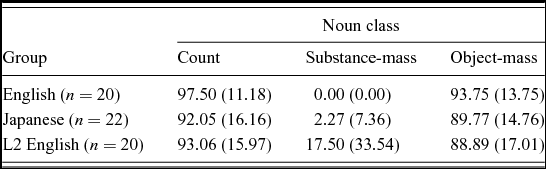
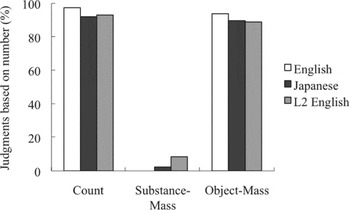
Table 2 presents the percentage of responses in which L2 learners of English, as well as L1 English speakers and L1 Japanese speakers in Inagaki & Barner (Reference Inagaki, Barner, Inagaki, Hirakawa, Hirakawa, Sirai, Arita, Morikawa, Nakayama and Tsubakita2009), based their judgments on number (i.e., judging six tiny objects/six tiny portions of stuff as more than two large objects/two large portions of stuff). Results are shown for count nouns (e.g., shoe), substance-mass nouns (e.g., mustard), and object-mass nouns (e.g., furniture). The results are also represented graphically in Figure 4.
English, Japanese, and L2 English number-based judgments for count nouns, substance-mass nouns, and object-mass nouns in percentages (standard deviations in parentheses).

English, Japanese, and L2 English judgments for count, substance-mass, and object-mass nouns.

The overall pattern of responses was similar among the three groups: The judgments for count and object-mass nouns were mostly number-based, whereas those for substance-mass nouns were predominantly volume-based. A two-way repeated measures ANOVA was conducted including one between-subject factor (language) with three levels (English, Japanese, L2 English), and one within-subject factor (noun class) with three levels (count, substance-mass, object-mass). There was a main effect of noun class, F(2,118) = 595.19, p < .0001, but no effect of language, F(2,59) = 1.65, p > .20, indicating that all language groups based judgments on number for count and object-mass nouns, but on volume for substance-mass nouns. This was confirmed by planned comparisons, which showed that substance-mass nouns were judged differently from both count nouns, F(1,61) = 925.85, p < .0001, and object-mass nouns, F(1,61) = 858.45, p < .0001, whose judgments did not differ from each other, F(1,61) = 1.27, p > .25. There was also a significant interaction between noun class and language, F(4,118) = 3.06, p < .05, with L2 English learners’ judgments for substance-mass nouns (17.50%) more number-based (with a large standard deviation of 33.54) than those of English speakers (0%) and Japanese speakers (2.27%). However, this seems to have been caused by two learners who, for some reason, gave number-based judgments to all test items regardless of the noun class. In fact, if these two subjects were removed from the analysis, the interaction ceased to be significant, F(4,114) = 1.40, p > .20, with the number-based judgment for substance-mass nouns decreasing to 8.33% and the standard deviation to 19.17.
In sum, similar to English and Japanese native speakers, Japanese learners of English based judgments on number for count nouns (e.g., cup) and object-mass nouns (e.g., furniture), and on volume for substance-mass nouns (e.g., mustard). Thus, when Japanese speakers learn English, they are not less likely than English speakers to construe the referents of nouns as objects. Instead, L2 learners of English are equally likely to quantify by number.
Experiment 2
The second experiment examined how Japanese learners of English interpreted mass–count flexible nouns, which can be used as either mass or count nouns (e.g., some [string/strings]), and compared the results to those of English and Japanese native speakers in Inagaki and Barner (Reference Inagaki, Barner, Inagaki, Hirakawa, Hirakawa, Sirai, Arita, Morikawa, Nakayama and Tsubakita2009).
Method
Participants
The participants were 39 undergraduate students, 20 of them at Osaka Prefecture University majoring in human sciences and 19 at Osaka University of Foreign Studies majoring in foreign languages (other than English). Their age ranged from 18 years to 47 years (M = 20.44, SD = 4.50). Most of them began learning English in junior high school or a “cram school” in Japan around age 12 (M = 11.72, SD = 2.04) and had studied English formally since then. None of them had stayed in an English-speaking country for longer than 30 weeks (M = 2.34, SD = 5.72). Thus, their proficiency level could be regarded as intermediate.
The L1 comparison groups from Inagaki and Barner (Reference Inagaki, Barner, Inagaki, Hirakawa, Hirakawa, Sirai, Arita, Morikawa, Nakayama and Tsubakita2009) consisted of 22 Japanese undergraduates (20 at Osaka Prefecture University, two at Osaka University of Foreign Studies) and 20 English-speaking undergraduates at Harvard University.
Materials
I used a quantity judgment task (Barner & Snedeker, Reference Barner and Snedeker2005) containing four mass–count flexible nouns in English, which are provided in (8) along with their Japanese counterparts used in Inagaki and Barner (Reference Inagaki, Barner, Inagaki, Hirakawa, Hirakawa, Sirai, Arita, Morikawa, Nakayama and Tsubakita2009).
-
(8) Mass–count flexible nouns
stone/isi, string/himo, chocolate/tyokoreeto, paper/kami
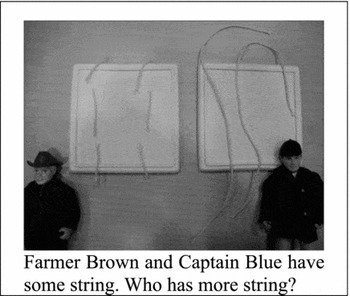
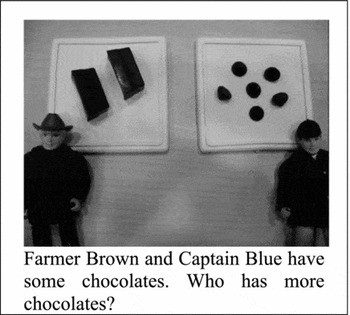
These nouns were presented in mass syntax (e.g., more string) to 20 of the participants and in count syntax (e.g., more strings) to 19 of them. Japanese nouns were presented without any syntactic cues, as in yori-ookuno himo “more string” (Inagaki & Barner, Reference Inagaki, Barner, Inagaki, Hirakawa, Hirakawa, Sirai, Arita, Morikawa, Nakayama and Tsubakita2009). Again, participants were presented with photos containing two characters: one who had two large items (e.g., two strings), and the other who had six tiny items (e.g., six strings). Each photo was followed by a question, Who has more X(s)?, to which participants gave their responses on a separate sheet. Figure 5 shows an example test item in which the noun appears twice with mass syntax ([some/more] string) and therefore should quantify by volume, whereas in Figure 6 the noun appears twice with count syntax ([some/more] chocolates) and therefore should quantify by number.
Example test item for mass–count flexible nouns used with mass syntax.

Example test item for mass–count flexible nouns used with count syntax.

Participants were tested individually and shown the stimuli on a computer screen. There were four items, which were presented in two random orders with either mass or count syntactic cues between subjects. The left–right location of the two large items and six tiny items in each photo was also randomized. After reading the instructions, participants were shown the items one at a time, pressing a key to proceed to the next. There was no time limit but they all finished the task within two to four minutes.
Results
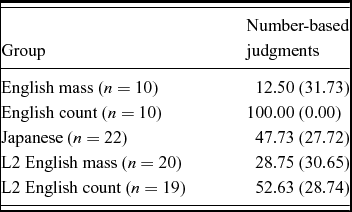
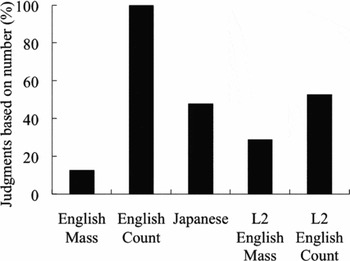
Table 3 presents the percentage of responses in which L2 learners of English, as well as L1 English speakers and L1 Japanese speakers in Inagaki & Barner (Reference Inagaki, Barner, Inagaki, Hirakawa, Hirakawa, Sirai, Arita, Morikawa, Nakayama and Tsubakita2009), gave number-based judgments (thereby judging six tiny items as more than two large items) for mass–count flexible nouns used with mass syntax (e.g., more string) and count syntax (e.g., more strings). The results are also represented graphically in Figure 7.
English, Japanese, and L2 English number-based judgments for mass–count flexible nouns in percentages (standard deviations in parentheses).

English, Japanese, and L2 English judgments for mass–count flexible nouns.

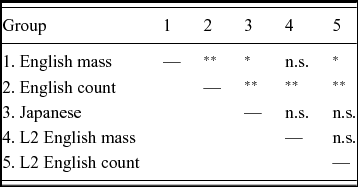
Overall, it appears that Japanese speakers’ judgments in both L1 and L2 fell between the mass and count judgments of L1 English speakers. A one-way ANOVA was conducted with language (English mass, English count, Japanese, L2 English mass, L2 English count) as an independent variable. There was a significant effect of language, F(4,76) = 15.50, p < .0001. Scheffé tests (Table 4) revealed that there were no significant differences among the three Japanese groups (Japanese, L2 English mass, L2 English count), but that there were significant differences between all pairs that included at least one English group (i.e., English mass or English count), except between English mass and L2 English mass. This indicates that L2 learners did not shift judgments according to the mass–count syntax in which the words appeared as clearly as English speakers. In fact, L2 English learners’ count judgments were at around chance level (52.63%), which were similar to their judgments in the L1 (47.73%). However, as mentioned above, no significant difference existed between L2 English mass and English mass, which might suggest L2 learners’ emerging sensitivity to mass syntax in English.
Results of Scheffé tests.

* p < .05, ** p < .01
In sum, unlike English native speakers, Japanese learners of English did not change interpretations depending on whether the words were used with mass or count syntax (e.g., string or strings). They seemed indecisive about mass–count flexible words, thus resembling the pattern found in L1 Japanese (except for their mild sensitivity to mass syntax).
Experiment 3
The third experiment extended the logic of Experiment 2 to investigate how Japanese learners of English interpreted cross-linguistic variable nouns – words that vary in mass–count status cross-linguistically – in English and French. Words like spinach are mass nouns in English, whereas their equivalents in French are count nouns (e.g., epinards “spinaches”). L2 English results were compared with L1 comparison groups of English, French, and Japanese speakers from Inagaki and Barner (Reference Inagaki, Barner, Inagaki, Hirakawa, Hirakawa, Sirai, Arita, Morikawa, Nakayama and Tsubakita2009).
Method
Participants
The participants were 20 undergraduate students, half of them at Osaka Prefecture University majoring in physical therapy and the other half at Osaka University of Foreign Studies majoring in foreign languages (other than English). Their age ranged from 18 years to 20 years (M = 19.25, SD = 0.79). Most of them began learning English in junior high school or a “cram school” in Japan around age 12 (M = 11.65, SD = 2.23) and had studied English formally since then. None of them had stayed in an English-speaking country for longer than five weeks (M = 1.16, SD = 1.65). Thus, their level of English could be described as intermediate.
The L1 comparison groups from Inagaki and Barner (Reference Inagaki, Barner, Inagaki, Hirakawa, Hirakawa, Sirai, Arita, Morikawa, Nakayama and Tsubakita2009) consisted of 22 Japanese undergraduates at Osaka Prefecture University, 20 English-speaking undergraduates at Harvard University, and 16 French-speaking students at College Montmorency in Laval, Québec.
Materials
I used a quantity judgment task (Barner & Snedeker, Reference Barner and Snedeker2005) containing four cross-linguistic variable nouns in English, which are provided in (9) along with their French and Japanese counterparts used in Inagaki and Barner (Reference Inagaki, Barner, Inagaki, Hirakawa, Hirakawa, Sirai, Arita, Morikawa, Nakayama and Tsubakita2009).
-
(9) Cross-linguistic variable nouns
spinach/épinards/hoorensoo, hair/cheveux/kami, pasta/pates/pasuta, toast/rotis/toosuto
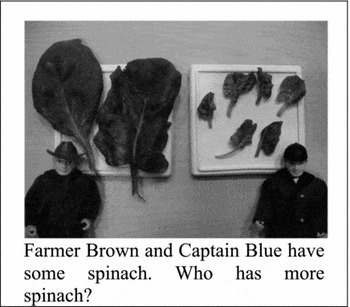
These nouns were presented with mass syntax in English (e.g., more spinach), with count syntax in French (e.g., le plus d'épinards “more spinaches”), and without any syntactic cues in Japanese (e.g., yori-ookuno hoorensoo “more spinach”) (Inagaki & Barner, Reference Inagaki, Barner, Inagaki, Hirakawa, Hirakawa, Sirai, Arita, Morikawa, Nakayama and Tsubakita2009). Again, participants made quantity judgments for comparisons of two large items versus six tiny items. Figure 8 shows an example test item.
Example test item for cross-linguistic variable nouns.

Participants were tested individually and shown the stimuli on a computer screen. There were four items, which were presented in two random orders. The left–right location of the two large items and six tiny items in each photo was also randomized. After reading the instructions, participants saw the items one at a time, pressing a key to proceed to the next. There was no time limit but they all finished the task within two to four minutes.
Results
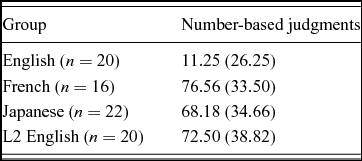
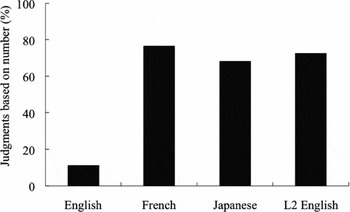
Table 5 shows the percentage of responses in which L2 learners of English, as well as L1 English, French, and Japanese speakers in Inagaki & Barner (Reference Inagaki, Barner, Inagaki, Hirakawa, Hirakawa, Sirai, Arita, Morikawa, Nakayama and Tsubakita2009), gave number-based judgments for cross-linguistic variable nouns (e.g., “spinach”). The results are also represented graphically in Figure 9.
English, French, Japanese, and L2 English number-based judgments for cross-linguistic variable nouns in percentages (standard deviations in parentheses).

English, French, Japanese, and L2 English judgments for cross-linguistic variable nouns.

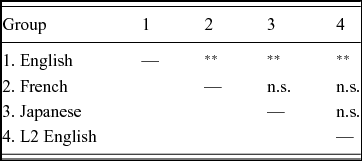
Overall, a majority of L2 English judgments were number-based, similar to French and Japanese judgments, but unlike English judgments, which were mostly volume-based. Indeed, a one-way ANOVA, including language (English, French, Japanese, L2 English) as an independent variable, revealed a significant effect of language, F(3,74) = 16.34, p < .0001. Scheffé tests (Table 6) showed that the English group differed from the other three groups, among which there were no significant differences. This suggests that, while English and French speakers’ judgments were in accordance with the syntax in which the words appeared (e.g., spinach/épinards), L2 learners’ judgments were mostly number-based although the words appeared with mass syntax (e.g., [some/more] spinach). In addition, the L2 judgments were similar to the judgments found in L1 Japanese, which were equally number-based in absence of syntactic cues.
Results of Scheffé tests.

** p < .01
In sum, syntax had a significant effect for English and French speakers’ judgments for cross-linguistic variable nouns like spinach or épinards, but not for Japanese speakers’ judgments for such nouns in English, which were largely number-based, similar to the judgments found in L1 French and L1 Japanese.
Discussion
Experiment 2 showed that Japanese learners generally failed to distinguish the count use of English mass–count flexible nouns (e.g., strings) from their mass use (e.g., string); Experiment 3 revealed that the learners were far more likely than English speakers to base quantity judgments for cross-linguistic variable nouns (e.g., spinach) on number, apparently disregarding the mass syntax in which the words appeared. These results have clear implications for what aspects of the mass–count distinction pose difficulty for Japanese learners of English, and what the grammatical nature of this confusion is. First, a key difficulty should be to master the mass–count status of the two classes of nouns – mass–count flexible nouns (e.g., string) and cross-linguistic variable nouns (e.g., spinach) – which denote either individuals as count nouns or non-individuals as mass nouns. Furthermore, the difficulty seems to be related to the learners’ inability to access the syntax–semantics mappings underlying the distinction. That is, since conceptual semantics alone cannot predict the mass-count status of these words (allowing either number-based or volume-based interpretations within or across languages), the learners must notice the mass–count syntax in which the words are used and interpret the referents accordingly in order to figure out their mass–count statuses. However, the learners apparently fail to draw on the syntactic cues to disambiguate the interpretation and thus are unable to acquire the distinction. Incidentally, although Experiment 2 generally revealed L2 learners’ insensitivity to mass–count syntax (with no differences among L2 mass, L2 count, and L1 Japanese judgments for flexible nouns like string), it also showed some effect of mass syntax for L2 learners (with no difference between their mass judgments for flexible nouns and those of English speakers). However, in Experiment 3 the learners showed no sensitivity to mass syntax by preferring the count judgments for cross-linguistic variable nouns, such as spinach, which are mass in English. Together, there was no substantial evidence in this study that indicated Japanese learners’ sensitivity to mass–count syntactic cues in English.
In contrast, Experiment 1 showed that Japanese learners correctly interpreted count nouns (e.g., cup) and object-mass nouns (e.g., furniture) as referring to individuals, and substance-mass nouns (e.g., mustard) as referring to non-individuals. This is perhaps not surprising given that Japanese controls performed similarly in the L1, suggesting that the first two classes of nouns individuate, but not the third, in Japanese as well (Inagaki & Barner, Reference Inagaki, Barner, Inagaki, Hirakawa, Hirakawa, Sirai, Arita, Morikawa, Nakayama and Tsubakita2009). This indicates that some Japanese nouns individuate in absence of count syntax, and that the concept of individuation is available to Japanese learners, due to L1 transfer, when they learn English.
All in all, the results of the present study suggest that Japanese speakers use the conceptual semantics of corresponding Japanese nouns to infer the mass–count statuses of English nouns, which is strongly supported by the fact that in all three experiments, the learners’ judgments generally mirrored those of Japanese controls. As previously proposed (Inagaki & Barner, Reference Inagaki, Barner, Inagaki, Hirakawa, Hirakawa, Sirai, Arita, Morikawa, Nakayama and Tsubakita2009), Japanese words quantify, in absence of mass–count syntax, by number if they denote individuals, by volume if they denote non-individuals, and by either number or volume (varying on an item-specific basis) if their reference is ambiguous. In other words, in Japanese, quantity judgments are based on the conceptual semantics of words. This approach would work in L2 English judgments as well if the referent of a word was unambiguously discrete (e.g., cup) or non-discrete (e.g., mustard), but not if the referent of a word could be construed either way (e.g., string, spinach). In the latter case, the learners would have to draw on mass–count syntax, as English speakers do, to select between number-based or volume-based interpretations; however, Japanese learners apparently fail to do so. In sum, Japanese learners’ insensitivity to syntactic cues to distinguish mass and count nouns in English may well be due to L1 influence since, in absence of mass–count syntax, whether a noun is countable or not is determined by semantics in Japanese.
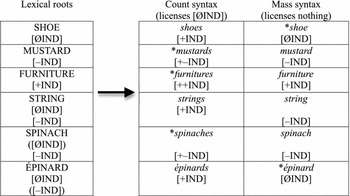
To be more explicit about the grammatical nature of my proposal, suppose that the mass–count distinction derives from a lexical feature specified for each noun. Specifically, following Barner and Snedeker (Reference Barner and Snedeker2005), count nouns have in the lexical root a principle of individuation [ØIND], which, in languages like English with obligatory mass–count syntax, must be licensed either lexically or by count syntax as [+IND], while substance-mass nouns do not have such a principle (i.e., [–IND]) in the lexical root. Figure 10 illustrates what each class of nouns has in its lexical root and how the lexical features interact with count and mass syntax to determine the well-formedness of the noun phrases. Count nouns (e.g., shoe) have the lexical feature [ØIND], which count syntax licenses (more shoes), but mass syntax leaves it unspecified, resulting in ungrammaticality (*more shoe). Substance-mass nouns (e.g., mustard) lack the lexical feature (i.e., [–IND]) and therefore are fine with mass syntax (more mustard) but incompatible with count syntax (*more mustards). Object-mass nouns (e.g., furniture) have a principle of individuation licensed lexically as [+IND] in the lexical root (Barner & Snedeker, Reference Barner and Snedeker2005, pp. 58–59) and thus are fine with mass syntax (more furniture) but cannot be doubly specified by count syntax (*more furnitures). Mass–count flexible nouns (e.g., string) have both [ØIND] and [–IND] (i.e., two meanings) in the lexical root: Count syntax (more strings) licenses the former as [+IND], whereas mass syntax (more string) realizes the latter as is. In other words, mass–count flexible nouns are count nouns in one meaning (i.e., [ØIND]) and substance-mass nouns in another (i.e., [–IND]). In English, cross-linguistic flexible nouns (e.g., spinach), with the lexical feature [–IND], are substance-mass nouns (more *spinaches/spinach). I assume that although this class of nouns semantically has both [ØIND] and [–IND] in the lexical root, the former option is syntactically unrealized in English. This ‘dormant’ [ØIND] is expressed as ([ØIND]) in Figure 10. In contrast, in French, these nouns have the lexical feature [ØIND] and therefore are count nouns (le plus d'épinards/*d'épinard “more spinaches/spinach”), leaving the other feature [–IND] syntactically dormant, which is expressed as ([–IND]) in Figure 10.Footnote 10
How lexical roots of different noun classes are realized in count or mass syntax.

Given Figure 10, it is clear that the acquisition of the mass–count distinction involves the learning of the lexical features associated with the different classes of nouns. Turning to the acquisition of English by Japanese speakers, the first three classes (SHOE, MUSTARD, FURNITURE) would be unproblematic because they are interpreted similarly in Japanese in absence of mass–count syntax. Presumably, the corresponding Japanese nouns have [+IND] for SHOE and FURNITURE and [–IND] for MUSTARD in the lexical roots, which are transferred to L2 English. On the other hand, in order to learn the lexical features associated with the other two classes (STRING, SPINACH), transferring the L1 features associated with these nouns in Japanese, which I assume are [+IND] and [–IND], to L2 English would not suffice (because the learner still could not decide which feature to select in a given context); the learner needs to observe the syntax in which the words appear (more strings/string/spinach), interpret them correctly as either [+IND] or [–IND] according to whether count syntax or mass syntax is used, and assign the correct feature [ØIND] or [–IND] to the lexical roots. Therefore, the correct syntax–semantics mappings are essential to acquire the mass–count statuses of these nouns. However, Japanese speakers have trouble mapping syntax to semantics, resulting in their failure to acquire the mass–count distinction for these nouns.
To recapitulate, I have proposed that the difficulty that Japanese speakers experience learning the mass–count distinction in English stems from a failure to map count syntax to individuals and mass syntax to non-individuals, which is required to acquire the mass–count statuses of those nouns that denote either individuals or non-individuals. In other words, Japanese learners of English have difficulty using syntactic cues to disambiguate the two meanings associated with these nouns and, as a result, fail to distinguish mass and count nouns. If this proposal is on the right track, the important implications of the present study are that (i) the conceptual semantics of nouns (i.e., whether a word refers to individuals, non-individuals, or both) has a lot to do with the difficulty Japanese speakers experience in learning the mass–count distinction in English, and that (ii) the difficulty arises from the learners’ inability to map syntax to semantics to identify which words are mass and which are count.Footnote 11 The novel contribution of this study would, then, be that it pinpointed problems with syntax–semantics mappings as a source of difficulty Japanese speakers encounter in learning the English mass–count distinction.
Finally, some limitations of this study should be pointed out. First, although Japanese speakers’ insensitivity to mass–count syntax in English was attributed to the L1, this might also be a universal tendency. To verify L1 transfer, we need to include L2 learners whose L1 has obligatory mass–count syntax like English and show that they outperform Japanese speakers. L2 learners of English with other classifier languages (e.g., Chinese, Korean) as their L1s should also be looked at to see if they have the same difficulty as Japanese speakers do (recall Footnote 8). Secondly, since this study involves only intermediate-level learners, it remains an open question whether more advanced L2 learners would eventually be able to draw on syntax–semantics mappings and acquire the mass–count distinction. It would also be interesting to see whether deliberately drawing L2 learners’ attention to the mappings may help them learn the distinction. Possibly, syntax–semantics mappings associated with the mass–count distinction are not explicitly taught and this is a factor contributing to the difficulty that the learners experience in mapping syntax to semantics. Lastly, this study did not investigate the mass–count distinction for abstract nouns (e.g., advice, suggestion, information, evidence, thought, pleasure), which, as previous studies suggest, might be most challenging for L2 learners. Presumably, these words could potentially refer to either discrete or non-discrete entities (i.e., have both [ØIND] and [–IND] in their lexical roots) and, in that sense, are similar to concrete ambiguous nouns like string and spinach. This is supported by the fact that, for example, thought can be either a count noun or a mass noun in English and that, while advice is a mass noun in English, conseil “advice” is a count noun in French. The learner, then, has to observe how the words are used in context, as in He read the manuscript and gave me some advice and suggestions , and draw on these syntactic cues to identify their mass–count statuses. This might explain why the mass–count distinction for abstract nouns is difficult to acquire. In any event, we need more research to fully understand the nature of the mass–count distinction in an L2.