This is a summary of an evidence brief for policy regarding human resource capacity building as well as staff motivation as policy options for developing the capacity to effectively implement the proposed malaria elimination strategy in Ethiopia. The methods used to prepare this policy brief are described in detail elsewhere (Reference Lavis, Wilson, Oxman, Lewin and Fretheim1–6). This policy brief assesses a health system problem, potential policy options and their impacts, and strategies for implementing those options. The policy brief brings together global research evidence (from systematic reviews) and local evidence to inform deliberations about building the human resource capacity for malaria elimination. The purpose of this report was to inform deliberations among policy makers and stakeholders, and specifically as a background document to be discussed at meetings (policy dialogues) of those engaged in developing policies for malaria elimination.
THE PROBLEM
Ethiopia is planning to eliminate malaria within the coming 7 years (7). However, this task being a formidable one requires a huge number of motivated and well-trained staff.
Size of the Problem
Sixty-eight percent of the total Ethiopian population is at risk of malaria infection (8). It has been reported that malaria is the major cause of death in rural Ethiopia (Reference Deressa, Fantahun and Ali9). This is where more than 83.9 percent of the total population resides (10). In 2007–08, malaria (diagnostically confirmed) was the top cause of outpatient visits and admissions, with 12 percent of all visits and 10 percent of admissions (11). Moreover, in light of the envisaged malaria elimination strategy, the need for additional human resources is eminent. However, specialized and mid-level malaria expertise has been dwindling over the past few decades, particularly people with entomological expertise, because of retirement or being transferred to other health services without trained persons to replace them (Reference Kitaw, Meskel and Djirata12).
Factors Underlying the Problem
Reasons for the shortage and maldistribution of health workers with the necessary expertise to control or eliminate malaria include a failure to replace the vertical control program with a viable alternative, inadequate motivation and retention of health workers, lack of a malaria control training center, and lack of a succession plan for people with malaria expertise.
The Vertical Malaria Control Program Was not Replaced with a Viable Alternative After Decentralization in 1993
There was no national program to control malaria in Ethiopia until 1959. Since 1959, the malaria program in Ethiopia has undergone various reforms, including the Malaria Eradication Service (1959–70), Malaria Control Program (1971–78), Division for Malaria Control (1979–85), and Malaria and Other Vector-Borne Diseases Organization (1986–93). After the dissolution of the Malaria Eradication Service, malaria control in Ethiopia lost its structural strength and manpower in the subsequent reforms, and finally in 1993, decentralization and integration led to malaria control workers being distributed among the federal states without an organizational structure capable of staff development, deployment, and guidance. Subsequently, the Ministry of Health lost experienced malaria workers due to retirement, attrition, or promotion to other fields of work, leaving malaria control activity understaffed in the country (Reference Kitaw, Meskel and Djirata12).
Lack of a Dedicated Malaria Control Training Center, Adequate Motivation and Retention Mechanisms, and Skill Transfer or Succession Plans
The Malaria Eradication Service training center stopped training in the 1970s (Reference Kitaw, Meskel and Djirata12). Since then, very few training activities for malaria experts have been carried out in Ethiopia (Reference Deressa, Olana and Chibsa13).
A key constraint in African health systems is the lack of properly trained and motivated health workers and retention mechanisms (14). The disparity between salaries of civil servants and people working for non-governmental organizations in Ethiopia is huge. This has drained people out of the Ministry of Health in general and the malaria control program in particular. Malaria experts were excluded from the 1997 and 2001 changes in career structure that were intended to benefit health professionals, and the incentives were not enough to retain and motivate other health professionals. Nonetheless, this affected negatively the morale of malaria experts and encouraged malaria experts to shift to administrative roles rather than malaria control in an effort to benefit from the changes in career structure (Reference Deressa, Olana and Chibsa13). Experienced malaria technicians who were trained in the 1960s were not replaced as their number dwindled over decades due to retirement and death (Reference Deressa, Olana and Chibsa13).
POLICY OPTIONS
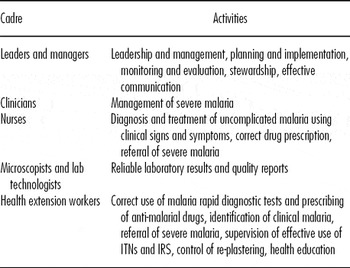
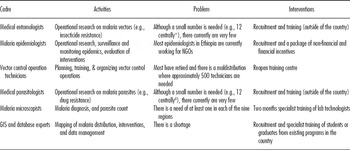
We propose three options for addressing the acute shortage of personnel necessary to implement the activities necessary to achieve malaria elimination in Ethiopia. These include: (i) in-service training to build up the knowledge and skills of general health workers involved in malaria control (Table 1) (ii) recruiting and training malaria specialists (Table 2), and (iii) motivating and retaining malaria experts so that there will be a sustainable pool to achieve and sustain malaria elimination.
Key Activities by General Health Personnel

ITNs, insecticide-treated nets; IRS, indoor residual spraying.
Summary of New Specialists, Activities, and Interventions to Combat the Existing Gap

aAt least one medical parasitologist/entomologist in each region.
NGO, non-government organization.
The three options are described below. The costs and cost-effectiveness of all the options are uncertain.
Policy Option 1: In-Service Training
In-service training is education for employees to help them develop their skills in a specific discipline or occupation. In-service training takes place after an individual begins work responsibilities. There are different approaches to improve health professional practice. These interventions include guideline dissemination, educational meetings, audit and feedback, outreach visits, supervision, and tailored interventions (Reference Grimshaw, Thomas and MacLennan15). Examples of the deliverables from this option are (i) improving quality of diagnosis and treatment, (ii) reduction of malaria cases and deaths, (iii) improve case detection and early warning, and (iv) support malaria surveillance and reporting at all levels.
Advantages
Advantages include that in-service training can potentially improve the human capacity to deal with malaria elimination and a large manpower force could be trained within a short period of time.
Disadvantages
Disadvantages include lack of trainers and training facilities, and difficulty in meeting standards in different regions of the country as the distributions of the manpower is not the same
Acceptability
Given the commitment by the government to eliminate malaria, the acceptability of this option is very high.
Policy Option 2: Recruit and Train Malaria Specialists
Malaria specialists (Table 2) are people who have gone through additional and/or specialized training on various techniques and skills related to malaria such as medical entomologists, medical parasitologists, microscopists, vector control operation experts, etc. Some of the results this intervention may deliver include the following: rebuild the malaria expertise in the country; create a sustainable pool of malaria experts; improve the quality control in malaria microscopy; improve the quality control in vector control operations; improve the monitoring and evaluation of malaria control and elimination program.
Advantages
This program can potentially improve the human capacity to deal with malaria elimination.
Disadvantages
Disadvantages are the lack of trainers and training facilities and that implementation is expensive.
Acceptability
Given the commitment by the government to eliminate malaria, the acceptability of this option is very high.
Policy Option 3: Motivation and Retention Packages for Malaria Specialists
Motivation and retention packages involve both financial and non-financial incentives. Examples of deliverables from this intervention include the following: highly motivated staff to tackle malaria elimination, less attrition, continuity of skill, increased commitment, increased productivity, increased efficiency, and increased ownership of the program.
Advantages
Providing both financial and other incentives could potentially improve the motivation and retention of malaria experts.
Disadvantages
Disadvantages are that it is expensive and some skills are not available in the market.
Acceptability
As a low-income country, this option would be very difficult for government to raise salaries and or provide other non-financial incentives, especially considering other sectors that are in a similar situation of shortage of skilled manpower.
IMPLEMENTATION CONSIDERATIONS
Building the human capacity to effectively implement malaria elimination is just one solution among many others. Building the human resource and motivating and retaining them requires other changes, including policy changes and collaborations with other sectors. Strategies for implementing all three options should take advantage of factors that enable their implementation as well as addressing barriers. Enabling factors include the following: Strong political commitment from the government, reactivation of malaria elimination as a top priority globally, major funding opportunities and public-private sector collaboration globally, effective intervention options both for treatment and vector control; and advanced research and training opportunities.
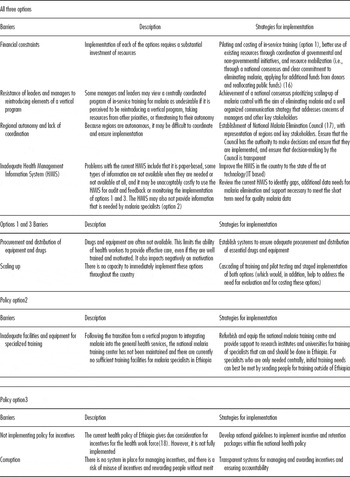
Barriers to implementing the three options and possible strategies for addressing them are summarized in Table 3. There is limited evidence of the extent of these barriers or of the effects of strategies for addressing them.
Showing Barriers and Implementation Strategies for the Three Options (Option 1: In-Service Training, Option 2: Recruit and Train Malaria Specialists, and Option 3: Motivation and Retention Packages for Malaria Specialists)

HMIS, Health Management Information System; IT, information technology.
THE NATIONAL POLICY DIALOGUE
This policy brief was discussed as a background document at a policy dialogue meeting in Gelan, Ethiopia. Participation at these meetings included policy makers, researchers, civil society, professional organizations, the academia, and development partners. The purpose of these dialogues was to conduct a structured discussion of the policy brief on the envisaged malaria elimination in Ethiopia by 2020. These deliberations among health policy makers and other stakeholders can potentially contribute to evidence-informed health policies by adding value to the policy brief through clarification of the problem and solutions and developing a shared understanding of the problem and possible solutions.
The dialogue was conducted in a very open manner following the structure of the policy brief. Every participant was given ample time to freely air his or her views. The role of the moderator was strictly to facilitate and keep the discussion on track. Various viewpoints and opinions were recorded without change as far as possible.
CONTACT INFORMATION
Mamuye Hadis, MSc, PhD, (mamuyeh@ehnri.gov.et), Director, Technology Transfer and Research Translation Directorate Project Coordinator, Supporting Use of Research Evidence for Policy Project, Ethiopian Health and Nutrition Research Institute Addis Ababa, Ethiopia, Adugna Woyessa, MSc, Technology Transfer and Research Translation Directorate, Ethiopian Health and Nutrition Research Institute, Addis Ababa, Ethiopia, Amha Kebede, MSc, PhD, Director General, Ethiopian Health and Nutrition Research Institute, Addis Ababa, Ethiopia
CONFLICTS OF INTEREST
The authors have received funding to their institution from the European Commission 7th Framework Programme.