Diagnoses in many neurodevelopmental disorders are largely based on a description of symptoms, with few specific measures or tests. Although diagnostic criteria (American Psychiatric Association, 1994; World Health Organization, 1992) provide reliability, they are limited in terms of their validity. The problem is not with typical cases of a condition with all or most of the described features, but in the many cases that have features of more than one diagnostic category. For example, the Kraepelinian dichotomy of schizophrenia and bipolar affective disorder has been prominent in psychiatry over the last century and continues to influence the way these disorders are considered by clinicians and the public. However, there is increasing evidence that these disorders share clinical signs and symptoms, respond to similar treatments, and share genetic susceptibility, and, by implication, underlying biological etiologies (Williams et al., Reference Williams, Craddock, Russo, Hamshere, Moskvina and Dwyer2011). Classical family studies show a clustering of specific diagnoses in families, but families often contain members with apparently unrelated conditions, and, seen in retrospect, researchers may not be taking a sufficiently broad approach to the full range of both behavioral and physical symptoms and signs.
Using schizophrenia as an example, families segregating multiple cases with schizophrenia and other different diagnoses have been described over the years (Waddington & Youssef, Reference Waddington and Youssef1988), but have generally been avoided in recent molecular genetic studies because they were thought to potentially carry multiple risk variants for the different disorders, which complicates genetic analysis. However, for some families the same mutation has been shown to be clearly linked to, and therefore largely causative of, multiple psychiatric diagnoses. The best described example is the large Scottish family cosegregating a 1:11 translocation (Blackwood & Muir, Reference Blackwood and Muir2004; St. Clair et al., Reference St. Clair, Blackwood, Muir, Carothers, Walker and Spowart1990), initially identified in a cytogenetic study of learning disability (LD), but noted to contain many translocation carriers with schizophrenia and other major mental disorders. The linked disorders include schizophrenia, bipolar disorder, and depression, but not additional conditions in the family such as alcoholism, anxiety, and minor cases of depression. Knowing which phenotypes are potentially related to a given mutation is more difficult in the absence of linkage information. Classical family studies have not generally found an excess of disorders outside the psychosis spectrum in relatives of probands with schizophrenia (Onstad, Skre, Edvardsen, Torgersen, & Kringlen, Reference Onstad, Skre, Edvardsen, Torgersen and Kringlen1991); however, statistical power has generally been limited. Large population and case registers such as the Danish Civil Registration System, which is linked to the Danish Psychiatric Central Register (Mortensen, Pedersen, & Pedersen, Reference Mortensen, Pedersen and Pedersen2010; Thorup, Waltoft, Pedersen, Mortensen, & Nordentoft, Reference Thorup, Waltoft, Pedersen, Mortensen and Nordentoft2007), have enabled an unbiased assessment of the conditions in first-degree relatives of cases diagnosed with schizophrenia. As expected, the highest relative risk was associated with schizophrenia in a first-degree relative, followed by a diagnosis in the schizophrenia-related category, and then almost all other categories of mental disorder, including childhood-onset conditions, such as autism and attention-deficit/hyperactivity disorder (ADHD) but not Alzheimer disease (Mortensen et al., Reference Mortensen, Pedersen and Pedersen2010). It should not be surprising that recent evidence from studies of structural variations in the human genome suggest that the situation is more complex than the relationship between schizophrenia and bipolar affective disorder, or the relative risk findings from the Danish population registers. Apparently similar DNA structural variants are emerging as rare mutations in disorders previously considered unrelated, including developmental and degenerative neuropsychiatric disorders, LDs, cognitive disorders, and a wide range of developmental physical abnormalities, including obesity and low body weight (Girirajan & Eichler, Reference Girirajan and Eichler2010; Shinawi et al., Reference Shinawi, Liu, Kang, Shen, Belmont and Scott2010). These recent developments could provide insights into the shared biology in a disorder as well as normal brain functions.
This article will review the literature on DNA structural variation in LD, autism, schizophrenia, and other disorders from classical cytogenetic abnormalities to emerging findings of rare submicroscopic copy number variations (CNVs).
Chromosomal Abnormalities in LD
Cases of LD (also known as mental retardation) are often associated with dysmorphic features, some of which are readily identifiable as in Down syndrome. Of the cases that do not fit into a known syndrome, a wide range of chromosomal abnormalities may be detected using classical cytogenetic techniques. In a large systematic survey of the literature, Van Karnebeek, Jansweijer, Leenders, Offringa, and Hennekam (Reference van Karnebeek, Jansweijer, Leenders, Offringa and Hennekam2005) report numerical and structural chromosome abnormalities in 9.5% of cases, with individual studies ranging from 2% to 48% of cases. Broken down by the severity of the disability, they report average rates of 4.1% of borderline and mild disability and 13.3% of those with moderate or profound disability. A full range of possible structural and copy number abnormalities are found, and deletions are particularly common and often associated with known syndromes including, among others, del(4)(p16); Wolf–Hirschhorn, del(5)(p15); Cri du chat, del(7)(q11.23q11.23); William syndrome, del(8)(q24.1q24.1); Langer–Giedion syndrome, del(15)(q11q13) paternal; Prader–Willi syndrome, del(15)(q11q13) maternal; Angelman syndrome, del(16)(p13.3); Rubinstein–Taybi syndrome, del(17)(p11.2p11.2); Smith–Magenis syndrome, del(17)(p13.3); Miller–Dieker syndrome, del(20)(p11.23p11.23); and Alagille syndrome and velocardiofacial syndrome (VCFS), del(22)(q11.2q11.2). VCFS is discussed further below, but it is interesting to note that even at this early stage, VCFS and some other cytogenetically visible mutations have been found associated with apparently different disorders. For example, chromosome 15 deletions have been recorded in Prader Willi and Angelman syndromes, speech and motor delay, epilepsy, and autism (Burnside et al., Reference Burnside, Pasion, Mikhail, Carroll, Robin and Youngs2011) and the chromosome 22q11.2 deletion in autism, schizophrenia, LD, and epilepsy (Vassos et al., Reference Vassos, Collier, Holden, Patch, Rujescu, St Clair and Lewis2010).
An excess of males over females in the lower range of the IQ distribution has long been recognized (Penrose, Reference Penrose1938). Given the expression of X-linked disorders in hemizygous males, the X chromosome has become an obvious target for cytogenetic abnormalities in LD. An important focus of recent research has been the identification of genes affected by X-chromosomal rearrangements in patients with nonsyndromic LD. The chromosomal rearrangements include those that are apparently balanced (at light microscopy level) X: autosome translocations, where the normal X chromosome is preferentially inactivated in females; X-chromosome inversions in males; and submicroscopic deletions in males. X-chromosome genes structurally affected by breakpoints or lost by deletion represent human gene knockouts that probably account for most of the symptoms in the patients who carry the particular chromosomal abnormality. Two of the first genes identified on the X chromosome (fragile mental retardation 2 and interleukin-1 receptor accessory proteinlike) were obtained by cloning from within deletions (Gu, Shen, Gibbs, & Nelson, Reference Gu, Shen, Gibbs and Nelson1996; Zhang et al., Reference Zhang, Huang, Niakan, McCabe, McCabe and Dipple2004).
Chromosomal Abnormalities in Autism
There have been multiple reports of autism associated with a chromosome abnormality, such as a deletion, duplication, inversion, or translocation; abnormalities on the long arm of chromosome 15 and numerical and structural abnormalities of the sex chromosomes are the most frequently reported. Reddy (Reference Reddy2005) in a survey of chromosomal examination in autism and related conditions, identified an abnormality in 14 of 421 individuals (3.33%). These 14 cases broke down into 4 supernumerary chromosome markers, 4 deletions, 1 duplication, 3 inversions, and 2 duplications. Several studies have confirmed that such abnormalities can be identified in ~3%–5% of these patients (Gillberg, Reference Gillberg1998; Vorstman et al., Reference Vorstman, Staal, van Daalen, van Engeland, Hochstenbach and Franke2006). The regions commonly reported include 2q37, 5p14, 5p15, multiple locations on chromosome 7, 11q25, 15q11-q13, 16q22.3, 17p11.2, 18q21.1, 18q23, 22q11.2, 22q13.3, and Xp22.2-p22.3.
The different deletions on the q arm of chromosome 22 are interesting. Deletions of the terminal 22q13 distal band define a syndrome that includes pervasive behavior abnormalities and impaired language development. However, the 22q11.2 microdeletion syndrome mentioned above in the context of LD, and known as VCFS, or diGeorge syndrome (Swillen et al., Reference Swillen, Devriendt, Legius, Prinzie, Vogels and Ghesquiere1999), is different and occurs in ~1/4,000 live births. The syndrome has a complex phenotypic expression and affects multiple organs. The physical features include a typical facial appearance (long face, narrow palpebral fissures, flattened malar eminences, prominent nose, and small mouth), anatomical and/or functional abnormalities of the palatal shelves (e.g., cleft palate and velopharyngeal insufficiency), lymphoid tissue hypoplasia, and heart defects. A wide range of childhood-onset developmental symptoms and disorders are described in association with the VCFS mutation (Gothelf, Schaer, & Eliez, Reference Gothelf, Schaer and Eliez2008), including ADHD, oppositional defiant disorder, phobias, anxiety, obsessive compulsive disorder, and autism spectrum disorders (ASDs).
Chromosomal Abnormalities in Schizophrenia
In the history of genetic research, there have been fewer cytogenetic studies of adult-onset disorders (e.g., schizophrenia and bipolar affective disorder), most likely because geneticists usually consult on pediatric cases, with only rare follow-ups to adolescence/adulthood, and general adult psychiatrists have a low index of suspicion for genetic syndromes in psychiatric patients, or have traditionally less access to clinical genetics services (Bassett, Chow, & Weksberg, Reference Bassett, Chow and Weksberg2000). In the early literature, the most consistent chromosomal anomalies reported associated with schizophrenia and related psychoses are those involving the sex chromosomes. Yet, sex chromosome loci for either of the major psychoses have not generally been considered, because the pattern of inheritance was thought to be inconsistent with a classic sex-linked gene (DeLisi et al., Reference DeLisi, Devoto, Lofthouse, Poulter, Smith and Shields1994). This study concluded that the sex chromosome aneuploidies (XXX and XXY) were increased in populations of patients with schizophrenia, but that there was insufficient data to determine whether an association also exists with XYY. However, a careful examination of cases of individuals with these aneuplodies show a wide range of psychiatric symptoms and social difficulties, including increased rates of psychotic symptoms, schizophrenia, and related diagnoses. A survey of 250 patients with schizophrenia (Kunugi, Lee, & Nanko, Reference Kunugi, Lee and Nanko1999) also showed an excess of X chromosome aneuploidies. The case sample also had an additional observed incidence of 4% for a percentric inversion of chromosome 9, which is generally considered a normal variant, compared to a rate of 1.7% in the Japanese population.
A review of the literature by Bassett et al. (Reference Bassett, Chow and Weksberg2000) concluded that the 22q11.2 microdeletion detected by fluorescence in situ hybridization was significantly associated with schizophrenia. Psychotic symptoms are common in VCFS populations (affecting ~30% of patients), and the VCFS mutation is overrepresented in unselected individuals with schizophrenia (Murphy, Reference Murphy2002). As described above for childhood-onset disorders, adolescents and adults with the VCFS mutation develop psychotic symptoms and receive diagnoses of schizophrenia and schizoaffective disorder.
Diagnostic Categories and Exclusion Criteria
It is worth digressing a little to comment on psychiatric diagnoses in the presence of a known or suspected “biological” etiology. Schizophrenia in the context of VCFS is generally considered to be VCFS with schizophrenia-like symptoms; autism in the context of fragile X is considered to be fragile X with autism-like symptoms. This raises a conceptual problem. Davidson and Bagley (Reference Davidson, Bagley and Herrington1969), in an extensive review of the literature, described conditions indistinguishable from schizophrenia occurring in over 100 brain disorders, including a wide range of genetic disorders and metabolic, toxic, tumor, and trauma-related conditions. They quote Kay (Reference Kay1963), “from these accounts one cannot avoid thinking that had the organic diagnosis not been reached independently of the psychiatric symptomotology, most of the cases would have been regarded as indubitably schizophrenic.” Is the diagnosis of schizophrenia incompatible with the presence of defined organic etiology? According to current diagnostic criteria, such cases, if known, should not be diagnosed as schizophrenia, and have generally not been included in genetic linkage and association studies. In a recent review of the autism literature, Betancur (Reference Betancur2011) reports on 103 disease-related genes and 44 genomic loci that have been reported in subjects with an ASD. Are these conditions not to be considered “true” autism? As with schizophrenia, many such cases, if known, are generally excluded from linkage and association studies. However, whereas cases of schizophrenia with epilepsy and LD have often been excluded from genetic studies, this is not the case with autism, because over 70% of cases have a LD and approximately 25% have epilepsy, both features considered as part of the autism syndrome. A similar conceptual problem occurs with epilepsy, where there are more than 200 Mendelian disorders described in which epilepsy is part of the clinical condition (Mulley & Mefford, Reference Mulley and Mefford2011). Taking the diagnostic concepts to the extreme, if all genetic causes of schizophrenia, autism, and epilepsy are ultimately identified, will these diagnostic categories cease to exist?
Copy Number Variation
The human genome has both sequence and structural variations, the majority of which have no functional consequences and are unrelated to any disorder. Structural variation may be balanced, such as with inversions and balanced translocations, or it may alter the DNA copy number. The latter, referred to as CNVs, extend from the duplication or deletion of a single base pair to whole chromosome abnormalities. The term CNV is arbitrarily used to indicate the larger changes. They were initially identified using cytogenetic methods: classical staining and light microscopy. However, rearrangements involving less than 1–2 mb are generally undetectable in this way. If large rearrangements and copy number abnormalities visible using cytogenetics methods underlie a substantial proportion of LD (up to 40% of severe cases), autism (up to 5%), and schizophrenia (1%–2%), then there is reason to suspect that smaller abnormalities might account for a substantial number of cases. Methodology in this area has progressed through a number of stages initially focused on single loci, and later on the whole genome. Screening using variable number tandem repeat probes was explored as a possible method of detecting smaller events by observing an abnormal inheritance of alleles from parents, but it was impractical because of the large number of probes that were required to screen the whole genome (Ropers, Reference Ropers2010). Evidence emerged to suggest that the terminal regions of chromosomes might be enriched for submicroscopic chromosomal abnormalities, and this led Flint et al. (Reference Flint, Wilkie, Buckle, Winter, Holland and McDermid1995) to examine this hypothesis in 99 cases with LD using subtelomeric polymorphic probes. Three cases of monosomy were detected, two on chromosome 22q and one on 13q. Two were due to unbalanced translocations and one a deletion. This encouraged the development of fluorescence in situ hybridization based probes for all telomeric regions (Knight & Flint, Reference Knight and Flint2002). Cryptic telomeric CNVs were shown to account for over 2% of cases of idiopathic ID (Ledbetter & Martin, Reference Ledbetter and Martin2007). Given that many of these deletions were interstitial and subtelomeric, there was interest in knowing if such deletions and other rearrangements might occur throughout the genome. This hypothesis was confirmed with the development of high-resolution array-based comparative genomic hybridization (Zhang, Gu, Hurles, & Lupski, Reference Zhang, Gu, Hurles and Lupski2009).
The development of arrays was preceded by the use of comparative genomic hybridization in which DNA from the study target (often tumor DNA) is competitively hybridized to a normal human chromosome metaphase spread so that relative amounts of target and reference DNA are bound to a locus on a chromosome dependent on the relative abundance of the sequences in the two samples. The arrays work in the same way except that the template on which the comparative hybridization is performed is DNA immobilized as an array on a platform such as a glass slide. The DNA arrays initially consisted of human DNA cloned into bacterial artificial chromosomes (arrays) representing the human genome at approximately 1-mb intervals. The present arrays consist of 25-mer oligonucleotides (probes) that were originally developed to detect single nucleotide polymorphisms (SNPs). Initial arrays were limited to a few thousand regularly spaced probes that could detect abnormalities of approximately 1 mb or greater. In the last two decades, however, the resolution of the arrays has improved to the extent that the number of smaller CNVs identified in the genome, which were previously invisible to microscopy, has increased enormously. Deletions and duplications as small as 10 kb are now known to occur throughout the genome. Array CGH studies in cases of idiopathic LD have identified apparently pathogenic CNVs in an additional 15% of cases (Jaillard et al., Reference Jaillard, Drunat, Bendavid, Aboura, Etcheverry and Journel2010; Koolen et al., Reference Koolen, Pfundt, de Leeuw, Hehir-Kwa, Nillesen and Neefs2009). At the current level of resolution, the number of CNVs identifiable in a given genome numbers in the hundreds, and, as the resolution increases, this is likely to increase into the thousands.
It is interesting that some CNVs appear to differ from SNPs in terms of locus specific mutation rates. Rates for genomic rearrangements range from 10−4 to 10−5, a rate that is a 1,000-fold more frequent than point mutations (Lupski, Reference Lupski2007). This high mutation rate, coupled with reduced fecundity in some carriers, and that, comparatively speaking, they affect a larger proportion of the genome, make CNVs a potentially important source of new and recent mutations in neurodevelopmental disorders.
Origin of CNVs
There are several mechanisms that result in the formation of a CNV. A common mechanism is nonallelic homologous recombination, which is associated with low-copy repeats (LCRs; Gu, Zhang, & Lupski, Reference Gu, Zhang and Lupski2008). LCRs, or segmental duplications, are DNA fragments greater than 1 kb in two or more copies and that have more than 90% sequence homology. With increasing size, sequence similarity and localization near one another, and they appear to cause genomic instability with recombination hotspots and unequal crossing over. If orientated in the same direction, they can result in deletions or duplications of the segment of the genome between them that is the same or similar in size between different individuals. Recurrent CNVs are largely caused by this mechanism, because multiple rearrangements, similar to each other, can arise independently in different individuals. If the LCRs are not orientated in the same direction or are complex in structure, CMVs may also occur, but they are likely to vary in size and be nonrecurrent. Nonallelic homologous recombinations can occur both in meiosis and, less often, during mitosis (as seen in some cancers). Other mechanisms that can lead to the formation of CNVs include nonhomologous end joining where additional sequences are inserted at a repair junction (Conrad et al., Reference Conrad, Pinto, Redon, Feuk, Gokcumen and Zhang2010). The breakpoints are often seen within repetitive elements in the genome. A further mechanism involves DNA replication errors such as microhomology-mediated break-induced replication, where the strand being replicated disengages from the original template strand and reattaches nearby because of DNA homology. This is a related to fork stalling and template switching, which is a replication-based mechanism that is normally induced by single strand breaks occuring during DNA replication. These mechanisms lead to genomic rearrangements that can vary in size and complexity. Finally, there is a mechanism involving retrotransposition of long interspersed nuclear elements that can move to new genomic locations using reverse transcription.
Detection of CNVs
Array-based comparative genome hybridization (aCGH), described above, is a method developed specifically for the purpose of detecting CNV between individuals’ DNA or between tumor and nontumor DNA from the same individual. It is becoming an increasingly routine clinical application in individuals with LD and other developmental syndromes (Shinawi & Cheung, Reference Shinawi and Cheung2008). Another method, used in recent research programs, is to interrogate SNP arrays for intensity information that might reflect copy number variation. The SNP arrays were developed for efficient genome-wide association studies in common disorders (including autism and schizophrenia) to search for common variants associated with disease risk. Although not the originally designed function of the arrays, computer algorithms have been developed to identify likely CNVs from the raw data. When identified, it is generally required that these be confirmed experimentally using quantitative polymerase chain reaction or aCGH. All methods have limitations when it comes to the identification of very small structural variants, which may be even more frequent in the genome than existing variants (Redon et al., Reference Redon, Ishikawa, Fitch, Feuk, Perry and Andrews2006). In addition, modern sequencing outputs are increasingly being mined for copy number information using sequence read measurements (Xi et al., Reference Xi, Hadjipanayis, Luquette, Kim, Lee and Zhang2011). These include a variety of approaches including paired end mapping, read depth of coverage analysis, split read analysis, and sequence assembly methods. However, sequence-based methods have not yet been widely applied to genomes, leaving most smaller CNVs as yet to be discovered and studied with respect to function and illness phenotype.
Mechanisms Whereby CNVs Affect Function/Phenotype
Most CNVs identified to date are large and may encompass one or more genes, and often many. In a recent study of CNVs detected using sequencing methods, nearly half of all deletions overlapped with genes (Mills et al., Reference Mills, Walter, Stewart, Handsaker, Chen and Alkan2011). Apart from the effects of under- or overexpression of genes, the CNV breakpoints may disrupt genes or affect their regulation or other aspects of their functionality. Stranger et al. (Reference Stranger, Forrest, Dunning, Ingle, Beazley and Thorne2007) looked at the effect of CNVs on gene expression in lymphoblastoid cell lines from the HapMap samples. Most of the CNV was appropriately correlated with gene expression, but a sizable proportion (~20%) was not, suggesting a range of mechanisms whereby CNVs and SVs in general may have a functional impact. Overall, a minimum of 20% of the measurable impact on gene expression was mediated by CNVs, with the remainder by mediated by SNPs, although these proportions are likely to change as smaller CNVs are identified.
The larger CNVs are likely to affect many genes, producing phenotypes affecting multiple systems, whereas the smaller variants may affect a single gene or even a single regulatory element of the gene. CNVs may also have long-distance effects on gene expression. In addition to effects on gene dosage, disruption, and regulation effects, deletions may unmask recessive mutations on the remaining strand, as often is the case in cancer.
Evolutionary Aspects of Structural Variation
From an evolutionary perspective, SVs may be neutral, detrimental, or advantageous, with duplications perhaps more likely to be neutral or beneficial than deletions (Cooper et al., Reference Cooper, Coe, Girirajan, Rosenfeld, Vu and Baker2011). As expected, the distribution of SVs in the reference genome is biased against gene-containing areas, suggesting that SVs are to some extent detrimental. This and their high mutation rate, the high proportion of genome sequence affected, and the probability of their overlapping with genes make them an important source of individual mutation burden, potentially increasing the frequency of many neurodevelopmental disorders that have markedly reduced fecundity (Lupski, Belmont, Boerwinkle, & Gibbs, Reference Lupski, Belmont, Boerwinkle and Gibbs2011).
CNVs and Developmental Psychopathology
The field of developmental psychopathology has been restricted at times by a focus on specific diagnostic categories or age profiles that had little connection between child and adulthood (Rutter & Sroufe, Reference Rutter and Sroufe2000). This applies to genetics research with its focus on clearly separated samples of individual diagnoses of childhood- and adult-onset disorders. This and rigid if reliable diagnostic boundaries has made the assimilation and comparison of findings more difficult than it should have been. Classical genetics data has often been constrained by these artificial boundaries and has struggled to enable the development of plausible and reliable models for genetic transmission of disorder or risk. Proposed models have ranged from a single major gene through intermediated combinations, most impossible to prove or disprove, to true polygenic models with liability thresholds (Gibson, Reference Gibson2011). Single gene, singlelocus models have been excluded using genetic linkage studies, but linkage studies have been insufficiently powerful to rule out anything other than the simplest of locus heterogeneity. Polygenic models are still being tested through large-scale genome-wide association studies, but the results to date have been modest, with a handful of SNP associations identified at genomewide significance (Ripke et al., Reference Ripke, Sanders, Kendler, Levinson, Sklar and Holmans2011; Sklar et al., Reference Sklar, Ripke, Scott, Andreassen, Cichon and Craddock2011). Nonetheless, these are important, not for the small amount of genetic variance that they explain (because most have relative risks of less than 1.2), but because they identify genes likely to be involved in the pathological process.
CNV Studies in Learning Disability
Numerous recurrent microdeletions and microduplications have been identified in patients with idiopathic LD using aCGH. The number is constantly being updated, but as of 2010, the total involved at least 19 genomic intervals (Ropers, Reference Ropers2010). It is interesting that most regions show reciprocal deletions and duplications, often creating distinct and differing syndromes. The detailed description of the full range of behavioral, cognitive, physical, and dysmorphic features are only slowly emerging. Many are specific for LD or developmental delay, but some syndromes have features of autism and schizophrenia as part of the phenotype, and some have been identified independently in surveys of large case samples specific to those disorders (International Schizophrenia Consortium, 2008). Reliable frequency estimates are often not available due to limitations on the phenotypic characterization or the number of cases studies. Mefford et al. (Reference Mefford, Sharp, Baker, Itsara, Jiang and Buysse2008) examined the frequency of recurrent CNVs in over 1,000 children with idiopathic LD, comparing them to frequencies in 2,500 screened healthy adults. Pathogenic and possibly pathogenic CNVs were identified in only 5.4% of the LD case sample, showing that common CNVs only account for a small percentage of cases where CNVs are likely to be involved. The remainder of the identified CNVs are rare, nonrecurrent, and often de novo. The former are also identified in the control sample, albeit significantly less frequently. Thus, there are two principle ways in which CNVs are confirmed as pathogenic: statistical and biological. This has become an increasingly important problem as high-resolution platforms are now able to identify up to 1,000 CNVs in any given individual, case or control. To interpret this data, a statistical requirement might be that a given CNV occurs more frequently at a genome-wide level of significance in cases compared to controls or that there are strong biological reasons why a given rare or even unique CNV might be considered pathogenic. A rare CNV that is de novo in a case, that is a large CNV and that potentially disrupts genes known or thought to be involved in the condition, is only “very likely,” but not proven to be involved in the pathological process. CNVs associated with LD tend to have high densities of functional elements, whereas benign CNVs are often enriched in repetitive sequences. A combination of statistical and biological evidence may be used to make a case for the pathogenicity of any given CNV. For example, a CNV showing a modest association with LD is more likely to be pathogenic if it disrupts a gene whose mouse orthologue, when mutated, results in abnormal axon or other neurodevelopmental morphologies. Therefore, as either statistical or biological evidence accumulates, suspected CNVs may be determined to be causative or may be excluded. Algorithm-based methods are being developed that will attempt to combine the complex sets of data required to determine pathogenicity at acceptable levels of sensitivity and specificity (Hehir-Kwa et al., Reference Hehir-Kwa, Wieskamp, Webber, Pfundt, Brunner and Gilissen2010).
One of the largest surveys to date (Cooper et al., Reference Cooper, Coe, Girirajan, Rosenfeld, Vu and Baker2011) included over 15,000 children referred to a commercial diagnostic laboratory with a general diagnosis of LD (73%) and/or developmental delay, but included a wide range of phenotypes including congenital malformations, hypotonia, feeding difficulties, speech and motor defects, growth retardation, cardiovascular and renal defects, epilepsy, hearing impairment, craniofacial and skeletal abnormalities, and behavioral symptoms. Using data from aCGH with up to 100,000 probes, the authors estimate that ~14% of the disorder in the cases was caused by larger rare CNVs (>400 kb). Defining rare as less than a 1% population frequency, they found a highly significant excess of large CNVs in cases compared to controls. Using the 400-kb threshold, they found the 25% of cases with LD or developmental delay, and 11% of controls, had at least one CNV of this size. As the size of the CNV increases, the odds ratio increased from 2.7 at >400 kb to 47 at >3 mb. In 45 known disorder regions, deletions in the cases were found to be twice as common as duplications. Greater complexity of phenotype and the severity of the LD are also associated with an increased burden of large CNVs. In addition to reporting frequencies in the 45 known genomic disorder regions, the authors identified an additional 14 novel and potentially pathogenic CNV loci. A similar study by Kaminsky et al. (Reference Kaminsky, Kaul, Paschall, Church, Bunke and Kunig2011) provided data from over 15,000 individuals referred to clinical genetics laboratories that were part of the International Standards for Cytogenomic Arrays consortium. The referrals were for diagnostic testing; clinical indications included unexplained developmental delay, LD, dysmorphic features, congenital abnormalities, autism and related disorders, or other features suggestive of a possible chromosomal syndrome. Fourteen deletions and seven duplications were significantly more frequent in cases compared to controls, and the most common deletion was at 22q11.2. The second most commonly affected region for both duplications and deletions was 16p11.2 and for duplications was 16p13.11. Using this data, Kaminsky et al. examined recurrent duplications and deletions previously identified in the literature as either pathogenic or a variant of unknown significance (VOUS). They confirmed the pathogenic call in all recurrent deletions, reclassified one VOUS (16p11.2 duplication) to pathogenic CNV, and reclassified three pathogenic CNVs (3q29, 8p23.1, and 5q35) to VOUS. This is likely to be a conservative count, until larger samples are available.
CNVs in Autism
As discussed above, autism is a phenotypic feature of many genomic disorders. Betancur (Reference Betancur2011) lists 103 disease genes and 44 genomic loci where autism or autistic-like behaviors have been described. The genes and loci listed were all causally implicated in LD, indicating that these two neurodevelopmental disorders share genetic risk. A genetic overlap between autism and epilepsy is also likely given the increased frequency of each condition in cases of the opposite diagnosis. Methods of detection of CNVs have differed between autism and LD, with the former being assessed with both aCGH and SNP array intensity information, and the latter mainly aCGH. Early use of aCGH in idiopathic autism suggested the method had promise in detecting hitherto unrecognized CNVs. For example, Jacquemont et al. (Reference Jacquemont, Sanlaville, Redon, Raoul, Cormier-Daire and Lyonnet2006) identified six deletions and two duplications in 29 patients presenting with syndromic ASD where previous high-resolution karyotyping was reported as normal. Another study showing the potential for CNV analysis was a large linkage study (Szatmari et al., Reference Szatmari, Paterson, Zwaigenbaum, Roberts, Brian and Liu2007) using a 10k SNP array. The authors highlight some individual findings, including a family with two sisters with ASD, both of whom had a ~300-kb deletion on Ch. 2p16, which included the coding exons of the neurexin 1 gene (NRXN1). A second finding was a recurrent 1.1-mb duplication at Ch. 1q2.1 in four affected individuals from three families, a third was a ~900-kb de novo duplication at 17p12 in an affected sib pair (and with the same region appearing as a maternally inherited deletion in two male siblings), and a paternally inherited deletion in a further female. Duplications in this region cause Charcot–Marie–Tooth 1A (CMT1A) and hereditary neuropathy with pressure palsies when deleted, and overlapping deletions are seen in Smith–Magenis syndrome, which includes symptoms of autism in many cases (Smith et al., Reference Smith, Boyd, Elsea, Finucane, Haas-Givler, Gropman, Pagon, Bird, Dolan and Stephens1993). The fourth CNV highlighted was duplications of 22q11.2, which is the VCFS region. However, in the two families described the duplication was not present in a male with a developmental disorder or a male with autism. This was an early indication of the complexity involved in attributing causation to individual CNVs.
A key development was the report of de novo CNVs in autism by Sebat et al. (Reference Sebat, Lakshmi, Malhotra, Troge, Lese-Martin and Walsh2007) using aCGH. The authors showed that individually rare CNVs, and, in particular, ones that affect neurodevelopmental genes, were enriched in cases. They further suggested that the rate of de novo CNVs differed between simplex cases, where they occurred in 10% of families in the sample, and familial cases, where they occurred in 3% of families, suggesting that sporadic and familial cases of ASD might have different underlying genetic mechanisms, although not all studies since then have found this distinction. Several studies of CNVs in large autism cases and family series have followed. Marshall et al. (Reference Marshall, Noor, Vincent, Lionel, Feuk and Skaug2008) examined 427 ASD families using a 500k SNP array and karyotyping by standard clinical diagnostic method. Using three CNV calling algorithms, they identified approximately 8 CNVs per case genome at a mean size of 390 kb, and with a more rigid set of criteria, approximately 3 CNVs per case genome at a mean size of 603 kb. This was similar to the number found in control samples, suggesting that germline chromosome instability was not a significant contributing mechanism. Of the total count of stringently defined CNVs, 277 occurred only in the case samples. A de novo rate of 7.1% and 2.0% in simplex and multiplex families, respectively, was observed, supporting the previous findings of Sebat et al. (Reference Sebat, Lakshmi, Malhotra, Troge, Lese-Martin and Walsh2007). Families occasionally showed more than a single de novo event where both may combine to produce risk. A further set of loci was identified in two or more unrelated families, increasing the evidence supporting a pathogenic role. As with the LD literature, at some loci, both deletions and duplication were found, suggesting a more complex mechanism than simple over- or underexpression of gene products. Of the 196 inherited CNVs confirmed experimentally, 90 were of maternal and 106 of paternal origin. The authors list numerous potential ASD candidate genes where a structural change was either de novo, found in two or more unrelated ASD cases, or, in the case of the X chromosome, transmitted from an unaffected mother. Given their rarity, very few individual CNVs in this study provided statistical evidence to support their role in autism. For example, 4 CNVs from 427 cases were found at the DPP6, a subunit that affects the function of Kv4.2 channels at the same site of expression as SH3 and multiple ankyrin repeat domains 3 (SHANK3) and neuroligin (NLGN) gene products. Only one similar CNV was found in 1,652 controls (Fischer exact test p = 0.016). In keeping with previous cytogenetic findings and the emerging overlap in disorders involved, CNVs were found that involved loci known in disorders such as Waardenburg Type IIa, speech and language disorder, LD and VCFS. A further case with a 500-kb duplication at 16p11.2 was identified, a region also implicated in LD, physical developmental abnormalities, and epilepsy. Christian et al. (Reference Christian, Brune, Sudi, Kumar, Liu and Karamohamed2008) used cCGH in a study of 397 unrelated cases, a subset of the Autism Genetic Resource Exchange sample with ASD, compared to controls. A total of 51 CNVs were found in 46 cases and not in the controls. Forty-two were familial and 9 de novo with recurrence in 2 or more cases at three loci. In total, case-specific CNVs were found in 11.6% of cases, although, in keeping with the Marshall et al. (Reference Marshall, Noor, Vincent, Lionel, Feuk and Skaug2008) study, none were individually associated with case status, and the majority were observed in only a single case. Pinto et al. (Reference Pinto, Pagnamenta, Klei, Anney, Merico and Regan2010) compared CNVs in 996 ASD cases of European ancestry to 1,287 matched controls, using the Illumina 1M SNP array. Cases were found to carry a higher global burden of rare, genic CNVs, especially so for loci previously implicated in either ASD and/or intellectual disability. Nearly 6% of the cases had de novo mutations with some having two or more events. Novel candidate genes were identified that were seen as de novo in cases and not controls, including SH3 and multiple ankyrin repeat domains 2 (SHANK2), synaptic Ras GTPase activating protein 1 (SYNGAP1), and disks large-associated protein 2 (DLGAP2) genes. In keeping with previous studies, only one novel CNV (maternally inherited X-linked deletions at patched domain containing 1 [PTCHD1]) occurred statistically more frequently in cases compared to controls (7 vs. 0). This finding is supported by the report of two male siblings with autism both of whom inherited a deletion at Xp22.11 containing only the PTCHD1 gene (Filges et al., Reference Filges, Rothlisberger, Blattner, Boesch, Demougin and Wenzel2011), and in another family with cosegregating LD (Whibley et al., Reference Whibley, Plagnol, Tarpey, Abidi, Fullston and Choma2010). Its involvement in autism and LD was further extended and confirmed in a focused examination of the PTCHD1 locus in cohorts of autism and LD cases, and by extending the study of CNVs to sequence data, identifying additional maternally inherited missense mutations in eight probands not seen in controls (Noor et al., Reference Noor, Whibley, Marshall, Gianakopoulos, Piton and Carson2010). In the Pinto et al. (Reference Pinto, Pagnamenta, Klei, Anney, Merico and Regan2010) study, certain gene sets were found to the enriched for case deletions but not duplications. These included sets involved in cell and neuronal development, projection, motility, and proliferation; GTPase/Ras signaling known to be involved in regulating dendrite and spine plasticity, and kinase activity/regulation. There was additional overlap with gene sets thought to be involved in LD, including microtubule cytoskeleton, glycosylation, and central nervous system development/adhesion. In a more recent study, Salyakina et al. (Reference Salyakina, Cukier, Lee, Sacharow, Nations and Ma2011) showed the value of extended multiaffected families in a CNV study of 42 families. They found five deletions and seven duplications that cosegregated with ASD, two overlapping with known autism CNVs on 7p21.3 and 15q24.1, and two near regions on 3p26.3 and 12q24.32 previously associated with schizophrenia.
As the resolution of the probe arrays improves, smaller CNVs will be detected, and the boundaries of previously identified CNVs will be refined (Celestino-Soper et al., Reference Celestino-Soper, Shaw, Sanders, Li, Murtha and Ercan-Sencicek2011). Nord (Reference Nord, Roeb, Dickel, Walsh, Kusenda and O'Connor2011) examined genomic DNA of 41 children with autism and 367 healthy controls for rare CNVs using a very high-resolution aCGH platform. They found that cases were more likely than controls to have CNVs as small as ~10 kb, which likely affects genes involved in transcription, nervous system development, and receptor activity. They found that expression of contactin-associated proteinlike 2 (CNTNAP2), zinc finger protein 214 (ZNF214), proline dehydrogenase (oxidase) 1 (PRODH), and AT rich interactive domain 1B (ARID1B), genes, all genes affected by CNVs, were decreased in probands compared with controls, suggesting reduced expression as a potentially etiological factor during development.
Larger samples, particularly those based on families, will also enable the improved estimation of the overall effects of de novo mutations and the assessment of rare recurrent events as disease-associated mutations (Sanders et al., Reference Sanders, Ercan-Sencicek, Hus, Luo, Murtha and Moreno-De-Luca2011). Sanders et al. studied 1,124 autism families containing a probands, unaffected parents, and an unaffected sibling, using the Illumina 1M SNP array. In a related article (Levy et al., Reference Levy, Ronemus, Yamrom, Lee, Leotta and Kendall2011), they were able to confirm de novo CNVs identified using the SNP array with those detected using a Nimblegen 2.1M aCGH platform. A combined total of 58 rare de novo CNVs were identified in the two studies, with each array type identifying 95% of the total. However, the sensitivity to smaller CNVs was low for both arrays. Overall, the burden of rare de novo CNVs in the Sanders et al. (Reference Sanders, Ercan-Sencicek, Hus, Luo, Murtha and Moreno-De-Luca2011) study was greater in probands than in siblings for total number, size, and gene content. Using the rate in siblings as a control to evaluate the findings in the cases, there was strong individual statistical support for recurrent de novo duplications at 7q11.23, the locus at which deletions cause Williams–Beuren syndrome; deletions at 16p11.2; and duplications at 16p11.2. In addition, the authors observed 8 loci at which rare transmitted CNVs, present only in probands, overlapped with 1 of the 51 regions in probands containing one or more rare de novo CNVs. However, the rare transmitted CNVs were not more likely to be in cases than in unaffected siblings, even when subdivided into genic, exonic, and brain expressed; or previously identified as ASD related. This suggested that the excess burden in their sample was due to rare de novo events, although when the gene sets were applied to pathway analysis, more pathways showed enrichment in the case set compared to the sibling set. At the time of writing, the number of definitive replicated findings for autism from all studies has been small, with data suggesting an extreme heterogeneity model with no single risk variant occurring in more than 1% of cases.
Mutation Rates and Models of Risk in Autism
Given the replicated finding that de novo mutations are more frequent in simplex cases compared to familial cases, Zhao et al. (Reference Zhao, Leotta, Kustanovich, Lajonchere, Geschwind and Law2007) have suggested a model of autism risk in which families fall into two groups: those in which the overall risk for autism is low (the majority of families), and those in which the risk is higher due to a disease mutation with a dominant mode of transmission with greater penetrance in males compared to females. In this model, sporadic cases of autism occur in low-risk families due to a de novo mutation of relatively high penetrance, whereas familial autism occurs due to the inheritance of an existing mutation from a clinically unaffected or asymptomatic parent.
Estimated de novo mutation rates have been based on data from individual loci (Lupski, Reference Lupski2007; Turner et al., Reference Turner, Miretti, Rajan, Fiegler, Carter and Blayney2008), from population genetics based approaches (Conrad et al., Reference Conrad, Pinto, Redon, Feuk, Gokcumen and Zhang2010), or directly from genome-wide data in families (Sebat et al., Reference Sebat, Lakshmi, Malhotra, Troge, Lese-Martin and Walsh2007; Xu et al., Reference Xu, Han, Morales, Menzie, Williams and Fan2008). These estimates have been limited in accuracy by initial assumptions and sample size. Itsara et al. (Reference Itsara, Wu, Smith, Nickerson, Romieu and London2010) focused on large (>500 kb) de novo CNVs using three samples: the HapMap samples, autism families, and asthmatic proband trios. They estimated the genome-wide frequency of de novo CNVs to be 1.2 × 10⁻² per haploid genome per generation in the asthma sample. This rate (9 of 772) was similar to the rate calculated from unaffected individuals from the multiplex autism pedigrees (4 of 736). However, the rate in autism-affected individuals in these pedigrees was enriched approximately fourfold compared to the combined rate in unaffected individuals.
These results are consistent with the models proposed by Zhao et al. (Reference Zhao, Leotta, Kustanovich, Lajonchere, Geschwind and Law2007), described above. In another model, Girirajan and Eichler (Reference Girirajan and Eichler2010) proposed the necessity in some families for a second mutation to lead to severe neurodevelopmental disorder. In this study, individuals with childhood developmental delay are enriched approximately fourfold for a rare 520-kb 16p12 deletion. In nearly all cases examined (22 of 23), the deletion was inherited. Thus, 16p12 deletions appear to be an example of inherited predisposition to neurodevelopmental disorders with dominant transmission. However, these individuals were more likely to carry a second large (>500 kb) CNV compared to matched controls, and clinical features of those with a second large CNV were typically more severe than those with the 16p12 deletion alone. Itsara et al. (Reference Itsara, Wu, Smith, Nickerson, Romieu and London2010) suggest that multiaffected autism pedigrees segregate an existing inherited mutation of low penetrance, which, by itself, is rarely sufficient to cause disease. Secondary mutations, such as de novo mutations, are required to manifest a disorder. Whether these second hits are disease-specific remains to be determined. The authors propose that the excess of de novo CNVs among cases may be due to a depletion of second hits in the unaffected sibling, which in turn is due to the initial low penetrant mutation segregating in the family. The abundance of inherited low-penetrance mutations and the high rate of de novo CNVs in the population enable multiple cases to appear within families with apparently unusual patterns of inheritance.
CNVs in Epilepsy
In epilepsy, the discovery of single-gene forms of the disorder led to an awareness that both sequence and structural variation might be involved at the same loci. For example, most cases of Dravet syndrome are caused by sequence mutations at the sodium channel, voltage-gated, type I alpha subunit (SCN1A) gene. However, in those that are not, a percentage is due to CNVs (Mulley et al., Reference Mulley, Nelson, Guerrero, Dibbens, Iona and McMahon2006). Other similar syndromes were found to be due to deletions affecting the protocadherin 19 gene (PCDH19) on the X chromosome, a gene also associated with LD. Another example is Lennox–Gastout syndrome with a duplication at 15q11.2–q13.1, and a myoclonic epilepsy with a deletion at 15q26. Recurrent CNVs have been identified in epilepsy with support for deletions at 1q21.1, 15q11.2, 15q13.3, 16p11.2, and 16p13.11 in patients with a variety of epilepsy syndromes (de Kovel et al., Reference de Kovel, Trucks, Helbig, Mefford, Baker and Leu2010; Heinzen et al., Reference Heinzen, Radtke, Urban, Cavalleri, Depondt and Need2010; Helbig et al., Reference Helbig, Mefford, Sharp, Guipponi, Fichera and Franke2009; Mefford et al., Reference Mefford, Muhle, Ostertag, von Spiczak, Buysse and Baker2010). Three common recurrent deletions at 15q13.3, 16p13.11, and 15q11.2 collectively accounted for ~3% of cases (Mefford & Mulley, Reference Mefford and Mulley2010). Reflecting findings in autism, some cases had more than one potentially pathogenic CNV, suggesting the existence of a mechanism underlying phenotypic variability. In this context, the 15q13.3 deletion was not present in a cohort of 300 cases with partial epilepsies, suggesting that the deletion may be specific for generalized epilepsy (Heinzen et al., Reference Heinzen, Radtke, Urban, Cavalleri, Depondt and Need2010). In an aCGH survey of 279 cases with unexplained epilepsy (Striano et al., Reference Striano, Coppola, Paravidino, Malacarne, Gimelli and Robbiano2011), rare (i.e., absent in DGV) CNVs occurred in 26 patients compared to 16 of 246 controls. CNVs in the cases were larger and had a higher gene content. The type of epilepsy (focal vs. generalized) was not associated with the occurrence of CNVs, whereas LD and neuropsychiatric features (e.g., autistic traits and hyperactivity) were associated. In 21 cases with parental information, 10 occurred de novo and 9 were inherited. The de novo CNVs were larger and had a higher gene content than the inherited CNVs. Analyzing the 791 genes involved in the CNVs in cases using gene ontology (GO) categories showed significant enrichment for genes involved in ion channels, posttranslational modification of proteins, cell differentiation, and metabolic processes, whereas CNVs in controls showed no significant enrichment for any GO category.
CNVs in Schizophrenia and Other Mental Disorders
The findings for schizophrenia and other mental disorders are covered in detail in an article by Rucker and McGuffin (Reference Rucker and McGuffin2012) and therefore will be only summarized here. Routine chromosomal analysis is rarely undertaken in adults with mental disorders unless they have concurrent LD or obvious dysmorphic features. Abnormalities in single cases or small families have been reported for almost all chromosomes (MacIntyre, Blackwood, Porteous, Pickard, & Muir, Reference MacIntyre, Blackwood, Porteous, Pickard and Muir2003), but multiple independent cases with the same abnormality or multiple cases in the same family with evidence of cosegregation between the psychosis phenotype and the abnormality have been rare. However, examples for both of these scenarios emerged in the form of the 22q11.2 microdeletion (VCFS), and a 1:11 translocation with significant evidence of linkage to psychoses and other psychiatric diagnoses in a large Scottish family (Blackwood et al., Reference Blackwood, Fordyce, Walker, St. Clair, Porteous and Muir2001).
Both LD and autism were found to have higher rates of CNVs elsewhere in the genome, and given that these two conditions are sometimes seen as comorbid with schizophrenia, researchers have applied the newly developed CNV detection methods to schizophrenia samples. Key studies include Walsh et al. (Reference Walsh, McClellan, McCarthy, Addington, Pierce and Cooper2008), who found that rare variants >100 kb (“rare” being defined as those not previously described in DGV-3), disrupting genes, were more common in cases (15% in adult-onset cases and 20% in childhood-onset cases) than in controls, and collectively were significantly overrepresented in gene pathways important to brain development. This study was not able to prove involvement in schizophrenia of any individual variant or gene, but this subsequently occurred with the investigation of very large cohorts of patients that had been genotyped with genomewide SNP arrays. The International Schizophrenia Consortium (2008) identified three CNVs more common in cases: deletions at the VCFS region and deletions at 15q13.2 and 1q21.1. Stefansson et al. (Reference Stefansson, Rujescu, Cichon, Pietilainen, Ingason and Steinberg2008) found significant associations at 1q21.1, 15q11.2, and 15q13.5 overlapping with the first study. Odds ratios calculated were 14.83, 2.73, and 11.54 for the 1q21.1, 15q11.2, and 15q13.3 deletions, respectively. These compared to odds ratios of 6.6 for the 1q21.1 deletion and 17.8 for the 15q13.3 deletion reported by the International Schizophrenia Consortium (2008). More recent studies have shown additional individual loci to be significantly more frequent in cases than in controls. These include deletions of 3q29 (Mulle et al., Reference Mulle, Dodd, McGrath, Wolyniec, Mitchell and Shetty2010) deletions and duplications at 16p13.1 (Ingason et al., Reference Ingason, Rujescu, Cichon, Sigurdsson, Sigmundsson and Pietilainen2011), duplications at 16p11.2 (McCarthy et al., Reference McCarthy, Makarov, Kirov, Addington, McClellan and Yoon2009), and duplications of the vasoactive intestinal peptide receptor 2 gene (VIPR2; Vacic et al., Reference Vacic, McCarthy, Malhotra, Murray, Chou and Peoples2011). The latter is of additional interest in that increased VIPR2 expression may be a potential target for the development of therapies.
To assess penetrance values for CNVs associated with schizophrenia, Vassos et al. (Reference Vassos, Collier, Holden, Patch, Rujescu, St Clair and Lewis2010) used a Bayesian method applied to pooled case control data from published studies. Penetrance was highest for the 22q11 deletion at 0.55, with the next highest being the 15q13.3 deletion at 0.07 and the lowest being 15q11.2 deletion at 0.02. The authors point out that these are penetrance values for schizophrenia, whereas the CNVs are also risk factors for LD and other neuropsychiatric disorders. Therefore, their overall penetrance might be considerably higher.
Sahoo et al. (Reference Sahoo, Theisen, Rosenfeld, Lamb, Ravnan and Schultz2011) have taken a genotype first approach to the examination of broad phenotypic effects of CNVs by identifying 20 CNV loci reported to be associated with schizophrenia, and testing 38,779 individuals referred for routine microarray diagnostic testing. They identified 1,113 individuals with CNVs at these 20 loci and, of these, 1,035 had a CNV at one of six recurrent loci: 1q21.1, 15q11.2, 15q13.3, 16p11.2, 16p13.1, and 22q11.2. The reasons for the original referrals included developmental delay, LD, autism and related disorders, and multiple physical and congenital abnormalities.
ADHD symptoms are seen in children with VCFS, fragile X syndrome, sex chromosome aneuploidies, Simpson–Golabi–Behmel syndrome, and partial trisomy of chromosome 16 (Stephen & Kindley, Reference Stephen and Kindley2006). The evidence to date suggests that these abnormalities are more likely to be found in children with a LD comorbid with their ADHD as in an unselected sample of 100 children with ADHD in which only a single case had an abnormality (47,XXX), and this did not differ significantly from that expected in the general population (Bastain et al., Reference Bastain, Lewczyk, Sharp, James, Long and Eagen2002). Elia et al. (Reference Elia, Gai, Xie, Perin, Geiger and Glessner2010) found CNVs in ADHD were enriched, compared to controls, for genes implicated in autism, schizophrenia, and Tourette syndrome. Williams et al. (Reference Williams, Zaharieva, Martin, Langley, Mantripragada and Fossdal2010) found a significantly increased rate of large (>500 kb) rare (<1% population frequency) CNVs in ADHD cases compared with controls, particularly for those with intellectual disability, in keeping with cytogenetic findings described above. A duplication at 16p13.11 was the only CNV to occur individually more frequently in cases. In a further study in a large sample of ADHD cases and controls, with replication from multiple independent case and control cohorts, Elia et al. (Reference Elia, Glessner, Wang, Takahashi, Shtir and Hadley2011; Rucker et al., Reference Rucker, Breen, Pinto, Pedroso, Lewis and Cohen-Woods2011) reported CNVs affecting metabotropic glutamate receptor (GRM) genes as significantly enriched in cases, with GRM5, GRM7, and GRM8 deletions and GRM1 duplication individually more common in cases compared to controls. The numbers affected by these CNVs were very small in comparison to the total number of cases, the most frequent being the GRM5 deletions occurring in only 10 of 2,493 cases.
In depression, in a study of 3,106 cases and a combined total of over 6,000 controls, Rucker et al. (Reference Rucker, Breen, Pinto, Pedroso, Lewis and Cohen-Woods2011) showed deletions, but not duplications, to be more common in cases. The finding was largely due to CNVs affecting genes. Taken together, there was enrichment for CNVs in cases to have been previously implicated in schizophrenia.
CNVs may also play a role in speech and language disorders. Rare mutations of the Forkhead box protein P2 (FOXP2) gene have been described in individuals having expressive and receptive language and speech deficits generally described as developmental verbal dyspraxia (Hurst, Baraitser, Auger, Graham, & Norell, Reference Hurst, Baraitser, Auger, Graham and Norell1990; Lai, Fisher, Hurst, Vargha-Khadem, & Monaco, Reference Lai, Fisher, Hurst, Vargha-Khadem and Monaco2001). Horn et al. (Reference Horn, Kapeller, Rivera-Brugues, Moog, Lorenz-Depiereux and Eck2010) used aCGH in 1,523 patients with LD and found three cases with de novo overlapping deletions solely affecting the Forkhead box P1 (FOXP1) gene. All three cases had moderate LD and significant language and speech deficits. The authors concluded that the haploinsufficiency of the FOXP1 gene leads to abnormal development of the neural structures that coordinate general cognitive, psychomotor, and verbal abilities.
Tourette syndrome may also be associated with the same CNVs that have been found in other neuropsychiatric disorders. In a sample of 111 cases, Sundaram, Huq, Wilson, and Chugani (Reference Sundaram, Huq, Wilson and Chugani2010) found 5 exons disrupting CNVs. Two unrelated cases had deletions affecting NRXN1, and a pair of identical twins, both with Tourette syndrome, had a 1q21 deletion that had been previously reported in association with LD, autism, and schizophrenia.
Case Ascertainment Strategies
Data on CNVs in neurodevelopmental disorders are accumulating rapidly and an increasing number are being strongly associated with specific disorders. The ascertainment strategies for samples being analyzed, however, does not easily allow for an accurate estimation of penetrance. Samples to date have been either disease specific, or based on cases referred for routing diagnostic cytogenetics. Both approaches have obvious ascertainment biases. Some studies, although disease specific, have assessed unselected cases (Bassett et al., Reference Bassett, Costain, Fung, Russell, Pierce and Kapadia2010). A new approach is required that could systematically sample all cases presenting with broadly based mental health diagnoses, neurological disorders, and neurodevelopmental disorders presenting to pediatricians and LD cases. Ascertainment should be epidemiologically based, and encompass all childhood- and adult-onset disorders. The sample should include parents and other family members where available. Data from such a sample would allow for more accurate estimates of penetrance, frequency of recurrence, de novo CNVs, and other mutations. It would also permit a closer phenotypic examination of family members who carry risk CNVs but who have not presented with any disorder. Careful assessment of cognitive function, and brain structure and function might reveal subtle phenotypic and human functional effects in apparently normal carriers of risk CNVs.
Individual CNV Syndromes
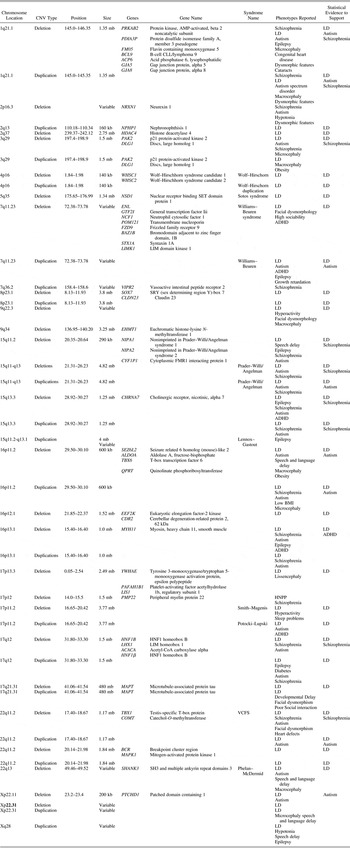
The list of individual CNV syndromes is growing steadily as larger numbers of samples are being examined with high density arrays. The ones outlined in Table 1 have strong statistical, biological, or combined evidence supporting their role in neurodevelopmental disorders. Characteristic phenotypic patterns are emerging and, for some, the information may be of clinical significance. Examples include the duplication at the neuropeptide receptor gene VIPR2 (Vacic et al., Reference Vacic, McCarthy, Malhotra, Murray, Chou and Peoples2011). Individuals with this duplication overexpress the receptor; highly selective antagonists with a strong affinity for the VIPR2 receptor have been developed and may offer potential therapeutic utility for patients with this mutation. Awareness of other CNVs may have implications for associated physical health problems. Deletions at 16p11.2 are associated with autism and obesity, and the duplications with autism, schizophrenia, and an increased risk of being clinically underweight (Jacquemont et al., Reference Jacquemont, Reymond, Zufferey, Harewood, Walters and Kutalik2011; McCarthy et al., Reference McCarthy, Makarov, Kirov, Addington, McClellan and Yoon2009).
Recurrent CNVs contributing to neurodevelopmental phenotypes

Note: CNV, copy number variant; LD, learning disability; ADHD, attention-deficit/hyperactivity disorder; VCFS, velocardiofacial syndrome.
Conclusions
CNV contributes a significant proportion of genetic risk to a wide variety of neurodevelopmental disorders and to neurodevelopmental psychopathology in general. This is particularly so for LD, but it also includes autism, schizophrenia, ADHD, epilepsy, depression, and Tourette syndrome. Many similar CNVs have been found across disorders, suggesting common underlying neurobiological mechanisms across all neurodevelopmental disorders. It is typical that larger CNVs, particularly deletions, are more common in cases and preferentially affect neurobiological gene categories or pathways. Many CNVs arise de novo, in keeping with a higher mutation rate for CNVs and reduced fecundity, and a model of recent, local, and potentially private mutation. Most CNVs have modest penetrance, and data is emerging that suggests models of multiple mutations with combinations of inherited and de novo mutations that may account for patterns of inheritance and variable expression or severity of disorder. Finally, it should be noted that the field is in a phase of rapid discovery relating to improvements in technology for the detection of smaller CNVs. The interpretation of the next generation of sequence data is still in its infancy, but, with time, it should be capable of detecting all CNVs right down to single base deletions and duplications. Thus, this review is likely to be out of date by the time it is published. Moreover, the insights into shared and unique neurobiology emerging from these studies will challenge the way neurodevelopmental disorders are defined and may make current diagnoses largely redundant.