The overture to Idomeneo moves seamlessly to the first scene of Act I as Ilia enters to introduce herself, and the opera's plot, to the audience. When will her harsh misfortunes end? She is a Trojan princess captured by the Greek Idomeneo, King of Crete, and she has survived a violent storm at sea which she hopes has obliterated Idomeneo and his fleet as revenge for the destruction of Troy. But her rescue was thanks to Idomeneo's son and heir, Idamante, with whom she has fallen in love. This has placed her in several quandaries: loving a Greek means betraying her family, and while she should wreak vengeance on Idamante, she owes him gratitude for saving her life. Moreover, she fears that Idamante is in fact enamoured of the wicked Greek princess Elettra, who therefore is her rival for his affections. Ilia is indeed oppressed from all sides.
We are given a great deal of information in 24 lines of text (in the versi sciolti, mixing loosely rhymed seven- and eleven-syllable lines, typical for musical recitative): Ilia tells us all we need to know save the forthcoming plot-twist that to escape the storm just described, Idomeneo has made an incautious vow to Neptune that should he land safely on Crete, he will sacrifice the first person he sees (who then turns out to be his son, Idamante). This recitativo stromentato also builds to a climax as Ilia's heart is torn by the conflicting emotions of vengeance, jealousy, hate, and love (‘vendetta, gelosia, odio, ed amore’), setting the stage for an ‘aria’ (so called in the libretto):

This text is in the standard two-stanza format canonised within Metastasian opera seria: two isometric strophes (four seven-syllable lines) each with the same rhyme scheme (indeed, here the same rhymes), and with the last line of each strophe a verso tronco, where the weak–strong end-accent – rather than the strong–weak one of the prior versi piani – allows for a clear cadential articulation.Footnote 1 Were Handel setting it, he would have done so in the form of a da capo aria: an A section for stanza 1, a B section for stanza 2, and then a da capo (or dal segno) return of the A section, ending the setting with the reprise of the first stanza. My essay seeks to explore how and why Mozart could do something different.
Idomeneo in context
Mozart received the commission for an opera seria for the 1780–81 Carnival season at the Munich (formerly Mannheim) court in the summer of 1780.Footnote 2 Deciding on Idomeneo required agreement on three main issues with the court's theatrical Intendant, Josef Anton, Graf Seeau von Mühlleuten. First, the subject of the opera: to be adapted from Antoine Danchet's tragédie en musique, Idoménée, set by André Campra in 1712 and revised in 1731. Second, a ‘plan’ outlining the drama and mapping in some detail (it seems) the arias, ensembles, and choruses; subsequent amendments to, or deviations from, the plan would then require separate approval.Footnote 3 And third, the librettist: Giovanni Battista Varesco – although he had scant experience in theatre poetry, as a Jesuit-educated Italian and chaplain to the Prince-Archbishop of Salzburg he was conveniently positioned to work directly with the composer. Varesco and Mozart must have set down to work quite quickly, and it is clear that a decent amount of the music of Idomeneo was composed in Salzburg in the autumn.
However, the Munich court typically expected its opera composers to spend a significant amount of time on site to prepare a production. Mozart left Salzburg on 5 November 1780, arriving in Munich the next day, and he threw himself into an intense three months of meetings and rehearsals – not to mention composing – prior to the (slightly delayed) premiere of Idomeneo on 29 January 1781. Clearly he relished this close collaboration with the singers, the orchestra, and the backstage team, even as he wrestled with them over innumerable issues large and small concerning the design and staging of the opera. But there was one disadvantage: Varesco remained in Salzburg. Therefore, in those many cases where adjustments were required to the libretto, Mozart had to negotiate with him by correspondence, using his father, Leopold, as an intermediary. This was not entirely convenient, but it had a fortunate consequence for posterity: the rich trove of letters between father and son (from 8 November 1780 to 22 January 1781) that document many of the musical and dramatic choices concerning Idomeneo that Mozart made in Munich.Footnote 4 These letters also reveal that Varesco eventually became deeply annoyed over the whole enterprise, at least if we are to believe Leopold's reports to his son. Although Mozart later was willing to consider working with him again on the composer's first intended opera buffa for Vienna after he moved there permanently – the aborted L'oca del Cairo (1783) – it is clear that their eventual disagreements over Idomeneo, and the librettist's increasing reluctance to respond to them, created difficulties at the time.Footnote 5
It seems that Mozart took to Munich a score comprising the bulk of Act I of the opera, and at least some of Act II;Footnote 6 he felt comfortable enough writing the choruses and instrumental music where the staging was clear, and even recitatives and ensembles, but in the case of arias he would write only for those of the intended cast whose voices he already knew, such as Dorothea Wendling (Ilia) and her sister-in-law, Elisabeth Wendling (Elettra). He would have wanted to defer the composition of anything substantial for the singers he first encountered only in Munich, including Vincenzo dal Prato (Idamante) – with whom he was distinctly unimpressed – and Domenico Panzacchi (Arbace).Footnote 7 This was common, and commonsense, practice. The case of the singer who played Idomeneo, Anton Raaff – whom the composer certainly knew before – is more problematic. When Mozart started writing Idomeneo, he was working on the assumption that the role would be taken by the Munich bass, Giovanni Battista Zonca' and it seems that even after Raaff was decided upon, Mozart waited until Munich to compose his arias because he wanted to work more closely with him, and to see how his voice was changing with age.Footnote 8 The earliest reference to the first two of the arias associated with Raaff – ‘Vedrommi intorno’ (no. 6) in Act I and ‘Fuor del mar ho un mar in seno’ (no. 12a) in Act II – comes in Mozart's letter of 15 November, where he notes that ‘the man is old’ and would have problems showing off in a bravura piece such as ‘Fuor del mar’ (though it is not clear that it had yet been composed).Footnote 9 This letter also reveals that changes were being proposed to the role: the plan to have a second ‘aria or rather a sort of cavatina’ for Idomeneo at the end of Act II separating the last two choruses in the last scene was not going to work for dramatic reasons, and Raaff was asking for an aria toward the end of Act III (we shall see the consequences, below).Footnote 10 It also becomes clear from the letters (and from the paper-types used in the autograph) that much of Act III was composed ab initio in Munich; indeed, a comment by Leopold (4 January 1781) suggests that the composer only received the complete libretto of the last act of the opera by way of Count Seeau (to whom Varesco had sent it) soon after his arrival there, even if they may have discussed its content before he left Salzburg.Footnote 11
Mozart's Munich letters have led to Varesco being given a bad press in the literature on Idomeneo. To be fair to the librettist, he was constrained by his source on the one hand, and by the Munich plan on the other. That plan may also have caused him some uncertainty because it reflected various conventions common to Munich opere serie that made them stand apart from the Metastasian stereotype. These conventions included higher-than-usual proportions of choruses, of instrumental music (some for dances), and of recitativi stromentati, as well as a more ‘natural’ approach to each aria in terms of how it might flow from, and into, the surrounding recitative. Their presence in Idomeneo makes it seem more than a run-of-the-mill opera seria, and this – coupled with Mozart's evident efforts in Munich to mould the libretto despite Varesco's increasing intransigence – has led scholars to engage in an unusual (though not, in the end, surprising) degree of speculation concerning the opera's powerful drama and penetrating characterization. These must, so the argument inevitably goes, be due to Mozart's remarkable music: not for nothing is Idomeneo the earliest of his operas to occupy a place in the mainstream repertory.
Karl Böhmer, the scholar who has produced the most complete account of Idomeneo to date, would beg to differ, not so much on Varesco, about whom he typically says very little, as on what makes the opera stand apart from Mozart's earlier stage works. Given his concern to place Idomeneo in its immediate context, Böhmer has stern words to say against critics who claim to perceive in the music Mozart's deep understanding of his characters and their situations, yet fail to acknowledge, or even to realise, that the composer was dealing, however expertly, with common musical tropes in and for Munich.Footnote 12 This reproach is all well and good, and it plays into the demythicizing of opera, and of Mozart, characteristic of much recent scholarship; it is also true that such misguided (according to Böhmer) psychological perceptions can tend to rely more on the wishful thinking of the critic than on any evidential basis within the score. But while one might agree with Böhmer on the danger of submitting any operatic character to psychoanalysis musical or otherwise, one can plausibly respond that working within conventions did not prevent Mozart when composing Idomeneo from exercising choices that, in turn, might aid interpretation. One could further add, as I intend to do, that at least some of those choices were influenced, even encouraged, by a libretto that now needs to be brought back into the critical frame. In what follows, I do not seek to offer an apologia for Varesco, but I do suggest that a careful reading of his text offers a more nuanced view of Idomeneo that also permits an escape from the impasse of ungrounded critical reflection on this work in particular, and perhaps even on opera in general.
Aria forms
Mozart handles the beginning and ending of Ilia's first aria, ‘Padre, germani, addio!’ very carefully indeed. Instead of a formal orchestral introduction, he has the strings complete the cadence of the prior recitative while exploiting the supremely economical gesture of introducing just two bassoons to suggest that something new is about to happen: the upper strings move to off-beat patterns, thereby bringing a new metre (24) into focus, and the voice comes in almost immediately. Likewise, Mozart omits any final orchestral ritornello – given that this is not an exit-aria (Ilia stays on stage for the next scene) – and even preempts the audience's tendency to applaud by way of an offbeat forte chord. As many have noted, this concern for elided continuities is often apparent in Idomeneo, whether at the level of the recitative–aria complex or in terms of the quite extended musical sequences that drive the action forward without a break:Footnote 13 all the arias at least in Act I begin quite abruptly. The technique is familiar from other operas of the third quarter of the eighteenth century by the likes of Ignaz Holzbauer, Niccolò Jommelli, Niccolò Piccinni, and Tommaso Traetta, who sought to modify the stricter musical differentiations of late Baroque opera seria in the interest of a more flowing presentation of the drama. The trend is also apparent even in Mozart's Lucio Silla (Milan, 1772), to a libretto by Giovanni de Gamerra, while Idomeneo's immediate predecessor in Munich, Paul Grua's Telemaco (the Carnival opera in 1780), exhibits a similar concern for musical continuities.Footnote 14
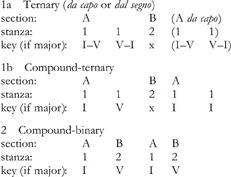
These operas also explored new formal patterns for arias.Footnote 15 As we have seen, the text of ‘Padre, germani, addio!’ is in the standard two-stanza format that was the norm for arias from the last quarter of the seventeenth century on. This allowed for the typical da capo (or dal segno) treatment, whereby the first and second stanzas are set to two discrete musical sections, with the first then repeated from its beginning (da capo) or at some point thereafter (dal segno; for example, from the first entry of the voice, cutting the opening orchestral ritornello); the ABA model is clear in Table 1.1a. Moreover, the A section normally runs through stanza 1 twice (plus additional internal repetitions), once modulating from tonic to (in a major key) dominant, and once modulating from dominant to tonic; these tonal areas are also stabilised by an initial, middle, and final instrumental ritornello (not indicated in the table). This means that five or more complete stanzas of text are normally presented in a full-blown aria: stanza 1 four times (twice in each A section), and stanza 2 at least once. As in the case of any ternary form with closed sections (for example, a Minuet and Trio), the complete A section also needs to serve a double function: it is a musical beginning that must somehow prompt continuation, yet it also serves as an ending.
Three Aria Forms

The difficulty for the librettist is no less apparent: the second stanza needs to follow logically from the first, and yet the entire text must be able to end with the first. Matters are straightforward if the main poetic idea in stanza 2 complements the one in stanza 1, with which one can therefore end easily; they are far less so if, as sometimes happens, stanza 2 shifts to a very different perspective. In such situations, the aria can plausibly return to, and end with, stanza 1 only by negating the sentiment expressed in stanza 2 or by some manner of ironic reinterpretation. While performance elements (ornamentation, inflection, gesture) might enable such reinterpretation, there is scant room for manoeuvre within the music itself. What is impossible within the two-stanza da capo format, however, is some notion of rhetorical argument and/or dramatic progression that works through both stanzas to, and only to, the end of the text.
The problem is well known in studies of Baroque da capo arias, but contemporary librettists had various tricks to get round it. An aria from Metastasio's Achille in Sciro is as good an example as (m)any of one of them: this libretto was first set by Antonio Caldara in 1736 and then at least another 26 times up to 1828, including the opera by Pietro Pompeo Sales staged in Munich in 1774, and we shall see its partial relevance to Idomeneo below. Achille has spent the opera pursuing Deidamia until her father, Licomede, finally accepts him as a son-in-law:
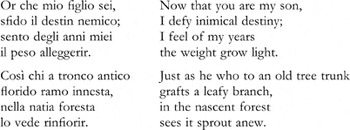
In such cases where stanza 1 makes a personal statement (Licomede no longer feels his age …) and stanza 2 develops a less personal simile (… just as an old tree can sprout new leaves), ending with stanza 1 makes perfect sense, and even is preferable within any kind of dramatic situation: the statement provides the excuse for the simile which, in turn, feeds the statement. The same applies to another typical Metastasian device: having stanza 2 deliver some kind of maxim. Drawing a generic lesson from a specific situation is all well and good, though it turns opera into a series of ex cathedra pronouncements that, while suiting some didactic purpose, can run contrary to any dramatic flow such as it might be.
By the early 1770s (and probably earlier in opera buffa), however, composers were starting to develop alternative ways of handling the two-stanza text, including running through both stanzas twice one after the other (hence ABAB) – with or without additional internal repetitions – so that the ends of the text and of the music coincide (see Table 1.2). This structure was in principle shorter than the old da capo format: the two stanzas are presented as four rather than five or more. Nor would it make much sense for the typical Metastasian pattern (or at least, one of them) illustrated by ‘Or che mio figlio sei’, designed to end with stanza 1: as a result, two-stanza texts needed to adopt new rhetorical tactics (we shall see how). In terms of the music, this ABAB form merged with the most common strategy of eighteenth-century tonal grammar, whereby the A section starts in the tonic, modulates to a related key by or in the B section, returns to the tonic by or in the second A section, and ends in the tonic with the second B section transposed: that ‘related key’ will depend on whether the key of the aria is major (usually moving to the dominant) or minor (usually to the relative major). This is often termed a ‘compound-binary form’: it approaches so-called sonata form (although the term is problematic both in itself and as applied to operatic numbers) to the extent that the tonal areas for stanzas 1 and 2 are strongly articulated, and depending on how the return to the tonic (for, or in, stanza 1 the second time around) is handled. The fact that the second B section necessarily involves some rewriting of the music of the first B section to fit the new key also allows for a different perspective on its content. In these terms, the dramatic potential for any (re-)reading of stanza 2 is clear.
A similar tonal strategy was also starting to operate in ternary-form arias based on older da capo or dal segno structures (ending with stanza 1): in the A section first time round, the first statement of stanza 1 would be in the tonic and (in a major key) the second statement in the dominant; the B section (stanza 2) would be in a contrasting key and/or somehow modulatory; and the A section second time round would have both statements of stanza 1 in the tonic, forcing transposition and reworking of its second half (see Table 1.1b). Again, the comparison with sonata form is clear (stanza 2 acts as the ‘development’ section) although it is not always, if at all, appropriate. But given the similar tonal articulation, scholars have sometimes conflated these two aria forms – the compound-binary ABAB and the ‘compound-ternary’ ABA. In terms of their disposition of the text, however, they are quite different: the binary model ends with the second stanza, and the ternary one with the first.
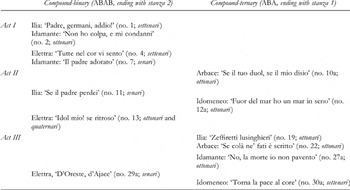
In response to all these developments, librettists were also starting to develop even more fluid approaches to aria texts – therefore prompting other musical strategies – using irregular structures sometimes in mixed metres: the libretto of Lucio Silla provides some good examples.Footnote 16 From that point of view, Varesco was certainly more conservative in Idomeneo: all but one of its fourteen arias have texts in two stanzas in what would seem to be the Metastasian mould. Of those thirteen, seven are set in some kind of binary form (ending with stanza 2) and six in some kind of ternary (ending with stanza 1); see Table 2. This is a far higher proportion of binary arias than we find in Mozart's handling of the two-stanza texts in his later opera seria, La clemenza di Tito (Prague, 1791). As for Idomeneo, the presence of these two musical forms has often been noted, though not always explained. What has not been fully considered, however, is the extent to which it was enabled – or at least, not disabled – by Varesco's aria texts, and therefore by how Mozart chose to respond to them.Footnote 17
Two-Stanza Aria Forms in Idomeneo *

* Idomeneo's ‘Vedrommi intorno’ (no. 6) has three stanzas (set 1, 2, 3), with a change of poetic meter for the third (from quinari to quaternari ending with an ottonario tronco), which Mozart treats as a stretta.
It is striking that binary arias predominate in Acts I and II, whereas Act III favours ternary ones. Save that the ternary arias beginning Acts II and III (nos. 10a, 19) might be viewed as conventional act-openers, there is no obvious reason for the binary/ternary distinction in terms of an aria's function in the drama: for example, as an ‘exit’-aria or as a soliloquy. It is true, however, that the ternary arias appear to act more as static interpolations – rather than contributing to plot development – such that one can do without them: Mozart removed a number in his late cuts to Idomeneo prior to the Munich premiere (and then in his 1786 revision of the opera for performance in Vienna). This impression is strengthened by the rather formulaic eight-syllable lines of most of their texts on the one hand, and on the other, by the less taut tonal design of the ternary form (with its digression in the section setting stanza 2). Of course, all this might seem merely to concern the composer's craft, and not something of any great critical import. But moments when a composer must make choices are always interesting both in themselves and for their consequences. How Mozart should, could, and did treat his texts are three quite different questions, and it is worth trying to explore some possible responses to them.
Ternary or binary?
Thus one can reasonably speculate on what, if anything, would have prompted Mozart to prefer one form over another in setting a given aria text. One set of issues might concern characterization. For example, there seems to be a pattern, at least in Acts I and II (we shall see why Act III might be different), of distinguishing ternary arias for the older characters – Idomeneo and his faithful retainer Arbace, who sing in what now appears to be an old-fashioned da capo vein – from binary arias given to the younger ones who are more directly affected by the dramatic action (Ilia, Idamante, Elettra). This may in addition be due to Mozart's perceptions of the singers who took those senior roles: Anton Raaff (Idomeneo) was well into his sixties, while Domenico Panzacchi (Arbace) was a ‘worthy old fellow’, so the composer wrote on 5 December 1780 (though Panzacchi was born in 1733, only three years before Dorothea Wendling). The texts of these arias for Idomeneo and Arbace also seem fairly conventional – even the three-stanza one for Idomeneo's ‘Vedrommi intorno’ (no. 6) produced something that Mozart said (on 27 December) was ‘commonplace’ – and designed for ternary treatment.
For example, Arbace's ‘Se il tuo duol, se il mio disio’ (no. 10a) follows the Metastasian pattern:
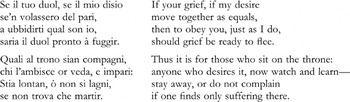
Stanza 1 is consequent upon Idomeneo having ordered Arbace to arrange for Idamante to leave Crete with Elettra so as to save the prince from his father's vow: thus Arbace hopes that the king's grief will disappear as readily as he is willing to obey his master. Stanza 2 is both more abstract and more general: let anyone wishing to ascend a throne learn from Idomeneo's example either to stay away from it, or not to complain when suffering is the result. While so sententious a moral was not unusual at least in earlier opera seria, it is hardly relevant to the immediate matters at hand: Idomeneo's commission, Arbace's eagerness to carry it out, and whether the king's grief will indeed be assuaged. Therefore, it makes sense to end with stanza 1. Similar reasons support the ternary reading of Idomeneo's ‘Fuor del mar ho un mar nel seno’ (no. 12a): the first stanza describes the storm within the king's breast, with Neptune's wrath looming over him, while the second addresses the proud god (‘Fiero Nume!’) and asks – in a rather inelegant, roundabout way – how Idomeneo's heart might avoid foundering on the rocks. In the case of such texts moving from the personal and/or specific to the general and/or abstract – rather as with the Metastasio aria text noted earlier – the tendency would be to use ternary form, also helping to keep the focus on the main drama.
The ‘personal’ can often be identified by a first-person pronoun or verb positioned in one place rather than another: Arbace's ‘io’ in the third line of ‘Se il tuo duol, se il mio disio’ is a straightforward example.Footnote 18 Thus although Ilia is associated with binary arias in Acts I and II, her ‘Zeffiretti lusinghieri’ (no. 19) at the beginning of Act III seems to work differently:

In stanza 1, Ilia hopes that the gentle breezes will ask her adored Idamante to keep his heart true to her; in stanza 2, she begs the plants and flowers to tell him of so great a love. This is not high drama, and both stanzas say more or less the same thing, so Mozart could end the aria with either one. The difference, and it may be the deciding factor, is that the first, but not the second, ends with the personal pronouns ‘io’ and ‘mi’: given that Ilia is talking more about herself, it makes more sense to end the aria at that point.Footnote 19
Two-stanza arias in which each stanza ends with an equally personal statement (a first-person pronoun or verb in their final lines) – such as Idamante's ‘Non ho colpa, e mi condanni’ (no. 2), Ilia's ‘Se il padre perdei’ (no. 11) and Elettra's ‘D'Oreste, d'Ajace’ (no. 29a) – could of course go either way, at least by this criterion, so other issues come into play (we shall see some of them below). Nor is any singular location of personal pronouns an infallible method for determining formal paradigms: in ‘Fuor del mar’, Idomeneo refers to ‘il mio cor’ in stanza 2, but the aria ends with stanza 1 as he asserts his sense of being under Neptune's constant threat. Yet viewing texts in this way does prompt further questions when expectations seem not to be met. For example, Elettra's ‘Idol mio! se ritroso’ (no. 13) – as she contemplates leaving Crete with Idamante – has a first stanza ending with a pronoun and the second not. Moreover, the second stanza ends with a maxim. Yet Mozart's setting in binary form seems encouraged because her argument continues through both stanzas:

Here the text – mixing eight- and four-syllable lines – moves from the personal (Elettra is not fazed by Idamante's love for Ilia) to the general (love close at hand is stronger than at a distance). But contrary to Arbace's ‘Se il tuo duol, se il mio disio’, this general point has a more direct bearing on Elettra's aspirations: that she will eventually succeed in wooing Idamante. Thus the binary setting, coupled with the reprise of stanza 2 in the tonic, allows Elettra to work harder to persuade herself of the likelihood of that outcome.
Böhmer would of course resist such reasoning as mere psychobabble, and one should not fall into the trap of granting agency to operatic characters, who have no say in how they are represented by their creators. There is also an obvious danger of circularity in this kind of speculation: Mozart's choices must always be shown to be the right ones – or at least, better than the alternatives – because he is, well, Mozart. And it is true that a ternary-form setting of ‘Idol mio! se ritroso’ would not be implausible: stanza 1 does not contradict stanza 2, so the aria could end with it. My point, however, is that doing so would take our perception of the character and her situation in a different direction: should we be encouraged to focus on Elettra's claim that she is happy with a ‘sober love’, or on her attempt to prove the reverse adage, as it were, that closeness makes the heart grow fonder? The music directs us to the latter. Thus Mozart has made not just a musical choice in setting ‘Idol mio! se ritroso’ in one way rather than another, but also a dramatic one, or at least, one with dramatic consequences.
This might seem to be a borderline case. But elsewhere in Idomeneo, the consequences of choosing one form over the other are starker. In the case of Ilia's ‘Padre, germani, addio!’ we have seen that the prior recitative builds to the climax of her being torn by ‘vendetta, gelosia, odio, ed amore’. For the aria, the issue for Mozart is whether to end with stanza 1 (‘Grecia, cagion tu sei. / E un greco adorerò?’) or stanza 2 (‘ma quel sembiante, oh Dei! / odiare ancor non so’). What is more important to his, and our, reading of the character – Ilia's self-disgust at loving a Greek, or the fact that she cannot find it within herself to hate Idamante? Should she end with a question or with some version of its answer? The outcome is clear: Ilia's main concern is her feelings for the prince, and that concern becomes all the more painful (or resigned? – the performer can choose) as it is recapitulated in G minor rather than its original B-flat major.
Elettra's first aria, ‘Tutte nel cor vi sento’ prompts similar inquiry:

Here Mozart must decide whether the main point is (stanza 1) the displacing of love, mercy, and pity in Elettra's heart, or (stanza 2) her threat that she (Ilia) who has stolen her lover, and he (Idamante) who has betrayed her love, will face her fury (‘mio furore’; note the personal pronoun) and her need for vengeance and cruelty.
Ilia's problem is that she cannot hate Idamante, and Elettra's, as it were, that she is dominated by rage. Both these arias come down firmly on the side of a binary form that Mozart's treatment accentuates still further by placing even greater emphasis on stanza 2 than the form itself requires: it is heard twice complete in each B section, also with additional repetitions of the final line.Footnote 20 In ‘Tutte nel cor vi sento’, the return of the first stanza is weakened still more – or its representation of emotional instability strengthened – by an ‘irregular’ recapitulation in C minor rather than D minor. But the important point, again, is that in each of these cases, ending the aria with the first stanza in a ternary form would produce a different reading of the character – a more outraged Ilia, and an Elettra with at least the potential for ‘amor, mercè, pietà’ – also with different consequences for the rest of the opera. Some critics may feel that Ilia and Elettra are fairly monochromatic characters in Idomeneo,Footnote 21 but Mozart's colouring of them one way rather than another (or rather than multiple others) is a direct result of his handling of their texts. Moreover, this handling, in turn, at least reflects the potentials of those texts as created by Varesco.
It is not surprising to find Mozart forging close correlations between an aria's poetic content and its musical character (key, tempo, melodic style, orchestral writing, etc.). It is more so to extend the text's influence to his decisions on, and handling of, musical form – as one can suggest with all the arias in Idomeneo along the lines initiated above – given that it allocates a greater role than usual to the poetry in terms of enabling possible formal outcomes, if not of determining them. The matter would hardly deserve comment were we dealing primarily with texts leading to ABA settings: here Varesco, an inexperienced librettist, would simply be exploiting da capo aria stereotypes in a manner familiar to anyone knowing Metastasio. It would also be convenient for our view of Mozart the dramatist if he were somehow improving upon a staid libretto by adopting musical forms that are progressive (in both the dramatic sense and the historical one). However, the comparison with La clemenza di Tito is again quite striking, even taking into account Caterino Mazzolà's revisions to Metastasio's original libretto adopted for that opera: there the aria texts are more clear-cut, and Mozart simplifies the ternary forms still more (often with the A section just in the tonic and the B section in the dominant). In the case of Idomeneo, the fact that the poetry itself of both ‘Padre, germani, addio!’ and ‘Tutte nel cor vi sento’, and even of ‘Idol mio! se ritroso’, at the very least encourages an ABAB setting strongly suggests that Varesco was somehow made aware of that less common (for a poet) binary possibility, and that he designed, or revised, his verse accordingly. In other words, one might plausibly suggest that Mozart's choice of musical form was a result of decisions made by, or in conjunction with, his librettist, and that at least in some cases in Idomeneo, they were working together on such structural matters and their dramatic consequences.
Danchet's original libretto was no help when it came to these and other arias in Idomeneo: the French tragédie en musique worked in very different ways. Nor do we know what other librettos Varesco might have read to prepare for Idomeneo. It is clear, however, that the three arias just mentioned were composed in Salzburg: Mozart already knew the Wendlings' voices from his earlier visits to Mannheim.Footnote 22 Thus no record survives of the discussions with Varesco that led to their creation, nor of whether their form as much as their content was on any agenda. One question that now follows for Idomeneo, however, is what might have happened once such discussions were no longer possible after Mozart left Salzburg for Munich on 5 November 1780.
Issues in Act III
The apparent shift in favour of ternary arias as Idomeneo progresses through Act II to Act III makes the latter part of the opera appear more conventional than the former. Böhmer attributes this to Mozart's relative freedom when working on the earlier portions of the opera in Salzburg (albeit according to the Munich plan) compared with his being on site, where greater constraints were placed upon the composer by his being in direct contact with his singers and with those in charge of the production, by the more immediate pressures of impending performance, and even by the weight of the conventions themselves.Footnote 23 Another factor to bring into the equation is that the later parts of Idomeneo are where deviations from Danchet's Idomenée were most needed (to create a lieto fine), leaving the opera more to its own devices. It seems clear, however, that further problems were raised by the fact that Varesco was now working on his own.
Mozart's Munich letters are filled with his requests for adjustments to the libretto in matters that had turned out to be problematic now that the composer was in direct contact with those involved in staging the opera. The first difficulty for him was that once he was in Munich, negotiations with Varesco became much more cumbersome given that problems that might have been solved around a table now needed explanation and justification in writing. The second was that Leopold Mozart tended to filter his son's written requests for revisions for fear of offending a librettist who eventually became heartily tired of the whole business. As a result, compromises and accommodations that might otherwise have been achieved were sacrificed for the sake of expediency.
Many of these adjustments concerned matters of staging and pacing predetermined by the plan for the opera that had been agreed with Munich the previous summer: now that the production team and cast were assembled, various kinks needed to be ironed out and personal requests from the singers accommodated – in particular, we shall see, from Anton Raaff. Thus although Varesco needed to cut or add text – which caused further annoyance given the need to prepare a final copy of the libretto for the printer – we do not have much evidence of him having to devise or revise words to suit Mozart's musical purposes in ways that, I have argued above, probably occurred in Salzburg even if (inevitably) we have no record of it. Two exceptions, however, are revealing, one of which is the celebrated case of Idomeneo's last aria (discussed further, below). The other is Ilia's ‘Se il padre perdei / la patria, il riposo’ (no. 11) in Act II. In his first letter back to Salzburg (8 November), Mozart told his father of the new agreement to include in this aria obbligato parts for flute, oboe, bassoon, and horn, which means that he had not yet begun to set the text to music. But only then had he started to look closely at the words, even though he must have seen them in Salzburg, and he now found a problem. The beginning (which Mozart styles ‘Se il padre perdei [/] in te lo ritrovo’) ‘could not be better’: ‘for the poem is charming and, as it is absolutely natural and flowing, I can go on composing quite easily’. But then came an aside that Mozart felt would not make sense in terms of the text repetition required in an aria, so he wanted his father to ask Varesco to revise it (‘I would prefer an uninterrupted aria’). It is significant that in this case, at least, Mozart seems only to have engaged fully with a text when he started to consider the music in concrete rather than more abstract terms. Varesco quickly produced a revision: Leopold sent it on 11 November, and Mozart acknowledged it on the 15th.
Not everything was so straightforward, however. A good number of the adjustments proposed in Munich concerned Act III, in part (again) because of the staging and pacing, but also because of Raaff. Varesco certainly wrote the libretto of this act according to the plan, but as we have seen, Mozart may not have been able to read it until after his arrival in Munich, and even if he had, he would not have considered it in any musical detail prior to starting composition on it, at least to judge by the case of ‘Se il padre perdei’. Moreover, the aria texts in Act III seem to lose focus both in terms of their content and of their structural implications, meaning that Mozart's formal choices appear to hinge still more on his own dramatic interpretation: while they are not prohibited by the libretto, nor are they always prompted by it. The text of Ilia's ‘Zeffiretti lusinghieri’ seems constructed for ternary form (see above), which Mozart follows. But Arbace's ‘Se colà ne' fati è scritto’ (no. 22) appears binary: in stanza 1, Arbace hopes that even if Crete must pay the price for Idomeneo's incaution, the prince and king might be saved, while (stanza 2) he is willing to lay down his own life so long as the kingdom might gain mercy. Quite apart from the tendency noted above to give Arbace (or Panzacchi) da capo-like forms, Mozart seems to have decided to end with stanza 1 so as not to place too much emphasis on an offer of self-sacrifice that is of far less dramatic importance than Idamante's and then Ilia's later in the act. Idamante's ‘No, la morte io non pavento’ stays with the personal for stanza 2 (so, binary), but that stanza concerns his going happily to the Elysian Fields if his beloved Ilia will have life and peace, whereas in stanza 1, Idamante makes the more vigorous claim that he does not fear death if it will bring peace and serenity to his land and to his father. Mozart opts to end with this properly filial, and therefore more appropriate, statement, accentuating it by setting stanza 2 in a slower tempo (Larghetto, followed by a return to Allegro). As for the text of Elettra's ‘D'Oreste, d'Ajace’ it could go either way, we have seen: Mozart's choice of binary form – the only such aria in the act – makes it seem even more the over-the-top mad-scene, which is probably how it is best interpreted.
The charitable view is that Varesco was leaving options open for Mozart; another is that without knowing the composer's intentions, he was confused. But in the case of Act III, Mozart seems to have had no grounds for complaint thus far: he was able to work with what he was given. Matters became more complicated, however, as the production team started to identify defects in the plan for the end of the opera. Idamante has an aria to mark his submission to the High Priest's sacrificial knife (‘No, la morte io non pavento’) but Ilia does not, although the plan called for a duet between them arguing over who should die: Mozart noted on 13 November that it would be cut.Footnote 24 Instead, an oracle abruptly intervenes to pronounce Idomeneo's conditional reprieve from his vow (‘Ha vinto amore, a Idomeneo perdona’): the gods have been appeased by Idamante's and Ilia's willingness to be sacrificed, and they will allow them to live happily ever after so long as Idomeneo abdicates, leaving the throne to Idamante. Elettra's hopes to marry Idamante are finally dashed, and she vents her fury (in the aria ‘D'Oreste, d'Ajace’) before flying off in a passion (‘parte infuriata’, according to the stage direction in the libretto). Idomeneo then announces his acceptance of the gods' terms in a recitative (‘Popoli! a voi l'ultima legge impone’).
In the plan, so Mozart recounted in his letter of 15 November, this recitative was be followed by a quartet, presumably for the main characters left on stage: Ilia, Idamante, Idomeneo, and Arbace.Footnote 25 But Raaff decided that he wanted a ‘pretty’ aria instead of the quartet because the opera did not yet give him sufficient music capable of displaying his cantabile singing. Mozart was inclined to accommodate him, in part because the old singer would not be shown to advantage in the virtuoso showpiece ‘Fuor del mar ho un mar nel seno’, and also (so the letter goes on to say) because Idomeneo was about to lose an aria (or cavatina) from the end of Act II. However, Mozart also felt that dropping the quartet was a good dramatic move (‘Thus too a useless piece will be got rid of – and Act III will be far more effective’) in ways similar to the removal of the second Idamante/Ilia duet that he had noted two days before.
Despite the logic, this new aria cantabile for Idomeneo would prove to be the most bothersome of the Idomeneo revisions.Footnote 26 It would also stretch the binary/ternary paradigms to their limits, and perhaps even beyond. Here Varesco was truly on his own, and coming to the end of his tether: he reverted still more to the Metastasian stereotype. Leopold sent his first version of the new aria on 25 November: we know only its first two lines (in seven-syllable lines) as quoted by Leopold – ‘Il cor languiva ed era / gelida massa in petto’ (‘My heart was languishing, and was / a cold weight in my breast’). But Leopold was worried about the hanging ‘ed era’ at the end of the first line, forcing an awkward enjambment, and Mozart agreed on 29 November, also expressing further concerns about the text and requesting something ‘peaceful’ and ‘contented’ instead. He cited as an example of what he wanted an aria from Metastasio's Achille in Sciro, ‘Or che mio figlio sei’ (the one discussed above), or at least its first stanza, which he quoted. Mozart repeated the request on his and Raaff's behalf on 1 and 5 December, reiterating his preference for just a single stanza: as he wrote on 1 December, ‘Even if it has only one part – so much the better; in every aria the second part must always be kept for the middle section – and often indeed it gets in my way.’ Clearly he wanted a smaller-scale cavatina in contrast to the ternary arias prevalent thus far in Act III – and replacing the one Idomeneo lost at the end of Act II – whether for dramatic reasons or because the act was already running long.
On 11 December, Leopold sent Varesco's second text for the aria, again in seven-syllable lines. ‘Sazio è il destino al fine’ still had two stanzas: in the first, Idomeneo feels his spirit reinvigorated now that Fate is satisfied, and the second presents the rather extravagant simile of a snake rejuvenating itself by shedding its skin (so, implying a ternary-form setting). On 27 December, Mozart reported his and Raaff's concerns over this text, in part because of its awkward vowels – Leopold disagreed (29 December), chiefly, one suspects, because he did not want to have go back to Varesco yet again (although eventually he did) – and on the 30th, Mozart noted Raaff's suggestion of secretly inserting another setting of Metastasio, this time ‘Bell'alme al ciel dilette’ from Il natal di Giove (first set by Giuseppe Bonno in 1740, although Raaff may have recalled Johann Adolf Hasse's setting of 1749); it is a conventional celebration of a lieto fine with a reference to Cretan celebrations in its second stanza. On 4 January 1781, however, Leopold sent a third text by Varesco, also recounting the librettist's furious reaction to the request for it: he had complained angrily, had noted that his author's fee was too low to warrant him having had to make so many alterations, and had insisted that the last text he had sent (‘Sazio è il destino al fine’) was perfectly acceptable and should be included in the printed libretto (as it was).
This third text (no. 30a) – once more in seven-syllable lines – still had its problems:
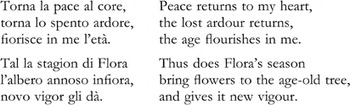
The model remains Metastasian – a personal statement in stanza 1 and a more general comparison in stanza 2 – and Spring (Flora's season) offers a better simile than sloughing snakes: it also harks back to the leafy boughs of Metastasio's ‘Or che mio figlio sei’. But it is compressed to the point of diffidence, the short three-line stanzas suggesting Varesco's exasperation with the whole business.
Mozart seems to have become reconciled to the idea of a two-stanza aria in ternary form (he had already quoted both stanzas of ‘Bell'alme al ciel dilette’ on 30 December), or at least, he realised that there was no point (both with his father and with Varesco) trying for something better. Time was also getting very short in terms of Mozart's needing to finish his score. But he was unusually uncertain about how to set the second stanza of ‘Torna la pace al core’, starting it as a continuation of the music of the first (although he was already well into the dominant in the second statement of the stanza 1) and then switching course after four measures, opting instead for a middle section in contrasting metre and tempo. Although this type of contrast is not uncommon in an aria cantabile,Footnote 27 one rarely finds Mozart changing his mind in mid-composition, especially given his well-known tendency to have everything clear in his head before putting it on paper.Footnote 28 What is even odder, however, is the wholly premature reprise of stanza 1 within that middle section, where it simply does not belong, at least within any normal parameters of the ABA form.
Mozart had a far easier time with Tito's last aria in La clemenza di Tito, ‘Se all'impero, amici dei’, which despite its musical and even dramatic similarities to ‘Torna la pace al core’ is much more straightforward. Part of the problem may have been Varesco's three-line stanzas: longer ones were better in terms of producing balanced phrase-structures. The irregularity also affected Mozart's treatment of the text at the end of the A section. The first time round, this section has the conventional two statements of stanza 1 complete, but it then returns to the first two lines, and further repeats the first changed to a verso tronco so as to end ‘torna la pace al core, torna lo spento ardore, torna la pace al core, la pace al cor, la pace al cor’. Mozart's initial draft of the end of the second A section went the same way (though the music is now in the tonic rather than the dominant), but he changed his mind over ‘torna lo spento ardo-[re]’ (the text is written in but then scrawled through).Footnote 29 Thus, by bringing just the first line of stanza 1 back at the end (modified as a verso tronco), Mozart turns this part of the text, at last, into a typical four-line stanza. At some stage after this draft, he also decided to extend the opportunity for a cadenza. As a result, the end of second A section (after the two full statements of stanza 1) reads ‘torna la pace al core, torna la pace al cor, la pace al cor [four bars rest] torna la pa-[cadenza]-ce al cor’. The ternary form, plus these additional repetitions, means that the aria focuses more on Idomeneo's having found peace in his heart than on his bounding happily off, flourishing and with new vigour. This is probably a better dramatic outcome. But an aria with no fewer than 13 iterations of ‘pace’ still seems like an act of desperation: it was eventually cut from the opera.
* * *
There is another point in Idomeneo where Mozart unexpectedly (from Varesco's point of view) brings back words from the beginning of a text at its end: the great quartet in Act III scene 3, ‘Andrò ramingo e solo’, where Idamante resolves at the start, and again at the end, to leave Crete and wander alone through the world.Footnote 30 Clearly, any opera composer is free to manipulate a libretto to suit a dramatic purpose, at least within certain limits fixed by time and place, and Mozart certainly continued to do so in and through his collaborations with Lorenzo da Ponte, if less often than one might assume. He may well have believed that ‘in an opera the poetry must be altogether the obedient daughter of the music’ (so he wrote to his father on 13 October 1781), but if my reading of the arias in Idomeneo suggests (I would not say proves) anything at all, it is that Mozart could be sensitive to a text's syntax (those pronouns), to its rhetoric (how the argument flowed and where it ended), and to the dramatic consequences of treating it one way rather than another. To judge by ‘Torna la pace al core’, he could also founder when stymied by weak poetry and pressed for time.
The fact that the libretto exerts some manner of control over the composer is obvious enough, if not always sufficiently acknowledged. My broader point, however, also concerns its impact on the critic in terms of seeking to identify poetic and musical choices and thus engaging with their interpretative and even performative consequences. We cannot ask Mozart his reasons for composing an aria as he did – and even if we could, he might not have known them – but that does not prevent us from interrogating the results. Bringing not just the content but also the structure of the text back into the frame aids that process significantly, while making clearer still just how a composer might make opera function as drama.