Introduction
The last two decades have witnessed a rapid increase in agency employment in Pakistan (Sayeed et al., Reference Sayeed, Ali, Parveen and Ali1997; Qadir, Reference Qadir2006). The growth of agency employment in Pakistan is a public policy concern (Khan and Kazmi, Reference Khan and Kazmi2003; Samad and Ali, Reference Samad and Ali2000) because of the potentially negative implications for agency workers’ basic statutorily provided safety net (Cotton, Reference Cotten2010; Haque, Reference Haque2004; Sheikh et al., Reference Sheikh, Naveed and Iqbal2011). Preliminary evidence suggests that employment agencies in Pakistan often exist as pay-rolling agencies (Sayeed et al., Reference Sayeed, Ali, Parveen and Ali1997). Pay-rolling agencies are employer-arranged small enterprises, often run by one person with the aim of solely performing a payroll function. They are mostly formed on a temporary, makeshift basis and are very difficult for the labour ministry to trace and regulate. Such agencies are often created or arranged in order to lessen the number of employees on an establishment's payroll, so that employers’ obligations in regard to statutory benefits are confined to fewer workers. Workers hired through these agencies receive wages from the agencies, and thus these agencies are often used as an intermediary only for payroll purposes. This then exempts client organisations from any legal obligation to offer statutorily required benefits to these workers, since Pakistani law considers the employing establishment and the agency as two independent entities. The objective of these client organisations, therefore, is to show that an employer–employee relationship between the client organisation and the ‘agency workers’ is not established. This can often be achieved with the help of a ‘confident employee’ of the client organisation whose job is to act as an ‘agency’ by facilitating wage distribution among workers from a different payroll book. In addition, this objective of illustrating indirectness of employment can also be achieved by outsourcing the pay-roll function through independent, but fraudulent, companies. These companies earn their living by facilitating a pay-roll function for their clients, for which they charge a fee. The central goal in each of these cases is to show indirectness of employment, by subtly misclassifying a group of employees as ‘agency workers’.
Traditionally, agency employment is a ‘three-way’ or ‘triangular’ relationship involving a worker, a company acting as a temporary work agency and the client organisation, whereby the agency employs the worker and places him or her at the disposition of the user company. The role played by employment agencies is both complex and dynamic (Cetinkaya and Danisman, Reference Cetinkaya and Danisman2011; Sankaran, Reference Sankaran2007; Wynn, Reference Wynn2009). This three-party employment relationship often generates ambiguity regarding the employment relationship and raises questions as to who bears the responsibility of an ‘employer’ in terms of providing employment rights and responsibilities (Connell and Burgess, Reference Connell and Burgess2002; Davidov, Reference Davidov2004). This question arises in part due to the blurring of organisational boundaries and the lack of clarity surrounding the position of these workers in labour laws (Dickens, Reference Dickens2004; Fudge, Reference Fudge, Davidov and Langille2006).
As existing studies, mainly discussed in the Western academic literature (see for example Forde and Mackenzie, Reference Forde and Mackenzie2010; Mitlacher, Reference Mitlacher2007; Purcell et al., Reference Purcell, Purcell and Tailby2004; Storrie, Reference Storrie2002; Wynn, Reference Wynn2009), have focussed on the traditional form of agency employment, it is difficult to identify robust findings that generalise across contexts where agency employment may take different forms, particularly where these different agency forms may have diverse implications for agency workers. It is, therefore, important to examine the reasons why firms adopt different practices in regard to agency employment in different national legal contexts. One such context is Pakistan, which is the empirical setting of this study. The selection of Pakistan for this study was primarily prompted by preliminary (anecdotal) evidence alluding to the existence of the pay-rolling agency system in Pakistan (Khan and Kazmi, Reference Khan and Kazmi2003; Samad and Ali, Reference Samad and Ali2000). While many studies have tracked the growth of agency work quantitatively and have understood this as a characteristic of additional flexibility arising from economic changes, not enough attention has been paid to the socio-economic explanations underlying agency work. Though arguments rooted in the flexible employment strategies are useful in explaining the growth of temporary agency work against the backdrop of economic changes and fluctuating demand, a new approach to temporary employment has emerged: whereas temporary workers were once used primarily to fill in for sick or vacationing permanent employees, many employers now use temporary workers on an ongoing basis in formerly permanent positions, and in many cases are converting permanent jobs into temporary positions (Cowell and Singh, Reference Cowell and Singh2002). This raises important questions about the validity of the flexibility thesis. The question then becomes whether or not flexibility is a defunct premise in explaining agency employment. The issue of ‘pay-rolling agencies’ is an under-researched area within the academic literature. This study sought to fill this gap in the growing body of literature on agency employment.
Considerable growth in agency employment has been reported in Pakistan over the last two decades (Shafi, Reference Shafi2005). Cursory evidence, however, indicates that agency employment in Pakistan increases the likelihood of worker exploitation (Sayeed et al., Reference Sayeed, Ali, Parveen and Ali1997; Sheikh et al., Reference Sheikh, Naveed and Iqbal2011). Pakistan adopts an unregulated approach to agencies and agency work. For example, agencies can start up without any public quality control and registration with the Labour Department or other concerned government institutions. Unlike the European Union, there is no social directive or national policy in Pakistan that attempts to clearly set out the rights associated with agency employment and to date there has been very little legislative action. It is also believed that union activities have declined in Pakistan over the last two decades Qadir (Reference Qadir2006) and this is to some degree a consequence of the growth in agency employment (Samad and Ali, Reference Samad and Ali2000; Sayeed et al., Reference Sayeed, Ali, Parveen and Ali1997). Given the history of acrimonious union–management conflicts in the 1970s and 1980s (Khan and Kazmi, Reference Khan and Kazmi2003; Qadir, Reference Qadir2006), Pakistani employers are consequently more inclined to hire a large number of workers through agencies to weaken union strength or to avoid future prospects of unionisation if the firm is not currently unionised, with adverse consequences for agency workers who cannot adequately voice their own concerns and needs (Dawn, Reference Dawn2002). This underscores the public policy significance of this issue in Pakistan and calls for a rigorous investigation to explore the motives and nature of agency employment use, and leads us to the following research questions.
Research questions
To address the issues discussed above, this study is set out to investigate the following research questions:
• What are the motives behind the use of agency employment in Pakistan?
• What are the implications of agency employment use on agency workers’ statutory benefits and their collective representation and bargaining rights?
The next section will discuss the theoretical perspectives on the antecedents of agency employment followed by a discussion on Pakistan's labour market structure in regard to the agency employment.
Theoretical perspectives on the antecedents of agency employment
Firms potentially hire agency workers to adjust staffing levels to fluctuations in demand caused by seasonal or cyclical variations (Atkinson, Reference Atkinson1984). Avoiding fringe benefit costs is another major reason employers use non-standard work arrangements (Houseman, Reference Houseman2001; Hudson, Reference Hudson2007). In most European countries, agency workers face marginalisation in terms of employee benefits, even where the law demands parity with the client organisations’ permanent workers (Matiaske and Nienhuser, Reference Matiaske and Nienhuser2006; Storrie, Reference Storrie2002). Even in situations where the principle of non-discrimination is in effect, agency workers often receive fewer fringe benefits than those available to their ‘permanent’ counterparts on open-ended contracts (Matiaske and Nienhuser, Reference Matiaske and Nienhuser2006; Purcell et al., Reference Purcell, Purcell and Tailby2004). Furthermore, since terminating a permanent contract is often associated with severance and other legal costs, firms are often inspired to hire agency workers to save these costs (Zuehl and Sherwyn, Reference Zuehl and Sherwyn2001).
Researchers have often relied on demand-driven approaches to explain the use of temporary agency labour (Boxall and Purcell, Reference Boxall and Purcell2003; Houseman, Reference Houseman2001), and have suggested that the proliferation of non-standard forms of employment over the past twenty years has merely been the result of changing ‘human resource’ strategies on the part of business managers in response to new global market imperatives, as if no other factors such as government regulatory policy or established legal precedent had posed potential obstacles to their plans (for example their inability to (Biggs et al., Reference Biggs, Burchell and Millmore2006). In other words, legal factors substantially influence the decision to opt for agency employment and shape the extent and pattern in which client organisations utilise temporary work agencies across different industrial relations systems.
Concerning the interaction of legal regulation and the nature of the employment relationship, Dickens (Reference Dickens2004) argues that improving the conditions of agency workers on temporary contracts through legal intervention improves employment rights, and makes it more likely that workers will accept such contracts. In the Netherlands, recent changes in law have resulted in agency workers receiving comparable employment rights, such as social security and dismissal protection (Kok, Reference Kok2004). Kok (Reference Kok2004) has associated this change in law with a decline in the level of involuntary agency employment. Moreover, in the UK context, evidence suggests that protective employment legislation has resulted in a decline in the use of temporary employment contracts (Biggs et al., Reference Biggs, Burchell and Millmore2006). Nevertheless, in situations where statutory and case law provide better protection for non-agency atypical jobs, such as part-time and temporary work, agency work evolves as an evasion (Heery, Reference Heery2004).
Identifying the employer for the purposes of employment- and labour-related obligations in situations outside conventional bilateral employment contracts can be very complicated (Fudge, Reference Fudge, Davidov and Langille2006). Instead of retaining the services of workers directly, firms can resort to labour intermediaries in order to have work completed (Burgess et al., Reference Burgess, Rasmussen and Connell2004). This allows firms to shift the responsibility for, and the risks of, employing workers to other smaller, less stable, and in some cases unregulated, organisations. Ultimately, these risks are borne by some of the most vulnerable workers (Smith and Neuwirth, Reference Smith and Neuwirth2009). These intermediaries or employment agencies are much more vulnerable to failure than bigger firms and the ensuing segmentation of workforce into core−periphery or permanent versus temporary lines tends to establish segmented labour markets and undermine equity in employment. In addition, employers effectively exclude these workers from bargaining units within their workforce, often generating a non-unionised workforce within a unionised workplace (Heery, Reference Heery2004). Consequently, a sizable portion of workers hired through agencies remain deprived of their fundamental employment rights, since neither employer nor agency takes up the employer's role for these workers (Dickens, Reference Dickens2004).
Pakistan: labour market structure and agency employment
Pakistan is a developing country with the world's sixth-largest population and an economic growth rate that has been consistently positive since 1951. Driven by an agenda sponsored by the International Monetary Fund (IMF), World Bank and neo-liberal economic policies, the Pakistani economy has rapidly integrated into the global economy (Afzal, Reference Afzal2006). This has resulted in the privatisation of key state industries and the opening up of export processing zones to attract foreign capital. In these Special Industrial Zones, labour laws have been waived in order to attract investors. This has changed labour relations, and has potentially contributed towards a culture of subcontracting labour through third-party supplier establishments (agency employment) (Afzal, Reference Afzal2006; Sayeed et al., Reference Sayeed, Ali, Parveen and Ali1997).
An important dimension to note in relation to the current state of data availability in Pakistan is the dearth of existing knowledge about employment practices and the most basic of labour market statistics. Further to the lack and incomprehensiveness of large-scale statistical data sets, the field of employment is a highly under-researched area. A small number of empirical studies sponsored by the International Labour Organisation (ILO) to study employment and the structure of the labour market have alluded to the significant use of agency employment, especially in the manufacturing sector (Sayeed et al., Reference Sayeed, Ali, Parveen and Ali1997). These studies, however, were not based on rigorous scholarly research and the evidence was mostly gathered through interview data solely from union officials. Despite these weaknesses, nevertheless, these studies do serve to highlight some key motivating factors behind the increased use of agency employment. These were reported to be anti-unionism, evasion of complex and costly procedures for termination of permanent employment and the avoidance of statutory benefits. These assertions are exacerbated by the suggestion that employers achieve these objectives through the deliberate cynical manipulation of employment legislations (Cotten, Reference Cotten2010; Sheikh et al., Reference Sheikh, Naveed and Iqbal2011; World Bank, 1998). According to the existing regulatory framework, the employment status of agency workers in Pakistan appears to be rather fluid. Concerning agency workers’ legal employment status in relation to statutory benefit entitlements and their right to voice their concerns and needs collectively, there exist a number of ambiguities in the existing employment legislation of Pakistan.
Statutory benefits
A serious ambiguity exists in the form of a lacuna in Pakistani law in relation to the employment status of agency workers. A person on the books of an agency, in some cases, may not be regarded as an employee of the agency because he/she does not work under the control of the agency. The client organisation is usually not regarded as the employer because no contractual relationship exists between them and the worker, the only contract being between the agency and the client. Nevertheless, in some cases, courts are inclined to consider client organisations as the employer in relation to statutory benefit entitlements once it is established that agency workers are working under direct supervision of the client organisations, and the nature of their job is not temporary. However, because of the manipulative tactics used by some employers, such as the use of pay-rolling agencies we have previously discussed, it becomes difficult to establish such a relationship between agency workers and client organisations (Shafi, Reference Shafi2005).
Collective bargaining
Unlike that of many Western developed economies, Pakistani law is ambiguous with regard to granting agency workers a legal right to collective representation and bargaining. Workers hired through agencies are not entitled to join a bargaining unit composed of permanent workers. This is because these workers may be considered employees of the agency, not of the client organisation. Although provision exists in the law for these workers to form a separate union (IRO, 2002), which allows workers to legally bargain with the agency as their employer, this provision rarely materialises, largely because client organisations do not want union activity of any kind at their establishments. For the most part, this is not viable as an approach, as client organisations can simply avoid this situation by terminating their relationship with the agency, and can immediately switch to or create another agency. Consequently, the vast majority of agency workers are excluded from collective representation and bargaining.
To summarise, the pay-rolling agency phenomena in Pakistan seems to have potentially adverse implications for labour rights. There appears to be no clear guidelines within legislation or on the basis of previous court cases to define who the ‘employer’ is in the context of this triangular relationship between agencies, client organisations and workers. If the case goes to the courts, however, then the courts’ decision in establishing the employee–employer relationship between agency workers and client organisations or agencies depends on a variety of factors: the issuance of a letter of employment, nature of the job and the amount of time a worker has worked for a particular organisation. This case-by-case approach is unpredictable and indeterminate, lacking the reliability needed for effective employment relations procedures (Khilji, Reference Khilji, Budhwar and Yaw2004). Moreover, it is not viable for impoverished workers to be involved in lengthy legal battles, because of the scarcity of means and time.
Given the largely unregulated nature of agency employment in Pakistan, it is difficult to ascertain the size and precise functions which employment agencies may be involved in as a sector. It is, however, important to note that the employment agencies discussed here are third-party labour intermediaries who provide labour to domestic clients only, within Pakistan. Enterprises involved in the recruitment of migrant labour for overseas assignments and head-hunters engaged in job placements normally against a one-time fee are not within the scope of this study.
Data and methods
Given the sensitive and exploratory nature of the research aims, it was decided to adopt a case-study-based qualitative inquiry. An empirical study was conducted by drawing data from six case study organisations operating in industrial sectors characterised by higher than average incidence of agency employment. This involved face-to-face semi-structured interviews with a cross section of respondents, including managers at the workplace (with day-to-day responsibility for industrial relations, employee relations or personnel matters), senior union and agency officials and agency workers. The case study interviews were supplemented by a programme of in-depth interviews with nine industry specialists (people having knowledge about agency use practices and regulatory concerns related to agency employment use in Pakistan). These interviews included representatives of the labour ministry, national-level union federations and industry experts and academics.
To maximise the relevance of data from a small number of organisations, an effort was made to choose cases following the ‘purposive sampling’ model by selecting organisations (workplaces) from industrial sectors characterised by a higher than average incidence of agency employment. Rather than just looking at one context, this study explored agency employment use in case study organisations operating in three different industrial sectors of the economy – hotel, dairy and polyester. Case study organisations included two five-star hotels, two large dairy processing companies and two large polyester fibre plants.
Case study organisations
A brief introduction to the case study organisations is given below:
Hotel A
Hotel A is a five-star luxury hotel and is part of a large hotel chain in Pakistan. At the time of research, Hotel A employed around 1,700 staff. It is also important to note that although Hotel A is a unionised organisation (i.e. all permanent workers are union members), the union–management relationship has rarely been based on a partnership approach.
Hotel B
Hotel B is another luxury hotel property and is part of a chain of hotels owned by a Pakistani businessman. Hotel B has a workforce of around 650 workers. This includes around 300 permanent workers and approximately 350 agency workers. This hotel uses one agency to supply workers and the agency's office is located inside the hotel premises.
Dairy A
Dairy A is part of one of the largest domestically owned dairy companies in Pakistan and enjoys market leadership in several product categories. Out of 1,500 workers, a large majority of approximately 1,400 workers were on agency contracts.
Dairy B
Dairy B is part of a world-renowned multinational company, which has a number of production facilities located across Pakistan. Dairy B employs around 1,400 workers. About 600 out of the 1,400 are permanent employees and the rest are hired through two different employment agencies.
Polyester A
Polyester A is part of a large multinational involved in several businesses across Pakistan. Polyester A is a major polyester unit in Pakistan, and at the time of the research employed approximately 800 workers out of which roughly 600 were agency workers.
Polyester B
Polyester B is part of a large domestic textile group. It employs around 1,400 workers out of which approximately 1,000 are permanent employees and around 250 are hired through one employment agency.
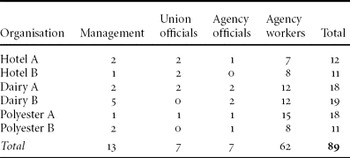
A total of eighty-nine case study interviews were undertaken (excluding industry specialists), with each interview carried out in person (see Table 1). Nearly all interviews were recorded and transcribed. The total number of interviews and the composition of interviewees varied between case studies primarily due to access arrangements within each case study. Given the likely unavailability of data on extent of agency employment within the case study organisations (mainly due to indications of a pay-rolling agency system in some case study workplaces), it appeared difficult to base workers’ interviews on any notion of statistical representativeness. The selection of agency workers for interviews in each case study organisation was a challenging task. Workers had to be chosen based on their availability and willingness to take part, primarily due to access arrangements within each case study (because of the difficulty associated with obtaining managements’ consent). A large number of agency workers were actually interviewed at their residences since they were reluctant to speak on these sensitive matters at their workplaces. Hence, selection of workers for interviews was planned to be truly random and opportunistic; however, union officials and industry specialists, in most instances, were asked to provide information regarding the whereabouts of agency workers (and to accompany the author in locating agency workers at their residences).
Case study organisations − interviewees

Findings
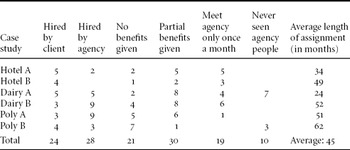
The analysis indicates that temporary agency work has a number of distinctive features in Pakistan. Circumventing legal regulations, for instance restrictive dismissal protection rules, is a primary reason why firms commission temporary labour agencies. Consequently, temporary agency work serves as a balancing corrective to strict labour laws. The case studies provide considerable evidence that the employers respond to changing legal settings by attempting to bypass strict operative dismissal protection rules. First, it is mostly a one client, one agency relationship, and a worker's assignment to each client is mostly the only assignment they have for the agency with which they are employed. Secondly, the duration of assignments is very long and often appeared to be ongoing, indefinite, continuous assignments, similar to permanent jobs. Thirdly, cost aspects represent another strategic reason why the surveyed companies opted for agency working. The opportunity to save on labour costs through pay differentials and lower benefit claims positively influenced the use of agency workers. Table 2 summarises key findings which form the basis for the key inferences emanating from this study.
Summary of key findings regarding agency workers

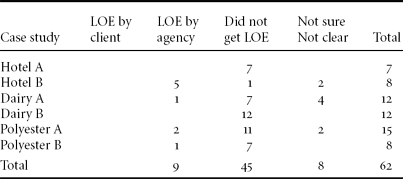
Forty-five of the randomly chosen sixty-two agency workers were not issued any sort of letter of employment, a core legal requirement. Evidence also pointed to the fact that client organisations in some cases consented to and influenced the non-issuance of such a letter, because a letter of employment could have potentially made these workers eligible for full benefit entitlements and would have possibly allowed them to join unions. Findings surrounding issuance of letter of employment are summarised in Table 3.
Issuance of letter of employment to agency workers
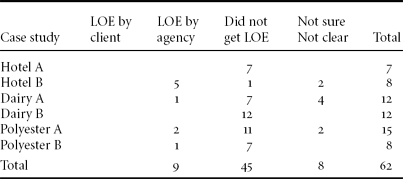
Further to the findings presented in Tables 2 and 3, approximately one-third of the sixty-two workers claimed to have worked under different contract types while working for the same client firm, and about one-fourth claimed to have worked under different agencies for the same client. During the course of these agency conversions, workers interviewed were not consulted when they were being changed from one agency to another. They were simply notified by the management of this change, which did not require workers to complete a different application form or go through a distinct set of recruitment procedures. A number of workers in one case study (Dairy B), for instance, mentioned that they had worked under three agencies without going through any due paper work or re-recruitment procedures. One worker, said during an interview conversation:
Agency ABC was in the beginning but for the past five months, I have been switched to Agency XYZ.
Another worker puts it this way:
About four to five years ago I worked without an agency – then there was an agency called ABC before RST, then XYZ came and now EFG.
When asked, ‘So for all these conversions from the first agency to the second and then to the third one, did they (Dairy B) ask or inform you or solicit your consent for changing your employer (agency)?’, one worker said:
No – Only once the agency was changed, they simply informed us that we now need to contact the new agency.
The findings also pointed to indications that a few agencies were set up for specific client organisations and some even continued to only supply workers to the same client up to the point this investigation was undertaken. In a few cases, it was found that the agencies’ offices were located inside the premises of the client organisation operational facility. In one case (Hotel B), when the author approached the agency to seek interview access, agency officials advised the author to acquire permission from the human resource department – ostensibly suggesting a misleading setup.
A vast majority of agency workers were excluded from collective representation and bargaining and a number of tactics were employed to avoid or weaken trade unions. When asked why the hotel was hiring a large number of workers through the agency, a manager working in the HR department of Hotel A replied by saying:
Basically, we have a strong union. We have union for almost 300 employees. Hotel does not want workers to join union. This is the main reason for hiring agency workers because we do not want union to get more strength. So the actual reason is to weaken trade union.
In a response to a question about the possibility of agency workers’ organising against the agency as a principal employer, one of the union officials replied by saying:
Employer can simply change the agency if they get any suspicion that union movement is going on – what employers do is simply change the person and name to show a change of agency – even labour courts, at times, are bribed and take employers’ side.
As noted in the case of Hotel A, a tactical move of reducing organisable (unionisable) headcount, Dairy B started promoting its permanent non-supervisory workers to some forms of junior supervisory positions (possibly created solely for the purpose of getting workers off the union-prone territory as only non-supervisory permanent employees are allowed to join the bargaining unit). This was explained by the president of the current union, he said:
What Dairy B did, they gave half of their workers the title of supervisors [sort of promoted them for some sort of managerial/supervisory positions] so that these people could not technically join union – in turn union became weak – so we [union] objected and brought it to the court and the case was in the court for about 12–13 years – we even went to supreme court and thank God – the decision came that the person who does not have the hiring/firing authority can join union.
In some cases, the client organisations may not be aware of the violation, or in some cases may turn a blind eye, even though the work is performed on its own grounds. In a number of situations, though, as suggested by the data presented above, client organisations are directly involved in the curtailment of workers’ basic employment rights. The findings in this study clearly suggest employers’ dubious motives in deploying agency workers are enabled by the lacunas in the regulatory framework, compounded by the weak law enforcement mechanism in Pakistan. Agency workers and union officials interviewed often explicitly revealed that the agencies under discussion were bogus, and that people working in agencies’ offices were in reality employees of the client organisations, receiving monthly salaries from them to play the agency's role. When asked why their clients hire workers through them, one agency owner made a general comment in response by saying:
That is why multinationals are getting into this business [implying getting agencies in the middle as an intermediary] because they don't want to get into this hassle of unionism or other such activities.
Twenty-four of the sixty-two workers interviewed claimed that they were hired by the HR departments of the client organisations without any involvement of agencies in the recruitment process. The average length of assignment of workers interviewed across case studies was forty-five months (see Table 2). For each worker, this was their only appointment through the agency; none had worked for any other client through their current agency. One worker in a five-star hotel shared his recruitment experience in the following words:
There was no interview done, but hotel's HR department made us fill out hotel's application form and appointed us. If they decide to interview somebody, it is done by the hotel's HR people and we are supervised by the hotel people as well. We only get salary from the agency. Agency has an office inside the premises of the hotel. Previous agency did not even have any office. They just used to come once a month to distribute the wages.
When asked to explain how her company hire agency workers, one manager working in the HR department of Dairy A responded by saying:
Actually we hire the workers and do the interviewing, etc., and then we tell the agency to hire them [implying to do the paperwork].
Across all case study organisations, avoidance of costs associated with the employment benefits appeared to be the obvious rationale for the deployment of temporary agency work. Twenty-one of the total sixty-two workers interviewed claimed that they do not receive any sort of benefit from the agency or the clients. Thirty workers claimed that they receive partial (of total statutorily required) benefits from the agency (see Table 2). In cases where benefits were offered, they were reportedly partial in nature and did not fulfil the minimum threshold of statutorily required provisions according to the law. When asked about benefit availability, one worker in Polyester B said:
Not a single day off not even Sunday and if take any day off [even for sickness] salary get deducted – and they deduct 40 rupees for SS [social security] every month but then don't give us SS card.
When asked whether or not they receive statutory benefits at Polyester A, one worker explained:
No, nothing − no EOBI [employee old-age benefits institute], SS cards, no nothing – even any day off [including] Sunday will be deducted from the salary – no paid time off – every minute is tracked.
In regard to the interaction between workers and the agencies, a number of workers reported that they only see agency officials once a month, particularly at the time of salary collection. For all other queries and concerns, workers asserted that they contact client organisations’ staff, such as personnel in the HR department. When asked, ‘Does the agency ever check on him to see if he is ok?’, one worker replied by saying:
No they have no concern – In fact, if somebody gets some problem in the salary – like salary is short for a day or two [deducted] − then they [agency] tell us to go to the HR office and check with them.
When asked ‘if you have any complaint/issue, who do you then see: agency or HR people?’, he replied:
No – [we go] to our supervisors who are Hotel A's people – Agency people are in fact hotel's own people but they [hotel management] are just pretending that it is an agency. The only time we see them [the agency person] is the day when we have to receive our wages so we line up for that.
One union spokesman in Hotel A said:
Agency normally is just a person on the front end. Hotel prepares cheques in his name [agency's name] and then he distributes those [cheques] in the hotel. Hotel offers him 15 per cent service charge or sort of profit for acting as a middleman.
In regard to how these agencies normally come into existence, it was learnt during the interviews with one worker and one owner of the agency supplying workers to Polyester A that Polyester A had frequently been forcing some of its permanent employees to accept a ‘golden handshake’ in return for switching their permanent contracts to the agency one. This worker had been working with Polyester A for about fourteen years. When asked why Polyester A uses agency employment and what the motives were behind an involuntary ‘golden handshake’, he made the following comments:
Just to deceive the system and workers – it is like this – from the laboratory they gave [awarded] agency business to an ex-worker within the laboratory – because that worker was sort of influential one. He helped Polyester A influence other people [his colleagues] to accept involuntary ‘golden handshake’ scheme and then Polyester A got all those people back on agency contracts immediately afterwards – so that one key person who helped the company in convincing his colleagues for switching contracts from permanent to agency became the agency owner himself.
Data such as those above suggest that the agency employment setup appeared to be a hoax, a technique used by client organisations to establish a ‘legal’ relationship between workers and the ‘fictitious’ agencies. Although case study findings cannot be generalised, given the small, purposive sample size of six organisations, findings across all case study firms standing for a wide range of economic sectors pointed towards deceptive agency setups. Despite the fact that the nature of agency employment setup varied slightly from one case to another, findings across all three sectors amounted to a situation where workers typically experienced lower wages, fewer benefits, less ability to avail themselves of established employee rights and less protection from certain social programs of the so-called safety net given to them in the law.
Discussion
A number of interesting themes emerged from the data: benefit−cost savings, termination ease and union avoidance. In addition, evidence from interviews with workers revealed insightful details on the nature of agency employment and issues surrounding violation of workers’ legal employment rights. In an attempt to avoid paying benefits and other non-wage costs associated with regular employment by using employment agencies as labour intermediaries, firms can transfer part of their employment costs to the workers. These findings also refute the notion, often rooted in conventional belief, that temporary work has only been a natural and inevitable response to changes in the economy. The evidence suggests that the essential characteristic of agency employment in the case study organisations was not the short duration of employment assignments, but rather the creation of a ‘triangular relationship’ between a business, an agency and an employee. In essence, this agency system does not even actually supply labour – it simply re-routes it, or legally reconstitutes it, on paper. It thus appeared from the evidence that the use of temporary agency workers is, in many instances, a labour relations strategy rather than a matter of economic efficiency.
Some of the evidence gathered in this study is generally in line with existing studies investigating the motives and implication of agency employment in the developed countries (for example, in the European Union, see Arrowsmith, Reference Arrowsmith2006; Kok, Reference Kok2004; Matiaske and Nienhuser, Reference Matiaske and Nienhuser2006; in the United States, see Mitlacher, Reference Mitlacher2007; Smith and Neuwirth, Reference Smith and Neuwirth2009; in the United Kingdom, see Biggs et al., Reference Biggs, Burchell and Millmore2006; Wynn, Reference Wynn2009 and in Australia, see Burgess et al., Reference Burgess, Rasmussen and Connell2004). However, there are some distinctive features of agency employment identified here which potentially can be considered new findings in the growing body of the literature on agency employment. Although most of the studies cited above, carried out in Western, developed countries, uncovered situations where agency workers continued to face some levels of mistreatment, agencies were still genuine in regard to their operations and existence. The agency employment mechanism, in all the case study organisations, investigated in this study, however, did not appear to be a manifestation of genuine independent employment agencies operating in their traditional role. The findings relating to the sheer magnitude of the use of pay-rolling agencies by some of the large multinational corporations operating in Pakistan and hoax techniques used by employers in creating these employment agencies is one way in which the findings of this study differ from existing studies, mostly carried out in the developed countries. A number of other findings are also fairly novel. These include the non-issuance of letter of employment to the agency workers, the conversion of employment agencies on paper by employer without seeking the consent of agency workers and, finally, the subtle misclassification of effectively permanent employees as agency workers. These appear to be distinctive features of agency employment in Pakistan.
Policy implications
The arguments for agency employment rest on three central points, namely: (1) the agency independently hires workers and sends them to clients at their request, (2) that agency workers own a significant degree of individual bargaining power over terms of employment and (3) that there is a ‘free market’ for agency labour to decide which agency they should work under. None of these assumptions reflected the reality in the case studies investigated. The idea of a ‘free market’ for temporary labour was undermined when corporate users (i.e. client firms) ensured through exclusive contracts that their ‘primary vendors’ (i.e. the agencies) did not have to compete. Workers were simply told which agency they must work through. These primary vendors had contracts that ensured them a steady supply of new workers, no matter how poor their job placement services or benefits. Hence, the only real negotiations going on behind the scenes were between agencies and their client firms. The savings achieved in these discussions represent the full or partial cost of the workers’ benefits package (including health insurance, holidays, sick days etc.). It also shows how other employment-related costs to the client firm (e.g. social security) can become revenue for the client firms or may be divided between client firms and the employment agencies.
A number of serious policy concerns are raised in this study. The growth of temporary employment seemed a deliberate, systematic, effort to relinquish employers’ obligations. It, therefore, becomes a matter of policy concern in relation to the economic wellbeing of impoverished and vulnerable temporary agency workers, because the rapidly growing size of the temporary employment sector in Pakistan would suggest that its ability to operate outside of a regulatory framework potentially results in grave implications for workers. Moreover, there should be considerable concern over several negative aspects often associated with agency employment, whereby large corporations restructure their workforce through the replacement of permanent workers with agency workers, leaving agency workers without many rights and protections associated with employee status.
Though these practices clearly appear to be against the spirit of the law and are aimed to be achieved on the back of the weakest workers, ironically some of the employers’ practices discussed here are, ostensibly, within the scope of the law. This perhaps indicates that the existing Pakistani employment legislation may not be sufficient to prevent the potential abuse of agency workers. Such potential manipulation of the law can be mitigated through the identification of loopholes and gaps in legislation which need to be addressed in order to prevent employers using the law to protect their own interests. If social protections are to continue to be linked to employment, then the ‘true employers’ must be held to their social and legal responsibilities, lest workers and society at large continue to bear the cost for those who utilise labour without obligation. Measures should be designed and implemented that will preclude unscrupulous employers from simply turning to new forms of employment practices in the false name of flexibility and efficiency in order to evade fundamental labour protections for a substantial portion of their workforce.
It therefore follows that the changing nature of employment requires changes in the modes of regulation, which no longer fits with reality. The challenge for those who shape the law is to bring public policy in line with workplace reality. If agencies are legally considered the ‘employer’, then they must be asked to provide the workers with statutory employment rights. Consequently, the pay-rolling agency system – an attempt by employers to bypass statutory obligations, simply by paying workers through an agency − should potentially be curtailed. Moreover, a viable legal right for agency workers to collective representation and to belong to a trade union is needed, regardless of the legal status of the employment.
Future research
While this study has furthered our understanding of the motives and nature of agency employment, there are additional avenues that still invite exploration. For example, the limitation of analysing this issue by drawing on just a few cases and sectors may pave the way for other researchers to replicate similar inquiries in other important sectors of the economy. Future research should use larger samples to ascertain a more generalised view of the situation across the economy, providing a more representative view of agency employment practices, since these may necessitate a robust public policy review.
Conclusion
The use of temporary agency workers is becoming less cyclical and more built into ‘business as usual’. Economically speaking, the use of some temporary arrangements seems sensible; it increases the ease, and reduces the cost, of responding to changes in demand, making the economy more adaptable and flexible. But where temporary agency work is being used as a short cut to avoid the human resource investments that would guarantee flexibility in the long run, they are clearly detrimental. For many agency workers, any gains in flexibility comes at a high price, and for society they are likely to exacerbate socio-economic inequality if qualified workers who seek regular full-time jobs must settle for less desirable alternatives. From the worker's viewpoint, when temporary work offers employment only under inferior conditions and destroys rather than supplements regular full-time opportunities, it clearly endangers the worker's standard of living. It appeared from the evidence presented here that the use of temporary agency workers is, in many instances, a labour relations strategy rather than a matter of economic efficiency or workforce flexibility. This provides an important counterweight to the notion that agency employment evolved organically only out of the need of businesses for employment flexibility.
This research has studied the motives and characteristics of agency employment in a non-Western context; namely, that of Pakistan, and has sought to explain a perhaps novel tactical nudge by opportunistic employers characterised by lopsided financial and political powers to exploit weak and vulnerable agency workers in Pakistan, thus increasing class disorganisation. This study, therefore, furthered our understanding of the motives and characteristics of agency employment, beyond the conventional model of genuine agency work.