Aspirin has been used to prevent thromboembolism in children with CHDs without conclusive evidence supporting its anti-platelet efficacy in this specific group of diseases. The effectiveness of aspirin and other anti-platelet agents has been subject to criticism related to possible resistance or biologic variability.Reference Lisa, Scott and Zellers 1
There is an open debate about the incidence of aspirin resistance in the paediatric population. The incidence of aspirin resistance has been reported to range from 2.3 up to 80% in the medical literature through different laboratory assessments.Reference Yee, Dinu and Sun 2 , Reference Mir, Frank and Journeycake 3 However, there has been a poor correlation among the different tests to measure platelet function and the prediction of thrombotic events.Reference Lisa, Scott and Zellers 1 , Reference Adatia, Barrow, Stratton, Miall-Allen, Ritter and Haworth 4 – Reference Eikelboom, Hankey and Thom 8
Even though the possible aspirin resistance and its questionable efficacy in children has raised concerns among patients and physicians, no laboratory assay has been recognised to effectively monitor aspirin therapy in children.Reference Schmugge, Speer and Kroiss 9 The possible causes of aspirin resistance include poor compliance, drug interaction, inadequate aspirin dose, increased turnover of platelets, genetic polymorphism of cyclooxygenase-1, and up-regulation of alternative (non-platelet) pathways of thromboxane production.Reference Tran, Anand, Hankey and Eikelboom 10
Children undergoing cardiac surgery are at a higher risk for thrombosis than the general paediatric population.Reference Emani, Trainor, Zurakowski, Bair, Fynn-Thompson, Pigula and Emani 11 Thromboembolic disease is a significant cause of morbidity and mortality in infants and children. Nearly 50% of infants younger than 6 months of age and 30% of older children with venous thromboembolic disease have an underlying cardiac disease.Reference Long, Pitfield and Kissoon 12 Almost 8–33% of subjects will suffer from thrombosis after Fontan surgery.Reference Long, Pitfield and Kissoon 12 The evidence supporting most recommendations for anti-thrombotic therapy in neonates and children remains weak and most recommendations are based on extrapolation from adults.Reference Monagle, Chan and Goldenberg 13 , Reference Thon, Hanslik and Male 14
Thromboelastogram plus platelet mapping (TEGPM) test has been previously proposed to function as a bedside test to assess the platelet function of adult patients taking aspirin.Reference Nalyaka, Radhakrishnan, Englyst, Weir and Curzen 15 The aim of this study is to evaluate the effectiveness of platelet therapy with TEGPM in children with CHD after being surgically repaired.
Materials and methods
Study design
The Institutional Review Board committee at Driscoll Children’s hospital approved this study. A retrospective chart review was completed in 24 subjects with surgically repaired CHD and one subject with an acquired heart condition which was coronary aneurysm due to Kawasaki disease, who had had a standard TEGPM done to evaluate aspirin therapy. All of the patients fulfilled the inclusion criteria of receiving aspirin therapy for more than 1 month. The aspirin dosage was 5 mg/kg/day, not to exceed 81 mg/day. The compliance of aspirin therapy was confirmed during the patient’s follow-up visit. The decision to perform a thromboelastogram plus platelet mapping was done by the primary cardiologist based on evidence of previous compliance to medications.
All reviewed data included patients’ charts from July, 2014 to June, 2015. A complete blood count drawn within a week from the TEGPM in sample was also extracted from the patients’ charts to measure haemoglobin and platelet levels for quality control. All study patients had an echocardiogram performed within a week of their standard TEGPM test collection.
Blood sampling and thromboelastogram analysis
Thromboelastogram plus platelet mapping is a different test than simple thromboelastogram 5000, Haemonetics Corporation analyzer system (Braintree, Massachussets, United States of America). For a standard thromboelastogram®, a specimen on 1.8 cc of whole blood in 3.2% of sodium citrate was taken by phlebotomy from the patient’s antecubital fossa. The sample was transported to the laboratory immediately and was allowed to sit for 15 minutes before analysis. An additional tube with 3 cc of whole blood on sodium heparin (75 units) was obtained for platelet mapping assessment.
In classical thromboelastogram®, a small cuvette of blood is slowly rotated through an arc of about 4.75°, six times per minute, to imitate sluggish venous flow and to activate coagulation. A thin probe is immersed in the moving cuvette; a clot begins to form between the probe and the side of the cuvette. The strength of the clot, among other parameters, is measured over time.Reference Kroll 16 The Maximal Amplitude represents the strength of the clot.
The modified thromboelastogram® to assess platelet function (platelet mapping) uses four channels to detect the effects of anti-platelet therapy acting via the arachidonic acid and adenosine diphosphate pathways.Reference Nalyaka, Radhakrishnan, Englyst, Weir and Curzen 15 – Reference Swallow, Agarwala and Dawkins 17 The samples were run until Maximum Amplitude was obtained in the four channels or at least 60 minutes have elapsed.
The percentage of platelet inhibition is calculated by the software of the manufacturer (Haemonetics®) using the following equation:Reference Hobson, Petley, Dawkins and Curzen 18
 $$\eqalignno{ {\equals}\,100\,{\minus}\,{{{\displaystyle \rm Maximum}\,{\displaystyle\rm Amplitude},\,\displaystyle{\rm channel}\atop\displaystyle\,3{\minus}{\rm Maximum}\,{\rm Amplitude},\,{\rm channel}\,2} \over \displaystyle{{\rm Maximum}\,{\rm Amplitude},\,{\rm channel}\atop1{\minus}{\rm Maximum}\,{\rm Amplitude},\,{\rm channel}\,2}}{\times}100$$
According to the previous published literature, we classified a patient as aspirin resistant by TEGPM if the percentage of platelet inhibition in the arachidonic acid pathway was <50%Reference Mir, Frank and Journeycake 3 and clinical aspirin resistant to that patient taking aspirin at therapeutic dose, with echocardiographic evidence of thrombosis and/or signs and symptoms of thrombosis.
Echocardiogram
All of our study subjects had an echocardiogram performed within 1 week from obtaining TEGPM results. The echocardiogram was completed by a trained echocardiographic technician with a General Electric® Vivid E9 echocardiograph (GE Healthcare, Wauwatosa, Wisconsin, United States of America) and read by a board-certified/eligible paediatric cardiologist.
Statistical analysis
Numerical variables without a normal distribution were analysed with a Mann–Whitney U test. χ2 test was used for categorical variables. Pearson’s correlation was used for continuous numerical variables. Multiple logistic regression analysis was done for all variables as a final analysis. We considered results to be statistically significant if they had a p value of <0.05 with a 95% confidence interval.
Results
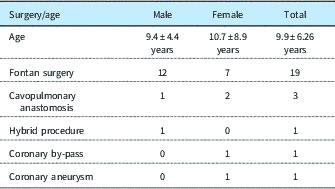
Our study population consisted of 25 subjects, 11 female patients, with a mean age of 10.7±8.9 years, and 14 male patients, with a mean age of 9.4±4.4 years. Details of subjects and type of surgeries are given in Table 1. Aspirin resistance by thromboelastrogram plus platelet mapping was found in 72% of all patients (18/25).
Subjects divided by gender and surgical procedure.

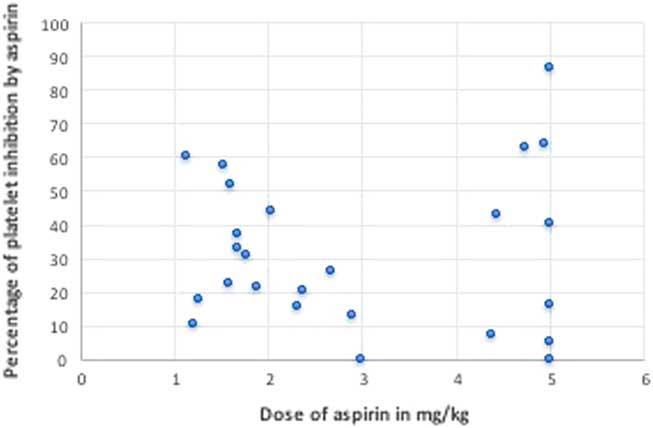
There was no correlation between the dose of aspirin calculated by mg/kg and the levels of platelet inhibition by arachidonic acid (confidence interval (CI) 95%, p: 0.7) (Fig 1). Of note, 72% (18/25) of our study subjects were taking the maximum dose of aspirin at 81 mg every day. The average dose for all subjects was 2.9 mg/kg/dose.
Correlation between dose of aspirin per mg/kg and percentage of platelet inhibition by aspirin (p:0.7 CI: 95%).

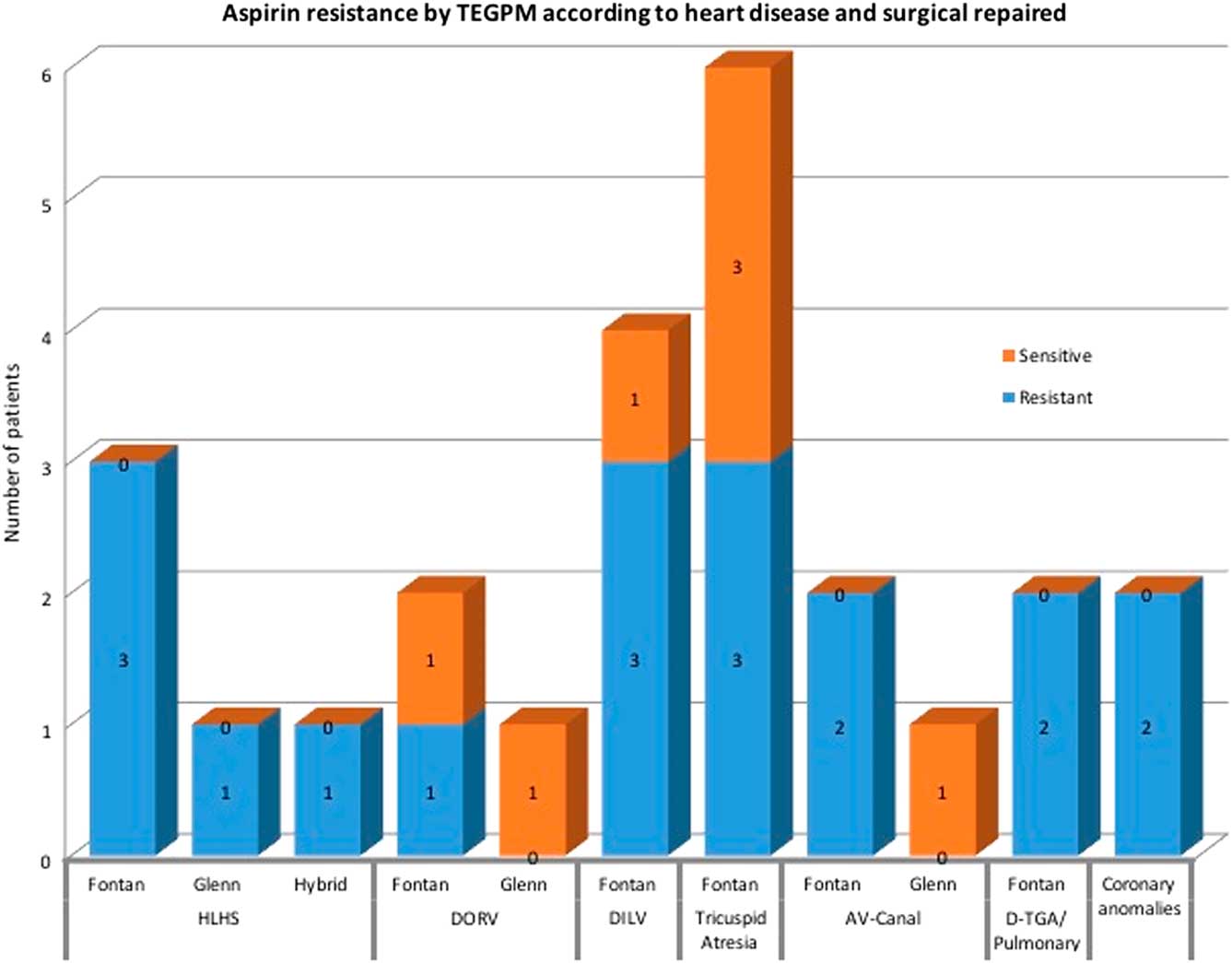
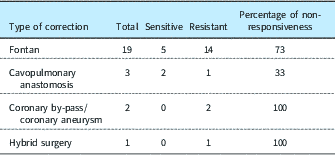
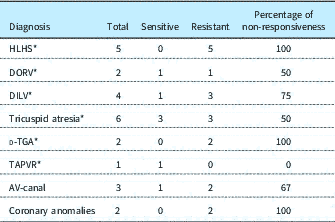
When sorted by type of surgery, 73% (14/19) of post-Fontan patients presented with aspirin resistance, whereas the rest of our study population was identified to have 67% (4/6) as may be seen in Table 2. When grouped by underlying diagnosis, 70% (20/25) of our study population had a cyanotic heart lesion as their underlying disease (Table 3). Patients with diagnosis of double-outlet right ventricle and tricuspid atresia had the least amount of aspirin resistance (Table 3, Fig 2). The average time in our population from surgery to the performance of the test TEGPM was 5.3 years.
Aspirin resistance by TEGPM according to heart disease and surgical repair. AV=atrioventricular; DILV=double-inlet left ventricle; DORV=double-outlet right ventricle; d-TGA=dextro-trasposition of the great arteries; HLHS=hypoplastic left heart syndrome.

Subjects divided by response to platelet inhibition and surgical procedure.

Subjects divided by cardiac congenital disease and response to platelet inhibition.

AV-canal=common atrioventricular canal; DILV=double-inlet left ventricle; DORV=double-outlet right ventricle; d-TGA=dextro-trasposition of the great arteries; HLHS=hypoplastic left heart syndrome; TAPVR=total anomalous pulmonary venous return
* Cyanotic lesion
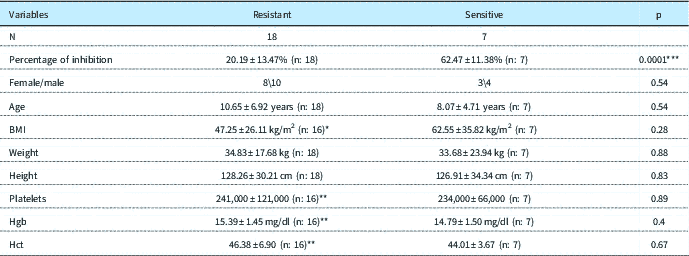
Patients were divided into two groups: sensitive and resistant to aspirin by TEGPM. When compared for possible confounding factors, we found no statistical difference between both groups when assessed for variables of haemoglobin, haematocrit, platelet level, age, weight, height, and body mass index by Mann–Whitney test (Table 4).
Subjects demographics.

BMI=body mass index; Hct=haematocrit; Hgb=haemoglobin
* Two patients were excluded because they were >18 years
** Two patients did not have a complete blood count within 2 weeks of the TE
*** Statistically significant results
There were eight female patients who were resistant by the test to aspirin – 72% of female patients – and 10 male patients with aspirin resistance by the test – 71% of male patients. Differences between gender were not statistically significant by χ2 test (score: 0.3645: CI 95%, p⩾0.5).
In one patient with tricuspid atresia and extra-cardiac fenestrated Fontan, an intra-systemic thrombus was identified at the level of the Fontan baffle, not obstructing the flow. The level of platelet inhibition in this patient was 64%. The time since the surgery and the detection of the thrombus was 7 months and 17 days.
Discussion
Thromboembolic complications in the postoperative period in patients with a single-ventricle physiology are an area of great concern. The aetiology for this increased thrombogenecity is incompletely understood.Reference Idorn, Jensen, Juul and Reimers 19 In addition, this complication appears to occur at any time of the life span of these patients. The prevalence of thromboembolic events after a Fontan surgery has been described to be 8.1% after a mean follow-up of 8.4 years.Reference Idorn, Jensen, Juul and Reimers 19 Aspirin is the most common medication used in the United States of America hospitals to prevent thrombosis in this specific population, but its efficacy has never been tested in a randomised clinical trial.Reference Wessel, Berger and Li 20 Aspirin is also an equivalent treatment compared with warfarin in children after Fontan surgery.Reference Iyengar, Winlaw and Galati 21 There is now an open debate on the concept of aspirin resistance in the paediatric population, although there has not been any laboratory test that has been able to clearly define it. Variability between laboratory test makes this task more challenging.Reference Schmugge, Speer and Kroiss 9
In our study, aspirin resistance by TEGPM is high (72%). These results are similar to those previously published by Mir et al, who evaluated aspirin resistance with TEGPM in the immediate postoperative period of cyanotic lesions in 1-month-old patients taking aspirin at therapeutic dose. They reported a level of aspirin resistance of 80%.Reference Mir, Frank and Journeycake 3 This may be explained by an increased activation of platelets after a vascular surgery.Reference Schneider, Rockman and Berger 22 Furthermore, it has been demonstrated that patients less than 1 month have a variable response to aspirin.Reference Romlin, Wahlander, Stromvall-Larsson, Synnergen, Baghaei and Jeppson 23 It is important to note that Mir et al were able to correlate the results of aspirin resistance by TEGPM and high levels of urinary 11-dehydroxy-thromboxane B2, which is a test that has been able to predict cardiovascular events in the adult population.Reference Szczeklik, Stodolkiewicz, Rzeszutko, Tomala, Chrustowicz Am Zmudka and Sanak 24 Similarly, our results parallel those described by Saini et al as well, who reported a level of aspirin resistance by TEGPM of 75% on patients on extracorporeal membrane oxygenation.Reference Saini, Hartman and Gage 25 Our results suggest that this high aspirin resistance by the test might be maintained a longer period of time after surgery and perhaps is independent of the use of extracorporeal membrane oxygenation as the levels of aspirin inhibition are similar in our study population. Further, bigger cohorts are needed to clearly define whether the similarity encountered by TEGPM in such diverse environments is due to intrinsic factors in the platelet function or it is because of the test itself.
We were not able to establish a correlation between aspirin resistance by platelet mapping and clinical thrombosis. In fact, the only patient with a thrombus identified was classified as aspirin sensitive. At this point, it is not clear whether the use of thromboelastogram and platelet mapping might have a relevant role for monitoring anti-thrombotic therapy in children with CHDs.
One of the possible factors affecting the results of thromboelastogram plus platelet mapping is the use of heparin in the sample to measure maximum amplitude in the arachidonic acid sample (Channel 3). Nelles et al has reported this effect. They demonstrated that platelets in heparinised samples had an increase in procoagulant platelet microvesicles and this might be responsible for up to 29–58% increase in the value of maximum amplitude in the arachidonic acid sample.Reference Nelles and Chandler 26
It is the opinion of the authors that a possible next step in the development of TEGPM test might be replacing heparin by salicylate – the active metabolite of aspirin – in a known therapeutic concentration in the arachidonic acid channel. This creates an in vitro test that could potentially predict the effectiveness of aspirin in a patient before starting therapy. At the same time, it eliminates the activation of platelets by heparin and overcomes the problem of monitoring the effectiveness of anti-thrombotic therapy in a non-compliant patient. On the other hand, this step might be able to identify a patient who is genetically predisposed not to respond to aspirin, opening the door for a future individualised anti-thrombotic therapy.
In the two previous studies and the present, the given definition of aspirin resistance was arbitrarily defined as a level of inhibition in response to arachidonic acid of <50% by TEGPM. We believe that this definition needs to be revised in light of our findings of one patient with a thrombus at level of the fenestration of the Fontan and a level of inhibition of 63%. These authors suggest lowering the definition to 20%, which is the average that we encountered in our patients with aspirin resistance (Table 4). Furthermore, owing to the complexity of factors that can alter platelet activation, we believe that it is reasonable to classify a patient between 20 and 50% level of inhibition as hypo-responsive or high on-aspirin treatment platelet reactivity. A correlation between the levels of platelet inhibition when assessing aspirin therapy by thromboelastogram plus platelet mapping and clinical outcomes is needed to make this classification operational.
The majority of our subjects had a cyanotic lesion as their underlying initial diseases (70%, n=20, Table 4). This high incidence of aspirin resistance is also in accordance with the result presented by Heistein et al, who demonstrated that the cyanotic lesions are more likely to present aspirin resistance (39.5%).Reference Lisa, Scott and Zellers 1 However, Heistein et al used Platelet Function Analyzer–100. This test is not equivalent to TEGPM
Thromboelastometry has been previously used by Lison et alReference Lison, Weiss, Spannagl and Heindl 27 in the post-surgical period to evaluate the haemostasis of adult patients after a major surgery, demonstrating an increase in the clog firmness up to the day 6 after surgery. We believe that a possible haematological derangements after a vascular surgery may predispose these patients to be more prone to not respond to the anti-platelet treatment.
Although our results are laboratory findings and do not correlate with clinical thrombosis, nor are evidence of haemostasis pathology, these haematological derangements are commonly identified after cardiovascular surgeries in CHDs.Reference Odendard, McGowan and Zurakowski 28 For example, there has been noted an increase in the levels of Factor VIII zand Von Willebrand factor after a vascular surgery.Reference Iyengar, Winlaw and Galati 21 The relation of this increase and the prothrombotic state after surgery is still not clear.Reference Iyengar, Winlaw and Galati 21
Particularly in CHD surgeries, adult-survivor patients post-Fontan have been shown to have a 23% increase in the Von Willebrand factor levels, as well as P-selectin, in the platelet’s surface.Reference Tomkiewicz-Pajak, Hoffman, Trojnarska, Lipcznska, Podolec and Undas 29 This increased activation on P-selectin in platelets has also been found in healthy children when compared with healthy adults,Reference Yip, Linden, Attard, Monagle and Ignjatovic 30 pointing to a multi-factorial cause that combines specific characteristics of a developing haemostatic system in children and the physiology after a vascular surgery that might predispose to clinical aspirin resistance. It is well described that Von Willenbrand factor acts as a chaperone for factor VIII , which has its reservoir in the Weibel–Palade bodies on the endothelium,Reference Wagener, Olmsted and Marder 31 whose integrity in any case might be compromised because of chronic cyanosis and/or surgery.
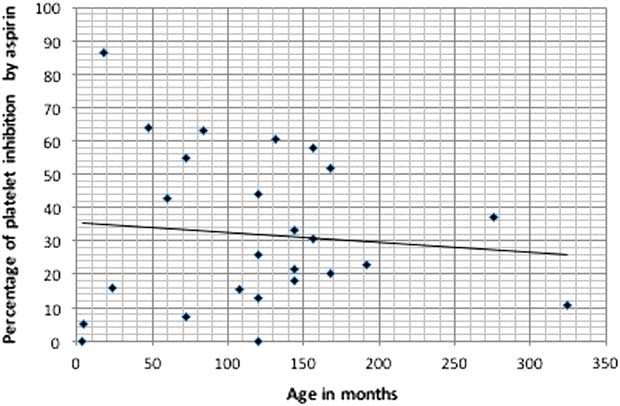
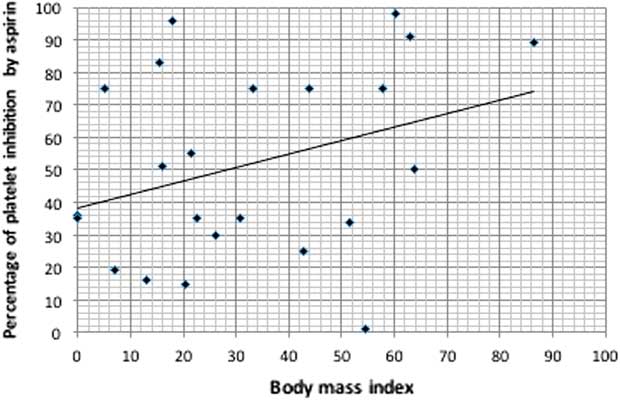
In our study, no correlation with age in months and level of platelet inhibition was observed. There is a weak positive trend between body mass index and platelet inhibition when the outliers of our sample are excluded – two patients >18 years of age. We consider that a bigger sample might show statistical significance (Figs 3 and 4).
Correlation between age in months and level of platelet inhibition by aspirin R -0.0971 (CI 95%, p: 0.64).

Correlation between body mass index and level of platelet inhibition: 0.3309 (CI: 95%, p: 0.107).

Conclusions
Aspirin resistance in children with congenital heart conditions after surgical repair, defined as a percentage of inhibition <50% by TEGPM, is high.
Our study demonstrates aspirin resistance as a laboratory finding. Correlation with clinical resistance – that is, a patient taking aspirin that presents with thrombosis – is still required. A standard definition of aspirin resistance as a first step and validation of this definition on large prospective studies is needed.
The accuracy of the TEGPM to predict clinical disease (thrombosis) is in question, given the published data that sets the standard for aspirin resistance. However, our patient numbers are not high enough to reach a conclusion on this. Further research is needed to assess the appropriate therapy for anti-coagulation/ anti-platelet therapy on patients with CHD.
In the current era of stenting, implantable valves, and interventions in the vascular space, a more proactive approach to monitor anti-thrombotic therapy is needed, rather than waiting for morbid events to define outcomes.
Acknowledgements
The authors would like to thank all Driscoll Children’s Hospital staff who took care of our patients. The authors are also thankful to Paige Cooper RN BNS and Christianna Donald RN BNS for their help on the chart’s search, as well as Jose H. Guardiola PhD Assistant professor at Texas A&M Department of Mathematics and Statistics for the statistical analysis and Teddy Sefawn MSC Laboratory Driscoll Children’s Hospital.
Financial Support
None.
Conflicts of Interest
None.