



Introduction
Lo! The friends of Allah have no fear, nor shall they grieve. (QS. Yunus: 62–3)
This article explores a topic that is considered controversial both inside and outside of Indonesia (most likely for different reasons) and also within the Indonesian Heavy Metal music scenes themselves.Footnote 1 We trace the history of Indonesian Islamic metal bands, including Purgatory, Tengkorak and Kodusa, and the unofficial One Finger Movement that revolved around these bands (centred mainly on Jakarta). We introduce the skirmish between the One Finger Movement and bands with a more secular and/or Satanic mind-set such as Funeral Inception (East Jakarta). We look at the differences in symbols, heroes, rituals and values between One Finger Movement bands and the Bandung secular Death Metal scene. We also study Bandung Death Metal band Saffar, which was known for its Islamic lyrics on its debut full-length studio album Mandatory El Arshy (Extreme Souls Production 2013), but which is now in limbo owing to the departure of vocalist and lyricist Parjo.
We also look at Saffar's positioning of itself as a ‘secular’ band with Islamic Religion and Anti-Zionist lyrical themes rather than as an Islamic band per se. This dichotomy can be best explained perhaps by the phrase ‘a band of Muslims rather than a Muslim band’, although ‘band of Muslims’ applies to many acts without religious lyrics. The secular Bandung scene context is significant as an explanatory factor here since there has never been an identifiable One Finger Movement or Islamic Metal scene in that city. Because of this, Saffar's success and its ability to maintain a profile and respect after several years of near non-activity from 2014 to 2016 has been a function of its band members’ abilities to build and maintain strong relationships with key identities in the secular scene, as well as their humility and obvious and demonstrated respect for the Bandung scene's symbols, heroes, rituals and values (Hofstede et al. Reference Hofstede, Neuijen, Ohayv and Sanders1990).
The topic of religion and metal music in Indonesia is not perceived as something that most Indonesian metalheads want to focus on or discuss.Footnote 2 This has made data collection difficult despite our extensive contacts within the Indonesian scene. The only partial (not total) exception to this would be Islamic metal bands Purgatory, Tengkorak and Kodusa. Their interview responses will be studied in depth later in this article. Most Indonesian metalheads think that religion is a private matter to be practised in private and that a person's faith (or lack of one) is irrelevant when she/he participates in the metal scene. In some ways this is a reaction to the fact that Islamic belief and practice is actually a very public and hegemonic aspect of Indonesian life (albeit not to the extent of the Middle East). Metalheads want a safe place to pursue their subcultural interests and practices, free from outside influences from the broader society. As Wallach et al. (Reference Wallach, Wallach, Berger and Greene2011, p. 17, emphasis added) write: ‘metal comes to function as a unique and appealing vehicle of youth identities … not burdened by religious … pressure’. Local metalheads also want to fight the perception they have that Westerners find Indonesian metal interesting because it (Indonesia) is a Muslim country.Footnote 3 They justifiably feel that this reductionism oversimplifies the complex influences that metal musicians have and the complex set of meanings, discourses and practices that constitute the Indonesian scenes. The opposition of secular metalheads, especially in the provincial city of Bandung (located 147 kmFootnote 4 south-east of Jakarta), to the One Finger Movement springs from similar ideas and ideals which hold that religion should be relegated to the private realm and to one's life outside of the metal scene. Tengkorak is sometimes disliked because it is perceived as breaking the unwritten rule that religion should not be brought into the metal scene but should be relegated to one's private life.
Note that the attitude of Indonesian metalheads is usually not the generalised ‘antagonism’ (Moberg Reference Moberg, Bossius, Häger and Kahn-Harris2011, p. 31) or ‘calculated antipathy’ (Mørk Reference Mørk, Bossius, Häger and Kahn-Harris2011, p. 125) that is common in Western scenes.Footnote 5 The majority of Indonesian metal musicians are practising and believing Muslims and there is a minority of practising and believing Protestants and Catholics, including Josh from Asphyxiate (Bekasi); Oki Haribowo from Death Vomit (Jogjakarta); Andre Tiranda from Siksa Kubur (Jakarta); and Yahnes from Tenggorokan (Kediri), who was previously part of the now defunct Christian metal band Pentekosta (an approximate contemporary band of the far more famous Kekal). Most Indonesian musicians thank ‘Allah S.W.T.’ and ‘Nabi Muhammad S.A.W.’ at the beginning of thank-you listings inside CD booklets (see, for example, the booklet for Saffar, Mandatory El Arshy). Somewhat ridiculously these thank-you notes also appear in the booklets of bands with Satanic or occult lyrics and imagery. Many Indonesian metalheads would see no obvious contradiction between the dedications and the lyrical themes, although some musicians who do make such distinctions would see them as impacting negatively upon the integrity of these bands’ overall projects.Footnote 6 Performing religious activities in private and/or outside of one's life in the metal scene is generally not viewed negatively. The only comparisons we can think of are Western Europe and Australia up to around 1970 (before attacks on religious beliefs and especially Christianity became commonplace and fashionable) and the situation today in the Eastern Orthodox countries.
Very few or no Indonesian bands directly attack Islamic belief or practices because to do so would run contrary to, if not their own belief systems and ethical norms, then those of the broader society (which Indonesian metalheads do not want to antagonise). Furthermore, sentiments against any given religion do not appear to be strong in Indonesia and this is another reason why anti-Islamic lyrical themes are uncommon. Many Indonesians would agree with Indonesian metal-music promoter Jason Hutagalung and his Australian wife Lauren that ‘religion has never been the problem in Indonesia’Footnote 7 (interview with Jason Hutagalung and Lauren Wilson, Xenophobic Records, 11 January 2011) and hence it is simply seen as superfluous and a distraction to discuss (or to criticise) religion within the metal scene. Supporting the view that ‘religion has never been the problem’, senior bands Asphyxiate, Death Vomit, Siksa Kubur and Tenggorokan have existed for a long time with both Muslim and Protestant or Catholic band members working amicably together. This fact supports Wallach's (Reference Wallach, Berger, Greene, Wallach, Berger and Greene2011, p. 88) assertion that ‘in Indonesia the national metal movement forges ties across … religion[s]’.
This article poses and attempts to satisfactorily answer the following research questions:
(1) What are the histories, motivations and worldviews of the Indonesian Islamic metal bands that made up the One Finger Movement?
(2) What are the symbols, heroes, rituals and values of the Islamic bands?
(3) What has been the response of Indonesian metalheads to the Islamic bands?
(4) What are the symbols, heroes, rituals and values of the secular Bandung Death Metal scene and what explains the commitment of its members?
(5) What is the history and perspective of the band Saffar and why is Bandung scene location significant in explaining its members’ attitudes towards the Islamic bands?
(6) Why are Saffar's members keen to present themselves as a ‘band of Muslims’ rather than as a ‘Muslim band’?
The present article is structured as follows: the second section provides background information about the Indonesian metal scene and One Finger Movement; the third section provides a theoretical framework; the fourth section discusses the research method; the fifth section provides analysis of interview data; the sixth section analyses the Bandung secular Death Metal scene and the band Saffar; while the final section concludes.
Background
Indonesian metal scene
The Indonesian metal scene has become well known worldwide owing to its size and passion (Wallach Reference Hagen, Wallach, Berger and Greene2011).Footnote 8 It is also known for being characterised by Indonesian cultural values of respect, politeness, tolerance and patience, to a large extent, as well as its unwillingness to directly criticise others (Wallach Reference Hagen, Wallach, Berger and Greene2011, p. 89).Footnote 9 Most of its members are socially conservative and respectful members of a pluralistic and diverse, but hierarchical, Indonesian society. Although Yuli of Jasad dates the scene back to 1975Footnote 10 (a plausible hypothesis given the crowds that lined the streets of Jakarta to welcome the British rock-band Deep Purple in that yearFootnote 11), the scene's foundation bands were mostly formed in the mid to late 1990s and the scene had grown to approximately its present size by 2011.Footnote 12 Addy Gembel, Forgotten vocalist, views the foundation of the Ujung Berung scene in East Bandung as occurring simultaneously with the coming of industrialisation to this semi-rural farming community on Bandung's eastern fringe (and the anger of the music reflected the anxiety which this historical development generated) (interview with Addy Gembel, 29 November 2012; see also Avelar Reference Avelar, Dunn and Perrone2001, p. 132; Wallach Reference Hagen, Wallach, Berger and Greene2011, p. 92; Wallach et al. Reference Wallach, Berger, Greene, Wallach, Berger and Greene2011, pp. 17, 26, n. 11, p. 30, n. 17, p. 32; Weinstein Reference Weinstein, Wallach, Berger and Greene2011, pp. 41, 52, 54).
Each city of Indonesia is known for its unique sub-genre mix. For example, the hegemonic leader of Indonesian metal is the Bandung scene, known for its many bands playing in the Suffocation/Disgorge USA style of Brutal Death Metal; Surabaya is known for Power Metal, Black Metal and War Metal; Jogjakarta is known for Death Metal across a variety of sub-sub-genres ranging from slamming to brutal to math-based; while the mountainous provincial city of Kediri is known for (believe it or not) Technical Death Metal. In East Java, especially, Black and War Metal draw upon centuries-old local traditions (Wallach et al. Reference Wallach, Berger, Greene, Wallach, Berger and Greene2011, p. 17, n. 11, p. 30; Weinstein Reference Weinstein, Wallach, Berger and Greene2011, pp. 41, 54–5) of occultism, black-magic, witchcraft, legend and superstition as much as they do on Western Satanic themes. However, band members also function in conservative civil society where there is minimal or zero welfare provision and they must adhere to accepted social norms to keep extended family, workplace and university relationships functioning smoothly. Respect and politeness trump most other values. Metalheads often marry and have families in their early to mid twenties, so very few of the women (or men) you might see at shows should be viewed as being ‘available’. Many people tend to mix metal scene practices with traditional religious customs and this creates some discontent among those (usually Black Metal-oriented) metalheads who like to see everything in (pun unintended) black-and-white terms.
Overall, the Indonesian scene must be viewed and understood primarily on a city-by-city basis and not as a large homogenous undifferentiated mass. Understanding tensions between the Bandung and Jakarta scenes and the Bandung and Surabaya scenes is fundamental to understanding the history and contemporary dynamics of Indonesian metal.
One finger movement
The One Finger Movement (Anonymous 2015; Saefullah Reference Saefullah2017, pp. 270–1, 273–4) was a community organisation or collective of bands, fans and gigs, which had an ethos of being pro-Islamic and anti-Zionist rather than being secular in the spirit of the Bandung scene and most overseas scenes (Anonymous 2015). It can be viewed as roughly equivalent to the Christian Metal scenes of the West and of South America, but only in that it aims to spiritually nourish and encourage religious people who already have an active interest in metal music.Footnote 13 It was based mainly in Jakarta in the 2000s and early 2010s and it also had some influence in Malang (East Java) and Medan (Sumatra). Jason Hutagalung, Australian-based Indonesian music promoter and tattoo artist, estimated that the One Finger Movement comprised at its peak about 20% of the Jakarta scene (interview, 11 January 2011).
The movement has had its supporters and opponents, the main figures for each camp being Ombat and Samier of Tengkorak for the Islamic bands and Doni ‘Iblis’ Herdaru (the vocalist of Funeral Inception) for the Satanic or hell-raiser bands.Footnote 14 The movement was named after the one finger sign (meaning ‘one God’) used by its proponents and supporters in place of the generally accepted worldwide devil's horns symbol, which they viewed as unacceptable (Saefullah Reference Saefullah2017, p. 270). This one finger sign involves metalheads touching each other's extended forefingers tip-to-tip. The major bands of the One Finger Movement were Purgatory (formed 1991), Tengkorak (formed 1993) and Kodusa (formed 1998), and the movement was also associated with Al Azhar Mosque in Jakarta attended by Ombat (Anonymous 2015). While the name of the movement may have outlived its usefulness, all three bands remain active today and continue with the same Islamic ethos and worldview.
Jason says that the consensus among secular metalheads was not to give the One Finger Movement any attention or air to breathe. The following conversation with Jason introduces the context and the main players:
Q: How many bands were involved in this skirmish or disagreement?
A: There are only a handful of bands involved [in the skirmish] – Funeral Inception leader Doni Iblis and, on the Muslim side, Tengkorak, meaning ‘skull’.
Q: What does this Muslim band sing about?
A: The band preaches about going to the mosque and praying. They are connected to Islamic [Defenders] Front [Front Pembela Islam, FPI]. These people want the country to become a Muslim country; they have their own publication, magazine.
Q: What percentage of the scene do you think is fundamentalist and where is it strongest?
A: About 20% of hard-core metal people [would support One Finger Movement] mostly in Jakarta, Malang and Medan. We had an agreement to ignore them and not give them publicity. We have not heard from them much but they are around in the Indo metal community. (Interview with Jason Hutagalung, Xenophobic Records, 11 January 2011)
The Indonesian militant Islamist organisation FPI (Front Pembala Islam or in English Islamic Defenders’ Front) is beyond the scope of the present article.Footnote 15
Theoretical framework
Hofstede's Theory of Culture as Symbols, Heroes, Rituals and Values
Hofstede et al. (Reference Hofstede, Neuijen, Ohayv and Sanders1990) argue that what we know about culture is that it is: (a) holistic; (b) historically determined; (c) related to anthropological concepts; (d) socially constructed; (e) soft; and (f) difficult to change. Hofstede's theory maintains that it is easier to change an organisation`s symbols, heroes and rituals, rather than its values (Hofstede et al. Reference Hofstede, Neuijen, Ohayv and Sanders1990). They conclude based on their 20 case studies and quantitative survey of employees of Dutch and Danish organisations that values are inculcated through childhood socialisation in the family and at school, and are largely absorbed by the age of 10 (Hofstede et al. Reference Hofstede, Neuijen, Ohayv and Sanders1990, p. 312). They vary relatively little across organisations as compared with practices (which incorporate and are reflected in symbols, heroes and rituals). What variation which does occur is due in part to cross-national variations in values. In contrast, practices are only taught and modelled later when a person joins an organisation as an adult employee. Practices are based on the values of the founders; they are the regular acting out of values (Hofstede et al. Reference Hofstede, Neuijen, Ohayv and Sanders1990, p. 311). Practices are defined as being part of a culture, based on a classic early definition of culture by Tylor (Reference Tylor1924, p. 1): ‘Culture is that complex whole which includes knowledge, beliefs, art, morals, laws, customs and other capabilities and habits acquired by man [sic] as a member of society’.
Hofstede et al. (Reference Hofstede, Neuijen, Ohayv and Sanders1990, p. 291) define symbols as ‘words, gestures, pictures, or objects that carry a particular meaning within a culture’. They define heroes as ‘persons, alive or dead, real or imaginary, who possess characteristics highly prized in the culture and who serve as models for behavio[u]r (Wilkins Reference Wilkins1984)’ (Hofstede et al. Reference Hofstede, Neuijen, Ohayv and Sanders1990, p. 291). They define rituals as ‘collective activities that are technically superfluous but are socially essential within a culture – they are therefore carried out for their own sake’ (Hofstede et al. Reference Hofstede, Neuijen, Ohayv and Sanders1990, p. 291). However, later discussion and examples in their article suggest that the authors do not regard all rituals as being technically superfluous or unnecessary. Symbols, heroes and rituals are ‘subsumed’ under the category of practices, which are ‘visible to an observer although their cultural meaning lies in the way they are perceived by insiders’ (Hofstede et al. Reference Hofstede, Neuijen, Ohayv and Sanders1990, p. 291). The core of culture is values, defined as ‘broad, nonspecific feelings of good and evil, beautiful and ugly, normal and abnormal, rational and irrational – feelings that are often unconscious and rarely discussable, that cannot be observed as such but are manifested in alternatives of behavio[u]r’.
Research method
This article is a small part of a larger research project into the Indonesian Death Metal scene and issues of ethics, values, meaning, power, networks, culture and resistance. The broader research project began on 24 February 2011 when we interviewed Bandung's most famous Death Metal export, Jasad, which has released CDs through Sevared Records USA and later played at the Obscene Extreme Fest in Czech Republic and Bloodstock Open Air in England. In Bandung our hosts from our second (October 2011) onwards were Popo Puji Apriantikasari of Demons Damn and her husband Bobby Rock, then the vocalist of Bleeding Corpse. Altogether we conducted over 67 band and/or musician interviews face-to-face and many more online over the period 2011–18. We travelled on the band tour-bus with Bleeding Corpse on its overnight trip to Cibinong on 8–9 October 2011; with Bloodgush from Bandung to Cililin on 26 February 2011; and with Jagal from Surabaya to Jombang, East Java on 7 December 2014. We visited the major centres of Death Metal in Indonesia, including Bandung, Jogjakarta, Jakarta, South Jakarta, Surabaya, Kediri, Malang, Madura Island, Balikpapan and Samarinda.
We became aware of the One Finger Movement and its Islamic bands during the course of the research and decided to write an article on the topic, contrasting it with the secular Bandung scene, which is the scene we are most familiar with. Our data is limited in quantity but we think it is rich and illuminating. If possible we might revisit this research topic further down the track if we can obtain more data. Our data includes one personal interview in Surabaya with Samier, the guitarist of Tengkorak; and two with Acil from Saffar, a young Bandung band which does not self-identify with the One Finger Movement but which has released an album featuring Islamic religious lyrics. We also use data from the online interviews we did with Ombat of Tengkorak, Lutfi of Purgatory and Kodusa band, which are the three principal Jakarta-based bands of today's Islamic scene. Unfortunately these interviews are not very revealing (other than the Kodusa interview) and responses were guarded and brief because there was no mutual contact or friend and we did not meet these bands in person. Furthermore, the question–answer survey format, where our questions were translated into Indonesian and then answers translated back into English, did not allow for the interviewer or interviewee(s) to respond to comments or probe for more details.
We spent three weeks in Surabaya (East Java province) during two 2014 field-trips (January 2014 and December 2014) where we were hosted by Dimas Bramantyo, the guitarist of local band Valerian. This hosting allowed us to meet and interview Samier from Tengkorak band. We visited Surabaya radio station Colors Radio 87.8FM, where Samier works; watched Samier play guitar at an Anthrax tribute night hosted by the associated Colors Pub (address: Jl. Sumatera no. 81, Surabaya 60281); and interviewed Samier about Tengkorak and his other band, the new Surabaya-based political grindcore act G.A.S.
Interview findings
We conducted two interviews with Tengkorak band members. The first, which provided by far the most interesting data, was conducted in person with guitarist Samier at his recording studio Inferno Music Studio & Rock Shop (address: Jl. Dharmahusada 178, Surabaya). In the section below we discuss first the interview with Samier and secondly the online band interview with Kodusa.
Samier Interview (Tengkorak)
We asked the Surabaya-based Tengkorak guitarist Samier to explain the vision and philosophy of his band Tengkorak. Samier answered as follows:
It comes from our [personal] philosophy itself. We have faith in Allah, we believe Islam; it's a good religion, not a terrorist. We should tell about the truth. A lot of kids in Indonesia, especially in Jakarta, at that time were starting to doubt their beliefs so we counter that. A lot of bands say they don't believe in God; some of them are fake [hypocritical] you know. If they don't believe [in] God they don't [i.e. can't, theologically speaking] believe [in] Satan. If they believe Satan but don't believe God, it's ridiculous, man! So we tell the truth. We want the kids who watch us to continue to believe their religion. Although they like metal they should not accept the lifestyle. (Interview with Samier, Surabaya, 26 January 2014)
Samier asks why God cannot be discussed in the metal scene whereas Satan can be discussed, claiming that this is ‘ridiculous’. As Samier argues, if you do not accept and honour God how can you accept and honour Satan since they are both key elements of Christian and Islamic theology with God having a nobler character and also being more powerful (Häger Reference Häger, Bossius, Häger and Kahn-Harris2011, p. 18)? Satan is a created being (a fallen angel) whereas God is Eternal (Häger Reference Häger, Bossius, Häger and Kahn-Harris2011). The situation of accepting Satan but not God in your discourses and practices is labelled as ‘ridiculous’ by Samier, presumably because these metal scene discourses and practices run contrary to Samier's previously held worldview (held since early childhood) that God is greater, mightier and worthier than Satan. The assumption is that, for most Muslims in Indonesia, they were socialised into Islamic religion at a very young age by parents, nuclear and extended family, mosque, school and community, and this socialisation for most people would predate chronologically their first involvement in the metal scene. This might not be true in all cases but, in the Indonesian context, it is probably a reasonable assumption. The issue is then crafted in terms of where one's primary loyalty and identification should lie. Islamic devotion to God/Allah should take priority in one's heart and actions over one's involvement in metal scene discourses and practices according to Samier. As we shall soon see, this assumption implies for Samier (but not for those who want to keep the scene secular and/or satanic) that it is right and natural that Islam can ‘enter’ legitimately into the metal world, and that it should enter from the viewpoint that it is deeper and superior.
That Islam is worthier of deeper devotion than metal scene discourses and practices is uncritically accepted by Samier and this assumption or conclusion has a complex relationship with the other assumption that most Indonesians’ socialisation into Islam occurs chronologically prior to their socialisation in the metal scene. Samier couches this connection not only in terms of the need for respect for and devotion to your earliest religious teachers, but also the presumption that Indonesian society has ‘got it right’ by socialising young children into Islamic belief and practices early on. Samier expressed privately his fear that Islam may become less important in Indonesia in the future so that it will no longer play such a vital role in most children's earliest socialisation experiences as it does today. He cites the declining role of the Church and Christian belief in European countries (Bossius et al. Reference Bossius, Häger, Kahn-Harris, Bossius, Häger and Kahn-Harris2011, p. 7; Moberg Reference Moberg, Bossius, Häger and Kahn-Harris2011, pp. 33, 39–44, Reference Moberg2012, p. 121) as providing a rational basis for his fears but there is the unstated implication left hanging in the air that this decline in the West might be due to Christianity being false or incomplete whereas Islam is true.
Our interview with Samier, after a promising start, then appears to get dragged down by the usual clichéd discussion of which aspects of metal scene symbols, heroes and rituals (together termed practices) (Hofstede et al. Reference Hofstede, Neuijen, Ohayv and Sanders1990) are acceptable to Samier and which are not. This list of acceptable and unacceptable practices became the humorous highlight of the Swedish documentary-making brother-and-sister Resborn team's interview with Ombat from Tengkorak in their coffee-table book Labour of Love & Hate (Reference Resborn and Resborn2012, pp. 127–30) where the terms halal and haram are used in jokey fashion (at least by the Resborns) to classify scene practices.Footnote 16 However, we note here in the interview responses that Samier does add some important content to the discussion (before it is again dragged down into a list of dos and don'ts)
Q: What are the things wrong with metal lifestyle and what things are OK?
A: A lot of metal fans here say that you are not metal if you are not drunk; you are not metal if you are not tattooed; it happens over the years. If you live in Indo you don't have to take that lifestyle if you like metal. You have your own lifestyle. As a child you studied your religion, you prayed, it was like that. If you like metal you should not leave what you believe. If you believe it is not correlated with your music. Music is just entertainment. If you like horror movie it does not mean you are a killer or something like that. Don't adopt the Western lifestyle. If the lifestyle doesn't match with your religion don't take it.
Q: What about black tee-shirt and long hair?
A: It's OK for me; it's not OK for some. In the end we realise the music has power to state our message. If people have a bad message in their music the metal fans think it's OK. Why then is the good music [i.e. the message of the good music] not OK? In Indonesia it's different to other [Western] nations, you still have religion. (Interview with Samier, 26 January 2014)
In the first response Samier notes that the worldview that a certain image and set of subcultural practices are deemed part and parcel of taking on a metalhead identity has become a part of the metal scene culture in Indonesia and these influences have slowly accumulated and crystallised over the years. Here we see Samier refer again to the importance of the assumption that one's early childhood socialisation into religion occurred chronologically prior to one's becoming part of the metal scene. It is hard to be sure whether Samier here is referring only to Muslims or also to Protestants, Catholics, Taoists and Buddhists (such as Bodas, the vocalist of Surabaya hardcore band Devadata). Then we get the injunction from Samier which relies upon this crucial assumption: ‘If you live in Indo you don't have to take that lifestyle if you like metal. You have your own lifestyle’. This injunction or instruction is straight-forward in theory but in practice it is sure to be complicated to apply. Clearly someone rejecting the moral worth of this injunction not to ‘take the metal lifestyle’ might then have issues with the entire philosophy and purpose of Samier. It would depend upon which aspects of the lifestyle are being referred to and to what extent the metalhead views these aspects as being important compared with their own religious beliefs. Tengkorak has proved to be a divisive band in large part because of how people outside the band have interpreted its public statements and philosophy. It is easy to be caught up in the never-ending cycle of arguing about the dos and don'ts.
Samier then puts forward his belief or goal that music should be seen only as ‘entertainment’Footnote 17 (Samier's word), which ignores the fact that metal music to many of its adherents has meanings and values that go beyond ‘mere entertainment’ as indicated by most metalheads’ loyalty to their preferred bands and disdain for ‘superficial’ pop-music (Avelar Reference Avelar, Wallach, Berger and Greene2011, p. 137; Greene Reference Greene, Wallach, Berger and Greene2011, p. 117; Wallach et al. Reference Wallach, Berger, Greene, Wallach, Berger and Greene2011, pp. 8, 13). Samier says: ‘As a child you studied your religion, you prayed, it was like that. If you like metal you should not leave what you believe. If you believe it is not correlated with your music [because music should only be viewed as entertainment]’. Lastly, the injunction is stated in more direct form: ‘If the lifestyle doesn't match with your religion don't take it’. As mentioned, we can conclude that the message is to not let metal scene practices enter into the deepest parts of your loyalties or value system without them being interrogated first (and probably not even then). It is not at all the case that Samier hopes that you will view metal music as something superficial or unimportant since Samier's lifelong devotion and commitment to metal music would seem to run contrary to that presumption. It is about the ordering of priorities and what you give your heart to (which is a very religious worldview). This is not to say that this worldview is impossible since in our many daily interactions we habitually bring some friends and contacts into our inner circle and keep others outside of that. The injunction is to treat metal scene discourses and practices in the same way as we treat individuals. It is implied that this is easier because we had an assumed (religious) worldview and lifestyle prior to our involvement in the metal scene. It also assumes that our involvement in the metal scene marked our first exposure to Western practices, which for many people is unlikely to be the case.
Samier then refers to an oft-repeated theme when metal ethics are debated: metal lyrics about serial-killing are rarely acted out in practice and he uses this example to reinforce his point that we do not need to take literally or take into our heart all metal scene practices. However, there is a tension here with his earlier stated view that even trivial practices (alcohol and tattoos are the examples he mentions but devil's horns in pictures and 666 and inverted cross signs in band logos and on website pages could be added), by their very repetition, attain a deeper level of significance over time as they crystallise and become regarded as synonymous with metal. Within Samier's worldview we may just have to live with such existential tension. The tension remains of being torn in various directions by your varied influences, which is sometimes referred to metaphorically, within Christian Metal circles, as being too worldly for the Church and too holy for the world.Footnote 18 Why should there be an easy way out? The easy way would be simply to leave the metal scene altogether, a path chosen by Niza, the female hijab-wearing Surabaya-based ex-vocalist for Death Metal bands Climaxeth and Osiris. This path is not directly encouraged (or discouraged) by the Tengkorak band members since it is not a path which they have chosen. If we look at the case of Niza, her bandmates and other metal scene members were saddened by her departure from the Surabaya and Sidoarjo metal scenes around 2014. The fact that she has been missed suggests that, in hindsight, committedly religious metalheads are able to contribute something significant and positive to a secular scene during periods of sustained involvement.
In his second response, Samier states that long hair and black metal band tee-shirts are OK for him but possibly not for others. (Obviously they are OK for him as he is usually seen around Surabaya with long hair and wearing his black metal band tee-shirts. He was wearing an Arch Enemy tee-shirt on the first day we met.) However, he covers this statement with the interesting conclusion that ‘we realize the music has power to state our message’ which can be interpreted to include at least some of the following propositions: (a) metal is a powerful visual and aural medium (Larsson Reference Larsson, Bossius, Häger and Kahn-Harris2011, p. 95) so that most messages can be conveyed powerfully through metal; (b) the long-term popularity of metal in Indonesia means that there will always be a sizeable audience; and possibly also (c) the vulnerability of metal youth to negative influences suggests that the message of Tengkorak will always be needed. In an interview with the Resborns, Purgatory band members recall the Napalm Death concert in Jakarta when the frontman said: ‘Religion is a myth – it only creates conflicts & bloodshed bla bla bla’ and the Indonesian audience responded: ‘Yeeeeeaaaaaahh’ (cited in Resborn and Resborn Reference Resborn and Resborn2012, p. 124). Purgatory admits to being ‘stunned’ as these people are meant to be a Muslim audience and most would probably confess to Muslim identity in non-metal contexts (such as Indonesian identity cards where one of six approved religions must be stated). Clearly it is conflicted and confused metal audiences like these, which treat the utterances of Western metal musicians with the utmost respect as part of receiving ‘gestures [from] elsewhere’ (Baulch Reference Baulch2003, Reference Baulch2007) that Tengkorak and Purgatory wish to bring back to committed religious faith and practice. As the radical theologian Jeffrey W. Robbins (Reference Robbins and Grimshaw2014, p. 88) writes about St Augustine: ‘It is knowledge of God that [must] anchor self-knowledge [from the perspective of the Abrahamic religions]’.
The closing section of Samier's second response is as follows: ‘If people have a bad message in their music the metal fans think it's OK. Why then is the good music not OK? In Indonesia it's different to other [Western] nations, you still have religion.’ This is essentially a restatement of the proposition featured in the first quote we used in this section. The good music (meaning here the music with the ‘good message’) should be allowed entry into the metal scene and not be derided or excluded. Then there is another reference to Indonesia being more religious than the West and ‘you still have religion’ in Indonesia, referring to its strength and influence but also perhaps being another reference to its eternal presence in a person's life and in society. Religion was there before the person's involvement in the metal scene and is (usually) there after it. However, it is this latter presence which the metalhead would have to learn to embrace and not to mock or push away. If a hybrid identity is formed (there really cannot be non-hybrids) then religious values and practices would have to be a priority so that they are emphasised while religiously unacceptable or ambiguous practices could be de-emphasised and perhaps eventually drop off or fade away. To quote Samier from later in the same interview: ‘If they are Christian or Muslim they should talk about their religion, it becomes about responsibility. Indonesia is not western; we have a religion; stay true to your religion’. It would be a fairly simple thing, for example, to make a committed personal decision to not include a pentagram or inverted cross in a band logo and/or not to make devil's horns in group pictures taken in metal-scene contexts. However, the subtler influences may be harder to protect oneself from. Purgatory band members, in interview with Resborn and Resborn (Reference Resborn and Resborn2012, p. 123), refer to Indonesian Islamic metalheads being ashamed or embarrassed to confess or practice their religion within the metal scene. For example, a male musician might pretend to be gay in order to avoid seduction after a concert (when the real reason is religious) and metalheads might make acceptable excuses in order to head off for prayers. Christian metalheads obviously face the same internal dilemmas and struggles.
The positivity and good values and ethics of the American hardcore scene (Agnostic Front, Biohazard, Madball, Sick of it All, etc.) were perhaps partially a collective response to the increasing trend towards dark (Moberg Reference Moberg2012, pp. 114, 116, 122–4) and evil (Phillipov Reference Phillipov2011, pp. 153–4, 157–8, 160, 162) metalhead discourse and practices which occurred in Europe and North America around 1992–1994 with the rise of Norwegian Black Metal (with its church-burnings, blasphemies, and murders) (Bennett Reference Bennett and Mudrian2009; Bossius et al. Reference Bossius, Häger, Kahn-Harris, Bossius, Häger and Kahn-Harris2011, p. 8; Granholm Reference Granholm2011, p. 529; Hagen Reference Hagen, Wallach, Berger and Greene2011, pp. 180–1; James and Tolliday Reference James and Tolliday2009, p. 151; Kahn-Harris Reference Kahn-Harris, Wallach, Berger and Greene2011, pp. 202–3, 215; Mørk Reference Mørk, Bossius, Häger and Kahn-Harris2011, pp. 124–5; Moynihan and Søderlind Reference Moynihan and Søderlind2003; Mudrian Reference Mudrian and Mudrian2009; Phillipov Reference Phillipov2011, pp. 152–6) and Floridian Death Metal (with its first-person lyrics of rape, torture, murder and mutilation) (Dick Reference Dick and Mudrian2009; James Reference James2009; James and Tolliday Reference James and Tolliday2009, p. 151; Kahn-Harris Reference Kahn-Harris2007, pp. 36, 43, 76; McIver Reference McIver2014; Phillipov Reference Phillipov2006; Purcell Reference Purcell2003, pp. 43–4). Norwegian Black Metal took literally and to its ultimate ‘logical’ (Phillipov Reference Phillipov2011, p. 152) conclusion what the earlier Heavy Metal and Thrash Metal scenes had managed to largely relegate to the symbolic realm.
Towards the end of the interview the author asked Samier what he thought of the global hardcore culture (as opposed to the global metal scene culture), expecting him to praise it for its positivity and good values. It is good that hardcore culture emphasises family and respect but Samier says that the source of these good values is ultimately religion rather than hardcore. Therefore, inspiration should be sought in the Al-Quran rather than in hardcore lyrics despite their positivity. (This is literally what Samier said to the Muslim music journalist Wendi Putranto of Rolling Stone Indonesia magazine.) This statement suggests that Samier believes that hardcore and metal scenes can only mirror and replicate positive things that existed in other contexts first and especially in religious contexts. We can read Samier's response here:
Q: What do you think of the culture of hardcore genre?
A: I think it's good because if we learn religion you will find that you should respect family, parents, mother, sister, etc. All the good things come from our religion, your religion … I think a hardcore band should say about religion. Our culture came from religion. If they don't say that a lot of people think hardcore is a religion. I read that it says metal has become a religion. Wendi of Rolling Stone magazine said hardcore lyrics are inspiring. Wendi is a Muslim. I told [Wendi] that if you want inspiration you should read Al-Quran. (Interview with Samier, 26 January 2014)
As the above quote indicates, Samier is concerned about the apparent lack of devotion to Islam and the abandoning of religious fervour and sincerity by some young people after they begin their participation in the metal scene. The goal of Samier is to counter this perceived negative influence so that metalheads may enjoy their participation in the scene (as Samier does by releasing albums and touring with Tengkorak and his grindcore band G.A.S.; playing guitar at an Anthrax tribute night held at Colors Pub; and by working at Colors 87.8FM radio station) while keeping their earlier religious fervour and devotion intact.
Kodusa band interview
Kodusa band members also speak about the need to produce positive (and polite) messages for the band's audience of religious metalheads as follows:
Our lyrics have some themes ranging from social matters, peace, justice, and some of them are religious. Religious in this context was some of story and legend based on our holy Quran. The point is we are trying to deliver the positive messages from it through our lyrics and music. We are also trying to pass the message by using appropriate words, as polite as possible. (Online interview with Kodusa, 27 November 2015)
Kodusa puts forward a view that not only the One Finger Movement but the term as well both continue to exist. We are not able to verify this because we did most of our field-work in Bandung, Jogjakarta, East Java and Madura rather than in the capital city:
As far as we know, One Finger Movement still exists. At the beginning, this movement was ignited by Ombat from … Tengkorak. But, generally speaking, metal bands such as Purgatory, Kodusa, and some local bands have been applying sort of Islamic metal far before terms like ‘Islamic Metal’ or ‘Metal Tauhid’ or ‘One Finger Metal’ [became] popular. This could happen because, in addition to the majority of population being Muslims, there were actually a lot of metal fans here in Indonesia. One interesting example was during the concert we could have a break until adzan is finished. (Adzan is the Muslim call to ritual prayer.) Even after adzan, everyone goes to mosque for praying. (Online interview with Kodusa, 27 November 2015)
The band also believes that the future of Islamic metal in Indonesia is bright, although we personally don't know of any new bands publicly aligning themselves with the One Finger Movement or (other than Saffar) utilising primarily Islamic religious themes in lyrics and imagery: ‘Yet, we are still confident with our identity. There are many local metal bands that have same ideology as us and they are also still proud of their Islamic values’ (source: online interview with Kodusa, 27 November 2015).
The Bandung Death Metal scene and Saffar
Bandung Death Metal scene
The Bandung scene is known for its size, dedication and commitmentFootnote 19 (to the Death Metal sub-genre in particular; James and Walsh Reference James and Walsh2015), extreme self-confidence, professionalism, hierarchical nature; its strong and cohesive networks of merchandise shops, recording studios, record labels, artists, and tattoo stores; its large number of talented and motivated underground musicians; and its high levels of organisation (Baulch Reference Baulch2007; James and Walsh Reference James and Walsh2015; Wallach Reference Wallach2008). It is famous for its penetration into spheres of society not yet reached in other parts of Indonesia including popularity of the genre even among primary-school students and widespread familiarity with the names and even the music of the leading local bands (James and Walsh Reference James and Walsh2015). It is associated with a lower middle-class/working-class district in the outer-eastern suburbs called Ujung Berung (or informally ‘Ujungbronx’) where most of the foundation bands originated from in the 1990s (James and Walsh Reference James and Walsh2015).
We get a situation in Bandung where the leading bands (Beside, Burgerkill and Jasad in particular) have the profile and brand-name recognition value of mainstream rock bands (or approaching such levels), but they still self-identify with the underground scene and play underground festivals (always headlining) for marketing purposes and to retain their hard-won subcultural reputational capital (Bell Reference Bell, Wallach, Berger and Greene2011, pp. 287–9; Bourdieu Reference Bourdieu1979 Reference Bourdieu1993; Kahn-Harris Reference Kahn-Harris2007, pp. 7, 121, 122–7, 128–31, 132–3, 136–7, 138–9, 2011, pp. 210–15; Thornton Reference Thornton1995). It is a city where competition is fierce; and festival and gig bills are rigidly controlled and reflect a religiously observed pecking order of seniority. Man of Jasad told us on 24 February 2011 that there were 128 active Death Metal bands in Bandung alone which surely makes Bandung the biggest metal scene in Asia and probably the world. Baulch (Reference Baulch2007, pp. 115, 156) refers to Bandung as ‘the heart’ of the Indonesian ‘underground scene’ while Wallach (Reference Wallach2008, p. 7) writes that Bandung is ‘home [to] a remarkably disproportionate number of … musicians’.
Bandung Death Metal scene – secular orientation
The Bandung scene is also known for its secular orientation whereby religion and religious belief are viewed as private matters which should be restricted to the private realm. Metalheads may freely go to the mosque or church but in their capacities as private citizens only; religious identification and activity are not permitted to infringe upon the scene's symbols, heroes, rituals and values.
Although Bandung is no less religious than any other Indonesian city, its rich history of arts, culture and music (van Zanten Reference Van Zanten2007, p. 11), going back decades,Footnote 20 also tends to create an artistic and music community today that feels somewhat empowered and more likely to follow an art-for-art's-sake philosophy (Bossius et al. Reference Bossius, Häger, Kahn-Harris, Bossius, Häger and Kahn-Harris2011, p. 4) while still keeping a quiet and regular eye on how to make money from art and music. The art-for-art's-sake philosophy tends to encourage a more professional and secular orientation whereby people expect religion to be relegated to the private sphere. The secular orientation was reinforced and people exerted more effort to defend it after high-profile Death Metal band Forgotten was condemned by Islamic hardliners from outside of the scene because of the title of its third-album Tuhan Telah Mati (Rock Records 2001) (meaning God is Dead) which was inspired by Nietzschean philosophy. Addy Gembel (Forgotten vocalist) offered to show us a threatening text message allegedly sent to him by an FPI member or supporter when we met in Bandung on 29 November 2012.
Application of the theory of Hofstede et al. (Reference Hofstede, Neuijen, Ohayv and Sanders1990) – symbols, heroes, rituals and values
The symbols of the Bandung scene are: spiky indecipherable band logos (Bell Reference Bell, Wallach, Berger and Greene2011, p. 282; Hagen Reference Hagen, Wallach, Berger and Greene2011, p. 189) and the logo of the Bandung Death Metal Syndicate community organisation; the devil's horn sign; the inverted cross; the pentagram; Baphomet; the number 666; the hammer and sickle (still a banned symbol in Indonesia); black band tee-shirts; tattoos; and long hair. Only the inverted cross, pentagram, Baphomet, 666 symbols and tattoos would appear to be unacceptable symbols for the One Finger Movement.
The rituals of the Bandung Death Metal scene include the following: Nongkrong (in English: hanging-out) (James and Walsh Reference James and Walsh2015; Wallach Reference Hagen, Wallach, Berger and Greene2011, p. 95); drinking beer or arak wine in conjunction with nongkrong; smoking and drinking potent and sweet Indonesian coffee in conjunction with nongkrong; group lunches and dinners (low-priced Indonesian food); visiting and showing support for small independent merchandise stores (such as Bleeding Corpse drummer Ari Bejo's Serak store on Jalan Cihampelas); growing and maintaining one's hair and music and music memorabilia collections; and animal sacrifices on stage (for certain Black Metal bands). Only drinking alcohol and animal sacrifices would be obviously unacceptable rituals for the One Finger Movement. One additional ritual of the Islamic bands, as we have seen, is having a break during a gig until adzan is finished.
The heroes of the Bandung Death Metal scene include the following: Man and Ferly of Jasad; Man's brother Iwan of the ESP record label; Dani aka Papap of Dismemberment Torture (the former Jasad drummer); Addy Gembel of Forgotten; Bandung scene history book author Kimung (ex-Burgerkill bassist);Footnote 21 Amenk of Disinfected; Kancil of Jihad; Ari Bejo of Bleeding Corpse and Injected Sufferage; Kinoy of Undergod; and the various past and present members of Burgerkill. These people can be often found relaxing at Papap's house in Ujung Berung in the evenings or at Extend Studio in the same district. Their values influenced the current practices of the Bandung Death Metal scene (Hagen Reference Hagen, Wallach, Berger and Greene2011, p. 182; Hofstede et al. Reference Hofstede, Neuijen, Ohayv and Sanders1990). In contrast, the heroes of the One Finger Movement have been primarily the band members of Purgatory and Tengkorak (especially Ombat and Samier). However, the heroes in this scene are not presented or viewed as ultimate icon figures in the same way that the Bandung scene figures are because there is also the awareness that they are pointing beyond themselves to Allah and Islamic faith (see also Bossius Reference Bossius, Bossius, Häger and Kahn-Harris2011, pp. 62–3, 70).
Introducing Saffar
One of the more interesting Bandung Death Metal bands is the relatively young Saffar which is in the second or third tier of the Ujung Berung/ESP hierarchy and is generally widely respected without being a household name outside of the metal underground, unlike Burgerkill or Jasad or Forgotten. Saffar was formed in either 2007 (according to Metal Archives) or 2009 (according to Ramon, Saffar's then bassist, band interview, 3 April 2012). The first line-up was Ezot (vocals), Acil (guitar), Faris (bassist from Lumpur) and Andris (drummer from Desire) (band interview, 3 April 2012). Only band spokesman Acil (pronounced ‘Ah-chill’) has remained with the band up until today. The band released two demos in 2011, Promo 2011 and You Fear Your Enemy; and participated in a 2011 split-album with one Filipino and two Indonesian bands titled Philippines to Indonesia 4-Way Split of Brutality.
Following this, Saffar released its 10-track debut full-length album Mandatory El Arshy on 9 September 2013 on the high-profile Ujung Berung label ESP (band's Metal Archives page). One thousand copies were released of the debut album (band's Metal Archives page), which is a typical size production run for an established mid-tier band in Bandung. The Mandatory El Arshy line-up was: Parjo (vocals), Acil (guitar), Ramon (bass) and Iyenk (drums) (see Figures 1 and 2). Parjo is pictured wearing a Tengkorak tee-shirt inside the album booklet, which certainly nails his Islamic colours to the mast. The band's lyrical themes are listed on Metal Archives as being Islam Religion and Anti-Zionist.
Saffar is one of the best examples of the regeneration of the Ujung Berung/Bandung scene from within. Saffar is on many people's lips as their favourite young or new Bandung band (see interview with Dada, ex-Turbidity vocalist, 30 November 2012; interview with Addy Gembel of Forgotten, 29 November 2012; comments by Butche of The Cruel in interview with Acil from Saffar, 18 July 2016). The Mandatory El Arshy album benefits from a crisp, clear, modern production unlike the muddy production and residual Thrash Metal influences which early Ujung Berung albums are known for.
Saffar band, April 2012. Left to Right: Parjo (vocals), Iyenk (drums), Acil (guitar), Ramon (bass).
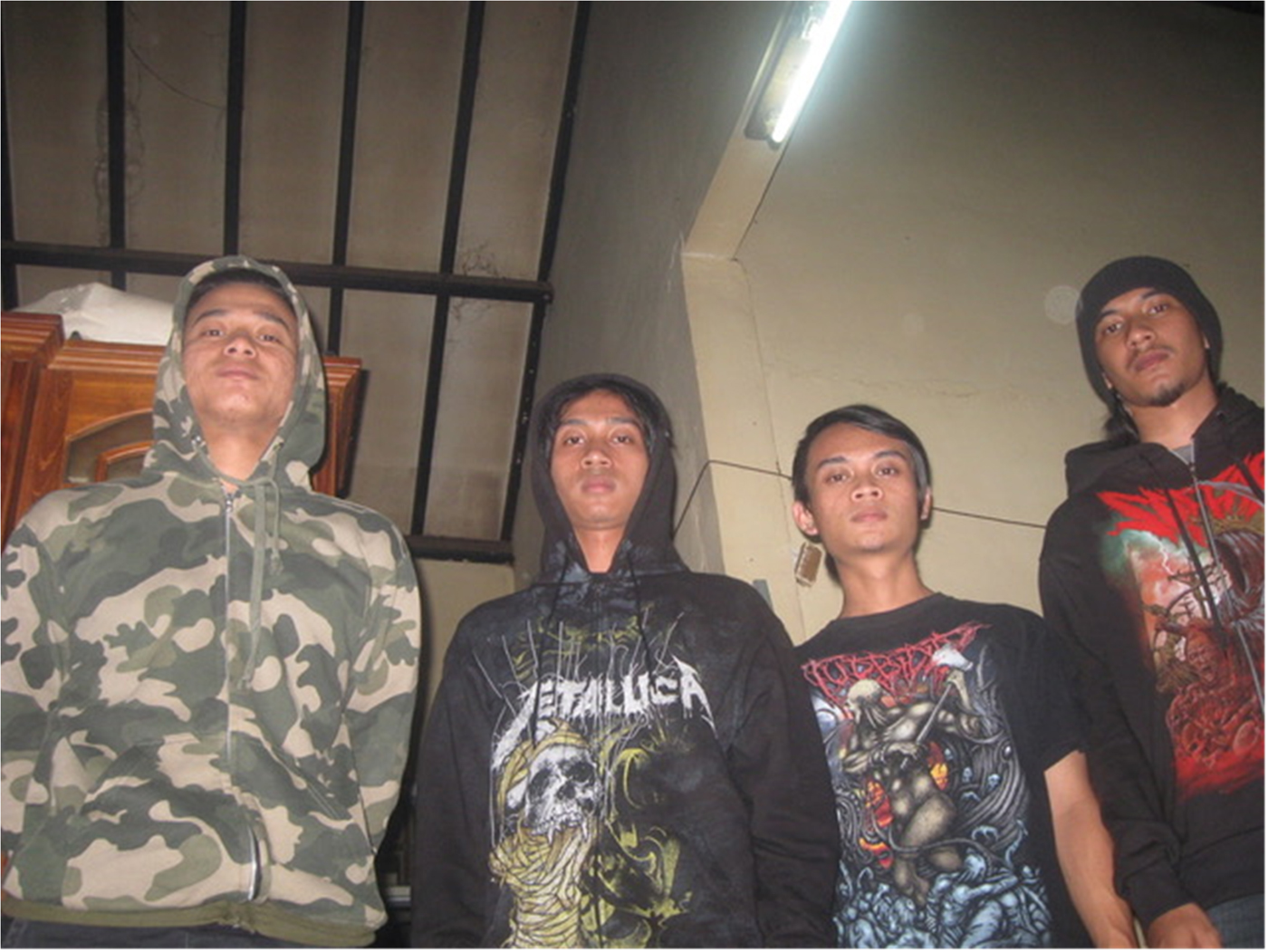
Saffar band, April 2012. Left to Right: Parjo (vocals), Iyenk (drums), Acil (guitar), Ramon (bass).
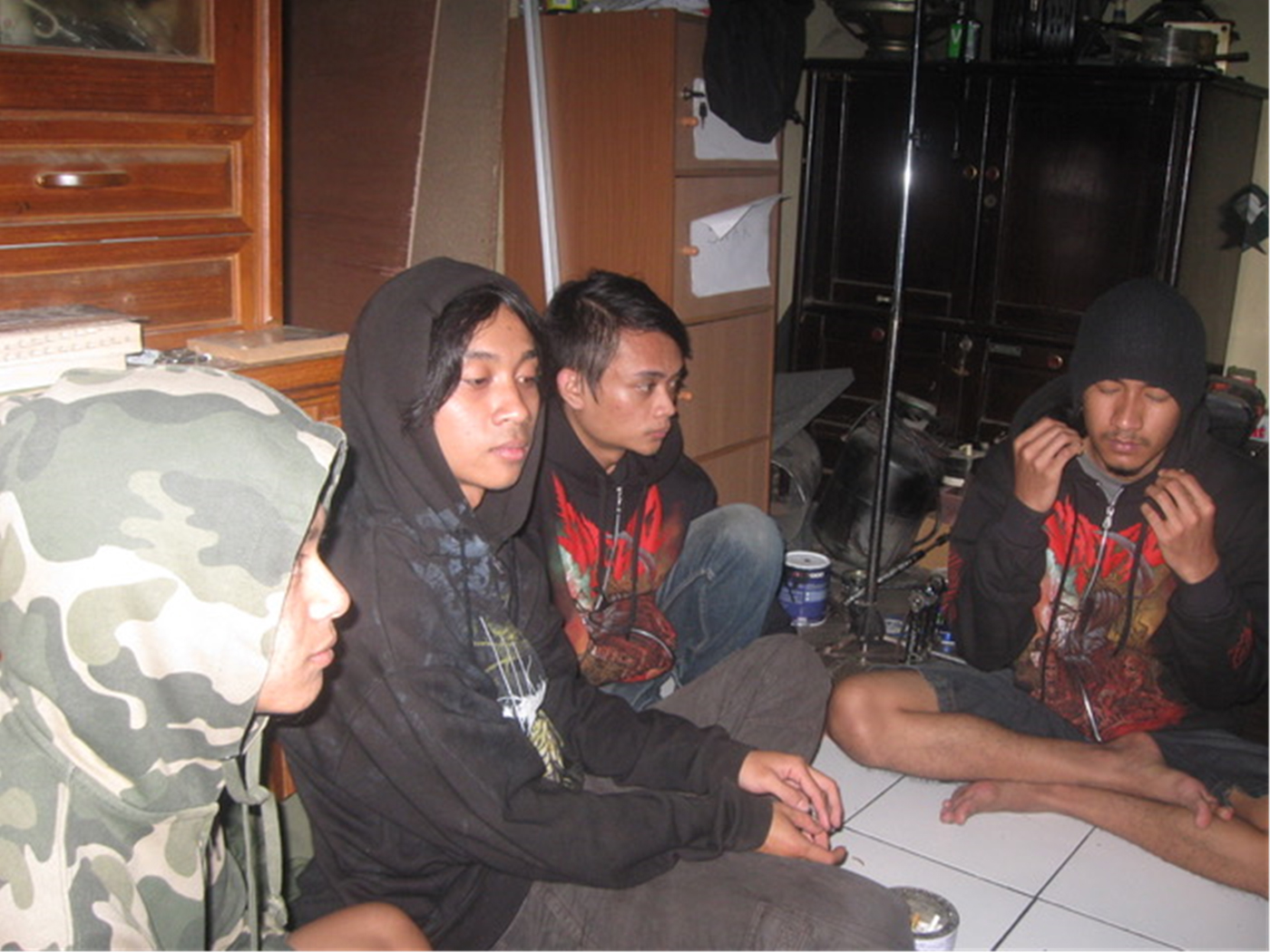
Despite the Saffar band members being very well connected and good socialisers who pay their dues, the band has not reached the next level of popularity and recognition, partly because it tends to do much less marketing and self-promotion compared with other bands; and partly because it has been losing members since the debut album with the only two permanent members from 2014 to 2016 being Acil on guitar and Iyenk on drums. The very talented bassist Ramon was sick for a long time and vocalist Parjo left the band in 2013 to concentrate on helping his parents in their doctors’ clinics and his continuing university studies (Acil's interview, 18 July 2016). In 2017 Evan, from Bloodgush and Dismemberment Torture (live band only), became the new Saffar bassist, replacing Ramon (band's Metal Archives page). The band has no permanent vocalist as at 24 January 2019. Acil comments about Parjo's situation as follows:
Parjo left the band because he wanted to work in his family's doctors’ clinic. He will continue what his parents built. Parjo is still continuing his study in college. He also got married and is more focused on work and family. He had a [further] problem because he lives far from Bandung so it was difficult for him to meet with the other band members. (Interview, 18 July 2016)
Acil also explained that he does not want to ask Parjo to write lyrics for the next album because ‘it would be hard for [him] to explain the meaning of the lyrics to the fans [because] only Parjo knows the meaning of his deep [Islamic] lyrics’. In a second interview on 16 May 2018, Acil confirmed that the primary reason why Parjo left the band was because he now believes that to play Death Metal music is haram (forbidden) for a committed Muslim; this does not mean that the various reasons Acil offered for Parjo's departure, mentioned in our 2016 interview, are necessarily falsehoods.
Saffar's inability to break into the next tier of popularity in Bandung (as Gore Infamous and Digging Up have done) may, although this is unproven and unprovable, be due in part to the Islamic religious imagery used in Saffar's lyrics, videos and band merchandise such as valiant Islamic warriors featured on tee-shirts and hoodies.
The debut album title El Arshy means ‘the sky’ or ‘coming from the sky’ literally in Arabic (Acil's interview, 18 July 2016) or colloquially we can say that the reference is to Allah. Acil explained further as follows with interpretation from Indonesian to English being provided by Butche from The Cruel:Footnote 22
Coming from the God, you know? The people say: God lives in the sky, God is everywhere. That is why the people say: God is coming from the sky. The sky is the highest place on this planet. We just say ‘in the sky’ meaning God because the sky is the highest place in this planet. (Interview, 18 July 2016)
The use of the English word ‘mandatory’ in front of El Arshy, from a band of non-native English speakers who prefer lyrics in Sundanese and Indonesian, has a vaguely threatening import and Acil did not refer to this word when he explained what the album title meant. It probably refers simply to those actions mandatory within Islam, i.e. the five pillars of Islam (van Zanten Reference Van Zanten2007, p. 14), but the vaguely threatening nature of the title remains an unresolved issue. Jason Hutagalung has described Saffar as being ‘too religious’ for his tastes (interview with Jason, 12 January 2015) whereas Jason confusingly accepts the beer-drinking members of Bandung/Cimahi band Jihad as ‘not too religious’. However, showing the subjectivity inherent in Jason's own very personal demarcation line, all of Jihad's members are confessed Muslims; they write lyrics about Islamic theology and philosophy; and their ambition is to go on Hajj pilgrimage to Mecca with their wives and families (the Hajj pilgrimage being the fifth pillar of Islam (van Zanten Reference Van Zanten2007, p. 14); interview with Jihad, 30 November 2012). Kancil, vocalist of Jihad, explains the lyrical themes for the second Jihad album Strategi Setan (Recluse Production, Singapore 2005) as follows:
The lyrics mostly tell about the description of one of the most evil creatures from when he was born until the end of his days. In Islam the evil one can create chaos between humans and is a sign in the Al-Qu'ran for the end of the world. The nickname is ‘Dajjal’, the real name is ‘Samiri’, and he has three eyes in his face. We call America or USA ‘Uncle Sam’, it means the shortened form of Samiri. (Interview with Jihad, 30 November 2012)
Acil has suggested that, with Parjo having departed, Saffar's lyrical themes will expand to include social and historical themes (interview, 18 July 2016) because Parjo wrote all the religious lyrics on the debut album and no-one in the current band has the same skill at, or perhaps the same interest in, writing lyrics on this topic.
Acil's message to the fans was as follows: ‘We still exist and our new songs will be different to other bands. Our style is always different from other bands’ (interview, 18 July 2016). With humility and a touch of anxiety he added to the author: ‘I hope that Saffar will continue to exist’ (interview, 18 July 2016). Popo, vocalist of Demons Damn, made the following supportive comments: ‘This is why I do not agree with what they say in other cities that all bands in Bandung follow the style of Jasad. Identity is made through both lyrics and music and Saffar has a unique identity’ (interview, 18 July 2016). Keeping the unique identity of Saffar without the unique Islamic lyrics of Parjo will be a continuing challenge in the years to come.
Saffar has been able to stay under the radar and avoid too much controversy by not publicly aligning itself with the One Finger Movement or the Jakarta scene; by avoiding preaching or the appearance of preaching; by building and maintaining strong relationships with Ujung Berung scene insiders; by having consistently self-identified with the Ujung Berung/Bandung scene since the band's foundation; and by a patient and humble attitude from the band members. In regards to this last point, band spokesman Acil is notoriously soft-spoken and shy and is sometimes seen literally sitting on the ground at the feet of other scene members who are seated on chairs.Footnote 23 As Wallach (Reference Wallach2008, pp. 135–6, emphasis added) points out: ‘paying attention to basic habits of sociality and to fundamental orientations toward physical space, the presence of others, and the burden of responsibility [are] part of an ethnographic perspective that is frequently missing from [popular music] studies’.
When asked about Saffar, Rozi (bassist of Jihad) said: ‘I don't know but they are very polite guys’; while Jihad vocalist Kancil added ‘very religious’ (interview with Jihad, 30 November 2012). Acil has stated to the author he sees himself as a musician and he feels no connection to or affinity with the One Finger Movement which has never had anywhere near the influence or popularity in Bandung as it once did in Jakarta.
Q: Are you part of One Finger Movement and if not do you support One Finger Movement?
A: Personally I try to be natural. I play Death Metal first and foremost and am not oriented towards One Finger Movement. (Interview, 18 July 2016)
Acil was reluctant to discuss religious matters or the One Finger Movement further with the author, preferring to focus on the band's music and lyrics, the band line-up and the band's future plans. Such an attitude makes perfect sense within the secular Bandung scene.
Conclusion
Christian and Islamic Metal are frequently criticised, by secular metalheads, on the tenuous basis that their proponents are ‘really’ and first and foremost religious evangelists and hence they are not ‘really’ ‘sincere’ metalheads who love and play metal-music for its own sake. According to this criticism, these people are just cynically ‘using’ the metal scene to promote their own private (religious) beliefs and agendas and to convert people. Quite clearly this is a strawman argument in that it fails to reflect the complexity of Islamic and Christian Metal discourses and practices and in particular how individuals in these scenes mix, harmonise, balance, sort and classify their religious- and metal-oriented behaviours so that the resultant mix of practices (symbols, heroes and rituals) reflects closely enough their own values and preferences. Indonesian metalheads’ reactions to the Islamic bands Purgatory and Tengkorak tend to vary from strong support to real indifference to pretend indifference to directly expressed dislike. The latter would usually be expressed quietly one-to-one in private conversations with trusted others. There is also confusion as metalheads do not know whether to view and categorise the individuals in the Islamic bands as metalheads or as religious people. Confusion can then lead to ignoring these bands as they are put into the too-hard basket. The percentage of metalheads in each category on the spectrum ranging from strong support to dislike is almost impossible to ascertain with any precision owing to the disinterest or antipathy or nervousness which the topic of religion generates when raised in conversations.
No-one could argue that Samier of Tengkorak, for example, does not genuinely love metal-music and he certainly enjoys being part of the Surabaya scene. He is aged around 40- to 45-years-old and is now a senior statesman of the metal scene in Surabaya. He has strong relationships, for example, with the members of Surabaya Power Metal band Valerian. He is widely respected by younger musicians and metalheads and this feel-good factor has allowed Tengkorak, in recent years and at least in Surabaya (all the other band members are based in Jakarta), to turn some negative opinions about the band into positive opinions. Samier does not go to the other extreme either; he sometimes wants to bring our interview away from discussion of religion to discussion of actual music. On the other hand, the guitarist of a well-known Jakarta Power Metal band has told the author that he does not want to attend social meetings where any One Finger Movement people might be present. This guitarist sees the One Finger Movement partly in terms of its anti-Zionist politics and, as an Indonesian-Chinese, he is wary of any racialist aspects of the One Finger Movement's position given the anti-Chinese riots which occurred in Jakarta in the 1990s.Footnote 24 He also has an interest in Satanism, Chinese mythology, the occult and ghosts and he does not view kindly the perceived preachiness and moralism of the Islamic bands. The arms-length atmosphere in Jakarta remains different from the collegial and fraternal mood in Surabaya.
Acknowledgements
We would like to thank the anonymous reviewers for the journal for their helpful and insightful comments.


