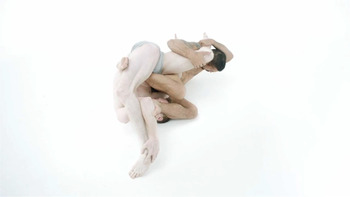
Intertwining struggle. Video still from Alignigung, with Riley Watts and Rauf Yasit. Directed by William Forsythe for Opéra national de Paris, 2016. (Photo © Opéra national de Paris, 2016)

Choreographic Objects
The camera slowly fades into a centered frame of two intimately intertwined bodies in hyperflexible positions. One fair-skinned individual is grasping his left foot above his head with his right hand. Because of the flatness of the image, his shoulder seems to disappear behind the arm of a brown-skinned person sitting behind him. The intricacies of this opening pose beg the viewer to logically deconstruct this amalgamated bodily construction into a cohesive whole. Their sunken heads erase their faces and deny the spectator a view of apparent emotion and features of the individuals, and in turn abstract the bodies to appear more as aesthetic, sculptural objects. However, a few seconds into the piece, the brown-skinned figure starts to slowly and gently gesture with his right hand, and both dancers begin exploring despite the constraints of their elaborate, contortionist positioning; the camera’s tracking shots create the momentum and relay a dynamic atmosphere to the viewer for the piece’s entirety.
This scene opens William Forsythe’s Reference Forsythe2016 screendance Alignigung. It was featured along with two other pieces at a 2017 exhibition of his “choreographic objects” at the Paris Gagosian. Originally filmed and produced in 2016 by 3e Scène — a digital third stage of the Opéra national de Paris — Alignigung reached a much larger audience than had any of his previous choreographic objects. Alignigung also found its way onto YouTube and Vimeo (Steeven Petitteville Reference Petitteville2016), where I discovered it. Since the early 1990s, Forsythe has been developing choreographic objects, which often consist of site-specific films or interactive installations in museum or gallery spaces for the general public. As participants move in relation to the “objects,” they realize their own bodily limitations and capabilities. Before this period, Forsythe was most recognized for his deconstructive and avantgarde dances with Ballett Frankfurt from 1984 to 2005 and the Forsythe Company in Dresden from 2005 to 2015. According to Forsythe the title, Alignigung, is “a threading of two languages”:
The English word align sounds like the German word allein, which means alone. That English word has been inserted into the German word Einigung, which means agreement. So the “threaded” result is a pun and a hybrid, which could mean aligning in agreement with oneself and another, on one’s own.
(Forsythe Reference Forsythe2016)Besides choreographing large ensemble pieces for professional dancers, in the late 1980s Forsythe began experimenting with and exhibiting his “choreographic objects.” He accepted an invitation in 1990 to participate in architect Daniel Libeskind’s permanent municipal installation project The Books of Groningen (1991) in the Netherlands. Forsythe’s experience on that project furthered his inquiry into choreographic objects. Working with Libeskind, who expanded his own métier through his interaction with the choreographer, Forsythe recognized how “the mechanics of choreographic strategy could be demonstrated effectively in adjacent domains and other media besides the body” (in Neri Reference Neri2017). His choreographic objects “all strive to give the viewer an unadorned sense of their own physical self-image and to return the analysis of kinetic phenomena that was previously the exclusive purview of professionals to a platform that speaks clearly to nonspecialists” (in Neri Reference Neri2017). For instance, in Towards the Diagnostic Gaze (2013), gallery visitors are instructed to hold a feather duster absolutely still. However, the inevitable trembling of the human hand magnifies the movement of the feathers, proving the task impossible.
When experiencing choreographic objects, everyday tasks such as avoiding a swinging door or stepping off a curb become distinct phenomena; these “invisible,” taken-for-granted movements and accompanying sensations are relocated in the novel context of an art space, making viewers — or participants — more aware of their own perceptions and the way the objects choreograph their movement. Not only is Forsythe’s aim to acknowledge the “plasticity” and different incarnations of the term “choreography” in its many historical contexts, he also provocatively questions whether choreography can reside outside the body:
A choreographic object is not a substitute for the body, but rather an alternative site for the understanding of potential instigation and organization of action to reside. Ideally, choreographic ideas in this form would draw an attentive, diverse readership that would eventually understand and, hopefully, champion the innumerable manifestations, old and new, of choreographic thinking.
(Forsythe Reference Forsythe and Spier2011:92)In addition, precisely because of his desire to reach a wider audience, Forsythe wants his choreographic objects to break down economic disparity and class distinction (see Bogdan Reference Bogdan2018).
On Forsythe’s choreographic objects website, the “Artworks” tab is broken down into “Objects” and “Films.”Footnote 1 While the majority of “Objects” are inanimate, embodying choreographic interaction with the viewer and inviting them to reflect on their own physicality in space, two of 36 actually use humans: Human Writes (2005) deals with constrained and bound bodies trying to exercise their human rights to little avail; and You Made Me a Monster (2005) displays dancers whose distorted movements among filigree paper sheets of festooning appendages evoke qualities of the monstrous. In both the bodies of the dancers still resemble a human body, to an extent. However, Alignigung departs from these representations because it complicates the notion of the objectness of human bodies by questioning whether they can still maintain some remnant of their humanness. It is this tension, between objectness and humanness, that influences my analysis of Alignigung.
The Genealogy of Alignigung
The earliest manifestation of Alignigung was Stellentstellen Films, which premiered in 2012 in Hellerau as the second piece of a two-work performance. In 2012, Forsythe was still predominantly producing stage works with his Forsythe Company. After he dissolved the company in 2015, Forsythe began more decisively working on choreographic objects, having joined the faculty at the University of Southern California and choreographing for major ballet companies in the US. In a review of the Hellerau performance, the critic “S.R.” described how some dancers intertwined their bodies with their partners as other dancers stood respectfully watching without the pressure of time — as if they were museum personnel. The poses came across as film stills that continued to change without arriving at a definitive ending (S.R. 2012). The idea of museum security and the filmic manifest themselves in later iterations of Stellentstellen.
From a live performance, Forsythe moved to a screendance version, which premiered in August 2013 in the Neues Museum in Weimar. Stellentstellen Films, featuring Amancio Gonzalez and Ander Zabala on two identical screens next to each other, lasts 7 minutes and 26 seconds. Instead of focusing on numerous entangled pairs on a stage, Forsythe’s filmic eye brings the choreographic object closer to the observer. Both male dancers are clothed in black track pants and purple shirts, reminiscent of the costuming of the concert premiere. Film closeups and panning alert the spectator to the multitude of movement minutiae in a museum space instead of the distanced view enforced by the stage. At first glance the title, Stellentstellen Films, may seem straightforward, but upon closer examination, it provocatively trips the viewer because its misspelling offers amalgamations that produce diverse meanings: “stellen/t/stellen,” “stell/ent/stellen”; “stellen” means “to place” or “to position” while “entstellen” means “to deform” or “to distort” (“to place/t/to place,” “place/deform”) (see Williamforsythe.com n.d.). This is close stylistically and conceptually to the idea of “threading” in Alignigung’s intertwining bodies. The titles themselves take on different constructions and assume similarly puzzle-like encryptions as the dancing bodies. During these first two instantiations, Forsythe is preoccupied with experimenting with media and the viewers’ perceptions.
The next manifestation is the 2016 Paris filming of Alignigung danced by Rauf “RubberLegz” Yasit and Riley Watts. Drawing on the resources of the Paris Opera, 3e Scène presents to new eyes original work by filmmakers, choreographers, writers, composers, visual artists, and photographers. Its manifesto declares the internet “a public space, a collective meeting place.” This new platform intends to “continue its dialogue with the public and also to make new [global] friends” (Paris Opera 2015). While the target audience may not be exactly clear, one could deduce that its viewership includes fans of the arts who access performances without the constraints of geography. In theory, anyone with a reliable internet connection can watch Forsythe’s screendance. Alignigung has since appeared on Facebook, Vimeo, and YouTube. In order to present work on 3e Scène, artists must create “original” pieces, which explains why this instantiation of Stellentstellen was renamed Alignigung. For this work, Forsythe wanted to create a compressed image perceivably devoid of air and space that eventually expands (Gagosian 2017). He implies that the seeming lifelessness of the formation eventually becomes organically alive — indeed, Forsythe comments that this choreography can only be performed by humans.
The next instantiation of Alignigung was as Stellentstellen in the Los Angeles County Museum of Art (LACMA) in 2016 as part of the site-specific exhibition Fall for Forsythe. The same Alignigung dancers — Riley Watts and Rauf Yasit — performed. According to Natalia Sanchez Herrera, they spent many hours rehearsing in constant dialogue with each other in order to attain a high level of coordination (Reference Herrera2016). Yasit reports, “We went through a long process of interviewing each other’s bodies for this work […] If we didn’t agree in each movement, we could end up in a total node, difficult to detangle” (in Herrera Reference Herrera2016). These comments throw light onto the choreographic processes: even when the dancers’ limbs and body core are tightly intertwined, they must be able to maneuver out of positions and not become permanently entangled. They have to keep moving dynamically. Herrera reports the observations of Felipe Duran, who perceived “private movements of the human body but without sexual connotations” and “an exploration of space and movement” instead of dance (Reference Herrera2016).
Ariel Osterweis’s essay provides a unique analysis of Stellentstellen. She writes that encountering performing bodies in a museum space is an experience of “altered attention.” For her Stellentstellen evokes an aesthetic similar to yet quite different from Contact Improvisation (CI). Osterweis parses this term into “contact” and “improvisation,” both of which occur in Stellentstellen as distinct processes that do not replicate Steve Paxton’s original concept of CI. For me, Alignigung both exemplifies and departs from CI.
Contact Improvisation as Influence and Departure for Alignigung
Forsythe was well aware of CI’s egalitarian ethos and wanted to express it in Alignigung specifically, using the pliable and docile male body. CI began in the US in the early ’70s, seeking along with other dance, theatre, and athletic forms a “redefinition of self within a responsive, intelligent body” (Novack Reference Novack1990:3). Led by Steve Paxton and Nancy Stark Smith, among others, CI was paradigmatically a barefoot duet without musical accompaniment. Dancers supported each other while in continuous motion. By working intimately together, the movers “yield[ed] rather than resist[ed]” and concentrated on maintaining an ongoing flow of energy. Novack compares CI to aikido, wrestling, and lovemaking (3). In fact, contact improvisation creates a cooperative, egalitarian environment, in which dancers can still express their individuality. Maintaining numerous points of bodily contact, improvisers sense with their skin instead of their eyes, giving and taking weight, rolling, tumbling, and changing positions taking advantage of all 360 degrees of space. Performances were informal, focusing more on the internal give-and-take of the duo, who were both dancers and choreographers, than on the spectacle of movement choreographed for an audience. Onlookers were empathetically engaged and sometimes invited to participate (72). Paxton espoused the idea of recalibrating the body through the reflexivity of the partners who evacuated their minds of culturally imposed, habitual movement (see Turner Reference Turner2010:126). This echoes Forsythe’s idea of viewers becoming more aware of their own bodies by experiencing his choreographic objects.
CI both empowered women who supported the weight of their male partners and men who expressed sensitivity and care for both women and men; the movement was neither erotic nor domineering (Novack Reference Novack1990:168). CI is political, informing practitioners about deep-seated hierarchical and hegemonic structures that block efforts to redistribute power. According to Robert Turner:
If we are conditioned in specific habits of docility (obedience, non-confrontation) toward our institutional authorities (parents, teachers, employers, directors, political parties, and so on), habits that therefore guarantee existing distributions of power and keep us generally alienated from each other and ourselves along conventional lines, then CI — by drawing attention to these power-creating and maintaining habits, offering spontaneous, interactive movement possibilities, and accustoming us to making conscious decisions in uncertain conditions — might begin redistributing power among us and providing more satisfying relations. (Reference Turner2010:129)
CI has been used by university students not studying dance to explore these relations. At Coventry University, CI was incorporated into the International Relations curriculum to enhance the students’ understanding of power dynamics (Rösch Reference Rösch2018:78). CI encourages self-criticism, empathy for others, and a greater awareness for how emotions influence an understanding of world politics, helping students to work more collectively for a human world politics.
CI’s idealistic paradigm outlined above, however, smooths over differences in gender, sexuality, and race. Forsythe prominently features white- and brown-bodied dancers interacting on a totally equal basis. On the other hand, in the 1980s in Philadelphia, Ann Cooper Albright watched Ishmael Houston-Jones and Fred Holland, two young African Americans wearing jeans, combat boots, and T-shirts, use CI to explore their masculinity and sexuality; they showed “anger and love, force and touch” (Reference Albright, Kowal, Siegmund and Martin2017:227). Self-identified as a white, middle-class female, Albright was struck by how the tense wrestling developed into erotic desire, how the playfulness evolved into a tender embrace, and how any emerging narrative was abandoned when one dancer nonchalantly dropped the other and walked off. She perceived enactment of eroticism and genderedness as breaking CI’s established white patterns. Christine Jowers pinpointed the violations: the dancers were black at a time when CI was broadly considered a “white” practice; they wore combat boots instead of being barefoot; they moved to loud soundtracks from kung fu films instead of in silence; they resisted gentle contact and gender neutrality by engaging in erotic and rough contact (Reference Jowers2012). Houston-Jones’s and Holland’s performance clearly deviates from CI’s white, middle-class perception of utopia. Furthermore, pointing to developments in CI, Albright mentions the African American performer mayfield brooks, who in an interview entitled “IWB = Improvising While Black,” describes being introduced to the movement form with other students from all over the world (Reference brooks and Nelson2016).
Perceptions of the brown body figure into the genealogy of Alignigung. Shortly before shooting the screendance version of Alignigung, the Afghani American Omar Mateen gunned down 107 patrons of Pulse, a LGBTQIA nightclub in Orlando, Florida, killing 49 individuals. Characterizing Mateen’s “toxic, tortured masculinity,” Tavia Nyong’o also recognizes the mass shooter’s indeterminacy. Was he “domestic or foreign, homosexual or homophobe”? Why did he retroactively and falsely claim to be a “radical Islamic terrorist”? (Reference Nyong’o and Puar2017:xiv). Nyong’o reads this ambiguity as an example of Jasbir Puar’s concept of queer, terrorist assemblages. In Terrorist Assemblages: Homonationalism in Queer Times, Puar traces how homosexual bodies — first tied to death in the US in response to the HIV-AIDS epidemic — after 9/11 became associated with life and homonormative productivity (gay marriage and child adoption). Also after 9/11, Puar argues, terrorists were represented as “a queer, nonnational, perversely racialized other [,…] persons who appear Middle Eastern, Arab, or Muslim” ([Reference Puar2007] Reference Albright, Kowal, Siegmund and Martin2017:38). The observation and analysis by Albright, Nyong’o, and Puar form the background that informs not only Forsythe’s conceptualization of white, brown, and black bodies but also viewers’ awareness of these depictions.
Camera Work
Between Object and Human
The screendance can be divided into three sections. The opening shot from afar introduces the viewers to the intertwined bodies with a slow approach in order to pique their curiosity. The second part involves numerous camera techniques like fading, cutting, superimposition, close-ups, and arc shots to establish enhanced views of the moving bodies; these methods disorient the viewer and create a critical distance. The last shot focuses on the final hand gesture of resolution.
The establishing shot of Alignigung begins with a white background creating the feeling of a void. Its starkness reminds one of a gallery or museum space, like the one in which Stellentstellen at LACMA had been staged. This frame then fades into a centered view of the two sculpture-like beings intertwining their bodies, their faces immersed in a contortionist formation. Both appear to be floating in a two-dimensional space and melding into the stark background. As a nondiegetic, high-pitched, dissonant string instrument begins to play, Yasit’s right hand unfurls itself from its static position and slowly starts exploring its grasp of Watts’s right elbow. This first movement establishes the movement capabilities of the object and encourages the audiences’ somatic reading of human contact through gesture. A slight movement of Yasit’s right foot cues a tracking shot that slowly travels toward the sculpture and gradually turns 90 degrees to the left. Such directionality contrasts the frontal view and establishes the space’s three dimensionality, attempting to break through. However, the lack of shadows and the washed-out aesthetic continues to draw viewers’ attention to the voided background and perpetually dis- and re-orients them. During this tracking shot, the sculpture moves to give the viewer a clear sense of the new angle. This wavering dimensionality adds to the perceived liveness of the organic object, giving the observer more agency through movement yet demanding a constant ascertainment of their own spatial orientation. In many ways, Forsythe tries to mimic the view of an active spectator who tentatively approaches the configured bodies as Osterweis’s students had done. Julia Meyer describes her experience:
Glass doors contain the bodies of men intertwined on a small black carpet. […] A large James Turrell installation sits to the right of the doors. The majority of the audience is seated along three walls surrounding the men, whose limbs spill off the carpet and onto the hardwood floor as they shift from one position to the next. It is difficult to decipher the number of men upon the mat, as their bodies are distorted through the fragmentation of their flesh. About twenty paces from the entryway, I sit down to face the performance. Other viewers join me, creating a fourth border to frame the contents of the performance. The modulation of form at the core gallery operates in extreme density, contrasting with the emptiness of the space. Though the performance takes place in a museum, the men are only surrounded by white walls, viewers, and air. There is no stationary artwork framing Forsythe’s composition. The men are forlorn, assuming the weight of a space that is empty.
(in Osterweis Reference Osterweis2018)This description of the live performance thoroughly involves itself with the other stimuli in its vicinity: other audience members, an installation, the walls, and the large space itself. But Alignigung, the film, removes all stimuli to immediately focus the viewer’s attention as the camera slowly approaches the intertwined bodies mimicking Meyer’s and other spectators’ movements.
After establishing the two movers and the voided white space as the screendance’s recognizable features, Forsythe uses fading, superimposition, and sudden cuts to different positions, both of the dancers and of the camera’s perspective, creating unexpected and contrasting views. Often cuts are inserted while the camera is moving around the dancing sculpture, enhancing its dynamics and mimicking the movement of a spectator. Therefore, while a viewer is not completely disoriented in space, certain angles allow for the optical puzzles themselves to more firmly establish. Watts and Yasit are two bodies experimentally intertwining.
Forsythe challenges the idea of the single body by harnessing disturbing, distorted, and posthumanist hybridity. At times, Watts and Yasit seem to lose their human attributes as the camera focuses less on their faces, so that their organic movements can be viewed through what Erin Brannigan terms “deterritorialization” by essentially allowing a dancerly lens to completely color the observer’s perspective (Reference Brannigan2011:128). By deemphasizing the face as the primary means of expression, Brannigan describes the microchoreographies of a close-up in dance films, which establish the entire body as a “corporeal geography” teeming with affective movement (125). Her characterization renders the body a landscape waiting to be discovered by dancers and by viewers, whose perspective is guided by the camera. In many respects, the contortionist and optical-puzzle aesthetic in Alignigung already establishes a choreographic strategy to disorient viewers and destabilize their perceptions.
Both with closed and open eyes, which could refer to different human states — dreaming, wakefulness, etc. — the viewers eventually see the faces of both dancers; however, the emphasis remains on the entangled bodies whose movements convey a necessary struggle. The hybridization of the brown and white human bodies also shows the oneness and morphing pliability that makes them exceptional dancers who blur the line between objecthood and humanness. On the one hand, the viewer is often drawn to the dancers’ facial expressions of their emotional states. And on the other hand, the effort qualities of the body arguably carry the weight of Alignigung. Yet, Forsythe does not completely siphon off the expressive capabilities of the face: we must not underestimate the power of a countenance, as Gilles Deleuze reminds us (Reference Deleuze1986:87–88). Therefore, we view the dancers as humans and not purely as aesthetic objects. Forsythe relays humanity through his dance instead of alienating the viewer by alluding to purely abstract art. The connections with the abstracted bodies and their movement qualities inform how gesture and the face relate to a broader social context.
The camera’s tracking speed reflects the slow movements of the dancers, who establish an exploratory rhythm for the cinematographer, Steeven Petitteville, to follow. In a sense, he not only maintains his mobile perspective but also brings the viewers along on the visual journey by directing their attention through the camera’s eye. The cinematographer’s movement mimics the behavior of an observer able to see the moving sculpture live. Forsythe’s filming of Alignigung engages with “camera-looking,”
an active performance that frames any event and elevates it while “screening out” all other information. It is an act that implies a reverence for that which is framed and eschews all that is outside the frame. In doing so it parses activity into essential and nonessential, absent and present, and presupposes the editing process — which further parses individual moments of mediated performance into even smaller partitions.
(Rosenberg Reference Rosenberg2012:69)Through camera-looking, the viewers’ eyes are drawn to the perspective of the cinematographer whose tracking shots travel over the two dancers: it, therefore, does not give viewers the same agency they would have had at LACMA to walk around Stellentstellen, even though it seems that most spectators sat and respectfully observed from a distance. On the other hand, the camera-looking focuses the viewers’ attention on a specific perspective, allowing them to engage with what they see in the frames. Although the dancers’ movements can be so minute and the sculpture itself, at first glance, so static, in reality, it does move, if slowly, providing viewers with copious visual stimulation. Therefore, while each film spectator is limited because she or he cannot move around the sculpture, the dance lends a focused kind of agency guided by Forsythe’s decisive perspective. The viewers may not be inclined to join the dance, as they sometimes do in CI, but they can still read and empathize with the movement qualities of this choreographic object.
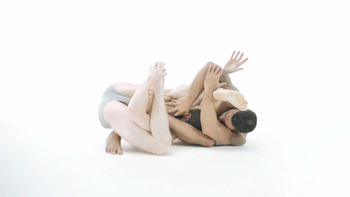
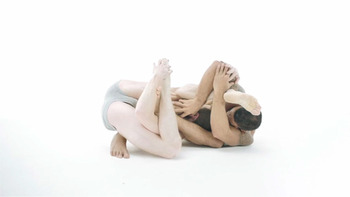
In a slow tracking shot, the film concludes with both dancers intertwined, their faces hidden as Watts unfurls his right hand onto Yasit’s (figs. 2 and 3). This last scene recalls Yasit’s exploratory hand articulations at the beginning of the piece and seems to complete the idea of one hand helping the other with equal agency for both. Caught in the midst of a small tracking shot, the camera cuts to a black screen as the credits begin rolling. While the piece started with a slow fade into the sculpture as an introductory gesture, the sudden ending implies a continuation of the movement of the camera beyond the confines of the screendance into our real lives, insinuating the observer in the work. Thus, Forsythe places great importance on the viewer’s journey into the dance — even if mediated by screendance. The book-ended hand gestures relay and ground the “humanity” of the piece, asking it to be read in a social context, while the middle part, through camera techniques, abstracts the body as an aesthetic object.
Beginning of the final hand gesture. Video still from Alignigung, with Riley Watts and Rauf Yasit. Directed by William Forsythe for Opéra national de Paris, 2016. (Photo © Opéra national de Paris, 2016)

End of the final hand gesture. Video still from Alignigung, with Riley Watts and Rauf Yasit. Directed by William Forsythe for Opéra national de Paris, 2016. (Photo © Opéra national de Paris, 2016)

Movement Analysis
In order to more closely examine the movement qualities in Alignigung, I turn to Rudolf Laban’s system of effort, which characterizes features of both everyday and dance movement. He observed four elements, all with dichotomic oppositions: space (indirect/direct), time (sustained/quick), weight (strong/light), and flow (free/bound) ([1950] Reference Laban1988:73). When two of these efforts combine, they become states representing both conscious and unconscious inner attitudes (11). In terms of space and time, the bodies in Alignigung engage in small, maintained movements that slowly explore their spatial territory. Throughout the piece, the figures do not rush or engage in quick or fast motions and never seem to have a direct destination; similarly, they do not perform overpowering movements or gestures that dominate the other. The dancers demonstrate light weight and free flow with their hands and generally strong weight and bound flow with torso, arms, and legs. The choreographic decision to keep the bodies perpetually entangled dictates the variances in their weight and flow. According to Laurence Louppe, in dance “the constellation: sustained time — bound flow — strong weight […] abolishes the relation with space” (Reference Louppe2010:69). This effect is further enhanced through Forsythe’s use of a stark white background that disorients viewers, who might feel they are floating in space with the dancers. The disorientation of the spectators pulls them further into the dance and outside of their comfort zone. It confronts them with the dancing image so they themselves also feel deterritorialized and buoyant in their own bodies.
Unlike CI, where the intimate positioning of bodies creates rolling momentum and larger movements, Forsythe’s intertwining aesthetic works by exploring tight crevices, working with micromovements and negotiating spatial constraints. Yasit also reports the long process of “interviewing” each other’s bodies so they would avoid knots too difficult to untangle. Early CI practitioners formatively lived together, experiencing intimacy on a day-to-day level (Turner Reference Turner2010:127). For both groups, in their own way, intimacy is essential. Paola Escobar makes the further observation that whereas CI involves small, temporary points of contact and moments of weight sharing, the interweaving technique positions the Forsythe dancers to sustain shared weight in constant contact over large surface areas. She reads this dynamic in Alignigung as “an honest exploration of struggle and the search for resolution” (in Osterweis Reference Osterweis2018). Such a reading changes Alignigung’s political slant from CI’s, which allows for a rolling carefreeness in movement, to a politics of necessary struggle but without overt domination. These movement qualities also highlight the overt polarization of affect in Houston-Jones and Holland’s dance: aggressive vs. gentle, erotic vs. platonic. In any case, both Forsythe’s dance and CI still convey a necessity of working together. Through Forsythe’s idealistic lens of representing both men as equal, he recognizes that both bodies have the same agency to create dynamic movement, which constantly reinforces the need for engaging together in an intimate space. This screendance highlights the fruitful interaction, intimacy, and spatial negotiation of the two bodies while carving out new aesthetic and political territory opposed to homonationalism.
Osterweis observed the end of the Stellentstellen performance at LACMA as the “collapsing moment” when Forsythe vocally and through touch signaled the end of the dance — “a relief and a violation at once” (Osterweis Reference Osterweis2018). Yasit and Watts display utter exhaustion and lie sweaty and stretched out on the floor as the magic spell of working, struggling, and connecting ceases. As Marissa Osato noted: “In that instant, the men transformed their amorphous energy into that of regular pedestrians.” After they rested for a couple minutes, Forsythe publicly gave them notes (in Osterweis Reference Osterweis2018). This last scene breaks the mesmerizing effect of the piece; it demonstrates the perpetual intellectual engagement of sensing through the skin but also the immense tension maintained throughout the work, a characteristic of Forsythe’s movement aesthetic. The end gives a needed release back into the everyday. The screendance does not show the release but aesthetically translates this final element by abruptly blacking out the screen, signaling the “end” of the dance but also marking the beginning of the spectators’ intellectual processing.
Addressing Masculinity
After the long tracking shot at the beginning, the camera moves backward as both figures engage more of their bodies by extending their arms and heads farther away from the body core. Compared to the opening, tight pose, the sculpture now begins to “bloom” like time-lapse photography of a blossoming flower. The camera engages with a slight slow-motion effect, which creates a subtle suspension, lack of tension, and floating quality — despite the fact that the two bodies are predominantly tense. The opening serves to trace the development from a flat, static visual object to an organic, flowing, dynamically moving sculpture. This suspension in time throughout the film adds an ease and conveys a nonaggressive quality, in slight contrast to the live performance.
While the high-pitched, dissonant string instrument sounds tend to desexualize the atmosphere, the dancing between two near-naked male dancers still awakens some homoeroticism. On the one hand, the dancers wear short, grey trunks that clearly bare their bodies and highlight their physical differences and fitness: slim-built Watts has fair skin and red hair, while muscular Yasit has brown skin, curly hair, and tattoos: coded as an Arab body. Forsythe aims for optimal contrast clearly delineating and drawing attention to their contrasting body types and racial markers, especially appropriate since 9/11 when the US declared a “war on terror” that often targeted brown bodies. As Sara Ahmed maintains, “the word terrorist sticks to some bodies as it reopens past histories of naming, just as it slides into other words in the accounts of the wars in Afghanistan and Iraq (such as fundamentalism, Islam, Arab, repressive, primitive)” (Reference Ahmed2004:131).
The viewers are always already aware of race even if Forsythe tries to conceal it at the beginning of Alignigung. Ahmed states that hate is not associated necessarily with one individual but with many different ones who share a likeness. In contrast to a heightened anxiety about encountering “threatening” brown or black bodies, Forsythe reverses this paradigm from the beginning by obscuring the racial identities of the dancers, showing them as a hybrid, posthumanist construct, which instills a curiosity — instead of fear — and draws the viewers even closer. This is followed by the slow discovery of the movement and the eventual recognition of the dancers’ races. Then, by presenting a gentle and masculine brown-skinned body, which belies the stereotypes of the “terrorist,” and “needy,” or the “helpless refugee,” Forsythe empowers Yasit and highlights his agency. Forsythe tries to decolonize the viewers’ conception of the brown body — which in the dance is never seen alone but always partnered with Watts; the two are conceptualized as one.
In contrast to the concert version of Stellentstellen in which the viewers’ distance from the stage accentuates movements over the dancers’ facial expressions, screendance uses close-ups to highlight intimacy and emotion. The focus on the body as an artistic and affective palate draws one’s attention to bodily details both on the level of abstract movement qualities as well as at the level of social, political, and historical racial signifiers.
Why did Forsythe so drastically change the dancers and the costuming in Alignigung compared to its earlier instantiations? Alignigung appeared on YouTube on 4 July 2016, US Independence Day; the Pulse massacre happened on 12 June. Can we read in the screendance Forsythe’s awareness of global terrorism, Islamophobia, the refugee crisis, and mass shootings? While I do not have proof of a strict cause-and-effect, I believe that such a highly publicized event as the Orlando shooting could have seeped into Forsythe’s imagination. The controversy at the time focused on whether Omar Mateen’s motive was fueled by his Muslim background, homophobia, or both. According to Syed Haider:
To essentialize and locate Muslim violence and homophobia in the religion of Islam has long been the method of Islamaphobes in Muslim and non-Muslim countries. It is a standard refrain within the narrative spun by proponents and advocates of the war on terror, since it marks Islam and its adherents as the “other” of the West — read Christian, civilized, democratic, progressive, and so on. (Reference Haider2016:556–57)
Forsythe may easily be reacting to and involving himself in this discourse on an aesthetic level by selecting Watts and Yasit for the intimate screendance, which advocates against this type of violence and Islamophobia. Yasit’s body could be visually evocative of “Muslim” or “Islam” even though he grew up in Germany and now dances in Los Angeles. Performatively he embodies many antitheses of an Orientalized, Muslim body from a Western perspective: utilizing gentle hand gestures, working together through a compliant struggle with his partner, and displaying an aestheticized, near-naked dancing image. Unlike the terrorist Mateen, who exudes a toxic masculinity, Yasit displays a strong, alternative masculinity.
In contrast to CI, which allows for a looseness in movement, Forsythe maintains an aesthetic of constant tension and negotiation primarily through the body parts closest to the core. Even if the slow-motion effect conveys a suspension and lightness, an underlying struggle, even violent movement, pervades the screendance. On the one hand, Yasit’s and Watts’s comments about the choreographic process convey a desired and necessary tension. On the other hand, I believe these qualities can be brought out of the aesthetic realm and interpreted as a brown and a white body in negotiation. Thus, while CI — Houston-Jones and Holland’s performance excepted — tends to idealize ungendered and relaxed bodies, Forsythe’s technique emphasizes a perpetual tension of negotiations aiming for egalitarianism.
Over the past decade there has been work attempting to establish “alternative masculinities.” Applying theories from sociology and literary studies, Àngels Carabí and Josep M. Armengol’s Alternative Masculinities for a Changing World provides counterhegemonic models of masculinity: becoming caring fathers and friends, responding nonviolently to aggressive encounters, and behaving “as equal partners without ‘losing’ their masculinity” (Reference Carabí, Armengol, Carabí and Armengol2014:1). Furthermore, Anna Buschmeyer and Diana Lengersdorf believe integrating typically “feminine” elements into male lives causes masculinity to become more flexible and reassured (Reference Buschmeyer and Lengersdorf2016:196). Michael Kimmel argues that character traits typically coded as “feminine” such as being kind and nurturing need to be degendered and rendered as good “human traits” (in Kimmel and Wade Reference Kimmel and Wade2018:250). Interpreted through this discourse and CI, Alignigung espouses an egalitarian ethos and alternative model to hegemonic masculinity by addressing issues of violence and by integrating traditionally coded traits of femininity into the movements of male bodies. Yasit and Watts maintain a continual, yet desired tension of working together: an anti-Islamophobic depiction of “friendship.” Their movements are beautiful as well as strong and masculine, revolving around agreement, negotiation, and working together.
Diametrically opposed to overt domination, Forsythe’s technique demands an alignment and a constrained oneness with the other dancer. As a result, these intimate intertwinings can appear like a struggle and at times even violent. Not only do the dancers have to be fully aware of their own bodies and positioning, they also have to work through the movements of the other. Similarly, changing the title from Stellentstellen Films to Alignigung is also political. While the former title implies an aesthetic experiment with movement, the latter adds to this while allowing the potential for politics to emerge. Michael Ward informs us that:
Alignment is not signified by formal treaties, but is delineated by a variety of behavioural actions. It is a more extensive concept than alliance since it does not focus solely upon the military dimension of international politics. Degrees of alignments in political, economic, military, and cultural spheres present a multifaceted sculpture of national and supranational postures. (Reference Ward1982:8)
This definition locates alignment in a flexible dynamic involving politics and aesthetics, as does Forsythe’s Alignigung.
The development and numerous iterations of Stellentstellen/Alignigung demonstrate a gradual shift from aestheticization to politicization, from objecthood to humanness. Camera techniques like continual tracking shots and close-ups imitate a spectator’s movement patterns. These shots obscure the racial markers of the dancers, at first instilling curiosity instead of fear when a presumably white European or American viewer later recognizes the brown body.
The hand gestures at the beginning and end of Alignigung signal an egalitarian ethos and gentleness in the relation between brown and white bodies. By using two male bodies of differing skin types and builds, Forsythe addresses issues of race and masculinity in light of current, global discourses. He advocates for an alternative masculinity in constant negotiation, a willingness to cooperate within the frame of a sustained and productive tension. A tension that, like the dance, does not remain fixed but evolves, guided by a perpetual attention paid by one dancer to the other.