




No CrossRef data available.
Article contents
The Sin of Sloth or the Illness of the Demons? The Demon of Acedia in Early Christian Monasticism
Published online by Cambridge University Press: 20 September 2005
Extract
The demon of acedia holds an important place in early monastic demonology and psychology. Evagrius of Pontus (ca. 345–399), for example, characterizes it as “the most troublesome of all” of the eight genera of demonic thoughts ( ). He goes so far as to characterize it as the commander of the demonic host arrayed against the monastic, which distracts the monastic with persistent thoughts. From the monastic demonology of Evagrius, especially as transmitted through his Latin-speaking protégé John Cassian, acedia—equated by Evagrius with the “noonday demon” (
 ) of Ps 90:6 In the medieval Latin tradition of the seven deadly sins, acedia has generally been understood as the sin of sloth. Moral theologians, intellectual historians, and cultural critics have variously construed acedia—or “accidie,” among other English spellings—as the ancient depiction of a variety of psychological states, behaviors, or existential conditions: primarily laziness, ennui, or boredom. Still others have attempted to place acedia within the context of Evagrius's highly idiosyncratic anthropology, or they have tried to situate it in the controversies over monastic itinerancy. More recently, acedia has been considered analogous to the modern clinical condition of depression. Andrew Solomon, notably, draws explicitly on the Evagrian monastic tradition for the title of his recent study, The Noonday Demon: An Atlas of Depression.
Information
- Type
- ARTICLES
- Information
- Copyright
- © 2005 Cambridge University Press
The demon of acedia holds an important place in early monastic demonology and psychology. Evagrius of Pontus (ca. 345–399), for example, characterizes it as “the most troublesome of all” of the eight genera of demonic thoughts (
).
1Praktikos 28 (Antoine Guillaumont and Claire Guillaumont, eds., Évagre le Pontique: Traité pratique, ou, Le moine [SC 170–71; 2 vols.; Paris: Cerf, 1971]); also Praktikos 12. Evagrius is typical in describing acedia as the most harmful demon (or thought, vice, or passion), so Guillaumont and Guillaumont, Traité pratique, 2:522–23. Apa Poemen is said to have claimed, “Acedia arises at every beginning, and there is nothing worse than this passion,” Apoph. pat. (alph.) Poemen 149 (PG 65:71–440). This is later echoed in John Climacus, Scala Paradisi 13 (PG 88:631–1164), who also describes acedia as the “most troublesome” (barutatou) of the eight Evagrian demons or thoughts. On John Climacus's (ca. 570–ca. 649) place in the literary and theological traditions of fourth- and fifth-century monastics, see Kallistos Ware's introduction to John Climacus: The Ladder of Divine Ascent (trans. Colm Luibheid and Norman Russell; CWS; New York: Paulist Press, 1982) 58–68.
Eulogios 8.8 (Pros Eulogion; Robert E. Sinkewicz, trans., Evagrius of Pontus: The Greek Ascetic Corpus [OECS; Oxford: Oxford University Press, 2003] 310–33; PG 79:1093–1140). Evagrius uses “thought,” “demon,” and “evil spirit” more or less interchangeably in reference to acedia; regardless, the malevolent demon is always underlying, for which see Sinkewicz, Evagrius of Pontus, xxv.
) of Ps 90:6
3Praktikos 12.
Placide Deseille identifies Evagrius's treatment in Praktikos 12 as “the origin of all the descriptions of acedia that we fi nd in the Greek, Syriac, or Latin spiritual traditions” (“Acedia according to the Monastic Tradition,” Cistercian Studies Quarterly 37 [2002] 297–301, at 297). On Cassian's function as transmitter and “domesticator” of Evagrian asceticism, see Stanley W. Jackson, Melancholia and Depression from Hippocratic Times to Modern Times (New Haven, Conn.: Yale University Press, 1986) 65; compare Owen Chadwick, John Cassian (2d ed.; Cambridge: Cambridge University Press, 1968) 46–47. His dependence on Evagrius is clear despite the fact that Cassian never mentions him by name, most likely due to the controversy over Origenist theology that erupted shortly after his death in 399. The origin of the term “acedia” in septuagintal and premonastic literature is well covered elsewhere; see Guillaumont and Guillaumont, Traité pratique, 84–90; Rudolph Arbesmann, “The ‘Daemonium Meridianum’ and Greek and Latin Exegesis,” Traditio 14 (1958) 17–31; and Siegfried Wenzel, The Sin of Sloth: Acedia in Medieval Thought and Literature (Chapel Hill: University of North Carolina Press, 1967) 6–8, 12–18.
On the transformation of acedia into sloth, and the eight evil spirits/demons/thoughts into the seven deadly sins, see the classic study by Wenzel, Sin of Sloth, esp. 23–67. There is a wealth of reflection on the demon's medieval reception. See, for example, Michael Raposa, Boredom and the Religious Imagination (Charlottesville: University of Virginia Press, 1999) 11–40; Jackson, Melancholia, 65–68; Reinhard Kuhn, The Demon of Noontide: Ennui in Western Literature (Princeton, N.J.: Princeton University Press, 1976) 39–64. On the ancient equation of acedia with the “noonday demon” of Ps 90:6, see Wenzel, Sin of Sloth, 6–7.
So the philosophical and literary studies of Raposa, Boredom; and Kuhn, Demon of Noontide.
See esp. Cristoph Joest, “Die Bedeutung von Akedia und Apatheia bei Evagrios Pontikos,” Studia Monastica 35 (1993) 7–53; Rüdiger Augst, Lebensverwirklichung und christlicher Glaube. Acedia—Religiöse Gleichgültigkeit als Problem der Spiritualität bei Evagrius Ponticus (Saarbrücker Theologische Forschungen 3; Frankfurt am Main: Peter Lang, 1990); Gabriel Bunge, Akedia. Die geistliche Lehre des Evagrios Pontikos vom Überdruss (Cologne: Luthe-Verlag, 1989); for the latter approach, note Daniel Caner's description of acedia as “a desperate kind of bored depression or despondency” (Wandering, Begging Monks: Spiritual Authority and the Promotion of Monasticism in Late Antiquity [Peter Brown, ed.; The Transformation of the Classical Heritage 33; Berkeley: University of California Press, 2002] 38–47).
New York: Scribner, 2001; see also Barbara Maier, “Apatheia bei den Stoikern und Akedia bei Evagrios Pontikos—ein Ideal und die Kehrseite seiner Realität,” OrChr 78 (1994) 230–49, esp. 246–47; Caner, Wandering, Begging Monks, 38; Jackson, Melancholia, 65–77; and Deseille, “Acedia,” 298. In his recent translation of the Institutes, Jerome Bertram (John Cassian, The Monastic Institutes [London: St. Austin Press, 1999] 145–61) jettisons the word “acedia” altogether in favor of “depression.” Also note the recent analysis of acedia as a “viral” type of depression parallel to a variety of affective disorders in Peter Toohey, Melancholy, Love, and Time: Boundaries of the Self in Ancient Literature (Ann Arbor: University of Michigan Press, 2004) 132–57.
With such interest in acedia, a re-examination of the early history of this demon is called for. The very persistence of the term “acedia” betrays the fact that none of the modern or medieval glosses adequately conveys the semantic range of the monastic term. In fact, Placide Deseille describes acedia as “a word so pregnant with meaning that it frustrates every attempt to translate it.”9
Deseille, “Acedia,” 297. Compare William Harmless and Raymond R. Fitzgerald, “The Sapphire Light of the Mind: The Skemmata of Evagrius Ponticus,” TS 62 (2001) 498–530, at 510. Also worth noting for the semantics of acedia in nonmonastic literature is Augst, Lebensverwirklichung und christlicher Glaube, 143–48.
Especially welcome in this regard is the recent translation of and commentary on the Evagrian corpus extant in Greek by Sinkewicz, Evagrius of Pontus. For Evagrian citations included in his volume, I have used the titles and numbering of Sinkewicz. Wherever I have adopted his translation it is noted; otherwise, translations of Evagrius are my own.
See Joest, “Bedeutung von Akedia”; appended to Joest's article is a German translation of Antirrhetikos 6. For the Syriac translation (with Greek retroversion), see W. Frankenberg, Evagrius Ponticus (Abhandlungen der königlichen Gesellschaft der Wissenschaften zu Göttingen. Philologisch-Historische Klasse, n.s. 13.2; Berlin: Weidmannsche Buchhandlung, 1912) 472–545. I thank Mark DelCogliano for providing a prepublication copy of his translation of Joest's article and his translation of Frankenberg's Greek retroversion of Evagrius's Antirrhetikos 6, now published in American Benedictine Review 55 (2004) 121–150, 273–307. Translations from the Antirrhetikos in the present article, however, are my own from the Syriac.
See, for example, Joest, “Bedeutung von Akedia,” 27–28; although I suggest below that the diverse descriptions in Evagrius and others are actually more consistent than they may at first appear.
E.g., Vices (Peri tas antizugous tōn aretōn kakias; PG 79:1140–44), Prologue (PG 79:1141A), 6.4 (PG 79:1144); Eight Thoughts (Peri tōn oktō pneumatōn tēs ponērias; PG 79:1145–64) 6.3, 6.5, 6.17 (PG 79:1157–60).
In this essay I offer a more synthetic and synchronic approach to interpreting the demon of acedia in the context of early Christian monasticism. This is important for understanding the ancient phenomenon of acedia because descriptions of it are by no means limited to the numerous works within the Evagrian and Cassianic corpora. Early monastic discussion of the demon, in fact, is attested in a wide range of authors and texts, including theoretical and practical treatises in Greek, Latin, Coptic, and Syriac, works written by men and women monastics, and representing the full range of early monastic social organizations.14
My primary sources are the writings of Evagrius of Pontus, John Cassian, the Apophthegmata patrum (the alphabetic collection), the Life of St. Syncletica, the Letters of Antony, the Life of Antony, the Lives of Pachomius, the Canons of Shenoute, the Scala Paradisi of John Climacus, Basil of Caesarea's ascetic writings, the Pratum spirituale of John Moschos, and Joseph Ḥazzāyā's Letter on the Three Stages of the Monastic Life. But by no means do I claim to have exhaustively covered late antique monastic discourse on acedia. Full bibliographical information is provided at the first citation of each text.
- What signs (or symptoms) does the demon of acedia exhibit in a monastic?
- What treatments may counter the demon?15
I discuss further below the fact that monastic discourse on acedia—and demonic thoughts in general—is generally medicalized, hence the terminology of signs, symptoms, and treatments.
With these questions in mind, a synthetic examination of early monastic texts demonstrates that the demon of acedia manifests itself in a range of psychological and somatic symptoms that is far broader and more complex than the familiar tradition that John Cassian bequeathed to the West. After laying out the diverse symptoms of acedia in early monastic literature, I will conclude with a sociological explanation for the widely varying descriptions of acedia. Specifically, the diverse— even contradictory—psychological and somatic signs attributed to acedia may be explained by reference to anomie, a type of disjunction in social structure that is especially likely in monastic communities of the lavra or semi-eremitic type.
The Signs of Acedia
Acedia is indicated by a range of signs. In the following discussion I divide these signs (or symptoms) into two basic categories: somatic and psychological. This distinction does not presuppose a dichotomous relationship between body and soul in a dualistic or Cartesian sense, contrasting material sōma with immaterial psychē. Rather, in agreement with commonplace ancient conceptions of the body/soul relationship, I take psychē and sōma to be mutually contingent and dialectically impinging upon each other.16
On the interaction of body and soul in ancient medical thought, see P. N. Singer's introduction to Galen, Selected Works (New York: Oxford University Press, 1997) xxxvi–xlii; Peter Brown, The Body and Society: Men, Women, and Sexual Renunciation in Early Christianity (New York: Columbia University Press, 1988) 77–78, and 27–32 for social ramifications.
Whether the soul is considered immaterial or material, corporeal or incorporeal, tripartite or monad, ethereal or atomist, is not immediately relevant. For background on ancient medical and philosophical constructions of the soul as “material,” see the rich discussion and analysis in Dale B. Martin, The Corinthian Body (New Haven, Conn.: Yale University Press, 1995) 3–15.
Acedia frequently presents signs somatically. Such bodily symptoms range from mere sleepiness18
Evagrius, Thoughts 17 (Peri logismōn; Antoine and Claire Guillaumont and Paul Géhin, eds., Évagre le Pontique: Sur les pensées [SC 438; Paris: Cerf, 1998]); Antirrhetikos 6.28; Eulogios 26.28; Vices 6.4; Eight Thoughts 6.15; John Cassian, Conferences 5.11 (E. Pichery, ed., Jean Cassien: Conférences [SC 42; Paris: Cerf, 1955]).
Apoph. pat. (alph.) Theodora 3; Evagrius, Antirrhetikos 6.38.
Apoph. pat. (alph.) Theodora 3; Joseph Ḥazzāyā, Letter on the Three Stages of Monastic Life 93 (Paul Harb and François Graffin, eds., Lettre sur les trois étapes de la vie monastique [PO 45.2; Turnhout: Brepols, 1992] 366–67).

, Scala 13 (PG 88:860).
John Climacus, Scala 13 (PG 88:860).
An anecdote attributed to Amma Theodora (probably a fourth-century monastic of Lower Egypt) also connects somatic pain and illness with the onset of acedia. It produces feelings of ill health in the monastic, with the specific result that the monastic is unable to pray the synaxis: “Be aware that when one has set out to achieve silence (

) the evil one comes and weighs down the soul in acedia (

), discouragements, and thoughts.” Through acedia, associated here—as usual—with dejection and demonic influence, the force of evil also “weighs down the body through illnesses (

), debility (

), and slackening of the knees and all the body's members. It dissipates the strength of soul and body, so that [one might say]: ‘I am ill and not strong enough to perform the synaxis.’ ”
23Apoph. pat. (alph.) Theodora 3 (PG 65:201).
Joseph Ḥazzāyā (writing around the turn of the seventh century in Mesopotamia) also describes the somatic symptoms of acedia as illness, general discomfort, and a heaviness throughout the body: “Once, this demon of acedia (quṭʿā) took hold of my tongue and prevented me from performing the office because he had placed a heavy weight on my head, and a burdensome disease (kurhānā) on all my limbs.”24
Joseph Ḥazzāyā, Letter on the Three Stages 93. Also, “For a solid week I lay prostrate on the ground because of a great weight that was set upon me” (ibid., 83).
The writers above speak from the monastic lifestyle of the solitaries, or monastics in semi-eremitic lavras.25
In the case of Joseph Ḥazzāyā, it is at least clear that he writes in the direct intellectual tradition of the lavra monastic Evagrius; see Harb and Graffin, Lettre sur les trois étapes, 272–78.
For example, in the memory of his biographers, Pachomius, putative founder of coenobitic monasticism, had developed a special interest in illness and health. Through spiritual discernment (

) and a process of “testing” (

), he learned to distinguish between different states of health, described in accordance with the standard ancient medical terminology of “mixtures” (

), that is, of bodily humors.
26V. Pach.. G1 52 (François Halkin, ed., Sancti Pachomii Vitae Graecae [Subsidia hagiographica 19; Brussels: Société des Bollandistes, 1932]). Such

, or mixtures of humors (generally regarded in late antiquity as black bile, yellow bile, phlegm, and blood), defined the various states of health or illness; see, for example, the classic exposition by Galen, Mixtures (C. G. Kühn, ed., Opera omnia [22 vols.; Leipzig, 1826; repr., Hildesheim: Georg Olms Verlag, 1965] 1:509–694).

) causes (demons). As his Life relates, Pachomius himself fell prey to an illness of demonic origin and suffered a fever for two days.
27Compare John Climacus, Scala 13.
V. Pach.. G1 52; for details of the “cure” of unnatural, demonic illness, see below. Pachomius was vulnerable to bodily illness as well: “Also another time (even though he was holy, the body is nonetheless weak) even he himself was enduring illness, because God tests his servants in various ways” (ibid.).
The cure for the Pachomian demonic illness also shares much with descriptions of acedia in semi-anchoritic sources, for which see the section “Treatment of Acedia,” below.

) of the soul not in accordance with nature (

),” and describes demonic thoughts in general as “unnatural” (

).
30Eight Thoughts 6.1; Skemmata 45 (J. Muyldermans, “Note additionnelle A: Evagriana,” Mus 44 [1931] 369–83; see commentary and translation in Harmless and Fitzgerald, “Sapphire Light”).
Shenoute (writing slightly later in the Pachomian tradition, ca. 385–465) also distinguishes between two types of illness, natural and demonic, that can be cured in different ways. Shenoute calls them “illness” pure and simple (vwne) and “the illness of the demons” (

),
31Shenoute writes, “Let us also not fall ill with the illness of the demons and lie down secretly out of sloth lest God be wroth with us and commit us to a base heart,” Canon 3, YB 72= BnF ms.copte 130.2 folio 60 verso. Writing in Coptic, Shenoute does not use the term “acedia,” which was translated by a variety of Coptic phrases that show the broad semantics of the monastic term:

, “pain, grief” (W. E. Crum, A Coptic Dictionary [Oxford: Clarendon, 1939] 164b);

, “amazement, stupefaction” (Crum 417a);

, “weariness, distress” (Crum 671b). The Greek word

is not attested in the Shenoutian literary corpus as published by Johannes Leipoldt, Sinuthii archimandritae vita et opera omnia (2 vols.; CSCO 42, 73, Scriptores Coptici 2, 5; Paris: Imprimerie nationale, 1906–1913); or Émile Amélineau, Œuvres de Schenoudi. Texte copte et traduction française (2 vols.; Paris: Leroux, 1907–1914), indexed by Heike Behlmer, “Index der Lehnwörter und Namen in Amélineau, Œuvres de Schenoudi,” Enchoria 24 (1997–1998) 1–33.
See, e.g., Canon 9, DF 185 = Leipoldt, Opera omnia, 4:104. Works of Shenoute are cited according to Stephen Emmel, Shenoute's Literary Corpus (2 vols.; CSCO 599–600, Subsidia 111–12; Louvain: Peeters, 2004). On the problem of secrecy in Shenoute's monasteries more generally, see Rebecca Krawiec, Shenoute and the Women of the White Monastery (New York: Oxford University Press, 2002) 86–87; Bentley Layton, “Social Structure and Food Consumption in an Early Christian Monastery: The Evidence of Shenoute's Canons and the White Monastery Federation A.D. 385–465,” Mus 115 (2002) 25–55, at 35–36.

), which tempts the sufferers to be absent from synaxis. In such cases, the bodily illness and pain caused by demonic illness—and all other monastic writers who describe the somatic symptomatology of acedia agree on this point—may be perceived by those without discernment as being caused by humoral imbalance or injury. Demonically induced illness is also distinguished from malingering: the sufferer is not faking illness, but suffers “real” pain.
33Malingering is a frequent topic of discussion, especially in coenobitic regula and homilies; see Horsiese, Regula 49; Shenoute, Canon 3, YB 73 = BnF ms.copte 130.2 folio 61 recto; Canon 5, XS 61–62 = Leipoldt, Opera omnia, 4:78; Canon 5, XS 275–76=Mich. 158:19B.
On the question of moral responsibility in monastic illness, see Andrew T. Crislip, From Monastery to Hospital: Christian Monasticism and the Transformation of Health Care in Late Antiquity (Ann Arbor: University of Michigan Press, 2005) 76–81.
A host of psychological symptoms also signifies the presence of the demon acedia, which affects the monastic's mental state, behaviors, and interactions with and attitudes toward other monastics.35
The psychological signs of acedia have received a considerable amount of attention in scholarship. Yet even among those monastic writers who emphasize the psychological symptoms of acedia, such as Evagrius and John Cassian, the rhetoric of bodily illness pervades their descriptions. So Cassian repeatedly likens acedia to a “disease” of the soul, which acts upon the monastic much as would bodily illness: acedia is “like some fever which seizes him at stated times, bringing the burning heat of its attacks on the sick man at usual and regular hours,” Cassian, Inst. 10.1 (Jean-Claude Guy, ed., Jean Cassien: Institutions cénobitiques [SC 109; Paris: Cerf, 2001]); Edgar C. S. Gibson, trans., NPNF 11:201–90); on acedia as disease, see Inst. 10.5, 10.14, 10.15. On medical terminology in Cassian's discussion of acedia, see Jackson, Melancholia, 67. Evagrius too emphasizes the symptoms of boredom, listlessness, and exhaustion (Praktikos 12), while drawing on medical language (especially the medical terminology of allopathy) in curing the monastic of acedia.
Evagrius, Eulogios 9; Vices 6.4; Eight Thoughts 6.14; Cassian, Inst. 10.2.
Praktikos 12, trans. Sinkewicz.
Closely related to tedium is a general laziness or refusal to work,38
Evagrius, Antirrhetikos 6.1, 6.28, 6.29; Vices 6.4; Praktikos 12; Cassian, Inst. 10.2; compare Vita Antonii (V. Ant.; G. J. M Bartelink, ed., Vie d'Antoine [SC 400; Paris: Cerf, 1994]) 18 (which does not specify the demon as acedia).
Evagrius, Eulogios 13.12, “But acedia, levity, and selfishness rejoice in occasions of rest,” trans. Sinkewicz. Also Vices 6.4.
When he reads, the one afflicted with acedia yawns a lot and readily drifts off into sleep; he rubs his eyes and stretches his arms; turning his eyes away from the book, he stares at the wall and again goes back to reading for awhile; leafing through the pages, he looks curiously for the end of texts, he counts the folios and calculates the number of gatherings. Later, he closes the book and puts it under his head and falls asleep, but not a very deep sleep, for hunger then rouses his soul and has him show concern for its needs.40
Evagrius, Eight Thoughts 6.15, trans. Sinkewicz; also Antirrhetikos 6.8; Eulogios 9; 26.28; Vices 6.4; Eight Thoughts 6.17. For hunger rousing the monastic from acedia, see John Climacus, Scala 13.
Acedia can also distract the monastic during the performance of the divine office, whether privately in the cell or collectively in the weekend assembly. Acedia assaults the monastic with inappropriate thoughts,41
Evagrius, Eulogios 9; Vices 6.4; Eight Thoughts 6; Joseph Ḥazzāyā, Letter on the Three Stages 85.
Apoph. pat. (alph.) Heraclides; Antirrhetikos 6.10.
Acedia also manifests in an overwhelming desire in the afflicted to leave the cell.43
Antirrhetikos 6.4, 6.9, 6.24, 6.26, 6.33, 6.35, 6.52, 6.53; Eulogios 13.12; Eight Thoughts 6.5, 6.8, 6.13; Thoughts 11; Vices 6.4; Praktikos 12; Joseph Ḥazzāyā, Letter on the Three Stages 85, 88.
Antirrhetikos 6.24.
Ibid., 6.33.
Ibid., 6.4, 6.6, 6.23, 6.35, 6.39, 6.44, 6.45, 6.46, 6.53;
Praktikos 28, 12; Eight Thoughts 6.5; Thoughts 11; John Moschos, Pratum spirituale 115 (PG 87/3:2851–3112); Cassian, Conf. 5.11; Inst. 10.2.
Acedia furthermore manifests in the monastic's feeling of alienation from the social order of the monastery, including its built environment, its isolation, its inhabitants, its behavioral expectations, and its goals and ideals. Often this is described as a general or specific dislike of the cell, the monastery, or the monastic life as a whole. Evagrius writes, “Yet still [acedia] inflicts hatred for the place and for [the monastic's] very way of life.”48
Praktikos 12; for hatred of the cell, see Antirrhetikos 6.15; Vices 6.4; dislike of the monastic life, see Eulogios 26.28; Antirrhetikos 6.14, 6.40, 6.41.
Inst. 10.2, trans. Gibson.
For the acedia-induced belief in one's own sinfulness and unworthiness, see Evagrius, Antirrhetikos 6.17: the monastic loses heart, believing “that he has been surrendered to the chastisement of demons;” compare 6.49, 6.51, 6.54; Vices 6.4. This is similar to the commonly reported feeling that the afflicted has been abandoned by his monastic peers (for which see below). Evagrius and others stress the (at least occasional) similarity of acedia to sadness, another of the eight evil thoughts or demons; see Vices 4 and Apoph. pat. (alph.) Syncletica 27, who characterizes acedia as a harmful type of grief.
Praktikos 12.
But alienation from monastic goals and ideals is far from universal in early discussions of acedia. In fact, the monastic's dislike of the place and the monastic life frequently stems from a sense of superiority over his or her brothers/sisters and elders, a sense that the peers and elders are hindering the monastic from true progress in asceticism. So, says John Cassian, acedia sows in the monastic “disdain and contempt of the brethren who dwell with him or at a little distance, as if they were careless or unspiritual.”52
Inst. 10.2, trans. Gibson. Also Antirrhetikos 6.9, 6.30, 6.50, 6.55; Praktikos 12.
Praktikos 12. Compare Antony, Ep. 6.30–39, who speaks of monastics who “despise one another,” “becoming bitter” and “thinking that [their] struggle comes from [their] fellows,” trans. Samuel Rubenson, The Letters of St. Antony: Monasticism and the Making of a Saint (SAC; Minneapolis: Fortress Press, 1995).
Praktikos 12, trans. Sinkewicz.
Antirrhetikos 6.6, 6.32; Praktikos 12; compare Antirrhetikos 6.30; Eulogios 12.11.
Antirrhetikos 6.36.
But acedia is not limited to encouraging monastics to criticize their colleagues for alleged ascetic shortcomings or driving the monastic away from the monastery entirely. Acedia also tempts the ascetic to undertake desirable and institutionally sanctioned activities, but to perform them in the wrong measure or with the wrong motivation. This is arguably the more devious path of temptation. Commonly this manifests in a desire to visit and care for the sick or to perform other charities. Evagrius writes that the afflicted monastic performs such generally praised activities as caring for the sick, but does so out of suspect motives: “A person afflicted with acedia proposes visiting the sick, but is fulfilling his own purpose. A monk given to acedia is quick to undertake a service, but considers his own satisfaction to be a precept.”57
Eight Thoughts 6.6–7, trans. Sinkewicz. Also John Climacus: “Acedia is … stubbornness in service (diakoniva),” Scala 13 (PG 88:860). Cassian also identifies monastic hospitality—again one of the core values of semi-eremitical monasticism—as a locus for demonic temptation: “Then the disease [of acedia] suggests that he ought to show courteous and friendly hospitalities to the brethren, and pay visits to the sick,” Inst. 10.2, trans. Gibson. Also tempting is the desire to visit relatives, or to visit pious widows, those despised by their own kin, Inst. 10.2; compare Inst. 10.5. On the centrality of hospitality to monastic life, see Benedicta Ward, Sayings of the Desert Fathers (CS 59; Kalamazoo, Mich: Cistercian Publications, 1984) xxiv–xxv.
Scala 13 (PG 88:860). In this way both demons and monastics use the same ammunition—the Scriptures—to battle one another; compare Evagrius's Antirrhetikos.
Apoph. pat. (alph.) Arsenius 11. The same situation—a monastic who undertakes care for the sick because of an inability to practice asceticism—is praised by Palladius in his memoirs of his life in the semi-eremitic monasteries of Lower Egypt in the late fourth century (Historia Lausiaca 13).
Evagrius, Praktikos 91.
“[Acedia] entreats [the monastic] to perform charities by manual labor,” John Climacus, Scala 13 (PG 88:860).
Evagrius, Eight Thoughts 6.12.
Even more threatening to monastics, the demon of acedia encourages them to undertake excessive feats of asceticism. Much as acedia uses the words of the Savior to tempt the monastic to care for the sick, the demon also uses the Bible and monastic hagiography to push the monastic toward excessive asceticism, to emulate the legendary feats of the heroes of both hagiography and the Scriptures.63
Much as acedia, commander of the demons, imitates sadness, here it imitates gluttony (Thoughts 35). Gluttony in Evagrian thought, as in that of other ascetic theorists (notably Basil of Caesarea, Sermo asceticus, PG 31:870–82), comprises both excessive consumption and excessive abstinence.
The demon of acedia also imitates this demon (gluttony) by suggesting to the patient (

) an extreme renunciation, summoning [him] to competition with John the Baptist and Antony, the founder of the anchorites, so that unable to endure the lengthy and inhuman renunciation he might shamefully flee, abandoning the place.
64Thoughts 35.
John Climacus also writes of the temptation to become excessively ascetic in imitation of the Fathers of hagiographic memory: “It is good to marvel at the pains (

) of holy men; to imitate them brings salvation. But to desire to emulate their entire way of life is irrational and unmanageable.”
65Scala 4 (PG 88:704).

) places” are especially prone to acedia.
66Scala 26 (PG 88:1017).
As indicated in the quotation from Thoughts above, John the Baptist is a biblical role model; also prominent are Daniel and his companions, whose health—although they fasted severely—outshone the well-fed heathen of Nebuchadnezzar's court (Thoughts 35).
An anecdote attributed to Apa Heraclides in the Apophthegmata patrum describes in some detail the process by which acedia impels the afflicted to reject the direction of the spiritual master, only to undertake more extreme asceticism. A young monastic burned to become a solitary before he was ready for the rigors of solitary ascesis. Begrudgingly his master allowed him; but recognizing the difficulties of the solitary life—particularly the threat of the demon of acedia—the master gave his disciple the following counsel: “Whenever you crave something (or, “you hunger” [

]), eat, drink, sleep; only do not leave your cell until Saturday; then return to me.”
68Apoph. pat. (alph.) Heraclides (PG 65:185). Compare Evagrius, who also writes of the temptation to excessive asceticism among the newly independent: “In the beginning they [demons] allow the brother to enjoy the sweetness of vainglory, to be vigilant in continuous fasting, to rise enthusiastically for the prayers and offices, so that he will figure to himself that when he was in submission he was not such,” Eulogios 26.28, trans. Sinkewicz; also Praktikos 29.
On the common descriptions of Ethiopian apparitions in monastic discourse, see David Brakke, “Ethiopian Demons: Male Sexuality, the Black-Skinned Other, and the Monastic Self,” Journal of the History of Sexuality 10 (2001) 501–35.
Acedia may also entice the monastic to excessive performance during synaxis, to go beyond the expected norms, or to add new elements to the service, such as charismatic outbursts (babbling, perhaps glossolalia) or chanting instead of reading.70
Evagrius writes, “Sometimes he [the adversary] drives the tongue to babbling when acedia envelops the soul, sometimes he encourages the chanting of the readings (when self-satisfaction interferes with the soul),” Eulogios 9, trans. Sinkewicz.
The technical term acedia is not used here (although it occurs once elsewhere, V. Ant. 36.2), but the description in V. Ant. 25 is unquestionably reminiscent of it: “While we are sleeping they arouse us for prayers, and they do this incessantly, hardly allowing us to sleep. It is possible, when they model themselves after the form of monks, for them to pretend to speak like the devout, so that by means of the similarity of form they deceive and then drag those whom they have beguiled wherever they wish. Nevertheless, it is unnecessary to heed them, even if they awaken you for prayer, or counsel you to eat nothing at all, or pretend to level accusations and reproaches concern-ing actions for which, at another time, they excused us. They do not do these things for the sake of piety or truth, but so that they might bring the simple to despair, and declare the discipline useless, and make men sick of the solitary life as something burdensome and very oppressive, and trip up those who, opposing them, lead it,” trans. Robert C. Gregg, Athanasius: The Life of Antony and the Letter to Marcellinus (CWS; Mahwaw, N.J.: Paulist Press, 1980).
Pseudo-Athanasius, Vita Syncleticae 49–50, 100.
Treatment of Acedia
Given the lack of uniformity in early monastic descriptions of acedia's symptomatology, it is hardly surprising that monastic writers prescribe a host of different—if not contradictory—methods for countering the demon. At the most general level, an attitudinal adjustment may be advised. For example, it is recommended that instead of focusing on the behavioral expectations of monastic life (e.g., the number of prayers to recite, hours to keep vigil, or mats to weave), the monastic should refocus his or her attention on the ultimate goals of monasticism: salvation, union with God, peace, apatheia, gnosis, and so forth. In this vein, one writer recommends the afflicted keep “eternal punishment” and “the kingdom of heaven before [their] eyes.”73
John Moschos, Pratum Spirituale 142 (John Wortley, trans., The Spiritual Meadow [Pratum Spirituale] [CS 139; Kalamazoo, Mich.: Cistercian Publications, 1992]).
Exhortation to Monks 1.5.
Scala 30 (PG 88:1160); Conf. 5.23.
Cassian, Conferences 5.10
Perhaps more usefully for the afflicted, monastic texts prescribe a variety of specific behavioral modifications for countering the demon. A common recommendation is for the monastic to redouble her or his efforts at prayer. Amma Syncletica advises that prayer and psalmody cast out acedia77
Apoph. pat. (alph.) Syncletica 27.
Scala 26 (PG 88:1084).
There was a certain monastic, and whenever he went to recite the synaxis shivering and fever would seize him, and his head was troubled by aches. Therefore he said to himself, “I am sick and may die soon; so I will get up before I die and recite the synaxis.” By this reasoning, he forced himself up and prayed the synaxis. And when the synaxis was fi nished the fever also ceased. So, by this reasoning (

), the brother resisted and recited the synaxis, and conquered the thought (

).
79Apoph. pat. (alph.) Theodora 3; compare V. Pach.. G1 52.
According to the passage in his biography discussed previously, Pachomius was able to cure himself of the demon through similar methods:
On his third day without eating, he got up a little for prayer, in his great desire for God, and he felt relief from the disease. And when the steward gave the signal for eating, as was the custom, he girded up his loins and went to eat at the table of the healthy brothers, realizing that the disease was unnatural.80
V. Pach.. G1 52, trans. Armand Veilleux, Pachomian Koinonia, vol. 1 (CS 45; Kalamazoo, Mich.: Cistercian Publications, 1980), slightly altered.
In other words, monastics must simply realize that the cause of the illness is not natural but demonic. They must “pull themselves together” and alter their behavior, thus conquering the demon.
Manual labor, but in appropriate moderation, is also recommended as an effective treatment for acedia. Evagrius writes, “Give thought to working with your hands, if possible both night and day…. In this way you can also overcome the demon of acedia.”81
Evagrius, Foundations 8 (PG 40:1252–64), trans. Sinkewicz; such prescriptions are common, e.g. John Cassian, Inst. 10.14 (who employs the metaphor of a doctor giving the prescription of work).
Apoph. pat. (alph.) Antony 1.
Not surprisingly, especially given the apparently contradictory range of symptoms that the demon produces in afflicted monastics, early monastic writers also understand acedia in the opposite manner as well. It afflicts those who “try too hard” in their asceticism, or who have channeled their ascetic drives into activities that, while normally approved, are enacted inappropriately. One such recommendation is to lessen one's prayers or take a break to eat, drink, and sleep. This is the advice of Apa Heraclides to his disciple in the passage discussed previously.83
Apoph. pat. (alph.) Heraclides, quoted previously; cf. the similar aphorism attributed to Arsenius, Apoph. pat. (alph.) Arsenius 11; see also the advice for moderation in Evagrius Ponticus, Praktikos 40, 49.
Eulogios 9, trans. Sinkewicz.
Regulae fusius tractatae (RF) 37.5 (PG 31:1016). Compare Sermo asceticus (PG 31:881).
My brother, take care lest you succumb to acedia on account of excessive psalms and thus cease to perform your liturgical hours. For this is not wise counsel: that you should subject yourself to servile regulations and impose upon yourself a fixed abundance of psalms, and because of the great burden succumb to acedia and give up on your prayers. Rather, freedom has been granted unto you by the permission of the Holy Spirit to limit yourself to one hymn and one section of the psalms (marmiṭā).86
Ḥazzāyā, Letter on the Three Stages 85. A marmiṭā is a unit of the Psalter, composed of between one and four psalms; J. Payne Smith, A Compendious Syriac Dictionary (Oxford: Clarendon Press, 1903) s.v.
Joseph Ḥazzāyā also describes an incident in which he was personally afflicted by acedia. He was cured by limiting his prayer to Ps 116 (LXX), the shortest psalm.87
Letter on the Three Stages 87.
There is little uniformity to be found in monastic treatments of acedia. The most consistently advised rule is for the monastic not to leave the cell.88
For example, Evagrius, Foundations 8.
Constitutiones asceticae 7 (PG 31:1368): “Frequently, going out (of the cell) eliminates acedia that has been generated in the soul, and furthermore allows such a person to strengthen up and to rest a little, to return to the struggles for piety more zealously.” On the Constitutiones asceticae, see Jean-Marie Baguenard, Dans la tradition basilienne. Les “Constitutions ascétiques,” l'“Admonition à un fils spirituel” et autres écrits (Spiritualité orientale 58; Bégrolles-en-Mauges: Abbaye de Bellefontaine, 1994) 77–105.
In sum, the demon of acedia manifests in a wide range of signs. Many of these signs are somatic: the monastic perceives pain in the joints, a heaviness over the entire body, shivering, sleepiness, dizziness, and fever. Such somatic symptoms are distinguishable from those brought about by natural causes only by spiritually discerning monastics. Acedia also appears in a variety of psychological symptoms. Those stricken with acedia are either lazy, or they push themselves too hard; the afflicted contemn their peers, or they evince an overwhelming desire to care for them in time of need; the afflicted hate manual labor, or they pursue it too single-mindedly or too impatiently; the afflicted desire to flee the cloistered life, or they push themselves to achieve inhuman ascetic greatness. Treatments for acedia are similarly wide-ranging. Monastic writers recommend perseverance or increase in ascetic activities, yet also counsel moderated or decreased asceticism. They advise monastics to remain in their cells continually, yet also recommend a break from the cell's confines as precisely the cure for acedia.
Acedia and Anomie
It should be clear from the preceding discussion that the traditional equivalents of acedia—boredom, tedium, and ennui—fail to capture the semantic range of the term. Even depression, which shares a number of attributes with acedia, cannot explain most of the symptoms attributed to acedia.90
As indicated at the start of this essay, acedia is very commonly equated with depression. In fact, the signs of acedia share certain features with what could be classified as a Major Depressive Episode in contemporary American diagnostic psychiatry, as reflected in the DSM-IV (American Psychiatric Association, Diagnostic and Statistical Manual of Mental Disorders [4th ed.; Washington, D.C., 1994] 327). The DSM-IV calls for a diagnosis of “Major Depressive Episode” when a patient reports five or more symptoms out of a list of nine within a two-week period (along with several other qualifications). Compared with the symptomatology of acedia, these could include lack of interest in daily activities (criterion 2), sleepiness (“hypersomnia,” criterion 4), self-reproach (“feelings of worthlessness,” criterion 7), and lack of concentration (criterion 8). Criterion 1 is difficult to apply to monastic acedia as it specifies that the subject presents a “depressed mood most of the day, nearly every day, as indicated by either subjective report (e.g., feels sad or empty) or observation made by others (e.g., appears tearful)” (DSM-IV, 327). Such depressive symptoms of acedia—quite to the contrary—are concentrated in one period of the day, hence acedia's nickname. Furthermore, acedia may be signifi ed by a lack of tears (e.g., Evagrius, Monks 56). Many other signs of acedia make no sense within the diagnostic criteria of depression in the DSM-IV: boredom, desire for interaction with peers, longing for the companionship of family, desire to leave the cell, nocturnal visions (specifically excluded from the criteria for a Major Depressive Episode in the DSM-IV), dislike of the cell, dislike of the monastic life, disdain or contempt of peers and superiors as either failing to provide support or holding one back from success, worry about future illness, desire to perform charities, desire to perform manual labor or inappropriate performance of manual labor, and excessive asceticism. Furthermore, the contemporary Western diagnostic categories of depression as stated in the DSM-IV (and its predecessors the DSM-III R and DSM-III) are difficult to apply cross-culturally; see, e.g., Janis H. Jenkins, Arthur Kleinman, and Byron J. Good, “Cross-Cultural Studies of Depression,” in Psychosocial Aspects of Depression (ed. Joseph Becker and Arthur Kleinman; Hillsdale, N.J.: Lawrence Erlbaum Associates, 1991) 67–99. Even within Western culture, it is debatable whether much of what is commonly labeled “depression” represents mental illness (a physiological disturbance of the brain) or is a culturally contingent manifestation of social distress, and thus even less suitable for cross-cultural analysis (see Allan Horvitz, Creating Mental Illness [Chicago: University of Chicago Press, 2002] 96–102, 126–29). I expect, however, that when acedia is equated with depression, some commentators do not have in mind what is clinically described as a mental illness through the standards of contemporary diagnostic psychiatry (and thus treatable by psychoactive drugs), but use “depression” in a more general, nonprofessional parlance, which could include a spectrum of mental states: those of psychological illness, as well as simple sadness (from bereavement, for example), anxiety, feeling “burned out,” and just being “blue,” all of which may be natural responses to stressful events and thus not mental illness per se. Such lay usage of “depression”—like the psychiatric usage in the DSM-IV—still fails to explain most of the symptoms of acedia.
A few remarks on the history of the concept of anomie may be helpful. Émile Durkheim was the first to describe anomie as a social fact. He characterized anomie (or “anomy”) as a type of social “normlessness.”91
A useful overview of the development of Durkheim's thought concerning anomie is in Marshall B. Clinard, “The Theoretical Implications of Anomie and Deviant Behavior,” in Anomie and Deviant Behavior: A Discussion and Critique (ed. Marshall B. Clinard; New York: Free Press of Glencoe, 1964) 1–56, at 3–10. Also, W. S. F. Pickering and Geoffrey Walford, Durkheim's “Suicide”: A Century of Research and Debate (London and New York: Routledge, 2000).
Emile Durkheim, Suicide: A Study in Sociology (ed. George Simpson; trans. John A. Spaulding and George Simpson; New York: Free Press, 1979) 241–46.
Ibid., 259–76.
Ibid., 246. In a description reminiscent of some early monastic descriptions of acedia, Durkheim observes that the suicide notes in such situations frequently “expressed primarily irritation and exasperated weariness. Sometimes they contain blasphemies, violent recriminations against life in general, sometimes threats and accusations against a particular person to whom the responsibility for the suicide's unhappiness is imputed” (284).
So, “a man abruptly cast down below his accustomed status cannot avoid exasperation at feeling a situation escape him of which he thought himself a master, and his exasperation naturally revolts against the cause, whether real or imaginary, to which he attributes his ruin” (ibid., 285).
“It is precisely the same whenever, far from falling below his previous status, a person is impelled in the reverse direction, constantly to surpass himself, but without rule or moderation” (ibid., 285).
Clinard, “Theoretical Implications,” 4–5. So Durkheim writes, “All man's pleasure in acting, moving and exerting himself implies the sense that his efforts are not in vain and that by walking he has advanced. However, one does not advance when one walks toward no goal, or—which is the same thing—when his goal is infi nity. Since the distance between us and it is always the same, whatever road we take, we might as well have made the motions without progress from the spot. Even our glances behind and our feeling of pride at the distance covered can cause only deceptive satisfaction, since the remaining distance is not proportionately reduced. To pursue a goal which is by defi nition unattainable is to condemn oneself to a state of perpetual unhappiness” (Suicide, 248).
Anomie is perhaps more familiar through Robert Merton's formulation in “Social Structure and Anomie” and its subsequent revisions.98
Appearing in its fullest form in Robert K. Merton, Social Theory and Social Structure (New York: Free Press of Glencoe, 1968) 185–214; for the early reception of his development of Durkheim's ideas, see Stephen Cole and Harriet Zuckerman, “Annotated Bibliography of Theoretical Studies,” in Marshall B. Clinard, Anomie and Deviant Behavior, 290–311. While to this day Merton's paper (in its serial iterations between 1938 and 1968) is acclaimed as the most frequently cited paper in the history of sociology, the Mertonian theory of anomie has fared similarly to other prominent sociological theories of the 1950s and 1960s, in which the application of anomie theory to various types of deviancy reached its zenith and “was considered the dominant explanation for deviance” (Richard Featherstone and Mathieu Deflem, “Anomie and Strain: Context and Consequences of Merton's Two Theories,” Sociological Inquiry 73 [2003] 471–89, at 480). Scholarly reception of anomie as an explanatory model waned in the 1970s, not only due to a growing skepticism toward functionalism in general, but also to disputes over the replication of the theory in empirical research, variously taken as refutation of, confirmation of, or ambiguous toward anomie theory (ibid., 484, 481). While not without critics (e.g., Philippe Besnard, “Merton in Search of Anomie,” in Robert K. Merton: Consensus and Controversy [ed. Jon Clark, Celia Modgil, and Sohan Modgil; Bristol: Falmer Press, 1990] 243–54), Merton's anomie theory has undergone a revival in interest and application since the 1990s (Featherstone and Deflem, “Anomie and Strain,” 480); see Nikos Passas and Robert Agnew, eds., The Future of Anomie Theory (Boston: Northeastern University Press, 1997).
Clinard, “Theoretical Implications,” 10–11. It may be worth noting that the terminology of deviance and conformity does not entail a value judgment: deviance and conformity are relative and complex; individuals play a variety of social roles, each with its own more or less stable standards of conformity, and what is once labeled deviant behavior may over time become conformative, and vice versa. See, for example, Talcott Parsons, The Social System (New York: Free Press, 1951) 250–51.
Merton, Social Theory, 216.
Ibid., 211.
Merton suggests a fourfold typology of deviant adaptations to anomie:
- Innovation: the individual accepts the cultural goals but rejects the institutionalized means.
- Ritualism: the individual rejects or despairs of achieving the cultural goals but continues to enact the institutionalized means or practices.
- Retreatism: the individual actor has internalized both the culture's goals and means but is unable to achieve success in accord with them and withdraws from the society altogether.
- Rebellion: the individual sees the social structure itself as the primary barrier to success and attempts to establish a new social structure with different goals and means.102
Ibid., 194–211.
Viewing the phenomenon of acedia through the heuristic lens of anomie has several distinct advantages over approaching it as a syndrome characterized by boredom, depression, and ennui.
First, anomie accounts for the diverse descriptions of acedia in early monastic literature. Boredom, depression, and ennui alone cannot account for the full breadth of acedia's symptomatology in early descriptions of the demon/evil spirit/thought, although these conditions indeed share certain signs with the monastic affliction. Since the present approach recognizes an underlying disjuncture at the level of social structure, it allows for any number of individual adaptive behaviors.
Secondly, using anomie to understand acedia enables one to understand the peculiar social structure of monasticism inasmuch as it locates acedia within the conflict between culturally approved goals and means. Monastic writers themselves—especially those with an interest in acedia—are clear in establishing a normative set of goals and means, offering a step-by-step program for achieving ascetic success. The rhetoric of goals and means runs throughout monastic literature, and it is especially prominent in Evagrian thought. Evagrius frequently describes the monastic life in terms of “a progression of stages that the monk must pass through in order to attain the ultimate goal of the knowledge of God.”103
Sinkewicz, Evagrius of Pontus, xxi. Also on the Evagrian construction of goals and means, see ibid., xxii–xxiv.
Inst. 10.3, trans. Gibson. Other monastic writers similarly emphasize a disjuncture in goals and means. This should be made clear in the following analysis, but a few examples include Apoph. pat. (alph.) Theodora 3; Apoph. pat. (alph.) Heraclides; Evagrius, Antirrhetikos 6.3.
The language of goals and means permeates any analysis of Evagrius's ascetic program in particular; so Sinkewicz, Evagrius of Pontus, xxii–xxiii, xxxi–xxxvii; Jeremy Driscoll, “Apatheia and Purity of Heart in Evagrius Ponticus,” in Purity of Heart in Early Ascetic and Monastic Literature: Essays in Honor of Juana Raasch, O.S.B (ed. Harriet A. Luckman and Linda Kulzer; Collegeville, Minn.: Liturgical Press, 1999) 141–59, esp. 141, 144, 157. It is to be expected that goals and means or practices will be differently constructed by different communities at different times, and the distinction between goals and means may not always be clear; at times such goals are described as stillness, freedom from anxiety, apatheia, gnosis, and theosis. On freedom from anxiety (ajmerimnia), whether goal or means, see V. Pach.. G1; in the Evagrian tradition ajmerimniva is equated with silence (hJsuciva) (Sinkewicz, Evagrius of Pontus, xxii). Theosis is more commonly adduced as an ascetic goal in later Byzantine mysticism, especially in the wake of Pseudo-Dionysius (“Theosis,” in The Oxford Dictionary of Byzantium (New York: Oxford University Press, 1991). As Evagrius's writings demonstrate, the system of monastic goals and means can be complex indeed, including a range of intermediate goals, each with its own particular behavioral expectations. Such complexities are to be expected, and lend early monastic literature much of its richness.
Third, analyzing acedia through the heuristic lens of anomie also explains why acedia almost exclusively afflicts semi-eremitic and solitary monastics (this phenomenon is widely noted among fourth- and fifth-century writers). Furthermore, it explains why acedialike behaviors occur in coenobitic sources almost exclusively in narrowly circumscribed situations, especially illness, described in more detail below.
Monastics adapt to anomie in a variety of simple or complex ways similar to the four adaptive responses described by Merton in his general studies of anomie. A helpful way of envisioning these four adaptive (or deviant) responses to anomie may be found in table 1, which is based on Talcott Parsons's theoretical expansion of Merton's studies.106
Talcott Parsons, Social System, 256–67; and Robert K. Merton, Social Theory, 185–214.
In Parsons's words, “The conformity-alienation dimension of possible deviance concerns … the orientation of any actor to the pattern aspect of the established system of expectations—or any part of it—which is institutionalized and internalized in the interaction system” (Social System, 257 n. 3).
Again, in Parsons's distinctive language, “Activity-passivity … is the dimension concerned with one primary aspect of the mutual orientation of ego and alter to each other as objects. The point of reference is, as always, a stabilized system of interaction. The concept of ‘activity’ defines deviation from the role of an actor in this stabilized process in the direction of taking more ‘initiative', of taking a larger degree of control over the interaction process, than the role-expectations call for. ‘Passivity’, on the other hand, is the obverse, it is the direction of taking less initiative, of letting alter control the situation and himself, to a larger degree than the role-expectations call for” (ibid.).
It is important to note that such a typology is not firmly fixed or deterministic (so Merton, Social Theory, 206). An individual's drive toward conformity or alienation regarding social norms, as well as one's general predisposition toward passivity or activity in relating to other people, will often—perhaps usually—be ambivalent and subject to change over time. It is to be expected also that individuals may bear quite different orientations toward different sets of significant others and social norms in the various social roles they may play. Thus, the anomic may pass through more than one of these types of adaptations. By using anomie as a heuristic model, it is possible to understand such varying behaviors as not contradictory or paradoxical, but stemming from the same underlying situation in the social structure.

One type of monastic adaptation may be termed “innovation”: the actor accepts or has internalized the culturally valued “success-goals” without accepting the behavioral rules of the community. In Merton's terms, “This response occurs when the individual has assimilated the cultural emphasis upon the goal without equally internalizing the institutional norms governing ways and means for its attainment.”110
Social Theory, 195.
Another adaptation to social anomie may be classified as “routinism.”111
Merton originally preferred “ritualism,” which no longer seems quite precise given the significant advances in thinking about ritual since the time of Merton's formulation.
In Merton's words, “It involves the abandoning or scaling down of the lofty cultural goals of great … success … to the point where one's aspirations can be satisfi ed. But though one rejects the cultural obligations to attempt ‘to get ahead in the world,’ though one draws in one's horizons, one continues to abide almost compulsively by institutional norms” (Social Theory, 203–4).
A third type of adaptation to anomie may be described as “retreatism.” In the case of one's primary society, retreatism is a rather infrequent phenomenon. Those who wholly withdraw from the dominant society (in Merton's formulation) include tramps, vagabonds, drug addicts, pariahs, outcasts, chronic alcoholics, and psychotics. As the marginal status of such types indicates, to truly abandon one's relationship with society is an extreme act. But in a secondary society, and one of such relatively recent vintage as the monastery, retreatism would entail a more attractive and less extreme response to anomie. The individual, in fact, returns to the social network of family and significant others and to the dominant cultural paradigm of goals and means. But it should be noted that this type of adaptation does not entail a rejection or negative evaluation of the prevailing cultural goals and means of the secondary society, per se. Rather,
this mode of adaptation is most likely to occur when both the culture goals and the institutional practices have been thoroughly assimilated [or internalized] by the individual and imbued with affect and high value, but accessible institutional avenues are not productive of success…. It is thus an expedient which arises from continued failure to near the goal by legitimate measures and from an inability to use the illegitimate route because of internalized prohibitions, this process occurring while the supreme value of the successgoal has not yet been renounced. The conflict is resolved by abandoning both precipitating elements, the goals and the means.113
Ibid., 207–8, emphasis Merton's.
Such behavior is frequently encountered in early descriptions of acedia. Mo-nastics who adapt in this manner do not, it is to be noted, criticize or reject the prevailing goals of the ascetic life, nor do they reject the culturally approved practices to achieve said goals (viz., prayer accompanied by appropriate manual labor, abstinence, and dietary practices). Rather, such monastics become frustrated and lose hope that they can ever achieve the goals. And having internalized cultural strictures that limit accepted ascetic practices, they simply abandon the quest entirely and leave the monastery.114
Despair at never achieving one's goal would pose a great threat indeed, especially given that there was no guarantee that the ascetic would ever achieve it. Bamberger (Praktikos, The Chapters on Prayer, 51) suggests that even in Evagrius's late work Prayer (ca. 390–395) he had still not yet achieved apatheia.
Merton observes that it is the retreatist who bears the greatest criticism from “conventional representatives of the society. In contrast to the conformist, who keeps the wheels of society running, this deviant is a non-productive liability; in contrast to the innovator who is at least … actively striving, he sees no value [at least for himself] in the success-goal which the culture prizes so highly; in contrast to the ritualist who conforms at least to the mores, he pays scant attention to the institutional practices” (Social Theory, 208).
So, inter alia, Pseudo-Athanasius, Vita Syncleticae 23.
The use of illness as a retreatist strategy is quite common in a variety of social contexts; so Parsons, Social System, 430; Howard Waitzkin, “Latent Functions of the Sick Role in Various Institutional Settings,” Social Science and Medicine 5 (1971) 45–75.
A fourth type of adaptation to anomie may be described as “rebellion.” Here the individual is predominantly alienated from the social order but is still inclined toward an active response to it. Rebellion as an adaptive response is seen “when the institutional system itself is regarded as the barrier to the satisfaction of legitimized goals.”118
Merton, Social Theory, 210.
Praktikos 12.
For example, Praktikos 12.
Ibid.
Conclusion
The significant benefit of analyzing acedia by means of the theory of anomie is that the great diversity of signs attributed to the demon are shown to be structurally coherent. Underlying what might appear to be a disparate collection of signs and symptoms is a discernable pattern of adaptation to a disjunction between culturally valued success goals and institutionally approved practices. The theory of anomie frames the behaviors attributed to acedia with a comprehensiveness that previous treatments have not attained. Furthermore, it clarifies acedia's social role within the unique historical circumstances of the early monastic movement, which was a more or less closed and inward-looking society that emphasized the step-by-step achievement of specific goals in concordance with a well-defined set of social practices, an achievement more or less expected from all members of the community.
Employing the theory of anomie also explains why acedia is, almost without exception, an affliction of monastic solitaries. Such a claim is made repeatedly in early monastic literature.122
Acedia especially attacks the solitary (John Climacus, Scala 27 [PG 88:1109]; Scholion 14 [PG 88:1120]). “Dejection [tristitia] and acedia generally arise without any external provocation, like those others of which we have been speaking: for we are well aware that they often harass solitaries, and those who have settled themselves in the desert without any intercourse with other men, and this in the most distressing way” (Cassian, Conf. 5.9, trans. Gibson, altered).
Philip Rousseau, Pachomius: The Making of a Community in Fourth-Century Egypt (The Transformation of the Classical Heritage 6; Berkeley: University of California Press) 68–71; such initiatory rituals were practiced in lavras as well, but under the supervision and at the discretion of individual monastic leaders in the dispersed cells, for which see the discussion in Hugh G. Evelyn White, The Monasteries of the Wadi ‘n Natrûn (3 vols.; New York: Metropolitan Museum of Art, 1932) 2:191–97.
So, for example, Pseudo-Athanasius, Vita Syncleticae 100: “Living in a coenobium we value obedience higher than asceticism” (PG 28:1549). On the uniform lifestyle of coenobitic monastics and the various mechanisms of social cohesion within the monasteries, see Krawiec, Shenoute and the Women, 17–30; more specifically on the role of house elder (and other leaders) in socialization, see Rousseau, Pachomius, 79; Layton, “Food Consumption and Social Structure,” 51–52.
Scala 13 (PG 88:860).
Crislip, From Monastery to Hospital, 68–76; idem, “Sickness and Health in the Monasteries of Pachomius and Shenoute,” in Coptic Studies on the Threshold of a New Millenium: Proceedings of the Seventh International Congress of Coptic Studies, Leiden, August 27–September 2, 2000, OLA 133 (ed. M. Immerzeel and J. van der Vliet; Louvain: Peeters, 2004) 873–82.
On the other hand, Climacus recognizes that “[acedia] is eternally wedded to the man seeking silence.”127

, Scala 13 (PG 88:860).
Compare Evagrius, “In the beginning they allow the brother to enjoy the sweetness of vainglory, to be vigilant in continuous fasting, to rise enthusiastically for the prayers and offices, so that he will figure to himself that when he was in submission he was not such. In the former situation there were insults, sorrows, and troubles, but here there is peace, tranquillity, and joy; in the former situation, the severity of a (spiritual) father, fear, and punishment, but here freedom from cares, fear and punishment” (Eulogios 26.28, trans. Sinkewicz). Then the demon of acedia strikes. Compare Apoph. pat. (alph.) Heraclides; see also Praktikos 29 on the need for ascetic moderation.
The demon acedia has enjoyed a long history of interpretation, and I do not intend for this to be the last word on the subject. Nor do I wish to suggest that acedia is just another term for anomie; indeed, I hope that it is abundantly clear that the semantics of acedia are so broad that there is no proper modern equivalent to this historically and culturally specific category. Yet given the diversity of its descriptions, acedia may be coherently understood as a constellation of behaviors, all of which entail deviant or culturally illegitimate adaptations to anomie. According to the theory of anomie, the baffling array of acedia's signs stems from underlying social strain between the institutionally supported goals of a society and the capacities of its members to achieve them. The judicious application of the theory of anomie elucidates the social strain that underlies the psychological and somatic signs of acedia, a strain that is rooted in the peculiar social organization of the nascent monastic movement. The late antique monastery, it is to be remembered, took for its home what was frequently an inhospitable environment, estranged both geographically and socially from society at large. It furthermore placed extraordinary pressures on its members to achieve ambitious goals of self-control and salvation through individual initiative and—one might hope—divine grace. The early monastic construction of acedia is clearly rooted in such a historical context. More generally, this analysis of acedia demonstrates the richness and variety of early monastic psychological (or spiritual) thought concerning human behavior and emotion. While monastic psychology would later be systematized and regularized into the familiar classification of the “seven deadly sins,” it is clear that the later iterations of the demon of “sloth” are but a partial reflection of the ancient condition of acedia. Early monastic writers clearly felt no sense of contradiction when attributing widely diverse psychological and somatic symptoms to acedia—which is a testament to both the depth of insight and the practical utility of the monastic traditions of psychological and spiritual guidance. I suspect that a similar social and psychological insight may be found in early monastic treatments of all the evil thoughts (lust, gluttony, envy, and so on) as identified by Evagrius and his desert peers. I hope that this essay may be a first step toward a fresh examination of the psychological legacy of early Christian monasticism.
Footnotes
This article was completed in fall 2004 during a Byzantine Studies Fellowship at the Dumbarton Oaks Research Library, Washington, D.C., whose generous support I gratefully acknowledge. Earlier versions of this paper were presented at the International Association for Coptic Studies 8th Quadrennial Congress, Paris, June–July 2004; and at the University of Mary Washington, Fredericksburg, Va., October 2004. For their comments and suggestions I would like to thank Bentley Layton, David Johnson, James Goehring, and the two anonymous reviewers at HTR. Finally, I thank the University of Hawaii at Manoa Travel Fund for support in presenting the paper.
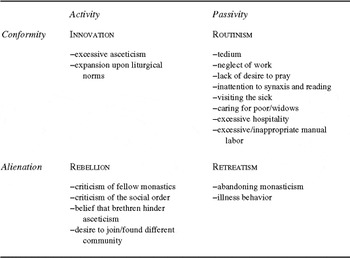
Table 1 Signs of acedia in Early Christian Monasticism
 You have
Access
- 22
- Cited by