INTRODUCTION
Crop genetic diversity, which is crucial for feeding humanity, for the environment and for sustainable development, is being lost at an alarming rate. Given the enormous interdependence of countries and generations on this genetic diversity, the loss raises critical socio-economic, ethical and political questions (Esquinas-Alcazar, Reference Esquinas-Alcazar2005). Development of low input protocols to enhance longevity of crop and wild plant seeds is a priority (Li and Pritchard, Reference Li and Pritchard2009) to facilitate biodiversity conservation of crop and wild plants (Corvalan et al., Reference Corvalan, Hales and McMichael2005; Fassil and Engels, Reference Fassil and Engels1997; Schoen and Brown Reference Schoen and Brown2001). In fact, seed vigour and viability preservation concerns seed scientists, plant genetic resources conservationists, plant breeders and those engaged in and practicing agriculture and horticulture. Seeds start ageing post maturity, which involves damage to macromolecules. The orthodox seeds have ability to tolerate desiccation and to retain their viability for a long time in the dry state; however, these seeds age during storage and eventually lose their ability to germinate. Free radical-mediated lipid peroxidation, enzyme inactivation or protein degradation, disruption of cellular membranes and damage to genetic (nucleic acids) integrity have been identified as major causes of seed ageing (Bewley and Black, Reference Bewley and Black1982; McDonald, Reference Mcdonald1999; Smith and Berjak, Reference Smith, Berjak, Kigel and Galili1995; Wilson and McDonald, Reference Wilson and McDonald1986). The primary physiological processes of seed ageing are not yet fully understood as deterioration during seed ageing has been studied mostly under accelerated ageing conditions, using high temperature and high seed water content (McDonald, Reference Mcdonald1999). Literature suggests that there may be several mechanisms of seed ageing (Walters, Reference Walters1998), for example, lipid peroxidation and the loss of membrane phospholipids are major causes of seed ageing under accelerated ageing conditions (McDonald, Reference Mcdonald1999; Priestley, Reference Priestley1986; Wilson and McDonald Reference Wilson and McDonald1986). Several studies of long-term storage detected little or no lipid peroxidation and loss of phospholipids in seeds of cucumber (Koostra and Harrington, Reference Koostra and Harrington1969), rice (Matsuda and Hirayama, Reference Matsuda and Hirayama1973), peanuts (Pearce and Abdel-Samad, Reference Pearce and Abdel-Samad1980), soybean (Priestley and Leopold, Reference Priestley and Leopold1983) and wheat (Petruzzelli and Taranto, Reference Petruzzelli and Taranto1984).
Moisture, temperature and oxygen are among crucial factors affecting seed ageing during storage. Low moisture and low storage temperature are recommended and practiced for long-term conservation of desiccation tolerant (orthodox) seeds in gene banks and seed stores (IBPGR, 1985). The use of very low temperatures close to that of liquid nitrogen (−196 °C) provides an alternative method for the preservation of seeds that might play an important role in the future, especially for recalcitrant material. The cryogenic storage of seeds, i.e., storage in liquid nitrogen, is an advanced method of germplasm conservation as metabolic activities are minimal and deterioration is practically non-existent at low temperatures (Stanwood, Reference Stanwood and Kartha1985). Though refrigeration and cryopreservation technologies have advanced, the cost, availability and reliability of electricity, especially in remote sites and developing countries, are still prohibitive and hence other suitable technologies have to be developed. High viability recorded in seeds of 37 species of Brassicaceae after almost 40 years of storage (Perez-Garcia et al. Reference Perez-Garcia, Gonzalez-Benito and Gomez-Campo2007) evidence potential of preservation methods. Low moisture is viewed more important for desiccation tolerant (orthodox) seed preservation than low temperature and the ultra-dry storage at ambient temperature is considered an alternative for efficient medium- to long-term seed preservation. The use of ultra-dry seeds can save enormous energy by avoiding the use of low temperatures during storage as the temperature may be the key factor when seeds are merely dried (Perez-Garcia et al., Reference Perez-Garcia, Gonzalez-Benito and Gomez-Campo2007). Apart from moisture and temperature, the presence or absence of oxygen has been contradictory over the years and, probably for this reason, it has mostly been neglected (Gomez-Campo, Reference Gomez-Campo2007). However, a recent study suggests that ultra-dry seeds are sensitive to oxygen (Ellis and Hong, Reference Ellis and Hong2007), and hence it should be taken into account for seed storage.
The use of ultra-dry conditions, i.e., moisture content between 0.3% and 3.0% (Perez-Garcia et al., Reference Perez-Garcia, Gonzalez-Benito and Gomez-Campo2007), is viewed as a potentially inexpensive method for long-term storage of orthodox seeds without refrigeration (Gomez-Campo, Reference Gomez-Campo2007; IBPGR, 1985; Zheng et al., Reference Zheng, Jing and Tao1998). However, the ultra-drying technique is time consuming, cumbersome and expensive, with subsequent handling and storing of very dry seeds being difficult as they become brittle and are easily damaged (IBPGR, 1985; Rao et al., Reference Rao, Hanson, Dulloo, Ghosh, Nowell and Larinde2006). Drying of seeds may be done either by conventional methods under low relative air humidity and low temperature or by involving a desiccant at low temperature. When using desiccants, precautions are needed as silica gel is an irritant to the respiratory and digestive tracts and its dust may cause irritation to the skin and eyes. Also, the crystalline silica may cause silicosis (Fisher Scientific, 1997; NCBI, 2016; OSHA, 2006). The silica gel often contains cobalt chloride or methyl violet as indicators and both compounds are very toxic (EPA, 2000; Gomez-Campo, Reference Gomez-Campo2007; Lison et al., Reference Lison, Boeck, Verougstrate and Kirsch-Volders2001).
Limitations inherent to the use of ultra-dry seed storage at ambient temperature could possibly be overcome by using a suitable liquid preservative (LP) (Pandey, Reference Pandey1996). However, such technique should be tested for a reasonable number of seed species for long time before it could be envisaged as an alternative for medium- to long-term seed preservation. The present study evaluated a solution composed by 20% CaCl2 in glycerol for liquid preservation of cucurbit seeds at ambient temperature.
MATERIALS AND METHODS
Cucurbit seeds
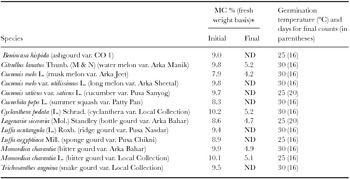
Twelve cucurbits (13 seed types) studied herein are shown in Table 1. The seeds were either obtained from the Department of Vegetable Breeding, Indian Council of Agricultural Research – Indian Institute of Horticultural Research, Hessaraghatta Lake Post, Bangalore (Benincasa hispida, Citrullus lanatus, Cucumis melo, Cucumis melo var. sativus, Cucurbita pepo, Lagenaria siceraria, and Momordica charantia) or from commercial sources (Cucumis sativus var. sativus, Cyclanthera pedata, Luffa acutangula, Luffa aegyptiaca, Momordica charantia and Trichosanthes anguina). All seeds were cleaned and then used in the experiments.
Cucurbit seeds – details of species included in the study, initial seed moisture at experiment initiation, final moisture in the seeds preserved in the liquid preservative and germination temperature and days after which final germination counts were recorded.

*Moisture determination was done in ground seeds dried at 130±2 °C in an oven until constant moisture. MC, moisture contents; and ND, not determined.
Seed moisture
Seed moisture content (MC, fresh weight basis, the convention used throughout) was determined using 0.5–1.0 g of seeds in triplicate for each species. The seeds were ground, dried in an oven at 130±2 °C until constant moisture (ISTA, 1985). This was done initially at the beginning of the experiments as well as on each sampling in hermetically stored seed samples and on LP-preserved seeds till final sampling.
Preparation of the preservative solution
The components of LP, glycerol and CaCl2 together in the proportion used were designed as a stable preparation for desiccating the seeds and storing the desiccated seeds in an air, thus oxygen, free environment without harming them. The preservative solution was prepared by dissolving CaCl2 (20%, w/w) in glycerol at 155±5 °C. The viscous preparation was allowed to cool to 50–60 °C and kept in airtight containers for ready use. In each case, the seeds were divided into six portions, three of them were hermetically sealed in laminated aluminium foil packets (hermetic storage, HS), and the other three portions were immersed in the preservative solution (LP), at a liquid to seed ratio of 1:1 (v/v) in reagent bottles (100 mL) and stored at ambient temperature in 1989–1990. The reagent bottles were hermetically sealed. All the treatments were stored at the same ambient temperature, which varied between 15 and 45 °C (average of 30 °C) throughout the storage time, representing tropical condition.
Seed sampling
The seeds were sampled from each of the three replicates of both treatments at yearly intervals. The HS seeds from laminated aluminium foil packets were drawn quickly through a narrow cut opening and resealed immediately to minimize moisture exchange with the ambient air and kept for further sampling. The seeds drawn from the LP were washed once with distilled water (1:100, v/v) by shaking for 2 min and blotter-dried. The seeds were kept at ambient RH (>60%) for 2 days and used for viability testing.
Preservative solution imbibition by seeds
Imbibition of preservative solution by seeds was examined in samples drawn from the LP treatment. The seeds (20 or more in each case) were placed in 0.5% (w/v) methyl violet (CI 42535) dissolved in glycerol and incubated at 30 °C for 24 hours. Then, the seeds were blotter-dried and dissected into two halves with a sharp blade, and observed for blue colour. While visual observations were sufficient for larger seeds, microscopal observations were also undertaken when necessary. The seeds stained blue (along the embryonic axis, endosperm and cotyledon) were considered to have imbibed the chemical (Pandey, Reference Pandey1994).
Seed desiccation by preservative solution
Seed desiccation was studied at short intervals over a month in C. pedata (cyclanthera) and over long term in this as well as in other species. The seeds (10.2% of moisture content) were placed in the preservative solution (1:1, v/v) in reagent bottles in three replications at ambient air temperature and sampled at regular intervals. Preservative solution was removed by wiping seed surface and moisture determined as previously commented. Seed desiccation by LP treatment was monitored over a short period at intervals of days until moisture content stabilization, subsequently at monthly intervals for a couple of months and then at yearly intervals extending to final sampling after 24 years.
Germination (viability) testing
Germination was performed on triplicate samples of 20 or more seeds in each case on wetted filter papers on 100 mm diameter Petri dish at appropriate temperatures (Table 1) at RH >90%. The seeds were allowed to germinate in the dark (ISTA, 1985) and germination was recorded after specified periods (Table 1). A seed developing into a normal seedling with both intact root and shoot was considered to have germinated and viable.
Regeneration of liquid preserved seeds
The liquid preserved seeds of C. lanatus (watermelon), C. sativus (cucumber) and L. siceraria (bottle gourd) were washed and sown in earthenware pots (300 mm diameter, 280 mm height) filled with soil in triplicate for each species, thinned to five plants in each pot after establishment, allowed to flower and form seeds during 2013–2014. The seeds were collected, dried at ambient temperature and used as fresh seeds for performance testing against the liquid preserved seeds. The performance was tested on 20 seeds in ten replications in each of the three species – watermelon, cucumber and bottle gourd. The seeds were sown in plastic trays (300 × 400 × 80 mm, length × width × depth) filled with sand (<1.0 mm). The trays were kept outdoors and watered. Emergence was recorded daily up to 16 days (ISTA, 1985). Thereafter, 10 seedlings were uprooted from each of the replications 10 days after sowing, washed, blot-dried and lengths and fresh weights of root and shoot were measured. Germination rate (GR), germination speed (GS) and standard germination (StG) were computed based on number of normal seedlings, using the equations (Pandey, Reference Pandey1989). The GR =
 $\frac{{100}}{{x\ }}$
 $( {\frac{{y5}}{5} + \ \frac{{y10}}{{10}}} )$
, GS =
 $\ \ \frac{{100}}{{x\ }}$
 $( {\frac{{y1}}{1} + \ \frac{{y\ 2}}{2} + \ldots + \ \frac{{y10}}{{10}}} )$
and StG =
 $\frac{{100}}{x}$
(y5 + y10); where x and y were number planted and normal seedlings on following numeral day, respectively.
Statistical analysis
The data were subjected to ANOVA using Completely Randomised Design for indices of significance at p < 0.05. The data on performance testing were subjected to t test (p < 0.05).
RESULTS
The species included in the study were typical cucurbits (Table 1) widely cultivated. The seeds had an average initial moisture content of 9.3±0.7% (mean of all seed types of all species). The moisture content in seeds under hermetic storage in laminated aluminium foil packets remained practically unchanged over years (data not shown).
None of the seeds, except a few damaged ones, had imbibed the liquid preservative over the period of the experiment as none trace of methyl blue colour intake was found. The LP had no detectable adverse effect on seeds preserved in it for 24 years at ambient temperature. The moisture contents in cyclanthera seeds preserved in LP at 0 (initial), 1, 4, 6, 12, 16, 20 and 30 days, 1, 2, 8 and 24 years were 10.2±0.1, 7.3±0.1, 6.3±0.2, 5.6±0.2, 5.5±0.2, 5.2±0.1, 5.2±0.1, 5.1±0.1, 5.2±0.1, 5.2±0.1, 5.1±0.1 and 5.2±0.2 (LSD 0.21, p <0.05), respectively. The seeds of cyclanthera immersed in the preservative solution had acquired almost stable moisture contents by 16 days and this was maintained until the final sampling (Table 1). The seed moisture content of the other four species evaluated ranged from 4.2% to 5.2% after 24 years (Table 1). Thus, the viability results refer to seed with constant moisture for the HS treatment and to seeds with 5% moisture content for LP treatment.
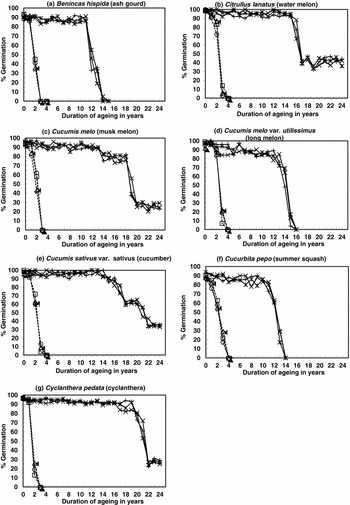
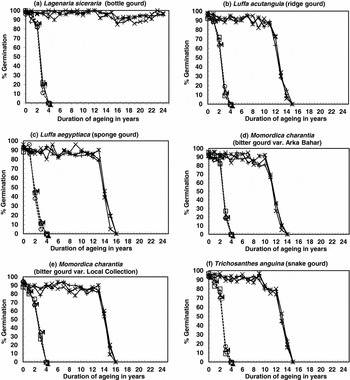
The seeds lost viability in HS treatment after 3.8±0.4 years, while in LP treatment viability was lost after 14 to 16 years in eight species and seeds were still viable after 24 years in five species (Figures 1 and 2). Preservation in LP-extended viability of the seeds by about four-fold or more over HS treatment, depending on the species.
Relative loss of viability (germination) of cucurbit seeds in hermetic storage (HS, dotted lines) and liquid preserved (LP, filled lines). The LSDs (p < 0.05) for HS and LP in different species were (a) 6.88, 7.30; (b) 9.69, 5.67; (c) 13.28, 5.06; (d) 8.62, 8.07; (e) 7.62, 5.05; (f) 8.20, 6.96 and (g) 7.96, 4.99, respectively.

Relative loss of viability (germination) of cucurbit seeds in hermetic storage (HS, dotted lines) and liquid preserved (LP, filled lines). The LSDs (p < 0.05) for HS and LP in different species were (a) 7.43, NS; (b) 6.31, 5.63, (c) 7.58, 7.21; (d) 6.40, 6.76; (e) 7.29, 10.28 and (f) 6.89, 4.92, respectively.

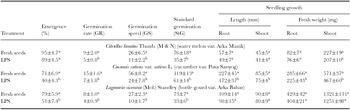
The fresh and preserved seeds of water melon had similar emergence and seedling growth, while GR, GS and StG were lower in preserved seeds (Table 2). Preserved cucumber seeds had lower performance as evidenced by lower emergence, GR, GS and StG and seedling growth (Table 2). In bottle gourd, preserved seeds had lower emergence, GR, GS and StG with seedling growth similar to fresh seeds (Table 2).
Performance of the fresh and liquid preservative preserved seeds (LPS) outdoors.

The values are means of 10 determinations ± SD. Means of an attribute for a species followed by different superscript letter in a column differed significantly (T test p < 0.05).
DISCUSSION
A major problem encountered with the use of liquid preservation of seeds (Pandey, Reference Pandey1994; Reference Pandey1995; Reference Pandey1996) was imbibition of the preservative solution by seeds and subsequent seed death. The results with the LP treatment after 24 years evidenced suitability of CaCl2 in glycerol for preservation of cucurbit seeds. The liquid preservative desiccated seeds with approximately 10% of moisture content to 5% in 2 weeks and maintained this throughout the storage period (Table 1). The seeds with about 10% of moisture preserved in hermetic storage had relatively much higher rate of ageing than the ones with the same moisture in LP treatment. The combined effect of seed desiccation and absence of air thus oxygen for liquid-preserved seeds appeared to have retarded the rate of seed ageing drastically. Seed preservation in LP treatment is likely associated with the substitution of air in seed environment by the preservative solution, which gradually dried seeds. The liquid preservative used in the study (20% CaCl2 in glycerol) appeared to be an appropriate formulation against 25% CaCl2, a more viscous preparation used earlier in a relatively short-term study (Pandey, Reference Pandey1996). In addition, the 20% CaCl2 solution presented all advantages and properties envisaged earlier (Pandey Reference Pandey1995) and kept them for preservation of cucurbit seed viability at ambient temperature.
The desiccation of cyclanthera seeds by the LP treatment to about 5% moisture content occurred in a short period of less than a month and such moisture was maintained throughout the storage period of 24 years. Enhancement of longevity of tomato seeds at 10% MC by immersion in the LP was equivalent to that of seeds at 2% MC either hermetically stored or immersed in the preservative with slightly different composition (Pandey, Reference Pandey1995). These earlier results confirmed seed ultra-drying to be one of the major modes of action of the LP equally applicable to the formulation tested in the present study. This is validated by the results of the long-duration experiment with cucurbit seeds.
The conventional ultra-dry seed storage for viability preservation may involve (i) drying seed to ultra-low moisture (2–6%), (ii) a desiccant, usually self-indicating silica gel with cobalt chloride or methyl violet – all toxic, (iii) multiple handling of seeds often also involving low temperature, (iv) removal of oxygen, (v) sustained risk of lapses including abrasion and physical damage to the seeds during storage and (vi) use of electricity throughout or at one or more stages (Gomez-Campo, Reference Gomez-Campo2009; IBPGR, 1985; Perez-Garcia et al., Reference Perez-Garcia, Gonzalez-Benito and Gomez-Campo2007; Reference Perez-Garcia, Gonzalez-Benito and Gomez-Campo2008). On the other hand, the constituents of preservative solution glycerol and CaCl2 are common chemicals, relatively non-toxic, are not mutagen, do not harm seed (over decades) or plants, and do not pose corrosion, fire, health or environmental hazards (Anonymous, 1997; 2002a; 2002b). Glycerol is a constituent of antifreeze used in automobiles and because of its sweet taste (about half the sweetness of sugarcane), it should not be left in a large amount where an animal might be tempted to drink it. Calcium chloride is used to melt ice on sidewalks, to fireproof fabrics, in antifreeze mixtures, in fire extinguishers and in dust control on unpaved roads (Anonymous, 1997). Thus, the LP treatment offers all the advantages to solve problems inherent with the ultra-drying technique at the same time it is a simple and low-input seed preservation option for long-term preservation of cucurbit seeds at ambient temperature.
The enzyme activity is strongly inhibited during storage at low seed moisture levels and is influenced by temperature, which also affects fluidity of membranes and storage lipids. Both increases in temperature and seed moisture can induce phase transitions of the cytoplasm from the glass to the fluid state, thereby reducing shelf-life (Roos, Reference Roos1998; Sun, Reference Sun1997). It has been shown that above the glass transition temperature, the cytoplasm in seeds still exhibits a low molecular mobility and high stability, but the level and types of protection presumably differ from that during the glass phase (Buitink and Leprince, Reference Buitink and Leprince2008). The deterioration processes occurring in seeds, the protection mechanisms preventing it and the activity of enzymes involved in repair may vary with differences in either temperature or water activity (Kibinza et al., Reference Kibinza, Vinel, Côme, Bailly and Corbineau2006; McDonald, Reference Mcdonald1999; Murthy et al., Reference Murthy, Kumar and Sun2003; Walters and Engels, Reference Walters and Engels1998). Schwember and Bradford (Reference Schwember and Bradford2011) showed that longevity of lettuce seeds stored at 32% RH was extended by anaerobic environments. In fact, an increase in oxygen concentration during storage hastens the seed deterioration and some studies have shown that storing seeds under reduced or zero oxygen levels can prolong their shelf-life (Groot et al., Reference Groot, De Groot, Kodde and van Treuren2014). Although storing seeds under reduced or zero oxygen will not provide an alternative for storing at low temperature, zero oxygen levels may be an additional tool to prolong longevity of stored seeds.
With seed lots exhibiting a relatively poor shelf-life, either due to genetic variation or seed treatments, it may be worthwhile storing the seeds under low oxygen levels, once they are dried (Groot et al., Reference Groot, Surki, de Vos and Kodde2012). Storage under anoxia has been suggested for prolonging the longevity of ex situ conserved seeds (Groot et al., Reference Groot, De Groot, Kodde and van Treuren2014). The precise mechanism of seed viability extension by preservative solution appeared to be a drastic reduction in ageing predisposed deterioration due to their rapid desiccation and maintenance of low oxygen levels as the seed environment was filled with the preservative instead of air.
The proposed liquid preservation of cucurbit seeds simplifies the process by just immersing the seeds in the stable, non-toxic and re-generable preservative solution without risking human and seed health and the environment. There was normal seed production in plants raised from liquid-preserved seeds (Table 2). The performance of liquid preserved and fresh seeds of cucurbit crops further confirmed practicability and suitability of the liquid preservation of cucurbit seeds. Among the species used were seed lots from commercial source and postharvest processing and age were not known; hence, the viability results and extension of viability by the liquid preservation may be underestimated herein.
This is the first report establishing the utility of the liquid preservation technique for extending longevity of cucurbit seeds for decades. Liquid preservation of cucurbit seeds offers an easy, low cost and alternative technique for seed viability preservation. Organizing the efficient conservation of plant biodiversity through seed preservation is an urgent challenge, especially in developing countries, where the costs of cold storage are prohibitive (Zheng et al., Reference Zheng, Jing and Tao1998). Such seed preservation technique may facilitate saving large germplasms, including plant breeders’ precious materials in remote locations and with resource deficient individuals, laboratories and organizations (Sukhdev, Reference Sukhdev2008). The liquid preservation also avoids use of electricity in drying the seeds to ultra-low moisture content, thus proving as an environmental friendly and green technology.
CONCLUSION
Preservative solution composed by 20% CaCl2 in glycerol extended seed longevity of cucurbit species stored over two decades at ambient temperature. The preservative solution was not imbibed by seeds during the storage and did not affect seed health. The findings suggest that liquid preservation is a promising, alternative, long-term storage method at ambient temperature for cucurbit seeds.
Acknowledgements
The work was part of a project initiated at the ICAR - Indian Institute of Horticultural Research, Bangalore, Karnataka, India and subsequently continued at the ICAR - Directorate of Weed Research, Jabalpur, Madhya Pradesh, India. The author is grateful to Dr M.P. Alexander for his encouragements in the initial stage of the study.