Introduction
Both the smaller scope of politics and the proximity of the public to elected officials mean that local politics is often perceived as the ideal level of government for civic participation and the best expression of citizen preferences (see, for instance, Oliver et al., Reference Oliver, Ha and Callen2012). A considerable body of research has explored different forms of participation and citizen expression in local public life. Nevertheless, the most fundamental expression of citizen preferences—voting—remains a phenomenon that is often overlooked (but see Caruna et al., Reference Caruna, McGregor, Moore and Stephenson2015; Cutler and Matthews, Reference Cutler and Matthews2005; McGregor and Spicer, Reference McGregor and Spicer2016; Moore et al., Reference Moore, McGregor and Stephensonforthcoming).Footnote 1
One result of this lack of study is that the factors that influence voter turnout in Canadian local elections remain largely unexplored. Studies of local turnout are sparse and, where this topic has been addressed, tend to focus on select cities within one or two provinces (Couture et al., Reference Couture, Breux and Bherer2014; McGregor and Spicer, Reference McGregor and Spicer2016). With the exception of Walks's 2013 analysis, there is no pan-national or longitudinal profiles of Canadian local electoral participation similar to the study conducted by Caren of 38 major US cities (2007). This shortfall of pan-national studies on local voter turnout is a major shortfall in the literature on local Canadian politics. In fact, this is one aspect of the “black hole” identified by Eidelman and Taylor (Reference Eidelman and Taylor2010) on the study of urban politics in Canada.
Our analysis here addresses the following question: What factors have influenced local electoral participation in Canadian cities since 2004? We begin by presenting the three primary theoretical approaches to explaining local electoral participation and highlight the utility of exploiting institutional diversity at the local level of Canadian government in particular to explain differences in voter turnout. We then expand upon the Canadian case and present the empirical model developed specifically for this study.
We drew from an original dataset of electoral data and institutional/demographic characteristics of Canada's 100 largest cities over three electoral cycles (n = 300) to address our research question. Our research tests three sets of hypotheses regarding (1) the sociospatial context within which local elections take place; (2) the institutional design of local elections and representation; and (3) the competitiveness of local elections. Our results provide a first-ever portrait of how these factors influence local electoral participation in major Canadian cities. In addition to uncovering the factors which underlie participation in Canadian local elections, our analysis lays the foundation for further research on these topics, more specifically, on the role of the competitiveness of elections and its effect on the mobilization of citizens.
Influences on Voter Turnout
In general, analyses of the determinants of electoral participation focus on three types of variables: institutional, political and socioeconomic (Geys, Reference Geys2006). In the subsections that follow, we review these variables both in general but in particular with respect to their influence on turnout in local elections. It is important to keep in mind that these three categories do not have the same influence depending on the level of government being considered. Cancela and Geys (Reference Cancela and Geys2016), for example, showed that institutional variables appear to have the most significant impact on municipal politics.
The institutional context
Institutional variables are factors related to the organization of elections. Three variables in particular are especially relevant in the Canadian context: territorial representation, the presence of concurrent elections and the possibility of a referendum being held alongside the election.
In simple terms, territorial representation is when an elector chooses a representative on a district or city-wide level. This factor has a major influence on electoral participation. According to Wood (Reference Wood2002), at-large systems may drive down voter turnout as citizens appear to be alienated by elections which produce no representatives from their own neighbourhoods. Conversely, territorial representation by district appears to encourage electoral participation. Oliver (Reference Oliver2001), however, finds that the electoral method employed does not affect voter mobilization. All this stands in contrast with the wider literature, which emphasizes the importance of proportional electoral systems in increasing voter turnout (for example, Eggers, Reference Eggers2015; Selb, Reference Selb2009).
The presence of concurrent elections on voting day is also a major element that should be taken into consideration. Both Caren (Reference Caren2007) and Hajnal and Lewis (Reference Hajnal and Lewis2003), for example, demonstrate that the point in time when an election is held influences turnout. As Hajnal and Lewis state, “By scheduling local elections that have traditionally had low turnout on the same date with statewide primaries or general elections with their much higher voter turnout, there is reason to believe that the number of local ballots cast could be almost immediately increased to levels nearly on par with national elections” (2003: 648). In a similar vein, elections of councillors may be held on the same dates as elections for mayors and other elected bodies such as school boards. When elections are held simultaneously, voter turnout tends to increase. These findings as they relate to local elections accord well with findings from the literature on concurrent elections and voter turnout (see, for example, Germann, Reference Germann2016; Nikolenyi, Reference Nikolenyi2010).
Hajnal and Lewis (Reference Hajnal and Lewis2003) suggest that the presence of the possibility of calling a referendum increases residents’ interest in public affairs and is therefore also likely to increase turnout. In an earlier study dedicated to electoral participation in several California cities, Hajnal and colleagues (Reference Hajnal, Lewis and Louch2002) found that the presence of a referendum tended to increase voter turnout.
Other factors related to electoral rules must also be taken into account. The length of term in office, for example, could have a positive or negative influence on voter turnout. In a similar vein, the number of positions to be filled also contributes to reducing electoral participation. The number of elected officials present in a given area can also affect the quality of representation. Merrifield (Reference Merrifield1993) showed that electoral participation is higher when the ratio of elected officials to inhabitants is lower because it tends to increase interest in voting. Rallings and Trasher (Reference Oliver, Ha and Callen2005) showed that a shorter time span between by-elections and the previous election lowered the turnout. Voter fatigue, therefore, appears to have a measurable impact on turnout.
The political context: competitiveness in question
The competitiveness of elections, political fragmentation, the number of candidates, the presence of party candidates and the presence of incumbents are all political aspects of local elections that may exercise an influence on voter turnout. Political fragmentation refers to the number of political parties participating in elections (Geys, Reference Benny2012). In North America, however, analysis of the influence of municipal political parties on electoral participation has yet to surface. In Canada, the question takes on a particular meaning as municipal political parties tend not to have organizational connections with the parties found at the other levels of government and they are also relatively rare. For many authors, the relative lack of municipal political parties is one of the causes of the information deficit that characterizes municipal politics. In the absence of political parties, electors are deprived of a “short cut” that allows them to make an informed choice (see, for example, Cutler and Matthews, Reference Cutler and Matthews2005).
In a similar category of thought, the number of candidates running for the same position also constitutes a variable that is likely to affect electoral participation. In fact, the higher the number of candidates running, the greater the chances of electors finding a candidate to correspond with their values (Geys, Reference Geys2006). The same can also be said of the number of candidates running. This issue is especially important in Canada where, once again, particularly in large cities, candidates are still occasionally elected by acclamation.
The presence of incumbents also affects the electoral playing field and the participation of electors. The participation of incumbents running in election campaigns is related to lower turnout as these races are perceived to be less competitive than contests without incumbents (Hajnal and Lewis, Reference Hajnal and Lewis2003). Further, the number of terms served by incumbents tends to create political monopolies, thus driving down turnout (Trounstine, Reference Trounstine2006). Conversely, higher numbers of candidates competing against incumbents is related to a higher turnout.
The socio-spatial context
The final approach employed to understand local electoral participation identifies several variables: (1) the size of the municipality and (2) population density; (3) variation in population. The argument underlying the first variable is that larger cities are likely to have lower voter turnout (Oliver et al., Reference Oliver, Ha and Callen2012). This argument is rooted in rational voter theory, which leads us to expect that, in the presence of a large electorate, voters are less likely to go to the polls because the probability that their vote will make a tangible difference is low (Frandsen, Reference Frandsen2002). Other researchers have put this expectation into perspective, however, by pointing out that high population density is likely to minimize the effect of the size of the electorate on voter mobilization (Tavares and Carr, Reference Tavares and Carr2012). Blank (Reference Blank1974) suggests that low density leads to higher turnout since voters are more likely to know candidates, thereby reducing the information costs of assessing them. In the case of Quebec, Breux and colleagues (Reference Breux, Couture and Goodman2016) have shown that the smaller the municipality, the higher the electoral participation.
As highlighted by Geys (Reference Geys2006), population stability enhances the feeling among residents of being “rooted” within the community. Dostie-Goulet (Reference Dostie-Goulet, Blais, Fournier and Gidengil2013) showed that for youths the feeling of belonging helped explain the vote. In large cities however, new residents tend to be renters, which may partially explain their abstention.
This sociospatial approach is often combined with analyses of the sociodemographic factors that affect likelihood of voting. Oliver and colleagues (Reference Oliver, Ha and Callen2012) for example, identified the local voter profile as being white, elderly, homeowning, educated and with above-average income. In Canada, Nakhaie (Reference Nakhaie2006) showed that age is the primary explanatory variable of behaviour in municipal elections. Trounstine, however, reminds us that although the sociodemographic context should not be neglected in the analysis of local electoral participation, the political context remains important and it should therefore be analyzed in detail (2009: 613).
Despite flourishing analysis of the determinants of electoral participation (Cancela and Geys, Reference Cancela and Geys2016), only two general conclusions emerge from the discussion: 1) there are few analyses that analyse turnout at the municipal level and 2) there are still many determinants to be addressed, especially in Canada, where analysis remains relatively rare.
The Canadian Case
The Canadian case is unusual because no national study of voter turnout at the local level has been conducted to date. In fact, the few existing studies of voter participation employ a broad range of data and were solely concerned with the province of Quebec (Couture et al., Reference Couture, Breux and Bherer2014). Turnout in Canadian local elections is therefore still a relatively unexplored field of study. The next section briefly describes the diverse institutions that govern local elections in Canada before presenting our empirical model and hypotheses.
Institutional design
Provincial governments in Canada are vested with the power to decide upon the governing structures of municipalities, including their systems of election. The result of this is significant diversity in local governing institutions as the provincial governments have made different decisions about how local government should be structured.
Nevertheless, all Canadian cities share two institutional-electoral characteristics. First, mayoral candidates are elected in separate elections on the basis of universal suffrage, a surprisingly presidential-style divergence from the parliamentary systems that characterize Canada's national and provincial governments. Canadian city governments in this respect are closer to the “political city” model than the “administrative city” model (Frederickson and Johnson, Reference Frederickson and Johnson2001). Second, councillors are elected in all cities. Both the number of councillors and the means through which they are elected, however, differs depending on the city.
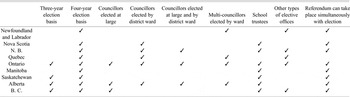
Table 1 summarizes the institutional settings of local elections since 2004 by province in the 100 largest cities. Specifically, the table compares three institutional aspects of those cities’ elections: (1) the number of years between elections, (2) the mode of election for councillors, and (3) other elections that take place concurrently with mayoral and councillor elections.
Institutional design of municipal elections by province in Canada's 100 largest cities since 2004

Currently, the number of years between local elections is the same in all provinces: elections are held every four years. This standardization across provinces, however, is relatively recent. Four provinces only recently granted terms of four years to local officials (Ontario in 2010, Saskatchewan in 2012, Alberta in 2013 and British Columbia in 2014), whereas previous local elections in those provinces had been held every three years.
Canadian cities have evolved four modes of electing councillors. The first is election in wards. Specifically, the territory is divided into districts, and the voters of each of these divisions elect one representative with a simple plurality. This mode of election is favoured in Nova Scotia and Quebec and is also found in some towns in New Brunswick, Ontario and Alberta.
The second mode, at-large elections, allows councillors to be elected by the general population in a similar fashion to how the mayor is elected. The council is characterized by a fixed number of seats that are filled by the candidates that receive the greatest numbers of votes. Voters in ward elections are given one vote, whereas voters in at-large election vote for as many candidates as there are council seats. This type of election is preferred in British Columbia, though it is also found in some cities in Ontario and Alberta. At-large elections exist in Quebec but only in cities of fewer than 20,000 inhabitants which make that choice.
The third mode is characterized by mixed-form elections. In this version, some councillors are elected by the voters of wards and others by the entire population. The last mode is characterized by multi-member rather than single-member wards. This form is favoured in Newfoundland and Labrador and is also found in New Brunswick, Ontario and Alberta although this type of election in also used in some wards of the city of Montreal, Quebec.
Voters elect their school board trustees at the same time as their local council members in all provinces aside from Quebec and Newfoundland and Labrador. Local elections in these provinces are referred to as civic elections. Several other officials are elected simultaneously with mayors and councillors. Among these are the positions of deputy mayor in Newfoundland and Labrador; hospital board members in New Brunswick; borough councillors or borough mayors for the cities of Sherbrooke and Montreal, Quebec; regional councillors in Ontario, the metropolitan regions of Windsor, Durham and Niagara Falls in particular; and, commissioners for boards such as the Vancouver Board of Parks and Recreation. Only Quebec does not allow a referendum on the same day as local elections. However, according to our data, there have been referendums in only 19 of the 100 largest Canadian cities since 2004.
City elections in Canada tend to be characterized by non-partisanship, although parties have formed and helped to shape electoral competition in several of the large cities. Vancouver's city politics, for example, has been characterized for some time by relatively stable competition between civic parties (see, for example, Cutler and Matthews, Reference Cutler and Matthews2005). In other cities, slates of candidates bound together by shared ideas are formed. Such coalitions, as well as non-partisan rhetoric, may in fact mask informal linkages to party organizations (Sproule-Jones, Reference Sproule-Jones, Gagnon and Tanguay2008), and McGregor and colleagues (Reference McGregor, Moore and Stephenson2016) demonstrate that voters may conceive of non-partisan local competition as partisan in nature. Milner (Reference Milner1997) argues persuasively that low turnout in Canadian elections can be partially explained by a lack of “integrative” political organizations, particularly parties with organizations that exist at all levels, particularly the municipal level, of the state.
Empirical model and hypotheses
The following equation summarizes our model explaining turnout in local elections:
Equation 1:
 $$\eqalign{& Turnout = a + b1(\Delta POP) + b2(Log\,pop) + B3(Log\,density) \cr & + b4(Log\,number\,of\,candidate) + b5(mayoral\,female\,candidate) \cr & + b6(mayoral\,incumbent) + b7(number\,of\,terms\,in\,office) \cr & + b8(victory\,margin) + b9(councillor\,acclamation) \cr & + b10(\,political\,party) + b11(Councillor\,by\,pop) \cr & + b12(three - year\,election\,basis) \cr & + b13(Referendum) + b14(Other\,elected\,officials) \cr & + b14(councillor\,elected\,at\,large) \cr & + b15(councillor\,elected\,at\,large\,and\,by\,ward) \cr & + b16(multi - councillors\,elected\,by\,ward) + \epsilon} $$
Specifically, we propose three groups of hypotheses, which tie in with the previously mentioned literature on the subject.
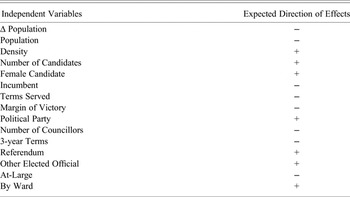
Hypotheses 1‒3 are related to the sociospatial context. To begin, we hypothesize that the more a city grows, the weaker electoral participation becomes. Also, we hypothesize that the higher the population of the city, the lower voter turnout will be. In addition, we hypothesize that the higher the density of the population, the higher the voter turnout in accordance with Oliver (Reference Oliver2001) and Tavares and Carr (Reference Tavares and Carr2012). These hypotheses are derived from the relevant literature that was summarized earlier.Footnote 2
Hypotheses 4‒10 are related to the competitiveness of the election. The more candidates there are, the greater the chance that voters find a candidate to their liking. This in turn prompts them to go to the polls in greater numbers. We hypothesize, therefore, that a higher number of candidates would be related to higher turnout. The same applies to the presence of at least one female candidate, which we hypothesize would also lead to higher turnout. We also hypothesize that the presence of incumbents would impede voter participation, with turnout therefore being lower in the presence of an incumbent mayor (Caren, Reference Caren2007). In a similar vein, the higher the number of elected terms served by the incumbent candidate, the lower turnout is expected to be (Trounstine, Reference Jessica2008). Additionally, the larger the margin of victory in previous elections, the lower the voter turnout is hypothesized to be; this is because voters would anticipate the outcome of the election (Breux et al., Reference Breux, Couture and Goodman2016). Furthermore, by definition, elections by acclamation, a relatively common phenomenon at the Canadian local level, undermine the competitiveness of elections. We therefore hypothesize that acclamations would be related to lower turnout. Finally, the presence of political parties should increase voter participation by improving the quantity and quality of information available to voters (Breux et al., Reference Breux, Couture and Goodman2016).
Hypotheses 11‒16 concern the organization of the election. According to Rallings and colleagues (Reference Rallings and Thrasher2005), we expect lower participation when elections are held every three years rather than four years. Caren (Reference Caren2007) finds that “complex” local elections—those characterized by concurrent national or sub-national elections held on the same day as local elections—are strongly related to turnout in the United States; local elections held concurrently with local elections increased turnout by no less than 27 per cent (41). The logic underpinning this relationship is that interest in elections at other levels acts to draw voters to the polls. Accordingly, we also hypothesize that complex elections will increase turnout. We expect higher participation when voters are required to take part in a referendum or vote for other elective positions (Hajnal and Lewis, Reference Hajnal and Lewis2003). Finally, we hypothesize that the election of councillors at large or by means of a mixed or multi-method form should decrease voter turnout. We suspect that ward elections are more likely to focus on distinctively local and neighbourhood-level issues and, as a result, be related to increased turnout among voters in local elections. In contrast, we expect that the use of larger units of election or, in the extreme case, at-large elections in which the entire city is the unit employed, will be related to less distinctively local focus and thus lower turnout in local elections.
Table 2 summarizes our hypotheses, the independent variables associated with these hypotheses, and the expected direction of the relationship between each of these explanatory variables and turnout in Canadian elections.
Expected direction of effects

Methodology
Data
In recent years, electoral data have been made available online by municipalities and municipal associations, allowing for the possibility of creating a national database. The first database to centralize these data was constructed as part of this research project. Of the 3,700 municipalities in Canada (Collin et al., Reference Collin, Léveillée, Rivard and Robertson2003), we decided to focus on the 100 most populous municipalities. This was because Canada has many smaller municipalities whose electoral data are, in contrast to larger municipalities, difficult to access. Quebec, for example, has 800 municipalities with fewer than 2,000 inhabitants and, in provinces where electoral data are not centralized, we would have been forced to collect the data directly from each of the small municipalities, some of which only employ one or two staff members or whose websites most often serve more as a placeholder than as a source of information. Our undertaking to centralize these data is, to our knowledge, the first exercise of this kind conducted in Canada.
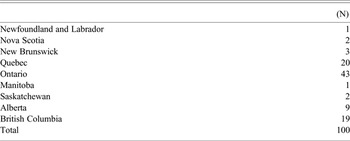
Table 3 shows the distribution of the 100 largest municipalities in 2014 by province. Only the province of Prince Edward Island has no city in the top 100. Most municipalities are concentrated in three provinces: Ontario, Quebec and British Columbia. The smallest municipality is Cornwall in Ontario, with a population of 46,340 in 2014; the largest is Toronto, with 2,615,060 inhabitants in 2014.
Number of municipalities by province

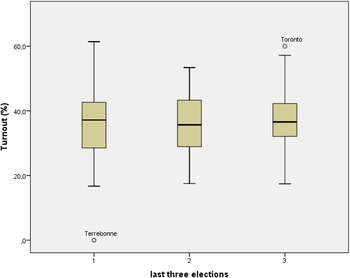
We collected electoral data from these Canadian municipalities for the last three local elections. Figure 1 shows the distribution of voter turnout. The average turnout for all three elections was 36.42 per cent, and the average turnout, chronologically, was 35.80 per cent, 35.97 per cent and 37.49 per cent for each of the three years. These differences are not statistically significant.
Box-plot municipal voter turnout (%) in the last three elections

Figure 1 shows that participation is well distributed. The line in the middle of the boxes is the median centre. The medians were, chronologically, 37.18 per cent, 35.70 per cent and 36.59 per cent, and thus very close to the average of each of the elections. The boxes contain half of the observations—the limits of quartiles 2 and 3. Outliers may extend up to 1.5 times the width of the box. The two cases that extend beyond this distance are represented by a point. They are Terrebonne (QC) in 2005, where there was no voter turnout, as the mayor and 16 councillors were elected by acclamation, and Toronto in 2014, which had a turnout close to 60.00 per cent. It should be noted however, that the highest voter participation was observed for the city of Cape Breton, Nova Scotia, with a turnout of 61.40 per cent in 2004. Apart from Terrebonne, the lowest voter turnout was around 17.00 per cent in the last three elections, namely in Wood Buffalo (AB) in 2007 (17.20%), North Vancouver (BC) in 2008 (16.7%), Chilliwack (BC) in 2011 (17.50%), and Dollard-Des-Ormeaux (QC) in 2013 (17.40%).
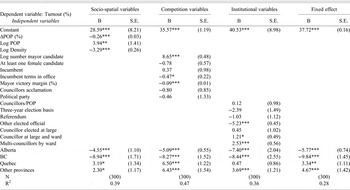
Our research design is therefore a time-series cross-section. The panel of three elections in 100 municipalities, amounts to a total of 300 observations. This research design does not permit for an OLS (ordinary least square) type of regression analysis, as the error terms of our estimates would be influenced by the presence of autocorrelation and heteroskedasticity. This, in turn, would contaminate the statistical significance tests of our estimates. To correct our estimates, we used the OLS method with PCSE (panel-corrected standard error) recommended by Beck and Katz (Reference Beck and Katz1995) for time-series cross-sections. In addition, two versions of the model will be introduced to monitor and evaluate the impact of province. A robustness test is also included in the appendix.
This analysis relies on ecological rather than individual-level data to make inferences about voting, which is necessarily an individual behaviour. Studies such as this may produce what is referred to in political science as aggregation bias (for example, Achen and Shively, Reference Achen and Shively1995). We have sought to avoid such bias in the presentation of our results below. We believe that the use of our original ecological dataset makes an important contribution to our understanding of turnout in the context of Canadian local elections, in part because individual-level data from surveys at the local level are very rare in Canada (but see McGregor et al., Reference McGregor, Moore and Stephenson2016).
Descriptive analysis
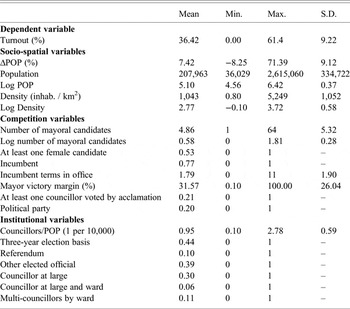
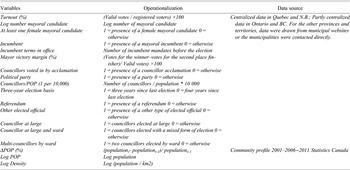
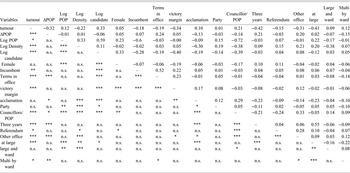
Table 4 provides a descriptive analysis of our variables. The definitions and sources for each variable are presented in the appendix, as is the correlation matrix. We found a significant distribution for all variables. The number of mayoral candidates, for example, varies between 1 and 64, and the margin of victory of mayors oscillates between 0.10 per cent and 100.00 per cent. There is at least one female candidate in 53 per cent of the elections and an incumbent in 77 per cent. One mayoral incumbent had served eleven previous terms as mayor. There was a vote by acclamation for at least one local councillor in 21 per cent of the elections. The number of councillors varies between 0.10 and 2.78 per 10,000 inhabitants. Some 44 per cent of the elections took place only three years after the previous election. Elections were complex in 38 per cent of cases. Councillors were elected by the general population in 29 per cent of the cases and on the basis of a mixed form in 19 per cent of the elections.
Descriptive analysis

Results
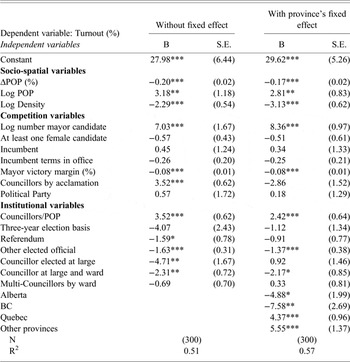
Table 5 presents the regression analysis. The first column shows the results without the fixed effects and the second column with the fixed effects. This was done to control for the provincial location of the cities. The results showed that adding the fixed effects did exercise an influence, though a slight one, on the results. The first model explains 51 per cent of the variation in voter turnout according to R2. The addition of fixed effects increases this explanation by 6 percentage points, with an R2 of 0.57 for the second model.
Regression analysis (OLS with PCSE)

Moreover, three variables are affected by the fixed effects, namely the presence of a referendum, the presence of at least one councillor being acclaimed and the election of councillors at-large. Referendums decreased electoral participation by 1.59 per cent in the first model but this relationship disappeared in the fixed effects model. This result is contrary to our theoretical expectations. Otherwise, the presence of an acclaimed councillor reduced turnout by 3.52 per cent in the first model but showed no effect in the second model. Finally, the election of councillors at large decreased voter turnout by 4.71 per cent compared to councillors elected by ward in the first model. However, this finding turned out to be insignificant in the second model. The change of these coefficients from statistically significant in the model without fixed effects to significant in the model with the fixed effects suggests that province—and potentially provincial political cultures—may exercise some influence on turnout in the cities in which they're located. From here, we will focus on the second model, with the fixed effects, for which nine variables were found to be statistically significant.
The three variables measuring the effect of the sociospatial context on voting are statistically significant. Thus, an increase in the population decreases voter turnout. More specifically, an increase of 1 percentage point of the population appears to decrease turnout by 0.17 of a percentage point. This is the variable that had the greatest effect on participation This result is consistent with our theoretical expectations. The two other variables in this group (population and density expressed logarithmically) were found to be statistically significant; however, the direction of these effects was the opposite of what was predicted by our theory. In other words, a larger population was found to correlate with a higher voter turnout, and a dense population correlated with lower voter participation. These results are further interpreted in the discussion section.
The variables related to political competition, the presence of a female candidate for mayor, the presence of an incumbent and the number of mandates of the incumbent, are not associated with voter participation. The number of candidates expressed logarithmically, however, is positively correlated with turnout. This is the effect we predicted: all things being equal, the more candidates there are, the more voters go to the polls. Moreover, the mayor's margin of victory is also associated with a decrease in participation. Specifically, a one-point increase in the margin of victory is associated with a decrease of 0.08 percentage points in voter participation. Finally, the presence of a political party appeared to have no impact on voter turnout.
Regarding the institutional variables, the results showed that holding elections every three years had no significant effect on voter participation. However, an increase of one councillor per 10,000 inhabitants increased voter turnout by 2.42 percentage points. This result is contrary to our theoretical expectations. The presence of other elected officials (aside from mayors, councillor or school trustee) decreased turnout by 1.37 per cent. Finally, the presence of a mixed form of election for councillor (at large and by ward) decreased electoral participation by 2.17 per cent. The presence of multi-councillor wards had no effect on turnout.
The value of the regression coefficients for the fixed effects showed that turnout rates seem to differ by province. These results must be interpreted with reference to the municipalities of Ontario as this province is left out of the model. Local electoral participation is 4.88 percentage points lower in Alberta and 7.58 percentage points lower in British Columbia than it is in Ontario. Moreover, voter turnout is 4.37 percentage points higher in Quebec and 5.55 percentage points higher in the other provinces (Newfoundland and Labrador, New Brunswick, Nova Scotia, Manitoba, and Saskatchewan) than it is in Ontario.
Of particular note here is the substantial negative magnitude of the relationship between cities in British Columbia and turnout. British Columbia is the province that makes the greatest use of at-large election systems. This is worth noting as the negative relationship observed between at-large systems and turnout disappeared when the fixed effects of province were included.
Discussion and Conclusion
For the most part, our findings substantiated the hypotheses presented. This research has allowed us to construct a portrait of local electoral participation in Canada. We will begin by addressing our attention to the two variables that appear to play an important role in electoral participation and its variations.
Within our sample, the variable that tended to drop electoral mobilization the most was population variation. According to Geys (Reference Geys2006), population stability is associated with the feeling of belonging that can be caused by living in a specific location over a given amount of time. This would partially explain how an increase in the population tends to reduce electoral participation: the arrival of newcomers can imply an absence of rootedness and the feeling of belonging for people in their new places of residence. Additionally, in the early 2000s, several cities had periods of municipal reconstruction (in Quebec especially) which contributed to a wholesale change in the relationships between electors and their municipalities. We also know that there are certain intracity cleavages that can explain the abstention of certain residents (Walks, Reference Walks, Sellers, Kübler, Walter-Rogg and Walks2013).
Additionally, complex elections—those in which elections are held for other positions such as for school boards—lead to lower voter turnout in our model. This result is difficult to explain. For Caren (Reference Caren2007), holding several elections at the same time contributed to an increase in the number of issues being debated and was likely to increase interest and mobilize voters, though this could conceivably have the opposite effect on turnout as well. We know that institutional complexity in federal systems tends to elicit confusion in the electors regarding the distribution of jurisdictions for each level of government (see, for example, Cutler, Reference Cutler2008). It is therefore possible that, as the number of positions to be filled increases, so too does confusion, which in turn may lead to a decreased likelihood to vote.
In the same train of thought, Breux and Couture (Reference Breux and Couture2014) showed that, in the specific case of Montreal where the elector votes at a minimum for the city mayor, the borough mayor, a borough councillor and a municipal councillor, the number of spoiled ballots was significantly higher than the other large cities of Quebec where the number of positions selected by the elector was lower. This finding supports the idea that complexity hinders both clarity and the issues of elections in general. To understand the implication of this variable, it is necessary to unpack diversity in this term to better understand the institutional differences between each of the provinces and their influence on turnout. As Walks pointed out, “participation in municipal elections is, however, more dependant upon local context than is participation in federal elections and it varies far most across different localities” (2013: 118).
Several of our hypotheses did not correspond to our theoretical expectations after testing and therefore are worthy of closer examination. The first curious finding relates to the influence of sociospatial variables. Past studies have found that as the population of cities increases, turnout tends to decrease. However, we found a statistically significant positive relationship between population (expressed logarithmically) and turnout.
One possible explanation for this unexpected result relates to the nature of media coverage of local elections in small and large urban centres. Many analysts have noted that local elections are poorly covered by media, especially when compared to media coverage of national or provincial elections. However, elections in large cities are more likely to attract media attention than elections in smaller centres. Smaller population centres may simply lack the media infrastructure to see widespread coverage of local races. This may help to explain why turnout increases with population.
The relationship between density and voter participation is likewise in the opposite direction to what was predicted, but rather supports the findings of Walks (Reference Walks, Sellers, Kübler, Walter-Rogg and Walks2013). Again, this result is difficult to interpret, but may result in part from the demographics associated with dense urban communities. The demographic characteristics of dense urban centres tend to be associated with lower turnout; for example, renters are less likely to vote than homeowners (Oliver et al., Reference Oliver, Ha and Callen2012), and dense urban settings are characterized by more renters than homeowners. Further analysis should further tease out the interrelationships between these different sociospatial variables.
Our analysis highlights the importance of electoral competitiveness to levels of turnout in local elections. As with elections in other jurisdictions, close races in Canadian cities have the effect of driving voters to the polls. Both the number of candidates present and previous margins of victory were related to higher turnout. Competitiveness is clearly a key to understanding turnout in local elections in Canada. Our analysis, however, also demonstrates that the presence of female candidates, incumbents and veteran incumbents does not influence voter turnout.
Finally, our results also shed light on the impact of electoral institutions on turnout. We do not find a statistically significant relationship between three-year terms and turnout. We do, however, find a significant relationship between the number of councillors and turnout, and there are significant real-world democratic consequences of this finding. A number of Canadian cities (including Ottawa) are exploring the possibility of reducing the number of elected councillors, while others have already done so. Our results suggest that reducing the number of councillors could have an unanticipated effect of reducing voter turnout in subsequent elections.
Our study of voter turnout also highlights more general characteristics of local elections in Canada, particularly the prevalence of incumbency and its role in influencing turnout. According to Breux and colleagues, local elections in Quebec are characterized by both a significant number of incumbents and the prevalence of election by acclamation (Reference Breux, Couture and Bherer2014). In our sample, we find incumbents in 77 per cent of all 300 mayoral elections, which suggests that incumbency is an important aspect of political life in Canada's cities. While the presence of incumbents does not affect voter turnout in our study, the fact remains that the presence of incumbents discourages new entrants into politics, and can therefore impact the competitiveness of local elections.
Finally, the role of acclamation in Canadian local elections is both prominent and, from a democratic perspective, disconcerting. Twenty-one per cent of the elections observed were decided by acclamation. In smaller municipalities, acclamations are sometimes explained by the simple fact that the population base is too small to provide a sufficient number of candidates (Champagne, Reference Champagne2007 Footnote 3 ), which is not the case in large cities. The frequency with which acclamation occurs in Canadian cities suggests that this is a phenomenon that requires further interrogation by scholars interested in the democratic implications of uncontested seats.
Appendix
Operationalization and Data Source

Robustness test (OLS with PCSE)

Pearson Correlation matrix