INTRODUCTION
Polyplacophora (chitons) are known from all ages from the Upper Cambrian to Recent (Smith, Reference Smith1960; Eernisse, Reference Eernisse2004). Their valves are a relatively significant quantitative component of fossil and biogenic sediments (Dell'Angelo et al., Reference Dell'Angelo, Palazzi and Pavia1999). Chitons are exclusively marine and basal molluscs, which have not significantly changed their morphology for more than 300 million years of evolution (Schwabe, Reference Schwabe2010).
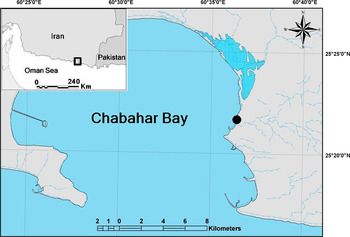
The intertidal and subtidal zones of the Oman Sea, and especially Chabahar Bay, have very diverse ecosystems and unique molluscan fauna (Ashja Ardalan, Reference Ashja Ardalan1993). However, information on the chiton fauna of the Iranian coasts of the Oman Sea (Sadeghi & Loghmani, Reference Sadeghi and Loghmani2010) is scattered and limited. The present paper focuses on the first report of Ischnochiton (I.) yerburyi (E.A. Smith, 1891) from Chabahar Bay, the Iranian coast of Oman Sea (Figure 1).
View of Tis shore, Chabahar Bay, Iran.

MATERIALS AND METHODS
The material considered in the present study was collected from medium-sized stones on stony-muddy bottoms of the intertidal zone of Chabahar Bay. Collected specimens were preserved in 75% alcohol and examined in the laboratory of the Iranian National Center for Oceanography, Chabahar.
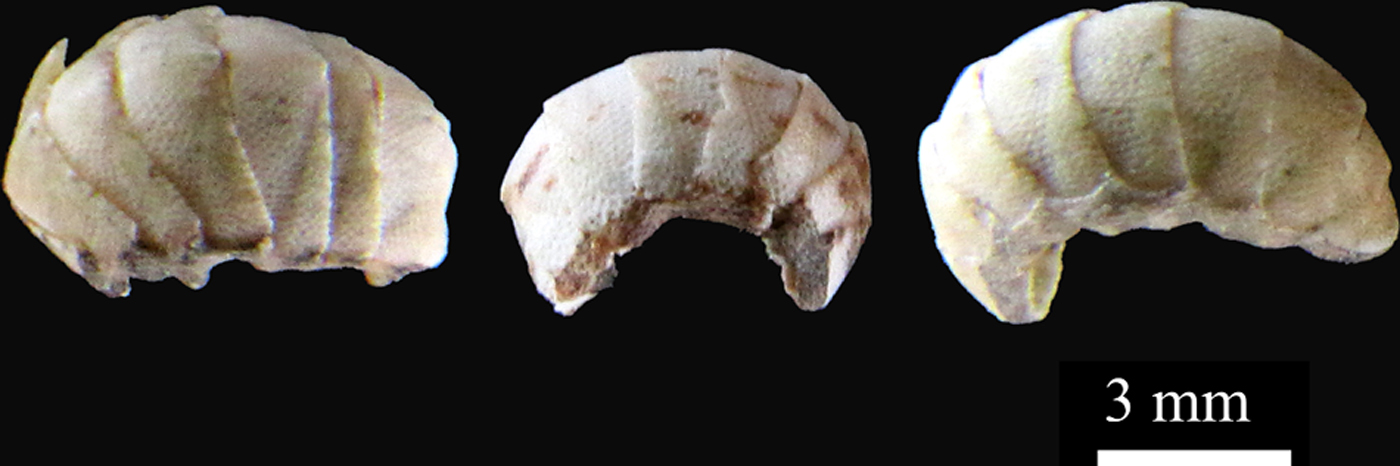
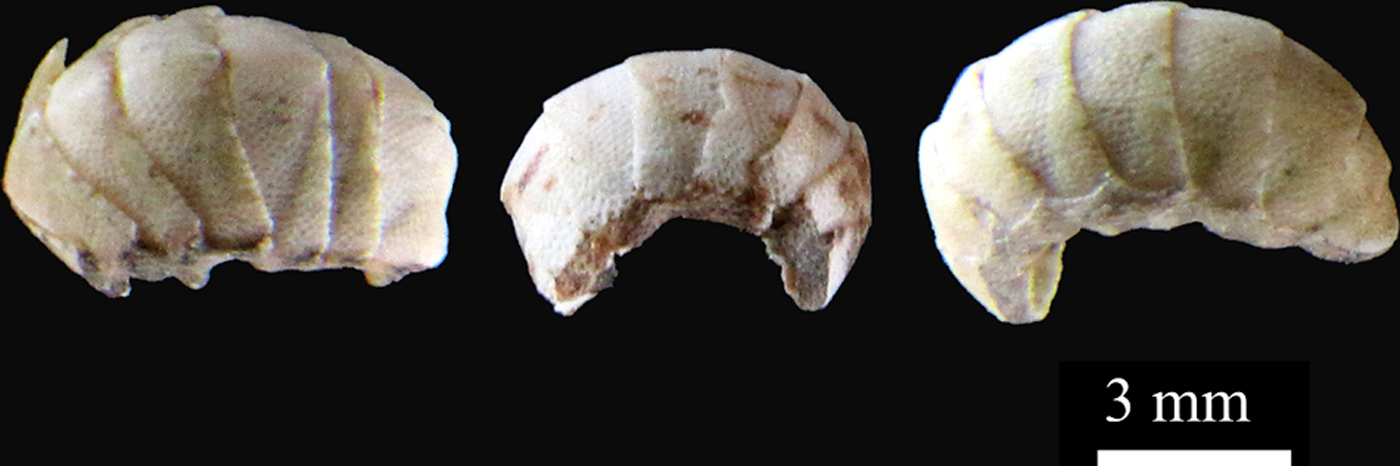
Ischnochiton (I.) yerburyi.
MATERIAL EXAMINED
Sampling was carried out in December 2010 from the intertidal zone of the Tis coast, Chabahar Bay (25°20′55.1″N 60°35′47′′E). Ten living chiton specimens were collected and examined (Figure 3).
Map of sampling site (•).

DESCRIPTION
A description of Ischnochiton (I.) yerburyi has been presented in Ferreira (Reference Ferreira1983), Kaas & Van Belle (Reference Kaas and Van Belle1988, Reference Kaas and Van Belle1990), Anseeuw & Terryn (Reference Anseeuw and Terryn2004) and Dinapoli & Janssen (Reference Dinapoli and Janssen2009). This species is small in size (length 8–9.5 mm) and has an elongated oval outline. Valves are not beaked and slightly keeled. Tegmentum is reticulated, thimble-like sculpture. Head valve is semicircular, front slope straight to slightly convex, posterior margin widely V-shaped. Intermediate valves are broadly rectangular, anterior margin somewhat convex, lateral margins rounded, posterior margin almost straight, lateral areas little raised, poorly defined. Tail valve is almost semicircular, as wide as the head valve, posterior slope concave. Dorsal girdle scales are broadly rounded moderately curved. Ventral side covered with radiating rows of rectangular, shallow scales. Articulamentum whitish, apophyses short, evenly rounded, insertion plates short. Central tooth of radula is narrow, abruptly widening distally to an umbrella-like blade. Major lateral teeth with bidentate head, inner cusp much stronger than outer one, shaft with a short, trunk-like appendix under and before head. Gills holobranchial, adanal with interspace.
DISTRIBUTION
The type locality of this species is Aden, Yemen. It is distributed from the north-western Red Sea to the Maldives. It has also been reported from the Gulf of Aqaba, the African coast from Somalia to Zanzibar, Socotra Island to Madagascar, western Indian Ocean, the Persian Gulf (Kosuge, Reference Kosuge1998; Hosseinzadeh et al., Reference Hosseinzadeh, Daghoghi and Rameshi2001), the coasts of Pakistan, Oman to the Maldives.
REMARKS
Kaas & Van Belle (Reference Kaas and Van Belle1990) distinguished two species of Ischnochiton: I. (I.) yerburyi with strong net-like sculpture and Ischnochiton (Ischnochiton) sansibarensis Thiele, 1909 with a weaker net-like sculpture. Kaas & Van Belle (Reference Kaas and Van Belle1990) revealed that the main external differences are the number of riblets on the dorsal girdle scales and the overall robustness of the tegmental sculpture of I. (I.) yerburyi.
ACKNOWLEDGEMENTS
We are grateful to M.A. Hamzeh, Iranian National Institute for Oceanography, for his assistance during this study. The authors also wish to thank Dr Enrico Schwabe (Bavarian State Collection of Zoology, Germany) and Professor Douglas Eernisse (Department of Biological Science, California State University Fullerton, USA) for their invaluable guidance during identification.