Introduction
An extensive literature has developed that addresses what organizations should do to provide an environment or culture that allows employees to balance their work and non-work lives. Such measures are often seen by senior managers and HR professionals as an integral part of an organization's overall diversity strategy and core to remaining competitive within the business environment (Michielsens, Bingham, & Clarke, Reference Michielsens, Bingham and Clarke2014). A key measure of organizational work–family culture was published in 1999 by Thompson et al., and has subsequently been widely utilized in the broader work–life balance literature (see e.g., de Sivatte & Guadamillas, Reference de Sivatte and Guadamillas2013). Thompson, Beauvais, and Lyness's original (Reference Thompson, Beauvais and Lyness1999) measure identified three dimensions of culture that were specific to balancing work and family. The current paper conceptually extends this measure in two important ways: first, by including two additional dimensions relevant to culture (co-worker involvement and gender expectations) and second, by considering aspects of non-work life beyond a focus on family responsibilities. The need for life spheres beyond family to be included has been highlighted recently in a review that established that much of the extant research does not include people without childcare responsibilities (Kelliher, Richardson, & Boiarintseva [Reference Kelliher, Richardson and Boiarintseva2019: 101]) so we know little about their experience of work–life balance, even though they constitute a large part of the work force. Additionally, the factor structure is tested separately for men and women, and for part-time and full-time workers, two characteristics potentially related to work–life balance culture, to ensure the measure can be used with equal confidence with samples including males as well as females, and part- and full-time employees.
This paper initially introduces Thompson, Beauvais, and Lyness's original (Reference Thompson, Beauvais and Lyness1999) measure of work–family culture and then provides a description of the proposed extra dimensions. Study 1 tests the extended scale using confirmatory factor analysis across gender. Links between the culture dimensions and employee well-being, work–life conflict and job attitudes are investigated. A second study tests a slightly modified version of the instrument (based on the findings from Study 1), confirming the revised structure and provides evidence that the structure is the same for both full- and part-time workers. Links to job attitudes are again tested. Finally, we discuss the utility of the new measure for future work–life balance research and factors to consider when providing a supportive culture for work and life balance.
Conceptualization of work–life culture
Thompson, Beauvais, and Lyness (Reference Thompson, Beauvais and Lyness1999) showed that culture was an important concept that was related to work attitudes, beyond what is accounted for by the mere availability of flexible work arrangements (FWAs) as set out in human resource and other organizational policies. Indeed, the availability of even extensive and generous work–life policies does not necessarily result in widespread utilization by employees (Fried, Reference Fried1998; Hochschild & Machung, Reference Hochschild and Machung1997; Pasamar, Reference Pasamar2015) and there is ‘often a resistance by employees to take up family friendly policies’ (Yuile, Chang, Gudmundsson, and Sawang, Reference Yuile, Chang, Gudmundsson and Sawang2012: 4). A study of over 800 employees from a range of Australian organizations (Timms et al., Reference Timms, Brough, O'Driscoll, Kalliath, Siu, Sit and Lo2015) found that the provision of FWAs without a supportive culture lowered the likelihood of achieving the outcomes expected by the provision of the FWAs. Annink (Reference Annink2017) conducted multiple interviews and found that the context of society and institutions can be both an enabler and a hindrance to social support for work–life balance (which was defined for this research in terms of capabilities). Sweet, Pitt-Catsouphes, Besen, and Golden (Reference Sweet, Pitt-Catsouphes, Besen and Golden2014) found that while most American employers provided some kind of FWA, the majority of employees did not have access to all, or even some of these. They further found that when there was flexibility available, it tended to constitute adjustments to the timing and location of work. This growing body of empirical literature identifies that it is the nature of the organizational environment and its supportiveness of work–life policy use that accounts for the gap between policy provision and utilization.
We build on the definition of work–family culture proposed by Thompson, Beauvais, and Lyness (Reference Thompson, Beauvais and Lyness1999), which is ‘the shared assumptions, beliefs, and values regarding the extent to which an organization supports and values the integration of employees’ work and family lives’ (394). Work–family balance and work–family culture differ in that while work–family balance refers to circumstances relevant to the intersection or integration of individuals’ work and family lives, work family culture refers to perceptions of organizational dynamics that support work–family integration (Thompson, Beauvais, & Lyness, Reference Thompson, Beauvais and Lyness1999). This distinction allows for the possibility of individuals reporting that their organization's culture is supportive of work–family balance without actually experiencing balanced work and family arrangements themselves, or vice versa. Although culture is, by definition, a ‘shared’ perception, individual perceptions of this shared work environment are important, and are related to individual level outcomes.
The measure of organizational work–family culture developed by Thompson, Beauvais, and Lyness (Reference Thompson, Beauvais and Lyness1999) was, to the best of our knowledge, the first published instrument to address the culture of perceived organizational support for work–family balance. It was demonstrated as being reliable as an overall measure (α = .92), with the three dimensions (manager support, career consequences and time expectations) uniquely important, as revealed in a principal components analysis. The measure has been utilized subsequently in a large number of empirical studies in a range of national, industry and workplace contexts.
However, the original dimensions of Thompson et al.'s measure, while still important, may be insufficient in capturing the full extent of the work–life culture construct. Indeed, a growing body of recent evidence has raised new perspectives on the ways in which different workplace dynamics impact the uptake of FWAs and the overall supportiveness of a work environment in facilitating employees’ outside work obligations. In particular, the unique variance of organizational-level and gendered workplace phenomena, as well as co-worker involvement, have been identified as potentially important. These additional constructs are investigated in our analysis and are introduced below following discussion of Thompson, Beauvais, and Lyness's (Reference Thompson, Beauvais and Lyness1999) original dimensions.
The first dimension of work family culture proposed by Thompson, Beauvais, and Lyness (Reference Thompson, Beauvais and Lyness1999) was time demands. Time demands assesses the extent to which the organization expects employees to put work before their family responsibilities (α = .82), whether or not employees are expected to take work home, and is related to the level of discretion in one's work schedule (Bailyn, Reference Bailyn, Parasuraman and Greenhaus1997) and the reliance on ‘face time’ as the primary measure of productivity (Glass & Finley, Reference Glass and Finley2002).
The second dimension of Thompson, Beauvais, and Lyness's (Reference Thompson, Beauvais and Lyness1999) measure, career consequences, addresses the perceived negative career outcomes of using work–family benefits or of prioritizing family demands (α = .74). Negative career consequences, or what has been referred to recently as a ‘flexibility stigma’ (see special issue of The Journal of Social Issues, vol. 69, issue 2, 2013) are thought to arise when a lack of physical presence in the workplace is associated with a perception of a lack of commitment to the organization, which has been shown to sometimes result in fewer opportunities for promotion and a lesser likelihood of receiving other organizational rewards (Allen & Armstrong, Reference Allen and Armstrong2006; Perry-Smith & Blum, Reference Perry-Smith and Blum2000; Thompson, Beauvais, & Lyness, Reference Thompson, Beauvais and Lyness1999).
One of the best demonstrated examples of the association between flexible work uptake and negative career consequences is part-time work. Although a range of individual and organizational benefits of part-time work have been demonstrated (see Eby, Casper, Lockwood, Bordeaux & Brinley, Reference Eby, Casper, Lockwood, Bordeaux and Brinley2005; Hill, Hawkins, Ferris & Weitzman, Reference Hill, Hawkins, Ferris and Weitzman2001; Kelly et al., Reference Kelly, Kossek, Hammer, Durham, Bray, Chermack, Murphy and Kaskubar2008), empirical research also has pointed to a number of significant penalties including slower advancement, less training and lower remuneration (e.g., Kirby & Krone, Reference Kirby and Krone2002; Webber & Williams, Reference Webber and Williams2008). One reason posited for the penalties attached to part-time work is that it is inconsistent with the notion of the ‘ideal worker norm’; typically a person for whom work is their primary commitment, with the demands of family or community as secondary (e.g., Rogier & Padgett, Reference Rogier and Padgett2004). Such research demonstrates that perceptions of the negative career consequences attached to the take-up of part-time work and other family–friendly arrangements is an important component of organizational work–life balance culture.
The third dimension of Thompson, Beauvais, and Lyness's (Reference Thompson, Beauvais and Lyness1999) measure, manager support, addressed the level of support from management and their sensitivity to employees’ family demands (α = .91). A raft of subsequent studies have pointed to manager support as a critical moderating factor between organizational policies and positive organizational outcomes (e.g., Hammer, Kossek, Yragui, Bodner, & Hanson, Reference Hammer, Kossek., Yragui, Bodner and Hanson2009; Hornung, Rousseau, & Glaser, Reference Hornung, Rousseau and Glaser2008; Knies, Reference Knies2011). Yuile, Chang, Gudmundsson, and Sawang (Reference Yuile, Chang, Gudmundsson and Sawang2012) surveyed over 1,200 people in Australia and found work-life balance (defined in relation to the many life roles participants may have) to be associated with managerial support. Managers, due to their status and power as decision-makers and supervisors, can be powerful change agents in making workplaces work–life friendly by actively encouraging or discouraging employees’ efforts to balance their work and personal lives (Straub, Reference Straub2012). A qualitative study (Galea, Houkes, & De Rijk, Reference Galea, Houkes and De Rijk2014) found that both managerial style and support, including their empathy and results orientation, were directly linked to employees’ feelings that they could utilize flexible arrangements.
Underpinning managerial decision-making around flexible work is the institutional environment in which managers are socialized and which shape their shared beliefs and attitudes toward work–life initiatives (Peters & Heusinkveld, Reference Peters and Heusinkveld2010). Research suggests that employees’ perceptions regarding the extent to which their work organization supports work–life balance explains a significant amount of unique variance associated with outcomes such as work–family conflict, above and beyond the variance explained by supervisor support (e.g., Kossek, Pichler, Bodner, & Hammer, Reference Kossek, Pichler, Bodner and Hammer2011; O'Driscoll et al., Reference O'Driscoll, Poelmans, Spector, Kalliath, Allen, Cooper and Sanchez2003). A study conducted in Ireland, for example, showed that HR managers’ attitudes and beliefs about the impact of work–life programs predicted employee uptake of such programs independently of immediate supervisor support (McCarthy, Darcy, & Grady, Reference McCarthy, Darcy and Grady2010). McCarthy, Cleveland, Hunter, Darcy, and Grady (Reference McCarthy, Cleveland, Hunter, Darcy and Grady2013) also found that the support from the immediate supervisor was related to the employees’ uptake of Work-Life Balance programs. A meta-analysis by Kossek et al. (Reference Kossek, Pichler, Bodner and Hammer2011) involving 85 studies and data collected from over 70,000 employees also demonstrated the importance of organizational as well as supervisor support for work–family conflict outcomes.
Allen (Reference Allen2001) noted that the managerial support factor, as originally measured by Thompson, Beauvais, and Lyness (Reference Thompson, Beauvais and Lyness1999), appears to confound perceptions of manager support, which was assessed with five items, with perceptions of global organizational support; assessed with six items. Thompson, Beauvais, and Lyness (Reference Thompson, Beauvais and Lyness1999) theorized that both organizational level support as well as manager level support were crucial in assessing culture. However, their factor analysis results showed all 11 items loading onto one factor. Thompson, Beauvais, and Lyness (Reference Thompson, Beauvais and Lyness1999) therefore considered them as one dimension. However, Allen (Reference Allen2001: 416) further identified that the loadings for the items, which indicated the more global organizational referent, were lower than those that indicated the manager as the referent. Based on the original and subsequent evidence, it appears that management support and broader organizational support are likely to be separate but related dimensions. In the current study, the existence of two versus one factor is explicitly tested.
Extending the measure of work–life balance culture
As a basis for testing the extended measure in this paper, we conceptualize culture more broadly than just family, substituting the terms ‘non-work’ or ‘life’ in place of ‘family,’ thereby allowing respondents to consider responsibilities and activities beyond family that may compete for attention with work. While caring obligations continue to dominate the literature in terms of discussions of why workers seek accommodations to standard working conditions, organizational and management research and practice have increasingly acknowledged that some employees require flexibility to fulfill non-family obligations (McDonald & Cathcart, Reference McDonald, Cathcart, Wilkinson, Townsend and Suder2015). Fisher, Bulger, and Smith (Reference Fisher, Bulger and Smith2009) used three studies to purposefully investigate non-work issues beyond the family domain. Their final conclusion supported taking a broader conceptualization of life beyond the family domain. As well, Casper, Weltman, and Kwesiga (Reference Casper, Weltman and Kwesiga2007) specifically looked at singles in the workplace who did not have children. Brough et al. (Reference Brough, Timms, O'Driscoll, Kalliath, Siu, Sit and Lo2014) analyzed the literature since the 1970s around the terminology related to work–life balance (and related terms). They conducted multiple studies to validate a measure of balance itself, but also concluded that the work–life terminology and conceptualization has broad appeal.
We consider two additional dimensions of culture to develop a more comprehensive measure of the workplace environment to support work–life balance. The addition of these two new dimensions was first proposed by McDonald, Brown, and Bradley (Reference McDonald, Brown and Bradley2005) who conceptualized work–life culture on the basis of the organizational dynamics affecting the uptake of work–life policies and the associated individual and organizational outcomes of supportive workplace practices.
The first additional dimension is co-worker support. Previous literature has shown the importance of co-workers in organizations. For example, Ferguson, Carlson, Zivnuska, and Whitten (Reference Ferguson, Carlson, Zivnuska and Whitten2012) found a link between co-worker support and satisfaction both directly and through work–family balance. As well, different types of support have been shown to be important for a good organizational climate. However, co-worker support has only rarely been considered explicitly in a measure of the environment to support work–life balance, even though our evidence shows clear links to perceptions of conflict and other employee outcomes.
There is some evidence, based on theories of organizational justice (Hegtvedt, Clay-Warner, & Ferrigno, Reference Hegtvedt, Clay-Warner and Ferrigno2002) that suggests resentment by work colleagues, sometimes referred to as the ‘backlash movement’ (Haar & Spell, Reference Haar and Spell2003), may contribute to a work environment where the utilization of work–life policies is not encouraged by co-workers. A study by Kirby and Krone (Reference Kirby and Krone2002), for example, found that women who utilized work–life balance policies felt resentment from co-workers and were cognizant of needing to balance use versus abuse so as not to be seen, and treated, as a less committed worker. Lu, Siu, Spector, and Shi (Reference Lu, Siu, Spector and Shi2009) examined the effect of family–friendly co-workers and found a negative relationship with work–family conflict and positive relationships with work–family and family–work facilitation. Similarly, Michel, Kotrba, Mitchelson, Clark, and Baltes (Reference Michel, Kotrba, Mitchelson, Clark and Baltes2011) conducted a meta-analysis looking at the antecedents of work and family conflict and found co-worker support (from 13 samples) was associated with both Work-Family Conflict and Family-Work Conflict. Recently, Perrigino, Dunford, and Wilson (Reference Perrigino, Dunford and Wilson2018) synthesized the literature relating to work–family backlash and found growing evidence of this phenomenon.
Another meta-analysis (Kossek et al., Reference Kossek, Pichler, Bodner and Hammer2011) shows how the type of support, and from where it is derived, is important for work–family conflict. However, they noted that they did not include a unique measure of co-worker support because there were too few samples in the literature to perform the meta-analysis with this concept (292). Bourne, McComb, and Woodard (Reference Bourne, McComb and Woodard2012) further report how co-workers are less often studied when examining social support in organizations. Hence, in the current study, co-worker support was included as a dimension of the workplace environment.
‘Gender Expectations’ is the second proposed additional dimension and refers to the idea that although work–life policy agendas and official discourses are ostensibly gender-neutral (Lewis, Gambles, & Rapoport, Reference Lewis, Gambles and Rapoport2007), and often aim to foster a greater sharing of occupational and social responsibilities between men and women, in practice they often revolve around facilitating the working conditions of women (Charlesworth, Reference Charlesworth1997; Haas & Hwang, Reference Haas and Hwang1995). Brescoll, Glass, and Sedlovskaya (Reference Brescoll, Glass and Sedlovskaya2013) found that higher status men were more likely to be allowed to use flexi-time than women of any status, although women were more likely than men to believe their requests would be granted.
Other evidence suggests that men request and utilize flexibility provisions less often than women and when they do request flexibility they may be more likely to have their request denied (Pocock, Strazzari, van Wanrooy, & Bridge, Reference Pocock, Strazzari, van Wanrooy and Bridge2001). Studies have interpreted this as an issue of either problematic access (e.g., Bittman, Hoffmann, & Thompson, Reference Bittman, Hoffmann and Thompson2004; Bragger, Rodriguez-Srednicki, Kutcher, Indovino, & Rosner, Reference Bragger, Rodriguez-Srednicki, Kutcher, Indovino and Rosner2005) or as a reluctance by males to seek out accommodations, even if they are available, because it deviates from the gendered ideal-worker image and normative conceptions of what ‘men do’ (Risman, Reference Risman2009; Rudman & Mescher, Reference Rudman and Mescher2013). In reviewing the literature, Williams, Blair-Loy, and Berdahl (Reference Williams, Blair-Loy and Berdahl2013) found gender interacted in complex ways with gender stereotypes. Women requesting flexibility were thought to be doing what was expected, but were further expected to give up their work status and the opportunities that went with that. For men, being a good father and good worker were seen as aligned, and having children was often beneficial to men's careers.
Further, Radcliffe and Cassell (Reference Radcliffe and Cassell2015) found through interviews that couples’ perceptions of the same work–family conflict situation was experienced and dealt with differently by men and women in dual-income heterosexual couples and was influenced by who had access to greater workplace flexibility. Research by Fujimoto, Azmat, and Härtel (Reference Fujimoto, Azmat and Härtel2013) demonstrated significant gender differences on perceptions of work–life conflict; organizational support for work–life balance; and management treatment. However, as organizations increasingly favor the provision and support of flexible work policies as a means of attracting and retaining workers, and as fathers increasingly participate in family life, a focus on gendered dimensions of work–life culture is increasingly important. As research by Ferrer and Gagne (Reference Ferrer and Gagne2013) shows through a large Canadian workplace survey, both men and women are attracted to companies that have family friendly provisions and benefits. Hence, the gender expectations dimension of the extended work–life culture instrument measures the extent to which employees perceive that the work environment supports both men and women in the use of flexible work policies. To investigate if this is the case in relation to the work–life balance environment, in the current research we further examine the factor structures for males and females separately to ensure the survey is robust for both groups.
To demonstrate that the added dimensions are useful in better understanding how culture relates to employee outcomes, a range of personal and workplace outcomes will be examined in both studies. In Study 1, the culture dimensions and their overall and unique relationships to work–life conflict and employee well-being will be examined. In the second study, employee well-being will again be examined, as well as job satisfaction and commitment as outcome measures.
Relationship between perceptions of culture and individual outcomes
When an individual perceives the workplace culture supports employees to balance multiple roles, the individual's overall well-being will be enhanced. A longitudinal study in Australia (Timms et al., Reference Timms, Brough, O'Driscoll, Kalliath, Siu, Sit and Lo2015) found perceptions of supervisor support, organizational support and time expectations were linked to turnover intentions at time 1, with time expectations remaining significant at time 2. A supportive organizational culture was found to be negatively related to psychological strain.
Earlier evidence demonstrates that a more supportive culture is also related to attitudinal outcomes such as higher job satisfaction and higher commitment (Allen, Reference Allen2001; Thompson, Beauvais, & Lyness, Reference Thompson, Beauvais and Lyness1999). Cleveland, Cordeiro, Fisk, and Mulvaney (Reference Cleveland, Cordeiro, Fisk and Mulvaney2006) studied faculty at a US university and found that two dimensions of organizational climate – organizational work expectations and organizational time demands – were related to work–family conflict and were a reliable indicator of well-being. Furthermore, family supportive organizational perceptions were related to life satisfaction, job satisfaction, turnover intentions and job burnout in a study of 373 New Zealand employees from multiple organizations (Haar & Roche, Reference Haar and Roche2010).
Theoretical endorsement for the link between environment and outcomes is derived from research that utilizes perceived organizational support theory (see Eisenberger, Huntington, & Sowa, Reference Eisenberger, Huntington and Sowa1986; Rhoades & Eisenberger, Reference Rhoades and Eisenberger2002). Perceived organizational support is employees’ beliefs that the organization values what they contribute, and is concerned for their welfare (Eisenberger, Huntington, & Sowa, Reference Eisenberger, Huntington and Sowa1986). Behson (Reference Behson2002) showed that stronger perceptions of perceived organizational support were associated with increased job satisfaction and affective commitment. Similar findings were revealed in a study by Kelliher and Anderson (Reference Kelliher and Anderson2010) who used social exchange theory to show that employees who used flexibility wanted to show reciprocation and put in extra effort.
This paper, therefore, has one main aim, and one secondary aim, examined over two studies. The main aim is to test the dimensionality of the expanded scale, and the benefits of the inclusion of the two new areas of co-worker involvement and gender expectations. The secondary aim is to demonstrate that the scale can be used to assess the broader concept of work–life culture (from an individual perspective), rather than the more restrictive, work–family culture to enable the measure to be used with a wider range of people. Each of the two studies will now be presented.
Study 1
Method
Participants
The sample comprised 717 employees from a large state government department in Australia. The organization is male dominated (approx. 70% male), which was reflected in the gender of the sample (457 male, 253 female) and the mean age was 41 years (range 17–75). Eighty percent of respondents were permanent full-time workers.
Procedure
The paper-based survey was sent to a stratified (by gender, business unit and seniority), random sample of 2,200 employees, resulting in a response rate of 33%. Surveys were sent via the organization's internal mail system, with reply paid envelopes attached. Surveys were mailed directly back to the university researchers. (In both studies, electronic surveys were not used as not all staff had regular computer access.) Participation was voluntary and respondents were assured of anonymity and that results would only be reported as an aggregate.
Measures
Five dimensions of culture
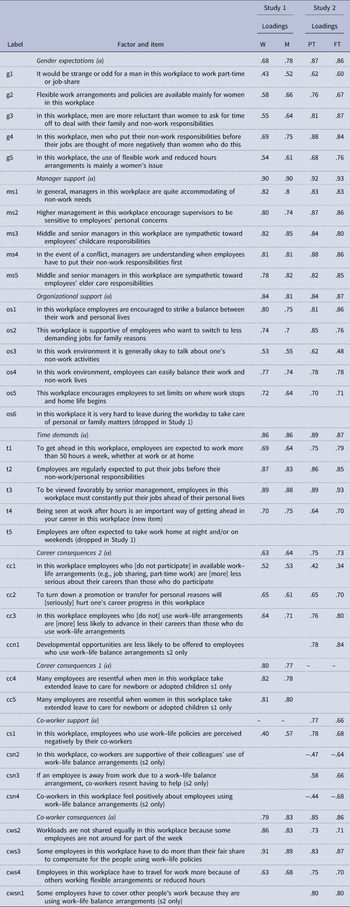
Items for the first three dimensions were derived from Thompson, Beauvais, and Lyness (Reference Thompson, Beauvais and Lyness1999) but re-worded to encompass aspects of non-work lives beyond family responsibilities. For example, the item ‘In general, managers in this workplace are quite accommodating of family-related needs’ was changed to ‘…quite accommodating of non-work needs.’ Further, the term ‘executive’ was changed to ‘senior managers’ to better suit the Australian context. All item responses were measured via Likert scale responses, with strongly disagree (1) to strongly agree (7) as anchor points. Items are listed in full in Table 2.
Managerial support. This dimension consisted of 11 items from Thompson, Beauvais, and Lyness (Reference Thompson, Beauvais and Lyness1999) and measured perceptions of how supportive managers were in enabling employees to balance multiple life roles.
Career consequences. This dimension consisted of five items from Thompson, Beauvais, and Lyness (Reference Thompson, Beauvais and Lyness1999), all of which were reverse scored. The dimension measured perceptions of the negative consequences for an employee's career if she/he did not prioritize work over non-work activities.
Time demands. This dimension consisted of four items from Thompson, Beauvais, and Lyness (Reference Thompson, Beauvais and Lyness1999). The dimension examined how the culture of the organization was perceived in relation to work versus non-work time demands. One item original to this study was added: ‘Being seen at work after hours is an important way of getting ahead in your career in this workplace.’
Co-worker support. This dimension consisted of four items original to this study. It measured how supportive co-workers were perceived to be of other employees who use work–life policies. Items included ‘Workloads are not shared equally in this workplace because some employees are not around for part of the week’ and ‘Employees in this workplace have to travel for work more because of others working flexible arrangements or reduced hours.’
Gender expectations. This dimension comprised five items original to this study. It measured the extent to which the work environment supported both male as well as female employees in their use of work–life policies. Example items include ‘Flexible work arrangements and policies are available mainly for women in this workplace’ and ‘In this workplace, men who put their non-work responsibilities before their jobs are thought of more negatively than women who do this.’
Dependent variables
Well-being. These 12 items were an adaptation by Warr, Butcher, and Robertson (Reference Warr, Butcher and Robertson2004) of the General Health Questionnaire. This was based on a 6-point response scale ranging from 1 (none of the time) to 6 (all of the time). All questions begin with the statement: ‘How much time during the past four weeks…’ and included endings such as ‘Have you felt full of life?’
Work–life conflict and life–work conflict. Each of these scales has five items, which are taken from Netemeyer, Boles, and McMurrian (Reference Netemeyer, Boles and McMurrian1996). The questions measure the conflict between work and non-work demands. The original items were designed to measure work and family conflict but the wording was altered to reflect broader concerns about non-work roles beyond the family.
Results
Analytical approach
As the purpose of the study was to test the factor structure of the extended scale, confirmatory factor analysis was employed, using AMOS V19 and employing Maximum Likelihood estimation. The factor structure was tested for women and men separately. The variances of the factors were identified by setting the loading of one item per factor to 1. All factors were allowed to covary. The evaluation of model fit was based on standard criteria (Fan, Thompson, & Wang, Reference Fan, Thompson and Wang1999; Hu & Bentler, Reference Hu and Bentler1999).
Testing the dimensions of ‘work–life balance’ culture
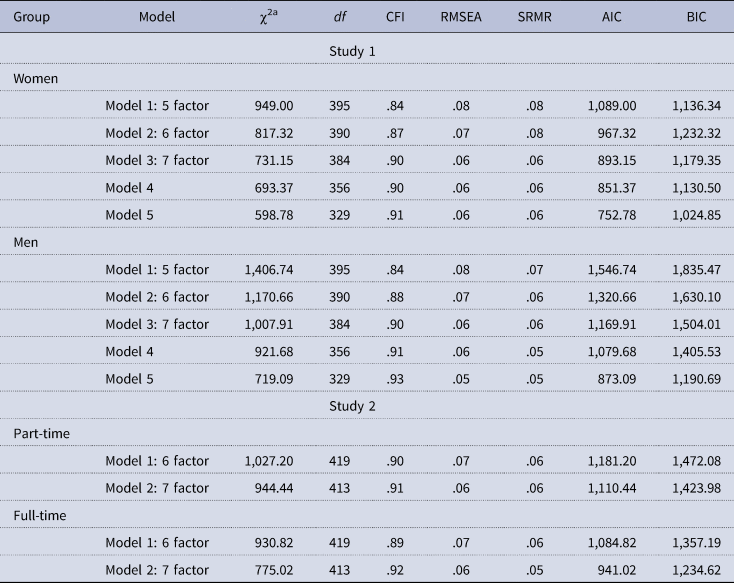
The first two models tested the hypothesized 5-factor model in which managerial support was modeled as one factor (model 1 in Table 1), and a 6-factor model (model 2), in which manager support was modeled as two factors, the second formed by the six items referring to organizational, rather than manager support per se, as suggested by Allen (Reference Allen2001). Model fit statistics demonstrate that the 6-factor model exhibited a significantly better fit for both groups (women: Δχ2(5) = 131.68; men: Δχ2(5) = 236.08) (see Table 1 for model fit statistics).
Model fit statistics for single model Confirmatory Factor Analysis for study 1 for men and women and Study 2 for part time and full time workers

χ2, chi square statistic; df, degrees of freedom; CFI, comparative fit index; RMSEA, root mean square error of approximation; SRMR, standardized root mean residual; AIC, Akaike information criterion; BIC, Bayesian information criterion. All chi square values significant p < .001.
Diagnostic statistics also suggested career consequences might be better represented by two factors. Two of the items referred to one specific work life balance policy (parental leave) and resentment from others when such leave is taken. These two items do not make explicit reference to the career of the employee, as do the remaining three items. Forming these two factors led to a significant and substantial improvement in model fit for both men and women (women: Δχ2(6) = 86.17; men: Δχ2(6) = 162.75). See model 3 in Table 1. Subsequent analyses used only the three item factor.
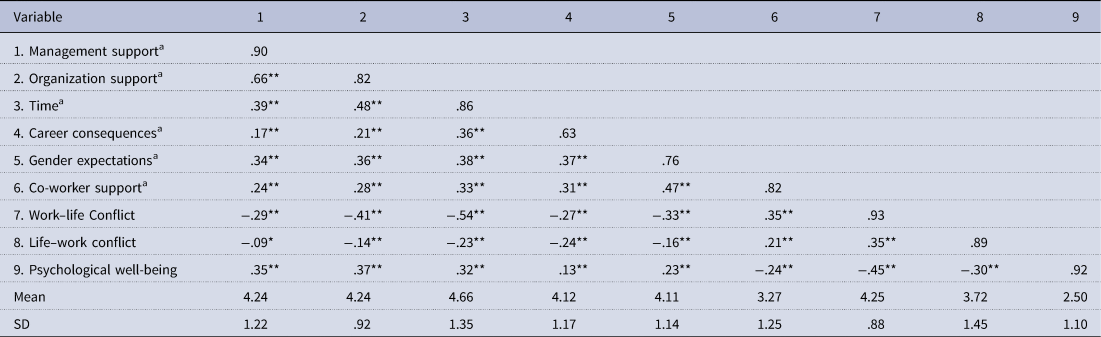
Two other localized areas of misfit remained in the model. Management support item 11 exhibited a weak albeit significant loading (.29 for men, .38 for women) suggesting the item was only a weak indicator of the underlying factor. Item content differed from the remaining items in that while the other items reflected a focus on support from the organization, this item concerned support for one specific behavior, which may or may not occur within any particular work place. Consequently, the item was removed and the model re-estimated (model 4). One final area of misfit related to two of the original items from time demands (items 1 and 5), which exhibited a sizeable residual correlation when estimated (.52 for women and .55 for men). Both items address similar content, which captured a focus on working long hours and working from home. Based on both item content and statistical considerations, item 5 was removed. This final modification resulted in adequate fit for men and reasonable fit for women (see model 5, Table 1). Standardized loadings from the final model for men and women are provided in Table 2. Table 3 reports means, standard deviations, internal reliabilities and correlations for each of the dimensions based on the results reported above.
Standardized estimates and Cronbach's αs for Study 1 (women and men) and Study 2 (full time and part time workers)

W, women; M, men; PT, part-time employee; FT, full-time employee.
Means, standard deviations, internal reliability and correlations among study variables for Study 1

a A higher number means a more positive environment; Cronbach's α on the diagonals; N = 717.
*p < .05, **p < .01.
Concurrent validity
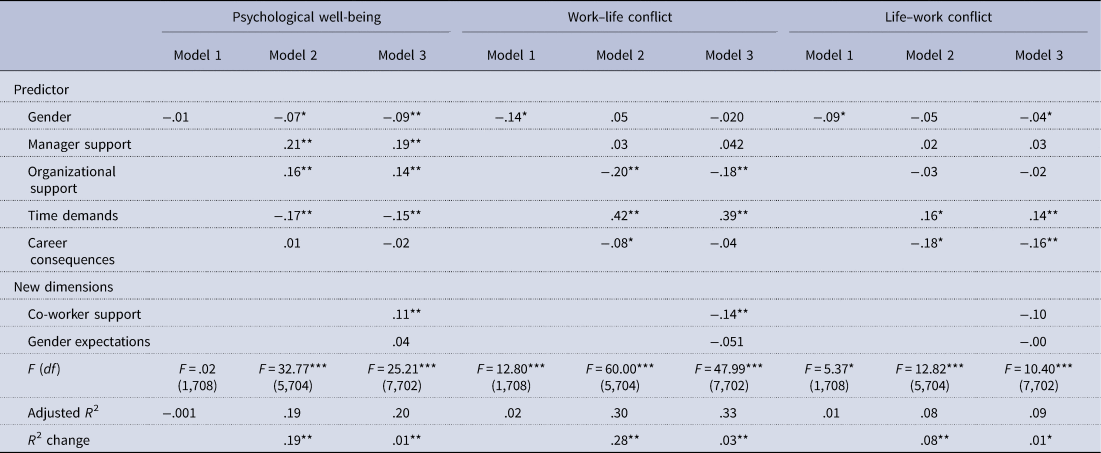
Next, regressions were conducted to examine the relationship of the dimensions with well-being, work–life conflict and life–work conflict. Independent samples t-tests showed significant differences on gender for both types of conflict (Work-Life Conflict: t = 3.58, p < .001; Life-Work Conflict: t = .2.32, p < .05, well-being t = .15, p = .881) with males being higher on both. Therefore, gender was controlled in the first step for each dependent variable. Hierarchical regression was conducted with gender entered on the first step, the original Thompson, Beauvais, and Lyness (Reference Thompson, Beauvais and Lyness1999) dimensions in the second step and the new dimensions in the third step. Table 4 shows manager and supervisor support related to well-being. Time demands significantly related to all three outcomes. Career consequences was only related to life–work conflict (negatively). Co-worker support (one of the new dimensions) was significantly related to all three dependent variables. Gender expectations was not significantly related to any of the dependent variables. Step 3 added small but significant additional variance for all three dependent variables (see Table 4).
Study 1 standardized coefficients for linear regression models predicting psychological well-being, work–life conflict and life–work conflict

*p < .05, **p < .01, ***p < .001.
Discussion
In relation to our main aim, the results show that while some improvements can be made through modifications to some items and dimensions (discussed below), the scales demonstrated measurement characteristics that support their use. In particular, two of the dimensions worked better split into sub-dimensions and it is recommended that some of the items be deleted in future research. The results also show that the items adapted to reflect the broader ‘life’ rather than just ‘family’ still worked well. This supports our secondary aim and initial expectations that the measure can be used to assess the broader concept of ‘life’ or ‘non-work’ rather than ‘family’ exclusively.
Our findings support that the managerial support items are better represented by two factors: manager support and organizational support. The factors are quite highly correlated, but the unidimensionality afforded by separating the two allows researchers to assess more accurately the domain of support of theoretical interest. It seems reasonable then (as others such as Allen (Reference Allen2001) have suggested) to consider the original Thompson, Beauvais, and Lyness (Reference Thompson, Beauvais and Lyness1999) manager support dimension as two separate subscales.
Of the two other original Thompson, Beauvais, and Lyness (Reference Thompson, Beauvais and Lyness1999) dimensions, one, time demands, performed well in the Confirmatory Factor Analysis. Career consequences was found to be two sub-dimensions, one of which was subsequently dropped (as has already been discussed).
Both of the new dimensions added in this study (gender expectations and co-worker support) performed well in the Confirmatory Factor Analysis with men and women exhibiting loadings of similar strength. On closer inspection, however, the items measuring co-worker support appear to reflect more accurately the perception that use of flexibility policies has a detrimental impact on other workers, rather than co-worker support per se. We therefore recommend adapting and renaming the dimension co-worker consequences, (rather than co-worker support) and new items to be tested in Study 2 were written to more accurately reflect co-worker support.
The results further showed that for the two new areas, only co-worker support was significantly related to the employee outcomes investigated. Gender expectations was not significantly related to any of the outcomes. The dimensions and items as proposed here will be further tested in Study 2.
Study 2
The aims for Study 2 are the same as for Study 1; however, we tested the revised items and examined if the factors were as consistent for full- as well as part-time workers. As stated by Oishi, Chan, Wang, and Kim (Reference Oishi, Chan, Wang and Kim2015), ‘Studies in western countries have shown that part-time work is associated with lower work–family conflict and higher job satisfaction…’ (5) and these authors found a similar result with East-Asian samples. Given these differences in experience, it is important to examine responses from part- and full-time workers separately. Further, the dependent variable well-being was tested again, in addition to two common attitudinal outcomes: job satisfaction and organizational commitment.
Method
Procedure
The paper-based surveys were sent via the organization's internal mail system, with reply paid envelopes attached. Surveys were mailed directly back to the university researchers. Participation was voluntary and respondents were assured of anonymity and that results would only be reported as an aggregate. The research had approval from the first author's university ethics committee.
Participants
The survey was sent to 2000 employees in a non-government, not-for-profit, female dominated (approx. 80% female) organization that provided a range of care services (such as elder care and child care). Six-hundred and twenty-nine respondents successfully completed and returned the survey (a 32% response rate). There were 89 men and 531 women (nine did not identify gender), thus preventing gender comparisons. The average age was 43 years (range 17–68). Respondents reported being employed to work an average of 59 hours per fortnight (range 10–110). Most respondents were permanent employees with 40% (254) working full-time and 51% (323) part-time. Others were employed as contractors or as casual or temporary workers. Due to the different working conditions of this latter group of employees, they were dropped from the analyses leaving a total of 577.
Measures
The full survey with the modified items for Study 2 is presented in Table 2.
Six dimensions of the work environment
Management support. Assessed using the five items classified as relating to manager support in Study 1.
Organizational support. This dimension used the five items classified as relating to support from the organization.
Career consequences. Three items directly assessing career consequences were retained. The items were revised to be positively worded and less cognitively complex. A fourth new item was included in this dimension to provide greater reliability ‘Developmental opportunities are less likely to be offered to employees who use work–life balance arrangements.’
Co-worker support. With the relabeling of three of the original items written for Study 1 as better reflecting co-worker consequences (see below), three new items were written to assess a co-worker support dimension clearly focused on the support attitudes of co-workers. Items include: ‘In this workplace, co-workers are supportive of their colleagues’ use of work–life balance arrangements.’ One item from Study 1 was retained as a measure of co-worker support.
Co-worker consequences. Labeled co-worker support in Study 1, three of the items more accurately reflect co-worker consequences, and thus the dimension was relabeled as co-worker consequences. One additional new item was added to the original three items from Study 1. ‘Some employees have to cover other people's work because they are using work–life balance arrangements.’
Time demands. This dimension consists of four items retained from Study 1. One item from the original scale was dropped as discussed.
Gender expectations. All five items in this dimension were retained.
Dependent variables
Well-being. These twelve items were an adaptation by Warr, Butcher, and Robertson (Reference Warr, Butcher and Robertson2004) of the General Health Questionnaire as per Study 1.
Satisfaction. These 10 items were from Warr, Cook, and Wall (Reference Warr, Cook and Wall1979) measured on a 7-point scale (1 – extremely dissatisfied, 7 – extremely satisfied). Aspects included satisfaction with: physical conditions, rate of pay and chance of promotion.
Commitment. Measured using the 9-item short form of the Mowday, Porter, and Steers (Reference Mowday, Porter and Steers1982) Organizational Commitment Questionnaire using a 7-point Likert-type scale.
Study 2: results and discussion
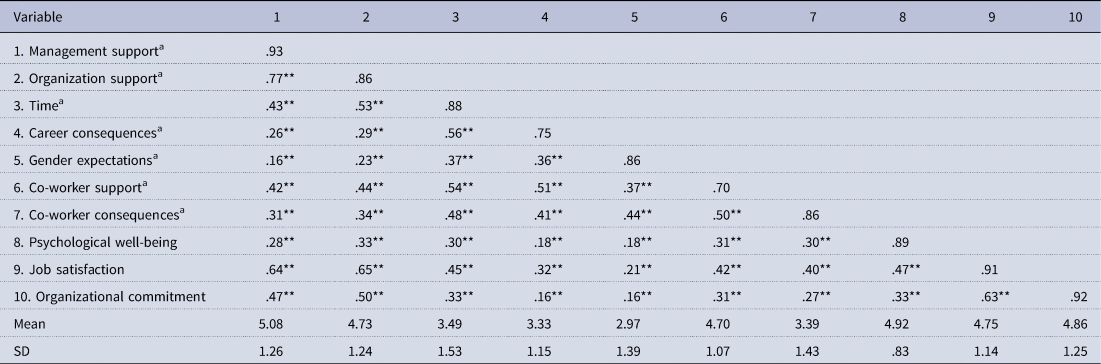
The sample was split into two: those working permanent part-time and those working permanent full-time. Two models were tested and compared; one with manager support and organization support modeled as one factor (6-factor model), and one model with these items modeled as two factors (7-factor model). Model fit statistics demonstrate that the 7-factor model exhibited a significantly better fit for both groups (full-time: Δχ2(6) = 155.80; part-time: Δχ2(6) = 82.76) (see Table 1 for model fit statistics). Confirmatory factor analysis of the revised 7-factor scale was conducted on each sample separately. Model fit statistics indicated that the model was an adequate fit to the data in both samples with no modifications to the model required (see Table 1). Standardized loadings for both samples are reported in Table 2. Loadings were generally high on their relevant factors. Table 5 reports means, standard deviations, correlations and Cronbach's αs for all study variables.
Means, standard deviations, internal reliability and correlations among study variables for Study 2

a A higher number means a more positive environment; Cronbach's α on the diagonals (N = 577).
*p < .05, **p < .01.
Concurrent validity
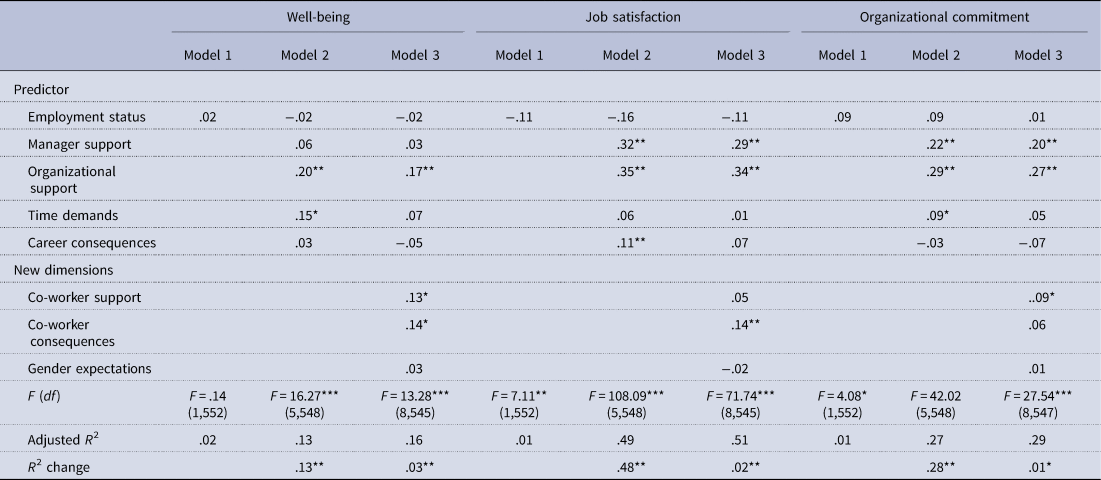
The relationships between the dimensions and job satisfaction, organizational commitment and well-being were all examined. An independent sample t-test was conducted with no differences found based on gender but significant differences based on employment status (full-time or part-time) for both commitment (t = 2.262, p = .024) and satisfaction (t = 2.827, p = .005) with full-time respondents higher on both variables. Employment status was subsequently controlled for in each regression. Regressions were conducted for each dependent variable, with employment status entered in the first step, the original Thompson, Beauvais, and Lyness (Reference Thompson, Beauvais and Lyness1999) dimensions entered in the second step, and the new dimensions entered in the third step.
The extra dimensions added significantly to the variance explained, although only small percentages (job satisfaction R 2change = .02, p = .000; organizational commitment R 2change = .01, p = .035; well-being R 2change = .03, p = .000). See Table 6 for full results. As with Study 1, the added co-worker involvement dimensions were significantly related to employee outcomes, and gender expectations was not. Co-worker support was positively related to well-being and commitment and co-worker consequences was related to well-being and satisfaction.
Study 2 standardized coefficients for linear regression models predicting psychological well-being, job satisfaction and commitment

*p < .05, ** p < .01.
Overall discussion
Overall, the expanded measure has been shown to be applicable to the concept of work–life culture (rather than only the more restrictive work–family), thus fulfilling our secondary aim. The dimensions demonstrated consistent structures across both males and females, and part- and full-time employees. Therefore, while the changes to wording to include non-work rather than family are minor, it is important because it means the survey can be used to gain an understanding of the influence of people's full lives rather than simply family obligations. The utility of the survey has therefore been broadened. Turner and Lindgard (Reference Turner and Lindgard2016) explain how to progress theory, ‘work, family and community must be equally explored in the development of work–life fit’ (590).
The main aim of the study was to test the dimensionality and utility of two new dimensions, gender expectations and co-worker support (the latter as two sub-dimensions in Study 2). Our results show that the inclusion of the co-worker involvement dimensions can add significant understanding of important aspects related to support for work–life balance in the workplace. Across both studies, gender expectations formed an adequate factor, with loadings higher in Study 2 than in Study 1. Further, only moderate correlations with the other factors were exhibited. Both adapted co-worker sub dimensions demonstrated a robust structure in Study 2. All three new sub-dimensions (gender expectations, co-worker support and co-worker consequences) were well supported in terms of their items in Study 2, and the co-worker dimensions had significant relationships with employee outcomes as will now be discussed.
Co-worker support in relation to work and life balance was positively related to employee well-being, and commitment. This informal support was an important aspect that made balancing work and life easier. Wattis, Standing, and Yerkes (Reference Wattis, Standing and Yerkes2013) argue that the absence of informal support is problematic in women's negotiations between work and family. They also reported that women identified being ‘harassed by colleagues’ as an issue when they were working part-time. While a limited number of previous studies have investigated the importance of co-worker support specifically in looking at the work and life environment within an organization, there is sufficient existing evidence, and the findings from the current study, to support the inclusion of co-worker support in future examinations of work and life culture.
Co-worker consequences were also found to be important. The original measure (Thompson, Beauvais, and Lyness, Reference Thompson, Beauvais and Lyness1999) includes career consequences for the person using FWAs as an important dimension. Clearly, there may also be consequences for the people working closely with this target person. Where co-workers feel they have to work harder/longer or in other detrimental ways due to a fellow employee utilizing flexible arrangements, these co-workers are less likely to be positive about the orientation toward work–life balance. Co-worker consequences are therefore a critical dimension of work–life culture.
Gender expectations was not meaningfully related to any of the employee outcomes although the items work well as a coherent dimension. For this reason it is recommended that future research only includes this dimension when the content of the dimension is likely to be important to the overall research purpose and/or context. However, it is the co-worker involvement dimensions that we strongly recommend be included in a comprehensive measure of a workplace environment to support work–life balance.
Limitations and future research
A limitation of the paper is that while there were two separate samples: one was a public sector sample and the other a non-government (but not profit-oriented) care provider. It may be that there is a bias in both samples toward ‘public service.’ Future research should conduct further testing in a fully commercial workplace to confirm the scale's generalizability.
A further limitation is the cross-sectional nature of the survey data. While the main purpose was to look at factor structures and associations between variables, it was proposed that the culture variables would predict the attitude and well-being variables. These causations are not able to be tested with the cross-sectional data. Future research should consider a multi-time study to see the effect that the culture variables have on a range of outcomes at a later time point.
In conclusion, the proposed extended measure is well supported by the presented research. Future research should incorporate this extended measure to better understand how support for work–life balance within an organization plays an important role. Identifying and understanding the role of specific dimensions within an organization is crucial for developing knowledge of how to facilitate opportunities and support for work–life balance for individuals and organizations. The multi-sample evidence from these two studies suggests that the measure can be broadened conceptually to include aspects of life beyond family when examining work and non-work balance. This is important for use with workers who do and do not have family or caring responsibilities. Further, the additional dimensions have been shown to be useful for inclusion. In particular, the focus on co-worker involvement – both in terms of support and consequences – is particularly important to be included in a measure of support for work–life balance. We propose this extended measure of work–life balance be used in future research.
Financial support
Aspects of this research were supported by the Australian Research Council ARC Linkage Project LP0455074.
Lisa Bradley is a Professor in Management in the QUT Business School in Australia. Her work focusses on quality of work life, and what organizations and individuals can do to help improve the quality of working life.
Paula McDonald is Professor of Work and Organization in the QUT Business School in Brisbane, Australia. Paula's research adopts an interdisciplinary, systems-level approach, addressing complex problems in workplace settings with an emphasis on employment relations.
Stephen Cox is the Director of Research Studies in the QUT Business School. He has a PhD in social psychology and has published several papers on the experience of young carers and adjustment.