Introduction
For the past three decades use of lightweight composite materials in aerospace, automotive, and for alternate energy applications like wind turbine blades has increased dramatically. However, composite structures fabricated by using prepregs either autoclave or out of autoclave manufacturing technique, is not an easy task and usually involves complicated temperature and/or pressure control. Moreover, most of the prepreg manufacturing process involves resin impregnation into the fiber preform. Improper impregnation of resin causes void, resin-rich areas and may affect the performance of the composite structure significantly. Typically, complicated composite structures are manufactured using prepregs and involves very little joining or machining and most of the times results into near neat shape components. Prepregs are usually considered as the best manufacturing option for high-performance polymer composite structures compared with other manufacturing processes like vacuum assisted resin transfer molding etc. The fiber content achievable using composite prepreg is typically very high and is around 65% and void content is typically <0.5% in an out of autoclave prepreg.[ Reference Michaud, Tavares, Sigg, Lavanchy and Månson 1 ] The trend in current composite research indicates that the further modification of material system with nanomaterials may help in improving other properties such as interlaminar strength of laminated composites manufactures using prepregs. However, adding an extra phase of nanomaterials pose new challenges in the fabrication of laminated composite structures. This paper provides detail review of these challenges and possible solutions to overcome these challenges. In the future, the nanoengineered prepregs are likely to play a key role in the composite industry, particularly in the applications where the failures are due to limitation in the interlaminar strength.
The role of nanomaterial for improving interlaminar properties of the laminated composites
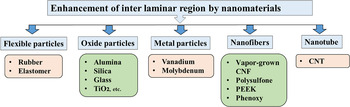
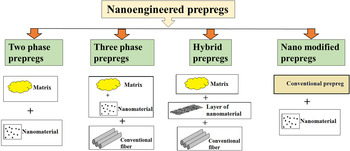
Literature review indicates that there are three distinct types of resin reinforcement mechanisms that are utilized to improve the interlaminar properties of the laminated polymer composites (Fig. 1). The most common nanomaterials used are oxide nanoparticles. Different oxide nanoparticles mixed with polymer resin have shown significantly higher strength as compared with the neat resin interface.
Types of nanomaterials used for enhancing inter laminar region of composites.

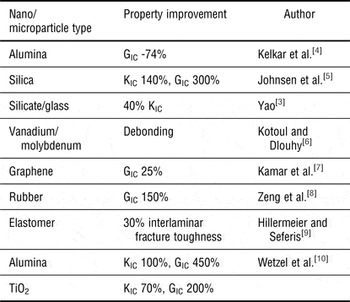
Table I shows various nanoparticles that are used to improve the interlaminar properties. Sometimes, a combination of one more nanoparticles can give more fracture energy than their additive increment. Hsieh et al.[ Reference Hsieh, Kinloch, Masania, Sohn Lee, Taylor and Sprenger 2 ] obtained up to 24.5% more interlaminar fracture energy with a combination of rubber microparticles and silica nanoparticles as compared with their individual effects on the fracture energy. Additional surface treatment of nanoparticles may also exhibit improvement in an interlaminar fracture toughness.[ Reference Yao 3 ]
Nanoparticles for improving interlaminar properties.

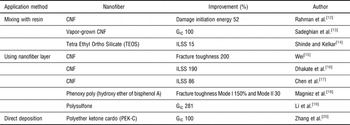
One-dimensional nanomaterials are also used to enhance other mechanical properties of the resin (Table II). The nano fibers have larger surface area compared with nano particles when comparison is based on the same volume fraction. Hence, the possibility to consume crack initiation energy and crack deflection energy is more in nanofibers than nanoparticles. Another benefit of nanofibers is that its large surface area maximizes adhesion or bonding with the matrix[ 11 ] and creates fiber bridging.
Nanofibers for improving interlaminar properties.

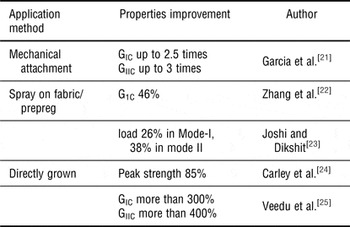
Among the nanomaterials, carbon nanotube (CNT) has the highest mechanical strength. The adaptation of CNT reinforcing polymer matrix has been successfully achieved by several researchers (Table III). The only limiting factor for CNT is cost and availability of large quantities from the scale up production point of view.
CNTs for improving interlaminar properties.

Fabrication attempts for nanoengineered prepregs
Literature review related to prepregs indicate that very little work is reported in the area of manufacturing techniques for nanoengineered prepregs. The research efforts for nanoengineered hybrid prepregs fabrication are limited to four categories (Fig. 2):
-
1. Nanomaterials with resin (two-phase, nanomaterial, and resin);
-
2. Nanomaterials, mixed with resin and impregnated into conventional fabric (three phase);
-
3. Nanofiber layers sandwiched between conventional prepregs-hybrid prepregs;
-
4. Nanomaterials modified conventional prepregs.
Different approaches for getting nanoengineered prepreg.

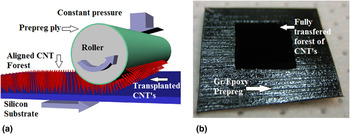
The most common practice for fabricating nanoengineered prepreg is to mix nanoparticles with the resin and infuse in the regular fabric. However, achieving high-volume fraction of nanomaterials for fabricating prepregs is challenging. Liang et al.[ Reference Liang, Wang and Zhang 26 ] developed a method for epoxy-infused Bucky paper prepregs. Ogasawara et al.[ Reference Ogasawara, Moon, Inoue and Shimamura 27 ] used hot melt method for the prepreg preparation and obtained up to 21 vol% of multiwall CNT for an epoxy-based prepreg and achieved 2.9 times ultimate tensile strength than that of neat epoxy. Zhou et al.[ Reference Zhou, Baseer, Mahfuz and Jeelani 28 ] utilized a solution impregnation with a combination of filament winding method to fabricate unidirectional silicon carbide (1.5 wt%) nanophase epoxy prepreg and obtained 20% gain in the flexural modulus. Chen et al.[ Reference Chen, Li, Chiang, Kuan, Kuan, Lin and Yip 29 ] used solution impregnation method for surface modified CNT nano prepreg and observed better bonding characteristics of CNTs with epoxy. Asarco et al.[ Reference Asaro, Rivero, Manfredi, Alvarez and Rodriguez 30 ] fabricated prepregs using carbon nanoclay-modified carbon fiber-phenolic resin by hand-layup and using vacuum bagging technique. Zhou et al.[ Reference Zhou, Baseer, Mahfuz and Jeelani 28 ] used SiC nanoparticles mixed with epoxy and developed a solution impregnation method to develop prepregs using conventional carbon fabric. Rahman et al.[ Reference Rahman, Hosur, Hsiao, Wallace and Jeelani 12 ] used carbon nanofibers mixed epoxy resin and impregnated the regular carbon fibers. No additional literature where semi-curing techniques are used to manufacture solid prepregs is reported. Conventional prepregs are generally fabricated in a continuous style by hot melt or solution impregnation method and both methods require continuous fiber or fabric. Nanofibers are usually soft and it is difficult to fabricate prepregs by using a conventional prepreg manufacturing process. Therefore, researchers developed hybrid prepregs by placing nanofibers in conjunction with regular fiber preform.[ Reference Arai, Noro, Sugimoto and Endo 31 , Reference Islam and Kelkar 32 ]. Li et al.[ Reference Li, Li, Zhang, Yu, Liu, Zhang, Jia, Yang, Xue and Ryu 19 ] used polysulfone nanofiber membrane and sandwiched the membrane between two epoxy prepregs. Magniez et al.[ Reference Magniez, Chaffraix and Fox 18 ] grew phenoxy nanofibers on prepregs by electrospinning. Joshi and Dikshit (2011)[ Reference Joshi and Dikshit 23 ] sprayed nanofibers on CRFP prepregs. Garcia et al.[ Reference Garcia, Wardle and John Hart 21 ] rolled conventional prepregs on CNT forest (Fig. 3). Chen et al.[ Reference Chen, Li, Chiang, Kuan, Kuan, Lin and Yip 29 ] dissolved CNTs by acetone and soaked it on the epoxy prepregs.
Transfer of CNT on conventional prepreg (Reprinted from Ref. Reference Garcia, Wardle and John Hart21 with permission from Elsevier).

Nano enhanced prepreg SE 84 Nano™ marketed by Gurit, as reported, increases 20% compressive strength than their similar product without nano reinforced.[ 33 ] Other companies like Nano-tech, Nanocyl, Zyvex™ technologies sell nanoengineered resins for improved performance. Most of the attempts of prepreg fabrication reported in the literature lacks process optimization, thermal, chemical, and mechanical characterizations.
Challenges involved in fabrication of nanoengineered prepregs
Fabrication of nanomaterials
The first challenge prior to the fabrication of the nanoengineered prepreg is to manufacture sufficient amount of nanomaterials for commercial production. Use of small diameter high-strength fibers obtained using electrospinning has great potential in the fabrication of nanoengineered prepregs.[ Reference Hackett, Nelson, Hine, Sedgwick, Lowe, Goetz and Schultz 34 ] Other alternatives include use of CNTs. CNTs typically have the highest strength, but they are relatively very expensive compared with the electrospun nanofibers and therefor the cost. Limits as an alternate material in the fabrication of nanoengineered prepregs.[ Reference Thostenson, Li and Chou 35 ]
Incorporation of nanomaterial in to composite system
A common approach to incorporate nanomaterials into the composite material system is mixing them with the resin. However, this approach may increase the resin viscosity and the proper penetration through the fiber becomes difficult to achieve due to the strong tendency of fine particles to agglomerate.[ Reference Jana and Jain 36 ] Most of the time the agglomerated particles are filtered out by the microfibers of the fabric[ Reference Hackett, Nelson, Hine, Sedgwick, Lowe, Goetz and Schultz 34 , Reference Reia da Costa, Skordos, Partridge and Rezai 37 ], which leads to poor dispersion.[ Reference Miller, Micham, Copa, Criss and Mintz 38 ] The nanoscale additives may result in lower strengths and lower dynamic stiffness because of improper dispersion of metal oxides at a nanometer scale.[ Reference Thostenson, Li and Chou 35 ] To avoid mixing problem, Falzon et al.[ Reference Falzon, Hawkins, Huynh, Radjef and Brown 39 ] grew CNT by chemical vapor deposition method on silicon substrates and transferred to prepregs. Different technique of applying nanomaterials has been described in Tables II and III. Chen et al.[ Reference Chen, Zhang, Rahman, Zhou, Wu and Fong 17 ] and Zhang et al.[ Reference Zhang, Liu, Kuwata, Bilotti and Peijs 40 ] used spraying technique to deposit CNTs onto microfiber performs to improve out-of-plane mechanical properties. Researchers also worked on depositing nanomaterials directly on the surface of the fabric.[ Reference Veedu, Cao, Li, Ma, Soldano, Kar, Ajayan and Ghasemi-Nejhad 25 , Reference Kepple, Sanborn, Lacasse, Gruenberg and Ready 41 – Reference Chen, Zhao, Zhou, Rahman, Wu, Wu, Xu and Fong 44 ] The choice of nanomaterial-mixing technique may be responsible for different thermal and mechanical properties.[ Reference Bensadoun, Kchit, Billotte, Trochu and Ruiz 45 ] Chemical compatibility with matrix materials is also an important issue[ Reference Hussain 46 ] for nanomaterials and corresponding resin system. The viscosity and resin gel time are two other important factors[ Reference Galledari, Beheshty and Barmar 47 ] of liquid resin transfer molding process during the fabrication of composite materials. Both of these factors regulate the injectability of the resin and the fiber preform wetting process.[ Reference Mahrholz, Stängle and Sinapius 48 ] Seyhan et al.[ Reference Seyhan, Gojny, Tanoǧlu and Schulte 49 ] observed a significant increase of viscosity for specific shear rate when the multi-walled carbon nanotubes were mixed with polyester resin. Therefore, resin with nanomaterial technique may create additional complexity during impregnation while fabricating prepregs.
Presence of residual solvent
The residual solvent, used for dissolving the nanomaterials, may cause void in prepregs.[ Reference Naganuma, Naito, Kyono and Kagawa 50 ] The choice of appropriate solvent is also important. Zhang et al.[ Reference Zhang, Liu, Kuwata, Bilotti and Peijs 22 ] used methanol for CNT dispersion and sprayed it over the fabric. However, for vapor-grown carbon nanofiber composites researchers Choi et al.[ Reference Choi, Sugimoto, Song, Gotoh, Ohkoshi and Endo 51 ], Patton et al.[ Reference Patton, Pittman, Wang and Hill 52 ], Siddiqui et al.[ Reference Siddiqui, Khan, Ma, Li and Kim 53 ] reported undesirable chemical effects of ethanol and dimethylformamide[ Reference Lau, Lu, Cheung, Sheng and Li 54 ] on the properties of the fabricated composites. Therefore, a detail study pertaining use of solvent during prepregging process is important.
Optimizing the dispersion density of interlaminar nanofibers to achieve the maximum fracture toughness in laminated composites
Along with the many successful attempts, there are plenty of researchers who did not get the optimum interlaminar properties by using nanoparticles and nanofibers. The utilization of optimum quantity and dispersion of nanofibers or nanoparticles to improve the fracture toughness of laminated composites is an important objective during the nanoengineered prepreg fabrication process. White and Sue[ Reference White and Sue 55 ] observed that the use of MWCNT mat improved interlaminar fracture toughness due to stress redistribution in resin-rich area rather than load transfer. Dzenis[ Reference Dzenis 56 ] argued that entangled nanofibers can improve interlaminar fracture resistance much like the hooks and loops in Velcro. Other mechanisms[ Reference Gupta, Hydro and Pearson 57 ] such as deflection, bridging, debonding, etc. may be studied to observe the performance of nanomaterials reducing delaminations.
Thermal characterization of resin system with nanomaterials
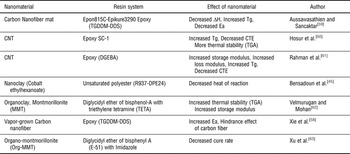
As prepreg comprises a partially cured resin, the curing kinetics is a very important parameter during the prepregging process. The modification of epoxy resins with nanoparticles can result in a significant shift in thecure kinetics curve involving heat of reaction, ΔH, and activation energy (E a) (Table IV). Even for the nanomaterial such as carbon nanofiber, which is similar to the parent fiber material (carbon fabric), the cure kinetics of the resin system can be entirely different.[ Reference Xie, Liu, Sun, Yuan, Shen and Cheng 58 ] The glass transition temperature (T g) and coefficient of thermal expansion are some of the other important parameters that can be affected due to introduction of nanofibers. The nano modified resin usually shows higher glass transition temperatures and higher thermal stability compared with conventional resin.
Change in thermal behavior of resin by addition of nanomaterials.

Conclusions
This review paper provided state of the art information related to some of the challenges that are involved in the development of nanoengineered prepregs. The literature review clearly indicates that traditional two phase composite material system comprising fiber mats and resin may not be adequate to prevent delaminations in the laminated composites. Obviously, the addition of nanolayer between the conventional prepregs may help in reducing delaminations. However, this additional nanolayer in between conventional prepregs involves additional complexity. Developing processing technologies to successfully accommodate nanolayer between the conventional prepregs remains to be one of the biggest challenges for a successful nano-engineered prepreg product development. Furthermore maintaining the quality of prepreg with an outstanding control of parameters is also very important. All the properties like rheological, thermal and chemical should be characterized for any material system for designing the fabrication process for the prepreg. The characterization of curing kinetics can play a key role in the development of nanoengineered prepregs. For the fabrication of nanoengineered prepregs, researchers will have to work over a large domain, from nano to macro. Process improvements, which include series of optimization techniques and product characterization comprising various mechanical, chemical, and physical testing, would act as a bridge from nanoscale to bulk level to produce a successful nanoengineered prepregs.
Acknowledgments
This work was performed at the Joint School of Nanoscience and Nanoengineering, a member of Southeastern Nanotechnology Infrastructure Corridor (SENIC) and National Nanotechnology Coordinated Infrastructure (NNCI), which is supported by National Science foundation (ECCS-1542174).