1. INTRODUCTION
A typical feature of Finnish, as an agglutinative language, is that it offers numerous and diverse ways to form derived words. Neither word-formation options nor individual derivational patterns are unchanging in languages: over time, the patterns, their semantic characteristics, and the productivityFootnote 1 of a certain type of derived expression may all vary greatly (e.g. Bauer Reference Bauer2001:205‒206). Indeed, in Modern Finnish we find both ancient and more recent word-formation categories and models from different periods. While Finnish has its own distinctive ways of forming derivatives, it is not unusual that over the centuries a language may borrow from another language not only words but other linguistic features as well. The focus in the present study is on a word-formation category that, from a historical perspective, is fairly recent in Finnish, i.e. actor-denoting nouns using the suffix -Ari. (The marking -Ari covers both variants, -ari and -äri, more generally, capital letters stand for both back and front variants alternating in vowel harmony: A for a and ä, O for o and ö, and U for u and y.) This derivational element is not a native feature of word formation in Finnish, but can be said to have been adopted from Swedish (see Uotila Reference Uotila1942, Hakulinen Reference Hakulinen1961:116, 141; also ISK:§195, §254).Footnote 2 There have been no previous studies on the development of this derivational pattern in Finnish; the purpose of this study is therefore to establish when the original -Ari derivatives appeared in the language, and whether they can be said to have become a type of agent noun belonging specifically to Finnish.Footnote 3 Finnish -Ari derivatives are particularly interesting in relation to Finnish -Uri agent nouns. These two types will be discussed in more detail in Section 2.
As noted above, the borrowingFootnote 4 of derivational elements from one language to another is not particularly familiar, but is not unknown. An excellent example of this is the use in many Indo-European languages of agent nouns using the derivational element -r, which is in focus here as well. The expansive -r suffix denoting an actor, which was widely borrowed or inherited in the languages, goes back to the Latin -ārius suffix. There has also been a tendency in many languages for the originally denominal suffix to be used as a deverbal suffix, and it is in this context that it has been particularly productive. (For more detail see e.g. Sütterling Reference Sütterling1887; Lilie Reference Lilie1921; Kastovsky Reference Kastovsky1971; Maurer Reference Maurer1973; Dressler Reference Dressler1986; Ryder Reference Ryder1991, Reference Ryder1999; Ekberg Reference Ekberg1995; Heyvaert Reference Heyvaert2003; Scherer Reference Scherer, Mírovský, Kotěšovcová and Hajičová2003; Luschützky & Rainer Reference Luschützky and Rainer2011c, d.) It has been shown in recent studies that the borrowability of nominal derivational morphemes, such as agent nouns and diminutives, is relatively high (Matras Reference Matras2009:210, Reference Matras, Gardani, Arkadiev and Amiridze2014:10; for more details see e.g. Johanson Reference Johanson2002, Pinto Reference Pinto2012, Tosco Reference Tosco2012). Derivational suffixes are not borrowed from one language into another as separate elements, but as part of existing derived words (e.g. Itkonen Reference Itkonen1966:134; Häkkinen Reference Häkkinen1990:263‒264; Heinold Reference Heinold2009; Booij Reference Booij2012:260‒269; for examples of derivational borrowing see e.g. Matras Reference Matras2009:209‒212, Reference Matras, Gardani, Arkadiev and Amiridze2014:10‒13). The process in which an element appearing in loan vocabulary starts to be interpreted as a derivational element, or to be used in native word-formation, takes time (for an example of this process, see e.g. Heinold Reference Heinold2009).
Examples of borrowing of derivational elements from foreign sources into Finnish are endings such as -ismi and -isti (from -ism and -ist) which have begun to be added to native words as elements resembling derivational suffixes in Finnish word-formation processes (e.g. kannel ‘kannel (Finnish zither)’ > kantel-isti ‘one who plays the kannel’, säkkipilli ‘bagpipe’ > säkkipilli-sti ‘one who plays the bagpipes’) (for more see Leino Reference Leino1989, ISK:§152). Another type of example is the Finnish -llinen suffix, which can be said to have been semantically influenced by the quite similar Swedish and German suffixes (e.g. kristillinen – kristlig – christlich ‘Christian (adj)’, piinallinen – pinlig – peinlich ‘painful’). Influenced by these foreign models, the -llinen suffix has spread from its original function (e.g. talollinen ‘one who owns a house’) to contexts where Swedish uses the -lig and German -lich suffix. Over time the suffix began to be used in considerably more abstract contexts than previously as in the above examples. The phenomenon can be considered to have originated in the written language; in such cases we can speak of a morphological translation loan, where the semantics of a native derivational element is influenced by a foreign language model (Hakulinen Reference Hakulinen1955, Reference Hakulinen2000:164–165; Häkkinen Reference Häkkinen1990:270). Similar features are evident in the development of the Finnish -Uri suffix, which can be said to have been semantically influenced by the Indo-European agent noun suffix (< Lat. -ārius) (e.g. Uotila Reference Uotila1942; see also Section 2.1 below).Footnote 5
2. WORD FORMATION BACKGROUND OF FINNISH AGENT NOUNS
2.1 Main types of agent nouns in Finnish
In Finnish, by far the most common and productive category of agent nouns is that ending with the -jA suffix. This is also the oldest type; the -jA suffix has been used to form new vocabulary throughout the history of the language (see Nummila Reference Nummila2014). The -jA suffix can be attached to almost any verb. This has probably had the effect of discouraging the use of other deverbal agent noun suffixes, thus making them less common. Other deverbal agent noun types found in Modern Finnish are -lAs and -Uri derivatives (e.g. oppilas ‘student’, sotilas ‘soldier’; ajuri ‘driver’, pyrkyri ‘social climber’). While one central semantic feature of agent nouns is presumably the active performance of an action, they are also formed from nominal stems. Representatives of this type in Modern Finnish include the -lAinen and -Uri suffixes (e.g. koululainen ‘pupil, schoolchild’, suomalainen ‘Finn’; lampuri ‘shepherd’, vakkuri ‘basket maker’). As indicated by these examples, there are also suffixes that can be combined with both verbal and nominal stems. The -Uri derivatives are an example of this, as it is not always possible to say which type of stem the suffix is attached to: leipuri ‘baker’ (< leipä ‘bread’/leipoa ‘to bake’), sahuri ‘sawyer’ (< saha ‘saw’/sahata ‘to saw’).
The developmental history of the Finnish -Uri suffix, used specifically as a derivational element in agent nouns, is not known for certain. It has probably been influenced by the model of agent nouns of foreign origin (Uotila Reference Uotila1942; Häkkinen Reference Häkkinen1990:263‒264; Hakulinen Reference Hakulinen2000:177–178, 220). According to the latest and most comprehensive grammar of Finnish, Iso suomen kielioppi (ISK:§195, §254), the -Uri suffix is hardly used any longer to form new vocabulary in the language, and might thus be called a weakly productive word-formation type. However, there are well established -Uri nominals in everyday use, and from the language-user's point of view these derived nouns represent one of the most typical agent nouns in terms of their schema (see Section 2.2 below). -Uri nominals are also an interesting derivational type in relation to the -Ari type agent nouns under discussion here.
ISK describes the language from a synchronic perspective, as is clearly evident in the section discussing word formation. In connection with denominal derived words, the grammar notes that for example such nominals as kaappari ‘hijacker’, maalari ‘painter’, mittari ‘measurer, measurement device’, rahtari ‘hauler, shipper’), and tuhlari ‘spendthrift’ can be seen as native complex words (ISK:§254). From a diachronic perspective, this claim can easily be questioned; it can be suggested that all the above-mentioned derived nouns, like dozens of similar names describing actors and instruments, have been borrowed into Finnish from Swedish or German at different stages of the development of the language. Other examples of such loanwords borrowed into Finnish from Old Swedish, i.e. during the 13th–16th centuries, are mylläri ‘miller’, ryöväri ‘robber’ and tuomari ‘judge’ (in contemporary Swedish rövare, mjölnare, domare, respectively; see e.g. SSA s.v. mylläri, ryöväri, tuomari). These are so-called ‘younger loan words’ in Finnish (e.g. Häkkinen Reference Häkkinen1990:263‒264; for young loanwords in general, see Streng Reference Streng1915; Hakulinen Reference Hakulinen1961:244‒248, Reference Hakulinen2000:369‒380; Häkkinen Reference Häkkinen1990:257‒265).Footnote 6
From the perspective of linguistic development and structure, there is in principle a clear distinction between loanwords with the -r element and native Finnish derived words formed with -r: in native Finnish words the vowel before the derivational -r element changes to U (e.g. aja- ‘to drive’ + Uri > ajuri ‘driver’; see also Footnote note 7). As borrowed agent nouns have not been adapted to the vowel system of the native vocabulary (e.g. mål are > *maal uri), a clear morphological difference has persisted between expressions that have arisen as a result of native Finnish word formation and those that are loan words (e.g. maalari). No adaptation has taken place, even though the language has a potential root word available (e.g. maal ata > *maal uri). Nothing would prevent using the -ri suffix to derive a new agent noun by connecting it directly to an A-stem vowel. Ultimately, the question is: has this happened in practice in the history of Finnish? To be able to establish such a derivational process in native Finnish word-formation we have to be able to prove that there are cases where the -ri suffix is connected to a stem of Finnish origin, not to a loanword from which the agent noun could have been borrowed as a ready-made agent noun derivative.
2.2 The importance of analogy in word formation and the patterns for the -Ari agent nouns
Word formation can be described as a directional process in which an affix is attached to a word root, resulting in the formation of a new word. An alternative way of perceiving a complex expression is to think of the derived word as being based on a certain previously known structural pattern or schema. In this case it is not really essential to point to a clear root word. In a structural schema or pattern, form and meaning combine to create an established entity (see e.g. Langacker Reference Langacker1987:74, Reference Langacker and Rudzka-Ostyn1988:134, 147; Evans & Green Reference Evans and Green2006:592). This kind of structural pattern has a dual function: on the one hand it expresses the characteristics of an established, complex vocabulary, on the other it provides a model for the formation of new vocabulary (Booij Reference Booij2012:63).
In my own research I understand the schema as this kind of semantic-functional structural model of derived lexical categories. Together and individually, native Finnish -Ari-derived agent nouns represent a certain semantic-morphological model, i.e. a certain derivational pattern. Here I use the terms ‘word-formation model’, ‘derivation pattern’ and ‘(structural) schema’. While the concept of the schema is applicable and useful in the study of agent nouns, I do not reject the traditional concepts of ‘derivational element’ and ‘derived word’; I use the former in referring to the unchanging morphological substance of a word-formation model, the latter in referring to the end product, without implying any more detailed views as to the formation process itself.
Regardless of the point of view adopted, analogy is extremely important in all word formation; in principle, new expressions are formed in a language on the basis of old models. These models can be seen as concrete derived words or as an abstract schema. In the case of agent nouns, the basic schema is typically quite simple: ajaa ‘to drive’ > ajuri ‘one who drives, driver’; kantaa ‘to carry’ > kantaja ‘one who carries, carrier’. In denominal cases the schema is in fact sometimes semantically more complex: e.g. vakka ‘basket’ > vakka + Uri > vakkuri Footnote 7 > ‘one who makes baskets, basket-maker’; lintu ‘bird’ > lintu + Uri > linturi > ‘one who catches birds, bird-catcher’ (see Ryder Reference Ryder1999:278). It is clear that the basic schema for forming agent nouns (especially deverbal -jA but also -Uri) has been very familiar to users of Finnish for centuries. Among these familiar agent noun schemata we can also include the model of agent nouns formed with the -Ari suffix, since numerous words of this derived category have been borrowed into the language.
The Finnish language also has its own old agent noun model with an -A element, although the model applied only to a very marginal group of words: -(U)ri nominals formed from monosyllabic verbs. In these the derivational element has exceptionally been attached to the -mA affix formed from the root verb (e.g. juo + ma + ri > juomari ‘drinker’ or ui + ma + ri > uimari ‘swimmer’).Footnote 8 The stem vowel does not change in these derived words before the -ri suffix, as is usually the case. In practice the initial derivational stage has been obligatory: the suffix could not be connected directly to these root verbs, as this could have led to confusion and potential misunderstandings (e.g. juo + (U)ri > *juuri/*juori; ui + (U)ri > *uuri/*uiri). In these words, the agent noun schema, for various reasons, is not transparent or apparent to speakers. Other agent nouns in this group are syömäri ‘glutton’, uimari ‘swimmer’ and käymäri ‘slow-walking horse’; nouns other than animate nouns are lyömäri ‘big knife’, viemäri ‘main ditch’ (NS s.v. lyömäri, viemäri; SMS s.v. käymäri). Syömäri, juomari and käymäri already appear in the oldest written language, while uimari and viemäri are found for the first time in eighteenth-century dictionaries (Jussila Reference Jussila1998 s.v. uimari, viemäri). The derivational category is rare, as Finnish does not have many monosyllabic verb stems. Despite its unproductiveness, the derivational pattern has offered a familiar word form, which may have been helpful in the assimilation of the new word-formation model. The -(mA)ri nominals are not included in the material of the present study.
3. RESEARCH QUESTIONS AND RESEARCH DATA
The purpose of this study is to find out whether native -Ari agent nouns occur in Finnish, once we exclude borrowed cases of the type maalata > maalari ‘painter’, muurata > muurari ‘stonemason’ (in contemporary Swedish målare, murare, respectively). If such derived words do occur, further questions concern their form, the time of their first appearance, and the use of the derivational element itself at different times. A further aim has been to identify the motivation for borrowing. The approach in the study was diachronic, progressing from Old Literary Finnish to Modern Finnish up to the present day. I have also examined the vocabulary of Finnish dialects. The criterion applied in collecting the data was that the root of the derived word had to be either of inherently Finnish origin or an old loanword comparable to native vocabulary. The focus of the research is primarily on the prototypical agent noun, i.e. on derived nouns referring to a person or another animate entity performing an action. As the vocabulary under study is fairly new and presumably scarce, possible -Ari-derived agent nouns referring to an inanimate referent have been included for the purposes of comparison and to help form an overall picture of the use of the derivational suffix.
The material for Old Literary Finnish (1543–1810) was primarily derived from an extensive list (Jussila Reference Jussila1998) giving the first occurrences of words during this period. The list covers most of the vocabulary found in written texts from the period of Old Literary Finnish. The disadvantage of the vocabulary list is that it includes only those words that remain in use in Modern Finnish. I remedied this drawback by also including all native Finnish -Ari agent nouns from the extensive corpus of Old Literary Finnish ‘Vanhan kirjasuomen korpus’ (VKSK).Footnote 9 The material representing the nineteenth century was taken from the corpus ‘Varhaisnykysuomen korpus’ [The corpus of Early Modern Finnish] (VNSK).
For the twentieth century, there is only a limited amount of electronic data available for research purposes, and therefore, in practice, the material had to be collected manually. The material was collected from Nykysuomen sanakirja, a dictionary of Modern Finnish (NS 1951–1961), using the Finnish reverse dictionary, the ‘Reverse Dictionary of Modern Standard Finnish’ (Suomen kielen käänteissanakirja Reference Tuomi1980). The NS dictionary material dates roughly from the years 1880–1950. The material has been supplemented by searching for original -Ari nominals in a 1990s newspaper corpus ‘Suomen kielen tekstikorpus’ (SKTK, Aamulehti 1995). The most recent part of the research material, from the 21st century, is represented by native Finnish -Ari nominals retrieved from the Kielitoimisto dictionary (the dictionary of contemporary Finnish), the Kielitoimiston sanakirja, online version (KS 2014), which is the most recent general dictionary available for Finnish.
In addition, for the sake of comparison, I collected dialect material based on a sample from the dictionary of Finnish dialects, Suomen murteiden sanakirja (SMS). The sample comprises words beginning with the letter k. The dictionary of Finnish dialects is based on the material of the Finnish Dialect Archive (SMSA), which represents the vernacular language more or less of the nineteenth century (Tuomi Reference Tuomi1989:14).Footnote 10 The vocabulary was retrieved partly from the electronic corpus of Suomen murteiden sanakirja (SMS-e) [A dictionary of Finnish dialects] and partly from the print dictionary itself.
Thus, the data used in this study were collected from extensive corpus and dictionary resources, without attempting to ensure that the number of words in the text corpora or dictionaries used was of equal composition or comparable in extent. This was because the purpose of the study was not to count the number of instances originating at different times, but to form an overall picture of the stages of development of the derivational category. As the number of agent nouns with the -Ari suffix is small, the focus has been above all on available examples.
4. FINNISH -ARI NOUNS
4.1 -Ari agent nouns in literary Finnish of the 16th–19th centuries
The very extensive material on Old Literary Finnish, covering a period of almost 400 years, contains only three native Finnish -Ari-derived nouns referring to persons: huijari ‘cheat’ (< huijata ‘to cheat’), kuohari ‘animal gelder, castrater’ (< kuohia ‘to geld’) and pilkkari ‘jeerer, scoffer’ (< pilkata ‘to scoff’). Of these, the second one refers to an agent in the performance of his work, while the subsequent ones are descriptive and can be considered stylistically pejorative designations. Of the three, pilkkari dates back to Mikael Agricola (who also uses the more typical -Uri derivative pilkk uri ‘jeerer, scoffer’ < pilkata ‘to scoff’), i.e. to the earliest written Finnish, from the 1540s.Footnote 11 It thus represents the first -Ari agent noun found in written Finnish, as well as the oldest known such nominal in Finnish.Footnote 12Pilkkari makes only one appearance in Agricola, and is not found elsewhere in literary Finnish; in principle, this may thus be a case of a slip or lapsus. The other nouns, huijari and kuohari, are almost 250 years younger than pilkkari, first occurring in the material from the eighteenth century.
In addition to actual person-denoting derivatives of the agent noun type, three instrument-denoting nouns that can be considered word formations of inherently Finnish origin are found in the Old Literature Finnish data: hyppäri ‘distaff’ (< hypätä ‘to jump’), koukkari ‘type of tool with a hooked end’ (< koukata ‘to catch’) and puikkari ‘type of wooden peg for nets’ (< puikata ‘to slip in, dive; to thread [a needle]’). As a lexical category, instrument names are semantically close to agent nouns. All the occurrences date back to eighteenth-century literature. At least two of the latter expressions (koukkari and puikkari) have become established in general use. It is certainly not impossible to assume that underlying these individual expressions is a schema that has become familiar from dozens, perhaps hundreds, of loanwords based on the same pattern. On the basis of such a small number of occurrences, however, we can hardly yet speak, referring to the eighteenth century, of a native word-formation model.
4.2 -Ari agent nouns in the material from the 19th and early 20th centuries
The nineteenth-century research material is based on an extensive corpus of texts from different fields (VNSK), and on a database consisting of fiction from that century (SKK). This wide-ranging database contains a total of five agent-denoting -Ari nominals, the above-mentioned kuohari ‘animal gelder’, and previously unmentioned konttari ‘crawler, one who walks with difficulty’ (< kontata ‘to crawl, to lumber’), mässäri ‘gourmand, also lecher, gambler’ (< mässätä ‘to feast on something’), vuokrari ‘land lord’ (< vuokrata ‘to rent’) and probably a poetic nonce-word: uhmari ‘one who defies, a defiant person’ (< uhmata ‘to defy’) (SKK: Eino Leino 1898).
In the light of the data, the formation of native -Ari-derived agent nouns seems to be very rare in other than person-denoting vocabulary. The nineteenth-century material shows only one such form, referring to an instrument: suuntari ‘compass’ (< suunnata ‘to head’). The expression is found in Elias Lönnrot's Swedish-Finnish vocabulary (1847), and it is probably a neologism made up by Lönnrot himself. In any case, none of the above new cases found in literary texts seems to have remained in use; they are not included, for instance, in NS. We can thus conclude that native Finnish -Ari-derived agent nouns were almost non-existent, at least in the written language, from the sixteenth century to the beginning of the twentieth. The person-denoting words from the period comprise only derived nouns, two of which describe an actor in an occupational capacity (kuohari ‘castrater’, vuokrari ‘landlord’), while the other four are expressions that can be characterized as descriptive and pejorative (konttari ‘crawler’, mässäri ‘gourmand’, pilkkari ‘scoffer’, uhmari ‘defiant person’).
4.3 -Ari agent nouns in material from 1900 to the 1950s
The data for the period between 1900 and the 1950s include instances included in NS. The material was supplemented with vocabulary from works of fiction (SKK), although this corpus did not yield any instances. In NS, containing more than 200,000 lexemes, there were eight person-denoting Finnish native -Ari-derived agent nouns: along with the already known kuohari, there are seven new instances. One of these is a professional name, rasvari ‘greaser, e.g. on a steamship’ (< rasvata ‘to grease’). We also find suhari ‘chauffeur; scoundrel, rogue’ (< suhata ‘to swoosh’), which is colloquial and pejorative. Other expressions are names that describe their referent: hiippari ‘sneak’ (< hiipata ‘to sneak’), loikkari ‘defector’Footnote 13puijari ‘swindler’, sieppari ‘catcher’ and veijari ‘rogue, rascal’. Puijari and veijari are presumably based in one way or another on contamination (puijari < puijata < peijata + huijata ‘to cheat’; veijari < veitikka + peijari ‘swindler’) (see SSA s.v. peijata; puijata; veijari).Footnote 14
The NS data also include three names for instruments or technical equipment. Of these, koukkari and puikkari have already been mentioned, but kahmari ‘grappling device’ is new.
4.4 -Ari agent nouns in newspaper language from the 1990s and in a dictionary from the 2000s
The sample of 1990s newspaper material includes -Ari-derived agent nouns occurring in the daily newspaper Aamulehti for all of 1995. The vocabulary from the approximately 360 issues of the newspaper contains five different Finnish native -Ari nominals denoting persons. Of these, three have appeared earlier (loikkari, sieppari, veijari) and two are new: pihtari ‘stingy miser’ (< pihdata ‘to skimp’) and purnari ‘grumbler’ (< purnata ‘to grumble’). All the cases in the 1990s data are descriptive: the majority is also pejorative or otherwise colloquial expressions. Only one noun was found that did not refer to a human agent: hauenpuikkari ‘a small pike (Esox lucius)’. The noun puikkari has been mentioned previously; in the eighteenth century, it was used to refer to a type of wooden peg for nets. In the 1990s data, it is used metaphorically. Despite the two new cases, -Ari agent nouns are still very few in number.
KS is the most recent dictionary of the Finnish language, the online version of which was updated in 2014. Of the several hundred nominals ending in the element -Ari found in the dictionary, a total of ten were native Finnish agent derivatives; of these ten, seven are person-denoting nouns and as many as five of these already appear in the above-mentioned materials (hiippari, kuohari, loikkari, sieppari, veijari). There are two new words in the most recent material that did not appear elsewhere: kaahari ‘reckless driver’ (< kaahata ‘drive recklessly’) and sähläri ‘clumsy person, scatterbrain’ (< sählätä ‘mess up’). All the new derivatives found in the dictionary are clearly negative in connotation and stylistically colloquial. In addition to person-denoting expressions, the dictionary describing the language of the first decade of the new century contains three native -Ari-derived nominals denoting inanimate referents. In addition to the previously mentioned instances, there is one new case, saumari (in general language saumuri) ‘overlock sewing machine’. The other two items are kahmari and puikkari (see above).
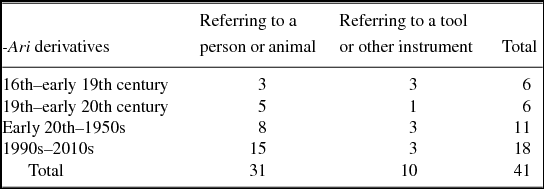
The numbers of words discussed in Sections 4.1‒4.4 are summed up in Table 1. (On the restrictions of a comparability of the research data see Section 3 above.). The table shows that while over the centuries the number of native Finnish -Ari agent nouns has multiplied several-fold, the word-formation type is nevertheless still very marginal in Modern Finnish. It is typical of agent nouns that the schema undergoes semantic expansion over time, typically expanding from personal and animal referents to non-human ones such as instruments. (For more on agent noun polysemy, see e.g. Kastovsky Reference Kastovsky1971; Dressler Reference Dressler1986; Ryder Reference Ryder1991, Reference Ryder1999; Scherer Reference Scherer, Mírovský, Kotěšovcová and Hajičová2003.) As Table 1 shows, down to the present, the number of instrument nouns has remained low.
Native Finnish -Ari agent nouns from the 16th to the 21st century appearing in the data.
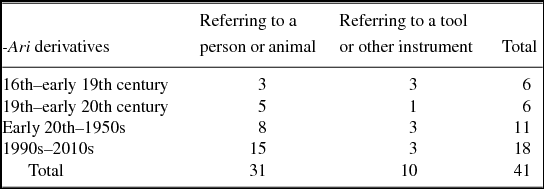
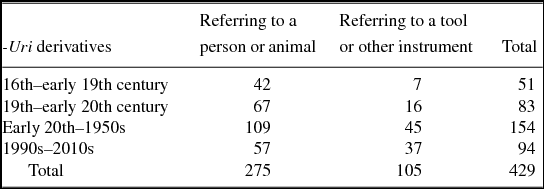
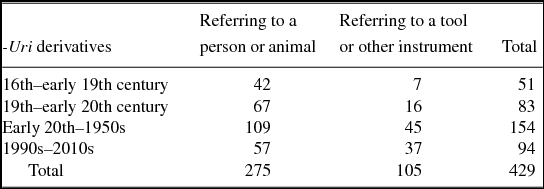
For comparison, in Table 2, I show all -Uri derivatives found in the same material. This table shows the quantitative and semantic differences between -Ari and -Uri derivatives in written Finnish at various times. Semantically, -Ari and -Uri nominals seem quite similar, but from the point of view of productivity the two types differ. The number of -Ari derivatives has apparently increased continuously, while the -Uri type has remained quite unchanged (see ISK:§195, §254).
-Uri agent nouns in written Finnish data from the 16th to the 21st century appearing in the data.
4.5 -Ari agent nouns in dialect material and colloquial words with the -Ari element
Even though the dialect material differs in many ways from the literary data, I have collected a data sample for the sake of comparison. The material in the archive of Finnish dialect words was collected during the 1880s and 1950s. The sample containing words beginning with k in the SMS dictionary contains more than 200 nominals with the -Ari ending; of these, by far the majority originate from loanwords. The material includes thirteen native Finnish -Ari derivatives. Of these, eight denote persons (or more generally an animate referent). There are four words denoting an actor in a professional or similar capacity: kalari ‘fisherman’ (< kala ‘fish’), kuohari (see above), kuokkari ‘worker using a hoe’ (< kuokka ‘hoe’), korjari ‘repairer’ (< korjata ‘to repair’). There are three pejorative nouns describing a person: koinari ‘lecher’ (< koinata ‘to have sex with, screw’), kursari ‘a poor seamstress’ (< kursia ‘to tack, stitch’), kuokkari ‘gatecrasher’ (< kuokka ‘hoe’).Footnote 15 There is also one word not belonging to either of these groups: kuoppari (also a synonym based on same root kuopus) ‘youngest, last-born child in a family’ (< kuoppa ‘pit, hole’).Footnote 16
The dialect data sample contains four derived words referring to entites other than animate referents: keihari ‘sharp horns’ (< keihäs ‘spear’), kalkkari ‘sleigh bell’, kolkkari ‘something that knocks’Footnote 17 and kilkkari ‘penis’. The last three are based on an onomatopoeic root (< kalkattaa, kolkattaa/kolkuttaa, kilkattaa ‘to tinkle, clang, knock, etc.’; for more, see Kulonen Reference Kulonen2010:105‒109),Footnote 18 although the word kilkkari referring to the penis should be understood mainly as metaphorical (note that kellit, kilkut, killuttimet, kulkuset, etc. are nouns of onomatopoeic origin used to refer to the male member in the vernacular; for more variants see Jarva Reference Jarva2003:127‒128). An interesting difference between the dialect and the literary data presented above is that the former contain three clearly denominal -Ari nouns, kalari, keihari and kuoppari (for more detail on the structure of the words see Section 5). It should be noted that the dialect data consist only of words beginning with k. Although the number of words is quite high, we can still probably conclude from the material that the formation of -Ari nouns may have been more versatile in spoken than in written language and that this category has spread from the vernacular into general usage.
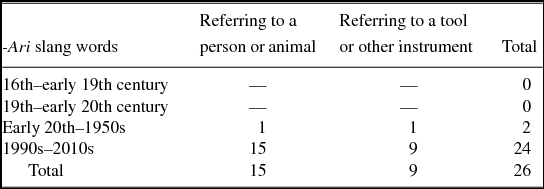
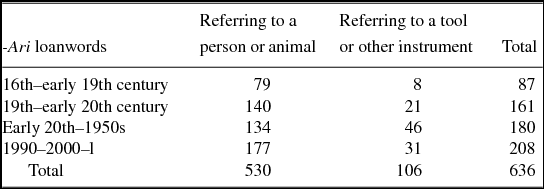
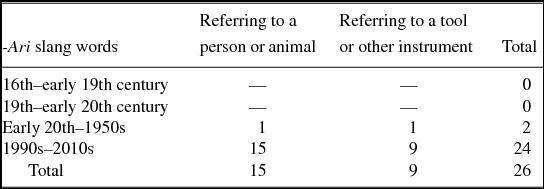
The increasing number of nouns with the -Ari element in everyday language is clearly evident in the vocabulary of the text corpora and dictionaries used in the study. The vocabulary referring to a person, animal or instrument includes expressions from many and varied backgrounds, from loanwords to colloquial equivalents of non-compound words (e.g. inkkari < intiaani ‘(American) Indian’) and derived colloquial words created by abbreviating compound words (e.g. talkkari < talonmies ‘caretaker, janitor’, sivari < siviilipalvelusmies ‘civilian serviceman’) (for colloquial and slang word formation see Nahkola Reference Nahkola1999; ISK:§214‒216, §195; Dahlgren & Kittilä Reference Dahlgren and Kittilä2014). For comparison, I show the numbers of these words in Table 3 and 4 (based on the same material as the main data).
-Ari slang words in written Finnish from the 16th to the 21st century appearing in the data.
Loanwords with the -Ari element in written Finnish from the 16th to the 21st century appearing in the data.
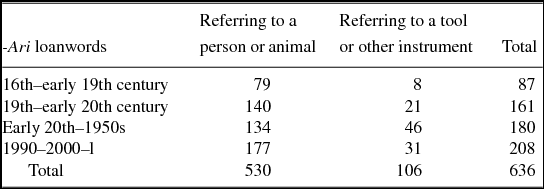
In the light of the research material of this study, it is only during the past few decades that expressions based on so-called slang derivation have been formed to any great extent. As Table 3 shows, the number of -Ari slang words referring to a person (or an animal) is still relatively low in Modern Finnish. However, the number of all kind of -Ari slang derivatives (without semantic restrictions) in the youngest researched material (KS and newspaper data) is quite large, 92 words. No previous research has been carried out on the development of slang vocabulary with the -Ari ending, and it would be interesting to study these words in more detail in the future. For the sake of comparison, numbers of non-native -Ari derivatives are shown in Table 4. As the table shows, non-native -Ari nominals have influenced Finnish word formation for a long time (for more see e.g. Streng Reference Streng1915; see also Häkkinen Reference Häkkinen1990:263‒264, Reference Häkkinen1994:490‒491).
5. MORPHOLOGY AND PHONOLOGY OF FINNISH NATIVE -ARI AGENT NOUNS
Agent nouns are often productive types of expression in the world's languages (see e.g. Bauer Reference Bauer, Benjaballah, Dressler, Pfeiffer and Voeikova2002; Luschützky & Rainer Reference Luschützky and Rainer2011a, b), and this feature has been associated in the Indo-European languages particularly with agent nouns of a type ending in or containing the phoneme -r (descended from Latin nominals with the ending -ārius), which can largely be considered to form the basis for Finnish -Ari nominals. To be productive, a derivational element must be sufficiently flexible so that it can be attached to different types of roots or stems. A good example of a productive agent noun element is the Finnish -jA suffix, which in principle can be attached to any root or stem verb. An even more productive type is the -er ending in English, whose productivity in the present-day language seems to be almost unlimited (e.g. Ryder Reference Ryder1999, Reference Ryder, Contini-Morava and Tobin2000; Panther & Thornburg Reference Panther, Thornburg, Dirven and Pörings2002; Heywaert Reference Heyvaert2003). In the following, I examine in the light of my research data the structure of the -Ari-derived agent nouns, a fairly recent type of word formation in Finnish, and any changes that may have taken place over time. I focus on three aspects: (i) the lexical category of the root of the derived noun, (ii) the verb category of root verbs, and (iii) the morphophonology of the derived form.
The question of the word-class of the root does not concern Finnish -Ari-derived agent nouns alone, but agent nouns of Latin -ārius origin more widely. Typically, in many languages, the denominal type has been seen as the primary one (for more detail see e.g. Kastovsky Reference Kastovsky1971:295; Wessén Reference Wessén1971:125‒126; Dressler Reference Dressler1986:525). Many Swedish -are-derived agent nouns, for instance, have two alternative roots: fiskare ‘fisherman’ could have been formed either from the substantive fisk ‘fish’ or from the verb fiska ‘to fish’, or indeed both (Wessén Reference Wessén1971:126). This also relates closely to Finnish -Uri agent nouns (ISK:§195; Nummila Reference Nummila2011:157‒164). In Finnish word formation, this phenomenon relates specifically to Swedish loanwords, where both the substantive ending -a and verb formed from the same base, and also ending in an a vowel, are borrowed into Finnish (e.g. lakka ‘lacquer’ and lakata ‘to lacquer’; maali ‘paint’ and maalata ‘to paint’). In such cases, it may also be hard to say whether a particular complex word is native or non-native (Kulonen Reference Kulonen1996:28).
In the research material based on written Finnish, the -Ari suffix is always attached to a root verb. As a typical agent noun clearly involves the idea of an active agent (e.g. ISK:§253, Ekberg Reference Ekberg1995), I have counted cases such as kuokkari ‘worker who uses a hoe’, pilkkari ‘scoffer’, suuntari ‘compass’ and uhmari ‘defiant’ as deverbal derivations (kuokkia ‘to hoe’, pilkata ‘to scoff’, suunnata ‘to direct’, uhmata ‘to defy’), although in principle they could also be based on nominals (< kuokka ‘hoe’, pilkka ‘scoff’, suunta ‘direction‘, uhma ‘defiance’). The dialect sample includes an additional three cases in which the -Ari suffix is clearly attached to a nominal. All of these, however, are individual cases and geographically far apart: keihari ‘sharp horns’ (Mikkeli, Eastern Finland), kuoppari ‘last-born child in a family’ (Perniö, Finland Proper) and kalari ‘fisherman’ (Värmland, Central Sweden).Footnote 19 All these denominal cases are based on a word with an -A stem (kala-, kuoppa-, keihää-; in the latter, the stem vowel is regularly abbreviated before the suffix, e.g. lammas ‘sheep’: lampaa- > lampuri ‘shepherd’). Although the value of the denominal derivations as proof is limited due to the individual nature of the cases and their wide geographical spread, it can be concluded that the native -Ari suffix, like the -Uri suffix, can be attached to either a nominal or a verbal base, although verbs are predominant.
A feature that connects all the -Ari agent nouns in the research data is that they are all based on a verb with a vowel stem ending in a long A vowel (e.g. pilkata: pilkkaa-, uhmata: uhmaa-, puikata: puikkaa-). This applies to onomatopoeic verbs as well (kalkkaa, kilkkaa-, kolkkaa-). The connection between -Ari agent nouns and this particular type of verb is also mentioned in ISK (§254). The results of the present diachronic study suggest that in this respect no changes have taken place in the derivational pattern. One interesting aspect is that in terms of conjugation patterns the new loan verbs fall into the specific category of verbs ending in a long A vowel. The schema of -Ari-derived agent nouns thus follows the pattern of their foreign-language models in this respect too.Footnote 20 It should also be noted that -Uri agent nouns are not subject to any corresponding limiting factors.
Native Finnish -Ari-derived agent nouns are also interesting phonologically. The interesting point proves to be the phonology of the first syllable of the root: in old Finnish vocabulary, the feature that derived words with the -Ari suffix have in common, is the labial vowel (o, u, y) of the first syllable. The only exception in the old Finnish material is pilkkari, found in a sixteenth-century text by Agricola. As a single occurrence, this may also be doubtful; it may be a spelling error, a misprint or an irregular one-time derivative (the -Uri variant pilkkuri occurs in Agricola's texts eight times). Otherwise the rounded vowel of the first syllable is a systematic finding right up to the twentieth century material, and applies to the dialect sample as well (e.g. h yppäri, k uohari, p uikkari, s uuntari, uhmari). The material taken from NS (approx. 1900–1950s) also for the most part follows the rule regarding a labial or rounded vowel in the first syllable, but with a few exceptions: hiippari, sieppari and veijari, as well as kahmari. In the first three cases, first syllable contains a so-called ‘neutral vowel’ (e or i), which can co-occur with all other vowels in a word, without restrictions. Only one word, kahmari, has an unrounded vowel in the first syllable. The most vocabulary, i.e. that from the 1990s–2000s, contains a few more words with an unrounded vowel (a or ä) in the first syllable (kaahari, rahtari, sähläri).
The findings indicate that native -Ari-derived agent nouns may have been formed from a somewhat marginal and limited group of verbs. The indication that the -Ari nouns representing the new type may have been originally formed on a phonological basis is an interesting point.Footnote 21 In principle, the derivation of agent nouns with the -r element from Finnish verbs has led to a change in the stem vowel from A to U (see Footnote note 7). Why has this change taken place? Could it be that the repetitive rounded vowel was in some cases found to be disturbing, resulting in a tendency to eliminate the repetition? Without detailed analysis, -Ari-derived agent nouns are easily interpreted as alternative or optional variants to -Uri ones (see Nummila Reference Nummila2007). However, a comparison of the -Ari agent nouns found in the data to all Finnish vocabulary indicates that for some reason such derived agent nouns as *hiipp uri, *kaah uri, *kahm uri, *kuoh uri, *kuokk uri, *loikk uri, *piht uri, *puikk uri *purn uri, *siepp uri, *suunt uri, *sähl yri, *uhm uri and *veij uri are not found. We can also ask to what extent such variants would seem natural and viable.Footnote 22
The most serious problem with these potential but nonexistent -Uri equivalents (*hiippuri, *kuohuri, etc.) seems to be that the root verb does not always occur in easily understandable form, or may coincide with a derived noun from another root. In fact, in the case of -Ari nominals, it does not ultimately seem to be a question of an alternative derived noun with the -r element. There is apparently something in the roots that allows only -Uri or only -Ari derivatives. These restrictions are not semantic or morphological, so they are presumably (morpho)phonological. The same restrictions, however, do not apply to the highly productive -jA agent nouns (e.g. hiippaili ja, kaahaa ja, kahmi ja, kuohitsi ja, loikkaa ja, pihtaa ja, purnaa ja, sieppaa ja); the stylistic register of -jA agent nouns is much more neutral than typical -Ari and -Uri nominals. Thus these three agent noun types are not usually alternative types of expression. This conclusion is supported by previous findings. The Oldest Literary Finnish contains seven agent noun types. Closer analysis, however, demonstrates that each type has its own semantic-functional specific (Nummila Reference Nummila2011:176‒177).
6. DISCUSSION
The main questions in this study were (i) whether Finnish possesses a word-formation type such as -Ari derivatives in the function of agent-nominalization, and (ii) if so, what has been the nature of the process whereby the -Ari suffix has been adopted. Other questions were (iii) what semantic groups are found in native -Ari derivatives; (iv) when was this type adopted in native Finnish word formation, and (v) what potential reasons and motivations can be identified for adopting a new derivational pattern in the language. Here I summarize my findings by providing answers to these central research questions.
The study shows that -Ari-derived agent nouns can be seen diachronically as an independent word-formation type: there are actual derivatives resulting from native word formation. As previous studies of language contacts have shown, the agent noun schema is one the most widely copied type of complex words in various languages (see e.g. Matras Reference Matras2009:210, Pinto Reference Pinto2012:241); thus the adoption of the -Ari suffix or the -Ari word-formation type in Finnish cannot be seen as particularly exceptional. In Finnish the model for the -Ari type of agent noun has come above all from young Swedish loanwords. These borrowed agent nouns have in practice involved two types of expression referring to persons: (a) vocabulary denoting a person acting in a professional or occupational capacity, and (b) an often pejorative vocabulary describing a characteristic of the referent. Loanwords with the -Ari suffix denoting a person acting in a professional or occupational capacity were adopted into Finnish especially in the late medieval periodFootnote 23 and in the Early Modern era, as a result of urbanization and professional specialization. This phenomenon does not affect Finnish alone, but is a typical feature of vocabulary belonging integrally to the medieval cultural sphere of the Baltic Sea region. Apart from this typical cultural vocabulary, Finnish has borrowed numerous pejorative words, probably at least partly earlier than the above types. The number of these descriptive expressions has been and still is considerable, particularly in the dialects of the west coast of Finland. The type denoting inanimate entities, typically tools or other devices, are ordinarily younger than the animate type across languages (for more, see e.g. Dressler Reference Dressler1986).
Although Finnish has dozens of neutral and well-established agent nouns with -Ari endings denoting the actor's profession or occupation and of entirely borrowed origin (maalari ‘painter’, rahtari ‘lorry driver’, sorvari ‘lathe operator’, suutari ‘cobbler’), native -Ari-derived agent nouns seem to strongly associated with such features as a colloquial register and pejorative connotations. The present results indicate that in the history of this derivational category in Finnish, only a few stylistically neutral words have occurred denoting a professional activity or occupation: kuohari ‘gelder of animals’, kuokkari ‘worker who uses a hoe’ and rasvari ‘engine greaser’. These expressions were in principle neutral at the time of their formation; from the perspective of Modern Finnish, however, the -Ari suffix, as well as partly the -Uri suffix, is easily interpreted as conveying a certain stylistic message. To the ear of the Modern Finnish speaker, the -jA agent nouns kuohitsi ja ‘gelder of animals’; rasvaa ja ‘engine greaser’ thus sound more neutral than the -Ari variants. The history of the derivational pattern with the -Ari suffix in Finnish is fairly short, but the development can be said to have been towards the pejorative, as all new derived words in the more recent material are clearly colloquial and negative in tone (kaahari ‘reckless driver’, pihtari ‘stingy person’, purnari ‘grumbler’, sähläri ‘clumsy person, scatterbrain’).
All the semantic categories found in loanwords also occur in Finnish native -Ari word formation. Diachronically, we can identify one main schema (schema 1) of Finnish native -Ari agent nouns, that of typical deverbal agent nouns. This main schema includes two semantic-functional types: (1a) the typical agent noun with agentive meaning (professional human agent), denoting a person acting in a professional or occupational capacity (one who acts), and (1b) pejorative vocabulary describing a characteristic of the human or other animate referent (one with a certain character). Type (1a) has a semantically and stylistically neutral root verb, expressing what kind of action is involved. The role of the -Ari suffix is to nominalize the expression and to represent an animate actor [neutral acting verb + Ari]. Type (1b) is derived from a descriptive and typically pejorative verb which somehow characterizes the animate referent it refers to [descriptive acting verb + Ari]. In the main material (literary Finnish data), animate-denoting words all represent this main schema (types (1a) and (1b)). In Modern Finnish these two variants of the main schema have coalesced, and stylistically or semantically neutral expressions are therefore no longer created.
The data also contain a few instrument names with inanimate referents. Instrument nouns are a well-known word-formation category and type in various languages. Typically, these words denote instruments used by human beings to do things and achieve their goals (one what uses in doing something). -Ari instrument nouns can be seen as the outcome of semantic extension (Dressler Reference Dressler1986, Panther & Thornburg Reference Panther, Thornburg, Dirven and Pörings2002, for example, describe English -er instrument nouns as the result of a natural extension of -er agent nouns). Stylistically these words are neutral, and can thus be seen as developed from type (1a) [acting verb + Ari]. This type is metaphorical and metonymic by nature.
As mentioned above, the material based on literary Finnish represents the main schema (type 1). The dialectal data include words which can be seen as denominal (schema type 2). Semantically these words are similar to type (1a) words. This schema is based on a neutral noun referring to a tool that the actor is using or acting with [tool + Ari]. The role of the -Ari suffix is to represent this animate actor (kuokkari ‘person working with a hoe’). The dialect sample also included the word kalari ‘fisherman’. The schema of this expression differs from all the others. There are a few old -Uri derivatives representing the same kind of schema, the so-called hunter schema (see Nummila Reference Nummila2011:175). In these the first part of the schema refers to an animal that is the object of capture. Finnish vernacular -Ari agent nouns are an interesting subject for future research.
One of the most interesting research questions concerned the timing of the appearance of the native Finnish -Ari type in literary Finnish. The findings indicate that the first Finnish native -Ari nominals, with the exception of a single, questionable case from the sixteenth century, did not appear in written language until the eighteenth century. The derivational pattern must be considered unproductive over the centuries, and there are few actual realized examples. The number of derivatives does increase towards the twentieth and twenty-first century, but this derivational category is still marginal. Semantically there are only few (3) words in the research material denoting professions or occupations; most of the derivatives are descriptive expressions for humans (13) and animals (1). There are also a few (6) derivatives denoting inanimate referents, but the number of words remains very low over decades (total of 23 different lexemes through decades).
Finnish has had an agent noun system that can be considered to have functioned well over time, and derived nouns with the -Ari suffix do not in practice appear to have brought anything new to the language. It is in fact quite difficult to show any obvious reason that would have favored the spread of the loanword-based affix in Finnish. Previous studies of derivational borrowing in other languages have shown that the reasons for adopting a foreign derivational schema are typically semantic and morphological, but phonological factors are also known (see e.g. Heinold Reference Heinold2009:82). In general, there need not necessarily be any functional reason for assimilating new models into a language, although if such a reason does exist it helps to develop and establish the new category in the language. A possible reason for adopting the -Ari agent noun pattern to Finnish is the same one that explains most lexical borrowing, i.e. to bring new and fresh vocabulary into the language. There need not always be a conscious choice made in forming an unusual expression – new practices and schemata are also adopted and used spontaneously and unnoticed. The language user's aim is not always necessarily to form a particularly fresh, foregrounded expression; in the process of speaking, choices and decisions can be made rapidly and intuitively.
There are also other potential morphological and semantic factors that could have helped to copy and adopt the -Ari suffix in the Finnish word-formation system. One of these is the pre-existence of similar words in the language (see Marchand Reference Marchand1969; Pinto Reference Pinto2012:241). The Finnish -Ari agent noun pattern has been adopted from Swedish, with a large number of loanwords of similar form. These pre-existing words include agent nouns, along with hundreds of other words with the -ari ending. The morphosemantic transparency of -Ari derivatives also makes the pattern, and the suffix, easier to adopt in the receiving language (see Johanson Reference Johanson2002; Matras Reference Matras2009; Pinto Reference Pinto2012:238‒239). In addition, the specialized meaning of the newly adopted suffix in relation to previous variants in the language increases its copyability and adoptability. This may have been true of the Finnish -Ari suffix, which stylistically differs clearly from the productive -jA suffix (see e.g. Heinold Reference Heinold2009:82).
The development of the Finnish -Uri suffix as a derivational element in agent nouns took place relatively late, and the development of this ending too was probably influenced by foreign language models going back to the Latin -ārius suffix. The -Uri agent noun type has become established in Finnish, but it has never been particularly common or productive (ISK:§254). The -Ari agent nouns can also be seen as an unproductive word-formation type. Native -Ari derivatives (or -ri derivatives with an A-stem vowel) can probably also be seen as a new variant of an older agent noun schema with element -r. The restrictions affecting the two types of agent noun with the -r element, however, are not the same; rather, the opposite is true. This study has shown that the -Ari type is not precisely an alternative variant to -Uri derivatives; the two suffixes seem to favor at least partly different types of root. Since the number of cases documented in the literary language over centuries is very limited as regards both types of derivative, no far-reaching conclusions can be drawn on these grounds. However, the present study gives grounds for the conclusion that each of these marginal and fairly new derivative types was created in its own typical environment. The structure of the root, as well as possibly its phonological characteristics, may have influenced the choice of suffix variant. The formation of new vocabulary is influenced by one condition above all others: speakers must be able to easily perceive and understand the structure of the new words. The adoption of a new agent noun variant in the language has introduced a new option meeting this requirement.
ACKNOWLEDGEMENTS
I would like to thank three anonymous NJL reviewers for their valuable comments, as well as significant suggestions from the editor, Matti Miestamo, and the copy-editor, Ewa Jaworska.
SOURCES OF DATA
KS = Kielitoimiston sanakirja [Dictionary of contemporary Finnish]. Online version: http://www.kielitoimistonsanakirja.fi/ (2014). Helsinki: Kotimaisten kielten tutkimuskeskus.
NS = Nykysuomen sanakirja 1–6 [Dictionary of Modern Finnish]. Helsinki: WSOY, 1951–1961.
SKK = Suomen kirjallisuuden klassikot [Classics of Finnish literature]. http://kaino.kotus.fi/korpus/klassikot/meta/klassikot_coll_rdf.xml. Helsinki: Kotimaisten kielten keskus.
SKTK = Suomen kielen tekstikokoelma. 1990-luvun sanomalehtitekstit, Aamulehti 1995. [Collection of Finnish texts: Newspapers from the 20th century]. https://sui.csc.fi/group/sui/lemmie. 8 April 2014. Helsinki: Kielipankki. CSC – Tieteen tietotekniikan keskus.
SMS = Suomen murteiden sanakirja 1–8 [Dictionary of Finnish dialects]. Helsinki: Kotimaisten kielten tutkimuskeskus, Valtion painatuskeskus ja Suomalaisen Kirjallisuuden Seura, 1985–2008.
SMSA = Suomen murteiden sana-arkisto [Finnish Dialect Archive]. Helsinki: Kotimaisten kielten keskus.
SMS-e = Suomen murteiden sanakirja [Dictionary of Finnish dialects]. Online version: http://kaino.kotus.fi/sms/. Helsinki: Kotimaisten kielten keskus.
SSA = Suomen sanojen alkuperä. Etymologinen sanakirja 1–3 [Etymological dictionary of Finnish]. Erkki Itkonen & Ulla-Maija Kulonen (eds.), 2nd edn. Helsinki: Suomalaisen Kirjallisuuden Seura & Kotimaisten kielten tutkimuskeskus, 2000–2001.
VKSK = Vanhan kirjasuomen korpus [Corpus of Old Literary Finnish]. http://kotus.fi/korpus/vks/meta/varia/westh_rdf.xml. Helsinki: Kotimaisten kielten keskus.
VNSK = Varhaisnykysuomen korpus [Corpus of Early Modern Finnish]. http://kaino.kotus.fi/korpus/1800/meta/smtr/smtr_coll_rdf.xml. Helsinki: Kotimaisten kielten keskus.