

Introduction
Education is often heralded as the greatest (potential) equaliser in modern societies and a central mechanism of the state to increase capacities of individuals and prevent the accumulation of inequality across generations (Esping-Andersen, Reference Esping-Andersen, Esping-Andersen, Gallie, Hemerijck, Myles and Mongin2002; Morel et al., Reference Morel, Palier, Palme, Morel, Palier and Palme2012; Hemerijck, Reference Hemerijck2018; Wagner et al., Reference Wagner, Pöyliö and Hemerijck2025). Yet education systems vary substantially along lines of equality versus “efficiency” (Okun, Reference Okun2015). Whereas some countries’ educational policies pursue equality of opportunity through inclusive education systems, later tracking and targeted access to resources, others pursue “efficiency,” dividing students at an earlier age into academic and vocational tracks. In such systems, inequality is entrenched across generations, and educational achievement is more likely a function of parental education, ethnic/migration background, and socio-economic status (SES) (OECD, 2015, 2016a, 2016b; Schmutz, Reference Schmutz2024).
While the role of educational policies in moderating social inequalities has been well researched, less is known about how educational policies impact inequality politics. Studies of the politics of the welfare state have long established patterns of policy “feedback” such that the structure and generosity of redistribution systems “feed back” onto attitudes of the electorate and thus have the potential to impact preferences of political elites in democratic systems (Busemeyer et al., Reference Busemeyer, Garritzmann and Neimanns2020; Harris and Enggist, Reference Harris and Enggist2024). However, researchers have not yet investigated whether individuals’ support for equality-enhancing policies in education (henceforth EEPs) is a function of the system in which they live and went to school themselves. In this article, we expect policy feedback to affect preferences for EEPs in a conditional manner, because resources and incentives in different school systems are not always (perceived to be) distributed equally. Individuals who went to the same school are likely to have different assessments of their time at school regarding the equal chances or opportunities they perceived were available to them.
In this article, we therefore investigate to what extent satisfaction with equal opportunities in education increases support for equalizing education policies (EEPs). We approach this question by focusing on support for EEPs that have been shown to increase opportunities for a group facing particularly high levels of cumulative, inter-generational inequality in educational outcomes across Europe; namely, individuals with an immigration backgroundFootnote 1 (Heath et al., Reference Heath, Rothon and Kilpi2008; Levels et al., Reference Levels, Dronkers and Kraaykamp2008). Prior research has highlighted two policies that are particularly effective in increasing education outcomes for migrant students: The first is a non-targeted policy that nonetheless disproportionately benefits immigrant students: delaying the point of tracking based on performance (OECD, 2016)Footnote 2 to the end of lower-secondary level education (age 15). This has been shown to increase the number of migrant students entering into the academic track, which in today’s skill-biased labour market ultimately predicts higher lifetime income and status (Bourdieu and Passeron, Reference Bourdieu and Passeron1970; Bourdieu, Reference Bourdieu1987; Hanushek and Woessmann, Reference Hanushek and Woessmann2006: 131; OECD, 2015; 2016a, 2016b; Georgi, Reference Georgi2024; for Switzerland, see Stadelmann-Steffen, Reference Stadelmann-Steffen2012; Diessner et al., Reference Diessner, Durazzi and Hope2022). Second, we are interested in a targeted policy, subsidising access to daycareFootnote 3 for immigrant students, which research has shown to prevent or delay the accumulation of disadvantage (Heckman, Reference Heckman2006; Hemerijck, Reference Hemerijck2018; Hemerijck et al., Reference Hemerijck, Ronchi and Plavgo2023 Footnote 4; see also Esping-Andersen, Reference Esping-Andersen, Esping-Andersen, Gallie, Hemerijck, Myles and Mongin2002: 49–50; OECD, 2015; Schleicher, Reference Schleicher2018).
We investigate whether support for these two EEPs depends on individual-level satisfaction with the education system in which they live. More specifically, we are interested in variation of public opinion of those living in inclusive and equality-driven compulsory education systems (henceforth integrated) and those living in systems focused on productivity and efficiency (segmented). In integrated school systems, tracking into academic and vocational tracks occurs after compulsory schooling (after age 15), and students are taught in mixed-ability schools/classes. Examples of these systems include Scandinavian countries and the United Kingdom. Conversely, in segmented systems, tracking into academic and non-academic tracks occurs following primary school (aged 11–12) and is less permeable. Examples of these systems include Germany, Austria, and parts of Switzerland.
For the non-targeted policy “delaying tracking,” we expect that those who are satisfied with the equal opportunities available are most likely to reinforce the existing setup of tracking (positive feedback effect) in segmented and integrated contexts. On the other hand, those who feel dissatisfied with the equal opportunities they received are likely to be less satisfied with the tracking system and may want to change it, resembling a “negative” feedback effect (see Weaver, Reference Weaver2010). Regarding the targeted policy “daycare subsidies,” we also expect that negative experiences with equality lead to de-solidarization, via depreciated subjective well-being, and as such individuals will seek to exclude immigrants from the community of deserving beneficiaries of childcare subsidies (Mayer, Reference Mayer2018; Wagner, Reference Wagner2023). Thus, we expect that one’s own experience of educational equality also has implications for EEPs that explicitly target immigrants, as well as non-targeted policies that disproportionately do so.
We test our expectations on the case of Switzerland to capture variation within uniformity: The education system is a cantonal (regional) competence, which leads to vastly different systems of segmentation ranging from highly segmented (e.g., Zurich) to more integrated (e.g., Valais) cantons. Using a survey experiment with 4,756 respondents fielded in 2024 in eight cantons in Switzerland, we explore whether satisfaction with one’s own schooling and the opportunities one received impacts support for the two EEPs described above.
Following our empirical analysis, we are forced to reject our main hypotheses and suggest an alternative mechanism. First, we find that support for delaying tracking to age 15 is universally preferred to age 12 across all cantons and levels of satisfaction, although this is strongest among those least satisfied with their education in systems with early tracking (segmented). This finding is mirrored, with higher levels of conventional significance, when turning to immigrant-targeted policies. Rather than positive feedback effects of social investment, we find evidence for negative feedback loops emerging in less egalitarian contexts and a higher solidarity with immigrants among those who do not benefit from the less egalitarian system. Resources in different school systems are not always (perceived to be) distributed equally, and our findings suggest that perceptions of unfairness may relate to support for minority groups, possibly due to solidarity or “linked fate.” This study thus contributes to the literature on social investment and education politics by investigating an under-researched element of public opinion – namely, EEP reforms – with external validity beyond the Swiss case, given the theoretical implications and their application across policy types and school system contexts.
Theory and background
Equality-enhancing education policies in compulsory schooling
Before generating expectations about the relationship between satisfaction with equal opportunities and support for EEPs, we first clarify the potential universe of EEPs and justify our choice of EEPs for this article. By equal opportunities in education, we use the common definition, such that educational outcomes are not determined by factors beyond an individual’s control, such as their immigration status, socio-economic status (SES), or other structural factors (Leemann et al. Reference Leemann, Pfeifer Brandli and Imdorf2022; Emmenegger and Giudici, Reference Emmenegger, Giudici, Emmenegger, Fossati, Häusermann, Papadopoulos, Sciarini and Vatter2024: 609–610). In general, any policy that seeks to weaken the effect of family background and resources on the educational outcomes of children is argued to be an equality-enhancing reform for vulnerable students.
Numerous studies have brought to light that various educational policies positively affect the equal opportunities of immigrants. For simplicity, we divide EEPs into two groups: targeted and non-targeted. Targeted policies increase access to high-quality educational opportunities, such as affirmative action policies, legal protection against discrimination, and language and education support for allophone students. However, there are also less visible ways of deconstructing social closure, which we call non-targeted EEPs: These are policies or system changes that impact all students to reduce the relationship between family background and educational trajectories by way of the economic, social, and human capital of parents (Bourdieu and Passeron, Reference Bourdieu and Passeron1970; Bourdieu, Reference Bourdieu1987). Notably, immigrant students benefit disproportionately despite not being the central target of these policies. Examples of such non-targeted EEP reforms include increasing permeability of the education system and avoiding tracking at an early age, financial investment in vulnerable students, classroom size, and spending per child (OECD, 2016b). In this study, we investigate support for one targeted and one non-targeted policy; therefore, we chose two policies which are often identified as having the highest potential to reduce the accumulation of disadvantages until age 16.
The first policy for which we analyse public attitudes is a non-targeted reform, namely, delaying tracking, which changes the degree of stratification in an education system (Allmendinger, Reference Allmendinger1989). While in many countries compulsory school-age children are streamed for certain courses such as maths and science (in the United Kingdom or United States, for example), other systems stratify children for the whole curriculum, such as in the Netherlands, Austria, Germany, and parts of Switzerland. This means that at the age of 11 or 12, school children are “tracked” into different curricula, often pre-defining either academic or vocational careers, and the respective entry into the labour market or university. Studies find that less stratification, through later tracking, leads to a reduced influence of parental background on outcomes (OECD, 2019; Hafner et al., Reference Hafner, Esposito and Leemann2022; Gratz and Heers, Reference Gratz and Heers2025). By consequence, reforms to delay the tracking system de-link SES and outcomes , by which disadvantaged immigrant students are disproportionately affected .
The second policy of focus is a targeted policy reform that subsidises daycare access for disadvantaged immigrant families only. Encouraging families to send their children to a daycare centre forms part of larger social investment strategies to encourage full employment, reduce gender differences in employment and income (Esping-Andersen, Reference Esping-Andersen, Esping-Andersen, Gallie, Hemerijck, Myles and Mongin2002), thus making this strategy of strong interest for the middle classes (Gingrich and Häusermann, Reference Gingrich and Hausermann2015). Moreover, incentivising the uptake of daycare for disadvantaged immigrant groups increases linguistic integration and improves interactions and network building with non-migrants too. Furthermore, while early daycare provision is supported highly by the middle classes and those without a migration background, the investment in targeted daycare spending for immigrant families is not necessarily a zero-sum game, because non-migrant parents on average have higher economic, social, and cultural capital to ensure satisfying educational outcomes for their children regardless of educational policies and particularly in countries where social inequalities are reproduced via the education system (e.g., Switzerland, Germany, and other continental welfare states) (Van Lancker and Pavolini, Reference Van Lancker and Pavolini2023; Schmutz, Reference Schmutz2024).
The dynamics of support for these two policies are the focus of the remainder of this article. Before explicating our theoretical argument, we provide a short review of the literature on public opinion in education politics more broadly.
Public opinion towards equality-enhancing education reforms
This article joins a collective effort from public policy and political economy to integrate the study of education policies and politics into mainstream scholarship in political science (Busemeyer et al., Reference Busemeyer, Franzmann and Garritzmann2013; Garritzmann and Seng, Reference Garritzmann and Seng2016). Most studies into public opinion on education policy focus on spending – and tend to show that individuals prefer spending on areas that they have a vested interest in in some form. For example, one’s own educational trajectory has been linked with support for similar educational institutions, such as university or vocational education spending (Busemeyer Reference Busemeyer2012; Lergetporer and Woessmann, Reference Lergetporer and Woessmann2023). This may be driven by concerns about status maintenance (Di Stasio, Reference Di Stasio2017) or entrenched views regarding the purpose of education (Busemeyer and Guillard, Reference Busemeyer and Guillaud2023).
Support for education spending is also associated with macro-level systemic factors. In the policy-feedback literature, institutions engender their “own unique fabric of social solidarity” (Esping-Andersen, Reference Esping-Andersen1990: 58) that determine norms (Svallfors, Reference Svallfors1997), patterns of self-interest, and “positive feedback” loops, which in turn explain and constrain actors’ decisions and preferences (Pierson, Reference Pierson1993;). Evidence suggests that the extent of educational stratification in a country or region can explain higher support for education spending among higher-educated and richer individuals (Busemeyer, Reference Busemeyer2012), and lower support for spending and subsidies in particular when individuals are provided with full information about regressive effects (Lergetporer and Woessmann, Reference Lergetporer and Woessmann2023). In sum, previous studies present support for education spending as structured both by individual self-interest and macro-level factors.
In contrast, very few studies have moved beyond spending towards preferences for different types of EEPs. Notable exceptions include Lergetporer et al. (Reference Lergetporer, Werner and Woessmann2020), who use five experiments from German survey data to analyse whether awareness of inequality increased support for different policies they describe as “equity-oriented.” In other work, Roberts (Reference Roberts2025) used electoral and survey data to show that individual education and class characteristics predicted the rejection of a referendum to delay tracking in Hamburg in 2008–2010. In this article, we take these factors into account but focus on contributing to understanding whether macro-level context impacts support, which requires a comparative research design and theoretical framework.
Indeed, the dynamics at play governing attitudes towards EEPs appear divergent from other fields of education spending in at least two ways: First, EEP policies run the risk of being perceived as relatively high-cost changes where the average taxpayer does not benefit. Such cost–benefit analyses are even more skewed in the case of targeted policies towards immigrants. At the same time, these policies are very likely to pay off in less measurable terms in the form of better educational outcomes but also enhanced integration of immigrant children. The literature on policies that require “future-oriented” mindsets and engender trade-offs between generations and individuals is useful here to theorise which individuals are more likely to forgo immediate gain for future benefit, or the benefit of others: Several studies of welfare preferences illustrate that where individuals trade-off between policies that benefit themselves and those that benefit others, altruism is predicted best by high trust in government, satisfaction, and well-being, even for those who “lose out” (Hetherington, Reference Hetherington2005). The mechanism underlying this relationship is the willingness to undergo uncertainty and risk in scenarios of high trust, perceptions of fairness, and well-being (Garritzmann et al., 2021; Häusermann et al., 2022; for extensions to radical right voting, see Kim and Hall, Reference Kim and Hall2024).
Positive and negative policy feedback and support for EEPs
In this article, we combine insights from the literature on education preferences and “future-oriented” reforms and argue that educational institutions impact support for EEP reforms. As such, we combine insights from the policy-feedback literature, which holds that different institutional resources and constraints may elicit different needs and policy preferences. However, we also incorporate the insights from the scholarship on trade-offs and solidarity, which implies that satisfaction with the equal chances offered in the system matters too. Our argument proceeds in two steps: first, deriving hypotheses about the impact of educational satisfaction on support for delaying tracking to age 15, before moving onto the second policy area, a targeted policy to benefit immigrants explicitly: subsidies for daycare.
As discussed above, delaying the division of students based on both ability and vocational versus academic career aspirations into different tracks has been shown to reduce the influence of parental background on education outcomes. We argue that support for delaying tracking may be a function of one’s own subjective satisfaction with the opportunities received throughout one’s tracking experience. In order to define tracking experiences, we use a binary classification of education systems: Countries and regions where students are separated into different tracks at an early age are henceforth classified as segmented systems, and here high levels of socio-economic segregation and structural patterns of intergenerational inequality persist (e.g., Zurich and Aargau; see OECD, 2016; SKBF, 2023: 88). Integrated Footnote 5 systems are where students are tracked only after post-compulsory education (around the age of 15 years), or where many streams exist within the same class or age cohort (e.g., Ticino and Valais).
Our argument builds on the literature on policy feedback to generate the hypothesis that one’s experience of the tracking system should define one’s preferences towards preserving or changing it. First, studies of education system persistence showed that actors and individuals become reluctant to change systems they have grown up with (Busemeyer et al., Reference Busemeyer, Franzmann and Garritzmann2013; Garritzman, 2015). Moreover, scholars have shown that individuals tend to be risk-averse and favour the (institutional) status quo compared to supporting policy change with unclear results. In other words, the resources and privileges won in certain education systems create winners who are then sucked into a “positive-feedback loop” (Pierson, Reference Pierson1996; Korpi and Palme, Reference Korpi and Palme1998).
Second, drawing from studies into the “interpretivist” or “normative” nature of policy feedback (Mettler and Soss, Reference Mettler and Soss2004), the norms imparted via different levels of tracking may instil beliefs about the desirability of change (Rothstein, Reference Rothstein1998). Where tracking occurs early and is the norm, beliefs in meritocracy and in the efficiency gain of sorting children early into vocational training and into more academically oriented tracks may override any arguments to change the system (Busemeyer and Guillard, Reference Busemeyer and Guillaud2023). On the other hand, in integrated systems with later tracking, based mostly on core classes and streams only for some disciplines, thinking around equality in education is likely to be differently shaped – a more universal distribution of chances may lead to a larger public belief in the positive benefits of investing in these areas even when not all students benefit directly from the policy (Albrekt Larsen, Reference Albrekt Larsen2020: 13). Taken together, these two arguments support the notion that those who grew up in more segmented systems are most likely to reject changes to the system, whereas those who grew up in more integrated systems are most likely to support delaying tracking even more.
However, not all individuals experience educational systems in the same way, and increasing spending on equal opportunities introduces costs and benefits, which are not equally spread across the population. This adds important scope conditions to the “positive feedback” argument, as we argue that individual assessments of education should be taken into account. The crux of our argument is that there are negative feedback loops that moderate the positive feedback logic. Put simply, individuals living within a welfare or educational system who do not benefit from the system in the long run may become advocates for change. Such “negative” feedback effects can lead to institutional change over time: for example, scholars of welfare state development have highlighted how political backlash from outsiders of the labour market led to changes in the conservative welfare state (Mahoney and Thelen, Reference Mahoney, Thelen, Mahoney and Thelen2010; Garritzmann et al., 2017). One can expect that a negative feedback logic holds in the case of support for delaying tracking. It appears plausible that those individuals who were unsatisfied with the opportunities they received – either feeling left behind in vocational training tracks in segmented systems, or under-challenged in integrated systems – are unlikely to have benefited from the “positive sum” effects of EEPs.
The binary distinction between positive and negative feedback effects is useful here to guide our expectations about the role of satisfaction with equal opportunities and preferences for delaying tracking. We expect that satisfaction plays a role in whether the system of early tracking is considered more or less fair: Individuals who had a negative experience of the education system in segmented education systems should prefer to reform said system to enhance equal opportunities, whereas those who had a positive experience want to keep to the status quo (leading to institutional persistence). Those individuals in integrated systems who are unsatisfied are also less likely to have benefited from low levels of stratification, whereas those who had a positive experience are more likely to want to keep the status quo or even make the system more egalitarian.
H1a. In segmented school systems, those who are highly satisfied with the equal opportunities they received are more likely to reject reforms to delay tracking to 15 than those with low satisfaction.
H1b. In integrated school systems, those who are highly satisfied with the equal opportunities they received are more likely to support reforms to delay tracking to 15 than those with low satisfaction.
Regarding immigrant-targeted EEPs, we argue that one’s experience of educational stratification matters in a more straightforward way. Whereas preferences towards tracking reflect one’s own experience of and satisfaction with tracking, preferences towards immigrant subsidies in daycare are more likely to reflect willingness to invest resources in immigrant integration more generally, potentially incurring personal expense (e.g., through taxes). While many factors have been shown to explain support for immigration, support for targeting immigrants in EEPs aligns with substantial evidence for the relationship between satisfaction, fairness perceptions, and political preferences.
First, many studies have highlighted how life satisfaction has repercussions for political preferences. Satisfaction with income and labour market outcomes affect perceptions of efficacy, optimism for the future, and recognition in broader society (Burgisser et al. forthcoming; Hausermann et al., Reference Hausermann, Pinggera, Ares and Enggist2022). Social psychologists suggest that these characteristics are essential for democratic attitudes, and therefore the lack thereof can lead to ripe conditions for succumbing to scapegoat narratives and (right-wing) populist voting (Russell Hochschild, Reference Russell Hochschild2018; Kurer and Van Staalduinen, Reference Kurer and Van Staalduinen2022). Given the formative experience of school, we argue that any negative assessment of satisfaction with one’s schooling should also have a similar effect on solidarity attitudes. Thus, one could expect that support for investment in the life chances of non-nationals and integration of immigrants into education policies is most likely when satisfaction with the opportunities received is high.
This argument is reinforced by research on subjective wellbeing returns from social investment (Hemerijck et al., Reference Hemerijck, Ronchi and Plavgo2023; Wagner et al., Reference Wagner, Pöyliö and Hemerijck2025). The argument holds that in contexts with high levels of spending on social investment (such as childcare, training, and other education initiatives), individual capacities increase, which, beyond material advantages, lead to higher levels of well-being. At the end of the causal chain, increased well-being, should also lead to a higher level of social cohesion (Bagadirov et al., Reference Bagadirov, Hemerijck and Puertas Roig2025; Wagner et al., Reference Wagner, Pöyliö and Hemerijck2025), which is crucial to foster the willingness to invest altruistically. The focus on investment in skills, furthermore, is said to engender solidarity with others in society via better understanding of the advantage of investment and prevention over redressing inequality after it happens. However, the flip side of this argument may also apply; a negative experience with educational institutions can reduce solidarity with others, with the consequence that the benefits of returns on social investment cannot be realised.
Given the breadth of convincing evidence that dissatisfaction leads to less solidarity and right-wing voting in vastly different contexts, we expect that low satisfaction with one’s own education experience will reduce the support for immigrant-focused EEPs. While some research suggests that macro-level context interacts with micro-level preferences in explaining immigration attitudes, the evidence suggesting big differences between educational contexts is minimal (although, see Kavadias et al., Reference Kavadias, Hemmerechts and Spruyt2017). Therefore, our hypothesis expects no differences across segmented or integrated contexts, and focuses on the effect of equal opportunity satisfaction:
H2: Those who are highly satisfied with the equal opportunities they received are more likely to support educational reforms that prioritise immigrants than those with low satisfaction.
Data and methodology
Case selection and data collection
We test our hypotheses using primary data from a survey of 4,756 participants across 8 cantons in Switzerland in December 2024. The decision to analyse the Swiss case is first and foremost motivated by research design, as education is a cantonal (regional) matter.Footnote 6 This means that policies governing tracking and other elements of compulsory education vary across cantons (SKBF, 2023), while keeping as constant as possible country-specific factors that could affect EEP attitudes, including the labour market and economic setup. Second, Switzerland faces above-average migration flows, with 27.8% of school pupils with a foreign citizenship (Swiss Statistical Office, 2025), and even more stemming from earlier immigration waves and who have naturalised. Second, Switzerland also has a higher average percentage of first- and second-generation students in school than other European countries (OECD, 2016). In terms of equal opportunities, the education system is geared rather towards status preservation, similar to its conservative welfare regime (Obinger et al., Reference Obinger, Starke, Moser, Bogedan, Gindulis, Leibfried, Obinger, Starke, Moser, Bogedan, Gindulis and Leibfried2011). This can be illustrated by analysing the effect of parental background and family resources relevant to educational performance. What national and international studies have found is that, in general, allophone, low-SES, and immigrant pupils face particularly high challenges to achieve similar educational performance as their (high-SES) native peers (OECD, 2016). Moreover, initial disadvantage tends to accumulate over time as lacunas at the beginning of an educational career tend to increase over time. Finally, Switzerland is a federalist country with a lively direct democratic system that is used locally, regionally, and nationally to shape education policies, including through initiatives and referendums. Given that the expression of public preferences is taken seriously by politicians when deciding how and whether to reform welfare systems (Brooks and Manza, Reference Brooks and Manza2006). This makes Switzerland an interesting case to study regarding the possible implementation of (education) reforms based on public attitudes data.
To test the hypotheses at hand, we rely on novel survey data collected in December 2024, drawing from an online panel of 4,756 participants from eight Swiss cantons recruited by the company Intervista. We selected the cantons based on theoretical criteria: first, optimising linguistic and population size variation so that larger and smaller cantons from the German (Aargau, Zurich), French (Geneva, Neuchatel, Vaud), and bilingual (Bern, Fribourg/Freiburg, Wallis/Valais) areas (SKBF, 2023) are included in the sample. Second, within each geographical and linguistic grouping, there is also variation in terms of the structure of compulsory schooling systems in terms of tracking. We thus divide the cantons into those with more segmented school systems, where tracking into academic or general and/or vocational-oriented tracks occurs directly after primary school, and those with more integrated systems where tracking occurs later or is more flexible.Footnote 7 We sample people residing in these cantons, including both Swiss and non-Swiss citizens, and apply interlinked quotas for gender and age using data from the Federal Statistical Office.Footnote 8 The respondents could answer the survey in either French or German.
Method
To operationalise our core dependent variable, support for equality-enhancing policy reforms, we use a vignette experiment embedded into the broader online survey. We use a fractional factorial (D-Efficient) design following Ausburg and Hinz (2014), which is computed to minimise the correlation between dimensions and interaction terms while varying the vignette levels to maximise statistical power (Kuhfeld, Reference Kuhfeld2010). The full vignette universe includes 108 vignettes with 7 different attributes.Footnote 9 Vignette experiments have clear advantages over observational survey items to measure support for policies. For one, they enable the researcher to minimise social desirability bias through presenting individuals with multiple policies at once (Ausburg and Hinz, 2014). Moreover, this method allows us to capture the relative importance of different policies within the framework of a broader educational reform while ensuring improved causal inference to observational questions, as policies can be analysed independently of other dimensions within the vignette.
In the introduction to the experiment, respondents were asked to think about an educational reform that could be discussed in their cantonal parliament with the aim of addressing different future challenges to society (we kept a general framing to avoid priming respondents and to reduce social desirability). Following this, each respondent was presented with four vignettes in a random order. The vignettes were shown as tables to avoid cognitive overload. The dependent variable was measured via a question following each vignette that asked, “On a scale from 0 (strongly reject) -10 (strongly accept), how far would you support such a policy reform in your canton?.” Appendix A in the Supplementary Materials presents a full version of the vignette.
Table 1 displays the various vignette dimensions (i.e., policies) and levels (i.e., characteristics) representing fictitious but plausible policy packages under debate. Each of the dimensions represents policies shown in the literature to improve equal opportunities for minority groups such as immigrants or those from poorer households, as discussed in Section “Theory and background.” As our interest in this paper is the relationship between satisfaction with one’s own schooling and targeted and non-targeted reforms, we select the two most-researched policies with evidence for impact on increasing educational outcomes: free-daycare places (targeted) and delaying tracking (non-targeted). The dimension daycare varies three types of policies that make non-mandatory pre-school education more affordable for “all,” for “immigrants only,” or for “Swiss citizens” only. The second policy dimension, “tracking,” varies the age at which students should be selected into academic and vocational tracks between “10”, “12,” and “15.”Footnote 10
Vignette attributes and levels: policy package to reform the education system.

Table 1. Long description
The table is organized into three columns: Concept, Dimension, and Levels.
* Daycare: The dimension is Free places. Levels include For all residents, For immigrants only, and For Swiss nationals only.
* S E S target: The dimension is Means test. Levels include No and Yes.
* Tracking: The dimension is Tracking age. Levels include Aged 10, Aged 12, and Aged 15.
* Cultural integration of minorities: The dimension is Language tutoring. Levels include 0 hours, 2 hours, and 4 hours.
* School adaptation or modernisation in the face of changing societies: The dimension is Teacher training. Levels include Modern teaching, Racism training, and Sexism training.
* Academic vs. vocational spending: The dimension is Increase in spending. Levels include For the academic track and For the vocational track.
* Partisan cues: The dimension is Parties supporting the policy. Levels include Left, Right, and Broad consensus.
A footnote indicates that Daycare and Tracking are the primary focus of the article.
a Dimensions in bold are the focus of this article. Full wording: Daycare: “Free Kita (daycare) for children from the age of 1 for []…..” Tracking: “The division of children into vocational or academic tracks in school occurs [], at the age of [].” For the full wording and translation of the vignette, please see Appendix A in the Supplementary Materials.
Other dimensions varied in the experimental design include socio-economic status target for the daycare policy, cultural integration (language tutoring), school adaptation (teacher training), school spending (vocational or academic), and party support (Stadelmann-Steffen, Reference Stadelmann-Steffen2012; Riederer and Verwiebe, Reference Riederer and Verwiebe2015, 630–631). These additional attributes are important to provide additional cues to the respondents about the education reform, while the analysis here remains focused on tracking and daycare.
To investigate our hypotheses fully, we also use an observational item to operationalise educational satisfaction, a measure of whether they perceived their educational trajectory as fair compared to other Swiss residents,Footnote 11 measured on a scale from 1 (fully disagree) to 5 (fully agree). In the analysis, we recoded this variable into those who were satisfied (agree/fully agree) and those who were not satisfied (disagree/fully disagree, neutral). We also use a categorical dummy variable identifying whether the respondent lives in a canton with a “segmented” or more “integrated” education system to test hypotheses regarding how the diffeffect of satisfaction varies by system (as shown in Table 2). We run further models that include cantonal fixed-effects variables to control for variation in unobserved characteristics that could lead to omitted variable bias. We run the main models without cantonal fixed effects as their inclusion introduces bias via multicollinearity.
Case selection and respondents.

Table 2. Long description
The table consists of four columns: Canton, Share survey, School system type, and Language spoken. The data for each row is as follows:
* Aargau: 654 (14 percent), Segmented, German.
* Fribourg/Freiburg: 310 (7 percent), Segmented, German-French.
* Geneva: 259 (5 percent), Segmented, French.
* Vaud: 785 (17 percent), Segmented, French.
* Zurich: 1108 (23 percent), Segmented, German.
* Bern: 1059 (22 percent), Integrated, German.
* Neuchatel: 224 (5 percent), Integrated, French.
* Valais/Wallis: 357 (8 percent), Integrated, French-German.
While this article’s central focus is to explore feedback effects and satisfaction, there are other individual-level characteristics that are associated with both satisfaction and education spending preferences. The research on class and educational background suggests that children from highly educated, income-secure backgrounds disproportionately benefit from selecting into academic tracks early in the education career compared to low-SES and immigrant children (Georgi, Reference Georgi2024). While the causal relationship between factors such as income security or education level and satisfaction is ambiguous and riddled with potential biases, it is reasonable to assume that such characteristics could confound our results and should be accounted for. We therefore include other respondent-level covariates such as age (18–29; 30–44; 45–59; 60–79), gender (dichotomous), education level (low, high [university/applied sciences degree or higher]), and income security (how comfortable they feel with their current income) in alternative specifications and discuss the implications of these models in the robustness checks section.
Results
To test our hypotheses, we employ mixed-effects linear regression to model support (0, fully disagree to 10, fully support) for the policy package presented in the experiment as a function of satisfaction with one’s own education. We specify a random intercept at the respondent level to account for the hierarchical structure of the data, given that respondents each saw four vignettes (Auspurg and Hintz, Reference Auspurg and Hintz2015). The model includes random slopes for the interactions between the individual’s level of satisfaction with their experience of equal opportunities and the two relevant vignette dimensions (i.e., tracking and daycare).
Before proceeding to test whether satisfaction with one’s own equal opportunities in education feeds back into preferences for (a) delaying tracking and (b) free daycare places, we first consider the results of a baseline regression model that only includes the vignette dimensions and canton fixed effects. The full baseline model is presented in the Supplementary Appendix, Table C.1 and shown graphically below in Figure 1, and from it we can infer levels of support for different equal opportunity policies. Beginning with the policy “delaying tracking,” individuals significantly prefer later tracking over early tracking, as respondents ranked policy packages 0.8 (0.47) points higher on an 11-point scale if the vignette included tracking at age 15 (age 12) compared to age 10. Delaying tracking to age 15 is also significantly preferred to tracking at age 12, suggesting that many Swiss residents support lengthening the time children spend in mixed-ability classes, which the literature in educational sociology suggests would redress structural inequalities overall.Footnote 12 In the case of subsidising daycare, respondents clearly prefer less targeting, preferring free daycare for “all” rather than immigrants or Swiss citizens only. As echoed in the literature on deservingness (van Oorschot, Reference Van Oorschot2006; Knotz et al., Reference Knotz, Gandenberger, Fossati and Bonoli2022), immigrants are seen as the least deserving group to be granted preferred access to such a generous policy (reducing support for the policy package by −0.77 on an 11-point scale). We conducted similar regression models for each canton in turn (Supplementary Materials D.4), as well as only for the first vignette (Supplementary Materials D.5). While the coefficients in some cantons vary in size or significance, the results for each canton mirror the pooled sample. Similarly, while overall support for the educational reform decreases as respondents are faced with new vignettes, the relative support for each policy dimension is the same in the first vignette compared to the pooled, mixed-effects model presented here.
Baseline model (survey treatments only), linear mixed-effects regression. Note: N = 4,756 individuals in eight cantons, December 2024. Controls included cantonal dummies, position of experiment in the survey, and vignette order. Reference categories were as follows: daycare, “natives”; SES target “means tested”; tracking age “10,” tutoring “2 hours”; school adaptation “new techniques”; middle class “gymnasium”; party “consensus.” Coefficient estimates taken from model 1 in Table C.1 in the Supplementary Materials.

Figure 1. Long description
The x-axis represents estimates ranging from negative 1 to 1 with a vertical zero line. Points represent coefficient estimates with horizontal error bars.
* Daycare immigrants: negative 0.77 with three asterisks.
* Daycare Swiss Only: negative 0.34 with three asterisks.
* S E S target Universal: negative 0.19 with three asterisks.
* tracking age 12: 0.47 with three asterisks.
* tracking age 15: 0.80 with three asterisks.
* tutoring 4 Hours: 0.07.
* tutoring no tutoring: negative 0.85 with three asterisks.
* school adaptation racism training: negative 0.08.
* school adaptation sexism training: negative 0.16 with three asterisks.
* middle class non-gymnasium: 0.20 with three asterisks.
* party left: negative 0.36 with three asterisks.
* party right: negative 0.32 with three asterisks.
The results also suggest that support for a policy package is lower if it includes no language tutoring for students with a migration background, compulsory teacher training on racism or sexism (rather than pedagogical technique). Support is positively associated with spending on non-academic tracks, means-testing (for income) any subsidy, and a political consensus in parliament. These dimensions are relevant and will be returned to later, but the remainder of the analysis regards the three dimensions of interest reflecting different types of equal opportunity policies in education; namely “tracking” and “daycare.”
These baseline results suggest that delaying tracking is more popular than targeting immigrant students in subsidising daycare. Yet, the central focus of this article is to investigate whether individual experiences of equal opportunities in school explain levels of support for these two policies. To test our hypotheses, we move beyond this baseline regression and run similar models including random slopes with cross-level interactions. We proceed in two steps: first considering models including interaction effects for the tracking treatment before moving onto the daycare treatment.
Delaying tracking age
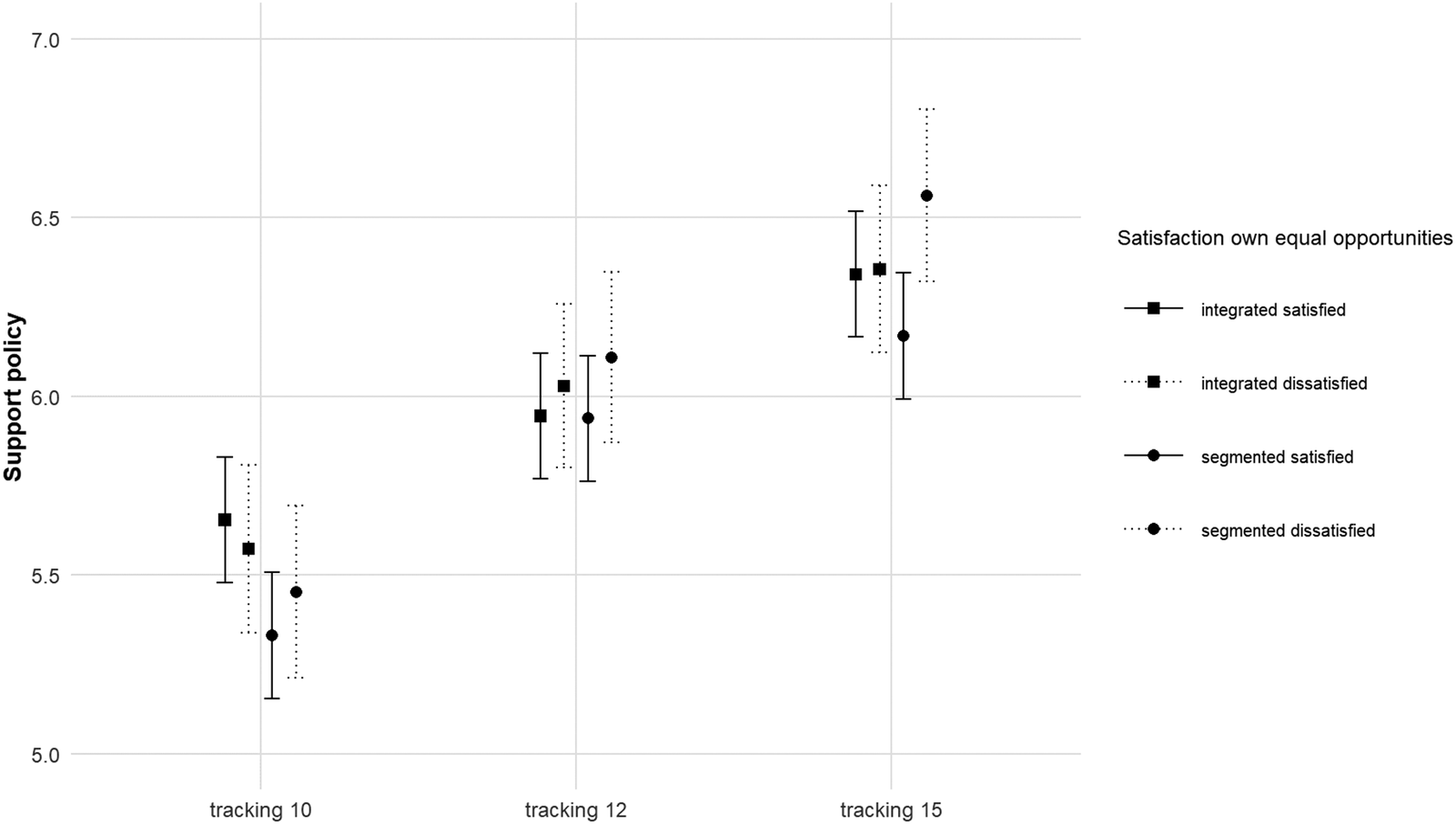
Hypothesis 1a and 1b expect that satisfaction with one’s own experience of equal opportunities at school has a positive effect on support for delaying tracking in more integrated systems and a negative effect on support for delaying tracking in segmented systems. To test this, we run a series of regression models that include interaction effects between the tracking treatment and satisfaction with the equality of opportunities they experienced. To this aim and to ease interpretation for the reader, we create a new variable that distinguishes respondents into four groups, namely those living in (i) integrated systems and are satisfied; (ii) integrated systems and are dissatisfied; (iii) segmented systems and are satisfied; and (iv) segmented systems and are dissatisfied. The results of all models can be seen in Table C.1 in the Supplementary Appendix, of which model 4 is shown graphically below in Figure 2. Figure 2 presents the marginal effects plot of the cross-level interaction between the new variable described above and the three tracking levels.
Marginal effects for the effect of satisfaction*cantonal system on tracking treatment. Note: N = 4,756 individuals in eight cantons, December 2024. Controls included cantonal dummies, position of experiment in the survey, and vignette order. Reference categories were as follows: daycare, “natives”; SES target “means tested”; tracking age “10,” tutoring “2 hours”; school adaptation “new techniques”; middle class “gymnasium”; party “consensus.” Coefficient estimates taken from model 4 in Table C.1 in the Supplementary Materials.

Figure 2. Long description
A coefficient plot with the y-axis labeled Support policy ranging from 5.0 to 7.0 and the x-axis showing three categories: tracking 10, tracking 12, and tracking 15. A legend to the right titled Satisfaction own equal opportunities identifies four groups: integrated satisfied (solid line with square), integrated dissatisfied (dotted line with square), segmented satisfied (solid line with circle), and segmented dissatisfied (dotted line with circle).
* At tracking 10: Support policy scores are lowest, ranging between approximately 5.3 and 5.7. The integrated satisfied group shows the highest support in this category, while segmented satisfied shows the lowest.
* At tracking 12: All groups show a moderate increase in support policy scores, clustering between 5.9 and 6.2.
* At tracking 15: Support policy scores are highest, ranging from approximately 6.2 to 6.6. The segmented dissatisfied group shows the highest support in this category.
Vertical error bars represent confidence intervals for each data point. The overall trend shows a positive linear increase in support policy as the tracking age increases from 10 to 15 across all satisfaction and system types.
H1a expected that high (low) satisfaction leads to lower (higher) levels of support for delaying tracking in segmented cantons; H1b expected that those with higher (lower) satisfaction levels express more (less) support for delaying tracking in integrated cantons. The first test of our hypotheses is to consider within-system (integrated/segmented) differences in support for tracking at 15 by satisfaction level. While none of the differences here reach conventional levels of statistical significance, those dissatisfied in segmented systems are 0.5 points (on a scale from 0 to 11) more supportive of policy packages that include delaying tracking to 15 compared to satisfied residents in similar cantons. This implies that individuals who perceived their schooling to have been unfair are the strongest supporters for reforming the system to become more egalitarian. As explicated in the theoretical framework, these individuals have not experienced positive material or normative effects of their education system and, therefore, do not wish to uphold the status quo. This offers evidence to support H1A, and the theoretical argument for negative feedback loops in strongly segmented and tracked cantonal education systems – although this narrowly misses significance. Within integrated cantons, satisfaction with one’s equal opportunities is not related to the support for tracking-related policies. This implies that negative feedback loops may be present for those within the early-tracked cantons who did not benefit from the system, whereas positive school experiences have no impact on support. However, due to the lack of significance, the strength of the negative feedback loops can be questioned.
Subsidized daycare for immigrants
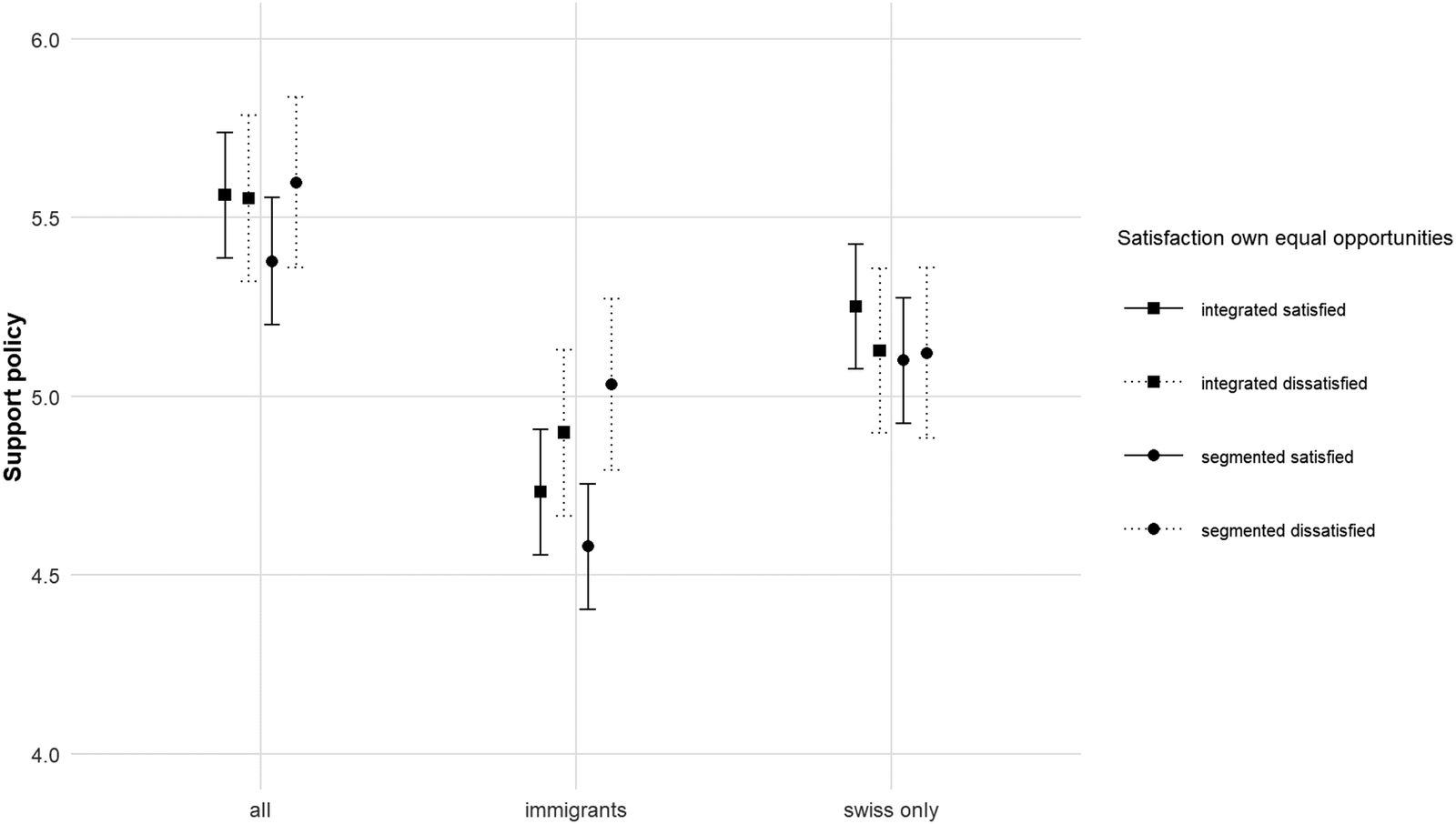
Do the patterns found above also translate to targeted EEP reforms that explicitly help immigrants? The baseline model (Figure 1) illustrates that when free daycare places are allocated to immigrants, this reduces public support for the policy package by 0.77 points. In hypothesis 2, we argued that satisfaction should feed back on preferences beyond this baseline: In our case, we argue that satisfaction with the fairness of the education they experienced leads to positive feedback effects on solidarity. Following H2, we expect that those who are more satisfied should be more supportive of immigrant-targeted investment regardless of the canton within which they reside. Figure 3 below presents the interaction between perceived fairness, that is, the person’s satisfaction with equal opportunities, and the daycare treatment (see model 4, Table C.2 in the Supplementary Materials).
Marginal effects for the effect of satisfaction*cantonal system on daycare treatment. Note: N = 4,756 individuals in eight cantons, December 2024. Controls included cantonal dummies, position of experiment in the survey, and vignette order. Reference categories were as follows: daycare, “natives”; SES target “means tested”; tracking age “10,” tutoring “2 hours”; school adaptation “new techniques”; middle class “gymnasium”; party “consensus.” Coefficient estimates taken from model 4 in Table C.2 in the Supplementary Materials.

Figure 3. Long description
A coefficient plot with a vertical y-axis labeled Support policy ranging from 4.0 to 6.0 and a horizontal x-axis with three categories: all, immigrants, and swiss only. A legend on the right titled Satisfaction own equal opportunities defines four markers: a solid line with a square for integrated satisfied, a dotted line with a square for integrated dissatisfied, a solid line with a circle for segmented satisfied, and a dotted line with a circle for segmented dissatisfied. Each data point includes a vertical error bar representing confidence intervals.
* In the all category, values are highest, clustered between 5.3 and 5.6. Integrated satisfied and integrated dissatisfied are nearly identical at 5.55, while segmented satisfied is lower at 5.38 and segmented dissatisfied is highest at 5.6.
* In the immigrants category, values are lowest, ranging from 4.5 to 5.1. Integrated satisfied is at 4.75, integrated dissatisfied at 4.9, segmented satisfied at 4.58, and segmented dissatisfied at 5.05.
* In the swiss only category, values are moderate, clustered between 5.1 and 5.3. Integrated satisfied is at 5.25, integrated dissatisfied at 5.15, segmented satisfied at 5.1, and segmented dissatisfied at 5.12.
Similar to the tracking treatment, our first test of H2 is to assess differences between satisfied and non-satisfied individuals. The main finding here is that dissatisfaction, rather than satisfaction, is correlated with support for immigrant targeting, which directly contradicts H2. This holds across integrated and segmented cantons, but in segmented cantons the variation explained by satisfaction is significant: Individuals in segmented cantons who are dissatisfied with the equal opportunities they received are those who support immigrant-targeted reforms the most, namely 0.4 points higher than those in segmented cantons who perceived no unfairness in this regard. In other words, educational solidarity with immigrants appears to be triggered in the context of personal perceptions of unequal opportunities in segmented cantons. This has consequences for our assessment of the hypotheses: For those individuals living in segmented cantons, the effect of satisfaction with equal opportunities has a contrary effect to that expected in H2: Rather than the most satisfied supporting measures to enhance equal opportunity for immigrants, we see that those with the lowest satisfaction are the most likely to prioritise spending on immigrants.
This evidence extends to nativist preferences for daycare subsidies among satisfied individuals, too. Those in both segmented and integrated cantons, who were satisfied with the equal opportunities they received in school, are significantly more likely to prefer policies that benefit Swiss children only compared to those that benefit immigrants only (in segmented systems, satisfaction shifts average support for a policy including Swiss-targeted daycare subsidies by 0.7 points on an 11-point scale). Solidarity with immigrants is associated with dissatisfaction in segmented contexts, and nativist tendencies are associated with satisfaction in both systems – thus, we reject H2.
Our findings go against our expectations taken from the literature on satisfaction and solidarity, but echo both the (just non-significant) findings of negative feedback loops for those dissatisfied in segmented cantons. Putting both results together, it seems that those individuals who (perceived to have) faced disadvantage in school both prefer reforming system inequalities as well as privileging underdog groups in targeted EEPs. However, given that we find a stronger effect, and a significant one, for immigrant-targeted reforms suggests that rather than “negative” feedback loops at play, negative experience impacts attitudes towards the disadvantaged. This finding could be explained within the framework of “cross-domain policy effects,” in which studies show that policy experiences in one field can influence policy preferences in related fields (Wang and Zhang, Reference Wang and Zhang2025). It also echoes studies in sociology and social psychology that explore the role of disadvantage in increasing solidarity for minority and underdog groups in general. In social psychology, “linked fate” theory was developed based on racial and ethnic minorities in the United States but has been expanded to other group characteristics including gender and social class (Gurin et al., Reference Gurin, Miller and Gurin1980; Dawson, Reference Dawson1994). The theory states that groups that are impacted by discrimination and disadvantage regarding welfare and other policies can develop perceptions of linked fate (Bajerano et al., 2021). This perception is characterised by (i) self-identification with a group; (ii) feeling close to the same group; (iii) and believing that one’s fate is linked to that of the group (Chong and Rogers, Reference Chong and Rogers2005). This shared identity often leads to similar policy preferences, which is a precondition for (potential) political participation and mobilization in line with the interests of the group (Bajerano et al., 2021). One possible explanation for this could be that individuals who are treated unfairly and experience unequal chances in their educational career feel a connection to other individuals with the same or similar experiences of disadvantage, and thus can develop what we call educational solidarity with other individuals or groups who are likely to have suffered from (different types of) inequality in the same educational system, such as allophone, immigrant, and other vulnerable students. It is beyond the scope of this article to test the exact mechanism behind the increased solidarity for immigrants among dissatisfied individuals from segmented cantons, however. After reflecting on the robustness of our findings, we proceed to discuss their theoretical and empirical relevance in the final section.
Robustness checks
To ensure the robustness of our results, we conducted further analyses as follows. First, the main sample includes individuals who did not go to school in the canton of residence, which could potentially introduce noise in our estimations, given that our theoretical mechanism assumes that one’s experience of the system in question affects one’s policy preferences. We repeated the analysis for all the hypotheses on a reduced sample (around N = 2810), only including those individuals who went to school in that canton (we operationalise this as those individuals who at age 17 or before were living in the canton). Our results regarding tracking remain unchanged (H1A and H1B – Section D.1 in the Supplementary Appendix), but the interaction effect between the daycare treatment and dissatisfaction with equal opportunities is no longer significant, although the direction, suggesting that satisfaction is negatively related to support for EEPs in segmented cantons, remains the same. Thus, our findings should therefore be interpreted with some caution, although it is likely that the individuals who moved within Switzerland to different cantons attended school in a neighbouring or linguistically similar one.
Second, we ran additional models with socio-economic and socio-demographic control variables that have been associated with both support for education spending and satisfaction in general. These models include the baseline treatments, cross-level interaction effects, and other individual-level covariates such as migration background, age, gender, education level, and parental status. They are shown in Tables C.5 and C.6 in the Supplementary Materials. In general, support for the EEP reforms package is higher among those with a migration background, younger individuals (age group 18–29), and females. Education level and parental status have no effect on support. Controlling for these variables in a stepwise fashion for the delayed tracking treatment does not change our results substantially (Supplementary Table C.5), yet controlling for migration background does affect the significance of the interaction effect between satisfaction and support for daycare subsidies for immigrants (Supplementary Table C.6). The interaction effect between satisfaction and support, controlling for migration background, is shown graphically in Supplementary Figure D.3.
This test is of particular relevance given the consequences of rejecting H2: In the main analysis, we found that those who were dissatisfied with the equal opportunities in education are more likely to support reforms that help immigrants. Yet, this could also be driven by self-interest considerations, should the individual in question have a migration background, rather than solidarity, which is required in the “linked fate” scholarship. As shown in Supplementary Figure D.3, the direction of the interaction effect remains the same as in Figure 3 above, but the significance is weakened to the 85% confidence level. Two-way interaction effects suggest that migration background is a relevant confounder of support for the policy package and the effect of satisfaction – and this should be explored further in future research. However, given the stable direction of the interaction, we continue to interpret our combined results as evidence for an effect of satisfaction on support. A similar argument regarding self-interest and low support for immigrant-targeting could be made regarding parental status, as one could expect preferential treatment for Swiss or universal daycare subsidies among Swiss parents. However, controlling for parental status (a dummy variable for whether an individual has a child or not) does not affect the results (Supplementary Appendix, Section D.2).
Finally, our theoretical framework and empirical testing use the concept of satisfaction with equal opportunities in education, although one could assume strong collinearity with such measures and more general satisfaction measurements. Indeed, we find (Supplementary Appendix C.3 and C.4) that replacing the main measure for an item on satisfaction with educational level reached (not equal opportunities) indeed produces similar results for tracking but not for the daycare variable. This further substantiates our claim that solidarity with immigrants reflects one’s own experience of equality, not only educational outcomes, which requires further exploration in future work.
Discussion and conclusion
Social investment and, in particular, the capacitating effects of early education have been clearly identified as promising strategies to address the challenges of current welfare systems in the context of knowledge economies (Morel et al., Reference Morel, Palier, Palme, Morel, Palier and Palme2012; Hemerijck, Reference Hemerijck2018; Wagner et al., Reference Wagner, Pöyliö and Hemerijck2025). However, education systems are also known to act as “sorting machines” (Domina et al., Reference Domina, Penner and Penner2017), meaning that under certain circumstances schools can exacerbate pre-existing inequalities, especially for immigrant students (OECD, 2015, 2016).
This article tackled the question of whether individuals’ subjective experiences of equality in school affect preferences for Equality-Enhancing Policies (EEPs): delaying the age of tracking (non-targeted policy) and daycare subsidies for immigrants (targeted policy). More precisely, we argue that different types of educational systems (integrated vs. segregated) lead to different feedback mechanisms because resources are distributed less equally in segregated systems where tracking occurs earlier and tracks are less permeable. To test these expectations, we exploit data from a large-scale representative survey experiment with 4,756 respondents, which leverages the substantial cantonal variation of the Swiss education system. More precisely, we chose eight cantons that varied in the dominant educational system. We used regression analysis to understand whether school systems at the macro-level feedback onto micro-level preferences via experiences of equal opportunities and thus explain patterns of support for the two EEP policy reforms at hand.
We find that support for EEPs appears to be conditioned by educational experiences of equal opportunity but not always following the logic of our hypotheses. Our first outcome variable, support for delaying tracking, disproportionately benefits immigrant students and thus compensates for the disadvantages they face when trying to catch up with native peers and pursue an academic curriculum. First, we found high support for delaying tracking to 15 across all cantons, with the strongest support among individuals who went to school in highly tracked systems (segmented cantons) but were not satisfied with their equal opportunities, although the difference in support between this group and their peers who were satisfied narrowly missed conventional significance levels. We found no evidence to suggest that positive experience of egalitarian school systems leads to higher support for delaying tracking (H1b). Rather than positive feedback mechanisms, the testing of our first policy instrument suggests that dissatisfaction with school policies may induce preferences to change the system, which could be interpreted as “negative” policy feedback.
Our second set of results, turning to support for immigrant-focused EEPs, reinforces this notion further. In segmented education systems with early tracking, dissatisfaction with equal opportunities is associated with solidarity towards immigrants. We thus find that those individuals “left behind” in segmented systems funnel their experience of disadvantage into educational solidarity, as theorized in the literature on “linked fate” (Smith et al., Reference Smith, Lopez Bunyasi and Smith2019). Rather than wholehearted support for positive or negative feedback, this finding implies that in non-egalitarian settings, negative experiences can have a positive impact on reforms that seek to reverse disadvantages. Because the respondents were not asked explicitly about their experience of daycare, we cannot argue for direct negative policy feedback per se. However, several authors have tested the impact of policy experience with preferences in other policy domains, and this evidence could also point towards such a “cross-domain policy feedback,” too (Brown, Reference Brown2024; Wang and Zhang, Reference Wang and Zhang2025). In this sense, that we find more solidarity towards immigrants from unsatisfied individuals in non-egalitarian systems speaks for a certain feedback effect – perhaps indirect – but a pattern exists all the same. More research is needed to understand what exactly is driving the solidarity preferences of those individuals who felt disadvantaged in their schooling – be it their subsequent socio-economic situation, perceptions of unfair educational outcomes, or otherwise. Further analyses conducted in the robustness checks suggest that migration experience confounds this finding, which should lead future research to explore the political attitudes of diverse populations.
Given our conclusions, we cannot provide evidence for a positive policy feedback mechanism via satisfaction with EEP support. The lack of a positive feedback effect via satisfaction suggests that in cantons with higher levels of educational equity, considerations of welfare deservingness and anti-immigrant bias may trump well-being effects. This remains to be researched further for education policies (but see Bonoli, Reference Bonoli2020; Eick and Larsen, Reference Eick and Larsen2022 for research on social investment policies and deservingness). Our findings do not necessarily contradict other studies in this special issue given that compulsory schooling as an institution differs from other welfare policies in social investment in numerous ways – with diversity of experience of schooling one among many. Furthermore, we did not find negative feedback effects of egalitarian policies – rather in non-egalitarian settings. Those individuals who perceived their schooling as unfair in segmented cantons expressed preferential treatment for immigrants in the allocation of daycare subsidies, and support delaying tracking to the age of 15, although this finding missed conventional significance levels.
This study is not without limitations. While our case selection allowed the analysis to hold institutional characteristics constant, the external validity of our study could have been improved by reproducing findings across different country contexts, including systems with fully integrated, mixed-class education systems such as the United Kingdom or Scandinavian countries. Second, while our focus was on feedback effects, several individual-level covariates, such as migration background and education level, are likely to affect preferences and potentially interact further with experience. We found that controlling for migration background reduced the conventional significance levels of our main finding regarding targeted reforms, and therefore particularly encourage future survey research to oversample low-SES students and/or immigrants to better unpick “linked fate” and self-interest. Finally, we were able to study only one mechanism of what can be conceptualised as a long causal chain that links individual childhood experiences to political reforms. Future efforts could be dedicated to analysing how and under what circumstances preferences for different equal opportunity policies can be successfully mobilized.
On balance, in modern knowledge economies, compulsory and early education can prevent inequality and contribute to ensuring children have the best possible start in life and decrease structural inequalities. Just as educational sociologists highlight the importance of education systems in reinforcing inequality, our article highlights that an individual’s experience of the system may “feed back” into preferences towards enhancing equality; rather than positive effects of social investment, we find rather negative effects of unequal systems. As such, researchers should take the design of institutions and the material and non-material resources distributed towards individuals in different school systems into account when seeking to explain solidarity with minority groups.
Supplementary material
The supplementary material for this article can be found at http://doi.org/10.1017/ics.2026.10110.
Data availability statement
A fully anonymised version of the dataset used inthis article will be available at https://doi.org/10.5281/zenodo.23413382 after the publication of the article.
Acknowledgements
This article benefited from the efforts of Rodrigo Sanchez Sienra in data collection and survey design, feedback from the editors of the special issue and workshops at the Lives Centre, University of Lausanne, and the special issue authors, online, both in May 2025. All mistakes and omissions are our own.
Funding statement
This research was funded by the Swiss National Science Foundation project number 212258.
Disclosure statement
The authors are not aware of any competing interests or conflicts in the submission of this article.
Ethical approval and informed consent
The project was approved by the Ethics Committee at the University of Lausanne. The informed consent form for the survey participants is in the Supplementary Material.




 Open access

