One of the major findings within the field of SLA research is the different rates of success with which children and adults achieve nativelike proficiency in a second language (L2). Since the 1960s, SLA research has systematically demonstrated that even though child learners often end up with nativelike mastery, ultimate attainment in adult learners exhibits great variation, ranging from rudimentary to near-native levels (e.g., Abrahamsson & Hyltenstam, Reference Abrahamsson and Hyltenstam2009; Asher & García, Reference Asher and García1969; DeKeyser, Reference DeKeyser2000; Hyltenstam, Reference Hyltenstam and Harris1992; Johnson & Newport, Reference Johnson and Newport1989; Krashen, Scarcella, & Long, Reference Krashen, Scarcella and Long1980; Lenneberg, Reference Lenneberg1967; Oyama, Reference Oyama1976; Patkowski, Reference Patkowski1980; Penfield & Roberts, Reference Penfield and Roberts1959). The differences between the ultimate attainment of child and adult learners are robust, in the sense that they are not confined to a specific linguistic domain but concern phonology, morphology, syntax, and, to a certain extent, lexis. However, even though most researchers agree on the existence of child-adult differences in L2 acquisition, there is considerable disagreement as to the ultimate cause of these differences. Whereas some researchers have suggested that socioaffective factors such as motivation and attitude may account for the differences in child and adult additional learning (e.g., Bialystok, Reference Bialystok2002; Snow & Hoefnagel-Höhle, Reference Snow and Hoefnagel-Höhle1977), the traditionally most prominent account of age effects in L2 acquisition, the so-called critical period hypothesis (CPH), holds that the cortical areas subserving language are characterized by a high degree of plasticity in children that makes nativelike attainment possible. There is a progressive loss of neural plasticity that culminates around puberty, which renders nativelike attainment in postpubescent learners virtually impossible (Hyltenstam & Abrahamsson, Reference Hyltenstam, Abrahamsson, Doughty and Long2003; Lenneberg, Reference Lenneberg1967; Long, Reference Long1990, Reference Long2007; Paradis, Reference Paradis2004; Pulvermüller & Schumann, Reference Pulvermüller and Schumann1994; Uylings, Reference Uylings2006). A competing set of recent constructs, labeled the impediment account(s), holds that it is not the loss of neural plasticity per se that renders L2 nativelikeness more difficult over time, but rather first language (L1) entrenchment (e.g., Flege, Reference Flege and Birdsong1999; MacWhinney, Reference MacWhinney, Kroll and de Groot2005; Ventureyra, Pallier, & Yoo, Reference Ventureyra, Pallier and Yoo2004). In this view, an increase in L1 proficiency leads to the progressive entrenchment of L1 representations, with the consequence that L2 acquisition becomes more difficult. With this interpretation follows the assumption that the less L1 there is, the smaller its interference with the L2.
A straightforward way of determining whether the predictions of the impediment account are correct is to examine not only the learners’ L2 skills but also their proficiency in the L1. This was pointed out by Long (Reference Long, Hyltenstam and Viberg1993), who underscored that the interpretability of the results of any study on child-adult differences would be strengthened “if researchers collect data on their L2 subjects’ L1 proficiency and use, despite the extra work this will inevitably involve” (p. 208). In spite of the fact that this remark was made almost 20 years ago, studies that empirically assess both L1 and L2 proficiency have rarely been done to date.
This study is an attempt to supplement the current lack of research into the relationship between L1 and L2 ultimate attainment. The aim of the study is to examine both L1 and L2 proficiency in Spanish-Swedish bilinguals whose age of L2 acquisition was within the assumed critical period. In particular, this study addresses the following research questions: First, what is the relationship between L1 and L2 proficiency in early bilingual speakers? and second, what factors may contribute to an early bilingual attaining nativelike or nonnativelike proficiency in his or her languages?
The outline of the article is as follows: The first section, “L1 as an Element that Impedes L2 Nativelikeness,” reviews the accounts that purport blocking effects of the L1 on L2 nativelikeness and research findings relevant to these claims and outlines the specific aims and scope of the current study. The research design of the study is presented in the Methods section, followed by a presentation of the results. Implications of the findings are presented together with some concluding remarks regarding proficiency interaction in bilinguals and age effects in L2 acquisition.
L1 AS AN ELEMENT THAT IMPEDES L2 NATIVELIKENESS
Whereas the study of age effects on ultimate attainment traditionally has been characterized by an emphasis on biological factors (loss of neural plasticity) as the ultimate cause of child-adult differences, a shift in focus seems to have taken place during recent years. This shift is reflected in a growing number of accounts and interpretations that deemphasize the role of the maturational state of the learner and conceptualize the learner’s L1 as an element that impedes L2 nativelikeness. Even though there seems to be an increased interest in exploring the possibility that age effects are due to L1 blocking, it should be underscored that the general idea that the L1 may hamper nativelike proficiency in the L2 is in itself not new. For example, Dunkel (Reference Dunkel1948) speculated that the less L1 there is, the smaller its influence would be on the L2. The idea of a causal relationship between L1 and L2 proficiency levels seems to have been based on the assumption that there is a limited brain capacity for language representation and processing. As Seliger and Vago (Reference Seliger, Vago, Seliger and Vago1991) put it, the two languages of the bilingual compete for a “finite amount of memory and processing space in the mind of the speaker” (p. 4). In a similar manner, the so-called balance theory of bilingualism (BTB; see Cummins, Reference Cummins1981) holds that “the brain has only a limited capacity and therefore the addition of a second language automatically leads to a decrease of proficiency in the L1” (Hoffmann, Reference Hoffmann1991, p. 129). According to the BTB, an equilibrium is obtained if proficiency in L1 and L2 taken together makes up 100% of total language ability, so that learning a new language consumes capacity from the L1 and vice versa.
Some of the most prominent interpretations of L1 and L2 proficiency level interaction within the context of the critical period are reviewed in the rest of this section. Given their view of the L1 as the major impediment for L2 nativelikeness, the umbrella term impediment account(s) is used here to refer to them.
According to the competition model (CM; Hernández, Li, & MacWhinney, Reference Hernández, Li and MacWhinney2005; MacWhinney, Reference MacWhinney, Kroll and de Groot1997, Reference MacWhinney, Kroll and de Groot2005), L1 and L2 acquisition are explained in terms of competition, resonance, entrenchment, and parasitism. For example, in an isiXhosa-English simultaneously bilingual child, competition occurs when two lexical items (e.g., itafile and table) compete for the same referent. Owing to cues that the child has learned during the course of acquisition (e.g., isiXhosa is associated with the father, and English with the mother) as well as language-internal resonance (the activation of forms in one language has resonant effects and also keeps forms in the other language deactivated), the competition between itafile and table is controlled, and the appropriate form is produced (for a computer simulation, see Li & Farkas, Reference Li, Farkas, Heredia and Altarriba2002). For a L2 learner, the situation is very different, in the sense that L1 representations are entrenched, and the L2 forms are acquired as word associations dependent on L1 forms. Even though L2 forms may gain strength and their internal resonance may increase, they will always have an association with L1 forms due to L1 entrenchment. In this sense, they will remain parasitic on the L1. Thus, according to the CM, repeated L1 use leads to entrenchment, with the consequence that L2 nativelikeness becomes increasingly more difficult as entrenchment proceeds. The CM does not posit a certain age span during which the L1 entrenchment effect changes but predicts that the ability to attain L2 nativelikeness declines gradually over the speaker’s lifespan (MacWhinney, Reference MacWhinney, Kroll and de Groot2005).
A second impediment account is the so-called interference hypothesis (IH; Pallier et al., Reference Pallier, Dehaene, Poline, LeBihan, Argenti and Dupoux2003; Ventureyra, Pallier, & Yoo, Reference Ventureyra, Pallier and Yoo2004), which originated from a series of studies on Korean adoptees living in France. The results from these studies show that, first, the adoptees in the study seemed to have lost their L1 Korean completely, as they were not able to discriminate between Korean and foreign languages, nor did they respond implicitly, as measured by functional magnetic resonance imaging (fMRI), when exposed to Korean. Second, the observation was made that during the test sessions, the adoptees exhibited a command of French that, on impressionistic grounds, was indistinguishable from native speakers. In view of these findings, Pallier and associates suggested that if the L1 is completely lost, the neural networks can reset (Ventureyra et al., Reference Ventureyra, Pallier and Yoo2004), and, thus, a nativelike level of a L2 can be attained. The reason, then, why some early L2 learners who maintain their L1 (such as immigrant children) do not reach nativelike L2 proficiency is because their L1 “acts as a filter that distorts the way in which a second language can be acquired” (Pallier et al., Reference Pallier, Dehaene, Poline, LeBihan, Argenti and Dupoux2003, p. 160). According to the IH, the resetting of the L1 neural networks can only take place within the critical period (see Ventureyra et al., Reference Ventureyra, Pallier and Yoo2004). However, given the fact that no systematic assessment of the L2 proficiency of the adoptee participants was carried out in these studies, the claim concerning L2 nativelikeness stands on shaky ground (which was also recognized by Pallier and associates). Following up on this issue, Hyltenstam, Bylund, Abrahamsson, and Park (Reference Hyltenstam, Bylund, Abrahamsson and Park2009) used a test battery including 10 different measures to assess L2 proficiency in speakers with either adoptee or immigrant backgrounds who had passed for native speakers in a listening experiment (with age of L2 acquisition ranging from 1 to 9 years in both groups). The adoptees reported that they had lost their receptive and productive L1 skills completely, whereas the participants with immigrant background used their L1 on a daily basis. The results—although somewhat preliminary due to the low number of participants—showed that, first, the adoptee L2 speakers scored outside of the native speaker range on several L2 measures, and more importantly, they did so to the same extent as the immigrant L2 speakers. The finding that international adoptees do not attain nativelike L2 proficiency is also confirmed by previous and later studies on this matter (Gauthier & Genesee, Reference Gauthier and Genesee2011; Gardell, Reference Gardell1979; Hene, 1992). As such, these results weaken the argument for the IH.
A third account that conceptualizes the L1 as an interfering element in L2 ultimate attainment is the speech learning model (SLM; Flege, Reference Flege and Strange1995, Reference Flege and Birdsong1999). This model concerns phonology and predicts the attainment of L2 segmental pronunciation of consonants and vowels. Assuming that the phonic elements of the L1 and L2 exist in a common phonological space, the SLM predicts that, in the bilingual speaker, L1 and L2 phonetic categories may mutually influence each other. The extent to which the L1 influences L2 pronunciation depends on the strength of representation of L1 categories (in terms of developmental status) in the sense that the more strongly represented the L1 is, the more it will interfere with the accuracy of L2 pronunciation. Over the years, Flege and associates have undertaken a series of empirical studies examining L2 pronunciation ability and its relationship to L1 use and proficiency. For example, Flege, Frieda, and Nozawa (Reference Flege, Frieda and Nozawa1997) investigated L2 pronunciation proficiency and L1 use in a group of adult L1 Italian–L2 English bilinguals who had started learning the L2 before puberty (on average at the age of 5). The results showed that those who used their L1 in an average of 30% of their daily interactions received significantly lower ratings on their L2 pronunciation than those who used their L1 in only 3% of their interactions. Whereas this finding suggests a negative relationship between self-reported L1 use and L2 nativelikeness, it does not provide a measure of the relationship between L1 and L2 proficiency, which would have been desirable to further evaluate the prediction that L2 nativelikeness varies as a function of L1 proficiency. Such evidence was, nevertheless, reported in a subsequent study on L1 Korean–L2 English bilinguals (Yeni-Komshian, Flege, & Liu, Reference Yeni-Komshian, Flege and Liu2000), in which global pronunciation was assessed in both the L1 and L2. The results from this study effectively showed a significant negative correlation (r = −.47) between L1 and L2 pronunciation scores among those bilinguals who had started L2 acquisition before puberty (i.e., before age 12), but not for those who started beyond this point. The interpretations pursued by Flege and associates range from strong claims such as “the effects on foreign accent are due to the development of the native language phonetic system rather than to maturational constraints on L2 speech learning” (MacKay, Flege, & Imai, Reference MacKay, Flege and Imai2006, p. 157) to the more ambivalent view that L2 pronunciation skills are not “determined solely by an individual’s state of neurological development at the time of first exposure to the L2” (Flege et al., Reference Flege, Frieda and Nozawa1997, p. 169). Additionally, as shown by Yeni-Komshian et al. (Reference Yeni-Komshian, Flege and Liu2000), the SLM holds that the interaction between L1 and L2 pronunciation proficiency first and foremost applies to learners who were immersed in the L2 environment before puberty.
These impediment accounts conceptualize L1 as an obstructing element for L2 nativelikeness, but they also differ in some regards. An obvious difference between them is their scope with respect to linguistic domains. Whereas the SLM makes predictions about phonological attainment, the IH and the CM are not confined to a specific linguistic subsystem but seem to apply to language proficiency defined in a global sense. The impediment accounts also differ somewhat in their conceptualization of the timing of age effects. Whereas the IH and the SLM recognize there is a specific time span, which ranges up to 12 years of age and during which the L2 may be fully acquired if the L1 is completely lost, the CM is less specific on this point. MacWhinney (Reference MacWhinney, Kroll and de Groot2005) holds that the possibility to achieve L2 nativelike proficiency declines gradually over the lifespan of a speaker because of consolidation of L1 representations. In a similar manner, in Hernández and colleagues (Reference Hernández, Li and MacWhinney2005) it is suggested that L2 parasitism can be overcome in children owing to the fact that they have a relatively low degree of L1 entrenchment, whereas this is not the case for young adults.
The process by which a L1 is replaced by a L2 in childhood and in the early teens has also been addressed by other studies that do not necessarily subscribe to an impediment view of L2 acquisition. In a longitudinal study, Jia and Aaronson (Reference Jia and Aaronson2003) investigated L1 Mandarin Chinese children and teenagers as they became bilingual in English and specifically focused on how language proficiency changes as a function of patterns of use and preference. The results showed that over a period of three years, the youngest children (age 5–9), who on arrival spoke little or no English, experienced a switch to English in terms of language dominance and preference.Footnote 1 This switch was in part ascribed to the children’s social interactions (with native English-speaking peers) and the rich L2 environment in which they were immersed. The young teenagers (age 12–16), in contrast, did not exhibit such language dominance shift, which was explained in similar terms (fewer English native peers and a L2 environment that was less rich).
In sum, a number of accounts and general suggestions have been formulated and posit that age effects in L2 ultimate attainment are not due to the maturational state of the learner but are instead a consequence of the degree of the L1 entrenchment of speakers. The problem with these impediment accounts, as they have been labeled here, is that they find little empirical support. The study by Yeni-Komshian et al. (Reference Yeni-Komshian, Flege and Liu2000) constitutes one of the few investigations that actually provides direct evidence of a negative relationship between L1 and L2 proficiency in prepubescent L2 learners (however, whether this finding indeed demonstrates causality is a question that will be left for the Discussion section). The other studies reviewed here either do not provide evidence of ultimate attainment but instead offer a snapshot of language systems in development (Jia & Aaronson, Reference Jia and Aaronson2003) or rely on self-reports or impressionistic data of language proficiency rather than thorough empirical assessments (Jia & Aaronson, Reference Jia and Aaronson2003; Pallier et al., Reference Pallier, Dehaene, Poline, LeBihan, Argenti and Dupoux2003; Ventureyra et al., Reference Ventureyra, Pallier and Yoo2004).
These methodological shortcomings are, however, not limited to the studies that provide possible evidence of a negative relationship between L1 and L2 proficiency. They are, admittedly, present to a certain extent in the studies on the L2 proficiency of international adoptees that report counterevidence to the impediment account. In the investigations of L2 proficiency among international adoptees conducted by Hyltenstam et al. (Reference Hyltenstam, Bylund, Abrahamsson and Park2009), Gardell (Reference Gardell1979), and Hene (1992), for instance, proper empirical assessments of possible L1 remnants are lacking. Additionally, the participants in Hene’s study were preteens, and as a consequence, any claim about their end state grammars must be seen as preliminary.
Aims and Scope of the Present Study
It is against this background that this study aims to further the understanding of L1 and L2 proficiency interaction in L2 speakers. The study specifically sets out to empirically investigate the relationship between L1 and L2 nativelike proficiency in early bilinguals (henceforth the term nativelike and its derivates are used even when referring to L1 proficiency).Footnote 2 One of three logical outcomes can be expected in this regard: (a) there is no relationship (i.e., neither positive nor negative) between L1 and L2 nativelikeness, (b) there is a negative relationship between L1 and L2 nativelikeness—that is to say, if a speaker has nativelike proficiency in the one language, he or she is likely to be nonnativelike in the other—and (c) there is a positive relationship between L1 and L2 nativelikeness—that is, if a speaker exhibits nativelike proficiency in the one language, he or she is likely to do so in the other language as well, and vice versa. Whereas outcome (b) is predicted by the impediment accounts, outcomes (a) and (c) should be considered as evidence against these accounts.
The second aim of this study is to explore what factors may contribute to an early bilingual speaker’s attainment of nativelike proficiency in both, one, or neither language(s). In this regard, this study investigates the possible influence of the following three factors:
1. Age of onset of L2 acquisition: Given the number of studies showing that age of L2 acquisition has an effect not only on the early learner’s L2 proficiency but also on his or her L1 retention, this factor is a given in the context of the current investigation (see Abrahamsson & Hyltenstam, Reference Abrahamsson and Hyltenstam2008, Reference Abrahamsson and Hyltenstam2009; Bylund, Reference Bylund2009a, Reference Bylund2009b; DeKeyser, Reference DeKeyser2000; Johnson & Newport, Reference Johnson and Newport1989; Montrul, Reference Montrul2002, Reference Montrul2004b, Reference Montrul2008; Oyama, 1976; Yeni-Komshian et al., Reference Yeni-Komshian, Flege and Liu2000).Footnote 3
2. Amount of L1 use: Just as age of onset (AO) of L2 acquisition has a proven effect on bilingual proficiency, the extent to which L2 speakers residing in a L2 context use their L1 has been shown to influence both their L1 and L2 proficiency (e.g., Bylund, Reference Bylund2009a, Reference Bylund2009b; Bylund, Abrahamsson & Hyltenstam, Reference Bylund, Abrahamsson and Hyltenstam2010; Flege et al., Reference Flege, Frieda and Nozawa1997; Hakuta & D’Andrea, Reference Hakuta and D’Andrea1992; Merino, Reference Merino1983; Montrul, Reference Montrul2008; Yeni-Komshian et al., Reference Yeni-Komshian, Flege and Liu2000).
3. Language aptitude: Whereas AO of L2 acquisition and amount of L1 use are well-documented factors within research on age effects in language development, language aptitude has only recently entered the arena. In its most generic conception, this factor is defined as an innate, relatively fixed skill for acquiring and processing language structure (DeKeyser, Reference DeKeyser2000). The four constituents of language aptitude identified as particularly important are phonetic-phonemic coding ability, grammatical sensitivity, rote learning ability, and inductive learning ability (for further discussion of these components, see Carroll, Reference Carroll and Diller1981; Carroll & Sapon, Reference Carroll and Sapon1959; Skehan, Reference Skehan1998, Reference Skehan and Robinson2002). Despite the fact that these components were identified by Carroll and Sapon (Reference Carroll and Sapon1959) more than 50 years ago, subsequent research has not “reconceptualized aptitude in any significant manner” but has mostly worked “within the aptitude agenda set by Carroll” (Skehan, Reference Skehan and Robinson2002, p. 73; but see Doughty, Campbell, Bunting, Bowles, & Haarmann, Reference Doughty, Campbell, Bunting, Bowles and Haarmann2007). To date, language aptitude has been shown to exert an effect on L2 proficiency in both formal and naturalistic settings (e.g., Abrahamsson & Hyltenstam, Reference Abrahamsson and Hyltenstam2008; DeKeyser, Reference DeKeyser2000; DeKeyser, Alfi-Shabtay, & Ravid, Reference DeKeyser, Alfi-Shabtay and Ravid2010; Harley & Hart, Reference Harley and Hart1997) as well as on L1 proficiency in situations of incomplete acquisition or attrition (Bylund et al., Reference Bylund, Abrahamsson and Hyltenstam2010). The effects of language aptitude on bilingual proficiency, however, remain uncharted territory in current applied linguistics research.
Although this study includes language aptitude as a variable in its analysis, it should be noted that it is confined to exploring the relationship between language aptitude and nativelikeness and resorts to the current techniques available for measuring language aptitude. To investigate the specific nature of language aptitude or its subcomponents is, in other words, not the intention of this study.
The present study adheres to Long’s (Reference Long1990, Reference Long2005) line of argumentation that research on age effects and nativelikeness in L2 acquisition must seek to avoid type II errors, or false positives—that is, claims of nativelikeness for L2 speakers whose proficiency should be characterized as near-native rather than nativelike (see also Hyltenstam & Abrahamsson, Reference Hyltenstam and Abrahamsson2000, Reference Hyltenstam, Abrahamsson, Doughty and Long2003). One way to achieve this is to implement tests and tasks that are sufficiently demanding so as to not produce ceiling effects in the performance of participants. Additionally, instead of limiting the scope of inquiry to one or a few linguistic structures, type II errors may be further avoided through the inclusion of diverse measures of nativelikeness, representing different aspects and levels of linguistic proficiency. The research questions addressed in the current study are summarized in the following:
1. What is the relationship between L1 and L2 nativelike proficiency?
2. What factors predict nativelikeness in both, one, or neither language(s)?
METHOD
Participants
Thirty L1 Spanish–L2 Swedish bilinguals with Swedish residence participated in the study. Their L2 acquisition began before the age of 12 (mean 6; range 1–11; SD 3.2) and their mean length of residence in Sweden was 23.7 years (range 10–41; SD 7.5).Footnote 4 According to self-reports, the average daily use of Spanish among the bilinguals was 27.2% (SD 14.1). At the time of testing, the participants were on average 29.3 years old (range 19–40; SD 6.1). The bilinguals came from countries throughout Latin America, with a specific concentration in Chile (60%). This participant composition roughly corresponds to the Spanish-speaking immigrant community in Sweden, where residents of Chilean origin are in the majority. The participants were either university students or had previously completed their academic degrees. A common denominator of the participants was that they exhibited a generally high level of L2 proficiency—which may be expected by early L2 learners—such that, in a screening test, they passed for native speakers of Swedish to at least 3 out of 10 Swedish native listener judges (for details on this procedure, see Abrahamsson & Hyltenstam, Reference Abrahamsson and Hyltenstam2009).
Fifteen native speakers of Spanish (mean age: 28.9 years) and 15 native speakers of Swedish (mean age: 30.1 years) were recruited as monolingual controls. The Spanish-speaking control group comprised native speakers of Chilean Spanish who were born and raised in monolingual Spanish-speaking settings in Santiago de Chile. The Swedish-speaking controls were native speakers who were born and raised in monolingual Swedish-speaking settings in the Stockholm area. Pure monolingualism was not a criterion for participation, and the vast majority of the controls had foreign language skills, for example, in English. None of the control participants had, however, lived abroad for any appreciable length of time in a setting in which their foreign language skills could be practiced. These two groups will be referred to as Spanish-speaking controls and Swedish-speaking controls, respectively. The control groups were matched to the bilingual participants by educational level.
Materials
Language proficiency was investigated in terms of grammatical intuition (as measured by a grammaticality judgment test GJT), and semantic and grammatical inferencing skills (as measured by a cloze test).
Grammaticality Judgment Tests.Grammatical intuitions in Spanish and Swedish were measured through aural GJTs.Footnote 5 The Spanish GJT included 80 sentences, 40 of which contained ungrammatical constructions regarding one of the following features: gender agreement, verb agreement, and verbal clitics. According to previous research on the acquisition of L1 Spanish, these structures are acquired early on and mastered by approximately 5 years of age (see López Ornat, Reference López Ornat1994; Montrul, Reference Montrul2004a). Research has also shown that these structures may be vulnerable in situations of Spanish-language contact and attrition (Lipski, Reference Lipski2004; Montrul, Reference Montrul2008; Silva-Corvalán, Reference Silva-Corvalán1994). The sentences were carefully designed so that the participants’ judgments would not be dependent on dialectal variation. Prior to application in the current study, the test sentences had been piloted extensively with both monolingual and bilingual speakers of Spanish, with the intention of removing any possible ambiguities or nontargeted deviations. Faulty sentences contained only a single error (see Appendix A for samples).
Similar to the Spanish version, the Swedish GJT included 80 sentences, 40 of which contained an ungrammatical construction. The grammatical structures tested in Swedish included subject-verb inversion, reflexive possessive pronouns, placement of sentence adverbs in relative clauses, and gender agreement (see Appendix B for samples). Previous research has shown that these structures are notoriously difficult for L2 learners, even those at near-native proficiency levels (e.g., Abrahamsson & Hyltenstam, Reference Abrahamsson and Hyltenstam2008; Hyltenstam, Reference Hyltenstam1977). To remove possible ambiguities or nontargeted deviations, the test sentences had been piloted extensively with native speakers and L2 learners of Swedish. The test sentences for both the Spanish and the Swedish GJT were recorded in an anechoic chamber by a female native speaker of the relevant language.Footnote 6
Semantic and Grammatical Inferencing.A cloze test was used to measure the participants’ semantic and grammatical inferencing skills. Cloze tests can be seen as global measurements of grammatical, lexical, contextual, and pragmatic knowledge (McNamara, Reference McNamara2000) that tap into the speaker’s ability to make semantically and grammatically based predictions about textual continuation. The Spanish cloze test consisted of a 300-word text about Tokyo in which every seventh word had been removed (see Appendix C). Similar to the Spanish version, the Swedish cloze test also consisted of a 300-word text. In this text, which was about Toronto, every seventh word had been removed (for an example, see Appendix D). Prior to application in the current study, both cloze tests had been piloted with monolingual and bilingual speakers of the relevant language.
Language Aptitude.The Swansea Language Aptitude Test (LAT, v.2.0; Meara et al., Reference Meara, Milton and Lorenzo-Dus2003) was used to obtain a measure of the bilingual speakers’ language aptitude. This test was developed through a series of research projects at the University of Wales, Swansea, and is described by Meara and associates as being loosely based on the Modern Language Aptitude Test (MLAT; Meara, 2005). According to DeKeyser (Reference DeKeyser2000) and Skehan (Reference Skehan and Robinson2002), the MLAT is still the most widely recognized and commonly used measurement battery of aptitude. The Swansea LAT comprises five subtests measuring phonetic memory, lexical-morphological analytical skills, grammatical inferencing skills, aural memory for unfamiliar sound sequences, and the capacity to form sound-symbol correspondences. The subtests include linguistic materials from either artificial language systems or languages with which the test taker is unlikely to be familiar. In the current study, aptitude scores are reported as mean total scores from all five subtests. The maximum test score is expressed as 100%.
Procedure
Bilingual participants were tested individually in each language on two different occasions. The bilinguals and the Swedish-speaking controls were tested at Stockholm University by a native speaker of the relevant language, and the Spanish-speaking controls were tested at the Pontificia Universidad Católica in Santiago de Chile by a native speaker of Chilean Spanish.
When taking the GJTs, the participants were instructed to focus on the structure of the sentence and not on its content (the difference between the two was illustrated through an example). The sentences were presented once through earphones in different random orders, and the participants indicated the grammaticality of each item by pressing a red button for incorrect or a green button for correct. The presentation of a sentence could be interrupted as soon as an error was detected. The participants were given a time frame of 10 s to indicate whether they perceived a sentence as grammatically correct or incorrect. If no decision was reached within this frame, the next sentence was presented (nonresponses were analyzed as incorrect responses). Both GJTs were run in E-Prime (v.1.0; Schneider, Eschman, & Zuccolotto, Reference Schneider, Eschman and Zuccolotto2002a, Reference Schneider, Eschman and Zuccolotto2002b).
The cloze tests were a pen-and-paper task in which participants were asked to fill in the 42 blanks with words that would fit into the context. There was an upper time limit of 10 min for these tests. The cloze tests were corrected blindly by native speakers of the relevant language. A number of grammatically and semantically correct alternatives were identified for each blank, and the participants’ answers were scored in accordance with these alternatives. Nonresponses were labeled as incorrect responses. Spelling errors were not considered.
The language aptitude test was computer administered. The test took about 40–60 min to complete. Data on the bilingual participants’ aptitude were collected during the Swedish test session, and the specific instructions for each of the LAT subtests were consequently given in Swedish. Prior to testing, all participants underwent a hearing test (Oscilla 910 screening memory audiometer) in which a loss of up to 10 dB for one frequency was considered acceptable. All participants passed the hearing test.
RESULTS
The Relationship between L1 and L2 Proficiency
Grammatical Intuition in L1 Spanish and L2 Swedish.A comparison between the performance by the bilinguals and the Spanish-speaking controls on the Spanish GJT showed that the bilinguals generally obtained a lower score. The average score for the bilinguals was 58.7 (SD 8.9) and for the controls 65.9 (SD 6.3) (maximum score = 80). This difference was significant at the .01 level, t (43) = −2.70, and exhibited a large effect size, d = .87. However, individual results showed that 53.3% (or 16 out of 30) of the bilinguals exhibited scores that fell within the range of the Spanish-speaking controls.
The results from the Swedish GJT presented a similar picture. When compared at the group level, the bilingual participants scored significantly lower than the Swedish-speaking controls. The bilinguals obtained 59.3 (SD 8.0) points on average and the controls 68.7 (SD 6.5) (maximum score = 80). This difference was robust and statistically significant, t (43) = −3.94, p < .01, d = 1.27. At the individual level, nevertheless, 50% (or 15 out of 30) of the bilinguals were shown to score within the range of the Swedish-speaking controls.
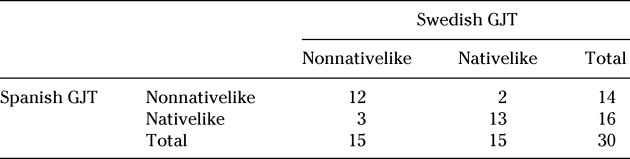
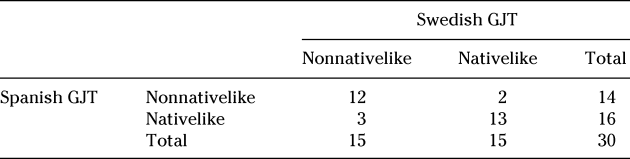
Having compared the bilinguals’ test scores to that of the native-speaking controls, the next step is to examine the relationship between L1 and L2 performance. Because the focus of the current study is on nativelike versus nonnativelike performance, the bilinguals’ test scores were converted into scores of nativelikeness. In accordance with previous research on ultimate attainment (e.g., Abrahamsson & Hyltenstam, Reference Abrahamsson and Hyltenstam2008, Reference Abrahamsson and Hyltenstam2009; Bylund et al., Reference Bylund, Abrahamsson and Hyltenstam2010; Flege, Reference Flege and Birdsong1999; Yeni-Komshian et al., Reference Yeni-Komshian, Flege and Liu2000), scores within (or above) the controls’ range were defined as nativelike. Scores below the controls’ range, in contrast, were identified as nonnativelike. Table 1 shows the scores of bilingual participants according to their nativelike-nonnativelike performance in the L1 and L2. As seen in the table, the bilinguals clustered in two major groups: First, there were those who presented nativelike GJT performance in both languages (n = 13), and second, there were those who obtained nonnativelike scores in either language (n = 12). A Phi correlation showed that the distribution of nativelikeness scores in Table 1 was statistically significant, Φ = .67, p < .001. This finding thus demonstrates that participants who attained a nativelike score in one language were likely to do so in the other language as well. To obtain a measure of the effect size of this finding, an odds ratio (OR) was calculated. The OR for the pattern of nativelikeness scores was found to be 26.00, which is considered a large effect size.Footnote 7
Cross-tabulation of the bilingual participants’ nativelike-nonnativelike scores on the GJTs
A similar result was found for the bilinguals’ performance on the Swedish cloze test: The average score was 29.7 (SD 5.2) for the bilingual group and 36.5 (SD 2.6) for the Swedish-speaking controls (maximum score = 42). This difference was statistically significant at the .001 level (t [43] = −4.67, d = 1.50). Individual results showed that half of the participants (15 out of 30) scored within the range of the Swedish-speaking controls.Footnote 8
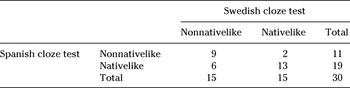
Table 2 shows a cross-tabulation of the participants according to their nativelike-nonnativelike performance on the cloze tests. In the table, a pattern similar to that found for the GJT scores emerges: The largest group (n = 13) comprises those who scored within the native range in both languages, whereas the second-largest group (n = 9) consists of those who did not score within the native range in either language. A Phi correlation confirmed that those who exhibited nativelike performance in the one language were also more likely to do so in the other language and vice versa, Φ = .48, p < .01. This pattern was robust in terms of effect size, OR = 9.75.
Cross-tabulation of the bilingual participants’ nativelike-nonnativelike scores on the cloze tests

The first research question in this study asked what the relationship was between nativelikeness in the L1 and L2 proficiency. Three possible outcomes were formulated: (a) L1 and L2 proficiency are not correlated, (b) L1 and L2 proficiency are negatively correlated, and (c) L1 and L2 proficiency are positively correlated. Taken together, the results from the GJTs and the cloze tests provide robust support for outcome (c); that is, nativelike proficiency in the L1 and L2 was positively correlated, in the sense that if a speaker scored within the native range in one language, he or she was prone to doing so in the other language as well.
Factors Contributing to Nativelike Performance in Both L1 and L2
To see what variables could predict nativelike-nonnativelike performance in both languages, a nominal dependent variable called nativelikeness category was created for each of the two types of proficiency tests. This variable was based on the bilinguals’ performance either on the cloze tests or on the GJTs and contained the following three values: 2 = nativelike performance in both languages, 1 = nativelike performance in one language, and 0 = nativelike performance in neither language. The predictor variables for nativelikeness category membership were AO of L2 acquisition, daily L1 use, and language aptitude. The participants obtained an average score of 57.5 (SD 10.0) on the language aptitude test (maximum score = 100).Footnote 9
There were no significant correlations between any of the predictor variables, as seen in Table 3.
Pearson correlation matrix, predictor variables

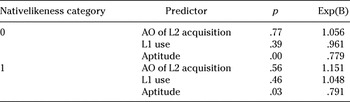
Factors Contributing to Nativelike Grammatical Intuition in L1 and L2.The predictor variables AO of L2 acquisition, daily L1 use, and language aptitude were entered as metric independent variables in a multinomial logistic regression analysis, with nativelikeness category membership as a dependent variable, and the nativelikeness category 2 (i.e., nativelike in both languages) as a reference group. The outcome of this analysis showed that the only significant predictor for nativelike performance in both the L1 and L2 was language aptitude (see Table 4).Footnote 10 More specifically, the analysis showed that the lower the degree of aptitude, the greater the likelihood of belonging to nativelikeness categories 0 or 1. As indicated by the odds ratios, as aptitude degree increases by one point (i.e., on the test), the odds of belonging to nativelikeness categories 0 or 1 compared to category 2 decrease by slightly more than 20% (.779 and .791, respectively).Footnote 11
p values and odd ratios (Exp[B]) for variables predicting GJT performance

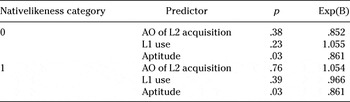
Factors Contributing to Nativelike Semantic and Grammatical Inferencing in L1 and L2.A multinomial logistic regression was run to determine which independent variables could predict nativelikeness category membership for cloze test performance. Similar to the GJT results, language aptitude turned out to be the only significant predictor for nativelike-nonnativelike behavior in L1 and L2 (see Table 5).Footnote 12 The likelihood of belonging to nativelikeness categories 0 or 1—as opposed to category 2, or nativelikeness in both languages—increases significantly by approximately 14% (.861 and .861, respectively) for each unit (i.e., test score) that language aptitude decreases.
p values and odds ratios (Exp[B]) for variables predicting cloze test performance

In regards to the second research question, which asked what factors might contribute to an early bilingual attaining nativelike performance in both, one, or neither language(s), the results showed that language aptitude was the only variable that could predict the bilinguals’ language proficiency—the higher the degree of aptitude, the more probable a person was to perform in a nativelike way, and vice versa. AO of L2 acquisition and daily L1 use did not exert a significant effect on this behavior.
DISCUSSION
This discussion of findings focuses on two main points: first, the positive relationship found between L1 and L2 nativelike proficiency and, second, the implications of the finding that nativelike performance was intimately connected to language aptitude.
L2 Ultimate Attainment and Its Relationship to L1 Maintenance
The current results show that those participants who behaved like native speakers in the L2 were more likely to do so in the L1 as well. This behavior was consistent across two different, global measures of language proficiency. The finding that L1 and L2 nativelike behaviors were positively—and not inversely—related constitutes evidence against impediment accounts of L2 acquisition because it shows that a low level of L1 proficiency is neither necessary nor beneficial for L2 nativelike attainment. As such, this finding is also at variance with the results presented by Yeni-Komshian et al. (Reference Yeni-Komshian, Flege and Liu2000), which showed a negative correlation between L1 and L2 pronunciation proficiency in early bilinguals. Two possibilities should be considered when accounting for this discrepancy: The most obvious one is that whereas the current study has looked at morphosyntactic intuition and semantic and grammatical inferencing skills, Yeni-Komshian and associates examined global pronunciation. It is, in other words, not inconceivable that an impediment interpretation of age effects in L2 learning is correct when applied to phonology and phonetics only but not when applied to the broader context of linguistic structure in general (see also Bylund, Reference Bylund2011).
Another possibility, however, is that inverse L1 and L2 proficiency levels need not reflect causality. This was pointed out by Long (Reference Long, Hyltenstam and Viberg1993), who suggested that whether negatively correlated L1 and L2 proficiency levels “reflect varying communicative needs in the two languages, differential opportunities for their use, or some underlying cognitive, neurolinguistic or social-psychological constraints on the human capacity to control two languages at nativelike levels is unclear” (p. 208). It is, indeed, quite possible to imagine that a negative correlation between L1 and L2 proficiency (e.g., high L2 proficiency and low L1 proficiency) can be a product of different communicative needs and opportunities of use. The typical scenario would be that of an individual who moves with his or her family to a L2 context during childhood and gradually abandons the L1 due to the fact that the number of L1 interlocutors and L1 contexts is comparatively low. As a consequence of this disuse, the L1 will stop developing and eventually attrite. The L2, in contrast, is present in virtually all social domains (with the possible exception of the family) in the life of this individual. Due to the pervasive presence of the L2, this young individual can be expected to develop advanced L2 skills. In such a scenario, it cannot be claimed that there is any causality to the negative relationship between L1 and L2 proficiency, in the sense that success in the L2 occurs because the L1 is weakened (in fact, the scenario sketched here is reminiscent of the findings on language shift in immigrant children reported by Jia & Aaronson, Reference Jia and Aaronson2003, and Kohnert, Bates, & Hernandez, Reference Kohnert, Bates and Hernandez1999).
There is another factor that may give rise to inverse L1 and L2 levels in addition to differential opportunities for use. Within the past few years, several researchers have observed that during the first decade of life, the heightened plasticity of a child’s language processing system not only allows the child to acquire an additional language at a high rate of success but also makes the child’s L1 highly susceptible to attrition (Bylund, Reference Bylund2009b; DeKeyser, in press; Köpke & Schmid, Reference Köpke, Schmid, Schmid, Köpke, Keijzer and Weilemar2004; Montrul, Reference Montrul2008).Footnote 13 As a consequence, if the opportunities for using the L1 are seriously reduced, whereas the amount of contact with the L2 is massive, the effects of these differential communicative needs on language proficiency will be further pronounced owing to the maturational state of the child. Again, what is important to underscore here is that the maturational state of the bilingual child, is not one of causality in the sense that there is no underlying constraint balancing the proficiency gains and losses in each language. It is important to note, for example, that Montrul’s (Reference Montrul2008) in-depth discussion of maturational constraints in language acquisition and retention is void of any suggestion about a relationship of causality between inverse L1 and L2 proficiency levels.
Given the scarcity of empirical evidence regarding L1 and L2 proficiency interaction, it is, however, difficult to ascertain whether inverse proficiency levels are truly a result of differential communicative needs and opportunities of use, or constraints on processing and representation capacities, as suggested by impediment accounts. Nevertheless, it is possible to argue that there are certain findings (apart from the current results) in support of the interpretation that L1 maintenance does not impede L2 nativelikeness, and by extension, when inverse L1 and L2 proficiency levels are found, this need not be evidence of causality. First, there is the evidence of nonnativelikeness in the L2 in studies on international adoptees. If there were an interaction between L1 and L2 levels, in the sense that the L1 impedes nativelikeness in the L2, then one would expect that the less L1 there is, the greater the chances of achieving a L2 level indistinguishable from that of native speakers. However, in Hyltenstam et al. (Reference Hyltenstam, Bylund, Abrahamsson and Park2009) it was found that international adoptees performed at the same nonnative level in their L2 as bilingual L2 speakers. Given that the adoptees were not able to utter a single word in their L1, in contrast to the sequential bilinguals who were fully functional in their L1, one would have expected the adoptees to be—if not fully nativelike in their L2—at least closer to nativelike performance than the bilingual L2 speakers.
The second piece of evidence comes from the study of delayed L1 acquisition. Findings from studies of congenitally deaf children with delayed exposure to sign language (Mayberry, Reference Mayberry1993, 2007; Mayberry & Lock, Reference Mayberry and Lock2003) as well as of children who have suffered from severe otitis media during the first year of life (Ruben, Reference Ruben1997, Reference Ruben1999) show that if there is a minimal delay in initial exposure to language, nativelike attainment is compromised. In these cases, it is hard to explain why individuals with little or no previous experience with language, and consequently no prior linguistic entrenchment, still seem to be affected by age of onset in the same way as individuals who would be characterized as having acquired potentially entrenching L1 skills. If L1 entrenchment is the actual mechanism underlying the age of onset effects documented in studies on L2 ultimate attainment, then there is no apparent reason to expect effects of the maturational state of the learner in any language-learning situation.Footnote 14
In view of these less typical language-learning situations, the current discussion about L1 entrenchment effects needs to be wider in scope. So far, the learner profile that has constituted the point of departure for this discussion has been that of an individual who moves to a new linguistic environment and retains his or her L1 while acquiring the L2. Even though such a profile is common, it is easy to see how the degree of L1 development (and with this, the alleged L1 entrenchment) may be confounded with the age of acquisition onset: If both L1 entrenchment and maturational effects increase over age, how is the one to be disentangled from the other? To move beyond this potential confusion and assess the interpretation that it is L1 blocking effects rather than the learner’s maturational state that underlie nonnativelike attainment, research will benefit from directing attention to less typical—but nonetheless very informative—language-learning situations, such as those of international adoptees, or cases of delayed L1 acquisition. When confronted with these situations, it is necessary to think beyond explanations of nonnativelike attainment based on blocking effects of previously acquired linguistic knowledge.
Bilingual Proficiency and Language Aptitude
The second point to be treated in this discussion concerns the relationship between bilingual proficiency and language aptitude. The current findings showed that language aptitude was the only factor under scrutiny that could predict nativelike proficiency in both languages, and they demonstrate, for the first time, the effects of aptitude on bilingual ultimate attainment. Neither daily L1 use nor AO of L2 acquisition was found to exert a significant effect on bilingual nativelikeness. This result does not mean that the degree of L1 use or AO of L2 acquisition may not be important for L1 and L2 proficiency when these are examined separately (e.g., Bylund et al., Reference Bylund, Abrahamsson and Hyltenstam2010; DeKeyser et al., Reference DeKeyser, Alfi-Shabtay and Ravid2010; Flege et al., Reference Flege, Frieda and Nozawa1997; Johnson & Newport, Reference Johnson and Newport1989; Yeni-Komshian et al., Reference Yeni-Komshian, Flege and Liu2000); rather, it suggests that these factors play a less prominent role in the total makeup of early bilingual proficiency.
The role of language aptitude documented in this study has important implications for informing the view that, in the bilingual speaker, processing and representation of one language consumes capacity from the other language. Instead of assuming a generalized limited capacity for bilingual proficiency, the current results propose that accounts of bilingual development need to take into consideration the fact that there is individual variation in the capacity to handle language structure. The current findings clearly show that language aptitude plays an important role for ultimate attainment in early bilinguals: Individuals with higher degrees of aptitude are prone to reaching nativelike proficiency in both languages, whereas individuals with lower degrees of aptitude are likely to do so in neither language. Recognizing that the ability to acquire and retain linguistic knowledge varies across individuals constitutes an important step in changing the indiscriminant view that the capacity of the human mind sets limits for the degree to which bilinguals can attain proficiency in their two languages.
How, then, does the relationship between language aptitude, L1 proficiency, and L2 proficiency work? Whereas the effects of higher degrees of language aptitude on bilingual ultimate attainment can be interpreted in a fairly straightforward way (i.e., a high aptitude level supposedly enables full acquisition of two language systems), the effect of lower degrees of language aptitude on bilingual proficiency is less transparent. The question that arises here is whether there is interplay between L1 maintenance and L2 ultimate attainment when aptitude is low. For example, two individuals, A and B, both with equally low degrees of language aptitude, move during childhood from a L1 to a L2 environment. Whereas the L1 system of individual A undergoes an apparently complete loss due to the lack of any L1 contact, individual B is continuously exposed to the L1, thus maintaining and developing this language for his or her use. Provided that L1 maintenance was the only variable differentiating A and B, would the L2 proficiency of these individuals differ? Or, more specifically, would individual A exhibit a higher L2 proficiency as a consequence of having lost the L1? Obviously, the current study cannot provide an answer to this question, and this issue is left open for further inquiry. If, however, it turns out that low-aptitude monolingual L2 speakers exhibit greater levels of L2 proficiency than low-aptitude bilingual L2 speakers, this would undoubtedly add another dimension to the understanding of the conditions under which L2 nativelikeness is attained. Such a finding would show that overall statements about positively or negatively related L1 and L2 levels are problematic because generalizations cannot cover an entire group of speakers whose bilingual and aptitude profiles provide them with different possibilities for acquiring an additional language.
The final observation presented in this discussion of bilingual proficiency relates to the fact that even though half of the participants performed like natives in both languages, a considerable portion of the remainder was not nativelike in either language. At first glance, this finding could be perceived as carrying a negative load, in the sense that it can be related to the semilingualism debate of the 1970s and 1980s, and to arguments about bilingualism being detrimental to linguistic and cognitive development (see Hansegård, Reference Hansegård1968; Hyltenstam & Stroud, Reference Hyltenstam and Stroud1982; Martin-Jones & Romaine, Reference Martin-Jones and Romaine1986; Stroud, Reference Stroud1978). For this very reason, it is of the utmost importance to bear in mind that the test instruments used in the current study were designed to be as demanding as possible, to distinguish between near-native and nativelike proficiency. Thus, the fact that an individual scored below the native range on these tests does not at all mean that he or she would merely have a rudimentary knowledge of the languages under scrutiny. It should be remembered that the participants had attained high enough levels of L2 proficiency that they could be perceived as native speakers of Swedish in screening tests (see the Method section). Moreover, during the test sessions, the participants exhibited fluency in both languages in activities such as interviews and narratives tasks. It thus becomes clear that the label semilingualism is not applicable in the current context.
CONCLUSIONS
This study set out to investigate the relationship between L1 and L2 ultimate attainment in early bilinguals. First, the results demonstrated that those bilinguals who exhibited nativelikeness in the L2 also did so in the L1, and vice versa. These results are clearly at odds with an impediment interpretation of nonnativelikeness in early L2 learners and provide important information for current discussions on L1-blocking effects—which to a large extent have been characterized by the absence of empirical evidence. Second, it was found that nativelike proficiency in both languages was positively correlated with language aptitude. This finding has important implications for basic assumptions of constraints on language processing and representation, as it demonstrates the impact that individual variation in the capacity to handle language structure has on bilingual ultimate attainment.
The impediment accounts discussed in this article share a family resemblance with frameworks that conceptualize the bilingual speaker as qualitatively different from monolingual speakers (e.g., Cook, Reference Cook2003, 2011; Grosjean, Reference Grosjean1998). Both the impediment construct and accounts such as Cook’s multicompetence framework recognize that the bilingualism that typically characterizes L2 speakers is an important ingredient in their L2 knowledge. Such a holistic approach to L2 acquisition is welcome, and the fact that most L2 speakers are actually bilingual should not be disregarded. The extent to which bilingualism exerts an influence on L2 ultimate attainment, however, must be subject to empirical research. That is to say, apart from these theoretical considerations about bilingualism effects in SLA, it is clear that what is most needed is further empirical research on the role of L1 for L2 nativelikeness. An important task for future research should consist of examining the possibility that if there are L1 impediment effects on L2 ultimate attainment, there may be differential effects on different linguistic subsystems, and even on specific components within those subsystems. Such an approach offers the possibility of providing a nuanced and comprehensive picture of the relationship between L2 ultimate attainment, L2 acquisition onset, and L1 maintenance.
Appendix A
Sample sentences from the Spanish GJT (gender agreement):
1. La actriz que desempeñó el papel de viuda en la última película del gran director italiano fue nominada a varios premios prestigiosos.
“The actress that played the role of widow in the last film of the great Italian director was nominated for various prestigious prizes.”
2. *Las cartas del rey, que en su versión original contenían mucha crítica contra el trabajo del obispo, fueron censurados [censuradas] por la Iglesia.
“The king’s letters, that in their original version presented much critique towards the bishop, were censored by the Church.”
APPENDIX B
Sample sentences from the Swedish GJT (gender agreement):
1. Värdena som legat under det normala i flera veckor och därför inte rapporterats till myndigheterna var nu plötsligt starkt förhöjda.
“The levels that had been below normal for several weeks and therefore not reported to the government authorities were now greatly increased.”
2. *Skjulen som varit skymda av den höga stenmuren och därför inte existerat i folks medvetande blev nu helt blottlagd [blottlagda].
“The sheds that had been hidden by the high stone wall, and therefore nonexistent in people’s consciousness, were now suddenly entirely exposed.”
APPENDIX C
Sample sentence from the Spanish cloze test (gaps represented by parentheses):
En 1923, un terremoto terrible (devastó) la ciudad, lo cual tuvo por (consecuencia) que las casas de madera quedaran (destruidas) por el fuego.
“In 1923 a terrible earthquake [ravaged] the city, with the [consequence] that the wooden houses were [destroyed] by fire.”
APPENDIX D
Sample sentence from the Swedish cloze test (gaps represented by parentheses):
Den kanadensiska storstaden Toronto, som med (sina) två miljoner invånare, av vilka de (flesta) är av brittiskt ursprung, är Kanadas (näst) största stad, ligger på norra sidan (av) Ontariosjön.
“The Canadian city Toronto, which with (its) two million habitants, (most) of which are of British origin, is the (second) largest city in Canada, is situated on the northern side (of) the Ontario Lake.”