‘Other nations in history have fought in foreign lands and remained to occupy and exploit. Americans, following a battle, want nothing more than to return home …’George W. Bush
Two recent American wars in the Middle East have reawakened discussions of American Empire.Footnote 1 In contrast to traditional patterns, however, the United States appears to have no desire to acquire more territory. Whether empire requires physical expansion and colonization, or simply ‘effective control’ of another society,Footnote 2 seems to us to be largely definitional.Footnote 3 Labelling American motives and practices as imperial, hegemonic or something else is perhaps less critical than attempting to understand why such behaviour exists and evolves over time.Footnote 4 We seek to explain the acquisition or abandonment of colonial holdings, offering an account that ties together the rise and fall of territorial expansion with the current American penchant for influence rather than long-term occupation. Developed nations exhibit little of the traditional preoccupation with obtaining land and resources through force. The appeal of colonial holdings evaporated for leading nations by the mid-twentieth century. Rather than reflecting an exception to traditional tendencies, American efforts represent secular change in the imperatives of power; owning land or minerals matters much less than guiding the global commons.
One of the defining characteristics of the modern world has been the cycle of the European empire. In it, the familiar pattern of expansion and contraction is readily discernible.Footnote 5 Yet while acts viewed as ‘imperialist’ may persist today, no nation or set of nations has come forward to pick up the gauntlet of empire. The world's richest and most powerful countries show little interest in the continuous administration of foreign territory, as opposed to attempting to influence, intimidate or coerce foreign sovereigns and polities. These same powers are also vigorously opposed to allowing other countries to pursue any territorial ambitions. What some have labelled a norm of territorial integrity seems to us to require further explanation.Footnote 6 What motivates an end of empire? Can we expect this phenomenon to continue or will the future return to historical patterns of imperial growth and decay? The notion of American Exceptionalism implies that other, less ‘exceptional’ nations will someday resurrect these more traditional patterns. China or India, for example, might use growing economic and military potential to expand at the expense of their neighbours. Alternatively, rising powers may find that control of physical space is best accomplished by proxy, ensuring that other countries accommodate Beijing or Delhi, rather than by actually having to conquer, and administer, marginally productive places that are geographically distant from the metropolis.
We offer a theory of imperialism and decolonization based on the dynamics of systemic structure, military technology and economic development. Random capability shocks create military advantages that gradually decay as insights fade or equipment becomes outdated or as accumulating capital forces a change in the logic of military organization that dilutes initial military advantages. Military capability shocks by themselves can explain the cycle of empire, but not the secular trend away from territorial expansion. A second feature, economic development, has led nations gradually to prefer commerce to conquest. Capital abundance makes empire expensive, shifting incentives away from appropriating inputs to production and towards efforts to influence the terms under which nations interact. A third element explains the timing and rapidity of decolonization. Conquest imparts political control that invites the vertical integration of economic processes. Mercantilism in turn impels other countries to acquire or maintain colonies in order to access markets and inputs to production. This imperialist prisoner's dilemma is reversed once influential actors prefer free market policies, allowing other countries to abandon empire as well. The theory predicts that territorial empire is archaic. Power in the modern world derives from productivity rather than from raw materials. The lust for land could return, however, if inputs again become scarce, if military technology lowers occupation costs, or if powerful nations fail to perpetuate and abet open markets.
Literature: Tropes Of Empire
Lasting over three and a half centuries, the age of imperialism profoundly shaped the modern world. The classical practice of territorial expansion virtually ended soon after the Second World War, but the institutions and economies of the often contrived successor nations formed to manage abandoned colonial holdings remain heavily conditioned by their dependency.Footnote 7 Territorial imperialism has been widely criticized both duringFootnote 8 and after its formal practice.Footnote 9 Considerable attention also focused on the consequences of decolonization.Footnote 10 Yet, while many scholars examine the origins of empire,Footnote 11 its practiceFootnote 12 or demise,Footnote 13 less effort has been devoted to relating historical cycles of expansion and decay to the secular, and precipitous, terminus of territorial empire in the mid-twentieth century.Footnote 14
Explorations of contemporary imperialism seem more rhetorical and didactic than deductive or analytical.Footnote 15 Discussion of American empire has ebbed and flowed with shifting American power,Footnote 16 and with a variable landscape of international actors.Footnote 17 Careful research has focused on an evolving logic of hierarchy,Footnote 18 or on the role of American hegemony in deterring territorial aggression.Footnote 19 Absent is an account of why, in fact, things are not more like they used to be.
Explanations for Imperialism
Explanations for empire focus on the demand of the metropolis for riches, resources, markets or jobs; on the supply of targets for conquest; or on system-level factors that condition colonial opportunities or demand.Footnote 20 Hobson, Lenin and others claimed that the imperial impetus comes from over-extended capitalism.Footnote 21 Snyder views instead political and military elites as the cause of empire, while jingoistic propaganda deceives the masses.Footnote 22 Dependency theorists shift the emphasis to political tensions and economic incentives on the periphery.Footnote 23 Agents co-opted by the metropolis undermine developing nations. A third category of argument involves structural theories from realists,Footnote 24 to Marxist historians like Wallerstein,Footnote 25 to long-cycle theorists.Footnote 26 Empires expand or contract in an organic fashion, responding in an unending cycle of world power or prosperity.
Explanations for Decolonization
Scholarship on the end of empire can be grouped by supply-side, demand-side and system-structural approaches. Some researchers emphasize domestic politics in the metropolis.Footnote 27 The need of landed nobles to provide employment for ‘second sons’ may have dissipated with the rise of other more fungible forms of property. Alternately, democracy itself may have shifted the domestic political calculus. A second perspective emphasizes colonial resistance and/or the decline of the European educated ‘comprador’ class of native elites.Footnote 28 Finally, other researchers favour international factors, such as the ‘demonstration effect’ of initial Japanese victories over the Western colonial powers in the Second World War, or the rise of an anti-imperialist bipolar system during the Cold War.Footnote 29
Putting Together Growth and Decay
Students of world affairs have long been interested in the rise and fall of great powers.Footnote 30 The ‘world-economy’ approach has been particularly influential in conjunction with the dependency theory.Footnote 31 Inequality varies between core and periphery.Footnote 32 Economic stagnation leads to imperial conquest, while booms reduce interest in colonial holdings. The world-economy model thus pays more attention to long economic cycles than to the variable costs of colonial occupation.
Economic determinists stress that imperialism is the inevitable product of capitalist expansion.Footnote 33 Changes in the economies of capitalist countries forced Western powers to seek dependencies that continue today in the post-colonial periphery.Footnote 34 However, Marxist thinkers in particular are less interested in explicating the forces driving divestment of colonial holdings.
Institutionalism emphasizes political and social factors as the leading determinants of imperial growth and decay.Footnote 35 Empire and decolonization result from shifting power relations among beneficiaries and those hurt by colonialism.Footnote 36 Competition is intensified by political liberalization in the metropolis,Footnote 37 or by metropolitan cultural traditions.Footnote 38 Yet institutionalists face a heavy burden in explaining the persistent impotence of anti-colonialist ideas, as well as their sudden salience. Rapid decolonization, in a context of dramatic economic change, suggests the value of economic incentives in bolstering institutionalist arguments. Indeed, as the other two approaches make clear, many view the colonial enterprise as fundamentally economic, even as other factors play significant roles.
Only a few studies attempt to explore intensively the micro-foundations for colonial expansion and decline. According to Grossman and Iyigun, investments in colonies could be profitable due to monopoly rents, provided that the risk of insurrection is low.Footnote 39 Increasing the insurrection technology or size of local populations could make colonization unprofitable, eventually triggering an abandonment of empire.Footnote 40 These studies rely on largely exogenous changes in the colony to explain the end of empire. Nationalism or insurgency could make colonialism more expensive.Footnote 41 But these same challenges confront domestic sovereigns who nevertheless strive to retain power. It seems unlikely that these changes alone explain the rapid and widespread divestment of colonial holdings. The question of why modernity has trended away from empire remains to be explained.
Territory ‘Ain't What It Used To Be’: Cycles And Trends
We offer a theory combining the flow, ebb, persistence and demise of territorial empire that focuses on three factors. First, exogenous military capability shocks create the opportunity to reallocate territory through colonization.Footnote 42 Secondly, occupation encourages mercantilist economic policies, in turn increasing incentives for other nations to acquire colonies. Finally, development produces a secular decline in the value of colonial holdings, while making occupation less efficient. Other influences on empire, including democratization in the metropolis, and nationalist sentiments and resistance movements in the colony, are explored in the modelling section and in two appendices.Footnote 43
Military Effectiveness: The Onset and Diffusion of Shock and Awe
Anecdote and logic suggest that the advent of empire is closely tied to the ability and incentive to project power.Footnote 44 Empire generally begins with new military, economic, transportation or logistical technology that suddenly allows one country to conquer and control other states or territories.Footnote 45 Capability shocks are thus a necessary, but not sufficient, condition for imperial expansion. Conversely, military and other advantages borne of technological innovation diffuse over time. Targets of empire have incentives to adapt, absorbing technologies and limiting or eliminating advantages of the imperial power.Footnote 46 Unless the imperial power continues to innovate, it eventually declines.Footnote 47 As one British historian describes the situation, ‘we had a comparative advantage as an island seapower. It was then enlarged and sustained because we secured the further comparative advantage of being the world's first industrial nation. These advantages first shrank and then disappeared.’Footnote 48
European expansion and colonization took place in the context of dramatic increases in the administrative, transportation and military capabilities of European states.Footnote 49 This transformation and its consequences for European politics are discussed elsewhere.Footnote 50 Accounts of the origins of these dramatic increases in capabilities vary. Some authors argue that harsh competition pushed European powers to develop more powerful arms and armies.Footnote 51 Others emphasize financial innovations which permitted powerful militaries, and particularly navies.Footnote 52 Still other research identifies a symbiosis in which states promoted a European state system, which in turn privileged states as actors.Footnote 53 For our purposes, identifying the origins of these innovations is less pertinent than explaining why waves of technological and administrative change propelled adventurers, then armies, to distant places and why this impetus later ebbed and evaporated, and has not returned.Footnote 54
The cyclical nature of empire,Footnote 55 and of military advantage,Footnote 56 are well established, if somewhat stylized, empirical facts. What is less well understood is whether there exists variation in the motivation for empire. Some scholars argue that the urge to conquer is ubiquitous, occurring in all nations at all times and held in check only by the lack of technological advantage or martial expertise, or alternatively by mutual deterrence.Footnote 57 Alternately, one can conceive of the impetus to empire as particularistic, housed in the aspirations of individual leaders, and thus more stuff of historical and biographical research than of social science. We view the preference for territorial aggression as a variable driven by environmental conditions that can recur or trend over time.
A second aspect of military innovation involves specialization. Armies can be used to fight and win wars against other armies, or to control the populations and territories of subject places. Winning at war involves massing military power against critical elements of an opposing force.Footnote 58 Controlling civilian populations involves exerting limited force in many places at once. Innovations in military technology presumably influence the classic elements of firepower, mobility and protection.Footnote 59 While the last two elements increase the ability of a military force of a given size to exert combat power and to control a populated space, the first factor leads optimal force structure in different directions. Heavy (strategic) bombers and missile cruisers are ineffective tools for crowd control. The logic of conventional war increasingly demands relatively large allocations of capital. In contrast, the logic of conquest and control calls for ‘old fashioned’ labour-intensive force structures – many soldiers with relatively little mechanization. The divergence of optimal force structures should mean that sophisticated capital-intensive militaries, armies that tend to win the wars they fight, should be less and less effective as occupiers. To the degree that the determinants of battlefield and colonial effectiveness differ, and to the extent that resources available to the military are finite, nations contemplating colonizing another country must choose between a military that is optimized for conventional combat, and a force structure intended primarily for occupation.
Economic Development: When Empire Pays, and When It Does Not
A central debate in the study of imperialism is over how much nations profited from empire.Footnote 60 While a number of studies provide evidence that colonies could be profitable, at least over certain periods,Footnote 61 scholars remain divided in their reading of the ‘balance sheet’ of empire.Footnote 62 This debate is instrumental to our objectives in explaining the basic imperial dynamic, however. We note simply that colonial conquest offered a perceived economic benefit to key constituencies or decision makers. Subsequently, the value of empire declined. If colonial holdings were never profitable (we doubt this), then rising costs of control, or declining benefits from markets or resources would eventually make clinging to empire prohibitive. Alternately, if empire was never a net drain on the imperial exchequer (we doubt this too), then plummeting profits must still weaken the forces of colonialism and embolden opponents. Social forces within the metropolis (i.e. democracy) or in the colony (i.e. nationalism) could also have tipped the balance sheet, as we discuss later. The critical issue, which appears to be widely accepted, is that the economic benefits of empire declined over time.Footnote 63
Nations, like firms or individuals, must address their wants through some combination of production, purchase and theft.Footnote 64 Stealing is appealing when taking is more lucrative than making or trading.Footnote 65 Theft can be preferred to purchase or production when the technology of stealing (appropriation) is relatively advanced, when the inputs to theft are relatively abundant, and when that which is taken is relatively valuable. Within borders, muggings and other property crimes tend to be committed by unemployed or unskilled labour.Footnote 66 Governments attempt to reduce the appeal of private theft by limiting access to the technology of appropriation (regulating firearms, explosives, locksmiths, etc.) by improving the productivity of non-appropriative labour (schools, vocational training), or by reducing the expected benefits of theft (police and prisons).Footnote 67
In contrast, the international system lacks some of the tools available domestically to discourage appropriation.Footnote 68 Across national borders, governments or populations seek to prevent aggression by making conquest expensive (defence) or occupation unprofitable (nationalism, ‘scorched earth’ policies). Countries cannot much alter the productivity of foreign labour, however, and typically nations control their own appropriative technology. International incentives for choosing production over predation thus depend heavily on environmental conditions, and on exogenous change.Footnote 69 If, for example, labour productivity rises in countries with the best appropriative technology, or if labour becomes scarce in these economies, while capital abundance drives down returns on appropriated capital, then countries capable of conquest will no longer covet colonial holdings, though these countries may continue to use force in a punitive manner for other political (policy) reasons.Footnote 70
The question of whether to trade or take is one civilizations have confronted throughout history.Footnote 71 Indeed, the two processes are linked. Vikings, the marauders of feudal Europe, were also the chief merchants of the era.Footnote 72 After robbing the churches and great houses, they often established trading posts where less lucrative goods were bought and sold.Footnote 73 Bank robbers often have bank accounts, while mobsters and petty criminals rob one person in order to pay another. Identifying how nations profit from particular combinations of trade and theft is central to the logic of empire.Footnote 74
The Imperialists’ Dilemma: ‘Mercantilism Made Me Do It’
Imperialism creates an opportunity for states to engage in anti-competitive economic behaviour.Footnote 75 The metropolis is in a position to determine whether trade will be allowed with third parties.Footnote 76 These incentives extend beyond the dependencies of any imperial power when vertical integration restricts the growth of non-imperialist states. Barriers to market entry and to raw materials in foreign colonies encourage nations to seek their own colonies and to adopt mercantilist policies.
Prisoner's dilemma beggar-thy-neighbour colonial policies ensured that industrializing states sought colonial holdings to gain access to markets and resources. As key imperial powers chose to prevent other nations from trading in their colonial hinterlands, nations experiencing follow-on industrialization were forced to choose between limited growth and entry into empire. The mad rush to conquer the remaining unclaimed portions of the globe followed, not so much because every property was profitable, but because staying home ensured that possible future profits would never arise. The process of territorial ‘crowding out’ reversed itself once the predominant power no longer sought markets through colonial occupation, but instead used its leverage to open access.
Preliminary attempts by the United States to acquire colonies suggest that moral opposition to empire could be contained.Footnote 77 Instead, later industrialization and large internal markets gave the United States a comparative advantage in free trade, while colonial expansion threatened war with Europe.Footnote 78
Modelling Imperialism
We construct three main versions of a game-theoretic model of imperialism: a basic model of the effects of power, technology and economic development, a second model of domestic political liberalization and a third model that examines the role of system effects (mercantilism) in perpetuating empire. Supply-side arguments (nationalism, colonial populations) are modelled by varying the cost of appropriation. Additional treatments (the size of empire, insurgency) appear in two appendices.Footnote 79 We begin with two actors (N, S) that represent tribal groups, countries or regions of the world.
The Basic Model
We can think of the potential for colonization as ‘lumpy’. A critical mass of fighting effectiveness and labour is necessary before a state can achieve any result. Warships and adventurers were needed before Europe could discover, and then conquer, the New World. Even neighbouring states must acquire some minimal level of capabilities to engage in territorial aggression. Appropriative activities thus only occur if the fighting effectiveness ρ is higher than some arbitrary level  . Formally, the restriction
 ensures that a state projects power only when the threshold has been exceeded.
The production functions for actors N and S are displayed as Equations 1 and 2 below:


where y= production output, L= labour allocated to domestic production, K= physical capital and land stock, α, β= total factor productivities, and where a,b,c,d= exogenous parameters.
These production functions take the standard Cobb–Douglas form, where output depends on the two factors of production, capital K and labour L, which are complements and are subject to decreasing returns (i.e. a < 1, b < 1, c < 1, d < 1). Actors also have a time endowment normalized to 1 and choose a proportion of time to allocate to production and to appropriation or defence:

where F= time devoted to appropriation, D= time used for defence, and where i∈[N,S].
Imagine that N develops a technological advantage. Europe's historical turning point began in the late feudal period when ideas and technology from the Muslim world diffused through Europe.Footnote 80 At this stage, neither N nor S has reached the technological threshold for overseas conquest  . By the fifteenth century, however, N reaches the threshold, while S does not,
 .
In the age of imperialism,  . S cannot colonize N. Accordingly, S always chooses FS = 0. Thus, the time constraint of S becomes LS + DS = 1. Since N will not be attacked by S, N chooses DN = 0 and its time constraint becomes LN + FN = 1. Thus, there is asymmetry in the incentive structure of the two players. This simplifies the analysis and reflects historical conditions.
Colonizing an opponent entails appropriating land and physical capital, assets that are valuable but can either be bought or stolen. The prospects of colonization are endogenous in our framework and depend on the fighting efforts of N and S. We first discuss the potential corner solutions where one or both actors select zero fighting effort. Clearly, when FN = 0, no colonization takes place. In this case, there is no fighting and both actors just receive their own domestic production: N receives the entire yN, and S the entire yS. Further, if N makes a positive appropriation effort FN > 0, but S fails to defend itself DS = 0, we assume that N captures the whole production of both actors. Note, however, that in equilibrium we never observe FN > 0 and DS = 0, because S would always be better off selecting a positive defence level (as we discuss further below).
We next introduce the payoff functions for interior solutions when both players select positive fighting efforts, FN > 0 and DS > 0. We assume that the part of the land and physical capital in S captured by N depends on the difference between the fighting efforts of N and S. When FN is much larger than DS, we assume that on average N captures a large part of KS, while N captures an intermediate portion of KS when FN and DS are of similar size, and so on. Use of a linear appropriation technology allows for a tractable model with production functions with decreasing returns to labour and capital (i.e. Cobb–Douglas).Footnote 81 As actors trade off concave production gains with linear appropriation gains, there is always a unique interior optimum involving positive fighting levels of both players. Formally, Equation 4 represents the payoff (utility) function for actor N:

where ρ= fighting effectiveness or latent power (0 < ρ < 1), and θ=a parameter (0 < θ < 0.5).
N's payoff equals its production output  , plus what capital and territory it ‘steals’ from S. The term
 is the ‘contest success function’.Footnote 82 As mentioned above, the greater the appropriation effort of N, and the lower the defensive effort of S, the more capital and territory N gains. The parameter θ refers to the decisiveness of the fighting effort. If
 , fighting is perfectly effective in determining distribution, whereas if θ = 0, the time spent on fighting has no effect on the distribution of benefits.Footnote 83 We also include a friction component to the fighting effort (1 − ρ). Improvements in military effectiveness or capabilities (higher ρ) make appropriation more efficient, which also means that N has less to lose by fighting S.
We shall now look inside the ‘black box’ of fighting effectiveness or latent military power. It is important to distinguish between the concepts of ‘fighting effectiveness’ and ‘fighting technology’. While the first concept refers to how successful a state is at appropriating or controlling colonial holdings for a given level of fighting effort, the second refers to the capital intensiveness of an army (i.e. the capital:labour ratio of defence or appropriation). Development leads to capital accumulation and results in the substitution of capital for labour in both civilian production and the military. This substitution (an increase in fighting technology) is usually less than one to one. Hence, it makes sense to think of fighting technology as a concave, increasing function of total factor productivity. This higher capital-intensity of the army may or may not lead to greater fighting effectiveness (although if it does improve fighting effectiveness, we can assume that this rise is also less than one to one). While it is reasonable to think that military technology is very important for conquest (e.g. ships are crucial), for the control of the colonized populations labour may matter more than capital, and capital-intensive high-tech armies may not perform as well.
Given this, fighting effectiveness, ρN and ρS, respectively, can be seen as a concave function of the total national factor productivity denoted by α and β. We assume that ρN is a concave function of α, and that ρS is a concave function of β, as increases in the general technology level of a society result in less than proportional increases (or even decreases) in fighting effectiveness. Technology requires military specialization, which optimizes force structures for battlefields versus riot control or counterinsurgency.Footnote 84 Factors such as muscle power and the morale of personnel are also effectively fixed; thus, doubling a country's weapons less than doubles the country's military strength. A functional form that reflects this reasoning is ρ = kα μ, where k= constant, μ < 1.Footnote 85
Introducing the time constraint LN + FN = 1 into N's payoff function and solving for first order conditions, we obtain N's optimal level of LN:

where  = the optimal level of LN, and other variables or parameters are as described. For simplicity, we will focus on parameter values for 0 <
 < 1, which guarantees that there always exists an interior solution, and which is the most interesting case for our research question.
Note that this interior  is the unique solution in the basic framework. An equilibrium of no appropriation and no defence would not be sustainable as N would always have incentives to deviate and choose some positive level of appropriation. Similarly, for positive appropriation efforts of N, S would also always have incentives to select positive levels of defensive activities.
N's optimal production level increases with total factor productivity, and decreases with fighting effectiveness (its military power or capabilities). Productivity increases encourage domestic production, while greater military power makes it more appealing to appropriate (steal) land or capital from S. The net effect of production technology on labour time is positive, however, as productivity increases yield less than proportional increases, or even decreases, in fighting effectiveness.
The payoff function for actor S follows a similar logic. S can either invest time into production or defence. Its payoff simply corresponds to its economic output that is produced using its remaining capital (the part that has not been appropriated by N) and its time devoted to labour. Formally:

The part of KS controlled by N,  , and the portion owned by S,
 , sum to 1. Introducing the time constraints, LS + DS = 1 and LN + FN = 1, and setting the first derivative of Equation 6 with respect to LS equal to zero, we obtain S's reaction function:

where  = the optimal level of LS, and other variables or parameters are as described. As expected, S's defence effort increases (lower LS) in N's colonization effort (lower LN).
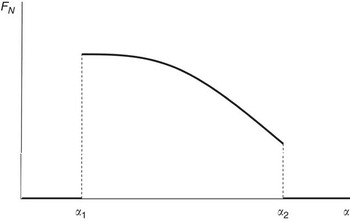
The first and second waves of European colonization (Latin America, Asia) can be explained using the basic model outlined above. The third wave of colonization involves system effects discussed below. As illustrated in Figure 1, threshold conditions initially constrain territorial empire. The level where domestic production technology reaches this first threshold (such that  ) is labelled α 1. Incentives for empire then decay gradually with increasing productivity. Finally, colonialism collapses when development reaches α 2. The rapidity in the fall of colonialism can be accounted for by fixed costs (see Appendix A)Footnote 86 or by democratization (see the next subsection).
The level of colonization effort chosen by N

Figure 1 reveals that the relationship between productivity (economic development) and efforts to acquire colonies is non-linear. Initially, development increases the ability to plunder, encouraging the pursuit of empire once the threshold capabilities are achieved. As productivity continues to increase, however, and capital accumulates, incentives to appropriate decline (N prefers making to taking).
Hypothesis 1. The effect of economic development on territorial empire should be strictly concave, first increasing, and then later decreasing the likelihood of a country possessing colonial holdings.
Unsurprisingly, military power probably makes empire more attractive. While power is a somewhat ambiguous term – referring alternatively to the potential to influence and to the act of influencing – there are reasonably direct empirical analogues for the notion of capable or effective military power. We thus hypothesize that capability should increase the appeal of empire.
Hypothesis 2. Increasing military effectiveness (greater capabilities/latent power) should make countries more likely to hold colonies.
Fighting technology can also be measured empirically, as we discuss in the empirical section below. The model does not tell us directly whether fighting technology leads to more or less territorial empire. However, we have speculated that capital-intensive armies do a poorer job at controlling subject populations. As nations accumulate capital, it is substituted for labour in both civilian and military (appropriative) production technologies. If, in addition, optimal force structures for winning wars and for plundering populations diverge with development, then we expect that the capital-intensiveness of an army is negatively associated with maintaining colonies.
Hypothesis 3. Increasing fighting technology (more capital-intensive military) should tend to discourage territorial empire.
Political Liberalization
Some scholars have suggested that European democratization contributed to decolonization.Footnote 87 In this section, we examine the possibility that political liberalization discourages territorial empire.
Appropriation and production decisions do not result from a plebiscite. Leaders and key political supporters may receive intense benefits from appropriation, even if empire is not socially optimal for the country as a whole. In the model below, the task of the government is to choose and impose a unified level of labour L, which can be more or less close to socially optimal levels, but which is eventually adopted by both the population and the elite. This politically optimal level is found by optimizing Equation 8, the payoff function for the government of N, with respect to labour L.

where VGN = payoff function of the government of N, φ = relative weight attributed to the collective payoff function of the population, VPN = payoff function of the population of N, VEN = payoff function of the ruling elite of N, ζ is the parameter capturing the costs of political instability.
The government cares about the payoff function of the population, as the leader wants to stay in power. However, for similar reasons, it also cares about the payoff function of the ruling elite. The relative weight of the two payoff functions depends on the level of democratization (M). As a regime becomes more democratic, the weight attributed by the leader to the utility of the population increases,  . A complete theory of democratization would endogenize φ in terms of other parameters or variables. Making φ exogenous serves our purposes here and simplifies exposition.
We also model the risk of political instability due to distributive conflicts that occur if relative payoffs of VEN and VPN are quite different. This is captured by the term ζ(VEN − VPN), which we can represent as ζ(VEN − VPN) rather than in absolute values, ζ|VEN − VPN|, assuming conventionally that elites are richer, more productive and can more easily capture rents from colonies: αEN > αPN, KEN > KPN, ρEN > ρPN. Elites have better access to business relationships,Footnote 88 and to political power,Footnote 89 extracting heavy rents from the country's colonial policies. If elites benefited from empire at the expense of the larger population,Footnote 90 or if democratization in Europe allowed moral sentiment to hold sway,Footnote 91 then democracy should lead to a decline in territorial empire.Footnote 92
Given that the level of labour is imposed by the government, L = LEN = LPN, it follows from Equation 4 that VEN > VPN, if the assumptions αEN > αPN, KEN > KPN, ρEN > ρPN hold and if aEN and aPN, as well as bEN and bPN, are of a similar magnitude. Introducing Equation 4 for both the elite and the population into the government's payoff function (Equation 8), we obtain Equation 9. The new variables x, y and z are introduced to facilitate interpretation of the results. For the purposes of illustration only, we further assume that a = aEN = aPN and b = bEN = bPN.

where  ,
 ,
 and where
 .
Taking first order conditions, we obtain Equation 10, the optimal labour level set by government:

Note that for xPN = xEN the result for  is just identical to the result in Equation 5:
 . It is also interesting to see that political instability increases the weight attributed to the population's payoff. In fact, increases in ζ have exactly the same effect as increases in φ. By moving L closer to the population's optimum, inequality between elite and population is reduced, which decreases the government's loss resulting from political turmoil.
Whether democratization (higher φ) leads to a higher or lower  depends on the relative size of
 and
 , where

Assuming that elites are richer (KEN > KPN), and more productive (αEN > αPN), implies that xEN > xPN. Assuming that elites extract more of the rents from colonies (ρEN > ρPN) implies that yEN > yPN. Whether on the whole  is greater or smaller than
 depends on the relative size of the wealth-productivity effect on the one hand (xEN versus xPN) and of the rent-extracting effect (yEN versus yPN) on the other. If the difference in wealth and productivity is large, but elites are much better at extracting rents (
 ), then
 <
 . This implies that democratization (a larger φ) reduces colonization, as the greater weight of
 increases
 .Footnote 93
Colonial holdings could have continued to profit elites even if they produced losses overall. Rapid decolonization can be explained by economic factors alone (see Appendix A),Footnote 94 but political liberalization could also have played a role. We must rely on empirical assessment to determine what mix of factors triggered decolonization. Domestic politics suggests the following hypothesis:
Hypothesis 4. Democracies should be less likely to possess (or to seek to acquire) colonies.
Accounting for System Effects
The logic of empire may be conditioned as well by system-level variables. The structure of the global economy is affected by the choices of multiple nations. While free markets are socially optimal, individual participants often have incentives to engage in anti-competitive policies, if able.Footnote 95 Countries may pursue or perpetuate colonial holdings if other countries inhibit free trade or capital.
Parsimonious models explain particular relationships, while omitting others. Different models also reflect competing claims in the literature and allow us to compare the implications of different assumptions. We next relax the assumption of a single imperialist country, including two players N 1 and N 2, that compete over access to S. We use the Nash equilibrium solution concept to solve a game in which the two imperialist countries choose between producing (L), and fighting (F).

Equation 12 displays the payoff function of country N 1 (N 2's payoff function is analogous):

where A = marginal productivity of labour, B = potential marginal gains from trade, ψ = parameter related to the decisiveness of the fighting effort (with 0 < ψ ≤ 0.5), ρ = N's fighting effectiveness or power (0 < ρ < 1), and λ = a parameter related to the defensive technology of player S.
Equation 12 has the same overall structure as Equation 4. However, since including a second colonial power increases model complexity, we simplify other aspects to keep the model tractable.Footnote 96
The payoff for country N 1 is composed of three elements. First, there are returns on productive activities, which are increasing in parameter A. Secondly, there are gains from trade that increase in parameter B and in the portion of country S that is controlled by N 1,  .Footnote 97 Treating S as divisible can be interpreted as the portion of the developing world controlled by a given imperialist power. Mercantilism attempts to restrict trade with a given colony to the colonial power. Thus, if one country (N 1) acquired all of S, N 2 would not trade.
The portion of country S that is colonized is represented by  . Given that the focus here is on the interaction between N 1 and N 2, we treat DS as exogenous. The part of this colonized fraction of S that is controlled by N 1 and that can be used as an exclusive trade partner is specified by the difference-form contest success function
 . The parameter ψ reflects how decisive fighting is in determining the division of the colony. If ψ = 0, fighting does not affect the division of resources. For ψ = 0.5, fighting is fully decisive. We assume that fighting has some strictly positive effect (i.e. ψ > 0). The logic of this contest success function parallels the basic model. When
 is larger than
 , N 1 receives a greater share of the colony, and vice versa.
The third component of country N 1's payoff is the portion of the value of the colony, KS, that it captures through fighting. Fighting for colonies against rival imperialist powers results in a direct benefit, the portion of KS gained, and in an indirect benefit, the possibility of trade. The profit from appropriation must be balanced against productive income lost due to friction from conflict.
Introducing players’ time constraints (11) into N 1's payoff function (12), we get Equation 13:

Setting the first derivative of equation (13) with respect to  equal to zero and expressing the result in terms of
 , we find the optimal value of
 displayed in the reaction function (14). The solution is analogous for player N 2. Note that these are the results for an interior solution. Corner solutions follow from the fact that neither variable can become negative,
 :

where  , resp.
 are the optimal levels of
 , resp.
 .
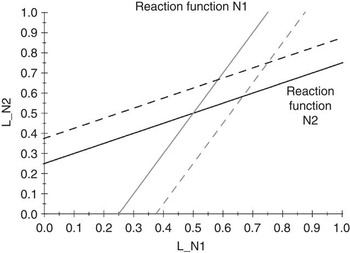
According to Equation 14, the proportion of labour time N 1 devotes to production increases in its productivity (A), and decreases with a more attractive target (higher KS). These findings are both consistent with the basic model, but in addition, systemic competition now creates an ‘imperialist race’. The more time N 2 spends on productive activities (higher  ), the more time country N 1 devotes to production. Conversely, when country N 2 puts time effort into fighting, country N 1 does so also. Thus, colonization by one power induces imperialism in other states:
Hypothesis 5. A country is more likely to hold colonies when the system contains many colonies.
The strategic interaction between the two imperialist countries N 1 and N 2 is illustrated in Figure 2.Footnote 98 The grey (black) lines represent the reaction function of country N 1 (N 2). The solid (dashed) lines correspond to a case of low (high) productivity, A = 0.16 (A = 0.24). The Nash equilibrium for the solid lines is at (0.5;0.5), and is (0.75;0.75) for the dashed lines. The reaction functions for both countries are positively sloped, indicating that each country increases its production effort for increases in the productive effort of the other state. This also means that a state increases its colonization effort for increases in the colonial activity of the other power.
The reaction functions of the countries N1 and N2

A slight extension of the systemic model helps to explain how the move from mercantilism to freer global markets helped to trigger rapid decolonization. Up to now, we have assumed that all gains from trade depend on the territorial control of trade partners (mercantilism). We can now allow that only a part γ of the trade gains depends on possession of colonies. The move from mercantilism to capitalism and freer trade is reflected by a gradual decrease in γ.Footnote 99
We introduce the possibility of partially free trade by changing Equation 12 into Equation 12′ below:

All variables are defined as before. The parameter γ can be interpreted as the level of mercantilism. Naturally, the results for γ = 1 are identical to the results presented above. By contrast, γ = ε (where ε is an infinitely small positive number) corresponds to a capitalist free trade system.
Introducing the time constraints (Equation 11) into Equation 12′ and computing the first-order conditions, we get:

We can evaluate the effect of mercantilism and capitalism on incentives for imperialism and decolonization by looking at the first derivative of  with respect to γ. A negative first derivative implies that more capitalism (lower γ) increases the incentives to produce (higher
 ) and accordingly reduces the incentives to fight (lower
 ) to gain or retain control of foreign territory or markets. The first derivative of
 with respect to γ becomes negative, if condition (15) holds:

Condition 15 holds when the gains from production (A) and the gains from trade (B) are each large relative to the product of S's capital endowment, the fighting effectiveness of N 1, and the pivotal nature of warfare. In the period after the Second World War, the steady decay of barriers to trade, the relative poverty of developing countries, as well as the rise of nationalist insurgency movements made colonialism less appealing. Changes in the global economy had by the early twentieth century created conditions in which the economics of colonies, as well as the vertical integration of production networks, was increasingly inefficient. Sources for raw materials proliferated. The ascendance of the United States as a hegemon further degraded the economic advantages of empire.Footnote 100
Mercantilism can be proxied empirically as a situation where the hegemon holds many colonies.
Hypothesis 6. A country is more likely to hold colonies when the hegemon has many colonies.
Development started with agricultural societies, moved through mercantilism, to be followed by capitalism. We expect the effect of systemic development on colonial holdings to be non-linear.
Hypothesis 7. The effect of systemic development on territorial empire should be strictly concave, first increasing, and then later decreasing the likelihood of a country possessing colonial holdings.
Research Design And Data
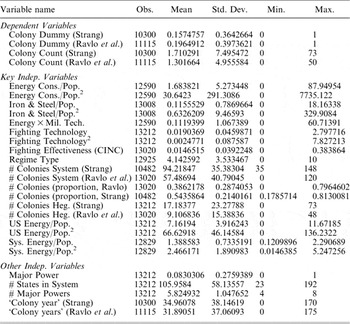
While our theory applies to broad swaths of history, our empirical analysis is limited by data availability to the last two centuries (1816–1992). Our unit-of-analysis is the country year. We examine both dichotomous (presence or absence) and ordinal (count) indicators of colonialism/decolonization. Given a dichotomous dependent variable, we use the ReLogit estimator.Footnote 101 We use negative binomial regression to estimate the number of colonies a country holds. We correct for spatial dependence using Huber/White robust standard errors. Independent variables are lagged by one year to address endogeneity. We also include a set of spline variables to control for duration dependence.Footnote 102 The descriptive statistics of all variables are displayed in Table 3.
Dependent Variable
The dichotomous and count versions of the dependent variable come from two sources. Strang provides a list of the start and end years for a large number of dependencies beginning in the late fifteenth century.Footnote 103 Strang includes dependencies that are not under colonial domination and cases where political boundaries change over time. This could be a problem if dependencies operated under a different logic than colonies, or if dependencies experience reorganization, but not decolonization. These discrepancies are bound to weaken support for our claims. We also examine colony data generated by Ravlo et al.Footnote 104 The authors use these data as an independent variable as part of a statistical analysis of their argument that democracies are less warlike towards former colonies.
Independent Variables
— Economic development: Given the need to cover substantial time periods before the mid-twentieth century, we adopt two variables widely used as proxies for per capita gross domestic product (GDP).Footnote 105 (1) Energy Cons./Pop. comes from the COW National Material Capabilities dataset of total annual fuel consumption in coal-ton equivalents.Footnote 106 (2) Iron & Steel/Pop. measures the quantity of iron (1816–99) or steel (1900–2000) produced by a country in a given year.
— Fighting Technology: No convention exists as to the measurement of fighting technology. Dupuy advocated an index where each weapon is given a lethality score.Footnote 107 The index requires detailed information that makes it unworkable here. Furthermore, such an index does not really address a focus of our concern, the capital-intensiveness of a country's military organization. We adopt a simpler and more direct measure of fighting technology, dividing defence spending from the Correlates of War National Material Capabilities dataset (CINC) by the number of military personnel per country year.Footnote 108 The result is a statistic analogous to GDP per capita identifying which armies have advanced weaponry etc., and which do not.Footnote 109
— Democracy: Polity data provide indexes based on formal constraints on the executive (autoc) and institutional support for democracy (democ).Footnote 110 We prepare monadic values by combining democ and autoc scales as follows, [(democi − autoci) + 10]/2, (where i∈[A,B]). We add 10 to make all values non-negative and divide by 2 to yield a 0–10 index. We examine both the monadic values and higher and lower democracy scores for states in a dyad.Footnote 111
— Fighting Effectiveness: Capabilities determine the ability of states to project power and conduct warfare abroad. We assess national military power or fighting effectiveness using the Correlates of War (COW) Composite Indicators of National Capabilities (CINC) score. CINC scores are computed as the weighted average of a state's share of total system population, urban population, energy consumption, iron and steel production, military manpower and military expenditures. CINC is widely acknowledged as an approximation of national power.
— Major Power Status: Major powers tend to be more active internationally, resulting in more frequent conflict behaviour. Since they may also tend to be more capable and prosperous, there is a danger that the relationship between development and conflict might be confounded by major power politics. We include a dummy, Maj. Power, coded (1) for the major powers.
— Temporal Dependence: Finally, we control for temporal dependence by constructing four splines for each dependent variable, interpolated from a dummy matrix coding the lag between directed dyad years of conflict initiation or onset.Footnote 112
Results
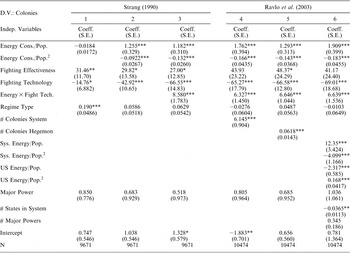
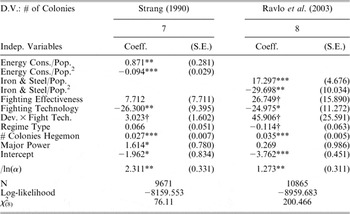
Results of our analysis of development, democracy, technology, hegemony and colonies are summarized in two tables containing eight regressions. Each of the six regressions listed in Table 1 estimates the probability that a given country possesses at least one colony. Succeeding models introduce additional variables to test hypotheses, compare model specifications or assess robustness.
The Political Economy of Decolonization

Sig. levels: †: 10%; *: 5%; **: 1%; ***: 0.1%. Coefficients and S.E.'s for spline variables suppressed.
Sources: David Strang, ‘From Dependency to Sovereignty: An Event History Analysis of Decolonization 1870–1987’, American Sociological Review, 55 (1990), 846–60; Hilde Ravlo, Nils Petter Gleditsch and Han Dorussen, ‘Colonial War and the Democratic Peace’, Journal of Conflict Resolution, 47 (2003), 520–48. For Relogit estimator, see Gary King and Kangche Zeng, ‘Explaining Rare Events in International Relations’, International Organization, 55 (2001), 693–715; and ‘Logistic Regression in Rare Events Data’, Political Analysis, 9 (2001), 137–63.
As Model 1 in Table 1 reveals, no simple monotonic relationship exists between economic development (Energy Cons./Pop.) and a nation's status as a colonial power. In contrast, both Hypothesis 2 and Hypothesis 3 appear to be borne out in these data. More capable countries (Fighting Effectiveness) are more likely to possess colonies, ceteris paribus, while nations with capital-intensive armed forces (Fighting Technology) are less inclined towards territorial imperialism. Contrary to Hypothesis 4, democratic countries appear much more likely to hold colonies. As we will see, this strongly counter-intuitive finding depends largely on the incomplete statistical model specification of Model 1. Major power status appears largely irrelevant for the possession of colonies.
The linear specification used for economic development in Model 1 may be inappropriate. Model 2 adds a quadratic term for economic development.Footnote 113 Introducing the second quadratic term for development leads both coefficients to become highly statistically significant. Energy Cons./Pop. and its square produce the concave function predicted by Hypothesis 1. Fighting Effectiveness (Hypothesis 2) is positive and significant, though at a lower significance threshold than previously. The modest significance of the capabilities variable suggests that power is not as important a determinant of colonial status as other variables in the analysis, but this may be a by-product of the research design and available data. Our theory and available intuition suggest that Fighting Effectiveness was most salient during the onset of the colonial era, for the expansion of empire rather than for its demise. Of course, the dataset contains only a limited portion of the period of imperial expansion.
In contrast to the power variable, Fighting Technology becomes statistically significant at a much higher threshold in Model 2. Since the available data cover the entire period of decolonization, the mechanisms encouraging the end of empire are able to perform more effectively, especially with the proper model specification. With the addition of a second term for economic development, the Regime Type variable is no long positive and significantly significant, though the relationship remains positive. It appears that democracy does not influence decolonization one way or the other (Hypothesis 4). The major power status variable also continues to be statistically insignificant.
Civilian and military technology are of course related.Footnote 114 Treating the two processes as independent, when they are not, risks biasing estimates of their respective independent effects. Model 3 adds an interaction term between Energy Cons./Pop. and Fighting Technology. Energy × Fight Tech. is statistically significant and positive indicating that, for small values of Fighting Technology, increases in civilian economic development tend to increase the probability of colonial holdings. While there is some synergy between civilian and military technology, all three development and technology variables remain highly statistically significant in the presence of the interaction term.
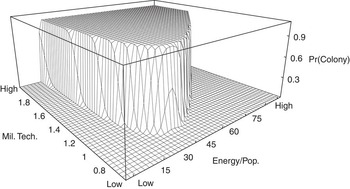
Figure 3 offers a three-dimensional plot of the predicted probability of an independent country possessing at least one colony based on Model 3. Development (Energy/Pop.) increases from left to right, while fighting technology (Mil. Tech.) increases from front to back in the image. The probability of colonial possessions is plotted on the vertical axis. The resulting plot looks roughly like a ‘grand piano’, ‘mesa’ or the bow of a ship (facing slightly right of the reader). Recall that in the formal model, fighting technology is a declining function of development. Imagine beginning in the left foreground of the figure (low Energy/Pop. and Mil. Tech.) and moving in a diagonal line towards the most advanced countries (high Energy/Pop. and Mil. Tech.). The declining marginal impact of development on fighting technology leads the trajectory of a nation to veer right as we travel first up to the piano/mesa/boat, and then down again to the floor/valley/water on the right side of the figure. Notice also that the transition to and from colonialism is abrupt. Colonial holdings were acquired as nations expanded their ability to subdue distant territories. They were abandoned suddenly, collectively, as if the logic of empire had suddenly fallen off a cliff.
Estimated effects of development and military technology on empire (Model 3)

While Hypotheses 1 through 3 are supported, but not Hypothesis 4, we have yet to assess the systemic and hegemonic hypotheses. Models 4 and 5 in Table 1 introduce variables for the number of colonies in the system (Hypothesis 5) and the number of colonies held by the hegemon (Hypothesis 6). Neither hypothesis can be rejected.Footnote 115 Systemic and hegemonic colonial portfolios clearly influence individual national decisions to maintain or abandon empire. By ‘crowding out’ access to markets and raw materials, the presence of colonies in the system appears to have led to additional acts of imperialism by other nations. Conversely, as soon as the hegemon or other nations abandoned empire, countries found perpetuation of a colonial system to be less necessary.
Model 6 completes Table 1 by introducing variables to evaluate systemic development, the effects of American hegemony, and to control for factors relevant to the systemic variables.Footnote 116 Consistent with Hypothesis 7, Sys. Energy/Pop. and its square reveal a concave relationship between systemic development levels and the appeal of colonies. Development initially leads to systemic predation as states compete to capture resources and markets. These incentives reverse themselves, however, as the gains from production (A in the formal model) increase with development and the gains from trade (B) grow with the size of the world economy. Similarly, the appeal of colonization appears to ebb with increases in American productivity, though at a declining marginal rate. As the chief proponent, and beneficiary, of free trade in the twentieth century, the United States possessed few incentives to prop up the European colonial system when the United States became a hegemon. We add States in System and Major Powers to evaluate the effects of changing system structure and size. Having more major powers in the system does not significantly increase territorial empire once monadic and systemic development, technology and other factors are considered. The number of states in the system is negatively associated with colonialism, though these two variables are of course rough complements.
Table 2 lists two negative binomial regressions, each estimating the number of colonies a country holds. Theoretical expectations for the count of colonies are less precise than for the dichotomous variable. Still, results are substantially consistent with those in Table 1. Model 7 reports the curvilinear relationship between development and the count of colonies. Fighting Technology is again negative and significant, while the interaction term between development and military technology is again positive. The power variable (Fighting Effectiveness) is positive, though significant only in Model 8. The number of colonies held by the hegemon significantly increases colonialism by other states, while state capabilities or major power status have modest effects. Model 8 substitutes iron and steel production per capita for energy consumption.Footnote 117 Regime Type becomes marginally significant in the expected direction for the first time. Six of our seven hypotheses are thus consistently supported. The fact that democracy is usually insignificant suggests that while institutionalist arguments are logically tenable, popular rule does not appear to impact imperialism in practice.
Political Economy and the Number of Colonies

Sig. levels: †: 10%; *: 5%; **: 1%; ***: 0.1%. Spline variables suppressed.
Notes: The values displayed are negative binomial regression coefficients.
Descriptive Statistics for All Variables Used in Table 1 and Table 2

Sources: David Strang, ‘From Dependency to Sovereignty: An Event History Analysis of Decolonization 1870–1987’, American Sociological Review, 55 (1990), 846–60; Hilde Ravlo, Nils Petter Gleditsch and Han Dorussen, ‘Colonial War and the Democratic Peace’, Journal of Conflict Resolution, 47 (2003), 520–48.
Conclusion: Once And Future Empire?
The lust for territory subsided among powerful nations as it became cheaper to make than to take, and as the global mercantilist system gave way to freer trade. Empire is unappealing when appropriative technology is low, domestic labour is scarce or when global markets are obstructed.
In contrast, the desire to control land, rooted labour and minerals remains strong in the developing world. Poor countries still covet territory, though they often lack the capacity to project power beyond their borders. In places where labour is cheap and abundant and capital is expensive, conquest and other activities designed to allow the state to acquire a larger pool of rents will remain appealing. A final factor is American enforcement of a norm of territorial integrity, though this could decay if the United States weakens or developing states become more capable of conquest.Footnote 118
Paradoxically, successful development could increase the number of ‘middle tier’ economies, which could then overwhelm internal or external inhibitions against territorial aggression. Rapid development could see nations cross the military effectiveness threshold ( ) faster than the rise in the cost of labour. At the same time, technological innovation might again increase the ability of the most advanced nations to take rather than make. Automation and smart weaponry could dramatically lower the cost of empire. Alternatively, political instability or dramatic price increases in critical resources could spark efforts to control mineral-rich regions. Global political competition could also ignite efforts to capture and control scarce minerals. We must hope that rising powers see themselves as beneficiaries of the global economy and endorse open markets in due course.
Finally, what should be made of the revived empire debate? At least some of the controversy follows from different conceptions of what empire entails. Proponents of American Exceptionalism seem in fact to be advocating American leadership. To the degree that our results suggest an important role for the hegemon in promoting open markets, we can support this limited form of leadership. However, much of the advocacy is overblown and confused, precisely because sponsorship of global markets limits the incentives for powerful states to pursue other aspects of empire. Critics, too, seem to exaggerate the continuity between recent American policies and earlier incarnations of territorial empire. There is something different about how the current hegemon treats territory, but in contrast to George W. Bush, we see this change as applicable to every nation, not just the United States.
 , where d = distance, or assumes a specific function, as in the gravity model: (1 − ρ) = ωd 2, where ω is exogenous.
 ,
 .
 , λ = 0.5, DS = 0. For the dotted lines we have A = 0.24.