Introduction
Farm to school (F2S) programs are a popular form of local foods promotion in the US that consist of activities whereby K-12 schools procure, serve, and promote local foods; implement school gardens; and/or incorporate educational activities related to agriculture, food, health, or nutrition into their curriculum. Of these practices, local food procurement is the most frequently implemented (NFSN and CAFS, 2019; USDA FNS, 2021a). According to the US Department of Agriculture Food and Nutrition Service's (USDA FNS) F2S Census, 67,369 US schools implemented F2S programming in the 2018–2019 school year (USDA FNS, 2021a).
However, local food procurement by school food authorities (SFAs)—a school or school district that administers a food service program—involves high transaction costs that stem from the extra staff time and resources needed to procure and prepare local food (e.g., Fitzsimmons and O'Hara, Reference Fitzsimmons and O'Hara2019; Bobronnikov et al., Reference Bobronnikov, Boyle, Grosz, Lipton, Nutter, Velez and Yadav2021a). Federal, state, and philanthropic grants exist to subsidize F2S programming, but some of them—including the Farm to School Grant Program administered by the USDA FNS—do not allow funding to be used to subsidize food procurement costs. Accordingly, one of the three most common F2S program challenges reported by SFAs is food costs (Bobronnikov et al., Reference Bobronnikov, Prenovitz and Yadav2021b). To address this issue, a growing number of US states have developed reimbursement incentive programs to subsidize local food purchases. However, little research assesses which SFA characteristics are associated with applying for or receiving reimbursement incentives in these state-level programs.
In this study, we examine F2S reimbursement programs in Michigan and Oregon. To do so, we merge administrative data on program participation by SFAs provided by agencies in each state for the 2018–2019 school year with data from USDA FNS's Farm to School Census. We use these data to estimate probit regressions that identify which SFA characteristics are associated with participation in their state's reimbursement program.
Michigan and Oregon provide an interesting contrast because their programs were in different stages of implementation in 2018–2019, the year of our study. In the 2018–2019 school year, Oregon had an ‘opt-in’ model in which all SFAs in the state were eligible to receive reimbursement incentives. By contrast, Michigan SFAs competed to receive funding. During the 2018–2019 school year, only SFAs in some regions of Michigan were eligible to apply, and only a subset of those that applied were awarded funds. Our research will help policymakers and food system stakeholders understand which SFAs apply for and receive F2S reimbursement incentives in budget-constrained competitive programs, and which opt into incentive programs in states that have funding to support all SFAs.
Background
Farm to school background
The US F2S movement began in the late 1990s in attempt to reverse the issue that US schools had ceased purchasing foods directly from farmers by the 1980s and 1990s (O'Hara and Benson, Reference O'Hara and Benson2019). According to the National Farm to School Network, a F2S program contains at least one of the following three activities: local food procurement, school gardens, and relevant educational activities. F2S programs aspire to promote the following outcomes: (a) healthier diets, (b) increased community engagement, (c) improved education on food and agriculture topics, (d) higher income directed to local farms and food businesses, and (e) larger local economic multiplier effects. Among the various FS2 activities, local food procurement is the most reported activity (NFSN and CAFS, 2019; USDA FNS, 2021a) and is thus the focus of this study.
F2S procurement seeks to leverage SFA spending on child food programs, including the National School Lunch Program (NSLP), wherein participating SFAs offer free, reduced-price, or low-cost full price meals to all qualified students based on income. Children in households with income ≤130% of the Federal poverty level are eligible for free meals, and those with more than 130% and ≤185% are eligible for reduced price meals (USDA FNS, 2021b). The USDA FNS offers meal reimbursement subsidies to SFAs if they meet nutrition standards, although SFAs may only receive a modest level of funding from child nutrition program meals to spend on fruits and vegetables. Accordingly, SFAs may experience budgetary strains because, within the USDA regulatory framework, they have multiple goals that are not necessarily in alignment: (a) serve nutritious food, (b) keep food costs low, and (c) maintain high participation rates in school meals (Long et al., Reference Long, Jablonski, Costanigro and Frasier2021). Because of the difficulties in resolving these tensions, many SFAs maintain a budget deficit after including all food service program costs (Ralston and Newman, Reference Ralston and Newman2015).
State legislation to support F2S programs is increasingly popular. Between January 1, 2017 and December 31, 2018, 32 states and the District of Columbia proposed 81 bills and resolutions, of which 25 passed. Of these bills, support for local procurement has been the most popular. Fifty of the introduced bills focused on local procurement, 23 of which passed. Further, as of 2018, six states (Alaska, California, Michigan, New Mexico, New York, and Oregon) and the District of Columbia had programs that provided subsidies for local food purchases to USDA child nutrition program sponsors, including SFAs and/or early care and education sites (NFSN and CAFS, 2019). These programs (called ‘reimbursement programs’ hereafter) vary in their structure and implementation across the US (NFSN and CAFS, 2019). While some have funds available to SFAs statewide (e.g., Oregon), others require SFAs to compete for funding (e.g., Michigan) or achieve a certain set of criteria around local food purchases to receive reimbursement incentives (e.g., New York). The National Farm to School Network prioritizes funding local procurement incentives, ranking it as one of the three funding areas needing ‘high’ support (the others are funded state coordinator positions and funded farm to school programs). They state that ‘incentive bills can be critical to increasing local procurement in schools’ (NFSN and CAFS, 2019, 21).
Literature review
The F2S Census, administered by the USDA FNS in 2013, 2015, and 2019, has contributed to a proliferation of national-level F2S research (Bobronnikov et al., Reference Bobronnikov, Boyle, Grosz, Lipton, Nutter, Velez and Yadav2021a). Research using the F2S Census finds that most local food products procured by SFAs are purchased from intermediaries (e.g., distributors), not directly from farmers (Christensen et al., Reference Christensen, Jablonski and O'Hara2019; Fitzsimmons and O'Hara, Reference Fitzsimmons and O'Hara2019). Furthermore, the use of intermediaries is associated with higher levels of food expenditures for local products (Christensen et al., Reference Christensen, Jablonski and O'Hara2019; Plakias et al., Reference Plakias, Klaiber and Roe2020). This result is consistent with research (also using F2S Census data) showing that SFAs that exclusively use intermediaries to source local foods report higher school meal costs than SFAs that make both direct and intermediated purchases (Fitzsimmons and O'Hara, Reference Fitzsimmons and O'Hara2019). This may occur because farmers have non-pecuniary motivations for making local sales (Izumi et al., Reference Izumi, Wright and Hamm2010; Conner et al., Reference Conner, King, Kolodinsky, Roche, Koliba and Trubek2012, Reference Conner, Sevoian, Heiss and Berlin2014; Matts et al., Reference Matts, Conner, Fisher, Tyler and Hamm2016), such as seeking to benefit their communities. By contrast, traditional distributors are more inclined to sell local foods to schools due to profitability motivations (Conner et al., Reference Conner, Sevoian, Heiss and Berlin2014).
The results from research that used F2S Census data to understand state-level F2S policies have led to ambiguous conclusions. Some studies have found that state-level F2S policies do not have a significant relationship with F2S programming or expenditures (Lyson, Reference Lyson2016; Plakias et al., Reference Plakias, Klaiber and Roe2020); other studies find a significant relationship (McCarthy et al., Reference McCarthy, Steiner and Houser2017; Ralston et al., Reference Ralston, Beaulieu, Hyman, Benson and Smith2017); and other studies have found mixed results (Turner et al., Reference Turner, Leider, Piekarz, Schermbeck, Merlo, Brener and Chriqui2017; Bonanno and Mendis, Reference Bonanno and Mendis2021). This ambiguity may exist because the state-level policy metrics that these researchers have used to create their independent variables are coarse. Researchers have typically represented F2S state policy support as either a binary variable indicating the presence of policies in a state or as a categorical variable that reflects the number of relevant policies in a state.
The F2S Census, the most comprehensive dataset on F2S activities available for empirical F2S research in the US, does not contain details about grants or other program support that SFAs apply for or receive funding from to implement F2S programs. For this reason, few empirical studies have been undertaken that examine which SFAs apply for and receive grants or subsidies. Our research contributes to this gap in the literature because we link data about SFAs that apply for and receive subsidies with F2S Census data. This allows us to undertake one of the few F2S studies that examines which SFAs receive support.
Several studies have researched F2S programs within a single state without using the F2S Census. Kane et al. (Reference Kane, Kruse, Ratcliffe, Sobel and Tessman2011) estimated the impact of Oregon's F2S program on the local economy and students' attitudes regarding fruit and vegetables. Matts et al. (Reference Matts, Kuhlman, Parrotte and Trumbull2020) administered program follow-up surveys to identify outcomes that SFAs experienced from participating in Michigan's reimbursement program. More recently, Long et al. (Reference Long, Jablonski, Costanigro and Frasier2021) conducted an ex ante analysis of Colorado's proposed $0.05-per-meal reimbursement program using a simulation calibrated with procurement data from a Colorado SFA, but they did not examine the factors associated with which Colorado SFAs received reimbursement incentives.
Case studies: Michigan and Oregon
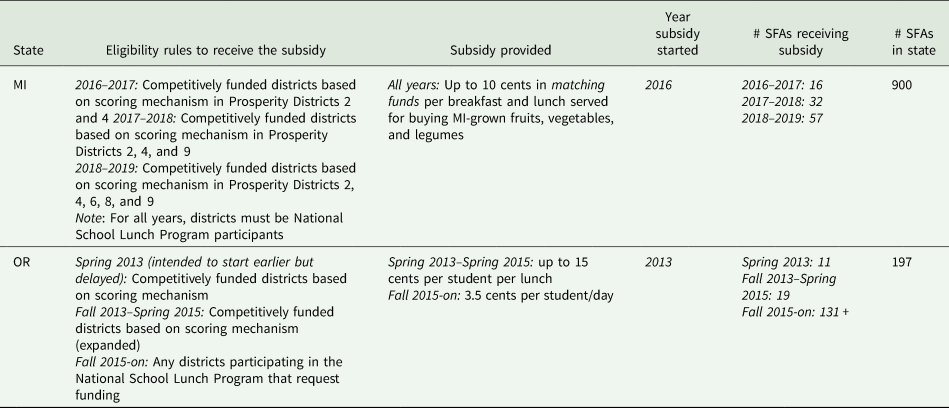
Our case studies come from two states in the 2018–2019 school year, which is the most recent complete year of data available for these programs prior to the COVID-19 pandemic (as the pandemic and associated school closures affected procurement in the 2019–2020 school year). Table 1 provides a summary of the elements of the reimbursement programs in both states.
FTS procurement policies by state: eligibility rules, subsidy level, and scale

Notes: Details sourced from state administrative agencies.
Michigan's reimbursement program is entitled ‘10 Cents a Meal for Michigan's Kids and Farms’. As the name indicates, the program provides up to 10 cents in matching funds per meal to SFAs to purchase Michigan-grown fruits, vegetables, and legumes and serve them in USDA child nutrition programs (i.e., school breakfasts, lunches, and snacks). Funds can also be used for minimally processed (e.g., frozen, dried, chopped, or sliced) fruits, vegetables, and legumes if the processing also occurs in Michigan.
Michigan started its pilot program in 2016 (see Table 1). In 2016–2017, the program supported 16 SFAs in eight counties with a $210,000 program appropriation for grants. Due to funding constraints, only counties in ‘Prosperity Regions’ 2 (northwest Lower Michigan) and 4 (west Michigan) were eligible in the 2016–2017 pilot program. By the 2018–2019 school year, there was funding to support counties in three additional Prosperity Regions: 6 (a portion of east Michigan that includes Flint), 8 (southwest Michigan), and 9 (the southeastern region of Michigan that includes Ann Arbor). These regions were predominately selected for pilot funding since they had high levels of F2S programming and community interest. Region 6 was included as a way to assist Flint, as the city was experiencing a crisis from contaminated drinking water. In the 2018–2019 school year, the year of our study, the program's appropriation had increased to $575,000, with $495,300 provided in grants. These funds were leveraged to support 57 SFAs that serve 135,000 students in 27 counties.
Michigan grantees competed to receive funding in 2018–2019, and as noted above only SFAs in specifically designated regions of Michigan were eligible to apply during the 2018–2019 school year. Of those that applied, only a subset received funding from the state. Grant administrators in Michigan indicated they would put a high weight (for evaluation purposes) on an SFA's responses to questions about plans for educational programming, marketing, and program assessment for their F2S program, as well as potential community impacts and barriers they have had in the past with local procurement. SFAs that received reimbursements in the pilot program in past years were required to reapply annually, and not all SFAs that started in a previous year of the pilot program continued it. For the 2021–2022 school year, Michigan increased the funding for the program to $5 million and invited all Michigan SFAs to apply.
Oregon first piloted its program in 2013, offering competitive funding to SFAs that applied (see Table 1). This competitive funding model appears common across states for programs at a pilot or proof-of-concept stage. By the 2018–2019 school year, however, Oregon had adopted an ‘opt-in’ model that allowed all SFAs in the state the opportunity to receive reimbursement incentives. In the year we study, any SFAs that previously received reimbursements were required to opt into the program again. (Subsequently, Oregon changed its program to an ‘opt-out’ model, meaning that all SFAs are automatically signed up for the reimbursement program.) For the 2019–2020 and 2020–2021 school years together, approximately $10.2 million in grant funds were available for meal reimbursement, technical assistance, and program administration. Procurement subsidies can be used for a wide variety of products ‘produced or processed in Oregon’, including Oregon-grown fruits, vegetables, and grains; Oregon-raised meat; Oregon-caught seafood; and Oregon-processed foods with at least some of the product grown, raised, or caught in Oregon.
Data and methods
Overview
We estimate which factors are associated with whether an SFA applies for and receives funding to support F2S reimbursement incentives in Michigan and Oregon. Eligibility for Michigan's 10 Cents program was limited to certain counties in 2018–2019. Thus, we compare the characteristics of SFAs in eligible counties with SFAs in ineligible counties (among Michigan SFAs that responded to the F2S Census). In addition, since funding was distributed competitively in Michigan, we compare the attributes of (a) eligible SFAs that applied for funding and those that did not and (b) applicant SFAs that were funded and applicant SFAs that were not. We present these results both by comparing the means of pertinent variables and estimating probit regressions. Funds in Oregon's program, in contrast, were available statewide to all SFAs in 2018–2019. Thus, for Oregon, we report the results of one regression, in which the dependent variable indicates whether SFAs opted to receive incentives. The regressions for the two states have the same independent variables, so we present one description of the model in the methods section.
For these analyses, we link the 2015 F2S Census data with administrative data from (a) Michigan about which SFAs applied for and received reimbursement incentives and (b) Oregon about which SFAs opted in. In Michigan, the Michigan State University Center for Regional Food Systems and the Michigan Department of Education supplied the data about which SFAs applied to and received assistance from its program. In Oregon, the Oregon Department of Education supplied these data.
The USDA FNS administered the 2015 F2S Census to public, private, and charter SFAs to ask them details about F2S activities from the 2013–2014 school year (USDA FNS, 2021a). USDA FNS disseminated 18,104 surveys and attained a 70% response rate with the 2015 F2S Census. USDA FNS sought to attain a high response rate with the Census, so designed it to be brief and structured the questions so that food service directors could answer them without having to compile information (e.g., food service directors self-defined the term ‘local’ when responding to questions). Michigan and Oregon had 528 and 167 SFAs that responded to the 2015 F2S Census, respectively. In Michigan, 286 (54%) of these responding SFAs were in the five eligible Prosperity Regions.
We use 2015 F2S Census data to construct most of the independent variables. These data represent SFA characteristics 5 years prior to when the dependent variable is measured, and our results are predicated on the assumption that SFA's characteristics 5 years prior to the dependent variable occurring are relevant to their participation in the procurement reimbursement program. All of the F2S Census variables that we use are derived from USDA FNS’ corresponding F2S survey, except for two. The original source for two of the variables in the F2S Census dataset (the percent of students on free and reduced-price meals and SFA size) is the 2013–2014 Common Core of Data School File. One independent variable (the county's metropolitan classification) is available from USDA's Economic Research Service.
We used the administrative lists provided by Michigan and Oregon to identify participating SFAs in the F2S Census. In Michigan, 101 eligible SFAs that responded to the F2S Census applied for reimbursement incentives. Of these, 47 SFAs (47% of eligible SFAs for which we have data) received funding. In Oregon, 98 SFAs that responded to the F2S Census (59% of all SFAs for which we have data) opted to receive support. In Michigan, 56 SFAs received reimbursement incentives in 2018–2019, of which nine did not respond to the 2015 F2S Census. In Oregon, these corresponding totals were 117 and 19, respectively.
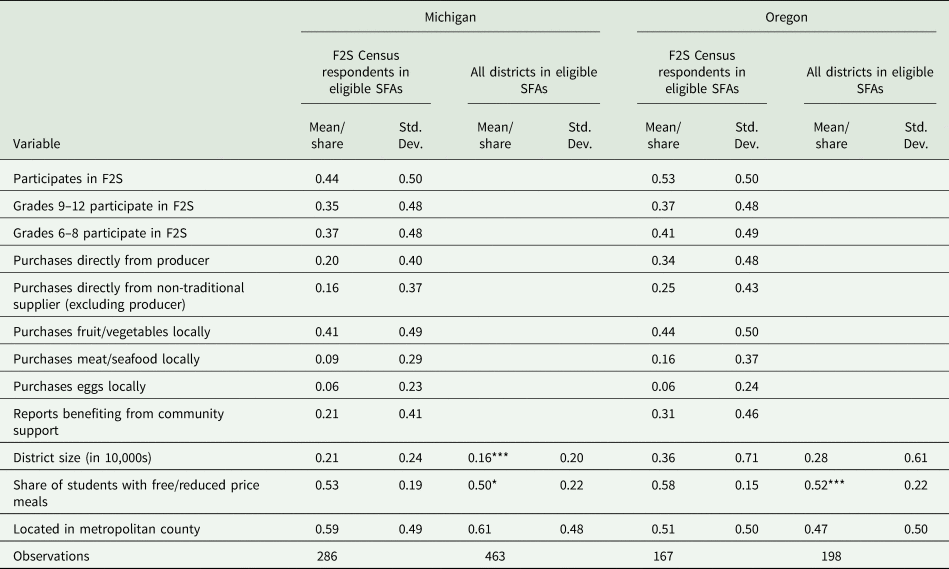
Our results are representative of the SFAs in Michigan and Oregon that responded to the 2015 F2S Census. However, not all SFAs responded to the F2S Census. The SFAs in our data represent 62% of all the SFAs in Michigan that were eligible for the state's reimbursement program, and 84% of all SFAs (all of which were eligible) in Oregon. In Table 2, we provide basic summary statistics for the eligible Oregon and Michigan SFAs. We further compare F2S Census respondent SFAs used in our analysis with all SFAs eligible for the reimbursement program using data from the National Center for Educational Statistics (NCES, 2018, 2021). Our sample statistics are statistically significantly different from the population of SFAs in three of six comparisons. In both Oregon and Michigan, eligible SFAs in our sample have a significantly higher mean share of students receiving free and reduced-price lunch than the population of eligible SFAs. In Michigan only, eligible SFAs in our sample are significantly larger than the population of eligible SFAs.
Summary statistics for F2S Census sample and comparison to population in 2013–2014 school year

Notes: Farm to school statistics for F2S respondent SFAs were obtained from USDA FNS (2021a). Data for free and reduced lunch for all eligible SFAs were obtained from NCES (2021). District size and location for all eligible SFAs were obtained from NCES (2018). Metropolitan county status was obtained from USDA ERS (2020). Two-sample t-tests were conducted for comparison of means between respondents and all districts in each state for the three variables for which comparisons were possible. The total number of SFAs in Oregon was 198 in the 2013–2014 academic year (the F2S Census data reporting period) and 197 in the 2018–2019 academic year (the year of the dependent variable), which is the reason for the difference in number of observations for Oregon between Tables 1 and 2.
*P < 0.1; **P < 0.05; ***P < 0.01 signify statistically significant difference between respondent SFA characteristics and the population of eligible SFAs.
Comparison of means
We conduct difference of means tests to explore differences in characteristics between (a) eligible and non-eligible SFAs in Michigan, (b) eligible SFAs in Michigan and Oregon, and (c) applicant and non-applicant SFAs in Michigan among SFAs that are eligible. We make comparisons using Z-statistics and t-statistics.
Probit regressions
We estimate three probit regressions: (1) among eligible SFAs in Michigan, we estimate which SFAs apply for reimbursement incentives, (2) among SFAs that applied for reimbursement incentives in Michigan, we estimate which SFAs receive reimbursement incentives, and (3) among Oregon SFAs (all of which are eligible), we estimate which ones opted to receive reimbursement incentives. We specify the probit regressions in (1):

In Equation (1), Φ is the standard normal cumulative distribution function. The dependent variable, y, is equal to one for SFAs that are participating in their state's F2S procurement subsidy program in 2018–2019 and equal to zero otherwise. The matrix x consists of independent variables, and β denotes the corresponding parameter estimates.
For Michigan, we also estimated the probit version of the Heckman correction model to test for whether the non-random sample of SFAs that applied for funding were influencing the results. Our results from this robustness check were similar to those for our main specification, so we report the results of the two Michigan regressions estimated separately for simplicity.
We generate our main dependent variable by identifying the SFAs that, in Michigan, either applied to or received reimbursement incentives in 2018–2019. In Oregon, the main dependent variable represents SFAs that opted-in in 2018–2019. For each of the three regressions, these participating SFAs in each state have a dependent variable value of one. The remaining SFAs have a dependent variable value of zero.
Two of the independent variables that we include describe the market channels that SFAs used to purchase local food. We include these variables because previous literature demonstrates that SFAs are less likely to reduce school meal costs when purchasing local foods exclusively from intermediaries (Fitzsimmons and O'Hara, Reference Fitzsimmons and O'Hara2019), and therefore these SFAs may be more inclined to apply for or receive reimbursement incentives. We follow market channel definitions used in Christensen et al. (Reference Christensen, Jablonski and O'Hara2019). The ‘direct from producer’ variable is equal to one for SFAs that purchase local foods directly from a producer, at a farmers' market, or via a community-supported agriculture program. The ‘direct from non-traditional supplier’ variable equals one for SFAs purchasing from a food hub, cooperative, or state F2S program office. Thus, the omitted market channel category is SFAs that make purchases of local foods from traditional suppliers exclusively.
We control for SFA size because larger SFAs are more likely to implement F2S programs due to scale economies (Ralston et al., Reference Ralston, Beaulieu, Hyman, Benson and Smith2017; Bobronnikov et al., Reference Bobronnikov, Boyle, Grosz, Lipton, Nutter, Velez and Yadav2021a). However, it is unclear a priori whether large SFAs are more likely to apply for or receive reimbursement incentives than small SFAs. This coefficient could be positive since large SFAs are more likely to implement F2S programs, or it could be negative since larger SFAs have less of a need for this support than smaller SFAs. We also control for the school grades that the SFA serves in its F2S programs, since these can also be associated with costs and need for procurement assistance. These two school grade variables are equal to one for SFAs with F2S programs serving grades 6–8 and 9–12, respectively, and zero otherwise. We control for grade level since SFAs with older children may serve fewer meals, particularly if older students are allowed to leave campus during ‘free’ periods. Thus, these SFAs may be less inclined to apply for or receive assistance.
We also control for the percentage of children on free or reduced-price meals. Past research has found that SFAs with higher rates of children eligible for free or reduced-price meals are less likely to undertake F2S programming (Bobronnikov et al., Reference Bobronnikov, Boyle, Grosz, Lipton, Nutter, Velez and Yadav2021a), which may indicate a need for procurement assistance. This variable reflects the socio-economic status of the student body, since a student body with a relatively high proportion of students that are eligible for free and reduced-price meals indicate that many students come from families with lower income levels.
We also include three binary variables that indicate the types of food products that SFAs source locally: fruits and vegetables, meat and seafood, and eggs. A statistically significant coefficient would indicate that SFAs' funding support varies with the types of food products that they procure.
We include a binary variable that controls for whether SFAs reported experiencing more community support for school meals because of F2S activities. We do so because SFAs with more community support may be more likely to apply for competitive funding. We also include a binary variable that is equal to one for SFAs in metropolitan counties (USDA ERS, 2020). There may be higher transportation and marketing costs for local procurement for SFAs in rural areas, and thus those SFAs may be in greater need of financial assistance. As evidence, Botkins and Roe (Reference Botkins and Roe2018) found that SFAs in more rural areas are less likely to undertake F2S programming than those in urban areas. Finally, we include a binary independent variable that is equal to one for SFAs that undertook F2S activities in 2013–2014 and zero otherwise. We include this variable to test whether SFAs with past F2S experience are more likely to apply for or receive reimbursement incentives.
For select variables, we report the coefficients' marginal effects in the text to assist with interpretation. We calculate marginal effects for each variable by changing its coefficient while evaluating the other independent variables at their mean values. For the binary independent variables, the value of the independent variable changes from zero to one. The marginal effect is the instantaneous rate of change for continuous independent variables. Because the dependent variable is binary, marginal effects are reported as a percentage point change in the dependent variable with a one-unit change in the relevant units of the independent variable.
Results
Comparison of means
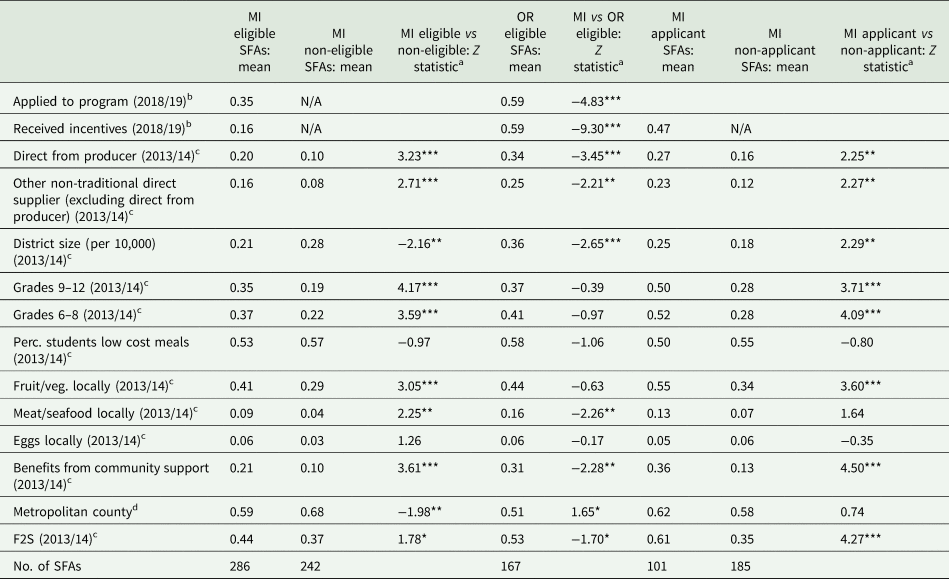
We make three comparisons in Table 3 that answer the following questions. First, how do eligible SFAs in Michigan compare with non-eligible SFAs in Michigan? Second, how do eligible SFAs in Michigan compare with eligible SFAs in Oregon? Third, for eligible SFAs in Michigan, how do applicants seeking funding compare with non-applicants?

Relative to non-eligible SFAs, eligible SFAs in Michigan were more likely to be in non-metropolitan areas, have smaller student populations, and have higher grade levels participating in F2S activities. Eligible SFAs were also more likely to make purchases directly from producers or non-traditional suppliers, as well as more inclined to purchase fruits, vegetables, and meat/seafood locally. Eligible SFAs also had more experience with F2S programming and were more likely to have community support.
On average, eligible Michigan SFAs were smaller than Oregon SFAs and more likely to be in metropolitan counties. The Oregon SFAs reported a higher level of community support, more experience with F2S programming, and were more likely to purchase local foods using direct market channels than eligible SFAs in Michigan.
Michigan SFAs that applied for funding in 2018–2019 were significantly more likely to purchase local food directly from producers and non-traditional intermediaries than non-applicant SFAs. They were also more likely to purchase fruits/vegetables and meat/seafood locally in 2013–2014 relative to other SFAs. In addition, SFAs that applied for funding were significantly larger, more likely to have students in grades 6–8 and 9–12 engaged in F2S activities, more likely to have had an F2S program, and more likely to report benefiting from community support than SFAs that did not apply.
Regression results
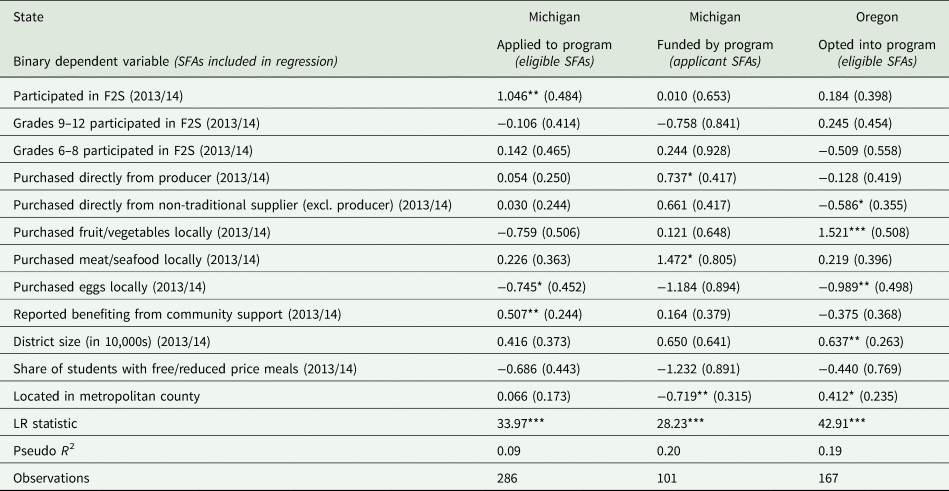
The regression results in Table 4 have an advantage to the descriptive statistics because they control for correlation between the independent variables. The P-values that we report in the text are associated with the regression coefficients. (The P-values in the marginal effects calculations have the same statistical significance level as the regression P-values).
Probit regression results of SFAs that applied to and were funded by procurement reimbursement program

Notes: Regression coefficients included. Selected marginal effects are reported in the text. Constant included but coefficient suppressed. Standard errors in parentheses.
*P < 0.1; **P < 0.05; ***P < 0.01.
Eligible SFAs in Michigan that had community support and F2S program experience in the 2013–2014 school year are 19 and 39 percentage points more likely, respectively, to apply for reimbursement incentives in the 2018–2019 school year (P < 0.05). Eligible Michigan SFAs that procure eggs locally are less likely to apply (P < 0.1). The other coefficients in the regression are not statistically significant.
Michigan SFAs that are awarded reimbursement incentives are 29 and 59 percentage points more likely, respectively, to purchase local food directly from producers relative to non-direct channels and to source meat/seafood locally than unfunded applicants (P < 0.1). Applicant SFAs in metropolitan counties are 29 percentage points less likely to receive funding than non-metropolitan SFAs (P < 0.05). The other variables are statistically insignificant.
In Oregon, SFAs that purchase local foods directly from non-traditional intermediaries are 22 percentage points less likely to opt into reimbursement incentives than SFAs that make purchases of local foods from traditional intermediaries exclusively (P < 0.1). Oregon SFAs in metropolitan counties are 15 percentage points more likely to receive reimbursement incentives than those in non-metropolitan counties (P < 0.1). An increase of 10,000 students is associated within an increase of program participation in Oregon by 24 percentage points (P < 0.05).
SFAs in Oregon that source fruits and vegetables locally are 57 percentage points more likely to receive reimbursement incentives (P < 0.01). In contrast, Oregon SFAs that source eggs locally are less likely to receive incentives (P < 0.05).
Discussion
In Michigan, SFAs with community support and experience with F2S programs were more likely to be in eligible counties than other SFAs (Table 3). Also, among the subset of eligible SFAs, they were more likely to apply for incentives (Table 4). These findings indicate that Michigan's 10 Cents program was established in areas where there was enthusiasm for the incentives. However, these two variables did not have a statistically significant effect on the likelihood of receiving funds (conditional on applying) in Michigan. The variables may be statistically insignificant because while such SFAs likely have greater capacity to successfully implement F2S programs, these SFAs are also in less need of assistance relative to other SFAs.
Non-metropolitan and smaller SFAs in Michigan were more likely to be in eligible counties (Table 3), and non-metropolitan SFAs were more likely to receive funding if they applied (Table 4). F2S programming is less common in rural areas nationally (Botkins and Roe, Reference Botkins and Roe2018). Thus, Michigan's program is helping rural SFAs that might have distance-based procurement challenges.
Also, in Michigan, SFAs that procure meat/seafood locally and purchase foods directly from producers were more likely to be in eligible counties, and to receive reimbursement incentives. Previous research has shown that farmers and ranchers selling to schools may charge SFAs less than the total cost of the food due to non-pecuniary motivations (Izumi et al., Reference Izumi, Wright and Hamm2010; Conner et al., Reference Conner, King, Kolodinsky, Roche, Koliba and Trubek2012, Reference Conner, Sevoian, Heiss and Berlin2014; Matts et al., Reference Matts, Conner, Fisher, Tyler and Hamm2016). Thus, the direct to producer coefficient may be positive if SFAs are awarded incentives so that they can pay farmers and ranchers for more of the cost of supplying food. Michigan SFAs that procure meat/seafood locally may be associated with receiving incentives if meat is more expensive to source locally than other food products. Another possibility is that since meat is less typically purchased locally than fruits and vegetables, a priority with the limited funds may be to develop markets for less conventional commodities. Michigan SFAs that purchased eggs locally were less likely to apply for incentives, perhaps because buying eggs locally is relatively inexpensive.
In Oregon, four of the coefficients are consistent with evidence that the SFAs that opted into the incentive program are also more inclined to implement F2S programs. We find that larger and metropolitan SFAs in Oregon are most likely to opt to receive incentives, which aligns with evidence that they are more likely to have a F2S program (Botkins and Roe, Reference Botkins and Roe2018; Bobronnikov et al., Reference Bobronnikov, Boyle, Grosz, Lipton, Nutter, Velez and Yadav2021a). Also, Oregon SFAs that purchase fruits and vegetables locally are more likely to receive reimbursement incentives. This result is consistent with findings elsewhere that fruits and vegetables are the most typical food products targeted in F2S programming (Bobronnikov et al., Reference Bobronnikov, Boyle, Grosz, Lipton, Nutter, Velez and Yadav2021a). Finally, Oregon SFAs that receive incentives are less likely to procure local foods from non-traditional intermediaries like food hubs than traditional suppliers (Table 3). This latter finding is consistent with national-level evidence that traditional distributors are the most common supplier of local foods for SFAs (Christensen et al., Reference Christensen, Jablonski and O'Hara2019).
However, the coefficients on three relevant variables that would otherwise support the interpretation that SFAs that opted in were also more likely to implement F2S programs were statistically insignificant: the percentage of students receiving free and reduced-price meals, SFAs with past F2S experience, and SFAs with F2S community support. One possibility we investigated is multicollinearity. The findings were robust to different specifications with one exception; the F2S experience variable was positive with statistical significance (P < 0.1) when the fruit and vegetable variable was omitted. So, multicollinearity is not a major concern. Another possibility is that while F2S experience and community support are associated with requesting funding from Michigan's competitive program, these variables may be relatively unimportant in an ‘opt-in’ framework in which SFAs expend less effort to receive support. In summary, SFAs that opted into Oregon's program have some characteristics, but not all, that are consistent with those already inclined to undertake F2S activities.
One limitation of our analysis is attributable to sample selection issues identified throughout the text. For instance, there is not a 100% response rate by SFAs to the F2S Census. In Table 2, we show that respondent SFAs in Michigan and Oregon were, on average, larger and had a greater percentage of students eligible for free and reduced-price meals than non-respondent SFAs. Also, in Michigan, the program was implemented in areas of the state with relatively high levels of F2S programming and community support (Table 3). For these reasons, the regression results are not necessarily generalizable statewide in either state, nor are they generalizable to other states.
A second shortcoming of the study is that the independent variables from the F2S Census were measured 5 years prior to when the dependent variable was measured. Our interpretation of the coefficients is predicated on the assumption that the independent variables have not had large changes in the interim. However, the parameter estimates would be biased if there is measurement error.
Conclusion
Two issues have confounded F2S research to date. First, few studies have examined which SFAs receive F2S subsidies since this information is not contained within the principal dataset for F2S research, the F2S Census. Second, studies of US state-level F2S policies have been inconclusive. Part of this ambiguity is due to challenges in creating independent variables that summarize disparate types of policies across states. Given that F2S procurement subsidies are increasingly being proposed and implemented by states, more research on the impacts of these policies on F2S programming is a priority.
We undertake one of the few observational studies to investigate which SFAs receive reimbursement incentives for local food purchases. The objectives of our study are to identify which attributes of SFAs are associated with the likelihood of applying for incentives, receiving incentives after they applied, and opting into incentive programs. As policymakers contemplate setting funding levels and application processes, our results provide insight into which types of SFAs might apply for or opt into reimbursement incentive programs.
In Michigan, community support for F2S and F2S experience are associated with applying for funding. We don't have details about the strength of each SFA's application, although community support for F2S and F2S experience could be correlated with high-quality applications. If so, then it appears in Michigan that need-based factors are associated SFAs that receive funding, instead of SFAs with the highest likelihood of successfully implementing program support.
However, SFA size and the percent of students on free and reduced-price meals were not statistically significant in either of the two Michigan regressions. These results suggest that these were not structural barriers systematically confronting some types of Michigan SFAs with receiving reimbursement incentives. Instead, Michigan's reimbursement incentive awards appear to be premised on assisting SFAs with other types of challenges. For instance, rural SFAs are less likely to have F2S programs due to distance-based challenges (Botkins and Roe, Reference Botkins and Roe2018), farmers and ranchers that make direct sales to SFAs may not be recouping their costs (Conner et al., Reference Conner, Sevoian, Heiss and Berlin2014), and procuring meat/seafood locally is less typical, and perhaps more expensive in Michigan, than procuring fruits and vegetables locally. In Oregon's opt-in program, community support and F2S experience were not associated with receiving the incentive, perhaps due to the relatively lower associated effort required to opt in.
There are other issues related to state procurement programs that would benefit from additional research. One is assessing which farms the procurement programs are affecting within their state and the magnitude of these effects. If the incentives support some market channels more than others, then it could affect the distance food travels and the types of farms that are ultimately selling to SFAs. For instance, are larger farms using traditional distributors and smaller farms selling through direct channels? As SFAs scale up their procurement, what distances are foods traveling from farms to schools? Is there evidence that these programs support improved profitability outcomes for participating producers?
A second issue is evaluating whether the incentive programs result in menu changes by SFAs, which may in turn impact student outcomes. For example, do Michigan SFAs shift from Idaho potatoes to Michigan potatoes, or do they make more fundamental changes to menus to incorporate a larger share of Michigan ingredients? A better understanding of the impacts of procurement programs will provide guidance for policymakers and practitioners in developing and implementing them.
Acknowledgements
We are grateful to our partners in Michigan (Colleen Matts and staff at the Michigan Department of Education) and Oregon (Melina Barker, Amy Gilroy, Megan Kemple, Michelle Markesteyn, and Rick Sherman) for providing data and context for this project. This material is based upon work that is supported by the National Institute of Food and Agriculture, US Department of Agriculture, under award number 2021-68006-34029.
Conflict of interest
None.
Disclaimer
The findings and conclusions in this publication are those of the authors and should not be construed to represent any official USDA or US Government determination or policy.