Over the last years, it has been an increasing interest in ageing issues, due to the exponential increase in the elderly population. The decrease in mortality that occurs in all age groups, as a result of both medical advances and improved living conditions, has fostered an increase in life span and contributes to the absolute growth of the elderly population. According to a report released by the Institute for Family Policies (IFP, 2009), Portugal, followed by Spain, is the country in the European Union (EU) where the population is ageing the fastest. The proportion of people aged 65 or older has doubled over the last 45 years, rising from 8% in 1960 to 17% in 2005. According to recent data from 2011 Census, there are 2 023 000 old people (65 or more years old) in Portugal, which is 19% of the population. It is estimated that in 2030, 25% of the population will be elderly (Instituto Nacional de Estatística [INE], 2011).
Ageing as a social phenomenon, is a major challenge of the 21st Century and therefore requires depth studies concerning livelihoods, quality of life, socio-economic aspects, intergenerational solidarity, sustainability of social security and health systems and establishing a social model of support (INE, 2002a). Quality of life is one of the major social problems associated with the progressive ageing. As a result, there is an increasing need for research into the elderly population with a biopsychosocial approach that enhances life span, quality of life and well-being, as well as successful ageing.
Theories of successful ageing, state that individuals are pro-active and able to regulate their quality of life by setting and pursuing goals, and by gathering resources that increase their adaptation to change. Furthermore, these theories emphasize that individuals are actively involved in preserving their well-being. Hence, successful ageing encompasses not only well-being but also quality of life, which is worth promoting from early developmental stages (Stevens, Reference Stevens2001). According to Oliveira (Reference Oliveira2008), successful ageing implies that individuals maintain their ability to function effectively, not only physically and psychologically but also mentally. Fontaine (Reference Fontaine2000) highlights three factors that have a significant influence in successful ageing: to maintain health, to maintain high levels of cognitive and physical functioning, to strength social engagement and personal well-being or, to maintain social participation.
According to Smith (Reference Smith2001), the concept of well-being has changed from the mid-twentieth century onwards. Until then, the concept simply denoted availability of vital goods (basic needs). The current understanding of the concept covers less tangible dimensions such as security, personal dignity, opportunities to achieve personal goals, life satisfaction, joy, and self-esteem. Focusing on the elderly, Zimerman (Reference Zimerman2000) suggests that the concept of well-being requires different dimensions: physical (gymnastics and sports), psychic (perception, reasoning, memory, attention, affection) and social (communication, socialization, sense of belonging). Warr, Butcher, and Robertson (Reference Warr, Butcher and Robertson2004), concluded that certain activities carried out within the family, the communities or the church significantly contribute to the well-being of the elderly. Nevertheless, the definition of well-being is difficult as it belongs to a field of study that includes other major concepts and research domains, such as quality of life. The concept of quality of life is related to self-esteem and to personal well-being. Besides that, it also includes a broad range of life areas such as functional ability, socioeconomic level, emotional state, social interaction, cognitive activity, family support, health, cultural, ethical and religious standards, lifestyle, job satisfaction and/ or satisfaction with daily activities and finally, the context in which one lives (Vecchia, Ruiz, Bocchi, & Corrente, Reference Vecchia, Ruiz, Bocchi and Corrente2005).
The term “quality of life” has a subjective meaning because it refers to the individual’s perception of life and bears upon socio-cultural level, age, expectations, and interests. The World Health Organization Quality of Life (WHOQOL) Group defined quality of life as an “individual’s perception of their position in life in the context of the culture and value systems in which they live and in relation to their goals, expectations, standards and concerns” (Fleck et al., Reference Fleck, Louzada, Xavier, Chachamovich, Vieira, Santos and Pinzon2000). It is a multidimensional concept that includes not only objective and measurable criteria, such as physiological functioning or maintenance of daily living activities (Fonseca, Martin, & Amado, 2005), but also subjective component that reveal the balance between expectations and achievements (Gonçalves, Martín, Guedes, Cabral-Pinto, & Fonseca, Reference Gonçalves, Martín, Guedes, Cabral-Pinto and Fonseca2006). Applied to the elderly, the concept is often associated with dependency-autonomy (Sousa, Galante, & Figueiredo, Reference Sousa, Galante and Figueiredo2003). Dependencies identified in the elderly are not only the result of biological modifications but also of modifications in social demands, and often these seem to determine those dependencies (Sousa et al., Reference Sousa, Galante and Figueiredo2003). Three types of dependency are described: (1) structured, where the participation in productive processes is determinant to the human being; (2) physical, when there is functional inability to perform daily activities; (3) behavioral, which is often preceded by physical dependence. This last type is socially induced since, regardless of the elderly’s level of competence, others expect them to have disabilities. Elderly quality of life becomes critical when one recognizes that the ageing process has an impact on different levels. In this way, it is crucial to create conditions that allow the elderly to have a healthier life, more dignified, autonomous and socially integrated. To be aware of functional preservation is crucial because it allows the elderly to lead an active and independent life (Faria & Marinho, Reference Faria and Marinho2003).
Mental disorders are common among the elderly. Although, in Portugal, the incidence and prevalence of most mental disorders remains undetermined, the available data reveals the impact of various determinants possibly associated with psychological distress (Ministério da Saúde, 2008). Portugal has the highest rates of mental disorders (22.9%) in Europe, which is near the USA rates (the country with the highest prevalence in the world – 26.3%). In the same study, 7.9% of Portuguese suffered from depression. Research has identified several factors associated with an increased risk for depression in individuals aged over 65 years. Marques and Firmino (Reference Marques, Firmino and Vaz Serra2003) argue that there is no evidence that genetic factors significantly contribute to the etiology of geriatric depression. When sociodemographic variables such as gender and marital status are taken into account, it is possible to conclude that throughout life cycle depression is consistently more common in women than in men, and that depressive episodes are more frequent among divorced or widowed elderly. More than that, several diseases are also associated with depression, generally those that are chronic, painful and involve disability. Among the elderly, functional disability is a feature that induces depression by itself, and can have a greater impact than the disease or the pain associated with it (Marques & Firmino, Reference Marques, Firmino and Vaz Serra2003).
Depression is the most common psychiatric disorder among the elderly (Conwell, Duberstein, & Caire, Reference Conwell, Duberstein and Caine2002; Marques & Ramalheira, Reference Marques, Ramalheira, Pinto, Leuschner and Barreto2006) and it seems to be responsible for loss of autonomy, strong impairment and worsening of preexisting pathological conditions (Gusmão, Xavier, Hector, Benedict, & Caldas de Almeida, Reference Gusmão, Xavier, Heitor, Bento and Caldas de Almeida2005). Depressive states in their paroxystic form can lead to suicide, and the frequency of these events is higher for individuals aged over 65 years (Cohen, Llorente, & Eisdorfer, Reference Cohen, Llorente and Eisdorfer1998; Costa, Reference Costa, Paul and Fonseca2005; Fontaine, Reference Fontaine2000; Marques & Ramalheira, Reference Marques, Ramalheira, Pinto, Leuschner and Barreto2006; Saraiva, 2006). Ferreira and Castela (Reference Ferreira, Castela, Simões, Gonçalves and Almeida1999) stress that suicidal ideation is a key indicator for suicidal behavior. This ideation refers specifically to thoughts and cognitions of self-destruction, i.e. of ending one’s life. The appraisal of the severity of suicidal ideation fosters a viable and proactive approach to the identification of individuals at risk. In fact, ideation can be seen as a preliminary stage that precedes more serious suicidal behaviors. Moreover, although suicidal ideation is an essential feature of suicidal behavior, it is not sufficient to determine it. Furthermore, suicidal ideation is also an important risk factor for suicide attempts (Taylor, Dal Grande, Gill, Fisher, & Goldney, Reference Taylor, Dal Grande, Gill, Fisher and Goldney2007). Consequently, early identification of potential self-defeating cognitions might assist both individuals and caregivers (Chamberlain, Goldney, Delfabbro, Gill, & Dal Grande, Reference Chamberlain, Goldney, Delfabbro, Gill and Dal Grande2009). Like mental illnesses, suicide causes intense suffering not only to individuals but also to their families and communities (European Union, 2008; World Health Organization [WHO], 2009). Every year, nearly one million people worldwide commit suicide and this represents approximately 1.5% of all causes of death, making suicide the 10th leading cause of death (WHO, 2009). In most industrialized countries, the suicide rate among the elderly is higher than in other age groups (Rubenowitz, Waern, Wilhelrnson, & Allebek, Reference Rubenowitz, Waern, Wilhelrnson and Allebek2001), and in individuals aged 75 and older, this rate can be three times higher than in younger individuals.
When other features such as gender, age, marital status, economic status and work situation are considered, it is possible to identify the characteristics of an individual at greater risk of suicide. The risk of committing suicide is greater for males aged over 65 years, widowed, inactive, socially isolated, lacking religious practices, depressed and suffering from various emotional or economic, as with physical or mental health problems (Campos & Leite, Reference Campos and Leite2002; Saraiva, 2006; WHO, 2000). Some research studies show that ageing and mood disturbances (depression) are associated with suicide risk (Cohen, Llorente, & Eisdorfer, Reference Cohen, Llorente and Eisdorfer1998; Conwell, Duberstein, & Caine, Reference Conwell, Duberstein and Caine2002).
The objectives of this research study are:
To characterize elderly patients aged 65 years or older for the first time at the Gerontopsychiatry Consultation of CHSJ, related to socio-demographic aspects, physical and global disabilities (including activities of daily living), organic pathologies as well as psychological variables (perceived quality of life, depression, and suicidal ideation).
Assessing the relationship between suicidal ideation, depression and quality of life and global and functional disability.
Method
Participants
In this cross-sectional study, 155 patients aged 65 or older were recruited consecutively in a convenience sample. Participants were recruited from those attending for the first time the Gerontopsychiatry Consultation of CHSJ. This hospital is a Central Hospital located in the city of Porto. Since this hospital is part of the Faculdade de Medicina of the Universidade do Porto, it is also a University Hospital designed for undergraduate and post-graduate studies. The inclusion criteria were: (a) age 65 years or older, (b) voluntary and informed consent, (c) without auditory deficits Footnote 1 , (d) without cognitive deficits Footnote 2 (e) without neurodegenerative and / or cerebral-vascular conditions Footnote 3 . The decision to include the elderly in this study was based on Gerontopsychiatry consultation records.
Procedure
After approval from the hospital’s Health Ethics Committee, data collection started in April 2009 and ended in October 2009. Then, the respective authors were contacted in order to obtain permission to use the scales. For the included patients (reaching inclusion and exclusion criteria), informed consent was obtained (including the study objectives, risks and benefits as well as a guarantee of confidentiality). For participants with some type of deficit, informed consent was obtained from their caregiver or family member.
Materials
Selection of participants required the use of specific instruments for screening cognitive impairment: the Mini-Mental State Examination (Folstein, Folstein, & McHugh, Reference Folstein, Folstein and McHugh1975, adapted by Guerreiro et al., Reference Guerreiro, Silva, Botelho, Leitão, Castro-Caldas and Garcia1994), the Clock Drawing Test (Shulman, Shedletsky, & Silver, Reference Shulman, Shedletsky and Silver1986; standards by Cacho, García-García, Arcaya, Lantada, & Vincent, Reference Cacho, García-García, Arcaya, Vicente and Lantada1999); and two sub-tests of the Battery of Lisbon for the Assessment of Dementia (Guerreiro, Reference Guerreiro1998) —Stories and the Token Test. After that, the elderly patients selected were assessed with the instruments: a Sociodemographic and Clinical Data Questionnaire; the EasyCare —Elderly Assessment System (Portuguese version by Sousa & Figueiredo, 2000); the Geriatric Depression Scale (Yesavage et al., Reference Yesavage, Brink, Lum, Huang, Adey and Leirer1983; adapted by Barreto, Leuschner, Santos, & Sobral, Reference Barreto, Leuschner, Santos, Sobral, Mendonça and Guerreiro2008) and the Suicidal Ideation Questionnaire (Reynolds, Reference Reynolds1988, adapted by Ferreira & Castela, Reference Ferreira, Castela, Simões, Gonçalves and Almeida1999).
Sociodemographic and Clinical Data Questionnaire
A semi-structured questionnaire was designed in order to obtain sociodemographic and clinical data. This questionnaire includes the variables: age, gender, marital status, education, cohabitation, and occupation/ leisure, as well as questions related to health problems (physical and psychiatric). The questionnaire also contains questions concerning bereavement issues, suicide attempts, alcohol, tobacco and drug use.
Mini-Mental State Examination - MMSE (Folstein, Folstein, & McHugh, 1975 , adapted by Guerreiro et al., 1994 )
The MMSE is the most widely used standardized instrument to assess cognitive impairment (Folstein et al., Reference Folstein, Folstein and McHugh1975). It is composed by 30 items, divided into six groups, covering dimensions related to the subject’s cognitive deterioration: (a) orientation —temporal and spatial, (b) retention (of words), (c) attention and calculation, (d) recall (of words), (e) language and (f) constructive skills. The score ranges from 0 to 30 points and has the following cut-off points for the Portuguese population: ≤ 15 for illiterates; ≤ 22 for those with 1 to 11 years of education and ≤ 27 for those with more than 11 years of education (as adapted by Guerreiro et al., Reference Guerreiro, Silva, Botelho, Leitão, Castro-Caldas and Garcia1994). Participants who scored below the cut-off point were considered to have a cognitive impairment. Used as a single screening tool, MMSE has limitations and, therefore, it was decided to combine this instrument with the Clock Drawing Test (Cacho et al., Reference Cacho, García-García, Arcaya, Vicente and Lantada1999) and two sub-tests of the Battery of Lisboa for the Assessment of Dementia (Guerreiro, Reference Guerreiro1998) in order to fill this gap and to detect false negatives.
Clock Drawing Test ( Cacho et al., 1999 )
The Clock Drawing Test is an instrument designed to assess cognitive functioning (Garcia-Portilla et al., Reference Garcia-Portilla, Bascarán, Sáiz, Paralleda, Bousonô and Bobes2009) whose importance, as a screening tool for cognitive deficits associated with neurological and/ or psychiatric conditions, has been increasing in recent years (Silva, Mendonça, & Guerreiro, Reference Silva, Mendonça and Guerreiro2009). The test allows the assessment of an extensive set of cognitive domains, including visuospatial ability, constructional praxis, abstract thinking (Ismail & Shulman, Reference Ismail, Shulman, Pinto, Leuschner and Barreto2006; Marques-Teixeira, 2005; Silva et al., Reference Silva, Mendonça and Guerreiro2009), perception, executive functioning, attention and comprehension (Garcia-Portilla et al., Reference Garcia-Portilla, Bascarán, Sáiz, Paralleda, Bousonô and Bobes2009).
The Clock Drawing Test is quite simple to administer, it can be completed in about two minutes and only requires a blank sheet of paper and a pencil. The subject is asked to draw a round clock face and to put in the numbers. The test is completed once the subject draws the clock’s hands to show any given time (the most common being eleven hours and ten minutes) (Ismail & Shulman, Reference Ismail, Shulman, Pinto, Leuschner and Barreto2006). This test has the disadvantage that it cannot be used with illiterate subjects that lack numeracy skills and therefore cannot tell the time. For this reason, the Clock Drawing Test was not used among the illiterate participants (N = 31). The value of the test as a single screening instrument has limitations in term of sensitivity to cognitive deficits. The scoring system consists of assigning points according to the presence and accuracy of the clock features. The final score is the result of the sum of the scores obtained on the three quotation criteria, and varies between 0 and 10 points, with a cutoff value of 6 points (Cacho et al., Reference Cacho, García-García, Arcaya, Vicente and Lantada1999).
Sub-tests of the Battery of Lisbon for the Assessment of Dementia - BLAD ( Guerreiro, 1998 )
Two sub-tests of BLAD (Guerreiro, Reference Guerreiro1998) were used. This battery is the only tool aimed at a “comprehensive neuropsychological study” of adults adapted to the Portuguese population. Formally, it is a battery of tests, that is, a coherent association of evidence (“A’s” cut off tasks, repeating digits, naming, repetition, reading, writing; verbal initiative; stories; verbal memory with interference; associative learning of words; visual memory; token test; graph motor initiative; arithmetic, among others) that allows an exploratory evaluation of the various brain regions and their more eloquent functions. Many of these tests were adapted from classic instruments, such as the Wechsler Memory Scale, the Luria Battery and the Raven’s Progressive Matrices (Santana, Reference Santana, Santana, Cunha and Colb2005).
This battery has been adapted (Guerreiro, Reference Guerreiro1998) and contains normative values for several age groups (35–49, 50–64, 65–79) and educational levels (illiterate; literacy at or below the fourth grade; literacy higher than the fourth grade). In order to evaluate two of the several partial domains relating to the cognitive logical functioning —logical memory and verbal comprehension —two sub-tests were selected: Stories / Logical Memory and the Token Test. There are several tools for assessing memory in its different domains, and among these one of the most used is the Logical Memory sub-test of the Wechsler Memory Scale (Johnson, Storandt, & Balota, Reference Johnson, Storandt and Balota2003). In this study, a version adapted by Guerreiro (Reference Guerreiro1998) which is designated as a Stories sub-test was used. According to Storandt and Hill (Reference Storandt and Hill1989), considering that difficulties in recent memory are common among older adults, this sub-test is a good tool to differentiate healthy elderly from those who apparently might be at an early stage of dementia (mild cognitive impairment).
The Stories sub-test is designed to assess immediate verbal memory through immediate recall of stories. The test consists of reading aloud two short stories to the participant, who afterwards should recall each of the stories spontaneously. The number of ideas precisely memorized is counted; allowing the amount of information absorbed and accurately understood to be determined. The aim is to understand if the individual can recall a story after storing its verbal content in the short-term memory (Guerreiro, Reference Guerreiro1998).
The Token Test was originally developed by De Renzi and Vignolo (Reference De Renzi and Vignolo1962), and it is designed to assess verbal comprehension in children and adults. The version used in this study was adapted by Guerreiro (Reference Guerreiro1998) and consists of a set of 20 different pieces resulting from the combination of two geometric shapes (circles and squares) with two sizes (small and large) and five different colors (white, black, yellow, red and green). The test requires subjects to manipulate the tokens in response to a sequence of oral commands, expressed in different degrees of complexity, to assess language comprehension.
EasyCare - Elderly Assessment System (Portuguese version by Sousa & Figueiredo, 2000a )
EasyCare (Sousa & Figueiredo, Reference Sousa and Figueiredo2000a) assesses physical well-being, mental and social health of the elderly. It assesses also the elderly’s perception of their own abilities without considering their skills, allowing the identification of the overall disability. It is a multidimensional instrument designed to assess the social and health needs of the elderly.
EasyCare contains a personal information form with the purpose of gathering personal data and the possibility of registering information concerning residence status, granted benefits (e.g., social support), the final degree of education, as well as information concerning the age of retirement (Sousa & Figueiredo, Reference Sousa and Figueiredo2000a). This instrument addresses the following areas: a) Physical Disabilities —visual and auditory accuracy, mastication and speech, these questions are intended to collect information about potential problems associated with the use of certain devices (glasses, hearing aids, and dental prosthesis). The score ranges from 0 to 12 points; higher scores indicate higher impairment. b) Subjects’ perceived quality of life —refers to the quality of life as perceived by the subject, considering health, loneliness, and accommodation. This index can vary between 0 and 15 points, where a higher value means a lower perceived quality of life. The following areas, determine the patient´s Global Disability, and these correspond to: c) Instrumental / functional area —capacity to carry out household, preparing meals, shopping, handling money, using the phone and taking medicines. The scores range from 0, which indicates overall functional/ instrumental capacity, to 23 points. In the view of the patient´s difficulty or inability to perform a task, the evaluator has the opportunity to record information concerning the caregiver (spouse or partner, family member, friend or neighbor, private or public support services as well as other types of support, or even, the lack of assistance). d) Mobility —the ability to leave the house and walk outdoors, move around inside the house, walk up and down stairs, move from the bed to a chair, use the toilet, use the bath or the shower. The maximum score for this index is 41 points. e) Personal care activities – patient´s ability to take care of their personal appearance, to dress and feed themselves. The total score may range from 0 to 22. f) Sphincter control —urinary and fecal incontinence. The score can reach a maximum of 17 points (Sousa & Figueiredo, 2000).
EasyCare takes about 10 minutes to complete (Sousa & Figueiredo, Reference Sousa and Figueiredo2000a). Regarding test results, the maximum score for disability is 100. This result can be calculated by gradually adding, first, the scores obtained in the items concerning the instrumental / functional area and then the scores concerning sphincter control. It is important to be aware that higher scores indicate greater disability. However, the possibility of establishing a value that indicates that the subject has no problems is excluded (only extreme values enable one with clear indications). In fact, the score is a simple orientation, as such, when median values were obtained the clinical judgment plays a prevalent role in terms of interpretation (Sousa & Figueiredo, Reference Sousa and Figueiredo2000a).
Geriatric Depression Scale - GDS ( Yesavage et al., 1983 ; adapted by Barreto et al., 2008 )
GDS (Barreto et al., Reference Barreto, Leuschner, Santos, Sobral, Mendonça and Guerreiro2008) is the only scale specifically designed to assess depression among the elderly. This scale is commonly used to screen the potential existence of depressive disorders in older adults, concerning the subject’s state of mind over the previous week (Garcia-Portilla et al., Reference Garcia-Portilla, Bascarán, Sáiz, Paralleda, Bousonô and Bobes2009). GDS consists in 30 items, formulated as easily understandable questions with Yes and No answers. This scale provides a single score, obtained with the sum of each item scoring (1 or 0). The total score ranges from 0 to 30. The cut-off points are as follows: 1–10 —no depression, 11–20 —mild depression and 21–30 —severe depression (Barreto et al., Reference Barreto, Leuschner, Santos, Sobral, Mendonça and Guerreiro2008).
Suicidal Ideation Questionnaire - SIQ ( Reynolds, 1988 , Portuguese version, adapted by Ferreira & Castela, 1999 )
The SIQ (Ferreira & Castela, Reference Ferreira, Castela, Simões, Gonçalves and Almeida1999) aims to assess the severity of suicidal thoughts and cognitions. It includes items that cover the hierarchy of thoughts about suicide, ranging from mild to very serious thoughts. It consists in 30 items and comprises seven possible choices, organized in the categories: I never had this thought (0); I have had this thought before but not in the past month (1); almost once a month (2); a couple of times a month (3); about once a week (4); a couple of times a week (5); almost every day (6). For scoring purposes, items are scored from 0 to 6, with a high score indicating cognitions occurring with significant regularity. The scores in SIQ can range from 0 to 180. The SIQ is applicable not only as a measure of suicidal ideation, but also as part of a battery to assess psychopathological issues (Ferreira & Castela, Reference Ferreira, Castela, Simões, Gonçalves and Almeida1999).
Statistical Analysis
Statistical analyses were performed using Statistical Program for Social Sciences (SPSS, version 17.0). For characterization of the sample descriptive analyses were used and to assess the association between suicidal ideation, depression and other variables (sociodemographics, physical and global disability, medical and psychological variables), a correlation analysis was performed. Additionally, the study of patients’ perceived quality of life, depression and suicidal ideation, was investigated using Spearman’s rank correlation test (rs). The significance level of 95% and 99% was used.
Results
Descriptive Analysis
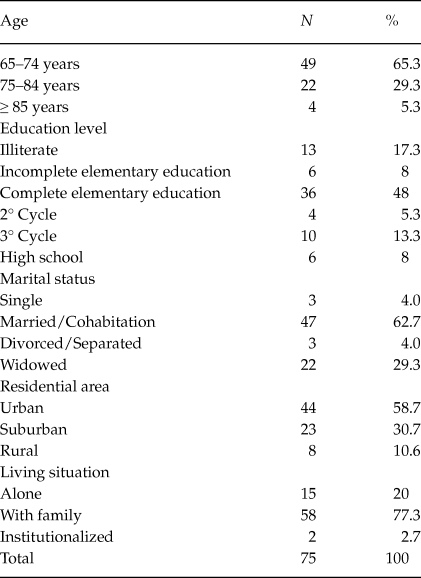
From an initial sample of 155 elderly patients, 80 were excluded because they did not fulfill the inclusion criteria (Table 1). The final sample comprised 75 elderly with a predominance of female (78.7%). The age ranged from 65 to 88 years, with a mean age of 72.8 years (SD = 6.04). In most of the cases, educational level was low, with an average of 4.68 years (SD = 3.51). Regarding marital status, the majority of participants were married (62.7%), followed by widowed (29.3%). Regarding place of birth, all the participants were from the north of Portugal and most of them lived in urban areas (58.7%). The majority of participants (77.3%) lived with family (the majority with their spouse or other relatives).
Sociodemographic characteristics of the sample

Concerning the level of physical disability (Table 2) the answers ranged from 0 to 4, with an average of 1.41 (SD = 1.2), which means that these patients had no disabling physical conditions. The index of global disability (including instrumental / functional area, mobility; personal care activities and sphincter control), ranged from 0 to 61, with a mean of 11.87 (SD = 13.56). None of the subjects in the sample presented a severe level of disability (score higher than 62).
EASYcare scores

In the final sample the majority of patients (N = 75) had some type of chronic health complaints not related to psychiatric diseases. These data were completed with medical records and osteoarticular diseases were found to be the most common condition (65.3%), followed by gastrointestinal and cardiovascular diseases.
Relating to perceived quality of life, scores ranged from 8 to 14, with an average of 10.47 (SD = 1.49), indicating a low level. The majority (71.3%) reported feelings of loneliness.
Concerning depression, 93.4% were depressed, with 66.7% of the participants being severely depressed.
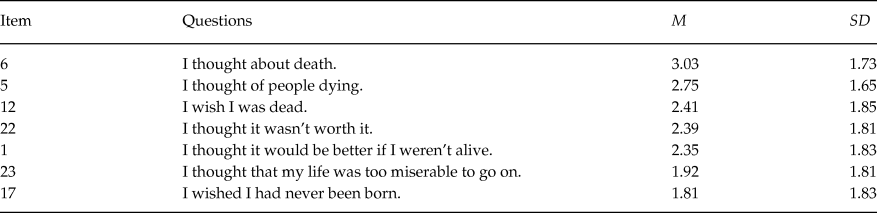
In terms of suicidal ideation (Table 3 and 4), answers varied between a minimum of 0 and a maximum of 129. The mean was 41.96 (SD = 36.38). These results reveal an important variation within the final scores.
Suicidal Ideation Questionnaire

SIQ means concerning frequent thoughts

Considering the value of 41 (from which there is a potential risk of suicide), 40% of the patients were above the cut-off point.
In relation to information about the history of suicidal behaviors within the family and community, 16% (N = 12) of the patients reported knowledge of suicidal behavior in their family and 17.3% (N = 13) cases of suicide in the community. In this sample, 37.3% mentioned already having attempted to commit suicide and 14.7% had made their attempt less than two years ago (the most common method used (18.7%) was drug poisoning).
Correlational Analysis
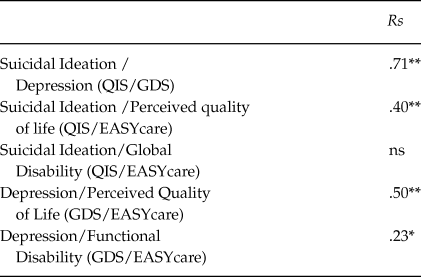
A significant correlation between depression and suicidal ideation was found (rs = .71, p < .001), indicating that increases in depression scores were associated with increases in suicidal ideation. When examining the association between depression and perceived quality of life, a highly significant correlation was found (rs = .50, p < .001). This result indicates that increases in depression scores were associated with increases in the quality of life scores, denoting poor quality of life. Concerning the Easy care index, a significant positive correlation between depression and the functional/instrumental area was found (rs = .23, p = .043). High values in depression were associated with greater inability to perform activities of daily living. No correlation was found with global disability.
In addition, a significant positive correlation between suicidal ideation and the patients´ perceived quality of life was found (rs = .40, p < .001), indicating that high scores for suicidal ideation were associated with a poor perception of quality of life (Table 5).
Correlational analyses

rs Spearman‘s correlation coefficient *p < .05; **p < .01.
Discussion
In this study, with a sample of 75 patients, 78.7% were female. Similar results have been found in most of the national studies (INE, 2002; Carrilho & Patrício, Reference Carrilho and Patrício2009). Regarding to physical disability, these patients did not reveal significant limitations in terms of vision, audition, mastication, or speech that could interfere with their day-to-day living. Similar results were obtained in the global disability index, revealing that patients had sufficient autonomy and ability to perform their daily living activities. Concerning diseases, most of patients reported chronic conditions with osteoarticular diseases being the most common complaint. In turn, this particular condition involved pain, discomfort and disability as well as loss of mobility and independence.
Concerning perceived quality of life and state of health, home and loneliness, patient perceived their quality of life as low. This result is supported both by national and international studies (Fernandes et al., Reference Fernandes, Pereira, Leuschner, Martins, Sobral, Azevedo and Orrell2009). According to Sousa, Galante, and Figueiredo (Reference Sousa, Galante and Figueiredo2003), dependency-autonomy has been associated with the quality of life in the elderly population. Although this is a multidimensional and subjective concept, it seems to be clear that mobility and autonomy contribute to a better perception of quality of life as well as to a positive mental state.
As in previous studies in this age group, the majority had severe depression. In fact, depression has great importance among elderly, as a major cause of psychological distress, appearing as the most common psychiatric disorder in this population (Conwell, Duberstein, & Caire, Reference Conwell, Duberstein and Caine2002; Marques & Firmino, Reference Marques, Firmino and Vaz Serra2003; Marques & Ramalheira, Reference Marques, Ramalheira, Pinto, Leuschner and Barreto2006). Moreover, it is often associated with loss of autonomy as a result of disability, and increased of pre-existing illnesses (Gusmão, Xavier, Heitor, Bento, & Caldas de Almeida, Reference Gusmão, Xavier, Heitor, Bento and Caldas de Almeida2005). Depressive states are very common in old age and can lead to suicide, which is often higher in people aged over 65 years (Cohen, Llorente, & Eisdorfer, Reference Cohen, Llorente and Eisdorfer1998; Costa, Reference Costa, Paul and Fonseca2005; Fontaine, Reference Fontaine2000; Marques & Ramalheira, Reference Marques, Ramalheira, Pinto, Leuschner and Barreto2006).
A positive association was found between depression and the patients´ perceived quality of life, being even worse when they were more depressed. This result was corroborated by Fleck et al. (Reference Fleck, Lima, Louzada, Schestasky, Henriques, Borges and Camey2002). In their cross-sectional study the authors reported that the presence of depressive symptoms is associated with a poorer quality of life, and that individuals with greater depressive symptomatology had a poorer perception of their health. Moreover, this study found a positive correlation between depression and the functional/ instrumental area, revealing a close association. Again, this result is in line with other research (Gusmão et al., Reference Gusmão, Xavier, Heitor, Bento and Caldas de Almeida2005) in which an association is found between depression and difficulty in performing activities of daily living.
Regarding suicidal ideation, it was established that 40% of the elderly were above the mean values, which are considered to be risk indicators (Almeida, Reference Almeida2000). In addition, the elderly showed recent and frequent cognitions about death, despair, sadness, helplessness and suffering. Another noteworthy finding is that 37.3% of elderly reported recent suicide attempts.
This study found significant correlations between: suicidal ideation and depression, as corroborated by Awata et al. (Reference Awata, Seki, Koizumi, Sato, Hozawa, Omori and Tsujl2005) in a cross-sectional study of elderly people; depression and functional disability, as reported in previous research (Conwell et al., Reference Conwell, Duberstein and Caine2002; Gusmão et al., Reference Gusmão, Xavier, Heitor, Bento and Caldas de Almeida2005; Marques & Firmino, Reference Marques, Firmino and Vaz Serra2003). The data from this study corroborated results found in studies of suicidal ideation, depression and quality of life in the elderly (Awata et al., Reference Awata, Seki, Koizumi, Sato, Hozawa, Omori and Tsujl2005; Fernandes et al., Reference Fernandes, Pereira, Leuschner, Martins, Sobral, Azevedo and Orrell2009) therefore denoting the need for early diagnosis and proper treatment of depression.
Acknowledging that the aspects that influence suicide are thoughts and cognitions of self-destruction, suicidal ideation, according to Ferreira and Castela (Reference Ferreira, Castela, Simões, Gonçalves and Almeida1999), their early identification can improve diagnosis and subsequent intervention. Suicide is often related to depressive mood disorders, and these are the most common treatable diseases among the elderly who use the National Health Service. Hence, many deaths by suicide could be avoided if the health system developed efficient preventive measures.
The consolidation of the relationship between these variables, particularly between the associated depressive condition and / or suicidal ideation, may prove to be important, not only in a broad preventive perspective, but also in improving the delivery of mental health care. As described in previous studies (Cohen, Llorente, & Eisdorfer, Reference Cohen, Llorente and Eisdorfer1998; Costa, Reference Costa, Paul and Fonseca2005; Fontaine, Reference Fontaine2000; Marques & Ramalheira, Reference Marques, Ramalheira, Pinto, Leuschner and Barreto2006), depressive states are very common in old age and can lead to suicide (above all over 65 years). Therefore, considering the progressive ageing of the Portuguese population, it becomes crucial to recognize and analyze its consequences in order to find appropriate solutions to this problem.