

Studies on compliance with hand hygiene technique commonly focus on observations regarding adherence of healthcare workers to the 5 moments outlined by the World Health Organization (WHO) guidelines. 1 These guidelines also provide guidance on the proper technique for the use of hand rub, consisting of 6 steps to ensure the complete coverage of the hands. Several studies have provided strong evidence for increased bacterial killing using this technique,Reference Carabin, Gyorkos, Soto, Joseph, Payment and Collet 2 – Reference Ayliffe, Babb and Quoraishi 5 but compliance with all 6 steps has not been evaluated. Therefore, we aimed to assess compliance of healthcare workers with the recommended hand hygiene technique.
Compliance with the World Health Organization Hand Hygiene Technique

This prospective observational study was performed at the University Hospital Basel, a tertiary academic medical care center in Switzerland that admits >32,000 patients annually. During defined study periods from 2010 to 2013, hand hygiene observations were conducted on 15 different wards: 5 medical and 5 surgical wards, as well as 2 wards belonging to the emergency department, 2 wards belonging to the intensive care units, and the bone marrow transplant unit. The study was approved by the institutional review board as part of the quality assurance program.
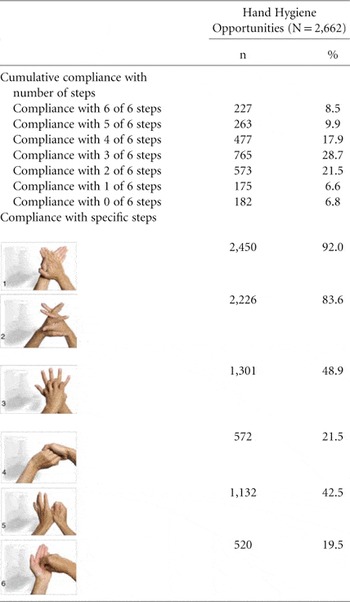
All hand hygiene observations were performed by 3 trained researchers over 520 hours of direct observation of performance of hand hygiene techniques at the 5 moments of hand hygiene. The 5 moments of hand hygiene as outlined by the WHO 1 are (1) before touching a patient, (2) after touching a patient, (3) after touching patient surroundings, (4) after body fluid exposure risk, and (5) before clean/aseptic procedure”). The individual steps of the hand hygiene technique as outlined by the WHO are (1) rubbing hands palm to palm, (2) palm to palm with fingers interlaced, (3) right palm over left dorsum with interlaced fingers and vice versa, (4) back of fingers to opposing palms with fingers interlocked, (5) rotational rubbing of left thumb clasped in right palm and vice versa, and (6) rotational rubbing backwards and forwards with clasped fingers of right hand in left palm and vice versa). 1 , 6
Furthermore, information regarding age, profession, and duration of employment at our institution was recorded. Age was categorized as <26 years, 26–35 years, 36–45 years, 46–55 years, and >55 years. Duration of employment was categorized as 0–5 years, 6–10 years, 11–20 years, and >20 years.
The primary outcome was compliance with all 6 steps of the hand hygiene technique. The χ2 test was used for comparisons of proportions, and odds ratios (ORs) were calculated using univariable logistic regression models and Stata statistical software, version 12.0 (Stata Corp, College Station, Texas). Two-sided P values <.05 were considered significant.
Overall, 2,662 hand hygiene opportunities were observed, mostly among nurses (65.3%, 1,737 of 2,662), followed by doctors (21.7%, 579 of 2,662) and other healthcare workers (13.0%, 346 of 2,662). The most common indication was “after touching a patient” (41.9%, 1,114 of 2,662), followed by “before touching a patient” (31.9%, 848 of 2,662), “after touching patient surroundings” (11.0%, 292 of 2,662), “after body fluid exposure risk” (9.0%, 240 of 2,662), and “ before clean of aseptic procedure” (6.3%, 168 of 2,662).
COMPLIANCE WITH HAND HYGIENE INDICATIONS
Hand hygiene was performed in 93.2% of all opportunities (2,480 of 2,662). Compliance rates were highest in the intensive care units (100%, 193 of 193), followed by the emergency department (94.8%, 255 of 269), the medical wards (94.0%, 1,225 of 1,303), and the surgical wards (90.0%, 807 of 897) (P<.001). No differences regarding compliance in respect to profession were identified (nurses 93.6%, 1,626 of 1,737, doctors 91.5%, 530 of 579, others 93.6%, 324 of 346).
COMPLIANCE WITH HAND HYGIENE TECHNIQUE
Compliance with all 6 steps of hand hygiene technique was 8.5%, the majority of healthcare workers adhered to steps 2 and 3 (Table). Profession was not associated with compliance with hand hygiene technique (nurses 9.0%, 156 of 1,737, doctors 6.9%, 40 of 579, others 9.0%, 31 of 346, P=.288). Healthcare workers ≤25 years of age showed higher compliance with the correct technique than older age groups (OR, 0.84; 95% CI, 0.74–0.97; P=.016), and compliance with all 6 steps decreased with increasing duration of employment at our institution (OR, 0.68; 95% CI, 0.54–0.87; P=.002).
No differences in compliance with hand hygiene indications or technique were detected over the study period (data not shown).
While compliance with hand hygiene indications was high at our institution, proper technique for use of alcohol-based hand rub was performed in <10% of all hand hygiene opportunities. Younger healthcare workers and those employed at our institution for shorter time periods were more likely to adhere to all 6 hand hygiene steps. This observation is concerning, as noncompliance with the proper technique for using hand rub may result in failure to cover all skin surfaces and, hence, insufficient bacterial killing.Reference Widmer and Dangel 3 , Reference Widmer, Conzelmann, Tomic, Frei and Stranden 7
These results mirror findings from a previous study revealing that repeated training programs on the proper hand hygiene technique should be offered throughout professional life to ensure greater degrees of reduction of bacterial densities.Reference Tschudin Sutter, Frei, Dangel and Widmer 8
Important limitations of our study include lack of standardization of types of care before performance of direct observation as well as an absence of measures to avert a Hawthorne observation effect.Reference Eckmanns, Bessert, Behnke, Gastmeier and Ruden 9 The latter limitation possibly explains the high compliance rate with hand hygiene indications observed at our institution while underscoring the low compliance rate with the hand hygiene technique.
In conclusion, compliance with hand hygiene does not necessarily correlate with proper WHO-recommended technique. The decline of compliance with increasing age of healthcare workers and duration of employment point to the high level of training needed to ensure performance of all 6 steps of the hand hygiene technique. Surveillance programs focusing on adherence of healthcare workers to hand hygiene indications may overestimate the efficacy of such interventions.
Acknowledgments
Financial support: No commercial funding was received for the study.
Potential conflicts of interest: No author has any conflict of interest relevant to this article and no financial interest in this manuscript.