Introduction
Tonsillectomy is one of the most common otolaryngology procedures performed.Reference Blair, McKerrow, Carter and Fenton1 Post-operative haemorrhage is a relatively common complication. Many studies have compared techniques and their rates of post-operative haemorrhage. Methods of tonsillectomy and haemostasis, patient selection, post- and intra-operative analgesia, periods of observation after surgery, and seasonal variation have been reviewed.Reference Blair, McKerrow, Carter and Fenton1–Reference Lee, Montague and Hussain6 The impact of local meteorological variables on secondary haemorrhage post-tonsillectomy has been examined by Lee and colleagues,Reference Lee, Montague and Hussain6 and Collison and Mettler.Reference Collison and Mettler4 Furthermore, both Dubs and Primault,Reference Dubs and Primault7 and Perrone and Ventura,Reference Perrone and Ventura8 have postulated climatic influence on post-tonsillectomy haemorrhage rates.
Many studies have found a significant correlation between atmospheric conditions and epistaxis rates in localities around the world.Reference Sowerby, DeSerres, Rudmik and Wright9–Reference Pallin, Chng, McKay, Emond, Pelletier and Camargo11 Anecdotal evidence,Reference Prasad12 and the delightfully titled article ‘Kilimanjaro, epistaxis and all that’,Reference Egan13 suggest an increased risk of mucosal surface bleeding at higher altitudes and with lower atmospheric humidity. Recent papers investigating the effect of atmospheric conditions on haemostasis and bleeding in conditions varying from intracerebral haemorrhageReference Jeong, Park, Yoo, Kim, Kim and Kim14 and aneurysmal subarachnoid haemorrhageReference Neidert, Sprenger, Wernli, Burkhardt, Krayenbühl and Bozinov15 to pre-eclampsiaReference Nasiri, Ahmadi, Khajeh, Sarafraz and Mazloum16 and angina pectorisReference Abrignani, Corrao, Biondo, Lombardo, Di and Braschi17 suggest a significant influence of atmospheric conditions on the incidence of a variety of conditions.
In their 2005 study, Lee and colleaguesReference Lee, Montague and Hussain6 examined 346 patient tonsillectomy episodes, and found a significant relationship between water vapour pressure and post-tonsillectomy haemorrhage. That study, performed in Dundee, Scotland, reported a significant correlation between local atmospheric temperatures and mean vapour pressures, with no significant correlation found between relative atmospheric humidity and bleeding rate. Similarly, Collison and MettlerReference Collison and Mettler4 examined a total of 430 patients who were operated on over the course of 3.5 years in Yankton, South Dakota, USA, and Roberts et al.Reference Roberts, Jayaramachandran and Raine3 examined 1090 patients over 1 year in Staffordshire, UK. Both studies reported a higher rate of bleeding during the late spring and summer months.
The DundeeReference Lee, Montague and Hussain6 and StaffordshireReference Roberts, Jayaramachandran and Raine3 studies both covered a single year's practice, with the Dundee study examining a relatively small number of tonsillectomies for analysis of the effects of atmospheric conditions on haemorrhage rates, and the Staffordshire study examining the effects of month of procedure only. Collison and MettlerReference Collison and Mettler4 examined more procedures over a longer timeframe, but less emphasis was placed on analysing the effects of atmospheric variables other than temperature.
As tonsillectomy is such a common procedure with serious potential complications, we felt the issue warranted further investigation with high patient numbers and over a longer timeframe. This allows a more reliable assessment of the effects of atmospheric conditions on post-tonsillectomy secondary haemorrhage.
Darwin, Australia is a tropical city. Whilst air temperature remains relatively stable throughout the year, there are large variations in monthly relative humidity and water vapour pressure between the wet season and the dry season. This relatively predictable meteorological environment was felt to represent an excellent opportunity to observe the effects of relative humidity, water vapour pressure and temperature on post-tonsillectomy bleeding rates across all performed tonsillectomies. Another positive attribute of Darwin city in the conduction of this study is its geographic isolation and the presence of only one hospital with an emergency department. Studies in areas with numerous hospitals may miss episodes of haemorrhage generated at the base hospital if the patients concerned present to another hospital in the area.
Materials and methods
A retrospective case note review of all patients who underwent tonsillectomy between June 2008 and May 2013 at both the Darwin Private Hospital and the Royal Darwin Hospital, Australia was conducted. All presentations and admissions post-tonsillectomy were recorded, as were concurrent procedures (e.g. adenoidectomy and palatoplasty), delay to secondary haemorrhage (measured in terms of days post-procedure) and general demographic data.
All data were subsequently correlated with Australian Bureau of Meteorology data for the corresponding months, and a regression analysis was performed. Data were also analysed by season, whereby dry season months were those with an average daily humidity of less than 70 per cent and wet season months were those with an average humidity of more than 70 per cent. For this comparison, analysis of variance and chi-square analysis were undertaken, in order to ascertain any difference in bleeding rates. In addition, data were analysed using both average 3 pm daily humidity and overall daily average humidity. The effects of gender and age on epistaxis rates were also examined.
At the Royal Darwin Hospital, all tonsillectomies were performed using the traditional ‘cold steel’ dissection technique, and at the private hospital, the techniques used varied between monopolar diathermy, co-ablation diathermy, bipolar dissection and cold steel dissection.
Results
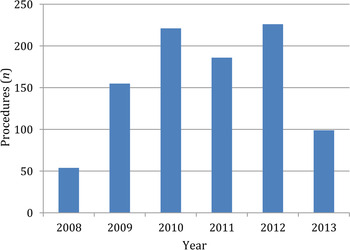
A total of 941 patients underwent tonsillectomy between June 2008 and May 2013. The patients had an average age of 15.26 years (range, 2–58 years), with a median age of 13 years. The total number of procedures performed for each individual year is shown in Figure 1.
Number of procedures performed by year.

A total of 74 bleeding episodes were recorded, at an average rate of 7.7 per cent. In the study group, the male to female ratio was 0.99:1. The average delay to secondary haemorrhage was 6.89 days (range, 2–15 days), with a median of 6 days and a mode of 6 days.
Children aged 12 years and under had an average haemorrhage rate of 6.2 per cent, whereas those aged 13 years and over had a bleed rate of 14.1 per cent (p = 0.005). Males had a significantly higher observed haemorrhage rate, at 9.8 per cent, contrasting with a haemorrhage rate of 5.6 per cent for females (p = 0.03).
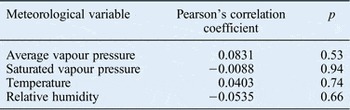
Average monthly relative humidity for the study period was 70.08 per cent, with the highest monthly relative humidity recorded in February 2011 (85.2 per cent) and the lowest in August 2008 (51.2 per cent). The bleeding rates for these months were 0 per cent and 7.7 per cent respectively. Mean monthly vapour pressure varied between 14.39 hPa, in June of 2011, and 31.34 hPa, in February 2010. Pearson's correlation coefficients for haemorrhage rates by average vapour pressure, saturated vapour pressure, temperature and relative humidity, with respective p-values, are displayed in Table I.
Effects of atmospheric variables on post-tonsillectomy haemorrhage rates

When analysed by season, no difference was found in haemorrhage rates between wet and dry seasons, with the dry season having an average bleeding rate of 8.4 per cent and the wet season having an average rate of 6.3 per cent (p = 0.279). Using water vapour pressure to delineate wet and dry seasons also revealed no significant difference in haemorrhage rates, with those months that had a water vapour pressure of less than 25 hPa being associated with an average haemorrhage rate of 6.6 per cent, and those months with a water vapour pressure of more than 25 hPa corresponding with a haemorrhage rate of 7.77 per cent (p = 0.483).
Discussion
Our results are consistent with previously published literature with regard to rates of post-tonsillectomy haemorrhage, with published rates between 1 and 9 per cent.Reference Collison and Mettler4, Reference Carmody, Vamadevan and Cooper5, Reference Lloyd-Faulconbridge, Fowler, Horrocks and Topham18 The results also show a significant difference between age groups when examining rates of bleeding post-tonsillectomy. Previous literature has suggested an increased risk of bleeding in older patients,Reference Blair, McKerrow, Carter and Fenton1–Reference Carmody, Vamadevan and Cooper5, Reference Tomkinson, Harrison, Owens, Harris, McClure and Temple19 including a 3-fold increase in secondary haemorrhage risk in those aged over 12 years, as reported by Tomkinson and colleagues.Reference Tomkinson, Harrison, Owens, Harris, McClure and Temple19 Our results, whilst not as dramatic, do support an increased risk of post-tonsillectomy bleeding for those over the age of 12 years, with an absolute risk increase of 7.9 per cent or a relative risk increase of 127 per cent.
Despite the results of previous studies,Reference Collison and Mettler4, Reference Lee, Montague and Hussain6 which indicate an increased rate of bleeding during the dry season (May to October), our results suggest no such relationship between haemorrhage rates and atmospheric humidity or water vapour pressure. In this study, we examined the effects of atmospheric conditions in an environment with little variance in temperature throughout the year. One interesting point to consider that arises from our results is the potential influence of temperature over water vapour pressure.
Water vapour pressure, when viewed in terms of temperature, can be calculated using the equation: log10P = A – B/(C + T), where T is temperature in degrees Celsius, P is the water vapour pressure in millimetres of mercury (mmHg),Reference Nahrwold, Archer and Cohen20 and A, B and C are defined constants. As water vapour pressure is proportional to atmospheric temperature, the question raised is whether the risk previously reported in environments with lower temperatures and lower water vapour pressures is due more to the influence of temperature than the vapour pressure. Based on our lack of significant findings, and given the limited range of temperature variation throughout the year, and the large variation in relative humidity and vapour pressure in our study, it could be suggested that the previously reported increased risk of bleeding in the summer months or, by Lee and colleagues,Reference Lee, Montague and Hussain6 winter months, owed more to the altered atmospheric temperature than the water vapour pressure. By extension, it may then be posited that a relatively homogeneous climate, such as that reported in the Scottish tonsillectomy audit,Reference Blair, McKerrow, Carter and Fenton1 would not uncover differing rates of post-tonsillectomy haemorrhages between different climates.
One possible avenue of continued exploration in this area would be to investigate the effect of climate on secondary haemorrhage rates through a prospective national audit in a country or locale with a wide variety of climactic conditions. To this end, Australia would make an ideal candidate given its widely varying microclimates and relatively small population.
Before considering the potential implications of our results, we must acknowledge the limitations of our study and possible confounding influences on our results. Firstly, our study may have been confounded by the burgeoning presence of domestic air conditioning. As air conditioning primarily relies on extraction of humidity in order to cool homes, the likely environments in which our patients will have spent their recovery time may potentially have been very different from the atmospheric conditions reported. This was not controlled for in our study (being a retrospective review). If further research was undertaken, the effect of air conditioning on post-tonsillectomy haemorrhage would present an interesting potential correlation to examine. Future studies could also investigate the validity of the common recommendation of the use of humidification post-tonsillectomy, as no literature on the subject was found on this practice when researching the current study.
• Tonsillectomy has a secondary haemorrhage risk of up to 9 per cent
• Previous papers have suggested increased rates of bleeding during hotter, drier weather
• Our results indicate no influence of water vapour pressure or humidity on post-tonsillectomy haemorrhage rates
• Temperature fluctuations may have an influence on bleeding rates, but this could not be examined adequately in this study
Equally, our results may have been potentially compromised by the varied methods of tonsillectomy employed at the two hospitals surveyed. Whilst the majority of patients underwent traditional or cold steel tonsillectomy, there were a variety of other methods used, including monopolar diathermy, co-ablation diathermy and bipolar dissection. Although the study may still be viewed as a review of the impact of atmospheric conditions on all-cause tonsillectomy bleeding, the authors would recommend that any future studies into this area be conducted in a prospective manner, with either a single modality tonsillectomy method or an ability to control for the method of tonsillectomy when analysing data.