Introduction
Functional psychosis in general, and schizophrenia in particular, has a variable outcome. Robust predictors of this are relatively few in number but have included demographic, pre-morbid, symptom-related, cognitive and treatment-related variables. However, studies designed to establish the predictive powers of these factors are often limited due to initial selection bias; brief follow-up period, incomplete follow-up rates, restricted outcome measures and shortcomings in statistical analysis. There is, additionally, an emerging consensus that outcome studies should ideally be based on first-episode (FE) cases from an epidemiological sample.
Evidence points to the importance of pre-existing neurodevelopmental vulnerability in the aetiology of psychosis, and perhaps particularly in schizophrenia (Andreasen, Reference Andreasen1999; Baldwin et al. Reference Baldwin, Browne, Scully, Quinn, Morgan, Kinsella, Owens, Russell, O'Callaghan and Waddington2005; Bombin et al. Reference Bombin, Arango and Buchanan2005). Markers such as pre-morbid functional deficits and the presence of neurological soft signs also appear to predict poor short- and medium-term outcome (Larsen et al. Reference Larsen, Moe, Vibe-Hansen and Johannessen2000; Cannon et al. Reference Cannon, Van Erp and Glahn2002; Leask et al. Reference Leask, Done and Crow2002; Chen et al. Reference Chen, Hui, Chan, Dunn, Miao, Yeung, Wong, Chan and Tang2005). However, comprehensive longer-term outcome studies (more than 5 years) of epidemiological FE cohorts are few and far between and methodologically heterogeneous. Thus, identification of long-term predictors of outcome remains something of an open question. Early clinical features of psychosis predicting poor outcome, such as a diagnosis of schizophrenia rather than affective disorder and the presence of marked negative symptoms early in the illness, have been consistently reported (Fenton & McGlashan, Reference Fenton and McGlashan1991; Moller et al. Reference Moller, Bottlender, Grosz, Hoff, Wittmann, Wegner and Strausz2002; Jarbin et al. Reference Jarbin, Ott and Von Knorring2003; Milev et al. Reference Milev, Ho, Arndt and Andreasen2005). An association between longer duration of untreated psychosis (DUP) and poor outcome has also received recent support (Drake et al. Reference Drake, Haley, Akhtar and Lewis2000; Marshall et al. Reference Marshall, Lewis, Lockwood, Drake, Jones and Croudace2005) both in the short-to-medium term (e.g. Addington et al. Reference Addington, Van Mastrigt and Addington2004; Harris et al. Reference Harris, Henry, Harrigan, Purcell, Schwartz, Farrelly, Prosser, Jackson and McGorry2005) and in at least one study with a follow-up period of 15 years (Bottlender et al. Reference Bottlender, Sato, Jager, Wegener, Wittmann, Strauss and Moller2003) though not in a second of similar duration (Ropcke & Eggers, Reference Ropcke and Eggers2005).
However, untangling the influences of inter-related risk factors for psychosis outcome remains methodologically problematic: For example, Verdoux et al. (Reference Verdoux, Liraud, Bergey, Assens, Abalan and Van Os2001) concluded that poor pre-morbid functioning itself predicts both longer DUP and poor outcome (Verdoux et al. Reference Verdoux, Liraud, Bergey, Assens, Abalan and Van Os2001). Similarly, Malla & Payne (Reference Malla and Payne2005) questioned the predictive significance of DUP because of its covariation with the apathy/anhedonia negative symptom dimension. The problem of establishing independent risk is additionally further compounded if other known, putative, or even possible factors are excluded, a priori, from a study's protocol.
In an effort to address some of these pitfalls, we report here a prospective study of 10-year multi-dimensional clinical and functional outcomes in a geographically defined sample of individuals with FE psychosis. The aims of the study were: (i) to test previously reported robust predictors of long-term outcome such as the presence (at illness onset) of pronounced negative symptoms; (ii) to examine the effect of pre-existing markers of neurodevelopmental compromise, specifically pre-morbid functioning and neurological soft signs, in predicting outcome; and (iii) to examine whether DUP was associated with aspects of long-term outcome and, if so, whether this association was independent, or alternatively, mediated by one or more of the other risk factors.
Method
Participants
A sample of consecutive first admission research diagnostic criteria (RDC) psychotic patients (Spitzer et al. Reference Spitzer, Endicott and Williams1979), excluding major depression, was ascertained over a 24-month period (mid-1986 to mid-1988). Cases were obtained by screening all adult admissions to National Health Service psychiatric units in south and central Manchester, UK (catchment area then 307 000). Patients meeting the following inclusion criteria were identified: aged 16–50 years; not suffering from a major neurological disorder; not pregnant or within 3 months post-partum; not fulfilling RDC criteria for major depression as the primary diagnosis; and illness not considered primarily due to intoxication with drugs/alcohol. A ‘leakage review’ carried out at the end of the recruitment phase to identify any potential participants presenting to general practitioners or psychiatric services who had not been admitted to hospital confirmed that no FE psychosis presentations were missed due to non-admission in the catchment area.
Recruitment and clinical assessments
Eligible participants were approached and full informed consent obtained. An initial interview was carried out within 72 h of admission to assess mental state and behaviour. A further interview was conducted approximately 2 weeks later to record a detailed social and psychiatric history. In the majority of cases an additional interview with one or more relative informants (usually parents) was undertaken to substantiate details about the patient's background.
Over the 24-month recruitment period, 111 individuals meeting these criteria were identified, two of whom declined to participate, resulting in a cohort of 109. Descriptive data relating to this sample have been previously reported (Montague et al. Reference Montague, Tantam, Newby, Thomas and Ring1989; Ring et al. Reference Ring, Tantam, Montague and Morris1991; Stirling et al. Reference Stirling, White, Lewis, Hopkins, Tantam, Huddy and Montague2003). Full ethical approval to conduct this stage of the study was obtained from the North Western regional ethics panel (UK), and the study itself was conducted in accordance with Treaty of Helsinki guidelines.
Assessments at baseline were as follows:
(1) Present State Examination (PSE-9; Wing et al. Reference Wing, Cooper and Sartorious1974). An index of positive psychotic symptoms was derived from the sum of items 41–3, 49, 55–64, 66–92.
(2) Scale for the Assessment of Negative Symptoms (SANS; Andreasen, Reference Andreasen1983). Inter-rater reliability for affective flattening and alogia subscales was established through the video recording of a subset of SANS interviews for assessment by raters. Weighted κ values of 0.6–0.7 were obtained for each subscale.
(3) Montgomery–Asberg Depression Rating Scale (Montgomery & Asberg, Reference Montgomery and Asberg1979).
(4) Pre-morbid assessments using the complete Pre-morbid Adjustment Scale interview (PAS; Cannon-Spoor et al. Reference Cannon-Spoor, Potkin and Wyatt1982) with one or both parents (or another suitable informant) were undertaken for 61 patients. It was possible to score a further 22 patients on the PAS based on information obtained from chart review and social and psychiatric history described above. Following Cannon-Spoor et al. we derived a PAS-global score based on the average of all rated subscales. For the remaining patients, for whom insufficient data were collected to generate reliable PAS scores (i.e. fewer than three rated subscales), onset chart-review records and early illness interviews were reappraised to generate an index of pre-morbid functioning [called for these purposes the Pre-morbid Functioning (PMF) score]. This measure took into account social and sexual relationships, academic and employment history, and both childhood and adult forensic histories (all prior to first onset), with appropriate corrections for any missing information. PMF was additionally calculated for respondents for whom satisfactory PAS data had been collected, to provide a common measure of pre-morbid functioning in almost all (107/109) participants. PMF scores were relatively normally distributed with a mean of 24.10 (s.d.=4.65). Maximum possible score was 34 (a high score signifying good pre-morbid function). Its validity was assessed by correlating it with PAS data in individuals where this was also available (n=83). Correlations were as follows: with PAS-general, r=0.65; with PAS-childhood, r=0.47; with PAS-early adolescence, r=0.49, with PAS-late adolescence, r=0.48; with PAS-adulthood, r=0.43, and with corrected PAS-global score, r=0.71 (all p<0.001). These data indicate that PMF demonstrates reasonable concurrent validity when considered against the PAS.
(5) DUP prior to first admission was assessed at baseline from interview in each case with the patient and, where available, informants. DUP was recorded as the time between onset of first positive psychotic symptoms and index admission. In 15 cases, antipsychotic drug treatment had been commenced before index admission, so a ‘true’ value of DUP was derived in these cases by subtracting duration of treatment from the initial estimated DUP.
(6) Neurological soft signs were assessed using a battery of measures similar to those comprising later standardized instruments such as the Neurological Evaluation Scale (Buchanan & Heinrichs, Reference Buchanan and Heinrichs1989). The items, each scored 0–2, were: adventitious movements; finger agnosia; finger flexion; movement copying; finger-thumb opposition smoothness and mirror movements; pronation-supination; dysdiadochokinesia; graphaesthesia; stereognosis. All examinations were carried out by one of two medically trained raters who showed satisfactory inter-rater reliability for total score on examination of 10 subjects (intra-class correlation: r=0.81, p=0.001).
Follow-up assessments
Additional full ethical approval was obtained to undertake the follow-up stage of this study. Tracing methods included contacting mental health services, family practitioners and use of a UK-national health database, the National Health Service Central Register. All patients (n=109) recruited into the study were successfully traced, a mean 10 years 6 months (range 8 years 2 months to 13 years 1 month) after index admission. Outcome assessments at interview were consented to and performed in 69 cases. The aim was to assess multiple domains of clinical, social and functional outcome. Assessments were undertaken blind to baseline measurements, and were, in all but three cases, performed by the same clinically trained rater (C.W.). Instruments were:
(1) World Health Organization Life Chart Schedule (WHO, 1992). Developed by the World Health Organization for the 16-country International Study of Schizophrenia (Sartorious et al. Reference Sartorious, Gulbinat, Harrison, Laska and Siegel1996), this measure assesses clinical and functional domains and is adaptable across cultures. We focused on recent (last 24 months) functioning; scoring months of independent living, months in work, months in receipt of a benefit or social security pension, time in hospital and number of admissions.
(2) Global Assessment of Functioning (GAF), (a) symptoms and (b) disability subscales (Goldman et al. Reference Goldman, Skodol and Lave1992).
(3) Scale for Assessment of Positive Symptoms (SAPS; Andreasen, Reference Andreasen1984) and SANS for assessment of positive and negative symptoms.
(4) Schedule for Affective Disorders and Schizophrenia, lifetime (SADS-L; Spitzer & Endicott, Reference Spitzer and Endicott1978) measures of (a) global outcome (item 970) and (b) sickest level of functioning in last month (item 969).
Of those unavailable for follow-up interview, 11 patients had died (including 10 non-natural deaths). Summary information was obtained for the remainder through (i) the use of a questionnaire for family practitioners (the General Practitioner Questionnaire; GPQ) relating to treatment, clinical judgement of recent and past mental health, service contacts and work/social functioning during the follow-up period and (ii) case-note and chart review.
Lifetime DSM-IV diagnoses were assigned for almost all cases at follow-up using clinical interview data and or/chart review (and ‘blind’ to onset diagnosis). In the event of an individual having died, or having had very little contact with services during follow-up, RDC diagnoses were also derived, based on whatever information was available from case-notes/chart review. Where this appeared to differ from probable lifetime DSM diagnosis, all available information was further scrutinized to establish a DSM diagnosis by consensus between two experienced clinicians (C.W. and S.L.).
Outcome measures and statistical analyses
Two sets of analyses were run. For the group as a whole (including the non-interviewed cases) outcomes were operationalized as either ‘poor’ or ‘not poor’ from data derived from the GPQ and chart review. ‘Poor outcome’ was defined a priori by fulfilling all of the following criteria: (i) ‘mentally ill in the last year’; (ii) ‘mentally ill’ for at least 5 of the previous 10 years; (iii) employed for less than 2 of the last 10 years; and (iv) not in work at all in the last year. Using this algorithm, 55 cases had a ‘poor outcome’ and 39 cases a ‘not poor outcome’. (The inclusion of non-natural death cases as ‘poor outcome’ in a supplementary analysis raised the size of this group to 64 and the total analysable sample to 103/109.) This dichotomized outcome measure was subjected to logistic regression against the baseline variables of interest: PMF; DUP; positive, negative and depressive symptom scores; soft signs total score; and age at onset.
For participants who completed the follow-up interview and assessments (n=69), outcome measures were, in some instances, correlated with one another, so were subjected to two-factor analyses with oblique rotation; one of general outcome measures (eight measures) and one of symptom measures. The first led to the extraction of two main factors: (i) functional outcome (factor 1; 46% of variance) loaded on GAF disabilities, SADS-L items 969 and 970 and life-chart scores for work record and pension receipt; and (ii) service contacts/dependency (factor 2; 19% of variance) loaded on life-chart scores for independent living, time in hospital and number of admissions. The second (of positive and negative symptoms from the SAPS and SANS, GAF symptom scores, and life-chart: recent negative symptoms) generated a single factor (factor 3), outcome symptom burden, accounting for almost 66% of the overall variance. Regression analysis of these factors against the same baseline variables of interest was planned. In order to test the specificity of any associations to lifetime diagnosis, each analysis was run once for all psychotic respondents interviewed at 10-year follow-up (n max=69) and once for those respondents meeting criteria for a lifetime DSM-IV diagnosis of schizophrenia or schizo-affective disorder (n max=49).
DUP, soft signs and negative symptoms were all strongly positively skewed and thus log-transformed. ‘Positive symptoms’ was also somewhat positively skewed and transformed by square root. All reported probabilities are two-tailed.
Results
Cohort descriptive statistics
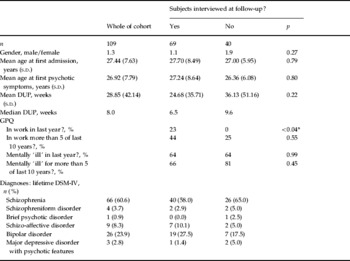
The index admission sample comprised, for the most part, young unmarried patients. Table 1 summarizes demographic and (selected) GPQ data and lifetime diagnoses for both the whole sample and for the subsample consenting to the 10-year outcome interview. The only significant difference between subjects interviewed at follow-up and those who were not related to employment record during follow-up, which was worse in the latter group. The mean DUP for the whole sample was 29 weeks (median 8 weeks). This was marginally longer (though not significantly so) in the non-interviewed group.
Diagnoses, demographic and (selected) GPQ details
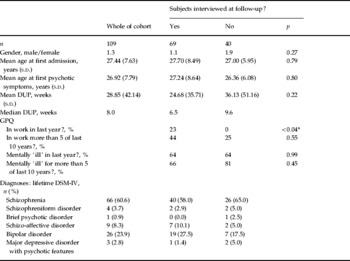
GPQ, General Practitioner Questionnaire; s.d., standard deviation; DUP, duration of untreated psychosis; DSM-IV, Diagnostic and Statistical Manual of Mental Disorders, 4th edition.
* p⩽0.05 (two-tailed).
Ten-year outcome descriptors
Descriptive indicators of outcome were as follows in the larger (surviving) psychosis sample (n=98): 80% had been in contact with mental health services in the previous year and 76% had been in contact with mental health services for 8 or more of the past 10 years; 18% had had no further psychiatric in-patient admissions and 18% had had 10 or more; 19% were in full- or part-time employment at follow-up and 48% had never worked.
Outcome in relation to baseline predictors
The entire cohort
Some predictors of interest were significantly correlated with each other: soft signs were correlated with poor PMF (r=0.244, p<0.05) and (absence of) positive symptoms (r=−0.237, p<0.05). Negative symptoms were correlated with higher depression scores (r=0.432), longer DUP (r=0.251) and poorer PMF (r=−0.474) (all p<0.01). Forward stepwise conditional logistic regression was performed with the dichotomized outcome measure (‘poor’–‘not poor’) as the dependent variable and DUP, PMF, positive, negative and depression baseline symptom scores, soft signs and age of onset as independent variables, in the sample of 91 surviving patients for whom all these data were available. Poor PMF was the best predictor of outcome (Wald=6.886, p=0.009) with both DUP and onset negative symptoms adding significantly to the regression equation (Wald=6.877, p=0.009, and Wald=3.272, p=0.05 respectively). Inspection of R 2 estimates and classification table indicated correct identification of 79% of poor outcome cases and 66% of good outcome cases. Repeating this analysis with the inclusion of non-natural death cases (increasing the sample of ‘poor outcome’ cases to 63) essentially duplicated these findings (PMF: Wald=5.912, p=0.015; DUP: Wald=7.774, p=0.005; onset negative symptoms: Wald=5.149, p=0.023). This model correctly classified 81% of poor outcome cases and 66% of good outcome cases.
Cases assessed at 10-year follow-up interview (n=69)
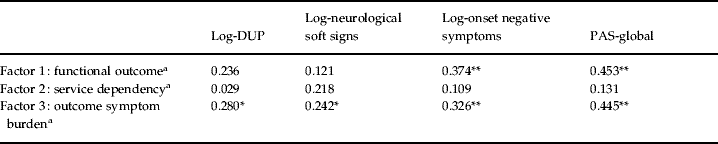
In view of their failure to contribute to the preceding logistic regression equation, coupled with our wish to keep the number of independent variables within statistically acceptable limits, age at onset and onset positive and depressive symptoms were removed from subsequent analyses. PMF was, additionally, replaced with PAS-global score as our index of pre-morbid function which was available for all but three of this cohort. Marked soft signs correlated with poorer pre-morbid functioning (r=0.328, p<0.01); and marked negative symptoms correlated with longer DUP (r=0.259, p<0.05) and poor pre-morbid functioning (r=0.358, p<0.01). Bivariate correlations between predictors and factor scores are shown in Table 2.
Bivariate correlations between outcome factor scores and onset predictor variables in the cohort interviewed at follow-up (nmax=69)
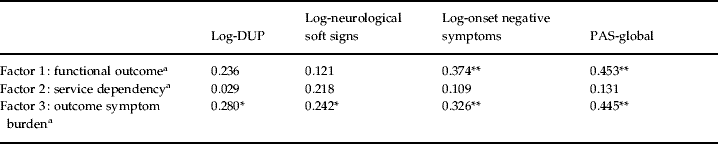
DUP, Duration of untreated psychosis; PAS, Pre-morbid Adjustment Scale.
a Higher score indicative of poorer outcome.
* p⩽0.05 (two-tailed), ** p⩽0.01 (two-tailed).
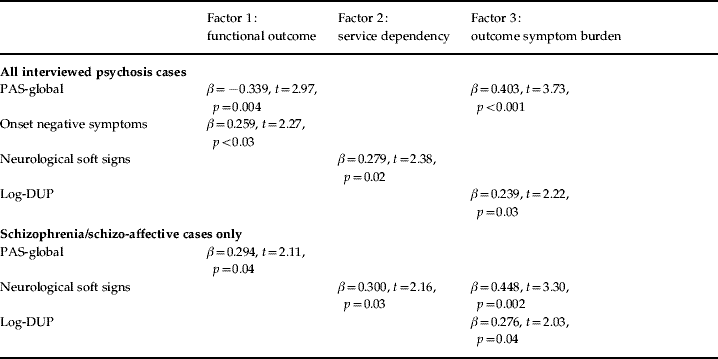
Linear regression was undertaken to assess the effects of these baseline variables on the factor analysis-derived outcome measures. These analyses were run first for the interviewed group as a whole (n max=69), then again for the subgroup with lifetime DSM-IV schizophrenia/schizo-affective disorder (n max=49). For the functional psychosis group, poor functional outcome (factor 1) was significantly predicted by poor pre-morbid adjustment (t=2.967, p=0.004) and onset negative symptoms (t=2.267, p=0.027). Pre-morbid adjustment explained 18% of the variance [F(1, 68)=14.93, p<0.001], and negative symptoms explained a further 6% [F(2, 67)=10.49, p<0.001]. Factor 2 (service contact/dependency) was predicted only by soft signs (t=2.38, p=0.02), accounting for 7.8% of overall variance [F(1, 68)=5.65, p=0.02]. Factor 3 (outcome symptom burden) was predicted by poor pre-morbid adjustment (t=3.70, p<0.001), explaining 18% of the variance [F(1, 68)=14.85, p<0.001], and longer DUP (t=2.22, p=0.03), explaining an additional 6% [F(2, 66)=10.32, p<0.001].
For the subgroup with a lifetime diagnosis of schizophrenia/schizo-affective disorder, poor functional outcome was significantly predicted only by poor pre-morbid adjustment (t=2.11, p=0.04), accounting for 8.7% of the variance [F(1, 48)=4.45, p=0.04]. Factor 2 (service contact/dependency) was predicted only by soft signs (t=2.15, p=0.03), accounting for 9% of the variance [F(1, 48)=4.66, p=0.03]. Factor 3 was predicted by both soft signs (t=3.30, p=0.002), accounting for 14.1% of the variance [F(1, 48)=7.70, p=0.008], and DUP (t=2.03, p<0.05), accounting for an additional 7% [F(2, 47)=6.17, p=0.004] (see Table 3).
Linear regression analyses of principal component analysis-derived factor scores for all interviewed psychosis cases (nmax=69) and the schizophrenia/schizo-affective subgroup (nmax=49)
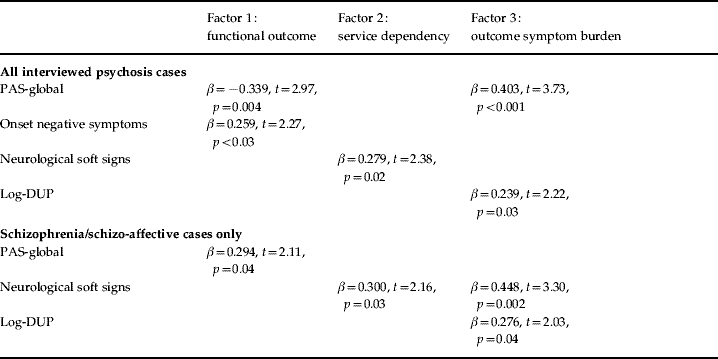
PAS, Pre-morbid Adjustment Scale; DUP, duration of untreated psychosis.
Discussion
Our 10-year follow-up study initially recruited 109 incident cases of functional psychosis from a geographically defined catchment area. In the late 1980s, the policy of UK clinical services was to admit all FE cases (confirmed by our leakage review), and inception rate was comparable with those of other UK studies (Harrison et al. Reference Harrison, Mason, Glazebrook, Medley, Croudace and Docherty1994; Baldwin et al. Reference Baldwin, Browne, Scully, Quinn, Morgan, Kinsella, Owens, Russell, O'Callaghan and Waddington2005). At follow-up, all participants were traced and strenuous attempts made to interview as many of the surviving sample as possible. Where respondents could not be interviewed, data about outcome were collected from hospital records and general practitioners. In the larger sample, poor PMF, longer DUP and more onset negative symptoms emerged as significant independent predictors of poor outcome. In the interviewed cohort, negative symptoms and poor pre-morbid adjustment predicted functional outcome; prevalence of soft signs predicted service dependency, and poor pre-morbid adjustment and longer DUP predicted outcome symptom burden. For the subgroup with a lifetime DSM diagnosis of schizophrenia or schizo-affective disorder, poor pre-morbid adjustment and soft signs predicted functional outcome and symptom burden respectively. Service contact/dependency was also predicted both by marked soft signs and longer DUP.
In other comparable studies, both poor pre-morbid adjustment and longer DUP are routinely described as risk factors for poor outcome (Foerster et al. Reference Foerster, Lewis, Owen and Murray1991; Addington et al. Reference Addington, Van Mastrigt and Addington2004). The former is thought to represent a combination of neurodevelopmental and social-cognitive deficits (Jones et al. Reference Jones, Rodgers, Marmot and Murray1994) and is an established predictor of poor social outcome and early relapse in schizophrenia (Weiselgren & Lindstrom, Reference Wieselgren and Lindstrom1996). In our study, it emerged as the most consistent predictor of poor outcome regardless of the assessment measure employed (PMF or PAS-global), the outcome measure in question (a simple binary designation or one of three principal component analysis-derived scores), or the outcome diagnosis of respondents (functional psychosis versus schizophrenia spectrum). However, this is not, of itself, an unexpected finding since all recent outcome studies that have included a measure of pre-morbid adjustment report that lower levels predict poor outcome (e.g. Van Os et al. Reference Van Os, Jones, Sham, Bebbington and Murray1998; Larsen et al. Reference Larsen, Moe, Vibe-Hansen and Johannessen2000; Vourdas et al. Reference Vourdas, Pipe, Corrigall and Frangou2003). The more interesting observation is that its predictive power ‘holds up’ despite the inclusion of other potential indices including DUP, a finding consistent with the conclusions from the systematic review by Marshall et al. (Reference Marshall, Lewis, Lockwood, Drake, Jones and Croudace2005) of (short/medium-term) outcome predictors in FE psychosis, albeit over a longer follow-up period.
The relationship between longer DUP and poorer outcome has generated interest because of the implication that outcomes may be improved by reducing DUP (Larsen et al. Reference Larsen, Moe, Vibe-Hansen and Johannessen2000; Johannessen et al. Reference Johannessen, McGlashan, Larsen, Horneland, Joa, Mardal, Kvebaek, Friis, Melle, Opjordsmoen, Simonsen, Ulrik and Vaglum2001), a hypothesis that is now driving service provision in some countries (McGorry et al. Reference McGorry, Edwards and Hihalopoulos1996; Larsen et al. Reference Larsen, Melle, Auestad, Friis, Haahr, Johannessen, Opjordsmoen, Rund, Simonsen, Vaglum and McGlashan2006). Although a longer DUP–poor outcome link has not always been found (Barnes et al. Reference Barnes, Hutton, Chapman, Mutsatsa, Puri and Joyce2000; Ho et al. Reference Ho, Andreasen, Flaum, Napoulos and Miller2000), both the systematic review by Marshall et al. (Reference Marshall, Lewis, Lockwood, Drake, Jones and Croudace2005) and a meta-analysis by Perkins et al. (Reference Perkins, Gu, Boteva and Lieberman2005) have reported a significant association. However, whether this is a truly causal relationship holding over longer time periods [already questioned by Verdoux et al. (Reference Verdoux, Liraud, Bergey, Assens, Abalan and Van Os2001)] has yet to be resolved. Harrigan et al. (Reference Harrigan, McGorry and Krtsev2003) concluded that DUP was a significant predictor of 8-year outcome measured by the quality of life scale (Heinrichs et al. Reference Heinrichs, Hanlon and Carpenter1984) and GAF disability scale, though not of outcome negative symptoms which were best predicted by poor pre-morbid functioning (Harris et al. Reference Harris, Henry, Harrigan, Purcell, Schwartz, Farrelly, Prosser, Jackson and McGorry2005). However, neither onset symptoms nor soft signs were entered into their regression models. Our analyses, which did include these baseline measures, indicate that DUP predicts global outcome at 10 years in the sample as a whole, but only outcome symptom burden in the interviewed cohort.
Do our findings undermine the importance of DUP in predicting general outcomes in psychosis? We think that there are at least two reasons why this conclusion would be premature. First, our mean DUP, whilst comparable with the 26-week average cited by Harrigan et al. (Reference Harrigan, McGorry and Krtsev2003), was shorter than in many more recent studies. For example, Krstev et al. (Reference Krstev, Carbone and Harrigan2004) reported a mean DUP of 9 months, and Altamura et al. (Reference Altamura, Bassetti, Sassella, Salvadori and Mundo2001) reported a mean DUP of 19 months. Statistically, a comparatively short DUP is likely to restrict its impact on outcome. Second, the DUP of patients interviewed at follow-up was somewhat shorter (though not significantly so) than those who were not interviewed (see Table 1), raising the possibility of a degree of unintended selection bias occurring at the point of follow-up interview (see McGlashan, Reference McGlashan1999; Friis et al. Reference Friis, Melle, Larsen, Haahr, Johannessen, Simonsen, Opjordsmoen, Vaglum and McGlashan2004). In effect, proportionately fewer respondents with longer DUPs were persuaded to participate in the comprehensive reassessments, perhaps through ‘lack of insight’, denial of symptoms, or apathy (or a combination of all three). DUP was also significantly correlated with more onset negative symptoms and showed a trend to significance in relation to more soft signs, suggesting that individuals with a long DUP are more apathetic and anhedonic a priori (and perhaps more neurologically impaired too). This argument takes us back to the concerns expressed earlier by Verdoux et al. (Reference Verdoux, Liraud, Bergey, Assens, Abalan and Van Os2001) and Malla & Payne (Reference Malla and Payne2005) regarding the covariation of DUP and negative symptoms, and demonstrates the need for further research to tease apart the relative contributions of inter-related predictors.
The importance of onset negative symptoms in predicting functional outcome has recently received strong support from two prospective FE studies. Siegel et al. (Reference Seigel, Irani, Brensinger, Kohler, Bilker, Ragland, Kanes, Gur and Gur2006) reported that higher levels of symptomatology in general (positive, negative and depressive) predicted poorer functional outcome 3 years later, and Milev et al. (Reference Milev, Ho, Arndt and Andreasen2005) identified onset negative symptoms as a predictor of poor psycho-social functioning at 7-year follow-up. Our findings about the importance of negative symptoms in predicting functional/behavioural outcome 10 to 12 years post-onset reinforce and extend the findings of Milev et al. (Reference Milev, Ho, Arndt and Andreasen2005) and Seigel et al. (Reference Seigel, Irani, Brensinger, Kohler, Bilker, Ragland, Kanes, Gur and Gur2006) over a longer timescale.
Although there has recently been renewed interest in the predictive significance of soft signs at psychosis onset (Scheffer, Reference Scheffer2004; Bombin et al. Reference Bombin, Arango and Buchanan2005; Emsley et al. Reference Emsley, Turner, Oosthuizen and Carr2005) they did not enter our logistic regression model(s) for the cohort as a whole although they did emerge as independent predictors of service dependency and symptom burden (non-affective psychosis cases only). However, in our study, frequency of service contact was higher amongst patients living alone who, inter alia, also tended to be older and have a later age of onset. This raises the possibility that the ‘predictive role’ of onset soft signs is partly mediated by age, and we note that the bivariate correlation between factor 2 and soft signs is rendered non-significant when age is partialled out (r=0.19, n.s.). At best, prevalence of soft signs at onset appears to be a comparatively modest predictor of 10-year outcome in comparison with pre-morbid adjustment, negative symptoms and extended DUP.
Several methodological limitations in this study merit consideration. First, 30% of surviving cases declined or were unavailable for prospective outcome interview, and we relied on indirect measures to assess functioning in these individuals. Further inspection of Table 1 suggests that this group were less likely to have been working during follow-up, and had poorer pre-morbid functioning and more onset negative symptoms (both trend significance), though they were no more likely to have been mentally ill either in the last year or over earlier stages of the follow-up period, than the interviewed group. Whatever the reasons for these differences, we cannot rule out the possibility of a selection bias affecting recruitment to the follow-up, and it is therefore reassuring to note that the factors predicting outcome in the cohort as a whole overlap with those predicting outcome in the interviewed group. Second, baseline assessment of soft signs preceded the availability of published soft signs assessment instruments such as the Condensed Neurological Evaluation (Rossi et al. Reference Rossi, DeCataldo, DiMichele, Manna, Ceccoli and Stratta1990) or the Neurological Evaluation Scale (Buchanan & Heinrichs, Reference Buchanan and Heinrichs1989). Our battery overlaps considerably with both, but might reasonably be characterized as ‘abbreviated’ in comparison. Third, positive symptoms at baseline were derived from the PSE rather than from a tool such as the SAPS or the Positive and Negative Syndrome Scale (Kay et al. Reference Kay, Fisbein and Opler1987). Fourth, in our logistic regressions, we were obliged, for reasons already stated, to rely on the use of a ‘heuristic’ PMF score as a proxy for ‘pre-morbid adjustment’ rather than the PAS itself (notwithstanding the good correspondence between the two measures in the 82 cases where both were taken). Finally, we would stress the ‘truism’ that multiple regression, upon which many similar follow-up studies in addition to our own rely, is sensitive both to the independent variables (IVs) entered and to their inter-relatedness. Its effectiveness is also limited by sample size:IV ratio, and we are aware that sample sizes for our stepwise regressions are precariously small.
In sum, we have found good evidence to support the predictive power of impaired pre-morbid functioning, prevalent onset negative symptoms and longer DUP for poor long-term outcome in functional psychosis, although the absolute independence of these predictors, and perhaps particularly of DUP, remains a matter of some conjecture. A critical issue outstanding is how such pre-existing (or onset) markers mediate their effects on outcome: Do they operate to make symptomatic and functional improvement less likely (see Malla et al. Reference Malla, Norman, Takhar, Manchanda, Townsend, Scholten and Haricharan2004)? Do they predict, and in some way contribute to, active progression during the long-term course (see Waddington et al. Reference Waddington, Sculley and Youssef1997; Keshavan, Reference Keshavan1999; Lieberman et al. Reference Lieberman, Perkins, Belger, Chakos, Jarskog, Boteva and Gilmore2001)? Or might they even be manifestations of an early insidious deteriorating process (Pantelis et al. Reference Pantelis, Velakoulis, McGorry, Wood, Suckling, Phillips, Yung, Bullmore, Brewer, Soulsby, Desmond and McGuire2003; Bilder et al. Reference Bilder, Reiter, Bates, Lencz, Szeszko, Goldman, Robinson, Lieberman and Kane2006)? Clarifying these issues may open up possibilities for new ways to improve long-term outcome in psychosis and schizophrenia.
Acknowledgements
Elements of this study were presented as posters at the Biennial Winter Workshop on Schizophrenia Research, Davos, Switzerland, in February 2004 and 2006, and at the International Congress on Schizophrenia Research, Colorado Springs, 2007. We thank Drs Newby, Ring and Huddy for their contributions.
The recruitment phase of the study was supported by a grant from the North Western Regional Health Authority, UK, awarded to D.T.; the follow-up study was partly funded from a Stanley Medical Research Institute Research Centre award to S.L.
Declaration of Interest
None.