




No CrossRef data available.
Article contents
FLAIR lesion volume in multiple sclerosis: Relation to processing speed and verbal memory
Published online by Cambridge University Press: 11 April 2005
Abstract
Information processing speed and episodic memory are two commonly affected cognitive abilities in MS. Insights into the mechanisms of and relationships between these abilities have recently come from structural neuroimaging techniques, but few studies have used fluid-attenuated inversion recovery (FLAIR), a neuroimaging sequence known to be sensitive to cortical and juxtacortical lesions in MS. We hypothesized that a volumetric index of FLAIR total lesion volume (TLV) would be associated with slowed processing speed and verbal memory dysfunction in MS. Twenty MS patients underwent FLAIR imaging and were administered measures of verbal memory and processing speed. Correlational and regression analyses indicated that TLV was directly and independently related to measures of processing speed and verbal memory, and TLV accounted for 56% of the variance in cognitive performance. These findings, considered in the context of prior work, suggest that FLAIR TLV is a useful predictor of commonly impaired cognitive functions in MS, and shows promise as a functionally relevant biomarker for disease status. (JINS, 2005, 11, 205–209.)
Keywords
Information
- Type
- BRIEF COMMUNICATION
- Information
- Journal of the International Neuropsychological Society , Volume 11 , Issue 2 , March 2005 , pp. 205 - 209
- Copyright
- © 2005 The International Neuropsychological Society
INTRODUCTION
Cognitive impairment has been noted in up to 65% of individuals with multiple sclerosis (MS) (Rao et al., 1991). Although cognitive deficits in MS tend to be heterogeneous, two of the most consistently affected cognitive abilities are information processing speed and episodic verbal memory. One method that has provided insights into the mechanisms of cognitive dysfunction in MS is structural neuroimaging research. MS-related deficits in processing speed and verbal memory have been associated with volumetric measurements of lesion burden in some (Rovaris et al., 2000) but not all studies (Foong et al., 2000), with mixed findings potentially attributable to use of neuroimaging techniques that are variably sensitive to MS pathology. Fluid-attenuated inversion recovery (FLAIR) imaging suppresses signal associated with cerebrospinal fluid, which allows for higher levels of T2-weighting relative to other sequences and increased contrast between lesions and normal tissue. FLAIR has been found to detect more cortical and juxtacortical lesions than other scan sequences (Filippi et al., 1996). Therefore, lesion burden as measured by FLAIR may be a relatively sensitive marker for the pathological substrate of cognitive deficits commonly experienced by MS patients.
Relatively few studies have examined FLAIR lesion burden in relation to cognitive dysfunction in MS. These studies have typically considered total number of lesions or scored lesion size using an ordinal scoring system. They have also tended to quantify cognitive deficits using a global cognitive index. Lazeron et al. (2000) found that total number of juxtacortical FLAIR lesions correlated with a cognitive impairment index comprised of measures assessing verbal and visual memory, working memory, processing speed, and verbal initiation. Moriarty et al. (1999) found that total number of juxtacortical FLAIR lesions, but not lesions seen on conventional spin-echo images, correlated with two measures of verbal memory. Rovaris et al. (2000) found that MS patients with cognitive impairment, as determined by composite cognitive index scores, had significantly greater total FLAIR and T1 lesion load.
Although these studies are valuable, important questions remain regarding the relation of structural MRI changes to cognitive impairment in MS. For example, it is unclear how a volumetric index of lesion burden relates to specific cognitive domains known to be impacted in MS. In addition, no previous research has examined the relationship between FLAIR lesion burden and cognition in early stage MS patients. The present study was designed to address these issues.
We hypothesized that a volumetric index of FLAIR TLV would be inversely correlated with two commonly affected cognitive domains in early stages of MS: information processing speed and verbal memory. Furthermore, given that these cognitive functions likely rely on distinct though overlapping neural circuitry, we predicted that they would be independently associated with TLV.
METHODS
Research Participants
Twenty patients (10 women) with clinically definite relapsing-remitting MS were recruited from the Dartmouth MS Center. Patients were diagnosed with clinically definite MS by a board-certified neurologist (L.H.K.) according to established criteria (McDonald et al., 2001). Mean duration of patients' MS symptoms was 6.4 years (SD = 6.1). Patients' mean EDSS score was 2.0 (SD = 1.4). Seventeen age-, education-, and gender-matched adults (9 women) served as healthy controls for the neuropsychological testing component. No patient was experiencing an exacerbation of symptoms at the time of testing. No participant had gross motor or visual impairment that may have interfered with neuropsychological performance. Participants were excluded from the present study if they (1) had a history of medical, neurological, or systemic illness other than MS, (2) had a history of traumatic brain injury with loss of consciousness exceeding 1 min, or (3) had a history of drug or alcohol dependence. No patients were taking disease-modifying medication at the time of the study; most patients were studied just prior to initiating therapy, while a minority were off medication by personal choice due to few symptoms and early stage of disease. Four patients were taking Neurontin, and 2 patients were taking Amantadine. Amytriptyline, Zanaflex, and Baclofen were being used by 3 separate patients. All participants provided written informed consent in accordance with the Committee for the Protection of Human Subjects at the study institution.
Clinical Measures
The Symbol Digit Modalities Test (SDMT) (Smith, 1982) and California Verbal Learning Test (CVLT; Delis et al., 1987) were selected for this study from a larger battery. The SDMT is a measure of attention and information processing speed that requires decoding of a series of visual symbols using a key with symbol–number pairs. The dependent measure was total items correct in 90 s. The CVLT is a word-list learning test assessing verbal learning and memory. Participants were read a 16-word list over the course of five trials; after each presentation of the list, the participant was asked to recall as many items as possible from the list in any order. The verbal learning index (Trials 1–5 total words correct) and delayed verbal recall (total words recalled after a 20-min delay) from the CVLT were employed as measures of verbal learning and memory, respectively. We used both the original and second edition of the CVLT in the present study due to the multiyear duration of data collection and subsequent change in CVLT versions, and did not find performance differences based on test version (p > .40).
Image Acquisition and Volume Estimation
All imaging was conducted on the same 1.5T Horizon LX clinical MR scanner and head coil (General Electric). FLAIR images were acquired using the following parameters: TR = 10,000 ms, TE = 156, TI = 2200, and FOV = 20 cm. Slice thickness was 3 mm (no gap) to minimize partial volume effects on measurements of lesion volume. Lesion volume was quantified by a trained image analyst (J.W.M.) using a semi-automated PC-based segmentation program (Alice™ version 4.4.9, Parexel International Co., 1999). A seed is placed in each lesion, grown to encompass the lesion, and a boundary is “shrink wrapped” to contain the lesion using a Sobel watershed filter. Lesion boundaries were verified by a Board-certified neuroradiologist (A.C.M.). Both the radiologist and image analyst were blind to clinical status and cognitive test performance. This procedure was found to be highly reliable across two internal, six-brain reliability studies conducted prior to the present study (ICC for TLV ≥ .98). The mean FLAIR lesion volume was 8,444 mm3 (SD = 10663). Brain MRI readings for all controls were unremarkable.
RESULTS
Data were analyzed in three stages. First, one-tailed t tests were conducted to compare MS patients to controls on demographic and cognitive measures. Second, one-tailed Pearson correlations were conducted to examine the relationship between TLV and cognitive measures in MS patients. Finally, hierarchical multiple regression analyses were conducted to determine whether cognitive variables were independently associated with TLV, particularly after accounting for MS-related physical disability as measured by the EDSS.
Compared to matched controls, MS patients showed impaired cognitive processing speed (p < .05; Table 1). Although group differences on the verbal memory measures were not statistically significant, they were in the expected direction, with poorer performance in the MS group (Table 1). We did not find sex differences for patients or controls on any measure (p > .30). TLV was moderately correlated with cognitive processing speed measures (r = −.57 to −.62 for SDMT–Written and Oral versions, respectively, p < .01) and verbal learning and delayed recall (r = −.46 to −.49, respectively, p < .05).
Demographic and neuropsychological data %*n = 20. **n = 17.

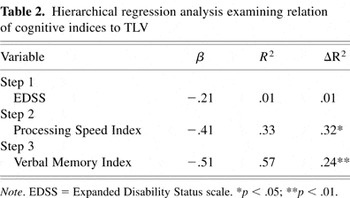
Patients' SDMT–Oral, SDMT–Written, CVLT-Verbal Learning, and CVLT-Delayed Recall raw scores were z-transformed based on published normative data. Z scores for domain-related measures were then averaged to derive separate processing speed and verbal memory index scores. These index scores were not significantly correlated (r = .31, p > .05). We subsequently conducted a hierarchical multiple regression analysis to determine whether processing speed and verbal memory indices were independently associated with TLV after accounting for MS-related physical disability. For this analysis, we entered the EDSS at the first step, the processing speed index at Step 2, and the verbal memory index at Step 3. Order of entry for cognitive indices was determined based on robustness of bivariate correlations with TLV. Results indicated that both processing speed and verbal memory indices remained significantly associated with TLV after accounting for physical disability. The final regression model accounted for 57% of TLV variance, with 56% of this variance associated with cognitive variables (p < .05; Table 2). A second hierarchical regression analysis was conducted to determine whether order of entry of cognitive variables would impact findings. This analysis revealed nearly identical results as the first procedure, with both cognitive indices remaining significantly associated with TLV after accounting for physical disability.
Hierarchical regression analysis examining relation of cognitive indices to TLV

DISCUSSION
The findings from the present study were (1) FLAIR TLV was associated with both processing speed and verbal memory deficits in patients with mild relapsing-remitting MS, and (2) information processing speed and verbal memory were independently related to FLAIR lesion load. These findings suggest that common cognitive deficits in MS are associated with volumetric measures of lesion burden using FLAIR, and, more generally, that FLAIR TLV may be a functionally relevant biomarker for the disease.
Although we did not directly compare measures of lesion burden across multiple sequences, FLAIR has been shown to be more sensitive than conventional T1- or T2-weighted images for detecting lesions in neuroanatomic areas known to be associated with multiple cognitive functions, including cortical and juxtacortical regions (Bakshi et al., 2001; Filippi et al., 1996). Other work indicates that T2-weighted sequences remain superior for detecting posterior fossa and spinal cord lesions (Stevenson et al., 1997). Our lesion load–cognition relationships were similar to, though stronger than those found by Fulton et al. (1999) and Sperling et al. (2001), who used T2 scans to quantify total lesion volume. Some groups have not found associations between T2 lesion load and cognition (Foong et al., 2000; Maurelli et al., 1992). Additional research is needed to compare the merits of FLAIR, T2, and other imaging modalities in relation to cognition in MS. Multispectral techniques that combine neuroimaging modalities sensitive to lesions and changes in normal-appearing brain tissue may yield particularly robust brain–behavior correlations. For example, one recent study in cognitively impaired MS patients found that a combination of multiple imaging indices was more robustly associated with overall cognitive performance than any imaging modality in isolation (Christodoulou et al., 2003).
We found that MS patients were more impaired than controls on measures of information processing speed, and performed slightly though not significantly lower on verbal memory measures. These findings are consistent with those of Achiron and Barak (2003), who found that a larger proportion of early stage MS patients (with mean EDSS of 2.2, similar to our study) showed more impaired processing speed than verbal memory deficits. MS patients in this study were in a relatively early stage of their disease, and it may be that patients need to cross a threshold of lesion burden before significant memory or other impairment is observed. In a related vein, functional neuroimaging studies have shown that MS patients with normal motor or cognitive performance display more distributed brain activation patterns than controls, suggesting that patients may recruit additional brain regions to maintain adequate performance despite advancing disease (Filippi & Rocca, 2003; Wishart et al., 2004). Evidence also suggests that lesion burden may play a critical role in the intensity and spatial extent of brain activation patterns associated with cognition in MS (Filippi & Rocca, 2003). Although these possibilities may explain the non-significant group difference we observed on the CVLT, this finding may also have been due to the relatively small sample size.
It is unclear how deficits in processing speed and verbal memory interact in MS. Some research indicates that information processing speed deficits are directly associated with verbal memory impairment (DeLuca et al., 1994; Litvan et al., 1988). In contrast, a meta-analysis found that slowed information processing speed and verbal memory deficits in MS may be independent (Thornton & Raz, 1997). Verbal memory and processing speed indices did not significantly correlate in our study, although they were independently related to lesion volume. A more definitive statement about the relationship between these two abilities could be made with a larger sample of early-stage MS patients. Additional structural and functional neuroimaging research is needed to further clarify the underlying mechanisms of cognitive dysfunction in MS.
One strength of this study was the inclusion of patients who were not currently using immunomodulatory treatment. Although previous lesion load–cognition research using T2 and other sequences has been conducted on immunomodulatory treatment-naïve MS patients (Fulton et al., 1999), to our knowledge this is the first using FLAIR in patients with a mean EDSS score below 3. This is notable given that our study provided an opportunity to examine lesion burden and cognition in MS outside the influence of disease-modifying medication in early stage MS patients. An important direction for future research will be to determine whether immunomodulatory treatment can impact the relationship between FLAIR lesion burden and cognition in MS.
ACKNOWLEDGMENTS
The authors thank Robert M. Ferranti and colleagues in the DHMC MRI center, and Jennifer Randolph, M.S. for their assistance with this project. This investigation was supported by a Postdoctoral Fellowship Award from the National Multiple Sclerosis Society (J.J.R.) and by additional grants from the National Multiple Sclerosis Society, Hitchcock Foundation, National Science Foundation, and Ira DeCamp Foundation.
References
REFERENCES
Achiron, A. &
Barak, Y.
(2003).
Cognitive impairment in probable multiple sclerosis.
Journal of Neurology, Neurosurgery, and Psychiatry,
74,
443–446.Google Scholar
Bakshi, R.,
Ariyaratana, S.,
Benedict, R.H.B., &
Jacobs, L.
(2001).
Fluid-Attenuated Inversion Recovery Magnetic Resonance Imaging
detects cortical and juxtacortical multiple sclerosis lesions.
Archives of Neurology,
58,
742–748.Google Scholar
Christodoulou, C.,
Krupp, L.B.,
Liang, Z.,
Huang, W.,
Melville, P.,
Roque, C.,
Scherl, W.F.,
Morgan, T.,
MacAllister, W.S.,
Li, L.,
Tudorica, L.A.,
Li, X.,
Roche, P., &
Peyster, R.
(2003).
Cognitive performance and MR markers of cerebral injury in
cognitively impaired MS patients.
Neurology,
60,
1793–1798.Google Scholar
Delis, D.C.,
Kramer, J.H.,
Kaplan, E., &
Ober, B.A.
(1987).
California Verbal Learning Test: Adult Version.
San Antonio, TX:
The Psychological Corporation.
DeLuca, J.,
Barbieri-Berger, S., &
Johnson, S.
(1994).
The nature of memory impairments in multiple sclerosis: Acquisition
versus retrieval.
Journal of Clinical and Experimental Neuropsychology,
16,
183–189.Google Scholar
Filippi, M. &
Rocca, M.A.
(2003).
Disturbed function and plasticity in multiple sclerosis as gleaned
from functional magnetic resonance imaging.
Current Opinion in Neurology,
16,
275–282.Google Scholar
Filippi, M.,
Yousry, T.,
Baratti, C.,
Horsfield, M.A.,
Mammi, S.,
Becker, C.,
Voltz, R.,
Spuler, S.,
Campi, A.,
Reiser, M.F., &
Comi, G.
(1996).
Quantitative assessment of MRI lesion load in multiple sclerosis. A
comparison of conventional spin-echo with fast fluid-attenuated inversion
recovery.
Brain,
119,
1349–1355.Google Scholar
Foong, J.,
Rozewicz, L.,
Chong, W.K.,
Thompson, A.J.,
Miller, D.H., &
Ron, M.A.
(2000).
A comparison of neuropsychological deficits in primary and secondary
progressive multiple sclerosis.
Journal of Neurology,
247,
97–101.Google Scholar
Fulton, J.C.,
Grossman, R.I.,
Udupa, J.,
Mannon, L.J.,
Grossman, M.,
Wei, L.,
Polansky, M., &
Kolson, D.L.
(1999).
MR lesion load and cognitive function in patients with
relapsing-remitting multiple sclerosis.
American Journal of Neuroradiology,
20,
1951–1955.Google Scholar
Lazeron, R.H.C.,
Langdon, D.W.,
Filippi, M.,
van Waesberghe, J.H.,
Stevenson, V.L.,
Boringa, J.B.,
Origgi, D.,
Thompson, A.J.,
Falautano, M.,
Polman, C.H., &
Barkhof, F.
(2000).
Neuropsychological impairment in multiple sclerosis patients: The
role of (juxta)cortical lesion on FLAIR.
Multiple Sclerosis,
6,
280–285.Google Scholar
Litvan, I.,
Grafman, J.,
Vendrell, P.,
Martinez, J.M.,
Junque, C.,
Vendrell, J.M., &
Barraquer-Bordas, J.L.
(1988).
Multiple memory deficits in patients with multiple sclerosis.
Archives of Neurology,
45,
607–610.Google Scholar
Maurelli, M.,
Marchioni, E.,
Cerretano, R.,
Bosone, D.,
Bergamaschi, R.,
Citterio, A.,
Martelli, A.,
Sibilla, L., &
Savoldi, F.
(1992).
Neuropsychological assessment in MS: Clinical, neurophysiological,
and neuroradiological relationships.
Acta Neurologica Scandinavica,
86,
124–128.Google Scholar
McDonald, W.I.,
Compston, A.,
Edan, G.,
Goodkin, D.,
Hartung, H.,
et al.
(2001).
Recommended diagnostic criteria for multiple sclerosis: Guidelines
from the international panel on the diagnosis of multiple
sclerosis.
Annals of Neurology,
50,
121–127.Google Scholar
Moriarty, D.M.,
Blackshaw, A.J.,
Talbot, P.R.,
Griffiths, H.L.,
Snowden, J.S.,
Hillier, V.F.,
Capener, S.,
Laitt, R.D., &
Jackson, A.
(1999).
Memory dysfunction in multiple sclerosis corresponds to
juxtacortical lesion load on fast Fluid-Attenuated Inversion-Recovery MR
images.
American Journal of Neuroradiology,
20,
956–1962.Google Scholar
Rao, S.M.,
Leo, G.J.,
Bernardin, L., &
Unverzagt, F.
(1991).
Cognitive dysfunction in multiple sclerosis: Frequency, patterns,
and prediction.
Neurology,
41,
685–691.Google Scholar
Rovaris, M.,
Filippi, M.,
Minicucci, L.,
Iannucci, G.,
Santuccio, G.,
Possa, F., &
Comi, G.
(2000).
Cortical/subcortical disease burden and cognitive impairment in
patients with multiple sclerosis.
American Journal of Neuroradiology,
21,
402–408.Google Scholar
Smith, A.
(1982).
Symbol Digit Modalities Test: Manual.
Los Angeles, CA:
Western Psychological Services.
Sperling, R.A.,
Guttmann, C.R.G.,
Mohol, M.J.,
Warfield, S.K.,
Jakab, M.,
Parente, M.,
Diamond, E.L.,
Daffner, K.R.,
Olek, M.J.,
Orav, E.J.,
Kikinis, R.,
Jolesz, F.A., &
Weiner, H.L.
(2001).
Regional magnetic resonance imaging lesion burden and cognitive
function in multiple sclerosis.
Archives of Neurology,
58,
115–121.Google Scholar
Stevenson, V.L.,
Gawne-Caine, M.L.,
Barker, G.J.,
Thompson, A.J., &
Miller, D.H.
(1997).
Imaging of the spinal cord and brain in multiple sclerosis: A
comparative study between fast FLAIR and fast spin echo.
Journal of Neurology,
244,
119–124.Google Scholar
Thornton, A.E. &
Raz, N.
(1997).
Memory impairment in multiple sclerosis: A quantitative
review.
Neuropsychology,
11,
357–366.Google Scholar
Wishart, H.A.,
Saykin, A.J.,
McDonald, B.C.,
Mamourian, A.C.,
Flashman, L.A.,
Schuschu, K.R.,
Ryan, K.A.,
Fadul, C.E., &
Kasper, L.H.
(2004).
Brain activation patterns associated with working memory in
relapsing-remitting MS.
Neurology,
62,
234–238.Google Scholar

Demographic and neuropsychological data %*n = 20. **n = 17.
Hierarchical regression analysis examining relation of cognitive indices to TLV
 You have
Access
- 28
- Cited by