For children who are fluent readers, reading is an effortless and automatic process. In fluent reading, words are read at a sustained fast pace with few errors, and hence high accuracy in words correct (Deeney, Reference Deeney2010; Johnson & Layng, Reference Johnson and Layng1996). Fluent readers are able to focus on comprehending the text rather than concentrating on decoding (Adams, Reference Adams1990; Allington, Reference Allington1983; Kuhn & Stahl, Reference Kuhn and Stahl2003; Logan, Reference Logan1997; National Institute of Child Health, & Human Development, 2000). Skills such as reading that are performed fluently tend to be remembered, generalised and maintained, supporting the development of other related and more advanced skills (Daly & Kupzyk, Reference Daly, Kupzyk, Madden and Dube2013; Hempenstall, Reference Hempenstall2009; Hudson, Lane, & Pullen, Reference Hudson, Lane and Pullen2005).
A report from the National Reading Panel (National Institute of Child Health, & Human Development, 2000) has highlighted the importance of reading fluency and the lack of understanding about effective fluency instruction by many teachers. This is reflected in the absence of fluency-related instruction, individualised intervention and daily lessons from teacher training and teaching manuals (Allington, Reference Allington1983; Hattie & Yates, Reference Hattie and Yates2014; Zutell & Rasinski, Reference Zutell and Rasinski1991); however, there are several intervention techniques that are focused on improving children's oral reading fluency. These include repeated reading (Burns, Reference Burns2007; Mastropieri, Leinart, & Scruggs, Reference Mastropieri, Leinart and Scruggs1999), word drills (Welsch, Reference Welsch2006), and live (e.g., parent or teacher) or recorded models demonstrating fluent reading (e.g., Rainbow Reading; Allington, Reference Allington1983; Buggey & Ogle, Reference Buggey and Ogle2012; Hudson et al., Reference Hudson, Lane and Pullen2005; Skinner & Shapiro, Reference Skinner and Shapiro1989; Welsch, Reference Welsch2006).
Learning by watching someone perform a behaviour is called observational learning (or modelling and imitation; Bandura, Reference Bandura1986). Typically, a model is an individual (the teacher) who has mastered or is more competent at the skill or behaviour than the observer (the learner; Dowrick & Raeburn, Reference Dowrick and Raeburn1995). Video self-modelling (VSM) is an evidence-based intervention technique applying theories of observational learning in which the teacher and the learner are one and the same person, with the individual acting as a model they themselves can imitate. This is achieved by filming the individual performing approximations to the target behaviour, and in some cases, receiving assistance and support to perform beyond their current level, and then editing the footage to show only the positive target behaviour as if it had been achieved by the person spontaneously and independently. The video footage then shows the individual, as model, seemingly performing the target behaviour successfully (Dowrick & Raeburn, Reference Dowrick and Raeburn1977).
For VSM to be successful, the target behaviour must be within the individual's zone of proximal development — that is, it must be a behaviour that is achievable but just out of reach (Dowrick, Reference Dowrick2012; Vygotsky & Cole, Reference Vygotsky and Cole1978). The individual gains three benefits from VSM. First, it provides the individual with an unvarying example of the target behaviour and how to perform it, encouraging imitation and encoding. Second, it shows the person that it is possible for them in particular to perform the target behaviour. Last, it gives the individual a boost in motivation, self-belief and self-efficacy (Dowrick, Reference Dowrick2012).
Feedforward video self-modelling (FFVSM) is a type of VSM that demonstrates behaviour — future behaviour — that the learner cannot yet perform or achieve some standard in; in this context, reading text at a fluent rate (Dowrick, Reference Dowrick1999, Reference Bilias-Lolis, Chafouleas, Kehle and Bray2012). A feature of FFVSM is the rapidity of behaviour change that may be obtained (Dowrick, Reference Dowrick2012). There are numerous advantages to interventions that work quickly, including reduction in stress on all involved, more rapid achievement of socially desirable behaviours, and improvement in the cost-benefit ratio (Bilias-Lolis, Chafouleas, Kehle, & Bray, Reference Bilias-Lolis, Chafouleas, Kehle and Bray2012). In addition, rapid change reinforces the individual quickly, which strengthens the use of this target behaviour in the future. Rapid skill acquisition also enhances the learner's self-efficacy; that is, an individual's perceived ability that he/she is able to perform a skill or behaviour (Bandura, Reference Bandura1977; Dowrick, Kim-Rupnow, & Power, Reference Dowrick, Kim-Rupnow and Power2006).
Dowrick et al. (Reference Dowrick, Kim-Rupnow and Power2006) and Hitchcock, Prater, and Dowrick (Reference Hitchcock, Prater and Dowrick2004) used FFVSM alongside a tutoring program called Actual Communication Empowerment (ACE) in Hawaii. The combined intervention took place four times for a 25- to 30-minute period over the course of 35–55 days. Both studies showed substantial improvement in the students’ reading fluency and comprehension levels.
The current research uses FFVSM alone, without any additional tutoring program, to determine if it is effective in improving reading fluency and comprehension. Using FFVSM as a stand-alone technique reduces the time taken to implement the intervention, therefore making it more practical for use by schools with large numbers of children. It does not require a lot of time outside of the classroom and could be used as a supplement to regular classroom instruction in order to boost the reading fluency and comprehension levels of any child who is falling behind in reading. Developments in video technology make the intervention cheap and accessible, and typically, rapid behaviour change occurs. It is predicted that FFVSM will improve the participants’ reading fluency and related comprehension as measured by words correct per minute (WCPM) during the intervention period and by using pre-test and post-test measures on the Neale Analysis of Reading Ability (NARA; Neale, Reference Neale1999). It is also expected that self-efficacy will increase from pre-intervention to post-intervention for successful participants.
Method
Participants
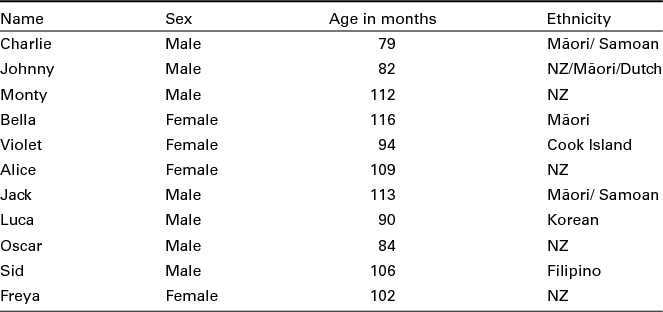
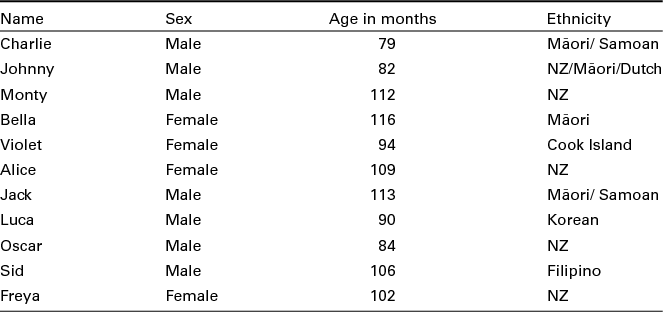
Participants were 11 children (7 boys and 4 girls) aged between 6 years 6 months and 9 years 6 months, who were recruited from three primary (elementary) schools in Christchurch, New Zealand. One school served a community of relatively low socio-economic status (SES) and the others, high SES communities. Individual characteristics are shown in Table 1. The children were first identified by their classroom teachers as needing to improve their reading fluency. Selection criteria required children to have a reading age (RA) lower than their chronological age (CA) and the majority of the letter and sound discriminations, as established by pre-testing on the NARA.
The Individual Characteristics of the Participants, Including Sex, Ethnicity and Age
Design and Setting
The design was a concurrent AB design replicated across 11 participants, and with a brief follow-up. Four children began baseline assessments concurrently, and relative to those children, two began on day 3, one on day 4, two on day 11, and two on day 12. Relative to this first assessment session, intervention began on days 17, 18, 20, or 25 for different children. Each session for screening, baseline, intervention and follow-up was conducted in the school's resource room. The rooms were quiet, had a table and chairs, adequate lighting and were free from other students and most distractions.
Measures and Equipment
NARA (Neale, Reference Neale1999)
The NARA consists of a set of standardised tests that assess oral reading ability. This test was used both as a pre-test and a post-test, and was scored to yield a reading age (expressed in years and months and also converted to months) separately for accuracy, comprehension and rate.
Science Research Associates Reading Laboratory (SRA; Parker, Scannell, & Science Research Associates, Reference Parker and Scannell1973)
The SRA is a set of graded texts and related comprehension questions that was used as a measure of students’ reading fluency and comprehension during the intervention phase. Participants were assigned a level on the SRA text that was 1 year ahead of where their accuracy RA was on the NARA pre-test.Footnote 1
Reader Self-Perception (Henk & Melnick, Reference Henk and Melnick1995)
The Reader Self-Perception Scale was used to measure the participants’ perception of themselves as readers (i.e., as a measure of self-efficacy) at the beginning and end of the intervention. The five-item Likert scale was adapted and presented as emoticon images because of the children's age.
Teacher Perception (adapted from Edl, Reference Edl2007)
Teachers were asked to fill in the Teacher Perception Survey when the child had finished the intervention phase. Questions focused on the teacher's perception of the child's attitudes, confidence, engagement and fluency in oral reading, as well as if they believed the intervention to be effective.
To film the children reading, an Apple iPad was put into a hard case shell that was mounted on a tripod. The tripod was set up at a close distance to the child in order to capture quality image and sound. The video self-model was edited on Apple computer iMovie software then transferred back to the iPad through iTunes. The children subsequently viewed their video self-model on the iPad.
Procedures
Screening and Baseline
Participants were tested on the NARA to determine their RA accuracy, rate and comprehension. Those who met the inclusion criterion were assigned a level on the SRA text 1 year above their RA. The Reader Self-Perception Scale was administered to each child. The baseline data point for fluency was estimated by averaging across the texts read with fewer than 16 errors from the pre-test reading on the NARA, a criterion for fluent reading derived from the NARA.
Creation of the video self-model
To rehearse for the filming of the video self-model, each child read the assigned and novel passage from his/her level of the SRA texts once through with the researcher and once alone. To film the video self-model, the iPad was set to record, capturing only the child in the shot. The child was asked to sit in a chair behind a desk and hold a blank piece of A4 cardboard folded in half. Echo reading was used to capture the performance needed for the video model. At a fluent rate, the researcher read the first sentence of the text and the child repeated this back, and so on until the text was finished. The child was asked to sit still during echo reading and look down at the folder cardboard the whole time. The researcher read the text at a fast speed (approximately 200 words per minute), so that this would be modelled by the child. In addition, the child was also encouraged to repeat quickly. If there was an error in the child's repeating or if it was read at a slow rate, the child moved or looked up then the affected line was repeated. The video recording was then edited by deleting where the researcher was talking and where the child paused or made a mistake.
The completed self-model videos were between 1 and 2 minutes long. The video for each child contained an opening shot of the ‘<Child's name> Movie’. Next was a photograph of the child looking at the page, with the title of the book underneath. During these first two title pages upbeat music was playing, namely ‘Acoustic Sunrise’ from the iLife sound files. Next, the video played, showing the child reading fluently. At the conclusion of the video a descriptive praise statement, ‘Fantastic fast reading of all the words in that story <Child's name>, well done!’ was shown to the sound of a crowd clapping.
Intervention
The intervention involved six sessions over a 2-week period. Ideally, this was to occur every second weekday, but owing to sickness and unforeseen school events this was not strictly adhered to. The child was extracted from class and brought into the resource room for sessions. They watched their video self-model once on the iPad; read a previously unseen text at the selected SRA level; answered five comprehension questions related to the text he/she had just read; and read the text a second time. The child was given the correct word if they paused for 3 seconds. During reading of the texts, the researcher recorded the time taken as well as the number of words read correctly, which was averaged across the two readings to give the average words correct/minute for each session.
Follow-up
One week after the intervention was completed the children were tested again on the NARA and completed the Reading Self-Perception survey again. Additionally, the child's classroom teachers were asked to complete the Teacher Perceptions Questionnaire before they were given any of the child's results.
Results
The primary results for the study are changes in reading fluency, as measured by words correct per minute recorded during training, and changes in accuracy, comprehension, and rate, expressed as Reading Age (in months) and derived from the NARA. Changes in student self-perception and also teacher perceptions about the intervention are also presented.
Inter-Rater Reliability
To ensure reliability of WCPM scores during the intervention phase, an interrater reliability check was completed. Six of the reading passages were independently coded by a second coder, and agreement was established by Agreements + Disagreements/100, yielding 91.1% agreement.
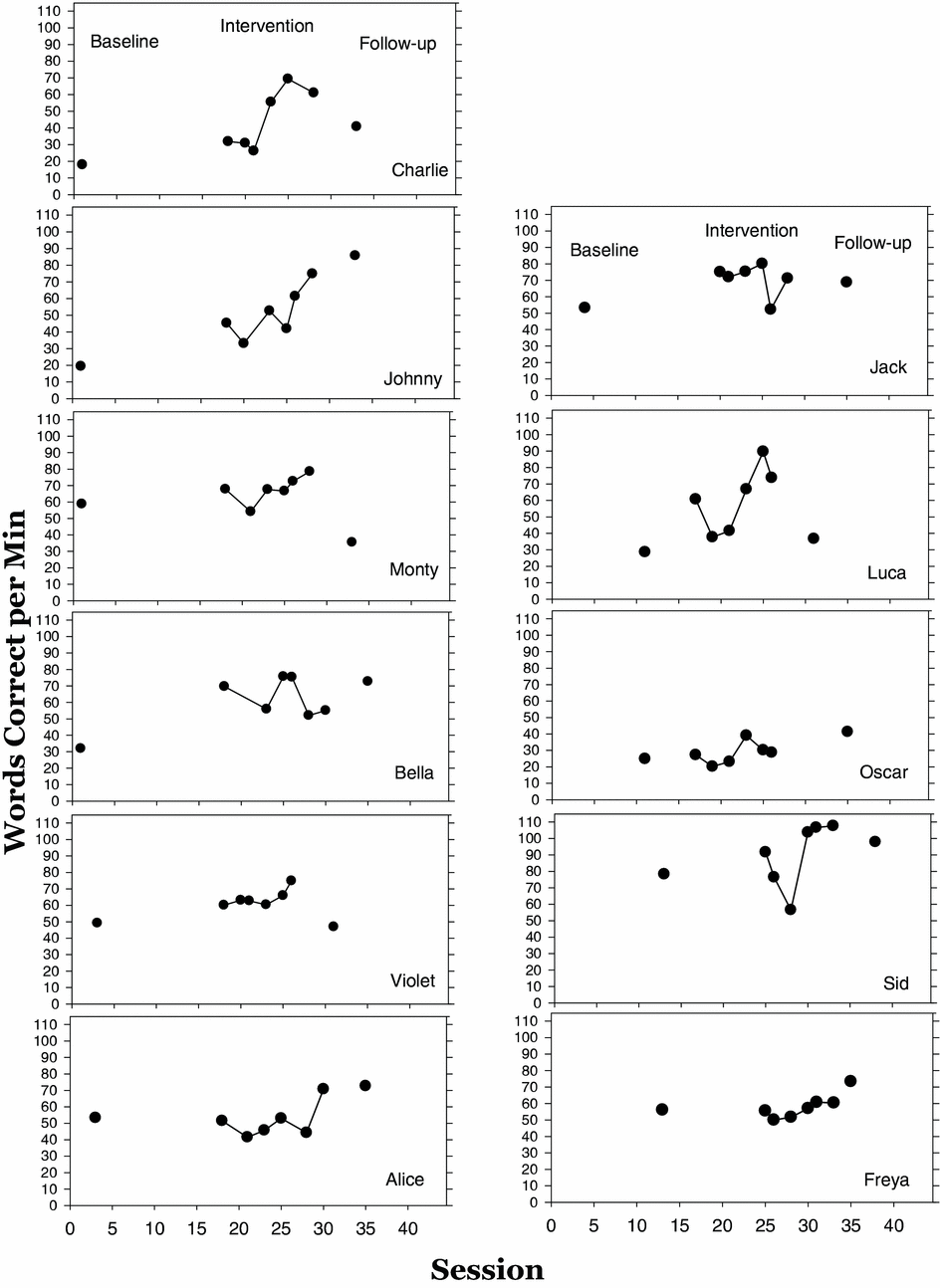
Figure 1 shows oral reading fluency, that is, the rate of production of correct words at baseline, during the training sessions and at follow-up. Baseline probes were staggered in time following the commencement of the study and showed that the majority of children had baseline rate of between 30 and 50 words correct per minute, two had rates between 60 and 80, and two a rate of 20 words correct per minute. Exposure to VSM of fluent performance had the effect of immediately increasing rate correct for Bella and Jack, and these children sustained a higher, fairly stable rate throughout intervention. Charlie, Johnny and Luca showed a cumulative acquisition effect, with changes in rate increasing over the intervention sessions. Violet showed a similar but smaller acquisition effect. Monty and Sid also learned to produce words correctly at a higher rate, but with considerable variability in the early training sessions. Three children — Alice, Oscar and Freya — did not show acquisition during intervention. At follow-up, five children — Charile, Johnny, Bella, Jack and Sid — had maintained gains made during VSM, and Alice, Oscar and Freya had follow-up scores that were higher than in baseline. Monty and Luca showed complete loss of any gains made during treatment.
Participant scores in WCPM, during the pre-test, intervention, and post-test phases of the study.

Comprehension was probed during each training session using the SRA (or the alternative measure). For all but one child, comprehension was good to excellent, with most scores in the range 60–100% over all training sessions. Charlie had comprehension scores of approximately 30% over training sessions 1 to 3, but improved to score 69% in session 6.
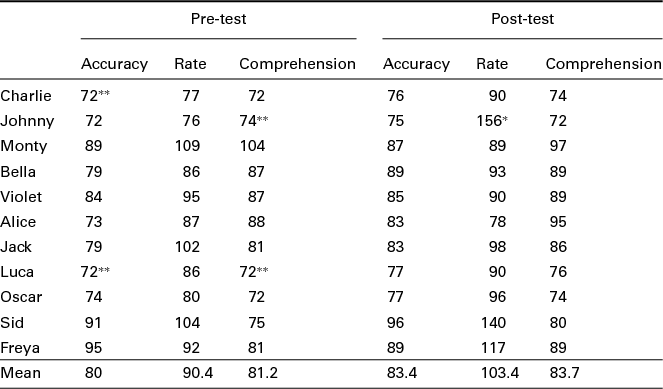
Table 2 shows the pre-test and post-test NARA Reading Age scores for Accuracy, Rate and Comprehension. On average, there were gains in accuracy, rate, and comprehension of respectively 3.4, 13, and 2.5 months in reading age, indicating that accuracy and rate (the key components of fluency) had increased by more than would be expected over the 2 months of schooling during which the study ran. Expressed as an effect size, Cohen's d (within), the largest change was for rate, d = .66, 95% CI (−10.89, 12.322], with accuracy next, d = .44, 95% CI (−4.08, 4.97), and comprehension least, d = .27, 95% CI (−5.21, 5.75).
Pre-Test and Post-Test Reading Age for NARA Accuracy, Comprehension and Rate; Reading Age is in Months
Note: *Ceiling effect on the test, student scored higher than shown score. **Floor effect on the test, student scored lower than score shown.
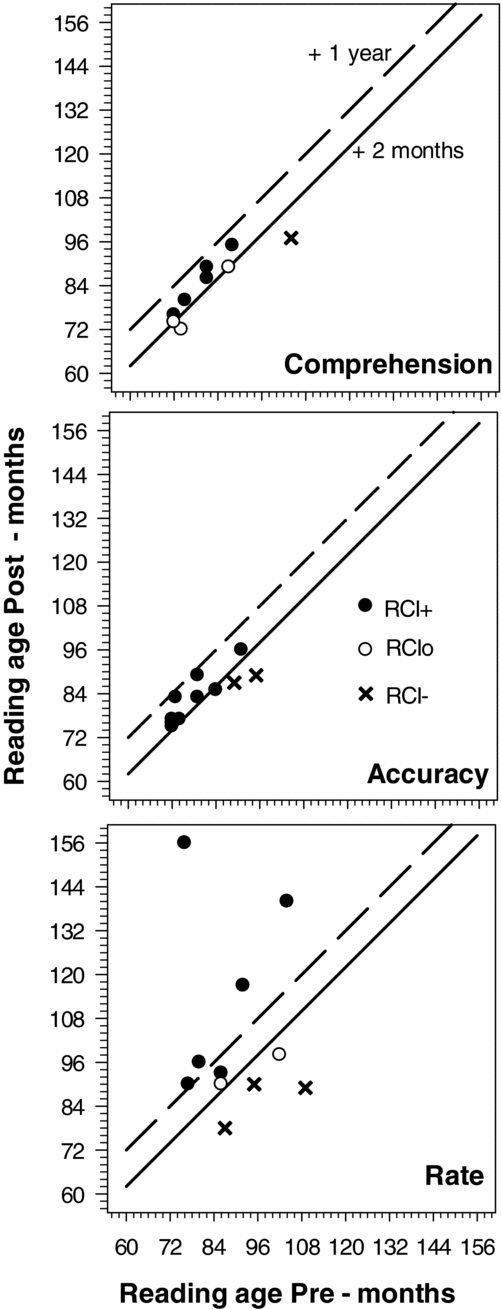
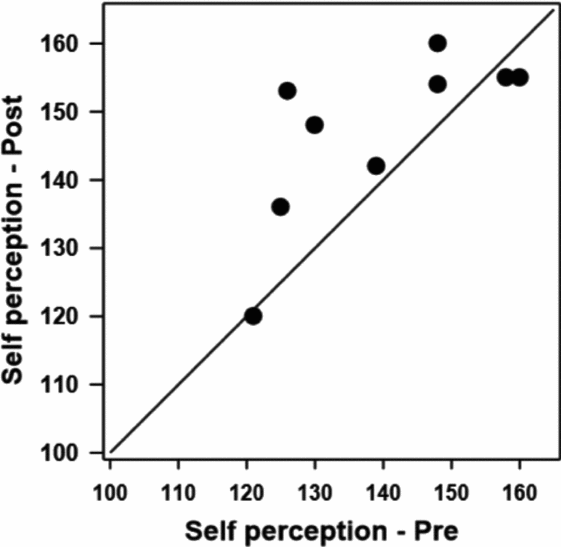
Changes over time in reading age can also be shown using modified Brinley plots (Blampied, Reference Blampied2007, Reference Blampied2014). In these plots, each participant's score at Time 1 (baseline) is plotted against their score at Time 2 (post-intervention). If the axes are drawn to the same scale, lack of change over time is shown by the data points falling on a diagonal line from the bottom left to the top right of the figure. Where improvement over time is indicated by increases in scores, data points lie above the line, while deterioration is shown by points below the line. Each child's change over time was also classified using the Reliable Change Index (RCI; Jacobson & Truax, Reference Jacobson and Truax1991) and classified as reliable improvement (RCI+), no reliable change (RCIo) and reliable deterioration (RCI−).
Figure 2 shows individual changes from baseline to post-intervention separately for accuracy, comprehension, and rate. Two diagonal lines are shown. If each child improved their reading age scores by 2 months (the overall exposure time to ongoing class instruction during the study) points would lie on the solid line. Gains equal to or exceeding 1 year (12 months) are shown by points on or above the diagonal dashed line. Points lying between the two lines represent individuals who gained between 2 and 12 months in reading age during the intervention, and points lying below the solid line are for children whose reading age deteriorated.
A modified Brinley plot showing changes for each child from pre- to post-intervention in Comprehension, Accuracy and Rate measured in reading age in months using the NARA. The solid diagonal line indicates 2 months’ improvement relative to baseline and the dashed line 12 months’ (1 year) improvement. Solid circles show those children who demonstrated reliable improvement, open circles those who showed no reliable improvement, and crosses those who showed reliable deterioration, using the Reliable Change Index.
Figure 2 shows that for Accuracy and Comprehension, most participants gained between 2 and 12 months in reading age and one or two children slightly deteriorated. The pattern of change is much more variable for Rate. Only four children showed gains of between 2 and 12 months, while four also showed some deterioration; however, two children showed large, and one very large, gains in reading age rate. Results from the NARA show that 7 out of 11 participants improved in their fluency (a combination of rate and accuracy). Five of the children improved their Rate by 12 months and 2 children improved their Rate between 2 and 12 months. This is in conjunction with either showing improvements or no detrition in their accuracy scores.
Student Self-Perception
The students all varied in their initial self-perceptions, with pre-test scores ranging from 94 to 160 compared with post-test scores ranging from 112 to 160. Four elements from the self-perception scale (process, observational comparisons, social feedback, and physiological state) were averaged and can be seen in Figure 3. All but four of the students made gains in their perception of themselves as reader (Figure 3). One student's score remained constant and the other three students had minimal decreases in their self-perception, with reductions of no more than 5 points.
A modified Brinley plot showing changes in Reader Self-Perception. Process, observational comparisons, social feedback, and physiological state ratings were combined into one Total rating. One child had missing data in the post-test so this child's data was not included.
Teacher Ratings of the Intervention
The majority of the teachers had a positive perception of the VSM intervention, as shown by the Teacher Perception Survey. Most of the teachers (81%) agreed that the intervention was beneficial to the students. The majority of the teachers were unsure if they would use the intervention with other students in the class, the main reason being that they wanted to see results from a larger number of students. When teachers were asked if they noticed a change in the students’ oral reading attitude, engagement in activities, and confidence the responses were mainly spread over neutral and agree. Several teachers commented that it was difficult for them to see a change over a short period of time.
Discussion
The aim of this research was to examine how FFVSM, if used on its own, could be practically used within a school environment to make rapid changes to academic reading behaviours (reading fluency and comprehension), and enhance reading self-efficacy. The majority of the students in this study increased their fluency from pre-test to post-test on the NARA and throughout the intervention as measured in WCPM. This result supports the hypothesis predicting that FFVSM would improve fluency, and it also shows that many of the children experienced rapid learning of fluency skills over the 2 months of the intervention, consistent with the predictions of Dowrick (Reference Dowrick2012).
Eight out of the 11 participants who improved their fluency also improved in comprehension, as measured on the NARA. The current study reinforces the link between comprehension and fluency reported in previous literature (Adams, Reference Adams1990; Hudson et al., Reference Hudson, Lane and Pullen2005; Logan, Reference Logan1997; National Institute of Child Health & Human Development, 2000). There were two students (Monty and Alice) who did not make any positive improvement in either reading or comprehension. A possible explanation for this could be that the students did not develop automaticity with their reading. Being able to read a text at a fluent pace without conscious awareness or pausing allows the individual to concentrate on interpreting the understanding of the text (Hudson et al., Reference Hudson, Lane and Pullen2005; Logan, Reference Logan1997).
An individual's perception of their own capabilities has a considerable impact on his/her ability to perform and master a new behaviour such as reading (Buggey, Reference Buggey2007; Dowrick et al., Reference Dowrick, Kim-Rupnow and Power2006). The majority of students made improvements in their reader self-perception measured pre- and post-test, but also noticeable during the study, by smiling at themselves reading and in comments to the researcher. Given the key role that self-efficacy plays in supporting performance of new skills (Bandura, Reference Bandura1977), the positive change will potentially support future sustained maintenance of reading fluency and engagement in reading (Schunk, Reference Schunk2003).
Although the findings show some promising results, the small number of successful replications of the positive effect of FFVSM on reading fluency means there is limited ability to generalise to the wider population by assuming that FFVSM would be of benefit to every struggling reader. That conclusion requires support from further research which, first, directly replicates the present study, and second, by additional systematic replication (Cooper, Heron, & Heward, Reference Cooper, Heron and Heward2007; Hersen, Barlow, & Kazdin, Reference Hersen, Barlow and Kazdin1976).
Another limitation of the current study concerns the durability of the changes observed following FFVSM. The intervention and testing occurred over a reasonably short period (2 months) of time, and rapid behavioural changes were made by some of the students, but it is not known if the results were maintained over a longer period of time.
Despite research that shows VSM is an effective and feasible intervention in supporting the learning and development of behaviour and skills, it is under-utilised within schools. Limited time, skills and access to technology have been outlined as the major restriction on VSM being embedded within the school environment (Buggey & Ogle, Reference Buggey and Ogle2012; Collier-Meek, Fallon, Johnson, Sanetti, & Delcampo, Reference Collier-Meek, Fallon, Johnson, Sanetti and Delcampo2012).
Video self-models are relatively straightforward for teachers or others to create after a small amount of tutoring and instruction in the hardware and software needed (Buggey, Reference Buggey2007; Collier-Meek el al., Reference Collier-Meek, Fallon, Johnson, Sanetti and Delcampo2012; Dowrick, Reference Dowrick1999). The method could be taught to teachers and parents during a series of afterschool workshops where techniques could be learnt and practised until fluency of the new skills is reached. In addition, older students could create video models for themselves or classmates to help improve academic skills they would like to focus on.
Parents could help children create their own video self-models that could be filmed, edited and played back on the iPad or iPod. Viewing the 1- to 2-minute video self-models could be done during homework sessions, for example, before reading the night's homework book. Children could be given a goal, for example, to read 100 WCPM and progress toward this goal could be recorded by the child themselves. There would not be much additional time needed to support this intervention on the teacher's behalf. Monthly fluency measures using standardised testing could be used to monitor students’ progress towards set goals. As the students increase their reading ability and fluency rates, a new VSM can be created, increasing the level of difficulty, or the focus of the behaviour (e.g., reading comprehension or pausing at full stops) could be changed. Future research could examine using a text that was closer or further away from the child's accuracy RA to examine the boundaries of the zone of proximal development and determine the influence this may have on fluency development.
Given the increased availability of technology such as iPads and iPods, there is real potential for using Feedforward learning within an educational context. VSM is an evidence-based intervention technique that combines the teacher (model) and learner (observer) as one, which enables all children to have individualised support to assist learning and development of new and existing behaviours. This research illustrates how barriers such as limited time, money and skill could be eliminated or at least minimised so VSM could be used in schools as a practical and effective tool for struggling readers (Buggey & Ogle, Reference Buggey and Ogle2012).
Acknowledgments
A special thanks to all the students who participated in this research, for being enthusiastic and always trying their best. Without their participation this research would not have been possible. Thanks to the principals and teachers for welcoming us into their schools and for their support and flexibility. We would also like to acknowledge the financial assistance provided by the Psychology Department at the University of Canterbury, and that from the New Zealand Federation of Graduate Women to purchase the iPads. Appreciation is further extended to colleagues, friends and family for their guidance, expertise and support throughout the research process.