INTRODUCTION
Life depends on the warmth of the sun being trapped by the layer of gases surrounding the earth. An abundance of evidence exists within the global scientific community suggesting that this layer is becoming thicker (Kriticos et al. Reference Kriticos, Sutherst, Brown, Adkins and Maywald2003; Fordham et al. Reference Fordham, Akçakaya, Araújo, Brook, Brodie, Post and Doak2012; Strauss et al. Reference Strauss, Tebaldi and Ziemlinski2012; Wang et al. Reference Wang, Wang, Yang, Zhang and Yin2012). Increases in floods driven by rising sea levels as a consequence of global warming, global shifts of invasive species in response to climate change and broad-scale shifts in the areas conducive to growing some economically important crops such as date palm, wheat, maize and oil palm are among the consequences of climate change (Coakley et al. Reference Coakley, Scherm and Chakraborty1999; Chakraborty et al. Reference Chakraborty, Tiedemann and Teng2000; Kriticos et al. Reference Kriticos, Sutherst, Brown, Adkins and Maywald2003; Fordham et al. Reference Fordham, Akçakaya, Araújo, Brook, Brodie, Post and Doak2012; Shabani et al. Reference Shabani, Kumar and Taylor2012; Strauss et al. Reference Strauss, Tebaldi and Ziemlinski2012; Taylor et al. Reference Taylor, Kumar, Reid and Kriticos2012; Wang et al. Reference Wang, Wang, Yang, Zhang and Yin2012; Paterson et al. Reference Paterson, Sariah and Lima2013). For instance, climate change has reportedly caused >55% crop failure in agricultural regions in India (McDermott Reference McDermott2009). The potential impacts of climate change on maize production indicate that climate change will cause a 10% reduction in maize production by 2055 in Africa and Latin America, resulting in a loss of US$2 billion per year (Jones & Thornton Reference Jones and Thornton2003). In Saudi Arabia, 129 million hectares (ha) that currently have a suitable climate for date palm growth are projected to become unsuitable by 2100 as a consequence of climate change (Shabani et al. Reference Shabani, Kumar and Taylor2012).
Date palm (Phoenix dactylifera L.), which includes c. 400 different species within the Arecaceae family, is an economically important crop and is very well adapted to the arid environments in Middle Eastern countries, particularly Iran (Botes & Zaid Reference Botes, Zaid and Zaid2002; Al-Shahib & Marshall Reference Al-Shahib and Marshall2003; Eshraghi et al. Reference Eshraghi, Zarghami and Mirabdulbaghi2005; Chao & Krueger Reference Chao and Krueger2007; Mahmoudi et al. Reference Mahmoudi, Hosseininia, Azadi and Fatemi2008; Kassem Reference Kassem2012; Reilly & Reilly Reference Reilly and Reilly2012; Tengberg Reference Tengberg2012). As a plant specifically adapted to desert oases, it requires very special climatic conditions at both flowering and fruit set. Heat is particularly important because the accumulation of sufficient ‘heat units’ is required for commercial date cultivation. A prolonged hot dry summer without rain or humid weather, which is present in Southern Iran, is the optimum climatic condition for date palm growth. For example, the overall heat requirement scales from 4000 to over 4500 degree days, a calculation based on the summation of the number of degrees of the daily mean temperature above 18 °C. Date palm has long been cultivated in Southern Iran, and c. 116 000 tonnes/year were exported to other countries in 2003–09 (Rahnema Reference Rahnema2013). Thus, mapping the potential distribution of P. dactylifera under the current climate, assessing the sensitivity of such a distribution to climate change and eventually evaluating the implications for cultivation of date palms in the future are of great importance.
Many models have sought to address the issue of climate change, including bioclimatic models, ecological niche models (ENMs) (Guisan & Zimmermann Reference Guisan and Zimmermann2000), species distribution models (SDMs) (Guisan & Zimmermann Reference Guisan and Zimmermann2000; Pearson et al. Reference Pearson, Dawson and Liu2004; Soberón Reference Soberón2007) and CLIMEX (Sutherst & Maywald Reference Sutherst and Maywald1985). CLIMEX, a computer-based software program for matching climates in ecology, has been broadly utilized to estimate the potential geographical distribution of different species in the future, including crops such as potatoes (Kriticos et al. Reference Kriticos, Sutherst, Brown, Adkins and Maywald2003; Kocmánková et al. Reference Kocmánková, Trnka, Žalud and Dubrovský2004; Kriticos Reference Kriticos2006; Senaratne et al. Reference Senaratne, Palmer and Sutherst2006; Sutherst et al. Reference Sutherst, Baker, Coakley, Harrington, Kriticos, Scherm, Canadell, Pataki and Pitelka2007a; Poutsma et al. Reference Poutsma, Loomans, Aukema and Heijerman2008; Follak & Strauss Reference Follak and Strauss2010; Shabani et al. Reference Shabani, Kumar and Taylor2012). CLIMEX enables users to identify areas where the selected species could establish and persist based on future climate scenarios. In comparison with some correlative modelling methods (Phillips & Dudík Reference Phillips and Dudík2008), CLIMEX is the most suitable climate modelling software for describing the response of species to the climate based on its geographic range (Sutherst et al. Reference Sutherst, Baker, Coakley, Harrington, Kriticos, Scherm, Canadell, Pataki and Pitelka2007a, Reference Sutherst, Maywald and Kriticosb; Webber et al. Reference Webber, Yates, Le Maitre, Scott, Kriticos, Ota, McNeill, Le Roux and Midgley2011; Shabani et al. Reference Shabani, Kumar and Taylor2012).
A major criticism of CLIMEX is that it does not include biotic interactions and dispersal in the modelling process (Araújo & Luoto Reference Araújo and Luoto2007; Barney & DiTomaso Reference Barney and DiTomaso2011). The CLIMEX modelling output is based only on climatic factors such as the overall maximum and minimum monthly temperature (T max and T min), the overall monthly precipitation (P total) and the relative humidity at 09:00 h (RH 09:00) and 15:00 h (RH 15:00) (Hearne Scientific Software 2007; Sutherst et al. Reference Sutherst, Maywald and Kriticos2007b). To refine the CLIMEX modelling output, some additional non-climatic factors, such as land use, soil types and biotic interactions such as diseases need to be taken into account, which can be achieved using geographic information systems (GIS) and remote sensing (RS) software (Guisan & Zimmermann Reference Guisan and Zimmermann2000; Beaumont et al. Reference Beaumont, Hughes and Poulsen2005; Fitzpatrick et al. Reference Fitzpatrick, Weltzin, Sanders and Dunn2007; Rogers et al. Reference Rogers, Reid, Rogers and Addison2007; Shabani et al. Reference Shabani, Gorji, Heidari, Esmeili, Gilkes and Prakongkep2010; Saremi et al. Reference Saremi, Kumar, Sarmadian, Heidari and Shabani2011; Shabani et al. Reference Shabani, Kumar and Taylor2012). Diseases of the date palm may also alter with climate change due to changes in the distribution patterns of pathogens. Therefore, future distribution of disease as a consequence of climate change could be a suitable tool to refine the CLIMEX outputs.
The global effects of an altered climate on date palm production were reported by Shabani et al. (Reference Shabani, Kumar and Taylor2012), who depicted broad-scale shifts in the areas conducive to date palm cultivation. However, the areas shown to be suitable were based on future climate only. Large parts of these areas may be unsuitable due to a variety of factors including soil types, topography and current land use.
The decision to use soil type as a refining tool was based on the observation that date palm fruit quality and quantity can be significantly altered by macro elements available in different soil types (Khayyat et al. Reference Khayyat, Tafazoli, Eshghi and Rajaee2007). Climate will not impact soil type but it was used as a refinement tool, to refine the results based solely on climate. The impact of macro elements (nitrogen (N), phosphorus (P), potassium (K), magnesium (Mg2+) and calcium (Ca2+)) on date palm yields have been reported in many studies (Rouhani & Bassiri Reference Rouhani and Bassiri1977; El-Baz & El-Dengawy Reference El-Baz and El-Dengawy2003; Khayyat et al. Reference Khayyat, Tafazoli, Eshghi and Rajaee2007; Dialami & Mohebi Reference Dialami and Mohebi2010). In addition, researchers have noted that c. 0·85 of date palm roots need a depth of 2 m on both lateral sides in a deep loamy soil (Zaid & De Wet Reference Zaid, De Wet and Zaid1999; El Modafar et al. Reference El Modafar, Tantaoui and El Boustani2000; Botes & Zaid Reference Botes, Zaid and Zaid2002). Accordingly, refining date palm suitability regions modelled by CLIMEX by investigating soil types could be one step forward to more accurately identifying the areas available for its cultivation, because unsuitable soil types have a large impact on date palm growth.
Other factors, such as land use, irrigation opportunities and slope could also be important. However, it is beyond the scope of the present study to model every single variable that may impact date palm distribution.
The aim of the present study was to determine the potential distribution of P. dactylifera under future climates and soil types and their physicochemical properties to assess the sensitivity of its distribution to climate change and to evaluate the concurrent implications for cultivation of date palms. CLIMEX and ArcGIS software products were utilized to simulate a model of response of date palm to climate change, and soil data were used to refine the CLIMEX output for projecting the suitable areas for date palm cultivation for the years 2030, 2050, 2070 and 2100 in Iran.
MATERIALS AND METHODS
CLIMEX software
CLIMEX enables scientists to model climatic conditions under different scenarios for various species as part of an ecological study: it assumes that climate is the chief determinant of the distribution of plants and poikilothermal animals (Kriticos et al. Reference Kriticos, Potter, Alexander, Gibb and Suckling2007). CLIMEX permits users to determine the climatic parameters that describe species’ responses to climate based on their geographic distribution (Sutherst et al. Reference Sutherst, Maywald and Bourne2007c). In other words, this software models the mechanisms that impose limitations to species’ geographical distributions and determine their seasonal phenology and, to a lesser extent, their relative abundance (Sutherst et al. Reference Sutherst, Maywald and Kriticos2007b). In CLIMEX, an annual growth index (GIA) denotes the potential for growth of a population throughout the favourable season. Four stress indices (cold, hot, wet and dry) and their interactions can illustrate the extent to which the population is reduced during the unfavourable season (Sutherst et al. Reference Sutherst, Maywald and Kriticos2007b). The ecoclimatic index (EI), derived from combining GIA and stress indices, is an overall measure of the suitability of a location for permanent occupation by the target species. The EI is an average annual index of climatic appropriateness based on weekly calculations of growth and stress indices. It utilizes a scale of 0–100, and species can establish themselves if EI>0. In the present study, CLIMEX was used to develop a model of the potential distribution of P. dactylifera under current and various future climate scenarios.
The averages of different climatic parameters from 1950 to 2000, which are in the CliMond 10′ (10 min) gridded climate records (Kriticos et al. Reference Kriticos, Webber, Leriche, Ota, Macadam, Bathols and Scott2012), were used to model the current distribution of date palm. The climatic parameters in the meteorological database were the overall maximum and minimum monthly temperature (T max and T min), the overall monthly precipitation (P total) and the relative humidity at 09·00 h (RH 09:00) and 15·00 h (RH 15:00). The aforementioned parameters were also used to project possible climates for several years in the mid- to late 21st century.
Climate change scenarios
In the present study, the potential distribution of date palm under future climates was modelled using two Global Climate Models (GCMs), namely CSIRO-Mk3.0 and MIROC-H (Center for Climate Research, Japan), with the A2 Special Report on Emissions Scenarios (SRES) scenario. The A2 SRES scenario includes various issues such as demography and the financial and technological forces driving greenhouse gas (GHG) emissions. The assumptions of the A2 scenario include a world of independently operating, self-reliant nations with continually increasing populations and regionally oriented economic development (IPCC Reference Pachauri and Reisinger2007). The A2 scenario predicts a relatively moderate increase in GHG and is around the midpoint of the low and extreme projections. The A2 SRES scenario was used for different years, including 2030, 2050, 2070 and 2100.
Model framing
Using both native and exotic distributions of date palm from different sources, a CLIMEX model illustrating the climate suitability for P. dactylifera was built (Auda & Khalaf Reference Auda and Khalaf1979; Heakal & Al-Awajy Reference Heakal and Al-Awajy1989; Abbas et al. Reference Abbas, Mouhi, Al-Roubaie, Hama and El-Bahadli1991; Elhoumaizi et al. Reference Elhoumaizi, Saaidi, Oihabi and Cilas2002; Eshraghi et al. Reference Eshraghi, Zarghami and Mirabdulbaghi2005; Hassan et al. Reference Hassan, Bakhsh, Ahmad Gill, Maqbool and Ahmed2006; Mahmoudi et al. Reference Mahmoudi, Hosseininia, Azadi and Fatemi2008; Bokhary Reference Bokhary2010; Markhand et al. Reference Markhand, Abdul-Soad, Mirbahar and Kanhar2010; Shayesteh et al. Reference Shayesteh, Marouf, Amir-Maafi, Carvalho, Fields, Adler, Arthur, Athanassiou, Campbell, Fleurat-Lessard, Flinn, Hodges, Isikber, Navarro, Noyes, Riudavets, Sinha, Thorpe, Timlick, Trematerra and White2010; Al-Senaidy & Ismael Reference Al-Senaidy and Ismael2011; Jain et al. Reference Jain, Al-Khayri and Johnson2011; Marqués et al. Reference Marqués, Duran-Vila and Daròs2011; Tengberg Reference Tengberg2012; Shabani et al. Reference Shabani, Kumar and Esmaeili2013). Here, stress parameters were fitted using the distribution of date palm at a global scale. Stress parameters were adjusted depending on satisfactory agreement between the potential and known distribution of P. dactylifera at a global scale. Finally, the fitted parameters were checked to ensure that they were biologically reasonable.
Wet stress
Environmental factors such as high rainfall may produce high moisture levels that can negatively affect date palm production by causing deep cracks, stimulating fungal infection and spoiling of the dates (Abdul-Baki et al. Reference Abdul-Baki, Aslan, Linderman, Cobb and Davis2007). Date palms are prone to wet stress (Elshibli et al. Reference Elshibli, Elshibli, Korpelainen and Tielkes2009) and it is documented by Elshibli et al. (Reference Elshibli, Elshibli, Korpelainen and Tielkes2009) in Southern Egypt that wet stress resulting from 78·74 mm of rainfall during 1 week might cause the loss of >0·50 of the date palm crop. The wet stress threshold (SMWS) was set to 0·9 and the accumulation rate (HWS) was set at 0·022/week to allow this species to establish in arid and semi-arid regions such as Iran and Saudi Arabia.
Dry stress
Hot dry summers provide favourable atmospheric conditions for date palm trees to produce high-quality fruits (Abdul-Baki et al. Reference Abdul-Baki, Aslan, Linderman, Cobb and Davis2007), since this desert species has evolved protective strategies against dry stress (Chao & Krueger Reference Chao and Krueger2007; Jain et al. Reference Jain, Al-Khayri and Johnson2011). Physiologically, it can maintain good levels of hydration as a result of its high level of water absorption (Elshibli et al. Reference Elshibli, Elshibli, Korpelainen and Tielkes2009). An extensive root system is another strategy for preventing dry stress, which brings the palm into contact with ground water and makes it less susceptible to short-term water stress (Jain et al. Reference Jain, Al-Khayri and Johnson2011; Shabani et al. Reference Shabani, Kumar and Taylor2012). Moreover, it is reported that very little rainfall or water delivered by modern methods of irrigation during the period from pollination to harvest can provide favourable conditions for date palm cultivation, since it is adapted to arid desert conditions (Abdul-Baki et al. Reference Abdul-Baki, Aslan, Linderman, Cobb and Davis2007). Therefore, dry stress was not used as a factor in the present study.
Cold stress
Cold stress temperature threshold (TTCS) and cold stress temperature rate per week (THCS) are the parameters indicating cold stress in the CLIMEX software. The TTCS defines a temperature below which cold stress begins to accumulate and THCS describes the rate at which this stress accumulates. Although the minimum winter temperature tolerated by P. dactylifera has been generally recorded as 10 °C, date palms have been found in locations with temperatures lower than 4 °C (15°N and 35°N) from Morocco in the west to India in the east) (Chao & Krueger 2007). Therefore, intolerance to frost was incorporated by setting the accumulation stress when the average monthly minimum temperature fell below 4 °C, with the frost stress accumulation rate (THCS) set at −0·01/week. This cold-stress mechanism allowed the species to survive in Pakistan (31°9′N and 72°42′E) (GBIF 2010).
Heat stress
The heat stress parameter and the heat stress accumulation rate in CLIMEX programme are defined as TTHS and THHS, respectively. The TTHS parameter was set at 46 °C because it is documented that in Eastern Pakistan and Southern Iran, P. dactylifera is capable of persisting in conditions up to this temperature (GBIF 2010). The THHS was set at 0·9/week, which allowed P. dactylifera to persist along Southern Iran (Eshraghi et al. Reference Eshraghi, Zarghami and Mirabdulbaghi2005). The annual heat sum for population restriction (PDD) was set at 4200 degree days, which constrained the projected range of P. dactylifera to Southern Iran, Saudi Arabia, Oman and Iraq.
Growth index
To obtain the growth index in CLIMEX, the temperature and moisture indices should be multiplied. The temperature index comprises: DV0, limiting low temperature, DV1 and DV2, lower and upper optimal temperatures, respectively, and DV3, the limiting high temperature. Date palm is found in areas with a mean annual surface temperature >16 °C (Hassan et al. Reference Hassan, Bakhsh, Ahmad Gill, Maqbool and Ahmed2006; Elshibli et al. Reference Elshibli, Elshibli, Korpelainen and Tielkes2009; Shabani et al. Reference Shabani, Kumar and Taylor2012; Tengberg Reference Tengberg2012). Data records with climatic conditions appropriate for date palm growth indicate that actual conditions in Western Pakistan match these requirements, with the exception of the annual soil surface temperature, which is 13 °C. The limiting low temperature (DV0) should be between 13 and 16 °C. Thus, 14 °C was determined to provide the best fit to the observed distribution of date palms in Saudi Arabia and Iran. Summer temperatures in these areas, which are optimal for the species, rarely exceed 46 °C. Thus, DV3 was set at 46 °C (Burt Reference Burt2005), DV1 was set at 20 °C since this has been documented as a favourable low temperature for date palms (Jain Reference Jain2011) and DV2 was set at 39 °C because, depending on variety, temperatures up to 39 °C are suitable for date palm development. These parameters resulted in maximum values that were set as parameters DV1, DV2 and DV3, so that EI exhibited the maximum values within native areas with the highest density of records.
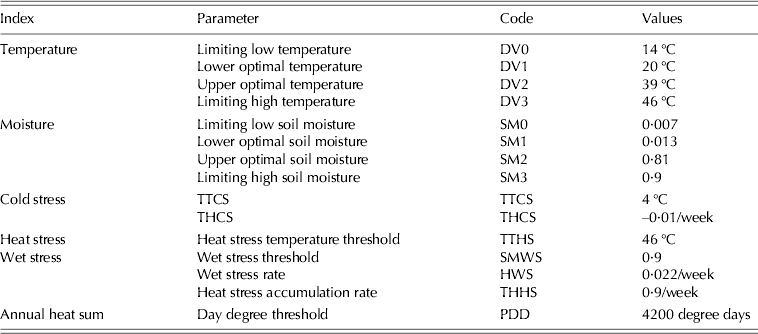
The soil moisture index in CLIMEX consists of the lowest threshold (SM0), the lower (SM1) and upper (SM2) optimum moisture thresholds and the upper threshold (SM3). In the current analysis SM0 was set at 0·007 to represent the permanent wilting point (Kriticos et al. Reference Kriticos, Potter, Alexander, Gibb and Suckling2007), which fits the observed distribution of date palms in Egypt, Saudi Arabia, Iran and Pakistan. The lower (SM1) and upper (SM2) optimum moisture limits were set at 0·013 and 0·81, respectively, to include varieties grown in Egypt, Saudi Arabia and Iran. The upper soil moisture threshold (SM3) was set at 0·9 as it is known that the fruits of this species can be negatively affected by high soil moisture (Elshibli et al. Reference Elshibli, Elshibli, Korpelainen and Tielkes2009). The selected values for parameters SM0, SM1, SM2 and SM3 allowed the highest EI values within native areas that had the highest density of records. Table 1 illustrates a summary of all CLIMEX parameters.
The CLIMEX parameter values that were used for P. dactylifera modelling

Current distribution of date palms (P. dactylifera) in Iran
Landsat images with 30 m image resolutions from EarthExplorer (http://earthexplorer.usgs.gov), the Global Biodiversity Information Facility (http://www.gbif.org), the Missouri Botanical Gardens’ database (http://www.missouribotanicalgarden.org) and other date palm literature in CAB Abstracts databases (http://www.cabdirect.org) were used to collect data on the distribution of P. dactylifera. This information was supplemented by other date palm literature (Eshraghi et al. Reference Eshraghi, Zarghami and Mirabdulbaghi2005; Mahmoudi et al. Reference Mahmoudi, Hosseininia, Azadi and Fatemi2008; Shayesteh et al. Reference Shayesteh, Marouf, Amir-Maafi, Carvalho, Fields, Adler, Arthur, Athanassiou, Campbell, Fleurat-Lessard, Flinn, Hodges, Isikber, Navarro, Noyes, Riudavets, Sinha, Thorpe, Timlick, Trematerra and White2010; Shabani et al. Reference Shabani, Kumar and Taylor2012; Tengberg Reference Tengberg2012; Rahnema Reference Rahnema2013) (Fig. 1). In total, 145 records for P. dactylifera were obtained from all the literature and databases. Nineteen records had no geographical coordinates and were therefore removed, leaving 126 records. To verify the accuracy of the point data, satellite images were used as a background, zooming in to each point to verify the presence of date palm in that area. Polygons were made around all the distinguishable areas currently cultivated for date palms for the entire country.
Location of date palm cultivation and model validation using suitable soil types for date palm cultivation in Iran under the current climate. The date palm records are from satellite images and Iranian date palm institutions, Iranian agricultural organizations and the national cartographic centre. The suitable soil types were determined from a soil map of Iran (1 : 1 000 000) provided by the national cartographic centre of Iran.
Refinement of CLIMEX outputs using soil data for date palm (P. dactylifera) cultivation in Iran
With the aim of refining the CLIMEX result, three datasets (CLIMEX, suitable physicochemical properties and suitable soil taxonomy) were created as shapefiles and then converted to raster format to provide a common spatial format.
Suitable physicochemical properties for date palms
Favourable physicochemical properties of soil for date palm cultivation include sandy topsoil with low salt levels (pH 8–8·5) on top of a heavy layer of white powdery calcrete clay with poor drainage, and highly alkaline soils pH 9·1–9·5 (Reilly & Reilly Reference Reilly and Reilly2012). The structural and textural properties of the suitable soils for dates include a content of 0·3–1·2% organic matter, sandy loam, sandy clay loam, loam, sandy clay and clay loam (Reilly & Reilly Reference Reilly and Reilly2012). Based on these properties, the physicochemical properties of soil for date palm cultivation for the whole country were classified into four physicochemical categories using a soil physicochemical map of Iran (1 : 1 000 000) provided by the National Cartographic Center of Iran as follows:
• 1=highly suitable physicochemical properties (pH 8–8·5 , texture: sandy loam, sandy clay loam, loam);
• 2=suitable physicochemical properties (pH 7·5–9·4, texture: loam, sandy clay and clay loam);
• 3=marginal physicochemical properties (pH 7–9·5, texture: silt loam, silty clay loam and silty clay);
• 4=unsuitable physicochemical properties (pH > 7 or <9·6, texture: sand, silt or clay).
It should be noted that the result of the physicochemical layer was independent of the current distribution of date palms.
Suitable soil taxonomy for date palms
Date palm plantation sites in Iran were determined using satellite data. This date plantation layer was then overlaid on the soil taxonomy map of Iran (1 : 1 000 000) to extract all the soil types that were suitable for date palm cultivation because date palm has been grown in these areas for over 100 years. This process resulted in 24 soil types: Typic Calcixerolls, Lithic Xerorthents, Typic Calcixerepts, Typic Aquisalids, Typic Haplogypsids, Typic Haplocalcids, Typic Haplogypsids, Typic Torriorthents, Typic Haplosalids, Ustic Torrifluvents, Ustic Torrifluvents, Aquic Torrifluvents, Lithic Xeric Haplocalcids, Lithic ustorthents, Lithic Ustic Torriorthents, Lithic Torriorthents, Typic Petrogypsids, Typic Calcixerepts, Typic Calciustepts, Lithic Haploxerepts, Gypsic Haplustepts, Xeric Torriorthents, Litihic Ustorthents and Lithic Xeric Torriorthents soils. Details on all the soil types can be found in Keys to Soil Taxonomy (Soil Survey Staff 2006).
The output from CLIMEX was then overlaid on the soil physicochemical layer and the soil taxonomy layer. All the locations that satisfied the conditions of EI>20, the soil physicochemical properties being highly suitable or suitable, and having a soil type within the identified 24 soil types were selected.
RESULTS
Model validation using suitable soil types under the current climate
The GIS output indicated that 4·8 million ha of Southern and Central Iran are currently cultivated for date palm (Fig. 1). This figure was confirmed by the Iranian Date Palm Institution, Iranian Agricultural Organization and the National Cartographic Center. Also, the soil map output indicated that date palms are currently grown in soils containing 29–57% sand, 26–59% silt and a maximum of 30% clay (% by volume). In the present study, all of the 24 soil types mentioned above and the areas having the aforementioned physical criteria were defined as areas containing suitable physicochemical soil properties for date palm cultivation (Fig. 1). Based on the GIS results, a total of 70 million ha of soil were found to be suitable for date palm cultivation (Fig. 1). Also, model validation using suitable soil types under the current climate is illustrated in Fig. 1. Nearly 0·94 of the occurrence records fell within the suitable categories, and a comparison between the CLIMEX result with the recognized distribution of this species and the location areas containing suitable physicochemical soil properties showed that there was consistency between the EI resulting from the CLIMEX model, the current distribution of P. dactylifera and the suitable physicochemical soil properties, which were completely independent of the date distribution (Fig. 1). Also, the model validation between the current distribution of date palm and the simulation by CLIMEX showed that 96·5% of the occurrence records fell within 20<EI<100.
Projected distribution under climate change scenarios
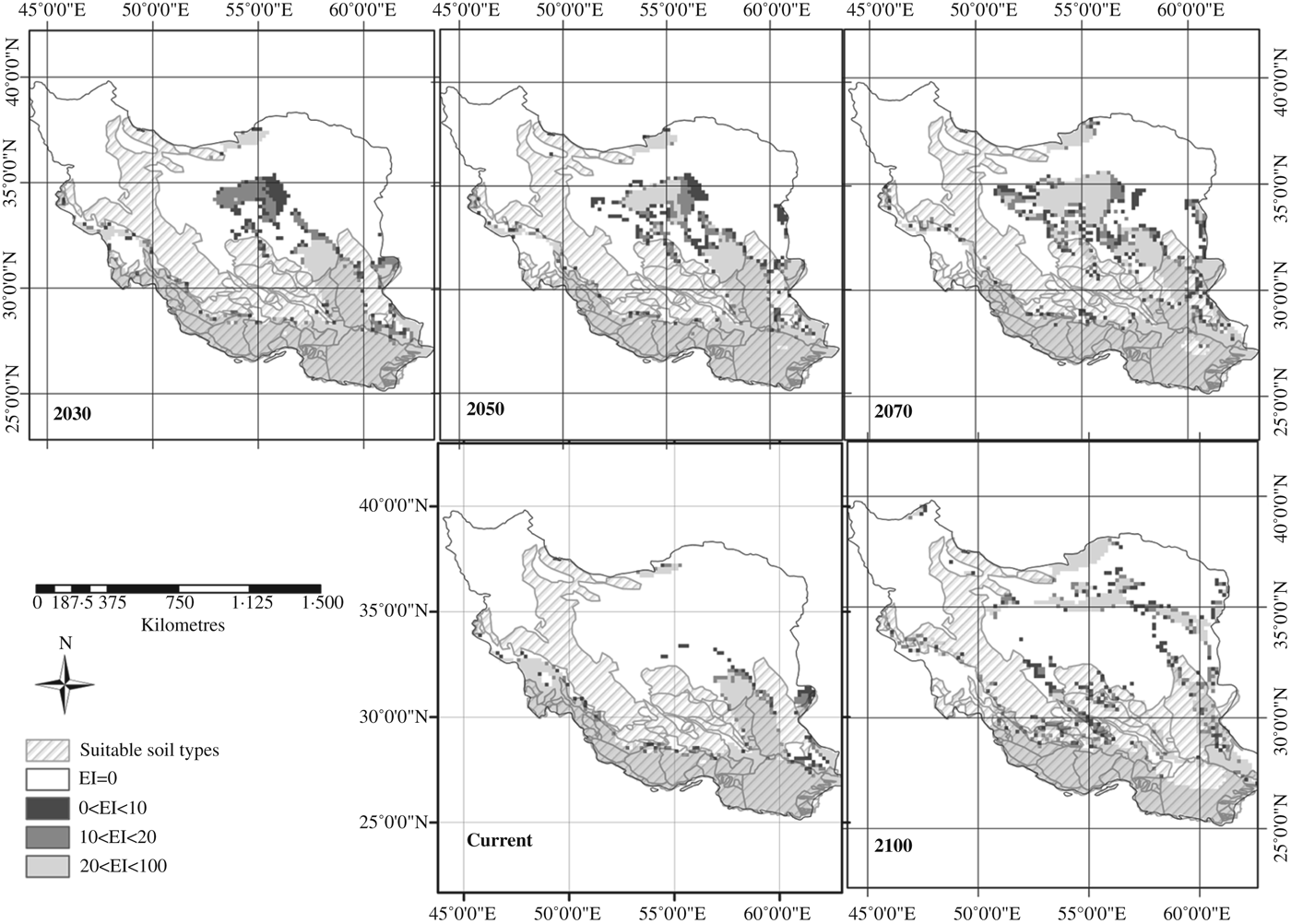
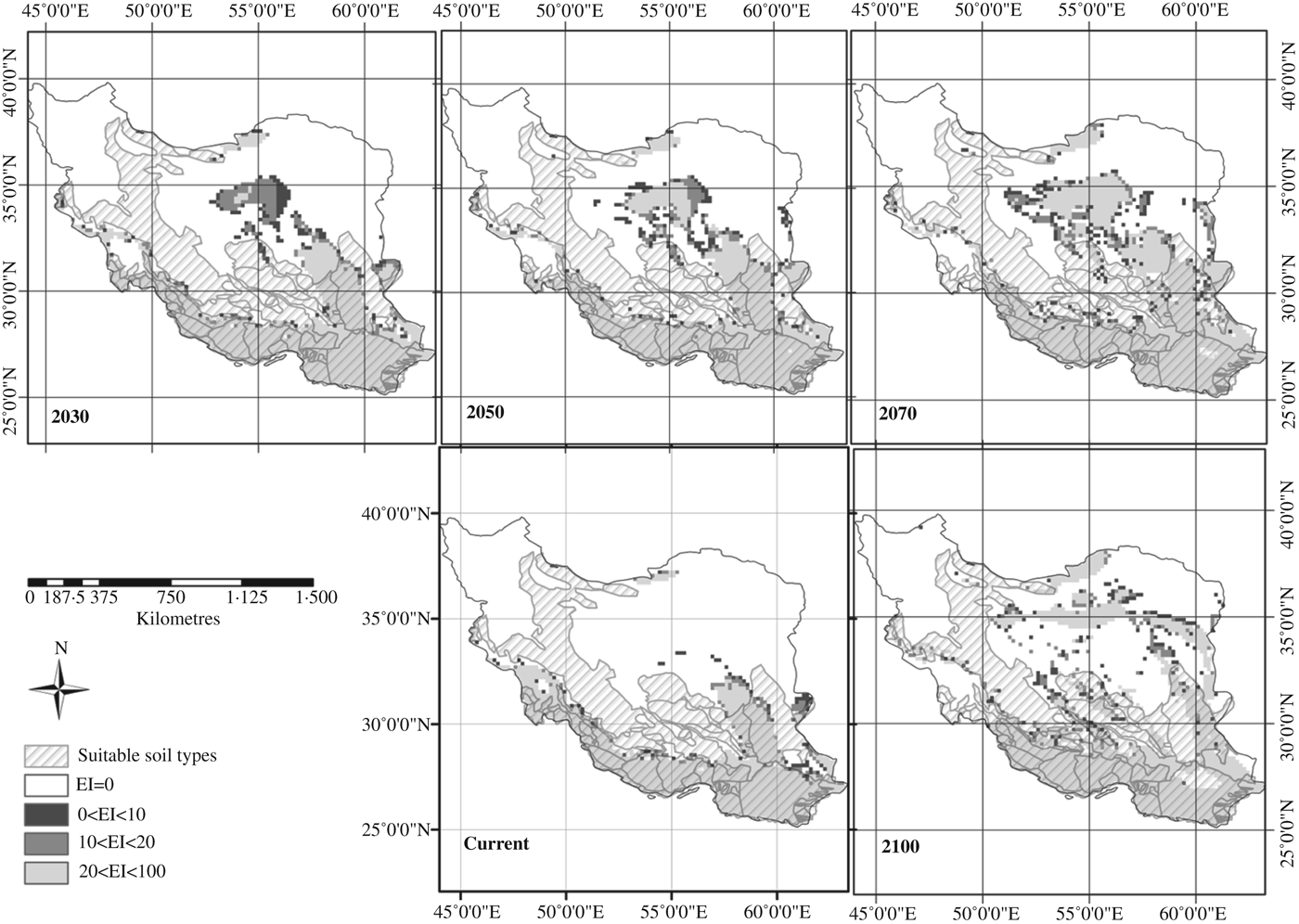
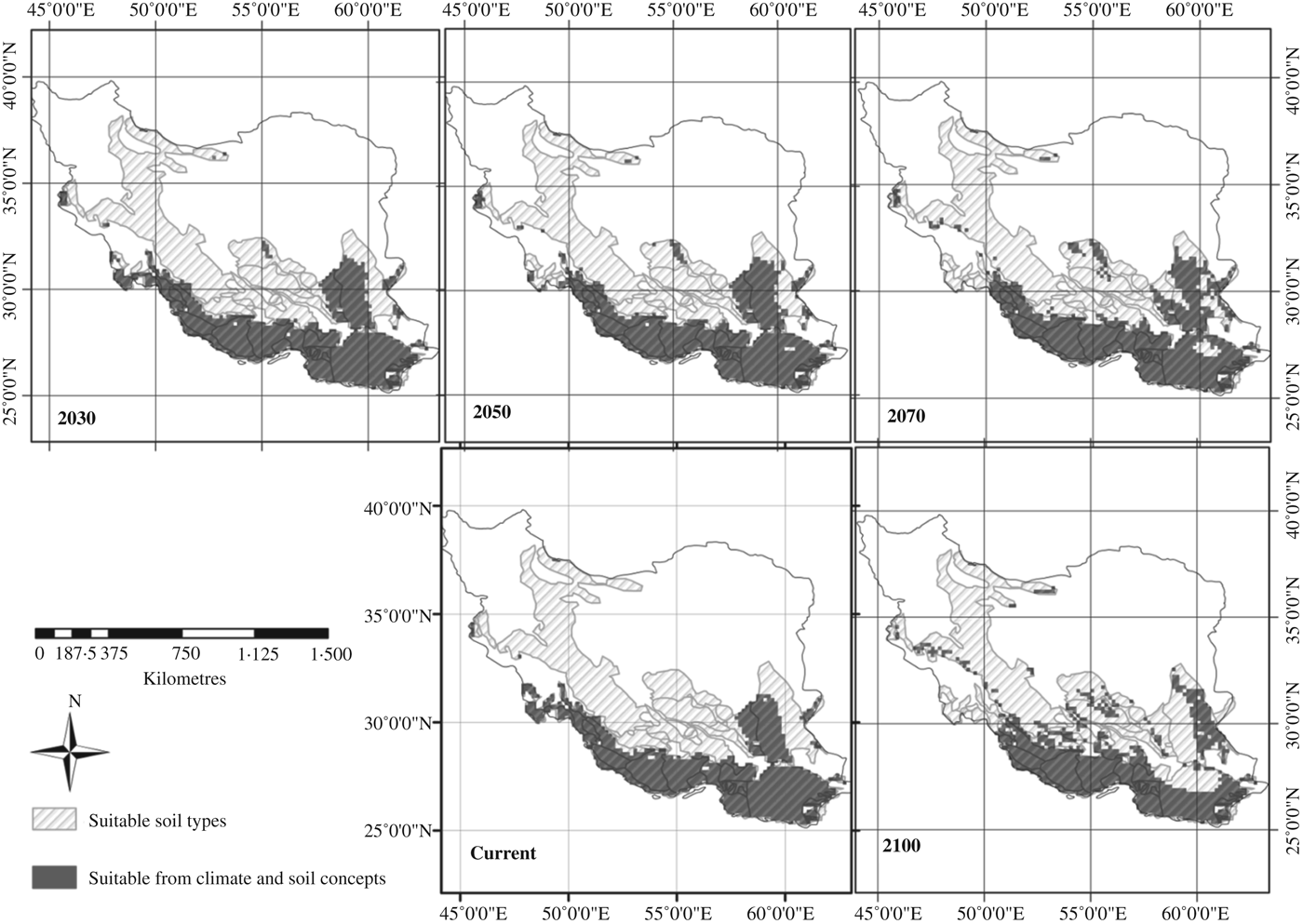
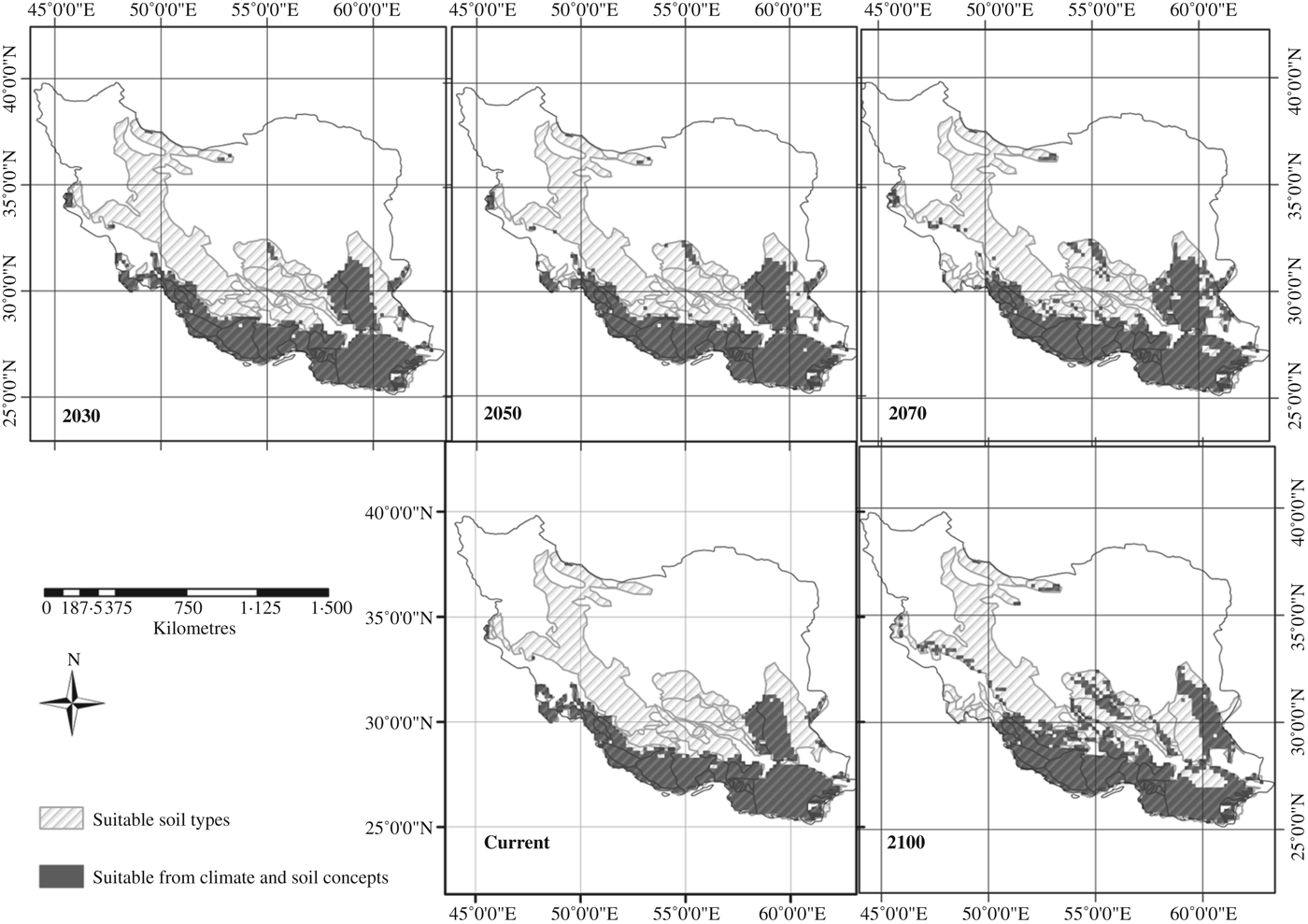
The outputs of the two different climate change models (CS and MR) with the A2 emission scenarios for the potential distribution of P. dactylifera for 2030, 2050, 2070 and 2100 are shown in Figs 2 and 3, respectively. The CLIMEX results, refined with the suitable soil layers, are illustrated in Figs 4 and 5.
The climate (EI) for P. dactylifera at present and projected using CLIMEX under the CSIRO-Mk3.0 GCM running the SRES A2 scenario for 2030, 2050, 2070 and 2100 and the locations of suitable soil types in Iran.
The climate (EI) for P. dactylifera at present and projected using CLIMEX under the MIROC-H GCM running the SRES A2 scenario for 2030, 2050, 2070 and 2100 and the locations of suitable soil types in Iran.
The refined suitable areas for P. dactylifera under the CSIRO-Mk3.0 GCM running the SRES A2 scenario for 2030, 2050, 2070 and 2100 by the location of suitable soil types and soil physicochemical properties.
The refined suitable areas for P. dactylifera under the MIROC-H GCM running the SRES A2 scenario for 2030, 2050, 2070 and 2100 by the location of suitable soil types and soil physicochemical properties.
Results from the CS model
The CS-modelled outputs indicated that the majority of the southern, eastern and central regions of Iran are projected to become climatically suitable for date palm cultivation between 2030 and 2070 (Fig. 2). The model projected that the total area conducive for date palm cultivation will increase to c. 65 million ha by 2070 and then decline slightly to 52 million ha by 2100 (Table 2). This model projected that c. 56, 61 and 65 million ha will become suitable for date palm growth by 2030, 2050 and 2070, respectively. In addition, the CS model demonstrated that the areas located between 30–35°N and 50–60°E will become highly suitable from 2030 to 2070 but that this suitability will decline slightly from 2070 to 2100. This model projected that 14 million ha currently used for date palm cultivation in Central Iran (30–35°N and 50–60°E) may become unsuitable for P. dactylifera cultivation between 2070 and 2100 (Fig. 2). In addition, the results of the modelling showed that the most significant loss (13·5 million ha) in suitability of areas will be in the areas between 30–35°N and 45–50°E, and 25–40°N and 50–65°E from 2070 to 2100.
Results of the CS and MR GCMs and the refined outputs using the location of suitable soils and soil physicochemical properties for date palm cultivation for 2030, 2050, 2070 and 2100

Once the CS model outputs were refined by the locations of suitable soil types, the results indicated that 31·7, 31·8, 31·5 and 28·7 million ha will be suitable for date palm cultivation in 2030, 2050, 2070 and 2100, respectively (Fig. 4, Table 2). The area located between 32–35°N and 55–60°E does not have potential for cultivation of date palm because suitable soil types are not present.
Results from the MR model and the refined results
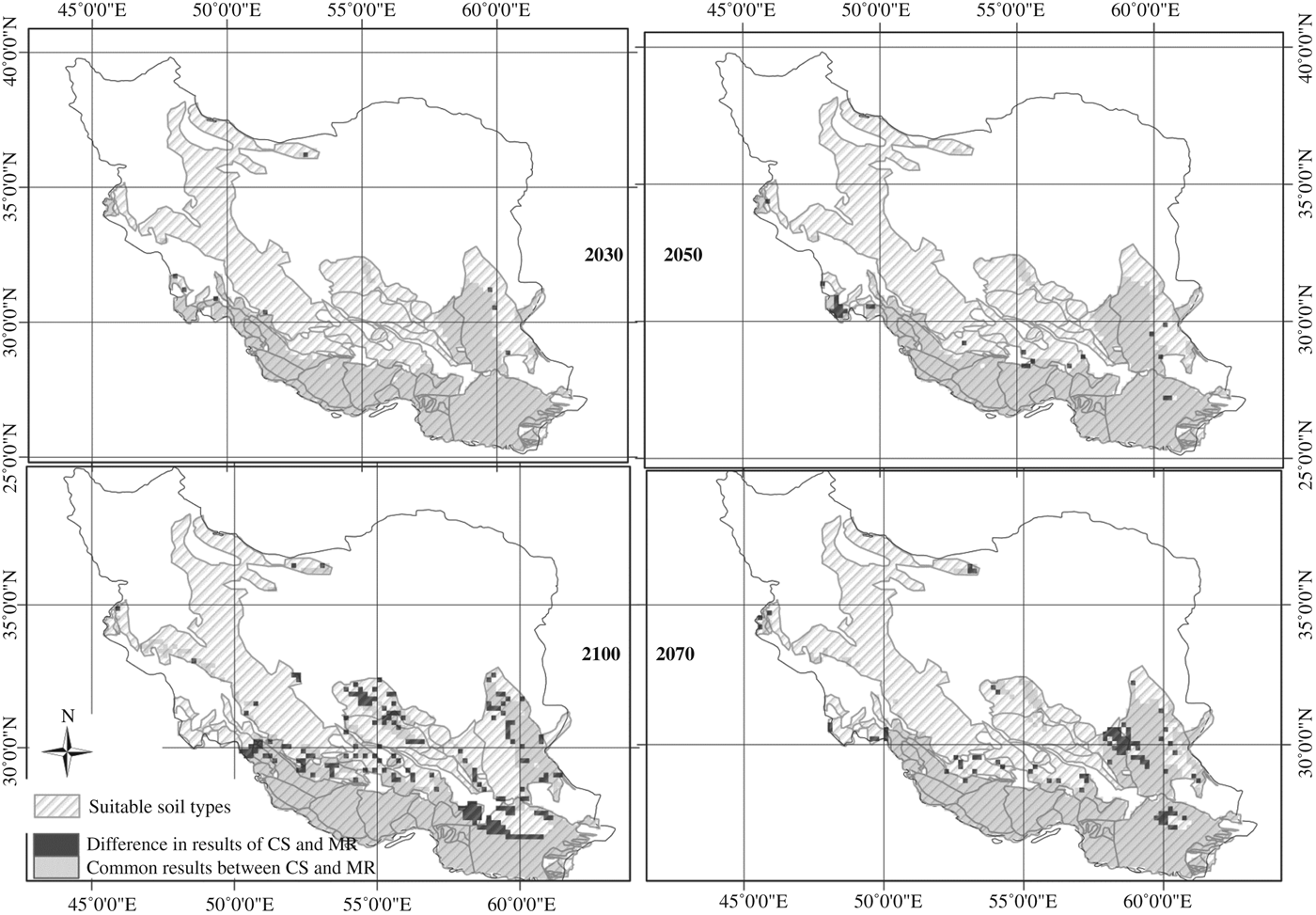
Based on the output of the MR GCM, the large areas located between 30–35°N and 50–60°E are projected to become highly suitable for date palm cultivation between 2030 and 2070. The MR model indicated that 57, 62 and 69 million ha may become highly suitable for date palm cultivation in the four decades after 2030 because the climatic conditions may become more suitable (Fig. 3). However, the current model showed a 7% reduction in the suitability of potential growing areas by 2100 compared with 2070 (Table 2 and Fig. 3). When the MR results were refined based on the locations of suitable soil types, the results showed an upward trend in the suitability of areas, from 31·8 to 34·2 million ha, in 2030–2070, and then a slight downward trend from 2070 to 2100 (Table 2 and Fig. 5). The refined results showed that the areas located between 25–30°N and 50–65°E will remain suitable for date palm cultivation from now until 2100, whereas the area between 32–40°N and 50–65°E will not be favourable for date palm growth. Figure 6 indicated that inclusion of physicochemical soil properties improved the agreement between the projections of the two GCMs.
Consistencies and inconsistencies in the projection of suitable areas for P. dactylifera under the CSIRO-Mk3.0 and MIROC-H GCMs running the SRES A2 scenario for 2030, 2050, 2070 and 2100 in Iran.
DISCUSSION
The results of both GCMs indicate that the difference in areas projected to be favourable for date palm cultivation is relatively small. However, the differences are greater towards 2100 compared with 2030, which is due to the differences in the projected rates of change in rainfall and temperature in the two models. The temperature and rainfall changes predicted by the two GCMs differ. For example, the MR model predicts that the temperature will rise by 4·31 °C, whereas the CS model forecasts an increase of 2·11 °C by 2100 (Suppiah et al. Reference Suppiah, Hennessy, Whetton, Mcinnes, Macadam, Bathois, Ricketts and Page2007; Chiew et al. Reference Chiew, Kirono, Kent, Vaze, Anderssen, Braddock and Newham2009). In terms of rainfall, the CS model predicts a 13–15% decrease in future annual rainfall, whereas the MR model predicts only a 1% reduction (Suppiah et al. Reference Suppiah, Hennessy, Whetton, Mcinnes, Macadam, Bathois, Ricketts and Page2007; Chiew et al. Reference Chiew, Kirono, Kent, Vaze, Anderssen, Braddock and Newham2009). Although CLIMEX modelling outputs do not consider non-climatic factors, other software such as ArcGIS can play an important role in refining the results by utilizing non-climatic factors. The present study refined the CLIMEX results using the locations of suitable soil types and soil physicochemical properties.
The CS and MR GCMs share some similarities in the projections of suitable areas for date palm growth. For example, both project that large parts of Central Iran will become climatically suitable for date palm cultivation toward 2070. Conversely, they project that 13 and 5 million ha (for CS and MR, respectively) of these suitable areas will become unsuitable as a consequence of increased heat stress in Central Iran by 2100. In other words, these two models indicate that large areas between 30–35°N and 50–60°E will become unsuitable for date palm cultivation as a result of heat stress by 2100. For the same year, both models indicate that cold stress will not have a negative effect on date palm growth. Furthermore, both GCMs indicate that date palms will not suffer from any wet or cold stress in Iran by 2100.
However, some inconsistencies between the results of the CS and MR GCMs were also found. For instance, the areas projected to be climatically suitable for date palm cultivation by MR were relatively higher than the CS model due to the differences in their predictions. Such areas were mainly located between 30–40°N and 50–65°E.
A comparison of the mean CS GCM output and the mean soil-refined results showed that c. 0·53 of the CS outputs will be suitable for date palm cultivation because of the unsuitability in physicochemical soil properties. This unsuitability could be due to several reasons, including highly alkaline soils in the central province of Iran and calcareous and acidic soils in northern Iran. The soil map indicated that most areas between 32–36°N and 52–60°E contained 47% clay and 14% sand (% by volume), which are unsuitable for date palm growth. Based on the MR results refined using soil type, only half of the area that was projected to be climatically suitable may be conducive for date palm cultivation, whereas the rest may be unsuitable due to soil type. Many studies have documented the negative impacts of unsuitable soil types on date fruit weight, volume, diameter and length (Bacha & Abo-Hassan Reference Bacha and Abo-Hassan1983; Rasmussen Reference Rasmussen1999). It has also been suggested that salty soils, which can be found in Central to Eastern Iran (32–37°N, 52–61°E), significantly decrease the soil–water osmotic potential in date palm trees and cause losses in date palm yield (Alhammadi & Kurup Reference Alhammadi, Kurup, Sharma and Abrol2012). Another potential consequence of saline soils is toxic ions, which may cause serious problems for plant growth (Tripler et al. Reference Tripler, Ben-Gal and Shani2007; Alhammadi & Kurup Reference Alhammadi, Kurup, Sharma and Abrol2012) and also inhibit root growth (Shani & Dudley Reference Shani and Dudley2001; Tripler et al. Reference Tripler, Ben-Gal and Shani2007). Furthermore, date palm seeds cannot emerge in saline soils: 12·8 dS/m salinity in soil is defined as a critical point that can stop germination (Ramoliya & Pandey Reference Ramoliya and Pandey2003). The soil map indicated that most of the central and eastern parts of Iran have salinities greater than 16 dS/m, making these regions unsuitable for date palm growth. Therefore, refining the CLIMEX results using non-climatic factors such as soil type is an important step.
Once the two modelled outputs were refined using soil data, the two models projected very similar locations suitable for future date palm cultivation. The locations projected by both GCMs for 2030 and 2050 are almost identical, with an overlap of c. 0·98.
However, for 2070 and 2100, the difference (0·13) between the GCM results is larger, which could be due to inconsistencies between the projected rates of change in rainfall and temperature by the CS and MR models. In other words, the results refined by non-climatic parameters led to better agreement between the projections of the two GCMs.
In the current study, 4·8 million ha in Iran were found to be cultivated by date palms, as obtained from satellite images. Both the refined CS and MR GCMs showed that this value can increase significantly, to 31·7 million ha by 2030, and remain suitable until 2070 as a result of climate alteration. However, the current modelling results indicated that this suitability may then decline to 31·1 million ha by 2100 due to heat stress. Thus, in Iran, areas that are presently climatically unsuitable will become climatically suitable for date palm cultivation in the future: areas that have suitable soil types but are currently too cold for cultivation may become suitable for P. dactylifera cultivation under future climatic conditions. Overall, the climatic suitability for date palm cultivation will improve in Iran. Iran should prepare itself to make use of these opportunities because, climate-wise, the area will become highly suitable for this plant.
It should be noted that the projected areas are based on climate modelling, soil types and soil physicochemical properties. Some of the projected suitable areas may not actually be favourable for date cultivation due to other factors, such as unfavourable terrain and land uses.
The results of the climate change and soil type modelling provide an indication of the probable changes in the potential distribution of P. dactylifera in Iran in the future. The results indicate that more areas will be suitable for date palm cultivation in the future. The present study indicated that c. 0·52 (32 million ha) of CLIMEX outputs using CS and MR GCMs with the A2 scenario for date palm species in Iran are suitable for date cultivation when soil type is considered, compared with the current known date palm plantation of 4·8 million ha. Further research could consider other non-climatic factors such as slope and land use in addition to CLIMEX-based modelling by overlaying layers on a map derived from CLIMEX to refine the results in a range of environments and locations. A further area of inquiry could look at hydrological modelling and how these may impact date palm distribution.