Identifying a feasible and appropriate model for conducting rheumatic heart disease screening as part of a public health programme in resource-poor areas is a challenge for health ministries in developing countries. Undertaking routine screening to detect cases early in their disease process is recommended, but difficult when the populations are located remotely from major centres, with limited resources and a lack of available skilled staff. In industrialised countries, echocardiographers undertake complex echocardiography scanning in hospitals on patients with complex cardiac conditions; however, echocardiographers are a scarce resource in developing countries.
A recent screening study in Fiji found a prevalence of clinical rheumatic heart disease, that is, with a significant cardiac murmur, of 8.4 per 1000 in children aged 5–14 years.Reference Steer, Kado and Jenney 1 Additional field studies undertaken in 2008 in Fiji demonstrated that the approach of using auscultation to detect suspicious heart murmurs, followed up with confirmatory echocardiography, lacked sensitivity and missed the majority of rheumatic heart disease cases detected if all children underwent echocardiography examination.Reference Reeves, Kado and Brook 2 This supports findings of similar rheumatic heart disease echocardiography studies undertaken in Nicaragua, Tonga, New Zealand, India, Cambodia, and Mozambique.Reference Paar, Berrios and Rose 3 – Reference Bhaya, Panwar, Beniwal and Panar 7 Taken together, this evidence suggests that potentially up to 10 times as many cases of rheumatic heart disease are detected using echocardiography compared with auscultation; however, the meaning of subtle findings on echocardiography is yet to be completely elucidated in follow-up studies. If this were the case, there would be many cases of undiagnosed rheumatic heart disease in schoolchildren in Fiji. One challenge to finding these children is to devise a screening protocol that is practical and affordable in a country like Fiji. In wealthy, well-resourced countries, it is not uncommon for nurses to be involved in ultrasonographic or echocardiographic procedures; however, these nurses have generally had many years of hands-on supervised training or completed lengthy postgraduate courses at tertiary institutions. A search of the recent literature indicates that this is the first study of its kind in a resource-poor setting.
We therefore designed a pilot study of a training module for nurses to determine whether they could perform rheumatic heart disease echocardiography at the level of undertaking basic two-dimensional and colour echocardiography scans. The pilot training was developed with the following guiding principles: the nurses would be trained only in basic rheumatic heart disease screening echocardiography, that is, it was not our intention to train them to a level of a formally qualified echocardiographer; they would receive weeks to months of training rather than years, and the model would be such that it could be reproduced in other similar settings using available local capacity. The aim of the model was for nurse echocardiographers to identify a relatively small subset of children with possibly abnormal findings, who would then be referred for confirmatory echocardiography by a more highly trained echocardiographer. This model requires high sensitivity and relatively high specificity, to minimise the number of missed cases while not requiring too many children to have confirmatory echocardiography, which could overwhelm the clinical workforce. The Ministry of Health had indicated that the most feasible and sustainable means of undertaking a dedicated rheumatic heart disease screening programme would be to train nurses working with school health teams to undertake basic rheumatic heart disease echocardiography screening. School health nurses are employed by the Fiji Ministry of Health and are located in all regions of Fiji.
Secondary prevention, delivery of three to four weekly penicillin injections to patients with a history of acute rheumatic fever or rheumatic heart disease, is a cost-effective method of disease prevention and control. 8 A coordinated national rheumatic heart disease control and secondary prevention programme has been running in Fiji since 2005. Regular administration of penicillin injections to children with mild heart valve lesions can result in up to 70% having no detectable disease 5 to 10 years later.Reference Tompkins, Boxerbaum and Liebman 9 – Reference Majeed, Batnager, Yousof, Khuffash and Yusuf 13 In the absence of a screening programme, most patients with rheumatic heart disease are identified because they become symptomatic with cardiac failure, reflecting progression to severe valvular disease.
Materials and methods
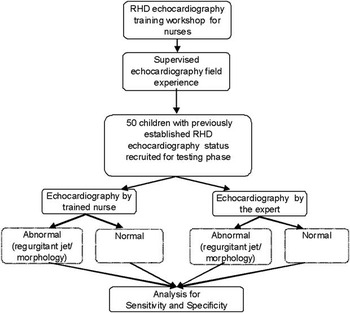
This pilot study had three main components: the first step was a training workshop for nurses in basic rheumatic heart disease echocardiography. In the second step, the nurses completed 2 weeks of supervised field screening training. The third step was a blinded comparison of the nurses’ ability to identify patients with rheumatic heart disease on echocardiography compared with a paediatric cardiologist also using echocardiography (Fig 1).
Flowchart showing analysis of the study design. RHD = rheumatic heart disease.

Two nurses were selected to participate in the pilot study. Both nurses had over 10 years of clinical experience, as well as research and public health experience in the field of rheumatic heart disease; however, neither nurse had any prior knowledge or experience in echocardiography. Informed consent was obtained from all participating children before any study procedures; assent was obtained from all children over 10 years of age. Ethics approval to undertake this project was obtained from the Fiji National Research Ethics Committee, the Human Research Ethics Committee of the Northern Territory Department of Health, and the Menzies School of Health Research. Approval was also obtained from the Fiji Ministry of Education and selected participating primary schools.
Workshop and field training/experience phase
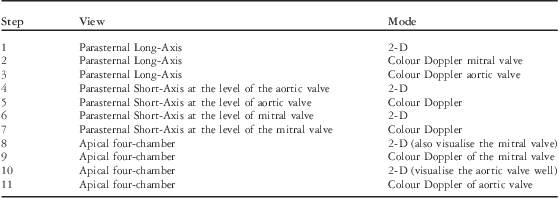
A week-long rheumatic heart disease echocardiography training workshop was held in March, 2010. The training was facilitated by two paediatricians with extensive experience in rheumatic heart disease echocardiography. The nurses received training in basic rheumatic heart disease echocardiography, with an emphasis on obtaining views of the left side of the heart and identifying mitral valve regurgitation, and capturing images of the mitral and aortic valve in three views – Parasternal Long-Axis, Parasternal Short-Axis, and Apical. The primary emphasis was on identifying and measuring a regurgitant mitral and/or aortic jet using colour Doppler function. Nurses were also asked to comment on whether the mitral and aortic valves appeared normal or abnormal. The nurses were trained to follow a basic 11-step rheumatic heart disease screening echocardiography algorithm (Table 1).
Eleven-step basic algorithm for nurse-led RHD screening echocardiography.

2-D = two-dimensional; RHD = rheumatic heart disease
Following the workshop, the nurses completed 2 weeks of echocardiography screening in two primary schools supervised by experienced doctors and echo technicians. It was intended that each nurse would undertake 60–80 echocardiograms, over this 2-week period, with a focus on gaining dexterity, experience, and competency in identifying children who require cardiac referral before the testing of their skills. If the supervising staff felt that the echocardiogram identified children with possible acute rheumatic carditis, rheumatic heart disease, or other abnormal cardiac findings, they were referred for further off-study clinical investigation to the Paediatrics Department at Fiji's tertiary hospital, the Colonial War Memorial Hospital, Suva.
Testing phase
In the week following the field experience, the nurses’ skills were tested on a blinded sample of 50 children. Children who had been screened using echocardiography in 2008, whose cardiac diagnosis was known, were approached to participate in this phase of the study. The 50 selected children included 10 children with rheumatic heart disease and 40 with normal echocardiographic findings as diagnosed in 2008. The 50 children involved in this phase each had three echocardiograms undertaken on the same day, one by each of the nurses being tested and the third by the cardiologist – all examiners were blinded to each other's findings.
Referral thresholds for nurses
We chose conservative measurements for the nurses to determine the need for referral – 1 cm of mitral regurgitation and/or the presence of any aortic regurgitation – to limit the likelihood of false negatives.
Case definitions for rheumatic heart disease for the gold standard reader
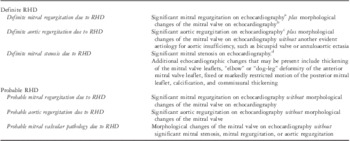
The definitions for definite and probable rheumatic heart disease used in this study were those used in previous screening studies in Fiji (Table 2). The cardiologist acting as the “gold standard” echocardiographer was asked to follow these guidelines when categorising rheumatic heart disease cases detected among the 50 children in the testing sample.Reference Carapetis, Paar and Cherian 14
Definition of RHD on echocardiogram (modified from the World Health Organization and the National Institutes of Health RHD working party guidelines).Reference Carapetis, Paar and Cherian 14

RHD = rheumatic heart disease
aSignificant mitral regurgitation on echocardiography is defined as: a mitral regurgitant jet at least 2 cm from the coaptation point of the valve leaflets, seen in two planes, with a high-velocity mosaic pattern and persisting throughout systole
bMorphological changes of the mitral valve on echocardiography are defined as: thickened mitral valve leaflets and/or elbow or dog-leg deformity of the anterior mitral valve leaflet
cSignificant aortic regurgitation on echocardiography is defined as: an aortic regurgitant jet at least 1 cm from the coaptation point of the valve leaflets, with a high-velocity mosaic pattern and seen in two planes
dSignificant mitral stenosis on echocardiography is defined as: evidence of flow acceleration across the mitral valve with a mean pressure gradient >4 mmHg
All echocardiography examinations were performed using portable Mindray machines (Mindray Diagnostic Ultrasound System Model M5, Mahwah, New Jersey, United States of America). These relatively inexpensive machines allow two-dimensional, motion-mode, colour Doppler mapping, and continuous wave and pulse wave Doppler imaging. All echocardiography was undertaken in a transthoracic mode using an appropriate ultrasound gel and with the aid of electrocardiography tracing.
Data analysis
The nurses were asked to obtain and record measurements of mitral valve regurgitation and comment on the presence of any aortic valve regurgitation. The nurses’ measurements of regurgitant mitral valve jet length in the Parasternal Long-Axis and Apical views were categorised into three divisions: jet of ≥2 cm, ≥1.5 cm, or ≥1 cm. Assessment of aortic valve regurgitation was a simple “yes/no” assessment. The nurses also commented on the presence or absence of mitral valve morphology. The primary outcome measure was the nurses’ finding of a mitral regurgitant jet and/or any aortic regurgitation – so-called “screen-positive” – compared with the cardiologist assessment of definite rheumatic heart disease as defined by the study criteria, for each nurse. Sensitivity and specificity with 95% confidence intervals were calculated for all comparisons. In addition, other comparisons were made between the nurses’ and cardiologist's assessment of mitral valve jet length using Spearman's correlation coefficient.
Results
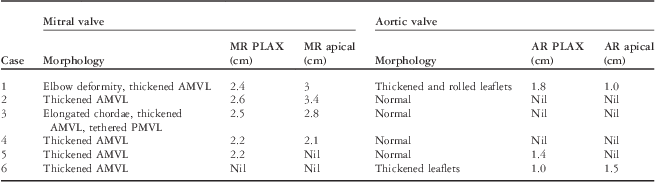
Of the 10 patients who were classified as having definite rheumatic heart disease in 2008, only six met the criteria for definite rheumatic heart disease in 2010 as per the echocardiogram performed by the study cardiologist (Table 3); three children no longer met the criteria for definite rheumatic heart disease despite having some abnormalities of the mitral valve. These features included either significant regurgitation in at least one view or significantly abnormal valve morphology. There was one patient who had a congenital abnormality of the aortic valve – bicuspid aortic valve – that was not previously detected. All three nurses correctly identified this case as having an abnormal aortic valve. This case was excluded from the analysis. No children with a previously normal echocardiogram developed definite or probable rheumatic heart disease during the 2-year period. Therefore, the case mix for the nurses consisted of six rheumatic heart disease cases out of 49.
Characteristics of the six patients who were identified by the cardiologist as having definite RHD.

AMVL = anterior mitral valve leaflet; AR = aortic regurgitation; MR = mitral regurgitation; PLAX = Parasternal Long-Axis; PMVL = posterior mitral valve leaflet; RHD = rheumatic heart disease
A total of seven children were found by the cardiologist to have a regurgitant mitral valve jet of between 1.5 and 1.99 cm and eight children had a regurgitant mitral valve jet of between 1.0 and 1.49 cm. The remaining 27 children had either no mitral regurgitation or regurgitation measuring <1 cm. Of the 49 included children, three were found to have an aortic valve jet >1 cm and the remaining 46 children had <0.99 cm or no aortic valve regurgitation.
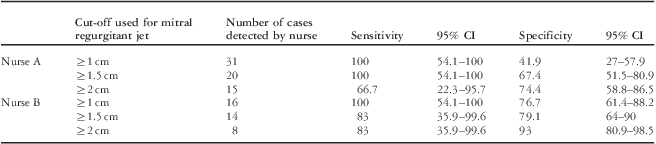
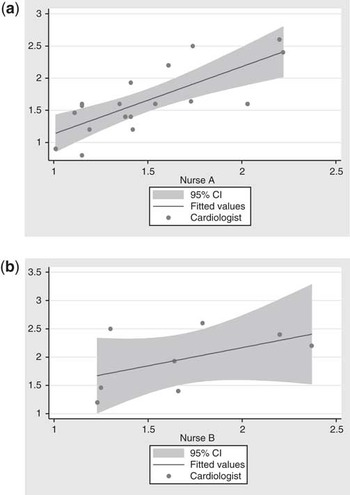
Data comparing Nurse A and B's screen positive cases at varying lengths of mitral regurgitation against the gold standard diagnosis of rheumatic heart disease are presented in Table 4. Of the six children identified by the cardiologist as having definite rheumatic heart disease, Nurse A identified three of these cases on the basis of mitral regurgitation ≥1.5 cm, whereas Nurse B identified four. The remaining cases were identified on the basis of aortic regurgitation. Indeed, of the total sample the nurses identified 13 and 8 cases with some evidence of aortic regurgitation. This was at odds with the cardiologist who found only three children with aortic regurgitation as outlined above. The nurses were not required to measure the length of the aortic regurgitant jets, thereby not allowing any further detailed analysis; however, it is likely that the majority of these children were identified as having <1 cm. When we compared the nurses’ measurement of the length of the mitral regurgitant jet directly against the cardiologist's measurement, there was only fair agreement with a Spearman's correlation coefficient of 0.46 and 0.39 for Nurse A and B, respectively (Fig 2).
Sensitivity and specificity of nurses in identifying cases of definite RHD as defined by study definitions (n = 6), when nurses used different mitral regurgitation jet length cut-offs and presence of any aortic regurgitation as screen positivea.

RHD = rheumatic heart disease
aNurses were not asked specifically to identify cases of RHD, but to identify cases with significant mitral regurgitation using different cut-offs and presence of aortic regurgitation, to be referred for further assessment
Correlation of Nurse A and B's measurement of mitral regurgitation jet length to that of the cardiologist.

The aim of this pilot project training was to focus on the nurse's ability to detect mitral and/or aortic regurgitation and identify cases that require referral with high sensitivity and specificity. They were, however, asked to answer a yes or no question, given their very brief level of training, on whether they thought abnormal mitral valve morphology was present. The cardiologist identified a total of 17 out of 50 cases with some degree or abnormal or suspicious mitral valve morphology. Of these, two cases also had an aortic valve abnormality recorded; it is noteworthy that there were no cases identified with isolated aortic valve abnormality.
Discussion
This pilot project has demonstrated that nurses, given brief focused training and supervised field experience, can follow an algorithm to undertake rheumatic heart disease echocardiography in a developing country setting with reasonable accuracy.
The current guidelines for rheumatic heart disease describe significant mitral regurgitation as being a mitral regurgitant jet of at least 2 cm from the coaptation point of the valve leaflets with a pansystolic signal on colour Doppler and peak velocity >3 m/s.Reference Carapetis, Paar and Cherian 14 Comparing the nurses’ results for mitral regurgitation at the cut-off level of 1.5 cm with the cardiologist's detection of rheumatic heart disease showed good sensitivity and specificity (Table 4). Using a 1-cm cut-off for mitral valve regurgitation resulted in excellent sensitivity results but poor specificity, suggesting that a 1.5-cm cut-off may be a more appropriate level to focus on in the next proposed phase of this project, assuming that mitral valve regurgitation <1.5 cm continues to be considered irrelevant in diagnostic guidelines developed in future. The finding that the exact measures of mitral regurgitant jets by nurses were not as reliable suggests that the focus should be more on asking nurse screening echocardiographers to detect children for further referral, as we set out to do in this study, rather than to try to have them make more advanced judgements based on specific measurements such as exact jet length and subtle changes in valve morphology. Identifying just mitral regurgitation alone did not pick up all the cases: three out of six for Nurse A and four out of six for Nurse B. It is important that we keep aortic regurgitation in our future “screen positive” definition because: first, the nurses’ finding of aortic regurgitation – any jet identified – increased sensitivity; second, one of the definite rheumatic heart disease cases had aortic regurgitation alone and would have been missed if we did not include aortic regurgitation in the “screen positive”. These results warrant further research, with a view to developing a module to guide rheumatic heart disease echocardiographic screening by nurses within the existing public health infrastructure in high-prevalence, resource-poor regions. A key factor in determining an appropriate screening module is the accuracy of the screening tool to correctly identify children who require further clinical referral without missing cases, that is, ensure high sensitivity, and the ability of the tool to exclude large numbers of children whose cardiac pathology is normal – high specificity. Poor sensitivity leads to potentially missed rheumatic heart disease cases that may go on to present with severe untreatable disease, yet unnecessary referral of a large number of cases for clinical review could overwhelm already burdened clinical services.
This pilot study has shown that when given brief comprehensive training nurses can operate sophisticated portable echocardiography machines with competence and detect findings suggestive of rheumatic heart disease with high sensitivity and reasonable specificity. Additional training and experience will be required to increase specificity. It was our anecdotal experience in this study that the nurses were able to acquire reasonable images in the four views by the end of the first week of training, although optimisation of these images required considerably more time. Further development of a rheumatic heart disease training module for nurses in a high-prevalence, resource-poor setting might include a longer period of supervised field experience and be undertaken utilising standardised rheumatic heart disease echocardiography guidelines and protocols when they become available.Reference Remenyi, Wilson and Steer 15
There are a number of limitations to our study, largely due to the pilot nature of the study. Only two nurses were tested, and thus generalisability of the results is limited. Practical aspects of the study relevant to implementation in the field were not measured, including the time spent per evaluation by the nurse. Only regurgitant jets were evaluated by the nurses without evaluation of changes in valve morphology on two-dimensional imaging.
There are currently no published studies that examine the cost-effectiveness of rheumatic heart disease echocardiography screening in resource-poor settings. Although there is good reason to think that early detection of rheumatic heart disease will lead to reduced health-care costs and increased lifetime productivity in individual patients, this has not been formally assessed. Although portable echocardiography machines are becoming more affordable, undertaking disease screening at a public health level is labour intensive and may have considerable downstream workforce consequences. A cost-effectiveness study of rheumatic heart disease screening is planned in Fiji.
In 2011, the World Heart Federation developed an evidence-based guideline for echocardiographic diagnosis of rheumatic heart disease.Reference Remenyi, Wilson and Steer 15 Our current study provides a useful basis for the next phase of development of the training module, which will utilise these new standardised echocardiographic criteria. In 2012, we aim to train an additional seven nurses, with the aim of validating the rheumatic heart disease echocardiography screening module and increasing the Ministry of Health rheumatic heart disease screening capacity across the country, potentially providing an echocardiography training model to be utilised in the future in Fiji and elsewhere in the Pacific region. With the newly developed international rheumatic heart disease echocardiography consensus guidelines, the pilot data from this current study and further data from our planned larger nurse-led echocardiography study, investigators and public health leaders will be in a better position to define feasible methodology for rheumatic heart disease screening in resource-poor settings.
Acknowledgements
The authors would like to thank the children, their parents, their schools, and their communities for participating in this study, as well as the Fiji Ministry of Health and Fiji Ministry of Education for their close collaboration in the project, particularly Dr Sala Seketa, Dr Isemeli Tukana, and Mr Brij Lal. We acknowledge the assistance and dedication of the Fiji Group A Streptococcal Project (Fiji GrASP) research team including Laisiana Matatolu, Frances Matanatabu, Sera Rayasidamu, Eseta Margrave, Kavita Prasad, Monica Brook, and Reapi Mataika. Disclosure: This study was funded by Cure Kids New Zealand, the Fiji Water Foundation, the Accor group, and the Menzies School of Health Research. The funding bodies had no involvement in study design; in the collection, analysis, and interpretation of data; in the writing of the report; and in the decision to submit the article for publication. There is no conflict of interest for any author.