Symptomatic neonatal thrombosis is uncommon, occurring in 5.1 per 100,000 live births. In one review, aortic thrombosis accounted for 2.5% of all neonatal thromboses.Reference Nowak-Göttl, Von Kries and Göbel1 Neonatal aortic thromboses are most commonly due to indwelling umbilical catheters.Reference Greenway, Massicotte and Monagle2,Reference Klinger, Hellmann and Daneman3 Spontaneous aortic thromboses in neonates are both rareReference Nowak-Göttl, Von Kries and Göbel1 and poorly understood. Clinical presentation is based on the location in the aorta and degree of occlusion. Presentation can mimic severe heart failure with hypotension, respiratory distress, and end-organ damage. However, presentation can also be subtler with lower extremity oedema, decreased femoral pulses, poor feeding, or irritability.Reference Nagel, Tuckuviene, Paes and Chan4 A case of a patient with a life-threatening spontaneous neonatal aortic thrombus is presented along with a review of the published cases of neonatal aortic thrombosis not associated with an umbilical artery catheter, other intravascular device, or procedure.
Case
A 12-day-old term male presented with bloody stools, vomiting, 19-ounce weight loss, and decreased urine output. Aortic coarctation was suspected given a new murmur, absent femoral pulses, and general poor perfusion, for which prostaglandin was initiated and the patient was transferred to our institution. The echocardiogram did not demonstrate coarctation but instead showed an echo bright periductal mass. Subsequent cardiac MRI demonstrated a non-occlusive mass extending from the patent ductus arteriosus into the descending aorta as well as an occlusive mass just distal to the superior mesenteric artery extending to iliac and renal arteries.
After subspecialty consultation, systemic tissue plasminogen activator and heparin were initiated simultaneously. Heparin was initially dosed at 10 units/kg/hour and increased to a maximum of 33.6 units/kg/hour. Heparin was titrated for a goal anti-Xa level of 0.35–0.7 IU/ml as recommended by Hematology. Tissue plasminogen activator was administered at 0.3 mg/kg/hour for 6 hours, off for 11 hours, and then administered again for 6 hours at the same dose. The decision was made to then restart a continuous infusion of tissue plasminogen activator at 0.2 mg/kg/hour for 17 hours. The tissue plasminogen activator was off for 3 hours, restarted at 0.1 mg/kg/hour for 2 hours, then discontinued after the patient developed an interventricular haemorrhage. Therapeutic heparin levels (anti-Xa 0.35–0.7 IU/ml) were not achieved despite increasing doses of heparin and replacement of antithrombin III. Daily head ultrasounds were performed, and a new grade III intraventricular haemorrhage was noted 60 hours into therapy, which prompted cessation of both tissue plasminogen activator and heparin despite no improvement in the thrombus at that point. The patient also experienced pulmonary haemorrhage while receiving tissue plasminogen activator and heparin. Other complications related to the thrombus included worsening renal insufficiency and necrotising enterocolitis; however, he did not require dialysis or surgical intervention. Three days after cessation of anticoagulation and thrombolysis, the thrombus was no longer occlusive and continued to regress. A hypercoagulable workup was normal (Factor V Leiden, Prothrombin G20210 mutation, homocysteine level, protein C and S levels, antithrombin III levels, and extended antiphospholipid panel). He was discharged on hospital day 10 on aspirin. The thrombus had not fully resolved but remained non-occlusive at the time of discharge. On follow-up, he was noted to have minor weakness on the left side at 11 months of age that normalised by 17 months of age. No other sequelae were identified.
Review of published cases
Methods
Search method
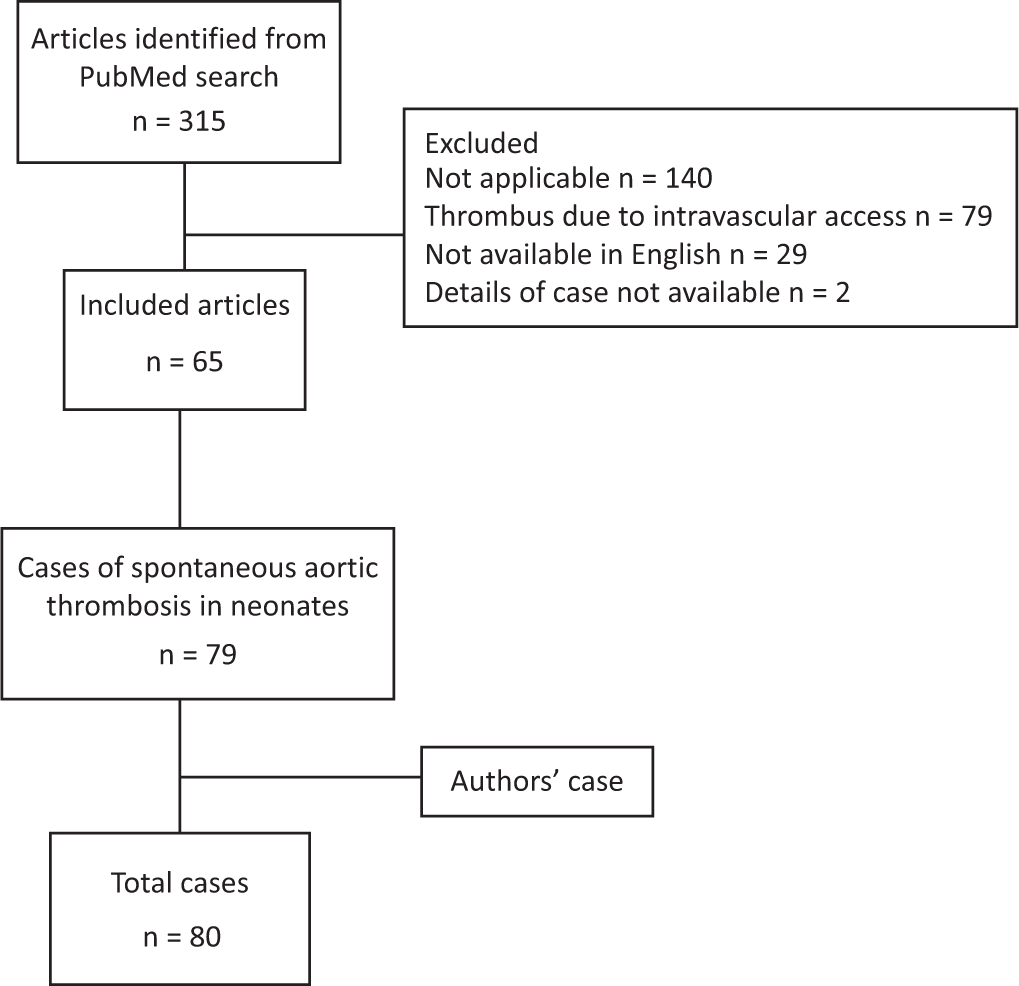
To identify other published cases, an electronic search was performed on PubMed using the following search details: ((“aorta” [MeSH Terms] OR “aorta” [All Fields] OR “aortic” [All Fields]) AND (“thrombosis” [MeSH Terms] OR “thrombosis” [All Fields])) and filtered for age from birth to 1 month. All articles were reviewed for potential inclusion. Articles were excluded if the content was not applicable to aortic thrombosis, the thrombus was due to intravascular procedure or catheter, the article was not available in English, or if the case specifics were not provided. Figure 1 shows the search results and article exclusion. A list of all included articles is supplied in Supplementary material 1.
Search results and excluded articles.

Statistical analysis
For statistical analysis of odds ratio for death, cases diagnosed at autopsy were excluded from the “no treatment” category. The case described in Cook et alReference Cook, Weeks, Brown and Bendon5 in which the aortic thrombosis was thought to be related to external compression from enlarged fetal bladder and was treated with bladder drainage was also excluded. Otherwise, all cases found by the search method described above were included. The treatment categories were no treatment; thrombolytic alone; anticoagulant alone; surgery or catheter-based mechanical removal alone; surgical and anticoagulant; thrombolytic and anticoagulant; and surgical, thrombolytic, and anticoagulant.
Exact logistic regression was used to model the binary outcome of death before hospital discharge using two variables: treatment category and era (1963–1979, 1980–1999, and 2000–present). The primary interest was in the effect of treatment on the outcome, but era was included because it is a potential confounding variable. Due to the relatively small sample size and given the number of treatments being compared, the analysis was not stratified by era but instead was adjusted for its effect as an additional predictor. Likewise, exact logistic regression was used because of the small sample sizes so that reasonable estimates, confidence intervals, and p-values could be obtained.
Results
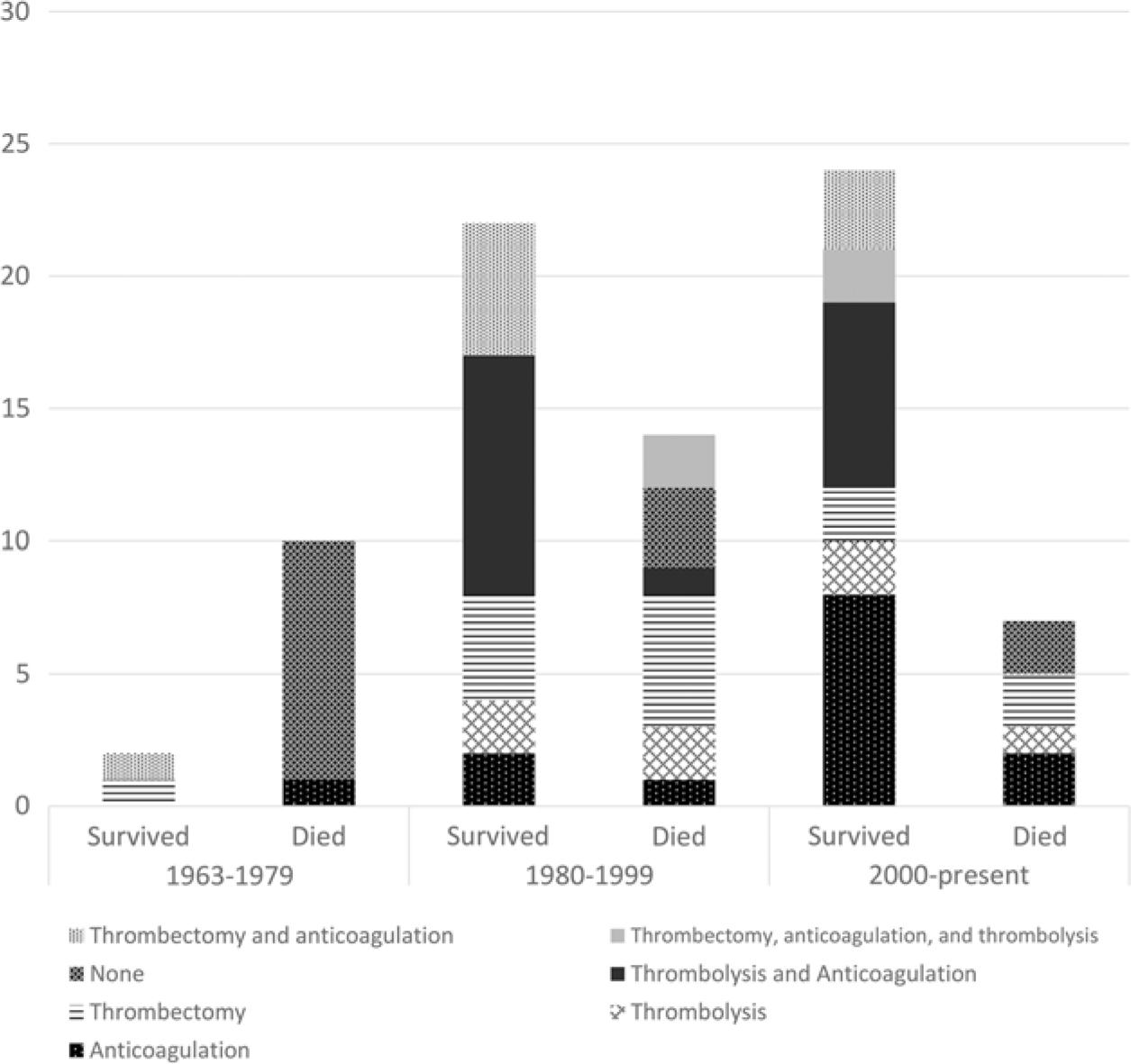
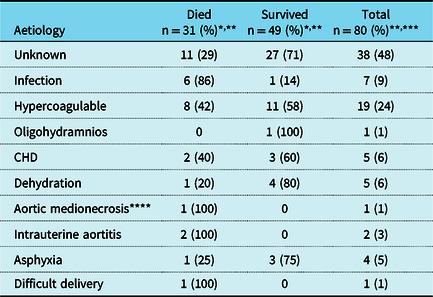
The PubMed search returned 315 articles, of which 65 were included. Including the previously presented case, a total of 80 cases of spontaneous aortic thrombosis were identified and published from 1963 to 2018. The median age of presentation on clot identification was 2 days (interquartile range 0.4–7 days). The overall mortality rate was 39% (n = 31). Mortality by publication era was 1963–1979 = 10 of 12 (83%); 1980–1999 = 14 of 38 (37%); after 2000 = 7 of 30 (23%). Mortality by era and by treatment are displayed in Figure 2. The aetiology of the thrombus (Table 1), as defined by the authors, was unknown in nearly half of the cases (48%). A thrombotic disorder was attributed as a cause in 24% of cases (n = 19). The identified or suspected thrombotic disorders included antithrombin III deficiency (n = 8), heterozygosity for Factor V Leiden (n = 6), protein C deficiency (n = 3), methylene tetrahydrofolate reductase C677T mutation (n = 2), homocystinuria (n = 1), Protein S deficiency (n = 1), antiphospholipid antibodies (n = 1), lupus anticoagulant (n = 1) and a highly suspected but unidentifiable hemostatic disease (n=1). Four patients had more than one identified or suspected thrombotic disorder. Nearly all the patients who had an infection as an attributed aetiology for the thrombus died (6 of 7). Coarctation of the aorta was listed as an aetiology in five cases, two of which died.
Treatment methods and outcomes separated by era (n = 79), excludes one case treated with bladder drainage.Reference Cook, Weeks, Brown and Bendon5

Aetiology of thrombosis as described by author of case.

* Percentages displayed for death and survival are row percentages
** The columns do not add up to 31, 49, or 80 because three cases had more than one primary aetiology listed
*** Percentages displayed for total are column percentages
**** Author of this case posited that “congenital metabolic defect” resulted in pathological findings of aortic medionecrosis with secondary thrombosis
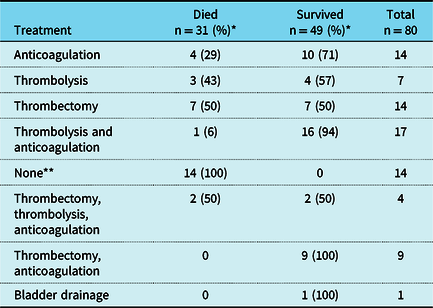
Table 2 illustrates the treatment method and mortality by treatment among all 80 cases. Treatment involved surgical/catheter-based intervention in 27 (34%) cases and thrombolytic therapy in 28 (35%) cases. Anticoagulant therapy alone was used in 14 (18%) cases of which 4 (29%) died. Surgical/catheter-based intervention alone was used in 14 (18%) cases of which 7 (50%) died. Combined thrombolytic and anticoagulant therapy without surgical intervention was used in 17 (21%) cases of which 1 (6%) died.
Treatment method and mortality for all cases.

* Percentages displayed for death and survival are row percentages
** Includes cases diagnosed at autopsy, those in which palliative care only was pursued, or if the patient died before treatment was initiated
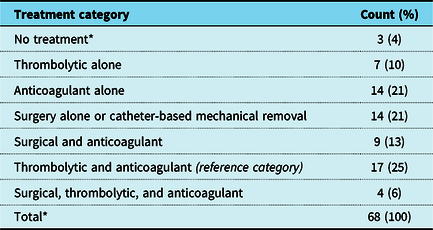
Table 3 shows the 68 cases used in the odds ratio analysis of Table 4. The thrombolysis and anticoagulant group was chosen as the reference category for subsequent analyses because it was the most common treatment category. The reference era is 1980–1999 because it had 50% of the analysis observations (followed by 2000–present with 46% and 1963–1979 with 4%).
Treatment method for cases used in odds ratio analysis.*

* Excludes cases diagnosed at autopsy and one case treated with bladder drainage
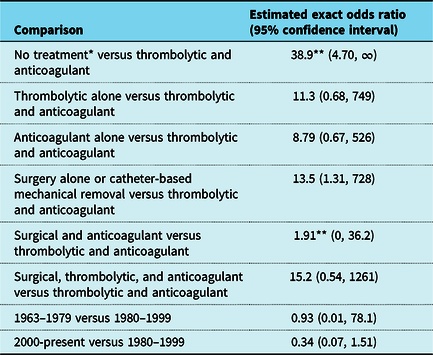
Exact odds ratio estimates and 95% confidence intervals for death before discharge (n = 68).

* Excludes cases diagnosed at autopsy and one case treated with bladder drainage
** Because the observed number of events for one category was on its boundary, the indicated estimated odds ratio is a median-unbiased estimate.
Table 4 shows the odds ratio for survival for each treatment method when compared to the reference category of thrombolysis and anticoagulant. The results for treatment group are adjusted for era, and vice versa. In two instances, the median-unbiased OR estimate was used because the observed number of events in the category was on the boundary (i.e., either all or none of the individuals in the treatment category died). Most of the 95% confidence intervals contain the null value of 1, with two exceptions where the comparator treatment had greater odds of death than the reference group. The OR for no treatment was 38.9 (95% confidence interval 4.70–∞) and the OR for surgery alone was 13.5 (95% confidence interval 1.31–728). No treatment modality had significantly lower odds of death than the reference (thrombolysis and anticoagulation).
The primary outcome analysed was mortality. Among all 80 cases, no complications were reported in 31 of the 49 surviving patients. Complications ranged in severity. One case required extracorporeal membrane oxygenation and a heart transplant. Two needed renal replacement therapy of unknown duration. Cerebral palsy, seizures, and developmental delay were reported in two patients. Other individual cases reported complications such as hypertension, temporary cardiac dysfunction, slight weakness of lower extremity, superficial wound infection, and loss of three toes.
Discussion
Although neonatal aortic thrombosis is rare, it is a medical emergency with a high mortality rate. Previous reviews of the topic have included all cases of neonatal aortic thrombosis, the majority of which are associated with umbilical artery catheterisation,Reference Nagel, Tuckuviene, Paes and Chan4 or limit the review to only neonatal aortic arch thrombosis.Reference Wieland, Jack and Seidemann6 To our knowledge, this is the first comprehensive review of available literature on neonatal spontaneous aortic thrombosis. The aetiology, treatment method, and outcome of neonatal aortic thrombosis have been reviewed.
Aetiology
The aetiology of thrombosis was unknown in nearly half of all cases, while at least one hypercoagulable disorder was identified in 24% of the 80 cases. Other aetiologies identified in more than one case included infection, CHD, dehydration, asphyxia, and intrauterine aortitis. While dehydration and asphyxia were attributed as aetiologies by some others, it is also possible that those could have been symptoms of the thrombi as opposed to purely a cause. For neonates without the risk factor of an umbilical artery catheter, the pathogenesis of aortic thrombosis remains varied and poorly understood.
Contribution of hypercoagulable disorders
Hypercoagulable disorders were found in some cases but in many cases no identifiable risk factor was found. Many of the cases with an unknown aetiology do not mention whether a hypercoagulable workup was performed and in those that included hypercoagulable testing the types of testing varied among cases. Therefore, the actual prevalence of hypercoagulable disorders in neonates with spontaneous aortic thrombosis may be underestimated. Two other factors complicate the assessment of hypercoagulability in this population. First, developmental haemostasis results in physiologically low anticoagulant levels in neonates, which can lead to false-positive results depending on the reference test used.Reference Yang and Chan7 Second, acquired deficiency states can occur with consumption of coagulation proteins at the time of an acute thrombotic event, so testing at the time of thrombosis cannot differentiate between acquired and inherited thrombophilia.Reference Yang and Chan7 The diagnosis of a hypercoagulable disorder changed management in at least two of the cases.Reference Guenthard, Wyler and Nars8,Reference Jasani and Nanavati9 Therefore, a hypercoagulable workup may be necessary for all newborns found to have spontaneous arterial thrombus.
Role of ductus arteriosus
Other literature has posited that the ductus arteriosus could be a possible prothrombotic source.Reference Knowlson and Marsden10,Reference Dworsky, Kohaut, Jander and Ceballos11 Normal closing of the ductus starts with partial closure as expansion of the lungs with inspiration causes a rotation and narrowing of the ductus. The final closure occurs by hypertrophy of the intimal linings and extension of the endothelial cushions.Reference Knowlson and Marsden10 Knowlson et al hypothesised this sequence may be interrupted by a fall in partial pressure of oxygen, leading to inappropriate ductal dilation and possible increased likelihood of thrombosis.Reference Knowlson and Marsden10 In this case series, thrombus was noted in the ductus in 12 cases, with 9 of the cases resulting in death. The young age at time of presentation (median 2 days) noted in this review supports the hypothesis that the prothrombotic nature of the ductus arteriosus may be associated with some of the cases.
Limitations
Although this literature review was comprehensive, there are several limitations. Overall the number of cases of spontaneous neonatal aortic thrombosis is low, and the review is by the information provided by the authors. Due to variations in types of anticoagulation (heparin versus low molecular weight heparin) and thrombolytics (streptokinase, urokinase, versus tissue plasminogen activator) used in reported cases, this review is limited in ability to recommend specific doses or agents.
The combination of thrombolysis and anticoagulation was used as the reference treatment, and no other treatment proved to have statistically significant lower odds of death. Treatment with surgery had an odds ratio for death of 13.5 (95% confidence interval 1.31–728). Overall survival improved with later decades, and surgical intervention alone became less common with time. An attempt was made to control for this possible confounder by adjusting for the effect of era as an additional predictor. However, the high mortality in those treated by surgical removal alone could be due to a selection bias, as those newborns may have appeared more severely ill and thus prompted the decision to pursue thrombectomy. This review is further limited by an inability to determine severity of the cases and analyse for outcome by treatment method and initial severity. The statistical analysis only examined mortality by treatment method and was not equipped to formally examine morbidity associated with neonatal aortic thrombosis or various treatment methods. Most cases did not report complications among surviving cases. However, this may be underestimated due to limited information available in case reports as well as uncertain duration and nature of follow-up.
Management recommendations
One of the aims in this literature review was to examine the evidence for treatment of spontaneous neonatal aortic thrombosis and provide guidance to clinicians caring for such patients. A strict interpretation of these results would favour treatment with thrombolysis and anticoagulation, but this treatment is not universally appropriate as a first management step for all patients. The major risk of systemic thrombolysis is bleeding, especially intraventricular haemorrhage,Reference Will12 and anticoagulation alone may be adequate treatment. Thrombolysis is further complicated in the neonate as the neonatal haemostatic system has relatively low plasminogen levels.Reference Will12 Thrombolytic agents work by converting endogenous plasminogen to plasmin, which then cleaves fibrinogen and additional plasma proteins and clotting factors.Reference Nagel, Tuckuviene, Paes and Chan4, Reference Will12 Many regimens for tissue plasminogen activator include supplementation of plasminogen via infusions of fresh frozen plasma. Unfortunately, there are no reliable lab tests to monitor the therapeutic level of thrombolytics.Reference Will12 Given these risks, the management strategy as outlined by Nagel et alReference Nagel, Tuckuviene, Paes and Chan4 is recommended and described below.
Previous reviews of neonatal aortic thrombosis have included management recommendations.Reference Nagel, Tuckuviene, Paes and Chan4 These recommendations were based on both spontaneous and catheter-associated thrombosis, but the general approach is likely valid for spontaneous aortic thrombosis as well. Once the diagnosis of thrombosis has been made, Nagel et al recommend triaging thrombosis by severity level to determine the most appropriate initial treatment.Reference Nagel, Tuckuviene, Paes and Chan4 Minor thromboses are defined by decreased femoral pulses and/or systemic hypertension but no other signs of decreased perfusion or heart failure. Moderate thromboses are defined by absent femoral pulses, peripheral ischemia as evidenced by cool, pale, or mottled extremities and poor capillary refill and/or systemic signs of congestive heart failure.Reference Nagel, Tuckuviene, Paes and Chan4 Major thromboses are defined by severe limb-threatening ischemia as evidenced by tissue loss, paralysis, or gangrene and/or systemic signs of renal failure, sepsis, end-organ damage, or acidosis.Reference Nagel, Tuckuviene, Paes and Chan4
For minor thromboses, Nagel et al recommend supportive care and antihypertensives as needed.Reference Nagel, Tuckuviene, Paes and Chan4 Moderate thromboses should be addressed first with anticoagulation with heparin in the absence of contraindications such as active bleeding or recent intraventricular haemorrhage. For major thromboses, initial management should be with tissue plasminogen activator or other thrombolytic therapy unless a contraindication exists, in which case surgical thrombectomy should be performed.Reference Nagel, Tuckuviene, Paes and Chan4
The case patient described above was treated in a manner consistent with the above recommendations. Of note, this patient developed a contraindication to thrombolysis and anticoagulation (grade III intraventricular haemorrhage) but did not undergo surgical intervention. This patient still improved, presumably due to ongoing therapeutic effect of previous treatment with thrombolysis and anticoagulation.
In conclusion, overall mortality for spontaneous aortic thrombosis is high but improving with time (83% from 1963–1979 to 23% from 2000). It is unclear whether this improvement is due to better treatment options, diagnostic methods, and/or improvements in supportive care. Diagnosis can be challenging due to the spectrum in severity of presentation, and aortic thrombosis may not be considered in neonates without the risk factor of an umbilical artery catheter. Although rare, spontaneous aortic thrombosis should be considered for neonates presenting with symptoms suggestive of coarctation of the aorta or unexplained deterioration once more common causes have been ruled out. If diagnosis is made, a hypercoagulable workup is recommended. Treatment options include anticoagulation, thrombolysis, and surgical/catheter-based removal and should be tailored to each patient based on severity of illness. Additional research of neonatal aortic thromboses with increased numbers of patients across multiple sites can help strengthen the evidence for the optimal treatment for neonates with this rare occurrence.
Supplementary material
To view supplementary material for this article, please visit https://doi.org/10.1017/S1047951119003093
Acknowledgements
None.
Financial Support
This research received no specific grant from any funding agency, commercial or not-for-profit sectors.
Conflicts of Interest
None.