Hearts with common arterial trunk belong to a family of congenital cardiac malformations in which there is one arterial trunk exiting the heart, in the absence of any atretic remnant of the aorta or pulmonary trunk. The solitary trunk should supply branches directly to the coronary, pulmonary, and systemic circulations. Reference Russell, Jacobs and Anderson1 Functionally univentricular hearts refer to a group of patients with congenital cardiac malformations who have in common that they usually require palliation with procedures that acknowledge the fact that biventricular surgical repair is not possible. Reference Wilkinson and Anderson2
The association of univentricular hearts with common arterial trunk is extremely rare. There is a lack of population-based outcome studies reported in the literature. In this series, we report our experience with six cases over a period of 30 years, highlighting the scarcity of this anatomic co-existence.
Decision-making in such rare lesions is difficult and challenging. The presented case series should add to the limited literature available and may help to aid in future counselling and management.
Materials and methods
This is a single-centre retrospective review of the outcome of all cases presenting with univentricular hearts and common arterial trunk to our institution over a 30-year period (1990–2020). The hospital records including case notes, echocardiographic and other imaging modality data such as computed tomography scans, outpatients' records, operation notes and other electronic data were reviewed. Patient characteristics, primary and associated cardiac lesions as well as the need for surgical and/or transcatheter intervention and the final outcome of these interventions were observed.
Results
Patients’ characteristics
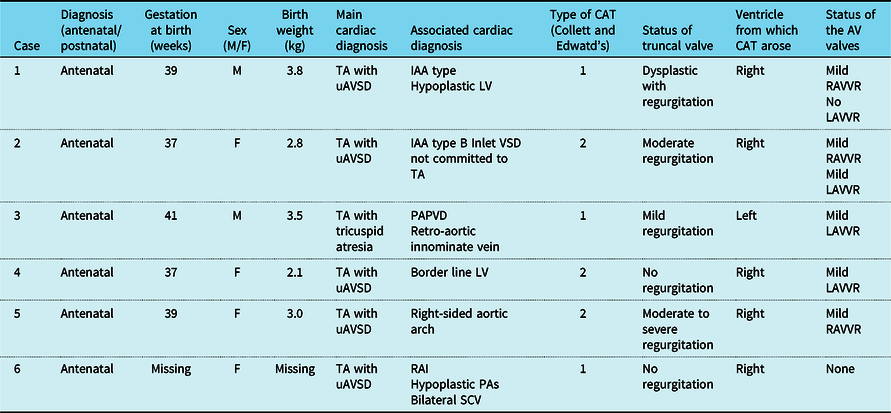
Six patients with univentricular hearts and the common arterial trunk presented over a 30-year period. Patients’ characteristics including gestational age, birth weight, and sex are demonstrated in Table 1. All patients had antenatal diagnosis and all were born at term (gestational age 37 + 0 – 41 + 6, median 38 + 4 weeks). Median birth weight was 3.04 (2.1–3.8) kg. Two patients were males, and four were females.
Patient’s characteristics and cardiac diagnosis
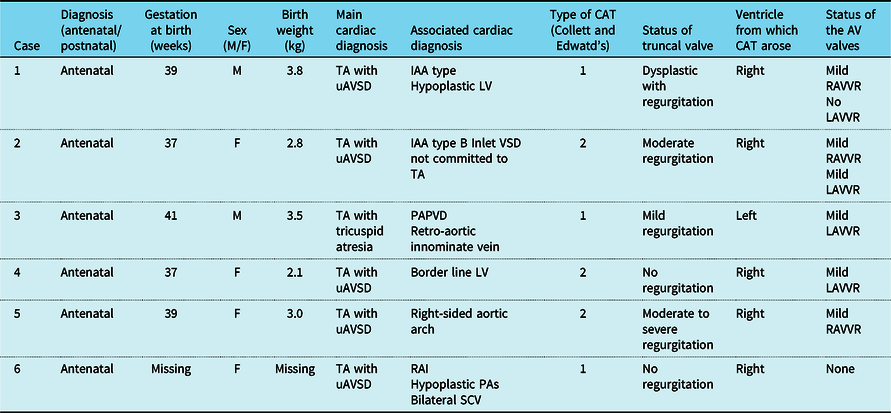
TA = Tricuspid atresia, IAA = inturrupted aortic arch, LV = left ventricle, VSD = ventricular septal defect, PAPVD = partial anomalous pulmonary venous drainage, SCV = superior caval vein, RAVVR = right atrio ventricular valve regurgitation, LAVVR = left atrio ventricular valve regurgitation, CAT = common arterial trunk, CC = cardiac catheterization, RV-PA = right ventricle to pulmonary artery, TCPC = total cavo pulmonary connection, uAVSD = unbalanced atrioventricular septal defect.
Cardiac anatomy
Table 1 also shows the primary cardiac diagnosis and the other associated cardiac lesions.
Out of the six, five patients had complete unbalanced atrioventricular septal defect (83%) with right ventricular dominance and one (17%) had tricuspid atresia with left ventricular dominance. The Collett and Edwards classification Reference Collett and Edwards3 was used to classify common arterial trunk. Three patients had Collett and Edwards’s type 1 and 3 had type 2. Varieties of associated cardiac lesions were also noted along with the primary cardiac diagnosis of univentricular heart and common arterial trunk. These included interrupted aortic arch type B, ventricular septal defect, partial anomalous pulmonary venous drainage, right-sided aortic arch, right atrial isomerism, hypoplastic pulmonary arteries, and bilateral superior caval veins. The severity of truncal valve regurgitation was assessed and categorised as mild, moderate, and severe. Five patients had either mild or moderate truncal valve regurgitation. One had severe truncal valve regurgitation and, after detailed discussions and counselling, was excluded from surgical or catheter intervention. The degree of atrioventricular valve regurgitation was either absent or mild regurgitation in all patients.
Non-cardiac diagnosis
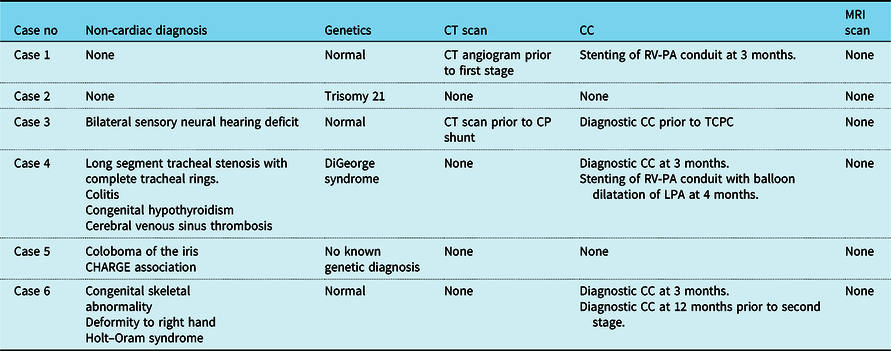
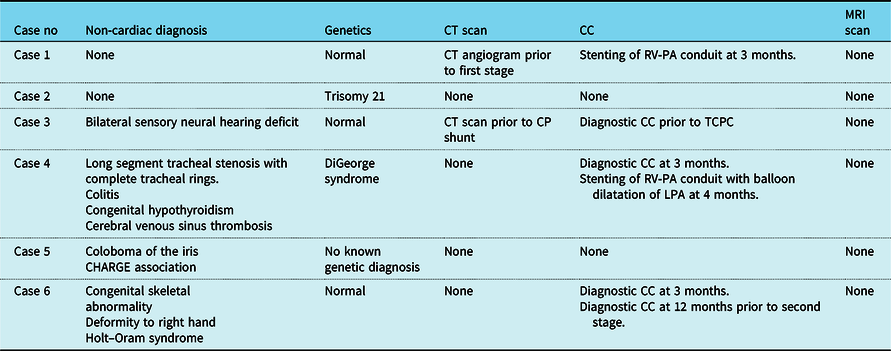
There were non-cardiac diagnoses associated with four out of the six patients (Table 2). These included bilateral sensory neural hearing deficit, long segment tracheal stenosis with complete tracheal rings, colitis, congenital hypothyroidism, cerebral venous sinus thrombosis, coloboma of the iris, CHARGE association (coloboma, heart defects, atresia choanae (also known as choanal atresia), growth retardation, genital abnormalities, and ear abnormalities), congenital skeletal abnormality, deformity to right hand, and Holt–Oram syndrome. Two out of the six patients had a confirmed genetic diagnosis. One patient had Down’s syndrome and the other had DiGeorge syndrome. Diagnostic cardiac catheterisation and computed tomography scans were performed in selected patients. This was either to help establishing the primary diagnosis, for follow-up, or for assessment prior to the next stage of surgical intervention.
Non-cardiac diagnosis, genetics, and pre-operative investigations
Interventions and outcomes
Upon presentation and after detailed imaging and general paediatric workup cases were discussed in a multidisciplinary team meeting.
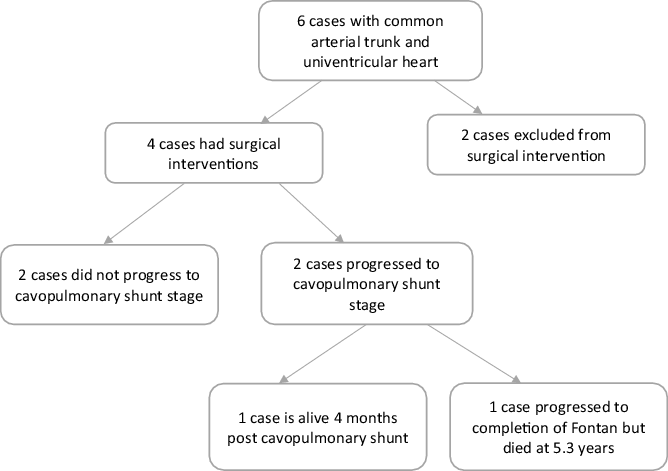
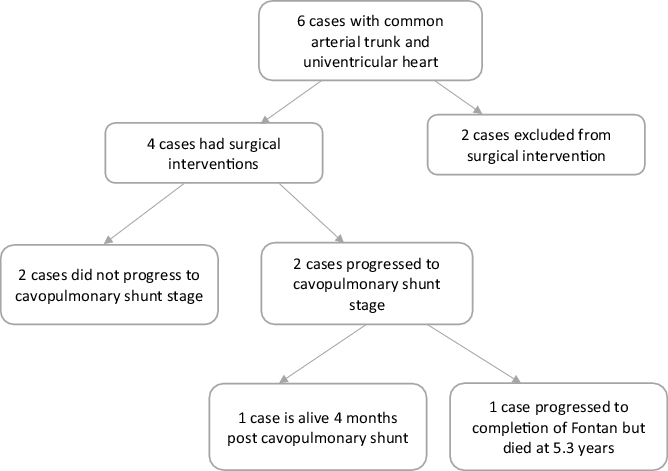
Two cases (33%) (cases 2 and 5) were excluded from initial surgical palliation due to Trisomy 21 in one (case 2) and severe truncal valve regurgitation in one (case 5), (Fig 1).
Cases breakdown.
The first was discharged to palliative care on day 2 of life with advanced care plan. They sadly passed away aged 3 weeks. The later was discussed with another institution for second opinion in view of the sever truncal valve regurgitation. Both centres agreed that intervention is not at best interest of the patient. They were left to rest in peace aged 4 weeks.
Initial surgical palliation was performed in four cases (67%) at median of 31 days (2–60) and consisted of disconnection and reconstruction of the pulmonary arteries and establishing controlled pulmonary blood flow. These interventions were in the form of: 1) modified Norwood stage 1 with 5 mm right ventricle-to-pulmonary artery conduit, 2) pulmonary artery disconnection, 3.5-mm modified Ballalock–Taussing shunt and atrial septectomy, 3) reconstruction of central pulmonary arteries with a pulmonary homograft patch and 5-mm Gortex right ventricle-to-pulmonary artery conduit, and 4) banding of the pulmonary artery origin. There were no early deaths.
Conversion to a cavopulmonary shunt was not possible in two patients (cases 4 and 6). The first patient (case 4) had severe airway problems in the form of long segment tracheal stenosis with complete tracheal rings needing multiple interventions including slide tracheostomy. Airway problems lead to raised pulmonary arterial pressures, precluding progression to cavopulmonary shunt. The patient died aged 11 months. The second patient (case 6) had unsuitable pulmonary artery anatomy to proceed for cavopulmonary shunt following pulmonary artery band. They had detachment of pulmonary arteriess from the main common arterial trunk with reconstruction of both pulmonary arteries and attempted formation of bilateral cavopulmonary shunts at 14 months of age. However, 3 days later, this was complicated by the need for emergency patch augmentation of the main pulmonary artery and right lower lobe branch. The patient then deteriorated with bilateral pleural effusions and need for long-term ventilation and ICU support. There was evidence of superior caval vein pathway obstruction on haemodynamic study. This was confirmed intraoperatively, and there was intraluminal thrombus lying in the pathway between the left and right superior caval vein behind the aorta with consecutive thrombus in both left lower and right lower lobe vessels. The superior caval vein themselves were wide open. There was no evidence of any external obstruction or compression with the whole obstruction seemed to be within the lumens. The patient had disobliteration of superior caval vein pathway, repatching of the pathway and extension of the aorta by aortic homograft tube. This patient sadly died on table aged 16 months, 8 weeks after attempting cavopulmonary shunt.
Two patients (33%) underwent successful cavopulmonary shunt. The first one (17%) (case 1) had common arterial trunk with unbalanced atrioventricular septal defect and first intervention was in form of a modified Norwood procedure with 5-mm right ventricle to pulmonary artery conduit at 7 days of age. This was followed by stenting of the conduit at 3 months of age due to low oxygen saturations. The patient proceeded to cavopulmonary shunt at the age of 6 months. They are currently doing well, aged 18 months. The second patient (case 3) who reached the stage of cavopulmonary shunt proceeded to Fontan completion at 2.3 years. They had common arterial trunk with tricuspid atresia. They also had anomalous drainage of left upper pulmonary vein to innominate vein which had retroaortic course. Their first intervention was in the form of pulmonary artery disconnection, 3.5-mm modified Ballalock–Taussing shunt and atrial septectomy. They then underwent cavopulmonary shunt at 5 months followed by completion of Fontan circulation at an early age (19 months) due to progressive desaturation in the context of severe pulmonary arteriovenous fistulae. Following Fontan completion, he suffered from prolonged chylothorax and required stenting of the Fontan fenestration. Nonetheless, further deterioration ensued with prolonged respiratory wean and acute renal failure. At 3 months after the Fontan operation, he underwent transcatheter take down of Fontan. He was stabilised on chronic peritoneal dialysis at home. He was considered for heart and kidney transplant. He passed away at 5 years, 4 months of age (3.5 years after Fontan take down).
Discussion
The accepted treatment of first choice in children born with univentricular heart physiology is initial palliation, followed by a staged Fontan procedure. Reference de Leval and Deanfield4 The option of palliative comfort care is often considered if there are significant co-morbidities or associated cardiac defects. Common arterial trunk is rarely found in hearts with functionally univentricular heart.
To date, limited surgical successes for surgical palliation for common arterial trunk when associated with univentricular heart have been described in a number of case reports. Reference Tripathi, Sridhar and Chidambaram5–Reference He, Olivieri, Jonas and Sinha8 To the best of our knowledge, the first successful univentricular palliation for patient with univentricular heart with common arterial trunk was reported by Shaddy and McGoouh in 1989. Reference Shaddy and McGough9 This was a baby with common arterial trunk and double-inlet left ventricle. Recently, Fujimoto and colleagues successfully palliated a neonate with common arterial trunk with hypoplastic tricuspid valve and right ventricle with anomalous left coronary artery orifice in a two-staged procedure. Reference Fujimoto, Tachi, Suehiro, Ito and Oda10
Decision for surgical intervention was difficult and, in most of occasions, brought high level of debate in the joint cardiology and cardiothoracic conference. This is due to the rarity of the lesions and the guarded prognosis.
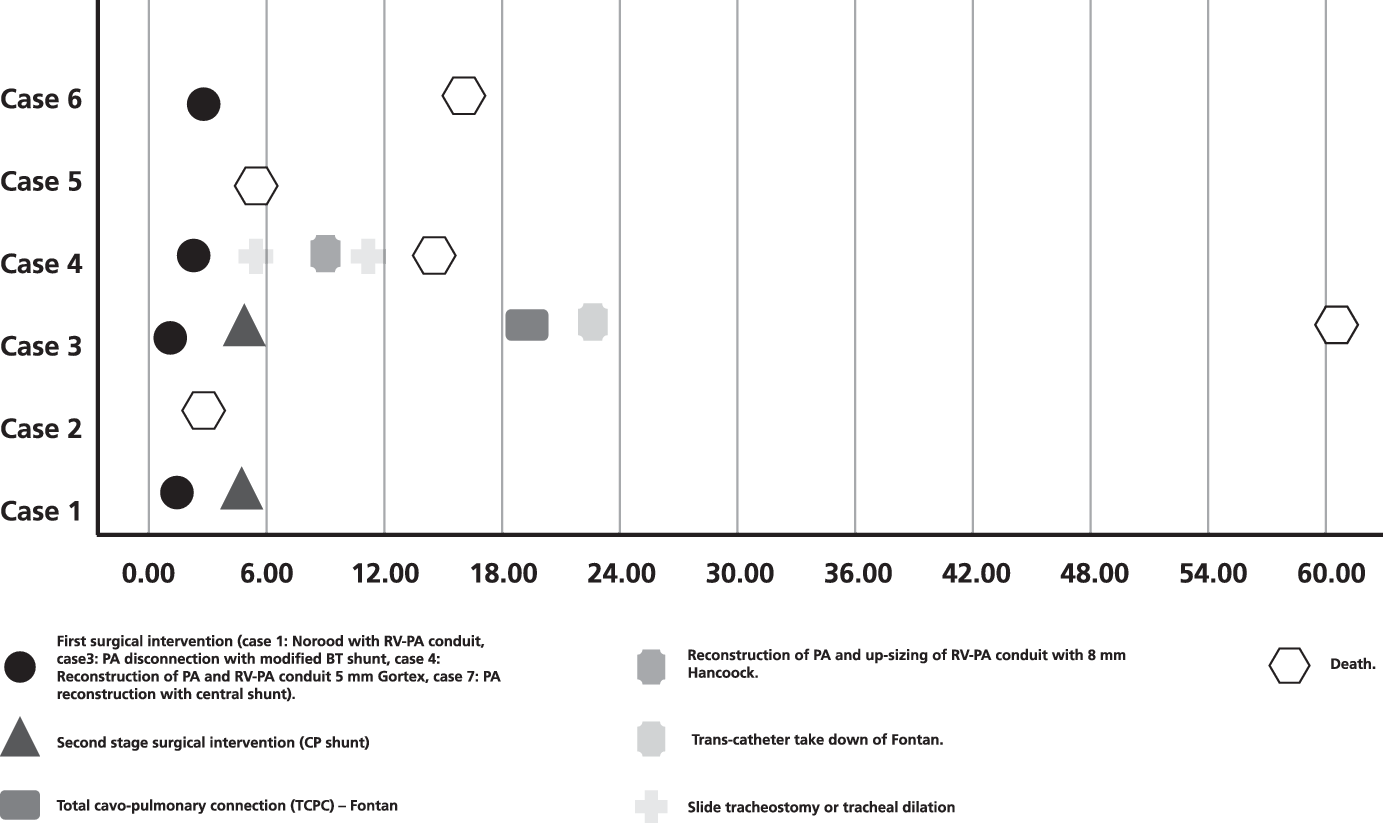
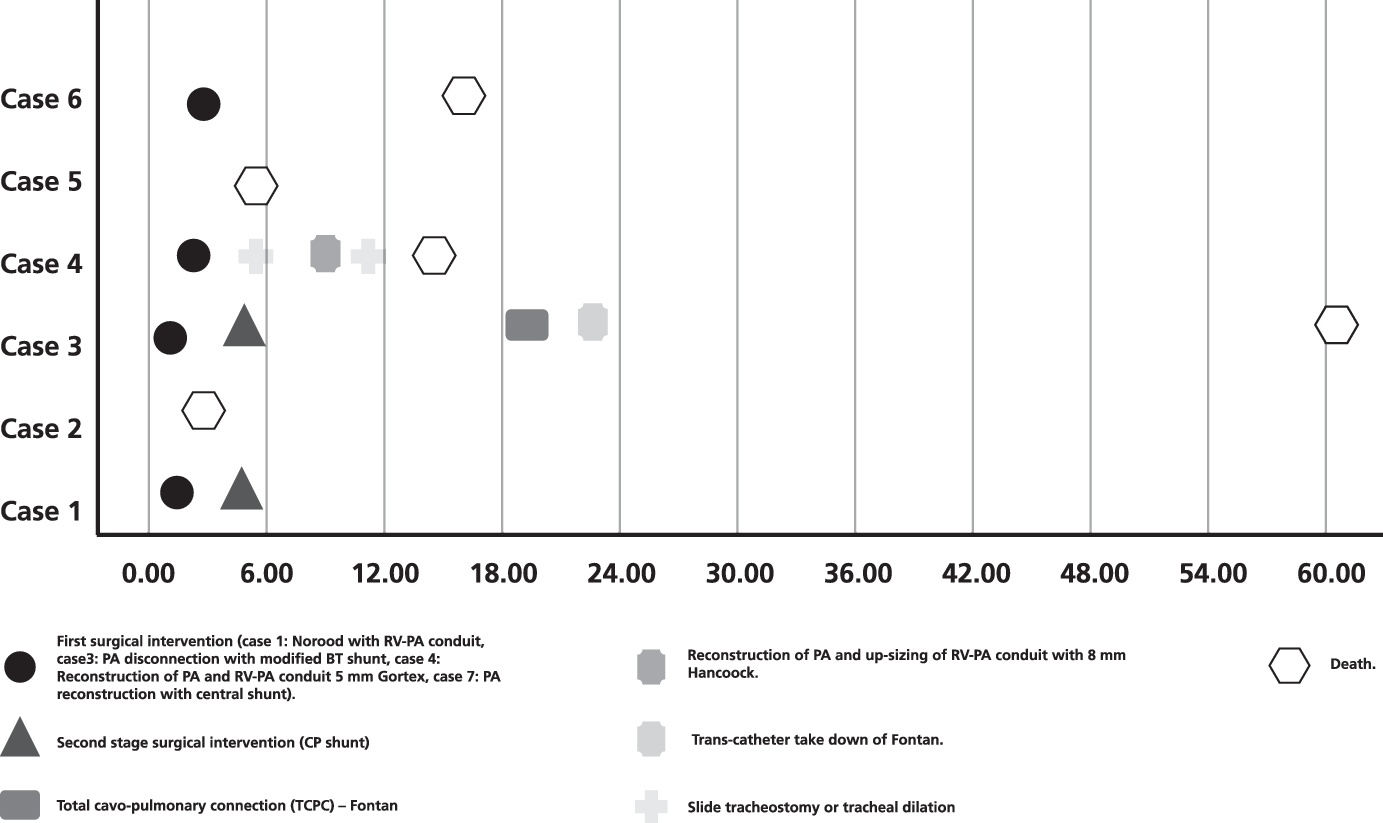
The course of surgical or transcatheter intervention depended on the anatomy and the associated diagnosis (Fig 2).
Timeline for interventions/deaths.
In our series, two out of the six patients were excluded from surgical intervention due to either genetic diagnosis (Trisomy 21) or severe truncal valve regurgitation making surgical intervention not possible.
This shows that major genetic syndrome and/or severe heart valve insufficiency are both too risky combinations to offer patients with common arterial trunk and univentricular heart of any type of surgical intervention. It is worth mentioning that there were no early deaths in those who had surgical intervention in our series.
Most of the cases in our series are in the form of unbalanced atrioventricular septal defect associated with common arterial trunk except one, which was common arterial trunk with tricuspid atresia. We did not have the other forms of single-ventricle anatomy such as double-inlet left ventricle. Regardless of the single-ventricle anatomy associated with common arterial trunk, the surgical outcome has more or less remained the same.
The particular association of common arterial trunk and unbalanced atrioventricular septal defect was successfully palliated to the single-ventricle pathway in three previously reported cases. Two of them were by Panwar and colleagues, Reference Panwar, Bradley and Kavarana11 whereas the third one was described in the cases series by He et al. Cases of common arterial trunk and unbalanced atrioventricular septal defect were the most common combination of cardiac anatomy in our series with five out of the six cases being this particular anatomy. Two out of those five were not suitable for surgical intervention due to previously mentioned reasons. The other three progressed for surgical intervention with one being alive at 10 months, 4 months post-cavopulmonary shunt. The other two who had truncus and unbalanced atrioventricular septal defect had not progressed post-initial surgical intervention and did not reach cavopulmonary shunt stage due to unsuitable pulmonary artery anatomy in one and sever airway complications as explained in the result above.
The only case of our series of who progressed to Fontan stage so far was a case of common arterial trunk with tricuspid atresia who went to have early Fontan at 19 months of age due to progressive desaturations. These was then complicated by chylothorax, prolonged chest drainage, renal failure, and prolonged respiratory wean leading to multiple admissions to ICU. This patient eventually passed away at just over 5 years of age.
In addition to multiorgan morbidity and mortality of patients with the common arterial trunk and univentricular heart, there is low incidence and a poor understanding of these lesions. Also, the surgical success for this combination is limited and with this dismal outcome, comfort care should, therefore, be the commonest option.
Conclusion
Univentricular hearts with common arterial trunk carry extremely poor short- to medium-term outcomes. Surgical repair is not possible in many occasions. Even in those whom surgery was attempted, progression to completion of Fontan circulation was not achieved, or complications leading to death occur in medium term. In our centre’s 30 years’ experience, only one patient (17%) is alive so far. They are only 10 months of age, 4 months post-cavopulmonary shunt. Although this patient had a smooth outcome thus far, the long-term prognosis remained guarded.
This dismal outcome of such a rare combination of cardiac lesions should be considered during antenatal and postnatal counselling to help decision-making. Comfort care should be considered as an option that is at best interest of patient and family.
Acknowledgements
The authors acknowledge that this is a retrospective study with a small size of the cohort. The authors also highlight that the only survivor so far is about 16 months of age. Although they are doing well thus far, the overall outcome still remains guarded. Larger multi-centre studies will throw more light onto this rare, challenging type of CHDs.
Financial support
The authors received no specific grant from any funding agency, commercial, or not-for-profit sectors.
Conflicts of interest
None.
Ethical standards
The study was classified and registered as service evaluation following assessment using the UK NHS research governance assessment tool (https://www.hra-decisiontools.org.uk/research/). The study was then reviewed by the Research Governance department at our institution and deemed to not require ethical approval. Due to the long time span of the study and the retrospective nature, patients’ consents have been waived.