In Latin America, it is difficult to win approval for policies that allow induced abortion and same-sex marriage. Social movements face more obstacles in promoting these policies than in promoting other gender and LGBTQ policies because abortion and same-sex marriage are particularly contentious issues. These policies involve doctrinal or countercultural topics, and supporters of these legislative changes must confront groups that mobilize to block these reform efforts (Blofield Reference Blofield2006; Corrales Reference Corrales2015; Díez Reference Díez2015; Friedman Reference Friedman2019; Grzymała-Busse Reference Grzymała-Busse2015; Htun Reference Htun2003). Yet in the period following democratic transitions, some Latin American countries successfully liberalized their legislation concerning abortion and marriage equality.
The most far-reaching legal reforms at the national level can be seen in just two countries: Uruguay passed a law that legalized abortion upon request (2012), while both Uruguay (2013) and Argentina (2009) recognized same-sex marriage. Chile (2017) passed a law that provides minimal protection by decriminalizing abortion for three specific reasons: when a pregnancy puts a woman's life at risk, fetal malformation, and rape. In Colombia (2007), Argentina (in the so-called FAL ruling, 2012), and Brazil (2012), supreme court decisions clarified the specific circumstances under which abortion is legal (Cook, Erdman, and Dickens Reference Cook, Erdman and Dickens2014). Brazil (2013) and Colombia (2016) enacted judicial resolutions establishing that notaries could no longer refuse to register same-sex couples seeking to marry (ILGA World Reference World2019). Nevertheless, access to rights depends not only on whether the legal reforms take place but also on how the laws or judicial decisions are implemented. In Latin America, in the postreform stage, reactions against recently adopted policies legalizing abortion and same-sex marriage have inhibited individuals’ access to these new rights.
Research concerning legal abortion and marriage equality has focused on analyzing the conditions that were conducive to enacting reforms (for Latin America, see Blofield Reference Blofield2006; Blofield and Ewig Reference Blofield and Ewig2017; Corrales Reference Corrales2015; Díez Reference Díez2015; Htun Reference Htun2003; Friedman Reference Friedman2019; Pierceson, Piatti-Crocker, and Schulenberg Reference Pierceson, Piatti-Crocker and Schulenberg2013). However, the politics of the postreform stage—what happens after the reforms are adopted—has been undertheorized, and empirical studies about the subject are not sufficiently systematic (Ayoub Reference Ayoub2014; Ball Reference Ball2016; Corrales Reference Corrales2015; Dickens Reference Dickens, Cook, Erdman and Dickens2014; Haider-Markel and Taylor Reference Haider-Markel, Taylor and Ball2016; Johnson, Rodríguez Gustá, and Sempol Reference Johnson, Rodríguez Gustá, Sempol and Friedman2019; Mansbridge and Shames Reference Mansbridge and Shames2008; Wilson Reference Wilson2016).
We argue that researchers must consider the postreform stage to better understand the conservative backlash against these policies and how citizens effectively access rights. In this essay, we outline a research agenda centered on “the day after” legal reforms. To do so, we build on recent work and illustrative evidence (press, documents of the social movements, and interviews with their members) from Argentina, Chile, and Uruguay to construct a typology of backlash against legal abortion and equal marriage policies. This article represents a first step toward the systematic study of the postreform stage of these particular policies.
THE CHALLENGES OF THE DAY AFTER
All public policies face challenges right after adoption and during implementation. In the postreform stage, laws can be reversed, policies can be modified to depart from their original objectives, or their implementation may be blocked (Jann and Wegrich Reference Jann, Wegrich, Fischer, Miller and Sidney2007; Moe Reference Moe, Edwards, Kessel and Rockman1993). Although this is a feature applicable to any postreform process, it is particularly visible for reforms that target doctrinal or contentious issues such as legal abortion and same-sex marriage.
In the postreform period, a new politics arises around these policies. On the one hand, the sites of struggle as well as the significant actors can change. The executive branch acquires predominance in the implementation of the law, while the bureaucrats constituting the last link in the implementation process may acquire more relevance than elected politicians (Moe Reference Moe, Edwards, Kessel and Rockman1993; Jann and Wegrich Reference Jann, Wegrich, Fischer, Miller and Sidney2007). Sometimes these actors will oppose decisions they are supposed to implement and thus block their execution (Haider-Markel and Taylor Reference Haider-Markel, Taylor and Ball2016). At other times, they ignore the prescribed procedures or do not have the capacity (resources, training, etc.) to implement the new legislative decisions correctly (Corrales Reference Corrales2015). Meanwhile, conservative social actors (i.e., the religious organizations or pro-life groups) acquire a new role as protagonists. Actors who failed to prevent adoption of the reforms redirect their efforts to the postadoption phase. Political losers “learn and recoup” (Corrales Reference Corrales2015, 56) and reorganize their strategies to reverse the reforms or block their implementation (Ball Reference Ball2016; Wilson Reference Wilson2016).
Also, the coalitions that promoted the reforms do not necessarily remain intact “the day after” the reforms. Historically, feminist and LGBTQ organizations in Latin America have specialized in agenda-setting activities, lobbying, and strategic litigation to achieve new rights (Blofield Reference Blofield2006; Corrales Reference Corrales2015; Díez Reference Díez2015; Fernandez Anderson Reference Fernandez Anderson2017). However, they are often less prepared to deal with the ensuing backlash and less trained to monitor the implementation of the new policies (Ball Reference Ball2016; Haider-Markel and Taylor Reference Haider-Markel, Taylor and Ball2016). Thus, pro-rights actors may lose power in the postreform phase vis-à-vis conservative actors. As a way of contributing to this discussion, in the following section, we present a typology that describes the different ways in which backlash occurs in the cases of legal abortion and same-sex marriage policies in Latin America.
CONCEPTUALIZING THE POSTREFORM STAGE
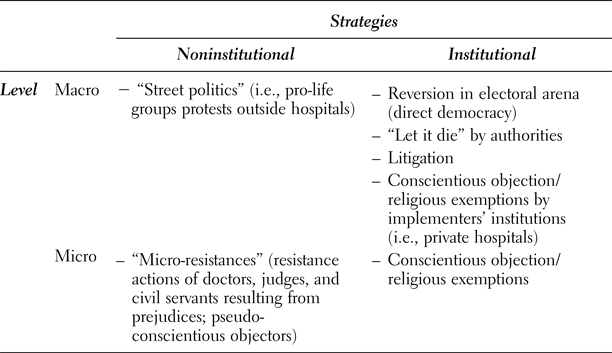
The backlash against feminist and LGBTQ agendas usually involves actions carried out by individuals, groups, or organizations that seek to undermine rights. Backlash may occur in the form of reactions during the postreform phase aimed at totally or partially reverting the status quo. We argue that backlash against legal abortion and equal marriage policies can be better understood if two dimensions of the concept are considered: the level at which the reaction occurs and the actors’ strategies.
Actors can operate at the macro or micro level. At the macro level, actors are groups or organizations who operate at a systemic—municipal, regional, national—scale. At the micro level, actors are individuals who aim to obstruct policies in face-to-face relationships. Actors’ strategies can be institutional or noninstitutional. Strategies are institutional when actors use formal channels (judicial, legislative, executive, administrative) to express their opposition to new policies. Noninstitutional strategies are informal and sometimes contentious. Table 1 shows the typology that results from considering both dimensions and lays out some possible instances that fit with each of the types.
Typology of backlash against abortion and same-sex marriage policies in the postreform stage
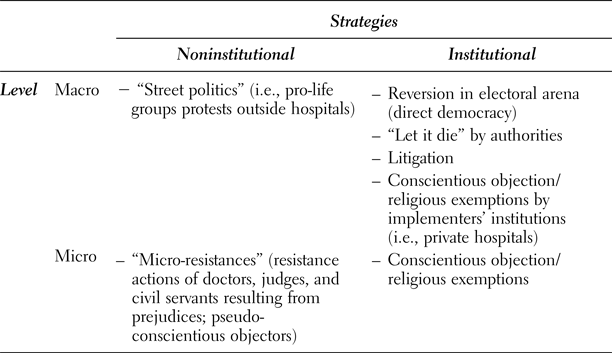
In the noninstitutional macro-level cell, the main actors are social organizations, such as religious organizations and pro-life groups. In the case of legal abortion, usual “street politics” practices include protests outside hospitals to prevent women from accessing abortion and to put pressure on doctors (Wilson Reference Wilson2016). In Argentina, for example, after the FAL ruling, this type of protest has been used to prevent abortions, especially in conservative provinces (Gebruers and Gherardi Reference Gebruers and Gherardi2015).Footnote 1
Examples of noninstitutional micro-level backlash include micro-resistances by actors who operate in the final stages of the policy implementation process (e.g., doctors, judges, or civil servants). These resistance actions involve brief and commonplace daily verbal, behavioral, or environmental hostilities, intentional or unintentional, resulting from prejudices and conservative attitudes toward members of minorities (Nadal et al. Reference Nadal, Issa, Leon, Meterko, Wideman and Wong2011, 235). In Uruguay, for instance, social activists determined that officials of the Civil Registry systematically asked same-sex couples seeking a marriage license more questions (i.e., whether they plan to have children or the order of surnames they would choose if they had children) than they asked heterosexual couples. However, these interview procedures are not established in the existing legislation (personal interview with LGBTQ activist).Footnote 2
Another type of backlash arises from “pseudo-conscientious objectors” in cases of legal abortion. Pseudo-conscientious objectors are doctors who do not formally declare an objection to abortion but refuse to perform the procedure (MYSU 2017). Also, conservative functionaries may deliberately misinterpret the law as a way to hamper access to rights. In Uruguay, for instance, some judges initially used “gray areas” of the Equal Marriage Law to deny adoption requests from same-sex couples (Sempol Reference Sempol2013).
In the institutional macro-level cell, the main actors are political parties, executive and administrative authorities, judicial bodies, medical corporations, and conservative social organizations. They use available formal channels to promote policy setbacks. For instance, in Uruguay, center-right parties, along with pro-life groups and the Catholic Church, tried to repeal, by referendum, the law that decriminalized abortion (Johnson, Rodríguez Gustá, and Sempol Reference Johnson, Rodríguez Gustá, Sempol and Friedman2019).
In Chile, right-wing parties, supported by conservative social organizations, went to the Constitutional Court during the second government of Michelle Bachelet (2014–18) to overturn the law that decriminalized abortion. The Constitutional Court refused to declare the law unconstitutional, but it granted Catholic University of Chile “institutional conscientious objector” status. This status, which the university authorities had sought, allowed this institution to refuse to terminate pregnancies in its hospitals. Previously, Congress had chosen to exclude institutional conscientious objection from the law (Pérez Bentancur Reference Pérez Bentancur2019).
In other cases, executive and administrative authorities “let the policy die” during the implementation phase. Failing to adjust procedures and administrative instruments to the new policy requirements (because of lack of state capacity or political will to update them) is an instance of this type of barrier. For example, in Argentina, lesbian couples faced difficulties registering their children. While the Equal Marriage Law states that birth certificates should record the birth mother and her female spouse both as mothers (Article 36), the Buenos Aires City Civil Registry listed the nonbirth mother only as a spouse, not as a mother. Resistance to updating the procedure came both from the lack of political will on the part of a subnational government opposed to the reform and from cultural bias among members of the civil service (Red Nacional de Familias LGTB con Hijos e Hijas and 100% Diversidad y Derechos 2015). Meanwhile, in Uruguay, the passage of the Equal Marriage Law did not result in the immediate modification of forms and administrative registries, which continued to assume that all couples and parents are heterosexual. Thus, a mother in a same-sex marriage would be listed on the birth certificate as the “father” of her child or would receive “paternal” leave instead of maternal leave.Footnote 3
Finally, a well-known example of an institutional micro-level obstruction is the systematic use of conscientious objection and religious exemptions by individuals who opt out of participating in the implementation (Haider-Markel and Taylor Reference Haider-Markel, Taylor and Ball2016) when these legal options are available in the country.Footnote 4 Although the laws assume that conscientious objection occurs only in exceptional cases, in Uruguay and Chile doctors have systematically used it to refuse to perform abortions (MYSU 2017).Footnote 5 In Uruguay, the use of conscientious objection has restricted access to abortion procedures, especially for women living in impoverished regions, far from the big cities (MYSU 2017).
AFTER REFORMS: A RESEARCH AGENDA
In this essay, we argue that what happens during the postreform stage is critical to guaranteeing rights pertaining to legal abortion and same-sex marriage. However, very little is known about what happens “the day after” the decisions take place. As a contribution to this debate, we propose a descriptive typology (Collier, LaPorte, and Seawright Reference Collier, LaPorte and Seawright2012) of backlashes against legal abortion and same-sex marriage policies. We intend this typology to be a first step toward an explanatory approach to this issue in Latin America.
Future research on this matter should address other supplementary questions: Under what circumstances will conservative actors choose a particular one of these strategies/levels of intervention to block implementation or to create setbacks for these policies? What are the political and institutional conditions that enhance the ability of conservative actors to block access to rights? What variables increase the capacity of feminist and LGTB movements to monitor the implementation of legal abortion and marriage equality policies? When do progressive actors succeed at neutralizing reversal attempts carried out by conservative actors? Further research should also analyze how these different types of reactions affect access to rights. Preliminarily, it seems that while macro-level reactions (especially institutional backlash) affect rights in general, reactions at the micro level are selective. The latter have greater effect on those who live in poor and conservative regions and on individuals who cannot oppose public officials’ arbitrariness.
Finally, much of the opposition to these policies occurs at the transnational level (Corrales Reference Corrales2015; ILGA Reference World2019). Thus, a deeper understanding of the phenomenon under study requires “scaling up” the analysis to shed light on this dimension. However, public policy studies of the implementation phase typically pay scarce attention to this level of analysis. These are some of the critical theoretical-methodological challenges researchers face in their efforts to develop this agenda. We hope that further refinements of the typology proposed in this essay can serve future attempts to advance knowledge in this area of inquiry.