When they said, “Does it buzz?” he replied, “Yes, it does!”
The limericks of Edward Lear (1812–1888) prompted a mid-Victorian craze that flourishes to this day. Gorgeously illustrated new limericks appear in a 2015 issue of Poetry magazine (Madrid), a five-line skewering of Stalin is tucked into a recent New York Times obituary (Grimes).Footnote 1 The newly founded Edward Lear Society celebrates at the Knowsley estate, and the keeper of the Edward Lear website adds a new feature on Lear and Comics. The British Academy's Chatterton lecturer attends to Lear's birds, including the parrot that “seized” a man's nose and the raven that “danced a quadrille” (Bevis 39, 41) – Lear's first work, it must be remembered, was the magnificent Illustrations of the Family of Psittacidae, or Parrots (1832).Footnote 2 Of course he is best known today as a writer of nonsense (Peck 15). The illustrated limerick, his lighthearted venture into a double genre, perennially raises questions among his admirers and scholars about the internal dynamics linking its components. Borrowing from recent discussions of various picture-poem combinations, one might call the illustrated limericks in A Book of Nonsense “picture-limericks” (Dilworth 42), “imagetexts” (Mitchell, Picture Theory 89), or “iconotexts” (Louvel). As the labels all suggest, the core issue is the proximity of two media and whether or how they converge.
It's generally agreed, as Ann C. Colley, one of Lear's most discerning critics puts it, that the pictures in the Book of Nonsense exude a “kinetic energy” while “the words beneath them” caricature “the subject's peculiarities”; each portion authenticates “the hyperbolic mode” of the other (“Anti-Colonial Bestiary” 109). Colley conceptualizes the limericks as “visual-verbal puns” and argues for the interconnectedness of the reading-viewing experience (“Reversals of Nonsense” 297). Thomas Dilworth, who analyzes “trans-generic” (52) puns in ten of the best-known limericks, finds Lear giving “the pictures equality with and often primacy over the text” (42). He identifies the “intermodal relationship” that links the postures, gestures, and facial expressions to the poem's language (52). And yet, in Dilworth's view, the dynamics of this relationship have been under-appreciated, and what should be a rich body of commentary has been stymied by the doubleness of Lear's media. He states the difficulty succinctly: “the limericks are visual as well as literary. They fall between two stools. On one sits the art critic, who hesitates to consider the relation of the pictures to verse. On the other sits the literary critic, hesitating in the opposite direction” (42).
Whether or not disciplinary specialties are actually to blame, the verbal hijinks that perhaps deter one scholarly cohort have an undeniable appeal for the other. Literary criticism's alleged hesitance about images may stem from its partiality to Lear's word-play, to his neologisms, preposterously-rhymed place names, and polysyllabic adjectives. There's no shortage of lively commentary, for example, on the origin of “scroobious” (Bevis 62), the Latinate form of “ombliferous” (Brown 26–27), and the function of the toponyms. Lear's geographic settings, as Anna Barton adroitly explains, thwart expectations about the protagonist-inhabitant: “the behavior of the young lady of Corsica is not Corsican” (317), nor is the man of Peru Peruvian (CV.373, CV.87).Footnote 3 Nonsensically emptied of meaning, the place-name's sound is the determinative factor; the young lady “buys a ‘saucy-cur’ because that phrase is a dactyl” that slant-rhymes with “Corsica” (317).
Scholars sitting nearer to the allegedly verse-shy art critics might legitimately demur at the complaint about their non-contribution to the scholarship of picture-poem combinations. W. J. T. Mitchell's study of Blake's Composite Art explores the “independence and interplay” of the illuminated books’ “texts and designs” (9-10) and provides strategies for critiquing the “topography” of a composite page as well as the “energy and significance” of its design features (98). Equally pertinent for the reader of Lear's Book of Nonsense is Mitchell's Picture Theory, which takes unabashed delight in using New Yorker cartoons by Saul Steinberg and Alain to explore “the notion that pictures might be capable of reflecting on themselves” (38).
Victorian specialists, moreover, have developed an extensive literature on the composite works created by Lear's Pre-Raphaelite contemporaries. Lorraine Janzen Kooistra's Christina Rossetti and Illustration: A Publishing History brings unparalleled expertise to a discussion of Arthur Hughes's illustrations in Christina Rossetti's Sing-Song: A Nursery Rhyme Book (1872). Kooistra focuses on “lyrics about the mother/child relationship,” noting how Hughes's vignettes enhance Rossetti's belief that “maternal love” breaks down “the barrier of class” (108).Footnote 4 Linda M. Shires in Perspectives: Modes of Viewing and Knowing in Nineteenth-Century England, explores Dante Gabriel Rossetti's career-long experiments with double works of art and theorizes the effects of individual pairings. The instructions in “Mary's Girlhood” about how to read the painting “The Girlhood of Mary Virgin” (“these are the symbols”) make the reader/viewer “part of the very topic of the painting/sonnet set” (Shires 41). Karl Josef Höltgen, historian of the “emblem tradition” as it extends from Francis Quarles to the Victorians, calls attention to the highly pertinent example of Rossetti's hand-drawn emblem for “The Sonnet,” his famous account of the genre's stylistic “fullness” (175-76).Footnote 5 Rossetti surrounds his text with a hovering “ANIMA” and various figurative abstractions, e.g., an hour-glass for time, an ouroboros for eternity. Like his emblem precursors, Rossetti requires these details to be “exegetically read” but does not deprive them of their “pictorial content” (Gilman 397–98). With its crowded topography, this fully integrated page replicates what many have described as the claustral density of Rossetti's verbal style. The visual and verbal components share a “fullness” that Paull Franklin Baum calls an “excess of artistry” (34).
The critical project undertaken by Mitchell, Kooistra, Shires, and the emblem scholars is to develop “the kind of critical analysis that would reveal the specific ways image and text collaborate to produce meaning” (Kooistra 101) and to clarify whether the components are fully “complementary rather than subservient” one to another (Welsh 256). This effort coincides with the aims advocated in near-allied field of visual design; in Reading Images: The Grammar of Visual Design, Gunther Kress and Theo van Leeuwen provide a methodologically explicit account of precisely how the “visual syntax” of pictures creates “meaningful propositions” and narratives (45). They too “seek to break down the disciplinary boundaries between the study of language and the study of images” (Kress and van Leeuwen 183). In attending to “composite or multimodal texts” (183) – illustrated textbooks, captioned news photos, magazine advertisements, and children's art – they too “look at the whole page as an integrated text” (183). Kress and van Leeuwen's approach extends readily to Lear's paired images and poems. “The way[s] in which” the visual and literary components of a limerick deploy media-means to say things resonate with each other (2). The basic method of Reading Images, one that will be important in the ensuing discussion, is to assume that the visual and verbal parts are “interacting with and affecting one another” (183). When applied to A Book of Nonsense, this assumption becomes a specific question: How does each component of a limerick “point at” or “aim at” or “direct its attention towards” the other? (58).
What is needed to pursue to this question is an overview of the specifiable image-poem interactions and, given the limericks’ profusion (216 published), a repeatable strategy for analysis. And for this, the Rossetti-Hughes collaboration provides useful examples. The Sing-Song combinations allow a critical distinction between mere adjacency or alignment on the one hand and mimetic engagement on the other. They clarify the difference between pairings that are confined to literal content and those that extend to the domain of formal presentation.
The first example, Hughes's vignette for Rossetti's “Wrens and robins in the hedge,” is notable for its delicate handling of ornithologically-accurate birds, one of each species, sedately posed for easy identification. Lovely as it is (and Rossetti herself admired her collaborator's work) the image is primarily depictive; it gestures knowledgeably toward the external world of actual birds but only minimally toward the companion text. It misses the poem's glee at the birds’ abundance and their busyness, the quick mimickry of the phrasing, “Building, perching, pecking, fluttering” going on “Everywhere,” and that last word's occupying all the syllables in the final line, just as the birds occupy all the hedges (Sing-Song 22). Hughes's birds are stolid and completely unaware of each other – and there are only two!
But in a second example, Hughes captures the Rossettian fun with an invitingly strange scene: a pair of four-toed lizards, precisely accurate but also vividly anthropomorphized. Their whip-tails entwine as one lizard gazes quizzically at the parasol the other is holding. The question in the eyes of the first lizard is our question; “What is this lizard doing with a parasol?” and it takes us right to the poem:
The quirky tangling of logic and nonsense in Rossetti's poem matches and is matched by the coiling of zoology and sheer fantasy in Hughes's picture. “Visual syntax” approximates verbal syntax in this lively mimetic collusion (Kress and van Leeuwen 45).
Hughes's charming birds are, of course, relevant to their poem, but they are largely self-sufficient; they would do just as well on a note card or a calendar page or on their own. But the incongruity of a realistically-depicted lizard with an unlikely parasol, along with the suggestion of narrative – “He's interested in her!”’ – begs for clarification. And while the if/then of the poem's nonsense does not explain what the picture means, it does give us our bearings. We're in the nonsense realm of patterned illogic and visually silly fun.
These Sing-Song examples are a first step toward demonstrating that a picture/poem dyad can be multimodal without necessarily being intermodal. This distinction is not aimed at assigning aesthetic value or disparaging a “mere” illustration. Rather, it is meant to suggest how, in Kress and van Leeuwen's formulation, components might or might not be “interacting with” each other's formal behaviors, preoccupations, and incongruities (183). The methodological hint provided by these nursery rhymes is to watch Lear's limericks play across genre borders.
The critic's watching begins with the image, where topography and design features offer “meaningful propositions” (Kress and van Leeuwen 45). The organization of the cartoon's spaces and edges, its symmetries and scale tell a visually puzzling micro-story. Then comes the poem where the pictured narrative is re-told (with unexpected variations) and the poem conducts itself as a poem by playing with rhyme, puns, and obstinately unlikely diction, with repetitions and much else. This self-delighting behavior prompts a re-conceptualizing of the image, whereupon visual features (a small detail or a fluke in the draftsmanship) become newly apparent as the drawing's own fun. This intermodality activates the pun that Mitchell finds in the word “drawing” itself; defined as “an act of tracing or inscribing lines,” drawing is also “an act of pulling, dragging, or attracting” (What Do Pictures Want? 59). Many of the most interesting limericks draw the reader-viewer back to the beginning where a compositely-generated surprise comes out of hiding. The discussions which follow will schematize limerick intermodality as a three-part picture-to-poem-to-picture motion, but whether our gathering of meaning occurs in two stages or ten, is not as important as the establishment of a procedure that will ensure our sensitivity to the visual and verbal media's influence on each other. As Dilworth rightly claims, “only in the relationship between the two arts can Lear's achievement be appreciated” (42).
1. The Impact of Mr. Lear's Nonsense
Collectors and rare book curators all know that the 1846 first edition of Edward Lear's A Book of Nonsense was read to shreds, and that with the addition of forty-three limericks to the 1861 edition, followed by another hundred in More Nonsense, Pictures, Rhymes, Botany, Etc. in 1872, the genre achieved such popularity that a reviewer could claim that the latest book from Mr. Lear “transcends criticism as usual” (Colvin 24). Given the infectiousness of the limerick pattern, Lear's contemporaries were soon writing them by the dozens. Within weeks of the 1861 edition, which identified the previously pseudonymous “old Derry down Derry” as Edward Lear, journalists were putting their favorite pieces to new uses. Here is a Lear original in the three-line format of his 1846 and 1861 editions:
There was an Old Man in a tree, who was horribly bored by a Bee;
When they said, “Does it buzz?” he replied, “Yes, it does!”
“It's a regular brute of a Bee!”
“Horribly” and punningly “bored”— either drilled by its stinger or teased out of patience by its drone – the Old Man is quizzed in a dialogue that features the orthographic incongruity of its own “buzz”/“does” rhyme sounds and the disproportionate though alliteratively balanced complaint that this tiny “Bee” is a “regular brute.” Eager to get into this new comic game, Punch takes up the “buzz” with a punning little satire on Parliament's restive chattering during Gladstone's presentation of the “Budget for 1862”:
In consequence, Mr. Punch adds, the obliging Mr. Gladstone “explained several things to the buzzers” (“Punch's Essence of Parliament” 143). Not wanting to miss out on the new craze, the humor magazine Fun (nowadays archived and tagged as “the Poor Man's Punch”) runs a column of items that “Nobody” supposedly “Omitted from the Book of Nonsense” (101). Meanwhile, in the private realm, the genre – not yet bearing the name “limerick” – is flourishing.Footnote 6 Dante Gabriel Rossetti, an early admirer of A Book of Nonsense, churns out witty five-liners to tease family and friends and to mock his nemesis, James Buchanan, the reviewer who had scorned The House of Life and attacked its author as an “intellectual hermaphrodite” (335). Buchanan's role as “Thomas Maitland” in the so-called Fleshly School Scandal has been well-aired by scholars (Cassidy, Stauffer), but Rossetti's ferocious limerick comeback seems relatively unknown:
Rossetti's squib follows Lear's underlying rhythm, rhyme scheme, and the anecdotal framing that so often “guides” one back to the poem's beginning. The acoustics are precisely right; there's the familiar anapestic lilt and the same play with slant and riche rhymes (“Buchanan,” “than Anon,” “Buchanan”). Rossetti, like modern commentators, is fully aware that whether Lear prints his poems as three lines (1846, 1861), or five (1855), or four (as in More Nonsense, 1872), they are all versions of the short measure quatrain, i.e., the trimeter stanza varied by a third-line tetrameter that readily splits into halves thereby turning four lines into five. It is only late in his limerick output that Lear settles on the four-line presentation that modern editors reproduce as standard. Arch-humorist himself, Rossetti knows to joke with the “nose” and puts Lear's fascination with this particular feature to “shuddering” satirical use.Footnote 7 But while Rossetti only slightly revamps Lear's customary opener (“There was” a young/old Lady/Man/Person from Somewhere), he deviates significantly from the spirit of Lear's fun, that is to say, from the cheery impersonality of his nonsense. To be sure, there's lexical play with the abbreviations (“pseudo” “anon”), but not much playfulness in this odor-detecting counter-attack. It lacks the buoyant silliness that is basic to Lear's appeal. It's notable that these limerick imitators don't attempt the hallmark of the Lear's nonsense books – the comic image – even though Victorian humor magazines typically include cartoons. Indeed, Henry J. Miller offers a reminder that “the word ‘cartoon’ as we understand and use it today was first coined by Punch in 1843” (284n.13).Footnote 8 John Leech (1817-1864) who was with Punch from the first, could have caricatured the “great person called G.,” as he would do a few years later in “Rival Stars” (1868) with its dour Gladstone scowling at Benjamin Disraeli. For years and for private amusement, Rossetti had been producing genial caricatures such as a portly William Morris filling up a small boat and a flailing Christina Rossetti supposedly having a temper tantrum, but none to accompany his limericks.Footnote 9
That Rossetti and Lear's other fans all forgo the opportunity to offer what might be called a double work of comic art points to the distinctiveness of a seemingly shallow form that requires, for its accomplishment, deeply intermodal cleverness. Historically, Lear did not invent the illustrated limerick or use the word itself or borrow the available labels. He grants priority to the anonymous Anecdotes and Adventures of Fifteen Gentlemen Footnote 10 and may possibly have known of two other collections, The History of Sixteen Wonderful Old Women and Anecdotes and Adventures of Fifteen Young Ladies. While either “Histories” or “Adventures” would have suited the micro-stories Lear tells about scores of remarkable figures, he prefers to call them “nonsenses.”Footnote 11 The term privileges the non-verbal status of images and the non-semantic aspects of poetic language as producers of the limerick's intermodal “buzz.” Non-sense, in other words, contributes to nonsense.
2. The Double Style of Lear's Limericks
The Victorians, including the reviewer at the Manchester Courier, found Lear's nonsense pictures “remarkably funny” and tended to think of his collections as children's picture books (“A Book of Nonsense” 3). Given that when Lear arrived at Knowsley, his audience and future dedicatees, the then Earl of Derby's children and grandchildren, included a five-year-old boy, the “picture book” label might be appropriate.Footnote 12 And yet, sets of Lear's limericks are gathered with nary an image, occasionally critiqued as such, and even included as plain texts in some college anthologies. Fortunately, the full limericks are handsomely reproduced in Vivien Noakes's indispensable edition of the Complete Verse, where the two-per-page set-up allows texts and images symmetrically comparable space. The Complete Verse is not meant to be a facsimile edition and its purpose is not to show the “textual and graphical appearance” of Lear's actual pages (McGann 12), but an examination of Lear's original formatting does contribute to an understanding of his genre. Lear presents each limerick in a landscape orientation on a leaf approximately the size of a 5x8 postcard (with blank verso) and he settles the poem into a shallow space at the bottom of the page. Such a spatial ratio makes the image impossible to ignore.
Consider the limerick that inspired Punch: “There was an Old Man in a tree” (CV.161).Footnote 13 The cartoon presents an uncanny image of large, facially-matched characters connected by the vector of their long-stemmed pipes. The viewer recognizes the humanness of the bee-doppelgänger but hardly expects the Old Man to see himself outside himself, least of all as a flying insect! The Old Man is supported by a tall-stemmed shape we initially take to be a flower where the bee meets a bee-faced rival already in situ. So the question arises: “What is going on?” (Figure 1). The poem's micro-story clarifies the image: the exaggerated scale shows the Bee to be a real “brute” – or makes its annoyance visually as large as it is in the mind. But with clarification comes new distortion. The narrative coolly assesses the Old Man's plight as if he were one of the socializing set Byron mocks as “the Bores and the Bored,”Footnote 14 thereby deflating this “elevated” botanical rivalry to funnily mundane drawing room tedium. At the same time the exaggeration latent – and literal – in “horribly” sets up the pun whereby “bored” also means pierced, possibly gored.
“There was an Old man in a tree.” Edward Lear, A Book of Nonsense (London: Routledge, Warne, and Routledge, 1861), 10.

The wordplay directs attention back to the bee's massive stinger and explains the minikins’ leaping alarm. And, there's more to be seen; with the information that this face-off occurs “in a tree,” a new pun emerges in the drawing. The tree is now seen to have a faintly biomorphic shape (a clouded face, shoulder and leg) that cambers symmetrically around the Old Man's body (his limbs); it's a topiary retreat for the smoker whose peace is disrupted by the oversize bore/borer.
An enjoyable feature of Lear's depiction of this Man-with-Bee-and-onlookers, one it shares with the modern comics described by Scott McCloud, is that “the process of drawing isn't hidden from view” (53). Lear's style swings from the convincing insect body (with translucent wings revealing all six legs) to the ambiguous botanical shape (the flower/tree, which in an Arthur Hughes illustration would have identifiable leaves or petals) to the flagrantly cartoony onlookers (whose potato shapes and minikin-size befit their minor role and whose ground shadows emphasize their leaps). The drawing's mix of realistic and unrealistic is the essence of nonsense, well suited to the poem's blend of confident absurdity (“there was an old man in a tree”) and everyday deadpan (“Does it buzz?”). Just as importantly, the visual suspension of the laws of realism reassures us from the outset that we do not have to take any hints of violence terribly seriously. The limerick's image and poem resonate – rhyme together – to produce an implausibly delightful mix of ennui and horror.
The point here is twofold. First, a typically top-down reading of Lear's page seems to put the verbal text in a graphically subordinate location that underscores the different strategies of the two media. But as the picture and text provide idiosyncratic renderings of the same characters and situations, the meanings interact in unexpected ways. They overlap, diverge, and re-converge, a behavior that might be described in Kress and van Leeuwen's terms as the “incessant translation, or transcoding” of each other's “modes” (37). Second, the effect of this not-quite-aligned pairing is to set the reader toggling between the components. The micro-stories’ faulty juncture and off-beat techniques point to newly emergent puns and details that multiply the connections between the two. This intermodal dynamic, repeatedly played out on the page and with the reader, is the source of the full limerick's distinctive liveliness.
Without pausing too long over emblems and illustrated fables, precursor genres still vital in the nineteenth century, we should note that their alignments of visual and verbal are much more stable and predictable than Lear's, though they have a similar fondness for bees, wasps, and all manner of insects. The early emblem books regularly use sting-bearers, for example, to deliver painful lessons about the deceptiveness of worldly pleasures. One characteristic wood cut from Quarles Emblems, I.iii., features two winged cupids (a haloed Divine Love holding a honeycomb for the winged human soul) and a hoard of wasps emerging from a toppled world-hive. Quarles's exegetically-trained reader would have been anything but surprised when the poem apostrophized the hive-thief, “Alas! fond Child,” and warned against hoping “for Hony from a nest of wasps.” In Thomas Bewick's edition of Aesop's “The Ant and the Grasshopper,” two infinitesimal insects sit in the foreground of a remarkably convincing landscape, its leafless trees denoting the bleak autumn season. Because not only the fable itself, but the insects’ “industrious” and “thriftless” roles are so familiar, the woodcut forgoes allegorical identifiers. Instruction comes, as expected, in the text's dialog and the ant's jingling common sense: “And in your frolic moods, remember / July is follow'd by December” (Bewick 233).
In other words, both the fable and emblem rely heavily on the reader-viewer's recognition of pre-encoded, recognizable, or intelligible images; the visual component's function is to pre-signal the genre's instructional purpose. Any decoding that remains proceeds along familiar lines toward truths known in advance. The limerick image, however, is freed of any introductory relation to a didactic or sensible text; its initiatory contribution is instant puzzlement. Lear's reader expects the fun of baffling images coupled with explications as improbable as what they set out to “explain.” The genre promises, moreover, that its components will be unpredictably involved with one another's doings and will collude in their enjoyment of an Old Man's or Lady's defiance of reason, expectation, and of gravity in both of its senses.
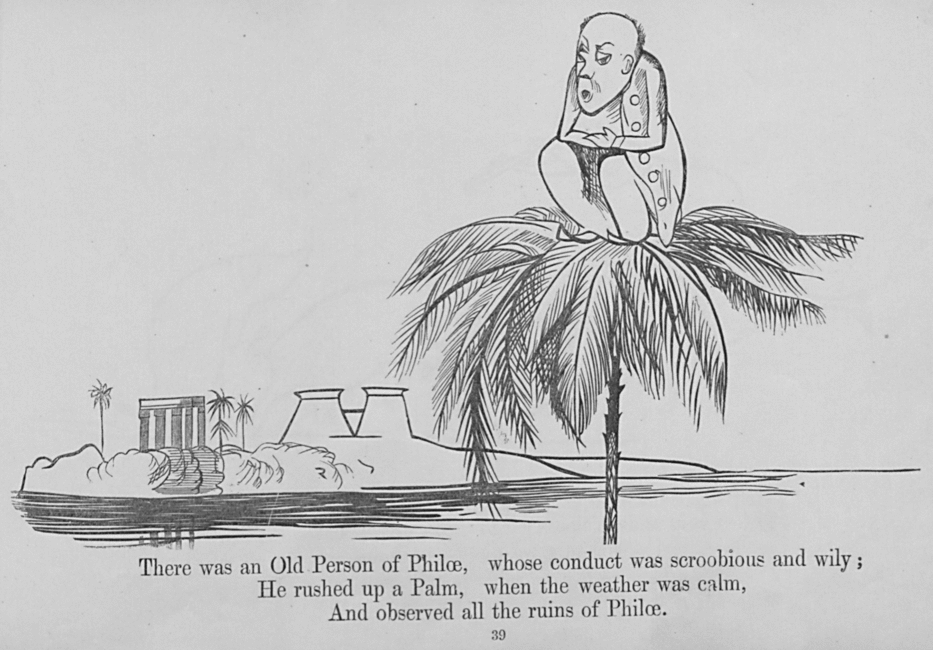
Of Lear's many tree-sitters, one of the best-known is the Old Person of Philœ whose cartoon watches him watch a remote landscape. Vivien Noakes rightly describes this background as the most delicately detailed in all the limericks, adding that Lear was dumbfounded by Philœ’s beauty when he traveled there in 1854 (CV.167). Bevis examines the sketches Lear made of this island in the Nile, at least one of which shows the giant palms to be eight times a human's height.Footnote 15 For the Book of Nonsense, Lear once again resorts to an impossible change of scale (Figure 2). Lear's image offers a mild send-up of an “observer” who is far more conspicuous than what he is presumably observing and who looks both cold and reluctant in what we imagine is a sun-baked and exhilarating landscape. Perched on a vertical axis, the Old Person's location at the foregrounded top-most edge of the picture sets up the poem's ironic, punning account of the sight-seeker's high or “rush” of elation as he scales the tree. His farfetched “conduct” may or may not be “scroobious” depending on whether one shades that doozy of a word more toward “scrupulous” or “dubious.” Easy to pronounce (neither a tongue-twister nor an inarticulable clump of non-phonemic syllables), it cheerily exploits the semiotic affinity of tall trees and long words. Such visual/verbal interaction is heightened by the components’ analogous mixing of aesthetic styles. The high arts of stately landscape and elegiac rumination at a ruin-site (such as Wordsworth's at Tintern Abbey) work in tandem to offset the “low” visual precariousness of a huge man balanced on a slender tree and the verbal nonsense about his “rush” to get there. Lear's placement of this sight-seer is perhaps a self-aware spoof on the basic rules of landscape art: his prominent man-in-a-palm has less to do with the realistic depiction of physical space delimited by the “linear effects” of river, shadow, and decreasing size (Maxwell 76) than with the conventional instruction that the landscape artist's perspective convey “the position from which he viewed the scene” (italics added, Gombrich 295).Footnote 16 Drawn to look again at what the poem calls “ruins,” the reader might discover that the columns on Philœ are mirrored in the waters and suddenly see them as a rebus-like allusion to the Old Person's aerial musings or “reflections.”
Lear's mobile figures, as distinct from the sitters on tree-tops, fences, and chairs, often activate spatio-temporal motifs. The “Young Lady of Dorking,” whose image might ordinarily be read as a satire on milliners’ confections – women's hats providing always-available targets for a Punch cartoonist – is notably ambulatory (CV.96) (Figure 3). The image communicates the young fashionista's self-absorption by locating her at the center of an otherwise empty page and by devoting half its height to the vacuous (empty-headed) headgear that keeps her from making headway. She might possibly topple backward except that her momentum, signaled (without benefit of the modern cartoon's motion lines) by her raised foot, by the axial tilt of her costume's patterned diagonals, and by the lift of her blown-back sash, tips her forward.Footnote 17 She seems, with the help of her umbrella, about to pivot en pointe. This teetering between coming and going anticipates the poem's narrated trip from Dorking to Dorking. The possibility of returning to the limerick's toponym is susceptible to witty treatment. When the unflappable “Young Lady of Hull” distracts the Bull chasing her, the poem itself becomes “distracted” and fails to repeat the word “Hull” (CV.84). In the case of the Old Man “who when little, / Fell casually into a kettle,” the second line's “kettle” names his location. Constrained by the poem's form, the Old Man grows “stout” and in the end cannot “get out” of the rhyme scheme or “that kettle” (CV.329). As for the Lady of Dorking, her trip is an instance of the poem's generic repetition and circularity rising into narrative. Her trajectory is an analog for the limerick text's acoustic journey back to its point of origin. More broadly still, the Lady's uncertain momentum comports self-referentially with the intermodal dynamic that sends the reader back-and-forthing from verbal once again to visual features. A second look at her drawing yields another cartoony joke: it's hard to see the “bedazzled” eyes that, in turn, can't see where the Lady is going.
“There was an Old Person of Philœ.” Edward Lear, A Book of Nonsense (London: Routledge, Warne, and Routledge, 1861), 39.

“There was a Young Lady of Dorking.” Edward Lear, A Book of Nonsense (London: Routledge, Warne, and Routledge, 1861), 26.

A limerick's image is loaded with inference. Size ratios, similar shapes, and page location (oversize hats, the twin faces, top edges) amount to propositions that it is the poem's business to re-present with a clarifying-and-distorting micro-story. The impetus to re-view the scene's visual details is born of the expectation that the poem's playfulness with language will, in turn, have visual resonances. This intermodal cueing is a consequence of the generic limits on what an image can say and what a poem can show. A Lear cartoon is necessarily incomplete and can be outright misleading when it appears to say everything that needs be said about its depicted micro-story. Though it might seem that the appended poem could do nothing but narrate an identical story (he sits in a flower; she wears a large hat), the experienced reader knows that visual transparency is a limerick ruse. That is to say, simple redundancy is only the most obvious limerick device and Lear can do subtler things with his image-text pairings.
What might be called the “action limericks” are a case in point. These have mobile figures relating to each other in an implied temporal sequence and bear a rough similarity to an individual panel of a modern action comic. To interpret the content of the visual anecdote, whether it features a superhero or an imperiled Learean eccentric, the reader spontaneously identifies what Elisabeth Potsch and Robert F. Williams term “the actions depicted” and “paths of motion” (31). The limerick-comic comparison needs adjusting, however, to take into account a conspicuous generic difference. When discussing the “image schemas” in comic strips, the cognitive linguists assume that the scene aims straightforwardly to yield up the anecdote's “cause-effect structure” (30). In Potsch and Williams's example, stylized “impact flashes” show that Batman's flung weapon is deflected by his enemy's sword (31). Such transparency is a rare thing in Lear's whimsical encounters, chases, and dust-ups. The limerick image, unlike the comics panel, typically precludes (or suspends) the possibility of immediate, maximal understanding. The “paths of motion” can be tentative, as in the Dorking, or the timing of the depicted actions may be left inexplicit, or an apparent sequence may be flat-out misleading. Lear's image routinely conceals the nonsense rationale or the outcome of its story until the poem's verbal surprise. By eccentrically scripting the limerick actor's desire, volition, or inhibition, the poem encourages re-appraisal of what seems to be going on in the drawing. If Mitchell's provocative title, What do Pictures Want?, may be applied to Lear's nonsenses, the answer is that limerick cartoons want the reader's return. They want it known that they knew from the beginning the joke that the following text was about to reveal.
Such is the case with the Young Lady of Clare (CV.88). The image shows her flopped into a curlicue that puts readers in mind of Lewis Carroll's Wonderland curriculum for “Drawling, Stretching, and Fainting in Coils” (129). At the same time, a pointy-eared creature of indeterminate species with sharp teeth and lolling tongue looks to be a carnivorous actor-pursuer! But, as Colley shrewdly observes, Lear's drawings typically “refuse to carry the intended violence through. Always a gap intervenes. Rarely does a figure touch another, and rarely do the instruments of harm reach their victim” (“Reversals of Nonsense” 295). But precisely how, the wary limerick aficionado wonders, will Lear's poem torque this scene of predation into something diverting? A wrong guess might be that Lear will borrow the plot of Aesop's fable about the hunter who eludes a bear by pretending to be dead (Bewick 33–34). Uncertainty about the identity of Lear's animal mixed with confidence in human cleverness leaves the reader utterly unprepared for the micro-story that arrives. Lear's heroic Young Lady doesn't feign death, she spontaneously dies (Figure 4)! Lear has no mechanism for showing the lady's state of mind as she collapses, nothing visually comparable to the sweat beads radiating from the foreheads of today's distressed cartoon characters (McCloud 130). But the omniscient poem can and does bring her private sentiment to the fore: “she found she was tired.” Such weary self-consciousness ascribed to the victim of impending violence is at once elevated and understated: the situation is slapstick but the lady's words are from the novel of sensibility (cf. Austen's Elizabeth Bennett in Pride and Prejudice: “she found herself suddenly addressed by Mr. Darcy”). The visual/verbal discontinuity widens further as she “abruptly” activates the worn out hyperbole about the dying or, rather more delicately, “expiring” or wanting to die of “shame” or “sorowe” or “drede.” With this, the difference between voluntary and involuntary actions is exploded and agency is transferred from the bear to the Lady. She becomes, with hilarious implausibility, the poem's limp heroine and prime mover. Such verbal shenanigans have the effect of making the Lady's visual contortion abruptly salient: the drawing, with the feet attached backwards, all but says not to worry about her literally preposterous situation. The proximity of metrical “feet” might be prompting Lear's prank with the Lady's extremities, but throughout the nonsenses, bodily misalignments deliver sly hints to watch for the deliberate incongruities that energize the limerick as a genre. Poems can re-invent the visualized stories, and the fine details of the drawings sometimes show that they know this. Such self-aware examples might be thought of as metalimericks.
“There was a Young Lady of Clare.” Edward Lear, A Book of Nonsense (London: Routledge, Warne, and Routledge, 1861), unnumbered final page.

3. Limerick Disruptions: Lear, Stevenson, and the Others
Lear's limericks have many ways to include secondary characters in their micro-stories. Singly or in aggregates, their visual/verbal interventions resonate across media to produce the genre's defining mix of witty alignments and misalignments. In the final three examples, however, these characters are less benign than the onlookers who ask about the monstrous Bee, “Does it Buzz?” or offer a large hatchet to kill a flea (CV.86) or warn a tree-climber not to sneeze (CV.343). These characters seem maliciously likely to murder, beat, or burn a living creature and this potential for violence creates vivid discrepancies between the limerick's components. The antics and dialogue of these other parties, whether or not they actually appear in the image, provide startling ways to crisscross the visual/verbal gap.
In one very tricky pairing, “There was an Old Person of Gretna,” Lear covertly professes the truth about limerick unpredictability (CV.85). Whimsically explicit about its semantic inexplicitness, Lear's image of Mount Etna flaunts the transparency its micro-story lacks. In a two-member “transactional schema” set above and below ground, a forward-leaning man seems to “play the role of ‘Actor’” (Kress and van Leeuwen 44), but the meaning of his gesture (completed pushing or imminent pulling) is uncertain (Figure 5). Lear's image might be showing a “catastrophic accident” like the one that cracked Humpty Dumpty in the riddling nursery rhyme (Orme 12) or that sent Jack smashing down-hill in the harrowingly illustrated Jack and Jill and Old Dame Gill (1806).
“There was an Old Person of Gretna.” Edward Lear, A Book of Nonsense (London: Routledge, Warne, and Routledge, 1861), 99.

Or it might be a murder scene, like those in Robert Louis Stevenson's wickedly funny Moral Emblems, the chapbooks he wrote and engraved for production on his 12-year-old step-son's toy press: “I cut them with a knife out of blocks of wood . . . . Sam then prints ’em: are they not fun?” (qtd. in Hill 78). The images are amateur's work and the two murder poems are sunnily satiric: in the first set of emblems, a raging man “hurls another into the sea” (I.v) and in the second, Robin “spears” an Abbot with a “javelin” (II.iii). Writing for Studio in the decade after Stevenson's death, the engraver and art historian Joseph Pennel assures the magazine's sophisticated readership that the Moral Emblems’ “rude cuts” are a source of “enduring” pleasure (Pennell 22). Both the Times reviewer, on their inclusion in the Edinburgh Edition of Stevenson's Works, and the modern critic relish the Emblems’ subversion of the “cast-iron rectitude of the professional moralist” (“Books”12) and “the whole activity of moralizing” for children (Katz 340). Stevenson's chunky forms and heavy square frames are themselves emblems of the project's irreverence. Here's “The Abbot for a walk went out” (Figure 6). The meaning of this image, despite its energetic diagonals and triangular symmetry, is obscure; so the poem cheerfully specifies the violent act – Robin's weapon has “struck” the Abbot “bravely” in the very “middle of his back” – and adds a flippant moral:
“The Abbot for a walk went out.” Robert Louis Stevenson, Moral Emblems. A Second Collection of Cuts and Verses. Davos, Graubünden, Switzerland. 1882.

The poem's rhymed couplets and inverted syntax (“Robin has that Abbot stuck”) are as clumsy in their own way as the woodcut, and the Abbot's tale is delivered with a jauntiness that is worthy of Lear. Stevenson indulges in scattered puns (the “wealthy cleric” is himself a well-dressed young “buck”), false cognates (“djavel” from “diabolus” is unrelated to “javelin” though both inflict injury), a boyish simile (an Indian brave's weapon goes “bravely” into his game) and sound-effects of the kind a modern comic puts into the image (“whack” / “Bang”) (McCloud 73). This verbal fun has the effect of reducing the crime of spearing a clergyman to a mere prank or mischievous target practice. Then, in explicit parody of its emblem precursors, the poem instructs the reader to study the image (“you observe”) and to listen for sounds no image can produce (“you may hear”). Finally, playing on the expectation that “we may learn” or be edified by the wisdom of this emblem, Stevenson concludes (as did Robin) by targeting the clergy: “abbots should / Never go walking in a wood.” The impudence is graphically heightened by italics that distinguish the moral from the body of the poem much as the box frame cordons off the woodcut. By these means, Stevenson's Moral Emblems, like Lear's limericks, show themselves to be comically aware, not only of their precursors, but of their inter-modal presentation.
In Lear's incident at Etna, the visual ambiguity and lack of temporal coding are resolved verbally. The poem clarifies the pictured scenario (the Old Person “rushed” into Etna) while the dialogue matches a fool's inapt solicitude (“Is it hot?”) with an unlikely reply (“No, it's not!”). The final line turns these absurdities metacritical with its attention-grabbing polysyllable: “That mendacious Old Person of Gretna.” The ethical term showily emphasizes that the limerick is made out of pictures and words that are clowning around; it parodies a non-existent genre, the seriously fabling, instructional “Moral Limerick.” In the empirical world, a heated denial (a denial of the crater's heat) would be “mendacious”; but in a cartoon, it's the truth. A visual medium is not physically “hot” and in Lear's nonsenses the most ridiculously dangerous predicaments are harmless.
By raising the question of truthfulness, Lear's adjective points to the unreality effect that Susan Stewart, in her brilliant Nonsense: Aspects of Intertextuality in Folklore and Literature, locates at the genre's core. Nonsense, as she elucidates it, carries “the message ‘This is play,’” which is to say “this behavior does not exist” (30). For the reader or critic to earnestly assess a limerick protagonist as “mendacious” or “imprudent” (CV.160), “oracular” (CV.105), “invidious” (CV.177) – or as having any of the ninety tongue-in-cheek qualities Lear's ascribes (Hark 28) – is to be side-tracked into highfalutin (possibly prissy or moralizing) non-nonsense speculation. The polysyllabic adjective, as Lear typically uses it, has a far-fetched or ironic connection to the poem's micro-story; it functions as reminder that the limerick enjoys its freedom from the conditions of everyday life. As for the specific situation at Etna, anyone looking at the Gretna drawing seriously doubts the “mendacious” Old Person's risk of incineration; for despite the plume of smoke signaling fire below, his foolishness is viewed through a transparent mountainside. The beholder actually sees through the bogus situation. The limerick might be performing precisely the kind of self-inspection that Mitchell ascribes to metapictures: their “principal use” is “to explain what pictures are – to stage, as it were, the ‘self-knowledge’ of pictures” (Picture Theory 57). Lear's drawing parades its knowledge that a picture ordinarily “efface[s] itself in the service of transparent representation of something else” (Picture Theory 48). Gretna, with its comic transparency, represents its own mode of representation; nonsense drawings, like their partner poems, parade their blithe denials of the solidity of matter, the burn temperature of flesh, and the laws of gravity.
The Gretna limerick's playful warning against over-solemn responses to “mendacious” nonsense bears on the Old Man's unlikely predicament in Whitehaven (CV.172). Once again the image deals in improbabilities, a pair of dancers are linked along the scallop of an oversize blackbird's lifted wings and an Old Man's coattails. Lear's early ornithological sketches and Hughes's Sing-Song illustrations depict real birds seen in hedges or at the London zoo (Bevis 36). In contrast, this limerick presents mis-proportioned but symmetrical cartoon figures who skip as if anticipating the poem's anapests (Figure 7). The poem unexpectedly converts the elated scene into an event, an insult-and-clobber crisis, by reporting that “they,” the off-site characters, are not amused with the Old Man's bird-brained absurdity. Matthew Bevis expands the punning reference to “this bird,” noting that it applies to the raven and, in the slang of Lear's day, to the Old Man; as a result, “It's not clear whether they smash the old man for resembling a bird, or for being one” (41). An especially cruel embodiment of society's non-Learean sensibility, “they” regard this partnering behavior as raving/raven mad! George Orwell fumed over this particular instance of social pressure: “To smash somebody just for dancing a quadrille with a raven is exactly the kind of thing that ‘They’ would do” (qtd. in Hark 30). Orwell might be over-literalizing or simply not noticing that the limerick's double mode accomplishes a clever bit of under-cutting. The relationship of image and poem can proceed in either of two temporal directions. The dancing scene can be read as eliciting or as following the smashing. It might viewed as a detail from a larger picture in which hecklers converge on the dancers or as the next episode in an ongoing story. In the latter, happier narrative, knockabout hostilities are shrugged off since they are “unreal” or of so little consequence that the dancing resumes in toponymic Whitehaven. It depends where our intermodal vibration stops, whether our last experience is the hammer-blow of the poem or the lyrical lightness of the drawing.Footnote 18
“There was an Old Man of Whitehaven.” Edward Lear, A Book of Nonsense (London: Routledge, Warne, and Routledge, 1861), 74.

By manifestly ignoring the poem's toughs, by sealing off their violence, the re-viewed drawing has the effect of affirming the dancers’ partnership. Like a cinematic freeze-frame shot, it captures the pair's original glee and holds it in “the space of representation” where it “lasts as long as the viewer wishes for it to last” (Louvel 81). Ultimately, the Whitehaven limerick stands as a covert ars poetica by insisting on its role in promoting absurdities; the sniffiness of the interlocutors’ objection to nonsense applies to the limerick that the reader-viewer is just in the process of enjoying. As for the fault-finders bent on enforcing their strait-laced aversions, Lear's humor co-opts them for the tickle of defiance their displeasure adds to dancing's (and his book's) delightfulness.
When Lear does visualize hecklers or ill-mannered parties, he gives them the look of life's indignant ones, the put-upon and the staid. Their bodies are either tightly aligned in symmetrical rows that “emphasize their tedious conformity” or scattered about in histrionic poses (Ede 115). The poems then, with impassive mock-seriousness, tell of miniature crowds and clusters who scowl as a soap-wielding foursome to fend off a stranger (CV.368), cringe “astonished” at the sound of a trumpeting nose (CV.359), and flee helter-skelter from a large-eyed woman (CV.75). In caricaturing their consternation and panic, the limericks expose these responses as social performances and mock the stagey over-reactors who take offense at the limerick protagonist.
In one brilliant satire on culturally sanctioned cantankerousness, Lear's victim challenges the antagonist. The image for “There was a Young Person of Smyrna” (CV.159) includes a short female on the left, a sprawling feline in the vector at mid-scene, and a looming female on the right. Their relationship as Young Person and stern elder seems clear given the taller figure's contorted features and the raised foot suggesting an imminent lurch forward – possibly in a rescue attempt. The semiotics of this picture-story (misleadingly) imply that a young mischief-maker's offense (tormenting the cat) elicits an elder's vigorous intervention (Figure 8). Because Lear's young protagonists do occasionally misbehave – they even throw stones at the “Old Person of Chester” (CV.74) – the Smyrna poem might conceivably object to the Young Person for activating the expression (and the complaint of Smollett's Matt Bramble) that a room is too narrow “to swing a cat” (OED swing v.1). Anti-felinist rough-necking might be a cause for censure, and a reader versed in 19th-century nursery rhymes might even expect a nonsense version of the kindly injunction in Rossetti's Sing-Song to “Hurt no living thing” (Complete Poems 251), something like this hypothetical ending: “Do not torment the striped cat of Smyrna!” Instead Lear's poem defies the visual cues and delivers a zany surprise: it is the Young Person who is imperiled (CV.159). The poor Cat is a prop (merely a shock-index) in a wild little episode that exposes a ferocious Granny (Figure 9).
Detail from “There was a Young Person of Smyrna.” Edward Lear, A Book of Nonsense (London: Routledge, Warne, and Routledge, 1861), 6.

“There was a Young Person of Smyrna.” Edward Lear, A Book of Nonsense (London: Routledge, Warne, and Routledge, 1861), 6.

The limerick's startling impact is the result of Lear's self-aware exploiting of modal differences. When the image says “This girl is a brat!” the poem snaps back “No, she is not!” – a rebuttal made possible by the power of language to establish a temporal sequence. The poem can stipulate a reversed “reading path” for the drawing (Kress and van Leeuwen 185). Here, as so often happens in the full limerick, the instability of left-right / active-passive coding invites the poem's revisionary transcoding. Visual ambiguity, in other words, crucially enlivens the interactive pairing. The micro-story implied by the image needs to be re-seen as originating with aggression from the right-side figure, the egregiously threatening Granny. The crossed signals about bad behavior in Smyrna (one party appears but the other is heard to receive a reprimand) allow further impertinences in the poem.
To contain Granny, Lear seizes on an extravagant pun that springs a fire-proof joke, one that deviates from the image entirely and removes the feline from risk. A “cat” was once a familiar term for a tripod “upon which things are placed before the fire” (OED Cat n.9). In the end, the cheeky young Smyrna, whether she flings a living animal or a non-combustible trivet, defends herself by re-directing the message so often delivered to children: “Granny, behave yourself!” Reacting with nonsense panache, the granddaughter takes full charge of the poem's last words, the toponym, the polysyllable, and the commanding rebuke: “burn that! / You incongruous Old woman of Smyrna.” Where Stevenson's emblem about the Abbot discredits the moralizing genre by ignoring Robin's crime and advising potential adult victims to stay home, Lear's tale of the doings at Smyrna allows the threatened youngster to moralize the offensive adult. The aims are similar, the spoofing strategies differ. The limerick's fantasy, one that is amusing, possibly soothing, maybe empowering, is that a flippant “burn that!” can fend off the impositions of ill-tempered superiors and those others who presume to speak for “the whole of the civilized world” (CV.180).
4. The Last Word?
Commentators often seize on the granddaughter's term “incongruous” as an irresistibly ready-made description of the nonsense limerick's conduct. It has been the aim of this essay to locate this incongruousness as precisely as possible in the limerick's visual/verbal goings-on, in the reverberations internal to its composite form. Lear's cartoon image presents a baffling micro-story that sends the reader into the text for an explanation. An essential intermodal component, the poem makes sense/nonsense of the cartoon's distortions while at the same time indulging in verbal extravagances that gesture toward suddenly pertinent aspects of the drawing. The very best limericks take full advantage of this recursive structure; the reader-viewer arrives (back) at drawing to find details that have been ready in advance with a comical, often self-referential response to the poem's delayed fun. Various features of the drawing as drawing – faintly scrawled shapes, faulty draftsmanship, the absent presence of bullies – now emerge to enhance or adjust the inter-modal story or to acknowledge the limericks’ preposterous behaviors.
Not every multimodal partnership exhibits the limerick genre's intermodal structure; historical emblems, illustrated fables, and many nursery rhymes find no use for the formal involvements that produce visual-verbal surprise. This does not mean, however, that the intermodal dynamic – the activity linking the design of the image, the style of the poem, and the handling of the drawing – is unique to Lear's nonsenses. Arthur Hughes manages it when Christina Rossetti's whimsy catches his interest, as does Robert Louis Stevenson when writing and engraving his comically amoral “Moral Emblems.” Stevenson once jokingly dismissed emblematists as “ambidextrous Kings of Art” whose double genre required the use of a pen and an engraver's tool (Collected 216). Lear would have approved of Stevenson's polysyllable, and it might be applied with genuine approval to his limerick achievement. What distinguishes the ambidextrous Lear's nonsense is the collusion of his mnemonically cogent and repeatable stanza with his brilliantly cagey cartooning. If Punch had asked about the limerick instead of Parliament, the answer to “Does it buzz?” would have been a resounding “Yes, it does!” The composite Lear limerick buzzes with intermodal activity.