Throughout the nineteenth century, communities in the eastern African kingdom of Buganda used their dreams to shape social processes. Dreams could provide both inspiration and material for communities to invent and challenge authority. This practice occurred within a larger apparitional politics in which statebuilders and priests incorporated spirit possession and visions to develop military strategies and chart regional campaigns.Footnote 1 More broadly, Baganda interpreted their dreams differently to inform contemporary conversations about life and politics. As the Church Missionary Society ethnographer Walter E. Owen observed in the early twentieth century, communities obtained counsel from deceased elders through their dreams.Footnote 2 Owen recorded: ‘[E]nquiry amongst other Baganda, Christian as well as heathen, showed that there is a belief, pretty generally held, that in dreams about the dead the Mizimu or spirits of the dead appear. The phenomena are not dismissed as being but dreams, for great depression of spirits occurs, evidently having close relation to the intensity of the belief.’Footnote 3 For Owen's interlocutors, dreams offered a powerful framework to orient daily politics.
Like Owen, the missionary anthropologist John Roscoe discerned the importance of dreams among his Ganda associates. He observed that ‘[d]reams were regarded as important, and as the means of communication between the living and the dead.’Footnote 4 Roscoe further noted that Baganda throughout the kingdom spent considerable amounts of time talking about and interpreting their dreams: ‘No person ever let a dream pass unnoticed, without drawing from it the lesson it was intended to convey.’Footnote 5 As one proverb noted, ‘Siroota kibula’: addusa ekyalo’, the one who maintains, ‘“I do not dream what does not happen”: drives the whole village away’.Footnote 6
By the early 1900s, the verb kulootolola was employed to describe the practice of retelling and publically interpreting a dream or series of nightly visions.Footnote 7 The etymology in Luganda was instructive; the kingdom's vernacular arenas aided citizens as they laboured to differentiate ordinary dreams from politically insightful encounters. Broadly, the gloss (loota) captured the experience of dreaming. Through the process of dreaming, one could encounter a vision of God or have a discussion with an insightful ancestor. While it was not the case that all dreams were believed to be politically insightful, dreams throughout the mid-1900s constituted the central experience through which activists obtained visionary elucidation. Through the reception and public interpretation of a dream (kulootolola), activists became more than mere dreamers; they became luminaries, bearers of personal, social, or political instruction that could have been obtained only through a dream.
The verbs that described this more complicated classification of visionary dreams were kwolesebwa or kulabikirwa. The latter of the two derived from kulaba (to see). In its conjugated form the term generally meant to have been shown something, or to have insights opened or revealed to a dreamer. For this reason, when Luganda writers in the late nineteenth century translated the visions of St John in the New Testament (The Book of Revelation), they selected a word that described politically insightful dreams, a term that designated the action of opening an object previously closed, kubikkulirwa.Footnote 8 In Buganda's ideational landscapes, it described the process of having been shown insight or the outcome of the future through a dream.
This article argues that Ganda activists throughout the colonial period continued to use their dreams to shape regional politics in ways that have not been addressed by historians of eastern Africa. It suggests that the public task of interpreting dreams – and the energy asserted toward distinguishing ordinary dreams from politically instructive visions – generated extensive vocabularies with which actors articulated differing conceptions of power and authority. Whereas previous scholars argued that modernity and literacy would supplant the public utility of dreams, the private archives of the trade unionist Erieza Bwete and the constitutional writer Eridadi Mulira show that Uganda's educated elite wielded colonial literacy as part of a larger strategy to challenge the earlier political vision of the state's ruling chiefs, such as Apolo Kaggwa. Islamic and Christian literacy and colonial rule did not curtail the ubiquity of dreams in Ganda politics. If anything, dreaming practices took on new, more complicated meanings as literary practices provided a deep repository of symbols to enrich interpretative practices. Textual sources, such as legislative minutes, journals and novels, in turn, provided interpreters and dreamers with new technologies to expound upon their imaginings.
To develop this argument, I begin by assessing the impact of European psychoanalytic theory on the study of dreams in African studies. The interwar academy suggested to anthropologists and future Africanists that dreams would lose their political function in modernising societies, especially through the proliferation of literary practices. However, as this article shows in the second section, dreams continued to significantly impact the practice of power in colonial Buganda. Whereas Muslim dissenters harnessed their dreams to challenge state authority following the religious civil wars of the late nineteenth century, historians such as Apolo Kaggwa focused vernacular production to complicate the supposed function of dreams in public life. The historical and political gaze of Kaggwa was sweeping; it cast a vision that activists throughout decolonisation were challenged to refocus. In the final two sections of this piece, then, I highlight how the prominent politicians Erieza Bwete and Eridadi Mulira read their dreams alongside colonial literacy to develop competing visions of Buganda's colonial monarchy. Building upon these case studies, the article concludes by offering an expansive framework for conceptualising the intellectual history of colonial Africa.
DREAMS, COLONIAL LITERACY, AND MODERNITY IN AFRICAN HISTORIOGRAPHY
The development of the academic and clinical study of dreams in the early twentieth century was interconnected with the practice of colonial anthropology, as well as the association of geographical topographies with the alleged history and function of human cognition. As Marian C. Jędrej and Rosalind Shaw have shown, when Carl Jung visited eastern Africa in 1925, his aim was to identify the relationship between two ostensibly primitive worlds: the deepest recesses of human psychology (dreams) and a savage hinterland (Africa).Footnote 9 Similarly, Jung's older colleague, Sigmund Freud, argued that dreams, like African societies, signified untamed wildernesses that needed to be subdued and civilised.Footnote 10 By travelling into the interior of Africa, it was argued, researchers could more powerfully observe a place where prehistoric communities continued to conflate waking reality with chimera.
Jung's association of dreams with ‘primitive’ psychology and African societies reflected the intellectual climate of Europe's interwar academy. Three years before Jung visited Kenya and Uganda, the French philosopher Lucien Lévy-Bruhl published La Mentalité Primitive, which reworked British missionary accounts to explicate the supposed correlation between dreams and primal intellectual formation. Lévy-Bruhl was particularly taken by the work of the Baptist missionary William Holman Bentley, a British linguist who translated the New Testament into Kikongo. Following Bentley, Lévy-Bruhl argued:
To come to a conclusion as far as the African races are concerned, we quote the actual words of the missionary W. H. Bentley, who was a keen observer, and who summed up his experience as follows: ‘An Africa, whether negro or Bantu, does not think, reflect, or reason if he can help it. He has a wonderful memory, has great powers of observation and imitation, much freedom in speech, and very many good qualities; he can be kind, generous, affectionate, unselfish, devoted, faithful, brave, patient, and persevering; but the reasoning and inventive faculties remain dormant. He readily grasps the present circumstances, adapts himself to them and provides for them; but a carefully thought out plan, or a clever piece of induction is beyond him.’Footnote 11
This assertion framed Lévy-Bruhl's central argument regarding dreams. ‘To the primitive mind, as we know’, noted Lévy-Bruhl, ‘the seen and the unseen worlds form but one, and there is therefore uninterrupted communication between what we call obvious reality and the mystic powers. Nowhere perhaps is this more directly and completely brought about than in dreams, in which man passes from the one world to the other without being aware of it.’Footnote 12 In ‘primitive’ societies – whose communities were cast as being unaware of the sophisticated ‘laws of contradictions’ – dreams were to be trusted more than empirical observations.Footnote 13
Lévy-Bruhl's analysis had a long shelf life among twentieth-century scholars, as did the evolutionary taxonomies employed by Jung and Freud. Historians of the modern period, in turn, increasingly argued that social progress throughout the nineteenth and twentieth centuries was fundamentally characterised by the declining impact of dreams in public life. For many scholars, abatement would be precipitated by the proliferation of textual practices. Dreams and textual modernity were believed to be largely incompatible.
Two of the most prominent scholars of modernity and textual production, Jack Goody and Michael Ong, for instance, reworked Lévy-Bruhl's analysis of ‘primitive mentalities’ to argue that the modern period was indeed a textual world without the consequentiality of dreams. For Jack Goody, building upon Lévy-Bruhl,Footnote 14 literary practices propelled the transition from ‘illogical’ societies toward more ‘logical’ organisations. Goody suggested that the practice of literacy accompanied – if not defined – the transition from ‘simple’ to ‘complex’ state formation in the modern era.Footnote 15 This process entailed the domestication or the literisation of the savage mind. His work assumed that there were essential political differences between literate and non-literate regions of the world, an argument that he developed by contrasting modern Turkey with colonial eastern Uganda. Goody's analysis of eastern Uganda had been shaped further by the research of Lloyd Fallers, an American anthropologist who worked with Audrey Richards and the East African Institute of Social Research during the 1950s.Footnote 16 Both Goody and Fallers saw the ‘oral economies’ of eastern Uganda (Busoga) as distinctly limiting and the legacy of primordial social constructions.Footnote 17 Indeed, Fallers’ central concern was the political evolution of Soga society.Footnote 18 Building upon both Lévy-Bruhl and Fallers, Goody concluded that the challenge of creating modern states and societies throughout postcolonial sub-Saharan Africa was compounded by ‘the absence of a strong, written tradition that can stand up against the written cultures of the world system’.Footnote 19
Like Goody, the Jesuit scholar Walter Ong maintained that without literary forms of knowledge, oral communities were politically impeded. He worked to rewrite the history of the modern world as a distinctly literate space within which actors reorganised society according to new forms of labour, industry and textual production. Without writing, noted Ong:
human consciousness cannot achieve its fuller potentials, cannot produce other beautiful and powerful creations. In this sense, orality needs to produce and is destined to produce writing. Literacy … is absolutely necessary for the development not only of science but also of history, philosophy, explicative understanding of literature and of any art, and indeed for the explanation of language (including oral speech) itself.Footnote 20
While he called into question Lévy-Bruhl's nomenclatures of ‘primitive’ and ‘savage’,Footnote 21 Ong's work still largely posited a modernist teleology. In consequence, his analysis completely overlooked the epistemological productiveness of dreams.
By the early 1960s, Africa's first generation of historians were tasked with the challenge of producing useful political pasts for recently independent, postcolonial states. Within the serious arenas of nation building, scholars of the continent, like Fallers, did not concern themselves with social practices, such as dreams, that belonged to an allegedly bygone era. It was not until the late 1970s and 1980s that scholars began to examine the role of dreams in African societies – and these studies were still few and far between.
When scholars turned to the practice of dreams, Africa's visionary landscapes were removed from their political contexts and largely confined to cultural or religious spaces. The cultural or religious study of dreams in Africa was still largely an exercise in psychoanalytic theory. It was the historian Bengt Sundkler who first challenged postwar scholars of Africa to take dreams seriously. His work, though, following Freud, saw dreams as a series of symbols shaped by psychological production.Footnote 22 He argued that ‘dreams play a more dominant role in the experience of Africans than in that of other peoples, at the least more so than for Westerners’.Footnote 23 In his seminal work on independent churches in Zululand, Sundkler demonstrated that dreams played a rudimentary part in the development of Zionist communities by facilitating group integration through the production of collective symbols.Footnote 24 In his later studies, Sundkler showed that the public interpretation of dreams among Zulu Christians provided a powerful ritual for converts to resolve their deepest moral conflicts.Footnote 25 Sundkler noted that the ‘luminary visions in Zulu dream life formed a new and obvious point of reference: the Zionist group in white’.Footnote 26
In a separate study on the history of Christianity in Bukoba, where he served as a bishop, Sundkler examined the extensive dream life of Pastor Loje, whose diaries recorded over 850 dreams.Footnote 27 For Sundkler, Loje's dreams were ‘spiritual’,Footnote 28 employed by Tanzania's first generation of Christian converts to mediate cultural cosmopolitanism: ‘In the contact and conflict of cultures in which he and his generation were involved, the images of dreams and visions helped make the new knowledge personal and urgent.’Footnote 29 Sundkler's body of work was innovative and important. It problematically viewed dreams, however, as an ecclesiastical practice removed from the hullabaloo of formal politics. Following Sundkler, historians of Africa have struggled to think politically about dreams. It is not without reason, for instance, that The Journal of African History has yet to publish an article with the word ‘dream’ in the title since its inception in 1960, with the notable exception of Achille Mbembe's work on the ‘economy of the night’ in late colonial Cameroun.Footnote 30
If dreams have been largely overlooked as a serious political practice in African historiography, important studies have been conducted on the larger history of waking visions. In the late 1980s, Jeffrey Peires showed how the southern African prophetess Nongqawuse reworked a divinely inspired vision of two strangers to persuade 100,000 amaXhosa to kill their cattle during a moment of social and epidemiological rupture.Footnote 31 Similarly, in his work on the Kongolese activist Dona Beatriz Kimpa Vita, John Thornton shows how resistance to Portuguese intrusion was driven by the organisation of a twenty-year-old woman who sought to restore the kingdom to an idyllic past, a time when Christ dwelt among the Kongolese. Saint Anthony of Egypt appeared to Kimpa in a vision, compelling her to mobilise resistance. ‘You are to move the restoration of the Kingdom of Kongo forward’, disclosed Anthony to Kimpa Vita, ‘and you must tell them all who threaten you that dire punishments from God await them.’Footnote 32 Portugal's military, though, ensured that Kimpa's vision of a powerful kingdom was not fulfilled. Disorganised followers were imprisoned and during the next thirty years approximately 245,000 enslaved central Africans were exported to the New World.Footnote 33 While these works are significant, the intersection of politics, dreams, and literary production warrants further study.
Beyond the field of African studies, historians have recently begun to rethink the political history and interdependence of literature and dreams – and in ways that do not follow the earlier modernist teleology of Jung or Lévy-Bruhl. In his work on dreaming in Medieval Europe, Steven Kruger has shown how the production of dreambooks shaped larger political contestations throughout the region. Kruger uses Latin and vernacular manuscripts to argue that urban and ecclesiastical elites were just as preoccupied with the practice of and questions concerning dreams as their rural and peasant counterparts. As Kruger notes, ‘those who were part of the medieval “establishment” did not view dream divination with simple and unambiguous disapproval’.Footnote 34 To imagine and articulate competing visions of authority, ‘[d]ifferent dreamers, of distinct social status, education, and experience, must have used their dreams in varying ways …’.Footnote 35 During the Medieval period, the standardisation and interpretation of dreaming cultures were central to larger shifts occurring in the intellectual and political histories of Europe, from the interpretation of Aristotle to the centralisation of Carolingian authority.Footnote 36
As the remaining sections of this article show, literati in modern eastern Africa worked similarly to translate their dreams into concrete political authority. In ways that follow Kruger – and complicate Goody and Ong – visionary forms of knowledge shaped textual practices and intellectual histories in ways that were neither teleological nor epiphenomenal. Dreams were not the primordial residue of precolonial tribes on their inevitable journey toward modernity. As rural activists and urban elites engaged in new types of textual production, they were also participating in far-reaching vernacular conversations off the written page, where dreams provided equally powerful archives to contest local historiographies. Colonial literacy did not supplant dreaming practices; it largely complicated them.
DREAMS AND POLITICAL AUTHORITY IN EARLY COLONIAL BUGANDA
To invest local power and authority, communities debated the implications of their dreams. Dreams could call villages to begin preparing for the fulfilment of a premonition, or to challenge areas to take measures to ensure that undesirable outcomes did not occur. In the early colonial period, Buganda's first generation of Christian converts struggled to control the politically productive character of dissenters’ dreams. This was especially the case for the dreams of the kingdom's Muslim converts, who had lost political power through the religious wars of the late nineteenth century. Qur'anic and biblical literacy enriched the symbolic archives from which people contested central power. Colonial chiefs struggled to talk about dreams in ways that both resonated with the past in the kingdom's vernacular registers and appealed to British sensibilities.
On 6 July 1909, the Muslim activist Hoda Bira travelled from the county of Butambala to the Lukiiko,Footnote 37 the parliament of Buganda. Bira proclaimed upon his arrival that God had appeared to him in a dream, revealing that he was the Prophet Isa (Jesus).Footnote 38 After recounting the dream to Buganda's king and court, Bira was not asked to remove himself. By contrast, he was requested to elaborate before Kabaka (king) Daudi Chwa II (r. 1897–1939) and the 32 members of the assembly ‘how he had become the Prophet Isa’.Footnote 39 Bira explained how the Prophet Muhammad and the Angel Gabriel had stood upon his stomach in a series of dreams to proclaim their message: ‘I was sleeping when the Prophet Mohamed called me. When the Prophet appeared he was together with the Angel Gabriel who stepped on my stomach and told me that I was like one of the prophets and should no longer be called Hoda Bira but Prophet Isa. I had this same dream thrice.’Footnote 40
Following his description, Buganda's statebuilders and Bira exerted energy toward discussing the imagery, character, and legitimacy of the dream.Footnote 41 In the public sphere, it was important to explore what characters looked like, the colour of their clothes and the feature of their faces. The transcription of the account is preserved and warrants full citation:
He [Hoda Bira] was asked how he that appeared to him at first resembled.
He replied, ‘He was a holy man with a beard, tall with a silver turban on his head.’
He was then asked what he looked like the second time.
He answered, ‘I heard the voice only saying “I am the Prophet Muhammad. Tell your friends as I will always tell you”.’
Then he was asked what message he had been told to tell us, but he did not remember what it had been. Then he was asked why he was not able to instruct people of all religions which he had been told to do. We were gathered but he would not tell us the message. To this he replied that he could not remember everything because he was all by himself at the time of the vision.
He was then asked whether he was speaking the truth, he said that he did not know whether it was true or not because what he had was a mere dream.
Question: ‘If you were transformed how can we speak with you?’
Answer: ‘I am not sure whether or not I am speaking words of the prophets because I, too, have never seen angels.’
Question: [by H. H. Kabaka]: ‘What you wrote to say that you were the Prophet Isa is a fact and not a mere dream. How is that?’
Answer: ‘I only wrote to the Mwalimu Sabiti to interpret the meaning of the dream but never knew that the matter would get as far as you.’
Question: ‘Why do you fear us, who are after all mere human beings, when you are in fact the angel's messenger?’
Answer: ‘What I have got to answer is no longer worth much, perhaps they were not delivered properly to me.’
Question: ‘Why did people boycott the mosque in your place?’
Answer: ‘Because I called myself Prophet Ismail, my father's name. They said that Ismail was a forbidden name in their religion.’
The Lukiiko then sent for the chiefs of the area and the Mwalimu before they did any more cross-examination.Footnote 42
Bira struggled to translate the dream and his personal charisma into concrete political capital. The dream had called subjects to shift their religious loyalties in Buganda's rural landscapes away from the kingdom's Protestant hierarchy and toward Hoda Bira, a claim that he hoped to bolster by looking toward the Muslim elder Mwalimu Sabiti. Buganda's court was not impressed. To undermine the integrity of the dream and to thwart Bira's messianic agenda, powerbrokers weakened the political bite of the dream by highlighting Bira's timidity: ‘Why do you fear us, who are after all mere human beings, when you are in fact the angel's messenger?’
The Lukiiko’s strategy was effective; Bira ‘… replied that he could not remember everything because he was all by himself at the time of the vision.’ The Lukiiko was in turn well positioned to exploit the solitary reception of the dream by sending ‘for the chiefs of the area and the Mwalimu before they did any more cross-examination’. Bira's prophetic dream was not religious fiction or the musings of a psychologically unstable adult. It was politically consequential and demanded rhetorical strategy by his opponents in the highest levels of Buganda's Christian government, who laboured to diminish the dreams of Butambala's visionary dissenter.
DREAMS AND APOLO KAGGWA'S HISTORIOGRAPHY
During a period when activists such as Hoda Bira were presenting their dreams before the ruling administration of Buganda, formidable chiefs, such as Apolo Kaggwa, the Protestant prime minister of Buganda, adapted Christian theology and colonial literacy to market themselves to Baganda and Britons as powerful interpreters of Ganda dreams. In a 1901 edition of the Church Missionary Intelligencer, Kaggwa recounted the visionary dream of the Muslim activist Mabizi. Mabizi had claimed before Kaggwa in an open assembly in the capital how God had appeared to him in a dream in which he was given the names, ‘Messenger’, ‘Apostle’, ‘Highest’ and ‘Prophet’.Footnote 43 According to Kaggwa, the Muslim community responded by arguing that Mabizi ‘ought to be put to death for blaspheming God’.Footnote 44 Whereas the kingdom's Muslim elders quickly prescribed violence, Kaggwa and his Christian council looked toward the apostles to assuage the conflict:
But the Christians in the council said, ‘It is not good to kill him, because the words are not against man but God; let God fight for Himself, He will defend His Holy Name.’ And they fetched a Bible and referred to Acts v. 31–40 and xii. 21–24, and said, ‘God will Himself pass sentence on him.’ Then they told the man to return to his home and pray there.Footnote 45
Kaggwa's reference, though, had a deeper meaning for Christian readers. The story in the Acts of the Apostles, Ebikolwa ebya Batume,Footnote 46 recounted a speech by the leader Gamaliel before the Jewish Lukiiko or Sanhedrin, a body of religious and political leaders in first-century Palestine. The Apostle Peter had accused the state's priests of executing the Messiah, after which the assembly ordered Peter's own execution. Gamaliel intervened, however, reminding the audience of a time when an activist named Theudas, whose movement quickly lost momentum, claimed to be the Messiah. If God guided the apostles, Gamaliel surmised, no one could stop them. If Peter was not empowered by God, his movement, like Theudas’, would lose impetus soon enough. Execution was not necessary. Uganda's British rulers could have confidence that Kaggwa's court, like Gamaliel's, was wisely governed.
The Lukiiko’s second reference, Acts 12, recounted the death of Herod Agrippa, the king of Judea, who according to Lukan sources was killed by an angel and devoured by worms after he appropriated divine titles. Kaggwa adapted this narrative to account for Mabizi's death, which allegedly occurred after Buganda's court adjourned:
He left the council in great joy, saying he had overcome his accusers, but as soon as he reached the threshold of his house he was taken very ill, fell down suddenly, and blood rushed out from his nose in a stream, and he died almost immediately. When they heard this, everybody was greatly astonished and said, ‘God was truly present, and His Name had been glorified and must not be trifled with, for He is Lord of heaven and earth,’ and all feared Him greatly.
Kaggwa placed apostolic authority and Protestant rule in Buganda in harmony by using the canonical hagiography of the early Church. By underscoring Gamaliel's wisdom and Agrippa's death, Kaggwa weakened the political force of dreams. Dreams remained dreams; they did not become illuminating visions (kulabikirwa or kubikkulirwa). Kaggwa presented himself as Buganda's Gamaliel, an authoritative interpreter of dreams in the life of high politics.
In the same year that Apolo Kaggwa recounted the story of Mabizi, he published what would become the most influential political history in Uganda during the twentieth century, Bassekabaka be Buganda, The Deceased Kings of Buganda.Footnote 47 Kaggwa's chronicle, argues John Rowe, became the most highly read book in colonial Buganda besides the Bible. In the 1960s, he observed that ‘[m]any Baganda who have no other book, cling tenaciously to their battered copy of Bas[s]ekabaka …’.Footnote 48 In his history, Kaggwa presented a past that legitimised military intervention to remove Buganda's Muslim chiefs and kings from power. As Michael Twaddle has shown, ‘the imposition of colonial rule is rewritten in Bas[s]ekabaka, not only to heighten the importance of the military contributions of Kagwa and his associates, but to Christianize retrospectively the whole anti-Muslim campaign as a kind of holy crusade’.Footnote 49 Kaggwa's official history had very little to say about the politics of dreams in precolonial Buganda. The topic was entirely ignored in Bassekabaka. There are at least three possible explanations for this silence. First, the intended audience of the book was Uganda's colonial administrators, at least partially. The logic of discussing politics without dreams, in turn, possibly reflected Kaggwa's attempt to delineate royal chronologies with straightforward explanations that did not unnerve Victorian sensibilities.
A second theory is that Kaggwa did not intend for Bassekabaka to be read in isolation from his larger body of works; it is historical hindsight that the volume eventually obtained prominence.Footnote 50 In 1911, for example, in an early edition of Ekitabo kye mpisa za Baganda, Customs of the Baganda, Kaggwa did discuss the political function of dreams. In his commentary on musical instruments and music in the royal court, Kaggwa cited songs that recounted dreams. These were among ‘several songs which were favorites with the king which were particularly adapted to this instrument [calabashes played by trumpeters]’.Footnote 51 Songs within this genre were played, noted Kaggwa, when autocratic kings ordered the execution of their subjects. The song entitled ‘I have found the large birds feeding’, for instance, was performed ‘whenever the king became angry, as when he ordered a large-scale human killing’.Footnote 52 When kings dreamed, they ‘thought about death’.Footnote 53 For Kaggwa, the reception of revelatory dreams accompanied the centralisation campaigns of Buganda's earlier kings. It is unfortunate, therefore, that available sources do not readily illuminate what Kaggwa believed about his own dreams, or the extent to which he experienced and discussed his own visions. It is mostly evident what he was doing with the dreams of others. That the topic itself is addressed, though, underscores how dreams continued to be thought about in terms of public authority. Following earlier monarchical practices, Ganda communities and aspiring chiefs largely assumed that the kingdom's newfound rulers would be powerful interpreters of the state's visionary registers.
Finally, Kaggwa's absence may have been a deliberate strategy of silencing the kingdom's Muslim dissenters, who continued to draw from the region's fantastical archives. In this respect, Buganda's Protestant premier was challenged to address the occurrence of dreams after a period of violence supposedly propelled by the kingdom's Muslim community. It was incumbent for Kaggwa to show how God guided Christian chiefs to manage the dreams, or the ‘extraordinary occurrence[s]’ of Muslim activists.
Silencing was indeed an effective managerial strategy, and the absence of dreams in Buganda's official historiography had a lasting impact on historical scholarship in Uganda. Uganda's first generation of nationalist scholars, such as David Apter and D. A. Low, did not recognise the importance of dreams in Buganda's colonial politics.Footnote 54 Throughout the early 1960s, studies published by the East African Institute of Social Research were also taciturn.Footnote 55 This followed a tradition of scholarship in the Ugandan academy. Between 1934 and 1956, the Uganda Society's Uganda Journal published only a few short portions that explored the practice of dreams in Uganda. One of these was part of a larger study on religion and magic among Langi communities,Footnote 56 the second was less than one full-page in length and taken from an entry from Uganda Notes in 1910.Footnote 57 More recent historians have also been challenged to account for the influence of dreams in Buganda's social histories.Footnote 58
Despite what silences may have existed in Kaggwa's history writing, as I will now show, Ganda activists continued to draw from their dreams, just as they were compelled to complicate Kaggwa's political vision more broadly. Contrary to earlier arguments made by Lévy-Bruhl, Jack Goody, and Michael Ong, the proliferation of colonial literacy did not result in the decreasing impact of dreams in the public sphere. For many writers and activists in Uganda, literacy provided opportunities to infuse dreams with complex meanings, and new possibilities for the dissemination of visionary insights.
THE EQUITABLE KINGDOM OF IGNATIUS MUSAZI AND ERIEZA BWETE
The dissenting Protestant Erieza Bwete was one of Buganda's foremost trade unionists in the 1940s. Together with Ignatius K. Musazi and Peter Sonko, Bwete organised political protests and co-operatives throughout rural B/Uganda. During the 1930s and 1940s, the three contextualised Christian literacy to criticise Buganda's colonial monarchy, which they accused of exploiting the kingdom's rural cotton farmers.Footnote 59
Private archives show that Musazi and Bwete interpreted their bibles and dreams coterminously to advocate for a kingdom where empowered monarchs protected their subjects from exasperating labour policies. Following a series of economic riots in the mid-1940s, Musazi, a former Anglican ordinand, was forced into exile in northern Uganda. During this period, he spent extensive amounts of time studying the Bible and interpreting dreams – his own and the prophet Daniel's. Musazi's exilic Bible shows that in July 1946 God ‘revealed’ to him the inner meaning of the prophet Isaiah's discourse on social justice, which called Buganda's rulers to ‘loose the bands of wickedness, to undo the heavy burdens, and to let the oppressed go free, and that ye break every yoke’.Footnote 60 In the book of Daniel, Musazi focused extensively on chapters two, four and seven, which recorded the dreams of the neo-Babylonian ruler Nebuchadnezzar and Daniel. From his study of the prophet's apocalyptic dreams, Musazi concluded that the kingdom of Buganda would dissolve unless the kabaka both granted rural farmers licences to gin cotton and removed avaricious chiefs from the Lukiiko.Footnote 61
The private papers of Erieza Bwete show that farmers in the 1930s interpreted their dreams to launch organisers into the arena of public activism.Footnote 62 During an unidentified evening in 1938, two angels, wearing long black robes with white collars and red belts, appeared to Bwete in a dream.Footnote 63 As the room filled with ‘great light just like sunshine’, one of the angels exhorted Bwete to pursue public politics: ‘Erieza, you will do voluntary work. You will unite my people – the farmers. Do not fear anything, be patient always and you will manage what comes to you. I will always lead you wherever you go to work for the farmers.’ The following night, an additional two angels visited Bwete. As a ‘fat and largely built’ angel revealed himself to Bwete, light filled half of the room. Bwete was struck not only by the angel's weight, but also by the pigmentation of his skin: ‘From his toes, waist, chest and the collar of his long robe [the angel was] very black.’ The angel, who sat on horseback, admonished Bwete to organise Buganda's farmers into a movement:
You! You are the messenger whom the Lord has chosen to unite the farmers. Wherever you will go, be his messenger. You will live longer and be able to see what many farmers will do. You will live happily but your riches have been concealed. It will take many years for you to discover your riches, but you shall be proud of it.
After the angel addressed Bwete, a second cherub appeared, who then joined his portly colleague on the horse. Bwete was struck again, although ‘with greater clarity’, by the angels’ Vantablack appearance. From horseback, the angels instructed Bwete on four occasions to ‘[w]rite to the leaders of the nation.’ After being instructed to use colonial literacy to advocate on behalf of Buganda's farmers, he was awakened. Bwete's remaining account indicates that he rested in bed for the following six days, unable to walk due to the power of the dream.
After resting for one week, Bwete, who described himself as appearing ‘drowned’ due to the intensity of the dream, began the labour of public interpretation. He disclosed the dream to family and neighbours throughout the village. One group suggested that the angels’ black robes signified the legitimacy of the revelation, ‘that the message was brought by angels from the God of all creation’. For some, the first angel's red belt symbolised persecution, while others argued that the belt foretold that large crowds would ignore Bwete's divine message. One interpretation read: ‘Let us run away from him, he is wearing blood.’ Other village interpretations talked about collective sorrow, of those who would ‘walk away slowly, holding their heads obviously worried and weeping’ due to Bwete's prophetic message.
According to his written accounts, Bwete next sought the guidance of the Orthodox priest Reuben Spartas Mukasa, who had been a former Protestant ordinand and organiser of dissent in southern Uganda throughout the 1920s and 1930s.Footnote 64 From Namungoona, Kyaddondo, Buganda's Orthodox priest, with whom Bwete had worked in the late 1930s in the Abazzukulu ba Kintu movement,Footnote 65 authoritatively reinterpreted Bwete's dream. Whereas Bwete's village struggled to come to terms with the alleged hardships that would accompany the divine mission, Spartas argued that the appearance of the angels in the dream signified blessing for the obedient. Angelic revelation often resulted in great honour and reward. There was reason to believe that God would both compensate Bwete for his labour and multiply preachers of the gospel of the farmer. For Spartas, God had revealed in Bwete's dream that all persons committed to volunteerism were in fact preachers of the gospel. To bolster his claim, Spartas grabbed a nearby Bible and read aloud Psalm 23, with the purpose of showing its deeper meaning, ‘The Lord is my shepherd of volunteerism.’Footnote 66 While Spartas agreed that the red belt that belonged to the first angel symbolised rejection, he also asserted that it raised insights into the consoling character of Bwete's mission. Bwete's public gatherings would become known as ‘meetings of light’, spaces within which ‘treacherous people’, or those who opposed the political and economic interests of Buganda's farmers, would be compelled by God to repent or hide from Bwete. The light that filled Bwete's bedroom would accompany him in public. This divine light would protect Bwete from Ganda chiefs and British administrators who sought to organise incarceration or torture in ‘the rage to come’.
Following the interpretation of the dream, Spartas organised a commissioning ceremony with members of the African Farmers’ Union. During the ritual, Spartas sanctioned Bwete's mission to call Buganda's king and his government to protect farmers and to create policies that empowered local ginners. Spartas raised both of his hands over Bwete's head and loudly prayed that God would empower the dreaming activist to engage in persuasive letter writing and public speech acts. Following the prayer, Bwete audibly responded by declaring ‘Amen’. In benediction, Spartas announced: ‘Erieza Bwete, let God be merciful to you. Let him help you in whatever you will do for the people. Amen.’
From their dreams, Erieza Bwete and unionists in southern Uganda created a political liturgy from which they could reimagine social mobility in colonial eastern Africa. Through the process of chronicling the dream in writing, Bwete worked to standardise the account in a way that was both personally and politically manageable. In doing so, he worked to translate these dreams into moral authority. The process of translation was complex: it involved prolonged periods of rest, overcoming personal anxieties, extensive discussions with neighbours, a journey throughout neighbouring counties, fervent prayers, and the repurposing of colonial literacy. Bwete's dream was an activist's rite of passage, an experience around which Ganda dissenters worked to produce a nascent, though formidable political community. Dreams were central to how Bwete and his community were thinking about colonial society and Christian texts, which a community was now called to rework to write to the leaders of Buganda's government. The juxtaposition was powerful. Bwete spent the next decade of his life rigorously advocating for an equitable kingdom: a state where Buganda's monarchs protected the economic rights of rural farmers.
ERIDADI MULIRA'S KINGDOM FOR UGANDAN COMMONERS
Eridadi Mulira was the foremost novelist and Protestant constitutional thinker in southern Uganda during the postwar period. In the 1940s he worked at the School of Oriental and African Studies to create a Luganda grammar and numerous plays and novels in Luganda.Footnote 67 In the mid-1950s he worked to secure the return of Buganda's exiled king, Kabaka Edward Muteesa II, who had been deported to London by the colonial government for refusing to support an eastern African federation.Footnote 68 Following the return of Buganda's king from exile, Mulira was one of the principal authors of the Namirembe Agreement, which defined the constitutional terms under which Buganda and Uganda secured independence in 1962.
In contrast to Ignatius Musazi and Erieza Bwete, who wished to see an empowered monarchy challenge the colonial state, Mulira was not interested in the invigoration of Buganda's kingship. Originally from the tributary kingdom of Kooki, which did not assimilate into Buganda until the late nineteenth century, Mulira envisioned a kingdom where non-Baganda and bakopi (citizens of no particular status or monarchical appointment) participated directly in the kingdom's hierarchy. In novels such as Teefe and Aligaweesa, which are explored more fully later, Mulira advocated for a social order where political accessibility was not contingent upon royal or bureaucratic selection. During a period characterised by the formulation of robust Ganda patriotisms on the eve of independence, which culminated in the formation of the King Alone party (Kabaka Yekka) and Buganda's movement for secession, Mulira advocated for a kingdom governed by both Baganda and non-Baganda ethnic communities. In Mulira's kingdom, ethnicity was not a political virtue in itself. His political vision emphasised social cooperation and ethnically inclusive moral communities – communities that dreams were used to imagine.
Until now, scholars have largely viewed Mulira's liberal politics as the product of missionary education and a postwar nationalism that was quickly ‘associated with moderate nationalist politics’.Footnote 69 Carol Summers, for example, has argued that Mulira's public career was the result of a missionary education that ‘fostered an intensively civic radicalism’.Footnote 70 Mulira's private papers, though, show that his biography and politics were also propelled by the power of his dreams. As the remaining paragraphs show, it was by reading dreams and colonial literacy alongside each other that Mulira sought to create a kingdom for Ugandan commoners.
Mulira's first visionary dream occurred in the early 1930s. He had received a scholarship to study at the prestigious missionary school, King's College, Budo. While his father had secured most of the funding, there remained a sizeable shortfall. After worrying considerably about the deficit, Mulira heard God speak to him in a dream, ‘clearly and unmistakenly [sic] in Luganda, “Kitawo ye mugagga asinga abagagga bonna” (literally, “your father [God] is the rich one who surpasses all other rich people”, i.e. “your father is the richest person”)’.Footnote 71 Throughout the 1930s, Mulira believed that God communicated to him through visions, audible voices and dreams, especially during moments of political crises. As a member of the Lukiiko in November 1953, God spoke to Mulira while he was driving to an assembly to discuss the exile of Kabaka Muteesa II. According to one family member, God audibly exhorted him to fight against the deportation.Footnote 72 Toward the end of the decade, in 1959, Mulira was sentenced to exile in northern Uganda for his role in an economic boycott that targeted Asian merchants. During this contentious period, Abraham Lincoln appeared to Mulira in a dream. Years later, before a Kikuyu audience in postcolonial Kenya, Mulira recounted the appearance of Lincoln:
I lived in political deportation in the town of Gulu in Northern Uganda. One night I went to bed with a heavy heart because of a letter I had received from my wife giving me alarming news, which was tantamount to a break up of all I had done. When I woke up at about 5:00 a.m. the following morning, I was still brooding over this matter. Then lo! I saw a vision of Abraham Lincoln in his full stature standing beside my bed and bending a little towards me, and a voice said to me clearly in the following words, ‘Anyone who kills Abraham Lincoln kills God in action.’ Lincoln disappeared and my worry disappeared, too. I never brooded over the matter again but gained wonderful peace of mind from that moment.Footnote 73
Mulira does not describe the precise nature of the concern that his wife raised. What is evident, though, is the dream itself, and the extent to which Mulira was challenged to publically translate its content into regional politics. By presenting himself as the inheritor of Abraham Lincoln's unifying and emancipatory ethos, Mulira presented himself as a mediator and unifier during a larger period of acrimonious, postcolonial politics.
Mulira had a longer history of using his dreams to explore the topics of rupture, rebirth, and unification. On 5 May 1930, he experienced a dream that inspired much of his liberal vision throughout the next three decades. The dream occurred three years after Hamu Mukasa had produced an illustrated edition of John Bunyan's Pilgrim's Progress in Luganda.Footnote 74 During a time when Christian revivalists were using Bunyan's story to imagine new forms of authority and mobility throughout eastern Africa,Footnote 75 Mulira adapted Bunyan's tableaux to recount and legitimise his dream. As it was retold and interpreted, Mulira's dream began much like Bunyan's – it occurred in a ‘certain place’,Footnote 76 where ‘the Baganda had chosen the broad way that led to destruction … going to perdition, and … completely lost’.Footnote 77 Mulira's certain place was cosmopolitan, populated by college students, crowds, Ganda elders and students from Zanzibar:
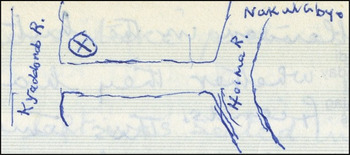
In my dream I saw the students [Makerere students] in a crowd in the street (Hoima Road as it was called then) just where Kyaddondo Road joins with that Hoima Road. They were heading in the direction of Nakulabye. Then I heard a voice say ‘All the Baganda have taken to the broad road including K[abaka Daudi Chwa II(?)] … only the two students from Zanzibar have not joined them’. When I turned I saw the two Zanzibar students standing behind me motionless, Then I found myself turning to the right and taking a very faint path hardly noticeable and walking down to the Konko …Footnote 78
As the dream progressed, Mulira was led past Kyaddondo Road, which he depicted in a map in his journal (see Fig. 1). He encountered an ‘old Kiganda hut’, dirty and full of smoke.Footnote 79
E. M. K. Mulira's Dream, Map, n. d. Cambridge Centre for African Studies, Mulira Papers, E. M. K. Mulira, journal.

A group of inebriated Ganda elders sat outside of the hut (signified by the encircled x on the map). Being unfamiliar with the junction, Mulira reluctantly asked them for directions:
They [Ganda elders] paid no attention to me. I asked them a second time and they paid no attention either. Then I decided to turn to the left at almost right angles with the Kyaddondo Road. When I turned that way I saw a footpath. I walked on it a few [metres] until I came to a very filthy pit, so filthy that I had never seen anything like it in all my life – I was aghast and turned back and went back to the dirty hut. I asked the gentlemen in the hut again whether they had seen my friends. This time, they rebuked me and shouted at me rude words and threatened that if I disturbed them again they would beat me. Meanwhile I saw my friends passing me in a crowd along the road from the Hoima Road. When they hit the Kyddondo Road they just walked across it in a crowd. After they had passed me I walked following in their trail but I could not cope with their speed[.]Footnote 80
The dream concluded with Mulira travelling toward the principal Anglican cathedral in Buganda, St Paul's Cathedral in Namirembe. After reaching the top of the hill, Mulira encountered 24 elders wearing spotless robes. Like St John of Patmos, Mulira observed a number of strange and fantastic creatures moving about before hearing Jesus, who was now hovering above Mulira. Jesus declared: ‘Mulira, I will make you my servant among the people and I will grant to you whatever you will need.’Footnote 81
The imagery in Mulira's dream was as rich as it was figurative; its symbolisms paralleled Bunyan's text. In the dream, a young Mulira approached a cadre of Baganda elders sitting alongside a road that penetrated into the heart of Buganda's capital, Kyaddondo. Here, in a place that mirrored Vanity Fair, he encountered drunkenness, hostility, and an absence of wisdom among Ganda elders. The compound on which the elders rested is strikingly dirty, as is the adjacent ground where Mulira observed ‘a very filthy pit, so filthy that I had never seen anything like it in all my life’. Mulira's dirty compound paralleled Bunyan's ‘Slough of Dispond [sic]’, where pilgrims became ‘grievously debaubed with the dirt’.Footnote 82 In Bunyan's dream, ‘miry Slough’ symbolised the conviction of sinners, a place where the unconverted lived due to ‘many fears and doubts, and discouraging apprehensions’.Footnote 83
The protagonist in Bunyan's dream, Christian, however, is informed that the realm's king does not take pleasure ‘that this place should remain so bad’.Footnote 84 In consequence, virtuous labourers and surveyors ‘from all places of the King's dominions’ attempted to tend the ground.Footnote 85 Running parallel to Mulira's road of destruction was Hoima Road, the ‘narrow way’,Footnote 86 leading to and from the kingdom of Bunyoro, Buganda's precolonial rival. It is from those travelling upon the latter that Mulira must find his way. Fittingly, Mulira was not guided in his pilgrimage by inept Ganda elders, but by non-Baganda youth, including two Zanzibari students.
Shortly after waking, Mulira approached an interpreter,Footnote 87 the students’ chaplain at Makerere College, Reverand Nasanaeri Zake, from whom he sought insight and explanation. Mulira explained that his dream challenged the integrity of Buganda's ineffectual gatekeepers, who esteemed fear, doubt, and apprehension from their homes in the Slough. Mulira's dream further offered a subtle critique of monarchical power in Buganda. In Bunyan's dream, Christian's monarch took definitive steps to marshal disparate communities for common purpose and labour. For Buganda's elders, no such king was present. Buganda's king was aloof, distanced from Buganda's tattered politics. In Bunyan's dream, according to Mulira, the idyllic kingdom was demographically inclusive, a space where actors of ‘all places’ served God's purposes indiscriminately. Similarly, in Mulira's dream, the luminaries were not Baganda; they were commoners from Zanzibar and Bunyoro – unlikely heroes in Buganda's semi-imperial politics.Footnote 88 Like Christian's Interpreter, Zake advised Mulira to keep the dream – considered ‘a very important dream’ – near to his heart.
Mulira drew insight from the dream throughout his expansive political career, noting in the early 1980s: ‘I wrote the dream immediately in a notebook that morning but throughout the years I lost the notebook, but the dream is as fresh in my mind [1983] as it was that morning of 5th May 1930.’Footnote 89 Indeed, throughout the 1940s and 1950s Mulira repurposed many of the themes in the dream to develop his political novels, which he authored to liberalise Ganda patriots. Mulira, for instance, produced the novel Teefe shortly after the Second World War. It chronicled the story of an urban youth, Mensusera William Besweri Teefe, who spent his days wandering aimlessly in Kampala: ‘Teefe and his friend Paatiriisi were known drunkards who set off to look for drink in the morning until late at night.’Footnote 90 During a period when activists such as Musazi were advocating for the empowerment of Buganda's ethnic kingship, or when activists in the Bataka movement self-described themselves as Buganda's hereditary sons of the soil,Footnote 91 Mulira pushed Teefe outside of Buganda. It is in the kingdom of Kooki that Teefe learned to work with non-Baganda communities. In Mulira's Buganda, the sons of the soil were those ‘resurrected through agriculture’, a state where Baganda commoners and Banyankole, Bakiga, and Banyarwanda lived and worked together to create a space characterised by fecundity and production, a kingdom that contrasted Bunyan's place of mire and apathy.
Whereas Teefe explored the importance of inclusive communities, the novel Aligaweesa: Omuvubuka wa Uganda Empya, or Aligaweesa: A Youth of the New Uganda, chronicled the story of a non-Baganda youth who successfully ascended Buganda's Protestant hierarchy.Footnote 92 The novel, produced in early 1955, like much of his work during this period, built upon ambiguities in Luganda grammar to imagine a state governed by various ethnic communities. Mulira highlighted that the terms ‘nationalist’ or ‘citizen’ were identical to the word in Luganda for ‘stranger’; each derived etymologically from ggwanga.Footnote 93 To belong to the nation, munnaggwanga, it was not necessary to be a Muganda. This all-encompassing vision harkened back to Mulira's apparitional anthropology, which called for ostensibly progressive communities that laboured together for the common welfare of the state.
In the manifesto of his political party, in turn, the Progressive Party, which he authored around the same time that he published Aligaweesa, Mulira called Baganda to ‘shake off the fetters and breathe freedom’.Footnote 94 He argued to his readers: ‘In man there are two voices: the voice that tells him to languish; and the voice that urges him to action, to getting on in life to doing something worthwhile. The latter is the voice of progress.’Footnote 95 In ways that reflected the ubiquity of perils in his and Bunyan's dreams of progress, Baganda and Ugandans more broadly lived in a ‘system fraught with many evils’.Footnote 96 ‘But fortunately’, as told in the dreams of Mulira and Bunyan, ‘a few resolute spirits could not stand this passivity any longer, and they raised their voices loud to reach freedom and activity’.Footnote 97 Just as the two dreams called their visionaries to awake and follow a ‘narrow’ or uncommon path, Mulira's party now called activists to awake and struggle to create an ethnically inclusive nation: ‘Wake up Uganda/The night's gone/The drum is calling: “Ssaagala Agalamidde”.’Footnote 98
By the late 1950s, Mulira's inclusive vision was largely overpowered by economic boycotts that were propelled by ethnic politics and the emergence of the Kabaka Yekka Party, which advocated for the primacy of Buganda's kingship in postcolonial Uganda. While Mulira's party did not ultimately secure control of the state, his centrist politics largely cast the constitutional discourses that pushed Uganda toward independence. His moderate vision, moreover, was often a focal point of opposition for Ganda patriots, who publically burned and submerged Mulira's proposed constitution in Lake Victoria.Footnote 99 At the very heart of Buganda's moral economy was the arduous task of making dreams into reality.
CONCLUSION
The practice of dreams in colonial Buganda shows the extent to which the kingdom constituted a dynamic moral economy of competing historical and political visions. Powerbrokers such as Kaggwa worked to undermine the authority that dissenters hoped to generate from their dreams. Bwete and Mulira sought to translate their revelations into disparate political projects. Whereas Bwete hoped to see Buganda's kings assert their power over the colonial state on behalf of rural farmers, Mulira reflected on the possibility of power resting entirely in the hands of regional commoners. For Bwete and Mulira, the translation of their dreams succeeded, at least to the extent that they attracted followers and shaped state policy. They were well positioned as Protestant Christians to publically interpret their dreams among communities that both controlled the state and were grounded in a common religious and symbolic vocabulary. As the cases of Hoda Bira and Mabizi show, however, the experience and public articulation of dreams and visions did not always translate into authority or extensive dissent. In Buganda's early colonial courts, marginalised Muslims struggled to render their dreams into larger movements.
This article, though, raises questions that available sources do not readily address. In what ways did women use their dreams to challenge patriarchy and shape Buganda's rural and urban social landscapes? As asked earlier, what did powerful chiefs, such as Kaggwa, believe about their own dreams? And how did these views change over time? To what extent did other late colonial activists, such as the Muslim intellectual Abubakar Mayanja, Prime Minister Benedicto Kiwanuka, or President Milton Obote, use their dreams? In the postcolonial period, rulers such as Idi Amin co-opted their dreams to legitimise state and economic policy, including the Asian expulsion of the early 1970s. For many in central Uganda, this was not theatrical or political absurdity. Did the cultural logic of Amin's dreaming practices build upon older Kakwa or regional practices? To what degree did dreams provide a common regional vocabulary around which the possibility of national politics occurred? More broadly, how might Uganda's postcolonial conflict be viewed as an attempt to assert control over the state's visionary landscapes? Oral interviews that I have conducted over the past 15 years in central Buganda and Tesoland, for example, suggest that dreams were a common topic of conversation during Uganda's civil war during the 1980s. These questions warrant further research.
More broadly, newly available sources show that the interpretation of dreams in colonial Buganda was not simply an ecclesiastical practice as Sundkler had argued. Neither were dreams a strategy of resistance strictly practiced among marginalised, non-literate communities. In ways that challenge Lévy-Bruhl's taxonomy, and Goody's and Ong's modernist conception of literacy, the influence of dreams in the history of political thought in colonial Buganda suggests that activists were just as compelled to interpret their dreams as they were to read texts. These two forms of knowledge production were often intimately intertwined and mutually enriching. As historians work toward developing new ways of framing eastern Africa's intellectual histories, the incorporation of more expansive, vernacular epistemologies should be central to this process. The evidence upon which this article is developed challenges historians, like the activists whom we study, to interpret the past with a much larger vision in mind.