Introduction
As in other European countries, in Ireland the population is ageing (Central Statistics Office 2007) and it is widely recognised that the majority of older adults wish to live independently, age in a place of their choosing and enjoy a reasonable quality of life. For too many, however, these aspirations are frustrated by a fall and its ensuing disabilities and frailties. The prevention and mitigation of falls is taxing both gerontologists and policy makers (World Health Organisation 2007). People of all ages fall but they are comparatively common and have more harmful consequences among older people: the prevalence among older people increases with age (Masud and Morris Reference Masud and Morris2001) and is higher among women (Scheffer et al. Reference Scheffer, Schuurmans, van Dijk, van der Hooft and de Rooij2008). Gannon, O'Shea and Hudson (Reference Gannon, O'Shea and Hudson2008) estimated that in Ireland, whilst 80 per cent of older people's falls are non-injurious, the remainder have serious consequences. They result in contacts with general medical practitioners, hospital care, hospital outpatient visits and admissions, new needs for formal and informal support and care and, for a few, admission to long-stay care or death. Other consequences include a loss of confidence in the ability to cope with everyday tasks, restrictions of social and physical activities, physical frailty, loss of independence, fear-of-falling, anxiety, loneliness, depression and repeat falls (seeCumming et al. Reference Cumming, Salkeld, Thomas and Szonyi2000; Kerse et al. Reference Kerse, Flickerm, Pfaff, Draper, Lautenschlager, Sim, Snowdon and Almeida2008; Lachman et al. Reference Lachman, Howland, Tennstedt, Jette, Assmann and Peterson1998; Yardley and Smith Reference Yardley and Smith2002). Around one-third of older people develop a fear-of-falling after a fall (and the anxiety is felt by some who have not fallen). Those who fear falling have worse prognoses in terms of reduced activities of daily living, loss of self-efficacy and self-confidence, activity avoidance, lower quality of life and a higher likelihood of institutionalisation (Scheffer et al. Reference Scheffer, Schuurmans, van Dijk, van der Hooft and de Rooij2008).
Randomised controlled trials have shown that the risk of falling can be significantly reduced by falls prevention intervention programmes, but the uptake of these programmes is low, ranging from less than 50 to 10 per cent in those aged 65 years and over (Robertson et al. Reference Robertson, Devlin, Gardner, Devlin, McGee and Campbell2001; Stevens et al. Reference Stevens, Holman, Bennett and de Klerk2001). Typically the focus is on biomedical and behavioural approaches such as medical and cardiovascular assessments, balance training, muscle strengthening and physical exercise (seeChang et al. Reference Chang, Morton, Rubenstein, Mojica, Maglione, Suttorp, Roth and Shekelle2004; Gillespie et al. Reference Gillespie, Robertson, Gillespie, Lamb, Gates, Cumming and Rowe2003). Some researchers contend that personal experiences and perceptions of living with falls or coping with a fear-of-falling are under-researched (Horton and Arber Reference Horton and Arber2004; Kingston Reference Kingston2000; McKee Reference McKee1998; Yardley Reference Yardley2004; Yardley et al. Reference Yardley, Donovan-Hal, Francis and Todd2006). Professional advice following a falls incident may also convey a sense of individual responsibility, with prescriptions ‘to slow down’, ‘not to rush’ and ‘take care’, which whilst practical may unwittingly reinforce a tendency ‘to shut the door on the world’ and withdraw (Ballinger and Payne Reference Ballinger and Payne2002; Yardley and Smith Reference Yardley and Smith2002). Each individual's understanding and implementation of ‘slowing down’ and ‘taking care’ needs to be considered.
Social research on the everyday experience of living with a fear or risk of falling is emerging. Yardley and Smith (Reference Yardley and Smith2002) surveyed a sample of community-dwelling older people to examine the fear-of-falling and its association with restricted activity. Their findings suggest that not only do some older people experience shame as a result of falling, but that they also restrict their activity rather than suffer the psychological damage that they perceive to be associated with a fall. In Canada, Ward-Griffin et al. (Reference Ward-Griffin, Hobson, Melles, Kloseck, Vandervoot and Crilly2004) used a phenomenological approach to explore perceptions of falling amongst community-dwelling older people and found a tension between ‘taking care’ and ‘striving for independence’. Berlin Hallrup et al. (Reference Berlin Hallrup, Albertsson, Bengtsson Tops, Dahlberg and Grahn2009) used a life-world approach to identify older women's strategies to deal with their understanding of falls' risk. Whilst much of the cited work has captured what older adults themselves understand and say about their falls experiences, it also raises further questions. Taken-for-granted activities and routines that are the backdrop of everyday life may not be reflected upon. What is said may not capture the detail of what is done. How do falls experiences or fear-of-falling impact on everyday mobility and activity? How do older people change their behaviour and what are the implications of such change for falls prevention and intervention?
This paper draws on the qualitative elements of a small exploratory, life-space diary study that was part of a large, multidisciplinary and multi-sited Irish research programme into ageing, Technologies for Independent Living (TRIL).Footnote 1 This collaboration between industry and academic partners including Intel, three Irish universities and the Industrial Development Agency (IDA) is conducting research into falls, cognitive health and social connections among older people. Since 2007, 600 community-dwelling participants aged 60 or more years have been recruited. Multidisciplinary research teams are working with older adults in clinical settings and in their own homes to understand how existing and new technologies can support independent living. The life-space study focused on how life-space data collection tools, including a diary, daily activity log, a two-dimensional house plan and a pedometer could be used to capture the fine detail of everyday mobility and activity. The project is also examining the ethical implications of new care and support technologies, such as how well do they fit with everyday challenges and needs without reducing an older adult to just ‘a faller’ or someone with a fear-of-falls.
Falls and independent living technologies
There is growing recognition that for new technologies to be useful and to support independent living, they need to spring from detailed investigations into everyday life so that they are appropriate to needs and are unobtrusively integrated into homes and daily routines (Dewsbury et al. Reference Dewsbury, Rouncefield, Sommerville, Onditi and Bagnall2007; Lebbon, Rouncefield and Viller Reference Lebbon, Rouncefield, Viller, Clarkson, Keates, Coleman and Lebbon2003; Tinker et al. Reference Tinker, McCreadie, Stuchbury, Turner-Smith, Cowan and Bialokoz2004). Independent living potentially has a different meaning for each older adult. For many, it implies not having to depend on others for assistance with daily activities, having the mobility to retain an active life and not to feel trapped at home and having the ability to live at home rather than in a care facility.
Independent living technologies are also referred to as assistive technologies (AT). These encompass devices and systems that ‘allow an individual to perform a task they would otherwise be unable to do or increases the ease and safety with which the task can be performed’ (Cowan and Turner-Smith Reference Cowan and Turner-Smith1999: 325). With advances in information and communication technologies, AT can now provide ‘video-monitoring, remote health monitoring, electronic sensors and equipment such as fall detectors, door monitors, bed alerts, pressure mats and smoke and heat alarms’ (Miskelly Reference Miskelly2001: 455). Increased intelligence in home appliances and rich sensor environments have stimulated research and development on the design of ‘smart homes’ (Camarinha-Matos and Afsarmanesh Reference Camarinha-Matos, Afsarmanesh and Camarinha-Matos2004). For example, sensor systems may detect changes or aberrations in daily routines, such as ‘furniture crawling’ (using surfaces to guide movement through the home), or pausing in doorways, which may signify problems with balance. They may also trigger alerts or responses to critical incidents, such as raising the alarm in the event of a fall, staying on the ground or not moving.
Research evidence suggests that users accept technologies only if there is a perceived need and they do not undermine the sense of personal identity (McCreadie and Tinker Reference McCreadie and Tinker2005); that there are tensions between medical notions of risk and older adults' sense of autonomy (Blythe, Monk and Doughty Reference Blythe, Monk and Doughty2005); that some older adults prefer to ‘soldier on’ with pain or discomfort, accepting that these are part of their everyday life (Milligan, Bingley and Gatrell Reference Milligan, Bingley, Gatrell, Davidson, Smith and Bondi2005) and that being monitored remotely produces anxieties and stress (Mahoney, Tallow and Jones Reference Mahoney, Tallow and Jones2003). Milligan, Bingley and Gatrell (Reference Milligan, Bingley, Gatrell, Davidson, Smith and Bondi2005) also emphasised that the affective experience of home can be as important as the physical structure, and that design needs to take into account the ways that technologies shape the physical and affective aspects of the home. Heywood (Reference Heywood2004) cited disparate evidence of the detrimental impact of new technologies upon health and wellbeing, including feelings of helplessness and disempowerment, and suggested that professionals failed to consider psychological factors and the meaning of home to recipients. Technologies, in themselves neutral, take on particular meanings in particular environments.
A life-space approach
Accessing the forgotten or taken-for-granted detail of everyday activity and mobility requires tools to raise people's awareness of their interactions with the environment. During the 1940s, psychologist Kurt Lewin (Reference Lewin1951) defined ‘life space’ through a dynamic person–environment model that encompasses physical, mental and social elements of everyday interactions between people and their environments. So, for example, no longer feeling confident about carrying bundles of clothes upstairs, or finding it difficult to bend down to feed the cat would be conceived not only as physical relinquishments but also as signifying an emotional loss or a loosening of a thread of self-identity. This echoes the rich ecological, person–environment work on older people in their residential settings (e.g. Lawton and Nahemov Reference Lawton, Nahemov, Eisdorfer and Lawton1973; Peace, Kellaher and Holland Reference Peace, Kellaher and Holland2006; Rowles Reference Rowles1978). For example, Lawton suggested a dynamic interaction between personal resources and environmental demand (Lawton and Nahemov Reference Lawton, Nahemov, Eisdorfer and Lawton1973). If a person feels they can adapt themselves or their environment to meet a ‘new’ demand, then they are more likely to feel positive and in control. If the person feels that they do not have the resources to meet the demand, or that they cannot change themselves or the environment, then this may lead to feelings of powerlessness and low self-esteem. Restricting physical and social daily activities following a fall or becoming fearful of falling may be a drastic response to a perceived risk and ultimately, a threat to wellbeing and independence. As described later, our life-space diary tools needed to be grounded in our life-space approach.
Research design and sampling
Early TRIL investigation into falls in older adults included ethnographic fieldwork. One finding was that it was difficult for older adults to recall the finer detail of everyday activity and mobility, which prompted additional questions about how best prospectively to capture such detail. In response, a TRIL multidisciplinary team, principally a medical physicist, an industrial designer, digital health engineer and ethnographer with support from a wider team, including a geriatrician with falls expertise and a clinical nurse manager, designed a four-week exploratory life-space diary study. The four weeks duration was justified as the study was intense and involved multiple data-gathering techniques. From within the TRIL research programme, the study was also designed to explore the efficacy of life-space data collection tools in enabling detailed investigations of what people are actually doing when carrying out routine, everyday activity and mobility.
The pilot was part of the larger TRIL programme, and the TRIL cohort was the recruitment pool. Eligibility criteria for the TRIL research programme includes undergoing a cognitive screening test, the Mini Mental State Examination (MMSE) (Folstein et al. Reference Folstein, Folstein and McHugh1975) to ensure capacity to consent; being over 60 years of age and living in the community; either having experienced falls, defined as having two or more falls, or a single fall requiring medical attention within the last 12 months (with or without injuries); or a control, a participant who had no falls in the last five years. As well as attending the TRIL research clinic in St James Hospital, Dublin, where participants undergo a comprehensive medical examination and falls, social and cognitive assessments, each participant can get involved with a number of research initiatives if they wish, including visits from an ethnographer to further understanding of everyday life for older people living in Ireland. The TRIL clinical nurse manager can both explain in detail the nature of a particular pilot project and give written participant information.
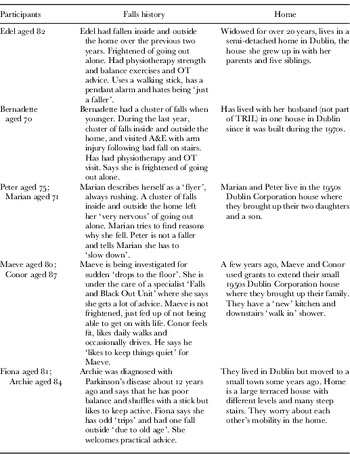
For the life-space diary pilot study, another inclusion criterion was that the participant was interested in taking part in a home-based, short but intensive pilot study on mobility and daily activities. Three of the participants had taken part in a previous falls-related study and all participants had met with the ethnographer, the primary fieldworker, prior to agreeing to participate in this exploratory study. The sampling was thus purposeful in that participants were recruited from the TRIL cohort. We engaged with five households comprising of eight community-dwelling older adults who had experiences of falls, expressed a fear of falling or lived with a spouse who had experiences of falls. Table 1 profiles each of the households with details of the living arrangements and falls' experiences of the participants. Written consent, outlining confidentiality, anonymity and the right to withdraw was sought from each participant.
The study participants

Notes: A&E: hospital accident and emergency department. OT: occupational therapy/therapist.
Data collection
Multiple data collection techniques were used. Over four weeks, the participants recorded a daily activity log, a weekly life-space diary and, for one week only, wore a pedometer. An introductory home visit included a qualitative interview that covered topics on childhood, education, paid work, living arrangements, family, friends, activities, daily routines, expectations, present circumstances, including self-reported health status, falls' history and social contact, use and experiences of technology and future planning. This was to give context to present daily life. With the participant's consent, a TRIL designer also accompanied the TRIL ethnographer on the first home visit to make a simple two-dimensional house plan that included the immediate outdoor spaces (e.g. garden, yard). The TRIL designer took measurements of rooms, placing doors, windows, large, fixed pieces of furniture and noting the orientation of the room. It had been explained to participants that the house plan would be used to plot daily activities and routine spatial pathways so that it would provide an immediate first impression of person–environment interactions within the home.
Two further home visits were carried out, one half-way through the study to collect the completed logs and diaries, to ensure that the participant was happy to continue, and to initiate the wearing of the pedometer. Adapted from the 17-item instrument of Monk et al. (Reference Monk, Reynolds, Machen and Kupfer1992) that was designed to log the times and locations of activities of daily living, we devised a 15-item log that recorded activities (e.g. getting up, eating and sleeping), locations (e.g. which room) and times (log of real time). The participants were asked to complete the log on all 28 days of the monitoring period. This was to raise awareness of mundane, familiar, daily activities that are rarely reflected upon. The semi-structured, life-space diary was adapted from the University of Alabama at Birmingham (UAB) Ageing Life-Space Assessment (LSA) tool (Peel et al. Reference Peel, Sawyer Baker, Roth, Brown, Bodne and Allman2005). Each week, the participants were asked to complete this diary with descriptions and durations of their interests and pastimes carried out in their homes, garden, back yard or the nearest open or green space. The diary questions also covered getting about the local neighbourhood (e.g. to shops, post office and pub); social activities elsewhere (e.g. attending a day centre, playing cards in a community hall), as well as visits to friends and family and travelling further than the local area. We encouraged the diary keepers to use free text and to note feelings and attitudes about particular activities in particular spaces.
The qualitative analysis
This paper reports the qualitative findings of the study. Across the households, the weekly free-text sections of the life-space diary were open coded by the TRIL ethnographer, which involved breaking down, examining, comparing, conceptualising and categorising the data (Bailey, White and Pain Reference Bailey, White and Pain1999; Morse Reference Morse and Morse1994; Thorne Reference Thorne2000). Ongoing coding and categorising meant that similar codes could be grouped under themes that were constantly compared, consolidated or challenged by the more recent data collection. The evaluative interview text and field notes were also compared to the themes that emerged from the life-space diary free-text analysis. Sharing the raw data and discussion of emerging qualitative themes with the wider TRIL ethnography team who were not directly involved in this project's fieldwork provided independent verification of the fieldworker's interpretation. The following sections present the findings under four themes: ‘being pragmatic’, ‘not just a faller’, ‘heightened awareness and blind spots’ and ‘working with technology’.
The findings
Of the eight participants, Edel withdrew by the third week of the research as unfortunately she was hospitalised, and Maeve became ill and provided only partial data.Footnote 2 Keeping daily logs and weekly life-space diaries for four weeks raised the participants' awareness of the backdrops to their daily lives.
Being pragmatic
Whilst some participants reported that the daily log was ‘tiresome’, ‘limiting’, ‘repetitive’ or ‘confusing’, and it was suggested that entries for seven or 14 days would have been sufficient, they were also surprised at how structured the days could be. The routine nature of all the participants' lives became very apparent: getting up more or less at the same time, having breakfast, lunch, a preference for going out ‘oh, straight after breakfast’ or ‘after the post comes, you know, I suppose it might be elevenish’ and ‘well of course I'm at mass every morning 9.30 ish to say the rosary’. The time spent doing activities also seemed habitual. As one participant remarked, ‘[it's] funny ticking all them boxes – look, see, I always seem to have 40 minutes at my dinner and then I like to have the sink in the chair for [a snooze for] a good hour’.
Whilst Bernadette suggested that a structure to the day ‘fills the time’, Fiona felt that routines are about ‘being pragmatic’, a coping strategy for dealing with what needs to be done. For example the participants had various health conditions (Parkinson's, heart disease, circulation problems) and many took medication. They described a number of strategies that helped them remember when to take the medicines. One couple used medication boxes, as the man said, ‘these are really useful. I sort both our pills every Sunday and then we have these for the week. They sit in the kitchen. We remind each other’. Another participant relied on his wife to remind him to take his daily medication after breakfast: ‘she has them there lined up, she's a marvel’. Others kept their medication in the bathroom, and taking them was part of their daily personal hygiene routine.
‘Being pragmatic’ also included developing new routines to deal with change. Adapting a new routine, even when the old one was getting difficult was sometimes only initiated by a particular incident. For example, getting up to go to the toilet at least once, often more, in the night seemed to be common among the sample. Maeve had had a series of falls outside the home and Conor, her husband, talked about their relatively new routine of using a commode and urinal in the bedroom as the bathroom was downstairs. Conor explained how this came about:
I'd seen Maeve struggle to get downstairs [to the toilet] and yet we didn't think about doing something. Then with the drops [falls] I thought this has to change and the nurse, she made it easy and brought what we needed.
For some, ‘being pragmatic’ meant accepting change simply as part of getting old, as indicated by phrases such as ‘parts wearing out’ and ‘what can you expect at my age?’ Fiona, aged 80 years, explained that her ‘trip’ (fall) might be ‘just old age’, and suggested that since ‘that trip in the garden, I've tried to be more aware of myself, of what I'm doing and yet the day so often just gets spent’. That said, the daily log made her aware not only of a ‘taken-for-granted’ structure to her day, but also of some activities that she considered risky:
When I look at this book [the daily log] and see what I'm doing, it makes you think. Like I got rid of the old mat in the kitchen, a trip hazard, but then I'm still reaching up to that cupboard to get the delph.Footnote 3 It's too high. We've been saying for ages we need to get the cupboards lowered. We should definitely do this.
I am ‘not just a faller’
Some of the participants were ‘tired’ of their falls status as ascribed to them by others. Edel, aged 82 years, had been widowed and living alone since her early sixties. She said she suffered from arthritis in her hips, knees and back and that this made walking extremely difficult. Within the previous two years, Edel had fallen both inside and outside her home, which left her frightened of going out alone. Twice a week, she is taken by car to and from a lunch club run by a local church, where she has a hot meal, and attends a weekly evening service. Whilst Edel found this routine enjoyable because she met other people, but felt that with a companion, she would be capable of walking to the lunch club as it is less than a quarter of a mile from her home. Her reflections on having to be helped ‘as a faller’ were spirited:
[What about] taking the help? I'm not just a faller. I have a wicked sense of humour, did you know I was a great dancer and the piano there [in the living room], the neighbours would be in and we'd have a sing-song and a bit of craic [conversation].
Edel also suggested that ‘taking the help’ might unwittingly entrench her sense of ‘just being a faller’. She described an incident when she was accompanied to her local church:
Oh I'm going to sound so ungrateful, but she [companion] kept saying, ‘Aren't you great?’ Like I'm a museum piece and [she was] fair hanging on to me, like she needed to prop me up … and she'd be saying, ‘watch now, oops: mustn't trip, pick up your feet and take your time’ in this sing song voice.
For Edel, the behaviour of others tended to diminish her sense of who she was. For other participants, falls that had left them fearful of going out alone were explicitly related to a loss of independence. Following a series of falls, the most recent three months before taking part in the study, Marian still curtailed going out alone. She suggested that the well-meaning advice of a long-standing friend to ‘slow down’ and ‘be careful’ was unhelpful. She did not want to be susceptible to falls. The mere act of thinking about ‘taking care’ and ‘slowing down’ seemed to emphasise both a loss of a pre-falling status of independence and acquiring a post-fall status of someone who needs to take care. As Marian said, ‘I don't want to be someone who falls’.
Five months prior to participating in this research, Bernadette suffered a series of falls in and outside her home. She expressed both continued nervousness at going out alone but also a sense of becoming a faller in her own home: ‘I was scared going up and down the stairs, it's true and the kids were always ringing and life was just almost like waiting to fall’. Reflecting on her life-space diary recordings, however, she said:
Well it's true, I'm still nervous going outside without him [husband] but I'm so much happier around me own home and up and down me own stairs now; isn't that good? And you can really see it from the diary and I was able to sit down and think about it and say to meself, ‘see Bernadette, see how you're getting back on form’. Isn't that great?
Heightened awareness and blind spots
The participants' diary entries revealed heightened awareness of lay and professional knowledge or understanding of falls prevention such as ‘picking up your feet’; ‘slowing down’, and this played out against a backdrop of daily blind spots. They had lived in their present homes for between two and more than 50 years. Some of the homes had different floor levels, with short declivities, sloping floors, steps to and from front and back doors, constricted landings, loose rugs, badly lit thresholds, large pieces of furniture that had to be avoided; as well as of course, the routines that continued without due thought, such as carrying a basket of washing whilst negotiating a home-made step, climbing the stairs with hot tea, using non-slip mats, and storing DVDs, newspapers and leaflets in dark corners hidden away so as not to cause clutter.
Three households participated in a home visit to produce a two-dimensional house plan. Some of the routine pathways and activities were mapped on to these plans and shared with the participants during the final home visit. One couple regularly negotiated unfixed breeze-blocks to step out into their garden.Footnote 4 He was sanguine: ‘Some things if you fix after nearly 30 years of dealing with it, you might just do yourself damage’ (laughs), but his wife commented: ‘Since the falls, I've been so careful, not to put too much washing in the basket, lifting it carefully, checking the floor's dry, and I never even noticed that loose back step!’
Maeve and Conor (introduced earlier) had lived throughout their marriage of over 50 years, in the same, small Dublin house on a large estate where they had raised six children. At the time of the study and for several months before, 80-year-old Maeve had suffered unexplained, sudden and frightening drops to the floor: ‘I'm up and then [in a moment] I'm down on my knees’. Maeve attended a local ‘Falls and Black-Out Unit’ for further investigations. During the final home visit, Maeve commented on her need to be ‘doing in the house’ and ‘tidying’. She commented that taking part in the study had made her aware of how often she suddenly changes her position, as when ‘bending down by the settee to put the magazines in that cupboard, stretching over the telly to get the phone’, and added that ‘the falls people [at the clinic], they've told me not to bend down, or get up too quickly, because I have that blood pressure that drops, and here I am doing it without thinking (laughs)’.
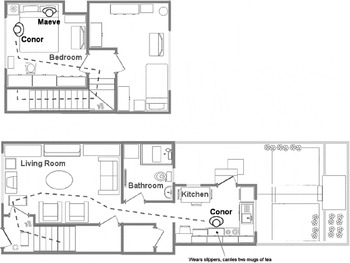
Conor enjoyed being the ‘first up to crack open the day’. He got up first to make tea, which he took upstairs to Maeve. He explained that the specialists at the clinic had said: ‘If she gets up quick, her [blood] pressure drops, she has to get up slowly and have a drink beforehand’. He did not mention, however, that this put him at risk of falling. Figure 1 plots Conor's movements on their house plan. The visual interpretation of the ‘pathway’ (denoted by a dotted line, with the circles depicting the whereabouts of Conor and Maeve, and the fixtures, furniture and moveable objects such as a rug at the foot of the stairs represented), bring to life Conor's taken-for-granted negotiation of several potential hazards, including stairs, rugs, the pathway from the living room into the kitchen, carrying mugs of tea, back through the living room, up the stairs, a sharp turn and small landing, the space between the bedroom door and the bed. None of this activity was articulated in his everyday talk or commented on in his diary and was very rarely considered, yet his daily habit offers scope for falls prevention interventions.
Conor's morning pathway from his bedroom to the kitchen.

Edel, introduced above, reflected on both her ‘blind spots’ (leaving her walking stick downstairs) and her own misleading awareness of her mobility. During the mid-way home visit, Edel asked the ethnographer to sit with her and listen to her audio life-space diary tapes. She remarked on ‘all them journeys I'm making from this table [in the living room] to the kitchen’, a very small space from which she makes multiple trips to collect food, tea and utensils. The diary made her aware of her considerable mobility in a small space, that she was not as sedentary as she feared, and that the table in the sitting room was a favourite spot. Edel did not have an opportunity to wear a pedometer, which may have provided further evidence of her high level of indoor mobility. For others, wearing a pedometer also raised issues beyond mobility.
Working with technology
Seven of the eight participants wore a pedometer for seven consecutive days and all remarked that it was not too intrusive. Whilst the pedometer's quantitative recordings gave an objective measurement of daily movements, the kilometres travelled and aerobic activity, the participants were curious to have the ‘objective measures’ along with their own perceptions of their mobility both within and outside the home. Peter, a keen amateur digital photographer, used a personal computer to manipulate the photographs which he found engrossing. He reflected that from initially being sceptical about ‘wearing a step clock’, he became motivated to try to improve on his ‘personal best’:
I was a bit taken aback when I saw that it [the pedometer recorded] a couple of kilometres that day. I get involved with the photos on the computer, so the next day, I went out the back [yard] a lot more, and got on with the sorting there. That reading, it was good, wasn't it? Almost double? Makes you think, you can be so unaware.
Despite our reassurances to the contrary, some participants took responsibility for the pedometer. Archie wore it clipped to his casual, elasticated trousers (‘easier to manage with the Parkinson's’) but it kept falling off. He remembered that one time, ‘I was so worried I'd lost it [outside] but when we got back there it was on the bed’. He fettered a loop on the pedometer to secure it to a loop on his trousers. Another participant was confused about how the pedometer worked: when arranging flowers in her local church, she placed the pedometer in her handbag and left it on a church bench.
As with their daily routines, for some participants their experiences with and use of everyday, familiar technology became a seamless aspect of daily living. Television, radio, DVD, cordless phones and remote controls were commonly used, as were microwaves and electric kettles. Three participants used the text function on mobile phones, and two others used them ‘when I'm travelling’, ‘to arrange meeting up’ and ‘in case something happens’. Three participants, two being a couple, owned and used their own personal computers. For others, however, there was a sense of ‘making do’ with earlier technology. Maeve and Conor had a 1980s ‘ghetto blaster’, a 1960s long-play record player, and a portable compact disc player, and did not have nor wanted a cordless phone. Conor said, ‘we have a phone downstairs and in the bedroom, what more would you need?’ He recounted a time when Maeve was out visiting local gardens and shopping with one of their sons and he received a call. Maeve had fallen in a greenhouse and was taken to a doctor. Later the son said, ‘you need a mobile phone, Daddy, the both of you. If you're out alone you can call someone’, but Conor reasoned that ‘it's too much fuss’ and said ‘how did we manage before?’ Nonetheless, after Conor fell out of an ‘old deep bath that we had for years in the downstairs bathroom’, on the advice of a neighbour, a grant was successfully applied for and the bath was replaced with a non-slip walk-in shower.
With particular reference to assistive technologies designed to mitigate the negative impact of falls and fear-of-falling, whilst the participants discussed their usefulness and costs, they also raised issues of emotional losses and gains. For example, Edel had fallen badly when dismounting a bus six months before the research, and had undergone physiotherapy to improve her strength and balance. An occupational therapist visited her at home. Edel accepted a walking stick, grab rails for her shower unit and bathroom, and another stair rail. She had also ‘signed up for’ and accepted ‘a small charge’ for a pendant social alarm, but she forgets to wear it. She explained, ‘I'm always hanging it up with the rosary [on the bedroom wall]’. Edel also refused to apply for a grant to install a downstairs toilet or a stair lift: ‘What would I be wanting with those? I've lived in the same house since I was two and I'm not going to change things now’. Finally, there were wish lists. Bernadette wanted a falls alarm that in the event of a fall would alert first a known and trusted family member. She reasoned: ‘I know you have to get the right help, but just speaking to someone you know particularly when falling outside, that would be so less embarrassing’. Fiona, on the other hand, was more pragmatic: ‘just a neat technological fix that gets my old joints back into the saddle [cycling]!’
Discussion and conclusions
The findings of this exploratory study raise some critical issues in relation to older adults, their falls experiences, awareness of routine activities and movements and technologies for independent living. Firstly, the participants had a keen awareness of practical falls-prevention advice, such as ‘to slow down’ and to avoid hazards such as leaving objects on stairs or unstable mats, but nonetheless recording and self-reporting their daily activities and spatial pathways raised awareness. Within the familiar space of home, where person–environment interaction is rarely if at all considered, there are ‘blind spots’. Maeve became aware of bends and stretches related to her daily, routine tasks that may affect her blood pressure, while Fiona, when stretching up to a cupboard positioned high, realised she might lose her balance. These then could be construed as hazards specific to individual life spaces. Investigating the finer detail of routine activities and spatial pathways may open up specific falls-related issues and these could then be addressed.
Secondly, and echoing Heywood's (Reference Heywood2004) and Milligan, Bingley and Gatrell's (Reference Milligan, Bingley, Gatrell, Davidson, Smith and Bondi2005) work on the affective experiences of home, the participants had a clear sense of what would be suitable for them, when and why. Maeve and Conor were happy with a home modification (the new walk-in shower), but despite Conor curtailing his regular walks for fear that Maeve may have another ‘funny turn’ whilst at home and alone, he had yet to ‘see the sense’ of acquiring and using mobile phones. As with the introduction of the pedometer, the potential of a ‘new solution’, as well as its particular challenges or need to be individually appropriated, may only be thought through, when actively used. As the findings illustrate, for some older adults, many familiar domestic technologies such as DVD machines are now part of everyday life. There would of course have been a period of adapting, perhaps resisting, before actual use deemed whether the device was useful.
Thirdly, and as noted in the introduction, whilst there is some research on everyday experiences of living with a fear or risk of falling, the theme not just a faller suggests that, as well as focusing on individualised falls-prevention advice, there is also a need to consider the wider social constructions and social implications of falling. As with Edel and Marian, unwanted roles may be ascribed to them as ‘fallers’ who need support or who need to ‘take care’. Equally and as with Bernadette, well-meaning concern may lead to a post-fall period when life seems to be reduced to ‘waiting to fall’.
Fourthly, the use of life-space data collection tools also raised the participants' awareness of taken-for-granted and potentially risky, routine activities and movements, which may have implications for falls-prevention advice. As the reviewed life-space approach literature demonstrated, the well-established and rich ecological, person–environment work suggests that if a person feels they can adapt themselves or their environment to meet a ‘new’ demand, then they are more likely to feel positive and in control (Lawton and Nahemov Reference Lawton, Nahemov, Eisdorfer and Lawton1973). For Bernadette, who some five months after a series of falls still felt that she had become a ‘faller in her own home’, the log and diary recording and her reflections on her daily activity and mobility indicated that she was beginning to take command again of home spaces that she had come to fear, such as the stairs. Raising awareness of such adaptation might lessen feelings of powerlessness and low self-esteem and also reduce drastic responses to falling, such as restricting physical and social daily activities and movements. Finally, in terms of falls-related technologies to support independent living, it is clear that an approach tailored to a person's broad needs rather than a narrow focus on falls or fear-of-falling in the long term may support and enable an affirming life space. For Conor's morning tea-making routine, it may be that an electric tea maker machine set up in the bedroom would be a ‘safer’ option. Knowing that Conor likes to be the first to go downstairs to ‘break open the day’, however, leads to a conversation about how to also minimise risk here such as investing in non-slip, indoor footwear.
A limitation of this study was its short duration. It developed from a larger study and emphasised an approach to data collection, in this case using self-report, life-space diaries and daily activity logs to capture the taken-for-granted detail of everyday activity and mobility. From with the TRIL research programme, the study findings highlight how for technologies to be appropriate to everyday needs, they need to mesh with a broad life-space canvas of adaptation to changing needs. Specifically, this finding informed a small TRIL study that piloted placing motion sensors in the homes of participants living alone and who had histories of falls. The first step in this study was to access participants' life spaces in order to make sense of participants' perceptions of the sensors from within the context of their everyday lives.
In conclusion, how the negative impacts of a fall or fear-of-falling may be alleviated through technological or other assistive devices has to take into account an individual's familiar life space. For some, there may be acceptance of strategies that although effective, could well be improved upon, but for others, there may also be a struggle to ‘get through the day’, to live comfortably within one's life space because the demands appear too great. The challenge is for technology to work with older people and their existing strategies, in order to focus on the ways in which such devices can be adapted to meet ongoing and changing need. Becoming older, use of technology and getting on with ageing in place are then symbiotic processes that for the older person denote achieving and maintaining comfortable autonomy over their life space.
Declaration
The views expressed here are those of the authors and not necessarily those of the study's funding bodies.
Acknowledgements
This paper is based upon a presentation at a symposium on Ageing, Wellbeing and Place during the 2008 annual conference of the Royal Geographical Society, London. Special thanks to the TRIL research team involved in this study: Lisa Cogan, Chie Wei Fan and Clodagh Cunningham of St James Hospital, Dublin; and Terry Dishongh of Intel, Ireland (TRIL). Thanks also to the TRIL ethnography team for analytical validation: Simon Roberts of Intel Ireland; and Athena Mclean and Cormac Sheehan of the National University of Ireland Galway. A special thanks to the anonymous reviewers for very helpful comments.