PS01.01
Guidelines for the management of aggression in dementia: The missing links
Brian Draper, H Brodaty, L Low, A Withall, University of New South Wales, Sydney, Australia
V Vickland, University of New South Wales, Randwick, New South Wales, Australia
N Chilko, Dementia Collaborative Research Centre, The University of New South Wales, Sydney, New South Wales, Australia
Objective: To develop a conceptual framework for computerised clinical guidelines on the management of aggression in patients with dementia.
Method: A concept map was developed of the key ideas and themes found in research papers, clinical guidelines and practice recommendations that focus on the management of aggression, the elderly and dementia. These concepts were used as criteria to evaluate the comprehensiveness and completeness of current clinical guidelines on the management of aggression in dementia.
Results: Eleven key concepts were identified in the literature as important in the management of aggression in dementia: (1) the clinical and demographic characteristics of the individual, (2) the environment where the patient receives care, (3) the personal experience and life story of the patient, (4) the characteristics of the aggression, (5) the theory of causation underpinning the treatment of aggression, (6) the goals of the treatment plan, (7) the characteristics of pharmacological interventions, (8) the characteristics of non-pharmacological interventions, (9) evidence based recommendations, (10) endorsement by health care services and medical and nursing colleges, and (11) the process of updating the guidelines. Fourteen clinical guidelines published since 2005 were included in the evaluation. Links between concepts and their representation in the text of the guidelines were assessed as strong, moderate, weak or absent. The most strongly represented links in the guidelines were the pharmacological management of aggression depending on its presentation, and the consideration of individual factors in managing aggression. These links were well represented and weak only in two out of fourteen guidelines. The role of the environment, non-pharmacological approaches and the goals of treatment were moderately represented in x guidelines. A consideration of theoretical approaches to causation was weakly represented, and a consideration of the patient's individual life story was weak or absent in nine out of the fourteen guidelines. The provision of details of updating the guideline was absent in eleven out of fourteen guidelines, which was quite alarming given the importance of managing the mental health of fragile elderly patients. Ten out of the fourteen guidelines were endorsed by a professional college or health service.
Conclusion: The overall mapping reveals that there are too many links missing in the majority of published guidelines which casts a doubt over their usefulness in clinical practice. This is of particular importance when we consider that one of the aims of clinical guidelines is to strengthen the transfer of knowledge from research to clinical practice.
PS01.03
The role of the dopaminergic system in apathy in Parkinson's disease and Alzheimer's disease: An experimental approach
Pauline Aalten,Alzheimer Centre Limburg, Maastricht, The Netherlands
R Drijgers, Maastricht University, Maastricht, Limburg, The Netherlands
A Leentjens, Maastricht University Medical Center, Maastricht, The Netherlands
F Verhey, University Hospital of Maastricht, Maastricht, The Netherlands
Overview: Rosa L. Drijgers, MSc.1, Albert F.G. Leentjens, M.D., Ph.D.1, Frans R.J. Verhey, M.D., Ph.D.1, Pauline Aalten, Ph.D.1 1 Department of Psychiatry and Neuropsychology, School for Mental Health and Neurosciene/Alzheimer Center Limburg. Maastricht University Medical Center. P.O. Box 5800, 6202 AZ Maastricht, The Netherlands.
Background: Apathy is characterized by a loss of initiation and motivation, decreased social engagement, and emotional indifference. Apathy is a frequent neuropsychiatric syndrome in Parkinson's disease (PD) and Alzheimer's disease (AD), and it has a negative impact on cognitive and motor performance, everyday functioning, prognosis, and quality of life of both the patient and caretaker. Little is known about the pathophysiology of apathy in PD and AD and no effective treatment is available to date. Dopaminergic circuits have been associated with self-reward and initiation and it has been suggested that dopaminergic medication may be useful to reduce apathy. Knowledge of the involvement of the dopaminergic system in the pathogenesis of apathy in PD and AD may open the road for new treatment options.
Objective: To examine the role of the dopaminergic neurotransmitter system in the pathophysiology of apathy in patients with Parkinson's disease (PD) and Alzheimer's disease (AD).
Methods: In a randomized, double-blind, placebo controlled, crossover design 23 PD patients and 23 age, gender and education matched healthy controls were challenged with methylphenidate, pramipexole or placebo on three different testing days. Twelve AD patients (inclusion still ongoing) received only a methylphenidate and placebo challenge. The main study parameters were the performance on neuropsychiatric and neuropsychological tests for all groups, including assessments of cognitive status, mood, apathy, and an observation of spontaneous self-reward behaviour. These outcome measures were assessed on each of the testing days, both before and after the pharmacological challenge.
Results: Data will be analysed soon and results will be presented at the IPA congress. We expect that PD and AD patients suffering from apathy can be primarily triggered with methylphenidate, an agent that stimulates dopaminergic circuits, and in the PD group, that pramipexole will have the same effect. In a between subject comparison, we expect patients to score worse than control subjects on measures for apathy and depression. We also expect patients to perform less well on neuropsychological tasks, which are mainly measures of executive functioning. These deficiencies are expected to improve after challenge with pramipexole or methylphenidate. In a within subject comparison it is expected that the improvement in score on the different measures will be greater after the methylphenidate and pramipexole challenge than after the placebo condition.
Discussion: The role of the dopaminergic system in the pathogenesis of apathy in PD and AD will be discussed. In addition, the relevance for healthcare will be evaluated and some recommendations for future research will be given.
PS01.04
The impact of antipsychotics and neuropsychiatric symptoms on quality of life for people with dementia living in nursing homes
Julia Vakhteeva, University Radboud Nijmegen, Medical Centre, Venray, The Netherlands
H Bor, R Wetzels, R Koopmans, S Zuidema, Radboud University Medical Centre, Nijmegen, The Netherlands
Background: Neuropsychiatric symptoms (NPS) and antipsychotic drugs (AP) are both thought to have a negative effect on quality of life (QoL). The aim of this study was to establish whether AP use has a negative effect on QoL independently from NPS.
Method: longitudinal cohort study of 290 dementia patients living in 9 different nursing homes in Netherlands. The measurements were repeated with a 6-month interval over a two-year period. Patients were considered for inclusion provided they: (1) met the Diagnostic and Statistical Manual of Mental Disorders fourth edition (DSM-IV) criteria for dementia, (2) had no history of life-threatening disease at the time of inclusion, and (3) resided in the nursing home for at least four weeks. Patients with severe stage of dementia (Global Deterioration Scale (GDS) = 7) at baseline and patients who reached GDS stage 7 during the two year follow up period were excluded from the analysis. QoL and NPS were assessed with the Qualidem questionnaire and Neuropsychiatric Inventory- Nursing Home Version (NPI-NH) respectively. Our longitudinal dataset include 5 assessments of each patient, with concomitant four intervals during which QoL, AP use and NPS and other variables may change. To correct for the dependency between the observations within a patient (intra-patient correlation was expected > 0), GEE was used. Influence of change in AP use on change in QOL of life and development of QoL in time was studied with two different GEE models with simultaneous correction for other possible predictor variables such as NPS, cognition, ADL, age, gender and use of other psychotropic medication Model 1: The first model was used to estimate the relationship between changes in QoL (as outcome) and AP prescription pattern. A categorical variable ‘AP -prescription pattern’ comprises 4 possible categories depending on the use of antipsychotics at each 6 month interval: 1) patient that did not receive AP at two subsequent measurements, 2) patients received AP at two subsequent measurements of a 6-month interval, 3) patient that used AP at the beginning of the interval and was AP-free at the end of the interval, 4) patients that did not use AP at the beginning of the interval and received AP at the end of the interval. This model allows to detect whether changes in QoL depend on AP prescription or change in AP use. Model 2: The second model estimates QoL (as outcome variable) in relationship to the variable time and AP use, comparing development of QoL in time between patients constantly using AP during the whole follow up (chronic AP users) and patients who stayed AP free during the whole follow up period (no-users). This model allows to detect whether QoL develops differently between patients that used AP chronically and patients that had never used AP (at any time point) after correction for other covariates i.e. NPI-NH total score, SIB-s, ADL total score, age and gender.
Results: AP prescription patterns did not have a statistically significant influence on change in QoL, whereas change in NPI-NH total score was a consistent predictor of change in QoL (Model 1). Development of QoL in time in chronic AP-users did not differ from AP-free patients, except for the Qualidem sub-scale restless tense behavior (Model 2). Restless tense behavior in AP-free patients improved compared to a slight deterioration in chronic AP users. This effect did not turned out to have a significant influence on total quality of life. Discussion: AP use does not necessarily have a detrimental effect on QoL in patients with dementia. Instead, NPS have a consistent negative effect on QoL. Cautious use of AP for treatmant of NPS might be justified when used carefully while monitoring benefits and avoiding side-effects.
PS01.05
The effects of introducing a nursing guideline on depression in psychogeriatric nursing home residents
Renate Verkaik, J Bensing, A Francke, NIVEL, Utrecht, The Netherlands
B Van Meijel, In Holland University for Applied Sciences, Amsterdam, The Netherlands
M Ribbe, Medicine, Amsterdam, The Netherlands
Introduction: The prevalence rate of depression in psychogeriatric nursing home residents with dementia is recently estimated at 19% (Verkaik et al., 2009). Comorbid depression in dementia has been associated with decreased quality of life, greater health care utilization and higher mortality rates. The effects of introducing an evidence based nursing guideline on psychogeriatric nursing home wards were studied. The guideline is based on the BehaviorTherapy_PleasantEvents, developed and studied by Teri et al. (1997) for people with dementia still living in the community. BehaviorTherapy_PleasantEvents follows the Integrative Theory of Depression and the Pleasant Events Schedules developed by Lewinsohn et al. (1985). The Pleasant Events Schedules aim at breaking into the depression cycle specifically at the point at which depressed individuals experience fewer activities as pleasant, engage in pleasant activities less frequently, and therefore obtain less positive reinforcement than other individuals. The Pleasant Events Schedules aim at increasing pleasant activities and positive interactions with the environment. Besides increasing pleasant events, a second aim of the BehaviorTherapy-PleasantEvents is reducing unpleasant events for people with dementia. For our nursing guideline we adapted the method of Teri et al. to the context of residential care provided by certified nurse assistants (CNAs) in collaboration with other caregivers. For the introduction of the guideline into the psychogeriatric nursing home wards a specific training program was developed in which the nursing teams learned how to apply the guideline to their own residents. The objective was to study the effects of the introduction of the nursing guideline on depression in demented nursing home residents of psychogeriatric wards.
Methods and Materials: A multi-centre (n = 9) controlled intervention study with randomization at ward level (n = 18) with pre-test, post-test and follow-up measurements was used. Participants were 97 residents of psychogeriatric nursing home wards that met the following inclusion criteria: (1) Diagnosis of dementia (all types) (APA, 1996); (2) Severity of dementia from “age associated memory impairment” to “moderately severe dementia” (Global Deterioration Scale stages 2 to 6: Reisberg et al., 1982). (3) Diagnosed with depression in dementia according to the Provisional Diagnostic Criteria for depression of Alzheimer's Disease (PDC-dAD:Olin et al., 2002). Primary outcome was severity of depression measured with the MDS/RAI-Depression Rating Scale and the Cornell Scale for Depression in Dementia. Control measures (covariates) are gender, marital status, duration of residence in the nursing home, care dependency, cognitive impairment, and medication use (antidepressants, antipsychotics, benzodiazepines and ACE-inhibitor/β-blockers).
Results: A significant treatment effect was obtained for depression on the MDS/RAI-Depression rating scale (DRS). In the experimental group depression severity reduced from 4.56 (±0.35) to 3.91 (±0.35) at post-test to 3.79 (±0.38) at follow-up. In the control group depression severity at pre-test is 3.84 (±0.52), at post-test rises to 4.61 (±0.57) and than decreases to follow-up to 4.07 (±0.61). The differences are quadratic because of the rise and fall of depression severity in the control group. The treatment effect was not significant on the Cornell Scale, although the trend in the experimental group shows a reduction of depression from 11.42 (±0.62) at baseline to 10.31 (±0.57) at post-test, to 9.96 (±0.66) at follow-up. The trend in the control group first remains at the same level from pre-test to post-test (11.48 ± 0.90 to 11.46 ± 1.12) and then drops to 9.93 (±1.18). The success of the guideline introduction was studied and was found to be good on three of the participating wards, on four it was moderately successful and on two not successful.
Conclusions: This study shows significant reductions in depression severity by introducing a nursing guideline on psychogeriatric nursing home wards. Better compliance with the guideline could probably enlarge the effects. Some ways to achieve this are: (1) additionally train non-certified nurse assistants, and (2) emphasize necessary conditions for successful introduction of the guideline to nursing team managers.
This study was funded by ZonMw, The Netherlands organization for health research and development (project nr. 5401.0001)
PS01.06
Non-pharmacological intervention in Alzheimer's disease: Benefits of aerobic exercise on neuropsychiatric symptoms and caregiver burden: A randomized controlled trial
Florindo Stella, UNESP - Unv Estadual Paulista, Rio Claro, São Paulo, Brazil
A Canonici
S Gobbi
R Santos-Galduroz
J Cação
L Gobbi
Overview: Abstract Neuropsychiatric symptoms highly prevalent among Alzheimer's disease (AD) patients and represent a source of caregiver's burden with a shorter time to institutionalization and an increase in suffering of caregivers or relatives. Currently there is a significant increasing effort in order to clarify the impact of physical exercises, as a non-pharmacological intervention, on reducing the patient's suffering and on alleviating the caregiver's burden. Pharmacological interventions for patients with behavioural disturbances in Alzheimer's disease at present are only symptomatic, although treated patients have shown significant benefits compared to those without treatment. Improving the management of Alzheimer's disease patients with neuropsychiatric symptoms such as agitation, aggression, depression, apathy, and other psychopathological phenomena, involves attenuating the frequency and severity of these disturbances.
Aims: To examine the effects of a six-month aerobic exercise on neuropsychiatric symptoms from patients with Alzheimer's disease, as well, the impact of exercise on alleviating caregiver's burden.
Methods: This controlled trial involved 32 community patients and their respective caregivers coming from two university centers in Brazil. The aerobic exercise program was performed during a six-month period, 60 minutes three times per week. Patients were divided into two randomized groups: 16 with motor intervention and 16 sedentary (five sedentary patients were excluded because of clinical intercurrences). Aerobic exercises and functional balance were conducted during six months, 60 minutes three times per week. Main exercise program involved walking, dancing, and exploring upper and lower limbs driven to enhance flexibility, strength, agility, and to improve functional balance. These motor components seem to be important for maintaining functional capacity of patients with AD. We evaluated psychopathological features of patients using Neuropsychiatric Inventory (NPI) and Cornell Scale for Depression in Dementia. Caregivers were evaluated concerning burden and stress through NPI-Distress and Burden Interview.
Results: The aerobic exercise program during a six-month period was effective in decreasing neuropsychiatric symptoms in patients with AD and reduced caregivers burden. Patients from exercise group presented significant reduction in (Neuropsychiatric Inventory (F:11.12; p = 0.01) and Cornell Depression scale (F:11.97; p = 0.01). Caregivers whose patients participated in intervention program had their burden and stress significantly decreased when compared to caregivers whose patients were sedentary (NPI-Distress (F: 9.37; p = 0.01) and Burden Interview (F: 11.28; p = 0.01). However, in the sedentary group, these symptoms slightly increased, and respective caregivers had their burden unchanged. Patients who participated in aerobic exercise had improvement on several domains from Neuropsychiatric Inventory, for instance in irritability, anxiety, apathy/indifference, and appetite alterations when compared to sedentary. On the other hand, differences between groups could be attributable to the reciprocal influence of two factors: the reduction in symptoms among patients who participated in aerobic exercise and the increase of these symptoms in the sedentary group. Concerning the procedures as described in the methods section, the raters completed the scales considering the patient and the caregiver together or separated, according to specific situations, such as emotional condition or behaviour control. Despite these procedures could interfere with accuracy of quality of measurements, the raters engaged themselves in order to avoid the emotional influence from patient or caregiver in the results. Regarding the number of patients, there was a small sample size mainly in sedentary group, which substantially reduces its statistical power and capacity of generalization.
Conclusions: An aerobic exercise program, during six months, contributed to reduce neuropsychiatric symptoms in patients with Alzheimer's disease and to attenuate caregivers’ burden. Irritability, anxiety, apathy, and appetite alterations were the mainly improved psychopathological manifestations. Aerobic exercise contributed to reduction in neuropsychiatric symptoms of Alzheimer's disease patients and attenuated caregivers’ burden.
PS01.07
Evaluation of psychogeriatric characteristics of frail elderly benefiting from innovative home care services: A Belgian follow up study
Johanna De Almeida Mello, Katholieke Universiteit Leuven, Winksele, Vlaams Brabant, Belgium
A Tancredi, University of Liège, Sart Tilman Liège, Liège, Belgium
T Van Durme, Universtité catholique de Louvain, Brussels, Belgium
Z Coulibaly
J Chiêm
S Cès
M Lopez Hartmann
C Gosset, University of Liège, Liège, Belgium
C Swine
R Remmen, Department of Primary and Interdisciplinary Care, Centre of General Practice, University Antwerp, Antwerp, Belgium
J Macq
A Declercq, KULeuven, Leuven, Begium
Overview: Background In order to expand the types of home care services funded by the government, the Belgian National Institute for Health and Disability Insurance (NIDHI) wishes to evaluate innovative projects in this sector. This evaluation will examine a large variety of initiatives in the elderly care with the main common objectives of keeping frail elderly at home, maintaining or improving their quality of life and preserving their autonomy. This paper shows research which is based on the evaluation project called Protocol 3, a collaboration project between the NIDHI and a consortium of four Belgian universities (UCL, KULeuven, UA and Ulg). In Protocol 3 there are 66 innovative projects which started in 2010. These projects are clustered according to the type of main intervention they provide: case management, night care, alternative housing, occupational therapy at home, psychological support for elderly and informal helpers, etc. Over three thousand frail elderly clients will be followed up closely during a period of 4 years, from 2010 until 2013. According to the inclusion criteria, these clients should be frail and at risk for institutionalization.
Methods: In the paper we show the preliminary results of the first data collected from 56 innovative projects providing care to 998 frail elderly clients (mean age 80.8 years old, 66.3% female). The presentation will show analysis of data collected from 66 projects and more than 1500 clients. Most of the variables are measured using the interRAI Home Care instrument. The interRAI instruments are standardized, evidence-based and internationally validated assessment tools. Other complementary internationally validated scales such as the WHOQOL-8 and the Zarit Burden scale (12-item) were selected to complete the evaluation. In this presentation, we will focus on the follow up of the results from the interRAI HC instrument and on how psychogeriatric characteristics evolve over time. Moreover, the analysis will also indicate whether there are significant differences between the characteristics of the elderly across projects.
Results: The preliminary results from the interRAI Cognitive Performance scale (CPS2) show that 47.1% of elderly in the study show cognitive impairment of mild (12.0%), moderate (15.1%) and severe or very severe intensity (20.0%). This scale has been validated with the MMSE scale. The interRAI Depression Rating Scale (DRS) shows that 27.7% of the elderly have signs of depression. Construct validity of this scale was assessed by comparing it with the Hamilton Depression Rating Scale and the Cornell scale. In addition, 37.4% of the clients in the study reported to withdraw from activities of interest such as planned activities or being with family or friends. The Clinical Assessment Protocol (CAP) ‘Activities’ is one of the output variables of the interRAI instruments. This indicator identifies elderly with some cognitive capacity who have either withdrawn from activities or who are uneasy entering into activities and social relationships. This CAP shows a very high risk for 30.4 % of the elderly in the study and provides advices to caregivers on how to set goals of care to improve their clients’ activity involvement. The analysis of these and other characteristics is important to have insight in the situation of the frail elderly. In addition, an important evaluation will be the comparison between elderly across projects. This will allow us to identify whether specific projects are more suitable for a certain elderly profile.
Conclusion: This paper focuses on some psychogeriatric characteristics of frail elderly benefiting from innovative home care projects in Belgium. The scores of the interRAI CPS and DRS scales show that cognitive decline and depression are a large problem in this study population. Moreover, a large percentage of elderly clients report to be less or not involved in activities which they used to be part of. The follow up of these and other determinants will give us insight on how elderly psychogeriatric characteristics evolve over time. The analysis will also point out the differences between the characteristics of the elderly across projects and will indicate whether innovative programs have an impact on frail elderly who are at home. The use of a comprehensive geriatric assessment such as the interRAI HC helps to evaluate these determinants and control for the presence of premorbid history, functional deterioration and other significant variables. Researchers intend to show the evolution of psychogeriatric characteristics and to analyze how co-morbidity affects these characteristics.
PS01.08
Methylphenidate in apathetic persons with dementia of the Alzheimer type (DAT): Impact on function, caregiver burden and cognition
William Burke, University of Nebraska Medical Center, Omaha, Nebraska, United States
P Padala, VA Nebraska Western Iowa Healthcare System and The University of Nebraska Medical Center, Omaha, Nebraska, United States
Background: Apathy is the most common behavioral problem reported in persons with DAT. Apathy is characterized by indifference, disengagement, passivity, and loss of enthusiasm, interest, empathy and interpersonal involvement. Apathy has profound consequences for both patients and caregivers leading to an increased reliance on family members for ADLs, higher caregiver burden and ultimately to institutionalization. There are no currently approved treatments for apathy. The purpose of this study was to evaluate apathetic patients with DAT treated with methylphenidate (MPH) in a randomized controlled trial. Reported here are outcomes of the trial related to cognition, caregiver burden and function.
Methods: Patients with mild to moderate DAT who had apathy scores on the Apathy Evaluation Scale (AES) of >40 entered into the study after informed consent was obtained. A thorough history was gathered including baseline demographics, and measurements included the Apathy Evaluation Scale (AES), Clinical Global Impression (CGI, CGI-S), Mini-Mental State Examination (MMSE), Modified Mini-Mental State Examination (3MS), Executive Interview (EXIT-25), Activities of Daily Living (ADL), Zarit Burden Scale (ZBS) and Instrumental Activities of Daily Living (IADL). Patients were randomly assigned to placebo or MPH initially dosed at 5mg BID and titrated to 10mg BID at two weeks. Follow up visits were scheduled at 4, 8, and 12weeks. Study medication was then stopped and subjects returned for one additional visit at week 14. Data with a normal distribution were analyzed using a repeated measures mixed model. ADL was transformed to a binary variable and analyzed with a generalized linear mixed model. Bonferroni corrections were made to adjust for multiple comparisons.
Results: A total of 60 male patients were enrolled and one patient was excluded in each arm of the study leaving a total of 29 patients in each group. Mean age was 76.6 (±7.9) years. Patients who received MPH showed significant improvement on a global measure of function (CGI) and global severity (CGI-S) at the end point of active study that did not persist after a two-week follow-up. Subjects receiving MPH also showed significant improvement on the MMSE and 3MS compared to the placebo group at week 12 that did not persist after drug discontinuation. There were significantly more subjects with ADL deficits at baseline in the MPH group. The percent of subjects with any ADL deficits did not differ significantly at study end point. IADLs were not significantly different at baseline and did not show any significant difference between groups at any time point though IADLs significantly improved from baseline in the MPH group. ZBS scores likewise did not differ at any time point between the two groups though those in the MPH group showed a trend for improvement at week 12 compared to baseline. MPH was well tolerated in this population. No patient discontinued the study due to adverse effects.
Conclusions: MPH treatment was associated with improved ratings of global function as well as improvements in brief cognitive measures that did not persist after treatment discontinuation. Measures of ADL, IADL and caregiver burden did not differ between groups but all showed evidence of positive change from baseline within the MPH group. None of these effects persisted beyond a two-week discontinuation period. MPH may offer significant benefits for apathetic persons with DAT beyond a direct effect on apathy.
PS01.09
Classification of delusions in Alzheimer's disease
Keiko Nomura, D Yamamoto, M Takeda, H Kazui, M Takaya, T Wada, H Sugiyama, K Yoshiyama, H Tokunaga, Osaka University Graduate School of Medicine, Suita, Osaka, Japan
Y Kito, Nissay Hospital, Osaka, Japan
K Tabushi, Asakayama Hospital, Sakai City, Osaka, Japan
Objectives: A wide range of delusions can be observed in the course of Alzheimer's disease (AD). Many AD patients experience more than two types of delusions at the same time. On the other hand, AD patients with delusion do not experience all of the different kinds of delusion, and the frequency of each type of delusion differs. Delusions in AD may be classifiable and distinguishable symptoms. The aims of this study were to classify delusions in AD and to investigate the effects of cognitive impairment on each classified delusion group.
Methods: Eighty seven consecutive probable AD patients showing delusion were recruited for this study (mean age = 75.7 ± 6.8, male: female = 22: 65). Delusion was evaluated using the Neuropsychiatric Inventory (NPI). In the NPI delusion subscale, eight different types of delusions were evaluated in a manner of present or absent. The eight delusions were: delusion of persecution, delusion of theft, delusional jealously, phantom boarder symptom (PBS) (belief that unwelcome guests are living in his/her house), belief that one's spouse or others are not who they claim to be, belief that his/her house is not his/her home, delusion of abandonment, and delusion relating to the television, which is a belief that television or magazine images and reports are actually present in the home. A factor analysis was performed to classify the eight types of delusions. After the factor analysis, multiple regression analyses were performed to investigate the effects of specific cognitive impairment, which was assessed by the Mini-Mental State Examination (MMSE), on each classified delusions.
Factor loadings for delusions according to Neuropsychiatric Inventory in the AD patients

Significant loadings (≥0.30) were entered into the factor.
Results: The factor analysis of the eight different delusions in the 87 AD patients with delusion classified the delusions into three factors and an independent category (Table 1). The delusions that were loaded into Factor 1 were: belief that his/her house is not his/her home, PBS, delusion of abandonment, and belief that one's spouse or others are not who they claim to be. The delusions that were loaded into Factor 2 were: delusion relating to the television and delusion of persecution. The delusions that were loaded into Factor 3 were delusion of abandonment and delusional jealously. Delusion of theft was not loaded into any of these factors, so it was regarded as an independent delusion. The multiple regression analyses showed significant associations between the factor scores of Factor 1 and the scores of MMSE constructional praxis (β = -0.255, df = 82, p = 0.033) and between the factor scores of Factor 2 and the scores of MMSE short-term memory/working memory (β = -0.306, df = 82, p = 0.032), but not between the factor scores of Factor 3 and any of the specific MMSE subgroup scores. In this study, delusion of theft was not classified into any factors, so that we could not assess the effects of cognitive impairment on delusion of theft. Discussion Factor 1 was regarded as delusional misidentification, and it was related to the impairment of constructional praxis, in which visuospatial perception plays a role. The patients with Factor 1 seem to misidentify objects, people, and home, so that they cannot obtain familiarity with the environment. Delusion of abandonment may subsequently emerge since the patients cannot receive familiarity with the loved ones and home due to delusional misidentification. The common feature of Factor 2 is awareness of persecution, and it was related to the impairment of short-term memory/working memory that interferes with information processing. AD patients can more successfully retrieve personal experiences arousing emotion, especially a fear, than the surrounding knowledge such as when and where the experiences were gained. In the patients with Factor 2, the loss of the information source can make the patients sense as if irrelevant events happen nearby, and then such irrelevant things can be sources of fear. A thought of being abandoned is the common feature of Factor 3, and it was not associated with any domains of cognitive dysfunctions. The thought of being abandoned in aged people is related to feelings of inferiority due to senescence and dependence on the spouse. Factor 3 may be related to feelings of inferiority due to the disease and the rejections of dependence on the spouse. Delusion of theft was not loaded into any of the three factors, and the factor loading of delusion of theft was negatively high on axes of Factors 1 and 2. It seems that delusion of theft is phenomenologically deviated from Factors 1 and 2.
PS01.10
The care for person with dementia: The role of an Alzheimer's special care unit for the management of BPSD
Andrea Fabbo, A.USL Modena, Mirandola, Modena, Italy
L Bergamini, Consultorio Psicogeriatrico, Mirandola, Italy
M Turci
A Bonora, CISA-Centro Integrato Servizi Anziani-ASP Azienda Servizi Alla Persona Comuni Modenesi Area Nord, Mirandola (Modena), Italy
R Chattat, University of Bologna, Bologna, Italy
M Veschi
Background: In the last decades there is a constant increasing in with the incidence of Dementia and Alzheimer disease; the natural course of the disease is associated with the presence of behavioural and psychological symptoms (BPSD), that are the major cause of burden both for the patient and for the family caregiver: Although home care may be the preferred choice for many families, staying at home may not be a realistic option for many persons with dementia, especially in the late stages of the disease or in the presence of BPSD. Thought there are no RCT's comparing Alzheimer Special Care Units (SCUs) to traditional nursing homes (NHs), many observational studies reported the benefit of a caring program that include the staff training, special planning, an adapted physical environment, and caregivers involvement. Our SCUs, founded in 2001 in the setting of a traditional NH, has peculiar characteristics, such as the adoption of a person centred approach and organizational program, use of comprehensive geriatric assessment tailored on residents with dementia and BPSD, training for formal careers oriented to learn specific stimulation techniques (occupational activity, ROT) and to prevent burn-out.
Methods: Admission criteria to SCUs are: BPSD difficult to manage at home despite the use of multiple pharmacological or non pharmacological attempts (presence of BPSD of clinical relevance; NPI, Neuropsychiatry Inventory > 28/144, or NPI single item = 12, except for depression and apathy), Burden and significative distress of family caregiver as a consequence of the care of person with dementia (evaluated with RSS 16–30, Relative Stress Scale), moderate to severe cognitive impairment (MMSE <20, Mini Mental State Exhamination), independent walk (Tinetti scale >18/28). Length of stay in the SCU range from 3 to 6 months, during this period the activity of the staff, (medical, nursing, formal careers, psychologists) is oriented to support residual skills, management of BPSD using psychosocial interventions as “Snoezelen”, “occupational therapy” and reminiscence therapy) aimed to reduce psychotropic medications and physical restraints, sustain familiars and planning with them and social services the return at home after discharge.
Results: From October 2008 to march 2011 41 persons (71%W, 29%M, mean age 80,9±5,9) affected by Alzheimer disease (CDR 3–4), with severe BPSD were consequently admitted in the SCUs located in “CISA Nursing Home”. Median length stay was 115,1±68,3 days. Comparisons from admission to discharge showed an unvaried cognitive and functional profile, in view of a significant decreasing in BPSD (NPI at admission 44,4±15,5, NPI at discharge 30,8±11,9, t = 4,34, p<0,001). The improvement of the behavioural symptoms is not explained by a significant increasing in psychotropic medications (number of drugs at admission 5,2±3,1, number of drugs at discharge 5,3±2,4 t = 0,13, p = n.s.). We also observed a decrease in use of benzodiazepines and typical antipsychotic drugs, although there's no statistical significant difference. At discharge 68 % of patient returned at home, at follow-up 62% still at home after 6 month and 47% after one year.
Conclusion: Thought there are conflicing data about the efficacy of SCUs toward traditional NHs in the management of BPSD, our experience, suggests that specifics person centred programs in a adapted environment, together with caregivers involvement, seems to be a useful and effective model of care for persons with dementia and severe BPSD. Further studies are needed, in particular RCT, to confirm the results.
PS01.11
The management of BPSD in Alzheimer's special care unit: A case report
Andrea Fabbo, A.USL Modena, Mirandola, Modena, Italy
M Turci
L Bergamini, Consultorio Psicogeriatrico, Mirandola, Italy
A Bonora, CISA-Centro Integrato Servizi Anziani-ASP Azienda Servizi Alla Persona Comuni Modenesi Area Nord, Mirandola (Modena), Italy
G Menabue, University of Modena and Reggio Emilia, Modena, Italy
C Bellodi, M Antonioli, CISA Nursing Home, Mirandola, Italy
Overview: In the last decades there is a constant increasing in elderly people with Alzheimer dementia; the natural course of the disease is associated with a number of specific complications such as behavioural and psychological symptoms (BPSD), that constitute a major burden both to the patient and to the family: Alzheimer Special Care Units (SCUs) compared with traditional nursing homes (NHs) have the benefit of a caring program that include the features of trained staffing, special programming, a modified physical environment, and family involvement. Our SCUs, founded in 2001 in the setting of a traditional NH, has peculiar characteristics, such as the adoption of a person centred management and organizational program, use of comprehensive geriatric assessment customized on residents with dementia and BPSD, training of formal careers oriented to learn specific stimulation techniques (occupational activity, ROT) and to prevent burn-out. One of the most important aim of this unit is building a personalized protected discharge project that can last peacefully for a long time.
Case Report: A 68 year old married man is admitted in Mirandola's Alzheimer Special Unit care for behavioral disturbances that include repeated aggressions towards his family, sleep and food disorders, hallucinations, anxiety and wandering. His NPI (neuropsychiatric inventory) value was 110/140. It was impossible to measure his cognitive impairment. He was dependent in every daily activity but he was able to walk by himself. The patient's birth and early development were unremarkable. In his medical history we can find only hypertension and gastritis. At the age of 62, the patient, who was just in retirement, began to present memory loss and language disorders. In January 2010 his cognitive and behavioral impairment began to got worse and worse and his family (two sons and his wife who had cancer) decided to hospitalize him in mental health district of a general hospital. Afterwards he was transferred to a Alzheimer hospital Special Unit care and then he went back to home with the diagnosis of Alzheimer’ disease. Unfortunately his family wasn't able to aid him because of his behavioral disorders, anorexia and some new medical conditions like a bad diarrhea. We decided to hospitalize by our SCUs. He was treated with pharmacologic (quetiapine, memantine and lormetazepam) and psychosocial interventions (sessions in Alzheimer's special garden and in snoezelen room during day and night time) with incomplete benefit. At his arrival the all unit was upset: hours, activities and environmental spaces were totally changed to handle his behavioral disorders. We observed him, made a complete geriatric assessment and the staff filled in detailed forms to assess if every therapeutic step was or not helpful. Sleep and food disorders got better after one month but physical aggression was present particularly with other patients noises and during personal hygiene's moment. Moreover the patient was oversensitive to antipsychotic drugs developing instability and rigidity before to have some therapeutic success. We also worked hard with the relatives: many psychological counselling and meeting were made to understand their will and help them to accept the illness and learn to nurse him properly. Although they wished to have him at home they also were really afraid of his behavior. At last they decided to want him at home again, attended by a 24 hours private assistant. We also make some home visit and give them some environmental suggest ion to decrease his behavioral disorders that they welcome. They also decided to separate their big house in two different flats: one for the ill wife and one for the patient and his assistant to permit the wife to rest. His assistant attended the unit for one month before the discharge to know the patient and the all unit team taught her to nurse him properly. At the discharge his NPI index was 65/140. He took risperidone (0,75 mg) and lormetazepam (2mg) and the assistant and the family is able to nurse him.
PS01.12
Using spontaneous occupational opportunities to promote engagement of people with BPSD in residential care
Alissa Westphal, The University of Melbourne, Kew, Victoria, Australia
S Noveloso, St Vincent's Aged Mental Health, Kew, Victoria, Australia
D Harris, St Vincents Health, Hawthorn East, Melbourne, Australia
Background: Up to 90% of people with dementia experience behavioural and psychological symptoms of dementia (BPSD) during the course of their illness. The presence of these symptoms can be due to unmet needs for engagement in meaningful occupation. However, with the progression of dementia, engaging in occupation can become more difficult requiring significant carer support and intervention. Despite this need for carer facilitated engagement, residential aged care facility care workers often have very limited time and few resources to enable them to provide those with dementia with opportunities for engagement outside of personal care activities. Establishing fixed activity opportunities within the environment that do not require carer set up has been suggested as a possible avenue for providing and increasing volitional and facilitated engagement for people with dementia. However, little is known about the impact such opportunities have on BPSD and carers. Aims: This project aimed to evaluate the impact fixed environmental opportunities for spontaneous occupation within a psychogeriatric nursing home had on the BPSDs of residents and their carers.
Methods: This project was conducted in a psychogeriatric nursing home in Melbourne, Australia which accommodated 30 older people with moderately severe to severe BPSD or severe and persistent psychiatric symptoms. The environment within the nursing home was modified to incorporate fixed occupational based opportunities that reflected the interests and occupational histories of the residents. ‘Activity stations’ were developed including a men's shed, baby nurseries, a sewing and craft area, an ironing centre, a multisensory room, a sensory bathroom, a resident's care, music areas, a tranquillity garden, raised garden beds and golfing and basketball areas. In addition, sensory activity boards and activity pods filled with various multisensory activities were installed throughout the corridors and communal areas of the facility. Demographics and BPSD levels of residents with dementia were compared across three time points, prior to the environmental changes in December 2005 and following the environmental changes, in March 2009 and again in November 2010 to assess sustainability of the projects results. Care workers were surveyed concerning their use and observations of resident engagement with the occupation based opportunities.
Results: No significant differences in the demographics, age and sex, were identified between the groups compared across the three time intervals permitting further statistical comparison between the groups to be made. Significant and sustained reductions in total BPSD scores were found following the environmental changes. Further analysis of the individual components of the BPSD scale revealed significant reductions in aimless wandering and delusions and significant improvements in activity initiation, all of which were sustained. The majority of care workers rated the occupational opportunities as beneficial in managing resident's BPSD with most reporting that these opportunities were easy for them to use with residents. High levels of utilization of the activities were reported for both residents and care workers.
Conclusion: This study suggests that the provision of fixed occupational opportunities within a psychogeriatric residential care setting can assist with improving engagement and reducing some aspects of BPSD. The opportunities appear to provide a medium for activity provision that is acceptable to care workers, easily utilized and identified as beneficial with BPSD management.
PS01.13
Risk factors for delusional jealousy in patients with dementia in Japan
Yusuke Ogawa, M Hashimoto, M Ikeda, N Ichimi, K Honda,
Kumamoto University Hospital, Kumamoto City, Kumamoto Prefecture, Japan
Background: Delusional jealousy, sometimes referred to as Othello syndrome, pathological jealousy or morbid jealousy is a symptom in which a person holds a delusional belief that their spouse or sexual partner is unfaithful. It is often associated with dementia, alcoholism and delusional disorder. Delusional jealousy in dementia is critical as it often leads the patients to violence to their caregivers and is known to be hard to manage. Few investigations have addressed the risk factors of delusional jealousy in dementia.
Purpose: We examined the risk factors for delusional jealousy in patients with dementia.
Method: Study participants were consecutive outpatients who were referred for evaluation to Dementia Clinic of the Department of Neuropsychiatry, Kumamoto University Hospital, from April 2007 to March 2010. All underwent a battery of routine screening blood tests, standard neuropsychological examinations, including the Mini-Mental State Examination (MMSE) and Clinical Dementia Rating (CDR). In addition, brain MRI or CT, and 123I-IMP SPECT studies were performed. The clinical, neuropsychological, and neuroimaging data collected prospectively in a standardized fashion were entered into the Kumamoto University Dementia Follow-up Registry. We assessed the presence of delusional jealousy by using subquestions from the delusion subscale of the Neuropsychiatric Inventory (NPI). Of 319 patients satisfied the DSM-III diagnostic criteria for dementia and living with their spouse, 12 had delusional jealousy. Additionally 7 caregivers of patients who visited hospital continuously were interviewed about patients’ sexual activities. All the procedures followed the clinical study guidelines of the Ethical Committee of Kumamoto University Hospital Before caregivers according to the Declaration of Human Rights, Helsinki, 1975.
Results: Of 12 (3.8%) patients with delusional jealousy, 9 (5.6%) were female and 3 (1.9 %) were male patients. The mean age was 76.7 (±3.5), the mean MMSE score was 18.4 (±6.3) and CDR score of 0.5, 1, 2 was 3, 6, 3, respectively. 6 patients with delusional jealousy were Dementia with Lewy bodies (DLB) patients, 4 were Alzheimer's disease (AD) and 2 were vascular dementia (VAD), while delusional jealousy couldn't be found in other types of dementia. Fourteen point seven % of DLB, 8.7% of VAD and 2.5% of AD had delusional jealousy. In past medical history, 10 of 12 patients had hypertension. Of 10 patients except VAD, 8 patients had white matter T2 hyperintensities, 4 patients had lacunar infarction in the basal ganglia and 3 patients had those of thalamus on MRI. Ten of 12 patients had frontal, 8 of 12patients had temporal and 8 of 12 patients had occipital hypoperfusion on SPECT. In 7 patients to whose family we interviewed about sexual function, 6 patients had no sexual relationship with their spouse because of their spouse's sexual dysfunction for several years. Another one patient had become hypersexual and asked her husband for sexual relationship frequently from around the same time as occurring delusional jealousy.
Conclusion: These results indicated that delusional jealousy in patients with dementia relates to diagnosis of DLB, history of hypertension, associated with white matter lesions, loss of sexual relationship.
PS01.14
Mirror sign as a cause of phantom boarder delusion in a patient with right occipito-temporal hypo-metabolism
Jan Van Den Stock, F De Winter, M Vandenbulcke, K Van Laere,
KU Leuven, Leuven, Belgium
B De Gelder, Tilburg University, The Netherlands
Overview: Mirror sign refers to the inability to recognize one's self-image in the mirror. We report a patient displaying a mirror sign leading to the development of phantom boarder delusion. “Ms. MV” was an 85-year old woman with no psychiatric history, who had been living alone for the past three years. She was admitted to an old age psychiatry ward after caregivers heard her talking to her mirror reflection. The patient also showed a phantom boarder delusion and was convinced a woman dressing like herself lived in her house at the patient's expenses. During admission, the delusion was not manifest during daily activities but emerged after explicit questioning. The patient then explained she had no idea where the woman came from, but she had the same name as her and dressed just like her. Therefore the patient had repeatedly asked her to dress differently, so people would be able to tell them apart. When MV was positioned in front of a tilted mirror, reflecting her whole body except the face, she reported seeing herself in the mirror. However, as soon as the mirror was repositioned to also reflect her face, MV suddenly reported the woman appeared. She failed the mirror mark test (Amsterdam, 1972), but passed when the mark was placed on another person next to her, confirming that MV was unconscious of her own face. There were no visual or auditory hallucinations or clinical features of Parkinsonism. The patient complained about impaired vision, but ophthalmologic testing showed no deficits. Neuropsychological testing revealed moderate deficits of memory, executive functioning, language and visuospatial perception. Detailed investigation of face- and object perception commonly used in prosopagnosia evaluation (Van den Stock, van de Riet, Righart, & de Gelder, 2008) showed apperceptive object agnosia. The patient was impaired at familiarity judgments of faces that were unfamiliar or famous, but also faces of family members and herself. The patient consequently classified recent photographs of herself (taken during admission) as familiar, but she identified the person as ‘the woman following her’. Also when showing recent group photographs of her family, the patient explained that ‘the woman even went so far she posed in pictures of her family’. Structural imaging with MRI showed cortico-subcortical atrophy. In agreement with accumulating evidence that visual self-recognition primarily involves the right hemisphere, functional imaging with FDG-PET in MV showed clear right-hemispheric lateralized occipito-temporal hypo-metabolism, suggestive for posterior cortical neurodegeneration. Furthermore, an fMRI face localizer experiment showed activation of the left but not the right fusiform face area (Figure 1). Although not definitely demonstrated, the observations are highly suggestive for a causal relationship between the mirror sign and the phantom boarder delusion. Based on this observation, evaluation of mirrored self recognition is advisable in patients presenting with phantom boarder delusion.
PS01.15
A comparison of the validity of the Cornell Scale and the MADRS in detecting depression among memory clinic patients
Anne-Brita Knapskog, Institute of Clinical Medicine, Oslo University Hospital, Oslo, Norway
M Barca, Oslo University Hospital, Ullevaal, Oslo, Norway
K Engedal, Norwegian Centre for Ageing and Health, Oslo University hospital, Oslo, Norway
Overview: Background Depression is common among patients with cognitive impairment. About 40% of the patients visiting a memory clinic in Oslo have symptoms of depression. Depression may be difficult to diagnose and several diagnostic tools are in use. Aim To examine the validity of the Cornell scale for Depression in Dementia (CSDD) and the Montgomery-Aasberg Depression Rating scale (MADRS) using two different sources of information in a outpatient population visiting a memory clinic for assessment of possible dementia.
Methods: In this study 125 memory clinic patients were examined. A nurse interviewed the caregiver (mostly a spouse) about signs of depression using the CSDD. Depressive symptoms in the patients were evaluated by a physician with the MADRS scale. A psychiatrist interviewed the patients blind to the results of the CSDD and the MADRS and diagnosed depression (or not) using the ICD-10 and DSM-IV criteria.
Results: Of the 125 patients, 64 (51.2%) were men and 61 (48.8%) were women. The mean age was 67.4 years (SD: 9.2) with a mean age for men and women of 68.2 years (SD 8.8) and 66.5 years (SD 9.4), respectively. The majority were married (85.6%) and they had, in average, 13.5 years of education. The mean IADL score was 11.4 (SD: 5.1).The caregivers were mostly spouses (71.3%,) or a child (14.8%). Of the whole group, 15.2% had a CDR score of zero, 45.6% a CDR score of 0.5, 31.2% of 1, and 8% a CDR score of 2. The mean MMSE score was 25.5 (SD: 4.6), and 68% were capable of drawing a clock correctly (mean score 3.9 out of 5 points possible). The CSDD was applied among 121 patients and the mean score was 6.8 (SD: 4.9). The MADRS was applied among 98 patients and the mean score was 8.5 (SD: 6.7). Both scales were used in 94 patients, and the mean scores of the two tests did not differ among them compared to the 125 and 98, respectively. Of all 125, 48 persons (38.4%) had a history of depression, and 31 (25%) used antidepressants at time of assessment. Assessment by the psychiatrists revealed that 51 patients (40.8%) had depression according to the criteria of ICD-10, most of them depression of mild degree (33 of the depressed), and 34 (27.2%) had a major depressive disorder according to the DSM-IV criteria as well. In the further analysis the patients were dichotomized into to groups; 55 demented and 70 not demented (SCI = 29, MCI = 41) according to their clinical diagnoses. There were more depressed patients in the not demented group compared to the demented group, 35 (48.6%) versus 16 (30.2%) respectively (P-value 0.018). ROC analyses were performed. For the evaluation of CSDD the AUC was 0.73 (95% CI 0.63–0.82) using the ICD-10 criteria, and 0.68 (95% CI 0.57–0.79) by using the DSM-IV criteria for the whole group. Using the ICD-10 criteria by evaluating the MADRS the AUC was 0.88 (95% CI 0.81–0.95) for the whole group. When we used the DSM-IV criteria, the AUC was 0.84 (95% CI 0.76–0.92). Comparing the two groups (demented or not demented) there were no significant changes in the results for the CSDD nor the MADRS neither using the ICD-10 criteria nor using the DSM-IV. The best cut off for the CSDD was 5/6, and for the MADRS the best cut off was 6/7.
Conclusion: This study shows that both the CSDD and the MADRS are suitable as screening tools for depression among memory clinic patients even though the MADRS seems better in this less demented group of outpatient population.
PS01.16
Intact recognition of emotional signals displayed by the face and body in patients with early probable Alzheimer's disease
Jan Van Den Stock, M Vandenbulcke,
KU Leuven, Leuven, Belgium
B De Gelder, Tilburg University, The Netherlands
Adequate recognition of the emotions and intentions of the people we interact with are important for successful social functioning. There is evidence that the ability to decode emotional signals produced by the face decreases in normal aging (Ruffman, Henry, Livingstone, & Phillips, 2008) and this decrease has been linked to social functioning. Previous studies using different task settings have indicated that recognition of facial expressions is impaired in patients with probable Alzheimer's disease (Hargrave, Maddock, & Stone, 2002) and that this deficit decreases the quality of life, independently of the cognitive deficits (Phillips, Scott, Henry, Mowat, & Bell, 2010). However, emotions are also expressed by other modalities than the face and we have previously shown that subjects are able to recognize emotional expressions displayed by the whole body (Van den Stock, Righart, & de Gelder, 2007). In the present study, we performed two experiments to investigate recognition of emotional expressions produced by either the face or the body in a group of patients with probable Alzheimer's disease (N = 12) and a group of control subjects (N = 15) that were matched on age, gender and educational level. In experiment 1, participants were presented three facial expressions (anger, disgust, fear, happiness, sadness or surprise) in a triangular arrangement. The three images were always of three different identities of the same gender. One of the bottom expressions was the same as the one on top. Participants were instructed to indicate which of the two bottom faces displayed the same emotion as the one on top. The design was set-up to minimize cognitive demands and verbal processing. We used a similar design in experiment 2, but with whole body expressions (anger, fear, happiness, sadness and neutral) instead of facial expressions. The face of the whole body stimuli was blurred, so no emotional information conveyed by the facial expression was visible. In contrast with previous studies, the results show no significant difference on any type of emotional expression between patients with probable Alzheimer's disease and control subjects, both in accuracy and response time data and when matching either facial or bodily expressions. These findings indicate that in the presence of mild to moderate cognitive deficits, the ability to process socio-emotional signals is preserved in the early stage of Alzheimer's disease.
References: Hargrave, R., Maddock, R. J., & Stone, V. (2002). Impaired recognition of facial expressions of emotion in Alzheimer's disease. J Neuropsychiatry Clin Neurosci, 14(1), 64–71. Phillips, L. H., Scott, C., Henry, J. D., Mowat, D., & Bell, J. S. (2010). Emotion perception in Alzheimer's disease and mood disorder in old age. Psychol Aging, 25(1), 38–47. Ruffman, T., Henry, J. D., Livingstone, V., & Phillips, L. H. (2008). A meta-analytic review of emotion recognition and aging: implications for neuropsychological models of aging. Neurosci Biobehav Rev, 32(4), 863–881. Van den Stock, J., Righart, R., & de Gelder, B. (2007). Body expressions influence recognition of emotions in the face and voice. Emotion, 7(3), 487–494.
PS01.17
The system for classification of in-patient psychiatry (SCIPP) assists in the identification of high risk seniors
Lisa VanBussel, Regional Mental Health Care London, London, Ontario, Canada
E Black, The University of Western Ontario, London, Ontario, Canada
T Ross
Overview: Background System for the Classification of In-Patient Psychiatry (SCIPP) grouping methodology and Case Mix Index (CMI) values, categorize patients into statistically and clinically homogeneous groups based on the collection of clinical and administrative data. Adjusting for patients of different levels of acuity forms the basis for healthcare organization comparisons and case mix adjusted resource utilization. This exploratory study used data from 102 intake or quarterly Resident Assessment Instrument Mental Health (RAI-MH) assessments and reported falls and aggression from a hospital patient safety database on all patients in a tertiary seniors’ mental health care setting over a 120 day period. Based in London, Ontario, Canada, Regional Mental Health Care London is a large tertiary care hospital that provides diagnosis, assessment, and treatment of patients with severe mental illness and dementia with challenging behaviors. Diagnostic groups were coded as part of the RAI protocol. Residential Assessment Instrument mental Health (RAI-MH) is designed to support care planning, outcome measurement, quality improvement and case mix based funding applications for all patients in Ontario, Canada hospitals with designated adult in-patient mental health beds. Regional Mental Health Care has instituted a Institutional Patient Safety and Reporting System that is an electronic database where staff report on patient safety incidents such as falls, medication errors, elopement from the hospital, and aggressive behaviours (such as physical aggression) . Assessing the viability of SCIPP (Includes diagnostics, clinical scales and behavioural factors in differentiating various patient groups) grouping methodologies, RAI-CMI and their accompanying indicators as indicators for facilities to effectively plan, monitor and manage the services they provide. This poster will evaluate the relationship between these groups and care needs of high risk senior patients
Results: There were 477 aggressive incidents involving 52 individuals and 126 falls concerning 40 individuals. Average age was 72.3 years (range 48 to 91) and males comprised 54.9%. Congruence of (SCIPP) general categories with diagnostic groups was 95.8%, 81.3% and 71.0% agreement with Cognitive, Schizophrenic and Mood Disorder Groups, respectively. The average number of reported incidents for aggression and falls were Cognitive (10.4, 3.2), Schizophrenic (4.3, 4.0) and Mood (5.0, 2.4) Disorders groups, respectively. Highest SCIPP codes involved with aggressive incidents were 2oda1, 2odb1and 1szpcb1subgroups representing 66.9% of all reported aggressive behaviour. First two groups are Organic Disorders with poor ADLs and depression and poor ADLs with aggression. The third group is Schizophrenia and Other Psychotic Disorders with depression and poor hygiene. This subgroup had the highest average fall rate representing 50% of all reported falls. SCIPP analyses demonstrated good levels of agreement with diagnostic categories and its ability to identify high need responsive behaviour subgroups. The SCIPP codes and their corresponding CMI's do accurately reflect inpatient population of older individuals with mental illness .The group predicted to have problems with aggression do appear in the patient safety database with frequent aggression. SCIPP can also provide a mechanism for programs to pre-identify patients who fall and act aggressively. SCIPP enhances the ability for programs to adjust practice and treatment patterns and improves our understanding of seniors utilizing tertiary care mental health services.
PS01.18
Agitated older people: An inpatient audit
Faiz-ur Rehman, South West Yorkshire Partnership NHS Foundation Trust, Keighley, United Kingdom
Background: Disturbed and violent older people in inpatient psychiatric settings pose a serious risk to themselves, other service users and staff members. Behavioural and Psychological Symptoms of Dementia (BPSD) are very common and occurs in 90% of patients across the course of their illness. The use of antipsychotic medication in those with dementia is associated with significant morbidity and mortality. The Mental Health National Service Framework, UK, stipulates that staff should be competent to assess the risk of violence, manage individuals who may become disturbed or violent to ensure patient and staff safety.
Aims: The aim of the audit was to assess the non-pharmacological management of older people who showed disturbed or violent behaviour on inpatient units. We assessed staff's ability to undertake the prediction, prevention and post-incident review of disturbed or violent behaviour as well as their training in managing such incidents.
Standards: Standards were taken from National Institute of Clinical Excellence (NICE) Clinical Guideline 25: The short-term management of disturbed or violent behaviour in psychiatric inpatient settings & Emergency Departments and The Royal College of Psychiatrists National Audit of Violence. The standards were: • Risk should be assessed or reviewed at admission and include violence to others • Observation skills should be used to recognize, prevent and manage disturbed behaviour • De-escalation techniques should be employed before other intervention • A post-incident review should take place as soon after the incident as possible, but in any event within 72 hours of the incident ending • Staff should receive training in the management of the disturbed or violent patient Method: Incidents of aggression and violence are recorded on incident report forms. We analysed all incidents happened in January and February 2010 on all Old Age Psychiatry wards of 2 hospitals of Trust. We checked the patient's electronic and paper record for details of the management of the incident. We checked staff training records on the wards to discover who had received appropriate training to manage such incidents. Results: 51 incident forms indicating disturbed or violent behaviour were completed showing 14 patients as the instigators. Risk assessment was completed in 50% on admission. The risk of violence or disturbed behaviour was assessed in 92% and action was planned and implemented in 71% during their admission. Post-incident reviews were completed after 15% incidents, of which 10% were within 72 hours of the incident. 76% of the staff members had been trained in conflict resolution, 72% in breakaway, 32% in equality and diversity awareness, 56% in incident/risk management, 52% in Deprivation of Liberty Safeguards, 60% in basic life support and (24%) in person centred care.
Recommendations: The use of a comprehensive risk assessment followed by a plan must be an absolute pre-requisite for the recognition, prevention and therapeutic management of violence. Post-incident review following all serious incidents should take place within 72 hours with the aim of learning lessons, supporting staff and patients and encouraging therapeutic relationship. Training in interventions used for short term management of disturbed or violent behaviour should be a priority to safeguard both staff and service users.
PS01.19
Anti-psychotic use in the management of BPSD
Keerthy Raju, Old Age Psychiatry, Warrington, United Kingdom
M Theophanous, Cheshire & Wirral Partnership NHS Foundation Trust, Crewe, United Kingdom
Overview: Background It is estimated that over 80% of people with dementia experience one or more recurrent or persistent symptoms known as behavioural and psychological symptoms of dementia (BPSD). In the UK there is no drug licensed specifically for BSPD. Drug treatments are therefore unlicensed. The Committee on Safety of Medicines (CSM) issued guidance on 9 March 2004 advising that Risperidone and Olanzapine should not be used for treating behavioural symptoms of dementia. There has been concern over inappropriate prescribing of anti-psychotics. Psycho tropics are associated with falls, fractures, confusion, hospitalisation and death. NICE UK states that people with dementia who develop non-cognitive symptoms or behaviour that challenges should be offered a pharmacological intervention in the first instance only if they are severely distressed or there is an immediate risk of harm to the person or others. Approaches that may be considered include aromatherapy, multisensory stimulation, therapeutic use of music and/or dancing, massage.
Aims: To review antipsychotic prescribing patterns in our practice locally for BPSD, compare our standards with NICE guidelines and suggest ways of improving our practice Methods An Audit of 50 randomly selected case notes of patients (residing in own homes and nursing homes) who have a diagnosis of Dementia. Patients diagnosed with clinical dementia (F00/F01/F02) using ICD1O classification aiming for a 50/50 distribution between home care and 24 hour residential/nursing care were included in the audit. Patients with co-morbid psychotic illness and Lewy Body Dementia were excluded.
Results: 34% of the patients have been prescribed anti-psychotics in this audit. Result show 40% of nursing home patients with Dementia are on antipsychotics in this audit which is less when compared to that reported by Soyinka & Lawley (54%) (Psychiatric Bulletin, May 2007, 31, 176–178). Agitation and physical aggression seem to be the main indications for prescribing anti-psychotics in patients residing at residential homes.
Recommendations: Clear documentation in the case notes/letter to General Practitioner regarding the indications for the use of anti psychotics in BPSD. Consider non pharmacological interventions in all cases of BSPD. Re-audit in 12 months to assess improvement in practice in accordance with NICE guidelines.
PS01.20
Pharmacotherapy audit meetings (PTAMs) using quality circles: A cost-effective strategy to improve guideline adherence in nursing homes? Study protocol
Paul Geels,Dutch Institute for Rational use of Medicine, Utrecht, The Netherlands
M Smalbrugge, J Eefsting,
VU University Medical Center, Amsterdam, The Netherlands
R Koopmans, S Zuidema,
Radboud University Nijmegen Medical Center, Nijmegen, The Netherlands
J Bosmans, M Van Tulder, VU University Amsterdam, Amsterdam, The Netherlands
Background: The use of medication is high in Dutch nursing homes. Dutch nursing home residents use on average 7 different medicines on a daily basis. Especially, psychotropic drugs are often and chronically prescribed, mostly for behavioural problems and psychiatric symptoms in dementia (BPSD). More than 70% of the residents is using at least one psychotropic drug for more than 80% of their nursing home stay. This high prescription rate is not in line with international and national guidelines on dementia management, which all recommend a very restricted use of psychotropics for BPSD. There is also large inter-doctor variation in prescription of psychotropics between elderly care physicians, indicating variable guideline compliance. Pharmacotherapy audit meetings (PTAMs) working with quality circles seem to be effective in Dutch primary health care to improve adherence to pharmacologic guideline recommendations, but have not been studied or introduced in nursing homes thus far.
Objective: To study whether introduction of working with quality circles in PTAMs in the nursing home setting improves guideline adherence with regard to the prescription of hypnotics and antipsychotics in nursing homes in comparison with usual practice. Cost-effectiveness will also be evaluated and a process-analysis will be carried out.
Design, Study Population: The study will be a cluster-randomized trial with 26 PTAMs consisting of physicians, pharmacists, and nursing staff members. Both the intervention and the control group will consist of 13 PTAMs. INTERVENTION PTAMs of the intervention group will be trained and intensively supported in working with quality circles during their meetings for one year. Quality circles are defined as a cyclic method in which evidence-based information about prescription is provided to the participants and feedback on individual prescription is given. Participants discuss this information, reflect on the prescription data and make general treatment agreements. In consecutive meetings the results are evaluated by using prescription data. This can result in adjusted treatment agreements if target goals are not achieved. PTAMs using quality circles can be seen as a multifaceted implementation strategy. In this study the national guideline for problem behaviour of the Dutch Society of Elderly Care Physicians (Verenso) will be the source for evidence-based information about prescription of hypnotics and antipsychotics.
Outcome Measures/Process-Evaluation/Economic Evaluation: The primary outcome is the percentage of residents using hypnotics and antipsychotics. Guideline adherence will also be measured by other prescription indicators like chosen drug, dosage, and treatment duration. Some of the costs that will be included are costs of the intervention, hospital admissions, and drug costs. In the process evaluation facilitators and barriers for the implementation of quality circles will be determined.
Sample-Size Calculation and Data Analysis: Based on a mean PTAM-size of 10 physicians, two times 13 PTAMs are necessary. Multilevel logistic regression and generalized estimated equations will be used for statistical analyses.
Conclusion: It is expected that implementation of PTAMs working with quality circles will improve guideline adherence with regard to the prescription of hypnotics and antipsychotics in nursing homes.
PS01.21
CAVIA: Continuity of ambulant care after admission to a nursing home for people with dementia and behavioural and psychiatric problems
Annetje Bootsma, GGZ and VU University Medical Center, Amsterdam, The Netherlands
L Van Mierlo, F Meiland, R Droes,
VU University Medical Center, Amsterdam, Noord Holland, The Netherlands
M Stek, Department of Old Age Psychiatry, GGZinGeest VUmc, Amsterdam, The Netherlands
Background: The presence of behavioural and psychiatric problems in community dwelling people with dementia often requires out-reaching mental health services. At the time of admission to a nursing home this type of care usually is discontinued and replaced by nursing home care. The discontinuity in mental health care and transition entails a risk of relapse that can negatively impact the wellbeing of the person with dementia and his informal caregiver. Continuing mental health care after admission to a nursing home, including transfer of relevant information on previously applied effective interventions to the nursing home care professionals, might improve the wellbeing of, and quality of care for, both people with dementia and their informal caregivers. Therefore, the regional mental health service in the South-Western region of Amsterdam developed a new intervention: Continuity of ambulant mental health care after admission to a nursing home. The intervention consists of a follow-up visit of a social psychiatric nurse, who helps to detect changes in mental health and behavioural problems, empowers informal caregivers after this life-event, and offers information and consultation to the responsible nursing home carer.
Objectives: To evaluate changes in behaviour and wellbeing of, and quality of care for, people with dementia and their informal caregivers while implementing the intervention continuity of ambulant mental health care after admission to a nursing home. To investigate positive and negative aspects of the follow-up visit of the social psychiatric nurse after admission of the person with dementia in the nursing home from the perspective of people with dementia, informal caregivers and professional caregivers, and to study whether this follow-up visit influences the care plan. To investigate facilitators and barriers for continuing ambulant mental health care after nursing home admission.
Methods: A social psychiatric nurse visits the nursing home between 5 and 7 weeks after admission for mental health evaluation of both the person with dementia and the informal caregiver, for evaluation of the care plan and for offering consultation for the responsible nursing home carer. Data will be collected with standardized questionnaires (i.e. MMSE, NPI-Q, CANE, QOL-AD) and by a clinical assessment by the social psychiatric nurse before and 6 weeks after nursing home admission among 30 people with dementia and their primary caregivers. Evaluation of handover information and the care plan is performed by a standardized set of criteria. Qualitative research is conducted using semi-structured interviews with key figures in the implementation of the intervention to get insight in facilitators and barriers of continuing ambulant mental health care after nursing home admission. These interviews cover topics on microlevel (such as motivation of personnel), mesolevel (consequences for cooperation with other organizations) and macrolevel (finances and legislation). Key figures are patients, informal caregivers, professional caregivers, managers and health care insurers.
Analysis: Descriptive analyses on changes in behavioural and psychiatric problems and well-being and care needs in people with dementia after admission to a nursing home. Qualitative analyses on written reports of the semi-structured interviews by coding and analysing text fragments containing facilitators and barriers for implementing this new intervention for continuity of ambulant mental health care in the nursing home.
Expected Results: We expect that continuity of ambulant mental health care after nursing home admission will help to detect changes in mental health status and problems in provision of care and that the exchange of information between mental health care professionals and nursing home professionals will improve the continuity of care for people with dementia. This may lead to an improvement of care, wellbeing and quality of life in people with dementia and their informal caregivers.
PS01.22
Barriers and facilitators to interventions for behavioral symptoms of dementia in long-term care: A qualitative study from Canada
Dallas Seitz, K Le Clair,
Queen's University, Kingston, Ontario, Canada
S Brisbin, S Horgan,
Providence Care - Mental Health Services, Kingston, Ontario, Canada
D Conn, Baycrest Centre, Toronto, Ontario, Canada
Introduction: Behavioral and psychological symptoms of dementia (BPSD) are common among older adults in long-term care (LTC) and lead to impairment in patient quality of life and increased caregiver distress. A number of non-pharmacological and pharmacological interventions have been investigated for the treatment BPSD. However, little is known of factors that may serve as barriers or enablers to the implementation of interventions for BPSD in LTC settings.
Methods: The study population included workshop attendees at the Canadian Coalition for Seniors’ Mental Health meeting held in Halifax, Canada in September, 2010. The workshop provided background on the prevalence and importance of BPSD in LTC. Participants then formed small groups consisting of between 8 – 10 individuals and discussed enablers and barriers to the provision of pharmacological and non-pharmacological interventions for BPSD in the LTC setting. Worksheets were distributed to the groups on which summary responses were recorded. Content analysis of the worksheet responses was then undertaken independently by three members of the research team to identify common themes. These themes were then summarized and highlighted using illustrative quotations.
Results: A total of 13 worksheets were completed by workshop participants. Several common themes were identified. Enablers of non-pharmacological interventions for BPSD in LTC included: innovative approaches to delivery of care; support from administration and consultants from external agencies; acquisition of skills and knowledge; and opportunities for collaboration with co-workers and families. Conversely, challenges to the implementation on non-pharmacological interventions included: fears or resistence to changing existing practices; lack of access and training in non-pharmacological interventions; lack of flexibility in provision of care; and, limited forums for broad-based collaboration in LTC. Enablers of use of medications included: widespread availability; being able to see effects quickly; and alignment with current models of care. Barriers to the use of medications included: being seen as a “quick fix”; concerns regarding adverse events; and difficulty in assessing response to therapy.
Conclusions: In this qualitative study of LTC providers, several themes were identified as being barriers or enablers to the provision of interventions for BPSD in LTC. Many factors seen as enablers or barriers were related to the institutional culture of LTC suggesting that efforts to improve access and implementation of interventions need to consider the dynamics of the LTC work environment. A call for greater education and knowledge of non-pharmcological interventions and the importance of collaboration were also identified. Future studies of BPSD in LTC should take these factors into consideration when implementing treatments for this condition.
PS01.23
Optimization of psychotropic drug prescription in nursing home patients with dementia: a study protocol
Klaas Van Der Spek, C Smeets, R Wetzels, D Gerritsen, S Zuidema, R Koopmans,
Radboud University Nijmegen Medical Centre, Nijmegen, The Netherlands
M Smalbrugge, VU Medical Center, Amsterdam, The Netherlands
M Nelissen-Vrancken, Instituut voor Verantwoord Medicijngebruik, Utrecht, The Netherlands
Background: Nursing home patients with dementia use psychotropic medication more frequently and longer than appropriate according to guidelines (1). Moreover, there is a large variance in psychotropic drug use (PDU) between different nursing homes. Hence, PDU is a quality indicator in nursing home care. However, the knowledge about factors related to appropriate prescription of psychotropic drugs is scarce, whereas the need to optimize psychotropic drug prescription is high. Objective: (1) To examine the quality of prescription and to identify factors related to the prescription of psychotropic drugs in nursing home patients with dementia, and (2) to study the effect of a multidisciplinary structured repeated medication review on the appropriateness of this prescription.
Study Population: Subjects will be recruited from 36 dementia special care units of 12 nursing homes, 6 with high rates and 6 with low rates of psychotropic drug prescription according to the quality indicators as measured by the Dutch Healthcare Inspectorate. For the first objective, 540 nursing home patients with dementia and 70 to 100 nurses/physicians of the 36 dementia special care units will be included. For the second objective, 360 nursing home patients and 50 to 70 nurses/physicians of 24 from the 36 dementia special care units will be included, in equal proportions from either of the 6 nursing homes.
Design & Methods: For the first objective, a cross-sectional observational study will be conducted. Dependent variables in this study are the frequency and appropriateness of psychotropic drug prescription. Appropriateness is assessed using a checklist based on a Dutch guideline for problem behavior (2). Both patients’ correlates (neuropsychiatric symptoms, use of physical restraints/psychosocial interventions/other drugs, demographics), and environmental correlates (physical and psychosocial environment, organizational culture, workload, job satisfaction, characteristics of staff) are studied. Quantitative as well as qualitative methods are applied. For the second objective, a subsequent 18-month cluster-randomized controlled pragmatic trial with 6-monthly measurements will be conducted. Randomization is on the level of nursing home. The intervention group receives 4 education and training sessions, carried out by the Dutch Institute for Rational Use of Medication, and will conduct a structured 3-monthly repeated medication review by the physician, pharmacist and nurse. The control group receives care as usual. Primary outcome is the frequency of appropriate psychotropic drug prescription. Secondary outcomes are: frequency of psychotropic drug prescription, neuropsychiatric symptoms, quality of life, adverse events, cognition, activities of daily living, motor symptoms, falls, mortality, drug-related hospital admissions, and co-morbidity. Data will be analyzed using multilevel regression analysis. Process analysis is carried out for facilitators and barriers regarding introduction of the medication review.
Conclusion: This protocol is expected to provide further insight in the factors related to the appropriate prescription of psychotropic drugs, and to provide a method for increasing the quality of prescription in nursing home patients with dementia.
References: (1) Wetzels, RB, Zuidema SU, et al: Prescribing pattern of psychotropic drugs in nursing home residents with dementia. International Psychogeriatrics, accepted, 2011 (2) Smalbrugge M, Boersma F, Kleijer BC, et al: Guideline problem behavior, NVVA, 2008
PS01.24
A pilot study of the effect of music therapy on neuropsychiatric symptoms in dementia
Vanusa Baroni Caramel, Vreugdehof, Amsterdam, Noord Holland, The Netherlands
M Broersen, Osira Amstelring, Amsterdam, Noord-Holland, The Netherlands
Background: It's known that neuropsychiatric symptoms are one of the most common problems of patients with moderate to severe dementia. Behavioral problems such as agitation, disinhibited behavior, shouting and wandering, often mean a great psychological distress for the patient and a heavy emotional burden for her/his surroundings. Music therapy (MT) is a promising non-pharmacologic approach for neuropsychiatric symptoms in dementia. MT may reduce depression or mood swings, anxiety, agitation, diminish or make bearable pain, come to acceptation, enriching interpersonal relationships, enhance communication, draw up a balance of life and enabling closure. There is relatively few data available about the effect of MT on cognitive and neuropsychiatric symptoms in dementia.
Goal of the study: The goal of the present study is to examine the effects of MT on global cognitive functioning and neuropsychiatric symptoms in patients with moderate to severe dementia. An additional question is whether MT reduces the emotional burden of the nursing staff.
Methods: Twelve out of sixty-one patients of psycho-geriatric wards of the nursing home Vreugdehof in Amsterdam appeared to have severe neuropsychiatric symptoms, causing a burden on the nursing staff. They were diagnosed with Alzheimer's disease, vascular dementia or mixed dementia. The assessment of global cognitive functioning, neuropsychiatric symptoms of the patients and burden of the nursing staff took place before and after the intervention period of 6 months. The patients were randomly divided in 2 groups, six patients in the “music group” and six patients in the control group. Frequency of the intervention included two weekly individual music therapy sessions of approximately 30 minutes. The patients in the control group followed their usual activities. Global cognitive functioning was assessed by the Mini mental state examination (MMSE). The neuropsychiatric symptoms of the patients and burden of the nursing staff were assessed with the Neuropsychiatric Inventory Questionnaire (NPI-Q). The person who did the assessment was not blinded for the study design.
Results: One patient of each group died during the intervention period. Consequently, the analysis was performed over 10 patients with 5 patients of each group. Global cognitive functioning F statistics showed that the mean MMSE score of the experimental group differed significantly from the mean MMSE score of the control group after music therapy (F (1,8) = 8,21, p = .02). The mean scores suggest that the experimental group had a higher MMSE score after MT than the control group. Severity of the neuropsychiatric symptoms of the patients Similar to the MMSE, F-statistics showed that the severity of the neuropsychiatric symptoms declined significantly in the experimental group, compared to the control group (F (1,8) = 5,68, p = .04). Burden of the nursing staff The decrease in the burden of the nursing staff after the MT intervention showed a trend (F (1,8) = 3,31, p = .11). Conclusion: The results of this pilot study suggest that music therapy may have positive effects on global cognitive functioning and neuropsychiatric symptoms in patients with dementia. The effect of MT on the burden of the nursing staff was not significant. These findings should be considered with caution, in view of the small number of participants. However, the results do warrant more extensive research into the effect of MT on cognitive and neuropsychiatric symptoms in dementia.
PS01.25
Overlooked inappropriate sexual behaviors and dementia in Japanese care system
Naoto Kamimura, A Fukushima, Y Imajou, S Shimodera,
Kochi Medical school, Kochi University, Nankoku, Japan
Background: In Japan, long term care system (LTS) for fragile elder lies has started in 2000. Although in LTS assessment, inappropriate behaviors were should be examined but there was neglected or avoided so long. Recently inappropriate verbal and physical sexual behaviors are among the least common of these actions, they can be profoundly disruptive to caregivers (spouse, institutional staff) and other individuals in the immediate surroundings. And less common than other behavioral issues, such as aggression and agitation, hypersexuality presents complex logistical and ethical problems for care stuff. In addition substantial mental and physical harm can occur secondary to these behaviors.
Objective: We investigated the actual inappropriate sexual behaviors in Japanese LTS system and the physical and mental burden of institutional staff from inappropriate sexual behaviors of elderliness. We wish to describe overlooked inappropriate sexual behaviors in Japanese LTS and suggest resolution for these problems.
Methods: We have investigated sexual behaviors in Japanese LTS from November to December in 2009 by mail. We have recruited 1134 care stuff in Kochi prefecture and they have returned 743(65.5%) by mail. Our questionnaire contains age, sex, type of occupation (Nurse, license nursing care worker etc), experience period of elder lies care, present mental state (GHQ-12), exposure of inappropriate sexual behaviors, classification of inappropriate sexual behavior, impact of experience (IES-R: Impact of experience stress Revised), existence of dementia, diagnosis of dementia.
Ethical issues: This research has permitted from clinical research committee of Kochi Medical School (NO:20–95) in 2008.
Results: Exposure of inappropriate sexual behaviors was 50.2% (373/743). And in these cases, Ratio of existence of dementia was 62.7% (234/373). From characteristic data, Alzheimer's disease was 86,Vascular dementia (VD):63,No-dementia:84. We analyzed 3 groups between characteristic data. There were no statistically significantly differences about experience period of elder lies care, GHQ score between AD and VD groups. And Control Group scores of IES-R were statistically significantly higher than other groups (AD, VD group). We classified 319 inappropriate sexual behaviors (ISB). There were 3 types, direct ISB (physical body touch, etc): 214, verbal ISB (obscene language, etc): 109, visual ISB (masturbating without shame, etc): 88. We make clear that there is various types of inappropriate sexual behaviors and these are not rare in Japanese LTS at all.
Conclusions: However, some sexual behaviors are stressing for the spouses, mainly women spouses. In nursing homes or long term care facilities, expressing sexuality by demented subjects and dealing with inappropriate sexual expression are source of concerns for the nursing staff, other residents, and families. Information about sex and dementia and a psycho-educational approach can decrease the strain of families and caregivers.
PS01.26
Unravel the meaning of the behavioural and psychological symptoms of dementia in clients with dementia in Hong Kong: A practical concern
Gemma Law, SPACE, HKU, Hong Kong, SAR PR China
W Lui, St. James’ Settlement, Hong Kong, SAR PR China
Overview: One of the main effects on caregivers and caregiving is to cope with Behavioural and Psychological Symptoms of Dementia (BPSD) in dementia care. There is no exception in Hong Kong. Family caregivers often complain about their care recipients with presenting behavioural problems represented by a breakdown of mental, psychological and physical health, abuse and disability, and eventually early institutionalization. In view of the continuing rise on the prevalence of dementia and great demand on the caring role by the family in community, it is essential to explore the pattern of behaivoural and psychological symptoms of dementia amongst the Chinese with dementia. The long term strategy pertinent for the family caregivers to cope with BPSD is a pressing need to be developed, so that with appropriate interventions, people with dementia like other elderly people, could enjoy “ageing in place” in their home environment. The present project, which was funded by the Chua Foundation (2010–2011), aimed to develop an understanding of the type of behaivour known as BPSD presented by the Chinese with dementia and to adopt a family-centered approach to explore the social and cultural context relative to the interpretation of BPSD by family caregivers in Hong Kong. The principle on caregiving is that the social and culture context are believed to be embedded into the caregiving process. The process of caregiving involves different levels of interpersonal intimacy between the caregiver and the care recipient as well as the supporting members within the family. In order to understand the effects of family dynamics and social cultural factor on the caregiving process, the use of narrative approach is necessary in an attempt to explore the family relations, perception and attitudes towards dementia and the use of effective coping strategies. A total of 50 cases were referred to the Centre for Behavioural Management for professional help from April 2010 to February 2011. The sources of referral came from family caregivers and professional agents. Home assessment was conducted on all cases. While quantitative data including social demographics, level of stress, caregiving burden, frequency and type of behaviour, use of drugs, and health status by way of standardized measurement scales, qualitative data was obtained through family interviews followed by in depth analysis to enable understanding about the onset and duration, the interpretation of BPSD, family relations, family support network and use of coping strategies. A case manager was responsible for monitoring individual case and coordinating the provision of services for individual family. All cases were regularly reviewed to evaluate the effectiveness of the approach towards the identified problems for intervention. The preliminary findings indicated that most of cases under study have already developed BPSD at different stages of the condition. Of the 50 families, majority of them did not pick up the behavioural problems at early stage thus delayed their seeking for help. About one-third had behaviour problems occurred even before the diagnosis of dementia. The outcome of the interview showed that dementia has brought traumatic experiences amongst the family caregivers especially those with a long history of family mental health issues or unresolved family conflicts. Multivariate analysis will be adopted to look at the associating factors and the main effects for the outcomes of home care; and content analysis to interpret the family dynamics, interpersonal relationship, attitudes towards the caregivers and caregiving and the coping strategies with BPSD between ‘Children Caregivers’ and ‘Spouse Caregivers’ will be carried out.
PS01.27
Grip on challenging behavior (GOCB): A multidisciplinary care program for the management of behavioral problems
Sandra Zwijsen, M Smalbrugge, J Eefsting,
VU Medical Center, Amsterdam, The Netherlands
D Gerritsen, Radboud University Nijmegen Medical Center, Nijmegen, The Netherlands
A Pot, Netherlands Institute of Mental Health and Addiction, Trimbos-Institute, Utrecht, The Netherlands
Background: Behavioral problems are a major concern in the care for nursing home residents with dementia. They have a substantial effect on the quality of life of residents and the workload and satisfaction of care personnel. The presence of multidisciplinary care teams in Dutch nursing homes offers ideal preconditions to manage BP effectively. Yet BP are still very common in Dutch nursing homes. A protocol for multidisciplinary treatment of BPs is missing in most nursing homes. In close cooperation with care professionals we developed a care program for the management of behavioral problems that is based on current national and international guidelines. The program structures the management of behavioral problems by using structured forms and by determining which discipline is responsible in every step of the program. The program does not offer new treatment as it is focused on the process of managing behavioral problems.
Intervention: The care program was developed through meetings with care professionals and experts who had developed guidelines for managing behavioral problems. Before the first meeting, the researchers made a draft of the care program, based on national and international guidelines on managing behavioral problems in dementia. In three meetings, the set-up of the care program, the structure of the program and the forms that were to be used in the program were discussed. After each meeting, the researchers adjusted the original draft. The resulting care program consists of four steps: Detection, Analysis, Treatment and Evaluation. Detection takes place both in daily care practice and through a 6 monthly screening (NPI-Q). When (symptoms of) behavioral problems are detected, the second step, analysis, commences. The nurse assistant fills in a structured analysis form which is sent to a psychologist or an elderly care physician–depending on the most likely cause according to the nurse assistant. Also using a pre-structured analysis form, the psychologist and/or the elderly care physician continue the analysis. Analysis focuses on finding modifiable cause(s) of the behavioral problems and is done multidisciplinary: the psychologist, elderly care physician and nurse assistant consult each other about their findings. In step three, interventions are chosen by the multidisciplinary team, targeted at the found cause(s) of the behavioral problems. The care programme stresses the use of psychosocial interventions and restricts pharmacological or restraining interventions to a minimum. The physician or psychologists registers the chosen treatment on a structured form, together with de defined treatment goal. On the back of the form, the current situation with regard to the treatment goal is valued with a number between 1 and 10 (1: goal not attained at all; 10 goal fully attained). On the form it is also registered when the evaluation takes place and who will evaluate the treatment (step 4). For evaluation a flow diagram is used to determine if the treatment goal was achieved, if all interventions were properly carried out and if continuation of treatment is necessary. Also, the current situation regarding the treatment goal is again valued with a number between 1 and 10 to determine if any improvement has taken place. This structured evaluation enables timely adjustments of the treatment plan or a new analysis when necessary.
Implementation: The nursing home staff receives five hours instruction about the care program, divided in two sessions of 2,5 hour. In the first session, background information regarding behavioral problems is discussed including the outline of the care program, with the complete team (care personnel, psychologist, physician). In the second session, care personnel gets to practice with the different forms that are used in the program. In a separate session, physicians and psychologists receive background information specified for their discipline and practice with the care program. The process of implementing and using the care programme will be evaluated. The researchers will do regular checkups on the implementation of the care program. Qualitative interviews will be held with key figures in the nursing homes to explore to which degree and in which way the care programme is being implemented.
PS01.28
Treatment intervention in nursing home versus hospital admission for patients with BPSD in dementia: A pilot study
Stein-Arne Hval, K Kristiansen, B Lorentzen,
Diakonhjemmet Hospital, Oslo, Norway
L Fagerstrøm, Buskerud University College, Vasa, Finland
L Tanum
Introduction: Behavioural and psychological symptoms in dementia (BPSD) is a common clinical picture in patients with moderate to severe dementia. These patients are usually in need of long term treatment and diffentiated health care services. Treatment of BPSD should be done on the most cost-efficient level of care, since hospitalisation per se does not change the course of this disorder. The most common manifestations of BPSD may be devided into three symptom clusters: - Hyperactivity including increased aggression, psychomotor agitation, irritability and lack of social inhibition - Psychotic symptoms including hallucinations and delusions - Affective symptoms including depression, anxiety and apathy.
Research Questions: The aim of this pilot study was to examine the clinical effects of an ambulant treatment intervention in the patient's nursing home compared to hospital admission. - Is there a difference in redorded BPSD before and after treatment intervention and after two months follow-up? - Is there any difference in treatment outcome between patients admitted to hospital and patients treated in their nursing homes? - Is there a difference in NPI-reported load among the caregivers before and after the intervention in the nursing homes and at two months follow-up? - Is there a difference in NPI-reported load among the caregivers when the intervention was performed in the nursing homes compared to when the patient was hospitalized? Material and methods: Patients referred for admission to psychogeriatric hospital from nursing homes in the period 1. september 2008 - 31. december 2009, were randomized to either hospital admission (the control group n = 7) or ambulant intervention in nursing home by hospital employees (the intervention group n = 8). Registratrion of severity and distress level of behavioural and psychological symptoms of dementia (BPSD) was done at baseline (T1), by the end of the intervention (T2), and two months post intervention (T3) using the Neuropsychiatric Inventory (NPI). The ambulant treatment was manualized and consisted of one weekly treatment visits during a five week period by a medical doctor being specialist in geriatric psychiatry and a psychiatric nurse with special competence in geriatric psychiatry. Besides directing the mode of treatment, the intervention consisted of supervision, counselling and teaching the caregivers about medication and how to approach the patients. Efficacy and identification of negative side-effects of previous and current pharmacological treatment was evaluated in cooperation with the nursing home doctor. Current medication with no detectable clinical benefits or with a potensial for worsening the BPSD were terminated. Ad hoc communication by telephone between visits was an option. Results: We found a statistically significant reduction in BPSD in both treatment groups, but no significant difference between the groups. However, there was a significant reduction in NPI-reported distress by the caregivers in the intervention group.
Conclusion: Our results indicate that an ambulant treatment intervention in nursing home corresponds to the effect of a hospital admission for patients with behavioural and psychological symptoms in dementia. Further, the caregivers experienced less distress in the intervention. Due to rather limited number of patients, no firm conclusions may be drawn from the study.
PS01.30
Family meetings for caregivers of dementia patients: The one-year effects of a randomized controlled trial
Karlijn Joling, HPJ van Hout, F Smit, HE van der Horst, P Scheltens, HWJ van Marwijk
VU University Medical Centre- EMGO+, Amsterdam, The Netherlands
Background: Family members of persons with dementia provide, often at great personal cost, provide much of the care for older adults with dementia in the community (Cohen 2000). These family caregivers have an extremely high risk of developing an affective disorder, such as major depression and anxiety disorder (Cuijpers 2005, Schulz 1999). Prevention of affective disorders in caregivers may prolong the period until institutionalisation while maintaining a comparable or better quality of life for the caregivers. Family meetings appear to be among the most powerful psychosocial interventions to reduce affective disorders in caregivers.
Objectives: To compare the 1-year effects of family meetings and usual care among the primary caregivers of community-dwelling dementia patients Methods In this randomized controlled trial a total of 192 primary caregivers and their community dwelling dementia patients were recruited by memory clinics, specialized mental health care centres, general practices and home care organizations in the Netherlands and randomized to the intervention (n = 96) or usual care (n = 96) group. Caregivers in the intervention group were offered 4 family meetings during 12 months with their family and close friends. The main outcomes were the 1-year incidence of anxiety and depressive disorders (Mini-International Neuropsychiatric Interview) and the severity of anxiety and depressive symptoms (CES-D and HADS-A) in the primary caregiver. Caregiver burden and quality of life were measured as secondary outcomes. Intention-to-treat as well as per protocol analyses are performed. Results We are currently analyzing the data. Results will be available at the conference Conclusion: We are currently analyzing the data. Conclusions will be available at the conference.
References: Cuijpers P. Depressive disorders in caregivers of dementia patients: a systematic review. Aging Ment Health 2005, 9: 325–330. Schulz R, Beach SR: Caregiving as a risk factor for mortality: the Caregiver Health Effects Study. JAMA 1999, 282: 2215–2219. Cohen D. Caregivers for persons with Alzheimer's disease. Curr Psychiatry Rep. 2000;2:32–9.
PS01.31
Predictors of burnout in Brazilian familial caregivers of patients with dementia
Annibal Truzzi, L Ericeira-Valente,
Federal University of Rio de Janeiro, Rio De Janeiro, Brazil
J Laks, State University of Rio de Janeiro, Rio De Janeiro, Brazil
E Engelhardt, UFRJ, Rio De Janeiro, Rio De Janeiro, Brazil
K Engedal, Norwegian Centre for Ageing and Health, Oslo University Hospital, Oslo, Norway
Introduction: Familial caregivers of demented patients suffer from high levels of burden of care, but the literature regarding the prevalence and predictors of burnout in this group is scarce. Burnout is a syndrome that appears in response to chronic interpersonal stressors at the occupational environment. It is composed by three dimensions: emotional exhaustion (EE), depersonalization (DP) and reduced personal accomplishment (RPA). Caregivers of dementia patients constitute a group particularly vulnerable to burnout. We aim at investigating the associations between burnout and both caregivers’ and patients’ sociodemographic and clinical characterisitics.
Methods: A sample of 145 patient and caregiver dyads were consecutively examined at the Center for Alzheimer's Disease and Related Disorders of the Institute of Psychiatry (IPUB), at the Federal University of Rio de Janeiro (UFRJ). Patients had a diagnosis of Alzheimer's disease (61.4%), Vascular Dementia (17.2%) or Mixed Dementia (21.4%). Familial caregivers were older than 18 years-old and had at least weekly face-to-face contact with the patient. The majority of the caregivers were children (52%), followed by spouses (30%), and other family members (18%). Caregivers answered the Maslach Burnout Inventory, Beck Depression Inventory, Beck Anxiety Inventory and a Sociodemographic Questionnaire. Patients were assessed with the Mini Mental State Examination, Functional Activities Questionnaire, Neuropsychiatric Inventory and Clinical Dementia Rating. T-Test and Mann-Whitney analyses were performed as an initial comparison of patients’ and caregivers’ sociodemographic and clinical characteristics according to burnout dimensions. Spearman's rank correlation was used to assess the relationship among burnout dimensions and caregivers’ clinical variables. Using linear regression analyses we investigated which caregivers’ and patients’ variables best predicted burnout dimensions. All variables which showed to be statistically significant in bivariate analysis were included in the linear regression analyses with backwards stepping.
Results: Our sample of familial caregivers of dementia patients exhibited a moderate burnout level. High levels of EE was present in 42.1%, and of DP in 22.8% of our sample. RPA was present in 38.6% of the caregivers. Cut-off scores for high EE, DP and RPA consisted of 26 or more, 9 or more and 33 or less, respectively. EE associated significantly with female gender (p < 0.05), depression, anxiety, psychotropic use, history of psychiatric treatment, and physical morbidity (p < 0.01). We also found a significant association between emotional morbidity, including sadness, irritability, anxiety, insomnia, fatigue (p < 0.01), and wish to die and EE (p < 0.05). DP associated significantly with irritability and depression (p < 0.05). RPA associated significantly with sadness, insomnia and fatigue (p < 0.01). The backwards linear regression modeling showed that the presence of any emotional symptom (β = 0.16, p < 0.05), particularly irritability (ß = 0.29, p < 0.01), and depression (β = 0.38, p < 0.01) remained as significant predictors of caregiver's EE. None of the patients’ and caregivers’ variables predicted DP and RPA in our sample.
Discussion and Conclusion: EE is the core burnout dimension and the most widely reported one. Caregiver's strenuous physical and emotional demands can exhaust their capacity to be involved with the needs of the patients. The presence of emotional morbidity, particularly irritability and depression, should always be part of the caregiver's evaluation in the dementia treatment plan. Individual strategies focusing on reducing emotional morbidity in familial caregivers may help improve their engagement in dementia care.
PS01.32
Elderly care: The interRAI-instruments in Belgium - Feasibility to use BelRAI across settings (home care, nursing home care and acute hospital care)
Lara Vesentini, L Van Eenoo,
LUCAS, – KULeuven, Leuven, Belgium
D Vanneste, A Declercq,
KULeuven, Leuven, Belgium
J De Almeida Mello, Katholieke Universiteit Leuven, Winksele, Vlaams Brabant, Belgium
Motivation: Fragmentation of elderly care is a common problem in many countries. Moreover the care for frail elderly is not sufficiently based on structured and standardized planning for health and wellbeing. To address these problems the interRAI-instruments are customized to the Belgian situation. This comprehensive geriatric assessment is called BelRAI. Caregivers from home care, nursing home care and acute hospital care use the interRAI-instruments on a web-based application, which allows working interdisciplinarily and improves communication. Therefore, the expertise of all the caregivers can be integrated. Another advantage of this system is the standardized and structured way of documenting the information on elderly across the different settings and across time. Furthermore, the output of the interRAI-instruments gives information about the health condition and the social situation of the elderly. Additionally, it gives direction to adjust the planning for health and wellbeing. This leads to a better quality of life and a better quality of care for frail elderly. However, the system has its disadvantages too. For example filling out the interRAI-instruments can be time consuming. But the most difficult challenge is the following paradox: on the one hand the BelRAI system leads to better communication and collaboration in health care, but on the other hand communication and collaboration are preconditions for a good functioning of BelRAI.
Problem Statement: In Belgium a pilot study is conducted. The aim of this study is to determine the conditions in which using the interRAI-instruments is feasible for organizations in home care as well as in residential care and hospital care. For each setting, we specifically wish: 1. To evaluate which output is used and how it is used; 2. To determine the motivating and the demotivating factors for using BelRAI; 3. To determine which preconditions should be fulfilled for successfully using BelRAI. Subsequently we want to compare the results across settings. Moreover, more insight in the different adjustment processes is needed.
Methods: Four Belgian partnerships (Kortrijk-Roeselare, Denderregio, Eupen, Huy-Herstal) participated in the project. Each partnership consisted of 3 different settings (home care, nursing home care and hospital care). A selected group of caregivers from these partnerships were trained by the researchers. Data was gathered by: 1. Qualitative methods such as focus groups, interviews and observations; 2. Quantitative methods such as the database of BelRAI and questionnaires. The qualitative data were obtained at three levels: micro level (caregivers in the field using BelRAI), meso level (management of individual service organizations) and macro level (steering committee of the partnership). Results Use of the BelRAI output changed over time in different ways across settings. Each organization had its own learning process. Finding enough and the appropriate time to deliberate about the output, finding how to translate the output information into an action plan, finding the best way in which to inform other caregivers about the output are examples of this learning process. The comprehensiveness en structuredness of the interRAI-instruments were an important motivating factor. Caregivers were convinced of the need to document information about elderly in a standardized and structured way. Demotivation was caused by unfulfilled preconditions on a more organizational level. Examples of preconditions are: 1. Regular contact between caregivers who have to fill out the interRAI-instrument; 2. To be able to organize multidisciplinary deliberations at regular intervals about the output of the interRAI-instruments to adjust the planning for health and wellbeing of the clients; 3. A good communication network inside the organization as well as outside the organization. In the nursing home care several preconditions were already fulfilled on a daily basis. That made the adjustment to BelRAI relatively easier in comparison with the other settings. Nursing home care already experienced the advantages of using BelRAI in an early stage, while the other settings used their efforts to create the right preconditions.
Conclusion: To counteract fragmentation of elderly care, in order to improve quality of life and quality of care for frail elderly, multidisciplinary use of BelRAI across settings is necessary. To experience the advantages of BelRAI certain preconditions should be fulfilled, like the useful output to adjust planning for health and wellbeing, These preconditions are not equally present across settings. More information about those preconditions will be described in the paper and presentation.
PS01.33
Identifying subgroups of informal caregivers of persons of dementia at increased risk for developing depression
Hein Van Hout, K Joling, H Van Marwijk, P Scheltens, H Van Der Horst,
VU University Medical Center, Amsterdam, The Netherlands
F Smit, Trimbos-Instituit, Utrecht, The Netherlands
R Schulz
Background: Depression in informal caregivers of persons with dementia is a major, costly and growing problem. However, it is not yet clear which caregivers are at increased risk for developing depression. This could provide valuable knowledge to identify target groups for prevention.
Objectives: To identify target groups of informal caregivers of persons with dementia for prevention of depression such that optimal health gains are generated in an efficient and cost-effective way.
Methods: In this prospective cohort-study with 18 months follow-up a total of 725 caregivers providing care for a relative with dementia who were without depression at baseline were recruited by for the REACH study from multiple community sites and health and social agency settings. Depressive symptoms were measured every six months with the self reported Center for Epidemiologic Studies - Depression Scale (CES-D). Incidence of ‘depression’ was defined as 1) absence of depression at baseline (CES-D).
PS01.34
Counseling dementia caregivers: Are we tailored enough to the individual needs and timing?
Nele Spruytte, M De Groof,
LUCAS, KULeuven, Leuven, Belgium
A Declercq, KULeuven, Leuven, Begium
C Van Audenhove
B Vermeulen
Introduction: In Bruges (Belgium) a small team of 5 counselors (Foton) offers different forms of support to persons with dementia and their family caregivers. One of those is dementia counseling at home. The team asked for a first evaluation of their pioneer work. Research questions were: - Which guiding principles underpin their counseling work? - How can this counseling work fit into current care policy and practice in Belgium? - Which family caregivers use this counseling and how do these users evaluate the work of the counselors? In this presentation we focus on question 1 and 3.
Methods: Document analysis and interviews with the main counselors were used to conceptualize the dementia counseling model used by Foton. All family caregivers and persons with dementia who used dementia counseling at least once in 2009 were invited to participate (N = 82). Semi-structured interviews were conducted with the 34 family caregivers who consented. The interview questionnaire consisted of four parts: 1. Care needs of the person with dementia (a.o. ADL/IADL) and use of professional and informal care 2. Satisfaction with dementia counseling, a new instrument based on the targets the Fotonteam sets for itself: give information, care coordination, give advice, emotional support, the family perspective, relief of burden, formal way of relating. In 50 items caregivers rate the importance and realization of these aspects. Satisfaction means that important aspects are realized. Discrepancy scores are calculated and studied. 3. Self-perceived health, burden of care (SPICC, Pot et al. 1995) and relationship quality (Spruytte et al. 2002) 4. Sociodemographic characteristics.
Results: We described their working model as being ‘demand-oriented, holistic, easily accesible, contextual, nonviolent and empowering, collaborative and specialist’. By their way of working, the counselors explicitly intend to respond as much as possible to individual needs of family caregivers, in terms of content as well as in terms of form or timing. For some family caregivers, it may be sufficient to have one good talk with the counselor about managing the finances, for other family caregivers several themes of interest pass by in the flow of multiple visits. We compared the working model of Foton with the evidence-based supporting interventions of Mittelman et al. (2004) and with the concept of dementia case management (Robinson e.a., 2010). The empirical research reveals that the Fotonteam reaches a wide variety of family caregivers. Positive is that they also attain families who are in the beginning of the care process, even before the dementia is diagnosed or when no other professional caregivers are involved. The satisfaction instrument showed that family caregivers were most satisfied with ‘being heard’ and with ‘getting information and advice tailored to my needs’. Two aspects were less realized, but found important: ‘obtaining help with care coordination’ and ‘getting advice on how to handle behavioral and mood problems’.
Discussion: In the international literature, the evidence for psychosocial interventions for dementia caregivers is growing. We were able to show that this specific format of individual dementia counseling at home is an important method for supporting family caregivers, especially when no other professional care is already present. We hypothesize that the non-structured, but very demand-oriented way of working of the team under evaluation, explains the high satisfaction of family caregivers. We are aware of the methodological weaknesses of this study including the absence of a control group, or a pre-post-test design. However, we believe our research revealed the importance of creating various dementia supporting strategies, emphasizing a demand-oriented way of working. It's a challenge to conceive dementia counseling as a necessary individualized supporting strategy, alongside other more structured interventions such as group counseling, psycho-education or case management.
References: Pot, A.M., e.a. (1995). Ervaren druk door informele zorg. Constructie van een schaal. Tijdschrift voor Gerontologie en Geriatrie, 6, 214–219. Mittelman, M.S., e.a. (2004). Sustained benefit of supportive intervention for depressive symptoms in caregivers of patients with Alzheimer's disease. American Journal of Psychiatry, 161(5), 850–856. Robinson, L. e.a. (2010). Primary care and dementia: 2. long-term care at home: psychosocial interventions, information provision, carer support and case management. International Journal of Geriatric Psychiatry, 25(7), 657–664. Spruytte, N., e.a. (2002). The quality of the caregiving relationship in informal care for older adults with dementia and chronic psychiatric patients. Psychology and Psychotherapy, theory, research and practice, 75, 295–311.
PS01.35
Supporting family carers and people living with dementia in the community
Colleen Doyle, National Ageing Research Institute, Melbourne, Victoria, Australia
V White, La Trobe University, Melbourne, Victoria, Australia
C Hunter
Overview: Delaying admission to residential care is only one of a number of goals of family carers and people living with dementia. The present study was part of an evaluation of the Australian Government's Extended Aged Care at Home Dementia program in which we asked: What were carers’ goals for support? What services were put into place to assist carers? What behavioural and psychological symptoms of dementia were most problematic to carers? What was the outcome of supports received? We surveyed 349 clients with dementia and conducted telephone interviews with 71 carers at commencement of community supports and then again every three months until discharge from the service. A battery of assessment scales was completed by clients’ case managers and family carers. The mean age of clients surveyed was 81.6 (SD 7.9); 93% of clients were aged over 70 years. Sixty four percent of clients were female, and male clients were significantly younger than female clients overall. Seventy percent of clients lived with their family carer, and of those clients who lived alone, the majority had a family carer living elsewhere. Fifty seven percent of carers were female, usually daughters or daughters in law. The most common goals for receiving community support services were assistance with personal care, and respite for the carer - few carers identified delaying admission to residential care or avoiding admission to hospital as a goal. Other goals identified were: Help with activities of daily living and personal care; help with showering; social support, company for the care recipient; assistance with behavioural symptoms; and help with incontinence issues. Substantial increases in support were found for: social support, on-call access, continence management, behaviour management and counselling/support. Three quarters of carers received assistance with personal care duties. In home respite was used by over half of clients at all time points, and residential respite increased markedly just before discharge. When analysing behavioural and psychological symptoms of dementia, we found that the most common symptoms (occurring on average several times a day) among clients (n = 349) were: required prompting to undertake activities of daily living (73.6%); asked repetitive sentences or questions (62.4%); was uncooperative or unwilling to participate (50.7%); was restless or fidgety, always moving around (49.1%); was up at night (48.3%). Behaviours that were perceived as most problematic were: Required prompting to undertake activities of daily living (Mean 2.98, SD .812, n = 213); Tried to get out inappropriately (Mean 2.98, SD 0.845, n = 50); Was up at night (Mean 2.98, SD 0.951, n = 148); Was uncooperative or unwilling to participate (Mean 2.91, SD 0.805, n = 149); Screamed, shouted or howled (Mean 2.88, SD, 0.871, n = 32). Over time, quality of life improved as measured by the DEM-QOL Proxy, and the improvement was statistically significant. At the second interview, most carers thought that EACHD had improved the area of concern that they had identified at commencement of EACHD. In conclusion, the services provided were targeted to specific goals that were not always related to admission to residential care. Rather than focusing narrowly on whether admission to residential care will be delayed by provision of community care services, it needs to be recognised that clients and their carers may be seeking access to community care to achieve a range of alternative goals, and that they can benefit from receipt of community care in a number of ways. Services that address the most problematic behavioural and psychological symptoms as perceived by carers would improve quality of life for carers and people living with dementia even further.
PS01.36
A behavioral health education series for older adults and their caregivers
Elaine Jurkowski, Southern Illinois University - Carbondale, Carbondale, Illinois, United States
Overview: Repeatedly as multidisciplinary professionals we are concerned about the individual patient we serve – especially as we consider their behavioral health needs and needs to facilitate mental vitality. In our efforts to understand the intricacies of the science underlying the psychiatric conditions of individuals living with psychopathology, dementia or Alzheimer's disease, we can easily loose sight of the many questions the individual, their caregiver or family members may have. The Caregiver Education Series, is a series of eight specific modules designed to enhance the coping of the caregiver and family members through scientific and educational resources. Each therapeutic workbook and accompanying CD provides an overview of information about a specific neurological or behavior aspect of a psychiatric disorder and provides the opportunity for the individual to develop an individualized action plan to better cope and adapt. The series designed through the use of the Self Efficacy Model (Bandura, 2005) and Prohaska and DiClemente's Stages of Change (1988) theoretical frameworks also utilizes a behavioral health education approach in the development of the series. Behavioral health literacy refers to understanding how the lack of knowledge and awareness about mental health is related to myths about self-reliance, susceptibility and treatment. The behavioral health literacy approach also called “mental health literacy” by Jorm and colleagues who defined it as “knowledge and beliefs about mental disorders which aid their recognition, management or prevention”. It is also crucial to identify within patients/consumers as this plays a critical role in their receptivity to interventions. An initial step towards meeting the behavioral health literacy needs within an older adult target group was to create awareness and understanding among older adults and their caregivers about mental health disorders. These disorders and this “improved literacy level” can affect both older adult treatment and treatment options that they may seek out, if properly educated. Thus, this project aimed to develop an effective intervention through some educational tools which can promote an understanding of various mental health issues and topics that are important to the older adult and their caregivers. The tools, consisting of an educational CD and accompanying workbook, will prepare people to develop a personal care plan for themselves, or encourage them to seek additional mental health resources through their primary care providers, as need be, through the use of the Health Belief Model. The goal of this intervention was to provide health information which will help consumers and their families make informed health decisions and seek care based on informed decision making. Some of the module topics include Understanding the Care giving Role; Care giving and Depression; Care giving and People with Alzheimer's Disease; Care giving and People with Dementia. This presentation will showcase the specific modules of the series, and provide some preliminary data on the efficacy of this intervention as measured by various psychometric scales including the Care giving Burden scale, Compassion Fatigue and Satisfaction Scale and Center for Epidemiologic Study Depression Inventory. Preliminary data suggest that these tools have demonstrated some positive impact in improving caregiver burnout and decreasing depression levels for users.
PS01.37
Psychological distress and health-related quality of life in co-habiting family members of people with mild cognitive impairment
Henry Brodaty, K Seeher, L Low, S Reppermund, M Slavin, B Draper, N Kochan, J Trollor, P Sachdev,
University of New South Wales, Sydney, New South Wales, Australia
K Kang
Background: Mild cognitive impairment (MCI) is sometimes regarded as transitional phase between normal cognitive ageing and dementia. Family members of people with MCI – while not ‘caring’ for the older person per se – often take over more complex activities of daily living (ADLs) for them or support them on a regular basis. Despite much research regarding burden and distress in dementia caregivers, little is known about psychological outcomes for family members of people with MCI and factors that influence these. AIMS: To investigate rates and predictors of psychological distress and health-related quality of life (QoL) in co-habiting family members of older people classified as having MCI as compared to cognitively intact controls. METHODS: Cross-sectional analysis of baseline data of the Memory and Ageing Study (MAS), a large, population-based longitudinal study of people aged 70 to 90 (we will refer to them as the participants) and their informants (i.e. someone who knows them well and has at least one hour contact per week) in suburban Sydney. The outcome measures were the Kessler Psychological Distress Scale (K10) and the Assessment of Quality of Life (AQoL). Separate stepwise linear regression models were applied to establish independent predictors of K10 and AQoL total scores. Aside from MCI status (0 = cognitively intact controls, 1 = MCI) the following characteristics were entered as predictors: demographics and physical disability of participants and family members, participants’ performance on six neuropsychological tests, neuropsychiatric symptoms (NPS) and family members’ distress associated with NPS, participants’ impairment on instrumental ADLs as well as objective burden (i.e. burden related to providing help with specific tasks such as running errands, managing finances or making medical decisions). Due to limited sample sizes, we did not control for different MCI subgroups (i.e. amnestic vs non-amnestic MCI, single domain vs multiple domain MCI). To increase statistical power only variables significantly associated with the outcomes in bivariate correlations were included in regression models.
Results: Of 1037 participants recruited into MAS, 327 (32%) had co-habiting family members as informants. For the current study, only those 327 dyads have been included. The majority of family members were spouses (88.3%) and female (65.7%). The MCI prevalence in participants was 33%. Family members’ psychological distress was generally low (M = 12.87, SD = 3.158). Only 4.6% had elevated clinically significant K10 total scores (K10>20) at baseline. Health-related QoL was also generally good (M = 0.813, SD = 0.154; on a scale from 0 to 1, higher numbers indicating better QoL). MCI family members and family members of cognitively intact participants did not differ significantly regarding psychological distress or health-related QoL (ANOVA: F = 2.459, p = .118; F = 1.605, p = .206, respectively). Family members’ psychological distress was predicted by their health-related QoL, objective burden and distress associated with NPS; those factors together accounted for 53% of K10 variance (adjusted R2 = 0.526). Health-related QoL overall was associated with family members’ physical disability and psychological distress (together explaining 57% of AQoL variance; adjusted R2 = 0.585). Post-hoc analysis revealed that AQoL sub-scales (i.e.’independent living’, ‘social life’, ‘mental health’, ‘coping’, ‘pain’ and ‘sensory perception’) were mainly predicted by characteristics of family members such as their physical disability, age or psychological distress. However, the ‘independent living’ sub-scale (i.e. extent to which someone can manage ADLs independently) was additionally associated with participant's age and objective burden while the ‘social life’ domain (i.e. level of satisfaction of and extent to which relationships with significant others are affected by one's own physical health) was also linked to the severity and frequency of NPS.
Limitations: Results were limited by cross-sectional design as well as a lack of variability in psychological distress and health-related QoL.
Conclusion: In this population-based sample, living with an older person meeting research criteria for MCI did not affect family members’ psychological health in a negative way. Neuropsychological test performance of the participants did also not affect their family members’ distress or QoL levels. However, other aspects reflecting decline or impairment in participants such as objective burden related to helping participants with certain tasks, the frequency and severity of NPS as well as distress caused by NPS significantly predicted psychological outcomes of family members. Longitudinal follow-up will investigate whether further cognitive and functional decline in the participants is linked to development of psychological distress and health-related QoL in their family members.
PS01.38
Guiding practices for the nursing home transition of people with dementia and their family carers
Hanny Groenewoud, Rotterdam University of Applied Sciences, Rotterdam, The Netherlands
J De Lange, Netherlands Institute of Mental Health and Addiction, Utrecht, The Netherlands
Introduction: The (possible) institutionalisation of a person with dementia often is a wrenching issue. The decision-making regarding nursing-home placement may be hindered by a negative view of nursing-home care, reluctant relatives, or feelings of guilt. We developed a practice guide for professionals to facilitate the transition process of people with dementia from home to nursing-home or small-scale living facility. The practical recommendations are based on the literature and on empirical evidence.
Methods & Materials: First, literature was reviewed for studies examining the transition from home to nursing-home. In addition, qualitative interviews were held with 26 informal caregivers (children or partners) of a person with dementia about their experiences, needs and expectations regarding nursing-home placement. Data were analysed with the constant comparative method using Atlas-ti, and then translated into practical recommendations for transitional care.
Results: The practical recommendations for transitional care address the period before institutionalisation, the day of admission and the period after institutionalisation. A successful transition starts with timely discussion of the possibility of moving into a nursing-home or a small-scale living facility with the persons with dementia and their caregivers, in order to prevent a hasty decision in a crisis situation. Regular discussion of the pros and cons of institutionalisation may promote readiness and reduce reluctance. Oral and written information and the opportunity of visiting some homes, or even a trial stay, will facilitate informed choice about future living arrangements. The admission to a nursing-home should be made an informal event without unnecessary administrative procedures. A personal welcome, including a small welcome gift in the room, and having the room ready and furnished with familiar objects may ease the transition. At the day of admission, special attention must be paid to the informal carers’ concerns and distress, especially when the time has come to say goodbye and leave their relative behind. After institutionalisation, professionals should maintain frequent contact with the family carers, particularly in the first two or three months after placement. The experiences and expectations of the informal carers around family participation should be explored, and counselling should be provided to carers to help them resolve any ambivalent feelings or depression. Finally, both people with dementia and their carers will need support to give new meaning to their lives, individually as well as a couple.
Discussion: This practice guide offers practical recommendations that professionals need to ease the transition of people with dementia and their family carers facing institutionalisation. Involvement of key service providers and representatives of persons with dementia and their family caregivers will encourage widespread adoption and implementation of the protocol.
PS01.39
Discharge planning for dementia patients from psycogeriatric hospital to nursing homes: Are we delivering best practice? A participatory action research project
Liv Helene Jensen, Buskerud University College, Drammen, Norway
K Rekve
M Korsnes, Oslo University Hospital, Asker, Norway
Overview: Health and social care services to the mentally ill elderly occurs increasingly in home living arrangements and nursing homes, and with shorter assessment in specialist services. To ensure proper professional patient care between specialist health and community care, it is important to strengthen interactions across services both at admission and discharge. A person centered approach may include observations and assessments of the severity of dementia, capacity, presence of functional abilities, the individual's physical and mental status and discussions of concrete measures and individual plans. The study explores how the discharge of people with dementia from the psychogeriatric specialists to nursing homes can be improved and quality assured, and at the same time generate knowledge of the possibilities and challenges involved in carrying out quality processes within these contexts. On these grounds the study is inspired by participatory action research in their own organization. The empiric research processes involves a multidisciplinary group and includes doctors, nurses, occupational therapist and nurses from 5 sheltered units in nursing homes and from psychogeriatric specialist services over a period of two years. The planning and implementation of coordinated interactions at discharge takes place in parallel with data generation. Lessons from the interaction analyzed continuously in interdisciplinary network group, as a starting point for new initiatives and improvements. The results include the learning processes of interaction, and testing and evaluation concrete measures to strengthen the knowledge base in the interaction by discharge. The study also explores how learning and transformative processes evolved over time, within the resources available in the hospital and nursing homes settings. The study gives voice to an important quality improvement approach in the communities of practice, involving collaboration between interdisciplinary personnel and leaders in specialist services and personnel in nursing homes in the action, learning and development processes.
PS01.40
The perception of informal caregivers about a day care unit for people with Alzheimer's disease
Joao Leite, Magalhaes Lemos Hospital, Porto, Portugal
Overview: The family burden due to Alzheimer's disease is known to be a problem of public health: there is a decrease in the number of young caregivers in comparison to the increasing number of elderly people with Alzheimer's disease. Moreover, there is only a few public institutions that satisfy both caregivers’ needs as well as the needs of Alzheimer's disease patients. The Alzheimer's disease is a progressive pathology and seriously debilitating disease, making the patient more and more dependent on others in all of his levels of occupation. This is then a serious challenge not only for the patient as it is for the people responsible for his care. The role of such caregiver toward this elderly person, inflicted by cognitive impairment, is greatly affected in particular in the cases of dementia. The complexity of such care is, therefore, dramatically increased. Caring for an elderly with dementia has been one of the major points of stress and burden for caregivers. It is, then, due to these aspects that caregivers are normally said to be the “hidden patients” as they themselves reflect the need for outside help and support regarding their own health and well-being. The act of caring for these patients in their own homes is significantly different in the way they lead their occupational patterns. Which is to say, the caregivers are put into situations of occupational imbalance and into an enormous physical and psychological burden. Thus, this work has its primary goal, to understand the perception of the informal caregivers in relation to the integration of these people in the day care units. As well as, to discern if the day care units are a good strategy for the improvement of the emotional and occupational stability of the caregivers. Concerning the data collection of empirical information, we find ourselves in a mixed method, which was built in the procedures of quantitatively and qualitatively research. In these guidelines, we administer on 10 informal caregivers, in the initial first 6 months before and after their relatives were integrated in the day care unit “Memoria de Mim”, the instruments “Zarit burden interview” and the “Brief World Health Organization Quality of Life Assessment Instrument (WHOQOL-bref)”. The purpose is to understand the impact of these care units in the emotional balance and subjective perception in their quality of life. Meanwhile, interviews have been made so as to comprehend what if, any impact these care units have on the caregivers’ occupational balance. The results show that there is a decrease in the emotional balance and an improvement in the subjective perception of the quality of life on the caregivers. It also shows, a pattern of adjustable occupational balance and an enhancement of their own well-being. Although this is an exploratory study, these conclusions seem to show the importance of these social answers to the people with dementia and their caregivers.
PS01.41
Can assistive technology reduce family caregiver burden?
Meredith Gresham, HammondCare, Sydney, New South Wales, Australia
C Chilcott
E Thompson
Overview: Australia is facing an ageing population and increasing costs of care. Rapidly developing applications of technology for the care of older people provide intriguing possibilities in the world of care, evidenced by an ever-increasing number of ‘technological solutions’ market place to address care issues. A new Australian study, funded by the Australian Government Department of Health and Ageing, utilised an iterative case study methodology to examine if assistive technology (AT) can be effective to relieve burden of family caregivers in the community, when AT is prescribed after a comprehensive needs based assessment. Assessment included caregiver burden, caregiver and care recipient physical, social, cognitive and environmental factors and how these factors interface with properties inherent in technologies. Family caregivers of 121 care recipients in receipt of Australian Government funded community and caregiver respite services were invited to participate in the project. A total of 77 caregivers consented. Comprehensive needs based assessment identified caregiver stress associated with personal hygiene care tasks (29.9%), domestic tasks (29.9%) fear of falls (15.6%) transfers to or from bed (14.3%) and respite or social needs (11.7%) as the most common of the 25 different issues identified. Project staff reviewed assessment information and identified potential technologies that may address individual needs. Solutions were discussed with caregivers prior to trial. 55 caregivers agreed to trial between 1- 4 technologies. 22 caregivers either elected not to trial the identified product, and were utilized as a control group of convenience. All participants continued to receive usual community care. Ninety-one products were deployed, comprising 20 different types of technology. Cost of products was $A92,300 (mean $1,015 per item) and required 108.6 hours (mean = 5.6 hours) of project staff time to install, train and support the caregiver in its use. Caregiver burden and psychological wellbeing was assessed at baseline, 6 and 12 weeks after deployment of technology. Instruments used were the Zarit Burden Inventory (Zarit,1980), and 12-item General Health Questionnaire (Goldberg and Williams, 1988). Caregivers set individualised goals for each technology deployed, and rated the attainment of goals at 6 and 12 weeks post deployment, based on Goal Attainment Scaling (GAS) methodology (Kiresuk, et. al. 2009). In GAS, a score of 50 indicates the goal (in this case, the expectation of AT satisfactorily addressing the identified need) has been met; a higher score indicates the goal has been exceeded. Mean scores of the Zarit Burden Inventory decreased from baseline and again at 12 weeks, though no significant difference was found when compared to the 22 caregivers who did not elect to trial technologies. The GHQ decreased at both time points from baseline, but likewise no significant difference was found. 112 of the 119 GAS scores (94.1%) were rated at 50 or higher (mean = 53.3, range 25.2 - 74.81). Caregivers with multiple goals had a mean GAS of 51.3 (range 25–70) with 79.2% of caregiver having a score of 50 or above. When caregivers who received $A1,500 or more in products (n = 29; mean = $A2,735) were compared to those receiving less than $A1,500 (n = 24; mean $A329) an independent samples t-test showed the low cost group to have great Goal Attainment (t = 2.21; df = 50.8; p.
PS01.42
Coping strategies and psychological morbidity in family carers of people with dementia: A systematic review and meta-analysis
Ryan Li, G Livingstone, C Cooper,
UCL, London, United Kingdom
J Bradley, Institute of Psychiatry, King's College London, London, United Kingdom
A Shulman, Royal Holloway, University of London, London, United Kingdom
Background: Carers for people with dementia experience high levels of anxiety and depression. Coping style has been associated with carer anxiety and depression with indication that dysfunctional coping is associated with being more anxious and depressed, but there have been conflicting findings about the relationships between other specific coping styles and psychological morbidity. In addition, previous reviews did not evaluate the influence of stressors, such as the severity of dementia or neuropsychiatric symptoms which might elicit both coping behaviour and predispose carers to anxiety and depression. We therefore systematically reviewed and meta-analysed the relationships between coping and anxiety or depression among family carers of people with dementia.
Method: We performed an electronic search up to March 2010 for peer-reviewed publications using the keywords: dementia and carers and coping and (depression or anxiety), supplemented by hand-search. We included primary studies that reported a measure of statistical association between coping style and psychological morbidity among family carers of people with dementia. Studies reporting data on carers of people without dementia were excluded, unless they separately reported results for dementia carers. Three authors independently rated study validity using standardised checklists and divided studies into ‘higher quality’ and ‘lower quality’ on this basis. We examined the measures of coping used and re-classified them into three categories to ensure comparability between studies: these were problem-focused coping, acceptance and emotional support, and dysfunctional coping. We tabulated the individual study findings, as to whether each coping style was positively, negatively or not significantly associated with morbidity. We included studies that controlled for severity of dementia or neuropsychiatric symptoms in their regression analyses in a meta-analysis. We calculated weighted mean correlations (WMC) for the relationships between coping and psychological morbidity, using a random effects model.
Results: From 5396 publications identified by the systematic search, we included 28 cross-sectional and 7 longitudinal studies that met the inclusion criteria. There were no observable differences between higher and lower quality studies in the direction and statistical significance of findings. Eleven studies controlled for the predetermined confounders and were included in the meta-analysis. Dysfunctional coping correlated with higher levels of anxiety (WMC = 0.39, 95% CI 0.28–0.50; N = 688) and depression (0.46, 0.36- 0.56; N = 1428) cross-sectionally, and with depression 6 and 12 months later (0.32, 0.10- 0.54; N = 143). Acceptance and emotional support correlated with less anxiety (-0.22, 95% CI -0.26 to -0.18; N = 628) and depression (-0.20, -0.28 to -0.11; N = 848) cross-sectionally; and predicted anxiety and depression a year later in the only study to measure this. Problem-focused coping did not correlate significantly with psychological morbidity.
Limitations: Just under a third of the identified studies provided extractable data for meta-analysis, including only two longitudinal studies.
Conclusions: There is good evidence that using more dysfunctional and less acceptance and support styles of coping are associated with more anxiety and depression cross-sectionally, and preliminary evidence from longitudinal studies that they predict this morbidity. This is the first review of carer coping in dementia to use meta-analysis, taking into account the influence of stressors, and a common classification system for different coping measures. Our findings would support the development of psychological interventions for carers that aim to modify coping style by increasing emotional support and acceptance coping, and decreasing dysfunctional coping.
PS01.43
Caregiver burden: Unwanted effects of home caring
Isin Baral Kulaksizoglu, İstanbul University, Istanbul, Turkey
O Yacı
G Babacan-Yildiz, Bezmialem Vakif University Medical School, Istanbul, Turkey
Introduction: Growing elderly population brought about a significant increase in the number of patients with dementia as well as caregiving problems all over the world. Although Turkey is a developing country, due to increasing life expectancy, the prevalence of Alzheimer's Disease is increasing. Caregiver burden also rises as an important and serious public health concern. Unlike the United States and European countries, in Turkey only few Alzheimer's patients stay in nursing homes. To institutionalize a demented old family member is not well-accepted socially and patient's care is usually provided by one of the family members. Caregivers may experience physical, personal, social, financial, emotional difficulties and they are at the risk of psychiatric and medical morbidities and burden. We aimed to evaluate the relationship between care giver burden, depression and status of the patient in terms of daily activities and the dementia severity.
Method & Patient Selection: 90 caregivers of 90 patients diagnosed AD according to the DSM-IV criteria were included in the study. 30 patients were mild stage, 30 moderate stage and 30 advanced stage patients. A questionnaire detailing socio-economical data was filled out. Minimental status examination (MMSE) and Daily Living Activities Scale (DLAS) was administered to the patients. DLAS is 15 item inventory consisting of 8 basic activities and 7 instrumental activities. Caregivers were evaluated with Zarit Caregiver Burden Scale (ZCBS) and Beck's Depression Inventory (BDI). Spearman correlation analysis was performed to analyze the possible interactions of the caregivers burden and patients daily activities.
Findings: The range of MMSE scores of the AD patients with mild, moderate and advanced disease stages were 20–26 (mean: 22.73 ± 1.76), 12–19 (mean 15.63 ± 2.13), and 0–9 (mean: 5.83 ± 3.24), respectively. 77.8% of the caregivers(total of 70) were female and 22.2% male (20 participants). The mean age of the caregiver group was 53.8 years (range 22–75 years of age). 50% of the caregivers (n = 45) were daughters,30% (n = 27) spouses,11.1% (n = 10) sons, 6.7% (n = 6) daughter-in-laws and 1.1%(n = 1) was a sibling. 43.3% of the caregivers performed this duty for more than 5 years. 85.6% of the caregivers provided their service 7 days a week and 45.6% more than 6 hours a day. The mean Zarit Caregiver Burden Scale (ZCBS) score of the group was 14.41±10.22. 50 participants (55.5%) had scores equal to or more than 12. The mean Beck's Depression Inventory score of the caregivers was 9.26±7.47 and 25 participants scored 14 or higher. Positive correlations between ZCBS and the basic items of self-dressing (rho = 0.35, p< 0.01), personal hygiene (shaving and combing) (rho = 0.27, p < 0.05), waking up and going to bed (rho = 0.25, p < 0.05), incontinence (rho = 0.28, p < 0.01) of the DLAS were noted. Statistically significant positive correlations were present between the ZCBS and all of the instrumentation items of DLAS.
Conclusion: As the AD progresses, the decline in the daily living activities of the patients demands more time spent for the caregiver with them. With increased length of time spent with the patients, there is an increase in the caregiver burden as well. Our study shows that Turkish caregiver population demonstrates serious caregiver burden in 50% of the cases and significant depressive symptoms in one third of the cases. These data suggests urgent support programs for caregivers, daycare centers for AD patients, and professional aid systems for families are mandatory.
PS01.44
Being responsible for an adult presenting an intellectual disability: Life experience, challenges and difficulties encountered by aging parents
Danielle Maltais, Human sciences, Chicoutimi, Québec, Canada
M Leclerc
Overview: Because of the increase of life expectancy of people with or without an intellectual disability, it is current to see nowadays 65 years old seniors and over having the charge of a 50 years old adult and more, presenting an intellectual disability. For several seniors, their parenting role can be very demanding since constant monitoring might be necessary in order to avoid accidents at home, ensure control and assistance for hygiene, dressing and eating as well as taking care of their child's medical follow-up. All these tasks are likely to evolve according not only to the age of the person presenting an intellectual disability but also to the variations in the health status of the aging parents. In this context, it is easy to imagine that parents 65 years old and more having the responsibility of a child presenting an intellectual disability face several challenges. Certain studies on this subject name as the prevalent difficulty the parallel aging of both the parent and the child which could lead to a situation of cumulated handicap. Having charge almost for life of a child presenting an intellectual disability therefore represents an important source of stress for aging parents 65 years old and over. As well, they are concerned for the future of their child after their death or when they won't have the physical capacities or health to take care of that child. In order to learn about the experiences of elderly people having charge of an adult presenting an intellectual disability, a quantitative study was conducted in the Saguenay - Lac-St-Jean (Québec, Canada) region. The eight participants are 65 years old and over, and are the legal guardians of their impaired child. Semi-directed interviews averaging 90 minutes were done and allowed to shed light on the main difficulties experienced daily by these elders as well as the challenges they must meet to assume their responsibilities. Within the framework of this communication, information will also be provided regarding the repercussions caused by having charge of an adult presenting an intellectual disability on the health, personal, social and professional life of the parents as well as the concern of these parents about the assumption of responsibility of their adult child once they cannot assume their role anymore.
PS01.45
Can affection become a burden? Caregiver profile in a Brazillian sample of patients with dementia
Cassio Bottino, E Paula, Institute Psychiatric HC FMUSP - Brazil, São Paulo, Brazil
J Yokomizo, Old Age Research, Institute of Psychiatry from Hospital das Clínicas of São Paulo, São Paulo, Brazil
Institute of Psychiatry, University of São Paulo, São Paulo, Brazil
Introduction: Population ageing increases the prevalence of diseases related to senescence, such as dementias1. Dementia syndromes are usually progressive diseases and the increasing dependence of these patients requires a growing effort from closest caregivers. About 70% of patients with dementia live at home and almost 75% of caring is provided by the family 2. Studies have reported that familial environment might have influence on elder's behavior3.
Objective: Describe the profile of the dementia caregivers with and without burden, assessed before a Psycho-educational intervention from the Old Age Research Group from the Institute of Psychiatry from University of São Paulo – Brazil.
Method: A structured questionnaire was applied to collect: socio-demographic data and information about the caregiver responsibilities; relationship with the patient; frequency, duration and dealing forms of the caring; if he/she lived with the patient and the knowledge about dementia prognosis. Burden was assessed by the Brazillian version of the Zarit Caregiver Burden Interview. A descriptive data analysis was performed showing frequencies and percentages of categorical variables as well as mean and standard deviation for continuous variables.
Results: The thirty-three dementia caregivers were predominantly women (88%), concluded high school (69%) and were elder (48%), which might explain the fact that most of them were in medical treatment (64%); 94% were relatives of the patient (54% children and 40% spouse), 70% lived with him/her, they spent 15 (±9) hours a day taking care of the patient and did not receive any payment for it. Moreover they had their own responsibilities such as: 27% took care of their children who were dependent on caring; 42% were employed (71,4% of those worked 20 hours a week or more); 79% were responsible for the housework; 76% took care of the patient for less or 4 years and 24% took care for more than 4 years. Two groups were compared according to the total score of Zarit, Caregivers with Burden (group A, N = 25) and Caregivers without Burden (group B, N = 8). No significant socio-demographic difference was found between the groups. However, in the multiple alternative question “Why do you take care of this patient?”, 77% of group A chose the answer “because he/ she is the reason of my life”, while half of the group B selected the alternative “because I just like him/ her”. The intensity of the feelings and affection for the patient might influence the way of caring; 44% of the group A reported that they “did not feel calm while taking care”, but all of subjects from group B (100%) said they “did feel calm”. When having to deal with a patient's solicitation, most caregivers in both groups reported that they “tried to hear him/ her because I noticed that was beneficial for the patient”, however for 24% of the group A mention that it “became tiresome”. About the attitude they took when noticing that the patient was getting nervous or agitated, 52% (group A) “tried to calm him down by talking, but did not know how to deal with it, because it did not always work”, while 62,5% (group B) just “turned the TV on or tried to distract the patient with something”. When questioned about the knowledge about the prognosis of the disease, 80% (group A) and 62,5% (group B) knew the “dementia progressive character”; nevertheless, 37,5% of group B believed that “the scenario would keep stable”.
Conclusion: Brazilian elderly population is growing considerably and, similarly to other countries, ageing is associated to the increase of the prevalence and incidence of dementia. In this study, most of the caregivers were informal (relatives), live with the patient and almost half of them were elders, which is consistent with other studies. The presence of burden was not associated with any objective variable however it was related to caregiver subjective aspects. Caregivers with burden presented a more intense affection for the patient and more difficulty in dealing with caring, despite of having more knowledge about the prognosis of the disease when compared to the group without burden. These findings need to be further addressed to understand the meaning and the importance of such feelings expressed by dementia caregivers.
References: 1. Aprahamian I, Martinelli JE, Yassuda MS. Doença de Alzheimer: revisão da epidemiologia e diagnóstico. Rev. Bras. ClinMed, 2009:7:27–35. 2. Dunkin JJ, Anderson-Hanley C. Dementia caregiver burden: areview of the literature and guidelines for assessment and intervention.Neurology 1998 51: S53–S60. 3. BottinoCM, Carvalho I, Alvarez AMM, Ávila R, Zukauskas PR et al. Cognitiverehabilitation in Alzheimer'sdiseasepatients: multidisciplinaryteam report. Arquivos de Neuropsiquiatria 2002; 60: 70–9.
PS01.46
Caring for the caregivers: Depression symptoms in a Brazillian sample of patients with dementia
Cassio Bottino, Institute of Psychiatry, University of São Paulo, São Paulo, Brazil
J Yokomizo, Institute of Psychiatry from Hospital das Clínicas of São Paulo, São Paulo, Brazil
E Paula, Institute Psychiatric HC FMUSP - Brazil, São Paulo, Brazil
Introduction: Informal caregivers allow demented patients to live at home, keeping them near to their families and their usual environment, and also avoid public costs with long-term care at nursing homes. Notwithstanding, caregiving might have serious adverse consequences for their health. It is known that depression is one of the main risks that may affect caregivers. For patients with dementia, some studies suggest that the frequency of depressive symptoms is related to factors such as gender, ethnicity, poorer health, fewer financial resources, the relationship between the patient and the caregiver, the presence of behavioral symptoms in dementia, the patient's dependence level for daily living activities and cultural factors.
Objective: Describe the profile of the caregivers of patients with dementia and identify depressive symptoms, assessed before the Psychoeducational intervention at the Old Age Research Group from the Institute of Psychiatry, University of São Paulo – Brazil. Method: A structured questionnaire to collect sociodemographic data and the profile of the caregiver was applied. Depression was assessed by the Brazillian version of the Beck Depression Inventory (BDI). A descriptive data analysis was performed showing frequencies and percentages of categorical variables as well as mean and standard deviation for continuous variables. Results: The thirty-one caregivers of patients with dementia were all predominantly informal (97%), women (87%), white (61%) married (80%), concluded high school (61%) and the mean age was 57.5 (±14.2). 55% were patient's children and 42% were wives or husbands. 74% lived with him/her and have been taking care of the demented patient for 2 years or more (58%). Most of them were in medical treatment (68%) and 13% were treated for depression. BDI identified that none scored for severe levels of depression, although 52% caregivers presented mild to moderate symptoms. This result indicates that almost 40% of those who presented some degree of depressive symptoms are not being treated. This information gets more concerning once the caregivers who scored the higher levels in BDI did not correspond to those who are being medically treated for depression.
Conclusion: Caregivers of demented patients are good helpers on treating and maintaining them safe and well. However, this occupation might have a negative impact on own caregivers' health, such as developing depressive symptoms. In this study, more than half of the caregivers presented mild to moderate level of the disease, and most of them were not having medical treatment. It suggests that a number of them is neglecting their own needs, which may even impair their caring of demented patients. This study confirms the recommendation that further researches are necessary to understand how mental illness can affect caregivers' life and develop effective interventions that prevent can adverse consequences of caring.
References: Covinsky, KE; Newcomber, R; Fox, P; Wood, J. Patient and caregiver characteristics associated with depression in caregivers of patients with dementia. J Gen Inern Med 2003; 18:1006–1014. Gallicchio, L; Siddqi, N; Langerberg, P; Baumgarten, M. Gender differences in burden and depression among informal caregivers of demented elders in the community. Int J Geriatr Psychiatry 2002; 17:154–163.
PS01.47
Proposal of a psycoeducational program for informal caregivers: Cuidar em casa (taking care at home)
Mafalda Duarte, ISAVE/UNIFAI, Póvoa De Lanhoso, Porto, Portugal
C Paúl, ICBAS-University of Porto, Porto, Portugal
M Azevedo, S Alves, UNIFAI, Porto, Portugal
Overview: The psycho-educational programs are an important intervention to informal caregivers. The psycho-educational interventions have both the component of provision of information and a psychological approach to caregiver distress (Reinhard et al., 2008). Psycho-educational programs are one of the most common types of interventions that address caregiver well-being, they normalize caregiving experiences and make a support system (set of connections) among participants (Sörensen et al., 2002)
Method: The QoL55+ was a diagnostic study made in the city of Guimarães that allowed characterizing the people with 55+ and their needs. Based on this diagnose and in the literature review, the project Cuidar em Casa (Caring at Home) was designed in partnership with a NGO with the objective to reduce the risks associated with informal caregiving. The project develops in three action areas: development and promotion of psycho-educational programs for Informal Caregiver; creation of a scholarship for volunteers to replace the informal caregivers (when they are attending the program to relieve the caregiver); dissemination of macro information on the provision of informal care. The psycho-educational program Cuidar em Casa has the following inclusion criteria: being caregiver of a person with 60+, dependent on ADL's or/and AIDL's, without any external formal support, and availability to attend to the sessions of the program. Two training programs were organized: i) create a volunteering group to substitute the informal caregivers during the sessions of the program and ii) train professionals (psychologists, social workers and nurses) able to boost capable of orienting the program. The program was released in the community through the media, flyers in key points like primary health care centers and municipalities, and through the priests. Informal caregivers were informed about the schedule of the program and called for a pre-test evaluation one week before the start of the program. The evaluation procedure was organized as follows: - pre-test evaluation: one week before the start of the program. The evaluation protocol encompasses: CUIDE and attachments (SF-12v2; GHQ 12; PAC and CSI) - pos-test evaluation: in the last session of the program. The evaluation protocol includes only the attachments; - follow-up: 8 weeks after the end of the program, using the same protocol as in post-test; - second follow-up: 6 months after the end of the program, by phone; The group had 8 participants, all female, aged 24 to 62 years with an average age of 46 years. The education level of caregivers varies between 4 and 12 years and they spent 10,6 hours average in care.
Results: The psycho-educational program Cuidar em Casa has 7 sessions with 2 hours, once a week, with the following themes: 1. Understanding aging; 2. Care for the Elderly I; 3. Care for the Elderly II; 4. How to act in urgent/emergency situations; 5.Leisure and stimulation; 6. Caring for the Caregiver; 7. Support in the community and end of the program. Sessions have a similar structure, divided into 4 moments: i) presentation session and its objectives, ii) educative support; iii) emotional support, iv) homework and end of the session. The program was conceived in a very interactive philosophy, where the informal caregivers have an active participation, with activities planned to facilitate sharing of feelings and experiences, and the acquisition of knowledge need to improved the care give at home. Running of sessions is assured by a coordinator (psychologist) and one or two professionals specialized in the theme of session, trained previously. Conclusion This program is of great importance because there is lack of support of this kind for informal caregivers. When caregivers are inquired about their participation into psycho-educational program, they have referred that program has reduced distress and burden effects. In generally, caregivers have mentioned positive effects. In the end of this program we hope that participants minimize bad feelings through share and standardization of feelings and experiences, developing skills to reduce stress, promoting feelings of self-esteem and self-control and recognize the need for assistance.
References: Reinhard, S., Given, B., Huhtala, P., Nirvana; Bemis, A. (2008). Supporting Family Caregivers in Providing Care in Patient Safety and Quality: An Evidence-Based Handbook for Nurses, pp 349–350. Sörensen, S., Pinquart, M., Duberstein, P. (2002). How effective are interventions with caregivers? An updated meta-analysis. Gerontologist, 42(3): 356–372.
PS01.48
Medication use in a large sample of nursing home patients with dementia
Raymond Koopmans, S Zuidema,
Radboud University Nijmegen Medical Centre, Nijmegen, The Netherlands
R Smink, Radboud University Nijmegen, Gelderland, The Netherlands
A Plouvier, Nijmegen, The Netherlands
Introduction: Because of their multiple comorbid conditions, nursing home patients with dementia are at high risk of polypharmacy, which in turn is an important factor for adverse drug reactions and drug-drug interactions. Especially in patients with advanced dementia, there is a debate about the appropriateness of certain drugs like lipid lowering agents or acetylcholinesterase inhibitors. A recent US study in patients with advanced dementia found a mean of 5.9 medications of which 37.5% was considered “never appropriate”.
Objectives: To study medication use in dementia patients residing in nursing homes and the association of gender, age, duration of stay, and severity of dementia. Methods: Cross-sectional study in 59 dementia special care units in 25 nursing homes. Patients with dementia according to DSM-IV criteria were included. Drugs were classified using the Anatomical Therapeutical Chemical classification. Gender, age, duration of stay in the nursing home, and dementia severity, assessed with the Global Deterioration Scale, were used as correlates. (Logistic) regression analysis was used to study the association between the correlates and medication use.
Results: The sample consisted of 1319 dementia patients. The mean number of drugs used was 4. Only 3.9% of the population used no drugs at all, 54.6% was prescribed 1–4 drugs, 35.9% 5–8 drugs, and 5.7% was prescribed 9 or more drugs. Drugs for the alimentary tract and metabolism, blood and blood forming organs, cardiovascular system, and nervous system (psychotropics) were prescribed most frequently. Medication use was associated with age, duration of stay and severity of dementia. Patients aged 65–74 years and 75–84 used more drugs than patients ≥ 85 years. Patients with a duration of stay ≥ 3 years or GDS stage 7 use less drugs as well. Conclusion: Medication use in this sample was comparable with other Dutch studies, but lower than in the US. Despite these figures, there still is a need to critically review medication on a regular basis, especially on the issue of appropriateness. References: Tjia J, Rothman MR, KIely DK et al. Daily medication use in nursing home residents with advanced dementia. J. Am Geriatr Soc 2010; 58: 880–8.
PS01.49
Abstract withdrawn
PS01.50
Abstract withdrawn
PS01.51
Living positively with dementia: A review of qualitative studies
Emma Wolverson, E Moniz-Cook,
The Univeristy of Hull, Hull, United Kingdom
C Clarke
Overview: Living Positively with Dementia: A Review of Qualitative Studies Wolverson, E. L.; Clarke, C.; and Moniz-Cook, E.2; Department of Clinical Psychology and Psychological Therapies, Hertford Building, The University of Hull, Hull, HU6 7RX, England2 Hull Memory Clinic, 39–41 Coltman Street, Hull, HU3 2SG, England
Background: Existing phenomenological and lived experience research in dementia has tended to focus on the inevitable losses and negative experiences that often occur as the condition progresses. The extent to which people living with dementia might have positive experiences in spite of, or even because of there dementia, and retain important strengths remains unclear and controversial. Some researchers and clinicians have questioned whether positive experiences in dementia are even possible; with positive emotions have been called a façade; denial; a defense mechanism; or even the result of a lack of awareness. In light of this controversy and the potential conceptual, clinical and psychosocial importance of documenting the subjective experience of dementia in all its variations, this paper reviews and examines the current qualitative research evidence relating to positive lived experience in dementia.
Aims: To review and synthesise reports of positive experience, strengths and capabilities in literature relating to the lived experience of dementia. To identify the particular virtues and character strengths experienced and reported by people living with dementia. To explore how researchers have conceptualized reports of positive lived experience in dementia where they exist in the literature.
Method: We conducted a systematic search for qualitative research concerning positive lived experiences in dementia, using MEDLINE, CINAHL and PsychINFO. In addition, manual searches were conducted of the reference lists of all included articles. A focused hand search was also performed in the journal Dementia. The research findings of included studies were synthesized using the Character Strengths and Virtues system (CSV; Peterson & Seligman, 2004) as a guiding framework. Results: A total of 28 studies were included in the review and each contained evidence of positive experiences in the lived experiences of people with dementia, though this was frequently not the primary focus of the studies. Particular strengths and positive experiences that consistently emerged in the literature included those related to wisdom, as dementia appeared to allow people to develop a wider perspective on life which they were able to share with others. Strengths related to courage were also evidence in the will to accomplish goals in the face of internal and external opposition. Strengths related to humanity, love and kindness were also evident. The strength of transcendence was also apparent, as for some dementia allowed them to learn more about life and themselves and consequently was regarded as a life enhancing experience.
Conclusions: The literature revealed that the experience of dementia is not wholly negative. People with dementia demonstrate strengths of character and report positive experiences, often as a direct result of their dementia. Whilst these positive experiences exist within the literature, they appear to have been somewhat overlooked by researchers. Positive subjective experiences in dementia highlight the strengths and capabilities that are retained by those affected and should therefore be examined closely as part of a broader effort to challenge the stigma and stereotypes associated with the condition. Future research needs to examine these character strengths and experiences more specifically and identify factors that promote well-being in dementia.
PS01.52
Plasma homocysteine and MTHFRC677T polymorphism as risk factors for incident dementia
Andrew Ford, L Flicker,
University of Western Australia, Perth, Australia
H Alfonso
G Hankey
P Norman
F Van Bockxmeer, Royal Perth Hospital, Perth, Australia
O Almeida, University of Western Australia, Crawley, Australia
Background: Elevated total plasma homocysteine (tHcy) has been associated with increased risk of dementia although data derived from cross-sectional, case-control and cohort studies has produced mixed results. A handful of clinical trials have investigated the association between tHcy lowering treatment and cognitive decline in non-demented older people, and their results have also been equivocal. The C677T polymorphism of the 5,10 methylenetetrahydrofolate reductase gene (MTHFR) increases tHcy and provides a means of studying the association between tHcy and dementia whilst not being as susceptible to the common biases and confounding of observational studies. We designed this longitudinal study to determine if high tHcy and the MTHFR C677T polymorphism increase the risk of incident dementia amongst older men.
Methods: We studied 4 227 men aged 70–89 years from the Health in Men Study (HIMS) cohort and established the diagnosis of dementia (International Classification of Diseases – 10th edition) using morbidity and mortality records. Information on tHcy, MTHFR gene status, lifestyle and clinical variables were obtained using postal and face-to-face assessments. We initially compared men with high tHcy (>15 μmol/L) to those with normal tHcy (≤15 μmol/L). Cox proportional-hazards regression models were used to examine the relationship between incident dementia and high tHcy, as well as the association between incident dementia and the MTHFR polymorphism (CC homozygotes as reference group) whilst adjusting for a variety of potentially confounding variables know to be associated with dementia. Results Men with high tHcy were 1.5 years older (t = -11.89, p 15 μmol/L) had lower mean HDL (t = 5.27, p 15 μmol/L (adjusted HR 1.36 95% CI 1.03–1.81, p = 0.032). Men with the TT genotype had a HR of dementia of 1.25 (95% CI 0.81–1.92, p = 0.403). We estimated that the study would need 6336 men (631 with the MTHFR TT genotype) to declare as significant an association of this modest effect size (HR = 1.25) between the MTHFR C677T polymorphism and incident dementia.
Conclusions: The results of this prospective study are consistent with a causal link between high tHcy and incident dementia and the observed associations were independent of risk factors commonly associated with dementia such as age, education, smoking, alcohol use and vascular risk factors. The study lacked power to determine an effect of the MTHFR genotype. The nature of observational evidence however makes it difficult to draw any firm conclusions regarding causality. Therefore we would argue that the best way to establish whether tHcy lowering therapy can indeed prevent dementia would be by means of an adequately powered, large randomised trial of older people with high tHcy being supplemented with B vitamins over an extended period of time.
PS01.53
Hard economic times and dementia care by families: Cross cultural perspective
Farooq Khan, G Tadros,
Staffordshire University, Stafford, United Kingdom
Introduction: Dementia is a progressive cognitive decline, which affects not only the individuals but also the families and communities. The National Dementia Strategy depicted the current figures of dementia in UK to be 700,000 and the Alzheimer's society came up with the figures of 750,000 people who suffer from dementia (Alzheimer's Society, 2010). The Strategy also talks about the cost to UK economy being £17 billion a year and as the projections estimate that within next 30 years the dementia population will double to 1.4 million, trebling the cost of dementia care to £50 billion a year (National Dementia Strategy, 2009). In different parts of world mainly in Asian countries and some European countries traditional joint family systems exists and people take pride in living and being part of such society. The traditional role of family looking after their elders in UK sounds strange and assumed to be nonexistent but it is found that family carers of people with dementia save the UK over £6 billion a year (Dementia UK report, 2007).
Aims: To find out whether providing quality dementia care in patient's homes with the help of families and informal carers would be much cheaper in these hard economic times.
Methods: The authors searched the journals electronically for phrases like dementia and family care, community support and economic burden of dementia. We searched the journals with the help of NHS library; articles, which were only abstracts were manually searched at the Library and if, not found were not included in the study. The authors then identified 33 articles, which were relevant to the aims of the review. After carefully reviewing all of them 23 were selected to be included in the review. The authors then subdivided the articles into epidemiological studies, economic studies and social care studies.
Results: The total cost of dementia care to the UK economy is £17.03 billion, which equates to £25,472 per person per year. Annual cost of dementia care per patients is: Community (mild dementia – £16,689, moderate – £25,877, severe – £37,473) and Care home – £31,296. If patients with dementia are kept in a home environment it will lead to lesser public and private expenditure on institutional care due to a possible delay in the need for it. It has been estimated that informal carers save the state between £15 and £24 billion per year by supporting dependents who would otherwise be institutionalized. There are a number of reasons why people in some countries provide care for elderly: Joint family system, sense of responsibility, social norms of respecting and caring for elderly, economic strains and lack of resources. ‘Job satisfaction’ and ‘Companionship’ were the two very positive aspects to caring their spouses with Alzheimer's disease in a cross-national study. They gained satisfaction from making their spouse as comfortable as possible. They had to learn new skills to deal with difficult situations and were happy with the achievement. 16% were satisfied for ‘doing their best’ for their partners. 12% felt that they can make a return for care and affection given in the past and this played a major part in the motivations. Staying together was the most rewarding aspect for 15% of spouses, 16% patients appreciated the effort that their spouses are putting for the care and that was the motivation for the carers to go on. Singing, playing jokes and any other pleasurable activity was found to be cherishing.
Conclusions: In hard economic times families and informal carers provide the personalized and high standard service. Dementia patients do value this service and are better looked after by family members and informal carers, though this will depend on the stage of dementia and presence of BPSD. Family members feels comfortable and satisfied in providing care for their loved ones. Families are committed to this job but would need support and timely help when needed.
PS01.54
Review of pharmacological vs. non-pharmacological management of behavioral and psychological symptoms of dementia (BPSD)in care homes: Experiences from Care Home Inreach Program (CHIP) Project
Farooq Khan, Staffordshire University, Stafford, United Kingdom
M Curtice
N Ali Baig
T McCreedy
Introduction: In care homes Priebe, Saidi, Want, Mangalore and Knapp, (2009) found that most patients receive support with activities of daily living, they are involved in some sort of occupational activities and 52% have a care coordinator in a community mental health team. Priebe, at al. (2009) have concluded that quality standards may have to be defined and applied to ensure that all patients in housing services (care homes, supporting housing services) receive appropriate care, they also expressed the need of more input from mental health services for the rehabilitation and recovery of patients. Behavioural and Psychological symptoms of dementia (BPSD) affect 83% of dementia patients (IPA, 2002), more than 80% of patients with Alzheimer's disease (Mega, Cummings, Fiorello and Gornbein, 1996). This will cause a considerable caregiver burden among people looking after dementia patients (Teri, 1997). It has been estimated that 180,000 people with dementia are treated with antipsychotic medication across the England every year. Of these, up to 36,000 will experience some benefit. But the use at this level equates to an additional 1,620 cerebrovascular adverse events and to an additional 1,800 deaths per year (Banerjee, 2009).
Aim: To provide an in-reach service to care homes and to analyze the impact of this service at the end of six months. Review the literature for care of dementia in care homes with respect to antipsychotic use and non-pharmacological approach in management of BPSD. METHODS Three doctors – Consultant, Specialist Registrar and Staff Grade were part of the Multi Disciplinary Team (MDT) providing the inputs in four care homes. All doctors had more than 5 years experience of working in Psychiatric services. All four Community Psychiatric Nurses (CPN) from the CMHT taking part in the project were qualified, well trained and experienced in dealing with dementia and BPSD. The team Psychologist was the part of this project and was actively involved in training staff members in management of BPSD. A two / three member team provided the service which included a doctor, Community Psychiatric Nurse (CPN) and Psychologist.
Results: The knowledge of common mental health problems and dementia increased in care home staff at the end of CHIP Project by a margin of 7% and 11%. Confidence in managing behavioural problems increased by 9% among cares home staff at the end of project. 65% of care home staff felt a need for education and awareness, practical problem solving and counselling in managing BPSD. Care home managers pointed at four themes regarding the weakness in managing behavioural problems of dementia: 1. Lack of training, need of regular psychiatric input. 2. Not able to cater for more challenging patients. 3. Management of physically aggressive patients. 4. Delay in medication management by professionals in crisis. CHIP achieved regular monitoring of psychotropic medications, were able to discharge 14 out of 63 existing patients in four care homes, psychoeducation was provided for staff and families. CHIP provided guidance on following non-pharmacological techniques: relaxation techniques, distraction techniques, reality orientation, reminiscence work, needs led therapy, music therapy, person centered approach, behavior therapy: Antecedent Behavior Consequence (ABC), dolls therapy and snozelen therapy. Some staff comments: “Valued the service, CHIP is a much needed service in all care homes”. “Training component was liked by all the staff who attended, more such formal training sessions are needed”. “Staff felt more confidant in dealing with behavioral issues in dementia patients, they felt more supported by the regular follow up visits”. “Continuity of patient care is maintained and regular follow ups will keep a check on medication specially anti psychotics”.
Conclusions: Antipsychotic use in care homes is high and there is need for regular monitoring of these medications. Care home staff need regular support from a specialist in reach service which could be delivered by the extension of existing CMHT models. The need for psychiatrists, psychologists and psychiatric nurses as part of in reach service is vital as it instills confidence in the care home staff to manage difficult behaviours. Education, awareness, teaching and training of care home staff is needed. Various non-pharmacological approaches for BPSD management must be tried as the evidence for only one model of treatment is not robust. It is possible to reduce number of referrals from the care homes, monitor medication side effects and improve confidence of care home staff in managing patients with BPSD by providing in reach service as a team. More empirical research with appropriately powered studies is needed in this area to draw conclusions of its long term effectiveness.
PS01.55
Perspectives on physical activity programs for older adults with and without cognitive impairment (FABSQual: Fitness for the Ageing Brain Qualitative Study)
Terence Chong, Melbourne Health, University of Melbourne, Melbourne, Victoria, Australia
N Lautenschlager, University of Melbourne, Kew, Victoria, Australia
C Doyle, National Ageing Research Institute, Melbourne, Victoria, Australia
K Cox
E Cyarto, National Ageing Research Institute, Parkville, Victoria, Australia
K Ellis, Parkville, Victoria, Australia
D Ames, The University of Melbourne, Parkville, Victoria, Australia
S Walker, Mental Health Research Institute, Melbourne, Victoria, Australia
O Yastrubetskaya
A AIBL Investigators
Overview: There is increasing research evidence to support the benefits of physical activity on improving, protecting or slowing deterioration of cognition in older adults. The purpose of this paper is to describe: (a) the attitudes, beliefs and barriers towards physical activity of older adults with and without cognitive impairment and (b) their opinion of the attributes of the ideal physical activity program. Eight focus groups and four individual interviews with a total of 50 older adults aged from 62–92 years (mean age 73 years) with no cognitive impairment (n = 14), subjective memory complaints (n = 19), mild cognitive impairment (n = 6) and Alzheimer's disease (n = 11) were conducted. Eighty-six percent of our participants currently exercise regularly. This was a stratified purposive convenience sample that was recruited from participants in the Australian Imaging Biomarkers and Lifestyle Flagship Study of Ageing (AIBL). Transcribed results were analysed thematically with the aid of the NVivo software program. The analysis focused particularly on investigating similarities and differences between participants with and without cognitive impairment. Confirming previous research, this study found that older adults generally had a positive view of physical activity and believed that physical activity was beneficial to cognition. Barriers to physical activity were similar to previous research including “physical problems/disability”, “motivation/personality” and “environment”. Participants preferred to find out about physical activity programs through advertising or their general practitioner. Generally, they did not mind who they exercised with, but they emphasised that the setting, type of exercise, frequency, duration and cost needed to be tailored to the individual. In particular, respondents indicated that cost should be “tailored” or “subsidised” given the benefits of the program to the individual and society. Some preferences and themes were more prominent for participants with cognitive impairment. These included the barriers of “memory” and “lack of companion”; memory problems and lack of somebody to assist makes participating in a program more difficult for someone with cognitive impairment. There was also a preference for “accessible” settings and “simple/light/safe” activities. Additionally, females were more likely to emphasise the importance of social aspects of physical activity which is consistent with previous research. Whilst there has been research into physical activity in older adults, there has been little research specifically addressing this with cognitive impairment. This study provides important insights into the attitudes, beliefs, barriers and types of physical activity program for older adults, particularly from participants with cognitive impairment. This information can be used to inform further research, including investigating the perspectives of carers and families. Ultimately, it can be used to guide efforts to translate research evidence of the benefits of physical activity, specifically for cognitive and mental health, into population wide programs for older adults with the potential for significant public health benefits.
PS01.56
Predictive factors for the objective burden of informal care in people with dementia: A systematic review
Claire Wolfs, Maastricht University Medical Center, Maastricht, The Netherlands
A Kessels
J Severens
W Brouwer
M De Vugt, Maastricht University, Maastricht, The Netherlands
F Verhey, University Hospital of Maastricht, Maastricht, The Netherlands
C Dirksen
Background: Informal care plays a substantial role in the provision of total care in dementia. Informal caregivers often experience subjective and objective burden. Subjective caregiver's burden refers to how an informal caregiver experiences the caregiving task and how informal caregiving is influenced by characteristics of the patient (such as behavioural or cognitive problems), characteristics of the caregiver (such as gender and age) and the social context (such as social support and family help). The objective burden of caregivers refers to aspects like the amount of time spent on caregiving and the type and number of caregiving tasks that are performed, which may significantly affect the costs related to informal care. Several reviews have been published concerning predictive factors of subjective burden; however, such a review is lacking regarding objective burden.
Objectives: 1) To give an overview of the predictive factors that are associated with the objective burden of informal care; 2) to discuss whether these factors are similar to the predictive factors of subjective burden; and 3) to examine whether they are influenceable. Design Literature was systematically searched in a number of international databases. Two independent reviewers scored titles, abstracts and full articles. Methodological quality and level of certainty were assessed.
Results: Ten studies were identified as relevant for the purpose of this review. A total of 39 predictive factors were described in these studies. Three factors (behavioural problems, (I)ADL-impairments and cognition) were considered to be predictors of the objective burden. Three factors were not related, 12 were potential predictors and the results of the remaining 22 factors remain inconclusive due to a lack of evidence (n = 19), or contradictory findings (n = 3). Conclusion Objective burden is associated with a variety of factors, reflecting its complex nature. Objective and subjective burden are two different relevant aspects of informal care and it is important to distinguish between them. Interventions aimed at countering behavioural problems and (I)ADL-impairments could reduce objective burden.
Future plans: Based on factors emerging from the review, construct validity and responsiveness for several different methods to measure and value informal care will be examined. The results of this study will provide us with more insight regarding the best method for the measurement and valuation of informal care in patients suffering from dementia or another cognitive disorder and their caregivers.
PS01.57
The features of verbal and visual cognitive impairments in mild to moderate semantic dementia
Naoko Ichimi, M Hashimoto, K Honda, Y Ogawa, M Ikeda,
Kumamoto University Hospital, Kumamoto City, Kumamoto Prefecture, Japan
Background: Semantic dementia (SD) is a clinical syndrome due to marked focal atrophy in the anterior, bilateral, though usually asymmetrical temporal lobes, characterized with selective degradation of semantic knowledge. With regard to features of the language disturbance in SD, word-finding pauses and semantic errors may be prominent with preservation of syntactic constructions1). However, there are a few studies about the features of cognitive impairments from the viewpoint of asymmetrical temporal lobe atrophy.
Objective: The aim of this study is to compare features of cognitive impairments between in mild to moderate SD patients with predominantly left temporal lobe atrophy (SD-L) and with predominantly right temporal lobe atrophy (SD-R), using standard cognitive tasks.
Method: Participants: Study participants were 7 SD-L cases (mean age; 69.1 years, female/male; 4/3, mean education; 11.4 years, mean MMSE score; 13.9, CDR grade 0.5/1/2; 3/4/0) and 5 SD-R cases (mean age; 69.0 years, female/male; 3/2, mean education; 11.6 years, mean MMSE score; 20.2, CDR grade 0.5/1/2; 1/3/1). They were selected on the basis of inclusion and exclusion criteria from the patients who had been given a medical examination at Dementia Clinic of Kumamoto University Hospital. All of these patients were examined by senior neuropsychiatrists and were given routine laboratory tests and neuropsychological examinations. In addition, MRI or CT, and SPECT were done. The inclusion criteria of SD was based on the consensus criteria for frontotemporal lobar degeneration (FTLD) 2).
Assessment: We assessed their semantic memory by using verbal tasks including naming, picture-word matching, repetition task (single-word, sentence), reading aloud of proverb (complete sentences, meaning), and visual tasks including face recognition (naming, pointing), famous buildings recognition (naming, pointing), and assessed their working memory by digit span (forward and backward) and arithmetic.
Result: There were no significantly differences in the scores of all verbal tasks, although the scores of SD-L were lower than those of SD-R. The score of SD-L group was significantly lower than that of SD-R only in the sentence repetition performance (p = .004). In visual tasks, only famous buildings recognition showed significant higher score of SD-L groups than SD-R group (p
PS01.58
Psychotropic drug prescription in nursing home patients with dementia: Influence of environmental correlates and staff distress on physician's prescription behavior
Sytse Zuidema, R Koopmans,
Radboud University Nijmegen Medical Centre, Nijmegen, The Netherlands
J De Jonghe, Medical Center Alkmaar, Alkmaar, The Netherlands
F Verhey, University Hospital of Maastricht, Maastricht, The Netherlands
Introduction: Psychotropic drugs are frequently used for the treatment of neuropsychiatric symptoms (NPS) in nursing home patients with dementia. The efficacy of psychotropic drugs in patients with dementia is questionable, with potentially harmful side-effects. Thus, it is important to know why psychotropic drugs are prescribed at such high rates. Psychotropic drug use (PDU) have been found to be associated with the degree of NPS. 1)
Objective: The aim of the study was to examine whether staff distress and aspects of the nursing home environment were associated with PDU in patients with dementia.
Methods: Cross-sectional study in 1289 nursing home patients with dementia (n = 1289), from 56 Dementia Special Care Units (SCUs) in the Netherlands. Patients with dementia according to DSM-IV criteria were included. The primary outcome was PDU, which was classified using the Anatomical Therapeutical Chemical classification. Potential correlates of PDU were staff distress, environmental correlates (i.e., the number of patients per unit or per living room, staff:patient ratio, and the presence of a walking circuit), and patient factors (i.e., gender, age, dementia severity, and NPS). Multilevel logistic regression analysis was used to estimate the relative contributions of predictor variables in explaining PDU psychotropic drug use.
Results: SCU rates of overall PDU were 66%, and for individual drug classes were 37% for antipsychotics, 28% for antidepressants, 16% for anxiolytics and 15% for hypnotics. PDU differed considerably between SCUs: 36–94% of all patients were on some psychoactive medication, 7–69% on antipsychotics, 0–53% on anxiolytics, 0–57% on hypnotics, and 8–52% on antidepressants. Nurses often experienced symptom related distress if patients were agitated (532/756 patients = 70%) and less frequently if patients were apathetic (143/431 patients = 33%). Staff distress, aspects of the physical nursing home environment and patient's neuropsychiatric symptoms were independently associated with PDU. Staff distress of patient's agitation was associated with antipsychotic and anxiolytic drug use (OR 1.66, 95% CI [1.16–2.36] and 1.62, [1.00–2.61], respectively). SCUs with more patients per living room had higher hypnotic drug use (OR 1.08, 95% CI [1.02–1.14]). Low staff:patient ratio was associated with high antidepressant drug use (OR 0.13, 95% CI [0.04–0.47]). The effects of nursing home environment on study outcome were smallest for antidepressant use (intra-SCU correlation 0.005) and highest for hypnotic use (intra-SCU correlation 0.171).
Conclusions: Staff distress and other environmental aspects are independently associated with PDU. Antipsychotic and anxiolytic drugs were more often prescribed to agitated patients if its staff were distressed compared to staff reporting no significant distress. Antidepressant drug prescription was related to patient factors and the number of staff per patient. Hypnotic drug prescription was, to a lesser extent, explained by NPS but was more strongly associated with the number of patients per living room. These findings raise questions about the appropriateness of psychoactive drug prescriptions in nursing home patients with dementia. Staff education aimed at increasing their knowledge of potentially harmful adverse effects of psychotropic drugs would be an effective intervention to ultimately reduce the inappropriateness of psychotropic drug prescription.
References: 1) Nijk R, Zuidema SU, Koopmans RTCM. Prevalence and correlates of psychotropic drug use in Dutch nursing home patients with dementia. Int Psychogeriatr 2009; 21: 485–493
PS01.59
NPI-NH factor structure in nursing home patients across countries
Pauline Luijkx, Thebe Breda, Breda, The Netherlands
S Zuidema, R Koopmans,
Radboud University Nijmegen Medical Centre, Nijmegen, The Netherlands
N Nijmeijer, SZMK, Winterswijk, The Netherlands
K Engedal, Norwegian Centre for Ageing and Health, Oslo University Hospital, Oslo, Norway
Ø Kirkevold, Aging and Health, TønsbergNorway
R Wetzels, Radboud University Nijmegen, Nijmegen, The Netherlands
G Selbaek, Centre for Old Age Psychiatry Research, Innlandet Hospital Trust, Ottestad, Norway
Background: Neuropsychiatric symptoms – frequently present in patients with dementia – is an umbrella term for a variety of symptoms such as aggression, psychosis, agitation, apathy, and depression. Neuropsychiatric symptoms can be measured with the Neuropsychiatric Inventory (NPI), a rating scale with 12 neuropsychiatric symptoms, for which different versions are available for different settings. Several factor analytic studies have been conducted in various settings (hospitals, within the community and long-term care institutions) over a wide range of countries with different symptom clusters as a result. This inconsistency may be related to different samples in various countries with different types of dementia, severity of cognitive decline, and rates of psychotropic drug use. In the European Alzheimer Disease Consortium, it has been tried to combine NPI data of dementia outpatients samples across different countries, resulting into four symptom clusters: hyperactivity, psychosis, affective symptoms, and apathy (Aalten et al., 2007). The purpose of this study is to examine the Neuropsychiatric Inventory-Nursing Home Version (NPI-NH) factor structure in aggregated Norwegian and Dutch samples of nursing home patients with dementia.
Norwegian and Dutch samples of nursing home patients
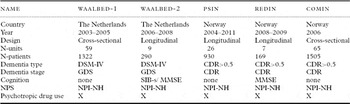
Abbreviations: GDS = global deterioration scale, CDR = clinical dementia rating scale, MMSE = mini-mental state examination, SIB-s = severe impairment battery- short version, NPI-NH = neuropsychiatric inventory- nursing home version.
Methods: Study population: 4216 participants from different study cohorts of 1612 Dutch elderly (Waalbed-1, Waalbed-2) and 2604 Norwegian elderly (PSiN, ReDiN, CoMiN). All patients resided in nursing homes and had a clinical diagnosis of dementia, established with either DSM-IV-TR criteria or Clinical Dementia Rating Scale (CDR> 0.5). Neuropsychiatric symptoms were measured with the NPI-NH across dementia stages. The NPI-NH includes 12 symptoms: delusions, hallucinations, agitation, depression, anxiety, apathy, irritability, euphoria, disinhibition, aberrant motor behaviour, night-time disturbances, and eating abnormalities. The measurements of baseline characteristics, dementia type and stage, and psychotropic drug use vary among datasets (see table 1). Data-analysis: The factor structure of the NPH-NH was evaluated using exploratory factor analysis (in SPSS). Factors with eigenvalues >1 were extracted and orthogonally rotated to achieve a simple structure (varimax rotation). Items with factor loadings (a measure indicating correlation) >0.4 were considered to be relevant. The highest factor loading of a particular NPI-NH item determined to which factor the item was assigned.
Results: Results of the factor structure will be presented at the IPA congress.
Discussion: To our knowledge, this factor analytic study is based on by far the largest nursing home sample, allowing for comparison of symptom associations across countries. Knowledge about the underlying behavioural dimensions is useful for further categorization of symptoms, which may have important pharmacological treatment implications.
References: Aalten P, Verhey FRJ, Boziki M, Brugnolo A, Bullock R, Byrne EJ, Camus V, Caputo M, Collins D, De Deyn PP, Elina K, Frisoni G, Holmes C, Hurt C, Marriott A, Mecocci P, Nobili F, Ousset PJ, Reynish E, Salmon E, Tsolaki M, Vellas B, Robert PH: Consistency of Neuropsychiatric Syndromes across Dementias: Results from the European Alzheimer Disease Consortium. Dement Geriatr Cogn Disord 2008;25:1–8.
PS01.60
Prospective study on the use of rivastigmine patch in Alzheimer's dementia in routine clinical setting
Ejaz Nazir, Shelton Hospital, Shrewsbury, Shropshire, United Kingdom
M Mushtaq, Bushey Fields Hospital, Dudley, West Midlands, United Kingdom
Overview: In this naturalistic longitudinal observational study we wanted to evaluate the safety, tolerability and efficacy of the rivastigmine patch in patients with early and late onset moderate Alzheimer's dementia (AD) in routine clinical setting. This study was conducted in the department of old age psychiatry at Shelton Hospital; Shrewsbury. The rivastigmine patch is the first trans-dermal treatment for probable Alzheimer's disease and dementia associated with Parkinson's disease.
Methodology: We had all patients diagnosed with moderate dementia of Alzheimer's type according to ICD10 (International Classification of Disease, 10th edition) and as laid down by NICE (National Institute of Clinical Excellence) guidelines. We undertook review of patients at baseline and then at intervals of 3 and 6 months and aimed at least 2 assessments for each patient. Each review consisted of making an assessment of improvement on global, functional and behavioural domains using MMSE (Mini Mental State Examination), BADLS (Bristol Activities of Daily Living skills) scores, patient and carer feedback and clinical judgement. We collected data over a period of 18 months from May 2008-October 2009, from first 30 patients with a diagnosis of moderate Alzheimer dementia, who were started on rivastigmine patch. 29 patients were newly diagnosed with Alzheimer's disease. Our sample comprised of 33% (n = 10) of early onset (median age 59.5, range 52–64 yrs) and 67% (n = 20) late onset (median age 79, range 65–88 yrs) Alzheimer's dementia. 53% of participants were women. Our primary outcome measure was safety and tolerability measured by incidence of adverse events and discontinuation due to any reason. As secondary outcome measure, we examined overall relative improvement on global, functional and behavioural domains.
Summary of Results: 1. Adverse events were reported in 6 (20%) of the patients. 2. Treatment discontinuation was needed in 3 (10%) patients due to adverse events. 3. Patch site skin reaction was observed in 3 (10%) patients and 2 of them needed discontinuation of patch. 4. Overall relative improvement in cognitive functioning was observed in 20 (66%) patients whereas 10 (34%) patients showed a relative decline. Discussion: A patch formulation of rivastigmine produces dual inhibition of acetyl cholinesterase (AchE) and butyrylcholinesterase (BuchE) and offers many potential advantages over oral formulation. It helps to avoid the rapid fluctuations of plasma drug concentration over 24 hours providing a smoother pharmacokinetic profile. This mechanism of drug delivery has several other benefits to patients and carers, such as: (a) Simple one step titration to the maximum dose with convenient once daily dosing (b) No requirements for the patients to swallow or take medication with a meal, hence being convenient to patients with swallowing problems. (c) Visual reassurance to carers that the medication has been administered, thus improving compliance. (d) Shows good overall adhesiveness and skin tolerability when used on upper back, chest or upper arm whereas thigh and abdominal application appear to provide lower plasma levels although highest patch adhesiveness. (e) A simple treatment option for patients with multiple medications making one less number of tablets. Clinical trial has already shown that caregivers of Alzheimer's disease patients prefer rivastigmine patch to oral treatment. Our clinical experience suggests that the most common form of skin reaction is erythema caused by removal of the patch which normally resolves after a short period of time. Therefore it is recommended to rotate the daily application site to minimize skin irritation.
Conclusion: Rivastigmine patch may provide a treatment option for those patients who require a change in their current oral cholinesterase inhibiter therapy due to either safety or tolerability concerns. Patch form may also provide a treatment option for those patients who require a change in their current oral cholinesterase inhibitor therapy due to safety or tolerability concerns.
Conflict of Interest: This study is independent of any industrial (pharmaceutical) influence and was not funded. However findings have been presented at the educational meetings sponsored by Novartis Pharmaceuticals with honorarium paid to one of the authors.
Note: This study has been published as Original Article in Dement Neuropsychol 2010 September; 4(3): 245–249.
PS01.61
Canadian Dementia Knowledge Translation Network (CDKTN): Improving the quality of life for those with dementia and their care partners through exchange and translation of knowledge and research
Cynthia Giles, CDKTN, Halifax, Nova Scotia, Canada
Background: The current health care systems are increasingly challenged and family members are struggling in their roles as caregivers during this time of escalating numbers of people with dementia. Often informal care partners, or those unfamiliar with dementia, have little understanding of the symptoms and behaviour to expect. An additional challenge for both formal and informal care partners, of individuals with dementia, is timely access to research-based evidence, practices, services, resources and supports within their communities. A great deal of quality dementia-related research has been and continues to be conducted. To facilitate effective knowledge translation, the Canadian Dementia Knowledge Translation Network (CDKTN) was established as a network for making users aware of knowledge and facilitating its use to improve the health of Canadians suffering from Alzheimer's Disease and dementia. CDKTN helps researchers, students and practitioners translate their work into practice and pass it on to those who need it most – patients, families and care partners. At the Canadian Dementia Knowledge Translation Network (CDKTN), members strive for creative ways to approach and engage researchers and knowledge users so research is translated into effective care strategies and best practices. These knowledge translation (KT) activities provide opportunities for individuals to explore their awareness of Alzheimer's disease to increase their understanding of disease symptoms, best practices and supports.
Methods: CKDTN members provide the vehicle for identifying and resolving gaps between research and practice, prevention, treatment, care and support. Three areas of focus include: Education and Training in Knowledge Translation which develops specific training programs that bridge knowledge and training gaps, while complimenting existing models. Dementia Resource and Knowledge Exchange targeting frontline professionals across a clinical-policy-social spectrum and focusing on knowledge exchange and sharing of dementia resources among national network partners. Person and Care Partner Centred Knowledge Translation focused on improving the quality of life for persons with dementia, their families and care partners This sharing of knowledge and resources, linking people and ideas enables CDKTN to engage in a dynamic and interactive relationship in which research is enriched by input from knowledge users. Knowledge users are engaged and actively involved in both the research and the KT&E process, from the identification of research priorities to the translation, exchange, use and evaluation of new knowledge generated by research. By bringing together researchers, students and practitioners, CDKTN helps researchers translate their work into practice and pass it onto those who need it most – Patients, families and care partners.
Results: The latest results are a collection of stories about real people in our communities, defined by dementia and Alzheimer's Disease that provide real insight and focus on providing persons with dementia and their care partners access to timely knowledge. This knowledge empowers them to use new care techniques, by sharing experiences and posing questions they want answers to. Building and not duplicating on existing scientific, clinical and social excellence in partnership with the Alzheimer Society of Canada, the knowledge translated for the user community includes: - Music and lyric development: Songs by local song writers/musicians describing dementia behaviour, symptoms, challenges, treatment development. - Video: Stories describing the development of dementia treatment, work and life of a leading Geriatrician - Brochure: “Staying Active in Later Life” describing the benefits of exercise and healthy living - Filmed narratives for web content: Describing personal family experiences at various stages of Alzheimer's and the disease symptoms (French and English films)
Conclusion: CDKTN's application of research findings for new KT approaches stimulate discussions of how research can be effectively utilized to become part of dementia care that supports and improve the quality of care for people with dementia, their families and other partners in care.
PS01.62
Essential patient characteristics required for a computer model of dementia management
Victor Vickland, University of New South Wales, Randwick, New South Wales, Australia
T Morris, Faculty of Medicine, Sydney, New South Wales, Australia
H Brodaty, B Draper, L Low,
University of New South Wales, Sydney, New South Wales, Australia
J Werner
G McDonnell, Bronte, New South Wales, Australia
Background: Randomised controlled trials have long been used as a primary tool for investigations in medicine and health sciences. However with recent advancements in computer technology the prospect of conducting virtual experiments became quite realistic. This virtual approach could bring not only savings in time and money but also offer environment in which large number of plausible scenarios regarding impact of therapeutic interventions could be tested without usual limitations of randomised controlled trials (RCTs). In order to build a computer model of dementia management in which virtual patients are the main active objects, we developed a blueprint for such patients corresponding to three main processes occurring in dementia: aging, cognitive decline and events associated with behavioural and psychological symptoms of dementia (BPSD).
Aim: Develop a comprehensive list of characteristics describing patients with dementia and associated behavioural and psychological symptoms. Evaluate the consistency and frequency in reporting of each of these characteristics and compare them with the requirements of our computer modelling framework. Provide recommendations regarding minimum datasets describing patient's characteristics in dementia research.
Methods: A detailed review of 110 published RCTs s on the management of dementia and BPSD was undertaken. Lists of RCT publications were obtained from references of systematic reviews. All sections describing the methodology and results of each paper were analysed by two independent reviewers. They examined each publication variables used to describe patients participating in the studies. A list of key concepts was created based on frequency and consistency of reported characteristics. Clusters of patient characteristics were presented in a form of hierarchical concept map and visualized as a network graph.
Results: Reported characteristics of patients with dementia were spread very unevenly in published literature. Socio-demographic characteristics such as age and gender were reported most consistently but current place of living was reported in only 25 % of publications. Other characteristics such as level of education or marital status were also inconsistent (31% and 11% accordingly). Surprisingly, characteristics which may be considered essential descriptors of the person with dementia such as duration of dementia or age at onset were only reported in 23% and 12% of publications. Age when the patient was first diagnosed with dementia was provided only in 8% of RCTs. A large number of health related characteristics were reported infrequently and some of them were only remotely related to any of the three dimensions of the model, which were aging, cognitive decline and BPSD. That included height, income and blood pressure. Important health variables such as comorbid conditions, history of depression or chronic health status were provided infrequently (13%, 10% and 5%). Furthermore, there were only a limited number of studies (one in three) which reported changes in patient's characteristics over time.
Conclusion: Even well designed randomised controlled trials provided limited reporting in regards to key patient's characteristics. Differences in reporting made RCTs difficult to compare and to generalize. Therefore interpretation of outcomes of RCTs may be difficult due to inability to generalize such outcomes to other groups of patients and environmental settings. A minimum dataset should be considered in reporting dementia research.
PS01.63
Services to people with early onset dementia (EOD) and their families
Per Haugen, The Norwegian Centre of Dementia Research, Tonsberg, Vestfold, Norway
Overview: In 2008 The Ministry of Health and Care Services presented a Government's Dementia Plan for Norway containing strategies as well as specific initiatives for the period until 2015. The Dementia Plan is based on recognition that current care services are inadequately developed and adapted to persons with dementia. This means that in the coming years changes within the care services are necessary in terms of skills, organization and physical form. The Dementia Plan consists of projects concerning various user groups and topics, including: - Schools for family caregivers and support groups - Day program for persons with dementia - Evaluation and diagnosis -The usefulness of milieu therapy and milieu treatment - Persons with minority language backgrounds who develop dementia - Persons with dementia with a Saami background - People with early onset dementia with dementia The Norwegian Centre of Dementia Research was asked to carry out the three year developmental program (2009–2011) for people with early onset dementia and their families. An earlier Norwegian study showed that with a few exceptions there are no suitable services available for persons with early onset dementia and their families. The reality for most families is a public service system that doesn't take responsibility and offer help (Haugen, 2006; Rosness, Haugen og Engedal, 2008). The objective of the program is to learn more about the stress experienced by children and spouses of younger persons who develop dementia, survey and implement measures that gives spouses and children more accurate information about dementia disorders and develop appropriate models for evaluating and following up younger persons with dementia. The program is to contain a survey and evaluation of experience in Nordic countries with various forms of group-based services, day programs and round-the-clock services specially adapted to younger persons with dementia, compile data on children and adolescents with a parent with dementia and find out which measures improves the quality of life of the family. Furthermore, the program is to contain a test of assistive devices for younger persons with dementia. The program consists of four projects: - Interviews with 25 persons with early onset dementia, 50 spouses and 25 children covering topics of: experience with and evaluation of the service, psychological and social challenges and emotional stress and burden. - An evaluation of models for diagnosing early onset dementia in the specialist health service. - A survey of experiences in Norway with various forms of group-based services, day programs and round-the-clock services specially adapted to people with early onset dementia. - Test of assistive devices for persons with EOD. Conclusions Our study shows so far that with a few exceptions there are not suitable services available for younger persons with dementia and their families. There is a need for better coordination between the specialist health service and municipal health and care services to provide respite care. It is particularly important that the specialized health care are involved in counselling and support to the persons with dementia and the caregivers in the early phase of the disease.
PS01.64
A study on the effectiveness of a psycho-educational group intervention for Asian family caregivers of clients with dementia
Sally Chan, Yong Loo Lin School of Medicine, National University of Singapore, Singapore
Background: With an increasing life expectancy, the number of people suffering from dementia in globally will rise to about 115.4 million by 2050. It is projected that in the 21st century the majority of the world's older people will be living in Asia. Aim of the study: To examine the effectiveness of a psycho-educational group programme in helping family caregivers of clients with dementia to cope better with caregving, when compared with routine community care.
Design: A randomized controlled trial. Setting and subjects: 76 family caregivers who are primary caregivers of persons with a diagnosis of dementia at mild to moderate stage were recruitd from the community centres in Singapore. Interventions: Control group: Participants receive usual outpatient services and community services .
Experimental Group: Participants receive usual care plus a 24-hour psychoeducation programme. Outcome measures: Data were collected at the baseline, 3-month, and 9-month after the intervention by the following instruments: • Family Burden Interview Schedule • Family Crisis Oriented Personal Evaluation Scales • General Self-efficacy Scale • World Health Organization Quality of Life Scale-Brief Version • General Health Questionnaire • Social Support Questionnaire • Modified Family Support Services Index Data analysis: Repeated measures MANOVA for differences of outcomes between the two groups in: the pre-test and 3 post-test mean scores (i.e. measured immediately, 3 months and 9 months after intervention); and post-hoc comparisons for results of those with significant differences between groups.
Discussion & Conclusion: The presentation will highlighted the preliminary findings of the study. This presentation will also examine the global issues of family caregiving for older persons with dementia from an Asian perspective, and the specific way that culture could influence family caregivers’ burdens which could play an important part in the development of a holistic model for family-centred care. The results of this study can inform health professionals whether this model of intervention can be effective in helping families of clients with dementia. An effective community care of clients with dementia needs to involve healthy family members as carers.
PS01.66
Structure of mental dysfunction in elderly subjects with dementia residing in nursing homes: An analysis using the mental function impairment dcale
Takumi Sato, Geriatric Health Services Facilities of Korakuen, Morioka, Iwate, Japan
Background: Currently, little is known about the relationship or interactions between various mental dysfunctional disorders and other simultaneously occurring dysfunctions in elderly subjects with dementia. A clearer understanding of this may help to ameliorate the disorderly structure of this condition and help predict ways to cure and care for those affected. The present study characterized the structure of mental disorders according to the level of severity, the affinity, and how they are influenced by various mental disorders in elderly subjects with dementia.
Participants: Study participants included 33 elderly subjects with dementia (mean age, 81.5±7.5 years) with no other complications or mental diseases who resided in nursing homes.
Methods: The Mental Function Impairment Scale (MENFIS) was used as an indicator, and included scores for cognitive dysfunction (7 items, as follows: temporal disorientation, locational disorientation, short term memory (STM), long term memory (LTM), judgment, expression of intentions, and conversation comprehension dysfunctions), motivational disorders (3 items, as follows: spontaneity, vigor, and interest dysfunctions), and emotional disorders (3 items, as follows: stability, propriety, and multiplicity dysfunctions). I employed the MENFIS to interview at least two care workers or nurses who cared for the participants on a daily basis. Scores were analyzed by ANOVA, multiple comparisons (Ryan's test), cluster analysis (Ward's clustering method) and multiple regression analysis (stepwise method, adjusted R-square >0.50).
Results: Cognitive dysfunctions were grouped into a cluster including STM dysfunction and disorientations as well as a cluster including judgment, conversation comprehension, expression of intentions, and LTM dysfunctions. Emotional disorders were grouped into a cluster including stability and propriety dysfunctions. Motivational disorders were separated into spontaneity and vigor dysfunctions. In addition, multiplicity (emotional disorder) and interest (motivational disorder) were grouped as a mixed cluster. The most severe cognitive dysfunctions were STM dysfunction and temporal disorientation.
PS01.67
Mood disorder and cognitive impairment of hospitalized elderly: Predictors of their functional decline?
Gary Sinoff, Carmel Medical Center, Haifa, Israel
A Zisberg
E Shadmi
N Gur-Yaish
E Srulovici, University of North Carolina at Chapel Hill, Chapel Hill, North Carolina, United States of America
H Admi
Overview: This prospective cohort study set-out to examine the presence of a mood disorder (anxiety and depression) and cognitive impairment of older adults hospitalized in acute medical wards and their effect on functional outcome. The study was performed in a 900-bed teaching hospital in Israel and 417 older (≥70) (mean age of 78.6) patients hospitalized for a non-disabling condition were studied. The outcome of functional change at one month post-discharge from pre-morbid baseline was examined. It was hypothesized that those with cognitive decline A regression model was examined to predict the factors for the change in function controlling for demographic and health characteristics, presence of a mood disorder, functional status prior to admission and cognitive impairment detected during hospitalization. At time of admission, using the cutoff score of 8/10 on Pfeiffer's SPMSQ, 27% were found to have some cognitive impairment. However at discharge, now using the MMSE instrument which is a broader screening instrument for cognitive assessment and using a score of less than 24/30 defining cognitive impairment, 55% percent of the subjects were found at discharge to have cognitive impairment. With regard to mood disorder, 26.3% had anxiety defined by a score of ≥ 24/40 on Short Anxiety Screening Test and 16.4% were diagnosed with depression with a score of ≥ 70/100 on the Short Interviewer-assisted Depression Rating Scale. The average pre-morbid Barthel Index (BI) score was 88.4, indicating minor to moderate dependency. However at discharge the average BI had dropped to 64 indicating functional dependency. 95.4% had a decline in their function at discharge from pre-morbid state and after one month BI had increased to mean of 76 but still 94.5% had continuing decline in function. The regression model showed that as expected the pre-morbid ADL function was the main predictor of dependency after one month and explained 43% of the variance but cognitive impairment also explained some 7% of the variance and finally the Charlson's co-morbidity index added another 5% to the model. This study reinforced the fact that many of elderly admitted to hospital have some cognitive impairment and showed that further cognitive decline occurred during hospitalization. Complicating this is the known fact that the medical staff often misses the diagnosis of cognitive decline/impairment in elderly in-patients. This then becomes a major factor in the discharge plan when one realizes that prior to admission 85% of subjects were living at home, usually with their spouses or families.
PS01.68
Examining the usability of a new software technology platform for cognitive and physical training in elderly people with and without cognitive impairment
Fátima Gonzalez Palau, Y Ruiz, E Vargas, J Muñoz, J Toribo, S Temprano, E Parra, C Turuelo, A Solis,
INTRAS Foundation, Zamora, Spain
M Franco-Martin, INTRAS Foundation, Valladolid, Spain
Introduction: Globally, the number of healthy older adults, elderly with cognitive impairment and with dementia is projected to significantly increase, both in terms of overall numbers and as a proportion of the population. United with the substantial amount of care this population requires, computer-based interventions become a promising solution to maintain and improved wellbeing with few professional and technical requirements. Long Lasting Memories (LLM) is a newly integrated ICT platform which combines cognitive exercises with physical activity in the framework of advance technologies. Cognitive exercises are provided by GRADIOR specialised software and physical training is based on FitForAll, a game platform that permits exercise through the Wii Balance Board low-cost platform. Although further applications for older adults have been designed, few of them have been analyzed in terms of their usability in elderly population with and without cognitive impairment.
Objectives: To analyze the usability of LLM cognitive (Gradior) and physical training applications in Spanish population. Method: 80 elderly recruited from a residential facility consented to participate in a pilot test of the cognitive and physical intervention LLM platform. 40 non-demented elderly, 22 subjects that met the DSM-IV criteria for Mild Cognitive Impairment and 18 who met the criteria for dementia (mean age = 75,9 years, SD = 8,4, age range = 60–92 years) received 1 hour of physical training and 35 minutes of cognitive training, 3 times a week, during 12 weeks program. At 8 week intervention they were assessed trough a specifically designed questionnaire that included aspects of their perception of the platform. A descriptive study of the results was performed.
Results: 73,33 % of the participants perceived LLM platform as beneficial (60%) to very beneficial (13,33 %)for them. 91,1% reported they enjoyed (58,62%) and totally enjoyed (34,48%) the sessions. 63,33% of the participants found the instructions of the software clear (20%) to very clear (43,33%) and understandable, but 40% of them expressed that was difficult (36,67%) or very difficult (3,33%) to learn how to use LLM and 56,67% perceived the platform as difficult (40%) to very difficult (16,67%) to use without help; Nevertheless, all the participants expressed they would be able to use the program alone if they have it at home. All the users agreed they would characterize LLM software as “warm and friendly” and would recommend the program, 70% reported that it met (56,67%) to totally met (13,33%) their expectations and the majority of them indicated they wish to continue using the platform after 12 weeks study.
Discussion: Primary results, supported by participant's perception of the platform over the trials, indicate that healthy elderly and older adults with mild to moderate impairment could be benefited by LLM cognitive and physical training software. Reviewing aspects of usability have significant implications in the development of new computer-based programs, helping in the design of an effective technology method, which improves mental skills in elderly population.
PS01.69
Symptom profiles of people seeking online dementia information prior to a dementia diagnosis
Kenneth Rockwood, A Mitnitski,
Dalhousie University, Halifax, Nova Scotia, Canada
A Zeng, DementiaGuide Inc., Halifax, Nova Scotia, Canada
Background: SymptomGuide™ is a web-based profiling tool that is used to identify the symptoms that are troublesome to a patient and then each symptom is tracked over the course of their dementia. Since its launch in 2007 until January 4, 2011, 989 online users have built symptom profiles and 364 users indicated the profilee had no diagnosis of dementia. It is well recognized that dementia remains under-diagnosed, especially at its mildest stages. The profile of needs of these patients is not well understood. Many people now go online to seek information about dementia, representing a possible means of understanding profiles of need.
Methods: The website www.demenitaguide.com offers the use of SymptomGuide™ which provides information on 61 dementia symptoms and the corresponding hundreds of plain-language descriptors that are easily understood by patients, families and caregivers. Here we describe caregiver-reported symptoms for website users in relation to a validated staging algorithm.
Results: Of 989 SymptomGuide™ users who completed symptom profiles, 364 (37%) reported that the person they cared for had not been diagnosed with dementia. Of these 364, a staging algorithm could not classify 45 patient profiles (12%; chiefly due to too few symptoms having been reported). Of the remaining 319, 168 profilees (46 % of the 364 who were without a diagnosis) met a profile compatible with “Cognitive Impairment – No Dementia” of which the most common subtype was “Mild Cognitive Impairment” (N = 118; 32% of the profiles of people not diagnosed with dementia). Amongst the 151 people in whom no dementia diagnosis was reported (41% of the no diagnosis group), 128 (35% of those reporting no diagnosis) had mild dementia. The remaining 23 profiles were chiefly compatible with moderately severe dementia. People who were reported to have dementia were equally likely to have been women (61% vs. 66%) but were older (75 ±12 years vs. 69 ±15 years).
Conclusions Amongst people who have caregivers sufficiently concerned about their cognitive functioning to complete a detailed online profile of symptoms, almost half appear to have dementia, chiefly mild dementia. An approximately equal proportion have mild cognitive impairment. Such opportunities as may exist to retard symptomatic disease progression in such people are hampered by the absence of a diagnosis.
PS01.70
The dementia workforce: Patients and carers views on workforce skills
Susan Mary Benbow, P Kingston,
Staffordshire University, Stafford, Staffordshire, United Kingdom
A Tsaroucha
Background: As part of a project to map the education available to the dementia workforce and to develop core competencies for the dementia workforce in the West Midlands, United Kingdom, we carried out a consultation exercise with people with dementia and their carers about their perceptions and experiences of workforce skills. A member of the team attended four face to face meetings with users and/ or carers: two cafés, a carer support group and a memory group (attended by people living with a dementia). Two people living with a dementia were interviewed in greater depth. This work was commissioned by the Workforce Deanery of the West Midlands Strategic Health Authority and the full project report ‘Final report: NHS West Midlands Clinical Care Pathways Project (Dementia) May 2010’ is available at http://www.staffs.ac.uk/assets/NHS_west_midlands_clinical_care_pathways_project_250810_tcm44–32416.pdf. We report here on the consultation with patients and carers.
Method & Results: At the meetings people were asked to talk (or give written feedback) on the following four areas: • What skills have you found to be missing in people working with you? • What do you value in people from health and social care working with you? • What do you find people working with you from health and social care do well? • What do you find people working with you from health and social care do badly? In total 60 individuals contributed (58 at meetings and 2 in-depth interviews): 47 patients and carers contributed in cafés plus 11 carers at a carers group and 11 people with dementia at a memory café. Direct quotations were recorded in conversations. The two in-depth conversations were recorded and, where participants in the consultation preferred, comments were contributed in writing. 1. What skills have you found missing in people from health and social care working with you? 2. What skills do you value in people from health and social care working with you? 3. What have you found workers in health and social care do well? 4. What have you found workers in health and social care do badly? All the contributions were subjected to thematic analysis.
Discussion: We concluded that patients and carers have knowledge and expertise relating to the education and training of members of the dementia workforce and that ways of using their skills in workforce development should be explored. Patients and carers bring distinct and important perspectives to our understanding of workforce skills. Their feedback highlights the importance of relationship-centred aspects of the care of people with dementia and their families. We also recommend the involvement of patients and carers at all levels in training and education related to dementia. This is very powerful and sends an important message to trainees/ students. Ways of involving and learning from both patients and carers should be explored and developed by all organisations providing training and education for the dementia workforce.
PS01.71
Impact of Alzheimer's disease into lexical semantic abilities
Nilda Henriquez, University Andres Bello/Ucinf Santiago De Chile, Santiago, Chile
Introduction: The slow and yet constant evolution on dementia of the Alzheimer type (DAT) has become the major problem of our society and the disorders in the lexical semantic abilities are often cited in the second stage of the DAT. Objective: The disorder or decline of these functions may have a profound impact on daily life activities. Therefore, this study aims to evaluate the decline of these processes experienced by DAT patients.
Methodology: The research aims to exam this disease by submitting 20 DAT patients, at an early stage of illness, to cognitive tests, along with a longitudinal study of the control group with matched subjects. In order to test the “encoding and lexical semantic level” the “verbal fluency test” was used (letter initial fluency and semantic fluency); “narrative discourse” and “oral and written descriptive discourse” and “nomination” (classical and description according to the model nomination). In order to measure the “coding”, there were used “words list”. In order to evaluate these exams, two levels of analysis were considered: a traditional approach (on the group) and an analysis on interindividual differences. For the statistical treatment we used the SPSS software 10,0 version; correlation, test X2 and ANOVAs were calculated.
Results: The statistical analysis made possible to categorize three types of patient groups showing a great heterogeneity among them. The DAT patients show a decline in lexical semantic abilities, especially under time limits and when the task is more complex thus requiring further attention. There is also an evidence of semantic loss, a loss of precise concepts and decline of executive function. The performance of DAT is better in the lexical evocation in the meaningful contexts and not time limit. The decline does not depend only on the person but also on the type the task (narrative or descriptive discourse), contexts (word with and without context) and aids (oral and visual).
Conclusion: The study of the results showed that the lexical semantic declines in the DAT are not only quantitative but also qualitative. The decline of encoding is generally lined to a disorder in the semantic organization, especially when facing complex information or when the information contains a lot of details, which worsens it under time limits. These declines show difficulty to access the lexical semantic stock that converts into an anomia affecting spontaneous expression on the DAT patients.
PS01.72
Person-centred care among nursing home patients: A 16 months single blinded randomised controlled intervention study
Janne Røsvik, K Engedal, Oslo University Hospital, Olso, Norway
A Rokstad
Background: The prevalence of dementia in Norwegian nursing homes is about 80%, and most of the patients have dementia of moderate or severe degree. Neuropsychiatric symptoms such as agitation and aggression are common. Meta-analyses have shown that psychotropic drugs have limited effect in treating these patients. Thus, there is a need for knowledge of non-pharmacological methods of treatment and care for these patients, that can reduce agitation. Person centred care (PCC) The VIPS-framework (Brooker 2007) sums up PCC as it is described by Kitwood (1997): V- Value base that asserts the absolute value of all human lives I – An individualised approach, recognizing uniqueness P- Understanding the world from the perspective of the person with dementia S- Promotion of positive social environment The VIPS-framework as a basis for discussion of concrete patient situations in staff meetings with a set structure, designated roles and a user manual is one of the two methods used in this intervention. The other method is Dementia Care Mapping (DCM) which uses observation based on PCC as basis for feed-back to improve care. Few randomised controlled studies have been carried out to study the effects of these two methods. One exception is the recently controlled intervention study by Chenoweth et al (2009) that showed a decrease in agitation using PCC as a method to reduce neuropsychiatric symptoms in nursing home patients. Our hypothesis is that both the VIPS-method and DCM will be more effective than an educational program about dementia in reducing agitation. The effect of using the VIPS framework and DCM will be equal. Design and methods This is a single blinded randomized controlled study in l4 nursing homes with 657 demented patients and their staff taking part in a 16 months intervention trial with 3 arms. After baseline measurements they were randomised at nursing home level to receive PCC using the VIPS methods, DCM or an educational program that consisted of six films of 25 minutes duration about different aspects of dementia. The study started February 8th 2011 and only demented patients with a Clinical Dementia Rating Scale (CDR) score of 1 and above are included. Effects in patients will be measured using the Brief Agitation Rating Scale (BARS), Neuropsychiatric Inventory (NPI-Q), Cornell scale for depression in dementia, Quality of life in Alzheimer's disease (QUALID), Clinical Dementia Rating Scale (CDR), physical self maintenance scale (P-ADL) and Lawton maintenance scale. Use of psychotropic drugs and diagnoses will also be measured. Effects at staff level will be measured by the PCC Assessment Tool (P-CAT), Stress of Conscience Questionnaire, Nordic Questionnaire for Psychological and Social Factors at Work in addition to age, gender, education and position in nursing home, type and size of wards. Preliminary results at baseline Baseline information were collected in 635 patients with mean age 86,6 (sd = 7,0), 67 % were women. Using the CDR assessment 7,8% had a score of 1 35,6% had a score of 2 49,1% had a score of 3. Mean scores: BARS 19.6 (sd 9.57) Cornell 7.5 (sd 5.1) QUALID 21.7 (sd 7.0) NPI-Q 3.6 (sd 2.5) P-ADL 18.9 (sd 5.5) After baseline measurements 219 patients were randomized to the VIPS-method group, 216 to the DCM group and 222 to the educational program group. The table shows the characteristics of the patients in the three arms. The patients of the 3 groups differ in scores regarding age, gender, BARS, Cornell, QUALID, NPI-Q, P-ADL and Cornell in these preliminary results.
Group differences

The patients of the 3 groups differ in mean scores regarding age, gender, BARS, Cornell, QUALID, NPI-Q, P-ADL and Cornell in these preliminary results.
PS01.73
Regional dementia networks: Development and evaluation
Marisol Otero, I Drašković, M Olde Rikkert, M Vernooij-Dassen,
Radboud University Nijmegen Medical Centre, Nijmegen, The Netherlands
Background & Objectives: To improve the quality of complex, multidisciplinary dementia care, a higher level of integration is needed. Therefore a program was launched setting up the infrastructure for integration of dementia care on the level daily care, the National Dementia Program. The present study investigates the impact of this program on quality and integration of care, work conditions, client centeredness of care and competences in dementia care as appraised by the professionals.
Research Design: Cross-sectional survey conducted in 2009.
Setting: Community care.
Participants: The study population consisted of healthcare providers (Nurses, general practitioners, specialists, social/spiritual workers, managers, elderly advisors, paramedics and volunteers) involved in dementia care from six regions participating in the National Dementia Program in the Netherlands.
Methods & Materials: Questionnaires were developed in order to assess improvements in: quality and integration of care (4 items), work conditions (5 items), client centeredness (14 items based on the community care problem areas defined by the program) and collaborative dementia care competences: the ‘Shared Competence in Multidisciplinary Dementia Care’ questionnaire (19 items). For all six regions, data were collected at the end of the program. Data were analysed with SPSS 16.00.
Results: 205 questionnaires were sent.107 healthcare providers returned the questionnaires, an overall response rate of 43%. Participants experienced a major improvement in integration of dementia care and moderate changes in work conditions. Improvement in the client centered approach: 86% of the professionals reported improved familiarity with a number of clients’ problems such as feelings of guilt and shame for having to call in additional help. Of these professionals, 40% found that the program helped them deal with these problems. Furthermore, 50% of these professionals reported improvement in their possibilities to refer clients. Our competence questionnaire showed that participants, especially nurses, appraised an improvement on their collaborative dementia care competences due to the program.
Conclusions: Professionals experienced a number of improvements in dementia care which they ascribed to the National Dementia Program: 1. quality and integration of care, 2. client centeredness, and 3. dementia care competences.
Key Words: dementia, integrated care, professional competences, client centeredness.
PS01.74
Implications of executive function and divided attention on the gait in patients with amnestic mild cognitive impairment and patients with Alzheimer disease
Carlos Augusto de Mendonça Lima, Centro Hospitalar do Alto Ave, EPE, Gulmarães, Portugal
E Lopes, Centro Hospitalar do Alto Ave E.P.E., Guimarães, Portugal
R Garcia, University of Salamanca, Salamanca, Spain
Background: The march has been considered by many authors as a highly automated motion, which only required minimum levels of cognition. Therefore, few studies have addressed the altered forms of gait as a predictor of cognitive decline associated with neurodegenerative diseases that occur with dementia. In this sense, NINCDS - ADRDA for probable diagnosis of Alzheimer disease (AD) suggest that “the problems of movement and gait in patients in early stages of dementia, would point to a diagnosis uncertain or unlikely AD (1). However, recent studies have shown that patients with cognitive impairment (especially those with impaired executive functions) may present early clinical manifestations of alterations in gait and balance, showing a greater willingness to falls. Some studies suggest that walking speed decreases in AD patients while performing other tasks (verbal), which could be associated with attentional deficits.
Objective: Authors intended to investigate the relationship between deficits in executive functions and divided attention with gait (mobility, balance and falls) in patients with Amnesiac Mild Cognitive Impairment (MCI-A) and in patients with AD (CDR stage 1) and compared with participants without cognitive impairment, control subjects (CS). Method: 90 adults were studied after the protocol approval by the Hospital Ethic Committee (30 with DA, 30 with MCI – A and 30 CS). The psychiatrist and the neuropsychologist settle the final diagnosis together during a multidisciplinary meeting according to the diagnostic criteria of the 10th version of the International Classification of Diseases (ICD-10 (2)). The instruments for assessment used was: Mini Mental State Examination (MMSE) (Guerreiro et al., 1994), Clock Test (Cacho et al., 1999), Clinical dementia Rating (CDR) (3), General Scale of Golberg (4), WCST - Wisconsin Card Storting Test (5) Digit Span, Category Fluency Test, Berg Balance Scale (Berg et al., 1992), Time Up & Go Mod: (Mathias, Nayak, e Isaacs, 1986). For the control subjects we included FAQ – Questionnaire of Functional Activities (Pfeffer, 1982).
Results: Patients with AD have greater deficits in executive functions and in divided attention than patients with MCI- A, and these deficits are lower in older people without cognitive problem; Patients with AD has a greater deficit in gait than patients with MCI – A and these deficits are lower in older people without cognitive problems. Measurement of executive function and divided attention is particularly good at predicting falls and contributes to the existence of disturbances of gait and balance in patients with AD.
Conclusion: This study attempts to relate concepts of gait and cognitive function and it is part of a general concern for understanding the problem and its contours. Authors intend to examine and challenge the idea that walking is an automatic movement that does not require high levels of cognitive input, look for evidence suggesting that cognitive deficits.
References: 1. Ala Ta; Frey WH 2nd. Validation of the NINCDS-ADRDA criteria regarding gait in the clinical diagnosis of Alzheimer disease. A clinicopathologic study. (1995). Alzheimer Disease Association Disorders. Fall: 9 (3): 152–159 2. World Health Organization. Classificação de transtornos Mentais e de Comportamento da CID-10. Porto Alegre; Artes Médicas, 1993 3. Maia ALG, Godinho C, Ferreira ED, Almeida V, Schuh A, Kaye J, Chaves MLF. Aplicação da versão brasileira da escala de avaliação clínica da demência (CDR) em amostras de pacientes com demência. Arq Neuropsiquiatr 2006; 64 (2-B): 485–489. 4. General Scale of Golberg (Golberg, 1978, translated and adapted by MacIntyre e Redondo, 1999) 5.Cruz, M. (2001). Test de clasificación de tarjetas de Wisconsin. TEA Ediciones: Madrid.
PS01.75
Dementia in the movies: Portrayal of professionals and life in an institution
Debby Gerritsen, Radboud University Nijmegen Medical Center, Nijmegen, The Netherlands
Y Kuin, Radboud University Nijmegen, Behavioural Science Institute, Nijmegen, The Netherlands
Background: Although dementia is affecting more than 30 million people worldwide, negative stereotypes about the consequences of dementia are still highly prevalent. Research shows that the general public's knowledge and beliefs about dementia need enhancement and that persons with dementia and their caregivers experience stigma. Stigma is also attached to nursing homes and those who work in them. It has been shown that the portrayal of psychiatric illnesses in movies and on television influences the public's perception and contributes to the stigmatization of these illnesses. Yet, little is known about the quality of the depiction of dementia in the movies, including the portrayal of professionals and life in an institution.
Aim: to study the portrayal of the professional environment of persons with dementia in recent motion pictures by considering the following questions: 1) how person-centered do professionals interact with and talk about the person with dementia, and 2) what institutional policies are displayed?
Method: Motion pictures were sought on the Internet Movie Database. Using the search terms ‘dementia’, ‘Alzheimer's disease’ and ‘senility’, the titles and keywords were searched up to March 1, 2010. Only movies released in or after 2000 were retained. Inclusion criteria were: 1) (possible) dementia is a theme, which is clear because it is mentioned in the movie; 2) there is interaction between the person with dementia and professionals; 3) the person with dementia is older than 65; 4) the movie is accessible for a large audience, which was operationalized as ‘released in the USA and either the United Kingdom or the Netherlands’; 5) the movie could be obtained by the authors. This selection procedure resulted in 10 films: Son of the Bride, Iris, The Notebook, Aurora Borealis, Away from her, The Savages, Is Anybody There?, Choke, Black, and Diminished Capacity. Independently, both authors watched all movies, selected relevant scenes and described observational information; one of them literally wrote down the dialogue of the relevant scenes. After having seen each movie, the researchers independently scored behavior of professionals on the elements of positive person work and malignant social psychology, as follows from Kitwood's conceptual framework of personhood. Also, they noted displayed information about institutional policies. Then, they discussed their scoring and reached consensus on differences of opinion.
Results: 1) The ten movies contain positive as well as negative interactions, but more malignant strategies than positive person work. Positive Person Work: most movies show ‘recognition’. ‘Play’ is also often seen. Malignant Social Psychology: the two most often shown aspects are ‘infantilization’ and ‘objectification’. 2) This question was applicable in eight movies. In general, the material environment of the institutions shown is agreeable. Yet, five films show one or more extraordinary policies. For instance, in two movies the person with dementia is chained to his bed (in one of these even with an iron chain!). In another two the husband is forbidden to visit his wife, which, in one of these, concerns the first 30 days of her stay. Also, in three movies, people with mild dementia live on the first floor. The second and third floor are mentioned as floors for ‘the more progressed’ and patients on these floors are shown sitting apathetic in wheel chairs, in their pajamas. The contrast with the first floor is sharp.
Conclusion: In most movies the depiction of professionals is twofold: all movies show positive person work as well as malignant social psychology aspects. In general, the latter seem to surpass the former. The depiction of institutions is double too. Although in most the atmosphere is rather good, five movies show negative stereotypes. The depiction of attitudes and behavior of professionals caring for older people with dementia is ambiguous and could be reinforcing stigma.
PS01.76
The utility of the social vulnerability scale as a predictor of financial capacity in dementia patients
Bronwyn Massavelli, D Pinsker, N Pachana,
University of Queensland, Brisbane, Queensland, Australia
K Vearncombe, Brisbane, Queensland, Australia
V Stone
G Byrne, University of Queensland, Herston, Queensland, Australia
J Wilson
C Tilse
In legal terms, capacity refers to understanding, appreciation, reasoning, and expressing a choice – i.e. a person's ability to understand the nature and appreciate the effect of their decisions, freely and voluntarily make decisions and communicate the decision in some way. Management of finances is a complex instrumental activity of daily living that impacts on a person's independence and quality of life, and is therefore a crucial issue of autonomy for older people. However, determining the point at which an older person with cognitive impairment is no longer capable of managing their finances can be a difficult task for healthcare and legal professionals, and distressing for family members and friends involved [1]. Currently there is no gold standard assessment for evaluating financial capacity, and issues pertaining to the degree of impairment that constitutes incapacity remain largely unresolved. In addition, a variety of intra-individual factors that may influence ability to manage financial affairs have been largely ignored in the research literature. When the decisional capacity of an older person to live independently and manage their finances is questioned, capacity has typically been determined on the basis of neuropsychological assessment and clinical judgment. As the process of determining functional ability on the basis of cognitive test scores is inferential, this approach has significant limitations. Further, assessments have focused predominantly on memory and executive tasks which may not be sensitive to degeneration in other brain regions responsible for social cognition and emotion – namely the orbitofrontal cortex. Damage to this brain region can result in marked changes in personality and emotional reactivity, inappropriate affect, poor insight, and difficulty with pragmatics of conversation. Affected individuals may experience a significant breakdown in everyday social conduct, despite being able to continue to perform in the normal range on intelligence and executive functioning tests. Additional information pertaining to the older person's everyday behavioural functioning can improve the validity of the assessment beyond simple cognitive testing. Social vulnerability is an important salient issue for older people. The term social vulnerability refers to a person's degree of susceptibility to exploitation. Various factors can promote social vulnerability, particularly negative changes in social support, a need for social approval, or underlying personality characteristics. However, cognitive deficits associated with memory, executive functioning and social reasoning that result from dementia and stroke can significantly increase the risk of exploitation for older people [2]. The current study investigated the utility of the Social Vulnerability Scale-15 (SVS-15) [3] in a neuropsychological assessment battery as a predictor of intact financial capacity with a community sample of 56 healthy older people and a clinical sample of five (data collection underway) older adults with a diagnosis of dementia. The assessment battery, designed with clinical practicality and ecological validity in mind, included the Financial Competence Assessment Inventory (FCAI), Addenbrooke's Cognitive Examination (ACE-R), and mood measures: Geriatric Depression Scale (GDS) and Geriatric Anxiety Inventory (GAI). Informant measures included assessment of instrumental activities of daily living, mood and social vulnerability. The SVS-15 is a fifteen item validated informant scale that assesses a person's perceived vulnerability to exploitation where higher scores are indicative of more vulnerability. Informants rate responses on a five-point scale regarding the frequency to which the person exhibits the specific behaviour, ranging from 0 (never) to 4 (always). Preliminary analyses for the healthy older people suggest that financial debt management (r = -.29), perceived (informant rated) psychopathology – severity of delusions (r = .27) and anxiety (r = .42), as well as the older person's self-reported mood (r = .32) were associated with increased social vulnerability. The five clinical cases are discussed in terms of how the SVS-15 relates to performance on a standard neuropsychological and financial capacity instrument. The current findings elucidate the degree to which social vulnerability relates to financial management in older people with and without cognitive impairment. We discuss the important implications of failing to consider social vulnerability in assessing financial capacity in those who may be at an increased risk for social and or financial exploitation.
References: 1. Pinsker, D.M., Pachana, N.A., Wilson, J., Tilse, C., Byrne, G.J. (2010). Financial capacity in older adults: A review of clinical assessment approaches and considerations. The Clinical Gerontologist, 33(4), 332–346. 2. Pinsker, D.M., McFarland, K. & Pachana, N.A. (2010). Exploitation in older adults: Personal competence factors and social vulnerability. Journal of Applied Gerontology, 29(6), 740–761. 3. Pinsker, D.M., Stone, V.E., Pachana, N.A. & Greenspan, S. (2006). Social vulnerability scale for older adults: A validation study. Clinical Psychologist, 10, 109–119.
Elders who receive in-home health care compared to elders who receive social care
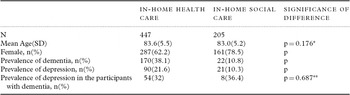
* Indep samples t-test, ** Chi-square
PS01.77
Promotion of activity program for elders with dementia in private residential care homes
NG Katie, Elderly Health Service, Hong Kong, SAR PR China
S.P. Ng, S.Y. Wan, W. Ting, M.C. Cheung, W.M. Chan,
Elderly Health Services (EHS), Department of Health (DH), Hong Kong, SAR PR China
Background: Among 35200 elderly residing in private residential care homes for the elderly (PRCHEs) in HK, around 32% are suffering from dementia. Leisure activities have been reported to reduce the risk of dementia and maintain function in many studies but due to a lack of the necessary skills among their staff, provision of activity for demented elders is limited in PRCHEs. A new integrated activity program was developed to help carers of PRCHEs to conduct activities for their demented elders. The program comprises 12-sessions of integrated activities for the demented residents with participative training of one carer who had not received formal dementia care training from each PRCHE.
Objectives: To study the effect of an integrated activity program on carers’ burden and their attitude in running and sustaining activity programs for demented elders in PRCHEs. Methods: Six PRCHEs were recruited to participate in the study. In each PRCHE, demented elders were randomly assigned to join a 12-sessions activity program (intervention) or receive usual care (control). Carers’ burden in taking care of the subjects and their attitude in running and sustaining activity program for demented elders, evaluated by semi-structured interviews, before and after the intervention were compared.
Findings: Five out of six homes (83%), involving 63 demented elders and 5 carers were able to complete the 12-sessions intervention. All five homes were able to sustain the activity program for at least six months afterwards. Significant reduction in perceived burden was observed among carers taking care of demented elders in the intervention group (F = 15.7, p = 0.013) after the intervention but not among carers of the control group. Though not statistically significant, carers of both groups had positive changes in attitude towards running and sustaining activities for demented elders after participating in the program.
Conclusion: A purposeful integrated activity program could help to reduce carers’ burden in taking care of demented elders and it is possible for non-professional staff in PRCHEs to sustain the program after training.
PS01.78
Depression and dementia among elderly receiving in-home health care and social care
Jon Wergeland, University of Agder, Kristiansand, Norway
Ø Kirkevold, Aging and Health, Tønsberg, Norway
G Selbaek, Centre for Old Age Psychiatry Research, Innlandet Hospital Trust, Ottestad, Norway
L Hogset
K Engedal, Norwegian Centre for Ageing and Health, Oslo University Hospital, Oslo, Norway
Background: Increase in the number of elderly persons put heavy strains on the provision of sufficient and good services to these elderly. Among 641 000 Norwegian elderly above 66 years, 165 000 receive some kind of public in-home health care or social service and 41 000 live in nursing homes. From earlier studies we know that the prevalence of dementia is 12% in the population over 70 years of age (Ott et al. 1995). In the same age group the prevalence of major depression is about 4% at disorder level and 12–19% at symptom level (Rosenvinge & Rosenvinge 2003). Studies have reported prevalence rates of depression of 20% at disorder level and 40–50% at symptom level in persons with dementia. Few studies have examined the prevalence of the two conditions among home-dwelling elderly receiving in-home health care and social care. We expect that the prevalence of both disorders is higher than in the general population of elderly persons because this group of elderly are disabled. Health care are mostly help with personal activities of daily living (PADL) and assistance in somatic health problems. Social care is mostly practical assistance such as help with household work, to do the shopping and other instrumental activities of daily living (IADL).
Mean NPI-score, Cornell-score and ADL-scores by mental capacity according to IQCODE and MMSE. N = 650

Aim: To examine the prevalence of depression and dementia among people 70 years or older who receive public in-home health care and social care. Methods The subjects, 650 persons over the age of 70, were recruited from urban and rural municipalities in the eastern part of Norway. They were randomly selected for this study and are representative to the Norwegian population above 70 years receiving public in-home health care and social care. Of them, 68.7% were females; mean age was 83 years (SD 5.4). All participants were evaluated with the Cornell Scale for Depression in Dementia (CSDD), the Informant Questionnaire on Cognitive Decline in the Elderly (IQCODE) and the Mini Mental State Examination (MMSE). According to Jorm (2004) we combined the score on IQCODE and MMSE to define participants with a possible dementia disorder. Participants with a score 3.44 or higher on IQCODE and 24 or less on MMSE were defined to have dementia. According to a recent Norwegian validity study of the CSDD elderly with a score of 8 or higher were defined as depressed (Barca et al. 2010)
Results: We divided the participants into two groups, those who received social care only (n = 205), and those who received in-home health care (many of them also received social care) (n = 447). Dementia was more prevalent among those who received in-home health care than those who only had social care (see table). Among participants with possible dementia disorder 62 persons (32%) also had depression, regardless of service received. There were significantly more depressed elderly who received health care compared to the group who was offered social care. However among participants with dementia the prevalence of depression was the same irrespective of group. Still 10.3% of depressed elders and 10.8% of elders with dementia were solely offered social care from their municipality.
Conclusion: This study shows that both depression and dementia are common among elderly who receive some kind of public assistance in their daily life. Many elderly with a possible dementia disorder also have depression. The difference in prevalence of depression between the two groups are probably mainly due to the difference in prevalence of dementia. Professional caregivers need knowledge of these two disorders to better meet the elderly needs.
References: Barca ML, Engedal K, Selbaek G (2010) A reliability and validity study of the Cornell Scale among Elderly Inpatients, using various clinical criteria. Dementia and geriatric cognitive disorders 29:438–447 Jorm, AF (2004) The Informant Questionnaire on Cognitive Decline in the Elderly (IQCODE): a review. International Psychogeriatrics 16:3, 275–293 Ott A, Breteler MMB, Harskamp F, Cammen TJM, Grobbee DE, Hofman F (1995) Prevalence of Alzheimer's disease and vascular dementia: association with education. The Rotterdam study. British Medical Journal 310:970 Rosenvinge B.H. & Rosenvinge J.H. (2003) [Occurrence of depression in the elderly – a systematic review of 55 prevalence studies from 1990–2001]. [Article in Norwegian] Tidsskrift for Den norske Laegeforening 123(7):928–9
PS01.79
The agreement between MMSE and IQCODE
Øyvind Kirkevold, Aging and Health, Tønsberg, Norway
K Engedal, Norwegian Centre for Ageing and Health, Oslo University Hospital, Oslo, Norway
G Selbaek, Centre for Old Age Psychiatry Research, Innlandet Hospital Trust, Ottestad, Norway
L Hogset
J Wergeland, University of Agder, Kristiansand, Norway
Introduction: More than 150 000 Norwegians receive some kind of public health or social service. Previous research indicates that less than 50% of persons with dementia receiving in-home nursing care have a dementia diagnosis. An efficient screening tool that can bee used by in-home nurses and social workers are needed. Two widely used screening tools for detecting dementia are the Mini Mental State Examination (MMSE) and the Informant Questionnaire on Cognitive Decline in the Elderly (IQCODE). The MMSE is a questionnaire test, while the IQCODE is a proxy rated instrument where family members or other persons who know the patient well, answer questions about the patient's decline in function due to cognitive abilities. Jorm (2004) suggests that a combination of these two instruments is useful for detecting dementia. He recommends that persons that have a score of 3.44+ on IQCODE or 24 or below on MMSE should be investigated further. Neuropsychiatric Inventory (NPI) is an instrument for screening of psychological and behavioural symptoms in dementia and Cornell is a well known proxy rated screening tool for depression in dementia, but can also be used for non-demented elderly (Alexopoulos 1988). Lawton (1969) has developed two scales for describing the activity of daily living (ADL) one for instrumental ADL (IADL) and one for self-maintaining (PADL).
Aim: To investigate the agreement between MMSE and IQCODE Methods A random sample of 650 persons 70 years or older, in 16 municipalities who receive health or social services from the municipality, were included. Information was collected by means of NPI, Cornell, and the two Lawton scales. Cognitive function was assessed by the IQCODE and MMSE and cut offs of 3,44+ or < 25 was defined as dementia, on the two scales respectively.
Results: We found a moderate agreement between the scores on MMSE and IQCODE (Kappa = 0.53; p
PS01.80
Artists and dementia: A case study exploring the impact of dementia in the life of an accomplished artist
Susan Mary Benbow, Staffordshire University, Stafford, Staffordshire, United Kingdom
R Merchant, Staffordshire University, Gloucester, Gloucestershire, United Kingdom
Background: An internet search on dementia and art brings up a list of sites which use art as a creative medium for people living with a dementia. What of artists who develop dementia? What do we know of how their illness affects their art? We know that changes, presumed due to early Alzheimer's disease but prior to its diagnosis, have been detected in the novels of a renowned author (Garrard, Maloney et al. 2005), and it would seem likely that it might be possible to do something similar by looking at the works of an artist. Similarly changes in artistic style have been documented after ‘minor posterior stroke’ (Annoni, Devuyst et al. 2005). A detailed case study (Liu, Werner et al. 2009) documents how a man with fronto-temporal lobar degeneration and amyotrophic lateral sclerosis who had no previous involvement in visual art developed a compulsion for painting: his art became simpler and more geometric as his illness progressed. Similarly after sub-arachnoid haemorrhage obsessive prolific artistic output has been described, including both poetry and visual art production (Lythgoe, Pollak et al. 2005). An accomplished artist who developed a fronto-temporal dementia exhibited changes in her work which became ‘intensely emotional and impressionistic, with less detail’ and this was attributed to the release of creativity and originality (Mell, Howard et al. 2003). Method and results We describe a case study of an accomplished painter who developed a dementia, diagnosed as Alzheimer's disease. The painter and his wife were interviewed as part of another study and agreed to talk about the changes in his painting and paintings. Discussion The case study raises a number of questions which we plan to investigate further: (1) Can changes be detected in someone's art prior to a dementia being diagnosed? If so how do they relate to the neuropsychological deficits associated with the illness? (2) The retention of skill and interest - what value does this have for the painter as a form of expression of identity? (3) What awareness does the person with dementia or/and their primary carer have of how the person's previously held skills have changed? (4) What perceptible change in form and structure of the composition can be identified from a visual analysis? (5) What other changes in artistic endeavour can be identified? For example we have identified a phenomenon of the person with dementia continuously returning to the composition, could one effect of dementia be to remove or diminish in some way the artist's previous ability to accept that a piece would never achieve the quality for which he strives?
PS01.81
Effectiveness of cognitive and physical training programs based on new software technologies in patients with mild dementia, Mild cognitive impairment and healthy elderly: Long Lasting Memories (LLM) platform
Fátima Gonzalez Palau, E Vargas, Y Ruiz, J Toribio, E Parra, R Losada, P Gomez, C Turuelo,
INTRAS Foundation, Zamora, Spain
M Franco-Martin,T Cid,
INTRAS Foundation, Valladolid, Spain
Introduction: Long Lasting Memories (LLM) is an integrated ICT platform which combines cognitive exercises with physical activity in the framework of advance technologies. LLM aims to deliver an effective solution against age-related cognitive decline, and to allow the recovery of higher cognitive functions in people who show cognitive impairment related to Mild Cognitive Impairment and Mild Dementia. Cognitive exercises are provided by GRADIOR specialised software which offers a structured evaluation and neuropsychological rehabilitation system. Physical Training is based on FitForAll game platform that can help elderly people to exercise through an innovative, low-cost ICT platform, such as Wii Balance Board. Objectives: To determine the effectiveness of LLM cognitive and physical training program in the improvement of mental capacities in non impaired elderly, mild cognitive impaired and mild dementia subjects.
Method: Volunteer sample of 86 participants was recruited from residential facilities, community centers and memory clinics. 44 healthy elderly, 24 subjects that met the DSM-IV criteria for Mild Cognitive Impairment and 18 who met the criteria for dementia (mean age = 75,9 years, SD = 8,4, age range = 60–92 years) were administered LLM during 12 weeks program. 49 subjects formed the control group (mean age = 79 years, SD = 6,48, age range = 62–94,). Mixed models analysis of variance (ANOVA) and paired t-test were calculated.
Results: Digit Span test score (Digit Span subtest of the Wechsler Adult Intelligence Scale-III) for the LLM group increased significantly during the intervention period, whereas the scores for the control group decreased. Two sample t-test showed a significant group difference at the post measurement (t = -2.01, p = .049) and no difference in pretest (p = -.54, p = .56). Participants significantly improved subscores of episodic verbal learning and memory (Hopkins Verbal Learning Test; immediate recall t = 2.68, p = .011; long delayed recall t = 3.36, p = .002; recognition t = 2.43, p = .02.) and general mental functioning (Mini Mental State Examination).
Discussion: Primary results support the effectiveness and usefulness of LLM cognitive and physical training in improving cognitive skills. LLM is a promising solution for aged related decline and the rehabilitation of higher cognitive functions, maintaining wellbeing of the elderly with few technical requirements.
PS01.82
Health self-perception of dementia family caregivers: Socio-demographic and clinical factors
Letice Ericeira-Valente, A Truzzi, F Sudo, E Engelhardt,
Federal University of Rio de Janeiro, Rio De Janeiro, Brazil
W Souza, National School of Public Health, Rio De Janeiro, Brazil
G Sousa Alves, University of Rio de Janeiro, São Luís, Maranhão, Brazil
C De Oliveira Alves
M De Oliveira Lanna
D Moreira, Institute of Neurology Deolindo Couto, Rio De Janeiro, Brazil
J Laks, State University of Rio de Janeiro, Rio De Janeiro, Brazil
Background: With the increasing life expectancy worldwide, dementia is becoming a major public health challenge, especially in developing countries like Brazil. An important but yet not well explored topic is how family dementia caregivers perceive their own health. Few studies have established the poorer health perceived of family caregivers when compared with caregiver groups for non-demented patients.
Objective: To investigate health perception of caregivers and its association with socio-demographic and clinical data.
Methods: A convenience outpatient sample (n = 137) of family caregivers and demented patients dyads were consecutively examined in a cross-sectional design from January 2008 to March 2010 at the Center for Alzheimer Disease and Related Disorders, Institute of Psychiatry (IPUB), Federal University of Rio de Janeiro (UFRJ), Brazil. Subjects with dementia aged 60 years or more were assessed with Mini-Mental State Examination, Functional Activities Questionnaire, Neuropsychiatric Inventory and Clinical Dementia Rating. Family caregivers over 21-years-old who had the major responsibility for providing care (for at least 10 hours a week) answered Socio-Demographic Questionnaire, Beck Depression and Anxiety Inventories, Zarit Burden Interview and Maslach Burnout Inventory. The present study was approved by the Ethics Committee of IPUB/UFRJ and all participants signed informed consent. Data were analyzed using SPSS statistical package 17.0 and Stata 9.0 (StataCorp, College Station, Tex.). T-test was employed to compare groups with and without self-reported physical and emotional problems. One-way Anova and Tukey's tests analyzed the relationship of subjective health status to socio-demographic and clinical variables. Logistic regression models were carried out to evaluate which clinical variables best predicted the poor health perception status.
Results: Gender proportions of caregivers differed considerably, the majority being females (80.3%). Most were married (55.5%), more than 80% were children and spouses of the patients and almost half were of higher educational level (46.0%). Caregivers’ mean age was 56.8 (SD = 14.0) years and the mean time of care was 3.9 (SD = 2.7) years. The majority of demented patients were females (65.6%), with 4–8 years and over 8 years of education (87.3%), almost half were married (47.4%) and the mean age was 76 (SD = 6.9) years. Most patients were at CDR = 1 stage (n = 57; 41.6%), followed by CDR = 2 (n = 49; 35.8%) and CDR = 3 (n = 31; 22.6%). The majority of caregivers reported health self-perception as “very good/good” (54.7%), followed by “regular” (34.3%) and “very bad/bad” (10.9%). The presence of physical (53.3%) and emotional (78.1%) problems was emphasized by the greater part of caregivers. The most prevalent types of physical and emotional problems were pain syndrome (50.6%) and anxiety (56.2%), respectively. “Very bad/bad” health profile was reported by older caregivers who presented higher symptoms of depression, anxiety, burden and emotional exhaustion. The presence of physical and emotional problems was associated with the same variables mentioned above. Caregivers with physical problems were older than those without, but no significant age differences were found for those with or without emotional problem. A multiple logistic regression analysis was performed with all statistically significant variables during the bivariate analysis. The backwards modeling showed that only anxiety (β = 0.0, p
PS01.83
Becoming a person with dementia - a systematic review: Exploring older peoples’ experiences in the transition from cognitive impairment to receiving a diagnosis of dementia
Louise Robinson, Institute of Health and Society, Newcastle Upon Tyne, Tyne And Wear, United Kingdom
C Abley, Newcastle University, Newcastle Upon Tyne, United Kingdom
J Bond
S Campbell, The University of Manchester, Manchester, United Kingdom
J Keady, The University of Manchester/Greater Manchester West Mental Health NHS Foundation Trust, Manchester, United Kingdom
K Samsi, King's College London, London, United Kingdom
A Gemski, Northumberland, Tyne and Wear NHS Foundation Trust, Newcastle Upon Tyne, Tyne And Wear, United Kingdom
J Manthorpe, King's College London, London, United Kingdom
Background: Wide variations exist in the diagnosis and disclosure of dementia despite international consensus recommending early diagnosis. Reported advantages to more timely diagnosis include an end to uncertainty, enabling people to receive pharmacological treatments and access psychological and rehabilitation therapies in addition to information and support, and to engage in future care planning discussions about legal, financial and care issues. In England, the National Dementia Strategy recommends early assessment of memory problems through memory clinics; however little is known about the experiences of people who accessing such services in their transition from being a person with memory problems to one living with a diagnosis of dementia. Aim: This study aimed to better understand the experiences and needs of an individual in their transition from having cognitive impairment to becoming a person with dementia, through a systematic review and qualitative study. This poster will focus on the methods, results and conclusions of the systematic review.
Methods: This review updated an earlier systematic review (2004,) on the topic of disclosure of the diagnosis of dementia, which identified the need for further evidence synthesis focused purely on the experiences of the individual with dementia and their families. Key electronic databases including Medline, CINAHL, Web of Science and EMBASE were searched; this was supplemented by hand searching of reference lists and contact with experts in the field. Abstracts, and then full papers, were independently assessed by two reviewers, with disagreements resolved through discussion or a third reviewer. Data extraction and quality assessment followed best practice guidance. As the majority of included papers included qualitative data, data synthesis was via a narrative review.
Results: 35 papers were included; 15 focused on carers only, 11 included both people with dementia and family carers and 9 solely on the person with memory problems. 18 reported research from Europe and 17 from the USA/Canada. Twenty two papers reported qualitative studies and 8 employed a mixed methods approach. Only 2 papers, reporting data from the same study, included empirical evidence on the actual process of diagnostic disclosure. Two papers explored the effects on the person with dementia's health. The vast majority of people with dementia wished to know their diagnosis and many cannot recall their actual diagnosis after disclosure; the term ‘Alzheimer's disease’ has more negative connotations than the word ‘dementia’. The key challenges for the person diagnosed with dementia were coming to terms with losses on multiple levels; psychologically, socially and functionally. Although there may be initial short-term distress, the majority of people with dementia do not appear to experience long term negative effects on their mental health. For family carers, becoming the main decision-maker and adjusting to increased responsibility were concerns. In terms of the nature and amount of information provision around receiving a diagnosis of dementia, only 1 of the included studies explored the views of people with dementia in this area.
Conclusions: This review found that research is slowly emerging which represents the voices of people with dementia and their family carers about receiving a diagnosis of dementia. There was consensus that diagnostic disclosure should be an ongoing process with the provision of support and information tailored to individual needs. Despite family carer concerns that disclosure of the diagnosis might affect a person's health and wellbeing, there is no evidence to data that disclosure leads to long term negative effects. However professionals need to identify those individuals and families who are experiencing ongoing difficulties in coming to terms with living with dementia and who may require additional specialist psychological support.
PS01.84
Sexuality, ageing and dementia
Susan Mary Benbow, Staffordshire University, Stafford, Staffordshire, United Kingdom
Overview: Although there is evidence that sexual activity decreases in frequency with age, more recent birth cohorts of older adults are reporting more frequent sexual activity, more positive attitudes and higher satisfaction with sexuality (Beckman, Waern et al. 2008). It would seem likely, given changes in sexual practice over recent decades, that this will continue and that sexuality and its impact on well-being will become more important in people entering later life in the coming years. However we also know that sexuality and ageing is an area that healthcare staff still find uncomfortable to talk about with older people (Gott, Hinchliff et al. 2004). Attitudes towards residents’ sexuality in residential and nursing staff differed between occupational groups (eg managers compared with nurses and care assistants) and those who have spent less than 5 years in the work were more negative in attitudes than those who had worked in the area for longer (Bouman, Arcelus and Benbow, 2007). Terminology and classification of sexually inappropriate behaviours in association with a dementia is inconsistent in the literature and terms like ‘inappropriate’ are difficult to operationalise, leaving considerable room for differences in application. Much of the literature on treatment of sexually inappropriate behaviours in dementia is based on case reports and dominated by pharmacological treatments. Tucker (2010) reviewed the literature and suggested a management flow chart (Tucker 2010) but there is a need to extend our understanding of the role of non-pharmacological treatments and the ways in which organisational policies, procedures and training impact on this area. There are also ethical dilemmas and conflicts in dealing with these issues. Actions needed to improve sexual health in older people with dementia include the following: • Professional bodies to include sexuality, ageing and dementia on their training curricula • Education and training programmes to include knowledge, attitudes and practice relevant to sexuality, ageing and dementia • More work on the impact of environmental issues • More work on consent issues including the balance between autonomy and protection; previous attitudes of people living with a dementia in relation to present attitudes; family and staff attitudes in relation to the attitudes of people living with a dementia. • Investigation of ethical decision making frameworks.
References: Beckman, N., M. Waern, et al. (2008). “Secular trends in self reported sexual activity and satisfaction in Swedish 70 year olds: cross sectional survey of four populations, 1971–2001.” BMJ 337: a279. Bouman, W.O., Arcelus, J. and Benbow, S.M. (2007) Nottingham Study of Sexuality & Ageing (NoSSA). Attitudes of care staff regarding sexuality and residents -A study in residential and nursing homes. Sexual and Relationship Therapy 22: 45–61. Gott, M., S. Hinchliff, et al. (2004). “General practitioner attitudes to discussing sexual health issues with older people.” Social Science & Medicine 58(11): 2093–2103. Tucker, I. (2010). “Management of inappropriate sexual behaviors in dementia: a literature review “International Psychogeraitrics 22(5): 683–692.
PS01.85
Dementia and creativity
Carlo Cristini, University of Brescia, Brescia, Italy
Introduction: Dementia and creativity may seem contradictory terms, opposites, however many observations, even in severe institutionalized older people, indicate that patients with dementia are able to demonstrate creative and innovative characteristics. Despite limited brain activity, it can still be possible to express creativity. Cognitive or emotional pain sometimes seems to imprison creativity or in other cases offers ideas and themes of rebirth and freedom of creative expression. Being creative may develop positive trends that are able to stem losses and enhance capacities. Within cognitive decline there are many examples of creative expression that demonstrate the desire to communicate deep thoughts and emotions.
Discussion: Some examples of dementia and creativity. William Utermohlen, an Anglo-American painter, stricken by Alzheimer's disease, continued to compose portraits following the inexorable progression of his decay (Crutch, Isaacs & Rossor 2001); he has witnessed the decline of his cognitive functions, maintaining until the end a kind of artistic core. In his last paintings the human figure crumbles, vanishes up to the last self-portrait that seems to reflect a loss identity, the image of a ghost that recalls ‘The blue phantom’ by Wols, just as a previous portrait evokes “Head of a hostage”, by Jean Fautrier. Utermohlen follows his dramatic existential adventure in a series of portraits. The ability to capture self-image, self-essence remains; the insight, despite the severity of the disease, is maintained; Utermohlen seems aware - at least in emotional terms - of what is happening to him. The cognitive deconstruction does not eliminate the possibility of being conscious and creatively expressing his feelings. Hyperbole and metaphor are two universal laws of art (Ramachandran 2003). Through hyperbole we may grasp the salient traits of a figure, the caricature of a face, as we can see in many contemporary paintings and in Utermohlen's portraits. In his verbal and non-verbal communication and his behavior, a patient with dementia appears to represent himself as hyperbole and takes the others as hyperbolic expression. In metaphors two unrelated concepts are combined to highlight certain aspects of both. Many great works of art are full of metaphors with multiple levels of meaning. During his illness, Utermohlen paints a man with his arms moving, disjointed, uncoordinated with the rest of the figure; perhaps a metaphor between the artistic expression of disintegration and the creative research of a new organization. In old age, Immanuel Kant presents signs of cognitive decline (de Quincey 1827). The German philosopher appears to be aware of his disorder, taking refuge in the past and expressing the pain of changes, the need to secure environmental and emotional reference points. His decline continues relentlessly, but he keeps his style, his elegance, his cultural achievements, and he accurately speaks about the gas and the Kepler's law of planetary motion. A few days before his death, he addressed his doctor with words of appreciation and gratitude. Kant, despite the relentless decline of his cognitive functioning, captures moments of cultural lucidity, and above all tenderness. In his last days, sick, not self-sufficient he reserves his final creative acts for the dignity of his knowledge, of his feelings of gratitude, understanding, humanity and affection. Cognitive mind is gone, but the soul of its history remains until the end. Cary Smith Henderson (1998), a professor of history, writes an important journal, expressing his feelings on his experience with Alzheimer's disease. Some people mistakenly think that a patient with dementia has no ability and emotional sensitivity. Even in advanced stages of the disease, the patient is able to grasp the meaning of situations and relationships; despite the difficulties and communication problems, he continues to have feelings and ideas that he would like to share with others, as Smith Henderson says.
Conclusions: Patients with dementia remember, think, communicate, understand and want to be understood, have feelings, can always be creative. In the words, artistic expressions and behaviors of a patient with dementia, we must always seek and find their way. Dementia may be a ‘hyperbole’, a creative ‘metaphor’ for life and the story of a man.
References: Crutch S.J., Isaacs R., Rossor M.N. (2001). “Some workmen can blame their tools: artistic change in an individual with Alzheimer's disease”, Lancet, 357, 2129–2133. de Quincey T. (1827). “The Last Days of Immanuel Kant”, Blackwood's Magazine. Ramachandran V.S. (2003). The Emerging Mind. Profile Books Ltd, London. Smith Henderson C. (1998). Partial view. An Alzheimer's Journal. Southern Methodist University Press, Dallas.
PS01.86
The development of institutional services facilitated for persons with dementia in Norway
Øyvind Kirkevold, Aging and Health, Tønsberg, Norway
A Eek, Vestfor Mental Health Care Trust, Tønsberg, Norway
Overview: The development of institutional services facilitated for persons with dementia in Norway Øyvind Kirkevold, Arnfinn Eek Background The care of the elderly in Norway is within the jurisdiction of the municipalities which provide social services (practical help and housing), health care services (mainly in-home nursing) and institutional care (mainly nursing homes). In the 1980s special care units for persons with dementia (SCU) emerged as a specialized service. The experiences with the SCUs were mainly positive compared with regular units. Since the proportion of people with dementia in Norwegian nursing homes is high (about 80%) it has been recommended that the municipalities should facilitate SCUs in the nursing homes. A survey of the municipal health services for persons with dementia in the municipalities in 1996/1997 showed that only 13.3 percentages of the beds in the nursing homes was in SCUs. During the 1990s a new type of service became more frequent; namely group livings for persons with dementia. The survey from 1996/1997 showed that in the whole country, was 856 beds in group livings. Due to the low total number of services specially facilitated for persons with dementia, the central authorities in Norway wanted to follow the development in this field.
The development of institutional services facilitated for persons with dementia in Norway

(1) Based on information from 397 of 430 municipalities (2) In the 397 municipalities that answered, total for Norway 69,600
Aim: On behalf of the Directorate of Health, the Norwegian centre for Aging and Health monitor the development on the municipal services for persons with dementia, focusing on SCUs and group livings. Method On five occasions (1996/1997, 2000/2001, 2004/2005, 2008 and 2011), a detailed questionnaire was send to all Norwegian municipalities. The questionnaire contained questions about the services for persons with dementia and covered information about number of beds, staffing and the formal qualification of the staff. Additionally, demographic data for each municipality was collected from Statistics Norway. The expected amount of persons with dementia in each municipality was calculated from the profile of the elderly population combined with the results from epidemiological studies of the prevalence of dementia. The municipalities who did not respond to the first posting were contacted by telephone, and the questionnaire was filed in as a telephone interview. The same procedure was used to fill in missing data.
Results: In this paper the results from the first four occasions are presented, the dataset from 2011 will be added for the conference presentation. Coverage In 1996/1997, 70 % of the municipalities had at least one SCU and 13.3 % of the beds in Norwegian nursing homes were in SCUs. In 2008 this 87 % of the municipalities had such services representing 23.2 % of the beds in the nursing homes. The number of beds in group livings for persons with dementia have increased from 856 in 1996/1997 to 1,686 in 2008 (even though the 2008 numbers are based on 397 of 430 municipalities). In 2008, 23 % of the municipalities had at least one group livings. The mean size of both SCUs and group livings was, in 2008, eight beds. This is about the same as found in the earlier surveys. Staffing SCUs have in average three patients per carer on an ordinary weekday day-time shift. In the weekends and evenings it averages out to four patients per carer. These numbers have been quite stable during the whole period, but there exists great variation between the wards. In the group livings, the number of patients per carer is marginally higher (3.5 on weekday day-time shift and 4.5 on weekend and after noon shifts). A high proportion of the staff is working part time; by merging the part-time positions to full-time positions, we have calculated the education level of the staff. In the SCU 26 % of the positions were filled by staff with a college education (e.g. registered nurses [RN]) and 62 % were filled by staff with a relevant high school education (most auxiliary nurses [AN]) and 12 percentages had no relevant education. In the group livings the distribution was 18 % of RNs, 68 % of ANs and 14 % without relevant education.
Conclusions: There has been a slow but steady increase in the number of institutional places facilitated for people with dementia during the last decade.
PS01.87
Association between apolipoprotein E ε4 and survival following onset of Alzheimer's disease in Korean elderly
Shin Gyeom Kim, H Jung,
Soonchunhyang University Bucheon Hospital, Bucheon-si, Gyeonggi-do, South Korea
S Lee
H Hwang
Background/Objectives: The ε4 allele of apolipoprotein(APOE) has associated with an increased risk and earlier onset of Alzheimer's disease(AD), but whether it affects mortality in patients with the disease is not consistently confirmed. This study aimed to assess the effect of APOE ε4 allele on mortality in patients with AD. Methods: APOE genotyping had been performed on 200 patients recruited from patients with probable AD registered in the Dementia and Age-associated Cognitive Decline Clinic of an university hospital and in a service program for the early detection and management of dementia in the community between 1996 and 2004. All the subjects had been examined according to the protocol of the Korean Version of the Consortium to Establish a Registry for Alzheimer's Disease Assessment Packet (CERAD-K) at baseline. Subjects were dichotomized into 88 patients with and 112 patients without at least one ε4 allele. Cox's proportional hazards regression models were used to identify the effect of the selected variables including the ε4 allele on mortality.
Results: Forty patients with and 49 patients without the ε4 allele were had died by December 2008. Median survival from onset of AD did not differ by the ε4 allele carrier status(10.2 years in the ε4-positive group, 9.1 years in the ε4-negative group). There were no differences between ε4-positive and ε4-negative group in age at baseline, sex, education, age at onset, duration of AD, severity of dementia. Significant factors that affects mortality during the follow-up included age at baseline and age at onset. Adjusting for age at baseline and age at onset, the presence of an ε4 allele did not show increased risk of mortality (RR = 0.98, 95% CI = 0.64–1.49) and the risk of effect of the ε4 allele not vary by age, sex, education in this sample. Conclusions: This study provide the first information about the effect of the ε4 allele on mortality in oriental elderly with AD. The APOE ε4 allele was not associated with mortality in patients with AD.
PS01.88
Persons with early onset dementia - experiences of living with dementia: A qualitative study
Aud Johannessen, Aging and Health, Norwegian Centre for Dementia Research, Education and Service, Tønsberg, Torød, Norway
P Haugen, The Norwegian Centre of Dementia Research, Tonsberg, Vestfold, Norway
A Möller
Background: Persons diagnosed with dementia disorders before the age of 65 are often referred to as ‘younger people with dementia’, ‘people with early onset dementia’ or ‘persons with EOD’, the latter which is the abbreviation used in this text. There is no Norwegian prevalence study but it is estimated that up to 1,400 Norwegian citizens suffers from EOD. In accordance with the recommendations of the Norwegian Directorate for Health and Social Affairs, these individuals are usually examined within the specialist health care services, mainly in memory clinics. Studies confirm that persons with EOD will need more help and assistance specific to their age group as the disease progresses. Persons with EOD and their families often fall through the net of services provided because services for families with a person with dementia are in general set up to meet the needs of the elderly people. Studies also show that the few services that are set up for persons with EOD are based on health personnel's subjective thoughts about what persons with EOD and their families are in need of and are not necessary in accordance with the subjective needs of persons with EOD and their families. Psychosocial interventions for carers considered being promising approaches as means of reducing the burden on carers of dementia sufferers in general and later studies show that persons with EOD should be included and be provided with their own groups for likeminded, but experiences and guidelines for such groups is there very little research to find. It is documented that persons with dementia can express their perceived needs of different kinds and expresses how it is to live with dementia; something that is also described through paintings and poetry. Therefore, we wanted to carry out this research for the purpose of developing services for persons with EOD based on having discerned what their needs truly are and thus what services are most beneficial. There are limited studies on this topic; studying persons with EOD's experiences of living with dementia and their need of adequate services to meet their specific needs.
Aim: The aim of this study was to find out how people diagnosed with dementia experiences living with dementia and hopefully make implications for practice and develop services further.
Method: A qualitative method, grounded theory, with depth-interviews, was used in this study. Four Norwegian Old Age Psychiatric hospitals/memory clinics in the Southern part of Norway were contacted and asked to recruit participant to this study; a task they performed via telephone or when the informants had a follow–up set up at their respective hospital. A total of 20 informants from 54 to 67 years, which eight of them were women were interviewed during 2010–2011. The informants brought with them different experiences of living with dementia. The informants time of diagnose was from four months to three years back in time.
Findings: Two of the persons who were asked to participate refused to and other findings and conclusions of this study will be presented at the congress.
PS01.89
Immigrant religion indigenous culture: South Asian experiences of dementia in the UK
Jemma Regan, Faculty of Health, Stafford, Staffordshire, United Kingdom
This poster presents details of an ongoing PhD research project, funded by a scholarship from the Centre of Ageing and Mental Health, Staffordshire University. Background In the U.K. Black and Ethnic Minority (BME) communities are most at risk for developing vascular dementia and experience a higher rate of young onset dementia (under 65 years), as compared with the majority ethnic population (RCP, 2009, p12). Despite this, BME dementia patients access health services and receive diagnoses later in their disease progression and are less likely to access anti-dementia medication or partake in research trials and care (Mukadam et al, 2011). Current clinical assessments may be ‘culturally biased’ (DoH Standard 7, 2001). The Western tradition to seek clinical intervention in the case of physical or mental illness highlights the discrepancy between indigenous U.K. culture and immigrant religious practices and rituals. A prominent theme emerging from existing research, not yet directly addressed, is the impact of spirituality and religiosity on dementia; in terms of perceiving the illness, accepting the illness, coping with the illness and accessing services (Milne and Chryssanthopoulou, 2005). This offers one explanation for why barriers exist for BME dementia patients accessing services. The behavioural manifestations of dementia affect religious ritual: For example, incontinence impeded Muslim home prayer as the house was considered ‘dirty’ (Bowes and Wilkinson, 2003). The stigma associated with mental illness negatively affected religious practices such as arranged marriage. Communication and translation issues manifested both in clinical communication and in support services. Cultural barriers to day-care and residential services were evident through inappropriate food or lack of observation of particular religious rituals associated with mealtimes (Patel et al., 1998). Mainstream dementia services appear ill-equipped to respond to the needs of ethnic minority individuals (Bowes and Wilkinson, 2003). Further study is needed to elucidate the role that religion and culture play in the help-seeking pathway for dementia, and to improve equity of access to healthcare services. The present study aims to improve knowledge of the interaction between health and religion in order to improve care provision. Aims of the investigation The main aims of this research project are: • Identify and analyse how religiosity and culture influences the experiences of care and coping for South Asian individuals with dementia, in the UK. • Discover and evaluate the potential deficits in - and benefits of - existing dementia care provided for South Asian groups. For the purposes of this study, the term ‘South Asian’ reflects the geographical location of an individual who descents from the region of south Asia: Afghanistan, Bangladesh, Bhutan, India, Maldives, Nepal, Pakistan, Sri Lanka; either from birth, as a first generation immigrant to the United Kingdom, or is born in the UK from immigrant parents of South Asian descent. The terms ‘Immigrant’ and ‘Indigenous’ refer to religion, with religion as one aspect of culture. ‘Immigrant’ is not a definition of the individual. Rather, it is their religious beliefs and associated practices that are immigrant to the cultural setting they are now living within. For example, the indigenous religion of the United Kingdom is Christianity. The culture of the United Kingdom is Christianity-orientated. Religious traditions such as Hinduism, Islam, Buddhism, and Sikhism are immigrant religions in to the indigenous culture of the U.K. Objectives of the project Research and critically evaluate the views and experiences of religiosity on dementia from the perspectives of: • The South Asian dementia patient • The dementia carer • The N.H.S. healthcare professional • The non-N.H.S. voluntary organisation worker • The religious leader Method The study is based on a qualitative design incorporating semi-structured interviews, to be analysed using grounded theory, across four phases: • Phase 1 (PILOT): T1 • Phase 2: T1 + 3 months • Phase 3: T1 + 6 months • Phase 4: T1 + 9 months Predicted Outcomes and Benefits: Increasing knowledge of the effect of immigrant religious beliefs and practices on dementia experiences will improve care provision in the indigenous U.K. culture. It will promote a positive shift in research from an ethnocentric perspective of dementia by raising awareness of, and sensitivity to, alternative cultural groups in dementia populations with a view to educating care providers and develop ‘culturally competent practice’ (LaFontaine et al, 2007).
PS01.90
“Caring & Innovating”: A community mental health project for older people
António Giro, M Salgadinho, A Estrela,
Hospital de Magalhães Lemos, Porto, Portugal
R Encarnação
T Salgado
T Santos
I Varandas
The population living in Portugal increased by 6.9% in the last 16 years, but growth in the age group over 65 years (65 +) was 34.6%, having risen from 14.0% (1,328,036) to 17.6% (1,787,344). As for the population 85 years and over (85 +), almost doubled. In 1991 1.0% (91,058) and it was estimated that 173,164 individuals reside in 2007 with 85 (1.7% of total population). By 2040 people aged 65 + and 85 + are respectively 28.8% and 3.8% of residents. The evidence of the growing importance that the age group over 65 years will possess, with special emphasis on the subgroup of “very elderly”, which will lead to greater attention being given to the problems of the elderly in order to make it a better match quality of life. This improvement involves, first, recognizing the specific nature of their needs, which, through ensuring better health care, meant that in countries with higher socio-economic development were being set up their own services for the elderly, whether in health care or from social support, to respond to the changing needs of the elderly and their carers. The absolute increase in the number of very elderly patients, coupled with the increased incidence of degenerative processes in this age group, leads to increasing weight whatsoever the elderly with mental health problems, disease of great potential for addiction and highly disruptive of the social matrix in which patients are located. The increasing prevalence of dementia, a result of aging and the significant growth of the incidence rate with age, has attracted a special attention to this risk group, given the marked dependence of these patients suffer and the high social costs resulting therefore. Moreover, the growing concern with individuals, moving services and / or professional assistance center and strong emphasis on community-based interventions, has led in recent years the relationship between the various providers, bringing together the nature of health interventions and social, using, where available, the cooperation of families. The sharp increase in social expenditure, health and social security in focus leads to solutions that are sought alternatives to institutionalization which prove to be advantageous with regard to their cost-effectiveness. The integration of care that is intended by the decentralization of mental health services and liaison with the multidisciplinary primary health care and community structures, will result in a more comprehensive and rigorous clinical situations, as well as the definition / implementation of intervention plans best suited to the actual needs of the target population - the elderly with mental health problems and their carers. The articulation and decentralization of mental health care will allow a greater accessibility of the elderly to care. In turn the work home strongly enrich this process to suit the more severe situations reducing all costs and inconvenience of a shift of the elderly and their caregivers, enabling closer care. Simultaneously the maximum transfer of skills for primary care technicians, as well as information and training of caregivers of the elderly will allow the extension of stay of elderly people in their social and family environment, promoting their independence, their quality of life by preventing or delaying its institutionalization. All these actions will enable a sustainable improvement in quality of care, providing professional and informal carers of lasting skills. The Community Mental Health Team is made up of a partnership between the Hospital Magalhães Lemos Department of Psychogeriatry and two Primary Health Care Community Centres in the area. It is developed at Community level by linking it with all existing structures and should be part of the intervention plan as needed by the wearer. This team will work continuously, based on activity around (business community), approaching the patients, their families and caregivers, promoting good practices of care, adequate health monitoring, supervising the adherence to proper treatment plan, promoting programs rehabilitation and active aging for users and psycho-educational programs for caregivers.
PS01.91
The impact of daydreaming on recently encoded information in older adults: A study with the diversion paradigm
Horacio Firmino, Centro Hospitalar Universitário Coimbra, Coimbra, Portugal
F Resende, Faculdade de Psicologia da Universidade de Coimbra, Coimbra, Portugal
S Pinho, Coimbra, Portugal
Introduction: The decline in memory performance is a common complaint in the elderly. The memory problems are mainly related to the ability to learn new information to be retrieved some time later (Dening, Jacoby, Oppenheimer & Thomas, 2008). The results of several empirical studies suggest that the ability to inhibit irrelevant information improves along childhood and early adolescence, but suffers a significant decrease in older adults (Soriano & Bajo, 2007). Some studies report that our wandering mind leads us to forget information encoded immediately before this lapse of attention (Delaney, Sahakyan, Kelley & Zimmerman, 2010). The wandering of the mind can operate over diverse topics, including concerns and events in the past, present or future, as well as unrealistic fantasies (Klinger as cited in Zimmerman, Sahakyan, Kelley & Delaney, 2010). In general, the occurrence of mental tasks has a cost in the performance of current activity. Several studies have shown that when the mind wanders the detection of the stimulus is poor, the encoding is superficial, reading comprehension is compromised and event memories are impaired (McSpadden, Schooler & Smallwood, 2002). Based on this kind of data it has been developed an operative task called the diversion paradigm (Delaney, Sahakyan, Kelley & Zimmerman, 2010). In this paradigm the daydreaming is simulated through instructions for thinking about autobiographical memories. These memories are diverse and include personal experiences and the emotion that accompanied them. So, when people divagate on an event they mentally travel and they are immersed in this context. It is possible that some of these daydreaming activities interfered with mnemic function. The change in context seems to explain the effect of the diversion paradigm (Sahakyan & Kelley, 2002).
Objectives: To observe if older adults instructed to think about autobiographical memories (diversionary thought) have a decreased recall performance of information recently encoded. So, it will be compared the memory performance of those older adults with an equivalent group performing other kind of distracting task without the personal information and diversionary thought. To contribute for the study of forgetting in older adults without cognitive impairment and depressive symptomatology.
Hypotheses: Two hypotheses are considered: (1) thinking about a past personal event (diversion group) leads to a larger decrease in recall of the first word list in comparison with the distracting task of speed reading a text (control group), and (2) an arithmetic task doesn't interfere with the recall of the second word list, i.e., average memory performance in both groups is not different.
Method Participants: Eighty older adults (40 in each group), aged 65 to 69 years with an educational level ranging from three to nine years, living in the community and without cognitive impairment and depressive simptomatology.
Materials: Two lists of 16 unrelated words each. Procedure: In diversion group the participants are instructed to study two lists of words for a memory test. After List 1 presentation they are instructed to think about a recent party in which they went and then during 45 seconds the participants describe this party. Following the List 2 presentation the participants performed an arithmetic task of backward counting during 90 seconds. At the end, the participants first recall the maximum number of words they can remember from List 1 and then the words of List 2. In the control group the same procedure is applied but the diversionary thought is replaced by a speed reading test.
Expected Main Results: It is expected that in the diversion group (diversionary thought) the recall of List 1 is lower than in control group (fast reading test). Concerning the recall of List 2, the same performance level is expected in both conditions (diversion group and control group).
References: Delaney, F. P, Goodmon, B. L., & Sahakyan L. (2008) Oh, Honey, I already forgot that: Strategic control of directed forgetting in older and younger adults. Psychology and Aging, 23 (3), 621–633. Delaney, F. P., Kelley, M. C., Sahakyan, L., & Zimmerman, A. C. (2010) Remembering to forget: The amnesic effect of daydreaming. Psychological Science, 20 (10), 1 - 7. Dening, T., Jacoby, R., Oppenheimer, C., & Thomas, A. (2008) Oxford textbook of old age psychiatry. Oxford University Press: New York. Sahakyan, L., & Kelley, C.M. (2002). A contextual change account of the directed forgetting effect. Journal of Experimental Psychology: Learning, Memory, and Cognition, 28, 1064–1072. Soriano, M. F., & Bajo, M. T. (2007). Working memory resources and interference in directed forgetting. Psicológica, 28, 63 – 85.
PS01.92
The influence of leisure activities on dementia prevalence in elderly community subjects
Ricardo Barcelos-Ferreira, Faculty of Medicine, University of Sao Paulo, Sao Paulo, Brazil
C Bottino, Institute of Psychiatry, University of Sao Paulo, Sao Paulo, Brasil
Recent literature has been shown the protective effects of leisure activities on cognitive decline. In addition, a few studies support the protective effects of cognitively stimulating activities like reading or playing chess. Prevention of dementia with potential preventive strategies is of high importance to reduce the individual risk. They seem to reduce the dementia risk by enhancing cognitive reserve and improving the functional capacity of older adults. Many studies have showed this relationship, as well the improvement of quality of life in this population. The present study aims to determine the prevalence of dementia and the association with leisure activities in a sample of elderly subjects, from Sao Paulo city, State of Sao Paulo, Brazil.
Cross-sectional study of a randomized community sample of 1,563 elderly subjects aged 60 years or older. The following instruments were used: a questionnaire with seven items about having the habit of leisure activities (reading newspaper, reading books, watching TV, going to the museum, listening radio, playing games and going to the cinema); The Cambridge Mental Disorders of the Elderly Examination (CAMDEX), and a socioeconomic questionnaire.
The univariated analysis indicated independent factors associated to dementia. After adjusting for all the variables, the multivariate analysis showed an association with watching TV (OR = 0.8; p = 0.015), reading newspaper (OR = 0.5; p = 0.033), reading books (OR = 0.7; p = 0.002), and not going to the museum (OR = 1.8; p<0.001). After adjusting for age, gender and educational level, the influence of these variables on dementia prevalence was maintained. There was no association between dementia prevalence and going to the cinema, playing games and listening radio.
Many authors believe that leisure activities could help people on having a successful ageing, although the concept of this term is not really clear. Variables like reading, playing and going out seem to be related to a great increasing in the quality of life. In our sample, dementia prevalence in elderly subjects was associated with many leisure activities. It seems that these activities are also related to an increasing in cognitive performance on the aging process. We believe that those activities could be stimulated perhaps at lower costs, enhancing cognitive performance and leading to the prevention of dementia and a better quality of life among older people. Potential benefit of leisure activities could be expected and explored by further research.
PS01.93
Shared decision making in care networks of persons with dementia
Leontine Groen - Van De Ven,M Span, J de Lange, C Smits, J Eefsting, M Vernooij-Dassen,
Windesheim University of Applied Sciences, Zwolle, The Netherlands
C Klingeman, Rotterdam University of Applied Sciences, Rotterdam, The Netherlands
K Coppoolse, Instituut Voor Gezondheidszorg, Rotterdam, The Netherlands
People with dementia and their family caregivers are continuously faced with changes regarding different aspects of their daily living situation e.g. care arrangements, housing, daily activities, financial and legal management. These changes require decisions to be made by people with dementia, their informal caregivers and professional caregivers involved. Each participant takes up his or her own role within the decision making process. Up until now little attention has been paid to shared decision making (SDM) in the field of dementia care. However, people with dementia and their family caregivers experience little involvement in the decisions that are taken over time. Professionals, in particular case managers, find it difficult to implement shared decision making in this patient group. This symposium is a collaboration between Windesheim University of Applied Sciences and Rotterdam University of Applied Sciences and reports on design and results of three different studies on daily life issues and related decision making processes in care networks of people with dementia. The first two studies (presentations 1, 3, 4 and 5) are part of a research program on SDM involving a longitudinal study using semi-structured interviews with care network members as well as the development of a decision aid for people with dementia and their relatives and its implementation in SDM processes. The research program will result in a dementia decision aid and provide SDM tools for care professionals and professional education relating to the care of people with dementia. Finally, the data will be used to improve theoretical models on SDM in care networks. The research program is carried out by the Research Group Innovation in Elderly Care from the Windesheim University of Applied Sciences together with the Centre of Expertise Innovations in Care from the Rotterdam University of Applied Sciences. The third study (presentation 2), from Rotterdam University of Applied Sciences, has a case-study design studying 15 care networks of people with dementia using semi-structured interviews. The following papers will be presented during the symposium: 1. Shared decision making in people with dementia and their caregivers This presentation focuses on aspects which influence (shared) decision making processes within networks of people with dementia. 2. Relationships between people with dementia, their informal caregivers and home care nurses. Who is director of care in a network of people with dementia influences care relationships between people with dementia, their family caregivers and home care nurses. This presentation will elaborate on this issue. 3. Developing a decision aid for people with dementia and their relatives: a study into Shared Decision Making in care networks This presentation focuses on the development of a decision aid, a flexible and dynamic it-application, which facilitates the SDM process involving persons with dementia, their informal caregivers and care professionals. 4. Strategies to ensure successful research with people with dementia People with dementia are often not involved as participants within (qualitative research). Most research is based on the proxy reports of informal and formal caregivers. It remains uncertain if these reports represent the perceptions of people with dementia themselves. This presentation discusses our experiences with interviewing persons with dementia. 5. Involvement of people with dementia in the development and implementation of supportive it applications: a systematic review of the literature To increase the usability of interventions and user satisfaction, it is important to involve people with dementia in the development of interventions. This presentation gives an overview of the extent to which people with dementia are involved in the development and implementation of supportive it applications, the strategies used to involve them, and the results of these strategies.
PS01.94
The evolution of memory disorder in the elderly people: Do you recover, will remain stationary or dementia?
Julio Zarra, Hospital Italiano de La Plata, La Plata, Argentina
L Schmidt, Hospital Centenario, Gualeguaychú, Entre Ríos, Argentina
Introduction: Even though most than a hundred years have passed since we know Alzheimer's disease today it's considered as the human's frightful flagellum. While most of mental disease seem to be losing its evilness, the neurocognitives disorders caused by Alzheimer's disease, far from attenuating has duplicated its appearance every each five years. And its symptoms are still being more depriving. So, in opposition to the rest of the illness that affects the nervous system and the psychic apparatus, which due to the new treatments has been attenuated the clinical forms of Alzheimer's disease. With its severe pronostic and the illness evolution, haven't been soften.
Hypothesis: Our intention is firstly, share some concepts to consider Alzheimer's disease as a cruel illness that can reach all the elderly people around the world. Secondly, to analyze the different forms of presentation than can mask a clinical state. Which many times could end-up in dementia? And will soon destroy the whole psychic apparatus of a person.
Methods: present our study group in the four institutional medical centers, with ambulatory patients, who consult about a cognitive disease. We describe the evolution trough time, taking into account the pharmacological treatments. We included 850 patients with diagnosis the Mild Cognitive Disorder and 348 patients with diagnosis the Alzheimer's disease (DSM IV-TR criteria).
Results: the importance of the early detection of memory disorder, as one of the first signs of alarm which give us the opportunity to intervene therapeutically in on time.
Conclusions: We can recognize the Mild Cognitive Disorder as a clue which reveal a first therapeutic instance probably in efficacy in this cruel evolution towards dementia.
Discussion: In the presence of a disorder of memory in the elderly people, with the possibility of evolving towards dementia, we prefer to begin drug therapy early, preventive character.
PS01.95
Delirium superimposed on dementia in an elderly Nigerian man: A case report and challenges
Gbolagade Amoo, O Abayomi,
Neuro-Psychiatric Hospital, Abeokuta, Ogun, Nigeria
A Olasore
Dementia was thought to be rare in Africa. Documentation of aging-associated dementia is still quite low in black Africa despite projections of future increment resulting from population aging and increasing cardiovascular risks. Many subjects with dementia present primarily to the neuropsychiatric practices because of behavioral and psychological symptoms of dementia. Occasionally, delirium can superimpose on dementia. Delirium in a patient with dementia is a problem that may have serious complications and poor prognostic implications. It may alter the clinical course and trajectory of cognitive decline and physical functioning but largely poorly recognized by physicians and nurses in older hospitalized patients. Delirium is superimposed on dementia when an acute stage in mental status (characterized by fluctuating course, inattention, disorganized thinking or altered level of consciousness) occurs in a patient with preexisting dementia. The immature and aging brains are particularly predisposed to delirium especially in the context of a preexisting brain condition. Dementia is a well documented risk factor for development of delirium and is often under-reported and under-treated. Behavioral and cognitive changes in patient with dementia are often attributed to diurnal variation of symptoms (sundowning) or underlying dementing illness itself rather than to a superimposed delirium. Though relatively little is known about the pathogenic mechanism in delirium versus those in dementia, both delirium and dementia have been shown to share several pathophysiological features including deficit in cholinergic neurotransmission, decreased cerebral metabolism and an inflammatory response. The elderly often have a number of concurrent illnesses (co-morbidity) and may require polypharmacy which may lead to a greater chance of problems arising because of drug interactions and to a higher rate of drug induced problems in general. The clinical and economic implications for the early recognition of delirium superimposed on dementia are considerable. In the management of this condition, we need to bring together clinical as well as ethical issues because they both come into play with respect to the outcome. The management involves among other things, assessment of possible contributory factors which may lie in the nature of the syndrome, in the environment and in the individual with the diagnosis. Thus concurrent physical health problems should be identified. Sources of physical discomfort should be sought and medication side effects should not be underestimated. Possible concurrent psychological and psychosocial contributory factors should be highlighted as well as understanding the individual's pathoplastic reactions to circumstances. The availability, nature and quality of carers as well as their current ability to cope with the needs of the person with the syndrome will shape behavior patterns. The characteristics of the care environment (physical space, comfort and adaptations to promote independence) should be considered. A number of ethical issues arising from this case along with the underlying philosophy should be discussed. We hereby report the diagnostic, environmental, psycho-pharmacological, psycho-social and medico-legal challenges in the management of a 73 year old retired male nigerian secondary school principal with delirium superimposed on dementia, behavioral and psychological symptoms of dementia and co-morbid medical conditions in a monospecialized psychiatric hospital setting: The neuropsychiatric hospital, Aro, Abeokuta, Ogun state, southwest geopolitical zone of Nigeria, sub sahara Africa.
PS01.97
How are relationships negotiated by people with dementia after they have received an early diagnosis of their condition? A comparison between young onset dementia and later onset dementia
Edward Tolhurst, Staffordshire University, Stafford, Staffordshire, United Kingdom
This presentation is based upon a nascent qualitative study which is exploring how support might be tailored to meet the variable requirements of people with dementia of different ages. The majority of people with dementia are older adults. However, a significant number have young onset dementia: in the UK approximately 16,000 younger people (aged under 65) have dementia, although it is estimated that the actual figure may be up to three times higher. There is a very limited number of research studies which compare the impact of young onset dementia with the impact of later onset dementia. In particular, there is scant qualitative research which draws comparison between the subjective experiences of younger and older dementia sufferers. An in-depth qualitative study comparing young onset dementia and older onset dementia thus will provide a crucial addition to the corpus of dementia research. Different life stages are likely to intersect with the experiences of people with dementia as they negotiate relationships with family members. The actual and perceived differences between these life stages may also impact upon the person with dementia's negotiations with health/social care organizations. This study will thus explore whether assumptions of age-based differences in needs could generate less favourable outcomes for people with dementia and their families. In addition it will consider how health/ social care agencies might support families consistently with regard to the impacts of dementia without generalising input to a degree which marginalises the specifics of age-based requirements. Younger people may face many of the same challenges as older people with dementia but could have additional needs as a result of early onset. For example, the less typical timing of the condition could present organizational and societal barriers as a result of the cultural association of dementia with old age. For example, because of dementia and age correlating at a relatively premature life stage, services may not be age-appropriate and social responses could be predicated upon additional ignorance and disquiet. It's also possible that younger people with dementia are disproportionately likely to have certain practical matters to consider, such as employment. In addition, the atypical early timing of young onset dementia may place additional emotional stress upon the family as a result of the shock of diagnosis. There is also an increased likelihood that the family will include dependent children; dementia therefore has an impact upon the whole family to an extent that it may not when an older person develops the condition. Older people with dementia are also likely to have particular issues which intersect with their condition. For example, they are more likely than young people to have additional health problems. Furthermore, the person with dementia's partner could be experiencing health problems which impacts upon their capacity to provide care, whilst their children are more likely to be independent and geographically dispersed. There is therefore increased likelihood that a person with later onset dementia will experience social isolation, in comparison with a person with young onset dementia. This suggests that there are likely to be emergent distinctions between the experiences of people with young onset dementia and those with older onset dementia. However, there is also likely to be substantial variation of experience within these two groups. Age may have a palpable intersecting impact upon the person with dementia's relationships, but this impact will be mediated by manifold contextual and dispositional factors. A key aim set out in the UK's Dementia Strategy is to provide diagnosis of the condition as soon as possible following onset; this is so that the person with dementia has optimum opportunity, whilst they have capacity, to make choices which will influence their future care. Recognition of the similarities and differences between those experiencing young onset dementia and those with later onset dementia can help to ensure that this strategic rhetoric is increasingly complemented by professional support and service delivery.
PS01.98
Familiarity and domesticity: The Eval'zheimer® way of life
Kevin Charras, Fondation Médéric Alzheimer, Paris, France
Introduction: This presentation will focus on the results of a controlled randomized trial to evaluate the impact of a psychosocial model of intervention proposed to improve the quality of life of institutionalized people with dementia: Eval'zheimer ®. People with dementia are particularly sensitive to their social and physical environment and are easily disoriented by changes in and/or non-familiarity of their proximal environment. In addition, congruency between social and physical environment is essential in order to promote well-being and adapted behaviors for institutionalized people with dementia and their carers. Stability and familiarity of the environment, of the care practices and of the activities of daily living in special care units for people with dementia stand for some of the fundamental characteristics promoting their well being. Eval'zheimer ® is a psychosocial model of intervention intended to fit caring practices and environmental design to institutionalized people with dementia. This model is based on the general finding that non-pharmacological factors such as interior design and architectural characteristics of environments can help reduce symptoms of people with dementia. Thus Eval'zheimer treats several conceptual aspects in order to provide people with dementia with residential satisfaction. The model not only adopts a person centered care and personhood approach but also incites carers to consider these people as elderly alter-egos that need to be accompanied more thoroughly throughout their daily life.
Method: A controlled randomized trial on 8 special care units – 4 took part in the intervention group and 4 took part in the control group – in France enabled us to evaluate the model of intervention in terms of quality of life of institutionalized people with AD. The model was implemented in the intervention group only. The environmental design intervention did not exceed the amount of 7.000 € per special care unit of the intervention group for refurbishing. Consent was given for 63 participants to take part in the evaluation, all were cognitively impaired with an average MMS score of 7,25 and length of institutionalization of 2,64 years. Data was collected by independent evaluators before the intervention and three months after the end of the intervention. Quality of life was measured with the validated French version of the Quality of Life in Alzheimer's Disease Scale (QoL-AD) and residents were also weighted before and after the intervention. An ANOVA with repeated measures was processed for the statistical analysis.
Results: The general results of this study showed an overall tendency of improvement of quality of life for the intervention group compared to the control group. More interesting were the comparisons within the experimental group concerning differences in care practices as sharing the meals between the caregivers and the residents, implementing night-shifts, or not wearing uniforms. Beyond the fact that these practices enhance significantly the global score of the QoL-AD for the residents and more specifically the living situations item, it is interesting to observe that the quality of life indicators fluctuate according to the implementation or not of these factors. For example, the items of the QoL-AD that fluctuate significantly when implementing nightshifts are living situations, self and fun, whereas the items that fluctuate significantly when implementing not wearing uniforms are mood, living situations, friends and Self. Discussion: One of the conclusions that can be drawn from this evaluation is the fact that the implementation of the model of intervention seem to benefit the well-being and quality of life of residents living in special care units. More specifically, these results suggest that specific care plans that take in account a human-environment approach and implement familiar care modalities relevant to daily activities and routines linked to “real” life, can enhance quality of life issues for residents with AD.
References: Charras, K., Eynard, C., Viatour, G., Frémontier, F. (2011). The Eval'zheimer® model: fitting care practices and environmental design to institutionalized people with dementia. Neurodegenerative Disease Management, 1(1), 29–35. Charras, K., Eynard, C., Menez, Y., Ngatcha-Ribert, L., Palermiti, F. (2010). Accompagnement de nuit en unité spécifique de personnes atteintes de la Maladie d'Alzheimer et qualité de vie. Neurologie-Psychiatrie-Gériatrie. 10(60), 264–269. Charras, K., Eynard, C., Menez, Y., Ngatcha-Ribert, L., Palermiti, F. (2010). Aménager, sensibiliser, accompagner le changement dans les institutions. La Revue de Gériatrie, 35(8), 591–596. Charras, K., Frémontier, M. (2010). Sharing Meals with Institutionalized People with Dementia: a natural experiment. Journal of Gerontological Social Work, 53(5), 436–448.
PS01.99
Presentation of Geriatric Mobile Team (GMT) integrates in the audomarois geriatric network
Jean Mely, C Fournez, M Hedouin, A Noel, H Lys, D Stievenard, K Garcon,
Chrso, Saint Omer, France
In agreement with the French legislation i.e. the ministerial decree concerning the gerontologic die of Mars 2007, the Plan ALZHEIMER 2008–2012, the plan solidarity Large Old 2007–2012; a Mobile Unit of Geriatrics or U.M.G (GMT) was created at the Hospital of Saint OMER in Pas-de-Calais (62) located in the north of France meadows of the Belgian border, to 60 km of Lille, the capital of Flandres. The hospital serves a population summons all rather rural with 116.000 inhabitants including 8000 of more than 75 years (Saint OMER is an agglomeration of 60.000 inhabitants). In addition to the service of U.MG., the hospital also has a service of short stay geriatric, a memory center, a SSR geriatric, an EHPAD, a Long geriatric stay, a cardiologic service SSR, a SSR rehabilitation, departments of surgery visceral and traumatologic, services of medicines: cardiology, pneumology, oncology, day and week hospital, alcoology, in of course services of pediatry and gynéco-maternity. The UMG was created on June 1, 2009 and is composed of 1 specialist geriatric physician, 1 framework nurse in common with the memory center and the short stay geriatric, 1 nurse coordinator, 1 psychologist, 1 neuropsychologist in common with the memory center, 1 social worker in common with the services of medicine, 1 secretary in common with the short stay geriatric. These various workers were trained by the medical colleges of Lille and Lyon (departments of Geriatrics and gerontology, Memory Center Regional). The UMG exempts into intra-hospital, as extra-hospital, the gerontologic good practices near medical staffs (councils, formations) concerning the take-care of the traditional syndromes geriatric: temporo-space confusion, malnutrition, the fall, social insulation, ill-treatment, dependence. Their places of intervention are the various hospital services of medicine and surgery of the CHRSO, also the 12 old people's homes of the SAINT OMER canton: EHPADS of Helfaut, Arpage de Saint Omer, Longuenesse, ARQUES, AIRE sur la Lys, Audruicq, Gonnehem, Arneke, Houchy les Hesdin, Fruges, ECQUES, ESQUERDES. (others are in the course of convention) The UMG also evaluates the elderly using validated scales that this team controls perfectly. These various sphere of activities are: the memory with the MMS of Folstein and the CLOCK test, the nutrition with the Mini nutritional assessment (MNA), the fall with the go test of Mathias and the Tinetti, the depression with the GDS of Sheik and Yesavage, the dependence with the ADL, the IADL of Lawton, the GIR of scale AGGIR, the vision, the hearing with the structured evaluation, the parents depression and the ill-treatment with the N.P.I. The UMG prepares the home returns after hospitalization. They work in close cooperation with the services of home care, the home medical care (HAD), the CLIC integrated for this year into the MAIA (information cell for the elderly), the families, the Conseil Général, the social town services and health insurance cases. The UMG prevents and avoids the elderly hospitalizations. In operating process, the UMG can be seized by telephone (+33321887348), by fax (+33321887349), by e-mail; by the patient himself, by his attending physician, by other specialist physicians (rheumatologist, dermatologist, surgeons,. . .), by the doctors coordinators of the old people's homes, by the families, the social workers, the courts, the administrative supervisions, the municipalities, the Conseil Général always nevertheless with the agreement of the patient. For the year 2010 one counts 175 interventions including 110 in the Old people's homes and 65 in the hospital. For 2011 the activity will be higher by six times because a new physician was engaged with the service Short stay geriatric making a geriatric physician to work practically full-time to the UMG. The UMG also works in network with the CLIC (information near the elderly), Conseil Général (MAIA), the health insurance cases, the family benefit cases, the pension funds, home care associations, the municipalities, the social workers services, the court, the administrative supervisions of which ARS . The UMG takes part with all these partners in the development of a gerontologic project suggested to the patient, within the framework of ethics.
PS01.100
Changing opinions on designing the optimal environment for persons with dementia
William Van Der Eerden, De Drie Hoven/ Osiragroep, Amsterdam, The Netherlands
G Jones, The Wide Spectrum, Sunninghill, Berkshire, United Kingdom
Although AD (Alzheimer's Disease) is increasingly referred to as a ‘visuo-cognitive’ disorder among researchers, this definition and conceptualization has not yet been widely disseminated to those involved in assessing dementia, designing dementia care environments, planning, and providing care. Many existing dementia care design concepts have come about in response to generalist knowledge, for example, that older persons have ‘poor vision’, as well as characteristic so-called ‘challenging or disruptive’ behaviours that must be contained. The new view and conceptualization of AD, increases the specificity of our understanding of the difficulties experienced, in a way which requires re-thinking and even re-defining behaviour changes in dementia, as well as care interventions for those changes. Combining the above insights, offers scope for increased innovation in the design of dementia care environments to help overcome and compensate for known visuo-perceptual difficulties and the resultant ‘relatively normal’ adaptive behaviour. Factors driving current changes in care environments and systems comprise: 1. Changing ‘institutional’ aspects of the care environment • Traditional combi- care homes still are (mostly) large scale institutions that look like hospitals • Some four-bedded rooms are still in existence, and although the majority of daytime is spent with other residents in one of several large dayrooms/lounge kitchen areas, by modern standards there is considered to be too little personal space and activities. The modernization of nursing home long-term care environments will result in: . Down-scaling of large institutions to small scale - sheltered housing facilities (well dispersed in the region and (or) proximate to a 24-hour care-institution).each person having a private small apartment providing individual space and more independent living, to enable them to maintain their lifestyles and to undertake daily activities that fit in their former life habits. The new style nursing homes, as institutions, will be: a modern nursing facility, functioning as a real care expertise centre - offering specialized, chronic dementia care, for those who actually need more intensive institutional psycho geriatric care, because of the intensity of their problems - offering additional (complementary) care and service to ‘small scale living facilities’ and people still living in the community. This is part of a transparent dementia-care-chain: “a chain of interlinked dementia care services”. 2. Improving quality of nursing home care for persons with dementia A Dutch national program for improving dementia care (“the National Dementia Program”), is helping regions to build their own ‘dementia-care-chain pathways’. This includes the goal of achieving more ‘demand driven care’, to ensure better incorporation of the individual's personal perspective in nursing home settings and: - A structural and national monitoring of the prevalence of relevant medical and nursing problems in the chronic care sector - Improving quality of residential/nursing home care for persons with dementia The national program on quality improvement of chronic care is called ‘Care for the Better’ - Implementation of transparent indicators of quality of care. - Implementation and confirmation of quality control systems Scientific assessment of the complex multi-dimensional needs of nursing home residents has been scarce; up till now there exists little information on quality of care and quality of life of nursing home residents in the Netherlands (and Europe), which is recognized and various programs to investigate the needs are now been developed An overview of realizable futuristic designs of environments for people with dementia will be shown, taking many of the above mentioned considerations into account. Organizing optimal dementia care in general, and achieving adequate residential/nursing home/community-based care, for people with dementia also requires more scientific research - basic research as well as management research on how to best attain transformations in care
PS01.101
Family caregiver perspectives on quality of life and care of elderly people with dementia in small-scale and traditional long-term care settings in the Netherlands and Belgium
Ietje De Rooij, De Wever, Tilburg, Noord-brabant, The Netherlands
K Luijkx, Tilburg University, Tilburg, Noord-brabant, The Netherlands
N Spruytte,A Declercq, LUCAS, KULeuven, Leuven, Belgium
P Emmerink
J Schols, Maastricht University, Maastricht, The Netherlands
Introduction: Caring for a family member with dementia affects the quality of life of residents as well as family caregivers. As the disease of the family member with dementia progresses, the psychological, practical and financial burdens may increase. Family caregivers of relatives with dementia experience lower quality of life and psychological adaptations need to be made in order to cope with the changing relationship between them and their relative. Usually, home care is preferred over residential care, but for a substantial number of persons in the later stages of dementia staying at home is no longer possible and admission into a long-term care setting is inevitable. In general, two types of long-term care settings exist in residential dementia care. Traditionally, residents live in large groups in nursing home wards. Caregiving is primarily based on an institutionalized medical and nursing approach with a number of different caregivers executing differentiated tasks and less attention for the living environment and welfare. Over the last decade, criticism about this model, consisting of arguments against the rigid organization, the more cure than care based culture and the mainly supply-oriented approach towards the care giver, has been growing. In reaction, many large nursing homes are transforming their traditional care model to a more home-like approach, by developing small-scale living facilities. In small-scale living facilities residents live in smaller groups (6 to 16) with a smaller number of different caregivers and care giving, based on a more home-like, holisitic and person-centred approach, in which social interaction and activities of daily life are of central importance. It is our hypothesis that in small-scale living facilities family caregivers will come into contact with fewer professionals, who know their relative better, as compared with traditional nursing home settings. As a consequence of the different care model, we expect that social relations between the family and the professional caregiver are likely to be more profound in small-scale living facilities than in larger, traditional nursing homes, resulting in more satisfaction of family caregivers. The aim of this study was to provide insight into family caregiver perspectives on the relationship between family caregiver, professional caregiver and elderly resident, as well as on their perspective of the quality of life of their relative with dementia in both traditional and small-scale long-term care settings in the Netherlands and Belgium. This study was a part of a broader research project on quality of life for elderly residents and their professional and family caregivers.
Methods & Materials: A questionnaire (37 items) was administered to 64 family caregivers of residents with dementia in traditional and small-scale long-term care settings at two measurement moments (at baseline and after 12 months) in the Netherlands and Belgium. Four topics of interest were covered in the perspective of the family caregiver: The relationship between family and resident, the family perspective on the treatment by professional caregivers, the relationship between family caregiver and professional caregiver, and the family perspective on ‘Quality of Life’ of the resident. Analyses were conducted using Mixed Models analysis and logistic regression.
Results: On the whole, a lot of similarities were found in how family caregivers of persons with dementia perceive the care their relative receives and in how these family caregivers experience their relationship with staff. However, three significant setting differences emerged. The study showed that, compared to traditional settings, family caregivers in both countries with a relative living in a small-scale setting had more contact with the professional caregivers and were more satisfied about this contact. They stated that the professional caregivers in small scale facilities show better listening skills and show more respect for the relative with dementia. They also experienced that more attention was paid to the feelings of themselves as family caregivers. Conclusion Shifting long term care from a mainly medically-oriented institutional model to a more holistic small-scale and person-centred model shows promising results for family. In coming to a more individualized care for persons with dementia, this study underlines the importance of integrating the family perspective in order to ameliorate quality of care. Suggestions for future research and practice are given.
PS01.102
Quality of life of residents with dementia in small-scale living facilities versus traditional long-term care settings in the Netherlands and Belgium
Ietje De Rooij, De Wever, Tilburg, Noord-brabant, The Netherlands
K Luijkx, Tilburg University, Tilburg, Noord-brabant, The Netherlands
J Schaafsma
A Declercq, KU Leuven, Leuven, Begium
P Emmerink
J Schols, Maastricht University, Maastricht, The Netherlands
Introduction: The considerable increase of the number of people with dementia worldwide implies an increasing demand for residential care. In general, two types of settings exist in long-term residential dementia care. Traditionally, residents live in large groups in nursing home wards. Caregiving is primarily based on an institutionalized medical and nursing approach with a number of different caregivers executing differentiated tasks and less attention for the living environment and welfare. Over the last decade, criticism about this model, consisting of arguments against the rigid organization, the more cure than care based culture and the mainly supply-oriented approach towards the care giver, has been growing. In reaction, many large nursing homes are transforming their traditional care model to a more home-like approach, by developing small-scale living facilities. In small-scale living facilities residents live in smaller groups (6 to 12) with a smaller number of different caregivers and care giving, based on a more home-like, holistic and person-centred approach, in which social interaction and activities of daily life are of central importance. The assumption, that this approach will improve quality of life (QoL) of older persons with dementia, is often made by the care organizations, politicians and other policymakers. However, little scientific evidence is available yet supporting this assumption. Therefore, the research question of our study is: Which elements affect the quality of life of elderly residents with dementia in small-scale and traditional long-term care settings in the Netherlands and Belgium? Because of the different vision on care and the approach to residents in the two types of settings, the expectation is that there will be both similarities as well as differences regarding aspects of quality of life of residents and perspectives of family and professional caregivers. However, family and caregiver perspectives are beyond the scope of this paper. Differences related to residents between the two types of settings are expected in social interaction, maintenance of independent activities and self-image. Social interaction is expected to differ because of the more profound contact between caregiver and resident, as well as among residents in small-scale settings. Because the emphasis is on continuing to perform activities independently, the assumption is that residents in small-scale settings will be able to care for themselves and stay active in daily life longer. In turn, both aspects may lead to a more positive self-image in small-scale wards than traditional wards over time.
Methods & Materials: The study had a quasi-experimental longitudinal design with a time interval of one year, with three measurement moments. A contextual model was developed, incorporating nine aspects of quality of life (QUALIDEM scale, nine subscales), as well as behavioral characteristics (NPI-NH, CSDD), behavioral interventions (Use of restraints and medication) and social interaction (RISE, visits) of persons with dementia. Data from 179 residents living in small-scale or traditional settings in five different nursing homes in the Netherlands and Belgium were obtained by means of observations by nurses, nursing assistants or psychologists. The data constituted a hierarchically multilevel data structure: observations across time were nested within persons, which were subsequently nested within settings. Accordingly, the data were analyzed using Hierarchical Linear Modeling techniques, in which the primary analyses were three-level models and each quality of life subscale was analyzed separately. Results Small-scale living settings appeared to have some beneficial QoL-related effects on residents. QoL decreased for traditional Dutch settings on the aspects of ‘Negative Affect’ and ‘Caregiver Relationship’, whereas these remained stable over time in the small-scale settings in both countries, as well as the Belgian traditional wards. Traditional wards also showed some beneficial effects on residents. In Belgium QoL increased on the aspect of ‘Feeling at Home’ in traditional wards, whereas in other wards this remained stable. Furthermore, on the aspects of ‘Social Relations’ and ‘Positive Affect’ traditional wards remained stable, whereas small-scale ward in the Netherlands showed a decrease. Furthermore, residents in all wards, except the Belgian small-scale wards, remained stable on ‘Restless Behavior’ over time. In the Belgian small-scale settings QoL significantly decreased on the aspect of ‘Restless Behavior’.
Conclusion: Both type of setting (small-scale or traditional) as well as living in a Dutch or Belgian setting affects the quality of life of elderly residents with dementia. Fewer differences were found than expected. However, the differences that were found came up to our expectations about the benefits of small-scale living.
PS01.103
Abstract withdrawn
PS01.104
Abuse of elderly people with demention syndrome
Olivera Bundaleska, Gerontology Institute, Skopje, Republic of Macedonia
A Mitevska
Overview: A memory disorder is one of the most striking symptoms of dementia. There is a weakness of memory and inability to remember the fresh happenings The memories of the past are usually well preserved and fresh in the memory In the course of the disease can often be monitored decay of memory from new to old happenings Falling ability of logical reasoning and the ability of generalization, differentiation, synthesis and analysis. Abstract concepts are lost. In such a situation dementnion people can become victim to: - Part of family -close-relative -man (woman who helps him for money or keep the person) -a distant relative - neighbor - Bill Collecte - Social Worker - anyone who is close to the old person
Goals: The recognition of the problem of abuse of elderly anddementni beings for their existence and safer living in their home environment as part of overall social life of the same Methods- History-often patients themselves are telling them what happened before being placed in the Gerontology Institute: - Heather history (close relatives, neighbors say the events at the home of the old person as disinterested observers noted) chat with social services (application and research of social services obtained knowledge of any abuse of the old person by another person) The inability to cope with everyday problems: pazaranje, cleaning, cooking, lack of communication company confidence they give the person who felt the closest currently considering the disease fromthat suffering.
Results: How are people abusing demention Financial-by deducting pension (whether by way of deprivation oflegal capacity in demention or forced the withdrawal of money) By moving the housing space in which the old person previously lived (often under the motive that will care for the old person, their relatives or someone close moves into the apartment) care about the old runs short, and after that of how to obtain knowledge thatcare and servicing is difficult to stay Mon homes or in geriatrics The seizure of property under no compulsion to keep often if the oldperson is guarded by someone using the threat that no longer held, it will leave you alone, forced to sign a contract for life support killing him the property - The seizure of property along the way life support contract - With housing in a nursing home and selling houses (there are cases when to undertake ill people, but since a few weeks would fatigue keeping them housed in Gerontology Institute and the property they use. In these cases the old pension often is sufficient to pay the expenses of accommodation. -Sexual abuse especially among women. Part of the female gender in a way that is sexually abused for monetary compensation or any purpose In the eight years of monitoring patients who are cared for in Gerontology Institute from any cause of 28 patients 4 are materially abused. Shopping-in long conversations with families and abused and have come to the knowledge of their abuse, which because of fear of being abandoned by the person who looks not tell of their suffering. The accommodation in Gerontology Institute and long termtreatment and support call they felt free and safe to say though some of their previous experiences when they were alone and unattended dequate court was often a mediator of resolving property abuse.
PS01.105
Mental capacity and deprivation of liberty of the elderly in Western Australia: Is there a problem?
Neville Hills, Mental Health Review Board, Swanbourne, Western Australia, Australia
Deprivation of liberty of the elderly in Western Australia: Is there a problem? Mental Health and Guardianship law in Western Australia (WA) has evolved progressively from English common law. How successful this has been is the subject of a PhD research proposal which examines the historical basis of this evolution, the extent of divergence from English and European law, and the degree to which WA law and procedures comply with natural justice, Human Rights expectations and policies in other jurisdictions. New laws dealing with the issues of mental capacity have been introduced in the United Kingdom which greatly impact on the elderly, particularly those lacking mental capacity to consent to treatment or to deprivation of their liberty. At the present time WA has no Human Rights Act, nor does it appear there is any interest from any of the political parties in raising the subject. Although a Human Rights Bill was proposed in 2007, it was dropped in favour of awaiting the outcome of proposed Australian Federal initiatives. Australia is a signatory to the Convention on the International Protection of Adults signed at The Hague in January 2000. The adequacy of current WA law and procedures to protect the elderly with mental illness or those lacking mental capacity is an appropriate and timely area for this presentation. This paper will outline the current legal position, illustrate the extent of divergence from European and English legislation which has emerged with passage of time, and indicate the direction of research which is planned to examine the medical and legal issues affecting the elderly in WA. Subsequent research will consider whether or not sufficient safeguards exist to ensure at the very least some parity with current European and English standards, and whether elderly Western Australians are well served by current legislation and procedures.
PS01.107
‘Oh it's wonderful when it actually works!’ Ethics of surveillance technology in the residential care for people with dementia and intellectual disabilities: Findings from an ethnographic field study
Alistair Niemeijer, B Frederiks, C Hertogh, J Eefsting, J Legemaate,
VU University Medical Centre, Amsterdam, The Netherlands
Background: Traditional institutionalised care for people with dementia and intellectual disabilities is shifting more and more towards small scale living arrangements where surveillance technology is becoming increasingly important. This technology has as its aim to increase safety and quality of life and can also serve as an alternative to the more traditional ‘hard’ forms of freedom restriction. However it is still not clear what the ethical and practical implications of these interventions would be in a formal residential care setting. What is more, it is often in relation to people with cognitive impairment that the use of surveillance technology provokes conflicting reactions. In summary: the field lacks a clear normative framework when it comes to these developments.
Aim: The goal of this research is therefore to develop a multidisciplinary guideline for the responsible (and restrictive) treatment and use of freedom restriction and surveillance technology in the care for people with dementia and intellectual disabilities. In this guideline the emphasis will thus lie in the prevention of restraints, the application of (technological) alternatives, and the ethical role of surveillance technology.
Method: For this research a multi-step approach is chosen, including 1) literature review; 2) concept mapping; 3) survey among care providers; 4) participant observation in identified ‘best practices’. So far several articles have been published, including a literature review and an article on concept mapping. The two concept mappings were conducted with ethicists and care professionals from the field, on the basis of which a survey was sent to care providers in the Netherlands. ‘Best practices’ were then selected for additional ethnographic research consisting of open interviews and participant observation. A normative analysis will also be made. In this presentation the focus will be on preliminary findings of an ethnographic field study carried out in 2 different care homes. Ethnographic research allows the researcher a more comprehensive perspective than other forms of research and is appropriate to behaviours that are best understood in their own environment. With this specific method a good insight can be gained into the ‘local logic’ of a (care) practice, i.e. the manner in which the daily doings of care providers are embedded in a sum of considerations which are not always in accordance with norms or policy regulations given from above.
Results: Among the central topics that evolved in the ethnographic field study were: ethical and (im)practical aspects of surveillance technology; motivation and application of restraints; and the effects of small scale living on primary care. Although the use and application of surveillance technology has as its aim to enhance safety and quality of life of the resident, it was not always clear to the actual users of the technology that these aims were met. Next to the potential benefits of surveillance technology, the application of surveillance technology can lead to more dependence on technology, a false sense of security and was seen to be used as supplemental rather than as an alternative to classic forms of restraint.
Conclusion: When it comes to (views on) the application of technology, there appears to be an inherent duality, rooted in the conflict of providing more safety versus (respecting) the autonomy of the resident. What is more, elaboration on this ethical issue has proven to be very difficult. Implementation of surveillance technology in residential homes for people with dementia or intellectual disabilities often precedes policy. However, the ethical and practical viability of surveillance technologies remains unclear, in particular to those who (have to) make use of surveillance technology the most, namely the nurses.
PS01.108
Cross cultural dementia screening: New test for non-western migrants. The first results of the SYMBOL study
Özgül Uysal, Academic Medical Center, Amsterdam, The Netherlands
Background: In the 60s and 70s many low educated immigrant workers came to Europe. In the Netherlands, these immigrants mostly came from Turkey and Morocco. These elderly migrants will form a substantial part of the Dutch elderly society in the next decades. Cognitive decline and dementia are difficult to evaluate in elderly migrants because of their different cultural background, language barrier and low level of education. Commonly used cognitive screening instruments are therefore not applicable for non-Western migrants. The newly developed Cross Cultural Dementia screening (CCD) exists of four subtests, which evaluate memory, executive functions and psychomotor speed. Although the test material is nonverbal, test instructions are given by computerized voice samples in the patients’ own language. Turkish, Moroccan Berber, Moroccan Arabic and Dutch versions of the test were validated in earlier research. International research shows that the prevalence of dementia is higher in ethnic minorities (Rosenbaum, 2008). Aims of the Symbol study are to determine prevalence of dementia and other health outcomes among elderly migrants in the Netherlands and to evaluate the effect of a tailored intervention for demented subjects and their caregivers. Another aim is to standardize the CCD. Methods: Symbol is a population-based study. We started data collection via general practitioners in May 2010, and we have tested (n = 850) Turkish, Moroccan Berber, Moroccan Arabic and Dutch elderly participants. Beside the cognitive test, information concerning depressive symptoms (GDS-15), Activities of Daily Living (Katz ADL index score), loneliness (de Jong Gierveld scale) and health related quality of life (EQ-5D) were collected. The CCD and health questionnaires were administered by trained psychology students and/or neuropsychologists. Results: We will present preliminary data on the prevalence of dementia and other outcomes in the different groups. The normative results of the CCD (means and standard deviations) for the different age and education samples will be presented as well. Conclusions: With use of the CCD, we can detect memory problems and dementia in subjects with different cultural backgrounds, with little or no education. This enables future application of the CCD in daily clinical practice. Reference Rosenbaum, B., Kristensen, M., Schmidt, J. (2008). Dementia in elderly Turkish immigrants]. Ugeskr Laeger, 8, 170(50):4109–13. Danish.
PS01.109
Profile of mental health problems in aged presenting to a tertiary centre in India
Shrikant Srivastava, S Pandey, N Pandey, S Tiwari,
Chatrapati Sahuji Maharaj Medical University, Lucknow, Uttar Pradesh, India
Introduction: The first psycho-geriatric hospital was established in India in 2005 heralding the beginning of geriatric mental health services in the country. There is no other such service in the country till date and therefore, no data regarding the profile of mental health problems in older adults presenting to a tertiary centre exists. Like elsewhere in the world, the population of those over the age of 60 years is increaseing, consequent to which the mental health problems are on the rise as well. There are no formal psychiatric services for this specific population in India, thus precise data on prevalence rates of various disorders is unknown. Albeit, there are few community surveys in rural and urban areas looking at prevalence rates in different parts of the country. The present study is an attempt to find out the profile of mental health problems in the only psycho-geriatric hospital in India. This data will be useful for planning future services in the country.
Methodology: The study included all the patients who attended the outpatient clinic in the Geriatric Mental Health Department at Chatrapathi Sahuji Maharaj Medical University, Lucknow, India in the year 2010. Information on referral pattern, socio-demographic details, psychiatric diagnoses, educational status, individual stressors and comorbidity .was obtained.
Results: The results have been presented in terms of psychiatric diagnoses prevailing in this population. There were 391 patients in all, 64.96% were males, 35.03 % were females, 27.87% of population was illiterate, 38.61% of population was educated up to high school and 30.17% of the population was above high school; 20.97% of patients were self referrals, 0.51% was referred by general practitioners and 2.55% were referred by other sources; 15.08% of patients reported some kind of stressors and 84.0% did not report any kind of stressors, and 13.29% of patients reported having co-morbid substance abuse. Conclusions: The results have been discussed mainly in terms of the profile of psyhiatri disorders with different age groups, gender and educational status.
PS01.110
Neuropsychological intervention for a patient with semantic dementia: A case study. Improving naming and semantic knowledge of foods
Laila Oeksnebjerg, Department of Neurology, Rigshospitalet, Copenhagen, Denmark
Background: Semantic Dementia is a commonly accepted term for a subtype of frontotemporal dementia. The condition is characterized by progressive loss of semantic knowledge, both verbal and non-verbal. However, the most common presenting symptoms are in the verbal domain, where patients with semantic dementia loose the semantic meaning of words, especially nouns, and, as a consequence, presents with anomia as a dominating symptom.
Method: This case study describes an intervention program based upon individualized goal-oriented neuropsychological rehabilitation. NN, a 64 year old woman, former office assistant, with semantic dementia, was participating in this program. NN was diagnosed with semantic dementia six months before the intervention program started. Also, her husband participated in the program, which included caregivers. One of the main goals of including caregivers in the program was to introduce methods of supporting patients’ rehabilitation process, with the aim of improving transference of the outcome of the rehabilitation process into the daily life of patients and caregivers. Initially the patients’ personally relevant goals of rehabilitation was identified. The process of rehabilitation was focused upon implementing personally relevant and useful strategies and methods, addressing these goals. As part of the method, her husband, as a caregiver, also took an active part in the identification of individualized goals and relevant strategies/methods of rehabilitation. The patient and her husband identified her fading semantic knowledge and naming of foods as a main goal of improvement. Her daily living was affected by fading of knowledge and anomia in many domains, but the domain of foods was particularly challenging in many ways; the patients fading knowledge of foods resulted in her eating a decreasing variety of foods, she found it very difficult to shop for foods, and she only cooked 3 different dishes. Her husband gladly took over the cooking, but the couple had increasing frustrations over difficulties of communicating about foods and her increasing unwillingness to eat foods she no longer had knowledge of. An intervention program was designed with the aim of halting and/or decelerating the effects of progressive anomia and reduction of semantic knowledge of foods. A neuropsychological examination showed that the patient still had a well preserved ability of learning new knowledge. She also had good personal skills of being well structured and working in a systematic way. The patient was presented with daily homework of rehearsing naming and relevant semantic knowledge of different foods. Pictures, names and semantic information were presented for her on a set list, which could ensure errorless learning. She was also participating in activities of shopping for foods and cocking food – these activities was managed by her husband, but she participated. While they were cooking she made her own personal diary of which ingredients they used in the hot meals her husband cooked. These activities were introduced to make her more personally aware and active towards what kind of ingredients their food contained. The rehabilitation program was conducted within an 8 weeks period. It was conducted at a Danish out-patient memory clinic, and was managed by a clinical neuropsychologist.
Results: The patient and her husband both expressed that they were happy about the rehabilitation program. They both enjoyed the common activities of shopping for foods and cooking. The husband described that his wife was decreasingly skeptical about foods. He could introduce a growing variety of ingredients in their daily diet, with her being interested and understanding the dishes they had. So, he sensed at growing knowledge of the different foods he presented for her. It was also registered that the patient had an increasing ability of naming and had relevant knowledge of foods. At the beginning of the rehabilitation program the patient could name and had relevant semantic knowledge of 14/43 of the kind of food ingredients that was presented for her by picture and written material. Also, she had relevant knowledge, but could not name 12/43 kinds of food. She could neither name nor give relevant semantic knowledge of 17/43 kind of foods. By the end of the 8 weeks training session this had increased, she could then both name and had semantic knowledge of 33/43 kind of foods. She also had relevant knowledge of 3/43 kind of foods. She could neither name nor had relevant semantic knowledge of 7/43. At the time of follow up, 6 weeks after the rehabilitation program had ended, this had changed to 21/43, 20/43 and 2/43 indicating the systematic rehearsal is crucial to keep the levels of re-learned semantic knowledge and naming in patients with semantic dementia.

PS01.111
Episodic memory in patients with the temporal variants of frontotemporal lobar degeneration and Alzheimer's disease
Cornelis Pleizier, Diakonessenhuis, Utrecht, Netherlands
A Van Der Vlies, E Koedam, T Koene, W Van Der Flier, P Scheltens, Y Pijnenburg,
VU University Medical Center, Amsterdam, The Netherlands
Background: The medial temporal lobe is affected is the first stages of Alzheimer's disease (AD). Episodic memory (EM) impairment in AD is associated with the degree of medial temporal lobe atrophy (MTA). Semantic dementia (SD), a clinical variant of frontotemporal lobar degeneration (FTLD) is associated with prominent left anterior temporal atrophy with asymmetrical left MTA. In the right temporal variant of FTLD, described as right temporal lobar atrophy (RTLA), there is predominant right temporal atrophy with asymmetrical right MTA. Semantic memory (SM) is impaired in SD and to a lesser extent in RTLA. Impairment of EM is an important hallmark of AD, but it also occurs in SD and RTLA, although in the latter two disorders the relation with MTA is unclear. In this study, we compared the severity of EM and SM impairment between AD, SD and RTLA in subjects with the same degree of MTA.
Methods: Consecutive patient with SD and RTLA were recruited from the database from the Alzheimer Center of the VU University Medical Center. Patients with SD and RTLA were matched, each with two AD patients, for MTA, age, sex and education level. Patients were diagnosed in a multidisciplinary consensus meeting according the prevailing criteria. MTA was measured using a visual rating scale. EM was tested with the Visual Association Test (VAT) and SM with animal fluency and the VAT naming test. Comparisons of EM and SM were made for SD versus AD patients and RTLA versus AD patients with the Mann-Whitney U test, and for SD, RTLA and all AD patients using Kruskall-Wallis test and afterwards Mann-Whitney U.
Results: 27 SD and 11 RTLA patients were matched with 76 AD patients. No significant differences were found in mean age, sex, education level and MTA. VAT recall was more impaired in AD versus SD patients (p<0.001) and in AD versus RTLA patients (p = 0.009). This was confirmed when all AD patients were compared with SD (p = 0.001) and RTLA (p<0.001). (Figure) SM was more affected in patients with SD than in patients with AD (VAT naming p<0.001 and animal fluency p = 0.001). Compared with RTLA and all AD both VAT naming (p<0.001 versus RTLA and p = 0.001 versus AD) and animal fluency (p<0.001 versus both RTLA and AD) were impaired in SD patients. (Figure)
Discussion and conclusion: EM impairment measured by VAT recall is more explicit in AD patients compared with subjects with SD or RTLA despite equal MTA. Therefore, EM dysfunction cannot entirely be clarified by MTA. SM was above all compromised in SD patients. We could confirm the different cognitive profile of RTLA in comparison with SD patients, measured by VAT picture naming and animal fluency. Despite we did not match for dementia severity, the MMSE scores were about in the same range.
The relatively preservation of EM in SD and RTLA compared with AD in patients with equal MTA suggests that probably different networks are involved in AD versus the temporal variants of FTLD. The use of functional imaging may further explain the role of different networks in EM and SM.

PS01.112
Mild Cognitive Impairment of vascular and non-vascular etiology: Evaluation of executive control function and memory subtypes
Felipe Sudo, L Ericeira-Valente, E Engelhardt, Federal University of Rio de Janeiro, Rio De Janeiro, Brazil
C De Oliveira Alves
G Sousa Alves, University of Rio de Janeiro, São Luís, Maranhão, Brazil
M De Oliveira Lanna, Brazil
T Chan
D Moreira, Institute of Neurology Deolindo Couto, Rio De Janeiro, Brazil
J Laks, State University of Rio de Janeiro, Rio De Janeiro, Rio De Janeiro, Brazil
Background: Mild Cognitive Impairment (MCI) has been proposed as a transitional stage between normal aging and all types of dementia. Vascular Mild Cognitive Impairment (VaMCI) refers to cognitive difficulties that arise from Cerebrovascular Disease (CVD), which confers a high risk for progression to Vascular Dementia (VaD). In most studies, cognitive evaluation remains as the gold standard for the diagnosis of MCI. It has been suggested that executive function (EF) and other functions related to prefrontal cortex and its connections may be cognitive markers for Vascular Cognitive Impairment (VCI), whereas non-vascular MCI (NV-MCI) may present memory impairment as a major feature.
Objective: This cross-sectional study aims to examine differences among healthy elderly controls and patients with VaMCI and NV-MCI in performances in EF and memory tests.
Methods: 34 elderly outpatients (mean age: 72.35 ± 7.94 years; 61.76% female; mean schooling: 9.73 ± 4.18 years) were consecutively assessed at the Centre for Alzheimer Disease and Related Disorders (CDA), Federal University of Rio de Janeiro (UFRJ), Brazil, between October 2008 and February 2011.
Patients and controls were examined by a multidisciplinary team, comprising psychiatrists, neurologists, one radiologist and one neuropsychologist. Subjects who fulfilled criteria for dementia or those who had history of alcohol or drug abuse, psychiatric disorders, diagnosis of major depressive episode according to DSM-IV-TR at the moment of evaluation, non-corrected sensorial disorders, exposure to neurotoxic substances and cranioencephalic traumatism were excluded from the study.
Cognitive assessment included the Cambridge Cognitive Examination (CAMCOG), Mini-Mental State Examination (MMSE), CLOX, semantic verbal fluency (category animals) and Trail Making Test (TMT) A and B. Memory subtests in CAMCOG were divided into different subtypes, as follows: Immediate Recall, Spontaneous Recall, Cued Recall, Semantic Memory, and Working Memory. Depressive symptoms were measured with Cornell Depression Scale. Pfeffer's Functional Activities Questionnaire (FAQ) was administered to informants in order to identify evidence of functional decline. All subjects underwent MRI scan of the brain. The modified Fazekas scale was applied to measure white matter hyperintensities. Hippocampal atrophy was quantified using De Leon score.
The diagnosis of MCI was made according to Petersen's criteria. VaMCI patients were identified as those who presented white matter hyperintensities score = />2 on Fazekas scale. Subjects scoring <2 were considered as presenting NV-MCI. The control group did not present evidence of cognitive and functional impairment.
Data were analyzed using SPSS statistical package 16.0. Univariate Analysis of Variance (ANOVA) was carried out to assess significant mean differences for “Age” and “Schooling”, followed by post-hoc Tukey analysis. Pearson's Chi-square analysis was performed to evaluate differences in the distribution of gender among the three groups. ANOVA was performed to assess differences among groups in the cognitive evaluation.
Results: Sample was divided into 3 groups: NC (n = 8), VaMCI (n = 16) and NV-MCI (n = 10). Proportion of male and female subjects did not differ significantly among the groups. There was no significant difference in “age” and “schooling” among groups. Mean scores in MMSE showed significant differences between NC and VaMCI. CAMCOG scores presented significant differences between NC and VaMCI, and between NC and NV-MCI. VaMCI performed significantly worse than NC in TMT B and Abstract Thinking Tasks. Abstract Thinking also distinguished NC from NV-MCI. Spontaneous Recall was the only subtest that allowed differentiation between VaMCI and NV-MCI, and also showed impairment in VaMCI in relation to NC. NV-MCI performed worse than NC in Cued Recall test. Semantic memory discriminated VaMCI from NC. Both VaMCI and NV-MCI performed significantly worse than NC in total Memory scores.
Conclusion: In our study, VaMCI subjects presented impairment in functions related to the prefrontal cortex, such as EF and abstract thinking in comparison to controls. Syndromes of disconnection of frontotemporal circuits caused by CVD were also associated to Semantic Memory impairments. NV-MCI individuals performed worse than controls in Cued Recall tests, which is in accordance with previous studies. CAMCOG's Memory total score could not distinguish VaMCI from NV-MCI. Studies have associated impairments in Spontaneous Recall to the severity of subcortical ischaemic lesions in individuals with vascular cognitive impairment.
PS01.113
Mild cognitive impairment and euthymic bipolar disease: similar cognitive profiles
Tzvi Dwolatzky, Mental Health Center, Beersheva, Israel
Y Osher, A Dobron, R Belmaker,
Ben Gurion University of the Negev, Beer Sheva, Israel
Y Bersudsky
Background: Mild cognitive impairment (MCI) is associated with cognitive impairment in multiple cognitive domains, with the specific cognitive domains affected forming the basis for criteria used to categorize the various types of MCI. Although MCI was initially described as referring to an objective decline in memory associated with advancing age, this narrow definition representing amnestic MCI has subsequently been revised and it is now clear that a multi-domain form of MCI is frequently present. While cognitive impairment in bipolar disorder is well documented, the degree of this impairment has not been compared directly to that of MCI, nor has the impairment of particular cognitive domains been well-characterized. Using the Mindstreams computerized cognitive assessment battery, this study compares the neuropsychological function of euthymic bipolar patients to those with mild cognitive impairment as well as healthy controls.
Methods: The patient group consisted of 58 volunteers with Bipolar I disorder as diagnosed by DSM-IV critera based on chart review and clinical interview, fully euthymic for at least one month before inclusion, ranging in age from 18 to 66, recruited from the ambulatory out-patient Mood Disorders Clinics at the Beersheva Mental Health Center. Patients were recruited sequentially without regard to subjective complaints relating to cognitive function. Patients with serious physical illness or substance abuse were excluded. All subjects provided their written informed consent for participation in the study. Data for 51 of the 58 bipolar patients were included in the final analysis. Three patients were excluded due to technical problems, two patients dropped out at the beginning of the computer testing phase, one due to cheating on one task and the other who was unable to understand test instructions adequately. All subjects underwent comprehensive neuropsychological evaluation by means of the Mindstreams computerized cognitive Global Assessment Battery (NeuroTrax Corp., NJ). Cognitive data were compared to those of subjects with mild cognitive impairment as well as cognitively healthy individuals tested with the same battery. The Mindstreams battery covers a wide range of cognitive domains, and is available in English, Spanish, Russian, and Hebrew. Administration time is 45–60 minutes, and all subjects completed the battery in their primary language. Measures of accuracy and response time are obtained on each of 10 tests, including (among others) a Go No-Go task, a version of the Stroop Interference test, finger tapping, a catch game, and simple mathematical calculations, language, visual-spatial and motor tasks. Scores are normalized (mean of 100 +/- SD of 15 points) according to stratifications of age and education. Normalized subsets of outcome parameters were averaged to produce seven summary scores, each indexing a different putative cognitive domain. The domains included memory, executive function, verbal, attention, information processing speed, visual-spatial and motor skills. A Global Cognitive Score (GCS) is computed as the average of these index scores. This study was approved by the Ben-Gurion University Ethical Committee of Human Experimentation, in accordance with the Helsinki Declaration of 1975. Results: Final analyses were based on 51 bipolar patients, 162 with mild cognitive impairment and 495 healthy subjects.
PS01.114
Sleep quality and one-year incident cognitive impairment in community-dwelling older adults
Olivier Potvin, Université de Sherbrooke, Longueuil, Canada
D Lorrain, University Institute of Geriatrics at Sherbrooke, Sherbrooke, Canada
H Forget, Université du Québec en Outaouais, Gatineau, Québec, Canada
M Dubé, Université du Québec à Trois-Rivières, Trois-Rivières, Québec, Canada
S Grenier, Université du Québec à Montréal, Montréal, Québec, Canada
M Préville
C Hudon, Université Laval, Québec, Canada
Overview: Neuropsychiatric symptoms may be early signs of dementia and might precede cognitive decline. This study investigates whether sleep quality, in older men and women with intact cognitive functioning, is associated with one-year incident cognitive impairment.
Method: The data come from a population-based prospective cohort study, l’Étude sur la santé des aînés (Study on elders’ health; ESA study). The sample used comprises 1665 participants without cognitive impairment, aged 65 to 96, and recruited from the community-dwelling population of the province of Québec, Canada. Data were obtained from the participants during two in-home semi-structured interviews separated by 12 months. Sleep quality was measured by the Pittsburgh Sleep Quality Index (PSQI). The PSQI is a short questionnaire measuring sleep quality in the last month by the sum of seven subscales measuring different components of sleep: subjective sleep quality, sleep latency, sleep duration, habitual sleep efficiency, sleep disturbances, use of sleep medications, and daytime dysfunction. Each component is reflected by a score ranging from 0 to 3, where 0 indicates no difficulty. Cognitive functioning was measured by the Mini-Mental State Examination (MMSE). Incident cognitive impairment was defined as a loss of at least two points on the MMSE between baseline and follow-up in addition to a score, at follow-up, lower than the 15th percentile according to normative data. Many variables were also assessed and considered as potential confounders: age, education level, baseline MMSE score, psychotropic drug use, anxiety and mood disorders, cardiovascular conditions, and chronic diseases. Psychotropic drug use was assessed using public medical records and was defined as at least one prescription during the year between the baseline and the follow-up interviews. Clinical and subclinical symptoms of anxiety and mood disorders at baseline were assessed using the Diagnostic and Statistical Manual of Mental Disorders, Fourth Edition criteria. A cardiovascular condition score was computed using data from public medical records and by asking participants at baseline if they had high blood pressure, diabetes, and heart diseases. The score was the total of these three health problems. The number of chronic diseases was measured by asking participants at baseline if they had any of the following chronic health problems: arthritis or rheumatism, eye diseases, backache or spinal problems, digestive problems, thyroid disorders, other metabolic disorders, anemia, hypercholesterolemia, asthma or emphysema or chronic bronchial diseases, liver diseases, kidney or urinary problems, skin diseases, and migraine or frequent headaches. Results: Thirty-seven men (7.3%) and sixty-eight women (5.9%) had incident cognitive impairment. The association between sleep quality (PSQI total score and each PSQI component score) at baseline and incident cognitive impairment were assessed by odds ratio adjusted for potential confounders computed by logistic regressions. Since significant sex interactions were observed for sleep duration (p = .017) and habitual sleep efficiency (p < .001) scores, analyses were conducted for men and women separately. PSQI total score was significantly linked with incident cognitive impairment (odds ratio: 1.16, 95% CI: 1.05–1.29) in men, but not in women (1.03, 0.96–1.10). When examining each component of the PSQI, sleep disturbances score (1.98, 1.22–3.22) in women whereas sleep duration (1.93, 1.27–2.95) and habitual sleep efficiency (1.93, 1.41–2.64) scores in men were significantly associated with incident cognitive impairment.
Conclusion: Sleep quality in elders should receive particular attention by clinicians since poor sleep quality can be an early sign of cognitive decline. Further studies should examine whether the poor sleep quality preceding cognitive decline is the consequence of particular sleep disorders or an underlying neurodegenerative disorder.
PS01.115
Neuropsychological assessment of subjective memory complaints in nondemented elderly with or without objective cognitive impairment
Hajime Tabuchi, M Mimura, Y Kato,
Keio University, Tokyo, Japan
M Mimura
M Konishi, Tokyo, Japan
Y Kato
N Saito
M Kato
Background: Subjective memory complaints (SMCs) are common in the elderly and may hold value as a predictor of dementia. However, previous studies of SMCs often included those with mild cognitive impairment (MCI). Little is known about SMCs without objective memory impairment.
Method: The participants included 75 outpatients of the memory clinic at Keio University Hospital (39 females; all age> = 65 years, mean age = 75.5±6.3 years) who complained of subjective memory decline without clinically evident dementia. All the participants received brain MRI and neuropsychological assessments including Rey auditory verbal learning test (RAVLT), Rey-Osterrieth complex figure test (ROCFT), logical memory subtest of WMS-R (LM), modified Stroop test (mST), trail making test (TMT) and verbal fluency test (VFT). The geriatric depression scale (GDS) was used to evaluate mood status. The participants were divided into subgroups of 48 persons with MCI (22 females; mean age = 75.0±6.0 years, CDR = 0.5 and MMSE> = 24), and 27 persons with pre-MCI (17 females; mean age = 76.3±6.9 years, CDR = 0 and MMSE> = 27). The pre-MCI was further subdivided into two subgroups of the better memory persons (delayed recall of LM> = 8) and the poorer memory persons (delayed recall of LM<8).
Results: No significant differences were obtained between MCI and pre-MCI in age (75.0±6.0 years in MCI and 76.3±6.9 years in pre-MCI, respectively), education (13.6±2.5 years and 14.1±2.5 years, respectively), GDS scores (4.76±3.1 and 3.8±2.6, respectively), and Z-score of MRI (1.27±0.70 and 0.99±0.55, respectively). In addition, better memory and poorer memory subgroups of pre-MCI were also equivalent in age, education, GDS scores and the degree of hippocampal atrophy. Neuropsychological assessment demonstrated that pre-MCI group showed significantly higher scores in memory (delayed recall of RAVLT and LM) and frontal function (mST, TMT, and VFT) than MCI group. Further analyses of pre-MCI individuals revealed that the better memory subgroup tended to have better frontal functions as well including TMT and VFT.
Conclusions: The pre-MCI persons performed better in memory and frontal function than those with MCI. In addition, better memory pre-MCI persons tended to show better frontal functions than poorer memory pre-MCI persons. Age, education, mood status and hippocampal atrophy are not predictors of cognitive impairments or pre-MCI to MCI progression.
PS01.116
Treatment with association between galantamine and escitalopram in mild cognitive disorder and depression
Julio Zarra, Hospital Italiano de La Plata, La Plata, Argentina
L Schmidt, Hospital Centenario, Gualeguaychú, Entre Ríos, Argentina
Introduction: To evaluate the efficacy of galantamine and escitalopram association in patients with Mild Cognitive Disorder and Depression. So there is a possible relation between the deficit in executive and cognitive cerebral function and depression or relation between the serotonin system and cholinergic system in relation with disease comorbidity cognitive-depression. Galantamine in its pure form is a white powder. Galantamine is a competitive and reversible cholinesterase inhibitor. It reduces the action of AChE and therefore tends to increase the concentration of acetylcholine in the brain. It is hypothesized that this action might relieve some of the symptoms of Alzheimer's.The atomic resolution 3D structure of the complex of galantamine and its target, acetylcholinesterase, was determined by X-ray crystallography in 1999. There is no evidence that galantamine alters the course of the underlying dementing process. Galantamine has also shown activity in modulating the nicotinic cholinergic receptors on cholinergic neurons to increase acetylcholine release. Along with other cholinergics or acetylcholinesterase inhibitors such as Huperzine A, galantamine also has been used as nootropic or “brain enhancer” to enhance memory in brain-damaged adults. Escitalopram is an antidepressant of the selective serotonin reuptake inhibitor (SSRI) class. It is approved by the U.S. Food and Drug Administration (FDA) for the treatment in adults with major depressive disorder, generalized anxiety disorder, and social anxiety disorder. Escitalopram is noted for its high selectivity of serotonin reuptake inhibition and has side effects typical for the SSRI class.
Hypothesis: To evaluate the therapeutic response in patients with comorbility between Mild Cognitive Disorder and Depression in treatment with Galantamine (acetylcholinesterase inhibitor) with Escitalopram (Selective serotonin reuptake inhibitors) and the two drugs associated.
Methods: A group of 705 patients with symptoms of Mild Cognitive Disorder and Depression (DSM IV-TR criteria) were separated in 3 groups of 235 patients. Each group received different treatment in a 12 months period: Group 1: Galantamine 16 mg/day. (Extended release capsules: 16 mg.) Group 2: Escitalopram 10 mg/day. Group 3: both drugs, same dose.
Results: The therapeutic response evaluated in Hamilton Scale for Depression (HAM-D), Montgomery and Äsberg Depression Rating Scale (M.A.D.R.S.), Mini Mental State Examination (M.M.S.E.) and Global Clinical Impression (G.C.I.) scores during 12 months. In the third group who received the two drugs associated, had much better response than the others and “brain enhancer”.
Conclusion: The group who received the association of the cholinergic agent Galantamine with antidepressant (SSRIs) Escitalopram had a relevant satisfactory therapeutic response: the best result, so there is a possible relation between the deficit in cholinergic systems and depression.
Discussion: Could be cerebral cholinergic systems deficit a generator of Depressive Disorder?
PS01.117
Malnutrition in care home residents with dementia: A complex problem
Jos Schols, Maastricht University, Bemelen, Limburg, The Netherlands
J Meijers, Maastricht University, Maastricht, The Netherlands
R Halfens, Health, Medicine and Life Sciences, Maastricht, Netherlands
Background: Despite the fact that malnutrition is a major problem in all health care settings all over the world, there is still insufficient awareness for its early detection and treatment in daily practice.This also counts for the care home sector. In The Netherlands, the prevalence of malnutrition has become an official outcome indicator of the quality of nursing home care. During the last 5 years several national care improvement programs have been carried out to enhance the overall quality of care in care homes. Within these programs, extra attention has also been paid to achieve a better nutritional care for care homes residents. This presentation specifically focuses on the problem of malnutrition in demented nursing home residents by addressing the following research questions: 1.What is the prevalence of malnutrition in Dutch nursing home residents in 2010 and what is the trend in the prevalence of malnutrition in this specific target group since 2006? 2.What's the prevalence of swallowing respectively chewing problems in malnourished demented nursing home residents? 3.What is the relation between both comorbidity and care dependency and malnutrition prevalence in demented care home residents? 4.Which developments have been taken place in the extent of nutritional screening and treatment of malnourished nursing home residents with dementia? Answering of these questions is possible in a valid way because in The Netherlands, since more than 10 years, an annual national prevalence study (LPZ) is carried out, which measures the prevalence, prevention, treatment and quality indicators of relevant care problems, like pressure ulcers, malnutrition, incontinence and falls in different health care settings, including the care home sector.
Methods: The Dutch LPZ (National Prevalence Measurment of Care Problems) is an annual, independent, multi-centre, cross-sectional, multimodule, point prevalence study in which a standardized 3-level questionnaire is used to measure the prevalence of malnutrition. On patient level demographic data, (co)morbidity, care dependency, nutritional screening activities and treatment interventions are measured. Malnutrition as such is measured by assessing BMI, undesired weight loss and nutritional intake. To obtain an objective assessment of every patient, two health care professionals (nurses, dieticians or doctors) evaluate each patient. Of these two, one works on the patient's ward and one is an independent professional from another ward. Interrater reliability has been found to be good (Cohen's kappa of 0,87). At institutional and ward level structural and process indicators of nutritional care are assessed. For this presentation the data from 2010 of a nationally representative sample of care homes are used, including 6785 care home residents. For the trend analysis data from 2006–2010 are used. The LPZ is approved by the Medical Ethics Committee of Maastricht University Medical Centre.
Results: In 2010, 6785 care home residents participated in the malnutrition module of LPZ, of which 3562 (52%) suffered from dementia. The prevalence of malnutrition in the residents with dementia was 22,2% whereas this was 20,7% in the total care home population. Comorbidity and care dependency were both positively associated with malnutrition. The higher the number of diseases and the higher care dependency, the higher the prevalence of malnutrition. The prevalence of swallowing problems respectively chewing problems in malnourished residents with dementia was 10,6% and 11,9%. Comparing 2006 and 2010, significantly more care home residents with malnutrition were screened for their nutritional status in 2010 and also the extent of nutritional intervention was considerably higher in 2010. This also counts for malnourished residents with dementia. Looking to the overall care home population, the prevalence of malnutrition (2006–2010) shows a gradual but progressive decline over the years, while the malnutrition prevalence in demented residents remains rather stable.
Conclusion: Malnutrition is a relevant and important problem in demented care home residents and requires sufficient awareness from health care professionals. Of course, attention has to be paid to providing both adequate nutritional care as well as oral health care. Nevertheless, solving this problem seems to be rather complex. That malnutrition prevalence, despite increasing nutritional attention in daily practice, remains the same over the years, raises the question whether the phenomenon of Alzheimer cachexia should receive renewed scientific attention, because this might explain the possible therapeutic resistance and the potential untreatable nature.
PS01.118
EXBELT: Belt Restraint Reduction in Psychogeriatric Nursing Homes
Math Gulpers,M Bleijlevens, J Hamers,
Maastricht University, Maastricht, Limburg, The Netherlands
E Capezuti
E Van Rossum
Background: The use of physical restraints still is common practice in nursing home care of older people with dementia. Physical restraints are defined as any limitation in an individual's freedom of movement and include for example belts, full-enclosure bedrails, and infrared warning systems. Although reports of restraint prevalence internationally varies from 15 to 66%, ranges of restraint prevalence in Dutch nursing homes is between 41 to 64%. Recent prevalence measures in the Netherlands have shown that 10% to 14% of nursing home residents are restrained with belts. Since physical restraints have been shown to be an ineffective and even hazardous measure, interventions are needed to reduce their usage. Several attempts have been made to reduce the use of physical restraints. However, the success rate of these interventions has been inconsistent. We developed a new multi-component intervention (EXBELT) comprising an educational intervention for nursing home staff in combination with a policy change (belt use is prohibited by the nursing home management), availability of a nurse specialist as consultant, and availability of alternative interventions. EXBELT is primary focused on reducing the use of belt restraints. We tested the effectiveness of EXBELT by addressing four questions: 1. Does a tailored multi-component intervention (EXBELT) result in a reduction of belt use in nursing homes? 2. Does EXBELT reduce the use of other types of physical restraints and psychoactive drug use? 3. Does belt elimination result in an increase of falls and fall-related injuries? 4. Does EXBELT prevent the use of belts in newly admitted residents?
Method: The EXBELT program has been evaluated in a quasi-experimental longitudinal study. A total of 26 wards from 13 Dutch psychogeriatric nursing homes, including 714 cognitively-impaired residents, were assigned to the intervention or control groups. The primary outcome measure was belt restraint use; this was measured at baseline, and after four and eight months of follow-up. Belt use and other types of physical restraint use was recorded by a single trained observer, blinded to group assignment, four times during a 24-hour period using an observation tool. Data on psychoactive drug use were collected from the residents’ medical records. Falls and fall-related injuries were recorded using the register of falls that Dutch nursing homes are required to maintain. Only complete sets of data from residents were used and analyzed according to the intention-to-treat principle. We used chi-square tests for categorical variables and independent-samples t-tests for outcome variables at interval and ratio level. In addition, generalized estimating equations (GEE) techniques were used to estimate the effect on the main outcome variable (belts use) while adjusting for baseline characteristics and dependence among measurements (age, gender, psychoactive drug use, falls and nursing home).
Results: A total of 714 residents were eligible for participation in this study and informed consent was obtained from the legal representatives of 520 residents. After eight months of follow-up, 115 residents had dropped out. Main reason for drop-out was death. Complete data were available (all three measurements) for 405 residents and were used in the analyses. Results show significant between-group differences with regard to the use of belts at eight months (19% in the control and 9% in the intervention group; odds ratio = 0.44; p = 0.006). The use of full-enclosure bedrails and sleep suits was also reduced after eight months in favor of the intervention group (p = 0.001 and p = 0.006, respectively). No significant differences were found regarding the number of residents who sustained a fall, fall-related injuries (including fractures), and use of psychoactive drugs. During the period between baseline and four months follow-up, 104 residents were newly admitted. Of these, 49 were present at both follow-up measurements and their legal representatives agreed on participation. At 8 months, 20% of the ‘new residents’ in the control group used belts and 0% in the intervention group (p = 0.01). There was no increase in the use of other physical restraints, psychoactive drugs use, falls and fall related injuries in the intervention group.
Conclusions: This study shows that reduction and prevention of belt use is attainable, without an increase of psychoactive drug use, falls and fall-related injuries. However, we should be careful about attributing the success of EXBELT to specific components of the intervention. The success of the intervention lies in the combination of all components of EXBELT, including the education program which in fact provides the foundation for the all other interventions.
PS01.119
Changes in liver enzymes in the use of neuroleptics in old age
Berislav Kostov, Gerontology Institute, Skopje, Republic of Macedonia
Overview: Organic anxiety disorder characterized by mood swings, often in the direction of euforic, irritability, insomnia, verbal conflicts with other patients. Changing affects directly caused by brain or other somatic distress The patient is impatient, interfere with patients in the room so often in conflicts with them. In this way most often intherapeutic targets and we use haleperidol respiridon as neuroleptic. Using ciljanin neuroleptic symptoms on the patients withdrawn rapidly. Aim of the work - to see what effect have neurolepticite, haleperidolrespiridon and on hepatic function in elderly patients in value, whether given changes in hematological status, the status of proteins, fats and enzymes.
Methods: Retrospective examined are: 120 Patientes, 82 Women and 38 Man.They are from 65 till 87 years old.In a period of 3 years they are taking continuous tablets haloperidol and risperidon - Because it is an old population of patients each month makes a complete blood count with the investigation of enzyme status due tochanges in hepar ASAT, ALAT, LDH and CPK, complete protein status of the total direct and indirect bilirubin Control group patients who do not receive neuroleptic. Result - The results are presented according to age, sex of the patient, how long it took neuroleptic, whether at the same time and took another neuroleptic. The results saw that no significant changes in liver enzymes
Conclusion: The results show that no changes in liver enzymes so that the choice of drug and dose which is made in the treatment ofanxiety disorder is organic fine against age. Treatment is given for several months with the aim of losing sympotmatology. Often the neuroleptic off, but in cases where it is not possible to leave maintenance dose.
PS01.120
The Rapid Assessment, Interface and Discharge model (RAID): An innovation in mental health
Nageen Mustafa, G Tadros,Staffordshire University, Stafford, Stafford, United Kingdom
M Hashmi, E Johnson, City Hospital, Birmingham, West Midlands, United Kingdom
R Salama, University of Cambridge, Cambridge, United Kingdom
S Balloo, Birmingham and Solihull Mental Health Foundation Trust (BSMHFT), Birmingham, United Kingdom
R Pannell, Sandwell and West Birmingham Hospitals NHS Trust, Birmingham, United Kingdom
Overview: Outline of the RAID model •£1.2 million pounds was made available for an 18 month pilot Liaison Psychiatry service, launched in December 2009. •The service consists of a 24 hour, single point of contact, multidisciplinary, multi-subspeciality, team operating under a single management and clinical structure.
Aim: To demonstrate that comprehensive, rapid response Liaison Psychiatry can reduce costs by improving quality of care and service delivery. •The team provides specialist assessment and management of mental health, substance misuse and psychological needs in all patients over 16yrs. •The future funding of the team is dependent upon research and evaluation demonstrating cost reduction and quality improvement. •This service has received accreditation from the Psychiatric Liaison Accreditation Network (PLAN) (Royal College of Psychiatry). •The team has the won the prestigious Health Service Journal (HSJ) award for innovation in mental health (2010). Objectives of the new service •To improve access to prompt skilled mental health assessment and treatment, including early intervention, promoting recovery and well-being •To provide equitable treatment in response to the patient experience rather than being designed on the basis of professional training or subspecialty. •Responding to the social determinants of mental illness and previously marginalised and difficult to reach populations who often present in crisis to an acute medical hospital. •To provide one point of contact and access for all the acute general hospital referrals in relation to specialist assessment of mental health, substance misuse and psychological needs, including those for older people. •The service has an emphasis on rapid response, with 1 hour response target for all referrals received from accident and emergency and 24 hour for all referrals received from the wards. •To facilitate early but effective discharge from hospital for patients seen by the team.
Method: Cost was examined in terms of length of stay, re-admissions and admission avoidance for three subject groups: 1.Patients directly seen by RAID. 2.RAID influence patients (not directly seen by RAID but managed by acute colleagues that had received training/support from RAID) 3.A retrospective control group The method used to calculate length of stay was Retrospective Matched Control Study; Length of stay has been compared through a paired matching between the RAID group versus the Retrospective control group and the RAID influence group versus the Retrospective control group. The groups were matched for; age, sex, period of admission, HRG code, main diagnosis and ICD-10 codes Quality was measured through questionnaires, training evaluation and team functioning e.g. response time targets using a ‘Discharge Outcome Form’.
Results: External validators of quality within the pilot period included PLAN accreditation and RAID winning the Health Service Journal award for innovation in mental health 2010. Length of stay was reduced by 14,156 bed days over an 8 month period equivalent to 60 beds per day (or 3 wards). Estimated cost savings £4.5 million over 12 months. Results showed a decrease in re-admissions from 15 per 100 (controls) to only 4 per 100 for the RAID group. 1200 readmissions were saved over an 8 month period, estimated cost savings of £5.4 million over a 12 month period. Admission avoidance was significantly increased with 202 patients discharged at the point of MAU after RAID involvement, saving £454,500.
Discussion: Data was independently collected and analysed regarding cost savings and focused on three areas: reduced length of stay, reduced re-admissions and admission avoidance at the point of the medical assessment unit (MAU). Combined saving are estimated at 10 million. In addition, a high level of quality was evident as the team proved to provide a rapid response.
Conclusions: This study shows that the RAID model is effective in rapid response, reducing length of stay, readmission and admission avoidance of patients with mental illness in acute hospital. Savings are shared between acute hospital and primary care trusts.
PS01.121
The RAID liaison psychiatry model: Older adults in an acute hospital, how can quality and outcomes be improved?
George Tadros, N Mustafa, Staffordshire University, Stafford, United Kingdom
R Salama, University of Cambridge, Cambridge, United Kingdom
S Balloo, Birmingham and Solihull Mental Health Foundation Trust (BSMHFT), Birmingham, United Kingdom
R Pannell, Sandwell and West Birmingham Hospitals NHS Trust, Birmingham, United Kingdom
Overview: Older adult referrals make up a substantial part of the workload of the RAID team. The national dementia strategy (NDS) has outlined several key objectives for patients with dementia, including early diagnosis, intervention, information, easy access to care, support and advice and good quality of care within general hospitals. Research suggests that over a third of people with dementia who go into hospital from living in their own homes are discharged to a care home, leading to poorer outcome for patients. This service evaluation aimed to examine the service provided, readmission rates, length of stay and discharge destination of older adults referred to the RAID team.
Aim: Research suggests that over a third of people with dementia who go into hospital from living in their own homes are discharged to a care home, leading to poorer outcome for patients. The aim was to examine the service provided and discharge destination of older adults referred to the RAID team.
Method: ICD 10 diagnosis, discharge destination and clinic data for all older adult referrals was collected. External data from the information technology department was requested regarding discharge destination and diagnosis of dementia in the hospital in general. Teaching and training provided was evaluated using questionnaires.
Results: An increase in the diagnoses of vascular and unspecified dementia was observed, with a 22% increase compared with the number of patients diagnosed in the same month in 2008/09, before RAID. Of the patients diagnosed with dementia, 27% of patients, carers, family or staff were given education regarding dementia and 60% of patients were either signposted or directly referred onto other services by the RAID team. Teaching was provided regarding dementia, delirium, depression, dignity, psychosis and managing challenging behaviour and was well received by staff, with staff feeling their practice would be improved. Over 7 months clinic appointments were offered to 32 patients with a 53% attendance rate. Of patients that had originally come from their own home, 47% of patients in a control group (pre-RAID), 47% from an influence group (a parallel group, influenced by teaching, training and presence of the RAID team) were discharged home compared with 80% of older adult patients seen by RAID.
Discussion: Overall, the implementation of the RAID Liaison Psychiatric model has increased the identification of ICD 10 diagnosis, demonstrated reductions in readmissions and length of stay. Furthermore, teaching and training provided improved staff knowledge and practice. Lastly, the majority of patients who had contact with the RAID team were more likely to be discharged to their own homes than all other older adult patients, improving outcomes for the patients. Although the savings to the wider health economy have not been calculated, this is an area where further analysis is currently being undertaken.
Conclusion: Findings suggest that the implementation of the RAID model has facilitated patients to return to their home after their stay in hospital, has increased awareness and diagnosis of dementia in the acute hospital through providing education, referral and outpatient clinics to patients over the age of 65 years and has had a positive impact on readmission rates and length of stay, with associated cost benefits.
PS01.122
How to redesign a dementia service
Karim Saad, West Midlands Strategic Health Authority, Birmingham, West Midlands, United Kingdom
The global economic impact of dementia can bankrupt healthcare systems. Dementia spend amounts to one percent of global Gross Domestic Product. 70% of the costs are incurred in Western Europe and North America. There will be an 85% increase in costs by 2030. International trends suggest that dementia healthcare planners need to focus on certain interventions including prevention, timely intervention, integrated pathways, ‘reframing’ and dementia friendly communities. A case is made as to why ‘more of the same’ is unsustainable. In England, reasons why there needs to be urgent change include a widening of inequalities, quality variations are unacceptable, systems are too complex for patients to navigate, insufficient investment in prevention, and service costs which are rising faster than income. In other words we continue to procure services that don't work, and our public have little confidence in our healthcare services for dementia. There are only limited options to change this, including reducing costs, or service redesign. A new initiative in England to address this coined QIPP, which stands for Quality, Innovation, Prevention and Productivity, will form the new ‘evidence’ complementing evidence based medicine. QIPP will assist us to address the biggest challenge of this decade. To improve the quality of our dementia services, with less funding. To do so we must consider a number of innovations including doing new things, stopping ineffective older practices, and doing things early or ‘upstream’. This entails change on an industrial scale. Transformational change and not accidental or incremental change. Transformational change involves reconceptualisation & discontinuity from the initial system, is radical rather than incremental, and often involves risk. The West Midlands Dementia Strategy is a blue print for an English region with six million inhabitants. The strategy's vision, standards, recommendations and ‘products’ incorporate an unique integrated pathway with innovative transformational service redesigns. This pathway template can be adopted easily and is already successfully incorporated into many local services 2 years into implementing our strategy. This ground breaking pathway incorporates a number of ‘attachments’ to ensure that it is self propelling and well balanced. These include a tariff to incentivise prevention/early interventions, workforce recommendations, a peer review quality assurance system, and appropriate metrics. Three examples of ‘upstream interventions’ from our pathway include: 1) a ‘Digital Ecosystem’ including apps, digital transactions, signposts, blogs, resident on-call and resources aimed at both service users and the public. 2) a prevention and early intervention programme aimed at starting at age 50, and includes risk stratification tools, preventative interventions and monitoring systems. The savings incurred from delaying the onset of dementia in a very complex modelling paper (submitted for publication) have been costed and make a compelling case to urgently consider this as an approach that is difficult to ignore. 3) a dementia awareness pack for schools, available and downloadable now on our digital platform. The pack includes 4 films, a PowerPoint presentation and a lesson plan for school children aged 13 years old. Lastly, there is increasingly useful European research on framing and reframing in dementia. This will help us pitch our message accurately contrary to what is happening now. There is a strong case for rebranding dementia. Such innovations will contribute to underpinning a contemporary dementia service and should be incorporated in national dementia plans. The key to a dementia pathway is diagnosis. We add to this that the entire pathway will be out of balance without the appropriate ‘upstream’ interventions. A number of recommendations can be drawn at the close of this talk to guide service redesign globally.
PS01.123
Exploring the potential of volunteers in aged care facilities
Eva Van Der Ploeg, D O'Connor, Monash University, Cheltenham, Victoria, Australia
S Genovesi, Monash University Melbourne Australia
Background: Recent literature reviews have shown that sensory interventions (e.g. aromatherapy and hand-massage), one-to-one social interaction, music, recreation therapy and videotapes of family members were successful in reducing behavioural and psychological symptoms of dementia. The largest effects were found when treatments were tailored to the backgrounds, interests and skills of participants, such as Montessori-based activities. Despite this evidence base, personalised one-to-one activities are rarely implemented in practice. Difficulties with implementation may be related to the activities’ time-consuming nature, low staff numbers and lack of training in nursing homes. Family carers often wish to remain active in the lives of relatives after they move to long term care facilities, but they seldom implement activities as part of their visits. The aim of this descriptive study was to explore the experiences, characteristics, motivations and interest in innovative methodologies of volunteers in aged care facilities (ACFs).
Methods: We invited all ACFs (n = 23) in the Melbourne south-eastern metropolitan area (Australia) to participate in the study. Seventeen managers/ directors of nursing and a sample of 40 volunteers across the facilities were interviewed. The interviews were taped and transcribed. The interviewer also provided summaries for every interview. Two independent researchers categorised the replies per theme and discussed discrepancies to reach acceptable agreement.
Results: Six out of 23 facilities (26%) did not employ volunteers. The other facilities worked with between 1 and 18 volunteers with an average of five per site. The majority of volunteers had initiated contact with facilities to inquire about providing assistance or were recruited using local media. Volunteers often had a relative living in the facility or were looking for useful ways to utilise their time after retirement. The main motivations for volunteering were: contributing positive experiences to people's lives, sharing conversation, Christian values and using and developing one's skills. Their top five activities with residents included outings, walks, one-to-one conversations, craft groups and games such as bingo. Volunteers often developed friendships with residents and were frequently perceived by staff as a highly valued extra pair of hands. However, some volunteers imposed more work on staff, for example, because they were in need of company themselves or became overly familiar with residents. On the other hand, volunteers across facilities expressed a preference for more task and role clarity. Often volunteers and sometimes staff members felt that volunteers were more aware of particular clients’ needs as some had been working at facilities for a long time, which at times contrasted with the frequent turnaround of staff. A large majority expressed an interest in learning new methods to interact with residents.
Discussion: This study showed that a large majority of ACFs engage with multiple volunteers. Their presence is generally perceived as positive by both volunteers and facilities. Most volunteers expressed interest to learn new, innovative ways of interacting with individuals with dementia. Thus, this group is a potentially large resource to implement a more ambitious range of activities where volunteers could be asked to engage with residents in evidence-based activities designed to improve residents’ mood and alleviate agitation.
PS01.125
The relationship between care practice organization and quality of care in long term care facilities in Europe
Henriëtte Van Der Roest, D Frijters,
VU University Medical Center, Amsterdam, The Netherlands
Background: Care practice in long term care differs across countries in Europe. In the northern European countries health care policies focus on demand-oriented health care, while health care in the southern European countries tends to be more supply-driven. These differences in health care policies are also reflected in long term care practice, size, and organization of facilities: In southern European countries relatively more large size institutional facilities provide care to the elderly, as in the north relatively smaller facilities, or small scale living facilities, situated in the community, provide long term care. The European Observatory on Health Systems and Policies supports and promotes evidence-based health policy-making through comprehensive and rigorous analysis of the dynamics of health care systems in Europe. Until now no international studies have been executed to explore intercultural differences in long term care organization and services, and its’ implications. It is not known what these country specific differences in long-term care practice organization imply for the quality of care in facilities. In this study we explore the question whether cultural differences in care practice organization are reflected in the quality of care provided in long term care facilities in Europe. Differences between European long-term care facilities and the relationship between country specific organizational characteristics of long-term health care on patient outcomes will be studied. Methods: This study is part of the Services and Health for the Elderly in Long TERm care (SHELTER) study, that aims to validate the Minimum Data Set (MDS) for long term care residents (interRAI-LTCF) as a methodology to assess the provision of care in long term care in Europe. The study will lead to the first, cross-national European database of long term care residents (Shelter database) containing information that was previously not available on residents typology and outcomes, quality measures and services characteristics. The SHELTER study takes place from January 2010 until December 2011. Longitudinal data on patient health status were collected by trained nurses. The assessment period was one year and patient information was collected at baseline, after 6 months, and after 12 months. At baseline 4156 patients were included, from 59 long term care facilities. The study took place in the Czech Republic, the United Kingdom, Germany, Finland, France, Israel, Italy, and the Netherlands. Patient health status was comprehensively assessed with the interRAI-LTCF and registered in the digital SHELTER database. Patient assessment with the interRAI-LTCF provide quality indicators (QIs), and validated scales on patient functioning, like: Cognitive Performance Scale (CPS), three Activities of Daily Living scales (ADL), Depression Rating Scale (DRS), Revised Index for Social Engagement (RISE), and Changes in Health, End-stage disease and Symptoms and Signs (CHESS). Reasons for patient discharge were also registered. At baseline a separate, standardized form was send to participating facilities to collect information on facility size, units, ownership, staff formation, staff education, services, and care processes. Results: We will report on preliminary results of country specific differences in long term care in Europe, on benchmarking of QIs on a country level. Preliminary results on the relationship between facility characteristics and patient outcomes shall also be presented.
PS01.126
A clinical dashboard within older persons mental health services
Jonathan Richardson, Campus for Ageing and Vitality, Newcastle Upon Tyne, United Kingdom
K Daley, NTW NHS Foundation Trust, Newcastle University, Newcastle Upon Tyne, United Kingdom
I James
A Chambers
D Corbett
M Santhana Krishnan
K Collier
G Miller
Overview: The aim is to describe the findings from a study investigating staff attitudes towards a new clinical dashboard system that had been implemented within Older Persons Mental Health Services, Northumberland Tyne and Wear NHS Foundation Trust (NTW). Criteria to achieve accreditation with the Royal College of Psychiatry Accreditation for Acute Inpatient Mental Health Services – Older People's Services (RCPsych AIMS-OP) metrics were also tracked.
Introduction: The ‘clinical dashboard’ is a toolset of visual displays developed to provide clinicians with the relevant and timely information they need to inform daily decisions that improve quality of patient care. The clinical dashboard provides clinicians with easy access to multiple sources of data being captured locally, in a visual, concise and usable format. The sources for the data included the electronic patient record used within NTW. The development of clinical dashboards was a key component from the National Health Service (NHS) Next Stage Review and the Health Informatics Review. Dashboards display locally relevant information alongside national metrics in a visual display. NTW was the mental health pilot site in the NHS Connecting for Health Clinical Dashboard Pilot programme (January 2009- November 2010), which was successfully implemented. To develop the metrics for the pilot close cooperation between; clinical team members, NTW management, NTW informatics, members of the NHS North East Strategic Health Authority informatics team and the national clinical dashboard team was required. It involved the use of a number of different sources to deliver the metrics. Two workshops were used to develop the metrics. The first workshop involved a multidisciplinary team representing clinicians from the areas, involved in the pilot. The second workshop involved the clinical lead, Informatics and management representation. The second workshop incorporated clinician's suggestions the NTW Trust Contract, the Commissioning for Quality and Innovation (CQUIN): indicators and RCPsych AIMS-OP list into this list of metrics
Aims & Method: To explore the experiences and attitudes of mental health professionals to a new clinical dashboard system. A questionnaire was completed across three clinical areas within involved in the Clinical Dashboard mental health pilot. Also baseline measures from the RCPsych AIMS-OP were tracked.
Results: Members of staff completed the questionnaire 3 months after the initial implementation. Providing timely access to information, increased levels of communication, information sharing, and staff awareness, and improvements in data quality were identified as potential benefits. Within the pilot, we have shown a 10% reduction in length of stay on the pilot wards. Two of the RCPsych AIMS-OP metrics improved: a recorded Multidisciplinary Team Meeting (MDTM) and recorded falls assessment (FA) with a subsequent in improvement in quality. The numbers of MDTMs’ increased from 54% at baseline to 94% at 6 months. The numbers of FAs’ increased from 0 % at baseline to 82% completed at 6 months.
Clinical Implications: The clinical dashboard has a number of benefits within older adult mental health services. The clinical dashboards’ potential to improve quality programmes, e.g. RCPsych AIMS-OP, is evident within 6 months of commencing the pilot. Future plans involve a NTW roll out, via the NTW improving teams programme and include; patient view, my dashboard view, workforce view and quality and performance view.
PS01.127
Clinical leadership in psycho-geriatric service delivery: A UK perspective
Keerthy Raju, Old Age Psychiatry, Warrington, United Kingdom
Introduction: The needs of the aged are increasing, yet our financial resources may not suffice to meet the demand. Rather than succumbing to the inevitable spending cuts of an unpredictable economy, there may be an argument to explore the value and benefits of clinical leadership in the existing models of service delivery available today. ‘Clinical Organizational Leaders’ has been outlined as a priority in several recent health care welfare reform policies and the current modernization agenda in the National Health Service (U.K.). But there is a sense that although clinical leaders are ad hoc and inherent, they are on the decline. The ‘Leadership’ initiative is important in the field of psycho-geriatrics given the various changes this specialty has undergone over the years. The most prominent change has been an increase in the focus on community based treatment models and functional teams such as community mental health teams, home treatment teams and crisis teams. This in turn has led to the closure of in-patient wards, the consequences of which has led to staff changes, poor staff morale, staff recruitment and retention problems. Challenges, Costs and Benefits of Clinical Leadership Many older patients with mental health problems have severe long-standing psychopathology and complex social needs. A key leadership challenge in this speciality is to bring relevant services including both health and the voluntary sector together at the right time based according to patient need, ensuring a smooth transition along a specific patient pathway. The biggest benefit of clinical leadership could be that this may have a direct implication in improving performance indicators or clinical outcomes in health care. Benefits of improved performance of health care institutions can be learned from a number of pioneering institutions such as ‘Kaiser Permanante’ in the United States and from research evidence in the United Kingdom. Making clinician doctors as organizational leaders will raise the profile of medical leadership in the NHS, something which is lacking currently. Leadership can be seen as the answer to recruitment and retention problems of the most valuable asset within this specialty which invariably are the dedicated staff whose contributions can never be understated. Perhaps the biggest challenge or cost in achieving our aim towards clinical leadership would be a change in the conventional view amongst ourselves that clinicians are responsible for patient care where as the managers or administrators are responsible for the organisational changes. Or in other words creating a culture of “we are in this together” is the task ahead.
Conclusion: Clinical leadership will be the stepping stone towards delivering high quality psychogeriatric services in the future. As a profession we need to think more about leadership and encourage a culture of developing leadership in clinicians who can lead. The benefits of making clinicians organisational leaders far outweigh the costs involved in making them. Therefore leadership programmes should be made a part of basic clinical and higher psycho geriatric training. Leadership in the context of psycho geriatrics cannot be understood from an individualistic approach alone. Rather a ‘distributed leadership’ model may be the answer in such a complex speciality given the various skills required to run a successful service. This will also enable frontline clinicians to make decisions locally in line with the organisational aims without excessive beaurocracy. ‘Measurability’ of an effective clinical leadership continues to be debatable. But the focus should be on the impact ‘Leadership’ makes, such as clinical outcomes and patient satisfaction.
PS01.128
Service Evaluation: Impact of routine specialist assessments over a two years period in Elderly Mentally Infirm (EMI) care home vs. standard care
Steve Gregory, E Nazir, M Awan,
Shelton Hospital, Shrewsbury, Shropshire, United Kingdom
S Powell, South Staffordshire and Shropshire NHS Trust, Shrewsbury, Shropshire, United Kingdom
M Mushtaq, Bushey Fields Hospital, Dudley, West Midlands, United Kingdom
Overview: Lightmoor View Care Home is a 75 bedded nursing home for the elderly in Lightmoor, Telford. The home provides facilities mainly for elderly mentally infirm (EMI) residents suffering from dementia. Residents at this care home have access to regular monthly input by specialist mental health services. This input was in the form of regular monthly clinics held at the care home by a consultant psycho-geriatrician during two years period from April 2008 to April 2010. Care home staff had opportunity to timely discuss their resident's problems with the specialist mental health team with regular follow-ups. Our intention was to offer best management in the community, so preventing mental health crisis and hospital admission. Two years outcome from this care home regarding mental health crisis and subsequent admission to local psychiatric hospital were compared with St Georges Park, another EMI nursing home in the same locality. Instead of having a regular monthly clinic, patients were only seen on ad-hoc basis with no routine follow ups by consultant psycho-geriatrician during the same period.
Study Objective: We wanted to ascertain if routine specialist assessments in the community prevented psychiatric crisis and in-patient admission to a local psychiatric facility, Shelton Hospital.
Methodology: Adopting a single point of access system for referrals, during this time period, Lightmoor View Care Home residents were referred to psycho-geriatrician by general practitioners. Residents were assessed by the consultant once a month with nursing staff and carers/ relatives. During those consultations, management plans were formulated, specifying therapeutic interventions. These care plans were shared between the care home, psycho-geriatric team and the general practitioner, highlighting effective co-management of residents’ problems. Mental Health Act Section 117 aftercare meetings were also held with the relevant social workers. Throughout, residents received no formal community mental health team input; however some were seen by a memory clinic nurse.
Results: Over a period of 2 years, in total 89 referrals (64 females; 25 males) were received from the Lightmoor View Care Home either by correspondence or over the phone. Prior to each visit, a consultation was made with the care home staff. Residents referred were between 60–95 years of age and had a formal diagnosis of Dementia. Analysis of the data revealed that the maximum (49%) of referrals was for medication review whereas 33% referrals were for advice over management of challenging behaviour. 18% referrals were for other reasons such as respite management, review of mental state, capacity assessment and Mental Health Act section 117 aftercare reviews. Out of 89 referrals, from the Lightmoor View Care Home, we had only 2 in-patient admission compared to St Georges Park EMI Nursing Home, from where we had in total 9 in-patient admissions over the same period.
Discussion: Provision of a timely routine specialist assessment service at the care home prevented crisis from arising and kept in-patient admission rate very low compared to the care home where this service was not available. This also helped to prevent the multiple accommodation moves. Residents therefore had a better quality of life, staying, within their familiar environment. Feedback about the services, from carers/relatives was also positive. One of the critical observations was the positive impact to service users, carers and staff of timely intervention, education, reassurance and availability of an integrated infrastructure of support to bridge social and health care gaps. The importance of early intervention which includes supportive diagnostic and therapeutic interventions cannot be ignored. It could be argued that the threshold for complex behaviours is raised as a direct result of effective joint working.
Conclusion: We believe, it is imperative that specialist care is provided to care home residents in partnership with general practitioners and social services to improve the quality of life for people suffering from dementia. This is in line with the National Dementia Strategy (1) and the Darzi Review (2) recommendations.
References: 1. Darzi, A. (2008). High Quality for All: NHS next stage review final report. London NHS, June 2008. 2. Department of Health. (2009). Living well with dementia: A National Dementia Strategy.
PS01.129
Why are antipsychotics and benzodiazepines used in nursing homes and what are the roles of health care professionals and relatives when they are used?
Juanita Westbury, A Robinson, University of Tasmania, Hobart, Tasmania, Australia
G Peterson, Faculty of Health Science, Hobart, Tasmania, Australia
Background: It is well established that psychotropic medication, in particular, benzodiazepines and antipsychotics, is over-used in many nursing homes. A preliminary cross-sectional study of over two thousand Tasmanian nursing home residents during 2006, found that over half were taking regular doses of an antipsychotic and/or a benzodiazepine. The present study aimed to investigate why these drugs are prescribed and define the roles of health professionals and relatives when these medications are used. Such information is vital for our understanding of psychotropic medication utilisation and is also necessary to shape interventions aimed at reducing inappropriate use.
Method: A qualitative methodology was adopted using semi-structured interviews with ten registered and enrolled nurses, five GPs, five pharmacists and ten relatives from five nursing homes in Hobart, Tasmania. Data was analysed thematically with the assistance of NVivo8 software.
Results: Emerging themes suggest that GPs rely almost exclusively on nursing staff for the assessment of behavioural and psychological conditions in nursing homes, and often feel pressured to prescribe psychotropic medication by them. GPs had mixed beliefs about the effectiveness of antipsychotic and benzodiazepine medication to treat BPSD. Among nursing staff there were also mixed opinions about the effectiveness of psychotropic medications to manage old age mental health conditions, with some of the nurses commenting that these medications made residents considerably more ‘settled’ and improved their quality of their life. In contrast, other nurses questioned whether these medications made much difference in a significant number of residents. Nurses appeared to have a strong influence in psychogeriatric management and many felt that assessment of mental health conditions was their role, despite limited training. Many nurses recalled instances of poor communication between GPs and nursing staff around medication use. This issue was often related to poor GP access to nursing homes. The majority of health professional respondents were not aware of specific guidelines relating to psychotropic use or good-practice management of psychogeriatric conditions, with regular review and dose reduction of psychotropics, as recommended in national and international guidelines, occurring very infrequently. Most of the health professionals stated that they were reluctant to alter psychotropic medication doses or taper use for fear that behavioural symptoms would escalate. The majority of health professionals acknowledged that more one-to-one interaction with residents and non-pharmacological strategies would reduce psychotropic usage. However, in the current environment with staffing and resource limitations, the ability to provide personalised care to residents was restricted. Relatives were generally supportive of GP and nursing staff decisions to use psychotropic medication. In many cases they had managed the mental health conditions of their relatives for many years prior to nursing home admission and they were relieved to hand over medical care to health professionals. Relatives were mostly informed retrospectively about changes to psychotropic medications by nursing staff and did not appear to influence decisions to use these medications. Pharmacists had limited impact on psychotropic medication usage and reported resistance to recommendations to reduce use from both GPs and nursing staff.
Conclusion: Guidelines on the management of psychogeriatric conditions need active promotion. Training on non-drug management of old age mental health conditions and the risks and benefits of psychotropic use is required for nursing staff, in particular, who largely appear to influence use. The involvement of nursing staff in medication review processes is vital. Increased staffing and effective strategies to promote review of antipsychotic and benzodiazepine medications are required to reduce the high rate of use in this setting.
PS01.130
A critical analysis of adult safeguarding practices in NHS mental health services
Tina Fanneran, P Kingston, Staffordshire University, Stafford, Staffordshire, United Kingdom
Overview: A critical analysis of adult safeguarding practices in NHS mental health services This poster presentation will feature a PhD research project designed to explore adult safeguarding practices in NHS mental health services. It will briefly review existing literature relevant to this area, highlighting the immediate need for empirical research. This will be followed by an overview of the proposed methods of data collection and analysis for the study. Finally, the concluding section of the poster will provide an outline of the expected uses and benefits of the findings of this study. Safeguarding is the U.K's response to abuse and neglect, which involves a national effort to implement policies, procedures, and practices within our national services to ensure the adequate protection of vulnerable people. Since its inception, many services appear to have embraced the concept of safeguarding, with evidence highlighting improvements to practice in services for children, older adults and adults with learning disabilities. However, despite the vulnerability of some mental health service users, as highlighted within the ‘No Secrets’ guidance 2000, mental health services appear to be resistant to change and ‘reluctant to tackle the problem of abuse’ (Williams & Keating, 2000, p32). As the number of reported cases of adult abuse in mental health continues to rise, it is clear that a critical examination of adult safeguarding practice in mental health services is paramount. The prevailing body of literature that examines adult protection work or safeguarding adults practice focuses predominantly on learning disabilities services. Consequently, explanations offered for the neglect to adult protection work in mental health, tend to be based on commentary unsupported by empirical data. Indeed few studies have been identified that empirically explore adult protection work or safeguarding adults practice in a mental health setting. A study carried out by Brown & Keating (1998) identified resistance of mental health staff to adult protection work, revealing that participants viewed the application of generic adult protection policies and procedures as inappropriate within a mental health setting. In addition a number of barriers to adult protection work perceived to be specific to mental health settings were identified. A more recent study carried out by Rees & Manthorpe (2010) found that in general the development of adult protection practice, policy and legislation in a small number of residential adult mental health and learning disability units, was perceived to have had a positive impact. However, the data gathered revealed a disruption to the provision of services in addition to the increased levels of stress reported by residents, staff and managers as a result of the newly implemented policies. These studies highlight the challenges faced by mental health staff when attempting to integrate adult protection practice and policies within already established structures and suggest a ‘translational gap’ between policies and procedures and their practical application (Tansella & Thornicroft, 2009). It is therefore suggested that in-depth exploration of the implementation, development and use of current adult safeguarding practices in mental health services is required. This will provide an advanced understanding of keeping adults safe in mental health care and help to bridge the gap between adult safeguarding policy and practice in mental health services.
PS01.131
Working group for clinical excellence in a department of old age psychiatry
Elin Lillehovde, E Finbråten, I Klundby, O Sommer, T Sundquist, S Juell, E Aakhus,
Innlandet Hospital Trust, Ottestad, Norway, Norway
Background: Implementing evidence-based care in clinical practice is a highly prioritised area of modern medicine. In the Norwegian South-Eastern Health Authorities region a substantial amount of professional and financial resources has been targeted against such implementation. The evidence for such implementation is scarce, and there are, to our knowledge, no established model for this. The result is that a variety of models for implementing evidence based practice have appeared. We want to present current experience with a working group in the department of Old Age psychiatry. The working group was started in 2007. The aim was to establish a common clinical practice throughout the Department's units, which are spread over a geographical area equivalent to the size of Denmark, using evidence based knowledge and clinical experience. Four groups were formed. The groups were multidisciplinary, comprising consultant psychiatrists, psychologist and the clinical developers from each of the different clinical units. This allowed each unit to pose relevant clinical questions. Methods for evidence based data collection could be used in everyday clinical practice. By involving key people from each unit, we had wanted to implement new practice more easily. The four areas of clinical focus were: 1. Dementia, diagnosis and treatment. Relatives/carers of patients with dementia. 2. Dementia, effects of non pharmacological interventions in BPSD. 3. Anxiety and affective disorders. ECT. Treatment combinations. Effect of different psychotherapies. 4. Delirium. Psychosis, if not previously diagnosed dementia.
Methodology: Initially, the members of the working group were trained in techniques for retrieving scientific literature, the grading of evidence and critical appraisal of articles. The members were also trained in formulating precise questions, using the PICO-approach (Patient-Intervention-Control-Outcome) on the basis of relevant clinical situations. Guidelines and systematic reviews in the targeted fields are preferred, although these may be missing in many fields of old age psychiatry. In such cases single interventions, reviews and case reports are appraised critically. The working group does not aim at developing systematic reviews; rather systematically identify current knowledge within the field. Recommendations, with respect to each clinical question, are documented using special forms developed by the working group and published on the hospital's intranet, thus available for all employees within the Hospital Trust,. Considerable efforts have been carried out in order to implement the recommendations in the wards. The group's work is regularly evaluated. The members filled out a questionnaire prior to the start in 2007, and again in 2010 in order to measure the members’ experience with, and attitude to, the working group.
Results: To date the working group has published six unique recommendations for the department. These are: 1. The Treatment of Delirium 2. Bright Light Therapy in Dementia 3. The Validity of Lawton's I-ADL-scheme 4. Clock Drawing Test – Which Model Should Be Preferred? 5. Maintenance Treatment in Geriatric Depression 6. Delusional Jealousy in Non-Demented Patients and its Prognostic Impact on Developing Dementia After three years the members have become more trained in retrieving relevant literature, and consider they more qualified in finding literature that answers their clinical questions. They also use significantly more of their time at work on retrieving evidence and using evidence-based databases. The recommendations from the working group are only known to a small extent among the employees within the department. This remains the main obstacle of the group's work.
Conclusion: All the groups have provided recommendations within their clinical areas. The groups’ members have experienced increased competency, and spend more time on evidence based knowledge. The attitude within the working group has remained positive throughout the period. The main challenge is to implement the recommendations in the wards, and integrate these in clinical practice. The medical staff has been more able to implement recommended changes in practice. It remains a challenge to implement recommended changes for nursing staff in the wards. We need to know more about the factors for successful implementation of evidence based practice and the barriers that create resistance to change.
PS01.132
Caregiver burden and utilization of social welfare services of elderly dementia patients in Korean long-term care insurance system
Byeong Kil Yeon, Kangdong Sacred Heart Hospital Hallym University, Seoul, South Korea
N Hong, Hallym University Sacred Heart Hospital, Anyangi, Gyeonggi Province, South Korea
D Lee
Y Lee, Ajou University School of Medicine, Suwon, Gyeonggi Province, South Korea
Background: In 2010, the prevalence of dementia reaches 8.76% of elderly population which has been rapidly increased in Korea. The rapid increase of dementia patients raises many social issues with the conspicuous trend toward nuclear families and the participation of social activities of women which decreases the ability to help fragile elderly in their families. Therefore the Korean Government has been carried out the long-term care insurance system since July 2008. This study aims to evaluate caregiver burden and utilization of social welfare services of elderly dementia patients in Korean Long-term Insurance System.
Results

For details of Clustering see Figure 1
Methods: Among 4,542 elderly persons who carried out neuropsychological test and were evaluated by psychiatrists at the centers for dementia at Seoul, 684 persons were received the evaluation with grade assessment tools of Korean Long-term Care Insurance System. They were classified as 76 normal persons, 101 persons with high risk for dementia,; and 507 dementia patients. We analyzed the data of 145 dementia patients who completed MMSE-KC, CDR, caregiver burden scale of centers for dementia, and ADL score, cognitive function score, behavioral change score, nursing score, and rehabilitation score in Korean Long-term Care Insurance System.
Results: 1. We performed multiple regression analysis using caregiver burden as a dependent variable, and cognitive function, severity of behavioral symptoms, ADL, IADL and demographic data as independent variables. It revealed that only behavioral symptoms influenced on caregiver burden of dementia patients significantly. 2. We cannot found any variable influencing on the reimbursement expenditure of long-term-care insurance with multiple regression analysis with the same independent variables. 3. Utilization of social welfare services of dementia patients was higher than that of normal elderly and dementia high risk group. There were tendencies that normal elderly and dementia high risk group made good use of at-home services and dementia patients liked to use home-helper services and long-stay facilities. 4. Whereas many of severe dementia patients used at home services, a few of mild dementia patients were admitted to the long-stay facilities.
Conclusions: Taking consideration into the significant influence on the caregiver burden, the behavioral symptoms of dementia patients should be reflected on the reimbursement expenditure of long-term-care insurance. Various at home service programs are needed for severe dementia patients and long-stay facilities should be built for mild dementia patients.
PS01.133
Standardization of mental health clustering within Psychiatry of Old Age Services (POAS)
Anthea Livingstone, Ash Court, North Shields, Tyne And Wear, United Kingdom
Overview: Standardisation of Mental Health Clustering within Psychiatry of Old Age Services (POAS) Background Provider NHS Trusts within the UK are currently paid through block contracts which often fail to reflect the quality / complexity of the care delivered. Payment by Results (PbR) is a different way of funding providers in order to provide the right care to service users. Within Psychiatric services, PbR will be guided by Mental Health Cluster Outcomes. The Mental Health Clustering Tool (MHCT) version 1.0 (January 2010) incorporates a large number of items from the Health of the Nations Outcomes Scales (HoNOS) and the Summary of Assessments of Risk and Need2 (SARN) (Self et al. 2008) in order to provide the information necessary to allocate individuals to Mental Health Clusters. The local service expectations for use of the Mental Health Clustering Tool have recently been clarified. HoNOS has only been used regularly for the last three months and the future financial implications have raised concerns with regard to possible inter-team scoring discrepancies.
Aim: This study aims to provide an exercise for the individuals within the North Shields POAS Team to test, improve and standardise their inter-rater reliability with respect to: a) The items of HoNOS used in Mental Health Clustering b) The subsequent Clustering Outcomes.
Method: Six service users were selected from the team's current caseload with a range of diagnoses/ clinical problems to encompass the heterogeneity of our patient group. The six ‘Initial Assessment Letters’ of those patients were anonymised and copied. In January 2011, each clinical team member (n = 10) were given these six anonymised service user letters, and based on those letters only, completed paper HoNOS and electronic clustering via a training system. Nine were returned. The team met to discuss the results to provoke debate and develop a process of standardising their scoring and improving inter-rater reliability.
Results: See Table 1 below. As per Table 1, HoNOS scoring elicited a wide range of scores from the individuals in the clinical team. The clustering outcomes were more consistent for the service users with organic diagnoses Care Cluster 1 Common Mental Health Problems (Low Severity) 2 Common Mental Health Problems (Low Severity with greater need) 3 Non Psychotic (Moderate Severity) 4 Non-psychotic (Severe) 5 Non-psychotic Disorders (Very Severe) 6 Non-psychotic Disorder of Over-valued Ideas 7 Enduring Non-psychotic Disorders (High Disability) 8 Non-Psychotic Chaotic and Challenging Disorders 9 Blank Cluster 10 First Episode Psychosis 11 Ongoing Recurrent Psychosis (Low Symptoms) 12 Ongoing or recurrent Psychosis (High Disability) 13 Ongoing or Recurrent Psychosis (High Symptom & Disability) 14 Psychotic Crisis. 15 Severe Psychotic Depression 16 Dual Diagnosis 17 Psychosis and Affective Disorder – Difficult to Engage 18 Cognitive Impairment (Low Need) 19 Cognitive Impairment or Dementia Complicated (Moderate Need) 20 Cognitive Impairment or Dementia Complicated (High Need) 21 Cognitive Impairment or Dementia (High Physical or Engagement) Figure 1
Conclusions: Despite using the same baseline information, this study showed considerable inter-rater differences in HoNOS scoring and subsequent Clustering. The individuals were from a number of different specialities and had different experience and training. Therefore they would have varied subjective assessments of risk. However, the MHCT being comprised of validated standardised risk assessment tools should overcome this. Therefore the team are not using the tool correctly. In order to provide service users with the highest standard of care possible this needs urgent review.
Recommendations: In the team meeting – on feeding back of at least one new assessment per week, the team will individually practice scoring and clustering that service user. This will immediately be discussed by the team to come to a consensus score and cluster outcome. Two of the team will focus their knowledge to become MHCT champions to guide these discussions. The study will be repeated after three months (April 2011) to re-review the team's inter-rater reliability. The exercise will be repeated with all of the other teams within the local service.
References: 1Self R; Rigby A; Leggett C and Paxton R (2008) Clinical Decision Support Tool: A rational needs-based approach to making clinical decisions. Journal of Mental Health, 17(1): 33–48. 2Wing, J. K., Curtis, R. H. & Beevor, A. S. (1999) Health of the Nation Outcome Scales (HoNOS). British Journal of Psychiatry, 174 (5), 432–434.
PS01.134
An evaluation of antipsychotic prescribing patterns pre and post RAID using pharmacy dispensing records
Salma Nabi, C Schneider,
Aston University, Birmingham, United Kingdom
S Balloo, Birmingham and Solihull Mental Health Foundation Trust (BSMHFT), Birmingham, West Midlands, United Kingdom
J Hughes, Sandwell and West Birmingham NHS Trust, Birmimgham, United Kingdom
N Khan, BSMHFT, Birmingham, United Kingdom
M Hashmi, City Hospital, Birmingham, West Midlands, United Kingdom
G Tadros, Staffordshire University, Stafford, United Kingdom
Background: A new psychiatry liaison team was initiated in City Hospital, Birmingham, in December 2009. The team consists of mental health nurses, psychiatrists, psychologists and social workers and is referred to as the Rapid Assessment, Interface and Discharge (RAID) team. This study looks at the effect of RAID on antipsychotic prescribing by comparing the dispensing of antipsychotic medication, to hospital patients, pre and post RAID. The study also sought to determine which patients were referred to RAID, by looking at differences between patients seen by RAID and the wider population of patients taking antipsychotic medication.
Objectives: 1. To compare prescribing pre and post-RAID for three variables: • Use of agents (typical v. atypical) • Prescription of more than one antipsychotic drug (polypharmacy) • Patient age 2. To compare patients who were seen by RAID to those who were not (i.e. unseen) for three variables: • Use of agents (typical v. atypical) • Prescription of more than one antipsychotic drug (polypharmacy) • Patient age
Methods: Pharmacy dispensing records from Sandwell and West Birmingham Hospitals were used to provide data for drugs dispensed from City Hospital, during November 2008 to November 2010. Drugs included for analysis were those listed in BNF Chapter 4: Psychotropics.Results were filtered to remove antidepressant and antimanic drugs. Levomepromazine and prochlorperazine were also removed due to common use as antiemetics at City Hospital. The data was sorted by date to separate pre-RAID (before 01/12/2009) and post-RAID (from 01/12/2009). A list of patient hospital numbers were provided for all the patients RAID had seen during the period of study. The post-RAID population was then split into ‘unseen’ (i.e. all patients not seen by RAID) and ‘seen’ (i.e. all patients seen by RAID). The data provided information for dispensing events (DE), this data was sorted to determine the number of patients. Patients were grouped by; use of agents (typical v. atypical), polypharmacy, age of patients and diagnostic category. Data was compared using Pearson's Chi square test for categorical data and Student t test for continuous data.
Results: Data initially consisted of 16,599 DE. After removing DE for other hospitals (Sandwell and Rowley), 8,689 DE remained. Antidepressants, antimanic, levomepromazine and prochlorperazine were then removed leaving a total of 2, 092 DE during the time period. Pre-RAID data consisted of 1,078 DE for 432 individual patients. Post-RAID data consisted of 1,013 DE for 407 individual patients. The 407 post-RAID patients consisted of 138 patients seen by RAID and 269 patients in the ‘unseen’ cohort. The proportion of patients prescribed typical antipsychotic medication reduced post-RAID (163 of 432 patients v. 114 of 407 patients, X2 = 7.73, df = 1, p = 0.005). However no significant difference was found between seen by RAID and unseen groups (33 of 138 patients v. 79 of 269 patients). 45 patients were prescribed more than one antipsychotic pre-RAID and 28 patients post-RAID (n.s.). 21 of the 28 were seen by the RAID team. The mean age of patients was 66 years (s.d = 19.6) pre-RAID and 65 years (s.d = 19.4) post-RAID (n.s). The mean age of patients in the unseen cohort was 66 years (s.d = 19.5) and 65 years (s.d = 19.2) in the seen by RAID cohort (n.s).
Conclusions: Since the inception of RAID, the proportion of typical antipsychotic agents prescribed has declined. Polypharmacy was lower in our study population compared to a previous UK study (Paton et al, 2008). Post-RAID the percentage of patients dispensing multiple antipsychotic medications declined further however, the result did not reach statistical significance. This may be due to the already low rate of polypharmacy in our population. The age of patients prescribed antipsychotic medication did not significantly change pre and post-RAID and no significant difference was found between the unseen and seen cohorts. Thus, suggesting that RAID is not targeting a specific age group of patients. In future, RAID could target patients that are elderly or are dispensed multiple antipsychotic medications to further enhance the prescribing of antipsychotic medication at City Hospital.
PS01.135
Teaching and training of acute hospital staff in mental health in older adults
George Tadros, Staffordshire University, Stafford, United Kingdom
S Balloo, Birmingham and Solihull Mental Health Foundation Trust (BSMHFT), Birmingham, West Midlands, United Kingdom
K Geelan,E Johnson, City Hospital, Birmingham, West Midlands, United Kingdom
N Khan, BSMHFT, Birmingham, United Kingdom
Overview: Stigma towards people with mental health difficulties has been well researched and documented, with these attitudes also present among the health professionals. Staff report feeling that they lack the skills to manage patients with mental health difficulties and they linked this to a gap in knowledge. As part of a new way of working in mental health in an acute hospital a liaison psychiatry team has provided teaching to acute colleagues. Aiming to improve understanding and reduce stigma of mental health conditions. Teaching for acute staff has been provided in the following areas: • 4D's training: Dementia, Delirium, Depression and Dignity (full 2 days training) • Ageing Brain: signs and symptoms of dementia (3X 1.5 hours). • Person centred care: managing people with dementia (3X 1.5 hours). • Challenging behaviour in dementia: dealing with challenging problems on the ward and case discussion (3X 1.5 hours). • Psychosis and depression (3×1.5 hours)
Aim: The aim of this evaluation was to examine staff satisfaction with the training and the impact they feel it will have on their future practice. Method Training was evaluated using questionnaires, which were completed and returned by staff trained after each session. The questionnaire included three open ended questions, two questions which required a response on a 5 point likert scale and two questions requiring yes, no or neutral responses.
Results: A total of 158 staff were trained. 95 completed questionnaires were collected from staff trained, with the largest percentage trained being from nursing backgrounds (22%). 83% felt that the training enhanced their knowledge, 91% felt that it was highly relevant and 92% felt that it would improve their practice. The mean rating was 4.7 (with 5 being excellent), with responses ranging from 3 (neutral) to 5 (excellent). Staff commented that the training was ‘interesting’, ‘informative’ and ‘enjoyable’. Staff felt that their practice would be improved through having more confidence, awareness, understanding and willingness to deal with mental health difficulties. Sample of feedback from teaching evaluation: • ‘A lovely insight from a very experienced practitioner’ (27) • ‘It will allow me to communicate better with patients diagnosed with dementia e.g. finding out their likes and dislikes, how they feel etc’ (22) • ‘A greater understanding and improved knowledge will enable me to give better nursing care’ (60) • ‘Very interesting I found the examples and scenarios interesting, time went quickly’ (23) • ‘I think it will improve my practice to deal with patients and learn to understand them better’ (7) Findings Training provided to acute staff regarding mental health was well received, they felt that it was relevant, enhanced their knowledge and would improve their practice. Given that previous research has suggested that staff feel they lack the skills to manage patients with mental health difficulties, training is an important part of reducing stigma and empowering staff. Training such as that provided by RAID is beneficial both to staff dealing with patients with mental health difficulties and to the patients themselves, hopefully reducing the associated stigma and fear that has been reported by staff in previous research.
Conclusion: RAID has provided a range of training relating to mental health difficulties in older adults for acute staff, which will hopefully enable staff to feel more able to manage patients with such difficulties.
PS01.136
Audit of mental health related four hour breaches in the accident and emergency department of an inner city acute general hospital
Mahnaz Hashmi, City Hospital, Birmingham, West Midlands, United Kingdom
S Balloo, Birmingham and Solihull Mental Health Foundation Trust (BSMHFT), Birmingham, West Midlands, United Kingdom
J O'Hagan
J Maris
Overview: The Rapid Assessment, Interface and Discharge (RAID) model is a unique service offering a comprehensive range of mental health specialities within one multidisciplinary team, so that all patients over the age of sixteen can be assessed and treated, signposted or referred appropriately regardless of age, address, presenting complaint, time of presentation or severity. The RAID model was launched in December 2009 and on average receives around 250 referrals per month. This service has received accreditation from the Psychiatric Liaison Accreditation Network (PLAN) (Royal College of Psychiatry). The team has the won the prestigious Health Service Journal (HSJ) award for innovation in mental health (2010). Research and recent guidance have highlighted the need for services in acute hospitals to address the needs of patients that self harm, have substance misuse issues and mental health difficulties commonly associated with older adults, including dementia. A service evaluation was carried out of the RAID model from three different perspectives one of which was response times.
Aim: To examine factors associated with failure to meet the four hour target in Accident and Emergency (A&E) related to mental health, and the impact of the implementation a 24 hour liaison psychiatry service (RAID) on the average number of breaches. RAID aims to see all patients referred from A&E within one hour of referral and provide an effective and efficient service to patients of any age with mental health difficulties. Method Data collected included number of breaches, factors contributing to the breach, date and time. December 2009 to August 2010 was audited, including the period from March 2010 when the service began providing 24 hour cover.
Results: There was a reduction in mental health related breaches. The highest number of mental health related breaches was recorded in December 2009 (27) and the lowest number was recorded in August 2010 (8), with a 70% decrease between these months. The mean number of mental health related breaches in the pre-24 hour period was 21 compared with 15 in the months since the service began operating over 24 hours. Prior to March 2010 home treatment would assessed at the hospital out of hours, subsequently RAID were onsite and able to assess and signpost patients in a more timely manner. On only two occasions did RAID fail to meet their 1 hour response target. Findings Findings suggest that the implementation of a rapid response liaison psychiatry team reduced the number of breaches that were mental health related, with particular benefit seen since the 24 hour service was launched. A combination of factors contributed to breaches including incompatibility of targets between teams e.g. home treatment teams have a four response target after liaison psychiatry refer to them, patients being intoxicated, medical delays and patients from outside the local area requiring psychiatric admission.
Conclusions: The RAID service successfully reduced the time patients with mental health related issues had to wait to be seen in an acute hospital setting. This suggests that having such a service can improve the efficiency of patient care and hospital resources. Furthermore, these findings indicate that with a continued presence of the team, patient care could be improved greater over time.
PS01.137
Discharge delays in the elderly from Birmingham City Hospital
George Tadros, E Kelson, Staffordshire University, Stafford, United Kingdom
S Balloo, Birmingham and Solihull Mental Health Foundation Trust (BSMHFT), Birmingham, West Midlands, United Kingdom
A Tejani
I Al-Taei
Background: Elderly people (over 65 years old) make up 7.7% of the population and they are the major users of the NHS. In 2003, the hospital admission rate for over-65s was about 1 in 5 people and they have the longest inpatient stays in hospital. There has been much concern since the inception of the NHS that elderly people occupy hospital beds inappropriately and this may be related to a number of factors. It is estimated that 30% of hospital discharge delays are due to non-medical reasons. Efficient discharge planning and implementation is important in older patients to prevent adverse outcomes and to prevent readmission. Due to the sustained pressure on the NHS and on caregivers from the rising numbers of hospital admissions, efforts are being made to understand and reduce costly discharge delays. As no local data is available, a study was planned to determine why discharge planning from hospital for elderly patients is delayed.
Aims: To survey the reasons for delayed discharge in elderly patients in hospital. Also aim to look at the correlation between patient demographics, social circumstances, admission and medical care.
Method: An unblinded randomised selection of patients aged over 65 was obtained at City hospital, Birmingham over one day. Information concerning patient demographics, reasons for admission, current medical status and discharge plan were obtained from electronic and paper patient documentation.
Results: Altogether, the details of 96 in-patients were collated. Majority of the patients were 81–85 years old (33%) and male (55%). Majority of them were located on two non-acute elderly care wards in the hospital (35%). The vast majority of them were transferred from Accident and Emergency (83%) and were self-referred. Most of them were admitted to hospital because of a neurological condition (23%) mainly constituting of stroke and worsening confusion. However, 9% of patients were inappropriately admitted with unspecific complaints, for example, inability to cope. Only 40% of the patients were still present in the hospital because they were not medically fit to go home. Of the rest of the patients, 33% were awaiting assessment from other healthcare professionals, 10% were awaiting transfer to a rehabilitation ward, 10% of patients were awaiting a social support package, 5% were awaiting transfer to a care home, and 2% were due to be discharged later in the day. A spearman's correlation showed a significant positive correlation between gender and reason for being in hospital (r (96) = 0.17, p<0.05). Significant correlations were also observed between age and speciality (r (96) = 0.18, p<0.04) and as would be expected reason for admission and diagnosis (r (96) = 0.44, p< 0.00), route and time of admission (r (91) = -0.26, p<0.01) and diagnosis and speciality (r (96) = 0.59, p<0.00).
Conclusions: A staggering 60% of patients were medically fit for discharge, yet were still within hospital. This has been shown to correlate with poor patient outcomes and poor patient satisfaction. It was also interesting to note that 9% of patients were admitted with non-specific complaints.
PS01.138
Abstract withdrawn
PS01.139
Streeton Cottage: Australia's first residential service dedicated to caring for younger people living with dementia
Meredith Gresham, HammondCare, Sydney, New South Wales, Australia
D McIntosh, HammondCare, Greenwich, New South Wales, Australia
K Sarkodee, HammondCare
F Darrow, HammondCare, Horsley, New South Wales, Australia
The prevalence of dementia in Australia is expected to rise from 257,000 to around 1 million by 2050. Of these, about 5% of all cases are projected to be younger onset (Access Economics, 2010). Currently, there may be around 12,500 Australians living with younger onset dementia of which 5,000 are estimated to live in the state of New South Wales. There is lack of recognition of younger onset dementia by health professionals and - even if recognised - there are very few service or support options available. Frequently, people living with younger onset dementia “fall between the cracks” of aged care, mental health and disability services. HammondCare, an Australian independent Christian charity, opened a 16-place dedicated younger onset dementia long-term residential (14 places) and residential respite (2 places) service in Horsley, a community about 100 kilometres south of Sydney, in January 2010. Known as “Streeton” cottage, the service is purpose built and comprises one house of a cluster of six stand-alone house aged care complex. Streeton functions as a normal domestic home, where residents can participate in all activities of daily living, including cooking, shopping, cleaning, laundry, gardening and leisure pursuits. The house design is based on evidence based design principles, including good visual access to promote wayfinding, reduction of extraneous stimulus to reduce confusion, and highlighting needed features to promote independence in self care and ADLs. Family members are encouraged to interact with residents as if Streeton were their own home. For example, spouses will stay overnight. There is no set program of activities at Streeton, and residents are supported to participate in normal, age-appropriate community activities. Activities include shopping; community college classes; volunteer office work; gym workouts; library visits; movies; beach visits; picnics and shopping. Diagnoses of residents are varied and include Alzheimer's Disease; dementia associated with Huntington's Disease; dementia secondary to alcohol abuse, carbon monoxide poisoning and unspecified neuromuscular disease. Challenges of this model include catering for the needs of a wide variety of ages in the cottage (range 36–69 years) and a wide variety of functional abilities and social interests of residents; the rapid decline of residents; the needs of families coping with dementia in middle age (including significant financial and social implications for families); insufficient staff available under an aged care funding model to cater for the greater energy and social needs of residents. This presentation will give a virtual guided tour of the house and elaborate on the outcomes of the first twelve months of operation.
PS01.140
Patient centred care pathway: Perspective of younger people with dementia service in Shropshire
Ejaz Nazir, M Awan,
Shelton Hospital, Shrewsbury, Shropshire, United Kingdom
A Johnson
Background: A carepathway was devised for Younger People with Dementia (YPwD) Service in Shropshire by the Audit leads in January 2009. This was based on an “Integrated carepathway for Young Onset Dementia in the West Midlands” from 2006. This audit will monitor if the standards agreed in the pathway are being met by the service for YPwD in Shropshire. AIMS To ascertain if the pathway standards are being met for everyone referred to the service. An action plan will be derived to improve any service deficits highlighted by the audit.
Methodology: The referrals from April 2009 – March 2010 were used. During this time there were 72 client referrals. There were 7 pathway standards that the results of this audit were based on: Referral / Allocation meeting held within 3 weeks of receiving referral. Full booking of assessment visit within 24 hours of allocation (date to treat) by telephone or letter as per policy. Initial assessment completed within 3–6 weeks of allocation. Brain scans (CT or SPECT) completed within 8 weeks of request. Follow-up appointments arranged within 4 weeks of receiving scan results. Visit from key worker within 2 weeks of diagnosis been given. Anticholinesterase medication commenced within 2 weeks of diagnosis (if appropriate).
Results: The results show the majority of clients, 70 (97%) achieved the service standard of having an allocation meeting within 3 weeks of initial referral being received. The majority of clients 59 (83%) achieved the service standard of having full booking of assessment visit within 24 hours of allocation (date to treat) by telephone or letter as per policy. A total of 58 (83%) achieved the service standard of having an initial assessment visit within 3 weeks of initial referral. Just under half the clients, 33 (46%) achieved the service standard of receiving a brain scan and having results within 8 weeks from initial request. Over a third of clients, 26 (36%) achieved the service standard of having a follow-up appointment arranged within 4 weeks of receiving scan results. There were 16 (22%) clients who were recorded as meeting the standard of a visit from their Key-worker within 2 weeks of a diagnosis of dementia being given. Of the remaining 56 (78%) clients, 37 (51%) had been discharged, 9 (13%) had ongoing assessments and were awaiting results, 5 (7%) had been referred to other services and 5 (7%) cancelled appointments and therefore disengaged from the service. Lastly, out of the total 72 there were 15 (21%) clients who were deemed to be appropriate for Anticholinesterase medication and the treatment for all began within the standard 2 weeks from diagnosis.
Recommendations: To improve communication with the Radiology department at both, Royal Shrewsbury Hospital (RSH) and Princess Royal Hospital, Telford (PRH) for scan information with a view to eventually accessing scan results electronically. Revisit the audit tool to see if it can be improved for future use. Re-audit in September 2011. To investigate and secure neuropsychometric services to aid the diagnosis of complex presentations of memory problems. Change practice in line with Memory Service National Accreditation Programme (MSNAP) where all necessary information for assessment is received before a client is seen by the service.
Conclusions: The majority of clients referred to the service received delivery of a smooth, timely assessment which met the carepathway standards. Factors outside the control of the service were sometimes the cause of standards not being met e.g. the waiting time for brain scan results. Further delays in diagnosing clients were occasionally due to the fact that clinics were only held every 2 weeks (although local clients are seen at home) and the lack of neuropsychometric testing within Shropshire.
PS01.141
Metformin use and cognitive function among older community-dwelling diabetic patients
Liang Feng,T Ng,
National Univeristy of Singapore, Singapore
L Yap, Khoo Teck Puat Hospital, Singapore
Background: Type 2 diabetes is associated with cognitive dysfunction. Diabetic patients are more likely to experience cognitive decline and at greater risk of developing vascular dementia or Alzheimer's disease. Their association could be due to hyperinsulinemia and hyperglycemia arising from insulin resistance (IR). Insulin sensitizer such as Rosiglitazone was found to be protective against cognitive decline. Metformin is an insulin-sensitizing biguanide with potent antihyperglycemic properties and commonly used in diabetic patients. But very few study examined the effect of metformin treatment on cognition in older diabetic patients.
Objective: To explore the cross-sectional and prospective associations of metformin usage with cognitive impairment. We hypothesized that duration of metformin use prior to baseline assessment would be inversely associated with cognitive impairment.
Method: A total of 375 diabetic patients aged 55 and over were selected from the cohort of Singapore Longitudinal Aging Study (SLAS) who had been followed up for 4 years. Cognitive function was assessed by Mini-Mental State Examination (MMSE) and lower score on the MMSE (maximum score 30) indicates poorer performance. Cognitive impairment was determined from the cut-off of 23/24. Information on metformin use was collected from self-reports and physical inspection of pill bottles, boxes, packets, diaries and other materials to assist recall. In this study, one variable of 3 mutual exclusive categories was defined based on duration of metformin use: no use, duration of use≤6 years, duration of use>6 years. Logistic regression was used to examine the cross-sectional association between duration of metformin use and cognitive impairment at baseline. The longitudinal relationship between duration of metformin use and cognitive impairment was estimated by generalized equation modelling (GEE) method.
Results: The mean age of the 375 diabetic patients was 67 years (range 55–93). 59% were female, 62% had a primary or lower education and about 15% had cognitive impairment at baseline. The average diabetes duration was 9 years (range 0.5–40) and about 56% used metformin. Patients with metformin use of >6 years were oldest and had longest diabetes duration. Other characteristics were not significantly different across the 3 duration groups. After controlling for age, education, cardiovascular conditions and other confounders, cross-sectional data indicated that patients treated by metformin over 6 years were at lower risk of cognitive impairment than non-users. (OR = 0.35,95%CI 0.18–0.68) But there was no significant difference in the risk of cognitive impairment between metformin users of ≤6 years and non-users. Similar results were obtained from prospective data as well.(OR = 0.39;95%CI 0.16–0.95)
Conclusion: In summary, we found that long-term metformin treatment appears to be independently associated with better cognitive function in patients with diabetes. The mechanisms of the association are still unclear. We need to conduct further research to verify the potential mediating effects of IR and hyperglycemia. However, data from the study have clinical implication in older population. Metformin treatment might be effective in preventing cognitive decline in addition to treatment of diabetes.
PS01.142
Effect of shunt operation on idiopathic normal pressure hydrocephalus patients in reducing caregiver burden: Evidence from SINPHONI
Hiroaki Kazui, Japan
E Mori
M Hashimoto
M Ishikawa, Rakuwakai Otowa Hospital, Kyoto, Japan
N Hirono
M Takeda, Osaka University Graduate School of Medicine, Osaka, Japan
Background: Patients with idiopathic normal pressure hydrocephalus (iNPH) are often given shunt operations to reduce the triad symptoms (cognitive impairment, gait disturbance and urinary disturbance). However, for some iNPH patients, symptoms do not improve after shunt operations. In addition, even in patients where improvements are observed, the symptoms do not always disappear completely. Moreover, for some iNPH patients, shunt operations can increase caregiver burden, because a shunt operation can reduce apathy, which is often observed in iNPH patients, but not necessarily reduce cognitive impairment or gait disturbance. Such patients could have an increased risk of falling, leading to an increase of caregiver burden. A multicenter prospective cohort study, called the study of idiopathic normal pressure hydrocephalus on neurological improvement (SINPHONI) (ClinicalTrials.gov, NCT00221091, http://www.clinicaltrials.gov/ct/show/NCT00221091?order=1), was conducted in Japan between 2004 and 2006 to examine the therapeutic outcome of installing a shunt with a programmable valve in iNPH patients. The study was limited to patients with specific magnetic resonance (MR) imaging features of iNPH, including ventriculomegaly with narrowing of high-convexity and medial subarachnoid spaces. In that study, the caregiver burden was evaluated before and one year after the shunt operation. In this presentation, we analyzed the caregiver burden data of SINPHONI to answer two questions: whether shunt operations lessen caregiver burden in general and how changes of the triad symptoms after the shunt operation contribute to the change in caregiver burden.
Methods: In 81 iNPH patients, caregiver burden was evaluated with the Zarit Burden Interview (ZBI) and each of the triad symptoms were evaluated with the iNPH grading scale (iNPHGS) before and 1 year after the shunt operation. The ZBI has two subscales: the personal strain (PS) and role strain (RS) factors. The PS factor indicates how personally stressful the experience is. The RS factor indicates the constraints on everyday life that occur due to being a caregiver. The total score, and PS and RS factors of the ZBI were compared between before and one year after the shunt operation using the Wilcoxon signed-rank test. In the preliminary analyses, the relationships between changes in the ZBI scores one year after shunt operation and changes of the iNPHGS scores one year after shunt operation were quantified with Spearman's rank correlation coefficients. In the primary statistical analysis, the specific effects of change in the triad symptoms one year after shunt operation on change of caregivers’ burden one year after the shunt operation were examined by using categorical regression analysis.
Results: In the ZBI, the PS factor and the total score significantly improved after the shunt operation but the RS factor did not. Categorical regression analysis demonstrated that the improvement in each of the iNPHGS scores significantly contributed to the improvement of the ZBI total score and PS factor independently. The improvement of cognitive impairment also contributed to the improvement of ZBI RS factor and was the major contributing factor to the improvement of caregiver burden.
Conclusions: Shunt operations reduced the burden on caregivers of iNPH patients. Caregiver burden was decreased by improvements in each of the triad symptoms, but mostly by the reduction of cognitive impairment.
PS01.143
Passive movement therapy in severe paranoia: A multi-center randomized clinical trial
Hans Hobbelen, Dutch Institute of Allied Health Care, Amersfoort, The Netherlands
F Verhey, University Hospital of Maastricht, Maastricht, The Netherlands
F Tan, Maastricht University, Limburg, The Netherlands
R Koopmans, Radboud University Nijmegen Medical Center, Nijmegen, TheNetherlands
R De Bie
Purpose: Motor dysfunctions are frequently seen in all types of dementia, especially in the advanced stages. In 90–100% of people in the advanced stages of dementia paratonia, a distinctive form of hypertonia, is notably present. It results in a characteristic bed posture of flexed arms and legs and an uplifted head floating above the pillow. It is also accompanied with pain and affects mobility and quality of life. Paratonia results in decreasing abilities of the patient and consequently an exponentially increase of the caregiver burden.
Relevance: Passive movement therapy (PMT)is the main therapy applied by physiotherapists in nursing homes to decrease this high muscle tone and to sustain range of motion of the affected joints. The objectives of this study were to investigate the effect of PMT after two and four weeks of treatment in severe paratonia. Furthermore, we studied the effect of PMT on caregiver's burden and on the experienced pain of patients during morning-care. Participants: For this study 19 physical therapy departments of nursing homes in the Netherlands were approached. Participants were included when; 1) they met the DSM-IV-TR Criteria for dementia and 2) had moderate to severe paratonia. Patients were excluded when: 1) they were prescribed antipsychotic medication; 2) they received PMT less than four weeks prior to trial start; 3) had an unstable health problem prior to admission or during the trial and 4) showed signs of challenging behaviour towards the therapist and/or the intervention. Participants were only included after written proxy consent.
Methods: A multi-centre single-blinded RCT. Participants were randomly assigned to either a PMT or control group. The PMT group received PMT 3 times a week during 4 weeks. The control group received no PMT. The primary outcome variable was severity of paratonia as assessed at baseline, after 2 and 4 weeks of PMT, measured by the Modified Ashworth Scale (MAS). Secondary outcomes were clincial change measured with the Clinical Global Impression (CGI), the carer's burden (modified patient specific complaints, PSC) and level of pain during morning care (Pain Assessment Checklist for Elderly with Limited Ability to Communicate, Dutch version, PACSLAC-D).
Analysis: The MAS, PACSLAC-D and PSC were investigated using multi-level mixed linear analysis, the CGI with cross-tabulation chi-square analysis.
Results: Hundred and ten participants from 12 Dutch nursing homes were enrolled, of whom 101 patients participated in the study; data from 47 patients in the PMT group and 54 controls were analysed. The mixed model showed that PMT had no statistically significant effects either on the muscle tone of both arms (ß = 2.01, sd = 1.17, p = .09) nor in both legs (ß = 1.37, sd = 0.76, p = .08) after two and four weeks. The PMT group showed also no effect on the carer's burden (CGI, PSC) nor on the experienced pain during morning care (PACSLAC-D) .
Conclusions: PMT has no beneficial effects. It is recommended to search for other, preferable preventive, interventions. Implications: PMT is not recommended as intervention in severe paratonia.
PS01.144
Ten-year trends in benzodiazepine use in the Dutch population
Caroline Sonnenberg, D Deeg, C Hannie,
VU University Medical Center, Amsterdam, The Netherlands
E Bierman
W Van Tilburg
A Beekman, Valeruis Clinic, Amsterdam, The Netherlands
Background: Benzodiazepines are widely used in the treatment of anxiety complaints, nervousness and sleep problems. Although people may benefit from their anxiolytic and hypnotic effects, when used for a longer period (more than two months) benzodiazepine use may lead to addiction problems, with withdrawal symptoms, diminishing effect and difficulty in discontinuing treatment. Particularly in later life, benzodiazepines have serious adverse effects, such as an increased risk of mobility and ADL problems, falling and a negative effect on cognitive functioning. In the past decades knowledge on adequate treatment of affective disorders and awareness of the negative consequences of long-term benzodiazepine use increased. Therefore, a decrease in benzodiazepine use is expected, particularly in prolonged use. The aim of this study was to assess time trends in benzodiazepine use.
Methods and material: Data from the Longitudinal Aging Study Amsterdam (LASA) were used to investigate trends in benzodiazepine use between 1992 and 2002 in two population-based samples aged 55–64 years ((LASA-1, n = 874 and LASA-2, n = 919). The data from both samples were pooled and the factor ‘time’ was added. Differences between the two samples with respect to benzodiazepine use and associations with sociodemographic (sex, level of education, income), physical health (chronic disease, functional limitations) and mental health characteristics (cognitive impairment, depression, anxiety, sleep problems, alcohol use and antidepressant use) were described and tested with chi-square tests and logistic regression analyses.
Results: Benzodiazepine use showed no major difference between the two samples with 7.8% in LASA-1 and 7.9% in LASA-2 (p = 0.90), nor did separate rates of tranquillising agents (3.7% and 4.8% resp., p = 0.24) and sleeping pills (4.6% and 3.9% resp, p = 0.49). In both samples the majority of the benzodiazepines was used for a long period. In LASA-1 26% was used during a month to a year, and 69% was used longer than one year. In LASA-2 these percentages were 15% and 80%. Use of short-working benzodiazepines without pharmacologically active metabolites increased from 56% in LASA-1 to 65% in LASA-2. In the pooled sample, benzodiazepine use was significantly higher in women, and in the respondents with chronic physical disease, functional limitations, cognitive impairment, depression, anxiety, sleep problems and when using an antidepressant. Benzodiazepine use was lower in respondents with higher education, higher income and with higher alcohol use. In the multivariate regression analyses, controlling for all covariates including time, benzodiazepine use was found to be associated with female sex, and with the presence of one or more chronic diseases, depression, sleep problems and antidepressant use.
Conclusion: It was concluded that benzodiazepine use in this middle-aged population sample remained stable from 1992 to 2002, with a majority of long-term use, despite recommendations in the guidelines for short-term use. Benzodiazepine use remained higher in women, and in respondents with low education, low income, chronic physical disease, functional limitations, depression, anxiety complaints, sleep problems and in those using an antidepressant. More attention should be paid to reduce benzodiazepine use in the middle-aged, in order to diminish its increasing negative effects on health and functioning when getting older. In the case of long-term use, discontinuation programs with a tapering-off procedure may be helpful.
PS01.145
Influence of Ketamine on the ECT outcome: Case series
L Lichtor, T Shteinlukht,
University of Massachusetts Medical School, Worcester, Massachusetts, United States
Introduction: In patients with major depression, electroconvulsive therapy is the most effective treatment currently approved by the FDA. Methohexital is the most common anesthetic used for the procedure since it interferes less with seizure duration and recovery time is relatively short.1–3 We describe four patients whose depression was not adequately treated with ECT using methohexial as the general anesthetic but whose depression quickly resolved when the anesthetic was replaced with ketamine. Possible explanations of the enhanced efficacy of ECT with ketamine as the induction agents are offered.
Case description: Description of 4 patients with recurrent severe major depression will be provided. Patients underwent ECT treatments with methohexital and after initial partial improvement failed to stay in remission. After methohexital was replaced with ketamine patients went into sustained remission.
Sample Case: The patient is a white male with a long-standing history of severe recurrent major depressive disorder with psychotic features. Because of a lack of response to medications, he agreed to undergo ECT. The patient had 12 right unilateral treatments three times weekly with an electric charge of 288 mC, 6 times above seizure threshold. Methohexital was used as the anesthetic. His symptoms of depression, included sadness, tearfulness, decreased interest, low motivation, fatigue, decreased appetite, fragmented sleep tendency to isolate, and staying in bed most of the time. By the patient's estimation, his depressive symptoms improved 60–70% at the end of his course of ECT treatments. He then continued with maintenance right unilateral ECT treatments, initially weekly (3 treatments) and then every 2 weeks (1 treatment). He stopped taking his psychotropic medications due to insurance issues. His depression worsened despite a gradual increase of electric charge to 576 mC. At maintenance treatment # 5, the anesthetic was changed to ketamine. Immediately after that treatment his symptoms of depression, by his estimation improved 60 %. This improvement was maintained for the three day interval until his next ECT treatment. Depression improved by 70% after the next treatment 6 days later. The patient has continued receiving weekly right unilateral ECT maintenance treatments with ketamine and an electric charge 576 mC and remains in remission after 8 treatments.
Discussion: In our case series, ketamine was shown to significantly enhance the effectiveness of ECT in 4 patients with severe depression. We offer couple of explanations for this increased efficacy of ECT therapy with ketamine as the anesthetic. First, recent experimental treatments done at NIH have demonstrated that ketamine vs placebo has been shown to significantly improve treatment-resistant major depression within 2 hours of single continuous infusion in a double blind crossover study. These effects lasted up to one week after the single dose 5. Thus ketamine may possess antidepressant properties. Second, ketamine enhances seizure quality during ECT. In a retrospective study comparing ketamine to methohexital, patients who received ketamine had longer seizure duration, greater midictal amplitude and a trend towards greater post-ictal suppression, features which are consistent with a better response to ECT. 4 Ketamine can be associated with certain side effects that might not be seen with methohexital including greater increases in heart rate and blood pressure. Adults might also experience unpleasant dreams as well as greater nausea and vomiting; though based on our albeit brief experience when using the drug for patients with depression who are managed with ECT, the relief experienced from resolution of depressive symptoms far exceeds discomfort from side effects. Based on our initial observations, ketamine should be considered for ECT particularly when there is little or no relief of depression when other anesthetics are used. More controlled studies are needed.
References: 1. Avramov MN, Husain MM, White PF: The comparative effects of methohexital, propofol, and etomidate for electroconvulsive therapy. Anesth Analg 1995; 81: 596–602 2. Cook A, Stevenson G, Scott AI: A survey of methohexitone use by anesthetists in the clinical practice of ECT in Edinburgh. J ECT 2000; 16: 350–5 3. Gurmarnik S, Young R, Alesker E: Divided doses of methohexitone improves ECT outcome. Can J Anaesth 1996; 43: 535 7. Krystal AD, Weiner RD, Dean MD, Lindahl VH, Tramontozzi LA,3rd, Falcone G, Coffey CE: Comparison of seizure duration, ictal EEG, and cognitive effects of ketamine and methohexital anesthesia with ECT. J Neuropsychiatry Clin Neurosci 2003; 15: 27–34 9. Zarate CA, Jr, Singh JB, Carlson PJ, Brutsche NE, Ameli R, Luckenbaugh DA et al.: A randomized trial of an N-methyl-D-aspartate antagonist in treatment-resistant major depression. Archives of General Psychiatry 2006; 63(8): 856–864.
PS01.146
Self injurious behavior associated with depression: Response to electroconvulsive therapy
Tatyana Shteinlukht, L Lichtor University of Massachusetts Medical School, Worcester, Massachusetts, United States of America
Background: ECT may be useful in treatment self injurious behavior (SIB) associated with treatment-resistant schizophrenia and psychosis in persons with mental retardation (Dean CD, 2000; Bates WJ et al., 1982). Methods: Caucasian female underwent ECT for major depressive disorder, severe, recurrent, without psychotic features, accompanied with severe SIB. Patient was treated with right unilateral ECT.
Results: Patient received 8 treatments while inpatient and her SIB as well as her mood had begun to improve. During the 9th treatment, patient sustained a prolonged (more than 3 min) seizure followed by a much brighter affect and no reports of SIB for 10 days. Patient did outpatient weekly maintenance ECT after discharge from the hospital. Two weeks after discharge from the hospital patient began to report worsening mood, and a return of cutting behaviors. Outpatient weekly maintenance ECT treatments continued and over the next 5 weeks patient became significantly less depressed with no reports of self harm. After those 5 weeks of remission patient missed scheduled ECT treatments for 2 weeks. Within a week after her last treatment she experienced a return of depression and SIB that lasted for two weeks. Subsequently patient then agreed to resume ECT with the frequency of once a week for 2 weeks and than twice a week for 1 week. Her mood improved and SIB subsided. She continued with weekly maintenance ECT for two month period free from SIB and thoughts.
Conclusions: ECT may help treating SIB associated with major depression.
References: 1. Dean CD. Severe Self injurious Behavior Associated with Treatment-Resistant Schizophrenia: Treatment with Maintenance Electroconvulsive Therapy. J ECT 16(3) 302–308, 2000. 2. Bates WJ et al. Electroconvulsive Therapy of Psychotic Self Injurious Behavior in a Patient with Severe Mental Retardation. Am J Psychiatry 139(10) 1355–1356, 1982.
PS01.147
The design of a two phase, repeated crossover study with dose escalation on Delta(9)-tetrahydrocannabinol (Delta-THC) in behavioral disturbances in dementia
Geke Van Den Elsen, M Olde Rikkert, E Abels, C Kramers,
Radboud University Nijmegen Medical Centre, Nijmegen, The Netherlands
J Ho
R Verkes
Introduction: Dementia is a common chronic condition, with predicted increasing prevalence. Nearly all subjects with dementia will experience neuropsychiatric symptoms (NPS). This causes significant burden for the individual subjects and their caregivers. Current drug treatment has only modest efficacy and important side-effects. Formulations with Δ9-tetrahydrocannabinol (THC), the psycho-active compound of cannabis, are currently being registered for spasms in multiple sclerosis and other diseases, and may have beneficial effects on NPS. Study objectives: The primary objective is to evaluate the efficacy and safety of Namisol® (a tablet with THC) on NPS in dementia, for subjects with mild to moderate dementia, compared to placebo. Secondary objectives are: To evaluate the efficacy on the secondary characteristics (e.g. caregiver burden) compared to placebo To determine the pharmacokinetic profile of THC and its metabolite 11-OH-THC and the relationship between plasma concentrations of THC and 11-OH-THC and clinical effects in these subjects. To evaluate the safety and tolerability of THC. To evaluate long term safety and tolerability of THC in an extension study. To perform a concurrent validation of the (Dutch) clinician version of the Neuropsychiatric Inventory (NPI-C) against the proxy based version of the NPI.
Methods Design: Phase II pilot study, single-center, repeated cross-over, double blinded randomized trial. Consisting out of 6 blocks of 2 weeks, after 3 blocks (period A) the dose will increase after safety evaluation by a Data Safety Monitoring Board. Each block consists out of active treatment and placebo, within between a wash-out period. After the two treatment periods, subjects will proceed to a 6 months extension phase if THC was safe and effective. Participants: 25 subjects with mild to moderate dementia and NPS and a completed NPI with a minimum mean score of 10 (or at least 1 item with high frequency and severity) on two time points before randomization Amonth other in- and exclusion criteria, patients and caregivers must give written informed consent. Intervention: Namisol® in doses of twice daily 0,75 mg tablet (period A) and twice daily 1.5 mg (period B) THC oral tablets. Placebo of twice daily 0,75 mg and twice daily 1.5 mg oral tablets Outcomes The NPI was selected as primary outcome measure.The NPI-C is an extension of the original NPI and will be used as secondary outcome measure in this study As a general rule for the NPI, a decrease in 4 points or a 30% reduction in NPI-baseline score is regarded as minimal clinically relevant change. Other secondary outcomes are CMAI, Zarit Burden scale, mobility, pharmacokinetics. Subjects will be observed during the hospital admission as part of the safety assessment using electrocardiograms (ECG), vital signs, limited physical examination (only auscultation of the heart, if indicated standard physical examination will be performed), and using the Delirium Observation Screening Scale (DOS), Visual Analogue Scale (VAS) Bowdle for ‘feeling high’, and observation checklist for side effects.
Statistical Analysis: Main outcome, mean differences between THC and placebo in NPI score, will be analyzed per period, using a random effects repeated measures linear model with fixed factors block and treatment. The study is registered at ClinicalTrials.gov.
PS01.148
Efficacy and tolerability of galantamine and galantamine combined with nimodipine in mixed dementia: A 24-week, randomized, placebo-controlled exploratory trial (The REMIX study)
Cassio Bottino, Institute of Psychiatry, University of Sao Paulo, Sao Paulo, Brasil
P Caramelli, Faculty of Medicine, Federal University of Minas Gerais, Belo Horizonte, Brazil
J Laks, State University of Rio de Janeiro, Rio De Janeiro, Brazil
A Palmini
R Nitrini
M Chaves
O Forlenza, Faculty of Medicine, University of Sao Paulo, Sao Paulo, Brazil
F Vale, Federal University of São Carlos, São Paulo, BRAZIL
M Barbosa
J Machado, Minas Gerais, Brazil
H Charchat-Fichman
F Lawson, Janssen-Cilag Brazil, Sao Paulo, Brazil
Background: Galantamine (GAL) is the only cholinesterase inhibitor approved for treatment of patients with Alzheimer disease (AD) with cerebrovascular disease (CVD) or mixed dementia. However, the drug's effects on quality of life (QoL) and cognitive speed have not been investigated so far in this population. Moreover, the combination of GAL with nimodipine (NIM), a calcium channel antagonist which may have some positive effects in patients with subcortical vascular dementia according to previous clinical trials, has not been explored in terms of efficacy and tolerability.
Objective: To investigate and to compare the effects of GAL + placebo (PLA) and GAL + NIM on QoL and on performance on computerized cognitive tests, as well as to assess treatment tolerability.
Methods: This was an exploratory study involving 11 centers in Brazil. Patients fulfilling DSM-IV diagnostic criteria for dementia and NINDS-AIREN diagnostic criteria for AD with CVD were selected for the study. Patients had to present mild to moderate dementia, with MMSE scores ranging from 10 to 26, both inclusive. Patients were randomized to two treatment arms, one with GAL + PLA and the other with GAL + NIM. GAL dose was started at 8 mg QD, with monthly increments up to 24 mg QD. NIM dose was 30 mg TID throughout the study; PLA was also given three times a day. The duration of the trial was 24 weeks. The primary efficacy measures were the performance of patients on a computerized neuropsychological battery (CNTB), which includes tasks assessing attention and memory (both verbal and visual, with determination of reaction times and percentage of correct responses), and the scores on a QoL measure (QoL-AD), at the end of the 24th week of treatment. Secondary efficacy measures were performance in the Alzheimer's disease Assessment Scale-Cognitive Subscale (ADAS-Cog), Clinician Global Impression of Change (CGI-C) and in the Neuropsychiatric Inventory (NPI). Tolerability was assessed through the rate of adverse events and serious adverse events.
Results: Twenty one patients were randomized to treatment and received at least one dose of the proposed drug regimen, being 9 in the GAL + NIM group and 12 in the GAL + PLA group. No differences between the two groups were observed in relation to age, educational level and gender distribution. MMSE scores were similar between the two groups on baseline. The same occurred for CNTB measures, QoL, ADAS-Cog and NPI scores. No significant difference was observed between the two treatment groups on any measure of the CNTB and also on QoL-AD. Significant improvement in patients’ evaluation of their own QoL was observed considering both treatment groups on week 24 in comparison to baseline (p = 0.027). As for the secondary efficacy measures, no difference between the two groups was observed in relation to ADAS-Cog, CGI-C or NPI, although significant improvement in ADAS-Cog scores was observed taking together both treatment regimens at the end of the trial in comparison to baseline (p = 0.029) and also a trend for improvement in the NPI (p = 0.096). MMSE scores also improved for both groups at week 24 in relation to baseline (p = 0.01). Adverse events were predominantly mild to moderate; six patients discontinued treatment due to adverse events (three in each group).
Conclusions: In this exploratory randomized, placebo-controlled, clinical trial, GAL proved to be safe and efficacious in improving QoL of patients with mixed dementia, in addition to its already known cognitive benefits. The combination of GAL to NIM did not demonstrate any apparent advantage. However, due to the small sample of patients evaluated, further studies are necessary before drawing definitive conclusions on this issue.
PS01.149
Survey of timing of use of PRN Benzodiazepines
Venkatesh Muthukrishnan, Leeds Partnerships NHS Trust, Leeds, United Kingdom
Introduction: It is well known that Benzodiazepines are known to cause various adverse side effects like falls, dizziness and fractures among elderly. In particular, it has been associated with 50% increase in risk of hip fracture in the elderly.(Cumming RG,2003). It is also to be noted that Benzodiazepines are one of the two classes of drugs prescribed on an as and when required (PRN) basis. The above two factors combined gave rise to the present audit topic. Aim and Objectives Aim The aim is to estimate the frequency of use of PRN benzodiazepines in an inpatient setting. In particular the timings were to be looked into to get feedback on clinical management issues.
Objectives: 1. Estimate the primary indication. 2. To estimate use of non-pharmacological measures before administration of benzodiazepines. 3. To examine for a specific care plan on the use of PRN medication. 4. To estimate the frequency and timing of use of PRN medication. 5. To estimate the duration of use of PRN medication.
Method: Audit Sample: The audit included all inpatients in an Old age psychiatry ward. We included those who had four weeks of inpatient admission and examined the first four weeks only as we estimated the maximum use to happen during the first few weeks. Data Collection: The data were gathered using a data collection tool designed specifically for the project. For this audit, the data were collected by the audit lead. Data Analysis: The data collection tool was created with FORMIC software which supports automated data capture. The completed forms were scanned and analysed by Clinical Audit Support staff. Data analysis was performed using Microsoft Excel and carried out collaboration with the audit lead.
Results: • Primary indication for use of PRN Benzodiazepines was Agitation (in 90%). • PRN Benzodiazepines were used only in 19 out of 54 patients. • However, only 1 out of these 19 patients had a specific care plan mentioned in the case notes about PRN Benzodiazepine use. • Out of a total of 64 times Benzodiazepines were used, a vast majority of them (41 occassions) were used between 9PM and 6AM, indicating either reduced staff or significant worsening of behavioural and psychological issues at night time. • It was prescribed for less than four weeks in a majority of patients(14 patients).
Recommendations: 1. The risk of falls as well as the cardiovascular, respiratory and hepatic status of the patient should be considered before prescribing PRN benzodiazepines. The findings from question 7 is the basis for such recommendation. 2. There should be a specific care plan on the use of PRN benzodiazepines- indicating the estimation of risk(falls, cardiovascular and respiratory symptoms), the intended purpose of use(agitation, anxiety etc), the intended outcome (i.e., documented reduction in anxiety or agitation- the use of scales to objectively measure these rather than subjective opinion of clinical staff). This is based on findings from ouestions 3,2 and 7. 3. It would be very useful if there were to be specific handover to night time staff on the use of PRN benzodiazepine. This is based on finding from objective question 4.
References: 1. Cumming RG, Couteur DG,. Benzodiazepines and risk of hip fracture in older people. A review of the evidence, CNS Drugs, 2003;17; 825–837.
PS01.150
A project for preventing vascular dementia by increasing the awareness of cardiovascular risk factors among primary care health professionals
Derek Beeston, Staffordshire University, Stafford, Staffordshire, United Kingdom
O Adeyemo, North Staffordshire Combined Healthcare NHS Trust, Stoke On Trent, United Kingdom
G Higginson
Overview: In England the National Dementia Strategy has as its first objective the need to improve public and professional awareness and understanding of dementia, including the need to promote the prevention of dementia. Evidence suggests that up to 50% of dementia cases will have a vascular component (i.e. vascular dementia or mixed dementia) and it is well established that “What's good for your heart is good for your health.” There are at last 700,000 people with dementia in the UK, and that this costs society about £17 Billion per year. In the next 30 years these numbers are projected to double, and the costs to triple. On a positive note the National Dementia strategy also points out that if we could delay the onset of dementia by an average of just 5 years then its incidence could be reduced by 50%. There is a clear and urgent need to look at ways that we could reduce the numbers of new cases of dementia occurring and there is a wealth of evidence suggesting that a key strategy for preventing or minimising dementia is by promoting better cardiovascular health. Given that existent pubic health messages and campaigns on diet, smoking, the benefits of exercise, and cardiovascular health have been positively received and have made a significant impact on behaviour, then including information about the likelihood of a decreased risk of vascular and mixed type dementia in such initiatives may help increase the impact of such campaigns overall. In summary, our risk of dementia may be reduced if we protect our general health, e.g. by eating a healthy diet, stopping smoking, exercising regularly, drinking less alcohol and generally protecting the brain from injury. In keeping with the ethos and aims of the Foresight: Mental Capital and well being programme, this project describes an an educational initiative to increase the awareness of the cardiovascular risks for dementia in primary care health professionals working across the life course.
Objectives: 1.To increase awareness of the cardiovascular risks for dementia in the widest possible range of health professionals working in primary care. 2. To increase the inclusion of the cardiovascular risks of dementia in health promotion campaigns and initiatives wherever relevant. 3. To increase awareness among the general public of the cardiovascular risks associated with dementia. The project objectives will be achieved between April 2010 and March 2011 through the use of: 1. Free ‘Master-classes’ delivered to up to 40 primary care professionals by nationally recognised dementia experts on dementia and cardiovascular risks. 2. An'online’ Distance Learning Module delivered to up to 40 primary care professionals via the ‘Blackboard’ Virtual Learning Environment. There will be no charge to the ‘end user’ for this module. 3.The design, authoring and creation of an innovative portfolio of briefing materials;including ‘fact sheets’ and a prototype IPhone/IPad application (subject to Apple Quality Assurance processes and technical and copyright constraints) on the prevention of Vascular Dementia in North Staffordshire. 4. The utilization of local media (television, radio, community oriented web sites, newspapers and magazines) to publicise the links between cardiovascular disease and dementia (see 3 above). The project which is a partnership between North Staffordshire Combined Healthcare NHS Trust and Staffordshire Universities Centre for Ageing and Mental Health will be evaluated with a view to sustaining its key messages beyond the life of the project. It would be anticipated that the distance learning component of this project would become a continuing part of the portfolio of modules offered by Staffordshire University beyond the life of the project itself.
PS01.151
Cost of dementia: Household cost for an Indian family
Srikala Bharath, G Rao,
National Institute of Mental Health & Neurosciences, Bangalore, Karnataka, India
The Gross Domestic Product (GDP) of any country is affected by the loss of productivity due to health issues among its people. This is often referred to as ‘Cost of Illness (COI). COI is a very important factor that drives the policies, program, development of services, building up of capacity and human resources in any country. Cost of Illness can be divided into medical and non-medical expenditure. It is also classified as Direct Cost, Indirect Cost and Intangible Cost. The Out of Pocket cost (OOPs) that includes expenditure of consultation, hospitalization, medication, secondary and tertiary intervention and paid care come under the rubric of direct cost. Losses of productivity, loss of opportunity, loss of wages due to care giving are usually considered under indirect cost. Pain and suffering due to the illnesses and care-giving are the ‘intangible’ and if assigned a value come under ‘intangible cost’. This is rather difficult to calculate as it depends on the sociocultural, spiritual aspects of the person who is ill and also the carer. Dementia is a chronic degenerative disease with a deteriorating course. Advances in medical technologies, and changing demography of the world has made dementia a cognizable condition in all countries – either developed or developing nations. Cost of Dementia is very a complex one as it affects the family, society and the country more than the other illnesses. The repercussions are both at the microeconomical and macroeconomical levels of economy of a country. The global cost of dementia is 604 billion US dollars. Most of the work on the cost of dementia is from developed countries like North America (Wimo and Prince 2010). This needs to be seen in the light of the fact that 14% of the persons with dementia live in developing nations but the cost of dementia in these countries account for only 1% of the total cost (Wimo and Prince 2010). Lack of awareness and non-availability of medical, psychosocial and welfare facilities in these countries make their ‘direct cost’ low; care being provided for informally by the family members ‘indirect cost’ or ‘social cost’ often are not recognized, calculated and reported. There are 3.7 million Persons with Dementia currently in India. With the changing demography this is expected to double in the next two decades (ADI 2009). However there is very little work on the Cost of Dementia in India. There is no prospective work in this area. Care is usually informal and not accounted for in the cost. This is evident in the reporting of work by the 10/66 Dementia Research Group from India (Prince 2009) The authors who are part of a Geriatric Psychiatric set up in an urban hospital setting in southern India have attempted to calculate the direct and indirect costs of care of dementia for families caring for persons with dementia. The methodological frame-work of the calculation of the cost of dementia for an average Indian family where one of the members is suffering from dementia would be presented in the poster. Both direct and indirect costs have been assigned in the care of dementia and the cost of dementia calculated thereof.
References: 1. Wimo A., Prince M.J. (2010) World Alzheimer's Report: The Global Impact of Dementia – Introduction, Methods, Results and Discussion (in press) 2. Prince M.J. (2009) The 10/66 Dementia Research Group – 10 years on. Indian J Psychiatry, 51(5), 8–15.
PS01.152
Aging and chronic diseases of the airways. Information project supporting prevention
Lia Fernandes, J Winck, J Fonseca,
Faculty of Medicine - University of Oporto, Porto, Portugal
A Costa-Pereira, Porto, Portugal
J Correia De Sousa, School of Health Sciences, Braga, Portugal
J Yaphe, University of Minho, Braga, Portugal
Chronic diseases are a major cause of death and disability worldwide. Without action, deaths from these diseases will increase by 17% over the next ten years [1]. Ageing is an important marker of the accumulation of the modifiable risks for chronic disease. The impact of risk factors increases over the life course [2, 3, 4]. Major risk factors for these diseases are known, and if these were eliminated, at least 80% of heart disease, stroke and type 2 diabetes would be prevent and over 40% of cancer would be prevented too [1, 2]. Among chronic diseases increasing worldwide, 210 million people have chronic obstructive pulmonary diseases (COPD), one of the five leading causes of death, and, 300 million people have asthma [5], with a major burden on individuals and societies [6]. In this context, a research project: “Chronic Diseases of the Airways: Contents and Tools for Productive Interactions between Empowered Patients and Proactive Professionals” will be presented [7, 8, 9, 10]. This project is part of the Harvard Medical School Portugal Initiative and aims to develop health information and interactive tools on various aspects of chronic airways diseases, both for patients and for physicians. The multidisciplinary team comprises scientists from several areas, including Allergy&Clinical Immunology, Pulmonology, Psychiatry and General Practice, who has experience in patient education, behavioural change, e-health, content production and online health, health care and patient-centered training for health professionals [4, 11, 12, 13].
References: 1. WHO – World Health Organization (2011). Available on: http://www.who.int/en/ 2. Action plan of the Global Alliance against Chronic Respiratory Diseases, 2008–2013. World Health Organization, 2008. 3. Lopez, A.D., Mathers, C.D., Ezzati, M., Jamison, D.T., Murray, C.J. Global and regional burden of disease and risk factors, 2001: systematic analysis of population health data (2006) Lancet, 367 (9524), pp. 1747–1757. 4. National Programme of Prevention and Control of Chronic Obstructive Pulmonary Disease. Department of Genetic, Chronic and Geriatric Diseases. Directorate-General of Health. Lisbon, 2005. http://www.dgs.pt 5. WHO – World Health Organization (2007). Available on: http://www.who.int/en/ 6. Bourbeau, J., Collet, J.-P., Schwartzman, K., Ducruet, T., Nault, D., Bradley, C., Renzi, P., Julien, M., Beaupré, A., Rouleau, M., Maltais, F., Bégin, R., Gerardi, G., Perreault, V., Dagenais, J., Fugère, C., Fargolia, L., Mancino, P., Leboeuf, G., Richard, F., Valois, S., Pineau, L., Laflamme, H., Dumont, L., Gauthier, M., St.-Jules, D., Pagé, L., Fournier, C., Chrétien, D., Montreuil, D., Beaudoin, L., Breton, M.-J., Bélanger, M., Pietrowski, B., Lalonde, F. Economic benefits of self-management education in COPD (2006) Chest, 130 (6), pp. 1704–1711. 7. Cruz-Correia, R., Fonseca, J., Lima, L., Araújo, L., Delgado, L., Castel-Branco, M.G., Costa-Pereira, A. Web-based or paper-based self-management tools for asthma–patients' opinions and quality of data in a randomized crossover study. (2007) Studies in health technology and informatics, 127, pp. 178–189. 8. Davis, D., Galbmith, R. Continuing medical education effect on practice performance (2009) Chest, 135 (3 SUPPL.), pp. 42S-48S. 9. Fonseca, J.A., Costa-Pereira, A., Delgado, L., Fernandes, L., Castel-Branco, M.G. Asthma patients are willing to use mobile and web technologies to support self-management (2006) Allergy: European Journal of Allergy and Clinical Immunology, 61 (3), pp. 389–390. 10. Kerr, C., Murray, E., Stevenson, F., Gore, C., Nazareth, I. IInternet interventions for long-term conditions: patient and caregiver quality criteria. J Med Internet Res. 2006;8(3):e13. 11. Kravitz, R.L., Melnikow, J. Engaging patients in medical decision making. BMJ. 2001;323(7313):584–5. 12. Mazmanian, P.E., Davis, D.A., Galbraith, R. Continuing medical education effect on clinical outcomes (2009) Chest, 135 (3 SUPPL.), pp. 49S-55S. 13.Lemmens, K.M.M., Nieboer, A.P., Huijsman, R. A systematic review of integrated use of disease-management interventions in asthma and COPD (2009) Respiratory Medicine, 103 (5), pp. 670–691.
PS01.153
Abstract withdrawn
PS01.154
Validity of the Dutch HoNOS 65+
Marjolein Veerbeek, A Pot, Trimbos Institute, Netherlands Institute of Mental Health and Addiction, Utrecht, The Netherlands
R Oude Voshaar, University Medical Center Groningen, GroningenThe Netherlands
Background: The Health of the Nation Outcome Scales for older adults (HoNOS 65+) is developed to evaluate whether mental and social functioning of older adults in mental health care improves over time and is internationally used to evaluate outcome of mental health care. The HoNOS 65+ is an observation scale and consists of twelve domains to be measured, which can be divided into four subscales. The aim of this study is to test internal consistency of the Dutch version of the HoNOS 65+ and its purposed subscales, as well as construct validity for a variety of diagnostic groups.
Method: Data were gathered as part of the Mental Health care Monitor Older Adults (MEMO), a large-scale monitor to assess quality of care in the Netherlands. The sample consisted of the HoNOS 65+ at intake of 767 clients attending the outpatient clinic of old age psychiatry of 14 mental health care organizations throughout the country. Clients with a primary diagnosis of a neurodegenerative disease (mainly cognitive disorders or dementia) are excluded.
Results: Internal consistency of the HoNOS 65+ was reasonable, although it's one-dimensionality is not clear. Subscales to evaluate outcome of care could not be identified. Construct validity appeared to be good for a variety of diagnostic groups. Also a medium and significant negative correlation was found with the Global Assessment of Functioning (GAF).
Conclusion: To evaluate outcome of care, the individual items of the HoNOS 65+ should be used preferably.
PS01.155
Abstract withdrawn
PS01.156
Factors associated with subjective memory complaints in urban community-dwelling elders in Japan: A community-based cross-sectional study
Kae Ito, H Inagaki, M Sugiyama, F Miyamae, M Ijuin, N Sakuma, S Awata,
Tokyo Metropolitan Institute of Gerontology, Itabashi, Tokyo, Japan
T Okamura, Tokyo Metropolitan Geriatric Institute, Itabashi, Tokyo, Japan
Aim: Memory complaints are common among the elderly. Some complain that their memory has deteriorated, whereas others complain that they are anxious about their forgetfulness, although it is unrelated to any actual decline in memory. This study aimed to clarify related factors between these two different subjective memory complaints among elderly individuals.
Method: We conducted a community-based, cross-sectional study that included 3827 subjects living independently in Chiyoda Ward, located in the middle of Tokyo. Participants were aged 65 or older with birthdays between April and September. A self-administered questionnaire was sent to all subjects that met entry requirements. The questionnaire included items concerning subjective memory complaints, sociodemographic factors, and health-related variables. Social network was assessed by the Japanese version of LSNS, mental well-being by WHO-5, depressive symptoms by GDS, daytime sleepiness by ESS, and IADL by the TMIG Index of Competence. Memory complaints were assessed by two items. Being worried about forgetfulness was rated with the question “Are you worried about forgetfulness?” Subjective worsening of memory was rated with the question “Do you find your memory has gotten worse in the last 6 months?” Associations were evaluated using chi-square test and univariate and multivariate logistic regression analyses were performed.
Results: A total of 2405 participants (910 males and 1495 females) returned the questionnaire (response rate = 62.8%). [1] Being worried about forgetfulness The prevalence rate was 65.4% in total, 61.0% for males, and 68.3% for females. It was significantly higher in females than males (χ2 = 11.03, p = 0.001). Univariate analysis identified that female gender (OR = 1.45, 95%CI 1.217–1.73), higher age (OR = 1.32, 95%CI 1.09–1.60), not working (OR = 1.22, 95%CI 1.01–1.48), social network (OR = 0.96, 95%CI 0.95–0.97), subjective perception of poor health (OR = 2.61, 95%CI 2.06–3.31), heart disease (OR = 1.54, 95%CI 1.06–2.24), pain (OR = 1.98, 95%CI 1.48–2.64), low mental well-being (OR = 3.11, 95%CI 2.45–3.96), depressive symptoms (OR = 3.62, 95%CI 2.68–4.88), daytime sleepiness (OR = 2.39, 95%CI 1.66–3.44), and impaired IADL (OR = 1.79, 95%CI 1.41–2.26) were significantly associated with being worried about forgetfulness. When associated factors detected in univariate analysis were entered into the multivariate analysis, female gender (OR = 1.48, 95%CI 1.07–2.04), low mental well-being (OR = 2.21, 95%CI 1.45–3.36), depressive symptoms (OR = 2.03, 95%CI 1.27–3.25), and low IADL (OR = 1.67, 95%CI 1.11–2.52) were independently associated with being worried about forgetfulness. Stratified analysis by gender indicated that associated factors for males were low mental well-being (OR = 1.94, 95%CI 1.78–3.49) and depressive symptoms (OR = 2.02, 95%CI 1.04–3.94), and those for females were living alone (OR = 1.87, 95%CI 1.15–3.04), low mental well-being (OR = 2.88, 95%CI 1.51–5.51), and depressive symptoms (OR = 2.30, 95%CI 1.15–4.62). [2] Subjective worsening of memory The prevalence rate was 45.8% in total, 44.3% for males, and 46.8% for females. There was no significant gender difference in prevalence rate (χ2 = 1.12, p = 0.305).Univariate analysis identified that higher age (OR = 3.29, 95%CI 2.50–4.32), low educational level (OR = 1.57, 95%CI 1.19–2.05), living alone (OR = 1.32, 95%CI 1.08–1.61), not working (OR = 1.25, 95%CI 1.04–1.50), social network (OR = 0.96,95%CI 0.94–0.97), subjective perception of poor health (OR = 2.27, 95%CI 1.86–2.77), cancer (OR = 1.60, 95%CI 1.11–2.31), heart disease (OR = 1.54, 95%CI 1.12–2.13), low mental well-being (OR = 2.53, 95%CI 2.07–3.09), depressive symptoms (OR = 2.72, 95%CI 2.14–3.44), daytime sleepiness (OR = 2.67, 95%CI 1.96–3.64), and impaired IADL (OR = 1.90, 95%CI 1.54–2.35) were significantly associated with subjective worsening of memory. When all associated factors detected in univariate analysis were entered into multivariate analysis, subjective worsening of memory was independently associated with higher age (OR = 2.79, 95%CI 1.49–5.20), depressive symptoms (OR = 2.09, 95%CI 1.41–3.10), and daytime sleepiness (OR = 2.31, 95%CI 1.36–3.94). Stratified analysis by gender indicated that associated factors of subjective worsening of memory for males were higher age (OR = 2.95, 95%CI 1.07–8.19), pain (OR = 2.70, 95%CI 1.28–5.67), daytime sleepiness (OR = 3.68, 95%CI 1.79–7.57), and impaired IADL (OR = 1.85, 95%CI 1.12–3.06); depressive symptoms were the only associated factor for females (OR = 3.21, 95%CI 1.87–5.53).
Conclusion: Subjective memory complaints are associated with overall mental health status. However, factors associated with memory complaints differ based on the type of subjective complaint. Being worried about forgetfulness was not related to age, whereas subjective worsening of memory was. Gender differences were found in the prevalence rate of being worried about forgetfulness, but not with associated factors; the opposite was seen for subjective worsening of memory. Being worried about forgetfulness may have a high prevalence in women with low mental well-being living alone, and subjective worsening of memory might be found in a depressed woman or an older man with physical disabilities who nods off during the daytime.
PS01.157
Psychiatric troubles in long term care residents: The problem of double care demanding patients
Janine Collet, Mondriaan, GGZ, Heerlen, The Netherlands
F Verhey, University Hospital of Maastricht, Maastricht, The Netherlands
J Schols, M De Vugt,
Maastricht University, Maastricht, The Netherlands
N Engelen
Introduction: Long Term Care Residents needing both psychiatric care and nursing home care for either physical illnesses or dementia combined with psychiatric disorders or severe behavioural problems are referred to as Double Care Demanding patients, or DCD patients. The results of a survey conducted in 2007 within all Dutch Nursing Homes showed that the quality and availability of mental health services to assess and to support the management of DCD cases can be criticized. Most professionals recognized easily the problem of a growing number of patients whose needs can't be covered adequately by either one of the two health care providers (Nursing homes and Mental Health Institutions). Eight percent of nursing home residents in the Netherlands were reported to be DCD patients. Given that -in 2003- there were 330 nursing homes in the Netherlands, with more than 58,000 beds (26,000 in somatic wards, primarily for patients with physical, problems and 32,000 in psychogeriatric wards for patients with dementia), it is assumed that there may be about 4640 DCD-residents, about 15 per nursing home. This number is likely to be higher, for instance because it does not include DCD residents from mental health hospitals who also need physical care. The survey also showed that the organization of mental health care for nursing home residents varies largely. Collaboration with mental health care institutions was not automatically realised, while the amount of qualified psychologists and psychiatric nurses in nursing homes was limited. Specific staff education in how to handle behavioural problems in DCD patients was only poorly provided. Nursing home staff expressed a clear need for improving their skills in recognizing mood disorders and behavioural problems. These findings are disquieting with regard to the quality of care for DCD patients. In addition we are currently investigating the care delivered to DCD patients treated within Dutch psychiatric hospitals. Mental health institutions have long been inadequately equipped to cover the needs of their patients with regard to somatic and nursing care, as was concluded in the important 1999 report of the Dutch Inspectorate of Health “Somatic care in Mental Hospitals”. In an update five years later, the Inspectorate concluded that the quality of somatic care in mental health institutions had improved, although the stages of development differed from institution to institution. A positive development that could be reported was that several mental health institutions now had specialised somatic nursing teams. The existence of these teams improved the quality of integrated care. This development possibly opens new opportunities for DCD patients who need integrated and combined physical, nursing and psychiatric care.
Method: We are conducting a structured survey within all Dutch psychiatric hospitals with an old age psychiatry unit to establish the quality and availability of physical and nursing care for DCD patients. In the questionnaire several topics are addressed: • The different models of mental- and physical health services for DCD patients. • The collaboration with nursing home physicians or nursing home nurses. • The availability of a specialized team within the psychiatric hospital to serve all the needs of these DCD patients. • The existence of specific treatment units within the old age psychiatry unit for these patients.
Results: The preliminary results of our survey will be presented on the IPA conference 2011 in Den Haag.
PS01.158
Barriers of antipsychotic discontinuation among older adults: A focus group discussion study
Majda Azermai, R Vander Stichele,
Ghent University, Ghent, Belgium
M Elseviers, K Van Rompaey, H D'Hont,
University of Antwerp, Antwerp, Belgium
Background: Antipsychotic agents are often chronically used for the treatment of behavioural and psychological symptoms in older adults with dementia. However, the effectiveness of antipsychotic drugs is limited and there is great concern about severe adverse effects including a higher risk of mortality with long-term use. Although evidence-based guidelines stimulate short-term use and discontinuation, antipsychotics are still widely used chronically and off-label in older adults.
Objective: The aim of this study was to investigate the potential barriers associated with antipsychotic discontinuation, portrayed by geriatric care professionals.
Methods: For a multidisciplinary, semi-structured focus group (n = 16) discussion, clinical pharmacologists, general practitioners, medical coordinators, pharmacists, headnurses, nurses, and nurse assistants were included. All participants were specialised in geriatric care and/or affiliated to nursing homes. The topics for discussion were identified in advance and included initiation, reassessment, discontinuation of antipsychotics and barriers of discontinuation efforts in clinical practice. Discussions were audio-taped, transcribed and analysed according to qualitative content analysis.
Results: The main actors of clinical practice in nursing homes (i.e. nurses and physicians) had different perspectives on the topic. Behavioural and psychological symptoms of dementia (BPSD) were the most important and off-label indication for using antipsychotic in nursing home residents. Physicians were aware of the chronicity of antipsychotic utilisation as well as the general lack of regular reassessment of antipsychotic prescriptions. However, these issues were not perceived as a matter of concern. Physicians indicated that they strive to provide a low but effective dose to resolve the disruptive behaviour. They consciously do not consider to discontinue or lower the dose further because they believe that the positive effect of antipsychotics outweighs potential side effects. Nurses and nurse assistants pointed out that they are often asking the physician to initiate antipsychotics because of behavioural problems. The severity of initial disruptive behaviour is an important barrier for any antipsychotic discontinuation attempt. There was a general fear that antipsychotic discontinuation may lead to more intensive observation, which might result in a higher workload. Also, the lack of regular visits and clinical evaluation of the nursing home resident by physicians was a matter of concern for nurses. Physicians as well as nurses mentioned a lack of knowledge with regard to the success rate and adverse drug reactions associated with the discontinuation of antipsychotics. In the best interest of the resident, both family and caregivers want to keep the resident at ease. The only alternative for antipsychotic treatment is physical restraint, which would affect the residents’ dignity and quality of life. The input of other disciplines (e.g. clinical pharmacologists and pharmacists) mainly revealed their strong knowledge, and awareness of the need of antipsychotic discontinuation attempts. They were less familiar with the interaction between nurses and physicians on the floor, indicating the need for multidisciplinary collaboration in clinical practice, especially when addressing antipsychotic discontinuation attempts.
Conclusion: There was a general lack of knowledge among the main practitioners (i.e. physicians and nurses) regarding chronic use, off-label use and potential risks associated with antipsychotic utilisation in older adults. Attitude problems with regard to antipsychotic discontinuation also formed a strong barrier. Any discontinuation program will need to address these barriers, incorporating a multidisciplinary approach.
PS01.159
Barriers to discontinuation of chronic use of benzodiazepines in Belgian nursing home residents: A focus group study
Jolyce Bourgeois, Heymans Institute, Ghent, Belgium
Background: Chronic benzodiazepine (BZD) use is prevalent in more than half of the Belgian nursing home residents. International guidelines discourage this long-term use, due to risk of hangover effects, sedation and falling in this age group. The rapid establishment of tolerance after 3 to 4 weeks, and the presence of withdrawal symptoms make benzodiazepines not a suitable drug class in older adults. Moreover, there might be an association between chronic BZD use and cognitive impairment.
Objective: The aim of this study was to explore the indications of this drug class, the willingness to discontinue chronic benzodiazepines use, and the perceived barriers associated with discontinuation.
Methods: A multidisciplinary focus group (n = 16) including clinical pharmacologists, general practitioners (GP), medical coordinators, pharmacists, head nurses, nurses and nurse assistants, all specialized in geriatric care discussed several topics according to a structured plan. After an introduction about the prevalence of the BZD in Belgian nursing homes, they discussed indications, chronic prescribing, discontinuation of BZD and barriers to this discontinuation. Discussions were audiotaped, transcribed and analysed according to qualitative content analysis.
Results: Physicians and nursing staff had similar views in the investigated topics, but physicians and pharmacists used more clinical arguments and nursing staff more practical arguments in defense of their attitude. Among the participating care givers, insomnia rather than anxiety or other indications, was the best known indication for benzodiazepines. The inappropriateness of prescribing benzodiazepines chronically was known among the GP's. Most of the time older adults enter a nursing home with a legacy of long-term BZD use, which makes it that more difficult to initiate a withdrawal process. Physicians also acknowledged they felt pushed by the resident himself and the family to prescribe these sleeping pills. Non pharmacological treatments, such as good sleep hygiene, could be an alternative to sleeping pills, but nurses consider this to be more time consuming. The physicians were aware of the need to systematically reassess chronic prescriptions, but expressed little intention to change prescribing habits. Among nurses lack of time, lack of interest and the multitude of different GP's visiting the nursing home were cited as possible explanations for not reassessing chronic prescriptions systematically. Fear of withdrawal symptoms was another reason why discontinuation of these drugs is not often initiated. To start a withdrawal process there must be a mutual agreement between the GP, nursing staff and the resident. Informing the resident about the effects of discontinuation and convincing him could be profitable, but can be time consuming. When a discontinuation process is started, the care giving staff should be informed about possible withdrawal effects. A gradual decrease is not easy as package doses of benzodiazepines for discontinuation are not on the market. A clear reduction scheme must be set up and adapted doses must be prepared by the pharmacist. The input of other disciplines (e.g. clinical pharmacologists and pharmacist) revealed a profound knowledge with regard to the risks associated with chronic benzodiazepine use. However, they were less familiar with the interaction between nurses, physicians and the resident on the work floor, indicating the need of more multidisciplinary collaboration to address benzodiazepine discontinuation. Discussing possible arguments to persuade residents to stop their sleep pill use revealed a lack of convincing material. Neither positive arguments of a withdrawal, nor negative effects of chronic use were considered to be sufficiently persuasive.
Conclusion: Insomnia was among physicians, nursing staff and pharmacists the best known indication for benzodiazepine use. Care givers frequently referred to patients explicitly indicating their need for sleeping pills, resulting in a low willingness to reduce and discontinue this chronic BZD use. To be successful, the withdrawal initiation must be supported by the GP, the nursing staff, the patient himself and the family. Fear of increased workload and the lack of willingness among patients are the most important barriers associated with discontinuation of benzodiazepines. Any implementation program to promote discontinuation of BZD will need to address these barriers.
PS01.160
Is there a faster decline in cognitive performance in bipolar elderly? A five year follow-up study
Sigfried Schouws, GGZ inGeest, Amsterdam, The Netherlands
M Stek, Department of Old Age Pychiatry, GGZinGeest/VUmc, Amsterdam, The Netherlands
H Comijs, VU University Medical Center, Amsterdam, The Netherlands
A Beekman, Valeruis Clinic, Amsterdam, The Netherlands
Objective: Older individuals with bipolar disorder may exhibit greater cognitive decline over time compared to mentally healthy elderly. This cognitive impairment seems to be rather consistent over a relatively short time of two years. In this study we aimed to investigate neurocognitive performance in bipolar disorder over a period of five years.
Method: Comprehensive neuropsychological tests were applied to 15 euthymic bipolar elderly outpatients with bipolar disorder and to a age and education-matched group of matched sample of 15 comparison subjects without mood disorders or memory complaints at baseline and five years later. Neuropsychological tests were grouped in four cognitive domains: Attention, Learning and memory, Executive functioning and Verbal fluency. Illness characteristics such as age of onset and medication were derived from patient interviews and hospital medical records. At baseline and follow-up two five later, current depressive symptoms were assessed using the Centre for Epidemiologic Studies Depression Scale (CES-D) and current mania symptoms with the Young Mania Rating Scale (YMRS).
Neuropsychological functioning and change in cognitive functioning over time was compared. Differences between groups were tested with independent samples t-tests. Two-tailed comparison with conventional significance levels (p<.05) were used. Effects sizes were calculated by means of Cohen's d. When significant group differences were found Pearson's product moment correlation coefficients were employed to analyse relationships between test performances and illness factors.
Results: The first results on all neurocognitive measures at baseline and at follow up compared to the healthy elderly will be presented.
Conclusions: A better understanding of the course of cognitive impairment in older bipolar patients may contribute to optimizing the treatment of bipolar disorder.
PS01.161
Long-term digital mobile phone use and cognitive decline in the elderly
May Li Lim, National University of Singapore
T Ng, Yong Loo Lin School of Medicine, National University of Singapore
M Niti
S Collinson
Background & Objectives: The widespread use of digital mobile phones has raised questions of the deleterious effects of electromagnetic fields (EMF) exposure on cognitive health of users. Existing evidence on the short-term effects of EMF associated with digital mobile phone use on cognitive functions is conflicting and inconclusive and research on the long-term exposure to EMF on cognition is lacking. In this study, we investigated the associations between frequent digital mobile phone use and global and domain-specific cognitive changes in older persons, a vulnerable group experiencing age-associated cognitive decline.
Methods: 877 non-demented Chinese participants in the Singapore Longitudinal Ageing Studies cohort were assessed on the frequency of digital mobile phone use, neurocognitive performance and confounding variables at baseline, and neurocognitive performance at follow-up after 4 years. The frequency of digital mobile phone use was measured on a 3-point Likert scale (0 = “never or rarely”, i.e. less than one call per week; 1 = “sometimes”, i.e. one call or more per week but not daily; 2 = “often”, i.e. daily).
Global cognitive functioning was assessed using the Mini-Mental State Examination (MMSE) (Folstein et al. 1975). Cognitive functioning on domains of attention, memory, learning, executive function and processing speed was assessed using a separate standardised battery of neuropsychological tests. These tests included: Digit Span (Wechsler, 1997), Spatial Span (Wechsler, 1997), Rey Auditory Verbal Learning Test (RAVLT) (Rey, 1964), Visual Reproduction (Wechsler, 1997), Categorical Verbal Fluency and Design Fluency (Delis, Kaplan & Kramer, 2001). Baseline information on potential confounders that was collected included age, gender, education, cigarette smoking and alcohol drinking habit, depression and leisure time activities. Information on cardiovascular risk factors and diseases (hypertension, diabetes, ischemic heart disease, congestive heart failure, atrial fibrillation, and stroke) using self-reports of physician diagnoses, cardiac procedures and surgeries, interviewers’ verification of medication packages, and measurements of blood pressure, ECG, fasting blood glucose and lipids were also collected. Participants’ APOE genotyping was also identified by polymerase chain reaction or PCR amplification, followed by restriction endonuclease digestion of the PCR product. Participants with the APOE-ɛ4 allele (ɛ2/4, ɛ3/4, ɛ4/4) were classified as carriers, and those without it (ɛ2/2, ɛ2/3, ɛ3/3) as non-carriers.
Results: Regular digital mobile phone users were significantly more likely to be younger, male, better educated, and were more active in physical, social and productive activities, and showed significantly better neurocognitive performance in crude analyses. Multivariate analyses of baseline cross-sectional data adjusting for the influence of confounding variables showed that occasional or daily versus non-users showed significantly better MMSE global (27.9 versus 28.0 versus 28.2, p trends = 0.032) and executive function z-scores (-0.6 versus -0.1 versus 0.6, p trends = 0.031). Longitudinal analyses showed consistent but statistically non-significant results.
Conclusions: Digital mobile users were typically self-selected to possess characteristics favouring better cognitive functioning and concomitantly demonstrate better performance on cognitive tasks. Crucially, the findings showed that there was no significant deleterious effect of digital mobile phone use on cognitive functioning in older people. Findings suggest, however, that digital mobile phone use may have an independent facilitating effect on global and executive functioning.
PS01.162
Verbal fluency in Alzheimer's disease, Parkinson's disease, and major depression
Narahyana Araujo, Federal University of Rio de Janeiro, Rio de Janeiro, Brazil
M Barca, Oslo University Hospital, Ullevaal, Oslo, Norway
K Engedal, Norwegian Centre for Ageing and Health, Oslo University hospital, Oslo, Norway
E Coutinho
A Deslandes
J Laks, State University of Rio de Janeiro, Rio de Janeiro, Brazil
Objective: Few studies have compared verbal fluency in Alzheimer's disease (AD), Parkinson's disease (PD), and Major Depression (MD) separately. This study aimed to compare verbal fluency among in AD, PD, and MD, and to assess which sociodemographic and clinical factors are associated with the scores.
Methods: Patients from an outpatient university center with a clinical diagnosis of AD according to NINCDS-ADRDA, of PD according to the United Kingdom Parkinson Disease Society Brain Bank and the Unified Parkinson's disease rating scale (UPDRS), and of MD according to DSM-IV criteria were included. In order to stage severity of each disorder, the Brazilian validated versions of the Hoehn & Yahr scale (stages 1 to 3), of the Hamilton Depression scale (cutoff scores- mild: 8–13; moderate: 14–18; severe: 19–22), and of the Clinical Dementia Rating (stages 1 to 3) were used for PD, MD, and AD, respectively. All subjects were assessed with a sociodemographic interview as well as with the Mini Mental State Examination (MMSE), digit span subtest of the WAIS-R, and the verbal fluency test, animal category. We fitted four types of regression models for count variable: Poisson model (PRM), negative binomial model (NRBM), zero-inflated Poisson model (ZIP) and zero-inflated negative binomial model (ZINB). Tests, plots and fit statistics were carried out and the ZINB model was the one with best results.
Results: One hundred-three patients were examined. Most patients were women and had less than 9 years of education. The mean MMSE of the AD patients was the lowest, significantly different from the other diagnoses (p < 0.001). The mean Digit Span and verbal fluency of the AD patients were smaller than the ones for those with MD and PD (p < 0.001). Verbal fluency test was different between diagnoses groups. The average number of words listed was much lower for AD patients (7.2 words) than for those presenting MD (14.6 words) and PD (15.7 words) (KW test = 32.4; p < 0.01). MD and PD groups had an average increase of 44% (ratio of means [ROM] = 1.44) and 48% (ROM = 1.48) in the number of words listed during one minute compared to those with AD. This association was independent of age, education, severity and attention. The severity degree within each diagnosis category was also associated to verbal fluency in an inverse direction. Severe cases, independently of diagnosis, age and education, experienced a 26% (ROM = 0.74) reduction in the number of words listed when compared to mild ones. The performance in the digit span test was associated with verbal fluency. We found a 62% reduction in the chance of not being able to list at least one word for each point in the digit span test (OR = 0.38).
Conclusions: The performance in verbal fluency of AD patients was significantly lower than the ones observed both in PD and in MD patients. Our results also showed that disease severity impacts directly on verbal fluency, regardless of the diagnosis, age, educational level, and gender. Overall, patients in the more severe stage, but not those in the mild and moderate ones, presented a decrease in the number or generated words. Moreover, attention and concentration seem to have an important role on the performance, as the digit span test not only reduces the chance of not being able to say at least one word, as it increases the average number of listed words.This study shows that the verbal fluency test would be able to better characterize these three entities even at later stages of the disease. We have also found that even at the more severe stages, differences in semantic verbal fluency are present.
PS01.163
Negative and positive psychosocial long-term effects of a flood on people 50 years old and over
Danielle Maltais, L Lachance,
Université du Québec à Chicoutimi, Chicoutimi, Quebec, Canada
In July 1996, floods disrupted the lives of thousands of elderly living in rural and urban communities in the Saguenay area of Quebec. Social workers, psychologists, nurses, city workers and volunteers of the Red Cross and other organizations were involved to bring support to the disaster victims during and after the floods. Despite all the support they received, the elderly who lost their home and all their possessions, as well at those who had damage to their homes or were evacuated as part of preventive measures, experienced a variety of difficulties during this disaster as well as in the months and the years following this event. Moreover, a good number of victims suffered health problems that appeared following their exposure to the disaster and also displayed psychological problems. This poster aims to share these situations, first by presenting information on the various studies conducted by our research team in the years following the flood; then, information is provided on: 1) the state of post-disaster mental health of urban and rural flood victims in comparison with non-victims and 2) the different types of positive or negative effects of the flood experienced by the victims in different aspects of their life.
In order to better grasp the difficulties experienced by the flood victims as well as the medium and long-term repercussions of the July 1996 flood on the bio-psycho-social health, different studies (n = 3) combining quantitative and qualitative approaches were conducted in rural and urban settings. The two first study consisted of administering a questionnaire containing primarily closed-ended questions to 124 elderly victims and 107 elderly non-victims living in an urban and rural setting, two or three years after the flood. The third study provides the opportunity for the same questionnaire to be administrated height years after the July 1996 flood, to 62 victims and 44 non-victims living and to conduct semi-directed interviews with 16 victims whose primary residence was lost or damaged. The primary objective of this longitudinal research was to confirm whether the differences between victims and non-victims were still present in the urban and rural setting alike.
The results of this longitudinal study show that in spite of the mid and long term presence of negative effects on the psychological health of the participants, the health of the study subjects improved over time (less significant differences between disaster victims and non disaster victims over time and higher score on the various measurement scales used in this study). On the level of the changes brought in their personal values, some study subjects noted positive aspects to the flood. They realized that unsuspected qualities and forces lived in them, enabling them to solve their problems and defend their interests against authorities sometimes recalcitrant to recognize the needs of disaster victims. The various studies undertaken with the victims and non-victims of the July 1996 flood demonstrate that this type of disaster can have mid- and long-term negative repercussions on the psychological health of an individual, while also bringing some positive and negative changes on different aspects of people's life.
PS01.164
Need fulfillment and well-being in the nursing home: A comparison of perspectives of residents, staff and observers
Annette Custers, Behavioural Science Institute, Nijmegen, The Netherlands
G Westerhof, University Twente, Enschede, The Netherlands
Y Kuin, Radboud University Nijmegen, Behavioural Science Institute
D Gerritsen, Radboud University Nijmegen Medical Center, Nijmegen, The Netherlands
M Riksen-Walraven
Introduction: Quality of life and well-being in nursing homes are becoming more important in research and practice. One of the main influences on residents’ well-being is the interaction with their professional caregivers. During these interactions staff can either support or hinder the fulfillment of residents’ psychological needs. In this study, self-determination theory was used to examine the fulfillment of three basic psychological needs that are related to well-being, i.e. relatedness, autonomy and competence. Relatedness refers to feeling connected to others or having a sense of belongingness. Autonomy refers to the experience that one can make own choices and decisions and Competence refers to feeling effective in performing actions. Need fulfillment in general and in the caring relationship were examined as well as residents’ well-being. The perspectives of residents, staff and observers were compared using both questionnaires and video-observations.
Methods: In this study, 35 newly admitted residents of somatic care units in seven nursing homes in the Netherlands participated. These are residents with physical illness and relatively intact cognition. The residents completed a questionnaire concerning the fulfillment of the needs of relatedness, autonomy and competence in general.
Video-observations were collected during morning care, using a handheld camera. After the video-observations, the residents were interviewed about the fulfillment of the three needs during the video-observation and during care routines in general. The extent to which professional caregivers provide support for relatedness, autonomy and competence was rated by two independent observers using observation scales developed by the authors for the purpose of the research project.
Furthermore, residents’ well-being was investigated with the Geriatric Depression Scale nursing home version and the Satisfaction with Life Scale. The caregivers (N = 31) who participated in the video-observations completed a short questionnaire including 4 items about the residents’ mood. The observers rated residents’ mood on three affect scales. Interrater reliability for the need support scales as well as the affect scales was high.
All scores were transformed to scales ranging from 1 to 10. The different perspectives were compared by using the mean scores as well as the correlations between the different ratings.
Results: Need fulfillment during the videotaped morning care was rated very high by residents (8.7 for each of the three needs). The observers noticed more nuances; their ratings were moderately high (between 6.6 and 7.0). When residents were asked to compare their need fulfillment during the video-observation with need fulfillment during other care routines, their ratings were clearly lower (6.9 for relatedness and 7.3 for autonomy and competence during care in general). The mean ratings of residents concerning their general need fulfillment were 7.8, 7.3, and 4.6 for relatedness, autonomy, and competence, respectively.
The correlations between observer ratings of need fulfillment and residents’ ratings of need fulfillment during the video-observation were .36 for relatedness, .29 for autonomy and .21 for competence. Furthermore, observer ratings were related to residents’ need fulfillment in general and in the caring relationship, with the highest correlations for autonomy.
Residents scored 4.0 on depressive feelings and 6.9 on satisfaction with life. Caregiver ratings of residents’ mood were 3.7 for sadness, 3.0 for fear, 2.1 for impatience and 6.4 for cheerfulness. Observer ratings of residents’ mood were 3.9 for sadness and fear, 2.1 for negativity and 5.4 for positivity. The correlations between resident and staff ratings were between .10 and .23, between resident and observer ratings between .10 and .30 and between staff and observer ratings between .20 and .64.
Discussion: The perspectives of residents and observers concerning need fulfillment were only low to moderately related. Concerning residents’ well-being the results suggest that the perspectives of staff and observers were more closely related with each other than with the perspective of residents. Our findings indicate that the perspective of residents is relatively independent and unique. In general, residents rate their need fulfillment higher than the observers. This could be due to social desirable answering, lowering of expectations after moving to the nursing home or because older people might have a different viewpoint on psychological needs. For future research and practice it is of importance to gain more insight in the discrepancies between perspectives, for instance during focus groups with residents, caregivers and researchers.
PS01.165
Feasibility of Euroqol-5D in nursing home residents and comparison of three perspectives of reporting quality of life
Ruslan Leontjevas, D Gerritsen, M Vernooij-Dassen, R Koopmans, M Vernooij-Dassen
Radboud University Nijmegen Medical Centre, Nijmegen, The Netherlands
M Smalbrugge, VU University Medical Center, Amsterdam, The Netherlands
Background: The European Quality of Life-5 Dimensions (EQ5D) is often used for calculation of utilities that are needed to determine quality adjusted life years in economic evaluation of health care interventions. Although the number of economic studies in nursing homes (MHs) is growing, little is known about the feasibility of the EQ5D in NH residents. Many residents have such cognitive and/or medical problems that they cannot be interviewed. In those cases, proxies are often asked to assess the residents’ quality of life. Proxies can report from two perspectives: their own and that of the resident. This can result in different utility scores, and these utilities may also differ from utility based on scores reported by residents. Comparison of utilities based on EQ5D scores from different perspectives has not yet been performed in NHs.
Objectives: (1) to evaluate EQ5D feasibility in NH residents with and without dementia, and (2) to compare utilities calculated using EQ5D scores from three perspectives: as reported by the resident self (client-client utility, Ucc), as reported by proxy from a resident perspective (proxy-client utility, Upc) and from a proxy perspective (proxy-proxy utility Upp).
Method Design: Cross-sectional. Participants were recruited from 33 Dutch NH units (16 dementia special care). No exclusion criteria were applied. Informed consent was provided by residents or their legal guardians, depending on residents’ cognitive capacity.
Procedure: To score EQ5D, MSc psychology students interviewed residents (client-client) and caregivers (proxy-client, and proxy-proxy).
Statistics: Feasibility was determined by the percentage of complete data. Utilities were calclulated using the Dutch tariff based on the time trade-off method. Paired t-tests were performed to compare utilities.
Results: One third (32%) of the 467 recruited residents were male; mean age was 80.5 years (SD = 10.3). Of 205 residents without dementia, 32 (16%) could not be interviewed because of cognitive or language problems (n = 14), refusal (n = 10), medical condition (n = 5) or other reasons (n = 3). Of the 262 residents with dementia, 103 (39%) could not be interviewed due to cognitive or language problems (n = 85), refusal (n = 11), medical condition (n = 3) or other reasons (n = 4). Of the 173 interviewed residents without dementia and 159 residents with dementia, five (3%) and 13 (8%), respectively, had missing scores for at least one of EQ5D dimensions.
Caregivers were not able to score at least one dimension in four (2%) residents without dementia and three (1%) residents with dementia for the proxy-proxy index, and in 12 (6%) residents without dementia and 29 (11%) with dementia for the proxy-client index.
In non-dementia, utilities (value (SD/N)) were as follows: Ucc = .45 (29/168), Upp = .43 (.26/ 201), and .Upc = .45 (.30/193). In dementia, utility scores were Ucc = .70 (.31/146), Upp = .42 (.25/259), and Upc = .54 (.32/233). Residents with dementia had higher Ucc (t(312) = -7.5, p<.001), and Upc (t(424) = -3.0, p<.001) than residents without dementia.
In residents without dementia, pairwise comparison did not reveal any significant differences between Upp, Upc, and Ucc. In residents with dementia, Ucc was .21 points (SD = .31) higher than Upp (t(144) = 7.9, p<.001), and .11 (SD = .32) points higher than Upc (t(144) = 3.9, p<.001). Upc was .09 points higher than Upp (t(231) = 5.7, p<.001). Furthermore, the difference between Ucc and Upp was larger than the difference between Ucc and Upc (t(143) = -4.5, p<.001).
Conclusion: Feasibility of the EQ5D was acceptable in NH residents when EQ5D was scored by proxies. There were slightly more missing scores for the proxy index from a resident perspective (proxy-client) than from a proxy perspective (proxy-proxy). Feasibility of the client-client index may be considered acceptable in residents without dementia because most of them could be interviewed without missing scores. In contrast, almost half of the residents with dementia had missing scores or could not be interviewed. Therefore, a proxy score may be the only available score for a large part of this population. It is important to consider that, in contrast to non-dementia, utilities obtained using EQ5D scores from different perspectives in dementia differed significantly from each other. Residents with dementia scored their own quality of life higher than their caregivers did, whereas proxy utilities were closer to the residents’ utilities when caregivers were asked to score EQ5D from the resident's perspective rather than from their own perspective.
PS01.166
Social determinants and mental health for the elderly: A model for categorizing determinants
Sabine Bährer-Kohler, Bährer-Kohler & Partners, Basel, Switzerland
Introduction: In 1948 the World Health Organization (WHO) defined health as “a state of complete physical, mental, and social well-being and not merely the absence of disease or infirmity.” Beyond this, the WHO specified that mental health is defined as a state of well-being in which every individual realizes his or her own potential, can cope with the normal stresses of life, can work productively and fruitfully, and is able to make a contribution to her or his community. A strategic approach in 2007 documented the developments concerning policies to build up the focus of strategy on core issues, on health in all aspects and facets, and in addressing global health tasks and issues. These three elements are also found within the proposal for a Program of Community Action in the Field of Health for 2007- 2013, adopted by the EU commission in May 2006. Core issues are protection and improvement of health across the EU, as for example to improve prevention, to support citizens and patients, to provide easier access to health care services and to improve information, to promote health and help to address social key determinants (see Health in Europe). Mental health and mental illness are many-faceted and related to physical, psychological and social, family, and societal factors. In this context, the aspect of the social determinants of health is perhaps the most complex and challenging of all (Tsouros, 2003). The social determinants of health have been described as ‘the causes of the causes’. They are the conditions that influence the health of individuals and populations. The world is rapidly ageing. Good health among older people is increasingly important, enabling the older adults to stay active for longer. But the elderly constitute a group in which environmental and social factors contribute greatly to active and healthy aging in societies worldwide. There will be more elderly people with their special needs such as protection from physical, financial, psychological abuse and neglect. Aim: To introduce and reflect the widely cited Dahlgren and Whitehead's model of health determinants relating to social determinants. To introduce the social determinants approach to health constructs health as an outcome of a range of upstream, mid-stream and downstream factors of health for the elderly (Dahlgren and Whitehead 1993).
Content: The model is helpful since it illustrates how various and important health influencing factors are embedded within broader aspects. Summary: The poster aims to raise awareness of health influencing factors and may highlight social determinants that currently influence elderly people with a mental disease in the context of emerging evidence and practices to promote mental health (WHO, 2004) and the WHO’ concepts of prevention of 2004. The concept of prevention is best defined in the context of levels, traditionally called primary, secondary and tertiary prevention. The poster may be helpful for scientists, practioners, and policy-makers to improve Mental Health for the Elderly. One aim is to ensure that older people are able to live independent lives. This includes living in their own homes for as long as possible.
PS01.167
Social determinants of health and promotion of mental health in old age: The role of policies
Carlos Augusto Mendonça Lima, Centro Hospitalar do Alto Ave, Guimarães, Portugal
Social determinants of health (SDH) are the conditions in which people are born, grow, live, work and age and which are shaped by the distribution of money, power and resources at global, national and local levels. SDH are the conditions in which people are born, grow, live, work and age and which are shaped by the distribution of money, power and resources at global, national and local levels. A list of these social determinants should include at least: - Cultural and spiritual references - Discrimination and stigma - Education and literacy - Employment and working conditions - Financial resources including - Food and housing security and quality - Health system - Inequalities - Justice system, including respect of Human Rights - Physical environment - Social status and security - Social, political and physical exclusion and marginalization - Violence, abuse, neglect, abandon These social determinants are associated with mental disorders by contributing to its onset or course. Social determinants may play a role as risk factors for mental health (unemployment, poverty, inequalities, stigma and discrimination, poor housing, poor early years experience, violence, abuse, drug and alcohol abuse, poor general health, caring duties), while others may be protective factors (employment, social protection, resilience, social networks, positive community engagement, positive spiritual life, hope, optimism, good general health, good quality parenting, positive relationships in childhood). By acting on SDH, it is possible to contribute to a better subjective mental health and well-being of people, to build the capacity of communities to manage adversity, and to reduce the burden and consequences of mental health problems. Disadvantages because of mental health problems damage the social cohesion of communities and societies by decreasing interpersonal trust, social participation and civic engagement. SDH are primarily responsible for disparities in health. They are influenced by policies choices which influence the development of public service systems. These systems, in their turn, shape the social determinants of health through the development of programmes, resource allocations and organization of services. The influence of negative social determinants of health often is caused by bad political choices and the consequent unequal distribution of resources. The establishment of good policies is the first step to produce changes. The goal of this poster is to describe how the interaction between social determinants and mental health and well-being of older persons were considered on recent selected statements, policies, declarations or other public health documents with the aim to promote a better mental health. These documents were grouped in four levels. Those promoting a better health and well-being (i) for all; (ii) for older persons and during the ageing process, (iii) for persons with mental disorders, and (iv) for older persons with mental disorders. The growing mental health needs of an ageing population may require additional policies, in particular for care and treatment, the promotion of healthy lifestyles and supportive environments. But the most important for the implementation of the presented texts are the political will and courage to induce changes.
References: Commission on Social Determinants of Health (2008). Closing the gap in a generation: health equity through action on the social determinants of health. Final Report of the Commission on Social Determinants of Health. Geneva, World Health Organization.
PS01.168
Happy makers make the difference in small scale living for persons with dementia
Evelyn Finnema, R Gobbens, M Goumans,
University of Applied Science Rotterdam, Rotterdam, The Netherlands
Background: The number of older persons in our society increases rapidly the following years. The number of persons with dementia increases simultaneously and our ideas about quality of care and quality of life change. The concept of large scale nursing homes does not fit the needs of most persons with dementia. In Rotterdam, the Netherlands, Endeldijk started, a small scale living facility for persons with dementia. Alongside new ideas about involving the neighbourhood they developed a new function, an unique new staff member “the happy maker”. A person solely focused on the well-being of the residents without any tasks related to Activities of Daily Living. The Rotterdam University of Applied Sciences was asked to evaluate this initiative. Objectives To evaluate the small scale living facility Endeldijk from the perspective of: • the residents; • their family caregivers and • the nursing staff.
Methods: A mixed method design was used. With the Qualidem quality of life of the residents (n = 26) was measured. Furthermore, observations took place and family caregivers were interviewed (n = 24). They were asked about their satisfaction and involvement with care. The nursing staff including the happymakers (n = 14) was interviewed about their experiences with working at Endeldijk. Two measures were conducted: at baseline and after 6 months.
Results: Almost all residents had severe cognitive disorders. It appeared that residents communicated frequently with each other and with the staff. Residents were helping each other with household activities and were in general in a good mood. Some residents were restless at moments without arranged activities. The residents’ relatives appreciate the way the staff approaches the residents and the way family caregivers are involved in care of their relative. However, communication and participation are too much dependent of the individual nursing assistant. A less positive aspect of care mentioned by family caregivers is the minimum amount of times the residents come outside for a walk or enjoying fresh air. The “happy makers” were evaluated positive, but their function name was changed. Every staff member wanted to be called happy maker so it not felt fair towards the other staff members.
Conclusion: Endeldijk offers comfortable living for persons with dementia. Residents seem to be relatively satisfied. They enjoy doing activities together. The residents’ relatives are satisfied about the concept of small scale living and the “happy makers” but they would like to see improvement of the communication between the nursing staff and themselves in order to improve continuity of care.
References: Gobbens RJJ, Finnema EJ. Kleinschalig wonen in Endeldijk. Hogeschool Rotterdam: 2010.
PS01.169
Development of the Korean quality of life scale for elderly with dementia (KoQoLD)
Narei Hong, Hallym University Sacred Heart Hospital, Anyang-si, Gyeonggi-do, South Korea
B Yeon, Kangdong Sacred Heart Hospital Hallym University, Seoul, South Korea
Objective: In Korea, the quality of life in elderly with dementia is apt to be neglected. For improving quality of life in elderly with dementia, it has to start with developing valid and reliable quality of life scale for them. The Quality of Life is considerably different on cultural and social backgrounds. We developed the Korean specific quality of life scale for elderly with dementia focusing on the community dwelling elderly with impaired cognition.
Methods: 45 items about the Quality of Life in Korea were collected through references and internet searching, and we drew up the preliminary questionnaire with these 45 items. Through pilot study of 132 elderly people who were dwelling in Hanam-si, Korea, we shortened our questionnaire to 28 item-questionnaire. As a part of Hallym Aging Study 2007 in Chuncheon-si, Korea, 545 elderly people were interviewed and applied the shortened instrument with 28 items. Hallym Aging Study is prospective cohort study on aging since 2003, and whole study participants at 2007 were 702. The subjects were divided into cognitively impaired group and cognitively intact group using Korean-Mini Mental State Examination (K-MMSE). We chose some items which showed high correlation with EuroQol 5D, Visual Analogue Scale (VAS) and Physical Component Summary (PCS) and Mental Component Summary (MCS) of 12-Item Short-Form Health Survey (SF-12). We modified the questionnaire to 16 item-questionnaire with each five score-scale (much satisfied- satisfied- fair- not satisfied- not much satisfied). We named the questionnaire ‘the Korean Quality of Life Scale for Elderly with Dementia (KoQoLD).’ We analyzed the validity and reliability of the KoQoLD.
Results: The final 16 items were Instrumental activities of daily living (IADL), activities of daily living (ADL), occupation, meeting family, making a call with family, family structure, positive emotion, past experience, self esteem, cognitive function other than memory domain, accessibility to medical facility, taking medication, leisure activities, pain, physical health state and sleep. For concurrent validity, we did correlation analysis of KoQoLD with EuroQol and MCS and PCS of SF-12. The correlation amount is more than moderate with all of them. Especially MCS of SF-12 was highly correlated with KoQoLD, and it meant the scale reflected subjective Quality of Life properly. Factor analysis revealed five factors- functional (IADL, ADL and occupation), familial (meeting family, making a call with family and family structure), psychological (positive emotion, past experience, self esteem and cognitive function other than memory domain), social (accessibility to medical facility, taking medication and leisure activities), and physical factors (pain, physical health state and sleep)- that explained 62.22% of the total variance. KoQoLD had moderate test-retest reliability(R = 0.595, p<0.01). The internal consistency (Cronbach's alpha) of the scale was 0.855.
Conclusion: We developed the KoQoLD for Korean specific Quailty of Life scale for elderly with cognitive impairment with adequate validity and reliability. Relationship with family members and self esteem rather than sight, hearing and transportation seemed to be important for quality of life of elderly with impaired cognition. The limitation of this study is that the subjects were not limited to diagnosed dementia patients. Further studies are warranted on this scale with hospital-based patients, and we have to develop modified scale for patients with severe dementia.
PS01.170
Acceptability and usability of a tangible surface to explore cognitive status: The MIDAS project
Georgina Corte-Franco, University Hospital Grenoble, La Tronche, Isère, France
C Lissot, P Couturier,
Centre Hospitalier Universitaire, Grenoble, France
F Pérreal
L Viroulaud
Introduction: It is a fact that elderly have been in contact with new technologies, around 20 % of people over 65 have a computer at home and use internet. Knowing that information about daily tasks and home performance can be useful to track cognitive status, in e.g. through cognitive games scores and other activities, we developed a computer based system (majook) which is based on existing validated tests.
Objective: To test the acceptability, ergonomics and usability of the first version device.
Methodology: As part of the MIDAS (Multimodal Interfaces for Disabled and Aging Society) project, we propose the majook system which is computer based and offers a set of 19 selected questions (out of 150) to evaluate cognitive performance. The person answers on a tangible surface that recognizes objects by placing a cube. To evaluate satisfaction the System Usability Scale (SUS) and other adapted questions were used.
Results: 20 persons did participate, mean age was 60 and they were divided in two groups, 10 younger adults and ten older persons. This later group (mean age 74years) had 8 male participants and their mean MMSE was 27. Concerning the acceptability, the device was well accepted. Most comments were on the timing, misunderstanding of questions and level of difficulty. Mean SUS score was 81.2/100 for all participants, and this score do correlate to non answered items (68%). When comparing performance scores between the two groups, seniors had lower scores, 59.4% succeeded compared to 90.6% from younger adults. These rates of success do correlate to socio cultural level, cognitive capacities, time to answer, and learning feasibility from the SUS.
Discussion: Independently of performance in memory tasks, majook seems to enhance executive dysfunctions and speed processing commonly observed in elderly patients. The usability of such device for self cognitive assessment seems to be effective even if we must validate it with a face to face assessment. It could help to early detection of cognitive problems since scores should be tracked by the general physician or geriatrician.
Conclusion: The Majook system could be an eligible new technology for cognitive assessment and training in frail elderly at home.
PS01.171
A tangible surface to facilitate communication and filling a pillbox, possible use for patients with cognitive impairment: The MIDAS project
Georgina Corte-Franco, University Hospital Grenoble, La Tronche, Isère, France
P Couturier, Centre Hospitalier Universitaire, Grenoble, France
P François
M Albinet, Intuilab, Labege, France
Introduction: Medication adherence starts by a properly filled pillbox, especially for persons with some memory impairment and for those with poly medication. This task depends partially on cognitive performance and therefore assisting persons living alone who have light impairment is crucial. But also the need to contact the health professionals in case of doubts regarding medication is important and this action should be simplified to avoid errors or time consumption. Therefore as part of the MIDAS (Multimodal Interface for Disabled and Aging Societies) project we tested a tangible surface which was developed on a multi touch support and that also offers a simplified communication via internet.
Objective: To test the acceptability and ergonomics of a tangible surface which recognizes medication boxes to help filling a pillbox and which simplifies communicating via internet.
Methodology: Volunteers over 60 tried after signing an informed consent the prototype. First they used freely the table and then they followed simple instructions corresponding to predefined scenarios. The table guides the person with images and easy instructions showing how to fill in a weekly pillbox. In case the patient needs help, the table which is online enables the person to contact his physician by email using a simplified interface. At the end participants were asked to fill the System Usability Scale (SUS)
Results: Until now we have results from 14 participants, mean age 79.6 years. Seven are men. Half of them live in an elderly home, 4 are in patients in rehabilitation and 3 visitors in the ward. Five of them have a computer. Only one person did not succeed to fill the pillbox alone, she needed constantly little indications, so we did a MMSE which was 23/30 but her clock test showed important apraxia. All persons managed to write a small message and 4 needed aid to send it. Nobody found the magnifying glass easy to use. All appreciated the simplified information about medications and visualizing the medication boxes pictures to better recognize them. Two persons have a nurse coming daily to assist them with medication intake. Most persons do not imagine such a system in their own homes in the near future (too big and expensive).
Discussion: Most participants felt confident with the system, once they got some little instructions. The discovery period was not useful, because only 3 persons started touching the table spontaneously. Even if they managed to follow the tasks, persons believe that you need to be cognitively fit to do so. But after observing their performance, we think that if we modify the system according to their inputs, we might have a version ready to be tested by persons with mild cognitive impairment. In fact the system demands little learning as stated by participants, which enables the success for both tasks tested, the filling of the pillbox and also sending an e-mail. The use of internet was a nice surprise for most of them. These results are encouraging and we will modify the identified ergonomic errors and propose the table to persons with mild impairment.
Conclusion: simplified systems can be attractive and user friendly to seniors. The multi-touch table was well accepted and appreciated. Input from future users might be very valuable to better adapt the system to persons with cognitive problems.
PS01.172
Successful augmentation of seizure induction with oral theophylline in electroconvulsive therapy for depression
Satoshi Ueda, Nippon Medical School, Tokyo, Japan
T Sakayori
Y Okubo
N Yamaoka
Introduction: To optimize the effectiveness of electroconvulsive therapy (ECT) for the treatment of mood disorder or psychosis, it is essential to induce adequate seizures at stimulus intensity above “therapeutic threshold,” which means 50% to 150% above seizure threshold in bilateral electrode placement. Because the elderly patients often have higher seizure thershold, inadequate seizures including missed or abortive ones more easily occur with pulse-wave stimulation. When only inadequate seizures are induced at a maximum intensity, augmentation of seizure induction is necessary. In Japan, unfortunately, sine-wave stimulation is still used instead of pulse-wave stimulation. More important is, however, the induction of adequate seizures by pulse-wave stimulation, which is considered standard. We describe a case of successful augmentation of seizure induction with oral theophylline in pulse-wave after sine-wave ECT for depression.
Case Report: The patient was a 73-year-old woman. At the age of 65, she was diagnosed as major depression and given several kinds of antidepressants, but her symptoms did not improve. Five years later, she was admitted to a hospital and well treated with pulse-wave ECT. After a half year of continuation ECT, only missed seizures were induced at maximum intensity. A sine-wave apparatus was used instead and induced seizures again. Two years later, ECT was discontinued for some reason and she relapsed into severe depression although daily given fluvoxamine 150mg, bromazepam 4mg, and hypnotics. She was admitted to our hospital. Full blood test, cranial CT, electroencephalography and cardiac ultrasound revealed no organic abnormalities. Acute ECT was started at three times a week. Thiamylal at 200–250mg was intravenously administered as an anesthetic agent, succinylcholine at 60mg as a muscle relaxant and flumazenil at 0.5mg as a preanesthetic agent. A sine-wave stimulation of an alternating current of 115 volts for 7 seconds was done. Adequate seizures, defined as an electroencephalographical occurrence of not only a seizure exceeding 20 seconds but also a greater postictal suppression, were induced until seizures were missed at 120–130 volts for 7–9 seconds at the fifth and sixth sessions. Then, sustained-released theophylline at 200mg was orally administered the night before the subsequent sessions. Seizures were adequately induced again without tachycardia or other toxicity. Her symptoms markedly improved, and after discharge, she received continuation ECT every four weeks with oral theophylline. Several months later, the apparatus was successfully switched to a Thymatron System Ⅳpulse-wave apparatus with a pulse width of 0.5ms and a pulse frequency of 70Hz. Stimulus dose was 504.0 millicoulombs at maximum in the bifrontal electrode placement, using the same dosage of thiamylal, succinylcholine and flumazenil. From then, she was well treated with the pulse-wave stimulation. Serum theophylline levels drawn on the mornings of the sessions ranged between 6.0 and 10.0 mg/L.
Discussion: There have been several reports on augmentation of seizure induction in ECT with oral theophylline. In our case, it appears noteworthy that theophylline augmented seizures until the wave mode could be successfully switched from sine-wave to pulse-wave. According to the APA Task Force Report on ECT, thoephylline will increase seizure duration but will not facilitate seizure adequacy, as there is little relationship between seizure duration and clinical outcome. In fact, however, the method in this case produced adequate seizures that led to favorable clinical results. Moreover, it was safe, probably because serum levels were under therapeutic range (10–20mg/L) for pulmonary disorder, although theophylline might have induced status epilepticus when administered at levels in this range. Our case suggests that oral theophylline administration needs to be reappraised for seizure augmentation in ECT.
PS01.173
Bipolar disease and cognitive dysfunction
Lia Fernandes, Faculty of Medicine - University of Oporto, Porto, Portugal
R Lopes, C Guerra,
Hospital São João, Porto, Portugal
Cognitive dysfunction in bipolar disorder is being considered at present as a core feature in this disease, with a great psychosocial and functional impact. The cognitive impairment seems to reflect trait or state of affective manifestation, both in the acute phases and in remission. The degree of impairment is related to the iatrogenic effects of medication and also with residual mood symptoms (Quraishi et al 2002; Goldberg et al, 2008). The possible evolution and/or overlap with the behavioural symptoms of organic dementia allow their categorization, according to some authors, as bipolar disease type VI (Akiskal et al, 2005; Manove et al, 2010). We present two clinical cases, of two 73-year-old women with different clinical features. The first case is a woman diagnosed with Bipolar Disease when she was 32 years old. At the age of 71 years she started to present difficulties in doing her daily activities. She was evaluated in a Psychogeriatric consultation, with severe cognitive impairment identified and she begun treatment with cholinesterase inhibitors. The second one is a woman without a psychiatric past, who presented, at 62 years old, psychological symptoms (hypomania, lack of inhibition and insomnia) as well as some deficits in her immediate memory and in complex daily activities. When treated for Bipolar disorder the behaviour improved, although cognitive deficits worsened, becoming progressively more dependent (Goldberg et al, 2009). In clinical practice it is very difficult to differentiate the cognitive dysfunction associated with dementia from that linked to the evolution and treatment of Bipolar disorder, or even from these two overlapping clinical situations in these elderly patients (Wingo et al, 2009; Demily et al, 2009). A rigorous clinical evaluation of the patient's cognitive deficits, past psychiatry treatment, premorbid personality and psychiatric history as well as family history were essential for determining adequate diagnosis and effective therapeutic strategies (Yatham et al, 2010; Fernandes et al, 2010).
References: 1. Akiskal HS, Pinto OC, Lara DR. “Bipolarity” in the setting of dementia: bipolar type VI. Medscape Fam Med/Prim Care, 2005 (http://www.medscape.com/viewarticle/495795) 2. Demily C, Jacquet P, Marie-Cardine M. [How to differentiate schizophrenia from bipolar disorder using cognitive assessment?]. Encephale. 2009 Apr;35(2):139–45. Epub 2008 Sep 23. 3. Fernandes L, Ribeiro M, Martins S. Bipolar Disorder and Psychoeducational Programmes. In: XVIII World International Family Therapy Association Congress IFTA Proceedings. IFTA (Edt.). Medimond – Monduzzi Editore International Proceedings Division, Bologna, 2010; pp. 9–12. 4. Goldberg JF, Burdick KE, editors. Cognitive Dysfunction in Bipolar Disorder: A Guide for Clinicians. Washington, DC: American Psychiatric Press, 2008. 5. Goldberg JF, Chengappa KN. Identifying and treating cognitive impairment in bipolar disorder. Bipolar Disord. 2009 Jun;11 Suppl 2:123–37. 6. Manove E, Levy B. Cognitive impairment in bipolar disorder: an overview. Postgrad Med. 2010 Jul;122(4):7–16. 7. Quraishi S, Frangou S. Neuropsychology of bipolar disorder: a review. J Affect Disord 2002; 72: 209–226. 8. Wingo AP, Harvey PD, Baldessarini RJ. Neurocognitive impairment in bipolar disorder patients: functional implications. Bipolar Disord. 2009 Mar;11(2):113–25. 9. Yatham LN, Torres IJ, Malhi GS, Frangou S, Glahn DC, Bearden CE, Burdick KE, Martínez-Arán A, Dittmann S, Goldberg JF, Ozerdem A, Aydemir O, Chengappa KN. The International Society for Bipolar Disorders-Battery for Assessment of Neurocognition (ISBD-BANC). Consensus Article. Bipolar Disorders. 2010: 12: 351–363.
PS01.174
Animal Assisted Therapy (AAT) in the Nursing Home: Important implications for enhancing quality of life in older people
Bronwyn Massavelli, University of Queensland School of Psychology, Brisbane, St. Lucia, Australia
Animal-Assisted Therapy (AAT) is an alternative therapeutic modality that can be used to promote quality of life and positive health benefits in older people, through providing relaxation and pleasure, or incorporating activities into physical therapy or rehabilitation. It is well documented that animals are beneficial to older people in a variety of settings. When considering factors that impact on the quality of life of older people, attachment to pets is one factor that is critical to consider from a psychological perspective; Pets can be central to an older person's life, and it is often the case that the pet is their family. Pets provide many of the emotional and psychological benefits that are associated with close human relationships. Specifically, relationships between animal companions and mood, enhanced social interaction and perceived quality of life, decreased loneliness and agitation associated with dementia are reported in the literature. Allowing animals into the nursing home can provide a sense of feeling needed and loved, a central focus to daily routines (self care and pet care), increased prosocial behaviour, decreased agitation in nursing home settings, promote emotional well-being and self efficacy, and importantly, highlights the relationship between allowing pets and the flexibility of the nursing home environment. In addition, the relationship between an older person and a pet may be linked with memories of a deceased spouse, absent family members, or special personal memories. Pet ownership is also associated with better adjustment to major stressful life events such as spousal bereavement and coping with major health problems in later life. Recent advances in the pet therapy literature and the acknowledgement of the important therapeutic benefit that companion animals can have on emotional wellbeing and social support in older age has led to an increased number of aged care facilities incorporating companion animals in some manner into their facility. A wide range of animals can be used including cats, dogs, birds, fish, horses and even goats, and the animals can be matched to suit the older persons’ activity level. However, despite the numerous documented benefits, although they acknowledge the important role that pets can play in later life and are open to the prospect, many nursing homes and aged care facilities report that it is simply impractical to bring pets in. Specifically, in nursing homes where behavioural and mood problems are often rife in people with dementia and severe cognitive decline, staff may be hesitant to bring animals in for fear of burdening staff, inadvertent harm to residents, or even harm to the animal. Here, robotic animals have been shown to be beneficial. Robotherapy is a relatively new innovation, where mechanical dogs such as AIBO that perform most of the actions of real dogs, robotic cats that purr and meow and even robotic ponies have been trialled in aged care facilities with promising results. The benefits are reportedly similar to real animals, in that residents display improvements in mood, social interaction, and emotional wellbeing, and reductions in loneliness, anger and behavioural problems – and the potential for harm to the older person and the animal is significantly reduced. Robotic animals have also been shown to be beneficial in treating children with developmental problems such as autism and Asperger's syndrome, where they too may have a lack of emotional regulation and an incomplete understanding of how to appropriately interact with real animals. Thus, this could be taken as evidence to suggest that these robotic animals may be useful in a similar manner, as an adjunctive approach to enhancing the quality of life of older people residing in aged care when it may not be feasible to have real animals in the facility.
PS01.175
Information and communication technology-based interventions for Spanish and Chinese speaking Alzheimer's caregivers
Sue Levkoff, University of South Carolina College of Social Work, Columbia, South Carolina, United States
X Lu, Environment and Health Group, Cambridge, Massachusetts, United States
H Chen
M Pagan-Ortiz, Northeastern University, Boston, Massachusetts, United States
D Cortes, Cambridge Hospital/Harvard Medical School, Cambridge, Massachusetts, United States
Despite numerous interventions being developed in the past decades for dementia caregivers, ethnic minority family caregivers do not benefit from this progress, mainly because these interventions are not culturally appropriate, cannot reach the users, and are too costly to be available and sustainable. Some studies showed that insufficiently met needs among the caregivers can be alleviated or even met by using Information and Communication Technology (ICT), yet very few interventions target at Spanish or Chinese speaking populations. To overcome these “implementation gaps”, two culturally-sensitive educational and support online programs were developed for Spanish or Chinese speaking family caregivers respectively. Each website includes a combination of texted-based educational information, expert opinions, caregiver stories, educational tools and an online community. Formative evaluations on context-rich caregiver stories and interactive features of the web-based interventions were completed. Based on the results, contents were edited with more appropriate literature level and the functions of the websites were improved to be more user-friendly. After that, family caregivers who speak Spanish and Chinese as native languages were recruited for randomized controlled trials: the participants in the experimental group used the online intervention while the control group received only text-based materials like brochures. Pre- and post- intervention assessments were conducted for both groups to examine the effectiveness of the intervention programs by investigating the changes of caregivers like knowledge gains, caregiving skills improvement, etc. Preliminary findings confirmed the wide-spread global needs in these two under-served populations for such services. Beneficial effects of the web-based interventions on participants were observed (1). The most mentioned strains and challenges as caregivers were the overall fear about the future and financial constraints on continuing to care for the relative with Alzheimer's. The most common negative feelings among caregivers were sense of loss, helpless, and disoriented. (2). The fact that the sites were available in their native languages was said to be the most useful features by both ethical groups. The most useful sections picked by the participants were noticing symptoms, understanding stages, and dealing with behavioral problems. Among the Spanish participants, 87% could read and understand the information on the website, 71% found the website easy to use and 71% would like to keep using it. Among the Chinese participants, 96% could understand the information, 89% could find the information they needed, 72% thought it was easy to use, and 92% would recommend it to others. (3). ICT-based intervention was effective in transmitting information about Alzheimer's disease to the under-served minority groups and creating an additional support system. Comparing the post-evaluation to the pre-evaluation, the majority of participants in the experimental group for both populations showed significant improvement in the knowledge of Alzheimer's disease, the care-giving skills for Alzheimer's patients, and the awareness of available resources and services. Among the Spanish population, before the online intervention, 35% knew what Alzheimer's disease is, 30% knew where to find information about the disease, 17% knew what services are available, and 9% knew how to manage the difficult behavior of a person with the disease. After the online intervention, the numbers increased to 95%, 91%, 87% and 83% respectively. (4). Participants in the experimental groups also showed increased level of self-care, emotional management, and the positive attitudes towards being a caregiver. Among the Chinese population, almost all the participants expressed relief after using the website, especially reading other caregiver's stories. (5). Both Spanish and Chinese speaking caregivers place considerable emphasis on family harmony and cohesion and would not like to let anyone outside the family take care of the relative with Alzheimer's. Thus, any intervention targeting these populations must address this core value and clear social and emotional division between “insiders” and “outsiders.” Further efforts should focus on developing more specific information in various formats and providing customized care-giving guide for ethnic minority groups.
PS01.176
An inventory of two years geriatric liaison psychiatry at a university hospital
Patricia Cools, University Hospitals Gasthuisberg, Leuven, Belgium
J Tournoy, University of Leuven, Leuven, Belgium
M Vandenbulcke, KULeuven, Leuven, Belgium
Background: Mental disorders are common among elderly people and therefore require special attention on geriatric wards. Medical teams on geriatric wards often lack skills, confidence and/or knowledge for adequate psychiatric assessment and care, especially with more complex psychiatric disorders. This leads to underdiagnosis and undertreatment, increased caregiver stress, longer stays at the hospital and a higher socio-economical burden. Therefore, we installed a geriatric psychiatry liaison team (GPLT) operating in geriatric wards at the University Hospitals of Leuven (Belgium). The GPLT consists of a psychiatric nurse, a resident in psychiatry and a consultant in geriatric psychiatry. The aims of the team are diagnostic evaluation and treatment, if needed referral to psychiatric inpatient unit or outpatient care and sensibilisation and education of the geriatric teams.
Aim: Given the paucity of data on the value and need for a geriatric liaison-psychiatry, we made a quantitative inventory of 2 years of work carried out by the GPLT. Methodology: We quantified descriptively the numbers of GPLT consults and the numbers of referrals to specialized psychiatric in- and outpatient treatment relative to the total number of admissions to our geriatric wards between 2008 and 2009. We also studied the nature and prevalence of the psychiatric disorders of patients that were assessed.
Results: 4966 patients were admitted to the geriatric wards between 2008 and 2009. The GPLT was consulted for 1007 patients, i.e. in 20.3% of the admitted patients. Of these, 352 (35.0%) were referred to a specialized inpatient geriatric psychiatry unit and 156 (15.5%) to an outpatient geriatric psychiatry clinic for further specialized diagnostic and therapeutic evaluation. Delirium was present in 65 (6.4%) cases, mild cognitive impairment or dementia in 394 (39.1%), mood or anxiety disorder in 219 (21.7%), adjustment disorder in 47 (4.7%), personality disorder in 30 (3%), psychotic disorder in 24 (2%) and substance abuse in 12 (1.1%).
Conclusion: Our data suggest that a significant number of patients admitted to geriatric wards may benefit from the inception of a GPLT. The number of referrals to specialized psychiatric care indicates that a GPLT is valuable in building bridges between geriatric medicine and psychiatry in order to optimize integrated care for the elderly.
PS01.177
An intensive community team in aged persons mental health
Kuruvilla George, Eastern Health, Forest Hill, Victoria, Australia
Background: In the UK and USA the move to community based treatment in mental health has been growing steadily since deinstitionalisaton began in the 1950s. Initially most community based treatment services were step-down, sub-acute or primary health care services. However there is growing trend to deliver more acute or intensive health care services in the community. In adult crisis intervention teams have reduced admissions, costs and stigma, though early claims were possibly overstated. There is widespread agreement among health providers that when given the choice, most patients and families preferred home-based treatments. Similar studies have not been conducted in aged psychiatry. Nothing is known of the efficacy of aged psychiatry intensive community treatment teams. It cannot be assumed that aged care programs will work as well as those for younger adults. Older clients are more likely to be cognitively impaired, have multiple medical co-morbidities, greater functinal incapacity and take larger numbers of medical and psychiatric medications that increase the risk of falls and other mishaps. Very old depressed men are at greater than average risk of suicide and many of those with chronic psychoses have limited family supports. Specialist, intensive mental health programs for older people therefore warrant independent scrutiny. This is the description of such a service that was set up in the outer Eastern suburbs of metropolitan Melbourne. The aged persons mental health service has a catchment population of around 110,000 people 65 years and over.
Method: The rationale for setting up the new team, the principles of the new team, service activity and findings from an evaluation of the team are described.Intensive community treatment is provided during an acute episode of mental illness as an alternative to hospitalisation, as a less restrictive option. An acute episode of treatment can include a pre and post hospitalisation course of intensive community treatment in addition to a hospital stay. At the time of the inital assessment, the expectation must exist that the Intensive Community Team will achieve outcomes comparable to those of an inapatient admission. It must be possible for intensive treatment in the home to be provided in a manner that assumes the safety of the patient and other. Both the patient and thier family must express a preference for the treatment in the home as an alternative to hospitalisation. There will be a twenty-four hour response to patients and families or carers on the program. The cooperation of the patient's general practitioner is required for intensive community treatment to be offered.
Conclusions: The program was found to provide substantial support and patient benefit. Intensive Community Treatment does not replace the need for acute inpatient beds but it does provide an opportunity for some patients to be managed in their homes who otherwise would have been admitted and it also has the potential of reducing the length of stay of a number of patients.The Intensive Community Team is now an integral and important part of the continuum of services provided by the Eastern Health's aged person's mental health service.
PS01.178
Involving families in institutional dementia care: Benefits of therapeutic family-staff partnerships
Marguerite Bramble, University of Tasmania, Launceston, Tasmania, Australia
W Moyle, Griffith University/Griffith Health Institute, Brisbane, Queensland, Australia
D Shum, Griffith University, Brisbane, Queensland, Australia
Background: International research acknowledges the increasing prevalence of dementia is causing unprecedented family caregiver burden, complicated by delayed diagnosis, lack of information and access to services. Family involvement is a multidimensional construct embracing dementia-specific psychosocial support, person-centred care and the changing role of families as the syndrome advances. There is also increasing evidence that in the early stages of the syndrome lack of specialised support from staff in the care of the person with dementia can directly impact on the level of distress experienced by the family caregiver during and after institutional placement, resulting in an increase, rather than decrease in family caregiver burden. One means to improve knowledge and develop cooperative roles between family and staff caregivers is the family-staff partnership, defined as a dynamic, therapeutic relationship that requires articulation of common care goals, the exchange of knowledge and clarification of care roles, thus improving satisfaction and reducing stress for all.
Aim: of this research was to examine family involvement as partners with staff in the care of their relative with dementia in institutional long-term care and to measure its benefits. This was achieved by implementing and evaluating a family-staff partnership model of care based on negotiation of therapeutic activities for the person with dementia. This study was a partial replication of the Family Involvement in Care (FIC) education intervention and evidence based partnership model developed and conducted in the US with successful care outcomes. Theoretical frameworks for the intervention are derived from person-environment fit and role theory.
Methods: The mixed method, sequential two-phase design of this study consisted of a pre-intervention and post-intervention phase, using a purposive sample of ten family participants to explore and evaluate family caregiver experiences before, during and after the nine month partnership. The sample for this quasi-experimental trial consisted of 57 family and 58 staff caregivers of residents with moderate to severe dementia across a control and intervention site in Australia. Between group and within group effects were analysed using ANOVAS at <0.05 level of significance.
Results: Pre-test comparisons showed no significant group differences in knowledge, stress or satisfaction measures for families and staff. Post-test beneficial intervention effects associated with family caregivers’ knowledge of dementia were found (p<.001). However post-test family measures showed decreased satisfaction with management effectiveness [t(29) = 2.64, p<.05] and with staff caregivers [t(55) = 2.18, p<.05] compared to the control site. Post-test staff measures showed increases in staff stress due to residents’ inappropriate behaviour [t(30) = -2.10, p<.05] and perceived lack of organisational resources available to care for the residents, compared to the control site [t(56) = −3.71, p<.01]. At the post-intervention interviews family caregivers identified two obstacles to the benefits of their involvement in the partnership; loss of their allocated staff member due to structural changes within the institution, and environmental changes for their relative during the nine month period of the study. Although these influences were reflected in decreased family caregiver satisfaction at the intervention site, family caregivers described the benefit of their partnership with staff as being an improvement in their relatives’ well- being as a direct consequence of their increased involvement. They acknowledged the benefit of family involvement in care of people with dementia, agreeing that the success of family-staff partnerships relied on support from management of family caregiver roles as part of standard care.
Conclusions: The post-intervention family interviews indicated that the FIC partnership can improve family caregiver involvement, which may in the long-term reduce psychosocial effects of caregiver burden. However, these findings firstly highlight the difficulties in establishing an intervention in institutional long-term care without strong support from organisational management and secondly in maintaining the intervention long enough to establish measurable beneficial psychosocial effects that reflect changes in family caregiver burden.
PS02.01
Pessimism and self perception of health in Portuguese old people
Constança Paúl, L Teixeira, M Azevedo
ICBAS-University of Porto, Porto, Portugal
O Ribeiro, University of Aveiro, Aveiro, Portugal
Background: Portuguese people are well known by their nostalgia, present in the national song –fado - which means fate or destiny. In previous studies we notice that people are frequently resigned with their status (e.g. Paúl et al. 1999). They attribute their life condition, namely health, to destiny or god's will, and this makes them passive and not engaged in preventive behaviors or active life styles. Human behavior is organized around the pursuit of goals. Pessimism is a negative expectancy toward future, leading people to doubt about the attainability of goals and so impairing efforts to move into action. Considering the maintenance of health a major goal, will pessimistic people perceived their health better or worse than non pessimistic ones. Self perception of health is considered a good predictor of morbidity and mortality in old people and reflects either real health, with people assessing their health as worse when having more diagnosis or a more negative attitude towards health (e.g. Paúl et al., 2007). Objective to check the association between pessimism and self-perception of health
Method: This research is part of an extensive Portuguese project on active ageing (DIA Project) with adults aged 55+ years living in the community (N = 1322). Pessimism is assessed with LOT-R (Scheier & Carver, 1992). We begin by doing exploratory factor analyses of principal components using the 6 items of LOT-R as four items are filler items and are not used in score (Scheier, Carver and Bridges, 1994) and contrarily to the authors we obtain 2 factors with 3 items each, explaining 57.8% of variance, similarly with the results of Sultan and Bureau (1999) in a French population. The items that constitute the factor of pessimism are: 3 ‘If something can go wrong for me, it will’; 7. ‘I hardly expect things to go my way’; 9. ‘I rarely count on good things happening to me’. After words we have done a multinominal regression using self-perception of health (with three levels; reference category good and very good health) as dependent variable, and pessimism, age and gender as predictors.
Results: There are 29% of people that reported their health as bad or very bad. Amongst them the percentage of pessimists is around 40% which is significantly different from the amount of pessimists reporting good or very good health except for the item 3. Being pessimist raises 1.3 times the probability of bad or very bad self perception of health (OR = 1.29, 95%, CI 1.19–1.39).
Conclusion: Considering that pessimism is a particular kind of thinking; we may conclude that pessimists tend to assess their health as worse than not pessimists. As subjective health is generally recognized as a predictor of morbidity and mortality (e.g. Fernández-Merino, et al., 2000; Jang, 2004), pessimists are at higher risk in what concerns health outcomes, probably by having inadequate life style. One remaining question is whether we will be able to intervene in pessimism in order to encourage people in controlling their health behavior and not only suffer the fated life course. References: Jang, Y., Poon, L., Kim, S-Y & Shin, B-K (2004). Self-perception of aging and health among older adults in Korea. Journal of Aging Studies, 18, November 2004, Pages 485–496. Fernández-Merino, M. Rey-García, J., Tato, A., Beceiro, F., Barros-Dios, J., Gude, F. (2000). Self-perception of health and mortality in elderly from a rural community. Atencion primaria, 25 (7), 459–463 Paúl, C. Ayes, S. & Ebrahim, S. (2007). Disability and Psychosocial Outcomes in Old Age, Journal of Aging and Health, 19(5), 723–741. Paúl, C., Martin, I. M.R. Silva, M, Silva, M. Coutinho, P. & Sequeiros, J. (1999) Living with Machado-Joseph disease in a small rural community of the Tagus valley Community Genetics, 2 190–195. Scheier, M., & Carver, C. & Bridges, M. (1994). Distinguishing optimism from neuroticism (and trait anxiety, self-mastery, and self-esteem): a reevaluation of the life orientation test, Journal of Personality and Social Psychology, 6, 1063–1078. Scheier, M., & Carver, C. (1992). Effects of optimism on psychological and physical well-being: Theoretical overview and empirical update. Cognitive Therapy and Research, 16, 201–228 Sultan S. & Bureau B. (1999), Which optimism in health psychology? European Review of Applied Psychology, 49, 43–51.
PS02.02
Psychological distress and loneliness in Macaronesia Islands
Gorete Reis, Universidade da Madeira, Funchal, Madeira, Portugal
P Rocha, Universidade dos Açores, Terceira, Azores
C Paúl, ICBAS-University of Porto, Porto, Portugal
Background: Mental health problems are increasing (WHO, 2002). Reducing suffering and dependence is a priority requiring on understanding of psychological distress's determinants. Risk of depression is a problem in later life (Paúl; Ribeiro, 2008) associate to loneliness, illness and disability. Loneliness seems to involve the manner in which the person perceives, experiences and evaluates his/her isolation and lack of communication with other people (Victor, et al. 2000).Studies point that loneliness and psychological distress are mostly underestimated because chronic illness gain relevance. Madeira and Azores are considered by the EU ultra-periphery regions because of the level of development and isolation. We want to know if there are differences in psychosocial variables in old age between Portuguese mainland and the islands and if Macaronesia Islands are distinct.
AIM 1- Determinate prevalence of psychological distress and loneliness in Macaronesia Islands, (b) identify factors related to psychological distress and loneliness.
Methods: DIA Project (POCTI/PSI/56505/2004): Cross-sectional study Samples Community dwellers aged 65 and plus living in Madeira (RAM) n 235 and Azores (RAA) n 98. Women RAM:62,6%, RAA 77,6,%; married RAM 48,1%, Widow RAA 58,2%; illiterate RAM 41,7%, RAA basic school 77,6%; mean age RAM 70.4, SD 6,94;(65–99), RAA mean age 74.6, SD 6,38;(65–90).
Instruments: Questionnaire GHQ-12 Scale- Goldberg & Hillier, 1979; Loneliness Scale- Paúl et al., 2006). We use the shorter version recommended for older people (cut point value of 4 to select cases with Psychological Distress (Bowling 1991;Paúl, 2006). The loneliness item was developed by Victor, (Victor et al. 2000) Data analysis Descriptive and inferential analysis using t test; qui square test
Results: Distress prevalence in RAM is 20, 9% and in RAA is 27,7% (Portugal value is 26,7%); Loneliness prevalence in RAM is 11,9% and in RAA 23,5%; (values in the study in Portugal 19,1%) There are differences in psychological distress and loneliness (RAM p< 0,001, RAA p = 0,006) on average those who have psychological distress have more loneliness. In both islands there are significant differences in psychological distress by gender with women having higher values (RAM p = 0,03, RAA p = 0,006); and by illness, with people with more diagnoses being more distressed (RAM p = 0,001; RAA p< 0,001). Only in RAM there are differences with living with children and alone (p< 0,001); be older (p <0,001); having restrictions in mobility and ADL (p <0,001); and sleep problems (p <0,001). Loneliness is related to cohabitation (RAM p<0,001; RAA p = 0,001) and weak health (RAM p = 0,008, RAA p<0,001). There are significant differences between the Regions (RAM and RAA) in loneliness (p = 0,001), with people in RAA feeling more loneliness.
Discussion and Conclusions: There are differences between RAM and RAA. RAA presents worse conditions for old people than RAM. People in Azores islands lived more isolated in the archipelagos disperse in 9 islands, in smaller communities and with less frequency of social contacts Women, illiterate people, people living alone, and with psychological difficulties, seem to be more vulnerable, and loneliness had a relationship with health and cohabitation.
We can intervene to foster social support and to prevent loneliness increasing wealth and wellbeing by paying particular attention to vulnerable groups, offering counselling to old people and families, encouraging to social participation and health promotion.
References: Bowling A. Mesuring Health: A review of quality of life measurement scales. Buckingham: Open Univesity Press; 1991
Gierveld, J. (1998). A review of loneliness: concept and definitions determinants and consequences. Reviews in Clinical Gerontology, 8, 73–80. Goldberg, D. & Hillier, V. (1979). A scaled version of the General Health Questionnaire. Psychological Medicine, 9, 139–145.
Paúl, C., Ayes, S. & Ebrahim, S. (2006). Psychological distress loneliness and disability in old age. Psychology, Health and Medicine, 11 (2), 221–232
Paúl, C., Ribeiro, O. (2008). Psychological Distress in Very Old Women in W. Hansson & E. Olsson (Eds), New Perspectives on Women and Depression, Nova Science Publisher
Victor, C., Scambler, S., Bond, J. & Bowling, A. (2000). Being alone in later life: loneliness, social isolation and living alone. Reviews in Clinical Gerontology, 10, 407–417
WHO. (2002), Active Aging. A Policy Framework, Généve: DHP
PS02.03
To what extent are a persons’ resources a protective factor for negative outcomes of frailty
Bart Ament, G Kempen
CAPHRI School for Public Health and Primary Care, MHeNS School for Mental Health and NeuroScience, Maastricht University, Maastricht, The Netherlands
F Verhey, M De Vugt, F Koomen
University Hospital of Maastricht, Maastricht, The Netherlands
S Mujakovic, Public Health Services South Limburg, Sittard-Geleen, The Netherlands
Background: As life expectancy increases and fertility rates are declining, the populations of most countries in the world are ageing rapidly. Frailty is an increasingly common condition in older people. It is however not an inevitable part of aging. An aging (frail) population is associated with increased health service utilization and related costs. In the last few years frailty is acknowledged to be not only a biological or physiological state but more a multidimensional concept in which psychological and social domains of human functioning are taken in to account as well. In addition, it is believed that a measure of frailty that integrates physical, psychological and social functioning (i.e. a diverse range of deficits) is a better predictor for adverse outcomes than chronological age. Still, even with this multidimensional concept, frailty is often conceptualized in terms of (personal) deficits. However, the level of frailty can also be perceived as a complex interplay between personal deficits and personal resources. We studied whether personal resources such as educational level, financial situation, and living alone situation, moderate the negative outcomes of personal deficits on two potential adverse consequences of frailty: self-perceived health and receiving professional care.
Method: Logistic regression analysis was performed using data from a cross-sectional survey, designed by the Public Health Service in the South of the Netherlands. The questionnaire was sent to a representative sample (of the municipal registrar's office) of people aged 70 and over. Deficits (multimorbidity, difficulty performing ADL activities, psychological distress, loneliness) and resources (educational level, financial situation, living arrangement) were related to self-perceived health and receiving professional care.
Results: Descriptive characteristics of the study population showed that the sample (N = 5912) included 44.3% men and 55.7% women with a mean age of 78 years. In our sample 59.9% of the participants (N = 3540) rated their health as good to excellent, 40.1% of the participants (N = 2372) rated their health as moderate to bad. Professional care was received by 28.2% of the participants (N = 1669). Within our sample 58.2 % of the participants (N = 3440) suffered from multimorbidity. Difficulties performing ADL activities was reported by 24.2% of the participants (N = 1432). A total of 441 participants (7.5%) suffered from psychological distress. Loneliness was reported by 10.1 % of the participants (N = 597). When looking at the personal resources we found that 85.7% of the participants (N = 5067) had no financial problems. Living alone was reported by 38.5% of the participants (N = 2276). A high level of education was reported by 10.6% of the participants (N = 628). We found that the effect of ADL activities on self-perceived health was modified by educational level (p<.01) (which indicated a stronger relationship for those with higher education) and living alone situation (p<.05) (which indicated a stronger relationship for those living alone). The effect of psychological distress on receiving professional care was modified by educational level (p<.05) (which indicated a stronger relationship for those with higher education). The main effects in the final model for both deficits and resources largely remained significant.
Conclusion: We conclude that the selected personal resources only partly moderate the impact of personal deficits on adverse outcomes. However, when looking at preventing adverse outcomes of frailty it seems plausible to not only look at personal deficits but to take personal resources into account as well.
PS02.05
Web-based assessment and cognitive interventions in the aging workforce
Jennifer Reijnders, Faculty of Health, Medicine & Life Sciences, Maastricht University, Maastricht, The Netherlands
M Van Boxtel, University of Maastricht, Maastricht, The Netherlands
The project ‘Web-based assessment and cognitive interventions in the aging workforce’ is part of the ‘Healthy cognitive aging’ program, in collaboration with academic partners in Amsterdam (VU, UvA) and Nijmegen (UMCN). We hereby present our project design. Background As people age, they increasingly encounter difficulties regarding changes in cognitive abilities such as memory, executive functioning and processing speed (Schaie, 1994). In the aging workforce, this is reinforced by the increase in productivity and the great appeal on intellectual abilities in many worktasks. As a consequence, people may experience an increased workload, decreased job satisfaction and mental exhausion which could eventually lead to increased absenteeism. Although cognitive aging is inevitable, enormous variability exist between individuals. The degree in which people experience difficulties partly depends on how the individual adapts to his or her changed cognitive reserve, their concern about mental health for the future (Mol, et al., 2008), knowledge about cognitive aging (metacognition) (Commissaris, et al., 1996), and the mediating effect of depressed mood (Valentijn, et al., 2005). The aim of this project is to get better insight into predictors and modifiers of cognitive complaints in people between 40 and 65 years old and the development of an individually tailored intervention program aimed at improved coping with cognitive changes, effective strategy use, and enhanced self-efficacy (McDougall, 2009; Valentijn, et al., 2005; Van Hooren, et al., 2006; West, et al., 2007). Objectives – To identify the prevalence of cognitive complaints in the aging workforce – Develop a web-based screening instrument to identify people at risk for developing cognitive complaints – Adjustment of available cognitive therapy techniques to a web-based intervention program – Implementation of two randomized controlled trails to investigate the effectiveness of the developed intervention program Method On the basis of available knowledge about (cognitive) aging an online screening instrument will be developed which adresses cognitive functioning, physical and mental health, personality characteristics and socio-demographic variables. This screening instrument will be tested on a small scale in a sample of employees from a midsize business. After this, it is used as a tool for case-finding to identify people at risk for developing cognitive complaints. The intervention program will be based on available ‘evidence-based’ cognitive therapy techniques and will be adjusted for extensive use on the internet. The intervention program includes coping with cognitive changes, metacognition, and self-efficacy. Identified risk factors by the online screening instrument will be adressed in the intervention program which results in an individually tailored intervention program. Two randomized controlled trails will be done to investigate the effectiveness of the intervention program in different target groups; medium vs highly educated group (n = 3*50) and low versus highly educated group (n = 3*100). Forthcoming results Results of the randomized controlled trails include both objective and subjective cognitive measures (perceived subjective cognitive complaints, metacognition, and self-efficacy), perceived physical and mental health, and absenteeism. Mood and personality factors will be examined as effect modifiers. References: Commissaris, K., Verhey, F. R., & Jolles, J. (1996). A controlled study into the effects of psychoeducation for patients with cognitive disturbances. Journal of Neuropsychiatry and Clinical Neurosciences, 8(4), 429–435. – McDougall, G. J. (2009). A framework for cognitive interventions targeting everyday memory performance and memory self-efficacy. Fam Community Health, 32 (1 suppl), S15-S26. – Mol, M., Ruiter, R., Verhey, F., Dijkstra, J., & Jolles, J. (2008). A study into the psychosocial determinants of perceived forgetfulness: implications for future interventions. Aging & Mental Health., 12(2), 167–176. – Schaie, K. W. (1994). The course of adult intellectual development. American Psychologist, 49(4), 304–313. – Valentijn, S. A., van Hooren, S. A., Bosma, H., Touw, D. M., Jolles, J., van Boxtel, M. P., et al. (2005). The effect of two types of memory training on subjective and objective memory performance in healthy individuals aged 55 years and older: a randomized controlled trial. Patient Education and Counseling, 57(1), 106–114. – Van Hooren, S. A. H., Valentijn, S. A. M., Bosma, H., Ponds, R. W. H. M., van Boxtel, M. P. J., I., R., et al. (2006). Effect of a structured course on goal management training in older adults: a randomised controlled trial. Patient Education and Counseling, 65(2), 205–213. – West, R. L., Bagwell, D. K., & Dark-Freudeman, A. (2007). Self-efficacy and memory aging: the impact of a memory intervention based on self-efficacy. Aging, Neuropsychology, and Cognition, 15(3), 302–329.
PS02.06
Memory complaints in older workers with different job characteristics
Kelly Rijs, EMG Ond, VU University Medical Center, Amsterdam, The Netherlands
H Comijs, T Van Den Kommer, D Deeg, VU University Medical Center, Amsterdam, The Netherlands
Introduction: Memory complaints are experienced at all ages and become more prevalent at higher age. If persons are still employed at higher ages, memory complaints may be noticed even sooner. Older workers depend more on their memory because of their responsibilities in work compared to unemployed age peers. To our knowledge, no studies have examined memory complaints in older workers. With the recent public debate and actual policy reforms concerning the retirement age in western countries, it seems imperative to prevent or to improve memory complaints. The goal of our study is to examine the cross-sectional and longitudinal (three years follow-up) association between (1) employment and memory complaints and (2) job characteristics and memory complaints.
Methods: Subjects were participants of the Longitudinal Aging Study Amsterdam (LASA) aged 55–64. To test the association between (1) employment status (employed if paid job of ≥ 8 hours per week) and subjective memory complaints (yes/no), respondents were selected with memory data available at t1 (n = 1937). Respondents with memory data available at both t1 and t2 were selected to study the longitudinal effect of employment status on memory complaints (follow-up of three years), stratified for persons with (n = 1318) and without (n = 353) memory complaints at t1. To test the association between (2) job characteristics and memory complaints subjects were selected who had a paid job of ≥ 8 hours per week at t1 and had memory data available at t1 (n = 506; cross-sectional). Again, to study the longitudinal effect on memory complaints the analysis were stratified for persons with (n = 97) and without (n = 409) memory complaints at t1. Studied job characteristics were hours of work per week, job prestige (13 – 87 (high)), job demands (heavy mental, light mental, mixed, light physical and heavy physical), job class (elementary (11) – science managers (98)). Logistic regression analysis was applied. The confounding influence of age, sex, education, MMSE, depressive symptoms (ces-d), mastery, self-efficacy, neuroticism, number of chronic diseases, stroke and cardiovascular diseases was studied.
Results: Of the 1937 respondents studied at t1, 409 (21.1%) respondents had memory complaints. 132 (6.8%) respondents had memory complaints and a paid job of ≥ 8 hours per week. After three years, 187 (14.2%) developed memory complaints. Having a paid job at t1 compared to not having a paid job at t1 was not associated with having memory complaints at t1 or t2. Adjusted analysis showed that persons who were employed and had a higher job class at t1, were more likely to have memory complaints at t1 compared to employed persons with lower job class (OR = 1.02; CI = 1.00–1.03). Persons with memory complaints at t1 who performed a job with higher job class (OR = 1.05; CI = 1.02–1.08) or job prestige (OR = 1.05; CI = 1.02–1.09) were more likely to have memory complaints at t2. Moreover, persons with memory complaints at t1 who performed a job with light (OR = 0.13; CI = 0.02–0.65) or heavy physical demands (OR = 0.10; CI = 0.03–0.44) were less likely to have memory complaints at t2 compared to persons with heavy mental demands, whilst persons with light mental (OR = 0.32; CI = 0.07–1.46) or mixed (OR = 1.06; CI = 0.10–11.47) job demands did not differ compared to high mental job demands.
Conclusion: Employed persons with high job class were more likely to have memory complaints. Moreover, persons with high job class, high job prestige and high mental job demands were more likely to have memory complaints after three years, but only if they had memory complaints at baseline. This suggests that persons with more employment responsibilities are more likely to have memory complaints and after three years still have memory complaints. Job class, job prestige and job demands may be useful to determine who is at risk for memory complaints and therefore may benefit from a cognitive intervention.
PS02.07
The Zimbardo Time Perspective Inventory: Focusing in Portuguese old people
Maria João Azevedo, L Teixeira, S Barbosa, C Paúl, UNIFAI/ICBAS University of Porto, Porto, Portugal
Background: Time perspective is considered a fundamental process in individual and social functioning. Zimbardo's Time Perspective model is based in the Lewinian tradition[1] and is a nonconscious process of attribution of temporal frames to the ensemble of social and personal experiences of the subject. This process contributes to provide order, meaning and coherence to these events[1,2]. Concepts related with time perspective, like finitude[3] are very relevant in old age, and there is a lack of research in this age group using the Zimbardo Perspective.
Objectives:)to assess Time Perspective in Portuguese Older People using the Zimbardo Time Perspective Inventory-ZTPI[1]; ii)to compare Older's People Time Perspective with Time Perspective of younger ones people.
Methods: This cross sectional research was conducted with two age groups. The first, ≤35 years (N = 40) mean age 19.4 (SD 3.7) and the second group, 65 + years (N = 26) mean age 73.5 (SD 5.9). People less than 35 years old are mainly single (97.5%) and 2.5% are married. 67.5% of subjects in this group are women; level of education: 92.5% 10–12 years, 2.5% 5–9 years and 5.0% >12 years. In the group 65+ years old, 38.5% are women, 23.1% are illiterate, 50% had 1–4 years of education, 19.2% 5–9 years, and 7.7% > 12 years.
To measure time perspective we used the Portuguese Version of the ZTPI[2] a well known widely used instrument. The ZTPI has 56 items distributed by 5 factors: i) Hedonistic-Present (HD), ii) Past-Negative (PN), iii) Future (F), iv) Present-Fatalistic (PF) and v) Past-Positive (PP), a similar factorial structure of the original version[4].
First we performed a descriptive analysis of the scores of each of the subscales of the ZTPI for each group, and then a T-Test for unpaired samples to verify if there were differences in subscales between the two groups.
Results: The ≤35 group scored higher in F (mean 3.69) and PP (mean 3.65) followed by PH (mean 3.52), PN (mean 2.74) and PF (mean 2.31). The 65+ group also scored higher in F (mean 3.59) and PP (mean 3.52), followed by PH (mean 3.30), PF (mean 3.11) and PN (mean 2.90). The profile of both groups is identical in what concerns the order of the time orientation, although PN seems more relevant for younger people as it appears in fourth place, instead of fifth place in the older group.
When comparing both samples we observe statically significant differences in PF (p<0.001), with people 65+ years being more present-fatalistic oriented.
Conclusions: Comparing with national data (normative sample 18–53 years old)[4] scores are identical for young people, but there are some interesting differences with the scores of our older age group, in PN and particularly in PF, with old people being more fatalistic oriented. This may be explained by the fact that old people cannot control their health and age related declines, which is to be studied in future research. The TP orientation profile in old people is close to the Balanced Time Perspective profile, an optimal time perspective[5]. These data can also be explained by the Socioemotional Selectivity Theory[3] that stresses the importance of positive emotions in old people for adaptation during the aging process.
References:
[1]Zimbardo, P. & Boyd, J. (1999). Putting Time in Perspective: A Valid, Reliable Individual-Differences Metric. Journal of Personnality and Social Psychology, 77(6), 1271–1288.
[2]Ortuño, V. & Gamboa, V. (2008). Estudo preliminary de adaptação ao Português do Zimbardo Time Perspective Inventory–ZTPI. Actas da XIII Conferência Internacional de Avaliação Psicológica: Forma e Contextos, Universidade do Minho.
[3]Carstensen, L., Fung, H., Charles, S. (2003) Socioemotional Selectivity Theory and the regulation of emotion in the second half of life. Motivation and Emotion. 27(2), 103–123
[4]Ortuño, V. & Gamboa, V. (2009). Estrutura Factorial do Zimbardo Time Perspective Inventory–ZTPI numa amostra de estudantes universitários portugueses. Avances en Psicologia Latinoamericana, 27(1), 21–32.
[5]Boniwell, I. & Zimbardo, P. (2005). Balancing one's time perspective in pursuit of optimal functioning. In P.A. Linley & S. Joseph (Eds.), Positive Psychology in Practice (pp. 165–178). Hoboken, NJ: Wiley.
PS02.08
Active aging and the role of age
Oscar Ribeiro, University of Aveiro, Aveiro, Portugal
C Paúl, L Teixeira,
UNIFAI/ ICBAS University of Porto, Porto, Portugal
Background: The lively contemporary debate on the active ageing concept and its related aspects has lead researchers to consider different perspectives in the understanding of optimal or successful functioning among old individuals. Along with the need for more research on the best measures to capture such definitions, a need for a deeper insight on objective and subjective definitions of “active ageing” has been stated (Bowling, 2008; Stenner et al. 2011). Moreover, the role of age has been increasingly considered as a fundamental issue since it is one of the most frequent significant correlates of the various definitions of successful ageing (Depp & Jeste, 2006). May there be a particular dependability on health factors, social dynamics or on psychological well-being for the very old, the fact is that there is a need to unravel the construct in specific late-life age groups and to provide more empirical data on which to build research.
Objective and Methods: This study is based on previous work on the operationalization of the World Health Organization's (WHO) Active Ageing model groups of determinants (physical environment, social determinants, economic determinants, health and social services, behavior determinants and personal determinants) by means of a protocol to measure which variables contribute the most for an active ageing process (Paúl. Fonseca & Ribeiro, 2007). In this study we used the achieved optimal model (Paúl, Ribeiro & Teixeira, submitted) where we have used exploratory and confirmatory factor analysis that revealed six components referring to (i) health, (ii) psychological component, (iii) cognition, (iv) biological component, (v) social relationship and (vi) personality. Considering the original sample comprising 1322 adults aged 55+ years living in the community [55–101 years old], of whom 426 individuals were 75 years old and over, multi-group analysis of structural invariance was used to test whether observed differences in the structural weights across age group were statistically significant.
Results and Discussion: Results from the multi-group analyses indicate that assuming an unconstrained model to be correct, the measurement weights for the two age groups were statistically different from one another (χ2 = 79.2, df = 16, p = < .001). These findings, discussed in light of previous work from the authors and recent literature on personal assets for positive ageing, add evidence to the particular value of psychological functioning in enabling an active engagement with later life. The need for more investigation on subjective aspects of ageing actively is also highlighted. References: Bowling, A (2008) Enhancing Later Life: How Older People Perceive Active Ageing? Aging and Mental Health 12(3): 293–301; Deep, C.A. & Jeste, D.V. (2006). Definitions and predictors of successful aging: a comprehensive review of larger quantitative studies. Am J Geriatr Psychiatry, 14 (1), 6–20; Paúl, C., Fonseca, A. & Ribeiro, O. (2007). The Protocol of Assessment of Active Ageing (P3A), 9th European Conference on Psychological Assessment – Thessaloniki, Greece [Abstract]; Paúl, C., Ribeiro, O. & Teixeira, L. (submitted). The WHO Active Aging model: empirical findings from a Portuguese study; Stenner, P., McFarquhar, T. & Bowling, A. (2011). Older people and ‘active ageing': subjective aspects of ageing actively. Journal of Health Psychology, XX(X), 1–11.
PS02.09
Childhood trauma and maltreatment and risk of dementia among former forced child laborers in Switzerland
Andreas Maercker,Psychopathology and Clinical Intervention, Zurich, Switzerland
S Krammer, Psychological Institution Zurich, Psychopathology and Clinical Intervention, Zürich, Switzerland
K Simmen-Janevska, University of Zurich, Zurich, Switzerland
Case reports and a recent study in US Veterans (Yaffe, Vittinghoff, Lindquist, Barnes, Covinsky et al., 2010)point to the fact of an increased risk of developing dementia among traumatized individuals or persons with Post-traumatic Stress Disorder (PTSD). Impaired cognition or mild cognitive impairment is regarded as associated states to increased risk of dementia or Alzheimer's. However, little empirical knowledge exists about Post-traumatic Stress Disorder as a risk factor for developing dementia. We investigate forced child laborers (FCL; German: ‘Verdingkinder’) in Switzerland. Forced child labor were mostly orphans or children of divorced parents who were separated from their families and publicly offered to interested families to use their labor due to legal regulations from 1800 to 1970. During the forced child labor time a majority of them suffered from severe maltreatment or traumatic experiences. 150 former forced child laborers are investigated with an age range of 70 to 95 years (Up to date [March 2011] N = 78). They served as forced childhood laborers between 1925 and 1975. Gender proportion is balanced. Assessments include Childhood trauma and aversive experiences list, Post-traumatic Stress Disorder (‘classic’ and ‘complex’ forms), Geriatric Depression Scale and SIDAM scales (Structured Interview for the Diagnosis of dementia of the Alzheimer type, Multi-infarct dementia and dementias of other etiology;). It comprises a brief structured clinical interview, a range of cognitive tests (e.g. including the Mini-Mental State (Folstein et al. 1975)) which constitute a short neuropsychological battery and a section for clinical judgment and third party information. All items rely on DSM-III-R and ICD-10 algorithms. The SIDAM has a high overall test-retest reliability which equally holds true on the diagnostic, criterion and item level. It is a brief (on average of 28 min), practical and easily scored diagnostic instrument, which reliably separates subjects with DSM-III-R and ICD-10 dementia from those without such a disorder. Cross-sectional results from the first assessment time point will be presented. We expect a mediated (by PTSD diagnoses) relationship between childhood maltreatment or trauma and various indicators of cognitive decline or dementia. Further analyses will include mediator models of ‘motivational reserve capacity’ (Forstmeier & Maercker, 2008) and ‘socio-interpersonal context model’ (Maercker & Horn, subm). Forstmeier, S. & Maercker, A. (2008). Motivational reserve: Lifetime motivational abilities contribute to cognitive and emotional health in old age. Psychology and Aging, 23, 886–899. Maercker, A. & Horn, A.B. (subm.). A socio-interpersonal context model of PTSD: the case for environments and interpersonal processes. Clinical Psychology and Psychotherapy. Yaffe K, Vittinghoff E, Lindquist K, Barnes D, Covinsky KE, Neylan T, Kluse M, and Marmar C. (2010). Posttraumatic stress disorder and risk of dementia among US veterans. Arch Gen Psychiatry. June; 67(6): 608–613. Zaudig M, Mittelhammer J, Hiller W, Pauls A, Thora C, Morinigo A, Mombour W. (1991). SIDAM–A structured interview for the diagnosis of dementia of the Alzheimer type, multi-infarct dementia and dementias of other aetiology according to ICD-10 and DSM-III-R. Psychological Medicine, Feb; 21(1): 225–236.
PS02.10
Biomarkers in dementia: The Dutch Parelsnoer Initiative on neurodegenerative diseases
Pauline Aalten, Alzheimer Centre Limburg, Maastricht, The Netherlands
W Van Der Flier, P Scheltens,
VU University Medical Center, Amsterdam, The Netherlands
M Olde Rikkert, Radboud University Nijmegen Medical Centre, Nijmegen, The Netherlands
G Biessels, UMCU, Utrecht, Netherlands
K Leenders, University Medical Center, Groningen, The Netherlands
A Oleksik, LUMC, Leiden, The Netherlands
E Richard, Academic Medical Center, University of Amsterdam, The Netherlands
J Van Swieten, Erasmus Medical Center, Rotterdam, The Netherlands
F Verhey, University Hospital of Maastricht, Maastricht, The Netherlands
Background: The Dutch Parelsnoer Initiative (www.Parelsnoer.org) is a unique collaboration between the eight Dutch University Medical Centers (UMCs) in which clinical data and biomaterials from patients suffering from one of nine chronic diseases are collected according to harmonized protocols. The aim of the Parelsnoer Initiative is to set up a nationwide biobank infrastructure that will be used for scientific research related to early diagnostics, improvement of treatment and to encourage the development of new products. Neurodegenerative diseases form one of the nine disorders studied in the Parelsnoer Initiative. The Parel (Pearl) Neurodegenerative Diseases (PND) focuses on the role of biomarkers in the early diagnosis and in monitoring the course of neurodegenerative diseases, in particular in AD. Here we describe the methods and the general set-up of the PND.
Methods: The PND is a 2-year follow-up study of 800 patients. Inclusion criteria are: patients referred to a memory clinic of an UMC with subjective and/or objective cognitive complaints, a Clinical Dementia Rating (CDR) scale of 0, 0.5, or 1 and a Mini Mental State Examination (MMSE) of ≥ 20. This implies that most patients will be mentally competent. Patients with vascular dementia are excluded. At baseline, all patients are subjected to a standardized examination, including: general information, medical history, MMSE, CDR, Neuropsychiatric Inventory, Geriatric Depression Scale, Disability Assessment for Dementia, Quality of life, a neuropsychological test battery, blood samples, MRI and CSF (in case of informed consent). Clinical data are collected at 1 and 2-year follow-up. Blood, CSF and MRI will be repeated at the 2-year follow-up only.
Results: Data collection is still ongoing until the end of 2011. At this moment about 600 patients have been included and the 1-year follow-up has started. Specific research questions are being proposed and it is expected that issue of the first data will be in the summer of 2011.
Conclusion: The PND is a large Dutch network collecting clinical data, MRI, blood and CSF of 800 patients with subjective and/or objective cognitive impairments. This unique dataset makes it possible to perform nationwide high quality research into biomarkers and prognostic factors in dementia.
PS02.11
Involvement of puromycin-sensitve aminopeptidase in metabolism of tau protein in cultured cells
Toshihisa Tanaka, M Takeda, Osaka University Graduate School of Medicine, Suita, Osaka, Japan
K Yanagi
D Maruyama
The microtubule associated protein tau is a major component of neurofibrillary tangles in brains suffering from tauopathies including Alzheimer disease (AD), frontotemporal dementia, corticobasal egeneration, and progressive supranuclear palsy. And a hereditary dementia disease, FTDP-17 (frontotemporal dementia and parkinsonism linked to chromosome 17) is caused by mutations of a gene coding tau protein, therefore one part of neurodegenerative dementia is caused by tau. Tau protein is predominantly expressed in neurons, where it is believed to play major regulatory roles in microtubule assembly for the organization and integrity of the cytoskeletal network. Tau protein has an ability to promote microtubule assembly, and this activity is regulated by phosphorylation that impairs the ratio of microtubule assembly. In tauopathies including AD, tau protein is hyperphosphorylated, ubiquitinated and accumulated in brains, however mechanisms of the accumulation is still unclear. The ubiquitin proteasome system is one of the major systems for protein quality control in eukaryote and neurodegenerative diseases are characterized by aggregates and inclusions of aberrant proteins. Therefore proteasome might be one of the most important key players in degradation of aberrant proteins. Previously the mechanisms of degradation of tau protein were investigated employing several proteasome inhibitors including MG-132 and lactacystin. After treatment of cell with MG-132 or lactacystin, changes of tau protein levels were not observed. These studies suggest that tau might be degraded by other mechanisms than proteasome in cultured cells. Cathepsin family is also one of the most prominent proteases to degrade aberrant protein, and works in an organelle called as lysosome. The lysosome is known to fuse with autophagic vesicles, in which aged organelle and aberrant proteins are accumulated. Dysfunction of cathepsins and autophagy has been reported to cause neurodegeneration, however its relevance with tauopathies is unclear. A recent genetic screening study employing Drosophila, identified puromycin-sensitive aminopeptidase (PSA) as a potent modifier of tau-induced pathology and suggested PSA as a possible tau-degrading enzyme. These results suggested that PSA might be involved in proteolysis of tau protein in living cells and regulation of tau protein levels. To clarify the involvement of proteases in degradation of tau protein, some of protease inhibitors; lactacystin and MG-132; inhibitors to proteasome, CA-074Me; an inhibitor to cathepsin, and puromycin; an inhibitr to PSA, were employed in SH-SY5Y human neuroblastoma cells. Pulse-chase experiments showed that proteolysis of tau protein in SH-SY5Y cells, was attenuated when the cells were treated with 200 nM of puromycin. Increased tau protein levels were also observed in SH-SY5Y cells treated with siRNA to PSA for inhibition of expression of PSA. Those data suggest that PSA is a protease which catalyzes tau protein predominantly in SH-SY5Y cells. And the enzyme might have a crucial role in development of tauopathies.
PS02.12
The arabic version of the CERAD neuropsychological forms including the MMSE
Mohamed Elokl, Ain Shams University, AL Khobar, Western Province, Saudia Arabia
Aim: develop the Arabic version of the CERAD including Arabic translation and adaptation of the CERAD neuropsychological forms to be suitable for use in the Arabic Egyptian language, according to linguistic, education levels and cultural background of the Egyptian elderly The study went through two stages Stage 1: translation and adaptation to the Egyptian language and culture Stage 2: testing the reliability and validity of the Arabic version of CERAD and MMSE Stage 1: Translation process to achieve a satisfactory and accurate Arabic translation of the original English version of CERAD including the MMSE Translation back translation 1. The original English versions of the CERAD and MMSE were translated into Arabic by the bilingual research committee. Each one made separate translation then they all revised all the translations and then agreed on a proposed conjoint translation 2. The proposed translation was revised by an independent bilingual translator to achieve accuracy in translation 3. The revised translation was given to another bilingual translator to translate it back into English 4. During the process of translation – back translation, the linguistic ambiguity has been minimised to be understandable by the Egyptian literate and illiterate elderly Stage 2: the proposed version of CERAD neuropsychological forms were applied on 2 groups of Egyptian illiterate elderly one group with dementia and one without dementia where validity and reliability tests were applied Test retest reliability of the Arabic MMSE for subjects with and without dementia MMSE item Normal Dementia Orientation to Time .87 .90 Orientation to Place .83 .93 Total for orientation .88 .96 Registration .91 .92 Attention .86 .79 Recall .93 .87 Naming ability .94 .93 Repitition .73 .78 Verbal command .96 .86 Obey simple verbal order .93 .56 Say a sentence .92 .75 Copy a diagram .92 .64 Total language items .96 .69 Total MMSE .93 .91 MMSE Arabic version Validity using internal validation and criterion relation Criterion relating validation Internal consistency validation No dementia Dementia No dementia Dementia Orientation to Time .52 .51 .42 .66 Orientation to Place .53 .65 .52 .68 Registration .81 .73 .62 .46 Attention .51 .57 .66 .67 Recall .52 .49 .56 .58 Naming two objects .73 .68 .57 .47 Repetition .61 .58 .73 .87 Command .53 .52 .64 .63 Listen and obey .81 .79 .83 .82 Say a sentence .72 .67 .54 .71 Copy a polygon .73 .81 .64 .61 Total language .57 .73 Total MMSE * * .71 .76 Test Retest Reliability of the Arabic CERAD neuropsychological forms for subjects with and without dementia Normal Dementia J1 .92 .85 J2 .94 .86 J3 .93 .91 J4 .78 .78 J5 .85 .74 J6 .79 .73 J7 .87 .75 J8 .82 .67 CDR .94 .95 BDS .96 .94 Internal validity of the Arabic CERAD neuropsychological forms for subjects with and without dementia Normal Dementia J1 .81 .85 J2 .74 .86 J3 .71 .76 J4 .62 .59 J5 .71 .81 J6 .66 .65 J7 .87 .77 J8 .72 .68 CDR .82 .79 BDS .73 .75 According to test retest reliability and internal consistency and criterion relating validity, The translated adapted versions of the MMSE and the CERAD neuropsychological forms are valid and reliable and are suitable for use in Egypt.
PS02.13
Type 1 cannabinoid receptor and amyloid PET imaging in patients with Alzheimer's disease
Rawaha Ahmad,University Hospital Leuven, Leuven, Belgium
K Goffin, J Van Den Stock, F De Winter, K Van Laere, M Vandenbulcke,
KU Leuven, Leuven, Belgium
P Persoons, UPC KUL, Kortenberg, Belgium
Objective: The neuronal expression of type 1 cannabinoid receptors plays an important role in learning mechanisms such as long term potentiation. Expression of CB1-receptors in microglia is associated with an anti-inflammatory effect in the brain. Both mechanisms may play a role in the pathogenesis of Alzheimer's disease. To date, CB1- receptors have only been studied in post-mortem brain of patients with Alzheimer's disease (AD), suggesting changes in areas of beta-amyloid peptide (Aβ) deposition and glial activation. The cerebral CB1R distribution has been successfully quantified in vivo in the human brain by using positron emission tomography (PET). In this study, we want to investigate CB1R availability in vivo in patients with AD in relation to amyloid deposition and cognitive parameters.
Methods: Ten patients with probable AD (3 men, 7 women; age range 58 to 81 years) and 7 elderly healthy volunteers (HV) (3 men, 4 women; age range 61 to 79 years) underwent [18F]MK-9470 PET and [11C]PIB PET scans to assess CB1R availability and amyloid deposition, respectively. Parametric [11C]PIB SUVR (regional standardized uptake value) images were coregistered to [18F]MK-9470 FUR (fractional uptake ratio) images, subsequently coregistered to individual MPRAGE MRI scans and spatially normalized to standard Montreal Neurological Institute (MNI) space. We performed whole brain voxel-based group comparisons of CB1R availability and amyloid deposition between AD patients and HVs. We further correlated CB1R availability with cognitive measures (among others, Mini-mental State Examination (MMSE), Auditory-Verbal Learning Test (AVLT) and California Verbal Learning Test (CVLT) and with regional PIB binding.
Results: In the voxel-based group analysis, there was a decreased relative CB1R availability in the right mid- and superior temporal cortex in AD patients. There were no differences in global CB1R availability between AD patients (cortical grey matter FUR 35.3±6.0 (mean±SD)) and HVs (37.3±6.3; p = 0.51). We found significant positive correlations between relative CB1R availability and MMSE in a cluster extending from the left parahippocampal gyrus to the left fusiform gyrus, between relative CB1R availability and AVLT delayed recognition (d-prime) in a cluster covering the right post- and precentral gyrus and between relative CB1R availability and total learning of the CVLT in the left superior temporal cortex. As expected, global [11C]PIB SUVR values were significantly increased in AD patients (SUVR 1.6±0.2) compared to HV (1.2±0.1; p < 0.001). The right temporal region that showed diminished CB1R availability in AD patient was associated with increased PIB binding, but no significant correlation was found between PIB binding and CB1R availability.
Conclusion: Using in vivo PET imaging, we found differences in relative CB1R binding between AD patients and HVs. We also found correlations between CB1R availability and measures of episodic memory. Although the region that showed diminished CB1R availability in AD patient was associated with increased PIB binding, we did not find a significant correlation between PIB binding and CB1R availability. This is –to the best of our knowledge – the first demonstration of an in vivo disturbance of the endocannabinoid system in Alzheimer's disease. Further study and analysis are needed to further elucidate the relevance of this altered CB1R availability in AD patients.
PS02.14
Stigma in Iranian family caregivers of people with Alzheimer disease
Reza Negarandeh, E Navab, H Peyrovi
Tehran University of Medical Sciences, Tehran, Iran
Introduction: The increasing number of aging population has made Alzheimer's disease (AD) as an urgent public health challenge. Family members as nonprofessional caregivers playing a significant role in delivering care to elders. Iran's population is about 70 million, of whom 5.2% are over 65 years. According to Iran Alzheimer Association (2010) there may be nearly 212000 people living with dementia in Iran at the moment. Respect for old people is very important in Iranian culture, but unfortunately Iran Alzheimer Association (IAA) is the only voice for people with all kinds of dementia, notably AD and also, their caregivers in Iran. While Iranian family members of patients with AD are providing care during course of disease, there are limited facilities for some of them. The experience of care giving is deeply cultural-dependent and context has an important impact on this experience. So understanding experiences of caregivers in their contexts reveals their feelings, difficulties and rewards.
Objectives: The aim of this study was to understand and interpret lived experiences of Iranian family caregivers of Alzheimer's patients. Method: A qualitative study was conducted using Heiddegerian hermeneutic phenomenology approach. A purposive sample of ten metropolitan family caregivers registered to the IAA was interviewed. The participants were nine women and one man aged between 25 and 67 years. Interviews were audio-taped and transcribed; data were analyzed by Van Manen methodology.
Results: According to our findings, eight main themes emerged that “stigma” is one of the most important of themes. This theme is supported by two sub-themes: “shame for the abnormal patient's behavior” and “fear of others’ judgment”. It should be noted that the first sub-theme indicates the intrapersonal aspect of the theme and the second indicates interpersonal aspect.
Conclusion: The findings suggest the necessity of continuous support, training and educating for family caregivers of Alzheimer's patients by nurses and other healthcare providers. Also, we recommend managing stigmatic beliefs by increasing public knowledge about AD to general population.
PS02.15
Recording time perception (TP) changes in Alzheimer's disease (AD): Preliminary findings and implications for care
William Van Der Eerden,De Drie Hoven/ Osiragroep, Amsterdam, The Netherlands
G Jones, The Wide Spectrum, Sunninghill, BerkshireUnited Kingdom
D Wilkinson, Memory Assessment and Research Centre, Southampton, United Kingdom
Recording Time perception (TP) changes in Alzheimer's Disease (AD): preliminary findings and implications for care Background: Although very severe disruption of temporal processing, (even up to loss of time perception for more than 80 years) has been observed in people with AD, the smaller increments of time perception changes, and [combinations of] specific deficits leading up to such dramatic disability have been poorly studied and documented. Researching TP includes a consideration of ‘time’, ‘timing’, the learning and coordination of ‘timing mechanisms’, changes in simple and complex reaction times, and the maintenance and updating of a variety of ‘internal representations of time’. For example, the physiology of the ‘timing-integration’ of neurally controlled functions can be permanently changed/distorted in various illnesses- markedly so in AD. What is so challenging about studying changes TP in AD, is that it is requiring researchers to: . find ways of documenting different types of incremental changes in TP across the entire illness process so it can be better studied . consider the links between the changes in various various time- related phenomena (time, timing, reaction time, subjective time perception, and TP) and changes in other cognitive abilities, . to define TP, and various types of TP abilities, more accurately, based on a better understanding of the specific cognitive abilities, component systems, cell networks and substrates that contribute . make observations and comparisons about what happens to TP in normal aging, and specific dementing illnesses. Research aims of the pilot TP in AD study: . to collect evidence of ‘changes in TP’ in people with various types of dementia, as it occurs over several years using the CITPOT tool . to describe the rates and patterns of change in TP in AD, compared with other types of dementia . to look for evidence of different types of TP systems, and whether any types are preserved Methods: The authors searched the literature for items related to time, time perception. This included gerontological psychological, biological and neurological literature for descriptions of [changes in] timing and timing mechanisms, simple and complex reaction time, and time perception, in normal elderly and dementia populations. They also searched the dementia-care literature, for descriptions of and theories about changes in TP, including recommended strategies for communicating with people with dementia whose TP is permanently changed such that they do not know how old they are, where they are, who is alive or dead – young or grown-up. The authors developed the CITPOT Tool (Changes In Time Perception Over Time), to enable the recording changes in TP over time in people with various types of dementia. The CITPOT tool enables the recording of changes in TP from two sources: . by noting changes in responses to time-related questions on repeated administrations of the MMSE, . by recording carer/giver observations of evidence of changes in TP, as they occur in daily interactions with the people with dementia and notice obvious difficulties and inaccuracies. Data is being collected both, as part of ongoing clinical assessment, prospectively (from several residential and nursing homes sites in the Netherlands and UK), and retrospectively (from data collected with participants in anti-dementia drug trials of long- duration at the MARC centre). Patients with specific diagnoses of dementia who are on anticholinesterase drugs will be compared with those on placebo. Examples of people with AD, vascular dementia, and PD with AD, and some rarer types of dementia are being collected. Data Analysis: Analysis will look for overall patterns of change between the groups studies: . to see if these patterns are related to the type of dementia, the age of onset . to see if there are different patterns in TP change between different types of dementia. Findings of the pilot study: Early findings of the CITPOT tool are showing different patterns of TP change in AD versus vascular dementia groups. There is some early evidence for different rates of change in TP, between drug and placebo groups. Conclusions: More accurate detection of the earliest TP changes, and its ‘rate of progression’ of may offer a variety of benefits. It could provide an inexpensive, non-invasive way of assessing the early stages of illness, provide a new tool for measuring the efficacy of interventions (drug and interpersonal), and be useful for inclusion in assessments and care-dossiers/plans of people with dementia in the community and in care settings.
PS02.16
Contribution of executive functioning and memory to rule induction in healthy older people and patients with MCI or AD
Sophie Heringa, E Van Den Berg, H Koek,
University Medical Centre Utrecht, Utrecht, The Netherlands
J Oosterman, R Kessels
Donders Institute for Brain, Cognition and Behaviour, Radboud University Nijmegen, Nijmegen, The Netherlands, Departments of Medical Psychology and Geriatrics, Radboud University Nijmegen Medical Center, Nijmegen, The Netherlands
J Kappelle, University Medical Center, Utrecht, The Netherlands
G Biessels, UMCU, Utrecht, The Netherlands
Background: Inductive reasoning is the cognitive process of drawing inferences from given information, by considering and evaluating possible alternative categorization rules. In healthy individuals this process is known to depend on executive functioning and, to a lesser extent, memory. We explored individual contributions of executive functioning and memory to rule induction in normal and pathological ageing, through administration of a newly developed task to healthy controls and patients with mild cognitive impairment (MCI) or Alzheimer's disease (AD).
Results: comparison between healthy subjects and MCI or AD patients
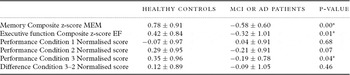
Z-scores for the domains of memory and executive functioning are based on standard cognitive tests; normalized scores of the experimental task are based on the number of trials needed to produce eight consecutive correct answers (inverse values: higher score corresponds to better performance).
Methods: 20 healthy older volunteers (mean age 66±13 years) and 27 patients (mean age 77±9 years) participated. Patients were recruited from a memory clinic, diagnosed with amnesic MCI or AD, according to established diagnostic criteria. Patients with an MMSE score 1 were excluded. Memory was assessed with the immediate and delayed recall score of the Rey Auditory Verbal Learning Test. Executive functioning was assessed with the Trail Making Test B/A ratio and the Stroop test Card 3/2 ratio. Raw test scores were standardized into z-scores and a composite score was calculated for tests composing Memory and Executive functioning. For the experimental rule induction task participants were instructed to sort stimuli by pressing a left or right button, based on feedback. The numbers of trials needed to produce eight consecutive correct answers were recorded. The task included three rule induction conditions of increasing complexity. In the first condition, which had a low memory and executive functioning load, participants were instructed to sort two stimuli by one characteristic (i.e. colour: a white balloon corresponded to the left button, a purple balloon to the right button). In the second condition, four stimuli were to be sorted by that same characteristic, denoting specifically an increase of memory load relative to condition one (a yellow or orange pepper corresponded to the left button, a green or red pepper to the right button). In condition three, four stimuli were to be sorted by two characteristics, leading to an additional increase of executive functioning load relative to condition two (colour and size: a small pink flower or a large blue flower corresponded to the left button, a small blue flower or a large pink flower to the right button). Thus, the second and third condition had an equally high memory load (in both conditions 4 different features had to be memorized), the first condition a lower load. The third condition additionally had a high executive load, which was low in condition 1 and 2. For people with intact cognition, the difference score between condition 3 and 2 was hypothesized to reflect the executive component in rule induction. Results: Patients had significant lower z-scores than controls for the memory and executive functioning composite scores. Moreover, patients needed more trials on condition 2 and 3 of the inductive reasoning task, but the difference score between conditions 3 and 2 did not differ between the groups (see Table). In controls, both memory (β = 0.43, p
PS02.17
Quantitative motor assessment in patients with mild to moderate Alzheimer's disease (AD)
Nicola Lautenschlager, A Goh, E Chiu, O Yastrubetskaya
University of Melbourne, Kew, Victoria, Australia
R Reilmann University of Muenster, Muenster, Germany
Motor signs of AD include problems with speech/facial expression, rigidity, balance, posture/gait, bradykinesia, tremor, incoordination, apraxia, and dysarthria. Even early-stage AD is characterized by motor impairment and slowing in a stage-dependent manner (Goldman et al., 1999). Information about the phenomenology of the motor signs in AD is important as they may predict cognitive decline (Chui et al., 1994), institutionalization (Lopez et al., 1997), cost of care (Scarmeas et al., 2004) and death (Mitchell & Rockwood, 2000). Compared with AD patients without motor signs, AD patients with motor signs have an average $7,394 higher annual total cost of care (a 1-point increase in a motor signs scale has been associated with an annual increase of $827 in costs of care) (Murman et al., 2003). There is large variability in reported frequencies: in a review of clinical series published over 10-years, frequency of motor signs in AD ranges from 6% to 50% (Ellis et al., 1996). Much inconsistency in the literature derives from methodologic differences including variable definitions of motor signs, use of standardised scales vs clinical evaluation, and inclusion of subjects at varying stages of disease. Motor signs of AD are generally treated dichotomously (present or absent), and research has relied heavily on clinician rated scales, limiting information about the full range of motoric changes that occur over time in AD. Current clinical rating scales lack sensitivity, have floor or ceiling effects, and require long observation periods to show changes. There are no known currently used objective quantitative assessments of motor signs in AD. The neurophysiological paradigm in this study has been successfully correlated with clinical stage in patients with other neurodegenerative disorders, including Amyotrophic lateral sclerosis, Multiple Sclerosis (Reilmann et al., submitted), and Huntington's disease (HD). Gordon and colleagues (2000) examined precision grip in HD, and found that force variability was correlated with functional capacity and motor performance. Reilmann et al. (2010) found increased grip force variability in premanifest HD gene carriers and correlation of grip force variability with both the disease-burden score and scores on rating scales, suggesting a strong genotype-phenotype correlation. Similarly, Reilmann et al. (2010) found that measures of variability of tongue protrusion forces and contact time distinguished controls, premanifest, and symptomatic HD groups. Findings were reproduced in a blinded analysis across four centers of a HD biomarker study, with premanifest deficits in tongue force variability detectable in gene carriers two decades before disease onset (Tabrizi et al. 2009). Tapping variability also distinguished between HD groups and correlated with disease burden, clinical motor phenotype, gray and white matter atrophy, and cortical thinning (Bechtel et al., 2010), which was also observed with tongue protrusion forces (Reilmann, pers. comm.). Aims: Isometric motor tasks are used as a quantitative measure for the assessment of motor phenotype in AD. We hypothesize that motor impersistency may be a feature of AD. Methodology. 20 participants diagnosed with mild to moderate AD, both women and men (MMSE 10–24), and 20 cognitively healthy and age-matched controls will complete: -MMSE -Clinical Dementia Rating Scale -Unified Parkinson's Disease Rating Scale -Isometric grip force analysis task in precision grip between thumb and index finger. -Isometric grip force matching task (isometric force persistency). -Transducer based tapping tasks assessing isometric force of the index fingers -Isometric tongue force analysis task. Analysis. Comparison of groups using one-way ANOVA using Bonferroni corrections and Scheffe post-hoc tests or nonparametric Mann-Whitney U tests; parametric Pearson tests or nonparametric Spearman rank tests will analyze correlations of measures with the task and other measures. Results will be expressed in means, standard deviations, box-whisker plots of the median, quartiles, and range. OUTCOMES. This project represents the use of a novel paradigm to quantitatively assess motor signs in AD. Assessment of the variability of tongue protrusion forces, grip force, and tapping will provide objective and quantitative measures that (1) provides much needed empirical data on the motor symptoms of AD and help elucidate a motor pattern, and (2) correlates with illness severity (as assessed by the UPDRS and CDR, and thus may be a measure of disease progression). Knowledge of the phenomenology of motor signs in AD is important, given their predictive ability for rates of cognitive decline and mortality and their association with increased costs of care. This knowledge, in addition to improvements in the efficiency and precision of objective measurements of disease progression in individuals with AD, could lead to techniques that are better able to assess disease progression and measure effectiveness of therapeutic interventions.
PS02.18
Comparison of measurements of medial temporal lobe atrophy in the prediction of AD in subjects with MCI
Lies Clerx, P Visser,
Maastricht University, Maastricht, The Netherlands
I Van Rossum, P Scheltens, L Van Der Pol, F Barkhof,
VU University Medical Center, Amsterdam, The Netherlands
L Burns, Bristol-Myers Squibb, Wallingford, Connecticut, United States
D Knol
F Verhey, University Hospital of Maastricht, Maastricht, Netherlands
P Lapuerta
R Van Schijndel, MS Center Amsterdam and Alzheimer Center, VU University Medical Center Amsterdam Amsterdam, The The Netherlands
R De Jong, Image Analysis Center and Department of Radiology, VU Medical Center, Amsterdam, The Netherlands
R Wolz, Imperial College London, London, United Kingdom
D Rueckert
P Aalten, Alzheimer Centre Limburg, Maastricht, The Netherlands
Introduction: Medial temporal lobe atrophy (MTA) predicts Alzheimer's disease (AD) in subjects with mild cognitive impairment (MCI). MTA assessment may be used for the selection of MCI subjects in AD trials. There are several methods to assess MTA ranging from qualitative rating to manual volumetric measurements. Predictive accuracy may depend on the method and on whether the method requires standardisation of the scan protocol. The aim of the present study was to investigate wich MTA assessment could best predict AD-type dementia in subjects with MCI in a multicentre and single-centre study.
Methods: We selected subjects with MCI from 2 cohorts: the DESCRIPA multicentre study (n = 270), which used different scanners and scan protocols and a single-centre study from the VU University medical centre (n = 156), which used the same scanner and protocol. Four MRI-measures were compared: volumetric manual hippocampal measurement, volumetric automated atlas based hippocampal measurement (LEAP), qualitative visual rating, and volumetric measurement of the lateral ventricle. All volumetric measurements were corrected for intracranial volume and pooled for left and right side. Outcome was the area under the curve (AUC) of a ROC curve for predicting progression to AD-type dementia after 2 years.
Results: Patients were on average 70.8 years of age in the single-centre study and 70.4 years of age in the multicentre study. The percentage of female participants was higher in the multicentre (57%) than in the single-centre study (40%). MMSE-scores of both cohorts were comparable: single-centre study (26.7) and multicentre study (27.1). In the multicentre study, the AUC was 0.72 for the manual hippocampal measurement, 0.72 for the LEAP measurement, 0.67 for the qualitative rating, and 0.56 for the lateral ventricle measurement. In the single-centre study, the AUC was 0.67 for the manual hippocampal measurement, 0.69 for the LEAP measurement, 0.61 for the qualitative rating, and 0.61 for the lateral ventricle measurement. Sensitivity of manual hippocampal measurement was slightly higher (sens = 0.71–0.79) than automated LEAP measurement (sens = 0.61–0.67) in both cohorts. Specificity, OR and HR was higher for the LEAP measurement in the multicenter study (Table 1). The best cut-point on the LEAP volume to predict AD-type dementia as determined by the Youden index was similar in the multicentre study (5374 mm3) and single-centre study (5431 mm3).
Conclusion: Hippocampal volume is better in predicting AD compared to a qualitative rating or measurement of the lateral ventricle. It seems that the presence of atrophy doubles the risk for AD. Both hippocampal measures yielded similar predictive accuracy in the multicentre and single-centre study. The LEAP measurement may be preferred in multicentre studies as it demonstrated good accuracy in discriminating between MCI progressors and non-progressors. Moreover, the measurement was stable across different cohorts, was automated, and was able to determine consistent cut-off points.

Youden cut-off points and predictive values
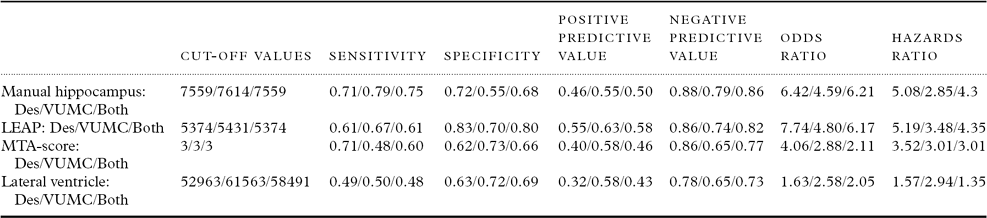
Des: Descripa multicentre study
PS02.19
Atypical focal presentations of Alzheimer's disease: A case report
Tarun Kuruvilla, S Macrow,
2gether NHS Foundation Trust, Cheltenham, Gloucestershire, United Kingdom
I Lyburn, Cranfield University, Cheltenham Imaging Centre, Cheltenham, Gloucester Shire, United Kingdom
Background: Alzheimer's disease (AD), typically, presents as an early amnesic syndrome with other cognitive deficits manifesting as disease progresses. Atypical presentations of AD, such as posterior cortical atrophy (PCA) and progressive non-fluent aphasia (PNFA), are increasingly recognised especially in younger people. Differentiating AD from other types of dementia, especially frontotemporal dementia (FTD) is important not least because in FTD, acetylcholine esterase inhibitors are ineffective and may cause agitation. European guidelines recommend functional neuroimaging with FDG-PET scans when diagnosis is in doubt.
Case Study: Our patient was 54 years old when she developed gradually progressing visual and language problems as described in her own words: “I first noticed I couldn't read the clock whilst working at the hospice. I was frightened and thought I had a brain tumour. I couldn't add up properly, I wasn't writing or spelling in my usual manner, my writing was no longer in a straight line and I could no longer read the newspaper. I couldn't see things which my family would point out. My vocabulary had changed, words became difficult to format and I couldn't say the right word. I demoted myself to health care assistant but found I couldn't dress patients, putting their clothes on back to front. I was frightened to share my fears with my family. Eventually I became so stressed that I had to give up work”. She initially presented to an optician who detected a right-sided hemi-anopia and referred her to neurology and ophthalmology. The poster will describe the results of the ophthalmology and neurology assessments including CSF assay, EEG, CT head, and MRI head (Figure 1) which showed slight asymmetrical enlargement of the occipital horn of the left lateral ventricle felt to be a normal variant, rather than ex-vacuo dilatation secondary to focal parenchymal atrophy, as there was no disproportionate sulcal widening in the parietal and occipital lobes on the left compared to the right. The poster describes results of a speech and language therapy assessment which suggested PNFA and a neuopsychology assessment which suggested PCA. After four years of onset, an FDG-PET/CT scan (Figure 2) showed substantially reduced glucose metabolism, bilaterally, in the occipital, parietal and temporal cortices with relative preservation of uptake in the frontal cortices, basal ganglia and posterior fossa. Appearances strongly favoured AD over FTD. The poster describes how the ending of diagnostic uncertainty, commencement of Donepezil and appropriate psycho-social support has improved our patient's quality of life.
Discussion: PCA, first described in 1985, is characterised by progressive decline in higher visual functioning and literacy skills. Clinical features may include visuospatial and visuoperceptive deficits like apraxia, visual agnosia, visual field defects, alexia, Balint's syndrome (optic ataxia, ocular apraxia, simultanosagnosia, environmental agnosia), Gerstmann's syndrome (acalculia, agraphia, finger agnosia, right/left disorientation) with relative preservation of memory, language and insight in the early stages. It usually affects younger patients, with clinicopathological studies showing AD as the commonest cause, hence its synonym ‘visual variant AD’. Other causes include stroke, tumour, Dementia with Lewy Bodies, corticobasal degeneration, and prion disease. Neuroimaging studies have shown posterior atrophy bilaterally, usually more severe on the right, with preservation of median temporal structures. Asymmetrical left-sided involvement, like in our patient, is rare and may account for her co-existing non-fluent aphasia. The phenotypes of FTD are behavioural variant FTD and the primary progressive aphasias of PNFA and semantic dementia. PNFA is the most heterogeneous with clinicopathological studies showing that a high proportion has AD pathology. Recent reviews have sub-classified PNFA into an ‘agrammatic’ variant, characterised by speech apraxia and expressive grammar problems, and logopenic progressive aphasia (LPA), characterised by slow rate of speech and naming problems, as in our patient .The former is associated with FTD pathology while the latter with AD pathology. Volumetric MRI studies have shown asymmetrical left sided atrophy in both, localised to the inferior frontal regions in the ‘agrammatic’ variant and to the posterior temporal regions in LPA.
Key Learning Points: 1.Patients presenting to opticians or primary care with complex visual problems in the absence of primary ocular pathology should be referred for specialist investigation. 2. Atypical focal presentations of Alzheimer's disease, such as PCA and LPA, can occur, and even co-occur, especially in younger patients. 3. Functional neuroimaging to support diagnosis in dementia should become widely available. 4. Sub-type diagnosis in dementia is important to access current and future disease-specific treatments as well as support services.
PS02.20
Comparative assessment of clinical efficacy after 12-Month clinical trial of Donepezil between the patients with pure Alzheimer's disease and mixed dementia
Hyoshin Kang, H Lee, K Lee, S Park, D Kim, S Kim, S Kim, J Back
Samsung Medical Center, Seoul, South Korea
S Lim, Kangnam-gu, Seoul, South Korea
Background: Alzheimer's disease (AD) and vascular dementia (VaD) are recognized as the two most frequent causes of dementia. AD is characterized by deficient cholinergic innervation of the cerebral cortex and subcortical structures and VaD is dementia associated with cerebrovascular disease. Most studies focus on AD and VaD as separate clinical entities, yet there is increasing evidence that the brain lesions associated with each pathological process occur together. This co-occurrence of AD and VaD pathology is referred to as mixed dementia (MD).
Objectives: The purpose of this study was to compare the efficacy of donepezil treatment between patients with pure Alzheimer's disease (AD) and Mixed dementia (MD) during a 12-month trial. Methods: A total of 139 patients were recruited for this 52-week study. Patients were attending the Clinical Trial Program of the Samsung Medical Center Geropsychiatry Clinic. All patients met NINCDS-ADRDA criteria for probable AD and MD patients met the additional following criteria: Hachinski Ischemic Score (HIS) = 5~6; evidence of significant small vessel disease (grade 2 suggested by Fazekas et al.) on magnetic resonance imaging (MRI) finding. The effect of donepezil on cognitive function was measured using Alzheimer's Disease Assessment Scale-cognitive subscale-preliminary Korean version (ADAS-cog-K). Patients’ activities of daily living using the Seoul-Instrumental Activities of Daily Living (S-IADL) and Seoul-Activities of Daily Living (S-ADL); behavioral symptoms using the Korean version Neuropsychiatric Inventory (K-NPI) were measured at baseline, 13-weeks, 26-weeks, 39-weeks and 52-weeks. We defined the responsive patients to donepezil at those who showed a cognitive improvement or no change during the first six-month clinical trial.
Results: 84 pure AD patients and 34 MD patients were available for intent-to-treat (ITT) last observation carried forward (LOCF) analysis. 83 patients completed the study and 35 discontinued their treatment before week 52 because of stopping treatment (n = 22), poor drug compliance (n = 3), death or poor physical condition (n = 5), refer to other institute (n = 5). There was no significant difference between two groups in sex, education years, duration of illness, dementia severity, whereas MD patients are significantly higher in age and hypertension rate. There was no significant difference between two groups in mean change from baseline in the total ADAS-cog-k, S-ADL, S-IADL and K-NPI scores at 52-week. Both groups demonstrated deterioration of S-ADL and S-IADL. The NPI scores did not significantly change in both groups (p>.05). Based on the operational criteria, 60.7% of pure AD patients and 58.8% of MD patients were responders to donepezil.
Conclusion: MD patients had similar levels of efficacy with pure AD patients and donepezil was well tolerated in both groups. These results suggest that donepezil is an effective and well-tolerated treatment for MD patients as well as for pure AD patients.
PS02.21
Early onset Alzheimer patients show distinct regional changes of oscillatory brain dynamics
Hanneke De Waal, C Stam, W De Haan, I Van Straaten, P Scheltens, W Van Der Flier,
VU University Medical Center, Amsterdam, The Netherlands
Background: Early onset AD patients often show a different clinical profile with more focal disturbances like aphasia and apraxia than late onset AD patients. They also show a different distribution of structural and functional brain changes. Large-scale neuronal activity can be measured with electroencephalography (EEG), spectral analysis describes the amount of activity in different frequency domains. The hallmark spectral analysis finding in EEG data of AD patients is a diffuse slowing of activity. The aim of the present study was to examine differences in oscillatory brain dynamics in diferent brain regions between early and late onset AD patients.
Method: We examined resting state EEGs of 320 probable AD patients and 246 controls. Subjects were categorised into a young (≤65 years) and old (>65 years) group. Of each EEG, artefact free epochs were selected and relative power in the delta, theta, alpha and beta band was calculated. First, the effect of age on global relative power was tested for each frequency band separately, by two-way analysis of variance (ANOVA). Subsequently, the effect of age on relative power in different brain regions (frontal, temporal, central and parieto-occipital) was examined using ANOVA for repeated measures. To examine the association between relative power and cognitive function, linear regression was performed.
Results: Globally, early onset AD patients showed a lower alpha power (p<0.05) than late onset AD patients. In controls, there was no age effect on relative power in any frequency band. Subsequently, using ANOVA for repeated measures we found an interaction between age and brain area in all frequency bands (p for interaction <0.05) in AD patients. In early onset AD patients alpha power was decreased in all brain areas, but this was most pronounced in the parieto-occipital region. Early onset AD patients had lower beta power in frontal, central and parieto-occipital regions. The late onset patients had lower power in the temporal regions. Increased delta power in early onset AD was most pronounced in posterior regions. Early onset AD patients had higher theta power than late onset in frontal, central and parieto-occipital regions, but not in the temporal regions. Linear regression showed a stronger association between relative beta power and MMSE-score in early onset AD than in late onset AD.
Conclusion: The results of this study give further evidence for biological differences within the group clinically diagnosed as AD. We show that besides different cognitive profiles, there also exist differences in oscillatory brain function between early onset and late onset AD, defined by an arbitrary age cut off. These findings further our knowledge into the phenotypical heterogeneity of AD that goes beyond age and argue for a different underlying pathophysiology in some AD patients.
PS02.22
Comparison of diagnostic and medico-social pathways followed by patients suffering from familial or sporadic young onset Alzheimer's disease
Marion Paulin,University Hospital Lille, Lille, France
V Sorel, S Caron, P Dartois, F Pasquier
Lille Memory Center, France
F Richard, Lille University, France
B Dubois, Paris Memory Centre, France
S Jourdain, V Hannier, D Campion, D Hannequin
Rouen Memory Centre, France
Background: Young onset Alzheimer's disease (AD) patients are defined by the onset of the disease before 65 years. They are estimated around 32000 in France. Their demographic, medical and medico-social characteristics are unknown but previous data showed that the initial symptoms are often attributed to psychological or psychiatric conditions causing a delayed diagnosis. Moreover, young AD disease patients pose specific problems concerning socioprofessional and familial impact because they are still active, often with dependent children at home. Otherwise, hereditary forms of AD, which represent less than 1% of all AD, are more frequent in young patients. The presence of at least two first degree relatives with AD before 60 in a family suggests an autosomal dominant form of the disease and justifies the search for a mutation in the genes PSEN1, PSEN2 and APP. These mutations represent 80–90% of cases of autosomal dominant forms of AD. A National Reference Centre for young patients suffering from AD or related disorder (CNR-MAJ) has been set up (Mesure 19 of France's 2008–2010 National Alzheimer's plan) in order to improve the knowledge and the management of these patients. In this purpose, information on the diagnostic and medico-social pathways of sporadic and familial form of AD is collected. The objective of this study was to compare on the basis of this data the medical and medicosocial pathways of familial and sporadic young onset AD.
Method: We collected information on the diagnostic and medicosocial pathways followed by all consecutive, volunteer young patients referred to the Lille, Rouen, and Paris memory clinic for Alzheimer's disease (i.e. prevalent and incident cases) with onset before the age of 60. Patients who had at least one first degree relative with AD before 60 were included in the group of familial form of AD and had a genetic analysis. This threshold of 60 years was chosen because in France, under-60 patients are not eligible for the state support given to over-60s. The information was collected with a medicosocial questionnaire completed by the caregiver and reviewed during a structured interview and a medical questionnaire completed by a neurologist.
First results: In 18 months, 118 patients were included in the study: 23 patients had a familial form of AD (FAD) (8 women/15 men) and 95 patients had a sporadic form of AD (SAD) (51 women/44 men). There was no difference between both groups regarding the median age at first symptoms (51 years for FAD and 52 years for SAD) and the MMSE score at the inclusion (12 for FAD and 14 for SAD. Among patients with FAD, one had a ApoE3/4 status, one a ApoE4/4 status, one a mutation of APP gene, one a mutation of PSEN2 gene and 5 patients had a mutation of PSEN1 gene. Median delay between first symptoms and first visit to a specialist was the same in both groups (3,5 for FAD and 3,8 for SAD). Patients with FAD tended to report more often a memory disorder as initial symptom (87%) than patients with SAD (69%) (p = 0,05). However, depression was the first diagnosis established in both groups (34% for the FAD and 42% for the SAD). 78% of caregivers report an impact on their lives in the FAD group against 36% in patients with SAD (p = 0,0003), especially in terms of professional consequences and health. Thus, 39% of the caregivers of FAD patients took a treatment as a consequence against 16% in the SAD group (p = 0,01). Medico-social aid appeared to be more frequent in patients with FAD than in patients with SAD, for example, nursing services at home (13% for FAD versus 1% for SAD) (p = 0,02) and physiotherapy (21% for FAD versus 5% for SAD) (p = 0,02).
Conclusion: In this study, although the characteristics of patients suffering from FAD and SAD were similar in term of age and severity of the disease, consequences for the caregivers were more important in FAD patients, that could be linked to the impact of a hereditary disease. In addition, medico-social support was more elaborate in patients with FAD who may also benefit from familial experience.
PS02.23
Determinants of care costs of patients with dementia or cognitive impairment
Ron Handels, F Verhey, C Wolfs,
Maastricht University, Maastricht, Limburg, The Netherlands
J Severens Erasmus University Rotterdam, Rotterdam, The Netherlands
P Aalten, Alzheimer Centre Limburg, Maastricht, Netherlands
Introduction: Dementia causes a high burden on patients, caregivers and societies. Decision analytic models to support allocation of resources are often developed making use of cost-of-illness (COI) studies. Several reviews on COI studies have been performed in the field of Alzheimer's and related dementias. The total annual costs of care per person suffering from Alzheimer's disease (AD) and other dementias show a considerable amount of variation, ranging from €6,614–€64,426 in Northern and Western European countries. These estimates are highly variable due to care setting and methodological issues. We aim to explore variables for explaining the variation of (formal and informal) health care costs of cognitive disorders, using a broad spectrum of variables; including patient, caregiver and social context variables.
Methods: A bottom-up COI study design was used in which a societal viewpoint and a validated method to measure and value informal care was applied. General practitioners were asked to refer all 55 years or older patients, suspected of having dementia or a cognitive disorder, not living in a nursing home and not suffering from an acute disorder. Volumes of resource use during the one year follow-up period after the diagnosis were measured and multiplied by the cost price per resource unit. Informal care activities were assessed using a survey that had been developed for the measurement of informal care and valued according to the proxy good method. Data were analyzed using univariate, multivariate and forward regression analyses.
Results: Average one-year health care sector costs were €26,140 ($34,505 or £17,775) and €11,931 ($15,749 or £8,113) for patient and family. The overall results of the analyses indicated that MMSE and SPPIC were significant predictors of the one-year square root total care costs. Patient gender and IADL were important variables in both the multivariate and forward analyses for explaining one-year square root total care costs.
Conclusions: Using the 12 month follow-up data of 219 patients with cognitive disorders, four variables were the most relevant predictors of annual care costs of patients suffering from dementia or a cognitive impairment: severity of cognitive function, experienced caregiver burden, patient gender and functional ability. These results are robust as three different analytic methods and a broad spectrum of disease severity variables and patient and informal caregiver social context variables were used and their relative effect on care costs. The findings stress the need for multi-component decision models and correspond to current recommendations for decision analytic modeling to include cognitive function, functional ability and behavior. In particular, this study adds the recommendation to include patient gender and caregiver burden to fully reflect the heterogeneity of the disease progression. The results of this study may improve decision models and help policy makers to allocate scarce health care resources more efficiently.
PS02.24
Clinical validation of the dementia risk assessment: An internet-based tool
Allan Anderson, Johns Hopkins Univerisity, Easton, Maryland, United States
It is widely accepted that the early detection of Alzheimer's disease (AD) and other dementias can lead to more effective interventions and the limiting of morbidity. This has led to increased efforts to promote screening of at-risk populations, especially during primary care appointments. At-risk individuals would include those over age 75 as well as those with a positive family history of dementia or other established risk factors. Many of the newer and most promising methods of detecting very early dementia or risk of developing dementia involve invasive or expensive procedures. Examples include genetic testing, examination of cerebrospinal fluid, new neuroimaging modalities, and lengthy neuropsychological assessments. Investigators at the Johns Hopkins School of Medicine and the Copper Ridge Institute have developed a very brief assessment of risk factors and cognitive performance that does not require an in-person interview, physical examination, or biological sampling. This new assessment is the Internet-based Dementia Risk Assessment (DRA), a tool that is entirely automated. Brandt & Rogerson (2011) recently described the subject characteristics and responses of the first 500 persons who completed the DRA. The predictors of impaired memory test performance were advanced age, male sex, complaint of severe memory impairment, and presence of hypertension. This poster will describe a clinical validation study of the DRA. The study is currently underway at two outpatient memory clinics at retirement communities in Maryland: Copper Ridge (in Sykesville) and William Hill Manor (in Easton). At each clinic, new patients are requested to complete the DRA at home prior to their first visit or, in some cases, at the time of the visit. They are then requested to bring a copy of the printed report from the DRA to their clinic visit. At that visit, they and/or their legally authorized representatives also give informed consent for the research team to have access to their medical records to record the results of their subsequent neuropsychiatric work up [including Mini-Mental State Exam (MMSE) score] and cognitive disorder diagnosis. As of this submission, the “proxy report” of the DRA has been completed regarding 23 patients. Three patients were subsequently diagnosed with mild cognitive impairment, 11 with possible or probable AD, and 3 with another form of dementia. The mean age of the patients was 79.0 (SD = 7.6) and their average MMSE score was 20.5 (SD = 6.3). Five of the 23 were men and 16 were rated by their proxies as displaying severe memory loss. Mean score on the Informant Questionnaire on Cognitive Impairment in the Elderly (IQCODE) was 4.3 (SD = 0.5), indicating moderate to severe cognitive decline in everyday life. Eight patients completed the “self report” of the DRA. Three were ultimately diagnosed with MCI, and one each was diagnosed with AD, another dementia, and major depression. One person was deemed cognitively normal and one person was not diagnosed. The mean MMSE score of these patients was 24.4 (SD = 6.0). Score on the experimental memory test embedded into the DRA was 0.26 (SD = 0.31), much lower than the average for older adults found in the initial standardization study (mean = 0.66, SD = 0.30). The memory test score correlated moderately with the MMSE (r = .34), although the very small sample precludes statistical significance. These preliminary data suggest that the DRA holds promise in the identification of cognitive disorders diagnosed by the “gold standard”: formal evaluation by a geriatric neuropsychiatrist, including supporting laboratory and imaging studies. Data collection is ongoing, and updated results will be presented in the poster. Reference Brandt, J. & Rogerson, M. (2011). Preliminary findings from an Internet-based dementia risk assessment. Alzheimer's & Dementia, e-published ahead of print, 1–7.
PS02.25
Characteristics of hearing loss in patients with Alzheimer's disease and its effect on cognitive function
Fumitaka Ohmori, K Iiboshi,
Kyusyu University of Health and Welfare, Nobeoka City, Miyazaki Prefecture, Japan
T Igakura, Kagoshima-shi, Kagoshima-ken, Japan
M Bourgeois, The Ohio State University, Columbus, Ohio, United States Of America
Introduction: Approximately 70–90% of patients with dementia suffer from hearing loss. Few studies reveal the characteristics of hearing acuity in patients with Alzheimer's disease (AD). Some studies have referred for the relationships between hearing loss and sources for leading to dementia (Lin et al., 2011) or cognitive function in patients with AD (Uhlmann et al., 1989), but no studies clear for the effect of hearing loss on the particular domains of cognitive functioning.
We try to make clear for the characteristics of hearing acuity in patients with AD and how hearing loss effects their cognitive function.
Subjects: The patients included a total of 52 individuals (38 women) who were diagnosed with probable AD by the NINCDS-ADRDA criteria. Their mean age was 84.3±7.0 years, mean Mini-Mental Status Examination Japanese (MMSE-J) score was 17.2±4.3, mean total years of education was 8.0±2.4 years and mean illness duration was 5.1±3.8 years.
We excluded severely demented patients (MMSE-J score<10) due to low reliability of the hearing test. We also didn't include patients who wore hearing aids.
Methods:
We conducted a pure-tone air conduction hearing test with an audiometer (MADSEN MIDIMATE 602) and the MMSE-J for cognitive function to each patient. The instructions were made enough sound for patients to hear easily.
1)We calculated the hearing threshold levels at 0.5,1,2 and 4kHz for each patient and grouped the results by age (70, 80, 90 years).
2) The pure-tone average (PTA) represented the subject's hearing threshold levels at 0.5, 1 and 2kHz for the better ear. Then, we calculated the correlation between PTA and MMSE-J total sore.
3)On the basis of PTA, patients were divided into the Hearing Impaired(≥41dBHL) and Hearing Unimpaired (≤40dBHL) groups. Then, we performed a non-paired t-test to clarify the difference in MMSE total score and 11 subtests score (Sugishita,2001). SPSS 16.0J for Windows was used to analyze the differences between groups on the dependent measures; the level of significance was set at p <0.05.
Results:
1) The hearing threshold levels at 0.5, 1, 2 and 4kHz were as follows; 70-year group was 49.0±17.8dBHL, 49.2±12.5dBHL, 55.1±19.6dBHL and 57.9±16.4dBHL, 80-year group was 47.3±15.3dBHL, 48.7±15.3dBHL, 54.7±14.7dBHL and 64.7±13.6dBHL, 90-year group was 53.9±11.7dBHL, 54.3±13.0dBHL, 62.7±15.4dBHL and 70.0±18.4dBHL.
2)PTA did not correlate with MMSE-J total score (r = −2.00).
3)No significant difference in MMSE-J total scores observed between the Hearing Impaired (17.0±4.5) and Hearing Unimpaired (17.9±3.6) groups. However, as for 11 subtests, it showed significant differences between Hearing Impaired and Hearing Unimpaired for delayed recall (0.7±1.0, 1.5±1.0, p = 0.04) and repetition (0.5±0.5, 0.9±0.3, p = 0.02) subtests between the two groups.
Discussion:
The hearing threshold levels at each frequency of patients with AD showed a close similarity at 0.5 and 4kHz compared to that of normal elder (Yanagida,1996), while it was greater at 1 and 2kHz. This study suggested that patients with AD had a pattern of greater hearing loss for the primary speech range, that is, 1 and 2kHz.
We think the presence of hearing loss tends to increase the effort of requirement to recognize speech, so, keeping short-term memory for delayed recall or repetition is inhibited. Higher IQs elder can prevent such an effect (Dickinson et al., 1991). We showed that patients with AD suffer from hearing loss became to be low conditions for delayed recall or repetition. So, we suggested hearing loss has relationship with the adverse effect of the memory function not total cognitive function of patients with AD.
PS02.26
Effects of calpain on an animal model of tauopathies
Etsuko Oshima,Okayama University, Okayama, Japan
T Ishihara, J Takano, T Saido
Kawasaki Medical School, Kurashiki, Okayama, Japan
M. Yabe, N Takeda, Y Kishimoto, O Yokota, Y Uchitomi
Okayama University Graduate School of Medicine and Dentrstns, Okayama, Japan
S Terada, Okayama University Graduate School of Medicine, Dentistry and Pharmaceutical Sciences, Okayama, Okayama, Japan
N Iwata, Riken Brain Science Institute, Wako, Saitama, Japan
M Higuchi National Institute of Radiological Sciences, Chiba, Japan
β-Amyloid (Aβ) plaques and neurofibrillary tangles (NFTs) are neuropathological hallmarks of Alzheimer's disease (AD). It is generally believed that tau abnormalities induced by Aβ accumulation promote the disruption of neuronal function and structures, leading to cell death. But the relationship between the two lesions remains unclear. It has been reported that the alteration of enzymatic proteolysis is implicated in the mechanisms of chronic neurodegenerative diseases such as AD. Calpain is calcium-activated intracellular cystein protease. Various studies have revealed the elevation of calpain activity in chronic neurodegenerative diseases including AD. Because tau, one of the cytoskeltal components, is a substrate for calpain, it can be hypothesized that activation of calpain induced by Aβ neurotoxicity causes tau hyperphosphorylation, leading to dysfunction of tau and cytoskeletal disturbances. In the present study, in order to confirm whether or not calpain has any effect on tau lesions, we generated double transgenic mice which overespressed the shortest human tau isoform and lacked calpastatin, the only endogeneous calpain-specific inhibitor. Mice lacking calpastatin did not show any difference pathologically compared with wild type mice under normal conditions. Because the major pathology found in the tau transnige mice used here (PrP T44) is the presence of tau-immunopositive spheroids in the spinal cord, we sought to determine whether calpain would have any effect on the number of spheroids. In the older bigenic mice, the number of tau-positive spheroids increased than that of PrP T44 mice. In brains of PrP T44 mice, NFT-like intraneuronal tau-positive lesions in the hippocampus and the entorhtinal cortex area start to appear at 18 months of age, and never seen in wild type littermates. In brains of double transgenic mice, there was no obvious alteration in the manner of appearance of those NFT-like inclusions. We investigated the activity of calpain in brains of mice using an antibody against calpain-cleaved carboxyl-terminal 148-kDa fragment of αII-spectrin. Activation of calpain was detected in double transgenic mice along aging compared with PrP T44 mice. But cell death was not detected by caspase-3 staining or terminal deoxynucleotidyl transferase dUTP nick end labeling (TUNEL). These results suggest that calpain may have some influences on tau-related neurodegenerative mechanisms, though it does not cause obvious neuronal death in our mouse model of tauopathies.
PS02.27
Comparative assessment of clinical efficacy between the naive and the switching group to Donepezil: 12 months prospective study
Hyoshin Kang, D Kim, H Lee, K Lee, S Park, Samsung Medical Center, Seoul, South Korea
S Lim, Kangnam-gu, Seoul, South Korea
S Kim
S Kim
J Back
Background: The three commonly used cholinesterase inhibitors (CHEIs) are donepezil, rivastigmine, and galantamine. The different pharmacologic characteristics of these CHEIs may influence individual treatment response. Switching to another CHEIs once the original drug is ineffective is a reasonable option that may either stabilize or improve the clinical course of the patients. Objectives: The purpose of this study was to compare the efficacy between switching patients with Alzheimer's disease (AD) from galantamine or rivastigmine to donepezil because they were not responding adequately, and naive patients with AD who initiated therapy with donepezil.
Methods: A total of 108 patients were recruited for this 52-week study. Patients were attending the Clinical Trial Program of the Samsung Medical Center Geropsychiatry Clinic. All patients met NINCDS-ADRDA criteria for probable AD. Patients were excluded if they had evidence of neurodegenerative diseases other than AD. The effect of donepezil on cognitive function was measured using Alzheimer's Disease Assessment Scale-cognitive subscale-preliminary Korean version (ADAS-cog-K). Patients’ activities of daily living using Seoul-Activities of Daily Living (S-ADL) and the Seoul-Instrumental Activities of Daily Living (S-IADL); behavioral symptoms using the Korean version Neuropsychiatric Inventory (K-NPI) were measured at baseline, 13-weeks, 26-weeks, 39-weeks and 52-weeks. We defined the responsive patients to donepezil at those who showed a cognitive improvement or no change during the first six-month clinical trial.
Results: 86 naive patients and 22 switching patients were enrolled in the study. 74 patients completed the study and 34 discontinued their treatment before week 52. There was no significant difference between two patient groups in demographic data, baseline characteristics and dementia severity except duration of illness. The total ADAS-cog-K scores were not significantly different from baseline after 52 weeks of treatment in both groups. Both groups demonstrated deterioration of S-ADL and S-IADL at 52 weeks. The NPI scores did not significantly change in both groups. Based on the operational criteria, 61.6% of the naive group and 54.5% of the switching group were responders to donepezil.
Conclusion: The switching group had similar levels of efficacy with the naive group who initiated therapy with donepezil. These results suggest that patients not responding adequately to rivastigmine or galantamine may improve or stabilize after switching to donepezil and prior medication does not effect donepezil's efficacy.
PS02.28
Relationship of leisure activities and Alzheimer's disease
Margarida Sobral,Hospital Magalhães Lemos, Porto, Portugal
C Paúl, ICBAS University of Porto, Porto, Portugal
Background: In the last decades there has been an increasing of old people in the Portuguese population. Alzheimer's Disease is the most common cause of dementia. Cognitive Reserve is a hypothetical construct that has been used to inform of cognitive aging. The leisure activities provide the maintenance or the increase of Cognitive Reserve throughout life. Participation in leisure activities has been associated with a lower risk of dementia (Scarmeas, N. et al., 2001, Verghese, J. et al., 2003, Stern, Y, 2006, Helzner, E. P. et al., 2007). Objective: The aim of this study was to examine the relation between leisure activities and the risk of Alzheimer's Disease.
Methods: The participants in this study were 60 patients diagnosis as probable AD (46 F, 14 M), recruited in Psychogeriatrics, Hospital Magalhães Lemos, Oporto and 30 healthy elderly participants were used as controls, matched for gender, age, schooling and civil status. This group was enlisted at the same geographical area covered by the Hospital Magalhães Lemos, in Oporto. All Alzheimer's Disease (AD) patients met the criteria set by the Diagnostic and Statistical Manual of Mental Disorders (4 th edition) and the National Institute of Neurological Communicative Disorders and Stroke Alzheimer's Disease and Related Disorders Association for probable AD. All subjects were given the Mini Mental State Examination (Folstein et al., 1975), the Clinical Dementia Rating (Hughes et al., 1982), the Barthel Index (Barthel,1965), the Lawton and Brody's Index (Lawton, 1969) and frequency of participation in leisure activity throughout life (questionnaire answered by the patient and/or caregiver). All participants, be them AD patients or controls, were free of severe medical conditions other than those pertinent to the study.
Results: The group of Alzheimer's Disease patients got a lower frequency (mean = 17,17) of participation in leisure activity than the control.
Conclusion: The Alzheimer's Disease patients got the lowest participation in leisure activities comparing with the control group. The data suggest that engagement in leisure activities may reduce the risk of incident dementia. References: Cummings, J. L. (2004). Alzheimer's Disease. The New England Journal of Medicine, 351, 56–67; Helzner, E., Scarmeas, N., Cosentino, S., Portet, F., & Stern, Y. (2007). Leisure Activity and Cognitive Decline in Incident Alzheimer Disease. Arch Neurol, 64(12), 1749–1754; McKhann, G., Drachman, D., Folstein, M., Katzman, R., Price, D., & Standlan, E.M. (1984). Clinical diagnosis of Alzheimer's disease: report of the NINCDS-ADRDA Work Group under the auspices of Department of Health and Human Services Task Force on Alzheimer's Disease. Neurology, 34, 939–944; Scarmeas; N., Levy, G., Tang, MX, Manly, J., & Stern, Y. (2001). Influence of leisure activity on the incidence of Alzheimer's Disease. Neurology, 57 (12): 2236–42; Scarmeas, N., & Stern, Y. (2003). Cognitive Reserve and Lifestyle. Journal of Clinical and Experimental Neuropsycholy. 25, 625–633; Stern, Y (2006). Cognitive Reserve and Alzheimer Disease. Alzheimer Dis Assoc Disord, vol. 20 (2), 112–117; Stern, Y (2009). Cognitive reserve. Neuropsychology, 47, 2015–2028; Verghese, J., Lipton, R. B., Katz, M. J., Hall, C. B., Derby, C. A., Kuslansky, G., Ambrose, A. F., Sliwinski, M., & Buschke, H. (2003). Leisure Activities and the Risk od Dementia in the Elderly, The New England Journal of Medicine, 348: 2508–16.
PS02.29
The efficacy of treatment of addition in Alzheimer's disease: Rationale for combination therapy with Galantamine and Memantine
Julio Zarra,Hospital Italiano de La Plata, La Plata, Argentina
L Schmidt, Hospital Centenario, Gualeguaychú, Entre Ríos, Argentina
Introduction: Considering the moderate clinical state the Alzheimer's Disease, without therapeutic response or poor therapeutic response with an anti dementia agent, we try improvement the therapeutic response with 2 drugs association. Galantamine is a reversible, competitive cholinesterase inhibitor that also allosterically modulates nicotine acetylcholine receptors. Cholinesterase inhibitors inhibit (block) the action of acetylcholinesterase, the enzyme responsible for the destruction of acetylcholine. Acetylcholine is one of several neurotransmitters in the brain, chemicals that nerve cells use to communicate with one another. Reduced levels of acetylcholine in the brain are believed to be responsible for some of the symptoms of Alzheimer's disease. By blocking the enzyme that destroys acetylcholine, galantamine increases the concentration of acetylcholine in the brain, and this increase is believed to be responsible for the improvement in thinking seen with galantamine. To evaluate the efficacy, safety and tolerability of galantamine associated with in Alzheimer's disease. Memantine is a low-affinity voltage-dependent uncompetitive antagonist at glutamatergic NMDA receptors. By binding to the NMDA receptor with a higher affinity than Mg2+ ions, memantine is able to inhibit the prolonged influx of Ca2+ ions, which forms the basis of neuronal excitotoxicity. The low affinity and rapid off-rate kinetics of memantine at the level of the NMDA receptor-channel, however, preserves the physiological function of the receptor, as it can still be activated by the relatively high concentrations of glutamate released following depolarization of the presynaptic neuron. The interaction of memantine with NMDA receptors plays a major role in the symptomatic improvement that the drug produces in Alzheimer's disease. Moreover, there is no evidence as yet that the ability of memantine to protect against NMDA receptor-mediated excitotoxicity has a disease-modifying effect in Alzheimer's, although this has been suggested in animal models. Hypothesis: The efficacy, safety, and tolerability of cholinergic agent: GALANTAMINE (with a dual mechanism of action on the cholinergic a system) and moderate affinity NMDA- receptor antagonist: MEMANTINE, were assessed taking into account the profile of patients with neurocognitive disorder: Alzheimer's disease, from the clinical aspects and the different classifications.
Methods: The experience included 428 patients who were enrolled in a prospective, observational, multicenter, and open-label study to receive 16 mg/day of galantamine and 30 mg/day of memantine for 12 months of treatment of addition.
Results: The therapeutic response was measured using the Mini Mental State Examination (MMSE), Clinical Dementia Rating (CDR), Alzheimer's Disease Assessment Scale (ADAS-GOG), Functional Activities Questionnaire (FAQ) the Clinical Global Impression Scale (CGI) and the UKU scale of adverse effects. Taking into account the efficacy, safety and adverse events of the treatment, the final results of the study showed that galantamine with addition memantine improve cognition, behavioural symptoms, and the general well-being of patients with cognitive impairment: Alzheimer's disease. The incidence of adverse events was not significant and a very good profile of tolerability and safety was observed.
Conclusion: At the conclusion of this session, we should be able to demonstrate with use the association memantine – galatamine in neurocognitive disorder: Alzheimer's disease, improve cognition, behavioural symptoms, and the general state recognized as neurocognitive disorder.
Discussion: Suggest that before Alzheimer's Disease continues evolution to a severe state, the pharmacological use this association to slowing or stopping the dementia process.
PS02.30
Changing practice to reduce admissions for people with dementia
Afifa Qazi,NELFT, Harold Wood, Essex, United Kingdom
There is a general move towards trying to reduce hospital admissions for people with dementia and to reduce length of stay in hospital. Many new developments in older people's mental health services have aimed to improve care and reduce length of stay. However, there is very little research on what might reduce inpatient bed use. The objective of this study was to reduce the need for psychiatric inpatient beds for older people by developing and testing a new model of service which emphasised working more closely with general practitioners and care homes. The new model of service was implemented over a three year period in one sector and at the end of the time the bed use was compared with other similar sectors in the region. It involved close working links with GPs/practice nurses and a “same day response” to patient queries from G.Ps where possible. Regular talks at GP practices to improve quality of referrals and GP confidence in managing psychiatric disorders in addition to Face to face discussions with GPs (eg referral for acute confusion) was regularly done. Close working links were developed with local care homes including training of care home staff and case discussions. Overall the system drastically reduced the number of admissions for older people with dementia and other mental health problems and if the practice is innovative it is less about any particular thing and more about combining all the elements in a systematic way so that each provide an incremental benefit and result in a service for the community which helps to minimise the risk of admissions for people and in doing so, helps to maintain and support them at home. The model could potentially be applied to many other services and across a range of specialties, particularly for older people and those with long term conditions who may be at more risk of admission. The key elements of the model were access/support, training/development and liaising- providing the missing link. The number of admissions per 10,000 elderly was only 16 per year (other consultants 19–50 per year) and the length of stay was 29 days (other consultants 37to 89 days). Occupied bed days were under 500 per year compared to 1000 to 1800 for the other consultants. The new model enabled the identification of difficulties before reaching crisis point. Use of beds was reduced to 33% of the other consultants and the model was popular with GPs and care homes. Draper B (2000) The effectiveness of old age psychiatry services. International Journal of Geriatric Psychiatry, 15, 8, 687–703.The number of admissions for people with dementia from a population of 10,000 elderly was reduced to 4 admissions in a year. In the current financial climate there is increasing need to not only save money but provide more efficient systems of care and the advantages of reducing bed use and supporting more patients in the community become very apparent.
PS02.31
Neuropsychological, functional and demographic characteristics in Alzheimer's disease patients
Margarida Sobral,Hospital Magalhães Lemos, Porto, Portugal
C Paúl, ICBAS, University of Porto, Porto, Portugal
Background: Alzheimer's disease (AD) is a progressive neurodegenerative disorder that is characterized by deterioration of cognitive and funcional abilities. Objective: The aim of this study was to describe the clinical and demographic profile AD patients at a specialized hospital in Portugal.
Methods: Sixty subjects with probable diagnosis of AD (46 F, 14 M), recruited at the Hospital Magalhães Lemos in Oporto, Portugal, took part in this study. All patients fulfilled the criteria of both the Diagnostic and Statistical Manual of Mental Disorders (4 th edition) and the National Institute for Neurological and Communicating Disorders and Stroke/Alzheimer's Disease and Related Disorders Association for probable AD. Functional and neuropsychological abilities of patients with probable AD diagnosis were revaluated at 36 and 54 months. All participants answered a structured questionnaire and were given the Mini-Mental State Examination (Folstein et al., 1975), the Clock-Drawing Test (Strub & Black, 1977), the Clinical Dementia Rating (Hughes et al., 1982) and a battery of neuropsychological tests adapted from the Lisbon Screening for Dementia Assessment (Garcia, 1984). Functional abilities were assessed with two Activities of Daily Living (ADL) Scales: the Barthel's Index (Barthel, 1965) and the Lawton and Brody's Index (Lawton, 1969). Results: Participants were 76,7% women, had a mean age of 80,48 years, a mean educacional level 4,23 years and mean dementia duration of 6,52 years. 58,3% was married, 40,0% widower and 1,7% single. At the first evaluation 86,7% were classified as CDR = 1 and 13,3% as CDR = 2. After 36 months 41,7% were classified as CDR = 1, 46,7% as CDR = 2 and 11,7% as CDR = 3. After 54 months 31,9% were classified as CDR = 1, 44,7% as CDR = 2 and 23,4% as CDR = 3. Significant differences between the first and the second evaluations were observed (by comparing mean scores of MMSE, Clock Drawing Test, Barthel Index, Lawton and Brody's Index, BLAD) and between the second and the third evaluations.
Conclusion: Analysis data showed a cognitive and functional decline along 54 months. This study is in agreement with what is known about AD that is characterized by progressive cognitive deterioration, together with declining activities of daily living. Reference: American Psychiatric Association (2002). DSM-IV-TR. Manual de diagnóstico e estatística das perturbações mentais. 4 edição, texto revisto, Lisboa; Berr, C., Wancata, J. & Ritchie, K. (2005). Prevalence of dementia in elderly in Europe. European Neuropsychopharmacology, 15, 463–471; Cummings, J. L. (2004). Alzheimer's Disease. The New England Journal of Medicine, 351, 56–67.; Fratiglioni, L., Launer, L. J., Andersen, K., Breteler, M.M., Copeland, J.R., Dartigues, J. F., Lobo, A., Martinez-Lage, J., Soininen, H., & Hofman, A. (2000). Incidence of dementia and major subtypes in Europe: A collaborative study of population-based cohorts. Neurologic Diseases in the Elderly Research Group. Neurology, 54 (11 Suppl 5):S10–5.; Jalbert, J. J., Daiello, L. A. & Lapane, K. (2008). Dementia of the Alzheimer Type. Epidemiologic Reviews, vol. 30, 15–34.; McKhann, G., Drachman, D., Folstein, M., Katzman, R., Price, D., & Standlan, E. M. (1984). Clinical diagnosis of Alzheimer's disease: report of the NINCDS-ADRDA Work Group under the auspices of Department of Health and Human Services Task Force on Alzheimer's Disease. Neurology, 34, 939–944.; Ritchie, K., & Lovestone, S. (2002). The dementia, The Lancet, 360, 1759–1766.;Villareal, D. T. & Moris, J. C. (1999). The Diagnosis of Alzheimer's Disease. Journal of Alzheimer's Disease 1, 249–263.
PS02.32
Psychiatric symptoms remaining after traumatic experiences during World War II in Dutch-Ontarian applicants for an insurance compensation assessment
Nicolaas Verhoeff,Baycrest Kunin Lunenfeld Applied Research Unit, Toronto, Ontario, Canada
R Loonstein
Purpose: Estimation of the current prevalence of psychiatric symptoms in applicants for an assessment whether they meet criteria for financial compensation related to the Wet Uitkeringen Vervolgingsslachtoffers (WUV) or Wet Buitengewoon Pensioen (WBP), which are intended to support war victims if needed.
Methods: Twenty-five applicants (16 females, 9 males; age 72 ± 6 years; Mini Mental Status Examination score 28 ± 1) each underwent a Structured Clinical Interview for DSM-IV-TR Axis I Disorders, as well as social work, general medical, neurologic and geriatric psychiatric interviews, during the period from October 2004 until June 2009. Of the applicants, 16 had been in Japanese Concentration Camps in Indonesia, 3 had been in hiding in the Netherlands because they were Jewish, 2 were children of Jewish parents who deceased in Extermination Camps in Germany or in Poland, 2 were children of resistance fighters in the Netherlands who had been punished by the Germans, one was a Dutch resistance fighter, and one had been sexually abused by a Jewish person in hiding in the Netherlands. The current prevalence of DSM-IV-TR Axis I Disorders was assessed. Limitations related to these psychiatric symptoms were also assessed quantitatively and qualitatively for the following categories derived from the classification for impairments used by the American Medical Association (AMA): (1) daily activities; (2) social functioning; (3) concentration, perseverance and tempo; and (4) adaptation to stressful circumstances
Results: The most common current DSM-IV-TR Axis I Disorders in this population were: Posttraumatic Stress Disorder (60%), Major Depressive Disorder (52%), Specific Phobias (48%), Social Phobia (36%), Generalized Anxiety Disorder (32%), Depressive Disorder Not Otherwise Specified (24%), Panic Disorder with or without Agoraphobia (24%), Agoraphobia without Panic Disorder (20%), Dysthymic Disorder (16%), Eating Disorders (16%), Pain Disorders (12%), Anxiety Disorder Not Otherwise Specified (8%), Bereavement (8%), Alcohol Abuse or Dependence (8%), Alcohol-induced Mood Disorder (4%), Benzodiazepine Dependence (4%), Nicotine Dependence (4%), Opioid Dependence (4%), Bipolar II Disorder (4%), Somatization Disorder (4%), Anxiety Disorder due to a General Medical Condition (4%), and Adjustment Disorder with Anxious Mood (4%). On average 4 DSM-IV-TR Axis I Disorders (range: 0–9) were diagnosed per applicant. The probable impact of these psychiatric symptoms on limitations in the AMA categories mentioned above will be presented at the conference.
Conclusion: Psychiatric symptoms are still currently active in a substantial proportion of Dutch-Ontarian applicants for World War II victim insurance compensation. This is in agreement with previous reports of active psychiatric symptoms that remain, recur or relapse long after the psychological trauma had been incurred during World War II (Bergherr et al. 1997). In some of the applicants, these psychiatric symptoms were connected to considerable functional limitations. Reference: Bergherr T, Bremner JD, Southwick SM, Charney DS, Krystal JH. Neurobiological Perspectives on Trauma and Aging. Journal of Geriatric Psychiatry 1997; 30(1):27–59.
PS02.33
Ptophobia and fall-related psychological concerns
Ângela Santos, O Ribeiro,
Universidade de Aveiro, Aveiro, Portugal
Ptophobia and fall-related psychological concerns Ângela Santos and Oscar Ribeiro, Universidade de Aveiro, Aveiro, Portugal Introduction: Ptophobia (phobic fear of falling) is widely found in the elderly and isn't a unique phenomenon of people with a history of falling. It causes several physical consequences and activity restriction in older adults and may be responsible for the development of depressive and anxiety symptoms, social isolation and psychological stress which may, in turn, adversely affect both autonomy and independence (Delbarere et al., 2010). Ptophobia is a psychological phenomenon, and, accordingly with this, there should be given more attention to the specific constructs associated with it. In this sense, Hadjistavropoulos and colleagues (2011) had recently offered a new theoretical model of fear of falling, falls efficacy and falls, presenting the recurrent use, yet conceptually problematic, of those two first terms in a interchangeably way. In this context, the need to analyze and better understand the psychological and psychiatric correlates of Ptophobia arises, including such particular aspects as geriatric anxiety symptoms and perceived control over falling. Objectives: The present study aims to investigate the relationship between Ptophobia, falls-efficacy, perceived control over falling and anxiety in a sample of older individuals. Associations of these variables with balance and functional status, falls history as well as with personal info and living conditions (geriatric institution vs community) were also studied.
Methods: Data from a cross-sectional study of elderly persons from the northern part of Portugal was considered. The sample consists of 100 participants, 67women, with the mean age of 80.80 years (SD 7.54). All participants answered a questionnaire with socio-demographic information, that included the Perceived Control Over Falling Scale (Lawrence et al., 1998), the Portuguese version of the Geriatric Anxiety Inventory (Ribeiro et al., 2011), the Falls Efficacy Scale (Melo, 2001), and the Performance Oriented Mobility Assessment (Petiz, 2002). Information was also obtained on the functional status, on the presence of fear of falling (though a categorical approach: “Are you afraid of falling?”) and falls history. Chi-squares and t-test analyses were performed to study the associations. Results: A high number of participants revealed having fear of falling (81%), presenting, in general, worse results in terms of falls efficacy, self-perceived control and balance than those who didn't present fear of falling. No differences were found on geriatric anxiety symptoms. Fear of falling is significantly more present in women (94%), in those participants living in geriatric institutions (89.8%) and in the elderly persons who felt (89%). When compared to women, men presented higher falls efficacy (M = 65.17) and self-control over falling (M = 16,18) as well as higher values of balance (M = 20.16) (p〈 0.05). The high levels of falls efficacy are associated with high levels of self-perceived control over falling, better balance and with a lower prevalence of anxiety symptoms. Moreover, the reduced prevalence of anxiety symptoms is significantly associated with higher self-control, which is associated with a higher balance. Conclusion: As in previous findings (e.g. Legters, 2002), female participants reported more fear of falling than men. Those participants who use technical assistance in their mobility, who live in institutions and who had felt had been more afraid of falling. However, most of participants who don't use any technical assistance, who live in the community or never felt also had high prevalence of fear of falling. These findings reinforce the fact that Ptophobia isn't an exclusive phenomenon of post-fall cases. Reference: Delbaere, K. et al (2010). Determinants of disparities between perceived and physiological risk of falling among elderly people: cohort study. BJM; Hadjistavropoulos, T. et al. (2011). Reconceptualizing the role of FOF and balance-confidence in fall risk. J. Aging Health, 23(3); Lawrence, R.H. et al. (1998). Intensity and correlates of fear of falling and hurting oneself in the next year: baseline findings from a Roybal Center fear of falling intervention. J. Aging Health, 10; Legters, K. (2002). Fear of falling. Physical Therapy, 82(3); Melo, C. A. (2001). Adaptação cultural e validação da escala “Falls Efficacy Scale” de Tinetti. Instituto Politécnico de Setúbal; Petiz, M.F. (2002). Actividade física, equilíbrio e quedas: um estudo em idosos institucionalizados. Universidade do Porto; Ribeiro, O. et al (2011). Portuguese version of the Geriatric Anxiety Inventory: Transcultural adaptation and psychometric validation. Aging & Mental Health, info n/a.
PS02.34
Escitalopram in the treatment of non-depressed elderly patients with generalized anxiety disorder
Jacobo Mintzer, O Brawman-Mintzer, P Nietert, Ralph Johnson VA Medical Center and Medical University of South Carolina, North Charleston, South Carolina, United States;
K Vankirk, C Flynn Longmire
Medical University of South Carolina, North Charleston, South Carolina, United States
E Jones, M Stuckey,
Ralph Johnson VA Medical Center, North Charleston, South Carolina, United States
Background: Anxiety disorders, particularly generalized anxiety disorders (GAD), are prevalent disorders in the elderly. Despite high prevalence, little data are available on the clinical characteristics and treatment approach to GAD in the elderly. Selective serotonin reuptake inhibitors (SSRIs) are currently the recommended first-line treatment in adults with GAD. However, only limited number of randomized, placebo-controlled trials utilizing SSRIs have been conducted in older GAD patients. Further, these trials either did not exclude subjects with concurrent major depression or were conducted among patients with a wide range of anxiety disorders. 1, 2 This double blind, placebo controlled trial assessed the efficacy of escitalopram in non-depressed elderly subjects with a primary DSM-IV GAD diagnosis.
Methods: Forty, non-depressed Veteran and non-Veteran GAD elderly patients (ages >60 years old; CGI-S >4; HAM-A total score >20; MADRS50% reduction in HAM-A total score, and Sheehan Disability scale scores were also assessed.
Results: Fourteen of 20 escitalopram and 16/20 placebo patients completed treatment. Mean endpoint dose for escitalopram was 14.5mg/day (SD = 6.5). Response rates (as defined by final CGI-I scores of 1 or 2) for the LOCF sample were 60% (95% CI: 36.1% to 80.9%) and 35% (95% CI: 15.4% to 59.2%) in the escitalopram and placebo groups respectively (p = 0.10). Among study completes response rates were 78.6% (95% CI: 49.2% to 95.3%) and 43.8% (95% CI: 19.8% to 70.1%) in the escitalopram and placebo groups respectively (p = 0.054). HAM-A total and psychic subscale change scores and HADS-A change scores at endpoint were numerically higher but not statistically significant in the escitalopram group compared with placebo. The most common adverse events included fatigue, somnolence, dizziness, diarrhea and nausea.
Conclusions: Although relatively small, this controlled trial indicates that escitalopram may provide a modest improvement of core GAD symptoms in older patients without concurrent depression. References: 1. Lenze EJ, Rollman BL, Shear MK, Dew MA, Pollock BG, Ciliberti C, Costantino M, Snyder S, Shi P, Spitznagel E, Andreescu C, Butters MA, Reynolds CF 3rd. Escitalopram for older adults with generalized anxiety disorder: a randomized controlled trial. JAMA. 2009 Jan 21;301(3):295–303. 2. Lenze EJ, Mulsant BH, Shear MK, Dew MA, Miller MD, Pollock BG, Houck P, Tracey B, Reynolds CF 3rd. Efficacy and tolerability of citalopram in the treatment of late-life anxiety disorders: results from an 8-week randomized, placebo-controlled trial. Am J Psychiatry. 2005 Jan;162(1):146–50. Funding source: Unrestricted Investigator-initiated grant from Forest Laboratories, Inc
PS02.35
Biomarkers: The weight of the evidence
Craig Ritchie, Imperial College, London, United Kingdom
N Smajlagic, University of Cambridge, Cambridge, United Kingdom
R McShane, University of Oxford, Oxford, United Kingdom
L Flicker, University of Western Australia, Perth, Western Australia, Australia
A Noel-Storr, Oxford University, Oxford, United Kingdom
Background: The AAA and NIA have proposed new diagnostic criteria, incorporating biomarkers, for Alzheimer's disease. The Cochrane Dementia Group sought to systematically review the quality of the literature on biomarker use for diagnostic prediction of Alzheimer's disease and other dementia disorders in mild cognitive impairment (MCI).
Methods: MEDLINE was searched covering January 2000 to September 2010, and results screened for the inclusion criteria: • Biomarker of interest used (abeta, tau, PET, or sMRI) • MCI at baseline • Longitudinal design From each potentially relevant paper obtained, the following was extracted: • Participant numbers with MCI at baseline • Confirmation of longitudinal aspect • Subject numbers who “converted” to dementia • Whether it included data from which the test's diagnostic sensitivity and specificity could be calculated. Each primary study then underwent a QUADAS assessment, evaluating the strength of the study and highlighting any inherent biases.
1. 123 primary studies, from 17344 references retrieved, met the inclusion criteria. 2. From papers clearly reporting it, the total number diagnosed with MCI at baseline who converted to clinical dementia was 2689 across all biomarkers considered. 3. Only 6% of studies included 500+ patients. 4. 50% clearly reported conversion to dementia over time (though follow-up times varied greatly). 5. In 63% it was unclear whether decisions about conversion to dementia were made without knowledge of scan/test. 6. From all studies of PET based amyloid imaging that reported conversion total number of subjects converting was only 35.
Discussion: The quality of reporting in such studies raises the possibility substantial biases may be present. Critical evaluation of the evidence base for diagnostic biomarkers is of major importance to the field of dementia. Without it, there is a risk that future clinical care and research will be built on assumptions about diagnostic validity which are wrong.
PS02.36
The relationship between homcysteine and incident dementia in elderly African Americans and elderly Nigerians
Olusegun Baiyewu, A Ogunniyi, University of Ibadan, College of Medicine, Ibadan, Nigeria
L Kamendulis, F Unverzagt, K Hall,
Indiana University School of Medicine, Indianapolis, Indiana, United States
K Lane, S Gao, V Smith-Gamble, Indiana University School of Medicine, Brownsburg, Indiana, United States
O Gureje
H Hendrie
Introduction: Homocysteine is a biomaker that has been shown to be a risk factor for dementia and Alzheimer's disease in various studies. However there is no known study on this relationship in Africa.
Aim: The aim of the study is to look at baseline homocysteine levels and incident dementia in two populations, African American and Nigerians.
Method: This report is from the longitudinal study on risk factors for dementia and Alzheimer's disease in the Indianapolis –Ibadan Dementia Research Project. This report includes the 2001, 2004, and 2007 waves of the study. Blood samples were collected in 2001 for measuring levels of homocysteine, folate and vitamin B12. The project consisted of a screening phase, with the Community Screening Interview for Dementia (CSI-D). It also had a clinical assessment phase. Scores on the CSI-D were classified into good, intermediate and poor performance for selecting subjects for clinical assessment. Diagnoses were made based on individual clinical examination with physical and neurological examination, modified CERAD neuropsychological battery, and structured informant interview for history, symptoms, and daily function. Multivariate logistic regression models were used to examine the association between homcysteine, folate, and vitamin B12 and dementia. Proportional odds ratios were used to examine the association between homocysteine with folate, vitamin B12 and other demographic characteristics.
Results: Analyses included 800 subjects from Indianapolis who were diagnosed either incident dementia in (2004, 2006, or 2007) or CSI-D good performance in 2007. In Ibadan there were 606 subjects either with incident dementia or good performance in 2007. In the final model for Indianapolis higher baseline levels of homocystiene were associated with increased probability of developing dementia (p = 0.022). Low level of education was also a risk factor for incident dementia (OR 0.857, p = 0.001). Subjects who had higher BMI measured in 2001 were less likely to become demented, (OR 0.940, p = 0.0013). Gender and age were not significant risk factors. Results for incident Alzheimer's disease were similar to those for dementia. For the Yoruba subjects in Ibadan, higher baseline levels of homocysteine were also associated with increased probability of incident dementia (p = 0.027). For each additional year of age from baseline, the odds for dementia increased by 8.7% (p = 0.001). Female gender, and lack of education were associated with dementia risk. Results for Alzheimer's disease were similar.
Conclusion: Higher baseline levels of homocysteine conferred risk for incident dementia and Alzheimer's disease in the African Americans and the Yoruba Nigerians, populations living in very different environments. In the African Americans low level of education was a risk factor for dementia, and those with higher BMI at baseline were less likely to develop dementia. In the Yoruba, female gender, lack of education, and increasing age were risk factors for dementia and Alzheimer's disease. Supported by NIA grant RO1 AG009956–15.
PS02.37
ALOIS the next phase: A comprehensive study-based register of diagnostic studies
Nadja Smajlagic, University of Cambridge, Cambridge, United Kingdom
A Noel-Storr, Oxford University, Oxford, United Kingdom
R McShane, University of Oxford, Oxford, United Kingdom
Background: ALOIS is a freely available, comprehensive register of dementia studies which was launched at ICAD in 2009 by the Cochrane Dementia and Cognitive Improvement Group (CDCIG). The register is ‘study-based’ which means that references about the same trial have been grouped under one parent record. ALOIS now holds details of over 4200 treatment trials. The site receives on average around 3500 page views per month. Users can view key details about a study such as number of participants, intervention duration, outcomes, dates of study, any study IDs, all related references. ALOIS is maintained by a group of graduate level volunteers, many of whom are, or were, caregivers of patients with dementia. They are supported by the Cochrane editorial unit. ALOIS is a valuable resource for the teaching of evidence-based dementia The Cochrane Dementia Group CDCIG is now undertaking a programme of reviews of studies of diagnostic tests. This complements the existing portfolio of reviews about treatments. ALOIS is now being developed to support these reviews of diagnostic tests.
Methods: There are two key strands to creating a comprehensive register of studies of diagnostic test accuracy (DTA): 1. Systematic identification of studies for inclusion: • A sensitive search strategy was designed and was run in MEDLINE to retrieve articles published between 2000 and 2010 in which cross-sectional diagnosis of dementia or prediction of progression to dementia were outcomes. • A team of paid assessors then screened the results. They identified any potential reference to studies of cross-sectional or longitudinal design in which diagnosis of dementia or cognition was an outcome/significant aspect • The resulting references were then examined and divided according to diagnostic method/test and study design • Studies of biomarkers as predictors of progression from MCI to dementia were then examined in more detail. Full papers were obtained and the following information extracted: ♣ Participants and their health condition at baseline ♣ Conversion figures and accuracy data if given • Efforts were also made to identify ‘primary publications’ and to group other references about that study together 2. Refining the user-interface: This phase involves consultation with researchers, funders, and CDCIG authors to establish: • Key details of studies they would like extracted • How they would like to be able to search for the studies on ALOIS (eg by index test; by clinical setting; by cohort etc) • What they would like to be able to do with their search results.
Results: The Diagnostic Test Accuracy arm of ALOIS will be launched in July 2011. It will be a valuable resource that will enable users: • To search by cohort and by individual analysis within cohorts • To search by study setting (community, primary or secondary care) and by index test (for example episodic memory tests, CSF abeta, PIB, ApoE, MRI etc). • To view multiple publications about the same cohort grouped under one parent record with primary papers within that record highlighted clearly • To link straight to related open access papers, reviews and relevant Cochrane DTA reviews CDCIG will expand its existing, comprehensive library of pdfs of all reports of dementia related interventions to include reports on diagnostic test accuracy.
Conclusion: The systematic expansion of ALOIS to include studies of diagnostic test accuracy is an important move in the effort to provide review authors, researchers and other stakeholders with easy access to content-rich comprehensive information about studies. CDCIG continues to welcome contributions to the maintenance of ALOIS from students, researchers, and graduate level caregivers.
PS02.38
Anxiety in dementia: A qualitative exploration of patients’ experiences of anxiety and cognitive-behavioral treatment
Minna Hynninen, I Nordhus,
University of Bergen, Bergen, Norway
Coexistent anxiety creates significant additional burden for people with dementia, as it is associated with increased behavioural problems and limitations in activities of daily living (Teri et al., 1999), increased disability in social functioning (Schultz et al., 2004), and increased risk of nursing home placement (Gibbons et al., 2002). Among younger adults with anxiety disorders, cognitive behavioural therapy (CBT) is the psychosocial treatment of choice, and recent data also suggest the utility of CBT for anxiety in later life (Wetherell et al., 2005). However, studies to date have typically excluded patients with cognitive impairment. Research on psychotherapy for this group of participants is strongly warranted, and a multi-method approach to evaluation of psychotherapy is recommended and sought after in the domain of clinical research (Klein and Elliot, 2006). Qualitative data material may provide much needed insight into how persons with dementia experience their anxiety, as well as a better understanding of the mechanisms or processes that may be helpful for reducing anxiety. In a pilot study, we examined the feasibility and potential of CBT for co-morbid symptoms of anxiety in patients with dementia. The CBT treatment, based on a treatment manual (Kraus et al., 2008), was tried out with six patients. The participants were assisted by collateral through the entire intervention. In addition to assessing the outcome of the study quantitatively with rating scales and self-report questionnaires, we also used semi-structured qualitative interviews in order to explore the participants’ subjective experience of anxiety and the treatment. Through the interview we sought to answer the following questions: 1. How did the participant experience the psychological distress when he/she first started the treatment? 2. How did the participant experience the treatment process? 3. How does the participant experience changes that resulted from the treatment? The interviews were analyzed using Interpretative Phenomenological Analysis (IPA). An IPA analysis takes an insiders perspective in that the researcher seeks to understand how the participant experiences and makes sense of his or her own life (Smith, 2008). We also compared the individual accounts in order to identify patterns of commonalities and differences in how the intervention and outcome was experienced. For this aim, we used the method of systematic text condensation (Malterud, 2001). The analysis of the interview transcripts were technically carried out with the assistance of Nvivo 8 software (QSR, 2008). Participants’ descriptions of the treatment process and outcome clustered around several themes. The meaning patterns and themes that were developed from the interview data will be described, and the interrelationships between the themes along with limitations and implications of the study will be discussed. References: Gibbons, L., Teri, L., Logsdon, R., McCurry, S. M., Kukull, W. A., Bowen, J. D. et al. (2002). Anxiety symptoms as predictors of nursing home placement in patients with Alzheimer's disease. J.Clin.Geropyschology, 8, 335–342. Klein, M. J., Elliott, R. (2006). Client accounts of personal change in process experiential psychotherapy: A methodologically pluralistic approach. PsychotherapyResearch, 16, 91 – 105. Kraus, C.A., Seignourel, P., Balasubramanyam, V., Snow, A.L., Wilson, N.L., Kunik, M.E., Schulz, P.E., & Stanley, M.A. (2008). Cognitive behavioral treatment for anxiety in patients with dementia: Two case studies. Journal of Psychiatric Practice, 14, 186–192. Malterud, K. (2001). Qualitative research: standards, challenges, and guidelines. Lancet, 358, 483–88. QSR. (2008). Nvivo 8. Doncaster, QSR: International Pty Ltd Victoria: Australia. Schultz, S. K., Hoth, A., & Buckwalter, K. (2004). Anxiety and impaired social function in the elderly. Ann.Clin Psychiatry, 16, 47–51. Smith, J. A. & Osborn, M. (2008). Interpretative Phenomenological Analysis. In J. A. Smith (Ed.). Qualitative Psychology. A Practical Guide to Research Methods (pp. 53–80). London: Sage. Teri, L., Ferretti, L. E., Gibbons, L. E., Logsdon, R. G., McCurry, S. M., Kukull, W. A. et al. (1999). Anxiety of Alzheimer's disease: prevalence, and comorbidity. J.Gerontol A Biol.Sci.Med.Sci., 54, M348-M352. Wetherell, J. L., Hopko, D. R., Diefenbach, G. J., Averill, P. M., Beck, J. G., Craske, M. G. et al. (2005). Cognitive-behavioral therapy for late-life generalized anxiety disorder: Who gets better? Behavioral Therapy, 36, 147–156.
PS02.39
Confusion Assessment Method: Preliminary results of Portuguese validation study
Lia Fernandes,Faculty of Medicine, University of Oporto, Porto, Portugal
S Martins, UNIFAI – ICBAS, University of Porto, Porto, Portugal
M R. Simões, University of Coimbra, Coimbra, Portugal
Delirium is a common condition in the elderly, affecting up to 30% of all hospitalized older patients (Saxena et al., 2009). It is also associated with multiple adverse outcomes that have been well documented, such as increased length of hospital stay, function and cognitive decline, institutionalization and mortality (Siddiqui et al., 2006; Cole et al., 2009). However, poor recognition remains the single greatest obstacle to both clinical and research efforts in Delirium. This situation has been related to its fluctuating nature and overlap with Dementia and Delirium, as well as to the scarcity of suitable screening instruments in general hospitals, fundamental for early detection and timely management (CCSMH, 2006; NICE, 2010). The Confusion Assessment Method – CAM (Inouye et al., 1990) is a widely used Delirium screening instrument, based on Diagnostic and Statistical Manual/DSM III-R (APA, 1987) criteria. It can be readily applied in routine clinical settings by non-psychiatric medical or nursing staff. The aim of the present study is to assess the psychometric proprieties of the Portuguese version of CAM. This cross-sectional study was carried out on consecutive elderly patients (≥65 years) (n = 150) within 24 hours after admission in the sub-intensive care unit of Emergency and in the sub-intensive care unit of the Surgical Service of S. João Hospital, in Oporto (Portugal). Patients in mutism or those who scored 11 or more in the Glasgow scale were excluded. A blinded assessment was conducted by a psychiatrist, as the reference rater using the Delirium criteria of DMS-IV-TR (APA, 2002) and by a psychologist, using the Portuguese translation of CAM (Martins et al., 2010). This instrument was stemmed from CAM long version (with 9 items), after permission from the author (Inouye, 1990), with the translation according to guidelines suggested by The Translation and Cultural Adaptation group (Wild et al., 2005). The preliminary results will be presented, namely the ecological, face and content validity of the Portuguese version of CAM. References: 1. American Psychiatric Association (2002). Diagnostic and Statistical Manual of Mental Disorders. 4rd ed.-Text Review (DSM-IV), Washington, D.C.: Author. 2. American Psychiatric Association (1987). Diagnostic and Statistical Manual of Mental Disorders. 3rd ed.-Text Review (DSM-III-TR), Washington, D.C.: Author. 3. CCSMH – Canadian Coalition for Seniors'Mental Health (2006). National Guidelines for Seniors'Mental Health – The Assessment and Treatment of Delirium. Toronto: CCSMH 4. Cole, M. G., Ciampi, A., Belzile, E., & Zhong, L. (2009). Persistent delirium in older hospital patients: a systematic review of frequency and prognosis. Age Ageing, 38(1), 19–26. 5. Inouye, S. K., van Dyck, C.H., Alessi, C.A., Balkin, S., Siegal, A.P. & Horwitz, R.I. (1990). Clarifying confusion: The Confusion Assessment Method. A new method for detecting delirium. Annals Internal Medicine, 113, 941–948. 6. Martins, S., Simões, M. & Fernandes, L. (2010). Review of delirium assessment scales. In Mateos, R., Engedal, K. & Franco, M. (Eds). IPA 2010 Diversity, Collaboration, Dignity. Universidade de Santiago de Compostela Publicacións (pags. 382–383). 7. NICE – National Institute for Health and Clinical Excellence (2010). Guidelines for Diagnosis, Prevention and Management of Delirium. NICE – National Institute for Health and Clinical Excellence. Available on: http://guidance.nice.org.uk/CG/Wave17/21 8. Saxena, S. & Lawley, D. (2009). Delirium in the elderly: a clinical review. Postgraduate Medicine Journal, 85, 405–413. 9. Siddiqi, N., House, A., Holmes, J. (2006). Occurrence and outcome of delirium in medical in-patients: a systematic literature review. Age Ageing, 35, 350–364.
PS02.40
Recognition of delirium in a teaching hospital
Aoife Ni Chorcorain,HSE South Lee/Cork University Hospital, Cork, Ireland
E Burke
M Madden
S Beatty, University College Hospital Galway, Ireland
E Greene
L O'Siorain
P Lawlor
Background: Delirium is one of the most common acute medical presentations, and yet is under-recognized. Inouye (1994) found delirium was unrecognized by 65% of physicians. Delirium presenting with acute agitation is often misdiagnosed as primary psychiatric disease, and when it present with confusion is often attributed to a dementing illness, with the reversible nature of the cognitive impairment overlooked. Kishi (2007) concluded that the consulting physicians of patients with delirium often incorrectly turn to past psychiatric diagnoses and/or are distracted by the presence of pain and, thus, fail to accurately diagnose delirium. Only 28% of cognitively impaired elderly emergency department patients had any documentation of mental status impairment (Hustey 2002) . Inouye (2001) investigated nurses recognition of delirium and its symptoms and concluded that nurses often missed delirium when present, but rarely identified delirium when absent. The aims of this study were to determine the recognition rate of delirium by medical and nursing staff and to determine factors associated with the recognition of delirium.
Methods: Over a six month period all referrals to the palliative medicine and psychiatry of the elderly services of a tertiary referral hospital were screened using the Confusion Assessment Method and The Delirium Rating Scale. The referral letter and cases notes (medical and nursing) of 121 patients diagnosed with delirium were reviewed. Demographic clinical details were gathered. Data was analysed using PASW (v 18). Median and interquartile range were reported for continuous variables. Frequencies were reported for categorical variables. Pearson's chi squared tests were performed.
Results: The median age was 79, and 47.1% were male. Delirium was cited as the reason for referral in 5.8% of cases. The most frequent reasons for referral were for “Palliative care input” (22.3%), depression (20.7%), agitation/behavioural disturbance (15.7%) and psychosis (11.6%). More than one reason for referral may have been included on the referral letter.
A diagnosis of Delirium was documented in 15.7% of referral letters, 37.2% of medical notes and 32.2% of nursing notes.There was an association between recognition of delirium and hyperactive subtype of delirium (X2 4.021, p<0.045), referring speciality (X2 13.131, p<.041) alcohol related delirium (X2 4.021, p<.045), documentation of in the medical notes of disorientation (X2 4.06, p< .044) and delusional beliefs (X2 3.902 p<0.048) and documentation in nursing notes of emotional lability (x2, p<0.02).
Discussion: Despite its high prevalence delirium remains under-recognised and misattributed by both nursing and medical staff. Alcohol-related delirium and hyperactive delirium were more likely to be recognised. Educational interventions and the use of screening tools must be considered to improve the detection of delirium. References: Hustey FM, Meldon SW. The prevalence and documentation of impaired mental status in elderly emergency department patients. Ann Emerg Med. March 2002;39:248–253.] Inouye, S. K. (1994). “The dilemma of delirium: clinical and research controversies regarding diagnosis and evaluation of delirium in hospitalized elderly medical patients.” Am J Med 97(3): 278–88. Inouye SK, Marquis Foreman D.;. Mion, L; Katz K,; Cooney, L Nurses’ Recognition of Delirium and Its Symptoms: Comparison of Nurse and Researcher Ratings. Arch Intern Med. 2001;161:2467–2473. Kishi, Y . Kato, M., Okuyama, T, Hosaka, T ., Mikami, K, Meller, W., Thurber, S, Kathol, R. Delirium: patient characteristics that predict a missed diagnosis at psychiatric consultation . General Hospital Psychiatry 29 (2007) 442–445
PS02.43
Does moderate alcohol consumption protect against late-life depressive symptoms? A 16 year longitudinal analysis of a nationally representative older US population
Frances Yang,Harvard Medical School, Brookline, Massachusetts, United States
There is growing evidence supporting the positive effects of moderate alcohol consumption and various health outcomes, such as reduced risk for cardiovascular diseases, cognitive impairment, and mortality. However, there is also evidence that having a problem drinking history predicts an increased risk for the onset of depression at 6-year follow-up (Odds Ratio [OR]: 1.67, 95% Confidence Interval [CI] 1.02, 2.74, Perreira & Sloan, 2002), functional decline, psychiatric problems, and memory decline. Using the Health and Retirement Study, a nationally representative sample of older adults aged 55 and over (N = 7,656), from 1992 to 2008, latent growth curve analysis is used to longitudinally examine the relationship between past and current alcohol consumption with incidence of late-life depression based on both the Center for Epidemiological Studies-Depression (CES-D) and the Composite International Diagnostic Interview (CIDI). The CES-D questions were asked of the participants whether much of the time during the past they felt the following nine symptoms: depressed, enjoy life, sad, trouble getting going, a lot of energy, everything was an effort, sleep was restless, happy, and lonely. Participants answered with a yes or a no response. The CIDI questions included the following symptoms: losing interest, feeling tired, lose appetite, concentrating, feeling down on yourself, appetite increased, trouble falling asleep, often had trouble falling asleep, and thoughts about death. There is a significant positive relationship between the past alcohol consumption of beer, wine, or liquor with increasing levels of feeling depressed in the past two weeks (b = 0.02, p<.001). There is also a significant positive relationship between the current number of alcohol beverages consumed per day in predicting increasing levels of feeling depressed in the past two weeks (b = 0.07, p<.001). Details regarding the longitudinal prediction of past and current frequency of alcohol use and late-life depressive symptoms experienced by older adults over 16 years of data are presented while considering confounding effects of common co-morbidities found among older adults, which include cardiovascular diseases and risk factors, cancer, diabetes, and lung diseases.
PS02.45
Trends in antidepressant use in the older population: Results from the LASA-study over a period of ten years
Caroline Sonnenberg, D Deeg, C Hannie, W Van Tilburg,
VU Medical Center, Amsterdam, Noord-holland, The Netherlands
A Beekman, Valeruis Clinic, Amsterdam, The Netherlands
Background: Depression is an important disorder in later life. Biological treatment and psychotherapy appear to be effective in older people. However, several studies show undertreatment, varying from no treatment at all to non-therapeutic dosages of antidepressants or too early discontinuation of medication. In the past twenty years, antidepressant use in adults has increased, mainly due to a rise in SSRI-use. Such data are not available for older adults. This study investigates time-trends in antidepressant use in an older, population-based sample over a period of ten years.
Methods: Data from the Longitudinal Aging Study Amsterdam were used to investigate trends in antidepressant use from 1992 through 2002 in a population-based sample aged 65–85 years. Data were collected every three years. The numbers of respondents available for this study were 1847 (T1), 1294 (T2), 1099 (T3) and 1119 (T4). At every cycle antidepressant use was measured. The factor ‘time’ was brought into the four study-samples as a covariate. Depression was investigated with the Center for Epidemiologic Studies-Depression scale followed by a diagnostic interview based on DSM-III. Differences between the four cycles with respect to antidepressant use and associations with depression, sociodemographic factors (sex, age), physical health (chronic disease, functional limitations) and cognitive impairment were described and tested with chi-square tests and logistic regression analyses.
Results: The proportion of respondents who were depressed remained rather stable over ten years. In the full sample, antidepressant use increased from 2% to 6%. The increase in antidepressant use over time was statistically significant at T3 (OR = 1.99; CI = 1.28–3.11) and T4 (OR = 2.72; CI = 1.79–4.14) compared to T1. The largest increase was found in the subgroup with subthreshold depression, with a rise from 2% to 12%. In the major depressive disorder subgroup, antidepressant use showed an increase from 15% to 30%, but no statistical significance was reached, probably due to the small numbers for antidepressant use in this subgroup (OR = 2.48; CI = 0.72–8.58). This increase was larger in the older old than in the younger old. The increase was mainly due to a rise in SSRI-use. TCA-use showed a relative decrease from 68% of total antidepressant use at T1 to 37% at T4. SSRI-use showed a relative increase from 13 % of total antidepressant use at T1 to 49% at T4. Lithium-use showed a relative decrease from 13% to 8%. The use of atypical antidepressants showed some variation in this period, but overall change was small (from 5% to 7%). Daily TCA-dosages often were too low; dosages of the other antidepressants seemed to be sufficient. A statistically significant association was found of antidepressant use with depression (OR = 2.51; CI = 1.79–3.54), functional limitations (OR = 1.91; CI = 1.30–2.80) and cognitive impairment (OR = 1.76; CI = 1.14–2.72). No association was found for sex, age and chronic physical illness.
Conclusions: Antidepressant use in older people increased over the past twenty years. This corresponds with the increase that is found in younger adults in this period. The increase in antidepressant use was mainly due to a sharp rise in SSRI-use, whereas TCA-use and use of other antidepressants remained rather stable. Daily dosages of antidepressants had become more adequate. In the subgroup with a major depressive disorder, treatment with antidepressants was doubled. However, even in 2002 only 30% of those with major depressive disorder used antidepressants, which is still a minority.
PS02.47
Determinants of depression in older people from the English Longitudinal Studying of Ageing (Wave1 – Wave 3)
Abebaw Yohannes,Manchester Metropolitan University, Manchester, Greater Manchester, United Kingdom
G Tampubolon, University of Manchester, The Brooks World Poverty Institute Manchester, Greater Manchester, United Kingdom
Introduction: Depression is common in older people. Cross-sectional population studies often suffer from unobserved individual heterogeneity (e.g. genetics or unobserved predisposition to adopt healthy lifestyle) contaminating the estimate of social inequalities on well-being. Therefore, longitudinal population studies that investigated predictors of depression in the elderly are sparse or lacking. In addition, accurate estimates of risk factors for depression using large epidemiological studies may help to develop services for older people in the community.
Aims: We examined the effect of socio-demographic characteristics, lifestyle choices, smoking status and their impact on depression in non-institutionalised older people in six-year follow-up. Method English Longitudinal Study of Ageing is current and ongoing longitudinal population studies in England over three waves (2002 = 9,953; 2004 = 8,411; 2006 = 8,411) were recruited. The study collected data on the personal, economic, psychological, and social circumstances of aging from a national sample of the non-institutionalised adults aged 50 years or more living in England. Depression was measured using the center for epidemiologic studies depression scale (CES-D). We used random effect Poisson model to analyse data, which accounts of individual heterogeneity and non-linear scale of depression. It is robust to attrition if the data is missing at random. Significance was set at p < 0.05.
Results: The mean (standard deviation) age of 11,284 subjects was 65.1 (10.2) years. The age range was 50 to 90 years. Fifty-five percent (n = 6,209) of the sample were women. Sixty-eight percent (n = 7,627) of the sample were married and 27% were divorced or separated. A significant proportion (44%, n = 4964) of the sample had no formal educational qualifications from accredited courses. Determinants of depression using CES-D as the dependent variable were: female gender (beta = 0.24, p < 0.0001), younger age (beta = −0.06, p < 0.001), self-reported health (beta = −0.40, p < 0.0001), separation/divorce (beta = 0.288, p < 0.0001), monthly income (beta = −0.076, p = 0.01), accumulated wealth (beta = −0.064, p = 0.01), current smoker (beta = 0.08, p = 0.01 and position on socioeconomic ladder (beta = −0.008, p = 0.001).
Conclusion: Female gender, younger age, poor self-health reported status, family disruption, active smoking and income were predictors of depression. Studies are needed in how to address these socio-economic related factors, social habits and smoking to improve the well-being of older people.
PS02.48
Early and late onset depression: Differential symptomatology, characteristics and risk factors?
Nicole Korten, H Comijs, B Penninx, VU University Medical Center, Amsterdam, The Netherlands
F Lamers, NIMH, Bethesda, Maryland, United States
Objective: Knowledge of differences between early onset depression (EOD) and late onset depression (LOD) could be important for diagnostics and treatment of depressive disorders in older persons. In previous research focusing on differences in depressive symptoms between EOD and LOD, results have been inconsistent. Besides a possible differential symptomatology of EOD and LOD, there may be psychiatric characteristics and psychosocial/somatic factors which differentiate LOD from EOD. This study was designed to examine the extent to which depressive symptoms, psychiatric characteristics, and psychosocial/somatic factors differ as a function of age of onset in a large adult cohort with current major depressive disorder. Its results will provide a more complete overview of the phenomenological differences between EOD and LOD.
Methods: Baseline data, collected during 2004 through 2007, were from 1,104 participants with a current major depressive disorder participating in the Netherlands Study of Depression and Anxiety. Participants were between 18 and 65 years and recruited from the general population, primary care and mental health organizations. DSM-IV diagnoses, the nine DSM-IV depression symptoms and age of first depression onset were assessed with the Composite International Diagnostic Interview (CIDI). Linear and logistic regression analyses were performed by using a continuous age of onset as well as a dichotomous age of onset indicator (cut-off 40 years).
Results: A higher age of onset was associated with: less feelings of sadness (p<.001), less diminished concentration (p = .02), less suicidal thoughts (p = .001) and decreased appetite/weight loss (p = .01). Using a dichotomous age of onset indicator (cut-off 40 years), feelings of sadness were less often observed in LOD than in EOD (p<0.05).
Also several psychiatric characteristics, and psychosocial/somatic characteristics were different: longer duration of symptoms (p<.001), an earlier personal history of depressive episodes (p<.001), childhood events (p<.001), a family history of depression (p = .03), and high neuroticism (p<.001) were less often present at a higher age of onset. These results remained significant using a dichotomous age of onset. In addition, a comorbid GAD was more often observed in EOD than LOD.
Posthoc analyses were conducted, only including persons aged 40 years and older so that the age distribution of EOD and LOD groups would be much more equal. Results of associations between symptomatology, psychiatric characteristics, and psychosocial/somatic factors with EOD versus LOD in these posthoc analyses were very similar to the results based on the full sample.
Conclusion: This study found phenomenological differences between EOD and LOD in a large cohort of persons with a current MDD. The results suggest that EOD and LOD can be seen as partially distinct phenomena. Feelings of sadness, diminished concentration and suicidal thoughts were significantly less prevalent at a higher age of onset, whereas decreased appetite/weight loss was more prominent at a higher age of onset. In addition, EOD seems to be characterized by a more chronic character (longer duration of symptoms, more often earlier episodes) and a higher personal vulnerability (more family history, more childhood trauma, more neuroticism).
When performing diagnostics it is important to take into account that some symptoms may not occur as much in LOD whilst a diagnosis may be present. Additionally, the personal vulnerability and the more chronic character of EOD are important factors to keep in mind for prevention and treatment strategies.
PS02.49
‘Lust for Life’: Implementation of a programme to detect, prevent and cure late life depression
Ilse Van Beljouw, H Comijs, E Van Exel, H Van Marwijk, PJ Van ‘t Veer-Tazelaar VU Medical Center, Amsterdam, The Netherlands
M Stek, Department of Old Age Pychiatry GGZinGeest VUmc, Amsterdam, The Netherlands
Introduction Background: (Sub)clinical depression is common in community dwelling elderly: prevalences range between 30 to 35%. Unfortunately, the majority of (sub)clinically depressed elderly persons go undetected and untreated, despite the fact that effective treatment for depression is available at low costs. However, it is unknown if large scale detection, prevention and treatment of depression is effective, and which implementation strategy should be adopted.
Objective: We aim to develop an effective implementation strategy for an integrated stepped care programme to improve detection, prevention and treatment of (sub)clinical depression in primary care by providing simple but effective interventions. A secondary objective of this study is to determine the clinical and economic effectiveness of the programme provided.
Methods Participants: Over 10,000 elderly of 65 years and older in general practices and from a home care organisation in Amsterdam and West-Friesland will be screened for (sub)clinical depression using the Patient Health Questionnaire-9 (PHQ-9) and the MINI International Neuropsychiatric Interview. We expect 450 elderly diagnosed with (sub)clinical depression to take part in the study.
Design: Participating general practices will be randomly assigned to four clusters: all general practices (N = 16) will eventually work according to the implementation programme. During the waiting period, standard care is provided. By spacing starting dates three to six months apart, we will be able to evaluate our implementation strategy in the first cluster, and -if necessary- adjust the strategy in the following cluster(s). Thus, this design enables the optimisation of the implementation for large scale detection, prevention and cure of depression in elderly, and secondly, the determination of the clinical and economic effectiveness of the programme. Intervention: The stepped care programme will be offered by trained nurse practitioners to prevent clinical depression in older people with subclinical depression, and to treat depression in those with a full blown depressive disorder. To optimise treatment adherence and a better sense of mastery, participants are encouraged to choose the treatment that suits them best. The programme starts with a first visit by the nurse practitioner, who provides psychoeduation and encourages participants by means of motivational interviewing techniques to choose from: Step 1: Bibliotherapy or an exercise program; and Step 2: Problem Solving Treatment (PST) or Life Review; and Step 3: Treatment in an out-patient clinic as long as remission has not been achieved.
Evaluation: The implementation strategy used will be evaluated by performing qualitative interviews and focus groups with participants, nurse practitioners and general practitioners after the implementation of each step of the programme. Information on participants’ perceived need for care, motivating and impeding factors, and experiences with the programme will be enquired. If necessary, the implementation strategy will be adjusted and implemented in the next cluster.
Conclusions: This is the largest European implementation trial aimed to detect, prevent and treat depression in older persons using an integrated stepped care programme. The design of this study will enable the researchers to evaluate whether simple but effective interventions can be implemented on a relatively large scale in the Netherlands. Findings on the screening procedures will be present in June 2011; results on the development of the implementation strategy and the clinical and economic effectiveness of the programme will become available in 2012.
PS02.50
Relationship between apathetic symptoms, depressive symptoms and executive cognitive functions in Dutch nursing home residents
Alexandra Evers-Stephan, D Gerritsen,
R Koopmans, Radboud University Nijmegen, Medical Centre, Nijmegen, Netherlands
R Leontjevas, Radboud University Nijmegen Medical Centre, Nijmegen, The Netherlands
M Smalbrugge, VU Medical Ccenter, Amsterdam, The Netherlands
N Jacobs, Open University of the Netherlands, Heerlen, The Netherlands
A Pot, Netherlands Institute of Mental Health and Addiction, Trimbos-institute, Utrecht, The Netherlands
Background: Depressive symptoms (DS) and apathetic symptoms (AS) are the most prevalent neuropsychiatric symptoms in nursing home residents with a cumulative prevalence of up to 80% in clients with dementia. They lead to impaired daily living and high caregiver's burden. They are not easily differentiated in clinical practice, although correct diagnosis and understanding of symptoms are crucial for adequate (pharmacological) treatment, psycho education and customized care. Previous studies, all carried out with Alzheimer Disease patients (either outpatients, patients of a dementia clinic, or drawn from a university database), showed that executive cognitive functions (ECF) are different for clients with DS and clients with AS suggesting that ECF may help distinguishing AS and DS. Although results have been inconsistent, examining ECF in relation to AS and DS may be a way to better distinguish between the two groups of symptoms. To our knowledge, this is the first study investigating the association between AS, DS and ECF in nursing home residents.
Objectives: To explore whether there is a difference in the relationship between AS and ECF on the one hand and DS and ECF on the other hand in nursing home residents. Methods. A total of 514 Dutch nursing home residents of 33 randomly assigned departments of ten nursing homes participated in this cross-sectional study. The study was part of a larger, ongoing study of the multidisciplinary care program ‘Act in case of depression’.
Measures: The abbreviated Apathy Evaluation Scale AES-10, specifically targeted at nursing home residents, was used to examine AS. DS were measured with the Cornell Scale for Depression in Dementia (CSDD). ECF were examined with the Frontal Assessment Battery (FAB), an easy to use instrument assessing frontal lobe functions. Data collection consisted of structured interviews with the clients’ professional caregivers (AES-10, CSDD) or residents (FAB) by MSc psychology students.
Results: Of 514 participants, 68.7% (N = 353) were female, the mean age was 79.74 ranging from 32 to 98 years. In addition, 58.4% (N = 300) had some type of dementia. Dementia was significantly associated with AS, DS and ECF and was included as a confounder in regression analyses. FAB was completed for 209 residents (missing data mostly due to severe cognitive or medical problems), AES-10 for 466 and CSDD for 511 residents. Analyses were performed after excluding cases with missing data. AS and DS were weakly correlated (N = 464, r = .36, p
PS02.52
Acute exercise improves cognition in major depressed elderly: Effect of dual tasks
Paulo Eduardo Vasques, UFRJ, Rio De Janeiro, Brazil
H Moraes, J Laks, H Silveira
State University of Rio de Janeiro, Rio De Janeiro, Brazil
A Deslandes, Federal University of Rio De Janeiro and Gama Filno University, Rio de Janeiro, Brazil
Introduction: Cognition is commonly altered in depression with impaired in attention, memory, visuospatial capacities and executive processing. Physical exercise has a positive effect on the brain, and may even act as an add-on treatment of Major Depression. However, activities which demand divided attention when performed in daily life (e.g. walking) pose an increased risk of falls and impaired cognition during the task. Dual-task performance (motor and cognitive activity) has been studied in a series of neuropsychiatric disorders and in normal subjects, although there are few data on depression in the elderly. In addition, it is not known the effects of acute cardiovascular exercise on cognitive function during and after an aerobic session in these subjects. The goal of this study was to assess the acute effect of physical exercise on cognitive function of depressed elderly patients in a dual-task experiment.
Methods: A series of elderly subjects (n = 10) diagnosed with Major Depression according to DSM-IV criteria with mild to moderate severity (using Hamilton Depression Scale) who were already participating in an exercise program for at least six months were included in this study. Digit Span Test (Forward and Backward) and Stroop color-word Test (congruent and incongruent) were used to assess cognitive function. The elderly walked on an electric treadmill for 30-minutes at 65%-75% maximum heart rate and underwent the same cognitive testing pre, during, immediately post, and 15 minutes after an exercise session. In the control session, the same cognitive tests were done, but without exercise training. Results. The patients showed a mean age of 71.5 (SD = 6.0) years and a mean HAMD score of 14.1 (SD = 3.8). In control session the Digit Span Test did not change in both Forward (p = 0.069) and Backward (p = 0.857). Although the congruent subitem of Stroop color-word did not present any statistically significant difference (p = 0.062), the incongruent task showed a difference among the moments (p = 0.015), with improvement in post vs pre test (p = 0.005) and a trend to improvement at the during vs pre moments (p = 0.059).In exercise session the Digit Span Test did not change in both Forward (p = 0.692) and Backward (p = 0.569). The Stroop color-word Test showed improvement in moments post 15 vs pre test (p = 0.009) and post 15 vs. during test (p = 0.013) at the congruent subitem, whereas in the incongruent trial there was improvement in post vs pre test (0.017), post 15 vs. pre test (p = 0.005) and post 15 vs post test (p = 0.028). Also, there was a trend toward improvement in post 15 vs. during test (p = 0.059).
Discussion: To the best of our knowledge, this is the first research to look into this issue using a dual-task paradigm (motor and cognitive stimuli). We have found an improvement in attention and inhibitory control but not in working memory after a 30-minutes moderately intense walk on a treadmill. These data suggest that cognitive function of depressed elderly is not impaired during and after an acute session of physical exercise, especially attention and inhibitory control. The improvement in attention and inhibitory control immediately after exercise in depressive and healthy subjects has been already attributed to the acute release of neurotransmitters, and to the higher levels of neurotrophic factors. Higher levels of BNDF immediately after exercise may enhance neurogenesis, neuronal plasticity, learning abilities, memory, and mood. Dual-task may be a safe and useful tool to assess motor and cognitive activity of daily life in major depressed elderly.
PS02.53
Is Serum Pro-BDNF (Brain Derived Neurotrophic Factor) a candidate marker for depression susceptibility and antidepressant treatment?
Shinwon LimKangnam-gu, Seoul, South Korea
S Kim
S Kim
H Lee; H Kang; S Park; K Lee; D Kim, Samsung Medical Center, Seoul, South Korea
J Back
Background: Clinicians managing depressed patients are faced with two major difficulties. First, around 40% of the depressive patients show no response to any antidepressants. Second, about 4 to 6 weeks are needed to assess the therapeutic responsiveness of a given antidepressants. Such a time lag of 4 to 6 weeks is known as contain the several signal transduction pathways and neurotrophic or depressed events in post-synapse after targeting antidepressant to monoamine transporter, primary target of most antidepressants. Therefore, we would study such signaling events to predict the treatment responsiveness to antidepressant s via biological markers representing patients’ clinical status. The ‘neurotrophin hypothesis of depression’ is based on the correlations between stress or antidepressant treatment and down- or up-regulation, respectively, of brain-derived neurotrophic factor (BDNF). The role of BDNF has been mainly known, implicating in the hippocampal neurogenesis after antidepressant administration. It has been reported that serum BDNF content in depressed patients is related to depression etiology and antidepressant treatment, but the results are controversial. BDNF is synthesized as a precursor pro BDNF, and then it is proteolytically cleaved in order to generate mature BDNF (mBDNF). The mBDNF binds to its receptor tyrosine kinase (TrkB) to generate the neurotrophic effect on neuronal cells. Recent studies found that proBDNF before processing is related to apoptosis by binding to p75 NTR (neurotrophin receptor) and may facilitate long–term depression.
Hypothesis: The two forms of BDNF (pro- and total-) are related to the opposite effects on patients’ outcome such as depressed symptom and antidepressant effect in elderly depressed patients during antidepressant treatment.
Methods: Forty-five elderly patients, diagnosed as major depression according to criteria for depression of DSM-IV, entered a 6 week clinical trial with antidepressants by clinician's choice and documented the several clinical variables and plasma drug concentrations. At six weeks, responder was defined as 50% decrease in17-item Hamilton scale for depression (HAM-D) score. Patients and 29 normal volunteers were drawn peripheral venous blood between 9~12 a.m before and after 6 weeks of drug treatment. After platelet activation for 30min in room temperature, serum was purified by centrifugation at 3000rpm for 15min. Serum proBDNF immunoreactivity was determined by western blot and total BDNF (tBDNF; proBDNF and mBDNF) content was detected by BDNF Emax Immunoassay System (Promega). Comparison between two groups was analyzed using t-test or Mann-Whitney test in SPSS ver.10.1.
Results: There was no difference of characteristics between normal volunteer and depressed patients, and between responders and non-responders. Serum proBDNF immunoreactivity and total BDNF content was increased in normal volunteer than depressed patients before antidepressant treatment (Mean±SE, proBDNF, 50.9±1.53 vs. 45.8±1.19, p = 0.012 by t-test, tBDNF: 17.7±0.41 vs. 14.8±0.46, p = 0.000 by Mann-Whitney test). After 6 week of antidepressant administration, only proBDNF immunoreactivity was increased in patients (p = 0.013, by Wilcoxon signed ranks test).
Conclusions: Our results suggest that serum proBDNF is possible to be candidate marker for susceptibility of depression and antidepressant treatment. However, we didn't fail to find the evidence that proBDNF and mBDNF have opposite effects on patients’ behavioral outcome. Further studies should elucidate the exact mechanism of the two types of BDNF related to depression etiology and antidepressant action in peripheral blood of depressed patient. This work was supported by the National Research Foundation of Korea (NRF) grant funded by the Korea government (MEST, R0A 2007–000-20129–0) and by a grant of the Korea Health 21 R&D project, Ministry for Health, Welfare and Family Affairs, R.O.K. (A030001)
PS02.54
The Socioemotional Selectivity Theory: Findings from the Belgian Ageing Studies
Eva Dierckx, S Dury, D Verté, L De Donder, N De Witte
Vrije Universiteit Brussel, Brussels, Belgium
T Buffel, Psychology and Educational Sciences, Brussels, Brussel, België
Introduction: Older adults are often confronted with experiences of loss, especially with physical health problems. In early adulthood, there is an interconnection between physical and mental health; so one would expect that when people are getting older, there will be a decline in subjective well being. However; there seems to be no more depressive feelings among older adults. This is the so called paradox of ageing: despite the fact that older people experience more losses; they are as happy as younger adults. One of the possible explanations of this phenomenon lies within the Socioemotional Selectivity Theory (SST; Carstensen, 1993). The assumption of this theory is that as time horizons shrinks, or when boundaries on time are perceived, as is typically the case when people get older, people prefer present oriented goals related to emotional meaning over future oriented goals aimed at expanding knowledge. Because older adults place a high value on emotional satisfaction, they spend more time with familiar individuals with which they have rewarding relationships. So smaller social networks are preferred over contacts with novel social partners. The theory postulates that when there is an emotional rewarding social network; there is a high degree of subjective well being and less depressive feelings. In this exploratory study we want to see whether we could find evidence for the SST in the data of the Belgian Ageing Studies.
Methods: The data were gathered within the Belgian Ageing Studies (BAS). 64277 older adults living self-reliantly in the Flemish part of Belgium filled in a questionnaire consisting of themes of neighbourhood features, physical health, wellbeing, volunteering, . . . As these studies were not designed to specifically measure the assumptions of the SST; we operationalised our research question into the following questions: 1) Are there indeed few negative feelings among older people? 2) Do older people prefer personal relations over personal accomplishments and personal growth? 3) Is lack of emotional rewarding social contacts a better predictor of the presence of depressive feelings than physical health problems?
Results: 1) Are there indeed few negative feelings among older people? Yes Approximately 93% of the older adults reported not to be “unhappy or depressed”. When we look at different age categories, we can see that more than 90 percent of older adults does not report depressive feelings, regardless of age. 2) Do older people prefer personal relations over personal accomplishments and personal growth? Yes Older adults prefer personal relations over personal growth and personal accomplishments as their sources of meaning. As are personal growth and accomplishment are concerned, there is a linear decrease over age. 3) Is lack of emotional rewarding social contacts a better predictor of the presence of depressive feelings than physical health problems? Yes According to a binary logistic regression analysis, lack of emotional rewarding social contacts (it is loneliness/isolation) is a better predictor of the presence of depressive feelings than physical health problems, financial problems and housing problems.
Conclusions: We find evidence for the SST in the BAS data. An intact social network with close and warm interpersonal relations may serve as a buffer against stressors. However, a limitation of the study is that we have no comparison group of younger adults. Moreover there might be a bias of who filled in the questionnaires; it may be the case that those older adults with severe depressive symptoms have not filled in the survey. Furthermore; future studies should also take place in nursery homes as we know that depressive feelings are very common there.
PS02.55
Prevalence and influence of psychiatric co-morbidity on rehabilitation outcome for older hospital inpatients
Carmel Lum, Southern Health (at Kingston centre), Melbourne, Victoria, Australia
C Gluyas, Southern Health, Cheltenham, Victoria, Australia
In the field of geriatric rehabilitation, any factor that may influence an individual's ability to benefit from the rehabilitation admission is of great interest, and this has resulted in a drive to investigate which patient comorbidity factors may influence both participation and progress. Research investigating the prevalence and impact of psychiatric co-morbidities in geriatric rehabilitation patients is limited. It has rarely studied a full range of psychiatric illness, and has delivered ambiguous findings in relation to rehabilitation outcomes.
Objectives: To characterise the psychiatric comorbidity of a group of older subacute inpatients and then determine whether their psychiatric comorbidity affected rehabilitation outcomes, with the hypothesis that greater severity of symptoms will be associated with a longer subacute stay, poorer ratings of quality of life and reduced functional improvement. 88 older subacute inpatients were recruited for this prospective study. Psychiatric comorbidity was defined according to a participants’ performance on four inventory scales: the Geriatric Depression Scale (GDS), Geriatric Anxiety Inventory (GAI), Brief Psychiatric Rating Scale (BPRS) and Health of the Nation Outcome Scale 65+, while rehabilitation outcome referred to the participants’ length of stay and their performance at discharge on the EuroQol-5D health-related quality of life questionnaire and Barthel Index. The mean age of the patients was 78.5 years, and the mean length of the subacute stay was 23.1 days. 68% of the patients scored in the clinical range on at least one of the four scales assessing psychiatric comorbidity at admission, with 51% in the clinical range for GDS, 32% for the GAI, and 43% for both the BPRS and HoNOS65+. The decrease in scores by the time of discharge was significant for all four scales. Linear regression analyses pointed to a trend for depressive symptoms at admission to be an influential but nonsignificant predictor of rehabilitation outcome. However, an interesting significant correlation was found between the length of the previous acute admission and GDS score on admission to the subacute unit. The study demonstrated that a high prevalence of psychiatric symptoms was identified upon admission to the subacute units, with a significant decrease by the time of discharge. Overall, the pattern of change suggested a process of improvement for the majority of patients occurring during their rehabilitation period. However, participants showed considerable individual variation during this period with some participants showing no change and a small proportion showing a worsening of their scores. The study also pointed to the emotional vulnerability of patients during longer stays in acute care and is suggestive of increased support to assist them in coping with this stage of their treatment. The psychiatric comorbidity scales did not significantly predict the selected measures of rehabilitation outcome. This may be due to many factors including the size of the variable effects under study being inherently small with considerable symptom heterogeneity (mental and physical), the use of dimensional psychiatric scales such that their adverse psychological state was symptomatic, not syndromal, or the fact that length of stay was influenced by many factors other than achievement of rehabilitation goals. The study highlighted depressive symptoms at admission as being the most relevant in contributing negatively to the rehabilitation of the older patient in subacute care. This finding suggests a need for early assessment and identification of depressive symptomatology to enable patients to optimise their uptake of rehabilitation therapies and to minimise the likelihood of adverse affective states arising from having a prolonged illness. Future longitudinal research on the prevalence and impact of psychiatric comorbidity on functional and other outcome variables during the Acute and Subacute inpatient stays and into the post-discharge period would be extremely valuable. This will assist to elucidate the range of factors at each stage of the patient's journey that are significant for their eventual outcome from an episode of illness or injury involving hospitalisation.
PS02.56
Influence of educational background on neuropsychological tests in depressed elderly patients: Case of São Paulo
Cassio Bottino, S Sanz Simon, R Avila, University of San Paulo, Sao Paulo, São Paulo, Brazil
E Paula, Institute Psychiatric HC FMUSP – Brazil, São Paulo, Brazil, Brazil
Institute of Psychiatry, University of Sao Paulo, Sao Paulo, Sao Paulo, Brasil
Introduction: Brazil is experiencing a similar boost in the proportion of elderly people (60 years and more) as other countries. Consequently, there is an increasing interest in studying mental disorders in the elderly, among which depression is considered as a serious public health problem because it is the most frequent cause of emotional suffering and reduced quality of life. Therefore, it is crucial to investigate the neuropsychological profile of older adults with depression, which can help the diagnosis and to distinguish it from the early stages of dementia of the Alzheimer's type. Moreover, some studies suggest that verbal fluency test (VFT) is an important measure to evaluate cognitive performance in depression, since verbal fluency impairment reflects general executive problems in this population. However, previous studies have shown that the performance on VFT is significantly influenced by years of education in the normal elderly population. Hence, in order to examine the utility of the VFT as a tool for screening for depression in older adults, it is necessary to study the effect of educational background on VFT. This relation is particularly important in developing countries like Brazil, since its population has a heterogeneous educational level. Objective The aim of this cross – sectional study was to investigate the influence of education background on the performance of elderly people with depressive disorder in verbal fluency tasks (letter and category fluency). Methods The study was conducted at the Institute of Psychiatry, University of São Paulo School of Medicine, Hospital das Clínicas. The study sample consisted of 79 outpatients with depressive disorder. All of the individuals evaluated were aged 60 or older. We stratified the sample by level of education: low = 0 – 8 years of schooling (mean age 71,3 (±6,1) years and 4,2 (±2,1) years of schooling); high = 9 or more years of schooling (mean age 70,9 (±9) years and 14,1 (±3,0) years of schooling). Evaluations consisted of psychiatric assessment, laboratory tests and cognitive assessment. The patients were asked to generate as many words as possible belonging to a category “animal” and beginning with “F”, “A” and “S” letters. All statistical analyses were performed with the Statistical Package for Social Sciences (SPSS) software and the performance of a verbal fluency tasks was correlated with educational level. Results We found a significant correlation (Pearson Correlation) between both verbal fluency tasks and lower educational level, which was not observed in individuals with higher educational background. Moreover, regardless the level of education, letter fluency test scores were more influenced by years of education than category fluency test scores. Conclusion The results of this study underline the importance of considering the education background in the analysis of cognitive performance in depressed elderly people, especially when these individuals have a low educational level. In addition, the outcomes suggest that letter fluency task is more sensitive to years of education than category fluency taks. Consequently, there is a need for new cognitive tests in which level of education has a reduced impact on the results.
PS02.57
Cognitive and fine motor function in depressed elderly patients
Lieve Beheydt, University of Antwerp, Duffel, Antwerpen, Belgium
F Bouckaert, UPC KULeuven, Kortenberg, Belgium
B Sabbe, Collaborative Antwerp Psychiatric Research Institute, Antwerp University, Antwerp, Belgium
Introduction: Psychomotor retardation (PR) is one of the core features in depression (DSM-IV-TR). Also aging in itself causes slowing (Pier et al., 2001). It has been shown that PR in depression is different from age related slowing (Bonin-Guillaume S. et al., 2008). Furthermore, more pronounced PR in geriatric depression has been hypothesised, because of an -at least- additive effect of age and depression (Pier et al., 2004). In this study, the effects of aging and depression on psychomotor and cognitive functioning will be examined in a group of depressed elderly patients.
Objective: Psychomotor retardation in normal aging is qualitatively different from that associated with depression. The cognitive factor of psychomotor retardation in old age is essentially a limited short-term memory capacity and an impaired set-shifting in the executive function. In depression, updating is the most important deficit in the executive function (posterior parietal cortex and caudate of the superior frontal sulcus). Depressive deficits cause a disturbance in compensatory mechanisms of normal aging. Methods: A group of 20 non-demented late-life depressed elderly is compared to a matched control group of healthy elderly to whom a battery of tests (Geriatric Depression Scale GDS, State and Trait Anxiety Scale STAI, Mini Mental State Examination MMSE, Widlöcher PRS, computerized simple and complex figure copying tasks CL CC, Fitts, Symbol Digit Substitution Test SDST, Strooptest, Trailmaking A & B TMTA TMTB and Wisconsin Card Sorting Test WCST) with questionnaires as well as neuropsychological and fine motor skill-tests was administered. A computerized method of recording and analyzing writing and drawing behavior was used. For this purpose, subjects were asked to copy figures from a computer screen with use of a special pressure-sensitive pen and a digitizer.
Results: Preliminary data about the comparison of the controls and the depressed elderly, more specifically the effect of depression on cognition and motor skills in later life will be presented as follows: both groups show age related slowing in copying complex figures. Yet, automated processes go off slower with the depressed elderly in comparison with the healthy elderly. Initiation time and reinspection time remain unaffected with healthy elderly copying ‘concepts’. Initiation time and reinspection time become longer, however, when copying random patterns. With elderly depressed patients, initiation time and reinspection time are dependent on the degree of abstraction of the pattern to be copied (Pier et al., 2004). Differences in short term memory, updating behavior, integration of automated processes and motor adjustments are apparent. References: Bonin-Guillaume, S., Hasbroucq, T. & Blin, O. (2008). [Psychomotor retardation associated to depression differs from that of normal aging]. Psychologie et Neuropsychiatrie du Vieillissement, 6(2), 137–144. Pier, M.P., Hulstijn, W., & Sabbe, B.G. (2004). Psychomotor retardation in elderly depressed patients. J Affect Disord, 81 (1), 73–77. Pier, M.P., Hulstijn, W., Sabbe, B.G., & & Horstink, M. (2001). Motor slowing in major depression, Parkinson's disease and normal aging. In R.G.J. Meulenbroek and B. Steenbergen (Eds.), Proceedings of the tenth biennial conference of the International Graphonomics Society (pp. 197–202). Nijmegen: IGS.
PS02.58
A comparative study of late onset and early onset depression
Srikala Bharath, National Institute of Mental Health & Neurosciences, Bangalore, Karnataka, India
G Debbarama, Agartala Medical College, India
Depression in Late Life is a very heterogeneous condition. Evidence is accumulating to indicate that First Episode Depression in the elderly is different from depression in the young and is associated with more neurodegenerative changes in the form of cerebrovascular accidents, cerebral hyper intensities, neuropsychological dysfunction.
The Study: Aim: This study was carried out to find the difference between Late Onset Depression (LOD and Early Onset Depression (EOD) with an age cut off of 50 years.
Location: Geriatric Clinic of the National Institute of Mental Health and Neurosciences, Bangalore India – a hospital based study. Methodolog: 20 subjects with Late onset Depression and 20 subjects with Early onset Depression were compared on Cognitive Functions and Executive Functions. Cognitive functions were assessed using Hindi Adaptation of the Mini Mental Status Examination (HMSE) (Ganguli et al 1995). Executive Functions were assessed using Trail Making, Stroop Test, Wisconsin Card Sorting Test (WCST) and Delayed Learning Test.
Results: Late onset Depressives had significantly more cognitive deficits than EODs but did not have dementia (p = 0.008). LODs significantly took more time than the Early Onset Depressives on Trail Test A (p = 0.032), first two trails of the Stroop Test (p = 0.004 & 0.017). There were significant differences between the two groups on WCST – Percent errors (p = 0.016), % perseverative response (p = 0.005), % perseverative responses (p = 0.002), % conceptual level responses p = 0.016), number of categories completed (p = 0.008), trials to complete first category (0.001). However there was no difference the between the two groups on their working memory ability measured by Delayed Word Learning (p = 0.181). The above results indicated that the Late onset Depressives of his study had difficulty in selective attention, sequencing, cognitive flexibility, speed of attention, abstraction, maintaining mental set in comparison to a control population with Early onset Depression. The differences between the two groups were not due gross cognitive deficits of the late onset depressives measured by the HMSE. This study indicates the differences between late onset depression and the early onset depression which are probably neurodegenerative in nature and documented by other researchers also in the West. (Alexopoulos 1993, 1997, 2002; Katz et al 2001). This is one of the first studies from India focussing on this issue of Late onset depression. This has clinical implications of early identification of depression in old age and effective intervention to prevent dementia. References: 1. Alexopoulos GS, Meyers BS, Young RC et al (1993) The course of geriatric depression with ‘reversible dementia’. American J Psychiatry 150, 1693–1699. 2. Alexopoulos GS, Meyers BS, Young RC, Campbell SK, Silberweig D, Charison M (1997) “Vascular Depression’ hypothesis. Archives Gen Psychiatry 54, 915–922. 3. Alexopoulos GS, Kiosses DN, Klimstra S, Kalayam B, Bruce ML (2002) Clinical presentation of ‘Depression Executive Dysfunction Syndrome” of late life. American J Geriatric Psychiatry 10, 98–106. 4. Katz IR (2001) Depression in Late Life: Psychiatric _Medical Comorbidity. Dialogues in Clinical Neuroscience 1, 81–94. 5. Ganguli M, Ratcliffe G, Chandra V, Sharma S, Gilby J, Panday R. (1995) A Hindi version of the MMSE: the development of a cognitive screening instrument for a largely illiterate rural elderly population in India. International J Geriatric Psychiatry 10, 367–377.
PS02.59
Major depressive disorder in long-term care facilities: A report from northern Thailand
Nahathai Wongpakaran, T Wongpakaran
Faculty of Medicine, Chiang Mai University, Chiang Mai, Thailand
Overview: Introduction and objectives Depression is a common mental illness among Thai elderly; however, little is known about major depressive disorders (MDD) in long-term care facilities (LTC). This study aimed to investigate the prevalence of MDD and suicidal behavior among Thai residents in a LTC facility.
Method: This was a cross-sectional study carried out in a LTC facility in northern Thailand. In early 2011, a care team conducted annual mental illness screening and monitoring among the residents of the LTC facility using the Mini International Neuropsychiatric Interview (MINI), the Geriatric Depression Scale-15 (GDS-15), the patient and caregiver versions of the Cornell Scale for Depression in Dementia (CSDD-p and CSDD-c), the Core Symptom Index-17 (CSI-17) and MMSE-Thai 2002.
Results: There were 109 patients at this LTC facility in 2011, and 81 residents agreed to participate in the study. The mean age was 76.96 years old (63–94, SD 7.17), and among the group, 55.6% were female, 6.2% were married and 84% had an education spanning not more than 6 years. In addition, 45.7% (37/81) were illiterate. When using the MMSE Thai 2002, 34.6% were found to have dementia, and when using MINI, 19 (23.5%) residents met the criteria in terms of experiencing current major depressive episodes. Twenty-six residents (32.1%) were reported at risk of suicide, of which the majority was in the low risk group. Among all the residents (with or without dementia), CSDD-p, CSDD-c, total GDS-15 and total CSI-17 proved useful tools for predicting MDE (p = 0.000, p = 0.043, p = 0.001 and p = 0.000 respectively), though among the residents with dementia, CSDD-p and the GDS-15 were found to be the best predictors (p = 0.013 and p = 0.043 respectively).
Conclusion: Nearly a quarter of the elderly Thai residents in the study LTC facility were found to suffer from a major depressive disorder. A suicide risk was thus reported for a third of all residents, though most of the cases were in the low risk category. GDS-15, CSI-17 and both versions of CSDD were found to be good predictors of major depressive episodes, while among the residents with cognitive impairment, GDS-15 and the CSDD-patient version were found to be the best predictors. Further studies with a larger sample size would be warranted to make these findings more precise and universal.
PS02.60
Plasma adiponectin is elevated in the elderly with subsyndromal depression
Ki Woong Kim, H Jeong, S Lim, J Lee, T Kim, H Jang
Seoul National University Bundang Hospital, Seongnamsi, Gyeonggido, South Korea
Background: Recently, adiponectin, an anti-inflammatory, anti-athrogenic and anti-diabetic adipokine, has attracted considerable attention as a means of explaining the link between depression and metabolic disorders. However, the association of adiponectin with depression warrants investigations of several additional aspects; 1) the association of adiponectin with depression was not observed in Asian populations, 2) association of adiponectin with depression has been barely studied in geriatric populations, 3) association of adiponectin with subsyndromal depression (SSD) has never been studied, 4) gender dimorphism in the association of adiponectin with depression has not been investigated yet. Aims: we investigated the association of plasma adiponectin with both syndromal and subsyndromal depression in an elderly Korean population, and examined whether the association is dimorphic by gender.
Methods: We measured plasma adiponectin concentration of 785 Korean elders aged 65 years or older (MDD 41, minor depressive disorder [MnDD] 46, SSD 61, normal control 637). We diagnosed MDD and MnDD according to the DSM-IV criteria, and SSD according to an operational criteria as follows: 1) Two or more concurrent symptoms of depression listed in the criterion A of DSM-IV major depressive episode criteria during the same 2-week period; 2) At least one of the symptoms must be ‘depressed mood’ or ‘anhedonia’; 3) Each depressive symptom should be present ‘more than a half of day’ or ‘more than seven days during two weeks’; 4) Do not meet criteria for the diagnosis of MDD and MnDD. The Korean version of the Geriatric Depression Scale (GDS-K) and 17-item Hamilton Depression Scale (HAMD) were also administered to evaluate depressive symptoms.
Results: Plasma adiponectin level was different between diagnostic groups (df = 3, F = 4.928, p = .002). Plasma adiponectin level of the SSD patients was higher than that of the non-depressed controls (12.48 ± 8.38 μg/ml versus 9.27 ± 6.21 μg/ml, p = .001, Tukey's posthoc comparison). However, plasma adiponectin level of the MnDD and MDD patients was not different from that of the non-depressed controls (p >.1, Tukey's posthoc comparison). The elevation of plasma adiponectin in SSD patients was significant in men (p = .002, Tukey's posthoc comparison) but not in women. In the subjects without depressive disorders defined in the DSM-IV criteria, i.e. the SSD group and the NC group, plasma adiponectin level was positively correlated with the HMAD score, an objective measure for depressive symptoms (Pearson's correlation coefficient = .156, p < .001) and the GDS score, a subjective measure for depressive symptoms (Pearson's correlation coefficient = .117, p = .002). However, in the MDD and MnDD groups, plasma adiponectin level was correlated neither with the HAMD score (Pearson's correlation coefficient = -.066, p = .546) nor with the GDS score (Pearson's correlation coefficient = .009, p = .936). When men and women were analyzed separately, the correlations of plasma adiponectin level with the HAMD and GDS scores were significant only in men without MDD or MnDD (Pearson's correlation coefficient = .211, p < 0001 for HAMD, Pearson's correlation coefficient = .116, p = .037 for GDS). Conclusions: Circulating adiponectin concentration was elevated in SSD, which may be a part of compensation mechanism for mood.
PS02.61
Strategy of buspirone augmentation of antidepressant medications in the elderly
Matt Robillard, Baycrest Hospital, Toronto, Ontario, Canada
Purpose: Buspirone is an azaspirodecanedione that acts as a partial serotonin agonist at the 5-HT1A receptor. In North America, it has been available since the 1990's as a nonbenzodiazepine anxiolytic. It may have antidepressant properties when used alone in patients with major depression. Buspirone has also previously been reported to be an effective augmenting agent of antidepressant medication. The purpose of this presentation is to report on an open label study of buspirone augmentation in a group of elderly depressed individuals who were not responding to several trials of antidepressant medications.
Methods: A retrospective chart review was undertaken of patients diagnosed with DSM-IV major depression who were treated as outpatients.
Results: The five patients in this study had previously failed multiple trials of antidepressant medication. Augmentation of several different types of antidepressants led to a significant improvement in three of the five patients. Buspirone was well tolerated but one patient did become hypomanic.This 82 year old gentleman with three sons and a cognitively impaired wife was referred for outpatient care of his depressive and anxiety symptoms. He desribed being depressed, unhappy, and “neurotic” since childhood. Over the previous two years he had become much more depressed, anxious, unable to cope with his wife, and had sleep, energy, and appetite disturbance. He had one impulsive overdose thirty years ago and saw a psychiatrist for depression when the patient was forty. He had a depressive episode four years ago which responded well to nortritpyline. He had been admitted to a geriatric psychiatry day program at that point in time. Past medical history included surgical resection of gastric carcinoma five years ago, skin cancer lesions on his face, glaucoma, hypertension, gout and a TURP. His brother had also struggled with depression and anxiety symptoms. The patient's medications included entrophen, allopurinol and atenolol. He was born in Toronto, Canada and he had four sisters and one brother. He described an unhappy childhood and felt like a “loser” for most of his life. He reported that his family was not affectionate and that he felt unloved. At twenty four he married but had not enjoyed this relationship very much over the years. He had his own textile business but lost most of his assets in stock market ventures and failures. There had not been any clear history of sustained hypomanic symptoms. The provisional diagnosis was Dysthymic Disorder and Major Depression. He had not shown improvement to 3 month trials of nortritptyline 50 mg qam and qhs, doxepin 100 mg qhs or luvox 150 mg qhs. After five months on luvox 150 mg qhs and oxazepam 30 mg qhs, his sleep had improved but mood remained low. Buspirone 5 mg tid was added next and within three days he became elated, hyperenergized, grandiose (believing that his creative writing was special, that it would somehow be published and that he would make a lot of money) and dressed in very bright clothes which were out of character for him. When the buspirone was discontinued and lithium therapy suggested, he became more irritable, paranoid and litigious. He terminated therapy but did resume care with a series of other physicians. Within a few months, he did have a return of his depressive symptoms.
Conclusions: Augmentation strategies of antidepressant medication have been used by many clinicians, but it remains unclear what factors would be helpful in predicting a positive therapeutic response.Despite the limitations of the study design, our work does support previous experience that buspirone may be considered as an augmenting strategy for antidepressant medications in older adults who may have partial response to monotherapy treatment with antidepressants.
PS02.62
Factor structure and measurement invariance of the Geriatric Depression Scale-15
Tinakon Wongpakaran, N Wongpakaran,
Faculty of Medicine, Chiang Mai University, Chiang Mai, Thailand
Background. The Geriatric Depression Scale (GDS; Brink, Yesavage, Lum et al., 1982) was designed to measure depression in older adults. The 30-item GDS, with its “yes/no” format, has gradually become a gold standard measure in the screening of depression in the geriatric population (Adams, 2004). The 15-item short form of the GDS, the GDS-15 (Sheikh & Yesavage, 1983), has been also widely used by clinicians and researchers. However, its factor structure was reported differently in a number of studies, ranging from 1–4 factors. In this study, we aimed at exploring the Thai version of GDS-15 with regard to its factor structure in a community-based, nonclinical elderly sample. In addition, Measurement Invariance was applied to see whether differences in depression scores by gender are due to true gender differences or to item bias.
Methods:. 213 subjects (M age 67.42, S.D. 7.6) voluntarily participated in this study. All completed the Thai version of Geriatric Depression Scale-15(TGDS-15) as a screening for depression. The sample consisted of 213 adults ages 60 to 94 years (M = 67.44, SD = 7.6) who completed the GDS-15 (Yesavage et al., 1993). The sample included 78 men and 135 women. Two gender-based groups were formed so the measurement invariance of the GDS-15 across gender, age and education could be tested. Multi-group confirmatory factor analyses (MG-CFA) using Robust Maximum Likelihood estimation were conducted to test for the measurement invariance of the GDS-15 across gender. The differences in overall fit of these models were then statistically compared to determine the best fitting model. The fit indices used were the comparative fit index (CFI; Bentler, 1990) and the root mean square error of approximation (RMSEA). CFI with values above .90 indicates a good fit; the higher the better. An RMSEA value at or below .05 would indicate a good fit of the data to the model, whereas a value between .05 and .08 would be considered acceptable. For evaluating the difference between nested models, a CFI less than −.01 was recommended in order for the measurement invariance to hold (Hu & Bentler, 1999).
Results:. Thai version of GDS-15 yielded a Cronbach's alpha of 0.85. Exploratory factor analysis extracted 3 factors i.e. Factor 1 positive feeling toward life (item 7,11,5,1,13), Factor 2 Hopeless/worthless (item14,12,8,3,4, and 15 Factor 3 withdrawal/worrisome -item 9, 2, 6, and 10. Factor loadings ranged from 0.653 to 0.859 in Factor 1, 0.486 to 0.795 in Factor 2, and 0.519 to 0.601 in Factor 3. Confirmatory factor analysis revealed a good fit model of 3-factor solution with χ2 147.57, df = 87, TLI = 0.93, CFI = 0.94, RMSEA = 0.057 (90%CI 0.41 to 0.73), SRMR = 0.067. The GDS‐15 met the criteria of strict measurement invariance across gender. Thus, it appears that the gender differences on depression scores on the GDS‐15 reflect true differences in depression levels between men and women and not just measurement artifact.
Conclusion:. Contrast to the previous studies, the Thai version of GDS-15 revealed a 3-factor solution. Even though, the GDS is commonly used among elderly with depression in various cultures and settings. It's difficult to explain the discordance of factor structure across studies. Further investigation need to be carried out.
PS02.63
The association of SSRI use and stroke in geriatric population
Tsuo-Hung Lan, C Hung, C Lin, C Chan
Taichung Veterans General Hospital, Taichung, Taiwan, Republic of China
Background: Stroke causes both physical and mental health deterioration and is a second major leading cause of death worldwide. Selective serotonin reuptake inhibitor (SSRI) exposure has also been shown to increase the risk stroke in postmenopausal women and elderly in the past. The risk has also been investigated in a few general populations. As SSRIs are equally common used in Taiwan, we evaluated a possible risk of SSRI exposure in stroke in the geriatric population, which is both risky for stroke and depresssion.
Methods: This is an 8-years retrospective observatory study. In this study, subjects were included if they were aged 20 or older in January 1, 2001. Subjects were defined to have SSRI exposed when received SSRI prescription (paroxetine, fluoxetine, sertraline, citalopram, escitalopram or fluvoxamine) for at least two consecutive months during January 1, 2001 to December 31, 2007. All subjects should meet the criteria of older than 65 years while recruited into this analysis. The related background information and birth month were recruited from a random 1 million subjects sampling from Taiwan National Health Insurance Bureau (NHIB) database between the year 2000~2009. All cases of stroke were defined as ICD 430 to 438, which was ever seen in the NHIB database during the selected period.
Results: Subjects with SSRI exposure were more likely to be older and female, and had a diagnosis of diabetes mellitus (DM), hypertension, hyperlipidemia or chronic renal disease (CKD) than those without. The Survival analysis showed a greater probability of stroke in subjects with SSRI exposure, and around 1 in third stroke events occurred in the first year after SSRI exposure. SSRI exposure, age, sex and clinical comorbidities had independent contributions to stroke, in which SSRI exposure had the strongest effect near 2.6 fold to get the stroke after adjusted for all abovementioned factors.
Conclusions: SSRIs invoked stroke may involve an 5-HT increment in the cytoplasm of platelets and thus disturb the hemostasis. We conclude that use of SSRIs might increase the risk of stroke across age strata. Currently, SSRIs are still practically safe to most users, providing precautious measures are given. Also, it should be reminded of a possible population difference in the risk of stroke induced by SSRI exposure. The clinicians should use SSRI in geriatric people with more cautions.
PS02.64
Depressive symptom profiles and the association with location and progression of cerebral changes on MRI. The SMART-Medea study
Mirjam I. Geerlings PhD, A M. Grool MD, Y van der Graaf MD PhD, Julius Center for Health Sciences and Primary Care, University Medical Center Utrecht, The Netherlands
W P.Th.M. Mali MD PhD, T D Witkamp MD, Department of Radiology, University Medical Center Utrecht, the Netherlands
K L Vincken PhD, Image Sciences Institute, University Medical Center Utrecht, The Netherlands
Objective: With increasing age, atrophy and cerebral small-vessel changes, characterized by white matter lesions and lacunar infarcts, are common findings on magnetic resonance imaging (MRI). Although often asymptomatic, these changes have been associated with an increased risk of cognitive impairment and late-life depression. The ‘vascular depression’ hypothesis proposes that small-vessel and atrophic changes predispose to late-life depression by disrupting emotion-regulating prefrontal structures or their modulating pathways, with motivational symptoms as dominant feature. Direct evidence supporting this hypothesis is however scarce, because few studies examined whether specific locations of small-vessel and atrophic changes were associated with characteristic depressive symptoms. Most studies examining locations of cerebral changes on MRI did not assess individual depressive symptoms, but an overall depressive symptom score. On the other hand, studies that did identify individual depressive symptoms, only investigated associations with lesion severity and not location. In addition, a direct relation between cerebral changes on MRI and a distinctive depressive symptom profile would be more likely if greater disease activity, characterized by an accelerated progression of small-vessel and atrophic changes, increases the risk of motivational or mood symptoms, but this has not yet been investigated. Therefore, we examined whether location and progression of white matter lesions, lacunar infarcts and atrophy were associated with an increased risk of motivational and mood symptoms.
Methods: Data were used from 589 participants aged 50 or older in the Second Manifestations of ARTerial disease-Memory, depression and aging (SMART-Medea) study. 1.5T MRI was performed at baseline and after 3.9±0.4 years follow-up. Brain volumes, including white matter lesions and atrophy measures, were obtained using an automated segmentation programme. The number and location of lacunar infarcts were rated visually. Depressive symptoms were assessed with the Patient Health Questionnaire-9 (PHQ-9) and were dichotomized into presence or absence of symptoms. The following symptoms were defined as motivational symptoms: anhedonia, energy loss, concentration problems and psychomotor retardation. Depressed mood, appetite disturbance, feelings of guilt and suicidal thoughts were defined as mood symptoms. Because most individual depressive symptoms were commonly reported (>10%) we used log binomial regression analyses to calculate relative risks instead of odds ratios, with MRI parameters as the independent variables and depressive symptoms as the dependent variables, adjusted for age, sex, education and vascular risk factors.
Results: Mean age was 63±8 years and 18% of the sample was female. Median PHQ-9 score was low (median 1, 10–90th percentile 0–8), but most individual symptoms were frequently reported, ranging from 4% for suicidal thoughts to 49% for energy loss. Periventricular white matter lesion volume (per SD increase) was associated with appetite disturbance (RR = 1.20, 95% CI 1.03–1.40), whereas deep white matter lesions increased the risk of anhedonia, concentration problems and appetite disturbance (figure 1). Greater progression of total white matter lesion volume was associated with an increased risk of anhedonia (RR = 1.53, 95% CI 1.14–2.06), concentration problems (RR = 1.66, 95% CI 1.23–2.23), psychomotor retardation (RR = 2.53, 95% CI 1.48–4.33) and appetite disturbance (RR = 1.71, 95% CI 1.14–1.55). Location of lacunar infarcts in deep white matter was significantly associated with an increased risk of psychomotor retardation (RR = 3.08, 95% CI 1.76–5.39), energy loss (RR = 1.36, 95% CI 1.09–1.69) and depressed mood (RR = 1.59, 95% CI 1.04–2.44), whereas lacunar infarcts located in the thalamus were associated with psychomotor retardation only (RR = 2.90, 95% CI 1.42–5.90). Subcortical atrophy (per SD increase) was associated with energy loss (RR = 1.10, 95% CI 1.01–1.20), feelings of guilt (RR = 1.28, 95% CI 1.04–1.57) and suicidal thoughts (RR = 1.61, 95% CI 1.05–1.41), and cortical atrophy with anhedonia (RR = 1.18, 95% CI 1.02–1.37). Progression of lacunar infarcts and atrophy was not associated with an increased risk of depressive symptoms.
Conclusions: Our findings suggest that disruption of frontal-subcortical pathways by white matter lesions and lacunar infarcts increases the risk of a symptom profile that is mainly characteristic of motivational problems, thereby providing support for the ‘vascular depression’ hypothesis. In addition, greater progression of white matter lesion volume increased the risk of mainly motivational symptoms, suggesting that greater white matter lesion volume is not only associated with, but could be a preceding mechanism contributing to the increased risk of motivational symptoms. Atrophy measures had a more global effect, and were associated with motivational as well as mood symptoms.
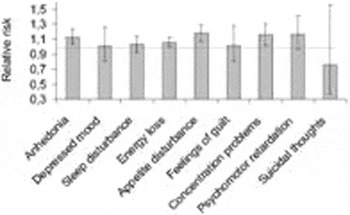
PS02.65
The association between depression and family relationships in elderly
Roza Krsteska, Psychiatric hospital Skopje, Skopje, Macedonia, Macedonia
Depression is not an inevitable outcome of aging, but is a disorder of the brain that arises in the context of the medical illnesses and psychosocial stressors that accompany aging. Late-life depression encompasses both patients with the late-life onset of depression (after age 60y) and older adults with a prior and current history of depression. Among the ageing population, anxiety and depression are currently the most prevalent mental health problems. Because of the importance of relationships in the life of elderly, the loss of family support and disruptions in close relationships may play a role in elderly greater propensity toward depression. In this study, we examined the association between depression in older adults and several aspects of relationships with close family members. Methods: This investigation represents an analytical cross sectional, case control study carried out at the Department for Geriatric Psychiatry of Psychiatric Hospital Skopje. The study included 120 older adults, in two examined groups. One experimental group comprising of 60 patients suffering from unipolar depression, diagnosed in accordance with the 10-th International Classification of Mental and Behavioral Disorders diagnostic criteria, without a history of other psychiatric disorders or dementia, compared against the control group of community-dwelling older adults without a history of depressive symptoms or other psychiatric disorders or dementia. There was no significant statistical difference in the sex proportion in both groups (p>0.05). The included patients were with average age of 70.43+/−6.63 years; and for the control group with average age of 71.12+/−6.49 years. We tested the difference in the average age between the first and the second group, and for the level of p>0.05 it is statistically insignificant, i.e. the examinees do not differ significantly in relation to the age. Investigated data were taken by means of questionnaire, designed for that aim. The Geriatric Depression Scale was used to measure depressive symptoms. Outcome measure was a score of > 10 on the 30-item Geriatric Depression Scale. The mean score in the Geriatric Depression Scale of the experimental group was 24.08 +/−3.67, whereas of the control group was 3.67+/−3.09, for the t-value 23.92 and p = 0.00000. The scores in the Geriatric Depression Scale revealed statistically significant difference between experimental and control group. Results: About the relations in the family 50% of patients against 85% subjects from control group responded that there are harmonious and tolerant relations in their family. Actually not tolerant and conflictual family relations were more common for the patients in the experimental group (25.67%) against examinees in the control group (10%). The distribution of examinees in experimental and control group in regards to quality of family relations has confirmed a statistically significant difference (D max = 0.37; p
PS02.66
Changes in depression and physical functional and quality of life over 12 months among community-dwelling depressed older persons
Shwe Nyunt, National University of Singapore, Singapore, Singapore
Introduction. Depression is associated with significant functional disability. Cross-sectional studies do not unravel the complex temporal relationships involving concomitant factors like medical comorbidity and cognitive impairment. A limited number of longitudinal studies have shown that depressed older persons report more physical disability over time. Depressive symptoms vary in intensity and duration over time, and few longitudinal studies have investigated the impact of changes in depression status on physical functional decline and quality of life over time in older persons. Aims. The present study aimed to investigate whether 12-month changes in depressive symptoms was associated with corresponding changes in physical functioning and quality of life of community-dwelling depressed elderly, independently of medical comorbidity and impaired cognitive functioning.
Method: In a community-based screening programme of 4633 older persons aged 65+, 370 (8%) older persons who reported depressive symptoms (GDS≥5) were followed up at 12 months. Baseline and 12 month follow up assessments included Geriatric Depression Scale (GDS-15) for depressive symptoms, instrumental and basic activities of daily living scales (IADL and ADL) for physical functioning and SF-12 for quality of life. Baseline co-variables included Mini mental State Examination (MMSE) for cognitive functioning, number of chronic medical comorbidities, and sociodemographic characteristics. Improvement in depression status was denoted by a positive change value of GDS scores (baseline minus 12 month), improved physical functioning by positive change value of IADL/ADL scores (12 month minus baseline) and improved quality of life by positive change value of SF 12 (12 month minus baseline).
Results: At baseline, the mean age of the older persons with depressive symptoms (GDS≥5) was 73.1 years (S.D = 8.1), 54.9% were female; mean GDS scores was 8.09 (S.D = 2.39), MMSE mean scores was 23.8 (S.D = 4.4), IADL mean score was 24.5 (S.D = 4.6), and ADL mean score was 18.76 (S.D = 3.04). After adjustment for baseline functional status, MMSE, chronic medical illnesses and other socio-demographic variables, positive change in depressive symptoms (baseline minus 12 month) was significantly associated with positive change (12 month minus baseline) in physical functional status (ß = 0.32, S.E = 0.07, p < 0.001) and SF 12 (12 month minus baseline) (ß = 0.81, S.E = 0.10, p < 0.001),. Higher MMSE scores at baseline was also independently associated with improvement of functional status (β = 0.21, S.E = 0.08, p = 0.01). Older age was negatively associated with improved physical functioning scores (ß = −0.09, S.E = 0.04, p = 0.02) and improved SF 12 scores (ß = −0.14, S.E = 0.05, p = 0.008). Men were significantly less likely to show improvement in SF 12 quality of life (β = −1.86, S.E = 0.92, p = 0.04).
Conclusion: In depressed elderly, improvement in depressive symptoms was associated with improvements in physical functional status and quality of life.
PS02.67
Age-related differences in anaphor resolution are revealed by event-related potentials and low resolution brain electromagnetic tomography
Horacio Firmino, Centro Hospitalar Universitário Coimbra, Coimbra, Portugal
J Leitao, Faculdade de Psicologia – Universidade de Coimbra, Coimbra, n/a, Portugal
M Gonçalves, Faculdade de Psicologia e Ciências da Educação, Portimão, Portugal
“Anaphor resolution” is the process by which one of the full noun phrases preceding a referentially deficient expression (an “anaphor”, e.g. a pronoun) is selected as the antecedent of that anaphor, thus establishing a reference for an otherwise referentially defective expression.
Objectives: We used ERPs and Standardized Low Resolution Brain Electromagnetic Tomography (sLORETA) to study the age-related differences occurring in the early(a) and later(b) stages of anaphor resolution. In (a) the antecedent-pronoun dependency is formed and syntactic structure plays a key role, either allowing low processing cost binding at the syntactic level, or forcing a more costly dependency formation at the discourse level. In (b) repair/enrichment processes may occur (e.g., pragmatic meaning-modulations). We hypothesized that, for the elderly, syntactic processing is well preserved, while pragmatic processing is hindered, namely inferences based upon breaches of pragmatic principles. Such inferences require, for the pragmatic anomaly to be detected, that the reader/listener predicts the writer/speaker”s choice of the particular type of pronominal expression that would conform to the pragmatic principle at stake. We tested our hypotheses by comparing ERP markers of discourse dependency formation (N400) and meaning enrichment (P600), in young and older adults; we further compared the aforementioned age groups wrt sLORETA reconstructions of localized differences in brain activity, elicited by two contrasting anaphor resolution contexts. Methods Participants: 20 older adults (60–80 year old), 20 young adults (19–26 years old). Materials: Gender agreement in 48 pairs of Portuguese complex sentences was manipulated to cause pronoun resolution either with the c-commanding NP (1: low cost syntactic dependency formation; breach of Grice”s maxim of manner – an explicit pronoun occurs instead of the Portuguese null/silent pronoun (pro), the most economic and common choice for this syntactic context) or with the NP in a genitive recess (2: high cost discourse dependency formation; no breach of pragmatic principles), e.g. (1) [[The butler]MASC of [the countess]FEM](i)MASC quarreled with the servant to whom he(i)MASC had lent some money. (2) [[The employee]FEM of [the butcher](i)MASC]FEM quarreled with the client to whom he(i)MASC had sold spoilt sausages.
Results: An enhanced Late Positivity and selective activation of right BA 9 and BA31 emerges in type (1) sentences for the young adults, indexing the additional effort required to compute the pragmatic inference conveyed by the breach of Grice”s maxim of manner. The absence of this effect in the elderly group suggests a failure in predictive processing, resulting in the lack of basis for the pragmatic inference. Older adults show instead a N400 and selective activation of right BA 18 for type (2) sentences, indexing the contrast with facilitated dependency formation in type (1) sentences, in which the pronominal form, void of pragmatic import for this group, can be fully processed at the syntactic representation level. Type (2) sentences, in contrast, require the dependency to be formed at the discourse representation level, thus motivating the N400 effect and right BA18 recruitment. In the young adults” group, the clash between the expected null pronoun and the explicit one that in fact occurs in type (1) sentences, leads the processor to shift resolution to the discourse level, where the unexpected binding will be visible to the pragmatic module.
PS02.68
Association study of APOE ɛ4 allele and dementia in a Singaporean Chinese population
Qi Gao, L Feng, D Seow, T Ng, Yong Loo Lin School of Medicine, National University of Singapore, Singapore and
L Yap, Khoo Teck Puat Hospital, Singapore, Singapore, Singapore
Background: The ɛ4 allele of apolipoprotein E (APOE) is the only confirmed genetic risk factor for Alzheimer's disease (AD). APOE is a polymorphic protein regulating the transport of cholesterol and the metabolism of lipoprotein particles. The interaction of APOE and the low-density lipoprotein (LDL) receptor determines the homeostasis of cholesterol and triglycerides. However, variability in the strength and type of association between AD and APOE polymorphisms among ethnic groups has been reported. The association of APOE ɛ4 allele with AD or non-AD dementia was weaker for African-Americans than for Hispanics and whites, and was not found in native Nigerians. Furthermore, the association of the APOE ɛ4 allele with vascular dementia (VaD) is still controversial. At present, the strength of association of the APOE ɛ4 genotype with dementia in Singaporean Chinese is unknown. In this case-control study, we examined the association between APOE ɛ4 allele status and the risk of AD and non-AD dementias in a Singaporean Chinese population.
Methods: We studied 153 patients with dementia (87 AD, 19 VaD and 47 mixed dementia) from the Memory Clinic of the Department of Geriatric Medicine in the Alexandra Hospital and 153 age- and sex-matched healthy controls from the Singapore Longitudinal Ageing Study (SLAS), respectively. APOE genotyping from blood samples was done using the deoxyribonucleic acid (DNA) polymerase chain reaction (PCR) amplification and single nucleotide extension technique. Patients with either one or both ɛ4 alleles were considered as ɛ4 carriers. APOE ɛ4 allele prevalence was compared by Chi-square test. Odds ratios (ORs) of association between APOE ɛ4 status and dementia were calculated in conditional logistic regression models.
Results: Of the 306 participants, 182 (59.5%) were women; mean age was 74.3 (range = 55–89). Compared with normal controls, more demented patients had less than 6 years of education (88.2% and 59.5% respectively, P<0.001).
Altogether, 52 of 153 dementia patients were APOE ɛ4 carriers (34.0%). No significant difference of APOE ɛ4 prevalence was observed between AD and VaD/mixed group (35.6% and 31.8%, p = 0.622). Between AD patients and healthy controls, the prevalence of APOE ɛ4 carriers was significantly different (35.6% and 17.2%, p = 0.005). The OR adjusted for education of the association of APOE ɛ4 carriers with AD was 2.41, 95% C.I. 1.10–5.28, p = 0.01. Among the VaD/mixed dementia patients and controls, there was no significantly difference of APOE ɛ4 prevalence between the two groups (31.8% and 21.2%, p = 0.168). No significant association of APOE ɛ4 allele with VaD/mixed dementia was found (OR = 1.78, 95% C.I. 0.78–4.02, p = 0.279).
Conclusions: Although associated with AD among Singaporean Chinese, the effect of APOE ɛ 4 in increasing the risk of AD was not strong as that observed in Western populations. No significant association was observed with non-AD dementia. More studies with larger sample sizes on Chinese, Malays and Indians should be done.
PS02.69
The association between paraoxonase 1(PON1) gene 192Q/R polymorphism and Alzheimer's disease and non-Alzheimer's dementias in a Singaporean Chinese population
Qi Gao, L Feng, D Seow, T Ng Yong Loo Lin
School of Medicine,
National University of Singapore, Singapore, Singapore
L Yap, Khoo Teck Puat Hospital, Singapore, Singapore, Singapore
Background: The association of human paraoxonase 1 (PON1) gene polymorphism and risk of developing dementia is of particular interest. PON1 participates in the prevention of low-density lipoprotein (LDL) peroxidation which is thought to be the mechanism by which high-density lipoprotein (LDL) exerts its anti-atherogenic activity. It is also a potent cholinesterase inhibitor and a Ca2+−dependent arylesterase, providing protection against organophosphate poisoning and metabolization of environmental neurotoxins which might be responsible for neurodegeneration with ageing such as Parkinson's disease. To date, eleven case-control studies have investigated the relationship between PON1 polymorphism at 192 Q/R and Alzheimer's disease (AD) or dementia and the results have been inconsistent. In this study, we aimed to examine the possible association of 192 Q/R polymorphism in the PON1 gene with dementia in a Singaporean Chinese population.
Methods: 153 demented patients (87 AD, 19 vascular dementia and 47 mixed dementia) and 153 age- and sex-matched healthy controls were recruited from Memory Clinic of the Department of Geriatric Medicine in the Alexandra Hospital and the Singapore Longitudinal Ageing Study (SLAS), respectively. Multiplex PCR was performed to detect the PON1 gene 192 Q/R polymorphism. Allelic frequencies were estimated by the allele counting method. Genotype and allele frequencies were compared by chi-square test. Odds ratios (ORs) of association between PON1 gene 192 Q/R polymorphism and dementia were calculated in conditional logistic regression models.
Results: The PON1 genotypes were in Hardy-Weinberg equilibrium. Among AD patients (n = 87) and age- and sex-matched controls (n = 87), there was no significant difference in the PON1 192 Q/R genotype distribution and allele frequencies. In addition, no statistically significant association of PON1 gene polymorphism and AD was found between AD patients and controls. Among non-AD dementia patients (n = 66) and age- and sex-matched controls (n = 66), a significant difference in the PON1 genotype total distribution was observed (29 R/R, 33 Q/R, 4 Q/Q; 32 R/R, 22 Q/R, 12 Q/Q respectively, p = 0.042); likewise, the presence of at least one R allele was significantly different (93.9 % and 81.8% respectively, p = 0.033). In conditional logistic regression model, a positive association of R alleles carrier status (QR or RR) and non-AD dementia was observed (unadjusted OR = 3.67, p = 0.046; education-adjusted OR = 3.75, p = 0.083); Q/Q genotype was associated with lower risk of non-AD dementia (unadjusted OR = 0.27, P = 0.046; education-adjusted OR = 0.27, p = 0.083). The analyses were stratified by Apolipoprotein E (APOE) allele ɛ4 status (ɛ4 carriers/non-carriers). Among non-ɛ4 carriers, there was a significant difference of the presence of at least one R allele (R/R or Q/R) between non-AD dementia patients and matched controls (95.6% and 80.0% respectively, P = 0.024). R allele frequencies was significantly higher in non-AD dementia patients than in controls (72.2% and 52.2% respectively, P = 0.006). Conditional regression failed to show a significant association between PON1 gene 192Q/R polymorphism and the risk of non-AD dementia in non-ɛ4 carriers. No significant results were observed for APOE ɛ4 carriers.
Conclusion: We found that in Singaporean Chinese, the PON1 192Q/R genotype distribution was significantly different between non-AD dementia patients and controls and these patients showed greater frequency of at least one R allele (R/R or Q/R). In particular, the PON1 R allele was significantly more frequent among non-AD dementia patients who were APOE ɛ4 non-carriers. However, we did not find a significant association between PON1 192Q/R gene polymorphism and AD/non-AD dementia. Larger case-control studied should be conducted to confirm the association of PON1 gene polymorphism and dementia subtypes.
PS02.71
Cognitive function domains associated with components of low extremity function in Korean aging population
Ki Young Son; S Kim; J Lim, Seoul National University Hospital, Seoul, South Korea
Background: Previous studies showed that cognitive decline was associated with physical performance decline. However study that investigated the association between domains of cognitive function and components of low extremity function is hardly found, especially for Asian, although it is important to elucidate the way these two functions affect each other.
Method: The Short physical performance battery (SPPB) and Korean version of Mini-Mental Status Exam (MMSE-K) were performed on random sample nested in the KLoSA panel, a national representative sample of aging people in Korea. Univariate analysis of correlation between components of SPPB (balance, gait speed, chair standup) and domains of MMSE (orientation to time, orientation to place, attention and calculation, registration and recall, understanding and judgment, executive function) was performed calculating Pearson correlation coefficient. And then multiple regression analysis was performed adjusted for age, sex, educational level.
Results: Of 516 participants, about forty-two percent (266/516) were male. And mean age was 63.80 ± 10.10. In univariate analysis, SPPB total score was significantly correlated to MMSE total score and score of all domains (p < 0.05). Balance was correlated to orientation to place, attention and calculation, and executive function significantly (r = 0.159, 0.165 and 0.158, respectively, p < 0.05 for all). Gait speed was correlated to orientation to time, attention and calculation, understanding and judgment, and executive function significantly (r = 0.185, 0.347, 0.090 and 0.316, respectively, p < 0.05 for all). And Chair standup was correlated to orientation to time, attention and calculation, understanding and judgment, and executive function significantly (r = 0.105, 0.387, 0.125 and 0.277, respectively, p < 0.05 for all). In multiple regression analysis, SPPB total score was associated with attention and calculation (β = 0.058, 95% confidence interval (CI) 0.034 – 0.081), and executive function (β = 0.097, 95% CI 0.036 – 0.157). Furthermore, attention and calculation (β = 0.010, 95% CI 0.001 – 0.020 for balance, β = 0.014, 95% CI 0.004 – 0.024 for gait speed, and β = 0.034, 95% CI 0.020 – 0.049 for chair standup) and executive function (β = 0.026, 95% CI 0.004 – 0.048 for balance, β = 0.033, 95% CI 0.008 – 0.058 for gait speed, and β = 0.037, 95% CI 0.001 – 0.074 for chair standup) were associated with all components of SPPB. Additionally, Orientation to place was associated with balance (β = 0.122, 95% CI 0.042 – 0.202), Orientation to time was associated with gait speed (β = 0.048, 95% CI 0.004 – 0.092), and Understanding and judgment was associated with chair standup (β = 0.164, 95% CI 0.019 – 0.309).
Conclusion: Attention and calculation, and executive function were the most prominent predictors for low extremity function and its each component in this Korean aging population. Future research should focus on these two cognitive function domains to elucidate link of cognitive function with physical performance and risk of fall.
PS02.72
Compensatory systems in Alzheimer's disease interventions: From memory books to SenseCam
Ana Rita Silva, Faculty of Psychology, University of Coimbra, Coimbra, Portugal
L Macedo Centre for Informatics and Systems of the University of Coimbra, Coimbra, Portugal
S Pinho, Coimbra, Portugal
H Firmino, Centro Hospitalar Universitário Coimbra, Coimbra, Portugal
Background In Alzheimer's disease (AD) memory deficits are emphasized as the primary symptoms and the most disruptive for the patients’ wellbeing. With this concern there has been a large effort to develop interventions to implement early with these patients (Clare, 2000). Recent studies have been conducted to evaluate the most effective techniques of memory training, like learning without errors, spaced retrieval and auto-generation of cues (Clare & Woods, 2004). Despite the effectiveness of these techniques, some limitations were also outlined. The excessive focus on the training of internal memory resources was one of those limits that sensitized the researchers to study additional and complementary procedures. In this context, the focus has shifted to the compensatory rehabilitation, mainly the development of external memory strategies. The wide range of literature on external memory aids for AD described the effectiveness of memory book training as a source of cues for memory retrieval (Schmitter-Edgecombe, Fahy, Whelan & Long, 1995; Sohlberg & Mateer, 1989). Early studies stated that helping the patient to write a standardized diary would be useful because it helps in recalling important events, compensating for prospective memory deficits, making the patient a more active listener and facilitating encoding process via multisensory modalities (hearing, vision, motor skills). However, there were identified some limits: extensive training; preserved awareness about the memory deficits and a greater motivation of the patient. Several researchers (cognition scientists, computer scientists) have joined with the aim of developing new and more effective methods of compensatory memory for dementia interventions. An innovative device, the SenseCam, has attracted the attention of the researchers. This Microsoft's device is a camera built to pick up digital records of the day from the point of view of the wearer, by capturing a large number of images and logging of sensor data. It consists in a passive memory capture approach that offers to the user a more integral awareness of past actions with residual input from him (Hodges, S., Williams, L., Berry, E., Izadi, S., Srinivasan, J., Butler, et al., 2006). The capture is unintentional, becoming similar to the real human memories. However, as researchers highlight, this device creates cues, not memories itself. This presentation concentrates in a specific issue of a major research project titled “Memory stimulation in Alzheimer's disease: The role of SenseCam in a comprehensive memory training program”. In this issue, we focus on the differential cognitive basis of the two external memory aids: memory book and Sense Cam. Consequently, we intend to evaluate their efficacy.
Methods: Two groups of 20 mild AD patients each compose the study sample. One of the patients group will write with assistance a memory book/diary, and the patients of other group will wear the SenseCam. The intervention will last six weeks, and each patient meets the psychologist twice a week during one hour per session. Memory book: Motivational training for the regular use of the book; presentation of the diary with defined features (place where the event took place, emotional impact, etc.) to fill with the events occurred during the day; require the help of the patient caregiver to remember him to fill the diary daily. At the sessions with the psychologist will be administered recall tests. SenseCam: Presentation of the device to the patient and to his/her caregiver; Teaching the caregiver to show the SenseCam pictures to the patient every two days; Application of recall tests at the sessions with the psychologist. For the objective assessment of memory gains with the use of each method, a comprehensive memory assessment battery will be applied before the intervention, immediately after and six months follow up. The battery includes the following testes: Rivermead Behavioral Memory Test – 3 (Wilson, et al., 2008); Pyramids and Palm Trees Test (pictures version; Howard & Patterson, 1992); Time based prospective memory tasks (two) from CAMPROMT (Wilson et al., 2005); Autobiographical Memory Test (Williams & Broadbent, 1986). Additionally, functional status and well-being measures will be collected (IAFAI; Sousa et al., 2008, and WHOQOL-OLD; M. Power et al., 2005).
Anticipated outcomes: We expect that SenseCam will allow higher recall levels than the memory book method because it provides strengthen cues and consequently this device will contribute to a greater sense of wellbeing of the patients. In addition, we also anticipate that the patients wearing the SenseCam will have a better autobiographic performance. We discuss the explanations concerning the basis of this expected outcome, from the analysis of the neurocognitive characteristics of the both methods as “cue creators”.
PS02.74
Abstract withdrawn
PS02.75
Mini Mental State Examination (MMSE): Probably one of the most cited papers in health science
Flemming Nilsson, Copenhagen University, Broendby, Denmark
The standard MMSE was published in Journal of Psychiatric Research in 1975 and is still in use, with only minor subsequent modifications done by the authors. The MMSE has demonstrated validity and reliability in psychiatric, neurological, geriatric, and other medical studies. The test was designed to measure orientation, comprehension, recall, reading, writing, and drawing tasks (viseospatial tasks). The form also includes alternative item substitutions for administration in special circumstances (spelling test in stead of calculation in case of dyscalculia). The MMSE has been translated into more than 35 authorized foreign language editions. Materials and methods Citation on this specific scientific paper was searched for in commercially available databases. The bibliometric measurements were done in commercial databases provided by the university library. All citations of the paper between 1975 and 2006 were downloaded from Web of Knowledge produced by the Institute for Scientific Information (ISI). Analysis were done by the programmes provided in the Web of Knowledge This short paper (poster) investigated the article by Folstein et al. previously published in Journal of Psychiatric Research as a method paper. It has been cited in an unusually high number. In November 2008 other researchers had cited the paper more than 21,900 times. Compared to other papers this is by far the most cited paper in neurology, psychiatry and geriatrics. It is discussed if it is the most cited paper in medical science. The Mini Mental State Examination (MMSE) is one of the most ever cited research papers in medical science. It is most probably going to be applied to more and more specialities in the future, since geriatric problems are increasing in many ways. Folstein M F, Folstein S E, McHugh P R. “Mini-mental state”. A practical method for grading the cognitive state of patients for the clinician. J Psychiatr Res 1975; 12:189–198.
PS02.76
When the mind drifts: The mnemic impairment effect of daydreaming in healthy older adults
Horacio Firmino, Centro Hospitalar Universitário Coimbra, Coimbra, Portugal
S Pinho, Coimbra, Portugal
F Alves, Faculdade de Psicologia e Ciências da Educação da Universidade de Coimbra, Coimbra, Portugal
The cognitive deficits of older adults have been a subject of special concern during the last decades. The aging reveal dissociative phenomena between declining areas and preserved areas of memory. One of the mechanisms underlying the memory deficits in older adults is the decreasing of inhibition efficiency. A study on control strategies with list-method directed forgetting in young and older adults showed forgetfulness among the younger but not the in older adults, which is consistent with the decreased inhibition efficiency. However, when the instructions were revised to downplay their concerns about memory and the experimenter provided a strategy that induced a mental context change – specifically, engaging in diversionary thought – older adults showed significant directed forgetfulness as well as the younger adults (Sahakyan, Delaney, & Goodman, 2008). Daydreaming transport us mentally to another place and time, but many diversionary thoughts are similar in content to the thoughts that we create when we try to forget something. Thereby, previous studies showed that daydreaming can induce an amnesic effect when we try to remember the previously encoded information. A recent study has also showed that the contents of daydreams affect the ability to access a recently-acquired memory (Delaney, Sahakyan, Kelley, & Zimmerman, 2010). Apparently, the context change explains these results, the directed forgetting and even the mind wandering paradigm effect. The diversionary thought starts a new mental context in which the next items are encoded, in other words, the new context match better to the learning context of the second word list than of the first word list. The main aim of this study is to explore the mind wandering paradigm effect in a group of old, healthy Portuguese people. The sample consists on a group of 80 healthy older adults aged from 65 to 69 years old, 40 of which compose the control group. The evaluation protocol includes the mind wandering paradigm, as well as a screening cognitive test (Addenbrooke's Cognitive Examination – Revised), a visual episodic memory task (Visual Association Test), a measurement of attention and mental flexibility (Trail Making Test A and B), a processing speed task (Digit Symbol-Coding from WAIS-II), a verbal intelligence task (Vocabulary from WAIS-III) and a depression scale (Geriatric Depression Scale –30). In order to test the hypothesis that thinking about past autobiographical events (diversionary thought) induce greater memory impairment in comparison with a control distractive task, the participants in diversionary thought condition were instructed to think about their childhood home after the List 1 presentation and before List 2 presentation. In the control condition the procedure was the same but diversionary thought was replaced by a test of speed reading. It is expected memory differences between the groups. Thus, the diversionary thought group will remember less words of the List 1 in comparison with the control group, in support of a context-change effect. It is also expected that List 2 recall does not depend on the group, i.e., memory performance on List 2 will not be influenced by the type of treatment applied to the List 1. All of us have heard that older adults live in the past. Knowing the adverse effect of the diversionary thought when recalling information recently encoded is needed, this study alerts to how important it is to promote strategies that enable older adults to engage only in the present learning context, at least, immediately after the encoding of relevant information. References: Sahakyan, L., Delaney, P., & Goodman, L. (2008). Oh honey, I already forgot that: Strategic control of directed forgetting in older and younger adults, Psychology and Aging, 23, 621–623. Delaney, P., Sahakyan, L., Kelley, C., & Zimmerman, C. (2010, Junho 14). Remembering to forget: The amnesic effect of daydreaming, Psychological Science, 20 (10), 1–7.
PS02.77
The impact of cognitive status on neuropsychiatric profile and outcomes in Parkinson's disease
Hiranmayi Pantula, Lancashire Care NHS Foundation Trust, Lytham, Lancashire, United Kingdom
I Leroi, Blackburn, Lancashire, United Kingdom
Background: Neuropsychiatric complications are common in Parkinson's disease (PD) without dementia, as well as in PD with frank dementia (PDD). The diagnosis of “mild cognitive impairment” in PD (PD-MCI) has only recently been described and the specific profile of neuropsychiatric problems, quality of life and disability in this population is as yet unclear. Objective: To compare the frequency, magnitude and profile of neuropsychiatric symptoms (NPS) in PD, PD-MCI and PDD as well as to compare the impact of these diagnoses on the outcomes of quality of life and level of disability.
Methods: Participants with PD and no cognitive impairment (n = 45), PD-MCI (n = 59), and PDD (n = 25) were assessed using the 12-item Neuropsychiatric Inventory (NPI), a quality of life scale (PDQ-8) and on disability ratings (Unified Parkinson's Disease Rating Scale, ADL subscale; Schwab and England scale). All were recruited from local neurology clinics in UK and met strict clinical diagnostic criteria for idiopathic PD. PDD was diagnosed according to MDS criteria and MMSE < 26. PD-MCI was diagnosed in participants with at least 1 abnormal cognitive domain (>1.5 SD below the mean in healthy controls) and MMSE ≥ 26.
Results: Over 70% of each of the three PD groups reported at least one NPS in the past month. In those with PDD, 72% reported the presence of three or more NPS. The proportion of those with clinically significant NPS (total NPI score ≥ 4) increased from 49% in PD to 61% in PD-MCI to 76% in PDD. In the PD group, sleep disturbances were the most commonly reported NPS (60%) followed by anxiety and depression. In the PD-MCI group, the profile was similar, with sleep (56%), anxiety (37%) and depression (33%) being common. Apathy increased markedly from 20% in PD to 39% in PD-MCI and 52% in PDD, as did psychosis, which increased from 11% in PD to 18% in MCI-PD to 60% in PDD. The magnitude of NPS (frequency x severity) did not differ significantly between groups. Total NPI score was associated with greater dopaminergic load, longer duration of disease, lower MMSE and more severe disease stage. Both quality of life and disability were significantly worse in the PDD group compared to PD as well as PD-MCI.
Conclusion: NPS in PD-MCI and PDD are more common than in non-PD MCI and other dementias respectively. In PD, the frequency of NPS increases as cognitive impairment worsens, with symptoms being most common in PDD. Apathy and psychosis in PD-MCI are more common than in non-PD-MCI increase markedly as cognitive stage worsens. Cognitive status is associated with worse quality of life and greater disability.
PS02.78
Old age and dental problems
Carlo Cristini, E Borreani,
University of Brescia, Brescia, Italy
Introduction: Despite being a risk group for dental problems, older people have a low dental attendance. According to McGrath and Bedi (1998), they generally recognise the importance of oral health but only attend the dentist in response to pain, resulting in emergency treatment. Many studies have explored the reasons that prevent older people to make and attend dental appointments. Borreani et al. (2008) have identified five groups of barriers to dental care in older people: cost, fear, accessibility, availability of dental treatment and personality of the dentist. Among these factors, fear of dental treatment seems to have a significant impact on older people's opinions, behaviours and choices. Traumatic past experiences have been shown to be significantly associated with dental fear, however there are also strong associations between dental anxiety and negative perceptions of dental experiences as uncontrollable, unpredictable, dangerous and disgusting (Armfield, 2010).
Objectives and Methods: This research aimed to explore older people's views on dental treatment focusing on emotional reactions, attitudes and opinions towards dental care, with a particular interest on the individual strategies used to overcome dental problems. Thirty-eight older people (18 male and 20 female; 19 up to 70 years old and 19 over 70 years old) were recruited in day centres and dental practices located in a suburb of Milan and in a small city in northern Italy. All participants were over 65. We used a qualitative approach with semi-structured interviews to investigate older people's views on dental care. Participants were interviewed by the researcher, using a questionnaire with open and closed questions and two self-rating scales to measure their level of anxiety and depression.
Results: This research confirmed that avoidance can be a strategy used to cope with dental anxiety and that negative past experiences at the dentist can strongly influence personal attitudes towards dental care and dental attendance. Participants offered a number of suggestions to increase the attendance level in older people, which included the use of relaxation techniques like yoga and autogenic training, finding a calm dentist, using dental anaesthesia. The study highlighted differences among male and female participants. In general, men seemed less scared of the dentist. It was easier for women to recall negative experiences at the dentist that significantly affected them. The episodes mainly referred to cases of malpractice which resulted in them looking for a new dental practitioner. Female participants seemed to have a stronger preference for a male dentist. Women found it harder to identify the scariest part of the treatment, while this was clear to most men interviewed. Male participants were more afraid of going to the dentist than to the surgeon while it was the opposite for their female counterparts. When asked if they had found any methods to overcome their fear, most women declared that they did not find any useful strategies. The research also underlined some differences among the two age groups (up to 70 and over 70). In general, people in the younger group seem to be more anxious at the thought of going to the dentist and having dental treatments. A few participants belonging to the older group highlighted the great improvements made to dental techniques that became less painful over the years that reduced the pain of dental treatment. Conclusions: This research, along with other studies (Cesa-Bianchi and Cristini, 2009), highlights the importance of communication and the use of a sensitive approach that should be tailored considering the general needs of older people, taking also into account the uniqueness of each individual. One recommended way to achieve this is through a training aimed to increase awareness of older people's needs and their dental problems. References Armfield JM. (2010). Towards a better understanding of dental anxiety and fear: cognitions vs. experiences. European Journal of Oral Sciences 118: 259–264; Borreani E, Wright D, Scambler S, Gallagher JE (2008). Minimising barriers to dental care in older people. www.biomedcentral.com/1472–6837/8/7; Cesa-Bianchi M, Cristini C (2009). Vecchio sarà lei! Muoversi, pensare, comunicare. Guida, Napoli; McGrath C, Bedi R (1998). A study of the impact of oral health on the quality of life of older people in the UK findings from a national survey. Gerodontology 15: 93–98.
PS02.79
Two improved cases with diffuse Lewy body disease (DLBD) and cardiac autonomic disorder (CAD)
Masaki Shiozawa, Kikuchi National Hospital, Koshi, Kumamoto, Japan
Background: Patients with diffuse Lewy body disease (DLBD) have constantly cardiac autonomic disorder (CAD) and carry a high risk of sudden disturbance of consciousness. CAD effects cardiac dynamism and causes orthostatic hypotension, transient ischemic attack (TIA), cerebral infarction, and tachyarrhythmia. Metaiodobenzylguanidine (MIBG) scintigraphy detects over 90 % of CAD in DLBD patients. However, MIBG scintigraphy is one of difficult examinations for patients with cognitive deficits. Two DLBD patients were treated their CAD, referring to their ECG and vital signs. They also showed the betterment of their psychiatric symptoms, after this treatment.
Case Study: A 84-year-old female with Parkinson's syndrome was introduced to our hospital because of fluctuating cognition (FC). EEG detected FC with the alpha waves of basic activity mixed by theta trains. Her MMSE score was 25/30 and MRI showed diffuse cortical atrophy without localized findings. ECG showed sinus rhythm with 75 of pulse and 378 ms of QT time. However, she often felt vertigo, orthostatic hypotension, and headache. 5mg of furosemide per day was started, and then her subjective symptoms were decreased. Her motivation, viscosity, and FC were improved after about 6 months. She reduced her HAM-D score from 17 to 0. A 81-year-old male was suffered from dementia with FC, REM sleep behavior disorder (RBD), and visual hallucination of persons. He twice experienced the sudden disturbance of consciousness with pallor of the face and unclear speech. The dose of furosemide was increased from 5 mg to 20. The low dose of chlorpromazine and levomepromazine, totally 12.5 mg, were administered to raise his pulse a little. The variance of pulse, in short, fluctuation of pulse, was reduced from 90.76 to 55.84. The pulse itself was increased from 61.4 to 67.5 (p<0.05). He reduced FC and his changeable mood and improved MMSE score from 11 to 19.
Conclusion: A diuretic was administered for the treatment of two DLBD patients with CAD to reduce cardiac burden. Its reduction makes the cardiac status without orthostatic hypotension or tachyarrhythmia. After this treatment, the patients felt better subjectively. Their psychiatric symptoms were reduced and cognition changed stable. CAD can be presumed by lower pulse, QT time of ECG, BNP or Schellong test. In addition, the subjective symptoms of vertigo, unsteady headache, and orthostatic hypotension help consider CAD in DLBD patients. DLBD patients frequently have a tendency of heart failure or cardiac hypertrophy with MIBG findings. We often experienced the deterioration that FC was accompanied with CAD, such as the fluctuation of pulse, orthostatic hypotension, and disturbance of consciousness. There are many cases clinically that the worse body status is, the worse cognition is. The treatment of CAD may make the body status more stable and lead to the improvement of psychiatric symptoms or cognitions in DLBD patients, because DLBD patients have a tendency to be suffered from CAD. The medication against cardiac burden is diuretics or antihypertensive agents. Because the problem is CAD, the attempt of a small amount of administering to the subjective symptoms might be useful. The medication against bradycardiac change is anti-cholinergic agents. However, they might worsen cognitive functions, such as learning or memory. We administered the very low dose of chlorpromazine and levomepromazine, totally 12.5 mg to the DLBD patient. It is equivalent to 0.125 mg of haloperidol. It may be considered to be smaller than the amount that changes his cognition worse and his MMSE score was improved.
PS02.80
Dimensions of apathy in Parkinson's disease without dementia: Clinical correlates and impact
Iracema Leroi, Blackburn, Lancashire, United Kingdom
E Mulin, Mémory Center, CMRR, CHU de Nice, Nice, France
M Andrews, Bradford Teaching Hospitals NHS Foundation Trust, Sowerby Bridge, West Yorkshire, United Kingdom
P Robert, CHU Nice, Nice, France
Background: Apathy can occur in a significant proportion of Parkinson's disease (PD) sufferers even in the absence of dementia. Apathy has three key dimensions, emotional blunting, lack of initiative, and lack of interest. These dimensions may be differentially associated with clinical variables in PD and may impact differently on PD sufferers and their caregivers. The objective of this study was to evaluate the clinical profile and impact of apathy in PD with particular emphasis on the individual dimensions of apathy.
Methods: 91 non-demented PD participants were evaluated with the Apathy Inventory (AI), which assesses the three dimensions of apathy. Those with clinically significant apathy (n = 32) were compared to those without (n = 59) on key demographic and clinical variables as well as the impact on disability, quality of life and carer burden. Within the apathy group, a subsequent comparison of those with clinically significant emotional blunting (n = 22) and those with only diminished interest and/or initiative (n = 10) was undertaken. Linear regression models predicting apathy overall were created.
Results: Those with apathy were significantly more depressed, and had greater levels of executive dysfunction compared to those who had no apathy. The group with apathy and emotional blunting was primarily associated with high levels of depression. The group with only diminished initiative and/or interest were primarily associated with older age and age of disease onset, later stage of disease, worse motor function, depression and attention and executive dysfunction. 54% of the variance predicting apathy overall was accounted for by depression, executive dysfunction (set shifting), sleep impairments and appetite impairments. Those with apathy, in particular emotional blunting, had significantly worse HRQoL (p<0.001), greater levels of disability (p<0.001), and greater carer burden (p = 0.001) compared to the non-apathy groups.
Conclusion: In non-demented PD, apathy, particularly with emotional blunting, is associated with depression and cognitive dysfunction. It also impacts significantly on PD sufferers and carers, whereas apathy without emotional blunting impacts less.
PS02.81
Neuropsychiatric symptoms, functional abilities and caregiver burden in dementia with Lewy bodies and Alzheimer disease
Mamoru Hashimoto, K Honda, Y Ogawa, M Ikeda, Y Yatabe, K Kaneda
Kumamoto University Hospital, Kumamoto-City, Kumamoto-prefecture, Japan
Background: Dementia with Lewy bodies (DLB) is considered the second most common cause of degenerative dementia after Alzheimer's disease (AD) in elderly people. Previous studies which examined the profile of cognitive impairments of DLB and AD have shown that visuospatial function and attention were more severely impaired in patients with DLB than in those with AD. However, there have been few studies that compared neuropsychiatric symptoms and functional abilities between DLB and AD and their influence on caregiver distress.
Purpose: To evaluate neuropsychiatric symptoms, functional abilities and the caregiver burden in patients with DLB and AD. Subjects: The subjects are consecutive patients with probable DLB (Consensus criteria for DLB, 2005) and probable AD (the NINCDS-ADRDA criteria), who visited to Kumamoto university hospital outpatient dementia clinic between April 2007 and September 2010. All patients were comprehensively examined, including routine laboratory tests, standardized neuropsychological and neuropsychiatrical examinations, MRI or CT brain scan, and SPECT. Patients excluded from the study were 1)those who were diagnosed as possible DLB, 2)those who had no reliable caregiver, and 3) those in institutionalization. All the procedures followed the clinical study guidelines of the Ethical Committee of Kumamoto University Hospital. Before entering this study, written informed consent was obtained for all patients and their caregivers according to the Declaration of Human Rights, Helsinki, 1975. Assessments: Cognitive function was assessed using the Mini-Mental State Examination (MMSE). Neuropsyhiatric symptoms were assessed by using the Neuropsychiatric Inventory (NPI). Functional abilities were evaluated by Physical Self-Maintenance Scale (PSMS) and the Instrumental Activities of Daily Living scale (IADL). On IADL scale male patients were assessed by only five items in the view of the sex differences in premorbid housekeeping skills. The care burden of primary family caregivers was measured by using the Japanese version of the Zarit Caregiver Burden Interview (J-ZBI). Statistical analysis: Each score was compared between DLB and AD groups by Student t-test. On the score of IADL male and female patients were analyzed separately. Results: Sixty-three patients with probable DLB (31 males and 32 females, mean age±S.D.: 78.6±5.2 years) and 186 patients with probable AD (65 males and 121 females, 74.5±8.9 years) were enrolled in this study. In DLB and AD groups, the mean MMSE scores±S.D. were 19.3±5.0 and 19.3±4.7, respectively (p = 0.96). This result indicates that the two groups have the same degree of cognitive decline. The mean NPI total score was significantly higher in DLB group (15.4±13.2) than in AD group (10.4±13.1) (p = 0.009). In regard to functional abilities, DLB group scored worse than AD group in PSMS, male IADL, and female IADL scales (4.1±2.0 vs. 5.1±1.3, respectively in PSMS, p<0.001; 2.7±1.3 vs. 3.6±1.2, respectively in IADL of male patients, p = 0.002; 5.2±2.0 vs. 5.9±1.8, respectively in IADL of female patients, p = 0.04). The mean ZBI score was significantly higher in DLB group (27.1±14.7) than in AD group (21.3±14.9) (p = 0.009).
Discussion: This study suggests that DLB patients have more neuropsychiatric symptoms and more serious functional deficits, and cause a higher degree of caregiver distress than AD patients in the same degree of cognitive decline. These findings suggest the possibility that both neuropsychiatric disorders and functional disabilities may influence the degree of caregiver distress in DLB.
PS02.82
Sleep talking in dementia with Lewy bodies
Kazuki Honda, Y Ogawa, M Hashimoto,
N Ichimi, M Ikeda,
Kumamoto University Hospital, Kumamoto, Japan
Background: In current criteria for the clinical diagnosis of dementia with Lewy bodies (DLB), REM sleep behavior disorder (RBD) was given greater diagnostic weighting as suggestive of the DLB diagnosis. RBD is a sleep disorder characterized by loss of normal voluntary muscle atonia during REM sleep associated with complex motor behavior while dreaming. The Presence of REM sleep without atonia on polysomnography is required for the clinical diagnosis of RBD. However, it is difficult to confirm RBD in patients with DLB, because it might be tough to perform polysomnography in dementia patients. Patients with RBD often present sleep talking and behavioral abnormalities while sleeping. The interview about these symptoms may contribute to diagnosis of DLB.
Objective: The aim of this study was to investigate the prevalence of sleep talking and abnormal sleep behavior in the patients with DLB, and to examine whether these symptoms might be useful to differentiate DLB from AD.
Methods: Study participants were selected from the outpatients who visited to dementia clinic of the Department of Neuropsychiatry, Kumamoto University Hospital, from May 2007 to June 2010. All underwent a battery of routine screening blood tests, standard neuropsychological, and neuroimagings including brain CT or MRI and SPECT. The subjects were 30 patients with DLB (mean age ± SD was 78.0 ± 4.3 years, 17 men and 13 women, mean MMSE score ± SD was 18.4 ± 3.3) and 30 patients with AD who were matched to those with DLB, one to one, on the basis of age, sex, and MMSE score (mean age was 79.2 ± 3.4 years, mean MMSE score was mean 20.6 ± 2.8). The diagnosis of DLB was based on the criteria for probable DLB of the consensus criteria for clinical diagnosis in DLB international workshop (McKieth et al. 1996). The diagnosis of AD was based on the criteria for probable AD of the NINCDS/ADRDA diagnostic criteria (McKhann et al., 1984). We performed the following semi-structured interview to their reliable informants concerning the frequency of sleep talking, the volume of sleep talking, and the appearance of movements or behavior while asleep. In this study, we defined the presence of sleep talking as the occurrence at least once a month, the loud sleep talking as louder voice than that in usual conversation, and the abnormal movements or behavior while asleep as standing or wandering while asleep. We compared the prevalence of sleep talking, loud sleep talking, abnormal movements or behavior while asleep between DLB and AD groups by using Fisher's exact tests.
Results: In 21 patients with DLB (70%) and three with AD (10%), sleep talking occurred. In six patients with DLB and one patient with AD, sleep talking was seen every night. In 16 patients with DLB (53%) and three patients with AD (10%), loud sleep talking occurred. Four patients with DLB (13%) shouted while sleeping, although no patient with AD did. In five patients with DLB (13%) and one patient with AD (3%), abnormal movements or behavior while asleep were seen. Sleep talking and loud sleep talking were seen more frequently in DLB patients than in AD patients (p < 0.01). Otherwise, there was no significant difference in the frequency of abnormal movements or behavior while asleep between DLB group and AD group (p = 0.19).
Conclusion: Sleep talking occurs more frequently in patients with DLB than in patients with AD. Sleep talking more than once a month had moderate sensitivity (70%) and high specificity (90%) for diagnosis as DLB differentiated from AD. The present results suggest that the interview of sleep state may be a very convenient tool to distinguish DLB from AD.
PS02.83
Changes in the Government Certified Index Score and requisite costs for Long-Term Care Insurance System among community-dwelling demented elderly in Japan
Shunichiro Shinagawa, The Jikei University School of Medicine, Tokyo, Japan
M Shigeta, Tokyo Metropolitan University, Tokyo, Japan
K Nakayama, N Tsuno, S Nakamura
Tokyo Jikei University, Tokyo, Japan
M Iwamoto, Iyokawa-Enju Hospital, Kanagawa, Japan
Background: The presence of dementia is strongly related to a decline in the level of daily functioning, have influence on their physical condition, require more caregivers’ burden, and even affect vital prognosis of elderly people. In order to reduce family caregivers’ burden of the disabled elderly, a new public long-term care (LTC) insurance system was launched from 2000 in Japan. Services are allocated based on the Government-Certified Index (GCI) score range from 0 to 5, which indicates the amount that can be spent. However, there have been few longitudinal studies involving changes in the GCI score and requisite costs for care insurance system of demented elderly. Furthermore, there have been no studies comparing such changes in GCI score and requisite costs, specially related to the causes of dementia.
Method: An epidemiological survey was conducted in Itoigawa City, a rural area of Japan in 1998–1999, and 271 subjects were diagnosed as having dementia. We confirmed age, sex, MMSE score, CDR score, causes of dementia, and coexisting physical diseases. After LTC insurance system was launched from April 2000, we tracked the GCI score and payment amounts from the government every month through December 2007.
Result: Among 271 demented elderly, 209 (77%) were certified to require care insurance. Thirteen of them did not receive any payment. Only 49 (23%) out of 209 were alive after 8 years of follow-up. Mean age at 2000 was 84.5 years old, 57 (27%) of them were male, mean Mini-Mental State Examiation (MMSE) score was 15.7, Clinical Dementia Rating (CDR) ratio was 78:72:59 (1:2:3), among 209 certified demented elderly. The most common cause of dementia was Alzheimer's disease (AD) (53%) followed by vascular dementia (VaD) (23%) and other causes of dementia. An average cost (total payment amount from the government) was 7,39 million JPY (0–28,9 million JPY). There was no significant difference between the mortality rate between AD and VaD. However, VaD patients tended to spend a longer duration in GCI 1, GCI 4 and GCI 5 stage than AD patients. AD patients required an average of 6.74 million JPY and VaD patients required an average of 9.35 million JPY. VaD patients required more costs than AD patients in every GCI score.
Conclusion: Our results indicate that causes of dementia affect the requisite costs of care insurance system, and government should consider these factors in order to reduce the costs.
PS02.84
How nursing teams learn and innovate
Olaf Timmermans, Faculty of Medicine, Nursing and Midwifery Science, Wilrijk, Antwerp, Belgium
The continuous development of health-care innovations forces nursing teams to adapt to changes and to implement innovations within their daily nursing practices (Blakeney et al. 2009, Holleman et al. 2009, Carman et al. 2010). However, reports in the literature show that there are major difficulties in the implementation of these innovations as evidence-based practices and clinical guidelines (Grol & Grimshaw, 2003, Van Achterberg et al. 2009). This presentation proposes a contingency perspective on team learning and innovation in nursing teams. More specifically, an empirical examination of a new model of ambidextrous team learning in nursing teams and the examination of the relation between ambidexter team learning and the implementation of innovations in nursing teams will be presented. In origin, health care organizations enhanced nursing teams to produce nursing care in a specific health care setting. Nowadays, nursing teams also have to be innovative and adapt to a diversity of innovations. Transferring research on ambidexterity, team learning, and innovation to nursing teams has opened the perspective that nursing teams are becoming ambidextrous. Raisch and Birkinshaw (2008) defined ambidextrous as the ability of a team to manage simultaneously production-oriented and development-oriented processes (Raisch and Birkinshaw 2008). Nursing teams actively try to implement innovations such as clinical guidelines, patient-centered care or changed organizational structures (Grol et al., 2007, Van Achterberg et al., 2008). The implementation of an innovation in a nursing team requires attitudinal and behavioral changes from the individual nurse in order to reframe the innovation into their own daily routines. In organizational literature, the attitudinal and behavioral changes of the individual nurses are defined as the outcomes of learning processes. To examine and express new behavior, individual nurses in teams activate learning in team learning activities as experimenting, using feedback for improvement and challenge one another for new viewpoints (Timmermans et al. 2011). Throughout the team learning activities, the individual nurses in the teams, and so the teams, transfer their practice. Team learning leads to become more efficient over time, acquire and apply new skills and change values, norms and procedures (Chan 2003, Edmondson et al. 2007). This presentation contributes to theory and practice through two complementary propositions. Team learning is presented as a facilitator for the implementation of innovations in nursing teams. Second, this presentation will synthesize contingency perspectives on team learning and innovation and will present study results on the fit between different team learning processes and the implementation of different types of innovations. Literature: Blakeney, B., McCarthy, C., & Coakley, E. 2009, “Unlocking the power of innovation”, OIJN: The Online Journal of Issues in Nursing, vol. 14, no. 2. Carman, J. M., Shortell, S. M., Foster, R. W., Hughes, E. F. X., Boerstler, H., O’ Brien, J. L., & O'Connor, E. J. 2010, “Keys for successful implementation of total quality management in hospitals”, Health Care Management Review, vol. 35, no. 4. Chan, C.C. (2003), “Examining the relationships between individual, team and organizational learning in an Australian hospital”, Learning in Health and Social Care, Vol. 2 No. 4, pp. 223–235. Edmondson, A.C., Dillon, J.R. and Roloff, K.S. (2007), “Chapter 6: Three perspectives on team learning—outcome improvement, task mastery, and group process”, The Academy of Management Annals, Vol. 1, pp. 269–314. Grol, R. & Grimshaw, J. 2003, “From best evidence to best practice: effective implementation of change in patients’ care”, The Lancet, vol. 362, no. 9391, pp. 1225–1230. Raisch S and J Birkinshaw. 2008. Organizational ambidexterity: Antecedents, outcomes, and moderators. Journal of Management 34: 375–409. Timmermans, O., Elseviers, M. Van Linge, R., Van Petegem, P., Dekenens, J. 2011,”Team Learning and team composition in nursing”, Journal of Workplace Learning, accepted Van Achterberg, T., Schoonhoven, L., & Grol, R. 2008, “Nursing Implementation Science: How Evidence-Based Nursing Requires Evidence-Based Implementation”, Journal of Nursing Scholarship, vol. 40, no. 4, pp. 302–310.
PS02.85
Audit comparing risk assessment and management of falls between an organic and functional ward in old age psychiatry
Anna Walters, A Ramakrishnan, Nottinghamshire Healthcare NHS Trust, Kirkby In Ashfield, Nottinghamshire, United Kingdom
Introduction: Falls are a leading cause of morbidity and mortality on inpatient wards. Within psychiatry this is a particular problem on psychogeriatric wards. The recent report by the National Patient Safety Agency (1) highlighted the risks of falls on inpatient wards and some of the problems relating to identifying serious injuries that may occur. These delays in treatment were often due to inadequate observation and examination immediately after a fall, so as well as auditing risk assessment of falls I will also look at acute management of falls, and long term management as laid out in NICE guidance.(2) The audit compares a functional and organic old age psychiatry ward. Method The two wards audited were based in Nottinghamshire Healthcare Trust and neither ward had resident medical cover out of hours. My standards were based on local guidelines relating to assessment of risk factors and on NICE guidance relating to long term management. This included risk assessment on admission, care plans, how the multidisciplinary team manages falls and whether referral to a specialist falls service has been considered. All standards were set at 80%. I also collected data on acute management of falls to ascertain what the practice was and whether any injuries were sustained by the patient. I manually collected data from multidisciplinary notes. I included all patients who had been admitted to both wards over the previous 3 months. Results The notes from 31 patients from the functional ward and 18 from the organic ward were included. There were 23 falls over the 3 month period on both wards. 33% of patients had a fall on the organic ward compared to 19% on the functional ward. Four of the total falls resulted in emergency transfer to A&E, all from the organic ward, one of whom sustained a fractured neck of femur. Two of the falls on the functional ward required x-rays but these were not done as emergencies. Patients on the functional ward were more likely to have a risk assessment completed (80% compared to 38%), were more likely to have no previous risk factors for falls (22% compared to 5%), and were less likely to have a history of falls (16% compared to 55%) Only two patients who fell had discussions documented in their notes regarding further management. Only 1 patient from the functional ward and 1 from the organic ward were referred to the specialist falls service. There was no consistent approach to acute management of falls. Only five falls on the organic ward (29%) and one (16%) on the functional ward were not discussed with a doctor at the time they happened. Where the doctor was informed they came to assess in 20% of cases on the organic ward and 50% on the functional ward. Implementation of monitoring and levels of observation including physical observations was quite variable. Conclusions and Recommendations Both wards fell short of the standards of 80%. The higher rate of falls on the dementia ward may be related to a number of factors. They are more likely to have physical health problems and polypharmacy. The design of the two wards was also different, with the functional ward having a more open design and the organic ward having a nurse's station in the corner of the ward leaving a large part of the ward not open to clear observation. Less risk assessments were completed on the organic ward which may be related to heavier work load but may also mean that less weight was given to identifying and managing these factors. This has implications for managers and for staff training on completing these risk assessments, awareness of what are risk factors for falls and in considering ward design on organic wards which are higher risk for falls. There was high variability in falls management, possibly because of the lack of guidelines or lack of confidence of psychiatry trainee's in managing physical health problems. One of the recommendations following this would be to implement such guidance and update training for juniors on call who are managing patients who've fallen. This would also fit in with the National Patient Safety Agency's call for all trusts to have clear guidance on these points. 1. Rapid Response Report NPSA/2011/RRR001 Essential Care After an Inpatient Fall Jan 2011 2. NICE guidance CG21 Falls: Full Guideline
PS02.86
BDNF altered in rat footshock acute stress model for depression
Xia Li, S Zhang, S Xiao, S Yu, L Bai
Shanghai Mental Health centre, Shanghai, China
Z Xiao, Shanghai Jiatong University School of Medicine, Shanghai, P R China
Background: Brain-derived neurotrophic factor (BDNF) is a neurotrophin related to neuronal survival and plasticity. Several Studies have been showed that BDNF surum/plasma levels are lower in untreated patients with major depressive disorder (MDD) than in health control. Animal study demonstrated stress reduced the BDNF gene expression in hippocampus in glucocorticoid receptor impaired mice while no effect in wild-type mice.
Objectives: To explore the BDNF plasma level and BDNF mRNA expression in blood and brain in the acute stressed rats by footsshock. METHODS: Sixteen Sprague-Dawley (SD) rats were randomly attributed to acute stress group and control group. Eight rats in acute stress group were exposed to foots shocks which last for 40 min (0.8mA, 3–6 secs foots shock with 2–8 secs rest intervals), once per day for 3 days. Every day animal behavior in open field was measured. The last day animals were sacrificed. The blood and brain were taken to measure the BDNF level (plasma) and BDNF expression. Plasma BDNF level was measured with Enzyme0linked immunosorbent assay (ELISA) and BDNF mRNA expression was tested with TaqMan probes. Results: At baseline, behavior data in open field were not different between two groups. With footshock procedure, stressed rats reduced their behavior with time. After 3 days exposed to foot shock, rats’ behavior in open field was significantly reduced compared to the baseline, such as total time mobile (95.31±61.45 vs 134.37±59.51 secs, P<0.01) and number of line crossings (519.86±163.43 vs 858.625±235.89, P<0.05). Plasma BDNF level in acute stress rats was not significantly different from that in control (198.07±72.92pg/ml vs 321.34±213.05 pg/ml, P = 0.19), while BDNF mRNA expression in blood in stressed rats was significantly lower than that in control (0.64±0.29 vs 1.23±0.36, P<0.01). Between stressed and control rats, BDNF mRNA expression in hippocampus, striatum and raphe nuclei were not different significantly. However, BDNF expression in frontal lobe was lower in stressed rats than in control, which nearly achieved statistical significant (Please see table 1)
BDNF compared between footshock stress rats and control rats

Conclusion: BDNF mRNA expression in acute stress rat may reduce in blood while increase in animal's frontal cortex. KEY WORD: neurotrophic factor; stress; depression; animal The study was supported by The Ministry of Science and Technology of the People's Republic of China (Project No. 2008ZX09312-003) and Shanghai Science & Technology Committee (Project No. 09411965600)
PS02.89
Rural determinants of mental health and older adults: A case for multidisciplinary collaboration?
Elaine Jurkowski, S Buila,
Southern Illinois University Carbondale, Carbondale, Illinois, United States
With nearly half of the world's population inhabiting rural areas (according to the United Nations, 49.4 percent), there is a need to consider how the social determinants of a rural environment impact mental health outcomes for older adults. The demographics of a rural environment present unique challenges and strengths for maintaining mental health, but that challenge is magnified for older adults who live in rural areas. This poster presents what it means to live and grow older in a rural community and how multidisciplinary collaboration within the rural context influences mental health for people during their later years. Social determinants of health, which include the physical environment, economics, social support, and lifestyle all play roles in the mental health of older individuals living in rural communities. This poster presentation describes what is unique about the role that social work can play within the therapeutic process by taking the vantage point that identifies the importance of social determinants and attending to the specific needs of a neglected population. This presentation will also showcase some of the unique ways social workers can utilize the strengths of the rural setting to build and improve mental health outcomes for older adults. This is however challenging endeavor, as psychiatric resources are often thin, or non-existent. Furthermore, the availability of a trained workforce means limited access to mental health treatment and access to advances in psychiatric service delivery such as telemedicine and mobile psycho geriatric specialists. This limited service availability to older adults living within rural communities is also impacted by stigma, beliefs about help seeking, and lifestyle. Social workers can serve as brokers and advocates to bridge these gaps, and to interface with other members of an multidisciplinary team. It has been documented that social determinants impact one's mental health, and impact mental health outcomes for older adults. These social determinants include economics, behavior/lifestyle, genetics, environment, and social networks. While there is significant documentation within the literature to suggest that these factors have a major influence on one's health, the literature summarized in various reports exploring mental health conditions, etiology and epidemiology (WHO, 2008; USDHHS, 2000) also suggests that these factors individually or in combination also contribute to one's mental health. Despite this, without a multidisciplinary approach, nor intervention from social work specialists, limited advances will take place within rural settings, nor will these same social determinants play a role in older adults and mental health outcomes in rural communities, as they do in urban settings. Practitioners can take advantage of the unique strengths that a rural social support system can offer. Understanding how lifestyle, social supports, health education, and access to advances in psychiatric service delivery outcomes is a central role of social workers within a multidisciplinary team. A major key to understanding how to improve mental health outcomes for rural dwellers is through understanding the unique role that social workers can play as part of a multidisciplinary team. These unique features will be addressed as a first step in designing solutions. An exploration of how rural determinants play a role in the outcomes of one's mental health among older adults will be addressed in an effort to make the case for multidisciplinary collaboration within the psychiatric interventions delivered. Lastly some specific options for improving service delivery in rural communities through the use of social work interventions will be showcased.
PS02.90
Charles-Bonnet Syndrome: A retrospective chart review
Maria Lapid, M Burton, L Jacqueline, B Boeve, Mayo Clinic, Rochester, Minnesota, United States Of America
S Cha, Mayo Clinic Rochester, Minnesota, United States
Background: Charles Bonnet Syndrome (CBS), characterized by the presence of complex visual hallucinations in people who have preserved insight and cognition, is frequently reported in the elderly with visual impairment. Despite existing diagnostic criteria, clinical manifestations are varied and dynamic, which makes accurate diagnosis difficult to establish. We aimed to describe demographic and clinical characteristics of persons with Charles Bonnet Syndrome through a retrospective chart review, and explore factors associated with mortality.
Methods: This was an IRB approved retrospective study. Institutional clinical databases were queried to identify medical records during a 12-year period from January 1, 1996 through 31 December, 2008 that contained the search term “Charles Bonnet.” Electronic medical records were reviewed until January 31, 2011, and demographic and clinical information were collected. Medical burden was measured using the Cumulative Illness Rating Scale (CIRS) and Charlson Comorbidity Index (CCI) scores. Kaplan-Meier mortality curves for each factor were compared using log-rank test. Cox proportional hazard model was used for multivariate analysis and hazard ratio (HR) and its 95% CI were given. SURVEXP SAS macro was used to calculate expected survival probabilities for a group of individuals based on age, calendar year, sex and race.
Results: Seventy-seven persons retrospectively identified to have a history of CBS were included in this study. Participants had a mean age of 79.47 (range 31–100), were predominantly Caucasian (97%), and the majority were female (73%) and retired (87%). Visual hallucinations were present in all subjects, of which 85% were complex visual hallucinations. 37 deaths (48%) occurred within 5 years. Using Cox proportional hazard model, three characteristics were each significantly associated with mortality: age 75–84 (HR = 3.34, p = 0.029), age > 85 (HR = 4.58, p = 0.007), renal disease on CIRS (HR = 3.39, p = 0.012). Neither the CIRS nor CCI medical burden scores were associated with overall mortality. Compared to total US population if age and gender were matched, our CBS study group had a higher mortality (p<0.0001).
Conclusions: Our study group of patients with a history of CBS had a high mortality rate that was highly associated with older age and renal disease. There was lack of evidence to associate overall medical burden with mortality. Larger studies are needed to further explore this finding.
PS02.91
Implementing the National Pain Guideline at a geriatric hospital ward: Not as easy as 1-2-3
Lieveke Kremers, D Taekema, L Van Haren,
D Boerman,
Rijnstate Hospital Arnhem, Arnhem, The Netherlands
S Pronk, Rijnstate Ziekenhuis, Arnhem, Gelderland, Nederland
Background: Recently, a National Pain Guideline on pain recognition and management was implemented in all hospitals in the Netherlands. Aim of this guideline is to improve early recognition and better treatment of pain in patients by daily monitoring of pain scores, particularly in postoperative patients. It has been reported that over 65% of elderly hospitalized patients experience pain. Pain is underestimated and undertreated in elderly in general. In elderly patients suffering from cognitive decline pain is also an important causal factor of behavioral problems and symptoms of dementia (BPSD). The preferred instruments for pain measurement in the National Pain Guidelines is the Numerical Rating Scale (NRS) However, the use of NRS is difficult for patients with cognitive decline. Observational pain scales as the PAIN-AD validated in nursing homes might also be a useful alternative in hospitalized elderly patients with cognitive decline.
Aim of the Study: To determine whether daily monitoring of pain scores in geriatric patients by our nursing staff could be achieved using the NRS or PAIN-AD. Furthermore, to assess if there was a difference in global cognitive function between the NRS and PAIN-AD group. Finally, we recorded number and changes of prescription of analgesics during the study.
Material and Methods: Before onset of the study all nursing staff and medical staff were instructed about the study protocol by the investigators. All patients admitted to the geriatric ward of a teaching hospital during a six week period from December 1st 2010 until January 15th 2011 were prospectively monitored for presence of pain by the nursing staff. The PAIN-AD scale was used by the nursing staff if in their opinion patients were unable to give a numerical score due to cognitive decline or confusion. Number of prescribed analgesics per patient were recorded at admission and at the end of the study duration or discharge from hospital. The number of changes in prescribed analgesics was also recorded. For each patient global cognitive performance was measured by Mini Mental State Examination (MMSE). Statistical analysis by comparisons of the mean (SPSS 11).
Results: 30 patients were admitted to the geriatric ward during the study period. The majority of patients were women (N = 12, 60%). Mean age was 83.8 (SD 7.4) years. Mean duration of stay was 16.8 (SD 7.8) days. Patients unable to give a numerical score (N = 8, 27%) had lower MMSE scores (mean 15 points, SD 3.8) compared to MMSE scores of able (N = 22, 73%) patients (mean 21 points, SD 3.7, P = 0.011). NRS score at time of admission was 2.8 points (SD 2,8) and improved with -1.4 points (mean, SD 3.5) points. PAIN-AD score improved from 3.1 (mean, SD 2.6) points to 2.5 (mean, SD 3.2) points. In PAIN-AD patients the number of analgesics at the end of the study period was higher (mean1.8, SD 0.5) required more changes during admission (mean 3.3 changes, SD 1.8). In NRS patients mean number of analgesics was 1,0 (mean, SD 0.7) after 2.0 (mean, SD 1.4) changes. Monitoring of pain was only achieved in 52% of the days that patients were admitted.
Conclusion: First, despite instruction of nursing staff and medical staff, daily monitoring of pain could not be achieved. Second, use of NRS was possible in patients with mild global cognitive decline (MMSE 21 points) and in patients with more pronounced global cognitive decline (mean MMSE ≤15) PAIN-AD was the preferred instrument for pain measurement by the nursing staff. Finally, in patients with pronounced global cognitive decline adequate pain management required more changes and higher number of analgesics, possibly as a result of using an observational scale to monitor pain in this patient group.
Future perspective: The National Pain Guideline focuses on pain management in postoperative patients and might oversee the specific needs of geriatric and neurological (aphasia) patients admitted to hospital. Further study is needed to evaluate the most adequate pain monitoring instrument in hospitalized geriatric patients to ensure adequate pain management.
PS02.92
Diogenes syndrome: A systematic literature and case review
Rosa Almeida, O Ribeiro,
University of Aveiro, Aveiro, Portugal
Background: Diogenes Syndrome (DS) as a possible geriatric syndrome presents a growing interest internationally for its relevance in both clinical and social areas. There are, however, some inconsistencies in its definition and diverse findings as to its etiopathogenesis. Many theoretical explanations have been presented but none is recognized as sovereign due to the great diversity associated with the phenomenon and the difficulty in studying this population. The objective of this systematic review is to provide an analysis of case reports presented in scientific journals and raise awareness among professionals for this syndrome.
Methodology: The literature on DS was comprehensively reviewed and its quality of data assessed in three domains: appropriateness, feasibility and meaningfulness on the approach of the DS. B-ON, ISI Web of knowledge, EBSCO and ProQuest databases (1966–2010) were searched using “Diogenes Syndrome” as the main keyword in English and non-English languages. Additionally, associated terms (e.g. extreme self-neglect) were combined, selecting relevant papers and frequently cited references. The literature that hasn't been formally published (grey literature) was also searched through the google search button. Some key authors were contacted to assist the selection of literature as well as in its clarification. The absence of an operational definition of Diogenes Syndrome or similar terms was the main criterion for the exclusion of articles. A total of 112 articles were considered, including 33 case reports, 21 reviews, 19 observational studies, 21 letters to the editor, 10 editorials and abstracts, and 8 guidelines. Several letters to the editor (6) and reviews (5) presented also case descriptions, which lead to an overall of 67 cases. A grid was developed for the categorization of the case reports, and the analysis set out main clinical features as well as socio-demographic variables. A comparative analysis of data presented in previous studies to assess significant trends that reaffirm the existing scientific knowledge or orient new posts was also performed. A peer-reviewed protocol guided the entire process.
Results: A highly heterogeneous description of cases was found, with individuals aged between 22 and 92 years, predominantly female (2/3), single (44%) or widowed (25%) and living alone (64%). Most cases reported old people (84%). DS was presented as having a long course of progressive decline, with an average of 8 years of evolution. Rare have been the reports of a precarious financial position which did not explain the poverty situation in which individuals lived. Living in an apartment in an urban environment was an important fact (74% of the reports present this information). This review highlights the presence of at least three DS characteristics: (i) social withdrawal (97%), (ii) physical self-neglect (92.5%), (iii) and domestic squalor (89.5%). The most common referral agents were neighbours (62%) and the main reasons for referral were emergencies due to falls and electrolyte imbalance (42%) and severe environmental degradation (35%). Predisposing and precipitating factors presented as triggers to SD were also analyzed and included dementia (19%), OCD (15%), personality disorder (15%), delusional disorder (11%), mental retardation (10%) and major depressive disorder (10%); other factors included life stressful events (45% referring to the loss of a close one, 16% to DS by proxy and 12% to retirement) and premorbid personality traits (40%). Single and divorced individuals were presented as having previous psychopathological conditions with strong influence in the course of DS – these two groups included persons aged <60 year (16%), reflecting an early presentation of DS. About 33% of the cases, mostly old and very old widowers, showed primary DS.
Discussion: Social withdrawal appears to be the most important factor in the course of DS. It is usually a source of anguish and an indicator of quality of life reduction, and it is the main reason for not detecting the signs of risk of DS, limiting a preventive potential. For this reason, the hoarding behaviour, although not always mentioned in the case reports, is referred to as one of the main indicators for its referencing. The presentation of the DS at an early age has a different range of predisposing and precipitating factors from those that are presented at advanced ages. There are strong reasons to believe that DS should be mainly considered as a geriatric syndrome.
PS02.93
Depression and lesion location among stroke survivors in Ibadan, Nigeria
Akinsola Ojagbemi, Ibadan, Oyo State, Nigeria
O Baiyewu, University of Ibadan, College of Medicine, Ibadan, Nigeria
A Ogundele, University College Hospital, Ibadan, Oyo State, Nigeria
O Atalabi, College of Medicine/University College Hospital, Ibadan, Nigeria
Background: The widely disseminated findings in the 1980s of increased frequency of depression in stroke patients with left hemispheric lesion is probably the most robust clinicopathological corellations reported in psychiatry. The success of these findings may be because association betweem specific clinical symptomatology and lesion location are rare in psychiatric disorders. As iconic as these early studies suggesting a lateralised emotional response to brain injuries are, their findings have not been replicated consistently. There are no previous reports of such clinicopathological corellations among African stroke survivors to our knowledge. Objective To determine the predictive values of neuroradiological characteristics of stroke lesions on poststroke Major depression diagnosed according to the Diagnostic and Statistical Manual (DSM IV) criteria among stroke survivors in Nigeria. Method: A sample of convenience of 30 stroke survivors attending rehabilitation at the University College Hospital (UCH), Ibadan were studied. The neuroradiological characteristics of the stroke lesions were documented using Computerised Tomography (CT) or Magnetic Resonance Imaging (MRI) scan techniques, while the presence of Major depression meeting DSM IV criteria was assessed using the Schedule for Clinical Assessment in Neuropsychiatry (SCAN). The predictive values of the neuroradiological characteristics on the diagnosis of Major depression were determined using a logistic regression model.
Result: Nine (30.0%) out of the total of 30 stroke survivors met DSM IV criteria for Major depression. Major depression in stroke survivors had significant association with female sex after logistic regression analysis (p = 0.04., O.R = 6.4., 95% C.I = 1.16–35.44). However, hemispheric lateralisation, intrahemispheric lesion location, type of lesion, or type of stroke did not significantly predict a diagnosis of depression meeting DSM IV criteria after logistic regression analysis. These variables were however associated with various degrees of risk of developing poststroke Major depression meeting DSM IV criteria (Left sided lesion; p = 0.69., O.R = 1.38., 95% C.I = 0.29–6.60., Anterior axis lesions; p = 0.23., O.R = 2.0., 95%C.I = 0.64–6.22., Subcortical lesions; p = 0.17., O.R = 3.13., 95% C.I = 0.62–15.79). This risk was highest when haemorrhagic stroke was involved (Intracerebral haemorhage; p = 0.13., O.R = 4.0., 95% C.I = 0.66–24.37., Subarachnoid haemorhage; p = 0.10.,O.R = 10.0., 95% C.I = 0.67–149.04)
Conclusion” Lesion location alone may not explain the high prevalence of depression among stroke survivors. The occurrence of depression among stroke may ultimately be determined by a combination of psychosocial, historical, and other biological factors. This conclusion is similar to those reported in western societies.
PS02.94
Seeing shapes and hearing textures: Two neural categories of touch
Maria Korsnes, Oslo Uuniversity Hospital, Asker, Norway
M Reiner, Technion Institute of Technology, Haifa, Israel
K Hugdahl, University of Bergen, Norway
M Feldmann, G Glover, Stanford University, United States
Background: Touching for shape recognition has been shown to activate occipital areas in addition to somatosensory areas. In this study we asked if this combination of somatosensory and other sensory processing areas also exist in other kinds of touch recognition. In particular, does touch for texture roughness matching activate other sensory processing areas apart from somatosensory areas? We addressed this question with functional magnetic resonance imaging (fMRI) using wooden abstract stimulus objects whose shape or texture were to be identified. The participants judged if pairs of objects had the same shape or the same texture.
Method: We included 16 right-handed students (21–29, average 25 years old) who performed two fMRI tasks (texture recognition or shape recognition) and then filled out a questionnaire about their performance on the tasks. The experiment included several phases: an instruction on which task to perform, an instruction delay, initial exploration of stimulus, a memory delay, and a probe recognition phase with response. The stimuli were cut wooden abstract shapes, four shapes covered with four grades of sandpaper resulting in 16 unique shape/texture combinations. Each object was replicated in six exemplars, producing a total of 96 stimuli. The stimuli were presented by a robotic turntable in the scanner, and the participants used their right pointing finger to follow either the contour or texture roughness of an object in order to decide whether the sensed feature of an object is identical to or different from that of the previous object. Hence our participants carried out similar tasks for recognition of shape and texture.
Results: The participants recognized shapes better than textures (91% vs, 85%, t = 2.8, p<.05), yet the participants did not express difficulty in discriminating the textures. Most participants reported having used strategies in remembering the stimuli, they categorized the stimuli for roughness and named them subconscious, and formed mental images and named or labelled the shapes.
We found that the activated brain areas for texture and shape matching have similar underlying structures, a combination of the primary motor area and somatosensory areas. The shape task activated more regions than the texture task particularly during the memory delay between two touch phases, and especially in the occipitotemporal area. shape specific local maxima were found in areas that have been reported as visual object shape- or size-related [23, 24, 25], including bilateral superior parietal lobule, (SPL; BA7, BA5), bilateral precuneus (BA7) and middle frontal gyrus, (BA 6). Activations during the memory delay also included the left and the right inferior temporal gyrus (BA 37) within the area LOtv, which is associated with touch and/or visual shape recognition. The left interior prefrontal cortex, LIPFC, (BA47) was differentially more activated during texture recognition than during shape recognition. The LIPFC is preferentially involved in retrieval of relational information and error estimation in simple quantitative (arithmetic) tasks, in addition to semantic processes. Greater activation for the texture task also occurred in the left associative auditory cortex (BA42) during the initial exploration of the stimuli.
Conclusion: We suggest that texture roughness is recognized in a framework of ordering. Left-lateralized activations favouring texture might reflect semantic processing associated with grading roughness quantitatively, as opposed to the more qualitative distinctions between shapes.
PS02.95
Qualitative changes in 18 F-FDG PET-CT scans to predict the conversion of Mild Cognitive Impairment cases to Alzheimer's Disease
Prashant Kukkadapu, Belfast Health and Social Care Trust, Belfast, N. Ireland, United Kingdom
S Hughes, Royal Victoria Hospital, Belfast, N. Ireland, United Kingdom
Introduction: Mild Cognitive Impairment (MCI), considered as a prodromal state to dementia is characterised by a decline in cognitive functioning which is more prominent than normal aging but not severe enough to be classed as dementia. Increasing attention is focussed on identifying cases with MCI which has proved particularly challenging and requires assessment tools or biomarkers that are sensitive to subtle changes in cognition and neuro degeneration. 18F-FDG PET-CT has consistently shown to detect reduced cerebral metabolic rate of glucose in MCI patients compared to age matched normal controls. Studies have largely focussed on standardised automated quantitative analysis and statistical mapping using techniques such as voxel-based analysis and analysis of regions of interest in established regions of parieto-temporal, posterior cingulate gyrus and medial temporal cortices. While these processes may offer an objective analysis, qualitative analysis of individual cases in multiple regions helps in detection of distinctive features that ordinary clinicians can apply in everyday practice. Longitudanal studies with serial scans focussing on the regions of reduced cerebral metabolic rate of glucose offer more insight into the progression of disease and help in predicting cases of MCI that are like to convert to dementia
Aims and Objectives: The objective of the present study is to qualitatively identify and analyse reduced cerebral glucose metabolism in multiple regions of the brain with the help of 18F-FDG PET-CT scan and to identify regions of brain that are most likely to predict onset of Alzheimer's Disease through sequential yearly scans. We are presenting preliminary findings on 11 subjects who are clinically categorised as having Mild Cognitive Impairment through comprehensive neuropsychological testing. All the 11 subjects had two 18F-FDG PET-CT scans one year apart and underwent neuropsychological testing prior to the two scans. All the subjects had their PET-CT scans reported by a consultant Radiologist, an expert in Nuclear Medicine (S.H.)
Results: Of the 11 subjects, 6 remained clinically stable in neuropsychological cognitive assessments and 5 showed a decline in their cognitions after the first scan. Of the 6 stable subjects, the first 18F-FDG-PET CT scan was reported as having established Alzheimer's Disease in two subjects, three as Normal and one as Vascular Dementia. Of the 5 subjects that showed decline in cognition, two had Normal scans, one each of Alzheimer's Disease, Vascular Dementia and Mixed Dementia. Of the 5 subjects that showed clinical decline in their cognitions, reduction of activity either unilaterally or bilaterally was found in Medial Frontal, Anterior Parietal and Medial Temporal lobes in all the subjects. 4 of the subjects had reduction in Superior Temporal lobe. Reduction in Posterior Parietal, Lateral Temporal, Posterior cingulate gyrus and General Frontal was seen in two subjects and Superior Parietal region reduction was only seen in one subject. Precuneus, Posterior Frontal, Medial and Lateral occipital activity reduction was not seen in any of the subjects. Maintenance of activity in Angular gyrus was seen in 4 subjects and in the Sensorimotor cortex in 2 subjects. Of the 6 subjects that were stable in their cognitions clinically, all the subjects had reduction in activity either unilaterally or bilaterally in Anterior Parietal and Superior Temporal regions and Medial Frontal activity reduction was seen in 5 subjects. Medial Temporal lobe activity reduction and maintenance of activity in Angular gyrus was seen in 4 subjects. Reduction in Superior Parietal, Lateral Temporal and Posterior Cingulate gyrus is seen in 3 subjects Conclusion: Reduction in Parieto-Temporal lobe activity appears to be a consistent feature in people with MCI. The current sample is too small to draw any definitive conclusions from other regions of the brain. Qualitative changes in 18F-FDG-PET CT scans can be useful method for clinicians in everyday practice to predict cases that are likely to progress to dementia.
PS02.96
Amyloid imaging with [11C]SB-13 PET in patients with mild Alzheimer's disease: A test-retest reliability study of distribution volume ratio estimates
Nicolaas Verhoeff, Baycrest Kunin Lunenfeld Applied Research Unit, Toronto, Ontario, Canada
K Honjo, S Black, Sunnybrook Health Sciences Centre, Toronto, Ontario, Canada
E Kaye, St. George's University School of Medicine, St. George's, Grenada
A Petrovic-Poljak, Mood and Related Disorders Clinic, Baycrest, Toronto, Ontario, Canada
A Wilson, P Rusjan, S Houle,
Positron Emission Tomography Centre, Centre for Addiction and Mental Health, Toroto, Ontario, Canada
R Van Reekum, University of Toronto, Toronto, Ontario, Canada
M Freedman, Sam and Ida Ross Memory Clinic, Baycrest, Toronto, Ontario, Canada
Background: The purpose of this study is to assess the reliability of in-vivo beta-amyloid imaging with [11C]SB-13 positron emission tomography (PET) in patients with mild Alzheimer's disease (AD). The validity had been previously assessed by comparison with [11C]PIB PET (Verhoeff et al. 2004).
Methods: Ten mild AD patients (7 males, 3 females; age 72 ± 13 years; MMSE scores 22.3 ± 2.9) each underwent a magnetic resonance imaging (MRI) scan and two 90-minute PET scans following about 370 MBq intravenous administration of [11C]SB-13. The test-retest intervals for the PET scans were 42 ± 17 days. Regions of interest were created using a semi-automated brain region extraction from the MRI images, which were then coregistered with the PET images. Distribution volume ratios (DVRs) were calculated by adding 1 to the following estimates of the beta-amyloid binding potential (which is proportional to the product of the density of the beta-amyloid binding sites and the affinity of [11C]SB-13 for these sites): (1) Lammertsma's simplified reference tissue models version 0 (SRTM) and version 2 (SRTM2), and the 4-parameter reference tissue model (4PTRM); or (2) Ichise's noninvasive multilinear reference tissue models version 0 (also called Ichise's non-invasive plot or MRTM0), version 1 (MRTM), and version 2 (MRTM2). Coefficients of variation (COVs: [standard deviation / average] * 100%) for the DVRs were calculated. Results: Average ± standard deviation of the COVs for of the [11C]SB-13 PET DVRs for all brain regions combined for the 10 mild AD patients were 3.6 ± 3.5% (SRTM), 7.1 ± 10.8% (SRTM2), 3.3 ± 2.5% (4PRTM), 2.0 ± 0.9% (MRTM0), 4.0 ± 3.2% (MRTM), and 4.6 ± 4.6% (MRTM2).
Conclusions: Our preliminary data suggest that [11C]SB-13 PET DVRs are reliable in mild AD patients. Research is ongoing to compare which DVR provides optimum effect sizes reflecting the ability to distinguish mild AD patients from controls. Reference: Verhoeff NPLG, Wilson AA, Takeshita S, Trop L, Hussey D, Singh K, Kung HF, Kung MP, Houle S. In vivo imaging of Alzheimer disease β-amyloid with [11C]SB-13 PET. Am J Geriatr Psychiatry 2004; 12: 584–595.
PS02.97
Stressful and non-stressful testing environments in relation to hippocampal volume, stress hormone levels, and memory performance among young and older adults
Shireen Sindi, McGill University, Montreal, Quebec, Canada
J Pruessner, McGill University, Montreal, Quebec, Canada
S Lupien, University of Montreal, Montreal, Quebec, Canada
Background: It is generally believed that with aging, memory performance degenerates. Such impairments may be related to decreases in hippocampal volume (HV), a structure involved in memory and stress regulation. Moreover, higher levels of stress hormones (cortisol) impair cognitive performance in laboratory contexts. It is, however, unknown whether testing environments themselves might function as stressors. Goals: A) to compare cortisol levels in the testing environment and basal levels at the corresponding time of the day. B) to compare memory performance of older and young adults when tested in testing environments manipulated to induce higher or lower distress for each age group, C) to assess whether HV is associated with memory in both environments, D) to investigate whether cortisol levels are associated with HV in the different environments. Methods: Thirty two healthy older adults (ages 60 to 75) and twenty eight young adults (ages 18 to 35) were each tested in two different environments: 1) Montreal Neurological Institute (MNI – stressful for older adults, non-stressful for young) on university grounds, PM testing by a young graduate-student; 2) Douglas Hospital (DH – non-stressful for older adults, stressful for young) AM testing by an older adult in an environment familiar to older adults. Declarative memory tasks and salivary cortisol were repeatedly assessed in both environments. MRI scans were performed for HV measures. Baseline cortisol levels were obtained through sampling over two days in participants’ natural (home) environments.
Results: A) T-tests showed that in the non-stressful testing environment for older adults (MNI), their cortisol levels were significantly higher than their afternoon basal levels at home. This difference was not observed among young adults. B) One-way ANOVAs revealed that in the non-stressful environment for older adults (DH), their forgetting rate was equivalent to that of young adults. By contrast, they were more forgetful in the stressful environment (MNI). C) Correlations revealed that HV was associated with memory only in the stressful environment, among older adults. D) Correlations showed that HV was associated with cortisol when older and young adults were tested in stressful environments for their respective age groups. This association was not observed in non-stressful environments.
Conclusions: Our results demonstrate that in the stressful environment for older adults, they secreted higher levels of cortisol compared to their basal levels and their HV is associated with memory performance. Only in the non-stressful environment, older adults show equivalent forgetting rate to young adults. For both older and young adults, HV is associated with cortisol levels in the stressful environment. Considering that older adults may be more susceptible to stress-induced memory impairments, these findings highlight the importance of the stressful nature of testing environments, which can artificially obscure interpretations of age-related memory impairments.
PS02.98
Altered brain white matter integrity in carriers of the APO E epsilon4 allele with late onset depression: A risk for Alzheimer's disease?
Chang Uk Lee, The Catholic Univerisity of Korea, Seoul, South Korea
H Lim, Saint Vincent Hospital Suwon, The Catholic University of Korea, South Korea
Background: The apolipoprotein E (APOE) epsilon 4 gene has been considered to be the major genetic risk factor for Alzheimer's disease (AD). The effect of APOE polymorphism on brain white matter integrity still remains unclear in late-onset depression (LOD). The aim of the study is to investigate the relationship between the alteration of white matter integrity and the effect of APO E4 gene in the patients with LOD and elucidate the effect of APO E4 in the LOD patients as a risk factor of AD. Methods: A total of 60 patients with LOD and normal controls were investigated with tract based spatial statistics (TBSS) which is a newer voxel based diffusion tensor imaging analysis method. We tested for differences in white matter integrity among the LOD patients without APOE4 allele (n = 20), with APOE4 allele (n = 20) and healthy elderly controls (n = 20).
Results: The results showed a decline in fractional anisotropy (FA) and increase of mean diffusivity (MD), a marker for white matter integrity, in the posterior corpus callosum and posterior cingulate of LOD patients with APOE4 allele compared to LOD patients without APOE4 allele. In addition, decline in FA and increase of MD in anterior cingulate, orbito-frontal gyurs and anterior corpus callosum were observed in the LOD patients without APOE4 allele compared to the controls. More extensive white matter integrity alteration in anterior corpus callosum, posterior corpus callosum, right hippocampus, anterior and posterior cingulate were also observed in the LOD patients with APOE4 allele compared to controls.
Conclusion: Our findings support the hypothesis that the LOD with APOE4 genotype might be associated with alteration of white matter integrity in the posterior portion of brain in LOD and increase the risk of AD in LOD patients
PS02.99
White matter changes in late-life depression: A diffusion tensor imaging study
Sean Colloby, M Firbank, A Thomas, J O'Brien Campus for Ageing and Vitality, Newcastle University, Newcastle Upon Tyne, Tyne And Wear, United Kingdom
A Vasudev, University of Western Ontario, London, Ontario, Canada
S Parry, Newcastle University, Newcastle Upon Tyne, United Kingdom
Background: Late-life depression (LLD), often defined as depression in people over the age of 60, is common and associated with disability and cognitive impairment with high probability of relapse. There is now growing evidence that vascular lesions may also increase an older individual's risk of developing depression. Several studies have identified white matter changes in LLD, including increased volumes of white matter hyperintensities (WMH) on magnetic resonance imaging (MRI) and microstructural abnormalities determined by diffusion tensor imaging (DTI). DTI measures the diffusion of water in biological tissue. If there is mobility of water molecules in all directions, diffusion is described as isotropic, whereas if mobility is restricted in any direction, diffusion is anisotropic. Measures most commonly derived from diffusion data include fractional anisotropy (FA) and mean diffusivity (MD). FA quantifies the directionality of local tract structure, while MD measures the overall displacement of water molecules. Typically, DTI abnormalities are represented by reduced FA and/or increased MD. At present, DTI studies have used mainly region of interest (ROI) procedures to quantify FA in LLD. A relatively new technique has now been developed for the analysis of DTI datasets, an automated tract-based spatial statistics (TBSS) method that potentially improves the objectivity and interpretability of DTI analyses. To our knowledge this is the first DTI study using the TBSS approach to investigate white matter abnormalities in LLD and similarly aged healthy individuals.
Methods: Thirty eight patients (age > 60 years) with a history of a current or previous major depressive episode (DSM-IV criteria) were recruited with a group of 30 healthy older individuals with no psychiatric history. Subject assessments included family history of depression, previous psychiatric history, medical history and current medication. Depression severity was rated using the Montgomery-Asberg Depression Rating Scale (MADRS) and the 30-item Geriatric Depression Scale (GDS). All participants underwent DTI on a 3.0 Tesla Achieva MR scanner following clinical and cognitive assessments. Diffusion images were acquired with FLAIR weighting to reduce the influence of CSF. Acquisition parameters were repetition time (TR) = 7000 msec, echo time (TE) = 68 msec, inversion time (TI) = 2200 msec. SENSE factor = 2, slice thickness = 2.5 mm, field of view 260 × 260 mm, acquisition matrix 120 mm × 93 mm. Two b values: 4 acquisitions with b = 0 sec.mm-2, and 30 gradients (1 acquisition each) with b = 1000 sec.mm-2, with gradient directions uniformly spaced around a sphere. The Functional MRI of the Brain (FMRIB) software library (FSL v 4.01) was used to process the raw DTI data generating aligned FA and MD images. Voxelwise analysis of FA and MD parameters were carried out using TBSS. Group differences in DTI parameters and associations with clinical features were examined using permutation-based nonparametric procedures (randomise v.2.1). For such analyses, 5000 permutations were generated with age included as a nuisance variable, producing uncorrected and familywise error (FWE) corrected statistical maps. Analysis threshold of was set to p ≤ 0.05.
Results: Compared to controls, uncorrected maps revealed patients with LLD exhibited lower FA in white matter regions of bilateral frontal, right temporal and midbrain relative to older healthy subjects. Specifically, frontal white matter structures included bilateral middle frontal gyrus (left: p = 0.027, right: p = 0.035) as well as left superior (p = 0.033), medial (p = 0.044) and inferior (p = 0.046) frontal gyri. In addition, temporal white matter structures included the middle (p = 0.032), fusiform (p = 0.035) and parahippocampal (p = 0.035) gyri. Regional differences in FA and MD (FWE corrected); between LLD and healthy older individuals did not reach statistical significance. Regressing out the effects of age, associations between FA and MD imaging data on depression variables (GDS, MADRS, age at depression onset, duration of depression) in LLD were also investigated (uncorrected and FWE corrected), yielding no significant results (p > 0.05).
Conclusion: Findings are suggestive of loss of integrity in white matter fibres within frontal, temporal and midbrain regions, increasing the evidence that implicates disruptions to the limbic-orbitofrontal networks in the pathogenesis of LLD. However, as results did not survive strict control for multiple comparisons, they should be considered tentative and replication in larger cohorts is needed.
PS02.100
BDNF mRNA expression in rat hippocampus elevated in the chronic mild stress model for depression
Xia Li, S Yu, S Xiao, S Peng, F Yuan, Z Xiao, Shanghai Mental Health Centre, Jiao Tong University School of Medicine, Shanghai, PR of China
Background: Brain-derived neurotrophic factor (BDNF) is a neurotrophin related to neuronal survival. Several Studies have been showed that BDNF surum/plasma levels are lower in untreated patients with major depressive disorder (MDD) than in health control. Animal study demonstrated stress reduced the BDNF gene expression in hippocampus in glucocorticoid receptor impaired mice while no effect in wild-type mice. OBJECTIVES: To explore the BDNF plasma level and BDNF mRNA expression in blood and brain in the chronic unpredictable mild stress (CUMS) rat.
Methods: Sixteen Sprague-Dawley (SD) rats were randomly attributed to CUMS group and control group. Rats in CUMS group were exposed for 6 weeks to a variety of mild unpredictable stressors applied in a random order. The following stressors were applied: water deprivation for 16 hours following with 1 hour empty drinking bottle, food deprivation for 24 hours, swimming in water 0°C for 5 min, swimming in water 45°C for 5 min, footsshock for 2.5 min, soiled bedding for 24 hour, restrained fro 3 hour, clapped tailed for 3 min. Each rat in both groups were feed separately At baseline and endpoint, sucrose preference and weight were calculated, open field test were applied. Animals were sacrificed the blood and brain were taken to measure the BDNF level (plasma) and BDNF expression. Plasma BDNF level was measured with Enzyme0linked immunosorbent assay (ELISA) and BDNF mRNA expression was tested with TaqMan probes.
Results: At baseline, the weight, sucrose preference, and behavior data in open field were not different between two groups. After 6 weeks exposed to stressor, rats’ weight and sucrose preference were lower than the control (516.60±21.04g vs 427.43±19.66g, 73%±10% va 60%±14%, P < 0.05 respectively). In open field, the behavior of stressed rats increased significantly compared to the control rats, such as total time mobile (234.38±123.61 secs vs 114.39±53.82 secs, P < 0.05) and rotations of the animal's body (12.50±5.18 vs 7.71±3.15, P < 0.05). Plasma BDNF level in CUMS rats was not significantly different from that in control (105.58±51.22pg/ml vs 150.61±123.18 pg/ml, P = 0.33). For the BDNF mRNA expression, between CUMS rats and control rats those in blood((1.92±2.72 vs 1.51±1.25, p = 0.56), raphe nuclei (7.09±7.87 vs 44.46±83.65, p = 0.80), front cortex (3.58±3.19 vs 2.41±4.57, p = 0.27) and striatum (2.26±3.68 vs 4.25±4.76, p = 0.30) were not different, nevertheless, BDNF expression in hippocampus of CUMS rats were higher than that in control, the different nearly achieved statistical significant (6.24±8.82 vs 1.22±1.53, p =0.06).
Conclusion: Chronic mild stress may increase BDNF mRNA expression in hippocampus in rat. The study was supported by Shanghai Science &Technology Committee (Project No. 09411965600) and Shanghai Jiao Tong University, School of Medicine (Project No. BXJ0938)
PS02.101
Berkson's bias: The differential hospital admission rate bias
Flemming Nilsson, Copenhagen University, Broendby, Denmark
Objective/Introduction: The concept of Berkson's bias is reviewed in this poster. Berkson's bias often gives problems in case control studies. A more descriptive name is the ‘hospital admission rate bias’. Berkson's bias was first described for case control studies in 1946 [1]. It is produced when the probability of hospitalisation of cases and controls differ, and it is also influenced by the exposure. It is the distortion of the odds ratio, or the hazard ratio that is described as Berkson's bias.
: A search for literature in Medline and EMBASE with keywords: ‘Berkson's bias’, ‘Berkson's fallacy’ or ‘Berkson's paradox’ and ‘differential hospitalisation rates’. In Web of Science® a search for Berkson's original article [1] was performed to search for ‘Times cited’.
Results: Psychiatry is more prone to comorbidity, and therefore more often will have to quote Berkson's article in the discussion of these matters (psychiatry, 31% of all, and clinical neuroscience, 11%). The most important contribution was made by Boyd in a lucid analysis, giving a mathematical and graphical explanation to the problem [2].
Conclusion: Berkson's bias is a phenomenon that can never be fully avoided in case control studies when involving hospital-based settings. This means, that discussion of whether or not Berkson's bias is present in a given case control study should be avoided. The important question is, if it is possible to design a means of measuring the size of Berkson's bias in an actual study. After this is established it is much simpler to test whether the claimed association in a case control study exists in spite of Berkson's bias. What to look for in studies prone to Berkson's bias is discussed. Key words: affective disorders, Berkson's bias, case control studies (1) Berkson J. Limitations of theapplication of fourfold table analysis to hospital data. Biometrics Bull 1946; 2:47–53. (2) Boyd AV. Testing for association of diseases. J Chronic Dis 1979; 32(9–10):667–672.
PS02.102
Psycogeriatric profile of a patient attending a psychiatric department
Susana Carreiro, Casa de Saude do Telhal, Lisbon, Portugal
According to data from literature, the elderly are: •a growing population, with significant psychiatric morbidity with major consequences • a population less studied in psychiatric research • are a vulnerable population at risk, which has specific needs and problems so should be a priority group in the provision of mental health care; So it is necessary to improve the delivery of caring for this specific population and bring them to the needs. It is therefore essential to know the reality (problems and needs) of the population that one attends. So the decision of the purpose of this study was to assess the psychogeriatric profile of a patient attending a psychiatric department. Knowing our reality, the reality of the patients we serve at our psychiatric care, we can plan structures that can respond to their needs. The general aim of this study is to understand the socio-demographic and clinical characteristics of patients older than 65 years, who attend the psychiatric department of a general hospital. We had as specific aims: •To determine the percentage of older patients who come to the psychiatric service and know their sociodemographic profile and clinical profile. • What are the most common diseases. • To know the frequency of mental illness depending on age. • What are the main problems presented by these patients and their severity. • What is the percentage of patients at risk of suicide. • Identify socio-demographic or clinical differences between patients with higher or lower risk of suicide. • Identify differences in the profile of patients according to groups of mental illness. It is a cross-sectional descriptive study, with data collected over a one-year period from the medical records of patients 65 years old or older who came to a psychiatric consultation. The data collected included socio-demographic variables, clinical variables, and data obtained using the SAD PERSONS scale for assessing the risk of suicide, and the HoNOS scale. The study includes 291 elderly patients who account for 17.7% of the population attending this service. Most of the sample either had no psychiatric history or have only had psychiatric symptoms after the age of 65. Mood disorders (depressive episodes) and Organic disorders (dementias) predominated; with the first predominating from 65 to 84 years, and dementia after that. A significant psychiatric comorbidity was found and is associated with an increased risk of psychiatric hospitalization and previous suicide attempts. An important finding of this study is that 11% of patients had an elevated risk of suicide; if to these we add those who had only increased risk of suicide, the total is 61% of the sample. Statistically significant variables associated with increased risk include being male, having a history of suicide attempts, recent hospitalization, and the presence of neurodegenerative disorders. Patients with an elevated risk have a corresponding increase in the HoNOS scale, predominantly in the clinical and social subscales. Therefore, we concluded that a significant percentage of elderly patients need specialist psychiatric care, and have specific needs, so it becomes essential to have specialized services organized around the characteristics of this group and to promote the training of geriatric psychiatry professionals.
PS02.103
Cognitive associations of benzodiazepine use in older adults
Edward Helmes, James Cook University, Townsville, Queensland, Australia
T Ostbye, Duke University Chapel Hill, North Carolina, United States
Use of prescription medications for various conditions is highly prevalent in older adults, often leading to the use of multiple medications. The resulting polypharmacy is widely recognized as a risk factor for many negative outcomes, but less is known about the risks of specific types of medication upon cognitive functions. Benzodiazepines are commonly prescribed for the treatment of anxiety and insomnia, among other conditions. While dependency with continued use has been the subject of much concern over this type of medication, other literature has suggested an increased risk of cognitive impairment with chronic use of benzodiazepines. The nature of the cognitive changes and the domains of cognitive function most likely to be affected have differed across various studies. Here we describe the associations between measures of various domains of cognitive functioning and benzodiazepine use in 2879 older Canadian adults from the Canadian Study of Health and Aging (CSHA; 64.3% female, mean age 81.0 years, SD = 7.44). These people underwent a comprehensive medical and psychosocial evaluation that included a record of medications used, in addition to a complete personal and medical history. The CSHA was a community-based epidemiological study of the prevalence of dementia and its associated risk factors in over 10,000 Canadians. Benzodiazepines were classified according to their half-life: short (under 12 hours), medium (12 to 40 hours) or long half-life (over 40 hours); 35 elderly people were excluded since they were taking more than one class of benzodiazepine. A comprehensive neuropsychological battery that assessed the major domains of cognitive functioning was administered to all participants who completed the CSHA clinical assessment. Neuropsychological test scores for the domains of short- and long-term memory, abstract reasoning, judgement, visuoconstruction, and language formed were the primary independent variables, while gender, age, and years of education were used as covariates in logistic regression models predicting use of each class of drug. Education was not a significant covariate for any analysis. Gender proved to be a significant covariate in the case of the medium-half life drugs, but not for the other two classes. Age was a significant covariate for the majority of test scores for the short and long half-life drugs. After controlling for the covariates, the results showed a broader range of cognitive impairments with the use of short half-life benzodiazepines than with the medium half-life or the long half-life benzodiazepine compounds. Six cognitive measures, assessing abstract reasoning and comprehension, verbal fluency, verbal memory, and visuoconstruction skills (Block Design), showed poorer performance among those who used short half-life benzodiazepines, two measures, those of abstract reasoning and comprehension, showed impaired performance by those using medium half-life benzodiazepines, and three measures, for abstract reasoning, verbal memory, and visuoconstruction skills, showed lower performance by those taking long half-life benzodiazepines. Wechsler Similarities, the measure of abstract reasoning, was the only showing significant differences common across all three drug class models. Results are discussed in terms of both the relative extent of lower neuropsychological test scores and the context of increasing evidence of impaired functioning associated with benzodiazepine use.
PS02.104
The psychogeriatric inhospital consultations
Giancarlo Savorani, S Gualandi, S.Orsola-Malpighi University Hospital, Bologna, Bologna, Italy
R Giannini, AUSL Ravenna, Ravenna, Italy
E Pini, Interdepartmental Center L. Galvani, University of Bologna, Bologna, Italy
Introduction: The Italian population is aging rapidly as in all industrialized societies: the number of over 65 subjects will proliferate to 34.5% in 2051, with increasing costs of 61%. The half of hospitalizated patients is over 65 years old and the percentage of psychiatric consultations for elderly patient is increasing from 20 to 50%. The clinical characteristics of these patients consist of psychosomatic and somato-psychiatric comorbidity with aspects of social frailty (WHO hypercomorbidity) and of complexity for more and more severe physical and mental needs. AIM: To describe the psychogeriatric activity (965 consultations) carried out in the S. Orsola-Malpighi University Hospital of Bologna from 2000 to 2010 and to analyze various aspects of the inhospital consultation process (reason of request, type of diagnosis, comorbidity, interventions).
Case Study: The age range of the patients is 61–99 years old, the half of the subjects is over 80 y. and the 55% is represented by females. The majority of requests came from the Internal Medicine Depts (64.7%) and secondly from the Specialist Wards (32%).
Results: Regarding the evaluated requests, the Mini Mental State Examination showed a mean score of 17.5 ± 10.2. The primary reason of requests was to support colleagues during the diagnostic process (65%), in second instance for pharmacological therapy adjustment (multiple drugs with side effects and adverse reactions, anti-psychotics prescriptions), then for not self-sufficiency certification and promotion of local services of social care (depression and loneliness). To make an accurate clinical diagnosis it was necessary more time availability in order to listen to the patient, the family and sometime the private caregiver too. For these reasons a third or fourth anamnesis was carried out. It is worth pointing out that the comorbidity in these patients is composed by neuropsychiatric pathology (dementia, depression, delirium, Parkinson disease, seizures, chronic mental disorders) associated with the somatic one (TIA, stroke, syncope, falls, heart failure, arrhythmia, thyroid dysfunction, decompensated diabetes). The majority of the diagnosis reported was represented by cognitive impairment (37.7%), delirium (19.9%), depression (13%), agitation and behaviour disorders (10.3%). The primary interventions after the diagnosis were drug therapy adjustment (75%) associated in selected cases to environmental treatment, additional appropriate diagnostic investigations (17.6%), and the creation of an assistance community-hospital network. Comorbidity (CIRS), drug politheraphy (number of drugs ≥ 4) and malpractice were noteworthy points for their progressive increase in our frail and complex elderly population. Conclusions: In psychogeriatrics, in our opinion, it is necessary to evaluate the patient as a whole bio-psycho-social entity in order to perform an accurate clinical differential diagnosis (listening skills and collection of complete medical and neuropsychiatric history). Accordingly the intervention on psychological and environmental factors might play a role as important as drug treatment. The continuing care process is a priority for improving the disease management pathways together with better communication among specialists in order to avoid the so-called “interprofessional wandering”. From our experience, the family interview became essential when there was a difficult interpretation of the hospital admission reasons. Furthermore it emerges from the study the lack of preparation on behalf of the sanitary operators and their inadequate organization skills, last of which it is the missing priority approach towards the type of environment, even if recommended, for the management of the BPSD. Our consultation experience is fully reflected in the words of D. Folks published on International Psychogeriatric Association Bulletin Editorial (2004): “the psychogeriatrics is” good medicine “, which can give relief to our patients, their families and also to colleagues who have requested our intervention.”
PS02.105
Prevalence and course of neuropsychiatric symptoms in geriatric patients with stroke: a dutch multicenter study
Bianca Buijck, S Zuidema, M Spruit-van Ejk,
R Koopmans, S Geurts, Radboud University Nijmegen Medical Centre, Nijmegen, Gelderland, The Netherlands
Objective: The aim of this study was to investigate the prevalence and course of Neuropsychiatric symptoms (NPS) in geriatric patients admitted to skilled nursing facilities (SNFs) for rehabilitation after stroke.
Design: This study was part of the Nijmegen Geriatric Rehabilitation in AMPutation and Stroke study (GRAMPS), which is a longitudinal, multicenter, observational study of geriatric patients admitted to SNFs for rehabilitation after either stroke or lower-limb amputation. Data of one hundred forty five patients with stroke were collected from January 2008 until January 2009 in 15 Dutch SNFs.
Measurements: NPS were assessed with the Neuropsychiatric Inventory – Nursing Home version (NPI-NH) with measurements at baseline and admission. The prevalence and course of NPS were described in terms of cumulative prevalence (symptoms either on admission or at discharge), conversion (only symptoms at discharge), remission (only symptoms on admission) and persistence (symptoms both on admission and at discharge) for patients who were discharged to an independent living situation within one year after admission and patients who stayed in the SNF for long term care.
Results: Eighty percent had have a first-ever stroke and almost 75% were successfully rehabilitated. Overall, the most common NPS were depression, eating changes, night time disturbances and anxiety. Patients who were not discharged after one year showed significantly higher frequencies of hallucinations, delusions, agitation, depression, disinhibition, irritability and night time disturbances than those who could be discharged to an independent living situation within one year. Depressive symptoms either on admission or at discharge were more present in patients who stayed in the SNF. Depressive symptoms disappeared in an equal proportion for patients who were discharged and patients who stayed in the SNF. Night time disturbances (either on admission or at discharge) were more present in the patients who stayed in the SNF after one year, than those who were discharged to an independent living situation after one year. Eating changes were twice as much present in patients who stayed in the SNF than patients who were discharged to an independent living situation. On admission, half of patients who stayed in the SNF had minimally one symptom and at discharge it was two thirds.
Discussion: The overall prevalence of NPS in this study was lower than reported by other studies in different settings. High prevalence of NPS occurred in patients that could not be discharged. This finding suggests that NPS should be optimally treated to ensure a good outcome of rehabilitation. Whether and to which extent cohesion exists between different NPS is unknown. It is possible that sleep disturbances, reduced appetite and anxiety are all symptoms of the same underlying process: mood disorder. To determine whether depression is an independent predictor of negative rehabilitation outcome, research in this geriatric population is necessary. It is possible that patients that cannot be discharged to an independent living situation are more likely to become depressed. Dealing with an unexpected negative outcome from rehabilitation, and admission to a long term care facility can be difficult. Therefore, the possible association between disability and depression would be an interesting topic for further research.
PS02.106
Small-scale, home-like dementia care environments: Effects on nursing staff
Hilde Verbeek, S Zwakhalen, J Hamers,
Maastricht University, Maastricht, The Netherlands
E Van Rossum, Maastricht University, Maastricht, The Netherlands and Zuyd University, Heerlen, The Netherlands
G Kempen, CAPHRI School for Public Health and Primary Care, Maastricht University, Maastricht, Netherlands
Introduction: Currently, there is a trend in long-term dementia care towards deinstitutionalization. Traditional large-scale nursing homes are transformed into or replaced by small-scale and homelike facilities. In these facilities, a small number of residents live together in a homelike environment. Nursing staff is part of the household. Residents are encouraged to participate in daily household activities, emphasizing normalization of daily life with person-centered care. This cultural change emphasizes values such as quality of life, wellbeing, preserving autonomy and enabling residents to maintain their own lifestyle. Nursing staff employed in these facilities have different (e.g. more integrated) roles and tasks compared to staff employed in traditional larger facilities. Despite the increase of small-scale facilities, relatively little is known about the effects of its work environment on nursing staff's well-being (such as job satisfaction). This study investigates the effects of working in small scale living facilities on staff's job satisfaction and motivation.
Methods: In a quasi-experimental study, two types of long-term institutional nursing care conditions were included: 28 small-scale living facilities and 21 regular psychogeriatric nursing homes wards. At baseline and at follow-ups after 6 and 12 months nursing staff were assessed using self-report questionnaires. A total of 305 employees were enrolled in the study: 114 working in small-scale living facilities (intervention group) and 191 in regular wards (control group). The primary outcomes were job satisfaction and job motivation. Secondary outcomes included several job characteristics (such as job autonomy, workload, perceived social support and physical demands) and burnout symptoms. Data were analyzed using multi-level analysis.
Results: Groups were comparable on baseline characteristics, except that nursing staff members working in small-scale living facilities were employed shorter and were more often women compared with staff working in regular wards. In the total group of employees no significant differences were found on job satisfaction and job motivation. Subgroup analysis showed that staff working in the most typical small scale living facilities were more satisfied (p<.01) and motivated (p<.05) than staff working in most typical regular wards. These differences were present at baseline and remained stable over time.
Conclusion: On the main outcome measures job satisfaction and job motivation no convincing effects were found. Differences in the subgroup analysis suggests that the degree of small-scale organizational climate may affect outcomes. With the changing role of nursing staff, more insight is required in their skills and competencies. Furthermore, future research should focus on how to provide adequate training and education. This is essential for future dementia care, since there is a critical shortage of well-trained and highly educated nursing staff specialized in geriatric and dementia care.
PS02.107
Person-centered attitude, job demands and resources of healthcare staff: The relationship with staff well-being
Bernadette Willemse, Q Vissr, D Smit,
J De Lange, A Pot,
Netherlands Institute of Mental Health and Addiction, Trimbos-Instituit, Utrecht, The Netherlands
Objectives The last decades, nursing home care for people with dementia increasingly focuses on the person rather than the disease. Person-centered care is not only assumed to increase the quality of life of residents with dementia, but also the well-being of healthcare staff. It is assumed that a more person-centered attitude has a positive effect on job satisfaction. On the other hand, organizational barriers can cause strain when staff cannot do what they think is best for the residents. This study focuses on the relationship of the person-centeredness of healthcare staff providing nursing home care for people with dementia and their perceived demands and resources, on staffs’ wellbeing (job satisfaction, intention to leave, emotional exhaustion and personal accomplishment). Results on this relationship are presented.
Methods: This study uses data from the Living Arrangements for people with Dementia (LAD-) study. This is a nation-wide study of a wide range of living arrangements (n = 136) providing nursing home care for people with dementia in the Netherlands. To gain insight into staff wellbeing 15 randomly selected nursing staff members have been asked to fill in a self-report questionnaire on their attitude toward people with dementia (ADQ), job characteristics, job satisfaction, intention to leave (LQWQ), emotional exhaustion and personal accomplishment (Dutch version of MBI: UBOS). A total of 1147 healthcare staff participated, resulting in a response of 59%.
Results: Healthcare staff were on average 43 years old. Most of the healthcare staff (74%) had educational level 3, this is equivalent to certified nursing assistants (CNA), and worked between 16 and 24 hours per week (33%). Multilevel linear regression analysis showed that a more person-centred attitude toward people with dementia of healthcare staff is related to more job satisfaction and more personal accomplishment. On the other hand, results showed that healthcare staff with a more person-centred attitude experience more exhaustion at high levels of demands and are more likely to leave the job when they experience low levels of social support from their supervisor than healthcare staff with a less person-centred attitude.
Conclusion: Healthcare staff with a more person-centered attitude were found to be more satisfied with their job and felt more professionally competent. In addition, this study shows that when the job environment is demanding and non-supportive, healthcare staff with a person-centered attitude are at a higher risk of becoming emotionally exhausted and are more likely to leave the job. This indicates the importance of creating a work environment in which healthcare staff feels supported by their supervisor and do not experience too much pressure in order to maintain healthy staff with a person-centered attitude to successfully provide person-centered care for people with dementia.
PS02.108
Survey of psychiatric nursing staff experience of and attitudes towards a psychiatric intensive care unit (PICU) for older men in a Scottish health region
Gary Stevenson, Stratheden Hospital, Cupar, Fife, Scotland
B Prasad, State Hospital, Carstairs, Lanarkshire, Scotland
I McClung, Royal Victoria Hospital, Edinburgh, Lothian, Scotland
Background & Aim: The Scottish Government's national mental health benchmarking project defined PICUs as: “. . .a multi-disciplinary team with specialised training; the ratio of nursing staff will be higher than a general psychiatric ward. The service is recovery focused; it provides intensive treatment and interventions to patients who present an increased level of clinical risk and require an increased level of observation.” (Scottish Government, 2008). Fife, a region in Scotland with a population of 360,000, has a ten-bed PICU for males over the age of 65 years, or younger if the primary diagnosis is of dementia, that was established in 2002 and provides a function for the older adult population similar to PICUs for general adults (Stevenson et al., 2007). The study aim was to examine psychiatric nurses’ views on criteria for psychiatric intensive care for older adults by comparing acute and PICU staff in the older adult services.
Methods: Questionnaires, which were sent to all nursing staff working in mental health NHS admission wards for older adults in Fife, examined: staff demographics; experience of working in PICUs; personal experience of physical harm from patients; likely responses to assist in PICU and other non-PICU wards; role in deciding admissions and discharges from PICU; and, reasons for admission to the PICU. Questionnaires for staff in the PICU unit included an additional question that enquired of possible reasons for refusing admission or transfer to the PICU. Statistical analyses were performed.
Results: A 75% response rate (45 staff from older adult (OA) and 11 staff from PICU ward) with 86% staff female, majority trained, 75% with more than 5 years’ experience. The majority of staff considered PICUs to be necessary, many felt safer at work as a result of such a unit, but a minority reported that the presence of a PICU deskilled staff on OA wards in managing behavioural disturbances in patients. Of responders, 77% had experienced physical harm from patients, 20% requiring time-off work as a result. In comparison to the PICU staff, OA staff considered they had a less active role in deciding admissions to and discharges from PICU; considered that there were always adequate intervention trials prior to PICU referral; considered that they should assess for suitability for transfer back to OA wards from PICU. The main reasons for considering referral to PICU by both staff groups were physical violence, absconding, disinhibited and threatening behaviours. Many staff in both groups did not feel adequately trained to work in such a PICU environment, and some did not feel adequately professionally supported.
Conclusions: High numbers of staff working in older adult mental health services experience physical harm from patients, and for some patients their behaviour secondary to mental disorder warrants their transfer to a more intensively staffed unit PICU. There are many views shared by nurses on the positive aspects of a PICU, but there are differences between staff working in OA wards and staff in PICU when considering assessment of patients being referred to and being discharged from the PICU. The aging population is likely to impact on the need to further consider such specialist units, and an understanding of differences in nursing perceptions and attitudes towards such units may be of value.
PS02.109
Geriatric mental healthcare: Towards an understanding of nurses’ most important caring behaviours
Christine Neville, The University of Queensland, Ipswich, Queensland, Australia
Aim: Caring is a universally accepted and expected concept of nursing no matter what practice setting. To strengthen the empirical foundation of caring it is worthwhile to know not only what healthcare consumers regard as important caring behaviours but also what nurses perceive these as being. Nurses’ perceptions of caring have been shown to differ in various clinical settings. Previous studies on perceptions of caring behaviours have been undertaken with nurses in acute medical/surgical care, rehabilitation, oncology, in- patient psychiatric and residential aged care settings but not with the highly specialized area of geriatric mental health. The aim of this study was to determine the ranking of the importance of caring behaviours for geriatric mental health nurses. The research question addressed was: Which caring behaviours are perceived by geriatric mental health nurses as being most important in making older people with a mental health disorder feel cared for?
Method: The study design was cross-sectional. In 2010, a convenience sample of members of a national psychogeriatric nurses association was surveyed using the Caring Assessment Report Evaluation Q-sort questionnaire (CARE-Q). The CARE-Q has established reliability and validity. Participants were prompted with the phrase ‘In order for the older person to perceive that she/he gets good caring, how important is it that you perform the following behaviours?’ to rank the importance of 50 caring behaviours on a seven-point Likert scale ranging from ‘1’ (least important) to ‘7’ (most important). The 50 items constitute six sub-scales in the CARE-Q. The sub-scales are 1) accessible, 2) explains and facilitates, 3) comforts, 4) anticipates, 5) trusting relationship and 6) monitors and follows through. Socio-demographic data was also collected.
Results: Forty-six registered nurses working in geriatric mental health care participated. This sample size met the requirements of a power analysis. The geriatric mental health nurses ranked ‘listening to’, ‘talking with’ and ‘allowing the older person to express their feelings about their disorder and treatment fully, and treat the information confidentially’ as the most important caring behaviours. The nurses identified the behaviours of ‘suggesting questions for the older person to ask their doctor’ and ‘volunteering to do little things for the older person, e.g. getting a cup of tea, posting a letter’ as being the least important in making older people feel cared for. The subscales of comforts and monitors/follows through were ranked as being more important than the accessible and explaining and facilitating subscales. However the median scores for all subscales were greater than six (seven-point Likert scale) indicating that all caring behaviours were considered important overall. The CARE-Q showed good internal consistency when used with this clinical specialty of nurses.
Conclusion and Clinical Implications: This study used the CARE-Q to identify the perceptions of geriatric mental health nurses of the most and least important caring behaviours. It is very important that nurses are aware of what behaviours they perceive as constituting caring. Through this awareness, they will be more able to enact and validate caring behaviours so that the interactions between nurses and the older people they care for are effective and meaningful. Future, complementary research will determine which geriatric mental health nurse caring behaviours are perceived by older people who have a mental health disorder as being most important in making them feel cared for and make comparisons with the nurse responses. The overall intention of this research program is to enhance nurses’ receptiveness to the care needs of older people and improve the provision of person-centred care in the geriatric mental health care setting.
Table of correlations
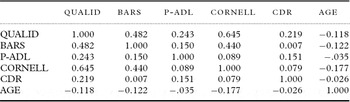
PS02.110
Quality of life and depression in nursing home patients with dementia
Marit Mjørud, Norwegian Center for Dementia Research, Oslo, Norway
K Engedal, Norwegian Centre for Ageing and Health, Oslo UniversityHhospital, Oslo, Norway
Background: Quality of life (QoL) is an established outcome measure for people with dementia. In order to develop interventions to improve QoL in people living in nursing homes, we need to investigate which clinical factors predict changes in QoL. Previous research has found an association between QoL and depression in non-demented patients as well as patients with mild dementia. It is reasonable to assume there is also a strong connection between quality of life and depression/depressive symptoms among nursing home patients with moderate and severe degree of dementia. However, this can be difficult to prove as patients with moderate, and especially severe dementia will have difficulties in expressing both their opinion about quality of life and feeling of sad mood. In this situation we often have to rely on proxy information.
Objectives: The aim of this study is to compare quality of life and depressive symptoms and investigate whether gender, age, degree of dementia, physical disability and aggression influence on this comparison. Method The study has a cross sectional design. Data was collected in January 2011 from 17 different nursing homes, and include 695 patients with scores between 0 and 3 on the Clinical Dementia Rating scale (CDR). The Quality of Life in Late-Stage Dementia (QUALID) Scale was used to measure quality of life, the Cornell scale for depression in dementia (Cornell) was used to measure depression and Physical self-maintenance scale (P-ADL) was used to measure ADL. The Brief agitation rating scale (BARS) was used to measure agitation. Demographic characteristics were collected form the patients records.
Results: The preliminary analysis includes 428 patients. 302 (70,6 %) were women. The patients had a mean age of 86 (SD = 8.2) years, range 47–105. Mean Cornell score was 7,9 (SD = 5,4), range 0–28. Mean QUALID score was 22,0 (SD = 7,1), range 11–47. Mean BARS score were 20,2 (SD = 9.9). Mean P-ADL score was 18,6 (SD = 5,1). 12 patients scored 0 (2,8%) at CDR, 18 (4,2 %) scored 0,5, 38 (8,9%) scored 1, 152 (35,5%) scored 2 and 208 (48,6%) scored 3 at the CDR. In a correlation analysis the highest correlation was found between QUALID score and Cornell scale score 0.645. See table for all correlations.
Conclusion: Quality of life in nursing home patients are affected by degree of depression, impairment in activities of daily living and degree of agitation.
PS02.111
End-of-life care for people with dementia living in a care home
Eleanor Taylor, University College London, London, United Kingdom
C Pitfield, UCL, Battersea, London, United Kingdom
H Jacobs, Jewish Care, London, United Kingdom
J Morris, Faculty of health Sciences, London, United Kingdom
G Livingstone, UCL, London, United Kingdom
End-of-life care for people with dementia living in a care home Dementia is associated with a variable but shortened life expectancy meaning death may occur unexpectedly or without end of life care being planned. While many people with dementia and their relatives would prefer them to receive palliative and non-intrusive interventions, if possible at home, rather than in hospital, this decision has not been made explicit for most people with advanced dementia before death. Thus hospital transfers are common near the end of life. Planning for end of life care in advanced dementia, particularly in care homes, is an area which requires further development. At present there are no interventions in this field which have either decreased inappropriate interventions or improved family satisfaction or psychological health. The project therefore aimed to put in place and evaluate an intervention for staff to enable relatives to plan end-of-life care for people with dementia living in care homes. We interviewed staff, residents and relatives before and after a 10 session educational intervention aimed at teaching staff through problem and case based learning about making advance written end of life care plans for people with dementia by consulting with family and the resident as far as possible. We aimed to evaluate its implementation and effectiveness for the residents, relatives and staff. This presentation reports on staff attitudes, knowledge and psychological health. We aimed to ascertain if the intervention increased staff ability to discuss end of life care and lead to more effective care giving. We also aimed to look if the intervention increased the quality of life and care for the residents receiving end-of-life care and their families. Participants were all from a 120-bed North London nursing home. Staff complete a General Health Questionnaire (GHQ28), a Job Content Survey (JCQ) and a qualitative interview to explore staff's feelings around end of life care and current practice around end of life in the home. Topics covered in the qualitative interview included: decision making, communication, support, staff beliefs around death and dying, training and current practice. The qualitative interview also explored staff's confidence and satisfaction with end of life practice. Pre-intervention interviews found barriers to a successful intervention included; care staff, nurses and doctors did not see themselves as a team and communicated poorly with relatives about approaching death, often thinking it was the job of someone who was more senior in the hierarchy. Staff used opaque euphemisms and worried about being blamed for messages about residents impending death so did not give them and being vulnerable as foreigners. They were often unaware of the existence or had concerns about validity of advance care plans about whether earlier decisions around end of life for people with dementia would be invalidated by relatives changing their minds and therefore did not implement them. They knew of the religious rituals around death, but frequently misunderstood religious tradition and ideas .14% of staff scored on the GHQ as being likely to have significant psychological symptoms. Staff were slightly more satisfied with their jobs than their American counterparts but reported higher psychological job demands. We are now in the process of the post-training evaluation to ascertain whether the training changes attitudes and increases support and control and decreases demand. The staff GHQ-28 will also be compared pre- and post intervention
PS02.112
Impact on residents with mild dementia of frequent death in aged care facilities
Daniel O'Connor, H Tan, T Howard,
M O'Connor,
Monash University, Cheltenham, Victoria, Australia
B Workman, Cheltenham, Victoria, Australia
Background: Residents in aged care facilities are exposed to death more frequently than people living in the general community. While the effects of frequent deaths on staff are well documented little is known about the effects on residents, particularly those residents with dementia.
Aims: This project aimed to investigate the impact of frequent deaths on residents with mild dementia living in aged care facilities, particularly in relation to grief and depression. Methods: Residents with psychogeriatric assessment scale scores (PAS) of between 4–9, and facility staff, were recruited from three residential aged care facilities. Interviews were conducted with 23 residents about their experience of grief and loss due to deaths of fellow residents. Twenty five staff were interviewed about their perceptions of the impact of deaths on both themselves and the residents. Interview responses were thematically analysed using NVivo.
Results: There was evidence of depression and grief in the residents; however there was little evidence that deaths of other residents were significantly impacting on them. More importantly, loss of lifestyle in the transition from home to residential aged care and previous deaths of family members were the reasons for grief cited by both staff and residents. There was also evidence of poor socialisation in many of the residents.
Discussion: The most unexpected outcome was the mismatch between resident and staff views on the impact of deaths. In addition there seemed less than ideal communication and acknowledgement of deaths to residents, perhaps due to a higher level of death anxiety in the staff compared to the residents. These issues have been further developed as foundational evidence for a staff education program.
PS02.113
Quality improvement in palliative dementia care
Jasper Riet Papp, M Vernooij-Dassen
Radboud University Medical Centre, Nijmegen, Netherlands
Y Engels
It is an intriguing question why available knowledge on palliative dementia care is not used, even when there is evidence of its effectiveness in helping to solve problems. Implementation research has developed models for stepwise implementation but it is still unclear which strategies are effective in what kind of situations and which factors influence the effectiveness of implementation strategies. A first step in the implementation process is to translate evidence and best practices into quality indicators. In this presentation this first step in the implementation process will be described: the development and validation of quality indicators in palliative care for cancer and dementia patients. These quality indicators are the base of the European IMPACT project (IMplementation of quality indicators in PAlliative Care sTudy) (2011–2015). In February 2011 we started this 7th framework project, with partners from 10 European countries, and in cooperation with an expert in Australia. Unique in this project is the focus on both cancer and dementia. Moreover, the project group represents all relevant professionals that are involved in palliative care for these patient groups: GP, nurse, medical oncologist, psychiatrist, social worker, psychologist, sociologist, researcher, radiotherapist etc. Two international networks will join their expertise and efforts in this study: the pan-European research group on detection and timely INTERvention in DEMentia (Interdem) network and the European Association of Palliative Care (EAPC) network. The quality indicators relate to all settings involved in palliative care: community care, hospices and inpatient care. The development of the quality indicators for psychosocial dementia care and for palliative cancer care included the use of a modified RAND Delphi procedure with experts to reach consensus on a set of quality indicators. Regarding dementia care, a retrospective cohort study using medical records was also conducted to study the feasibility. For dementia care 27 quality indicators have been selected, for palliative cancer care 67. Examples of quality indicators for palliative cancer care are: • All health and social care professionals should have standardized learning objectives for continuing basic training in palliative care (education and training). • The following treatments should be available for a palliative patient 24 hours a day, 7 days a week: Opioids and other controlled drug (all settings). • Family members and friends should be able to visit the dying patient without restrictions of visiting hours (caregivers, inpatient settings). Examples of quality indicators for psychosocial dementia care are: • The diagnosis of dementia should be discussed with the person with dementia (diagnosis). • The patient file should include information on: life history, social and family circumstances and needs and preferences (inpatient settings). • Caregivers of people with dementia should be offered: respite or short-break care and other psychosocial interventions, tailored to their needs and preferences.(community care and caregivers). Making one set of quality indicators developed for two diseases offers the opportunity to benefit from the knowledge gained in two fields that are segregated until now, but that have a lot in common. Next steps in the IMPACT study will be the stimulation of the implementation process by concentration on: the organization of palliative care, the development of a set of setting-specific implementation strategies including an interactive website, the evaluation of the use of the selected strategies to implement quality indicators with regard to adherence to the quality indicators, factors influencing the effectiveness of the implementation strategies. The final aim of IMPACT is to develop optimal strategies for implementing quality indicators to improve the organization of palliative cancer and dementia care in Europe. These strategies should be applicable across diverse healthcare settings.
PS02.114
Spiritual end-of-life care in nursing homes: An exploratory study among physicians
Marie-José Gijsberts, EMGO+ VU Medical Center, Amsterdam, Noord Holland, The Netherlands
J Van Der Steen; C Hertogh; L Deliens, M Muller,
VU University Medical Center, Amsterdam, The Netherlands
M Echteld, Erasmus MC, Rotterdam, The Netherlands
Objective: The aim of this study is to explore how Dutch physicians conceive spirituality at the end of life and their role in spiritual care giving in nursing homes, their perceptions of if and how they coordinate spiritual care giving, whether and how they collaborate with other caregivers, and to identify possible barriers and facilitators of spiritual care giving by elderly care physicians.
Method: A focus group study was conducted among Dutch elderly care physicians, because of its suitability to explore the complex and understudied area of physicians’ perceptions of spirituality and spiritual care giving. Three focus group discussions were conducted, with six to eight individual physicians participating in a single group discussion, to allow for sufficient variability in perceptions. The transcripts of the focus group discussions were analyzed qualitatively and coded by two researchers independently (MJG, MTM). The process of analyzing incorporated an iterative process of reading and rereading the transcript to code the transcript and identify emergent themes.
Results: The following themes emerged: Spirituality, the role of the physician in spiritual care giving, spiritual care in dementia, the importance of rituals and tokens in spiritual needs, and the role of the physicians’ spirituality, In this study the physicians’ concept of spirituality was primarily limited to religious aspects. Participants mentioned several aspects related to spiritual wellbeing, such as peace, readiness to die and comfort. Many participating physicians did not consider spiritual care giving at the end of life their responsibility and stated this explicitly. This was related to a barrier in spiritual care giving: lack of time and lack of competence. Some physicians however considered the assessment of spiritual needs as a part of their professional responsibility. Spiritual care giving in dementia was considered to be difficult, because of the impossibility of (verbal) communication with the residents. Religious rituals, and the participation in them by residents (including residents suffering from dementia) was considered to be an accessible and supporting way in relieving spiritual needs, such as in completion of life, the acceptance of death and to promote a peaceful end of life. Some physicians were very explicit about their own spirituality, and its effects on clinical work and interaction with nursing home residents. The spirituality of the physician sometimes appeared to be helpful, but could also be a barrier in the communication with the residents. Other topics that emerged from the study were: the multidisciplinary nature of spiritual care giving, the role of the nurse and their importance in assessing spiritual needs and the role of the pastor, social workers and psychologists in providing spiritual care.
Discussion: Although the elderly care physicians initially limited their association of spirituality to religion, when invited to talk about spiritual wellbeing, they mentioned the full breadth of the concept of spiritual wellbeing as reported in recent literature. To improve patient care, residents’ spiritual wellbeing may need to be brought more directly to the attention of physicians. The barrier in spiritual care giving: lack of time and lack of competence is concurrent with a qualitative US physician group study by Chibnall et al., that identified the same barriers in psychosocial and spiritual care giving by physicians. Our results also contain descriptions in which the participating elderly care physicians exemplified that they did not have the tendency to avoid psychosocial and spiritual issues. Schols et al contrasted the position of on-staff elderly care physicians in Dutch nursing homes with the situation inmost of the western countries, including the United States and other European countries, in which medical care is provided by family care physicians or by consulting of medical specialists. This exceptional medical situation in Dutch nursing homes was underlined in an article by Conroy et al., which compared the medical services in Dutch and English nursing homes. Hence, these elderly care physicians are responsible for care planning and palliative care giving, including spiritual care giving and eventually referral more specialized care givers, e.g. chaplains or other spiritual counsellors. After their residency, elderly care physicians in the Netherlands take a three year vocational training to prepare for their clinical practice ina nursing homes. The specific training and tenure of physicians may help address psychosocial and spiritual issues, which are important issues in end of life care.
PS02.116
Effect of cognitive training with reading aloud and simple arithmetic on transfer of cognitive function
Hajime Yoshida, Ritsumeikan University, Kyoto, Japan
Q Sun
I Ohkawa
N Tsuchida, Letters, Kyoto, Japan
K Furuhashi
N Takahashi
M Ishikawa
M Miyata
Y Sakaguchi
M Yoshimura
Previous studies failed to indicate cognitive training on transfer of cognitive function. Many studies trained memory function such as episode memory or working memory. Although they showed direct effect on trained function, they did not indicate transfer effect (Ball et al., 2000; Craik et al., 2007). However, some studies have pointed to two specific elements of engagement that might be responsible for cognitive gains: complex video game and multi-modal stimulation. Basak et al. (2008) presented evidence that performing complex video game would be responsible for improved performance on such tasks as fact recall or word recall. Noice and Noice (2009) trained the theatre instruction over four weeks, and found that acting group improved significantly from pretest to post test in word recall, pose comprehension, digit-span ability, and problem-solving. Due to greater increase of baby boomer, expectation to cognitive training would be stronger than now. However, tasks like theatre instruction or performance of complex video game need much effort and then might not be suitable for almost all of old adults. This kind of constraint would make training over long period hard. So, cognitive training which any person performs without difficulty would be expected. The purpose of this study was to examine cognitive training with reading aloud and simple arithmetic on transfer effect of memory and inhibition. Such cognitive training was proposed by Kawashima et al. (2005) who showed that the intervention group by reading aloud and simple arithmetic kept similar scores in MMSE after one year although the control one indicated significant decrease in the same period. However, this research has some weak points. The first was to use the aged with dementia as subjects. Previous studies suggested that even trained function would disappear after ending the training in these people. So, to assess transfer effect it is necessary to train not non-dementia or MCI but health old adults. The second was measures in their research. Kawashima et al. (2005) measured MMSE, which is fairly general cognitive function. To assess transfer effect, we need to use other critical measures such as working memory and inhibition. Participants in the present research were 103 community-dwelling volunteers between 61 and 84 years old, Kyoto, Japan. Forty eight participants were assigned to the learning group, and fifth one was done to the control group, respectively. There were no differences between the learning and control groups in age, year of education, and scores of MMSE. Learning task. Simple arithmetic and Japanese language sentences were used as the materials in the training program. We prepared a wide variety of materials, which were used for everyday learning from 3-year-old children to fourth grade elementary school students. Study design. Each person participated training sessions for about one and half years. They are given cognitive tests (short-term memory, working memory, stroop test, and SRC task) on four times; pre-test, after about six and twelve months, and post-test. Training. Each participant was given materials on reading aloud and simple arithmetic like addition and subtraction with one or two digits in a room of Ritsumeikan University. In the task of reading aloud, he or she read aloud sentences written on three or four A4 sheets of papers. In the arithmetic task, they answered each ten problems written on four or five A4 sheets of papers. They were given positive feedback after completing each task. Training session was about 20 minutes for each person. The session was held once a week, and participants were given homework of three days. Training lasted one and half years. The control group was given tests same to the training one at the similar time. Results and Discussion. As results of ANOVA to each test, the obtained results were fairly similar across four one; All interaction between group and test time were significant over level of 5 %. These significant interactions indicated that training group indicated significant increase over one and half years except SRC task. In addition, the control group showed significant decrease over years in all tasks. These results suggested that cognitive training with reading aloud and performing simple arithmetic produced strong transfer effect in cognitive function for health older adults.
PS02.117
Is ‘RedUSing’ antipsychotic and benzodiazepine use in nursing homes sustainable: A 12-month follow-up of an intervention trial
Juanita Westbury, G Peterson, S Jackson
University of Tasmania, Hobart, Tasmania, Australia
L Tichelaar, University of Groningen, Groningen, The Netherlands
Background: ‘Reducing Use of Sedatives’ (RedUSe) was a controlled trial conducted in 25 nursing homes for 6 months throughout 2008–9. Thirteen nursing homes participated as the intervention group and twelve homes participated as the control group. Nursing homes in the intervention group received a series of strategies, including audit and feedback, nursing staff education and a dedicated psychotropic review; which led to a significant reduction in the prevalence and a significant increase in the number of dose reductions of antipsychotics and benzodiazepines. Aim: To assess the long-term impact of the ‘RedUSe’ project on antipsychotic and benzodiazepine prevalence and dosage.
Methods: Data on antipsychotic and benzodiazepine prevalence at each of the participant nursing homes was collected 12 months after the RedUSe project was completed. Mean doses were calculated by converting daily doses of antipsychotics and benzodiazepines to mean chlorpromazine and diazepam equivalents. The psychotropic prevalence rates and mean daily dosage equivalence of antipsychotics and benzodiazepines at the 12-month follow-up measure were calculated, grouped and then statistically analyzed. This data was then compared to data collected from these nursing homes at baseline and trial endpoint. Antipsychotic and benzodiazepine prevalence and mean daily dosage equivalence outcomes over the 3 data collection periods (baseline, trial endpoint and 12-month follow-up) were analysed using two-way (group and time) repeated measures analyses of variance (R-ANOVA), with post-hoc analyses to examine any significant differences across individual time points.
Results: A total of 1578 residents from the 25 participant nursing homes were audited for the 12-month follow-up measure. Overall, when comparing baseline to the follow-up measure, the prevalence of benzodiazepine use and mean daily diazepam equivalence in intervention nursing homes decreased by 25% and 24%, respectively. [benzodiazepine prevalence: 32.8%(baseline) to 23.9%(12-month follow-up)]. However, neither benzodiazepine prevalence, nor mean daily diazepam equivalence altered significantly in control nursing homes over the same period of time. The antipsychotic prevalence rate in the intervention nursing homes returned to baseline level by the 12-month follow-up following an initial decrease in usage throughout the RedUSe trial. [antipsychotic prevalence: 20.3%(baseline) to 20.0%(12-month follow-up)]. In control homes, antipsychotic use increased slightly throughout the trial period but then decreased significantly during the 12 months following the RedUSe project. The mean daily chlorpromazine equivalence in intervention homes remained relatively constant across all three data collection points. However, mean daily chlorpromazine equivalence in control nursing homes rose markedly in the 12 months following the RedUSe project. Discussion: The effect of the RedUSe intervention on the prevalence of benzodiazepine use was sustained 12 months post-intervention. In contrast, the effect of the RedUSe intervention on antipsychotic prevalence was not sustained with prevalence rates returning to pre-trial levels. It appears that dosages of benzodiazepines in intervention nursing homes continued to be reduced the year following the RedUSe intervention. One of the main educational messages of the RedUSe project was to gradually reduce psychotropic doses with the aim of tapering off use so it was pleasing to see that a reduction in dosing was still occurring in the absence of active intervention strategies. The rate of benzodiazepine and antipsychotic use declined in control homes the year following RedUSe; which could possibly be due to media attention associated with the RedUSe trial, and active promotion of appropriate psychotropic use by health educators in the control location.
Conclusion: In the twelve months following the RedUSe project, benzodiazepine prevalence and mean daily diazepam equivalence continued to decline in intervention nursing homes, resulting in an overall reduction of 25% from baseline in both values. However, the effect of the RedUSe intervention on antipsychotic prevalence and dosage was not sustained. Continual intervention strategies are needed to help nursing homes maintain low rates of antipsychotic use or reduce antipsychotic use further.

PS02.118
Skills training and re-skilling for carers of people with dementia: A European lifelong learning project delivering online training in dementia care
Henriëtte Van Der Roest; R Dröes,VU University Medical Center, Amsterdam, The Netherlands
J Bengtsson, Cogknow Ltd, Hamrun, Malta
A Giuliano, AcrossLimits Ltd, Hamrun, Malta
S Stefanescu, Synopsismedia, Timisoara, Timis, Romania
R González, Vilau, Zamudio, Basque Countries, Spain
P Kingston, Staffordshire University, Stafford, United Kingdom
E Tamburini, Florence, Tuscany, Italy
C Nugent, University of Ulster, Ireland
Background: The European Union (EU) faces challenges in relation to its demographic future. Currently the esti-mated number of people with dementia in the EU is 10 million, and it is predicted that this number will increase to 14 million in the next 20 years. People with dementia are being cared for by informal car-ers, who are often elderly people with limited resources. They care for their loved ones at home to the best of their ability, with varying levels of financial and professional support. In some countries carer support is well developed, consisting of accessible services, allowances and care structures, however in other countries it is virtually inexistent. The EU population is decreasing, and in 2006, for the first time in post war history, births did not outnumber people that had died. Thus, the EU faces a future with more people with dementia and relatively less professional carers to provide support. After being diagnosed with dementia, many families try to care for their relative in their own home as long as possible. Healthcare policies in many EU countries also aim to keep people with dementia in their own homes for as long as possible. Since many relatives do not have the time, or resources to commit to full time care of the person with dementia, in some countries low-cost carers from other countries are hired to provide 24/7 support. Elsewhere relatives provide the care for persons with de-mentia and are eventually formally paid by care services to do so. Nevertheless, whether a relative, temporary staff, staff with a different language background or newly employed social care staff, all face the challenge of trying to gain an appreciation of how to best provide care to persons with dementia.
Aim: To improve the quality of care for community dwelling people with dementia, carers should be properly skilled. The ‘Skills Training and Re-skilling for Carers of People with Dementia’ (STAR) project aims to address this issue by developing, providing and evaluating online training in several European coun-tries for anyone caring for a person with dementia.
Method: The STAR project focuses on creating content and a methodology that will be distributed via an e-learning portal accessible via the Internet, TV and smart mobile phones to carers of people with de-mentia. This solution will assist carers to not only up-skill their vocational training by participating in courses and for example by learning from educational videos on caring for people with dementia, it will also facilitate communication between carers in online communities facilitated by STAR. The key value of STAR is that it aims to maximize the availability of training and information provision through sup-porting a mix of platforms and content adapted to the languages and situation in each country. Within the STAR project the first task relates to an analysis of the state of the art regarding existing educational materials. Following this a methodology will be developed that will aim to make existing and newly developed content more accessible for users, by focusing on short and simple modules. The materials will be developed in a multimedia style, making them applicable for digital television, the Internet and mobile phones. After implementation of the methodology and content, the e-learning por-tal will be evaluated in a user pilot starting in September 2012. Volunteer carers, or people who wish to equip themselves with skills from four countries (Italy, the Netherlands, Sweden and the United King-dom) to be able to work in this challenging new employment area, will be recruited to utilise the system for a period of at least nine months. Their experiences with the system will be recorded by means of (online) semi-structured interviews and tests. Results The consortium will analyse the collected data during the pilot, and finalise the adaptation of the mate-rials in preparation of a public EU-wide launch of the platform. Thanks to partners that already offer vocational training in healthcare, certification may be provided to carers when successfully passing examination of their knowledge.
Conclusion: The platform to be developed by the STAR project intends to provide opportunities for education, col-laboration, discussion and sharing experiences between users (carers of people with dementia), while supported by dementia experts from all over the EU. Experts from all countries are welcome to join the pan-European expert network at www.startraining.eu that will support the national communities. The project started in December 2010 and will finish in November 2013.
PS02.119
Using theatre to explore long-term care home health care provider needs
Lisa VanBussel, Regional Mental Health Care London, London, Ontario, Canada
I Gutmanis; A Jarvie, St. Joseph's Health Care London, London, Ontario, Canada
M Speechley, University of Western Ontario, London, Ontario, Canada
R DeForge, The University of Western Ontario, London, Ontario, Canada
Background: Providing optimal care for long-term care home (LTCH) residents with responsive behaviours is challenging. The literature suggests that, in Ontario, LTCH healthcare providers (HCPs) who care for residents with responsive behaviours are especially concerned about the accessibility and availability of external resources, notably during crisis situations. To mitigate this situation, many Ontario LTCH HCPs regularly receive training designed to increase their awareness of such resources as well as their knowledge base. Yet, the frequency of reported responsive behaviors has not decreased. Although a large body of literature exists on how to best care for older adults living in LTCHs with responsive behaviours, there is limited information on the front-line HCP perspective. To gain insight into this perspective and to help develop better knowledge exchange (KE) initiatives, from June to November 2008, 106 front-line staff from 12 LTCHs participated in 18 audio-taped focus groups. Data were transcribed verbatim and, using guidelines suggested by Krueger (1998) and a thematic approach, six themes were identified (place, organizational structure, relationships, consequences, information/ communication/technology, and resources). These themes and the verbatim responses were used to develop a short (25 minute) play, All Behaviour Has Meaning. Study Goals The goals of this subsequent study, “Using Theatre to Explore Long-Term Care Home Healthcare Provider Needs,” were to investigate the use of theatre as a knowledge exchange strategy and to provide a venue for LTCH interdisciplinary team development and discussion. Methods: The first draft of All Behaviour Has Meaning was reviewed by the study investigators and front-line HCPs for content validity. Subsequently, the play was read by actors to the study investigators, revised further, and then rehearsed with actors. Concurrently, a facilitation guide designed to promote critical reflection was developed. The combination of the play and a facilitator guided discussion were then field-tested at two sites (a LTCH that did not participate in the parent study (LTCH group) and at a rehabilitation hospital among staff who regularly consult with front-line LTCH HCPs (tertiary care group)). Focus groups were conducted following the play and facilitated discussion. Observations, recorded by three field observers, were collated and an iterative approach was used to identify themes. The study was approved by the Research Ethics Board at The University of Western Ontario.
Results: At the LTCH test site, nine people (two managers, two registered staff and five non-registered staff) saw the play and participated in the facilitated discussion (30 minutes) as well as the focus group (30 minutes). Participants indicated that their daily lived experiences were well represented by the actors and their script. When asked about their emotional reaction to the presentation, one participant indicated, “it's difficult working in this field” partially because of the “constant change.” Another participant asked, “How do you manage your anger and frustration?” Also, it appeared that the play had the effect of illuminating for participants some taken-for-granted practices: when asked if the play had changed their thinking, one participant indicated “This [play] brings you out of the routine – brings you to the heart and centre.” Another stated: “This needs to be done [i.e., performed] home wide – on each unit.” The tertiary care group, which consisted of six clinicians, two administrators and one scientist, further verified that the play accurately depicted the lived experiences of LTCH HCPs. As one participant said, “the play gets at points that many care providers face every day – they're frustrated.” When asked if the play had changed their thinking, one participant indicated (and others agreed) that the play highlights the “need for purposeful meetings” that address the challenging issues faced by LTCH HCPs. Discussion The field-testing of the play and the facilitated discussion suggests that its characters and content closely reflect the lived experiences of those working in LTCHs. The combination of the play and facilitated discussion created space for critical reflection and validation. Few participants mentioned lack of knowledge as a barrier to optimal care provision, but pointed instead toward organizational structures and processes that limit collaboration among care providers.
Conclusions/Next Steps: Overall, we found that using theatre as a mechanism for KE with LTCH staff particularly fruitful and worthy of continued investigation, particularly as it relates to generating the conditions for improvements to work and residential life in LTCHs. The play provides LTCH HCPs behaviors to model and so may promote actual change. Results also suggest that strategies need to be targeted to the audience. It is hoped that the play will be videotaped and the CD and the facilitator guide shared with LTCHs across the province.
PS02.120
Sex differences in schizophrenia risk across the age span: An individual participant meta-analysis of 117,000 incident cases
Manon Hanssen, S Köhler, F Verhey, R Van Winkel, J Allardyce, M Van Der Werf,
Maastricht University Medical Centre, Maastricht, The Netherlands
M Verkaaik, Regional Centre for Ambulant Mental Health Maastricht, Maastricht, The Netherlands
J Van Os, Maastricht University Medical Centre, Maastricht, The Netherlands and Kings College, Denmark Hill, London, United Kingdom
Context: Understanding the developmental timing of schizophrenia onset and its window of sex disparity may help to characterize underlying processes of vulnerability. The sex differences in schizophrenia onset suggests oestrogen-protective factors in women. However, studies show that environmental, social and premorbid neurodevelopmental factors also could influence the different men-women onset peak in schizophrenia. And finally, the observed men-women differences of schizophrenia expression may be secondary to methodological artifact such as criterion or sample bias. Hence, the extent to which sex differences in timing of schizophrenia onset are inherent to the disorder remains unclear.
Objective: To quantify schizophrenia incidence by age and sex using a comprehensive systematic review and individual participant meta-analysis
Data sources and study selection: PUBMED, EMBASE and PsychINFO databases were searched between January 1950 and December 2009. Schizophrenia incidence studies that covered a broad age span were included. Data extraction Numerator and population data were extracted by age, sex and, if possible, study period. Original data was requested from the authors in case of insufficient availability of data to calculate age- and sex-specific incidence rates. Forty-three independent samples met inclusion criteria, yielding 117,645 incident cases of schizophrenia for analysis.
Data synthesis: Incidence rate ratios (IRR) with their 95% confidence intervals (CI) were computed by age and sex from negative binomial regression models. Men had a 1.2-fold (95%CI: 1.02–1.35) greater risk of schizophrenia than women. For men incidence peaked at age 20–29 years (IRR: 2.37, 95%CI: 1.65–3.40). Women showed a peak at age 20–29 years (IRR: 2.08, 95%CI: 1.52–2.84) and 30–39 years (IRR: 2.01, 95%CI: 1.42–2.85). This peak was followed by an age-incidence decline up to age 60 that was stronger in men than in women (χ2 = 50.8; P
Conclusions: Robust sex-differences exist in the distribution of risk for schizophrenia across the age span, suggesting that men and women have different susceptibility to schizophrenia at different stages of life. The finding of an absence of a second risk peak in women at menopausal age questions the dominating view on the role of estrogen in the pathofysiology of sex-differences in the age distribution of schizophrenia in later life. The reduction in hypothesized estrogenic protective effects would be expected to impact psychosis expression close to the menopause rather than well beyond this period. Taken together, although estrogen may impart sex differences throughout life it is unlikely that the estrogen hypothesis can account for the marked sex differences and the relatively high proportion of women with onset of schizophrenia in late life. Instead, other risk or protective factors may be at work. The onset in later life may represent a final common pathway of various disease processes of different etiology including hormonal changes, differential exposure to risk and possibly neurodegenerative conditions in very old age. In conclusion, this study offers an unique opportunity to study the risk distribution by age and sex more accurately and sets the black box open to new hypotheses of the origin of schizophrenia.
PS02.121
Trials and tribulations of treatment resistant psychosis in the elderly: A case series
Carmelle Peisah, University New South Wales, Sydney, New South Wales, Australia
S Reutens, Bankstown Hospital, Justice Health, Sydney, New South Wales, Australia
Background: Psychosis in later life is a heterogenous condition surrounded by several nosological controversies regarding its relationship to schizophrenia.[1] A confluence of factors associated with ageing, such as vulnerability to the adverse effects of medications, somatic co-morbidities and social and functional disability, conspire to present a number of treatment challenges in this setting. Thus, treatment resistance (referring to patients whose positive symptoms of schizophrenia have not responded to treatment- usually involving two trials of medications at adequate dose and adherence) [2] is not uncommon. Yet, the options for dealing with treatment resistance in older people with psychosis have not been well-studied.
Methods: A descriptive case series of consecutive patients with treatment resistant psychosis in older life admitted to a psychogeriatric inpatient unit serving a culturally and linguistically diverse catchment area in Sydney, Australia, will be presented. Modes of treatment (including non-pharmacological and pharmacological options), comorbidities, complications and outcome will be reported. A video presentation of a case of an older woman with early- onset schizophrenia, Parksinson's disease and Madopar-induced psychosis treated with Clozapine and bilateral ECT will highlight these issues.
Results: Presentations were often florid and associated with risk conferred by suicide attempts and violence directed to others, sometimes to partner. Non-English speaking backgrounds complicated assessments. Initial management with emergency sedation was often required. Treatment-resistance occurred in a range of contexts, including early and late-onset schizophrenia, dopa-induced psychosis and alcohol hallucinosis/delusional disorder. Treatment options ranged from second generation antipsychotics, ECT, depot medication and Clozapine, with simultaneous support for hydration and nutrition, prophylaxis for venous thrombosis/embolism and family therapy. Although a minority were single with no offspring, in most cases complex family issues relating to having a parent or spouse with a long– term mental illness needed to be addressed. These included supporting over- parentified single children, multi-sibships in conflict and facilitating rapproachement with alienated children. Treatment complications included Q-T prolongation on ECG, falls, hypotension, extrapyramidal symptoms, hyponatreamia, sedation and aspiration. Consultant geriatric input or co-management was often required. Neuropsychological testing, risk, capacity/consent and functional assessment guided placement decisions. Most patients improved with treatment but the time course to recovery was protracted, residual impairments were common and many required residential placement. Risk assessment was often factored into decisions regarding placement, and although decision-making capacity in regards to accommodation and finances was often borderline or compromised, facilitated or assisted decision-making was encouraged where possible.
Conclusions: Trials of different medications, use of clozapine and ECT and significant medical co-morbidity are to be expected in treating patients with late-onset psychosis. Treatment intolerance in one shape or form is the norm and probably leads to “treatment resistance”. While recourse to therapeutic nihilism would be not unexpected, this case series suggests that symptomatic improvement is the rule rather than the exception. Clearly, more empirical work on the management of such patients is needed to formulate treatment guidelines in this area. References [1] Hassett, A., Ames D.,M Chiu E. (2005) Psychosis in the elderly Taylor &Francis: Abingdon. [2] Pantelis C., Lambert TJR. (2003) Managing patients with “treatment-resistant” schizophrenia Medical Journal Australia. 178 (9 Suppl); s62-s66.
PS02.122
Individualized music – an implementation program
Audun Myskja, GAMUT, Ski, Akershus, Norway
Introduction: Individualized music is a method based on assessment of personal music preference in nursing home residents followed by implementation of pre-recorded music programs played daily, supplemented by singing based on preference assessment tailored to the individual's preferences and needs. The method individualized music has been delineated by Linda Gerdner (Gerdner, 2000) and other researchers (Tang & Vezeau, 2010) from the early 90's. It has been specified and empirically tested in the PhD “Integrated music in nursing homes – an approach to dementia care” (Myskja, 2011). Individualized music has especially shown promise in agitation among nursing home residents. Two dementia wards in a Norwegian nursing home have been extensively educated in the method, applied it over time specifically on general and procedure-related agitation. Due to the general success of the development of this method, a teaching program within a municipal region in another part of Norway was instigated. The project aim was to implement and evaluate effects of the method individualized music and its perceived effect during a one year period.
Method: The implementation program included teaching, both nursing students and nurses'aide students were given to times three hours general teaching program, followed by hands-on education in the wards of the five nursing homes in the regions (n = 468). Staff in nursing homes was also taught through a short teaching program and hands-on teaching. These students applied the method on agitated residents measured by 24-hours agitation sheets. A control group with agitation was not given individualized music, but general attention during the same time period through conversation and games.
Results: The method individualized music reduced baseline of 3.4 hours/24 hours to 1.1 hours compared with 3.3 hours/24 hours to 3.1 hour in the control group, p < 0.05. Qualitative analysis based on observational studies, interviews and videotaping, showed that the method was easy to learn for students and with a minimum of guidance was transposed into clinical skills in the meeting with patients. Students also made independent observations, contributing to development of method, for instance evaluating the correct use of music and media in living-rooms with several residents. International guidelines indicate that psychosocial treatment strategies should be the primary treatment for symptoms of dementia.
Conclusion: There is today no consensus in the form of application of psychosocial strategies. Individualized music as a concrete expression of a psychosocial strategy has shown itself to be consistent, practicable, effective, cheap and simple to use pro integration with medical treatment and other psychosocial strategies and with a high level of patient staff and family satisfaction. Gerdner, L. A. (2000). Effects of individualized versus classical “relaxation” music on the frequency of agitation in elderly persons with Alzheimer's disease and related disorders. International Psychogeriatrics, 12(1), 49–65. Myskja, A. (2011). Integrated music in mursing homes – an approach to dementia care. Unpublished Monograph, University of Bergen, Bergen. Tang, H. Y. J., & Vezeau, T. (2010). The Use of Music Intervention in Healthcare Research: A Narrative Review of the Literature. Journal of Nursing Research, 18(3), 174.
PS02.123
Strategies for improving communication with individuals of Alzheimer's disease who have hearing difficulty
Kiyoko Iibosh, F Ohmorii,
Kyushu University of Health and Welfare, Nobeoka City, Miyazaki Prefecture, Japan
T Igakura, Kagoshima-shi, Kagoshima-ken, Japan
M Bourgeois, The Ohio State University, Columbus, Ohio, United States
M Mimura, Keio University, Tokyo, Japan
Approximately 70–90% of individuals with dementia are estimated to have hearing problems. Hearing difficulty hinders dementia individual's daily communication in the course of medical treatment, rehabilitation and care activities. However, only a few studies have investigated strategies for improving communication with individuals of dementia who have hearing difficulty.
Objective: This study explored characteristics of communication problems of patients with Alzheimer's disease (AD) who have hearing difficulty, and proposed strategies for improving communication with such individuals. Participants The participants included 75 individuals (54 women) who were diagnosed with probable AD according to the criteria of NINCDS-ADRDA. Their mean age was 83.0 (+/−8.0)years, and mean MMSE score was 16.1 (+/−5.5).
Method: 1) Auditory test: Applying hearing thresholds at 0.5 kHz, 1 kHzand 2 kHz by using the audiometer (MADSEN MIDIMATE 602), the participants were classified into four groups of different pure-tone average: i.e., “normal” less than 25 dBHL, “mild” impairment 26–40 dBHL, “moderate” impairment 41–60 dBHL and “severe” impairment 61–80 dB HL. We found no significant difference in MMSE scores among the four groups. 2) Language test: The participants were given the communication screening test (Iiboshi et al., 2007), which was comprised of four aspects of language (auditory comprehension, reading comprehension, speech and writing). 3) Word recognition test: The participants were given the word recognition test, which included 20 words from the list of 67-S words (Japan Audiology Society, 2000). A speech therapist (ST) spoke words in a normal tone, had the participants listen to these words and repeat them. Each participant listened to the words in two different ways, i.e., with watching or without watching the ST's mouth movements during speech.
Results: 1) The two-way (4 levels of hearing difficulty; normal, mild, moderate or severe x 4 aspects of language; auditory comprehension, reading comprehension, speech or writing) ANOVAs showed main effect of language aspects [F(3,69)=21.17, p = .00]. In addition, an interaction between the levels of hearing difficulty and the aspects of language was also significant [F(3,71)=3.11, p = .03]. For the normal, mild and moderate groups, auditory comprehension, reading comprehension and speech aspects were relatively spared and significantly higher than writing aspect. However, for the severe group, the reading comprehension aspect was significantly higher than writing aspect only. 2) The two-way (4 degrees of hearing difficulty; normal, mild, moderate or severe x 2 mouth movement; with or without watching) ANOVAs showed main effect of mouth movement [F(1,73)=34.57, p = .00]. An interaction between the levels of hearing difficulty and the mouth movement was also significant [F(3,71)=12.27, p = .00]. It was indicated that the effect of watching the speaker's mouth movements was particularly remarkable for the moderate and severe groups.
Discussion: Among the four groups of different hearing difficulty, the AD individuals with normal, mild and moderate hearing difficulties showed relatively spared auditory comprehension, reading comprehension and speech, which were useful starategies for improving communication. However, those with severe hearing difficulty showed a unique pattern in that their reading comprehension was higher than the other language aspects. Hence, use of letter language is expected to improve comprehension of AD individuals, especially those with severe hearing difficulty. In addition, this study proved that watching the speaker's mouth movements may improve the individual's word recognition. This procedure would be a useful and effective strategy for AD individuals, particularly for those with moderate or severe hearing difficulty.
PS02.124
Sydney Multisite Intervention of LaughterBosses and ElderClowns (SMILE): Results from a clustered randomised controlled trial
Lee-Fay Low, H Brodaty, A Casey,
University of New South Wales, Sydney, New South Wales, Australia
B Goodenough, University of New South Wales, Sydney, New South Wales, Australia
P Spitzer, Humour Foundation, Bowrol, New South Wales
J Bell, Hot Tin Productions, Sydney, New South Wales, Australia
L Chenoweth, University of Technology Sydney, Sydney, New South Wales, Australia
R Fleming, University of Wollongong, Wollongong, New South Wales, Australia
Design: The Sydney Multisite Intervention of LaughterBosses and ElderClowns (SMILE) is a clustered randomised controlled trial of humour therapy in residential aged care.
Aim: The aim of the study was to examine the effects of humour therapy on resident mood, social engagement, quality of life, agitation and behavioural disturbance. Intervention: The intervention comprised 1-day training for a staff member nominated by the facility to act as the LaughterBoss for that facility. The training was addressed how to incorporate humour into daily care practices. The LaughterBoss partnered with an ElderClown (a performer experienced in using humour in health care settings) to engage residents through humour using music, mime, props and other techniques. ElderClowns visited facilities over 12 weeks for humour therapy sessions lasting two hours on each visit, weekly for 12 with each facility receiving a minimum of 9 sessions. LaughterBosses were encouraged to continue use humour techniques between ElderClown visits and after these sessions had ceased. Sample: Three hundred and ninety-nine residents were recruited from 35 residential aged care facilities. Facilities volunteered to participate and were included if they provided full-time residential aged care at either hostel or nursing home level within the greater Sydney area to older persons with dementia or other age associated conditions. Residents were included who resided permanently within a pre-defined area of the facility; had lived within the facility for more than 3 months; were not too aggressive, floridly psychotic, receiving palliative care, or vegetative; could provide informed consent or had a guardian who could consent for them, had pre-morbid English language skills sufficient to participate in an interview.
Randomisation: Facilities were stratified based on size and level of care (hostel or nursing home) and randomised to either intervention (17 facilities) or control (18 facilities) groups. Assessment: Researchers blind to treatment assignment collected information at baseline (week 0, n = 399), post-intervention (week 13, n = 372) and at follow-up (week 26, n = 272 to date). Data were collected through resident and staff interviews and from resident charts. The main outcome measures were the Cornell Scale for Depression in Dementia (CSDD), dementia related quality of life measured with the DEMQOL resident and proxy versions, the social engagement subscale of the Multidimensional Observation Scale for Elderly Subjects (MOSES), the Cohen-Mansfield Agitation Inventory (CMAI), and the Neuropsychiatric Inventory Nursing Home version (NPI). Demographic and clinical information were also collected. Post hoc qualitative interviews were undertaken with LaughterBosses.
Analysis: An intention-to treat approach was used. Multilevel models were used to test the interaction between treatment and time taking into account clustering of residents within facilities. Analyses were conducted using linear mixed-effects models in SPSS 18.0.
Results: Residents who dropped out of the study had higher levels of depression, cognitive impairment and agitation at baseline. Follow-up data for eight facilities has not yet been collected. Analysis of all currently available data showed that there were significant improvements on in agitation scores across time for the humour therapy group relative to controls. However there were no significant time by group interactions on the other outcome measures. Within the subsample of intervention facilities, there were significant facility by time interactions on the MOSES, DEMQOL-proxy and a trend for the CMAI. The full dataset for all 35 facilities will be presented in September.
Conclusions: Humour therapy seems to reduce the level of agitation of aged care residents, but did not affect mood, quality of life or other behavioural symptoms. There were differences between the facilities on the effectiveness of the intervention. Differences in the penetration of the intervention between facilities will be discussed.
PS02.125
Influence of adherence to a systematic care program for caregivers of dementia patients
Anouk Spijker, H Wollersheim, E Adang,
Radboud University Nijmegen Medical Centre, Nijmegen Centre for Evidence-Based Practice, Scientific Institute for Quality of Healthcare, Nijmegen, The Netherlands
S Teerenstra, M Vernooij-Dassen, Radboud University Nijmegen Medical Centre, Nijmegen, The Netherlands
F Verhey, University Hospital of Maastricht, Maastricht, The Netherlands
Not much attention is usually given to the most obvious reason why support programs in dementia research are not effective: health professionals’ adherence to the intervention protocol. Therefore, we evaluate the influence of adherence to the intervention protocol for caregiver and patient outcomes on the Systematic Care Program for Dementia (SCPD) study in community mental health care. Basically, the SCPD consisted of training health professionals in the systematic assessment and interpretation of caregiver problems and in strategies to deal with deficiencies. The SCPD training consisted of three sessions of 2 hours each. One meeting was used to explain the program, and two meetings were used for evaluating the use of the program and for preparing suggestions about how to hand over the responsibility for care after the health service's work was completed. The SCPD can be used in the health professional's first consultation with a patient–caregiver dyad entering the community mental health service. It might prevent overburdening caregivers who have made no request for treatment of their own problems. The intensity of the interventions is left to the discretion of the health professionals. Data were drawn from the SCPD study – a single-blind, multicentre, cluster-randomized, controlled trial. Six community mental health services across the Netherlands and forty-eight health professionals treating 125 patient–caregiver dyads who were referred to the community mental health service because of suspected patient dementia participated. We used multivariate regression analyses to assess the influence of adherence. The dependent variables were the sense of competence, caregiver's depressive symptoms, caregiver's distress due to patient's problem behavior and its severity. The main independent variables were adherence to the SCPD intervention protocol and the intensity of the SCPD interventions. The follow-up lasted 12 months. Studying adherence to the intervention revealed that, at follow-up, caregivers treated by adhering professionals had a better sense of competence than caregivers treated by nonadhering health professionals [b 6.48, 95% confidence interval (CI) 0.001 – 12.95, t = 2.01, df = 47.81, p = 0.05]. Moreover, the caregiver sense of competence in the control group tended to be greater than that of caregivers assigned to health professionals who did not adhere to the intervention protocol (b 5.64, 95% CI −0.76 to 12.04, t = 1.77, df = 49.93, p = 0.08). The pattern in differences in the sense of competence due to health professionals treatment differences was consistent with that of the other clinical outcome measures, although the numbers were not statistically significant. This suggests that caregivers treated by health professionals adhering to the intervention protocol or health professionals in the control group were less overburdened than caregivers treated by nonadhering health professionals i.e., they had fewer depressive symptoms and less distress, and they perceived less severe behavioral problems in patients. In addition to those results, it revealed that the SCPD intervention was not intensive enough, even for dyads treated by health professionals who adhered to the intervention protocol. Compared to the literature the number of counseling sessions in successful interventions was much higher (at least 10 professional – caregiver contacts or sessions) versus 3.37 (SD 2.79, range 1–15) counseling sessions in the SCPD study over 12 months. One reason for this was that the intensity was not standardized beforehand, and it depended on the health professionals’ judgment, the optimization the flexibility of the SCPD to individual caregiver needs, and the acknowledgement of the health professionals’ expertise. Our study has some limitations. The study sample consisted of a selective subgroup of patient–caregiver dyads and health professionals due to attrition. However, it is unclear whether this selection influenced the results. Furthermore, the possibility of contamination due to a transfer of patient–caregiver dyads and knowledge exchange between health professionals in the intervention and control groups could have taken place. We checked whether the health professionals in the intervention groups discussed the intervention with health professionals in the control group, and, given their answers, we conclude that they did not. In sum, our study shows that future controlled trials of daily clinical practice should not overlook the influence of adherence to the intervention protocol on outcomes. Furthermore, the intensity of a program is crucial and should not be left to the discretion of health professionals.
PS02.126
The Enriched Opportunities Programme for people with dementia living in extra care housing: A randomised cluster controlled trial of a complex psycho-social intervention
Dawn Brooker, University of Worcester, Worcester, Worcestershire, United Kingdom
E Argyle; A Scally, Bradford, West Yorkshire, United Kingdom
The Enriched Opportunities Programme (EOP) is a multi-level psycho-social intervention focusing on improved quality of life for people with dementia and other mental health problems. EOP was developed from utilising a review of the published literature, expert opinion from practice, service user perspectives and an action research programme in four practice development sites (Brooker & Woolley, 2007; Brooker, Woolley & Lee, 2007) including three specialist nursing homes and one extra care housing scheme. In line with the Medical Research Council (MRC) sequential framework for developing and evaluating complex interventions these exploratory studies helped us to further develop the intervention and plan this definitive evaluative study. On the basis of this we are able to define the key components of a replicable intervention and a feasible protocol for comparing the intervention to an appropriate alternative.
We compared the experience of people living with dementia and other mental health problems in extra care housing schemes that utilised EOP with schemes that employed an active control intervention. The provision of extra care housing (similar to assisted living in the US) has been put forward as a means of improving the quality of life for older people living with long term conditions, such as dementias (Department of Health, 2005; 2009). The only UK longitudinal study looking at how people with dementia fared in extra care housing over a three-year period showed that residents with dementia and their relatives were very positive about extra care as an experience (Vallelly, Evans, Fear & Means, 2006). Despite this, over half were admitted to other care settings during the first two years. Reasons for moving on were given as challenging behaviour, conflicts with staff and other residents, and increased distress.
In the study described here, ten extra care housing schemes were cluster randomised to receive either the EOP intervention or an active control intervention for an 18 month period. Residents with dementia or other significant mental health problems (20–30 per scheme) were assessed on a number of outcome measures at baseline, six months, one year and 18 months. The primary outcome measure was quality of life. Self reported depression was an important secondary outcome. The EOP participating residents rated their quality of life more positively over time (4.0 [SE 0.6] units; 14% p<0.001) than the active control (1.3 [SE:0.6] units; 4% p = 0.003). There was also a significant group-time interaction for depressive symptoms (p = 0.003). The EOP participating residents reported a reduction of 25% at both 6 and 12 months and a 37% reduction at 18 months (all p<0.001). EOP residents were less likely than residents in the active control sites to move to a care home or to be admitted to a hospital inpatient bed. They were more likely to be seen by a range of community health professionals. Improvements in the use of health care resources in the EOP resulted in significant cost savings (National Audit Office, 2010). The Enriched Opportunities Programme had a positive impact on the quality of life of people with dementia in well-staffed extra care housing schemes. References: Brooker, D. & Woolley, R. (2007) Enriching Opportunities for People living with Dementia: The Development of a Blueprint for a Sustainable Activity-Based Model of Care. Aging and Mental Health. 11(4): 371–383. Brooker, D., Woolley, R. & Lee, D. (2007) Enriching Opportunities for People living with Dementia in Nursing Homes: An evaluation of a multi-level activity-based model of care. Aging and Mental Health 11(4): 361–370. Department of Health (2005) Independence, well-being and choice; our vision for the future of social care for adults in England. London, Department of Health. Department of Health (2009) Living well with dementia: National Dementia Strategy, HMSO: London. National Audit Office (2010) Improving Dementia Services in England- an interim report. Report by the Comptroller and Auditor General. London: The Stationery Office. Vallelly, S., Evans, S., Fear, T. & Means, R. (2006) Opening Doors to Independence: A longitudinal study exploring the contribution of extra care housing to the care and support of older people with dementia. Housing 21, Housing Corporation. London
PS02.127
Promoting accessible and appropriate activity engagement for people in residential aged care facilities in Melbourne, Australia
Alissa Westphal, The University of Melbourne, Kew, Victoria, Australia
S Noveloso, St Vincent's Aged Mental Health, Kew, Victoria, Australia
D Harris, St Vincents Health, Hawthorn East, Melbourne, Australia
Background: People with dementia experience progressive deterioration in their functioning which can make engaging in meaningful activities difficult. With disease's progression, increased demand is placed on carers to select and facilitate activity engagement in a manner that affirm identity, provide meaning and opportunities for self expression and utilizes remaining abilities (Hellen, 1998; Westphal, 2010; Perrin et al., 2008). Whilst literature supports the centrality of activities to the quality of life of those with dementia, research indicates that within residential aged care, this need for engagement is largely unmet (Hancock, et al., 2006; Kuhn, et al., 2004; Logsdon et al., 2007). Various reasons have been cited including lack of carer training, limited knowledge, time constraints and limited access to appropriate resources and expertise (Kuhn et al., 2004; Marcy- Edwards et al., 2005). In response to several of these identified needs, an innovative program called the Leisure Resource Library was developed in Melbourne, Australia using philanthropic grant funding and community input. The library, which is the first of its kind in Australia, is managed by the St Vincent's Aged Person's Mental Health Service and operated with the assistance of dedicated volunteers who assist with the library's day to day running. The Leisure Resource Library seeks to address the limitations impacting on the provision of meaningful activities for people with dementia in residential aged care by providing facilities with access to a range of leisure activity resources, education and access to experienced Allied Health and nursing expertise. Aim: This project evaluated the effectiveness of the Leisure Resource Library in addressing some of the identified limitations residential aged care facilities experience in providing people with dementia with meaningful engagement.
Methods and Results: Residential aged care facilities who are members of the Leisure Resource Library were surveyed in 2009, 2010 and 2011 to identify the usefulness of the service in meeting the engagement needs of their residents with and without dementia. Informal feedback was also collected from members and recorded verbatim by St Vincent's Aged Person's Mental Health Service staff and volunteers. Responses from facilities identified high rates of satisfaction with the service as well as increases in their accessibility and utilisation of leisure activity resources and education.
Conclusion: A library service containing leisure activities appropriate for older people with dementia in residential aged care together with education and accessible expertise can increase accessibility to and utilisation of meaningful activity, provide opportunities for capacity building in carers and assist carers in translating knowledge concerning meaningful engagement into practice. Exploration of the suitability of this model of activity provision for people with dementia living in the community is also warranted. References: Hancock, G.A., Woods, R., Challis, D., & Orrell, M. (2006). The needs of older people with dementia in residential care. International Journal of Geriatric Psychiatry, 21: 43–49. Hellen, C.R. (1998). Alzheimer's Disease: Activities focused care (2nd Ed). Butter-worth-Heinemann: MA. Kuhn, D., Fulton, B.R. & Edelman, P. (2004). Factors influencing participation in activities in dementia care settings. Alzheimer's Disease Quarterly, 5: 144–152. Logsdon, R.G., McCurry, S.M. & Teri, L. (2007). Evidence-based interventions to improve quality of life for individuals with dementia. Alzheimer's Care Today, 8: 309–318. Macy-Edwards, D., Grant, N.K. & Slater, S. (2005). The exploration of self-determined behaviour and activity vignettes. Alzheimer's Disease Quarterly, 6: 35–51. Perrin, T., May, H., & Anderson, E. (2008). Wellbeing in dementia: An occupational approach for therapists and carers. Elsevier Limited: Philadelphia, PA Westphal, A. (2010). Occupational Therapy in dementia care. In D. Ames, A. Burns & J. O'Brien (Eds). Dementia (4th Ed), 186–194. Hodder Arnold: London.
PS02.128
“Looking for meaning”: A preventive life review course for long-term care residents
Iris Van Asch, J DeLange, A Pot,
The Netherlands Institute of Mental Healt and Addiction, Trimbos-institute, Utrecht, The Netherlands
M Smalbrugge, VU medical center, Amsterdam, Netherlands
Background: Older adults living in nursing homes or homes for the Aged have a higher risk to become depressed (Jongenelis et al., 2005). “Looking for meaning” is an evidence-based prevention course for community-dwelling older adults with depressive symptoms, based on life review (Pot et al., 2010). An adjusted version for older adults with severe mental disorders has been developed to assist them in developing a coherent, meaningful life-story and to improve their life satisfaction (Willemse et al., 2009). The purpose of the current pilot study was to evaluate if this adjusted course is suitable for older adults living in nursing homes and homes for the Aged. Another purpose was to see if the course has an impact on depressive symptoms, psychological wellbeing and quality of life. Intervention: The adjusted intervention consists of 12 weekly sessions of 1.5 hours. Each session has a structure in which life review, dialogue and creative expression alternated.
Method: The pilot project was conducted in 2009–2010 in four nursing homes and four homes for the Aged in the Netherlands. The residents participated in eight different groups, each consisting of 5–8 persons. People with cognitive impairments were excluded from this study. The intervention was carried out by a psychologist and an activity therapist. To evaluate the effects of the intervention on depressive symptoms, psychological wellbeing and quality of life three questionnaires were used; The Geriatric Depression Scale-8 (GDS-8), Philadelphia Geriatric Center Morale Scale (PGCMS) and the Euroqol-5 (EQ-5D). Data were collected at baseline and one week after the last session.
Results: At baseline the sample consisted of 42 females and 13 males. Due to death and physical illness 44 participants completed the course. Results of the pilot evaluation show that the intervention had a significant effect on the GDS-8 (p<0.001) and the PGCMS (p<0.001), but no significant effect on the thermometer of the EQ-5D (p = 0.186). Which subgroups benefit more or less from this course was also investigated.
Discussion: “Looking for meaning” seems to be suitable course for older adults living is nursing homes and homes for the Aged. It also seems to have an impact on depressive symptoms and psychological wellbeing.
PS02.129
Psychological outcomes of life story work for community-dwelling seniors
Claudia Lai, W Shae, E Chan
The Hong Kong Polytechnic University, Hong Kong, SAR PR China
Background: Use of the life story approach in elderly care has become popular in recent years. Life story work (LSW) has been found to result in positive changes such as increased insight into self and increased hopefulness. Yet, strong evidence of the benefits of LSW is lacking. This study aims to examine whether the LSW of community-dwelling elderly would lead to a higher level of life satisfaction and an increased sense of self-esteem and well-being.
Methods: Members of 17 community and daycare centers who are (i) aged 60 or above, (ii) able to understand and speak Cantonese, (iii) able to see and hear without or with aids, (iv) without any active major psychiatric illnesses, acute or unstable chronic medical conditions, or active psychosocial crises are eligible as participants. Because members of community centres tend to know each other, the participating centres instead of individual members will be randomly assigned to the experimental or control group to avoid cross contamination. The control group have planned social activities designed in the same manner as the intervention group except that participants do not talk about their life stories. In this proposal, ‘life story’ refers to a facilitated written account of an individual's life. Participants in the intervention group work with trained volunteers to produce their life story book through four to six semi-structured sessions either at the senior's home or at the social centers. The outcome measures include: (i) The Life Satisfaction Scale (LSI-A); (ii) the Rosenberg's Self-Esteem Scale (RSES); (iii) the General Health Questionnaire; and (iv) the Geriatric Depression Scale (GDS). Immediate outcomes (T1) of the LSB intervention will be compared against the baseline (T0), and measurements taken three months (T2) and six months (T3) postintervention.
Results: Twenty-six intervention group and 32 control group subjects have been recruited at the moment. Preliminary data analysis using generalized estimating equation finds that only ‘time’ significantly affected the outcome scores of GDS (p = 0.000), LSI-A (p = 0.000), and RSES (p = 0.000). Friedman's test shows that RSES significantly changes from T0 to T1 (p = 0.033) and from T0 to T3 (p = 0.003) for both groups. The study is still in progress.
Discussion: Upon completion of the project, the findings are expected to help clinicians to better understand the psychological outcomes of LSW for seniors in the community. If the life story approach can produce better psychological outcomes for seniors, then it is worthwhile promoting in the care of elderly people.
PS02.130
Barriers and facilitators to implement evidence based psychosocial care in dementia: A focus group approach using multinational and multidisciplinary expert groups
Emmelyne Vasse, M Vernooij-Dassen,
Radbou University Nijmegen Medical Centre, Nijmegen, The Netherlands
Introduction: Optimizing quality of life of both patients and carers is an important treatment goal in dementia care and psychosocial interventions have shown to be effective treatment options. Several European countries have presented dementia strategies which include statements about the use of this type of interventions. However, the widespread availability of evidence based psychosocial care is not guaranteed throughout Europe. To facilitate the implementation of psychosocial care a set of content and face valid quality indicators was developed. The purpose of this study was to explore barriers and facilitators for implementing the set of quality indicators for psychosocial interventions in various countries.
Methods: A qualitative study was conducted which included a purposive sample of 27 experts from nine European countries (Denmark, Norway, France, the Netherlands, Germany, Poland, Italy, Spain and the United Kingdom) and the disciplines of clinical psychology, general practice, geriatric medicine, old age psychiatry, medical sociology, nursing and dementia research. These experts met face-to-face and were divided over three groups to discuss the barriers and facilitators for implementing the set of quality indicators across and within countries during 2 focus group sessions of 1.5 hour each. The interview guide for the focus groups included barriers and facilitators regarding people with dementia and their informal carers, collaboration between professionals, and national health care systems. Focus groups were taped and data was transcribed verbatim. The data were analyzed inductively with ATLAS.ti version 6.2, using the Framework approach.
Results: Two themes relevant to the implementation of the set of quality indicators emerged. These two themes were barriers and facilitators for the implementation across and within countries. Among the facilitators were incentives such as money for the correct use of the quality indicators or a quality certificate, the European consensus about the set of quality indicators, the right time to introduce the quality indicators because of the growing evidence base and attention for psychosocial care, and increased involvement of patients and carers in the care process. Among the barriers were the lack of specificity of some quality indicators, the access to quality indicator data for quality comparison between or within countries, and the motivation of professionals in dementia care. Some of the issues that were raised were found to be both a barrier and a facilitator. This was related mostly to differences in the organization of dementia care between countries. Among these were national and local policies and the applicability of the quality indicators to all patients with dementia.
Conclusion: The barriers and facilitators that were found in this study indicate that there is not one standard implementation strategy that can be used across all countries. Barriers and facilitators do not only differ between countries but also within countries, depending on how dementia care is organized. National and local governments can increase success of the implementation process, for instance by introducing incentives or the inclusion of quality indicators in national and local health care laws. Professionals can improve the quality of dementia care by using the quality indicators because it increases the involvement of the patient and carer in the care process and the attention for the needs and wishes of the patients themselves.
PS02.131
Elder abuse in Poland
Jerzy Leszek, University of Wroclaw, Wroclaw, Poland
Typically, elder abuse include physical abuse, neglect, or a deprivation of care that results in physical harm or pain/or mental suffering. Neglect may be defined as both passive and active neglect.It is generally agreed that abuse of older people is either an act of commission or of omission(in which case it is usually decribed as “neglect”) and that it may be either intentional or unintentional. Poland is a country with a rate of demographic aging similar to other developed nations. In 1999, the percentage of persons 60 years and older constituted 15,2 percent of the total populations; is expected to rise dramatically to 20% by 2020.It is important that in Poland as well as in another Eastern European countries as a result of changes from planned to market economies, many older people have been left without a retirement income and the health and welfare services that were provided by the former communist regimes. The complexity of elderly's life situations in Poland increases the probability that they will be subject to neglect and abuse.A research study conducted to ascertain the causes and extent of elder abuse in Poland found the cases of violence against the aged are probably often and the family bonds are still maintained. Polish gerontological literature has not be defined abuse and neglect with regard to the elderly people. In this situation is difficult to estimate the extent of this problem in Poland. Individual studies only marginally suggest the existence of this fenomenon. According to this investigations, the following factors take part in elderly abuse: *the increased rate of aging of the ruled society(16,5%) compared to the urban society(12,8%)-a result of intensive migration process *the influence of the residence on the creation, course on results of family conflicts *in cities neglect and abuse of the elderly are more frequently(a results of a shortage of flats, lack of specified social roles for old age, their dependency in terms of care and help, and alcohol abuse) *difficult economic situation for retired people The kind of elder abuse.The abuse is generally divided into the following categories: 1.physical abuse- the infliction of pain or injury, physical coercion or physical or drug-induced restrain 2.psychological or emotional abuse- the infiltration of mental anguish 3. financial or material abuse-the illegal or improper exploitation or use of funds or resources of the older person.Some authors include financial exploitation as a important part of the elderly abuse 4. sexual abuse -non-consensual sexual contact of any kind with the older person. 5.neglect -the refusal or failure to fulfil a caregiving obligation.This may or may not involve a consious and intentional attempt to inflict physical or emotional distress on the older person. 6.isolations from family It is interesting that no clear correlation between the occurence of the family conflicts and social class and education was found. Knowledge about the problems of elder abuse in Poland as not satisfactory until now is currently under discussion and new concept of this phenomenon will be prepared.
PS02.132
Improving patient compliance and mental health outcomes: Health behavior and its foundations which undergird patient compliance
Elaine Jurkowski, Southern Illinois University Carbondale, Carbondale, Illinois, United States
Patient compliance can be the key to successful treatment interventions. Older adults however may have their own set of psycho-social factors which will play a role in patient compliance and ultimately successful treatment outcomes. This presentation will explain specific health promotion theories which have been developed through Health Behavior specialists, and then explore how these theories can be used to both understand and improve patient compliance when treating older adults for mental health issues. The Health Belief Model (Rosenstock & Becker, 1974), Stages of Change Framework (Procheska and DiClemente, 1983) and Health Model for Perceived Self Efficacy (Bandura, 2005) will be showcased. The Health Belief Model (Rosenstock, 1974, Becker, 1974) helps explain the role of lifestyle based upon human motivation. Perceived seriousness and perceived susceptibility play a role into how people handle and attend to factors which promote or detract from optimal mental health conditions. Although the model is comprised of six major components which drive health behaviors, the most significant two components rely upon how an older adult will perceive the seriousness of a potential mental diagnosis, and how susceptible they perceive themselves as being threatened with the adverse health outcomes without treatment. Cues to action also will contribute to overall success with interventions in the model. Prochaska & Diclemente (1983) identified six stages of change which impact one's readiness to participate in change regarding smoking behavior. While their original work examined one's behaviors in relation to addiction behavior, the stages of pre-contemplation, contemplation, preparation, action, evaluation and termination are relevant in how people participate in their own self care and within treatment for mental health disorders. The continuum of readiness for intervention and potential compliance can be identified along these defined stages in the change process. Identifying where older adults are along this continuum is relevant for predicting compliance among older adults. Social learning theory or social cognitive theory (Rosenstock, Strecher & Becker, 1988) theorized that learning and behavior is a result from events or a series of reinforcements and expectations. Individual behaviors are guided by individual expectations, but ultimately may be controlled by external expectations, or expectations from others. Internal and external locus of control will have an impact on one's behavior, however the expectations of others will greatly influence the outcome (Rosenstock, Strecher & Becker, 1988). Bandura (2005) built upon the components of social cognitive theory to evolve a model of self-regulatory behavior. The health promotion literature has well documented the success or failure of health interventions targeting mental health based upon these theories. Unfortunately, some cultures or settings utilize the notion that one is personal responsible for their own health and mental health and shift the burden of responsibility for mental health on the individual, rather than the state, or government. Thus, any deficits or maladaptive behavior is a result of the individual and their lifestyle, which results in a societal perspective of “blaming the victim” (Ryan, 1976), rather than understanding the individual and what programmatic interventions could improve mental health outcomes. Within this presentation, each model will be described, and through the use of case studies, the components of the models will be showcased to explain how the use of these health behavioral frameworks can be used to help demystify the process of psychiatric intervention for patients, improve mental health outcomes and improve patient compliance, This presentation will also address how the use of health promotion frameworks/theories can improve patient behavioral health literacy related to their mental health issues, with the ultimate goal of patient compliance.
PS02.133
Transition from regular day treatment in the nursing home to Low-threshold Psychogeriatric Day treatment plus informal caregiver support in the community
Rose-Marie Dröes, VU University MedicalCcenter, Amsterdam, Noord-holland, The Netherlands
A Van Dijk, F Meiland,
VU Medical Centre Amsterdam, Amsterdam, The Netherlands
Background: In the past fifteen years Meeting Centres for people with dementia and their informal caregivers have been meeting a significant need. Repeated research showed that the Meeting Centres have more positive effect on the behaviour and moods of people with dementia, the sense of competence of their informal carer, and on delay of nursing home admission. To date, only a few nursing homes in the country have utilized this knowledge by transforming (part of) their p.g. day treatment into a low-threshold p.g. day treatment (LPD), or meeting centre. Apparently the transformation of the intramural p.g. day treatment that is completely embedded in the nursing home organization into a low-threshold extramural p.g. day treatment in the community, with intensive cooperation with care and welfare organizations, is no simple task. In order to stimulate the transition nationwide, research on a regional level would provide insight into the surplus value of the transition (on a micro, meso and macro level), and into the factors that facilitate or impede the transition, thereby gaining insight into how the transition may be realized successfully at a nationwide scale.
Goal of Implementary Study: To evaluate on a regional level the transition from regular psychogeriatric day treatment in the nursing home to Low-threshold Psychogeriatric Day treatment in the community, which can also include, if so desired, Support for informal Carers, based on the Meeting centres Model (LPD-plus CS). Supplementary to the Meeting centres the LPD-plus CS will serve not only couples of people with dementia and their informal carers, but also single persons with dementia and persons with dementia whose informal carer does not want support. The research, that is carried out in the framework of the transition project Continuity of Care in Dementia in the Amsterdam region, will provide insights required for the nationwide dissemination and implementation of the LPD-plus CS. These insights pertain to: a) the surplus value of LPD-plus CS as compared to regular day treatment, at the micro, meso and macro levels; b) insight into facilitating and impeding factors for implementation at the micro, meso and macro levels, and successful implementation strategies based on which a practical guide for the implementation of LPD-plus CS will be composed.
Method: Four regular p.g. day treatments in Amsterdam nursing homes are transformed into LPD-plus CS. Before and after the transformation both quantitative and qualitative research will be conducted according to a pretest-posttest control group design. In order to establish the surplus value of LPD-plus CS at the micro level, two measuring moments (after 1 and after 6 months) will be used to investigate whether on average the users of the LPD-plus CS (post-transition), in comparison with the group of regular day treatment users and their informal carers (pre-transition), utilize the care sooner and for a longer period of time, and experience better quality of life; the people with dementia suffer fewer behaviour and mood problems; and their informal carers (if present) gradually experience less burden and feel better able to cope with the care (for a longer period of time) (delayed nursing home admission). At the meso level it will be studied whether and how the cooperation with care and welfare organizations in the community changes after the transition, and at the macro level cost effectiveness will be investigated. By means of interviews with key figures in the transition process the transition will be investigated for facilitating and impeding factors for implementation at the micro, meso and macro level. A theoretical model that was developed in earlier research will be used for composition of the interviews and analysis. Based on this model a scenario will be formulated for the transformation of regular p.g. day treatment into LPD-plus CS. RESULTS: First results of a pilot study executed in the period of June 2010 to June 2011 will be presented. In this study the transition of a psychogeriatric day care into a low-threshold day care plus caregiver support was realised, the surplus value was investigated and interviews with key figures resulted in a list of facilitators and barriers of the transition.
Conclusion: The results of this pilot study will be used in the implementation study to optimize the transition from four regular day treatments in the nursing home to four Low-threshold Psychogeriatric Day treatment-plus informal caregiver support in the community. The project is started in February 2011 and will finish in January 2014.
PS02.134
The self-efficacy based memory training program for healthy elderly with subjective memory complaints
Seung-Ho Ryu; S Kim, Konkuk University Hospital, Seoul, South Korea
J Lee, Seoul National University Hospital, Seoul, Korea
J Yoon, H Park, Seoul National University Borainae Hospital, Seoul, South Korea
D Lee, Inse University Sanggye Park Hospital, Seoul, South Korea
Objectives: According to the increase of the older people, the need for effective methods to maintain or improve cognitive functions in the elderly becomes increased. However, there are few effective non-pharmacologic and cognition based treatment for preventing and improving cognition. The present memory training program that we used was multistrategic memory training, including a metamemory approach and memory self efficacy concept. The term “metamemory” includes knowledge, perception, and beliefs about their own memory and the memory system. Metamemory emphasis on self-reflective and control processes in learning, and people's knowledge about their memory and cognitive process. This kind of concept was also used in the term “memory self-efficacy” as a specific dimension of metamemory.Recent studies indicate that metamemory process, including memory monitoring, judgments of learning and control process, can enhance the effectiveness of learning. We hypothesized that this multistrategic memory training with a metamemory approach may improve cognitive performance of untrained areas as well as memory ability. Specialized and self-efficacy based cognitive enhancing method may contribute to prevent elderly cognitive decline by aging and dementing illness. Here, we aimed to provide the effective memory training program for normal healthy older people so as to improve cognition or prevent disease causing dementia.
Methods: Multistrategic memory training program (MMTP) based on memory self-efficacy theory was developed by psychiatrists and psychologists in accordance to Korean situation. We applied the MMTP to the community-dwelling healthy elderly with subjective memory complaints. 70 Participants were randomized to receive the intervention with non-treatment 53 controls. This program consists of 10 sessions and has once a week schedule. Comprehensive neuropsychological tests for pre-treatment and post-treatment were compared by well-trained psychologists between two groups.We selected appropriate items from the Elderly Memory Disorder Scale (EMS). To assess memory function, we administered the Elderly Verbal Learning Test (EVLT) and the Simple Rey Figure Test (SRFT). In addition, short-term delayed free and cued recall of the learning word lists and long-term (20 min) delayed cued recall and recognition tasks are included. In the SRFT, copying tasks, immediate recall tasks and tasks on delayed recall and recognition after 20 min are included. To evaluate attention and executive function, we used the Digit Span Test (DST), the Spatial Span Test (SST), the Phonemic Fluency Test (PFT) and the Categorical Fluency Test (CFT). The Subjective Memory Complaints Questionnaire (SMCQ) was used to evaluate subjective memory functioning. The Korean version of the Geriatric Depression Scale, Short Form (SGDS-K) was used to evaluate depression.
Results: There were significant effects favoring the intervention group on verbal memory subtests, including short term delayed free (p<0.05) and cued recall (p<0.05) as well as long-term delayed free (p<0.05) and cued recall (p<0.01). Significant effects on the visuospatial memory subtest and SRFT recognition (p = 0.01) indicate greater improvement in the intervention group. On the attention and verbal fluency, there were significant effects favoring the intervention group on visuospatial span forwards (p<0.05) and Categorical Fluency Test (p<0.005). In general linear model analysis, the changes of baseline and post-treatment scores in participants were significantly higher than in controls in verbal short-term delayed cued recall (F = 4.85, p<0.05), verbal long-term delayed free recall (F = 4.48, p<0.05), and delayed recall of visual memory (F = 4.985, p<0.05) We excluded the effect of changes in depressive symptoms on cognitive performance.
Conclusion: It seems that MMTP has an effect on the improvement of cognitive performance in the normal older adults. This multistrategic and memory self-efficacy based approach may be an effective tool for preventing cognitive decline and dementia like disease in the elderly.
PS02.135
Neuropsychological rehabilitation for people with prodromal and early stage Alzheimer's disease
Laila Oeksnebjerg, Department of neurology, Rigshospitalet, Copenhagen, Denmark
Neuropsychological rehabilitation for people with prodromal and early stage Alzheimer's disease Background: There is a growing interest as to how methods of non-pharmacological intervention can be offered to people with dementia and their caregivers, with the purpose of relieving symptoms and improving quality of life. At the Copenhagen Memory Clinic at Rigshospitalet, Copenhagen University Hospital, we are offering a program of neuropsychological rehabilitation to people with prodromal and early stage Alzheimer's disease. Neuropsychological rehabilitation is a holistic method concerned with improving cognitive, emotional, psychosocial, and behavioral deficits caused by brain malfunction, and has traditionally been develop within the field of acquired brain injury. Our pilot study is conducted with the aim of applying this method to patients with progressive neurodegenerative diseases, and their caregivers, in the setting of an out-patient memory clinic. Method The program is based upon individualized goal-oriented rehabilitation. Initially the patients’ personally relevant goals of rehabilitation are identified. The process of rehabilitation is focused upon implementing personally relevant and useful strategies and methods, addressing these goals. Subsequently the training and implementation of individualized strategies and methods are conducted within a group of patients. These group sessions have the advantage of conducting rehabilitation within a real-life setting of interaction, communication, patient-to-patient feedback and support. Parallel to the group training, patients also receive individual support and challenges that bring the strategies and methods of rehabilitation into their daily life. The effectiveness and suitability of the individualized strategies and methods are being evaluated during the rehabilitation process, and are adjusted, if necessary. Also, caregivers are included in the process of rehabilitation. They take part in the identification of individualized goals and relevant strategies/methods of rehabilitation. They also participate in caregiver group sessions, where they are introduced to methods of supporting patients’ rehabilitation process, with the purpose of improving transference of the outcome of the rehabilitation process into the daily life of patients and caregivers. The caregiver group sessions also have the purpose of psycho education and caregiver support. Caregivers are defined as the closest relative to the patient, a person who has a frequent contact with the patient and takes an active part in the patients’ daily life. However, the caregiver is not necessarily living with the patient. The rehabilitation program is conducted within a three months period, and is managed by a clinical neuropsychologist. Results 8 patients and 8 caregivers are included in the pilot study. The outcome of the pilot study is evaluated on several variables. As a primary outcome measure, it is being evaluated to what extend the patients’ subjective goals for their individual rehabilitation process is achieved. A brief battery of neuropsychological tests is conducted to describe the patients’ cognitive profiles; however, it is not presumed that the rehabilitation process will have an effect on cognitive functions, as measured by traditional neuropsychological tests. Pre- and post intervention levels of quality of life and symptoms of depression are also measured, both for patients and caregivers. Pre- and post intervention levels of caregivers strain is also evaluated. Specific results from the pilot-study will be available in June 2011.
PS02.136
SenseCam intervention based on Cognitive Stimulation Therapy framework for early-stage dementia
Paulina Piasek, Dublin City University, Dublin, Ireland
K Irving, School of Nursing, Dublin City University, Glasnevin, Dublin, Ireland
A Smeaton, CLARITY: Centre for Sensor Web Technologies, Dublin City University, Dublin, Ireland
Estimates suggest that Ireland will have 50,000 people with dementia by 2016 and over 100,000 by 2036. Combined with European total costs estimated in 2005 at €130 billion. As dementia is incurable there is a real need to develop innovative approaches that improve mental health of the people with dementia. Using technology is one way of developing such approaches. This research explores intervention which uses Microsoft SenseCam images within the principles of Cognitive Stimulation Therapy (CST) to engage people with early stage dementia in meaningful discussion. This SenseCam intervention, like the CST approach, is aimed at general enhancement of quality of life and global cognitive and social functioning. SenseCam is a lightweight wearable digital camera which passively takes images of the wearers’ activities throughout the day. It does not have a viewfinder or a display that can be used to frame photos; instead SenseCam is fitted with a wide-angle (fish-eye) lens that maximizes its field-of-view. This ensures that nearly everything in the wearer's view is captured by the camera. SenseCam also contains a number of electronic sensors, including light-intensity, a passive infrared (body heat) detector, accelerometers, and a temperature sensor, which are used together to automatically trigger a photograph to be taken. SenseCam takes about 3,000 images a day. Aspects of CST to be adopted in this intervention include: focus on strengths and abilities and carefulness to avoid situations which erode self-esteem; and a framework of 14 sessions of themed activities run over a seven week period. The sessions have some basis in reminiscence. As remembering is an act of communication, meaningful discussion about memories from one's life is the key to social interaction, enjoyment, interpersonal bonds, increased contribution and engagement. Reminiscence relies heavily on generic images to generate discussion. In this instance the images derived from SenseCam are personal to the individual and always relate to individual's own life, and to that of one's family. They encourage romanticizing about everyday life events, finding sentimentality in unexpected events and portraying personality. SenseCam images have also been found to improve memory in patients with memory impairments hence this technology has potential as a memory training technology although this is not the central focus of this study. In this research three individuals with early stage dementia who have a carer will be recruited. They will be asked to wear SenseCam while they go about their everyday life, for the duration of seven weeks. During which the therapist and the researcher will call at pre-arranged appointments twice a week, 45 minutes each. Throughout these sessions the therapist will view the images and engage the participant in discussions about the images using software which automatically structures the thousands of SenseCam images captured each day, into “events”. The event-based browsing software developed in the CLARITY centre allows huge amounts of SenseCam data to be navigated easily. The researcher will observe the therapist and participant engaging in CST, noting reflections in the journal regarding the process of administration, participant enjoyment and any other comments. The primary aim is to explore responses of individuals with dementia to viewing images derived from Microsoft SenseCam, secondary aims include exploring whether the images enable rich opinion based discussion, under what conditions, and whether discussing such images is meaningful and enjoyable to individuals. A broad range of measures and qualitative data will be collected to evaluate the extent to which the images from an individual's own life generate discussion, and such discussions affect quality of life, communication skills and carers’ strain for example. Currently, people with dementia and their families in Ireland rarely receive any intervention in the early stages of the disease; participation in this study will provide free intervention for both the person with the dementia and their carer. It is possible that there will be direct benefits to the person with dementia and the carer in terms of improved cognitive or psychosocial well-being. Indirectly this will contribute to the currently small literature base on meaningful interventions in the early stage dementia care. This poster will present a flavor of the initial results of these case studies and demonstrate the SenseCam interface being used with clients.
PS02.137
Happiness, health, religiosity and gender differences among the elderly
RosHan Dahiya, R Kumar
Post Graduate Government College, Chandigarh, India
Manu, the ancient law giver, in his Dharmasastra divided the human life span into four stages – brahmacharya (student life), grihastha (family life), vanaprastha (in young old stage moving to forest) and finally sanyasa (asceticism). Aging is a universal, continuous and insidious process, beginning with conception and ending with death. What is understood as “old age”. Demographic ageing is a global phenomenon. In the words of Seneca; ‘Old age is an incurable disease”, but more recently, Sir James Sterling Ross commented: “You do not heal old age. You protect it; promote it; you extend it”. Therefore old age should be regarded as a normal, inevitable, biological phenomenon. Religion is important social and psychological factors in the human society at different age levels. Happiness may be conceptualized as the ultimate aim of practicing psychology, as well as a main topic in, and a suitable subject for psychology. Yet, during several decades in its history, psychology focused more on negative emotions, such as depression and anxiety, than on positive emotions, such as happiness, well-being, and satisfaction. Hence, the present study was to investigate whether religiosity and gender have significant contribution on happiness and health among elderly people. Therefore, The sole aim of the present research paper was to test for an association between, happiness, health, and religiosity among male and female elderly. The following psychological tools were used in the present study: Oxford Happiness Questionnaire by Steve Wright, Mental Health By Jgdish & Srivastava and Religiosity Scale by Bhushan. A stratified random sampling technique was used to collect data from 400 participants, age ranges of 60–70 years were randomly selected and aforesaid tools were administered respectively. Their attained scores were statistically analyzed and found that males had a significantly higher self-rating mean score of happiness and mental health than females, while females had a significantly higher religiosity mean score than their male counterparts. Similarly, it has also been proved that religiosity increased with age among both male and female. Further it has also been found that happiness, religiosity and health are positively correlated to each other irrespective of male and female. Numerous empirical studies have demonstrated that people, who are religiously devout and committed to their tradition, excluding extremists, tend to enjoy better psycho-physical health. Therefore, the relations between happiness and health, both physical and mental, may be hypothesized on solid grounds, inasmuch as bad physical or mental health may have an adverse effect on feeling happy. * & ** Asst Professors of Psychology, Government Post graduate College, Sector-46, Chandigarh – INDIA, Postal Code- 160047

PS02.138
Psycho social determinants of mental health in older adults
Elaine Jurkowski, Southern Illinois University Carbondale, Carbondale, Illinois, United States
Although the WHO has identified specific behaviors which fall within the diagnostic categories for mental health and mental illness, some specific perspectives view mental health, mental illness and mental vitality a fluid, rather than static concept The former United States Surgeon General, Dr. David Satcher identified one's mental health as one's psychological state which was on a continuum, and fluctuated based upon a variety of factors, both internal and external to the person (USDHSS, 2000). These internal and external factors comprise one's psycho social determinants of mental health. Although the field of psychology and behavioral science has identified numerous theories which help build an understanding of the psychological factors which impact mental health, others have defined social determinants of health and mental health (LaLonde, 1981; WHO,2008; Bahrer-Kohller, 2011). This poster will address the social determinants of health and how these interplay within one's psyche to impact one's mental health. These social determinants include economics, behavior/lifestyle, genetics, environment and social networks. Economics Economic factors include the interplay between common mental disorders and poverty, and continue to substantiate the role that economics plays in promoting mental health. Although studies suggest that poverty is associated with poor mental health, there is some debate about which factors actually contribute the most to one's mental health. Factors such as food insecurity, financial stress and housing may play a larger role than social class and socio-economic status. Increasingly, with limited incomes and challenges to one's economic situation at the given time, economic factors will play a role on an older adult's mental vitality. Behavior/Lifestyle The health behavior literature, which has studied the interplay between one's help seeking behavior and one's lifestyle on mental health outcomes, have contributed greatly to our understanding of the relationships between behavior/ lifestyle and mental health. Behavior can also include addictive behaviors such as substance use, substance misuse and other addictive behaviors such as gambling and hoarding. Adaptive behaviors and coping strategies also contribute to one's overall mental health, and these too are antecedents of mental vitality in older adults. Genetics/Human Biology Early scientific studies to understand schizophrenia through twin studies helped lead rise to the interplay between genetics and psychopathology. These early studies have continued to be substantiated and continue to help reinforce the linkage between genetics and mental health disorders such as depression, schizophrenia or bi-polar disorder (de Lara et al., 2010; Meyer-Lindenberg, 2009; Sprangers, M. et al., 2010; Toulopoulou et al., 2010). More recently, findings are also suggesting genetic linkages between cognitive disorders, dementias and Alzheimer's diseases. Environment The context of one's environment has also long been linked to one's overall health and subsequently, an older adult's mental health. Numerous publications have identified the linkages between one's physical environment and mental health, as well as one's neighborhood environment and its relationship to mental health outcomes (Andrersson, Bjorngaard, Kasperson, Wang, Skre & Dahl, 2010; Jackson, Langille, Lyons, Hughes & Martin, 2009). Environmental toxins and pollutants can also have an impact on an older adult's mental health, although we are only beginning now to discover the linkages between environmental toxins and mental health outcomes in older adults. Social networks Lastly, social networks and supports play a pivotal role as a social determinant to one's mental health. Peer support and group intervention strategies have been well documented within the literature as strategies to help facilitate stronger mental health outcomes during intervention trials. The literature also strongly supports social support to alleviate isolation, and loneliness among older adults, with the goal of improved mental health outcomes. While there is significant documentation within the literature to suggest that these factors have a significant upon one's health, the literature also suggests that these factors individually or in combination also contribute to one's mental health, and each component along with it's component parts will be explored to help inform how psycho-social determinants will play a critical role in defining and impacting mental health of older adults.
PS02.140
Self-management and mental health
Henrike Wolf, University of Zurich, Psychiatric University Hospitals, Zurich, Switzerland
Background: Self-management has become a broad generic term to refer to interventions that aim to train health service users and enable them to actively solve problems and improve their self-regulation and –efficacy. If self-management strategies are successfully learned or changed, individuals (re-)gain their ability to manage their lives without external professional support services. Self-management interventions were originally established for a number of long-term medical conditions. Numerous well-established self-management intervention programs exist for patients with chronic somatic conditions. Their use is today regarded as evidence-based. Only recently, self-management programs have begun to involve people with psychiatric diagnoses.
Objective: This presentation gives an overview of current needs and devolopments of self-management in the context of mental health. In light of a brief analysis of current health policy trends in the mental health field, scientific studies that use self-management interventions in a mental health context are being reviewed. Special attention is given to randomized controlled trials using self-management interventions. In addition, theoretical and practical limitations, as well as the potential of self-management in mental health conditions are being discussed.
Results: The promotion of mental health and the prevention of mental illness form part of national policy in many countries. Self-management in this context is a focus of current initiatives by the WHO and national health programs in many countries. For example, the WHO and the European Commission are currently co-funding a project aimed at improving strategies and actions to empower people with mental health problems. This underpins the need and developmental potential for self-management programs in the mental health field. Theoretically, self-management in the context of mental health involves 1) coping and managing the stressors of daily life in healthy people, 2) preventing and managing milder psychiatric conditions, 3) self-management programs targeting on people diagnosed with relatively severe psychiatric disorders. All of these aspects are represented in the current scientific literature. In comparison to the situation in chronic somatic conditions, studies focusing on self-management interventions in the mental health field are still scarce. Relatively few studies that focus on primary prevention were identified. Although the use of self-management strategies in milder psychiatric conditions is theoretically useful and promising, the majority of already published studies were noted to focus on more severe psychiatric conditions. This finding may reflect international trends of de-institutionalization. To date, various self-management programs have been developed and scientifically evaluated. Such studies have included patients with a range of psychiatric conditions, for example schizophrenia, mood disorders, and posttraumatic stress disorder. Rather than focusing on a particular diagnosis, some of these studies have used symptom-oriented or rather individualized interventions, and first results from such studies are promising.
Conclusions: Self-management in mental health conditions is relatively new. From already published studies, evidence is beginning to accumulate that self-management is a feasible and effective strategy in mental health conditions. In the future, more self-management initiatives and trials in the mental health field should focus on primary prevention in both adolescence and more advanced age.
PS02.141
DEMENTELCOACH: Effect of telephone coaching on informal and professional carers of community dwelling people with dementia
Lisa Van Mierlo, F Meiland, R Dröes,
VU University Medical Center, Amsterdam, Noord Holland, The Netherlands
Background: Taking care of a community dwelling person with dementia is often a burdensome task for informal carers. Intervention studies showed that carer support can alleviate the experienced burden and feeling of competence. Though a lot of effective support services are available, many carers hesitate to use them. The project Dementelcoach provides emotional, social and practical support by means of telecoaching. The telecoaches are specially trained professional caregivers with experience in the field of psychogeriatrics. The study evaluated the impact of this intervention on informal carers and the trained telecoaches.
Objectives: Main aim of the study was to gain insight into the effectiveness of the Dementelcoach intervention on the burden and health problems of informal caregivers as well as on their satisfaction with the telecoaching. Secondary, the effect of the intervention (including the training) on the professional carers’ work satisfaction, work experience and self-esteem were investigated. Finally, the type of support delivered during the telephone coaching was investigated.
Methods: The telephone coaching was offered once in every two to three weeks during a period of 20 weeks. A pretest-posttest control group design was used to evaluate the effect on the informal carers. Three groups were compared: a group who received telephone coaching, one who received telephone coaching in combination with respite care (i.e. day care for the person with dementia) and a group who received respite care only. To evaluate the effect on the professional carers a randomised controlled trial was applied to compare a group that provided care as usual with a group that, besides usual care, provided telephone support. Outcome measures for the informal carer were: carer burden and health complaints. Outcome measures for professional carers were: work satisfaction, work experience and self esteem. To investigate the type of support offered by the telecoaching all support provided by the coaches was registered and a questionnaire on client satisfaction was administered to the informal carers. Results: The results show a significant difference in feelings of competence between the groups of informal carers after 20 weeks: The group who received telecoaching in addition to day care felt more competent than the group who received telecoaching only or day care only. There was also a significant decrease in health complaints within the group of caregivers that received telecoaching in combination with day care. Satisfaction with the intervention was high among all informal caregivers. Informal caregivers mentioned they valued the listening ability of the coaches, the flexibility of time of care, the acknowledgement of their problems and the support and positive feedback their received. The type of support that was most often provided was “emotional support” and “information and advice”. With regard to the professional caregivers, no significant differences in work satisfaction, work experience and self esteem were found between the experimental and control group.
Conclusion: Telecoaching according to the principles of Dementelcoach combined with respite care is more effective in reducing burden and health complaints in informal caregivers of community dwelling people with dementia, than telecoaching or day care only. Informal caregivers received most often emotional support and information and advice during the intervention. Telecoaching doesn't seem to have impact on the worksatisfaction or self esteem of the professional carers.
PS02.142
Abstract withdrawn
PS02.143
Daily life study of community-dwelling elderly couples in the context of dementia: Description of an Experience Sampling Method (ESM)
Laetitia Rullier, V Bergua, J Bouisson, J Dartigues, J Swendsen
University of Bordeaux 2, Bordeaux, France
Introduction: Dementia is an important vulnerability factor for elderly people and their caregivers. Spouses represent the majority of family caregivers in dementia (Thomas et al., 2004). This disease affects the interactions between elders and spouses and disrupts their daily life routines. Nowadays, it exists some difficulties for responding specifically to the needs and expectations of the caregiving dyad. Also, it seems necessary to study the expression of their vulnerabilities in daily life. The present researches, based on the study of vulnerability factors, are currently using single moment-time assessments. However, emotional impact of most of daily experiences does not exceed more than a few hours. Furthermore, the interactions between the emotional state and the activities or behaviors are happening very fast and also depend on the context and the subject's characteristics (Swendsen, 1997, 1998). The objective of this work is to describe the Experience Sampling Method (ESM) to study the daily functioning and life habits of elderly couples in the context of dementia.
Method: Our sample had been recruited within a large French cohort, followed during four years. The participants were retired farmers over 70 years, living in community in the South West of France. Inclusion criteria were: (1) living in the community, (2) living with his or her spouse, (3) speaking French and (4) having a diagnosis of dementia. Exclusion criteria were: (1) Having severe hearing problems, (2) having severe health disease and (3) having a MMSE (Mini Mental State Examination, Folstein et al., 1975) score less or equal than 16. Both the retired farmer and their spouse were willing to participate in our study, were able to communicate by phone and able to provide consent. Written informed consent was obtained from retired farmers and their spouses. The sample is composed of sixty-five couples, divided in two groups. Group1: “demented older person-caregiver”. Group 2: Control group “participant without major cognitive disorder-spouse”. Diverse socio-demographic and clinical characteristics of Group 2 were paired to Group 1. We used ESM method that consists to gather data by repeated phone interviews proposed five times per day during four days. The data concern: the emotional state of the subjects (sadness, anxiety, etc.), their behaviors, activities, some of their life habits (drug or alcohol consumption), minor life events and coping strategies associated. These data will be crossed with some of the results selected from a psychological and health evaluation that took place during the cohort follow-up. Expected results The analyses will allow us to study: 1) Socio-demographic characteristics of elderly couples depending on the group they belong (“demented older person-caregiver” vs control group), 2) their strategies used to cope with everyday difficulties and 3) whether the extent of the stability or repetition of behaviors, activities and daily life experiences affect their momentary emotional state and psychological well-being. Gaining insight into the issues within community dwelling elderly couple in the context of dementia will help to suggest better targeted support and care.
PS02.144
A pilot study to explore the value and applicability of Integrated Group Psychotherapy to depressive Chinese elders
Kar Chan, M Leszca,
Mount Sinai Hospital, Toronto, Ontario, Canada
P Choi, Alzheimer Society of York Region, Newmarket, Ontario, Canada
S Li, Y Siu,
Mon Sheong Richmond Hill Long Term Care Centre, Richmond Hill, Ontario, Canada
A Chiu, National Certified Council for Dementia Practitioners, Sparta, New Jersey, United States
Background: Group psychotherapy is increasingly recognized as a useful modality in treating depressive patients. However its applicability and value to Chinese clients has been frequently questioned especially for those who are older and less acculturated. Many believe that Chinese culture discourages revealing of deeper feelings and emotions, and that the concern of losing “face” may also inhibit Chinese clients’ willingness to disclose their problems in group situation. Meanwhile, there is little evidence demonstrating the therapeutic efficacy of language-and-culturally-appropriate group psychotherapy for elderly Chinese immigrants. In an attempt to address these questions, a pilot study was conducted to explore the potential and applicability of group psychotherapy, employing an integrated model (Leszcz, 1997), in the treatment for Chinese elderly with depression. The pilot also aimed at identifying the cultural adaptations required for and the variation on depression related themes brought up in a Chinese-speaking psychotherapy group.
Methods: 22 community-dwelling Chinese elderly were referred from different sources, including family physicians and community agencies, to join the psychotherapy group.12 met admission criteria based on Geriatric Depression Scale (GDS-15) score and suitability conditions specified by the American Group Psychotherapy Association's practice guideline. Of the 12 accepted, 3 failed to show up for the 1st meeting and 2 dropped out within the first 2 sessions due to reasons, such as, inability to travel outside home due to physical frailty, need to travel outside province, or perceived incompatibility to group treatment. The remaining 7 clients went through the 12-week intensive group treatment and then continued with monthly maintenance sessions for another 3 months. Apart from the GDS-15, the Patient Health Questionnaire Somatic Symptom Subscale (PHQ-15) and the Rosenberg's Self Esteem Scale (SES) were used as outcome measures and administered at intake as well as at the end of both the intensive and maintenance treatment phases. Meanwhile, as the group progressed, process measures including the Group Climate Questionnaire Short Form (GCQ-S) and the Therapeutic Factors Inventory – Cohesion Domain (TFI-S:C) were administered to yield an understanding of the core mechanisms of actions which took place within the group and to assess their possible relationship to therapeutic outcomes. All measures used in this study were translated into Chinese, and most of them had been previously validated in Chinese populations.
Results: Of the 7 clients who completed the treatment, all except one, have achieved reduction in GDS-15 score after the 12-week intensive group therapy. Among them, 3 were considered non-depressive and one was marginally depressed based on their GDS-score. The GDS group average decreased from 10 (SD = 1.63) at baseline to 6.3 (SD = 3.50) at the end of intensive treatment, then to 5.29 (SD = 3.54) at post-maintenance treatment. There were also measurable improvements in somatic symptoms, as reflected by reductions in PHQ-15 scores, experienced by 6 group members including the one who had no change in GDS score over the 12-week period. As a group, the PHQ-15 mean went from 10.14 (SD = 4.60) at baseline, to 7.00 (SD = 3.51) at the12th week, and then to 5.86 (SD = 3.34) after the maintenance phase. Whereas, the changes in Rosenberg's SES among group members were found to be less consistent. 4 achieved higher scores and the remaining have obtained reduced scores over the same period. The group mean of the TFI-S:C moved from 5.43 (SD = 0.83) measured at the 5th session, to 6.36 (SD = 0.98) at the 12th session and was maintained at about the same level during the maintenance phase. The trend of TFI-S:C resembled the moving pattern of Engagement subscale of GCQ-S, but was in a mirror pattern of the movement of the Conflict subscale of the same measure. In program evaluation, this group of clients rated group discussion, psychoeducation and personal sharing as the three most valued elements during the group process. All of them considered the emphasis on confidentiality and the discussion on how it should be maintained as extremely important.
Conclusion: Based on information reflected by process measures and program evaluation completed by clients, this group of Chinese seniors appear to be receptive to this form of group psychotherapy. The outcome of this pilot study suggests that this specific, time-limited group therapy may hold promise as an effective treatment modality for Chinese elders, though more rigorous studies involving randomized control group, larger sample size, and longer follow-up period are needed to determine its value and therapeutic benefits for Chinese patients.
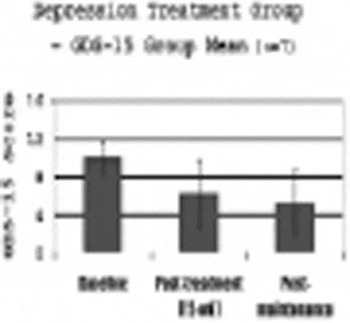
PS02.145
Competitive Memory Training (COMET) for treating depression and rumination in depressed older adults
Wilfried Ekkers, Parnassia, The Hague, The Netherlands
Depression is a highly prevalent psychiatric disorder in later life that is associated with substantial costs and burden, and excess mortality rate. The prevalence of depression is expected to increase, especially in older adults. Rumination is one of the key cognitive aspects of depression. Rumination is defined as the tendency to experience intrusive, repetitive and negative cognitions about symptoms of depression, and the possible causes and consequences of these symptoms. Rumination predicts the onset, duration, relapse and severity of depression. Furthermore, rumination has a negative impact on thought content, impedes problem-solving skills and mediates the predictive effect of other known risk factors of relapse. Rumination is an important factor in late life depression (as well as in adult patients). Several treatments have been developed that target rumination, including meditation, attention training techniques acceptance and commitment, and rumination-focused cognitive behaviour therapy (RFCBT) for residual depression. Also concreteness training (CNT). Purdon (2004) reports that treating rumination is difficult, e.g. whereas meditation and attention training seem promising interventions, both have only moderate effects. In the present study the effectiveness of a new, time-limited transdiagnostic training was adapted to treat depression by focusing on rumination in older patients. The supposed mechanism of change is by inhibiting access to dominant dysfunctional attitudinal styles and meanings by facilitating access to more functional attitudes and meanings. According to Brewin (2006), cognitive therapy does not directly modify negative information in memory but rather influences the relative retrievability of the different meanings that emotional concepts are associated with. Strengthening the retrievability of functional representations that are in retrieval competition with dysfunctional negative representations is considered to be the core activity of all effective psychological treatments. Competitive Memory Training (COMET) for rumination is aimed at helping patients to distance themselves from their worries and to let their ruminations go. In COMET for depressive rumination, instances are identified in which patients have proven to be able to ‘let things go’. Then, the experience of ‘letting go’ is made more emotional salient by having patients imagine these successful instances, by adapting a bodily posture and facial expression that enhances the experience of ‘letting go’ and by (sub)vocalizing their abilities to ‘let go’. A total of 93 patients (over 65 with major depression and suffering from rumination) were treated in small groups according to the COMET protocol in addition to their regular treatment. Patients were randomized to two treatment conditions: 7 weeks of COMET + treatment as usual (TAU) versus TAU only. COMET + TAU showed a significant improvement in depression and rumination compared with TAU alone. This study illustrates that the transdiagnostic COMET protocol might also be successful in treating depression and rumination in older adults. At the end patients that received TAU + COMET ruminated less and were less depressed than the patients in TAU alone. Furthermore a mediation analysis will be discussed as well as strengths, weaknesses and possible implications of the study. As COMET for depressive rumination is only one of the applications of the transdiagnsotic COMET protocol attention will also be given to the other COMET protocols and their efficacy in treating psychopathology.
PS02.146
Learning to live with MCI: Results of a group intervention for MCI patients and their significant others
Liesbeth Joosten, M Vernooij-Dassen, J Pins,
M Olde-Rikkert, S Roelofs, R Kessels
University Medical Centre Nijmegen Radboud Nijmegen Radboud, Nijmegen, Gelderland, Nederland
M Vullings, Vicurie Hospital, Venlo, The Netherlands
Background: Individuals with Mild Cognitive Impairment (MCI) and their care partners have to deal with an uncertain prognosis and face a multitude of memory-related and psychosocial consequences. This study examines the efficacy of a 10-session newly developed comprehensive group program aimed at MCI patients and their care partners that comprises elements of psychoeducation, cognitive rehabilitation and cognitive behavioural therapy. Aim was to evaluate the quantitative and qualitative effects of the program in the individuals with MCI and their care partners in a controlled design. Additionally long term effects were examined for the MCI patients and their care partners after 6 to 8 months after completion of the program.
Participants and methods: In a mixed-method design pre- and post-treatment quantitative and qualitative data were collected in the care partners of 93 MCI patients and 85 care-partners, with 30 patients and 27 partners having first been assigned to a waiting list, thus serving as their own control group. Besides evaluating the program, the dyads assessed their Well-being (RAND-36), Distress (GDS-15), and Acceptance and Helplessness (ICQ), and the care partners their Sense of Competence (SOC). Results of the RAND-36, ICQ, IQCODE, GDS-15 and SOC at follow-up were compared with the post-intervention assessment.
Results: Linear mixed model analyses of the patients’ data showed that acceptance had increased more in the intervention group compared to the waiting-list period (p = 0.034). Treatment responders demonstrating a clinically significant effect on acceptance and two of three secondary outcome measures had higher baseline levels of helplessness and fewer self-reported memory complaints in daily life than patients who did not improve. Distress and general well-being showed no changes in both the MCI Patients nor in their care partners. Analyses in care partners yielded discrepant findings. Whereas the linear mixed-model analyses of the quantitative data did not reveal statistically significant differences between the control and intervention condition, the qualitative results showed that at program completion the care partners reported significant gains in knowledge, insight, acceptance and coping skills. Forty-seven MCI patients participated in the follow-up assessment and 47 significant others. Our findings showed that the increased level of acceptance in the MCI patients was maintained at follow-up, with an increased insight into their cognitive decline compared to post-intervention assessment (p<0.001). In both the patients and the significant others, helplessness and wellbeing were worse at follow up (p<0.05), and burden of care-giving increased in the significant others (p<0.05).
Conclusion: The intervention helped the patients deal better with their uncertain future in that they were overall better able to accept their condition, with especially the female patients showing a decrease in helplessness cognitions. The caregivers’ results showed that, although no statistically significant changes were found on the measures of well-being, distress, burden or illness cognitions, the qualitative data suggest that the MCI program facilitated the process of learning to live with or care for a loved one with MCI. Suggestions for program adjustments and alternative outcome measures are discussed. The follow up results indicate a need for extension of the support after completion of the program, for example by providing regular booster sessions.
PS02.147
The development of a Cognitive Behavioural Therapy (CBT) manual: A pilot randomised control trial of CBT for anxiety in people with dementia anxiety
Susan Sadek, G Charlesworth, M Orrell, A Spector,
University College London, London, United Kingdom
Anxiety is common in people with dementia, with prevalence estimated from 5–21% for anxiety disorders, and up to 71% for anxiety symptoms (Seignourel et al., 2008). In addition to excessive worries and fears, anxiety may physically manifest as agitation, motor restlessness, day/night disturbance and aggression. It has been associated with high physical dependency and problems in the patient/carer relationship (Orrell and Bebbington 1996), decreased independence and limitations in activities of daily living (Porter et al., 2003), increased behavioural problems (Teri et al., 1999), and increased admissions to nursing care (Gibbons et al., 2002). There is currently limited understanding of psychological approaches to anxiety in dementia, which can lead to inappropriate and sometimes problematic use of pharmacological interventions (Moretti et al., 2006). Cognitive Behavioural Therapy (CBT) for anxiety in people with dementia has been investigated in four small studies. Clinically meaningful reductions were found in anxiety, in addition to improvements in mood and participation in pleasurable activities, and reduction in alcohol intake, night wakenings, and collateral distress (Kipling et al., 1999; Koder, 1998; Kraus et al., 2008; Paukert et al., 2010). As the feasibility of CBT in people with anxiety and dementia has been demonstrated, it is clear the formal development of a cognitive behavioural intervention is required. This presentation will describe the development of a CBT manual for adults with dementia and anxiety. This took place in five key stages:- identification of key themes in anxiety for people with dementia derived from the literature- identification of relevant cognitive and behavioural techniques for this population- expert consultation- consensus consultation with thirty professionals and service users- field testing with five clients with anxiety and dementia. We will also summarise the manual and the CBT approach for this population. This includes the process of developing collaborative formulations, session preparation and outlines, and worksheets and psycho-education resources available for each session. Preliminary outcomes and feasibility findings from field testing will be presented. The development of this manual is the foundation for a pilot randomised control trial of CBT for people with anxiety and dementia, beginning in mid 2011. CBT for anxiety in people with dementia could lead to significant benefits, including the reduction of excess disability, and reduced costs to the NHS, through a reduction in GP visits, decreased use of medication and admission to care homes. In addition, manualised CBT for this population provides the opportunity to standardise the intervention process, and improve the quality of psychosocial care.
PS02.148
Delusional parasitosis among the elderly: Report of a clinical case
Maria Ferreira, CEIS 20 – The Centre for Interdisciplinary Studies of the 20th Century of the University of Coimbra, Coimbra, Portugal
J Freitas, C Paz,
Magalhães Lemos Hospital, Oporto, Portugal
M Sotto Mayor, Hospital Magalhães Lemos, EPE, Porto, Portugal
Delusional parasitosis consists of a pathological conviction, and without an objective basis, of a skin infestation by small parasite animals. Already in 1892, the French dermatologist Thibierge was referring to the subjective and irreducible belief of certain patients being infected with scabies, a phenomenon he called “acarophobia”. The first reference to the term “delirium” appears in 1930 in a work by Mallet and Malet. The authors describe a case which they classified as “coenesthetic delirium” after having eliminated the existence of a manic-depressive, toxic, or paranoid element and of obsessive coenesthetic sensations.In 1932, Borel and H. Ey describe a case in which they stress the existence of a “dominant idea” and consider that the anxiety and phobic terror were primitive and determined real visual and haptic hallucinations. In 1938, in a famous monograph, the Swedish psychiatrist Ekbom, elaborating on the presentation of seven clinical cases of his series, made reference to this syndrome as a particular frame which does not resemble any of the psychopathological syndromes described, affecting mainly pre- senile aged women, complaining of itching or tingling, symptoms that, due to a misunderstanding, led the patients to assume a skin infestation delusion, with chronic course and spontaneous remissions, which he called “pre-senile delusion parasitosis” (Ekbom, 1938). Years later, the American dermatologists Wilson and Miller called this syndrome “delirium of parasitization” (Wilson, Miller, 1946). The studies that have occupied themselves in detailing the symptoms and causal correlations of these delusions discuss wether the priority lies with the delusion itself, with skin hallucinations, or with misinterpreted sensations. Whatever the original perceptual experience, its interpretation is based on a modification of the patient's own bodily, sensory and vital feelings (Alonso-Fernández, 1976). In certain cases, the delusional belief is expanded, allowing for visual and acoustic hallucinations. Delusional parasitosis often emerge symptomatically, grounded on a psychosis already in progress (secondary), which can give way to diverse forms of etiopathogeny, evolution and course. It can also manifest itself as an exclusive and primary psychotic change, as a systematized chronic delirium of skin zoopathic theme, assuming a paranoid or confabulatory-paraphrenic form.One can only speak of “primary delusional parasitosis” (Lorenzi & Ganne's, 1975) after excluding an underlying real infection or a medical or psychiatric condition. It can also arise as folie à deux or folie à trois or by proxy. Skin delusions of parasitization, being relatively rare, occur mainly during involution. The authors propose the study of psychopathology, the main interpretive theory, prevalence, course, differential diagnosis, prognosis and treatment of this syndrome among the elderly. For this purpose, they discuss the case of a 72 year old patient, with a psychiatric record of bipolar affective disease type I, with a long history of evolution and several psychiatric hospitalizations. The patient was admitted in the Department of Psychogeriatric Department due to her elation of mood, delusions of persecution and mystical content; at night-time she suffered from severe insomnia, psycho-motor agitation and also runaways from home. The recent appearance of delusional parasitosis in the patient's psychiatric record stands out, leading to self-mutilations of the scalp with itchy lesions due to itching. Hallucinatory activity was not detected. She possesses a broad-based apraxia of gait that was analyzed by Neurology and which is attributed to the vascular lesions (subcortical multi-infarcts) identified in the skull-brain CT scan. Thus, the behavioral changes also arise in the context of vascular dementia. The authors conclude that delusional parasitosis are not a nosographic entity, but a psychopathological syndrome. Among the elderly, they manifest themselves most oftenly in the context of an underlying psychiatric illness, as a single and primary frame and usually evolve with a high degree of systematization of delusions. Relatively homogenous in content and form so as to form the unique syndrome that we are concerned with, the delusions of parasitization are nonspecific in their aetiology, pathogenic processing and evolution. The cases of paranoid clipping are the most serious, chronic and resistant to therapy. The authors also state that when the syndrome manifests itself during the evolution of a base-psychosis, treatment with Pimozide (typical antipsychotic) seems to achieve good results. Finally, the authors suggest an integrated interpretation of the origin of this syndrome: the feeling of skin infestation would constitute a general form of disturbance in the sense of Barahona-Fernandes (Barahona-Fernandes, 1979), which, updated under the light of biographical events, in pathological context, would model itself within the dependence of the basic psychopathological structure of the subject.
PS02.149
Comparison of older adults vs. working adults presenting with overdose at city hospital
Farooq Khan, G Tadros, Staffordshire University, Stafford, England
T Sehgal South Essex Partnership, NHS Trust, London, United Kingdom
C Street, M Garcia Birmingham Medical School, Birmingham, United Kingdom
A Wooldridge City Hospital, Birmingham, United Kingdom
Introduction: It is known that a single elderly male; living on his own, is at high risk of committing more serious suicide attempt (Bock & Webber 1972, Dennis & Lindsay 1995, Bateman & Sandilands 2007), they would also tend to complete the attempt more often (Catell, 2000). AIMS To compare the profile of older adults with working adults who attend the poisons unit after overdose.
Methods: The data was collected retrospectively from the patient case notes, all patients of 50 years or older admitted to poisons unit from April 2009 to March 2010 were compared with people younger than 50 years. The data collection tool was designed to cover three aspects: socio-demographic details, over dose/suicide related themes, assessments and record keeping in case notes. While collecting the data attention was given to intent to die, accidental/deliberate, presence of psychiatric disorder, previous suicidal attempts, referral to psychiatric services and cognitive impairment. Case notes were also checked for precipitants, circumstances and potential reasons for overdose. We also included similar number of younger adults who were admitted to poisons unit during the specified time.
Results: It was found that 87% of patients have taken deliberate overdose, 63% have a clear intent to die of which 75% were among 50 years and above and 50% were among 50 years and below, though 63% were discharged within one day of admission. All 14 out of 14 (100%) under 50 year olds and 11 out of 16 (69%) above 50 year olds have taken deliberate overdose. Reasons for overdose as given by patients were recorded and multiple reasons were found in 40% of patients followed by other reasons (23%). Multiple reasons included relationship difficulties, pain, debts, feeling low / depressed, argument, bereavement and stress. Other reasons included low mood, accidental / by mistake, unemployment, housing issues, bereavement, alcohol issues, feeling low / depressed, argument, family issues and work issues. Past history of suicide attempt and overdose was found in 40% and 37% of patients respectively. Paracetamol was the most common medication for overdose (26.6%), psychiatrists saw 67% of cases after referral, psychiatric diagnosis was recorded in 67%, psychiatric history and mental state examination (MSE) was recorded in 70%. Cognitive impairment was found in 13% of cases but in 47% it wasn't recorded. 63% cases were just observed without any medical treatment and 30% were provided with medical treatment and observation as a part of management plan for overdose. Older adults will attempt overdose deliberately and would have clear intent to die. There is a need to understand the overdose pattern in the elderly with respect to types of medications used and prescription given to them.
Discussion: We found that paracetamol is the most commonly used drug (26.6%) in overdose and similar findings were reported in other studies (Shah, et. al., 2002). The use of drugs associated with significant toxicity should be avoided in older patients at risk of self-harm, though our data suggests that only 33% of cases have taken overdose of prescribed medication. (Doak, et al., 2009). In our sample we found 31% of above 50 year olds have taken accidental overdose and 69% have taken deliberate overdose compared to 100% of below 50 year olds who took deliberate overdose. 70% of our sample needed psychiatric assessment and psychiatrist assessed 67% of them. 23% had history of depression, 7% had alcohol related disorders (psychiatrist's assessment found 40% alcohol related problems) and 50% had no past psychiatric history. In yet another study done in acute hospital admissions for elderly people it was found that 21% had no psychiatric history (Lamprecht, et al., 2005).
Conclusion: Older adults will attempt overdose deliberately and would have clear intent to die. There is a need to understand the overdose pattern in the elderly with respect to types of medications used and prescription given to them. There is a significant psychiatric morbidity among patients who overdose and appropriate psychiatric liaison services are needed to manage patients.
PS02.150
CLOX predicts social functions of elderly patients with chronic schizophrenia
Aiko Okamura, M Kohigashi, J Narumoto,
K Fukui,
Kyoto Prefectural University of Medicine, Kyoto, Japan
Y Kitabayashi, C Morioka, M Kitabayashi
Gojouyama Hospital, Nara, Japan
K Shibata Kyoto Prefectoral University of Medicine, Kyoto, Japan
Background: It is critical to assess the cognitive functions of the patients to decide whether they can live in community because social functions are related to cognitive functions. The Brief Assessment of Cognition in Schizophrenia (BACS) is widely used as a measurement of cognitive functions of patients with schizophrenia. However, since it takes time and requires concentration, it can be burden for elderly patients. Therefore, a brief and easy assessment test for cognitive functions in schizophrenia is needed. The Clock Drawing Test (CDT) is a brief cognitive screening test widely used in assessment of patients with dementia. Considering the property of CDT, it would be also applicable for elderly patients with schizophrenia. CLOX, developed by Royall, is one of the scoring methods of CDT that covers wide range of cognitive functions. CLOX1 is an unprompted task that is sensitive to executive control, and CLOX2 is a copied version.
Objectives: We examined whether CLOX can be used as a cognitive screening tool for elderly patients with schizophrenia.
Subjects: Subjects were 45 elderly patients with chronic schizophrenia who had been hospitalized in a psychiatric hospital over a year (26 men and 19 women, mean age 55.0 ± 11.2 years old, mean duration of illness 30.9 ± 11.4 years). Three patients could not complete BACS because they lost their concentration during the long test time. We therefore excluded their data out of the following analyses. METHODS: We investigated their sociodemographic data and assessed cognitive functions with BACS, CLOX, and MMSE. We also assessed their social functions with Life Skills Profile (LSP) and psychiatric symptoms with Positive and Negative Syndrome Scale (PANSS). First, Spearman's rank correlation analyses were performed to investigate correlations between CLOX1, CLOX2, BACS composite score, and MMSE. Second, we performed multiple linear regression analyses to identify the variables that predicted LSP. Total LSP score were used as the dependent variables, and considering multicollinearity, the following candidate factors were used as independent variables: CLOX1 score, CLOX2 score, total PANSS score, and sociodemographic data (gender, age, education, length of hospitalization). This study was approved by the ethics committee in Gojouyama Hospital. We obtained informed consent from all participants.
Results: When Spearman's rank correlation analyses were performed, both CLOX1 and CLOX2 scores were significantly correlated with BACS composite score (CLOX1: rs = 0.361, p = 0.019, CLOX2: rs = 0.475, p = 0.001) and MMSE score (CLOX1: rs = 0.426, p = 0.005, CLOX2: rs = 0.579, p < 0.001). Multiple linear regression analyses revealed that only a higher CLOX2 score predicted a higher total LSP score (β = 0.455, adjusted R2 = 0.187, F = 10.441, p = 0.002).
Conclusions: We found that CLOX1 and CLOX2 were highly correlated with BACS and CLOX2 performance predicted social functions in elderly patients with chronic schizophrenia. Though CLOX2 is less sensitive to executive function than CLOX1, it reflects attention, verbal memory, visual memory, and working memory better than CLOX1. Our results suggest that higher social function may be related to these cognitive functions rather than executive function and CLOX2 can be a useful tool for medical staffs who want to assess cognitive functions of elderly patients with schizophrenia to promote their discharge.
PS02.151
Schizophrenia spectrum disorders in later life: Prevalence and distribution of age at onset and sex in a Dutch catchment area
Paul Meesters, M. Stek, P Eikelenboom, J Smit
GGZ inGeest, Amsterdam, The Netherlands
L De Haan Academic Medical Centre, University of Amsterdam, Amsterdam, The Netherlands
H Comijs, VU University Medical Center, Amsterdam, The Netherlands
A Beekman, Valeruis Clinic, Amsterdam, The Netherlands
Background: In keeping with the general aging of the population, there is a rapid increase of elderly patients with schizophrenia. As in other psychiatric disorders, elderly patients with schizophrenia represent those that have had this disorder for the larger part of their life, as well as patients with a more recent onset. The prevalence of schizophrenia in later life is affected by both outflow of early onset patients, due to recovery and excess mortality, and inflow of patients with a later age at onset. This makes it likely that characteristics of elderly patients differ markedly from younger patients.
Design Case register Study Participants: We assessed the one-year prevalence of schizophrenia and spectrum disorders and their distribution according to age group, age at onset and sex in an epidemiological sample of elderly patients, in contact with the Mental Health Organization GGZ inGeest in a psychiatric catchment area in Amsterdam, the Netherlands. Diagnoses included were schizophrenia, schizoaffective disorder and delusional disorder.
Setting: The psychiatric catchment area of the southern district of Amsterdam is a geographically well-defined urban area comprising 17.5% of the total Amsterdam population. The district includes a variety of neighbourhoods, ranging from lower-class housing to upper-class residences, and is highly urbanized. On January 1, 2008 25.631 (19.6%) of the catchment area inhabitants were aged 60 years and over, approximating the proportion of elderly (20.8%) in the general Dutch population. The proportion of women in the catchment area aged 60 years and over (58.8%) was slightly higher than in the general Dutch population (54.9%). The average income of catchment area inhabitants aged 65 years and over (20.100 Euro/year) came close to the average income of the same age group in the general Dutch population (20.700 Euro/year)
Results: 183 patients were included. Median age was 67 years (range 59–95), median age at onset was 34 years (range 15–88). The one-year prevalence of all disorders was 0.71%, subdivided in 0.55% for schizophrenia, 0.14% for schizoaffective disorder and 0.03% for delusional disorder. The one-year prevalence of early-onset schizophrenia was 0.35%, of late-onset schizophrenia 0.14% and of very-late-onset schizophrenia-like psychosis 0.05%. The estimated prevalence of schizophrenia among women (0.68%) was almost twice as high as the estimated prevalence among men (0.35%). Women outnumbered men markedly in the prevalence estimates for most diagnostic subgroups, including early-onset schizophrenia.
Conclusions: In this service-based sample of elderly patients, we found the prevalence of schizophrenia to be well within the range reported for younger populations. This underlines the clinical relevance of this disorder in later life and argues against the idea that schizophrenia becomes less important as the population ages. Our estimates for schizophrenia and spectrum disorders will be a lower bound of the true prevalence in the community, as it is suggested that more than half of all individuals with serious mental illness are not connected to mental health care, either because they failed to seek treatment or because they disengaged from treatment. The considerable proportion of patients with a later age at onset and the strong female preponderance are distinguishing characteristics with clinical implications. The fact that over 70% of our sample lived independently highlights the importance of a societal orientation for service provision, giving priority to interventions that support independent functioning.
PS02.152
Long-term efficacy and safety of Zolpidem extended-release 12,5 mg, administered for six months in old patients with chronic primary insomnia: A randomized, double-blind, placebo-controlled, parallel- group, multicenter study
Julio Zarra, Hospital Italiano de La Plata, La Plata, Argentina
L Schmidt, Hospital Centenario, Gualeguaychú, Entre Ríos, Argentina
Introduction: Being primary insomnia in older people, a condition so common that can impair the patient's general condition, considering a specific pharmacological and early treatment.
Hypothesis: To evaluate long-term efficacy and safety of zolpidem extended-release, in old patients for chronic primary insomnia.
Method: Multicenter, randomized, double-blind, placebo-controlled, parallel group. Population: Outpatient with aged more of 65 years. Diagnosis: DSM-IV criteria for chronic primary insomnia. Treatment: Single-dose zolpidem extended-release 12.5 mg (n = 128) or placebo (n = 127), self-administered every night.
Results: Patient's Global Impression (PGI) and Clinical Global Impression-Improvement (CGI-I) were assessed every 4 weeks up to six month. Patient Morning Questionnaire (PMQ), recorded daily, assessed subjective sleep measures-sleep onset latency (SOL), total sleep time (TST), number of awakenings (NAW), wake time after sleep onset (WASO), and quality of sleep (QOS)-and next-day functioning. Zolpidem extended-release also was statistically significantly superior to placebo at every time point for PGI (Items 1–4) and CGI-I (P < 0.0001, rank score), TST, WASO, QOS (P < 0.0001), and SOL (P < or = 0.0014); NAW (Months 2–6; P < 0.0001). Sustained improvement (P < 0.0001, all time points) was observed in morning sleepiness and ability to concentrate (P = 0.0014, month 6) with zolpidem extended-release compared with placebo. Most frequent adverse events for zolpidem extended-release were headache, anxiety and somnolence to the morning. No rebound effect was observed during the first 3 nights of discontinuation.
Conclusions: These findings establish the efficacy of dosing of zolpidem extended-release 12.5 mg for up to 6 months. Treatment provided sustained and significant improvements in sleep onset and maintenance and also improved next-day concentration and morning sleepiness.
Discussion: In the presence of primary insomnia in older people, considering a specific pharmacological and early treatment to prevent sleep disturbance that could lead to an unfavorable outcome in any brain function, affecting the general welfare of the patient.
PS02.153
Effectiveness of the “better sleep” training course for elderly with sleeping problems
Marian Muller, GGZ NHN, Alkmaar, Noord Holland, The Netherlands
M Dijkstra GGZ NHN, Den Helder, The Netherlands
Background: Temporary sleep problems exist in one third of the Dutch population and the prevalence of chronic sleeplessness is 4 % among male and 8 % among female. There are indications that there is a strong increase of sleep disorders among elderly, up to 59%. Within our department for mental health care for the elderly the number of patients presenting with sleep disorders is relatively large. Many of these patients use sleeping medication. Literature shows that chronic sleep problems can induce depression. Our department developed a training course (“better sleep”) that focuses on aspects like: sleep hygiene, mulling, relaxation and information about sleep medication. The course is a six weeks course, with one session of two hours per week in which fixed topics are discussed following a fixed scenario. Participants are patients of our department as well as people who registered after having read an announcement in the local media.
Aim of the study: To measure the effectiveness of the course “better sleep” for elderly.
Method: A total of 57 persons in 6 groups participated in the study of which 42 could be included while the data of the 15 others were not complete. Sixteen persons were diagnosed with mild or moderate depression, 19 persons were meeting the criteria for the diagnosis primary insomnia, and 7 with anxiety disorder, somatisation or another diagnosis. Participants were asked to fill the SCL-90-R before and after the course, as well as a semi structured questionnaire. Total end scores and sub-scores from before and after the course were analysed. Effects of the course on medication use were evaluated through a semi structured questionnaire.
Results: The mean end score of the SCL-90-R participants decreased significantly. Scores on sub-scales decreased also. Patients with the diagnosis depression improved even more than the patients with primary insomnia on both the depression scale and the sleeping scale. The relaxation and breathing exercises contributed most to the improvement perceived by the participants.
Conclusion: The course helps to improve sleep. Patients report better sleep and fewer complaints after having attended the course. Depressive patients improve more than patients with primary insomnia on the SCL-90-R. The training course is an effective addition to our treatment for patients suffering from sleep disorders, specifically for depressed patients.
PS02.154
Prevalence of insomnia symptoms in elderly patients with mild cognitive impairment
Maeng Je ChoSeoul National University, Seoul, South Korea
B Kim, National Cancer Center, Goyang-si, South Korea
Introduction: Sleep disturbance is one of the non-cognitive symptoms of mild cognitive impairment (MCI), which clinicians regard as being on the presumed continuum from normal aging to dementia. Although several studies have addressed the higher prevalence of sleep disturbances in MCI compared to normal aging, no previous study has investigated the prevalences of insomnia's various symptoms according to the DSM-IV criteria (difficulty in initiating sleep [DIS], difficulty in maintaining sleep [DMS], early morning awakening [EMA], and non-restorative sleep [NRS]), which have differing clinical implications.
Methods: We evaluated 256 community-dwelling elderly for various clinical characteristics via structured interviews. To evaluate their depressive symptoms, we used the SGDS-K (the Korean version of the Geriatric Depression Scale, Short Form). We evaluated their cognitive functions using the Korean version of the Consortium to Establish a Registry for Alzheimer's Disease Assessment Packet (CERAD-K) and assessed their insomnia using a questionnaire based on the DSM-IV diagnostic criteria. To rule out depression, we excluded participants who scored 8 or higher on the SGDS-K. We regarded participants scoring below 1.5 SD from the normative value (by age, sex, and education) on any CERAD-K subtest (except trail-making test B) as having MCI.
Results: After excluding the persons who had dementia or depression, we analyzed the data from 163 participants. Of these, we diagnosed 65 as having MCI, while 98 were normal. The prevalences of DIS, DMS, EMA, NRS, and any insomnia symptom were 21.5%, 29.2%, 13.8%, 20.0%, and 43.1%, respectively, in the MCI participants. Corresponding prevalences in the normal elderly were 11.2%, 15.3%, 11.2%, 11.2%, and 24.5%. Participants with MCI showed a significantly higher prevalence of DMS (p = 0.032) and any insomnia symptom (p = 0.013) than did normal participants. The difference between the groups for DIS was marginally significant (p = 0.074). The MCI patients’ prevalence of diagnostic insomnia (any insomnia symptom with a moderate to severe daytime disturbance), which was 6.2%, was similar to that for the normal elderly (5.1%).
Conclusions: In line with previous studies, elderly patients with MCI showed a higher prevalence of insomnia symptoms than did the normal elderly. However, when we considered specific symptoms of insomnia, the difference was only valid for DMS. This finding suggests that, for MCI patients, clinicians can consider DMS a more specific symptom of insomnia than other insomnia symptoms. Further research could clearly confirm this association, and studies with a greater number of participants would overcome the current study's limitation.
PS02.155
What drives a person to a suicide attempt in later life? An explorative study
Anke Bonnewyn, Catholic University Leuven – University Hospitals Gasthuisberg, Leuven, Belgium
A Shah
K Schoevaerts, R Bruffaerts, K Demyttenaere, Katholieke Universiteit Leuven, Leuven, Belgium
Introduction: Suicide in later life is a considerable health problem worldwide and is highly prevalent in industrialized countries. Suicide rates in older age groups are at least as high as in younger age groups (McKeown et al., 2006); especially men over 75 years are particularly vulnerable. A suicide attempt (SA) is a strong predictor of completed suicide (CS) in later life. In contrast to increasing rates of completed suicides with increasing age, suicide attempts in older age occur less frequently, suggesting an increase of lethality of SA (Dombrovski et al., 2008). There is also growing evidence that suggests that SA and CS in later life can be considered as a single syndrome, implying that SA should be interpreted as a failed CS. Literature on SA in later life however is rather limited and often descriptive in nature, using cross-sectional designs. SA in later life has been found to be strongly correlated with the presence of a major depressive episode. A somatic condition, particular personality traits or a history of previous suicide attempts (Hawton et al., 2006; Wiktorsson et al., 2010) are important predictors of a SA as well. Other risk factors include being unmarried, being widowed, living alone and low educational attainment. Despite the fact that many elderly are confronted with the abovementioned risk factors, only a small minority of them, even when depressed, actually manifests suicidal behavior. Preliminary studies suggest that a more qualitative, person-centered approach may be needed in order to identify proximal psychological factors preceding a suicide attempt in older age. Such a methodological approach should be considered as complementary with quantitative approaches. Therefore, we developed a qualitative research design aiming to explore which psychological factors and reflections about life play a part in the decision making process towards a SA in later life.
Material and Methods: Qualitative data were gathered by means of in-depth interviews with eight older psychiatric inpatients (65+), recruited from the department of old age psychiatry (University Hospitals Leuven), who attempted to complete suicide. Interviews took place within 30 days following the SA and were audio-visually recorded. The study design was approved by the Ethical Committee of the University Hospitals Leuven, Belgium. Grounded theory was the method used to analyze the data.
Results and Discussion: Experiences of the interviewees describing their decision process leading to a suicide attempt could be broken down in two major segments: (a) the content of thoughts, feelings and considerations about life and (b) the experience of the physical state one was in. With regard to the first segment “life and the self were felt as being disrupted by the experience of a loss” and “the feeling of being on one's own in life” were dominant constructs. Interviewees reported that they were confronted with a loss of a loved one or with an important issue at some stage in later life, and experienced this loss as a complete disruption of the former life: life after the loss was perceived to be inferior compared to life prior to the loss. Both the casualness of life and the foundation it was once built on seemed to have disappeared completely. Data suggested that life of the suicide attempters was disrupted by the loss, causing the interviewees not being able to connect with the way of living they were used to. At the same time they felt they were on their own in life, left to their own devices after the loss, no longer connected to others, or no longer sharing with others. A lack of feeling of reciprocity in relationships with others was also reported. With regard to the second segment, another important experience described by suicide attempters was the particular physical state they were in at the time of the decision of the SA. A “complete bodily exhaustion”, “a physical experience of anxiety” and “feelings of confusion” were described as important constructs. Both the content of their thoughts and feelings as their physical state seemed quintessential components of the SA decision process. It appeared that older suicide attempters decided to end their life due to the combination of a current, negative evaluation of the quality of life, and the lack of control over physical experiences disturbing their daily life. The psychological constructs revealed by this explorative qualitative approach may yield important insight in the relation between the confrontation in life with the aforementioned risk factors on the one hand and the actual decision to attempt to complete suicide on the other.
PS02.156
Senior suicide: A multidisciplinary intervention strategy
Beth Butler, E Jurkowski,
Southern Illinois University Carbondale, Carbondale, Illinois, United States
Senior suicide is a tragic ending of life and is a cause of considerable devastation for families, caregivers and health professionals. In fact, every 90 minutes in America, 16 of those age 65 or over completes suicide while suicide victimizes approximately one million people in the world per year. This poster/paper, based on a review of national and international literature focusing on global elder suicide statistics and the main factors associated with elder suicide, will showcase how an act of suicide is a complex phenomenon involving the interaction of multiple psychological, physical and social factors operating at a crucial moment in the life of a vulnerable elderly person. Risk factors and barriers for medicine and gero-psychiatry will be explored as a venue for multidisciplinary collaboration. An educational intervention strategy for multidisciplinary collaboration will be presented. Lastly, some helpful tools for assessing seniors at risk for suicide will be offered as well as recommendations regarding outreach to elderly as they may be most susceptible to social isolation and loneliness. Suicidal behavior in elders, most always undertaken with great intent and lethality, is a serious problem in societies the world over. According to Szanto, (2003), the elderly population has the highest suicide rates in almost all countries in the world where data are available. Generally speaking, suicidal rates increase in both men and women and overall rates among those 75 years of age and older are approximately three times those aged 15–24 years (Vikram, 2005). A recent cross-national study of 87 countries reports that elderly suicide rates are the lowest in the Caribbean, central America, and Arabic countries, and the highest in central and eastern European countries (Shah, Bhat, McKenzie & Koen, 2009). This study also shows that suicide rates in males aged 65 – 74 are the lowest in Mediterranean (Greece, Spain and Italy) and western European (Ireland, Netherlands and United Kingdom) countries and the highest in central and east European (Austria, Bulgaria, Estonia, Hungary, Lithuania and Slovenia). A similar pattern is observed in males aged 75 + years, females aged 65 – 74 years and females aged 75 + years (Shah et al., 2009). The observations of suicide rates being higher in males than females for both the age bands, and higher in the 75 + years age-band than the 65 – 74 years age band in both genders, are consistent with the literature (Shah & De, 1998; Diekstra, 1989). Table 1 (Shah et al., 2009) presents suicide rates in males and females in age bands 65 – 74 years and 75+ years by quartiles and EU countries. Rogers (2010) identifies individual factors that may contribute to suicide which include Biological Factors, Predisposing Factors, Proximal Factors and Immediate Triggers. Biological Factors encompass family risk, brain chemistry, gender and psychological problems. Among the Predisposing Factors are psychiatric disorders, substance abuse, personality profile, and severe illnesses. Hopelessness, intoxication, impulsiveness, aggressiveness and severe/chronic pain are considered to be the Proximal Factors. Immediate Triggers can be public humiliation, access to weapons, severe defeat, a major loss and/or a worsening prognosis (Kepner, n.d.). Socio-cultural factors such as race, ethnicity, religion, and economic conditions, among others may also contribute to suicide risk (Goldsmith et al., 2002). Given the alarming facts about suicide and it's lethality in older adults, an educational tool for professionals working as part of the care team was developed to provide an evidence based approach to understanding and responding to older adults in need. This tool, is a strategy which social workers can use to educate other members of the older adults’ multidisciplinary team about the risk factors and intervention strategies for suicide/prevention in older adults.
PS02.157
Prevalence and correlates of suicidal thought and self destructive behavior among an elderly hospital population in Iran
Ali Javadpour, Shiraz University of Medical Sciences, Shiraz, Iran
Background: Suicide among elderly people is an important mental health issue. Increase in rate of suicide in the presence of medical condition has been consistently reported. As a significant proportion of older adult have at least three or more medical conditions, it is not clear what factors could increase suicide in the elderly medically ill population. Elderly inpatients as a subpopulation of aged people with medical condition might be at greater risk for suicide there are few studies investigating suicide ideation and behavior in inpatient older adults. Given that older people may present suicide ideation in indirect way, current study designed to investigate the prevalence of suicide ideation and indirect self destructive behaviors among a sample of hospital population of aged individuals.
Method: A cross sectional study was conducted between July 2009 and Sep 2009. 650 elderly inpatient screened from various medical services in teaching hospitals affiliated to Shiraz University of medical sciences in Iran. Suicide ideation and behavior was measured by using Beck Suicidal scale Inventory (BSSI) and harmful behavior scale (HBS). Co relational analysis was employed to detect correlation of suicide to various demographic and clinical variables. Further regression analysis was used to test the predictability power of each variable. Analyses were done in Microsoft SPSS 15.
Result: 650 subjects participated in the study, 8o subjects were excluded because of frailty, poor medical condition and history of current psychiatry disorders and 570 patients left for analysis. In preliminary descriptive analysis it was found that 21.6 % of the study sample had suicide ideation. Moreover at least one deliberate harmful behavior was detected in 14.4% of subjects. Further explorative analysis showed a significant correlation between suicide ideation and harmful behaviors (r = .503, p = .001). Depressive symptoms, burden of medical conditions, marital status, history of substance use and history of traumatic life event was positively correlated to both suicide ideation and harmful behavior. And the level of perceived social support and education were negatively correlated to suicide ideation and behavior. In regression analysis, depressive symptoms, history of traumatic events, poor social support, and duration of hospital stay and burden of medical condition were predictor of suicide in inpatient elderly individuals. From demographic variables living without spouse and unemployment were predictors of more suicide ideation and behaviors. Discussion: Suicide ideation and behavior in inpatient elderly is an important mental health issue. Some of elderly patients may present their suicide trend in indirect self destructive behaviors. In the presence of medical conditions, various psychosocial and clinical variables could increase the risk of suicide. Depressive symptoms predict more suicide ideation and behavior. Multi domain prevention program is needed to reduce suicidal risk in older adults in particular those suffering from medical conditions.
PS02.159
Physical examination of elderly mental health service users: A clinical audit
Ejaz Nazir,Shelton Hospital, Shrewsbury, Shropshire, England
M Mushtaq, Bushey Fields Hospital, Dudley, West Midlands, England
S Powell, South Staffordshire and Shropshire NHS trust, Shrewsbury, Shropshire, England
Introduction: Elderly mental health patients often have a multitude of co-morbidities that need addressing on admission to hospital. Routine physical examination is necessary in order to establish a baseline of observation and to determine if there are any other causes of deterioration in their mental health2,3. Another important aspect to examine is the extent and quality of the physical examination4. It is imperative that an examination is carried out within 24 hours of admission, and if this is not possible, within a reasonable time frame. This audit was carried out at an inpatient psychiatric hospital in Shropshire – UK. Standards/Criterion: 1. The Royal College of Psychiatrists recommends that “all” inpatients in psychiatric hospital should have routine physical examination within 24 hours of admission1. 2. Our Trust uses a structured proforma setting standards required for recording “full” physical examination for “every” patient at admission. We wanted to determine extent of physical examination recorded using a 30 points scoring system based on Trust proforma. Objectives: To determine whether we achieve 100% on above criterion.
Methods: A retrospective analysis of case notes of inpatients admitted between 1st and 15th November 2010 was carried out. We audited four old age psychiatric wards which included one ward for young people with dementia (YPwD) service. Forty sets of case notes were available for analysis at the time of audit. Clerking in documentation at time of admission was examined to ascertain if a physical examination had taken place within 24 hours of admission. If not, had there been a statement as to why this had not happened. To determine the extent of the physical examination, 30 points scorning system was devised using the local Trust proforma. (table 1)
Breakdown of 30 points scorning system (extent of examination recorded)

Results: 100% of the patient case notes audited used Trust recommended proforma to record physical examination. 88% clients had physical examination within 24 hours of admission. Remaining 12% had their physical examination at some point during their stay after 24 hours. Only 40% cases had routine blood tests on admission. Our 30 point scoring system revealed that there was a wide variation in the extent of the physical examination recordings. All case notes audited scored within a range of 7–26. It meant that all patients had only partial physical examination and none actually had “full” physical examination recorded as was required from by the Trust proforma. In any of the case notes there was an explanation as to why a full examination was not conducted at time of admission or within 24 hours of admission. Among the individual systems examined, all patients had their chest auscultated; cardiovascular system was examined in 80% patients with other systems having a wide range of completeness. Neurologically, most patients had a gross examination of their gait, pupils, speech and hearing. Examination of fundi, cranial nerves, sensory system, muscle power, tone, reflexes and co-ordination however were rarely performed.
Discussion: The difference in the scoring of systems may be because the cardiovascular system is one of the very first systems on the proforma to be examined. Conclusion: Although more than 2/3 patients had physical examination within 24 hours of admission but it is very concerning that all were incomplete and none had a thorough physical examination as required from the Trust proforma. Also only less than half had routine bloods done at time of admission. Also less than half of patients had routine bloods taken on admission. This is a very important aspect as psychotropic drugs can have a variety of side-effects and need regular blood monitoring. Without having any baseline blood tests, it can be difficult to monitor side-effects. Recommendations: 1. To highlight findings of this audit to current and prospective junior doctors with emphasis on “completeness” of examination and on “sending blood tests” at time of admission. 2. To re-audit in 6 months to complete audit cycle. 3. To repeat same audit using same scoring system on a larger sample including general adult psychiatric wards over a long time scale. References: 1. CR154. Good psychiatric practice, 3rd edition. London: Royal college of psychiatrists, 2009 2. Felker B, Yazell JJ, Short D. 1996; 47:1356–63. 3. MoosR, Mertens JR. Patterns of diagnoses, comorbidities, and treatment in late-middle-aged snd older affective disorder patients: comparisons of mental health and medical sectors. J Am Geriatr Society 1996; 44:682–8 4. Garden G. Physical examination in psychiatric practice. Advances in psychiatric treatment 2005; 11:142–9
PS02.160
Using e-learning to build capacity for disaster resilience: The “Frailty, Dementia and Disasters” Project
Maggie Gibson, St. Joseph's Health Care London, London, Ontario, Canada
D Maltais, Human Sciences, Chicoutimi, Québec, Canada
L Hardy, Government of Yukon, Canada, Whitehorse, Yukon, Canada
S Ruthe, District of Oak Bay, Victoria, British Columbia, Canada
Emergencies and disasters are increasing worldwide, secondary to factors including climate change, human pressures on the environment and infrastructure failure. Mounting evidence internationally suggests that older people suffer disproportionately in disasters as a consequence of largely remediable factors that cross the four pillars of emergency management: preparedness, response, recovery, and mitigation/prevention. Frailty and dementia are specific risk factors for heightened vulnerability, leading to increased risk for isolation, suffering and death in emergencies and disasters. Vulnerable groups are often neglected in emergency preparedness initiatives and sidelined in community recovery and rehabilitation activities post-disaster. An emerging consensus suggests that health care providers can contribute to disaster resilience for vulnerable groups at each phase of the emergency management cycle, but only if they have the requisite knowledge, tools and resources. Evidence suggests that for the most part, they do not. The overall goal of this knowledge translation initiative is to contribute to international efforts to reduce the disproportionate vulnerability of older adults in emergencies and disasters. The project involved the development, evaluation, and dissemination of an e-learning tool entitled “Frailty, Dementia and Disasters: What Health Care Providers Need to Know”. Key literature on geriatric emergency preparedness and response issues, including the roles and responsibilities of health care providers, was identified and synthesized in consultation with the International Working Group on Health Providers convened by the Division of Aging and Seniors, Public Health Agency of Canada (PHAC). Content was piloted in a facilitated workshop in the province of Ontario (central Canada). A Canada-wide health provider reference group provided feedback on the transition from a traditional powerpoint presentation to an e-learning format. The evaluation process included facilitated review of the English version of the program by health care providers in two in-person workshops in Yukon Territory (northern Canada) and of the French version of the program in two in-person workshops in the province of Quebec (central Canada; French speaking). An on-line review was conducted by health care providers in British Columbia (western Canada). A technical advisory group consisting of representatives from PHAC and the Canadian Dementia Research and Knowledge Exchange (CDRAKE) network provided expert guidance for web based dissemination. The learning objectives of the e-learning resource are to help health care providers, administrators and policy makers understand the: • disproportionate vulnerability of older adults who are frail and those who have dementia, in emergencies and disasters; • components of the emergency management cycle and how they apply to this target population; • best practice resources that can be used to improve emergency preparedness, response, recovery and mitigation; and • role of health care organizations and providers in emergency management for older adults who are frail and those who have dementia. The “Emergency Management Frailty, Disasters and Dementia: What Health Care Providers Need to Know” eLearning program is hosted with open access on www.dementiaknowledgebroker.ca, a platform facilitated by CDRAKE – the knowledge exchange theme of the Canadian Dementia Knowledge Translation Network (CDKTN). The program consists of four modules, as follows: • Module 1: Emergency Management. This module provides an introduction to the vulnerability of older people who are frail and those who have dementia in disasters. • Module 2: Emergency Preparedness. This module uses an extreme weather scenario to illustrate what can happen when a health care provider doesn't pay attention to emergency preparedness and how to help clients and their caregivers prepare for an emergency. • Module 3: Response. This module invites learners to reflect on how health care providers can contribute to the response component of the emergency management cycle and become aware of two best practices – Psychological First Aid and the SWiFT triage tool. • Module 4: Recovery and Mitigation. In this module, learners learn about the importance of addressing the recovery challenges of older adults, reflect on how care providers can contribute to mitigation activities, and are encouraged to complete an Emergency Management Action Plan. This project was completed with funding awarded to Maggie Gibson, Veterans Care Program, St. Joseph's Health Care London, London, Ontario, Canada, from the Canadian Dementia Knowledge Translation Network (CDKTN) and the Alzheimer Society of Canada (ASC) Education and Training Knowledge Translation Award Program, with financial and technical support from the Public Health Agency of Canada.
PS02.161
The Balloon-and-Brick Mission: Looking for sources and strengths in the nursing home
Theresia Botteram, SVRZ, Middelburg, The Netherlands
Disturbing behaviour in the nursing-home is the product of coping with a changing brain and a changing environment. Restoring equilibrium is the main goal of the individual client. Although the presentation of coping-techniques of (especially recently admitted) clients should be considered as a healthy effort to adapt to a new situation, the angry or anxious behaviour itself is rapidly considered to be ineffective and interfering with the routine on the ward. The focus of the nursing-staff is directed to the form –the unbalancing and disturbing nature- of the behaviour and not to the function itself. Conscientious observation and well-considered interaction with the client are repressed by the urge to diminish the negative impact of the behaviour on the client and/or others. Immediate causes might be easily overlooked and will continue to exist. In a training-programme for teams of nurses on psychogeriatric and psychiatric wards of our nursing-home, we try to explore and develop tools to search for sources and strengths. Not only within the clients, to help them discover and translate their needs and wishes, but also within the nurses themselves, to enhance their skills and their –and the clients’- quality of life, thus creating parallel processes. For our training, we use the ABC-cognitive behavioral and mediation techniques (Hamer and Voesten, 2006), the Strengths Model (Rapp and Goscha, 2005) and the Plan for Early Detection of Signals and Symptoms (Van der Werf, Huiberts and Goedhart, 1998). The clinical gerontologist, familiar with both clients and team members, is functioning as the Trainer. The team is challenged to contribute to the content and development of the education-programme and to immediately integrate the newly acquired knowledge and skills while working with the clients. One hypothesis is that, by discovering and using “Uplifting Balloons” and avoiding and eliminating “Weighing Bricks” in thought, feeling and action of both clients and nursing-staff, we can diminish the use of behavioral disturbance oriented medication. In 2008–2009, three pilots were carried out by one Trainer/clinical gerontologist in our institution. The results led to the assumptions that the method was effective for our clients and their families, welcomed by teams and staff, more Trainers were needed and that not only psychologists could function as such. In 2010, ten ABC-Trainers were educated within our institution, to teach and train teams at different locations at the same time, to maximize the effect. In fact, as is often the case in ABC-Training, not only nurses but all staff-members dealing with clients on a daily basis participated. To create a solid theoretical and client-oriented base within our nursing-home, each of the Trainers will educate at least two teams a year. The recent 108 evaluations (February 2011) resulting from the first ten team-trainings show that ABC-Training leads to a better understanding of the clinical picture, more detailed observations, a rise in client-focused attention and a different perspective towards sources within the client and/or the environment. Furthermore, there were reports of increased feelings of control over the work situation and of heightened work-satisfaction within the team. Whether the use of behaviour-related medication can be diminished will be examined next year. Interaction, new ideas and fun are considered as essentials of both the training and the Balloon-and-Brick Mission in our nursing-home. -in memory of Roz Seath-

PS02.162
Auditing the response time by a new liaison psychiatry service in assessing patients admitted to a general hospital following overdose
Nageen Mustafa, Centre for Ageing and Mental Health, Staffordshire University, Staffordshire, United Kingdom
D Silman, University of Birmingham, Medical School, Birmingham, West Midlands, United Kingdom
T Jayawardena
S Balloo, Birmingham and Solihull Mental Health Foundation Trust (BSMHFT), Birmingham, England
M Hashmi, City Hospital, Birmingham, West Midlands, United Kingdom
G Tadros
Aims: It is estimated that 140–150 000 present to accident and emergency with Deliberate Self Harm (DSH) each year in the UK [1]. Failing physical and mental make this an important concern for elderly patients with this population being shown to favour overdose as the main method of DSH [2]. We evaluated the success of the new Liaison Psychiatry service at City Hospital (Birmingham) in adhering to their policy of conducting initial psychiatric assessment of patients admitted with overdose within 24 hours of referral from the medical team. We then explored subsequent outcomes including length of stay and use of psychiatric interventions and also considered the influence of age and its associated co-morbidities.
Methods: All patients over 16 years referred to the Rapid Assessment, Interface and Discharge (RAID) liaison psychiatry team following admission with overdose between June 1 and August 31 2010 were studied. Principal outcome was to ascertain percentage of referrals seen within the target response time. Other outcomes explored included reasons for delay, length of stay following assessment, prevalence of older age in those with longer hospital stays, new psychiatric diagnosis and interventions and signposting for further mental health involvement.
Results: 244 consecutive overdose patients were recruited of whom complete follow up information was available on 203 (43% were male, median age = 32). In total, 27 (12.9%) had delayed (>24 hours) psychiatric assessment. Those patients were more likely to also have a later discharge defined as length of stay post assessment ≥3 days (8/27 vs 12/182; Odds Ratio (95%CI) 6.0 (2.2–16.4)). Amongst the later discharge group (20 patients), the median age was greater in those who also had a delayed assessment (68 yrs vs 35 yrs, Mann Witney U p = 0.004). Those being referred out of hours were also at greater risk of having longer length of hospital stay (18 / 90 vs 11 /113; Odds Ratio (95% CI): 2.32 (1.03 – 5.02). Patient education (44 patients) was the most common intervention. Most common post discharge follow up was with GP (65 patients).
Conclusions: These data confirm that the large majority of those admitted with overdose and referred to this liaison psychiatry service are seen within 24 hours. However, those in which assessment was delayed are at greater likelihood of having a longer length of stay in hospital post-psychiatric assessment. Medical morbidity delaying both assessment and discharge is likely to be a key factor, most obviously demonstrated by the older age of this sub-group. Other explanations include referral occurring out-of-hours – RAID operates 24/7 but with reduced staff at these times. Continued close adherence to the 24 hour response policy is required, and this may help minimise length of stay.
PS02.163
Design and acceptance of technology in dementia care
Yvonne Schikhof, Rotterdam University of Applied Sciences, Rotterdam, The Netherlands
Background: In the Netherlands, there is a growing interest for gerontechnology, especially for assistive technology in dementia care. In this study the Rotterdam University of Applied Sciences was asked to help with assistive technology for monitoring residents with dementia, during the evening and night shift in a new small scale living project. In nursing homes infrared sensors are often used to alert staff at night in case a patient needs assistance, for example because of a high risk of falling. The frequency of false positive alarms is an often heard complaint, because infrared sensors detect also non-alarming movements. In small scale living for dementia patients, the group living homes are mostly not connected to each other and each resident has got an own bedroom. At night, often one nursing-assistant is responsible for four homes and thus the time to respond to an alarm will increase. Also other risks like agitation, panicking and wandering, require attention. Consequently, the potential of assistive technology can hardly be ignored. However, the acceptance of technology, especially where privacy issues are concerned, is problematic. In a recent other project for small scale living, no cameras in bedrooms were used as it was assumed that this would violate privacy issues. But there was no evidence supporting this. The main question in this study was: Is acceptance of an integrated system including PDAs, sensors, microphones and cameras in bedrooms of the residents, especially by care professionals and family members of residents, feasible? Objective Designing, developing and implementing an accepted and effective monitoring system. Methods: Value sensitive design was used in a human centered design process for developing a new monitoring system. An exploratory survey on values and acceptance took place before a performance test of the prototype in a nursing home. In focus groups important values in small scale living were explored before implementing the system in practice. The system was evaluated by interviewing management, staff and family members of residents.
Results: Contrary to often heard resistance to new technology, it was noticed that there was no resistance of users during the test or implementation of this new system. In the test environment all staff members and family members found the use of cameras in the bedrooms acceptable. The monitoring system has been successfully implemented in the new small scale living project for people with dementia. The evaluation of the monitoring system in practice was positive. Worth stating are the positive effects on trust in care professionals, on capacity and autonomy of staff. Our study also confirmed the findings of Wu et al. (2008), that support of the management, which was clearly the case here, and the established relationship and trust between nursing staff and residents and trust between nursing staff and the relatives of a resident are major determinants for technology acceptance.
Conclusions: We learned that using Value Sensitive Design and a human centered approach benefits the adaptation of new technology. The positive effects on staff and residents are promising. References Friedman, B., Kahn, P.H. and Borning, A. (2002) Value Sensitive Design: Theory and Methods. UW CSE Technical Report 02–12-01, University of Washington, Dept. of Computer Science & Engineering, Seattle, WA. Harper, R. et al. (2008) Being Human: Human-Computer Interaction in the Year 2020. Microsoft Research Ltd, Cambridge. Schikhof, Y. et al. (2010) Who will watch (over) me? Humane monitoring in dementia care, Int. J. of Human-Computer Studies 2010, 410–422. Wu, J.H. et al.(2008) Testing the technology acceptance model for evaluating healthcare professionals’ intention to use an adverse event reporting system. International Journal for Quality in Health Care, Advance Access, January 25, 1–7.
PS02.164
Aging well: Examples from history
Alessandro Porro, C Cristini,
Brescia University, Brescia, Italy
G Cesa-Bianchi, A Franchini,
Milan University, Milan, Italy
B Falconi
L Lorusso
On the basis of positive psychology, psychogerontology emphasizes some elements related to an appropriate and creative way of getting old (Cesa-Bianchi & Cristini 2009, Cristini et al. 2011). Psychomotility helps us to prevent potentially dangerous conditions and health risks. Regardless of their status cognitive skills can be exercised: cognitive training is useful in preventing decay, in maintaining and improving the state of cognitive function The adoption of a healthy lifestyle, defined also as a balance between different daily activities, is an ancient message, but it is still relevant today. This can be combined with the possibility of having appropriate social relationships, but it can also be considered as an element of their promotion. History confirms this reality, providing us evidences from the past. At the end of the nineteenth century, Alfonso Corradi (1833–1892), an illustrious Italian pharmacologist and medical historian, dealt with the subject of longevity, bringing current information about the characteristics of cases from the past. Even the biographies of older people recorded and analyzed, can give us a better understanding of “ageing well”. We present some Italian cases from the past, in a time-span ranging from the Renaissance to the late nineteenth century (Cornaro 1558, Corradi 1887). The first example leads us back to the Renaissance, in Florence during the thirteenth century. Bonaccorso di Pietro Velluti lived for 120 years, until 1296, fighting, trading, and although after the age of 100 he had lost many cognitive abilities, he remained in good physical health. He died of a trivial domestic incident, related with the inability of maintaining normal daily physical exercise: motor impairment can be assumed as a contributory cause of his death (Corradi 1887). The second example is Luigi (Alvise) Cornaro (1482–1566), a Venetian nobleman and talented architect, who proposed a way of life characterized by moderation, simplicity, closeness to nature, social relationships, intellectual exercise and curiosity. The perfect age is over 80 years, with a good quality of life. The Treaty of Cornaro was published more than 50 times between 1558 and 2004 (Cornaro 1558). The third example regards a century-old Sardinian: he was a priest and died in 1857 at the age of 104. He led a physically and psychologically active life, taking care of the interests of villagers and traveling on horseback through Sardinia. When he lived for a period in the city of Turin, far away from his rural environment, and abandoned the healthy lifestyle he was used to, he quickly became ill and died (Porro et al. 2009). The final example concerns elderly patients in nursing homes: despite being frail, a certain level of creativity is always maintained and their biographies deserve to be recorded and retained. Now, a reflection regarding historians. In the twentieth century, some historians (Mirko Dražen Grmek (1924–2000), Simone de Beauvoir (1908–1986) George Minois) confronted the problem of old age (Grmek 1965, de Beauvoir 1970; Minois 1987). These examples helped to illustrate that psychogerontology is well rooted in solid facts and knowledge from the past. The past gives us indications that we still follow. This is an invitation to continue on our path to achieve a certain quality of life even for the weakest and most frail people. References Cesa-Bianchi M., Cristini C., Vecchio sarà lei! Muoversi, pensare, comunicare, Napoli, Guida, 2009. Cornaro L., Trattato de la vita sobria [. . .], In Padova, appresso Gratioso Porchacino, 1558. Corradi A., Della longevità in relazione alla storia, all'antropologia ed all'igiene, Annali Universali di Medicina e Chirurgia. Parte Originale, vol. 281, settembre 1887, pp. 161–199 Cristini C., Cesa-Bianchi M., Cesa-Bianchi G., Porro A., L'ultima creatività. Luci nella vecchiaia, Milano, Springer, 2011. Grmek M. D., Le vieillissement et la mort, In: Encyclopédie de la Pléiade, Biologie, Volume publié sous la direction de Jean Rostand, de l'Académie Françasise, et d'Andrée Tétry, Paris, Gallimard, 1965, pp. 777–829. de Beauvoir S., La vieillesse, Paris, Gallimard, 1970. Minois G., Histoire de la vieillesse en Occident: de l'Antiquité à la renaissance, Paris, Fayard, 1987. Porro A., Cesa-Bianchi G., Cristini C., Franchini A. F., Lorusso L., Falconi B., To be a centenarian 160 years ago: between history and story, The Journal of Nutrition, Health & Aging, 13, suppl 1, 2009, p. S317
PS02.165
The aging of persons with chronic mental illness: A case study review
Sarah Buila, Southern Illinois University Carbondale, Carbondale, Illinois, United States
This poster demonstrates the issues persons with chronic mental illness encounter as they age and experience declining health. A multiple case analysis is used to identify the issues that affect both a patient's mental and physical health. Case study analysis is uniquely suited for contributing to the knowledge base of mental health practitioners by demonstrating unique and complicated outcomes, which can occur as persons with chronic mental illness age. Unlike large, randomized controlled studies, case study analysis aids in viewing the uniqueness of individuals and captures important cases that may otherwise be excluded from study. Where as quantitative studies serve an important function, there is also value in the qualitative study that rings true to the real life practice situations we face everyday as we serve our patients. Five cases are closely examined for that which is common amongst them and for case and diagnosis specific problems. Each case was explored for mental health and physical health outcomes. The analysis included an exploration of factors which helped and factors which hindered positive mental and physical health outcomes. Criteria for inclusion in the study were the diagnosis of a chronic mental illness, aged 60 or older and facing medical health crisis or requiring acute medical health intervention. The first case is of a woman, aged 64 with bipolar disorder going into kidney failure. The second case is of a man, aged 60 with schizophrenia and type II diabetes requiring a second amputation. The third case is of a man, aged 75, with bipolar disorder and prostate cancer. The fourth case is of man, aged 76 with a history of chronic alcoholism, and bone cancer. The fifth is a case is of a woman, aged 66, with chronic depression and congestive heart failure. Four of the patients lived in rural settings in the United States, one in a metropolitan area. The patients chosen for the study had varying degrees of social support. The man with the bipolar disorder and the woman with depression were married. The man with alcoholism was living with his grandson and the man with schizophrenia was living with his mother. The woman with bipolar disorder was homeless. Each case identified problems in managing care between multiple physicians, and coordination of on going mental health treatments along with acute and ongoing medical treatments. Each case identified interactions between mental health management and outcomes and the patient's response to medical treatment. In specific situations, the patient's mental health directly influenced their ability to follow through with physical health management. There were two cases where the patient's behavior was interpreted by health practitioners as intentional and deliberate as opposed to simply the manifestation of their mental illness. This interpretation had a direct impact upon the quality of care the patient received in medical settings, one in an emergency room and the other in the hospital. Social support, stigma associated with mental health problems, accessing resources for managing both mental and physical health, and caregiver strain were also identified as significant factors influencing outcomes. Implications for practice with the aging of persons with chronic mental illness are presented.
PS02.166
Integrated community dementia care (ICDC) in the Netherlands: Towards a better organization of physical and social environments for patients with dementia that closely meet their needs
Margje Mahler, P Huijbers, I Diermanse, M Minkman
Vilans, Centre of Excellence for Long-Term Care, Utrecht, The Netherlands
This presentation will give the facts on the development of programmed improvement of community dementia care in the Netherlands over the last decade as well as an outlook on the upcoming one. The four presentations will explain on items of special interest. The first one is an exploration of what good integrated dementia care will include, and who will be involved. The second one is a research project on a model of the development of integrated care. The third is the coming about of integrated dementia care in the Netherlands, and the fourth one is a standard of good community dementia care. In the beginning of the 2000nds, the Netherlands national Alzheimer association (Alzheimer Nederland, AN) showed that a larger part of dementia patients in the community and their informal carers received no care, or too little or too late. Therefore, the Ministry of Health, Wellbeing and Sports in 2005 initiated a national programme to improve community dementia care. The programme (known by its acronym LDP) turned out to be very successful. In 57 regions (loosely defined adherence areas, together covering almost all of the country) various stakeholders joined together in regional co-operative projects aiming at improving dementia care. An innovative element was that the demands of people in need of care were charted beforehand and declared leading. On the average, in every region almost four improvement actions have been implemented, varying from information points to the introduction or reinforcement of case management and agreements on referrals. It was understood that better integration between independent care providers is the core of good dementia care. The Ministry decided to follow up the LDP and to start a new and larger project, that in the end should introduce fully fletched integrated community dementia care in all regions. In 2008 the Ministry of Health, wellbeing and Sport initiated its Programma Ketenzorg Dementie (National Programme on Integrated Community Dementia Care). A directive on funding integrated dementia care was issued. It specified for regions and care offices the conditions under which regions could receive funding for integrated dementia care. A number of elements were required, like case management, involvement of the regional AN department, a full coverage care package, agreements on referrals, and a transparent organisation with an action plan and a budget plan. it was attempted to (further) improve dementia community care in 16 front running ex LDP-regions where case management (or the like), early recognition, public information, assessment teams, and support for informal carers was already in place. In addition, all 16 regions established a regional organisation of integrated dementia care, and they drafted action plans and budget plans; this enabled the regional financier of LTC (vis. the AWBZ care office) to fund integrated care rather than separate treatments of individual patients, as was usual. Bottle necks for integration in this stage were lack of data on demand and use of care, lack of commitment of funders of primary care (care insurers) and of social support (local authorities), and the prevailing definition of fundable long term care which made funding of case management problematic. Next, the number of regions was extended on a voluntary basis to 59 (of possible 65). The aim was to include all dementia care providers within the regional integrated framework, rather then have them work in isolation and on their own account. A second aim was to offer in each region a fully fledged dementia care package with no omissions. A third aim was to include all three main funding sources: LTC insurance, health care insurance and local authorities (for funding of social support). Meanwhile, Vilans has taken an important role in supporting activities, like the organisation of meetings for project managers where they can learn from each other and information is given about recent changes in laws or research findings, research on the development stages of integrated care, the development of a dementia care guideline/standard (that states the details of what good dementia care would include) and of indicators of good dementia care (structure, process and outcome). Vilans also holds the positions of the linking pin between government and professionals working every day with people with dementia and their caregivers. Several other institutes have developed a patients monitor to assess the effects of dementia care on patients and research is done on effectiveness of casemanagement (a funders’ interest). The research on development stages of integrated care and the development of a care standard of dementia will be presented.
PS02.167
Success factors for living arrangements for people with dementia
Jacomine De Lange, B Willemse, D Smith, A Pot,
Netherlands Institute of Mental Health and Addiction, Trimbos-institute, Utrecht, The Netherlands
Objective: Living arrangements providing nursing home care to people with dementia vary to a great extent in terms of how they provide care, their staff ratios, staffs’ wellbeing, residents’ quality of life and quality of care. The quantitative Living arrangements for people with dementia study (LAD-study, n = 136) showed that some living arrangements had a positive score on all outcomes, while for others the opposite was true. The objective was to gain insight into the ‘secret’ of good care in five types of living arrangements for people with dementia in the Netherlands.
Method: A qualitative study as part of the Living Arrangements for people with Dementia Study (LAD-Study). Out of this study we selected ten arrangements, 6 best practices and 4 worst practices. The settings were three traditional large scale nursing homes with special care units for dementia, a large scale special care unit for dementia in a residential home, a group living home care facility with more than 36 residents, and four with less than 36 residents, and a farm with care for people with dementia and people with learning disabilities. In each facility we conducted three focus groups with managers/physicians/psychologists/ allied health professionals, with nursing assistants/activity therapists, and with family members. To observe the quality of life of the residents we made use of Dementia Care Mapping. In each facility six people were observed by trained researchers in the living room for six hours. Every five minutes the researchers made notes about behavior and mood of the residents and about interactions with nursing assistants (personal detractions – staff behaviors that undermine personhood – and positive events – which enhance personhood-). Data were analyzed with the constant comparative method with use of MaxQdata.
Results: Out of the analysis ten factors for success came up. Among others five factors were subtracted which were crucial for success: 1. A clear philosophy of care which is used as a guideline for practice and policy and is continuous in discussion, 2. Managers who give structure and support and who function as role models 3. Recognition of nursing staff as professionals, giving them control over their work and involving them in the development of new ideas and policies and offering them continuous education, 4. Nursing staff experience no time pressure and is able to set their own time schedule during the day, 5. Team cohesion; commitment of team members with each other, with the residents and with family members. Other factors for success had to do with person centered care, meaningful activities, family support, volunteers and the environment.
Conclusion: Good care in living arrangements for people with dementia is above all a combination of philosophy, management with respect to the content of care, and special attention for nursing staff, Is has less to do with staff ratio or with larger or smaller scale of the care facility, although a good staff ratio and a smaller scale make it easier to meet the conditions for success.
PS02.168
Heatwave mortality and morbidity among older people with mental illness and dementia
Stephen Ticehurst, HNEMHS, Newcastle, Australia
P Muir, Hunter New England Mental Health Service, Newcastle, New South Wales, Australia
Heatwaves have always been a threat to human survival. Climate change estimates suggest warming of 3–7 degrees Centigrade by 2100. If coordinated effective global action is taken the minimum increase is expected to be at least 2 degrees. It is very likely there will be an increased frequency and severity of heatwaves in coming years as a result. One upper end prediction is that there may be 3 significant heatwaves in many temperate regions per year if predicted warming comes to pass. During these heatwaves there will be peaks of temperature exceeding previous experience eg. Russian heatwave of 2010 resulted in averages 14 degrees above normal summer averages. Heatwaves will affect human health by direct temperature related events. Increased ambient temperature affects human physiology and may cause specific heat related pathological states including heat exhaustion and heat stroke, consequent dehydration and acute renal failure. In addition, heatwaves are associated with increases in morbidity and mortality in other illnesses. Ageing brings particular changes to these processes. The direct effect of heatwaves in developed countries is most severe amongst the elderly. The ageing of the population will significantly increase the size of the risk group for heat related mortality and morbidity. Elderly patients living in aged care facilities or nursing homes have been shown to carry a large proportion of the increased risk of mortality. This is particularly the case where such facilities are not air conditioned. Elderly patients taking antidepressants and antipsychotics have an increased risk. Some evidence exists that mentally ill patients constitute a particular risk group for heat related mortality. There is some evidence of increased suicide rates in heat waves. As well, there are concerns that behavioural changes affecting many elderly mentally ill would put them at risk of not mitigating the risk from heatwaves. The literature is based mainly on retrospective analyses of individual heatwaves such as Chicago 1995, the European event of 2003 and Victorian of 2009. These analyses have shown increases in mortality rates above that normally expected. It is difficult to quantify the degree of this increased risk as acclimatisation to heat is a major factor in mortality. Acclimatisation has both biological and sociological components. Studies examining hopital presentation during heatwaves will also be reviewed The characteristics in length, severity and timing of heatwaves which particularly impact mortality will be explored. We will attempt to quantify risks for the elderly mentally ill during heatwaves on what information is currently known. One estimate is that every degree of temperature rise centigrade above a threshold temperature for a particular city correlates with a 3% increase in mortality. Attempts to mitigate the effects of heatwaves have been proposed in several countries and adopted in some cities e.g. Chicago. We will discuss evidence of efficacy for these programmes and propose practical steps that may be taken in services for the elderly mentally ill to both prepare for and respond to heatwaves. Links to guidelines are provided. There is a particular concern of security of electricity supply during heatwaves where air-conditioning forms the basis of mitigation efforts. A poorly acclimatised psychogeriatric population could be at extreme risk in a heatwave if extended blackouts occur. Likewise, large sections of the elderly population in much of the world will not have access to air-conditioning.
PS02.169
Medical care in nursing homes in The Netherlands: Specialist medical education and training of the elderly care physician
Agnes Valkhof, W Achterberg,
LUMC, Leiden, The Netherlands
P Went, Leiden University Medical Center, Leiden, The Netherlands
Medical care for the elderly in the Netherlands Dutch nursing homes employ physicians who have completed a three year specialist training programme to become a qualified nursing home physician, called Elderly Care Physician (ECP). In the field of medical care for the elderly, ECP's work together with general practitioners, geriatricians and (old age) psychiatrists. Next to the medical care for nursing home patients, ECP's also make home-calls for the frailest elderly, for instance as a consultant, or assisting in the case-management of community dwelling dementia patients. The training program The competencies of the ECP are based on the 7 competencies as described by the CanMeds*. The education takes place during a three year course at one of three universities in The Netherlands: Amsterdam (VUmc), Nijmegen and Leiden. The training is received during consecutive periods in teaching nursing homes, teaching hospitals and teaching out-patients psychiatry clinics for the aged, mainly dementia patients. In the nursing home, the trainees participate in the medical care for patients on several wards: psychogeriatric wards, somatic wards, rehabilitation wards and day-care units. The education is given one day a week by university teachers, themselves ECP's and also by psychosocial teachers. The teaching groups consist of 12–15 ECP's-in-training with their own teachers. The teachers also take charge of coaching their pupils in finding their role as a specialist in this field. Part of the educational sessions is a scientific training, during which performing a small research project is obligatory. Ample information on both structure and content of the training will be presented. This training program ensures competent medical care for the elderly within reach of community services connected to the scientific and academic spheres through a geriatric network. *) CanMEDS 2000: Extract from the CanMEDS 2000 Project Societal Needs Working Group Report Medical Teacher Jan 2000, Vol. 22 *)The CanMEDS initiative: implementing an outcomes-based framework of physician competencies. Frank JR, Danoff D. Med Teach. 2007 Sep;29(7):642–7.
PS02.171
Cognitive decline in elderly bipolar patients
Sigfried Schouws, M Stek, GGZ inGeest, Amsterdam, The Netherlands
H Comijs, VU University Medical Center, Amsterdam, The Netherlands
A Beekman, Valeruis Clinic, Amsterdam, The Netherlands
Objective: Findings from epidemiological studies suggest that depression or depressive symptoms may be a risk factor for development of cognitive decline or dementia. There is also some evidence that individuals with bipolar disorder develop dementia at a higher rate than expected compared to healthy subjects. We aimed to investigate neurocognitive performance in bipolar disorder over a period of two years.
Method: A comprehensive neuropsychological testbattery was applied at baseline and two years later to 64 euthymic elderly outpatients with with bipolar-I and bipolar-II disorder (mean age = 68.35, range 60–90 years) and to a demographically matched sample of 42 healthy elderly. Neuropsychological tests were grouped in four cognitive domains: Attention, Learning and memory, Executive functioning and Verbal fluency. Illness characteristics such as age of onset and medication were derived from patient interviews and hospital medical records. At baseline and follow-up two years later, current depressive symptoms were assessed using the Centre for Epidemiologic Studies Depression Scale (CES-D) and current mania symptoms with the Young Mania Rating Scale (YMRS). A cerebrovascular risk score was determined as follows: respondents were asked whether they currently or previously had any of the following chronic diseases or disease events: disease of circulatory system (myocardial infarction, angina pectoris, heart failure, cardiac dysrhytmia), hypertension, history of ischemic attack or stroke and diabetes.
Results: There were no significant differences in premorbid IQ, education or vascular risk factors between bipolar patients and control subjects, patients with bipolar disorder were significantly younger than controls and included more males. Although the bipolar group had significantly higher YMRS scores than the comparison group on both measurements, the scores were below cut off point at each time point and the level of mood symptoms among bipolar patients was very low. The bipolar group did not differ on CES-D scores from the comparison group on T1 and T2, but both the patient group and the comparison group had higher CES-D scores after two years. The scores however indicated low depressive symptoms at both time points. In order to compare changes over time for each cognitive domain a group by time repeated-measures MANCOVA was performed controlling for the covariates (premorbid IQ and age). At baseline and at follow up bipolar patients performed worse on all neurocognitive measures compared to the healthy elderly. However, there was no significant group-by-time interaction between bipolar patients and the comparison group. Multivariate logistic regression analysis controlling for age and premorbid intelligence showed that more manic symptoms were significantly associated with a greater decline on memory.
Conclusions: Although older bipolar patients have worse cognitive function than normal controls they did not have greater cognitive decline over a period of two years. None of the demographic or illness characteristics were associated with cognitive decline in the domains of attention, executive and language functioning. Only manic symptoms predicted cognitive decline in memory. The finding that bipolar patients do not have a faster rate of cognitive decline may be due to the shorter interval between baseline and follow up than in other studies. Maybe more time is necessary to detect a faster rate of cognitive decline in patients with bipolar disorder. By nature of the design of this study and due to old age not all subjects completed follow up. Prospective studies following bipolar samples within the broad range of the spectrum are awaited with detailed description of drug treatment and clinical features.
PS02.172
Implementation of an effective community occupational therapy program for adults with dementia and their primary caregivers: Design of a cluster randomized controlled trial
Carola Döpp, R Nijhuis-van Der Sanden,
M Olde Rikkert, M Vernooij-Dassen, M Graff
Radboud University Nijmegen Medical Centre, Nijmegen, The Netherlands
Background: In 1998 a community occupational therapy in Dementia (COTiD) program was developed. This program was proven to be cost-effective in improving clients daily functioning, caregivers’ competence, and in improving both their quality of life. However, a pilot study showed that implementation needed attention as only 20% of the trained occupational therapists (OTs) were using the program or only parts of it in practice. Objective As implementation of cost-effective interventions is crucial for improving actual patient care the primary goal of the current study is to evaluate the effects of a combined implementation strategy compared to an educational strategy only. The primary objective is to compare the strategies based on OTs’ adherence to the COTiD program, community OT use, and the cost-effectiveness.
Methods Design: In this study a cluster randomized controlled design is used. All measures on professional and client-caregiver level are conducted at baseline, 6 months, and 12 months. Data was collected during a period of two years and 3 months. Participants: Each cluster consists of two OTs, one manager and at least one physician. A total of 45 clusters were included in the study with a total of 93 occupational therapists, 50 managers, and 89 physicians. Clusters were distributed over the two interventions at random by a statistician.
Intervention: OTs in control clusters received a three-day post-graduate course in theory and intervention skills of the COTiD program (the usual strategy). OTs in experimental clusters receive a two-day implementation training, coaching on the job, regional meeting, access to an electronic patient record system, and a discussion platform in addition to the three-day post-graduate course. Physicians and managers in the experimental clusters were provided with information on the COTiD program using newsletters and a website and were motivated through at least one telephone call. Outcome measures: Adherence of OTs to the COTiD program is defined as ‘the degree to which OTs intent to treat clients with dementia and their caregivers according to the COTiD program’. Vignettes are used to collect these data as they seem to be more valid compared to questionnaires and more feasible than Standardized Patients or observations. Vignettes are simulations of realistic events used to obtain participants’ knowledge, attitudes, or opinions on how they would behave in a theoretical situation. Previous studies showed that vignettes provide sufficiently valid data to measure adherence and were found to be sensitive to variation in setting and suitable for creating a sufficient case-mix. Two vignettes were created and formatted into an electronic survey system. Vignette data are quantified using a standardized scoring system. This system will assist in producing an adherence percentage between 0 (no adherence) and 100% (complete adherence). Use of community OT is defined as the number of clients with dementia referred to community OT according to the COTiD program (either specific or non-specific) compared to the total number of referrals of people with dementia to community OT services. Specific referrals are those in which the name of the program is mentioned (e.g. OT according to the COTiD program). Non-specific referrals contain a referral question in which the physicians requests evaluation, therapy, or advice concerning daily activities in the home environment of the client and/or caregiver. Referrals only concerning advice regarding an aid are solely included in the total number of referrals collected. To collect this data participating OTs were requested to send copies of all referrals concerning community OT for people with dementia and/or their caregiver to the research team. To evaluate the cost-effectiveness of the two implementation strategies regarding OT adherence to the COTiD program, incremental cost-effectiveness ratios are determined expressed as cost per extra percentage adherence. Secondary outcome measures are managers, physicians and OT knowledge on the COTiD program as well as treatment outcomes on client-caregiver level and cost-effectiveness regarding client-caregiver outcomes.
Data analysis: Random effects regression models will be used to evaluate differences in adherence and in use of community OT between the experimental and control group. Baseline scores are used as covariates and type of setting and OT will be used as random factors.
Results and Conclusion: Currently data is collected and analyzed. Preliminary results on outcomes on professional level will be available at the time of the conference.
PS02.173
Quality indicator development for an occupational therapy intervention at home for people with dementia and their caregivers
Carola Döpp, B De Swart, M Olde Rikkert,
M Vernooij-Dassen,
Radboud University Nijmegen Medical Centre, Nijmegen, The Netherlands
N Van ‘t Leven, Rotterdam University, Rotterdam, The Netherlands
M Graff
M Kaijen, of Paramedic Studies, Bemmel, The Netherlands
Background: Dementia is one of three major diseases with regard to health care consumption in developed countries and is a major cause of disability and burden of care in older adults. A community occupational therapy (COTiD) program was proven to be effective in improving clients’ daily functioning, caregivers’ competence, and the quality of life of both client and caregiver (Graff et al., 2006; 2007). In addition, the intervention was cost-effective. Adherence of OTs to the COTiD program in treating clients with dementia and their caregivers is essential to reach optimal benefits with regard to both treatment outcomes and healthcare costs. To be able to evaluate the adherence, measurable criteria are necessary. Therefore quality indicators should be developed for the COTiD program.
Objective: The goal of this study is to develop a set of quality indicators to evaluate the quality of the occupational therapy treatment for people with dementia and their informal caregiver according to the COTiD program.
Methods: The RAND / UCLA Appropriateness Method was used as a guideline in the development of the set of quality indicators (QI). A list of indications was developed through evaluation of the COTiD program manual and the literature on which this program is based. This list of indications was evaluated by a group of six experts who provided the research team with their feedback and suggestions. A conceptual set of indicators was created using this information. To create a set of indicators that are most relevant and necessary in the execution of occupational therapy according to the COTiD program, a new group of experts was asked to rate the relevance and necessity of each indicator on a 9-point scale. The relevance scale ran from least relevant (1) to most relevant (9). The necessity scale from not necessary (1) to undoubtedly necessary (9). This information was used to create a final set of conceptual indicators. Indicators with a median lower than 7 or indicators on which raters did not agree were removed unless they were perceived as necessary for delivering proper care. The feasibility of the final set of conceptual indicators was evaluated by reviewing 30 at random selected client records. Records from OT treatments conducted during the study of Graff et al. (2006) are used. These records were expected to be most complete and treatments were expected to be most accurate as they were executed by experts. During the evaluation of records the presence of each indicator was scored (“clearly present”, “uncertain”, or “not present”). The last step was to verify with the experts whether they agreed with the final set of indicators that resulted from the record evaluation.
Results and Conclusion: The literature search followed by a meeting with the six experts resulted in a conceptual set of 28 process indicators and 3 structure indicators. Three examples of process indicators are “Information on the possibilities and barriers of the physical and social environment regarding meaningful activities is collected”, “The treatment goals are formulated together with both the client with dementia and the caregiver”, and “Advice and solutions for improving daily activities meaningful to the client and caregiver are tested within practice.” One example of a structure indicator is “The occupational therapist is able to execute the entire therapy at the clients’ home environment”. Currently we are working on creating a final and more concise set of indicators. The development of quality indicators is important to make the key elements of the OT treatment for people with dementia and their caregivers visible. In addition the use of these quality indicators provides insight in the quality of OT care and on aspects of care that require improvement. However, quality indicators need to be updated as new data becomes available, for it to remain a proper evaluation tool. Key references: – Graff, M.J.L., Vernooij-Dassen, M.J.F.J., Thijssen, M., Dekker, J., Hoefnagels, W.H.L., & Olde Rikkert, M.G.M. (2006). Community occupational therapy for dementia patients and their primary caregivers: a randomized controlled trail. BMJ, 333, 1196 [BMJonline 2006, doi:10.1136/BMJ 39001.688843.BE] – Graff, M.J.L., Vernooij-Dassen, M.J.F.J., Thijssen, M., Dekker, J., Hoefnagels, W.H.L., & Olde Rikkert, M.G.M. (2007). Effects of community occupational therapy fon quality of life and health status in dementia patients and their primary caregivers: a randomized controlled trail. Journals of Gerontology Series A: Biological Science and Medical Science, 62(9), 1002–1009
PS02.174
The longitudinal relationship of pain and depression in the older population
Peter Hilderink, Pro Persona, Nijmegen, Nijmegen, Gelderland, The Netherlands
R Oude Voshaar, University Medical Center Groningen, Groningen, Netherlands
Background: Pain and depression are both common and associated with eachother in old age, but the temporal relationship remains unknown. Longitudinal studies examining whether pain precedes depression have produced mixed results. Even more inconsistencies have been reported for studies examining the effect of depressive symptoms on the develoment of pain over time. These inconsistencies may be explained by methodological limitations like small sample sizes, inadequate confounder control, and/or use of non-validated measurement instruments. Moreover, nearly all studies were limited to a short duration of follow-up up to 3 years or a maximum of 1 or 2 follow-up measurements.
Objectives: To overcome these problems, we have examined the longitudinal relation between pain and depression within the Longitudinal Aging Study Amsterdam (LASA). Our objectives were to examine to what extent pain in the elderly predicts the development of depression and to what extent depressive symptoms in the elderly population predicts the development of chronic pain.
Methods: LASA is an ongoing prospective, population based cohort study with a 12-year follow up and 3 years intervals among persons aged 55 through 85 years at baseline within 11 municipalities in the Netherlands. Incident depression defined as crossing the cut-off of 16 and showing a relevant change (≥5 points) on the Center for Epidemiological Studies – Depression scale (CES-D) among non-depressed participants at baseline. Incident pain was defined as a score of 2 or higher on pain scale of the Nottingham Health Profile (NHP) in pain free participants at baseline. Multiple cox-regression analyses with time-dependent covariates were performed including incident pain and depression as the dependent variable, respectively.
Results: In non-depressed participants (n = 1455) a higher level of pain increased the risk of becoming depressed during follow-up (univariate Hazard Ratio (HR) = 1.19 (95% Confidence Interval (CI) = 1.10 – 1.28, p < .001), which remained significant when corrected for age, sex, education, cognitive functioning, medication use, smoking, alcohol use, BMI, functional limitations and chronic conditions. The predictive value of pain with respect to depression was also found when looking at the mean symptom severity over time and/or the fluctuation of pain over time suggesting a robust relationship. In the pain-free participants (n = 1107), depressive symptoms at baseline increased the risk of incident pain with a HR of 1.03 (95% CI = 1.01–1.05, p = .005), which remained significant after correction for sex, education, cognitive functioning, medication use, smoking, alcohol use, BMI. Nevertheless, this relationship became insignificant after additional correction for functional limitations and chronic diseases. When included depressive symptoms as a time-dependent variable, depression still predicted pain (after full correction for confounders), which indicates that depressive symptoms do have only short-term effects on the incidence of pain.
Conclusion: Among community-dwelling older people, pain precedes the onset of clinically relevant depressive symptoms. The effect of depression on the development of pain, however, was less clear. Moreover, these latter effects seemed to be mediated by functional impairment and the number of comorbid chronic diseases.
PS02.175
An investigation into the use of computerised technology for the assessment of hand motor impairment in Alzheimer's disease
Raluca Briazu, C Newman
University of Plymouth, Plymouth, Devon, England
R Noad Plymouth Hospitals National Health Service Trust, Derriford Hospital, Plymouth, England
S Pearson, Devon Partnership Trust, Plymouth, Devon, England
Rational and Aim: There is growing evidence that individuals with mild cognitive impairment and early Alzheimer's Disease experience subtle motor impairment (Aggarwal, Wilson, Beck, Bienias & Bennett, 2006; Scherder, Dekker & Eggermont, 2008). Specific characteristics of this impairment can aid in the process of differentiating between the various subtypes of preclinical dementia (Kluger, Gianutsos, Golomb, Ferris & Reisberg, 1997). In spite of such evidence, motor function is one area of cognitive functioning that is not comprehensively examined as part of the routine clinical assessment for diagnosis of early AD and MCI. This might be due to the fact that there are currently no quick, practical and easy to administer motor test that is also sensitive enough to be able to identify subtle motor impairment. The present study aims to investigate the feasibility of assessing hand motor impairment in AD with an iPad, striving to exploit the features of the iPad namely the multi-touch technology and the 3-axis accelerometer sensor, in the assessment of elderly individuals.
Method: Individuals with AD and controls completed a battery of cognitive tests, including a newly developed measure of motor skill. The new measure was similar in concept to the “finger maze” test used in previous research (Grosse & Wilson, 1991) and used accelerometer based technology (iPad) in order to recognize tilt movements. Participants were required to repeat the test several times before and after a 20 minutes delay. The results were analysed in order to investigate between group's differences in motor performance, learning and retention. Participants were also asked to provide feedback on their experience of using the iPad.
Results: Between group analyses highlighted that AD participants had significantly lower motor performance times in comparison to normal controls (p = .001). AD participants were however able to learn the motor task and significantly improved as a result of learning, in a similar manner to controls (all p < .025). Between groups investigation of the difference in amount of overall improvement revealed that in spite of performing significantly slower, AD participants improved significantly more (p < .05). Analyses indicated a negative correlation between motor performance and cognitive status. Participants in the study were able to use the iPad irrespective of disease severity. On average they reported that the experience of using an iPad pleasant, and were overall willing to use the iPad in the future if required to do so.
Conclusion: The study supported the view that AD is associated with motor slowing and that individuals with AD are relatively unaffected in their ability to acquire motor skills. The findings provide encouraging support for the hypothesis that differences in motor performance can be validly and accurately measured with the aid of new technology, and that this method is suitable for the assessment of elderly individuals. More work is required in order to control for some methodological issues encountered in this study and to further determine how other characteristics of motor function such as: movement jerk or profiles of motor trajectory could be measured using this type of technology. References: Aggarwal, N.T., Wilson, R.S., Beck, T.L., Bienias, J.L., & Bennett, D. A. (2006).Motor Dysfunction in mild cognitive impairment and the risk of incident in Alzheimer's Disease. Archives of Neurology, 63, 1763–1769. Grosse, D.A., & Wilson, R. S. (1991). Maze learning in Alzheimer's Disease. Brain and Cognition, 15, 1–9. Kluger, A., Gianutsos, J.G., Golomb, J., Ferris, S.H., George, A.E., Franssen, E., & Reisberg, B. (1997). Patterns of motor impairment in normal aging and mild cognitive impairment and early Alzheimer's disease. Journal of Gerontology: Psychological Sciences, 52B, 28–39. Scherder, E., Dekker, W., & Eggermont, L. (2008). Higher-level hand motor function in aging and (preclinical) dementia: its relationship with (instrumental) activities of daily life – a mini review. Gerontology, 54, 333 – 341.
PS02.176
Managing radiation therapy for psychogeriatric patients
Victoria Nicholls, Greenwich Hospital, Sydney, New South Wales, Australia
S Nicholls, Westmead Hospital, Sydney, New South Wales, Australia
A diagnosis of cancer is stressful and psychologically devastating for any person, not only for the patient, but for those who are caring for that person as well. When that person has an existing mental health condition it is even more distressing. The psychogeriatric patient deserves the same respect and retention of dignity as anyone else. “It is not about choosing to live or die – it is about how we die” Dr Sue Edelman makes the point in her book Change your Thinking. Mental health issues may involve anxiety, hearing voices, physically inappropriate behaviour, self harm, grandiose ideas, flight of ideas, chronic depression to name just a few. The decision to give radiation therapy to a patient with any of these conditions presents major challenges and the administration of treatment needs to be carefully considered from a number of perspectives to ensure optimum outcomes. Older patients typically have skin like ‘tissue paper’ and the side effects of radiation therapy can be considerably worse in the psychiatrically disturbed patient who does not realise the need to care for the treated area. The psychogeriatric patient may not even be able to comprehend that they have an illness and so legal rights & dignity are two of the issues that are paramount if treatment is to proceed. For example, an elderly patient with a psychogeratric illness can result in late diagnosis eg lung cancer. In this instance, the need, prognosis, ability of the patient to cope with side effects, ability to follow precise instructions, benefits, effect on dignity, palliative or active and skin integrity, all need careful consideration before proceeding to radiation treatment. Pain in the psychogeriatric patient is often masked by their mental health symptoms. Even at a late stage this pain can sometimes be relieved to a degree with palliative radiation therapy This presentation will address the various issues associated with the successful administration of radiation therapy along with the fine balance needed to produce an optimum outcome for the psychogeriatric patient so that dignity & quality of life are preserved together with a maximisation of clinical effective treatment. Interviews were conducted with specialist staff in a specialised psychogeriatric unit in Sydney that has to prepare patients for radiation therapy and also with senior radiation therapists at a major radiation therapy department in a large Sydney teaching hospital. Administration of radiation therapy needs extra attention in assessing the suitability of the patient for treatment. With this in mind, trial runs of treatment are sometimes conducted in the psychogeriatric inpatient unit to assess the relative ability of the psychogeriatric patient to lie still and follow precise instructions. The nursing staff in a psychogeriatric hospital and/ or the carers of the patient at home need to be aware of the after care instructions for protecting the skin around the treatment area A draft protocol has been developed so that all radiation therapy departments and Psychogeriatric units are able to access these guidelines to best ensure an optimal outcome for an otherwise difficult treatment scenario. The protocol includes suggestions for the following: · Guardian issues · Power of Attorney · Legal enforcement · Consent issues · Different body sites · Sensitivity · Dignity · Skin integrity · Sedation / General Anaesthetic This presentation demonstrates that with some careful planning, along with family & legal involvement, it is possible to effectively treat a psychogeriatric patient who requires radiation therapy.