




No CrossRef data available.
Competing Approaches to Predicting Supreme Court Decision Making
Published online by Cambridge University Press: 01 December 2004
Extract
Political scientists and legal academics have long scrutinized the U.S. Supreme Court's work to understand what motivates the justices. Despite significant differences in methodology, both disciplines seek to explain the Court's decisions by focusing on examining past cases. This retrospective orientation is surprising. In other areas of government, for example, presidential elections and congressional decision making, political scientists engage in systematic efforts to predict outcomes, yet few have done this for court decisions. Legal academics, too, possess expertise that should enable them to forecast legal events with some accuracy. After all, the everyday practice of law requires lawyers to predict court decisions in order to advise clients or determine litigation strategies.The authors thank Michael Cherba, Nancy Cummings, David Dailey, Alison Garvey, Nick Hershman, and Robin Rimmer for their assistance. Their project is supported in part by National Science Foundation grants SES-0135855 and SES 0136679. The foundation bears no responsibility for the results or conclusions.
Information
- Type
- SYMPOSIUM
- Information
- Copyright
- © 2004 American Political Science Association
Political scientists and legal academics have long scrutinized the U.S. Supreme Court's work to understand what motivates the justices. Despite significant differences in methodology, both disciplines seek to explain the Court's decisions by focusing on examining past cases. This retrospective orientation is surprising. In other areas of government, for example, presidential elections and congressional decision making,1
political scientists engage in systematic efforts to predict outcomes, yet few have done this for court decisions. Legal academics, too, possess expertise that should enable them to forecast legal events with some accuracy. After all, the everyday practice of law requires lawyers to predict court decisions in order to advise clients or determine litigation strategies.The best test of an explanatory theory is its ability to predict future events. To the extent that scholars in both disciplines seek to explain court behavior, they ought to test their theories not only against cases already decided, but against future outcomes as well. Employing two different methods, we attempted to predict the outcome of every case pending before the Supreme Court during its October 2002 term and compared those predictions to the actual decisions. One method used a statistical forecasting model based on information derived from past Supreme Court decisions. The other captured the expert judgments of legal academics and professionals. Using these two distinct methods allows us to test their predictive power not only against actual Court outcomes, but also against each other.
In comparing a statistical model with actual legal experts, we do not join the stylized debate between “attitudinalism” and “legalism.” Rather than arraying the justices in simple ideological space, our statistical model relies on information from past cases to discern patterns in the justices' votes based on observable case characteristics, and to construct classification trees to predict outcomes based on the characteristics of the pending cases. Conversely, our legal experts considered many factors beyond “the law” in making their predictions. Although they read legal materials, such as court opinions and the parties' briefs, legal experts also took account of factors such as the justices' policy preferences and ideologies.
The critical difference between the two methods of prediction lies not in the law/politics dichotomy, but in the nature of the inputs used to generate predictions. The statistical model looked at only a handful of case characteristics, each of them gross features easily observable without specialized training. The legal experts, by contrast, could use particularized knowledge, such as the specific facts of the case or statements by individual justices in similar cases. The statistical model also differed from the experts in explicitly taking into account every case decided by this natural court prior to the 2002 term. No individual could have such comprehensive knowledge of the Court's output for the last eight terms, and so the experts necessarily relied on fewer (albeit more detailed) observations of past Court behavior.
Not surprisingly, these different decision-making processes often resulted in divergent predictions in particular cases. More unexpectedly, for the 2002 term, the statistical model more accurately predicted case outcomes, while the experts did slightly better overall at predicting the votes of individual justices. The model's success in predicting outcomes was in large part due to its relatively greater success in predicting the votes of the five most conservative justices on the Court, including the pivotal Justice O'Connor. These results raise interesting questions about when a global, quantitative approach has a comparative advantage over particularized, expert knowledge in predicting case outcomes, and vice versa.2
We offer a necessarily abbreviated description of the two methods of prediction and our major findings. More detailed analyses, along with a complete description of the statistical model, may be found in our longer article in the May 2004 issue of the Columbia Law Review, Ruger et al. 2004.
The Statistical Model
Our approach begins with data from all 628 cases previously decided by this natural court.3
The statistical forecasting model uses classification tree analysis and past voting behavior of the current Supreme Court justices to compute probable outcomes of decisions in the October 2002 term. Breiman et al. 1984.
Our “model” for this study is actually eleven distinct classification trees. The first two predict whether, based on the explanatory variables, a case is likely to be either a unanimous “liberal” decision or a unanimous “conservative” decision. If a unanimous decision is predicted in one direction then the forecast for that case is complete. However, if neither initial model predicts a unanimous decision (or if both do, in opposite directions), then the forecast is based on nine justice-specific tree models that forecast the direction of the vote of each justice. We allow the predicted votes of some justices to enter into the decision trees of some other justices to allow for interdependence. The specific trees used for forecasting were those with the best out-of-sample forecasting properties.
As discussed on the project Web site (http://wusct.wustl.edu), there was a bug in the code used to produce the forecasts given the classification trees. The original posting on the Web site thus did not correctly reflect the predictions of the statistical model. The forecasts currently on the Web site are the correct forecasts. A technical description of the bug and replication information is available on the project Web site.
For each case, we collected six observable characteristics to be used as explanatory variables, each of which had to be available before oral argument so they could be used for forecasting: (1) the circuit of origin for the case;6
Lower court decisions from a state court or a three-judge federal district court were coded as arising from the federal circuit encompassing the state.
Unlike most statistical work in political science, these variables were not chosen for explicitly theoretical reasons. Rather, they were chosen based on their availability and plausible relationship to Supreme Court decision making. Some variables, such as the ideological direction of the lower court decision, likely capture attitudinal factors,7
while others, such as the type of petitioner, are less strongly tied to extant theory. This forecasting exercise was not one of theory testing, but rather one of determining whether systematic patterns can be uncovered using these variables.For each case that we predicted for this study, we used the estimated classification trees to generate a forecast prior to oral argument. In figure 1 we present the estimated classification tree for Justice O'Connor.8
The estimated classification trees for the other justices are available on the project Web site and in an appendix to Ruger et al. 2004.
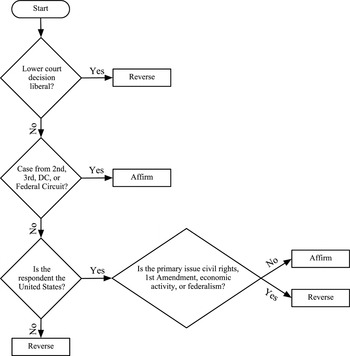
Estimated classification tree for Justice O'Connor for forecasted nonunanimous cases
The Legal Experts
The study's other method of prediction sought to capture the judgments of legal experts. Experts are distinguished from nonexperts by extensive training and experience in the relevant domain; they also have the ability to perceive meaningful patterns that cannot easily be coded into a statistical model and to structure their knowledge around principle-based schema. Often their judgments are based on qualitative analyses. The process underlying the judgments of our legal experts thus differed considerably from that underlying the model.
Because no metric exists to measure expertise precisely, we recruited participants much the way anyone might look for expert assistance: we researched their writings, checked their training and experience, and relied on referrals from knowledgeable colleagues. The 83 individuals who participated easily qualify as “experts,” having written and taught about, practiced before, and/or clerked at the Supreme Court, and developed special knowledge in one or more substantive fields of law.9
We list the names of the participating experts in an appendix to Ruger et al. 2004. We note with gratitude that the experts' participation was an entirely volunteer effort, and their substantial intellectual generosity quite literally made this project possible.
We asked experts to predict a case or cases within their areas of expertise. Experts assigned to the same case did not communicate with one another about their predictions. We requested their forecasts prior to oral argument, assuring them that their individual predictions and the cases to which they were assigned would not be revealed. Their predictions took the form of an “affirm or reverse” choice for the Court as a whole and for each justice. The bluntness of this binary choice precluded discussion of the kind of doctrinal nuance and partial holdings that are important to lawyers. However, limiting experts to a binary choice was necessary for direct comparison with the output from the statistical model.
Experts were free to consider any sources of information or factors they thought relevant to making their prediction. We provided a copy of the lower court opinion and citations to the parties' Supreme Court briefs, but did not limit experts to these materials. After they had returned their prediction for a particular case, we surveyed them regarding what factors were important to their decision. Nearly 90 percent of the experts completed at least one survey.
Results
We posted all of the statistical model and expert forecasts on the project Web site (http://wusct.wustl.edu) prior to oral argument. After decision, case outcomes and individual justice votes were coded “affirm” or “reverse.” Cases that were vacated and remanded or reversed even in part were coded as “reverse.” We use 68 cases to analyze the case outcome forecasts10
Of the 76 cases in which the Court heard oral argument, we excluded 8 from our analysis. We excluded 3 cases because they were dismissed without opinion (Abu-Ali Abdur'Rahman v. Ricky Bell, Ford Motor Co. v. McCauley, and Nike, Inc. v. Kasky) and 2 because they were affirmed by an evenly divided Court, with no information about individual votes (Borden Ranch Partnership v. U.S. Army Corps of Engineers and Dow Chemical v. Stephenson). We excluded 3 additional cases due to intractable coding ambiguities (Virginia v. Black, Green Tree Financial Corp. v. Bazzle, and National Park Hospitality Assn. v. Dept. of Interior). See Ruger et al. 2004.
We excluded Chavez v. Martinez from our vote analysis only, due to coding difficulties caused by ambiguous concurrences by some of the justices.
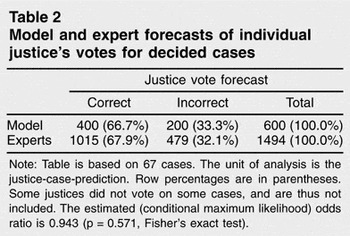
As seen in table 1, the model correctly forecast 75.0 percent of ultimate case outcomes, while the experts' predictions had an accuracy rate of only 59.1 percent. In forecasting individual justice votes, the experts did marginally better than the model. The experts' vote predictions were 67.9 percent accurate, compared to 66.7 percent correct for the model. See table 2.
Model and expert forecasts of case outcome for decided cases

Model and expert forecasts of individual justice's votes for decided cases

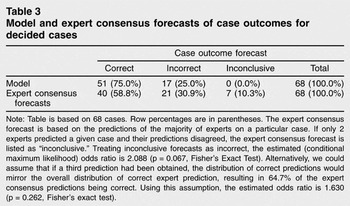
In tables 1 and 2 we treat each expert independently, summarizing the results by aggregating all expert predictions. As an alternative method of comparison,12
Treating individual expert predictions independently might be misleading, because the same number of experts did not predict each case, meaning that the weight of the machine's forecasts differs depending upon the number of experts who also predicted that case.
Cases with only two experts with opposite predictions result in an inconclusive “expert consensus” forecast. We could treat these inconclusives as incorrect (resulting in a 58.8 percent success rate for the experts), exclude them altogether (resulting in a 65.6 percent success rate), or assume that if a third prediction had been obtained in all these cases, the distribution of correct predictions would mirror the overall distribution of correct expert predictions (resulting in a 64.7 percent success rate).
Model and expert consensus forecasts of case outcomes for decided cases

For all of the tables we report the estimated (conditional maximum likelihood) odds ratio, and a p-value from Fisher's Exact Test.14
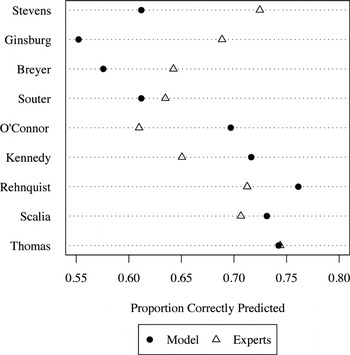
The null hypothesis is that the proportion of correct predictions by the model and the experts is the same. In table 1, which treats all expert predictions independently, the difference in forecasting accuracy of the model and the experts is statistically significant. The model clearly beats the experts on these cases, although a different result might well be obtained in a different term with another group of experts.Of greater significance than the winner of this particular contest is the model's considerable success in forecasting case outcomes. Why did the experts not do as well in predicting case outcomes? The explanation may well lie in their relative inability to predict the votes of Justice O'Connor. Figure 2 graphs the proportion of correctly predicted votes by the model and the experts, for each justice. As seen in the figure, the experts did worst at predicting O'Connor's votes among all the justices, and considerably worse than the model. Because O'Connor is often thought of as the Court's pivotal justice, the experts' relative lack of success in predicting her votes meant a poorer showing than the model in forecasting case outcomes.

Model and expert forecasts of votes for decided cases (n = 67), by justice.
Figure 2 arrays the justices along the vertical axis in order of increasing conservatism as estimated for the 2001 term by Martin and Quinn.
15 Focusing on the proportion of each justice's votes that the experts were able to predict correctly reveals an interesting pattern. The proportion of correct predictions forms a sideways
, indicating that the experts were most accurate at predicting the votes of the most ideologically extreme justices and least successful at forecasting the votes of the centrist justices. This pattern is consistent with attitudinalist explanations of justices' votes, and legal experts' implicit acceptance, at least in part, of an attitudinalist explanation. In fact, a solid majority of legal experts reported that the justices' policy preferences and their conservative or liberal ideologies were important factors in making their predictions.
16Experts were sent a survey following receipt of their prediction in a particular case. Experts predicting more than one case received a survey for each case. In all, approximately 90 percent of our experts returned at least one survey, and we received responses for 65 percent of the expert predictions made during the term. The survey presented a list of factors that might be considered relevant to predicting Court decision-making and asked experts how important each factor was to his or her prediction in a given case. Respondents were asked to rate the factors on a 5 point Likert scale (1 = not at all important; 5 = very important). Over two-thirds (67.5 percent) of the respondents indicated that the “policy preferences of the justices on the specific issue presented” was an important factor (4 or 5), and over half (54.3 percent) responded that “the conservative or liberal ideologies of the individual justices” was an important factor (4 or 5).
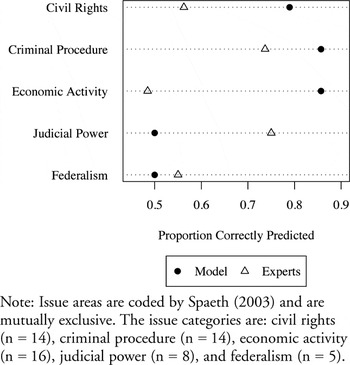
We have also sorted our results by issue area using Spaeth's coding protocol.17
These issue codes are based on the VALUE variable in Spaeth 2003.
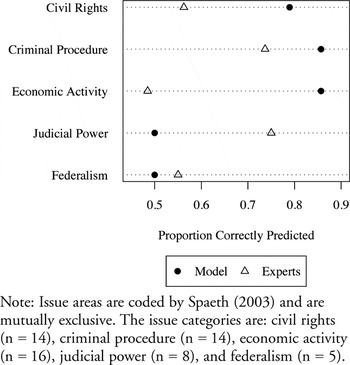
Model and expert forecasts of case outcomes for decided cases selected by issue area

Model and expert forecasts of justice votes for decided cases selected by issue area
The experts did significantly better than the model in predicting the judicial power cases (see figs. 3 and 4). These cases generally involved narrow technical issues of procedure in which the rule of decision was unlikely to have much impact outside the legal system itself. For example, Breuer v. Jim's Concrete, in which all three experts correctly predicted a 9–0 affirmance and the model predicted a 5–4 reversal, raised the question of whether statutory language conferring concurrent jurisdiction in state and federal courts barred removal to federal court of an action initiated by the plaintiff in state court. It is likely that these cases, more than most, turned on highly particularized features of the case—perhaps conventional “legal” factors such as statutory text and stare decisis—that the experts were able to recognize and incorporate into their decision-making process. The model, limited to the gross features of the case, likely missed the very specific factors on which these outcomes turned. The experts' relatively better performance in predicting justices' votes in the federalism cases also suggests that these votes often turned on factors not easily captured by the blunt case characteristics relied upon by the model.
The experts' survey responses clarify the difference in inputs between the two methods of prediction. Three of the six variables used in the model—circuit of origin, identity of the petitioner, and identity of the respondent—were deemed unimportant by large majorities of experts in the predicted cases (64 percent, 69.1 percent, and 75.5 percent, respectively). And unlike the model, the legal experts put great weight on legal authority—primarily in the form of prior Supreme Court opinions—in making their predictions. Although the statistical model's “issue area” variable incorporates some legal factors, it could only influence predictions in a fairly blunt way, in contrast to the legal experts' focus on particular cases, or even particular statements in past cases.
The two methods of prediction are perhaps most similar in taking account of the justices' preferences. The statistical model relied on a variable intended to capture the ideological direction of the lower-court opinion. In fact, the lower-court direction variable entered into the classification trees for all justices except Stevens (who was forecast to vote liberal on nearly every case), and for the small subset of cases forecast to be unanimous in the conservative direction. Similarly, substantial majorities of the experts responded that the justices' policy preferences and their conservative or liberal ideologies were important factors in their forecasts.
Conclusions and Implications
We designed this study primarily to compare two methods of assessing and predicting Supreme Court decision making. We found—somewhat to our surprise—that for this particular term the outcome predictions of the statistical model were more accurate than those of the experts, despite the fact that the experts were slightly better at forecasting the votes of individual justices. Critically, the model did significantly better than the experts at predicting the votes of Justices O'Connor, Kennedy, and Rehnquist, and this fact, coupled with the importance of those three justices in the ideological makeup of the current Supreme Court, explains much of the statistical model's success. Of course, the number of predictions is small enough that these differences may not hold across future terms, and additional iterations of this project are necessary to form firm conclusions.
With this caveat in mind, it is possible to discuss a few implications of our results. The two prediction techniques we used differ more dramatically in methodology than in underlying theory, and one methodological distinction is particularly stark. In calculating probabilities, the model incorporated each of the 628 cases that the sitting natural Court has decided in the past, and assigned each result equal empirical weight. The legal experts, by contrast, did what lawyers are trained to do—focus on a smaller subset of cases and give predominant analytical weight to a few leading cases. Law professors who study the Court retrospectively likewise focus on a handful, or at most a few dozen, important cases, rather than assess every case in a given term or given issue area. Even if an individual could take into account every case in a given term, much less a decade, the limits of human cognition would prevent an expert from assigning equal analytical weight to every case, as the model does. But there is a predictive benefit from a broad observation of past Supreme Court behavior, and there may be a similar benefit even in retrospective analyses from looking at a greater swath of Supreme Court decisions than typically considered by legal specialists.
A second difference in methodology has greater bearing on the traditional law-politics debate about the factors that underlie Supreme Court decision making. Although the model incorporated a large number of past results in its analysis, it took no account of the explanations the Court itself gave for those decisions. Nor did it take into account specific precedent or relevant statutory or constitutional text. The model is essentially nonlegal in that the factors used to predict decisions—the circuit of origin, the type of the petitioner and respondent, and so forth—are indifferent to law. If patterns relative to these observable factors capture legal differences (grounded in text, history, or precedent) at all, they do so only incidentally and with extreme generality.
Lawyers, politicians, and policy makers more generally care as much or more about the form that the law takes as about which party wins in a particular case. This concern raises the question whether a statistical model could ever forecast cases in terms of the legal principles they announce instead of a simple “affirm” or “reverse” outcome. In theory, the answer is yes, with a significant caveat. Statistical forecasting is possible whenever there is reliable training data. If a reliable and replicable scheme existed to code for legal arguments across a variety of case types, it could be applied to a large number of past cases and used to develop a model capable of predicting justices' choices among legal principles. The difficulty, of course, lies in developing such a coding system.
Conversely, although our experts were not limited to considering only “legal” factors, such as text and precedent, they did rely consistently on such factors. In addition, they were able to capture, in a manner that the model could not, factual idiosyncrasies in particular cases, and to consider how particular law might interact with particular facts to affect outcomes. Still, the overall predictive success of the model was higher—which suggests that for many cases an expert's ability to identify and analyze legal factors is not much help in predicting the Court's behavior.
Of interest in this regard is a subset of cases—those within the broad subject area of “judicial power”—where the experts did do well relative to the model. If one assumes that Supreme Court decision making is multifaceted—that it is an aggregation of the justice's preferences, of strategic interaction with other branches and within the Court, and of the constraints of text or precedent18
See, for example, Epstein and Knight 1998.
There may be another implication of this project beyond academia—in the world of litigants before the Supreme Court and (if our model is extended) before other courts. Expected outcomes play a huge role in litigants' decisions to press an appeal and in settlement negotiations, and to the extent this statistical model (or an improved future version) can reliably forecast judicial outcomes, it may benefit practicing attorneys and their clients.
Finally, we hoped through this explicitly interdisciplinary experiment to create a project of interest to the two groups of scholars who study the Supreme Court most closely, and thereby to enhance the gradually increasing dialogue between our two disciplines. This symposium is one realization of that aim, and we hope that the discussion continues with insight from others in both political science and law.
References
REFERENCES
Abel, Richard L., ed.
1995.
The law and society reader.
New York:
NYU Press.
Abu-Ali Abdur'Rahman v. Ricky Bell.
537 U.S. 968
(2002).
American Insurance Association v. Garamendi.
539 U.S. 396
(2003).
Atkins v. Virginia.
536 U.S. 304
(2002).
Beck, Ulrich
1991.
Risk society: Towards a new modernity.
Newbury Park, CA:
Sage Publications.
Berg, Joyce,
Robert Forsythe,
Forrest Nelson, and
Thomas Rietz.
2000.
Results for a dozen years of election futures markets research.
College of Business, University of Iowa.
Black, Donald.
1989.
Sociological justice.
New York:
Oxford University Press.
Borden Ranch Partnership v. U.S. Army Corps of Engineers.
537 U.S. 99
(2002).
Bowers v. Hardwick.
478 U.S. 186
(1986).
Brown v. Legal Foundation of Washington.
538 U.S. 216
(2003).
Breiman, Leo,
Jerome H. Friedman,
Richard A. Olshen, and
Charles J. Stone.
1984.
Classification and regression trees.
Belmont, CA:
Wadsworth.
Breuer v. Jim's Concrete.
538 U.S. 691
(2003).
Chavez v. Martinez.
537 U.S. 1027
(2002).
Connecticut Department of Public Safety v. Doe.
538 U.S. 1
(2003).
Cook County v. United States ex rel. Chandler.
538 U.S. 119
(2003).
Cotterrell, Roger.
1992.
The sociology of law: An introduction.
2nd ed.
London:
Butterworth.
Demore v. Kim.
538 U.S. 510
(2003).
Dow Chemical v. Stephenson.
539 U.S. 111
(2003).
Durkheim, Emile.
1964.
The rules of sociological method.
New York:
Free Press.
Eldred v. Ashcroft.
537 U.S. 186
(2003).
Epstein, Lee, and
Jack Knight.
1998.
The choices justices make.
Washington, DC:
CQ Press.
Epstein, Lee,
Jack Knight, and
Andrew D. Martin.
2003.
Childress Symposium: The political (science) context of judging.
Saint Louis University Law Journal
47 (3):
783–817.Google Scholar
Eskridge, William N., Jr.
1995.
The one senator, one vote clause.
Constitutional Commentary
12 (2):
159–62.Google Scholar
Ewick, Patricia, and
Susan S. Silbey.
1998.
The common place of law: Stories from everyday life.
Chicago:
University of Chicago Press.
Ewick, Patricia, and
Susan S. Silbey
2003.
Common knowledge and ideological critique: The significance of
knowing that the “haves” come out ahead. In
In Litigation: Do the “Haves” Still Come Out Ahead? ed.
Herbert Kritzer and
Susan S. Silbey,
273–89.
Stanford, CA:
Stanford University Press.
Ewing v. California.
538 U.S. 11
(2003).
Farber, Daniel A., and
Suzanna Sherry.
2002.
Desperately seeking certainty: The misguided quest for
constitutional foundations.
Chicago:
University of Chicago Press.
Federal Communications Commission v. NextWave Communications.
537 U.S. 293
(2003).
Federal Election Commission v. Beaumont.
539 U.S. 146
(2003).
Fisher, R. A.
1935.
The logic of inductive inference.
Journal of the Royal Statistical Society
98 (1):
39–54.Google Scholar
Ford Motor Co. v. McCauley.
537 U.S. 1
(2002).
Forsythe, Robert,
Forrest Nelson,
George R. Neumann, and
Jack Wright.
1992.
Anatomy of an experimental political stock market.
American Economic Review
82 (5):
1142–61.Google Scholar
Freidson, Eliot.
2001.
Professionalism, The third logic.
Cambridge, UK:
Polity Press.
Friedman, Lawrence.
1977.
Law and society: An introduction.
Englewood, NJ:
Prentice Hall.
Friedman, Lawrence
1984.
American law.
New York:
W. W. Norton.
Galanter, Marc.
1974.
Why the “haves” come out ahead: Speculations on the
limits of legal change.
Law and Society Review
9 (1):
95–160.Google Scholar
Giddens, Anthony.
1990.
The consequences of modernity.
Stanford:
Stanford University Press.
Goodman, Douglas.
2003.
Consumption as a social problem. In
The handbook of social problems, ed.
G. Ritzer,
236–45.
Thousand Oaks, CA:
Sage, 2003.
Goodman, Douglas, and
Susan S. Silbey.
2004.
Defending the liberal arts against law. In
Law in the liberal arts, ed.
Austin Sarat,
17–40.
Ithaca:
Cornell University Press.
Gratz v. Bollinger.
539 U.S. 244
(2003).
Greenhouse, Linda.
2002a.
Justices to reconsider ruling against sex between gays.
New York Times, December 3.
Greenhouse, Linda
2002b.
Supreme Court seems skeptical of F.C.C. position on Next Wave.
New York Times, October 9.
Greenhouse, Linda
2002c.
Justices hear arguments on extension of copyrights.
New York Times, October 10.
Greenhouse, Linda
2002d.
Court revisits question of jury selection bias.
New York Times, October 17.
Greenhouse, Linda
2002e.
California's 3-strikes law tested again.
New York Times, November 6.
Greenhouse, Linda
2002f.
Asbestos appeal centers on fear of cancer.
New York Times, November 7.
Greenhouse, Linda
2002g.
Method of legal services financing is challenged before Supreme
Court.
New York Times, December 10.
Greenhouse, Linda
2002h.
An intense attack by Justice Thomas on cross-burning.
New York Times, December 12.
Greenhouse, Linda
2002i.
Court ponders limits of punitive damages.
New York Times, December 12.
Greenhouse, Linda
2003a.
Nike, fighting trade suit, asks justices for free-speech
protection.
New York Times, April 24.
Greenhouse, Linda
2003b.
Medical leave act is debated in major federalism case.
New York Times, January 16.
Greenhouse, Linda
2003c.
Justices seem to lean to charity telemarketer.
New York Times, March 4.
Greenhouse, Linda
2003d.
Justices hear arguments on campaign finance.
New York Times, March 26.
Greenhouse, Linda
2003e.
Court appears ready to reverse a sodomy law.
New York Times, March 27.
Greenhouse, Linda
2003f.
Affirmative reaction: Can the justices buck what the establishment
backs?
New York Times, March 30.
Greenhouse, Linda
2003g.
Justices look for nuance in race-preference case.
New York Times, April 2.
Greenhouse, Linda
2003h.
Justices show their doubts on state law on Holocaust.
New York Times, April 24.
Greenhouse, Linda
2003i.
First Amendment argument is made in a trespass case.
New York Times, May 1.
Greenhouse, Linda
2003j.
In a momentous term, justices remake the law, and the Court.
New York Times, July 1.
Greenhouse, Linda
1984.
The theory of communicative action. Vol. 1, Reason and the
rationalization of society.
Boston:
Beacon Press.
Greenhouse, Linda
1987.
The theory of communicative action. Vol. 2, Lifeworld and system.
Boston:
Beacon Press.
Greenhouse, Linda
1998.
Between facts and norms: Contributions to a discourse theory of law
and democracy.
Cambridge:
MIT Press.
Green Tree Financial Corp. v. Bazzle.
539 U.S. 444
(2003).
Grutter v. Bollinger.
539 U.S. 982
(2003).
Habermas, Jürgen.
1984.
The theory of communicative action. Vol. 1, Reason and the
rationalization of society.
Boston:
Beacon Press.
Habermas, Jürgen
1987.
The theory of communicative action. Vol. 2, Lifeworld and system.
Boston:
Beacon Press.
Habermas, Jürgen
1998.
Between facts and norms: Contributions to a discourse theory of law
and democracy.
Cambridge:
MIT Press.
Hillside Dairy Inc. v. Lyons.
539 U.S. 59
(2003).
Holmes, Oliver Wendell.
1881.
The common law.
Boston:
Little, Brown.
Hunt, Alan
1978.
The sociological movement in law.
London:
Macmillan.
Illinois ex rel. Madigan, Attorney General of Illinois v.
Telemarketing Associates.
538 U.S. 600
(2003).
Jacobellis v. Ohio.
378 U.S. 184
(1964).
Johnson, Timothy R.
2004.
Oral arguments and decision making on the United States Supreme
Court.
New York:
SUNY Press.
King, Gary,
Robert O. Keohane, and
Sidney Verba.
1994.
Designing social inquiry: Scientific inference in qualitative
inference.
Princeton:
Princeton University Press.
Kritzer, Herbert, and
Susan S. Silbey, eds.
2003.
In litigation: Do the haves still come out ahead.
Stanford:
Stanford University Press.
Lane, Charles.
2003
Civil liberties were term's big winner.
Washington Post, June 29.
Lawrence v. Texas.
539 U.S. 558
(2003).
Levitt, Peggy.
2002.
Transnational villagers.
Berkeley:
University of California Press.
Lewis-Beck, Michael S., and
Tom W. Rice.
1992.
Forecasting elections.
Washington, DC:
CQ Press.
Martin, Andrew D., and
Kevin M. Quinn.
2002.
Dynamic ideal point estimation via Markov chain Monte Carlo for the
U.S. Supreme Court, 1953–1999.
Political Analysis
10 (2):
134–53.Google Scholar
Martin, Andrew D.,
Kevin M. Quinn,
Theodore W. Ruger, and
Pauline T. Kim.
2004.
Competing approaches to predicting Supreme Court decision making.
Perspectives on Politics
2 (4):
761–767.Google Scholar
McGuire, Kevin, and
Barbara Palmer.
1995.
Issue fluidity on the U.S. Supreme Court.
American Political Science Review
89 (3):
691–702.Google Scholar
Meehl, Paul.
1954.
Clinical vs. statistical prediction.
Minneapolis:
University of Minnesota Press.
Meirowitz, Adam, and
Joshua A. Tucker.
2004.
Learning from terrorism markets.
Perspectives on Politics
2 (2):
331–36.Google Scholar
Menand, Louis.
2001.
The metaphysical club.
New York:
Farrar Straus Giroux.
Merrill, Thomas W.
2003.
Childress Symposium: The making of the second Rehnquist Court: A
preliminary analysis.
Saint Louis University Law Journal
47 (3):
569–658.Google Scholar
Miller-El v. Cockrell.
537 U.S. 322
(2003).
Moseley v. V Secret Catalogue.
537 U.S. 418
(2003).
National Park Hospitality Assn. v. Dept. of Interior.
538 U.S. 803
(2003).
Nevada Department of Human Resources v. Hibbs.
538 U.S. 721
(2003).
Nguyen v. United States.
539 U.S. 69
(2003).
Nike, Inc. v. Kasky.
539 U.S. 654
(2003).
Nisbett, Richard, and
Lee Ross.
1980.
Human inference: Strategies and shortcomings of social judgment.
Englewood Cliffs, NJ:
Prentice-Hall.
Norfolk & Western Railway Co. v. Ayers.
538 U.S. 135
(2003).
O'Connor, Sandra Day.
2003.
The majesty of the law: Reflections of a Supreme Court justice.
New York:
Random House.
Penry v. Lynaugh.
492 U.S. 302
(1989).
Pharmaceutical Research and Manufacturers of America v. Walsh.
538 U.S. 644
(2003).
Pierce County v. Guillen.
537 U.S. 129
(2003).
Poole, Keith T., and
Howard Rosenthal.
1991.
Patterns of congressional voting.
American Journal of Political Science
35 (1):
228–78.Google Scholar
Poole, Keith T., and
Howard Rosenthal
1997.
Congress: A political-economic history of roll call voting.
New York:
Oxford University Press.
Quinn, James B.
1992.
Intelligent enterprise: A knowledge and service based paradigm for
industry.
New York:
Free Press.
Romer v. Evans.
517 U.S. 620
(1996).
Ruger, Theodore W.,
Pauline T. Kim,
Andrew D. Martin, and
Kevin M. Quinn.
2004.
The Supreme Court Forecasting Project: Legal and political science
approaches to predicting Supreme Court decisionmaking.
Columbia Law Review
104 (4):
1150–1209.Google Scholar
Scheidler v. National Organization for Women.
537 U.S. 393
(2003).
Segal, Jeffrey A., and
Harold J. Spaeth.
2002.
The Supreme Court and the attitudinal model revisited.
New York:
Cambridge.
Sell v. United States.
539 U.S. 166
(2003).
Sherry, Suzanna.
1986.
Civic virtue and the feminine voice in constitutional adjudication.
Virginia Law Review
72 (April):
543–616.Google Scholar
Silbey, Susan S.
1997.
Let them eat cake: Globalization, postmodern colonialism and the
possibilities of justice.
Law & Society Review
31 (2):
207–35.Google Scholar
Simon, Jonathan.
1988.
Ideological effects of actuarial practices.
Law & Society Review
22 (4):
771–800.Google Scholar
Sirovich, Lawrence.
2003.
A pattern analysis of the second Rehnquist U.S. Supreme Court.
Proceedings of the National Academy of Sciences.
http://www.pnas.org/cgi/10.1073/pnas.1132164100.Google Scholar
Smith, A. D.
1990.
Toward a global culture?
Theory, culture and society
7 (2–3):
171–91.Google Scholar
Smith v. Doe.
538 U.S. 84
(2003).
Spaeth, Harold J.
2003.
The original United States Supreme Court judicial database,
1953–2002 terms.
Program for Law and Judicial Politics, Michigan State University.
State Farm v. Campbell.
538 U.S. 408
(2003).
Stewart, Sharla.
2003.
Revolution from within.
University of Chicago Magazine
95 (2):
33–37.Google Scholar
Stogner v. California.
539 U.S. 607
(2003).
Sutton, John.
2001.
Law/society: Origins, interactions, and change.
Boston Thousand Oaks, CA:
Pine Forge Press.
United States v. American Library Association.
539 U.S. 194
(2003).
United States v. Bean.
537 U.S. 71
(2002).
Virginia v. Black.
U.S.538 U.S. 343
(2003).
Virginia v. Hicks.
539 U.S. 113
(2003).
Wasby, Stephen,
Anthony D'Amato, and
Rosemary Metrailer.
1976.
The functions of oral argument in the U.S. Supreme Court.
Quarterly Journal of Speech
62 (4):
410–22.Google Scholar
Washington Legal Foundation v. Legal Foundation of Washington.
See Brown v. Legal Foundation of Washington.
Wiggins v. Smith.
539 U.S. 510
(2003).
Zadvydas v. Davis.
533 U.S. 678
(2001).
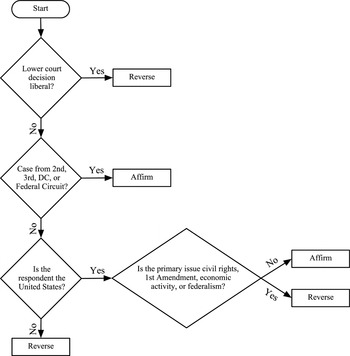
Estimated classification tree for Justice O'Connor for forecasted nonunanimous cases
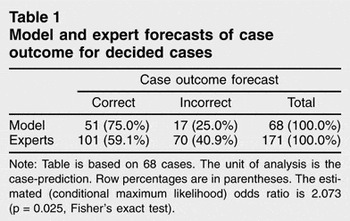
Model and expert forecasts of case outcome for decided cases
Model and expert forecasts of individual justice's votes for decided cases
Model and expert consensus forecasts of case outcomes for decided cases
Model and expert forecasts of votes for decided cases (n = 67), by justice.
Model and expert forecasts of case outcomes for decided cases selected by issue area
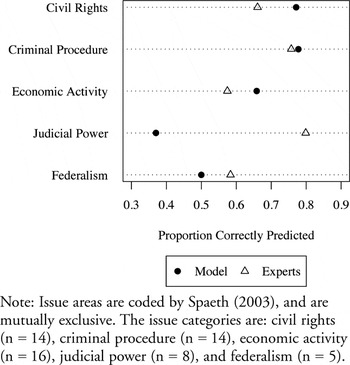
Model and expert forecasts of justice votes for decided cases selected by issue area
 You have
Access
- 72
- Cited by