Introduction
Microsurgery for vestibular schwannoma has seen significant development since it was first described in the 1700s.Reference Cushing1 Since then, there have been advances in anaesthesia, incorporation of the microscope, and the advancement of medical instruments and nerve monitoring systems to assist with tumour dissection and optimise patient outcomes.
Vestibular schwannoma tumours are relatively rare, with an estimated incidence rate of 1.1 per 100 000 persons per year, and have a variable but generally slow-growing growth rate.Reference Gal, Shinn and Huang2 As vestibular schwannoma is not usually life-threatening, clinicians need to consider long-term consequences for patients that are not purely focused on surgical outcomes but also on outcomes affecting quality of life (QoL). Microsurgery is one of the recommended management options that also includes observation and stereotactic radiation. Now that contemporary microsurgical technique has been in existence for over a decade, it is important to look at outcomes over longer periods to better assist patient counselling when faced with a presentation of vestibular schwannoma.
Quality of life is accepted to be best measured through self-assessed questionnaires to determine subjective patient QoL. Although there is a developing body of literature surrounding immediate and short-to-medium term QoL outcomes in patients with vestibular schwannoma, there is minimal literature providing long-term QoL outcomes for patients. There are also conflicting results with regard to which factors relate to QoL outcomes in the long term.
This aim of this study was to provide both surgical and QoL outcomes in the long-term for patients with vestibular schwannoma managed by an experienced acoustic neuroma team, and to examine the factors that influence QoL. This will serve to inform clinicians on expected outcomes and targeted rehabilitation strategies.
Materials and methods
This was a retrospective cohort study of 99 patients with vestibular schwannoma who had microsurgery between 2000 and 2007. The senior author (MD Atlas) was one of the operative surgeons in all cases, either as the primary surgeon or co-surgeon, who worked in conjunction with the other authors at Sir Charles Gairdner Hospital, Nedlands, Australia, St John of God Hospital Subiaco, Australia, and the Ear Science Institute, Perth, Australia. This study was approved by the St John of God Institutional Review Board (approval number: 505).
Patients who had been diagnosed with sporadic vestibular schwannoma and managed by microsurgery and who had 10 or more years of follow up since the time of surgery were included in the study. Eleven patients who had surgery over 10 years ago, including 3 patients who died of unrelated causes and 8 patients who were lost to follow up, were excluded from the study. Microsurgery was categorised by approach (translabyrinthine, middle cranial fossa or retrosigmoid approach) and degree of resection (gross total or incomplete resection (near total and subtotal resection included together)). Patients were excluded if they had received radiotherapy for their vestibular schwannoma or could not be contacted for a phone interview (response rate of 93 per cent of the remaining 107 alive patients).
Pre-management demographic data, medical history, tumour characteristics and audiological data were recorded. Tumour size was evaluated in millimetres by measuring the maximal diameter of the intracranial component from the most recent pre-operative magnetic resonance imaging scan. In addition, information on post-management symptoms were collected. This included the presence of hearing loss (including word recognition scores and pure tone audiometry), tinnitus, imbalance, headaches, facial nerve dysfunction (House–Brackmann grade) at one year, fatigue, mood disturbance (self-perceived or diagnosed depression), swallowing dysfunction, taste disturbance and memory impairment. The symptoms were defined as present if they were documented as existing in the post-operative clinical notes and were a combination of patient self-reported symptoms and objective assessment by the clinician.
Quality of life was assessed using the short form 12 item (version 2) health survey and the Glasgow Benefit Inventory in the form of a telephone interview.Reference Ware3,Reference Robinson, Gatehouse and Browning4 The short form 12 item (version 2) health survey divides QoL into 8 different categories including general health perceptions, physical functioning, vitality, bodily pain, physical role functioning, emotional role functioning, social role functioning and mental health. Results are then presented as a physical component summary and a mental component summary.Reference Ware3 The Glasgow Benefit Inventory produces a global score (Glasgow Benefit Inventory total) as well as scores for general well-being, social support and physical health.Reference Robinson, Gatehouse and Browning4
Statistical analyses included one-way analysis of variance with Tukey adjustments to compare QoL measures between gross total and incomplete resection. Pearson's chi-square test and two-sample tests of proportion were used to assess associations in post-operative symptomatology. A linear regression analysis using Pearson's correlation coefficient and least squares regression analyses were used to determine relationships between demographics, symptoms and QoL.
Results
Demographics
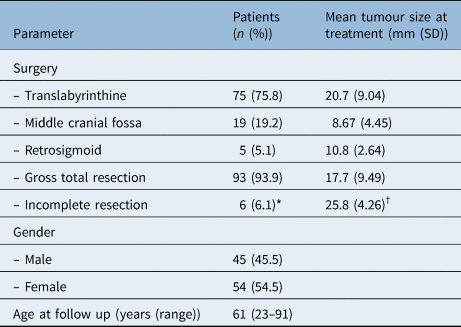
Demographic data of the 99 patients are presented in Table 1. The average length of follow up was 12.7 years (range, 10–17 years). Nine patients presented with American Academy of Otolaryngology Head and Neck Surgery (AAO-HNS) class D hearing loss, with seven patients going on to have translabyrinthine approach surgery and two patients going on to have middle cranial fossa approach surgery. The majority of patients underwent a translabyrinthine approach surgery (75.8 per cent) with resulting hearing loss. In addition to the two patients presenting with hearing loss, post-operative hearing loss (AAO-HNS class D) was identified in a further nine middle cranial fossa approach patients (a total of 11 of 19 patients). Four out of five patients who had the retrosigmoid approach surgery also had post-operative AAO-HNS class D hearing loss. A small group of patients underwent an incomplete resection (6.1 per cent), with these patients having a significantly larger tumour size than patients who had received a gross total resection (p = 0.002).
Demographic information for patients with vestibular schwannoma managed with microsurgery

*Translabyrinthine = 5, middle cranial fossa = 1; †Significant difference (p < 0.05) when comparing tumour size between gross total and incomplete resection
Surgical outcomes
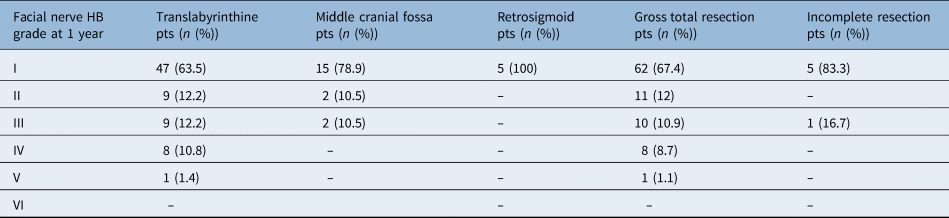
In one patient, who had a gross total resection with translabyrinthine approach, facial nerve function data were not documented (Table 2). Although there was an apparent trend for poorer House–Brackmann grade with the translabyrinthine approach, this was not statistically significant (χ2(8) = 5.47, p = 0.706). Nor was there any association between degree of resection and facial nerve function (χ2(4) = 1.68, p = 0.79). However, there was a linear relationship between increasing tumour size and increasing (poorer) House–Brackmann grade (r Reference Gal, Shinn and Huang2 = 0.15, p < 0.01). There was also a trend for larger tumours and translabyrinthine approaches (F(2) = 9.52, p < 0.01); however, given the comparatively very few middle cranial fossa and retrosigmoid approaches, this was insufficiently powered (power = 0.14).
Facial nerve function at one-year post-microsurgery by surgical approach and degree of resection

HB = House–Brackmann; pts = patients
Quality of life
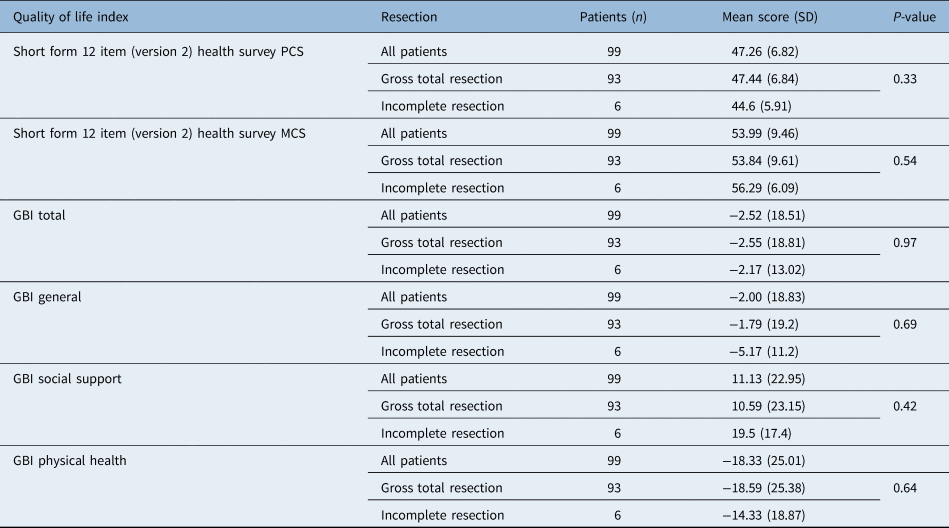
Gender had no relationship with QoL outcomes for the physical component summary, mental component summary and Glasgow Benefit Inventory (p = 0.09, 0.33 and 0.24, respectively). Increasing age had a negative relationship with the physical component summary (r = −0.26, p = 0.01), but no relationship with the mental component summary or Glasgow Benefit Inventory (r = 0.11, p = 0.31, r = 0.14, p = 0.18, respectively). No significant differences between gross total and incomplete resection were found for QoL measures (Table 3).
Long-term quality of life in patients with acoustic neuroma managed with microsurgery

P-values for one-way analysis of variance are presented comparing means of quality of life measured by degree of resection. SD = standard deviation; PCS = physical component summary; MCS = mental component summary; GBI = Glasgow Benefit Inventory
Symptomatology and QoL
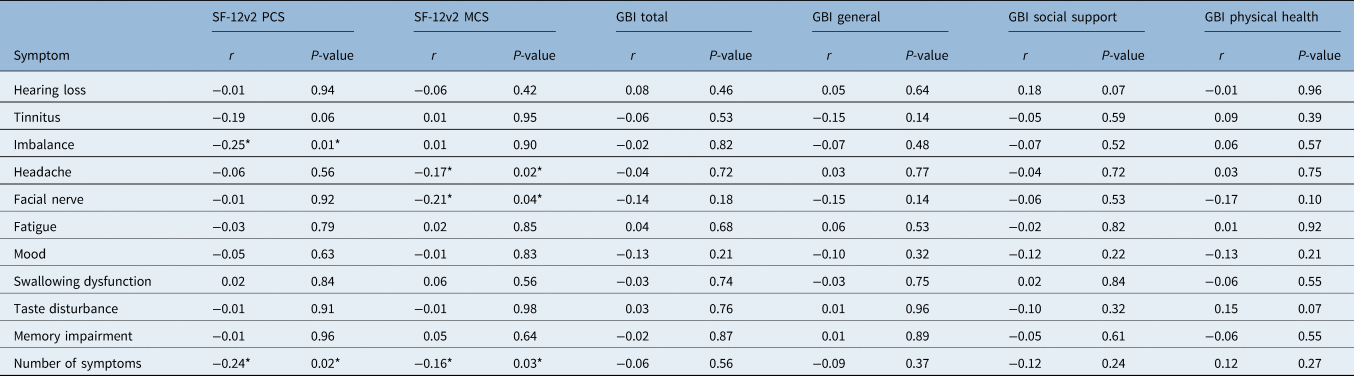
The median symptom burden was 2 (mean = 1.9, range 0–5), with the majority of patients suffering at least unilateral hearing loss (90 of 99 patients, 91 per cent). The subsequent most common symptoms were facial nerve dysfunction (31 of 99, 31 per cent), imbalance (22 of 99, 22 per cent), tinnitus (16 of 99, 16 per cent) and headache (12 of 99, 12 per cent). A linear relationship was found with increasing symptom burden being associated with poorer QoL using both the physical component summary and mental component summary measures (p = 0.02 and p = 0.03, respectively) (Table 4).
Correlations between post-treatment symptomatology and quality of life for all microsurgical patients

*significant relationships between symptoms and quality of life. Imbalance, headache, facial nerve symptoms and increasing number of symptoms were correlated with poorer quality of life scores. Data shows correlations between symptoms and quality of life for all patients, using a least squares regression analysis with Pearson correlation coefficient (r). SF-12v2 = short form 12 item (version 2) health survey; PCS = physical component summary; MCS = mental component summary; GBI = Glasgow Benefit Inventory
The presence of ongoing post-treatment imbalance (poorer physical component summary scores, p = 0.01), the presence of ongoing headache (poorer mental component summary scores, p = 0.04) and poorer facial nerve function at one year (poorer mental component summary scores, p = 0.02) were related to poorer scores in the short form 12 item (version 2) health survey. No significant relationship was found between any post-treatment symptoms and change in Glasgow Benefit Inventory score.
Discussion
Assessing QoL in vestibular schwannoma can be controversial because of the lack of consistency in measurement tools and the studies assessing it.Reference Gauden, Weir, Hawthorne and Kaye5 The measurement tools used to report QoL in vestibular schwannoma include the 36-item short form health survey, 12-item short form health survey, Glasgow Benefit Inventory, the Penn Acoustic Neuroma Quality Of Life survey, the Facial Clinimetric Evaluation Scale, the Patient-Reported Outcomes Measurement Information System, the Health Related Quality of Life survey and the Dizziness Handicap Inventory.Reference Brooker, Fletcher, Dally, Briggs, Cousins and Smee6–Reference Martin, Sethi, Lang, Neil-Dwyer, Lutman and Yardley14 We recognise that with such a large number of ways to evaluate QoL in vestibular schwannoma, there will inevitably be debate regarding which is the most accurate in reflecting QoL.
Increasing age is often shown to relate to poorer QoL in vestibular schwannoma management.Reference Brooker, Fletcher, Dally, Briggs, Cousins and Smee6,Reference Betchen, Walsh and Post7,Reference Tufarelli, Meli, Alesii, De Angelis, Badaracco and Falcioni15,Reference Carlson, Tveiten, Driscoll, Goplen, Neff and Pollock16 Our cohort also showed an inverse linear relationship between age and QoL. This is likely because of accumulating medical comorbidities, anxiety and depression, and poorer well-being that is associated with increasing age.Reference Dall, Gallo, Chakrabarti, West, Semilla and Storm17–Reference Fried, Ferrucci, Darer, Williamson and Anderson20 Our study did not identify a relationship between gender and QoL unlike other studies that reported poorer QoL for the female gender in vestibular schwannoma.Reference Betchen, Walsh and Post7,Reference Martin, Sethi, Lang, Neil-Dwyer, Lutman and Yardley14,Reference Tufarelli, Meli, Alesii, De Angelis, Badaracco and Falcioni15 No hypotheses are proposed for why females had poorer QoL scores in the above studies.
Our study is consistent with others in showing that patients report worse QoL when they are overwhelmed with their symptoms.Reference Brooker, Fletcher, Dally, Briggs, Cousins and Smee6,Reference Martin, Sethi, Lang, Neil-Dwyer, Lutman and Yardley14 This is also consistent with other areas of medicine.Reference Gapstur21 Physicians should apply generalised management strategies to reduce total symptom burden but also provide encouragement to the treating physician that when one symptom is difficult to manage, the overall effect on the patient can be reduced by concentrating on other more manageable symptoms.
Having persistent imbalance post-operatively leads to poorer QoL, a finding that is common in other studies.Reference Carlson, Tveiten, Driscoll, Neff, Shepard and Eggers10,Reference Deberge, Meyer, Le Pabic, Peigne, Morandi and Godey22 One study identified dizziness, reported as either vertigo, general unsteadiness or light headedness, as the most significant driver of QoL in patients post-microsurgery.Reference Carlson, Tveiten, Driscoll, Goplen, Neff and Pollock16 This is not surprising given that dizziness and imbalance leads to poor QoL in patients outside of vestibular schwannoma.Reference Tinetti, Williams and Gill23 These patients report a higher degree of functional disability and poorer mood.Reference Tinetti, Williams and Gill23–Reference Stevens, Lang, Guralnik and Melzer26 Despite the body's innate ability for vestibular compensation, a significant number of patients report long-term (8–10 years) dizziness and imbalance post-microsurgery.Reference Carlson, Tveiten, Driscoll, Neff, Shepard and Eggers10,Reference El-Kashlan, Shepard, Arts and Telian27,Reference Wiegand and Fickel28 Worse post-treatment dizziness and imbalance is associated with the presence of disabling dizziness prior to surgery, increasing age and reduced physical activity.Reference Carlson, Tveiten, Driscoll, Neff, Shepard and Eggers10,Reference El-Kashlan, Shepard, Arts and Telian27,Reference Driscoll, Lynn, Harner, Beatty and Atkinson29,Reference Parietti-Winkler, Lion, Frere, Perrin, Buerton and Gauchard30 The relationship between pre- and post-operative dizziness could identify delayed or poorer central vestibular compensation or the presence of other non-compensatable causes of dizziness such as presyncope.
Vestibular rehabilitation expedites and improves vestibular compensation,Reference McDonnell and Hillier31–Reference Cohen33 and all patients in this series had vestibular rehabilitation from a dedicated physical therapist in the immediate in-patient post-operative phase and as an out-patient depending on patient and physician wishes. Given the significance that dizziness and imbalance play in QoL, more intensive vestibular rehabilitation schedules could be beneficial, especially given that delayed intervention is less effective in improving overall balance outcome.Reference McDonnell and Hillier31–Reference Cohen33 Some have argued that pre-operative vestibular ablation via chemical labyrinthectomy improves post-operative vestibular compensation; however, the mid- to long-term effects of this requires further study.Reference Tjernstrom, Fransson, Kahlon, Karlberg, Lindberg and Siesjo34
The presence of headaches was independently associated with poorer QoL mental health scores. This is consistent with previous studies.Reference Betchen, Walsh and Post7,Reference Carlson, Tveiten, Driscoll, Neff, Shepard and Eggers10,Reference Link, Lund-Johansen, Lohse, Driscoll, Myrseth and Tveiten13 It has been suggested that headaches are the second most significant influencer of poor QoL after dizziness.Reference Carlson, Tveiten, Driscoll, Goplen, Neff and Pollock16 People who suffer with chronic headaches are twice as likely to develop chronic pain, depression and anxiety.Reference Cavallini, Micieli, Bussone, Rossi and Nappi35,Reference Kim and Park36 The retrosigmoid approach has been reported to have worse headache outcomes, particularly in patients who have craniectomy rather than craniotomy.Reference Schaller and Baumann37–Reference Schessel, Rowed, Nedzelski and Feghali39 It is postulated that this could be due to fibrous dural adhesions, the presence of intracranial bone dust, injury to the occipital nerve, cerebrospinal fluid leak and muscle spasm.Reference Sabab, Sandhu, Bacchi, Jukes and Zacest40 Fibrous dural adhesions are the result of tight closure of the dura (to prevent cerebrospinal fluid leak and aseptic meningitis), resulting in the adherence of richly innervated nuchal muscle fibres to the dura, and traction of these fibres results in pain and headaches.Reference Schessel, Rowed, Nedzelski and Feghali39 This relationship was not identified in this study, which only had a small number of retrosigmoid approach cases (five patients).
A number of other factors have been reportedly associated with post-operative headaches in vestibular schwannoma including younger age, female gender, the presence of pre-operative headaches, and the presence of anxiety or depression.Reference Carlson, Tveiten, Driscoll, Neff, Shepard and Eggers10Reference Rigby, Shah, Jackler, Chung and Cooke41–Reference Carlson, Tveiten, Driscoll, Boes, Sullan and Goplen44 None of these associations were identified in the present study. The association between mood disorders and headache symptoms are well-established.Reference Rimaaja, Haanpaa, Blomstedt and Farkkila43,Reference Juang, Wang, Fuh, Lu and Su45 Younger females have a higher prevalence of migraines and headaches in the general population, and it is possible that the relationship between pre-existing headaches, mood disorders and young females and the presence of post-operative headache is explained by a separate association and is unrelated to vestibular schwannoma. Analgesia for post-operative headaches needs to be tailored to the individual and suspected cause. In young females, the consideration of concomitant migraine and neurology input should be considered. Post-operative headaches can involve a number of management approaches.Reference Ryzenman, Pensak and Tew42 Simple analgesia is used in the majority of cases (acetaminophen and non-steroidal anti-inflammatory drugs) with adequate response in 29–61 per cent of patients.Reference Ryzenman, Pensak and Tew42,Reference Levo, Pyykko and Blomstedt46 Opioids for post-operative headache have been used less widely, with one study reporting regular use by 15 per cent of patients.Reference Ryzenman, Pensak and Tew42 The use of local anaesthetic injections in post-operative headache (presumed occipital neuralgia) has proven unsuccessful.Reference Levo, Blomstedt, Hirvonen and Pyykko47,Reference Schessel, Nedzelski, Rowed and Feghali48 In a small cohort of patients diagnosed with occipital neuralgia following vestibular schwannoma surgery, occipital nerve excision led to reversal of headache in 80 per cent of patients.Reference Ducic, Felder and Endara49 Chiropractic manipulation, acupuncture and acupressure has not been shown to be effective in managing post-operative headache in these patients.Reference Schessel, Nedzelski, Rowed and Feghali48 It is important to note that adequate and timely management of headache and post-operative pain is very important in preventing debilitating chronic pain, which can be very difficult to control particularly if patients are already taking regular opioids for headaches. The presence of headache risk factors prior to surgery can inform patient counselling, as well as affect surgical approach and technique. It may be necessary to involve neurology or psychiatry teams to optimise patient outcomes early on.
We show that worsening facial nerve function has a linear relationship with QoL. The effect of facial nerve function on QoL has been contentious. A number of studies have identified a similar relationship,Reference Leong and Lesser8,Reference Carlson, Tveiten, Driscoll, Goplen, Neff and Pollock16,Reference Cross, Sheard, Garrud, Nikolopoulos and Donoghue50 whereas others have shown no relationship.Reference Betchen, Walsh and Post7,Reference Martin, Sethi, Lang, Neil-Dwyer, Lutman and Yardley14,Reference Kelleher, Fernandes, Sim and O'Sullivan51 When ranked according to other determinants, facial nerve dysfunction is less important than imbalance, headaches or tinnitus.Reference Carlson, Tveiten, Driscoll, Goplen, Neff and Pollock16 It is more important in younger females, where self-esteem seems to be more affected by physical appearance.Reference Leong and Lesser8,Reference Cross, Sheard, Garrud, Nikolopoulos and Donoghue50,Reference Golan, Hagay and Tamir52 There is likely some selection bias in the studies identifying poorer QoL because responses were elicited from patients who had joined vestibular schwannoma support groups, indicating potentially higher levels of distress.Reference Leong and Lesser8,Reference Cross, Sheard, Garrud, Nikolopoulos and Donoghue50 It is unclear whether certain components of facial nerve function are more important than others for QoL (e.g. mouth closure during eating) as this has not been addressed in the literature. Facial reanimation techniques can result in significant aesthetic and functional improvements; however, there is a need for this intervention to be performed early on due to the potential for poorer functional outcomes secondary to muscle atrophy by 4–6 months.Reference Hohman and Hadlock53 By two years, there is almost complete degradation of the motor end plates and reinnervation is ineffective.Reference Gordin, Lee, Ducic and Arnaoutakis54 This highlights the need to manage facial nerve expectations pre-operatively and to address facial nerve function in post-operative patients to co-ordinate early rehabilitation to optimise QoL.
Traditionally larger tumours with adherence to or splaying of the facial nerve have been more typically managed with a near total resection in order to optimise cranial nerve function and reduce post-treatment morbidity. Interestingly, a recent study found that the near total resection group had significantly poorer mental health scores than patients who had received a gross total resection, which might be attributable to a potential mental health toll taken by the ongoing presence of a residual tumor.Reference Link, Lund-Johansen, Lohse, Driscoll, Myrseth and Tveiten13 Many studies have compared QoL in patients being serially observed to microsurgery; however, to our knowledge, there are no other studies that have analysed the effect of residual tumours post-microsurgery. Serially observed patients tend to have equivalent or better QoL measures than microsurgery patients.Reference Brooker, Fletcher, Dally, Briggs, Cousins and Smee6,Reference Robinett, Walz, Miles-Markley, Moberly and Welling9,Reference Myrseth, Moller, Pedersen, Vassbotn, Wentzel-Larsen and Lund-Johansen11,Reference Cheng, Naidoo, da Cruz and Dexter55–Reference Pollock, Driscoll, Foote, Link, Gorman and Bauch58 Our cohort did not have enough incomplete resections to draw comparison. Similarly, we are unable to draw conclusions on whether incomplete resections resulting in preserved facial nerve outcome had QoL benefits over complete resections with poorer facial nerve function.
How a particular patient sees their own QoL is complex. Most instruments used to measure it focus on patient satisfaction or dissatisfaction and objective functional ability, but rarely do these instruments consider the human experience.Reference Milton59 The perception of QoL is highly individualised, with some components being robust and fixed and other elements fluctuating depending on environment and circumstances.Reference Milton59,Reference Parse60 The challenge here for QoL measuring instruments is that every patient has different expectations (of operative outcomes, of what is normal or abnormal, of acceptable symptoms and so on) that are borne out of unique interactions of patient history, age, sex, socioeconomic status, ethnicity, and religion or spirituality.Reference Carr, Gibson and Robinson61
Perceived wellness, happiness and functionality are likely to fluctuate to some degree depending on day-to-day activity and interactions and life stresses, and this could mean the same person might give quite different responses depending on the day of testing. As expectations can have a big impact on perceived QoL, this study will help in managing these expectations and in turn improve QoL in patients with vestibular schwannoma undergoing microsurgery.Reference Carr, Gibson and Robinson61 The implications here are that managing patient expectations and appropriate counselling can potentially increase patient satisfaction and QoL, as can providing holistic, patient-centred care.
• Very few studies have looked at long-term quality of life (QoL) (more than 10 years) in patients who have had vestibular schwannoma surgery
• Increasing age and increasing symptom burden have been shown to poorly affect QoL
• Imbalance, headache and facial nerve dysfunction have been shown to have negative effects on QoL in particular
• QoL is highly individual and complex
• Managing expectations and providing holistic, patient-centred care can go a long way in promoting patient satisfaction and QoL in surgical patients
Conclusion
Imbalance, headache and facial nerve dysfunction were found to correlate with poorer QoL outcomes in patients with surgically treated vestibular schwannoma. Increasing symptom burden along with increasing age were also associated with poorer QoL. This is consistent with previous literature, with facial nerve dysfunction being somewhat more variable in its effect on QoL. Inconsistencies in QoL results across studies may reflect a failure in the QoL measure to adequately assess individual factors that shape perceived QoL. No relationship between the presence of a residual tumour and QoL was identified in this study; however, the sample size of patients with incomplete resections was very small, limiting any comment on an association.
Acknowledgements
The following people need to be thanked for their assistance in data collection: Karen Dick, Jonathon Chiew and Jessica Sommer.
Competing interests
None declared