INTRODUCTION
Secondary carbonate deposits very similar to the speleothems found in caves can develop in historical aqueducts or urban underground structures such as technical galleries. These urban secondary carbonate deposits (USCDs) can be used to reconstruct historical variations in land use that change the water quality by the input of chemical elements or pollutants (e.g., sulfate or lead see Pons-Branchu et al. Reference Pons-Branchu, Ayrault, Roy-Barman, Bordier, Borst, Branchu, Douville and Dumont2015, Reference Pons-Branchu, Roy-Barman, Jean-Soro, Guillerme, Branchu, Fernandez, Dumont, Douville, Michelot and Phillips2017). A recent study of an indoor USCD in a historical spa from Budapest (Hungary) highlighted the increasing interest in these deposits in urban or highly anthropized sites (Virág et al. Reference Virág, Molnár, Braun and Mindszenty2020). Establishing a precise chronology of these natural archives is challenging, however. The difficulties reside in the presence of a detrital fraction when using the U/Th technique (Pons-Branchu et al. Reference Pons-Branchu, Douville, Roy-Barman, Dumont, Branchu, Thil, Frank, Bordier and Borst2014) and in the presence of dead carbon, similarly to speleothems from caves when using radiocarbon dating (Goslar et al. Reference Goslar, Hercman and Pazdur2000; Genty et al. Reference Genty, Baker, Massault, Proctor, Pons-Branchu and Hamelin2001; Noronha et al. Reference Noronha, Johnson, Hu, Ruan, Southon and Ferguson2014). In a previous study, we presented the first radiocarbon records of the bomb pulse in USCDs sampled in a technical gallery from Versailles Palace gardens and a gallery of a historical aqueduct north of Paris (France). For these two records we showed: (i) fast carbon transfer from the atmosphere to the urban underground; (ii) a high proportion of dead carbon, between 17 and 22%, and (iii) a high damping effect in relation to possible old carbon stored within urban soils and/or the influence of local fossil carbon burning (Pons-Branchu et al. Reference Pons-Branchu, Bergonzini, Tisnérat-Laborde, Branchu, Dumont, Massault, Bultez, Malnar, Kaltnecker, Dumoulin, Noret, Pelletier and Roy-Barman2018). This previous study demonstrated that radiocarbon can be used in some cases, with the identification of radiocarbon peak bomb, to determine the chronology of USCDs and opened new perspectives for their use as natural archives for past water quality reconstruction. However, the radiocarbon bomb pulse could not always be fully recorded (younger deposits for instance). In this paper, we therefore tested 14C on very recent (younger than the bomb pulse) USCDs. We compared the 14C content of 6 sub-actual deposits from 5 underground sites in Paris (France) and the neighboring area. We discuss the factors affecting the dead carbon content and the carbon time transfer within urban or anthropized soils, which could help to understand pollutant transfer through urban soils and structures.
STUDIED SITES AND CARBONATE DEPOSITS
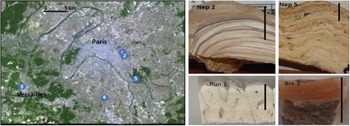
The locations of the studied sites are presented in Figure 1, and their main characteristics in Table 1.
Location and selected samples. Left: aerial photo of Paris and surroundings (from Geoportail, © IGN), with location of the studied sites in Paris (1, 2, and 5), Versailles (3), and Cachan (4); right: pictures of selected samples. Nep 2 and 5 from site 3, Run 1 from site 4 and Bra 1 from site 5. Vertical bar is 2 cm.

Main characteristics of the studied sites.

The sample from the “Saint Martin” site (Paris, site 1 on the map, sample SM B) was already described in a previous study (Pons-Branchu et al. Reference Pons-Branchu, Bergonzini, Tisnérat-Laborde, Branchu, Dumont, Massault, Bultez, Malnar, Kaltnecker, Dumoulin, Noret, Pelletier and Roy-Barman2018). All the studied samples were “humid” at the top, indicating active growth when sampled.
-
Bel 1 is a 5 cm core drilled in 2012, in USCD on the floor of the Belleville aqueduct (site 2 on the map, in the North of Paris). It is laminated. Only the top of the core was studied here. The aqueduct drains water from the Malassis plateau, north of Paris.
-
Nep 2 and Nep 5 (Versailles Palace gardens, site 3 on the map) are USCDs from leaks of the fountain of the Neptune basin sampled during the year 2017. They are respectively ca. 3.5 and 7 cm high. While only the top of Nep 2 was sampled for analysis, Nep 5 was analyzed all along its section.
-
Run 1, a 3.5-cm-high USCD, was sampled in 2019, in the historical Medicis aqueduct, at manhole 10 (site 4 on the map), which for centuries drained water from the Rungis plateau to Paris. It is well laminated and formed by the water of the perched aquifer drained by the aqueduct.
-
Bras 1 is a 1.3-cm-high USCD, sampled in 2014, in the former “Brasserie” quarry (limestone for the construction of Parisian mansions), below the “Bois de Vincennes”, a wood in urban context (site 5 on the map).
METHODS
Laminae Counting
In previous studies (Pons-Branchu et al. Reference Pons-Branchu, Douville, Roy-Barman, Dumont, Branchu, Thil, Frank, Bordier and Borst2014, Reference Pons-Branchu, Ayrault, Roy-Barman, Bordier, Borst, Branchu, Douville and Dumont2015, Reference Pons-Branchu, Bergonzini, Tisnérat-Laborde, Branchu, Dumont, Massault, Bultez, Malnar, Kaltnecker, Dumoulin, Noret, Pelletier and Roy-Barman2018), the comparison between laminae counting and radiometric dating demonstrated that in Belleville aqueduct (including the Saint-Martin manhole) and in the Versailles technical gallery, lamination of the four studied USCDs is bi-annual, as already demonstrated for speleothems from natural caves in Europe (Baker et al. Reference Baker, Smart, Edwards and Richards1993; Shopov et al. Reference Shopov, Ford and Schwarz1994). This may be different for USCDs from fountain leakages as the fountains regularly undergo emptying (for cleaning, repairs, etc.) or full operation of the water jets. Thus, laminae counting was performed for samples Run 1 and Bras 1 but not for the samples from Versailles Palace fountains.
For samples Run 1 and Bras 1, the method used is the one described in Pons-Branchu et al. (Reference Pons-Branchu, Ayrault, Roy-Barman, Bordier, Borst, Branchu, Douville and Dumont2015 and Reference Pons-Branchu, Bergonzini, Tisnérat-Laborde, Branchu, Dumont, Massault, Bultez, Malnar, Kaltnecker, Dumoulin, Noret, Pelletier and Roy-Barman2018), with the counting of visible laminae on enlarged photos of polished sections. The difference in the number of laminae between the various counts was used as the error bar for derived age.
Radiocarbon Analysis
CaCO3 samples of ca. 10 mg were cut using a little diamond saw. They were cleaned, hydrolyzed with H3PO4 to get CO2 and converted to graphite as described by Tisnérat-Laborde et al. (Reference Tisnérat-Laborde, Poupeau, Tannau and Paterne2001) and by Dumoulin et al. (Reference Dumoulin, Comby-Zerbino, Delqué-Količ, Moreau, Caffy, Hain, Perron, Thellier, Setti, Berthier and Beck2017). They were then measured at the Artemis AMS-facility (CEA Saclay, LMC14; Moreau et al. Reference Moreau, Messager, Berthier, Hain, Thellier, Dumoulin, Caffy, Sieudat and Beck2020). The 14C measurements were corrected from the isotopic fractionation according to the 13C values measured on the AMS Artemis facility, and from the blank following international recommendations (Mook and van der Plicht Reference Mook and van der Plicht1999).
RESULTS
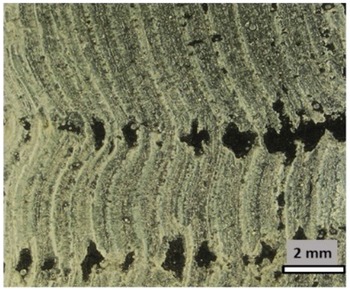
Laminae counting: Run 1 and Bras 1 samples displayed respectively 98 ± 6 and 63 ± 6 laminae, indicating 49 ± 3 and 31.5 ± 3 years for their growing period assuming a bi-annual laminae deposition. Laminae width is between 0.5 and 1 mm for laminae doublet for Run 1 sample (see Figure 3), and 0.3 to 0.5 mm for those of Bra 1.
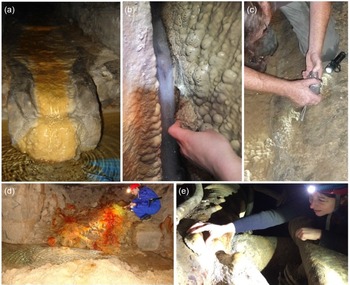
Pictures of the studied sites: (a) historical fountain of Saint Martin Manhole with CaCO3 crust (sample SM B); (b) Rungis aqueduct, south of Paris, with sample Run1 at the time of its collection in a water inlet; (c) Belleville aqueduct in northern Paris, and Bel 1 sample at the time of its collection; (d) Brasserie former quarry, with the red carbonate crust sampled (Bra 1 sample); (e) under the Neptune basin, Versailles Palace Gardens, Nep 2 sample, deposited on a pipe, by the fountain and basin leakages. (Please see online version for color figures.)

Picture of polished section of Run 1 sample used for the laminae counting.

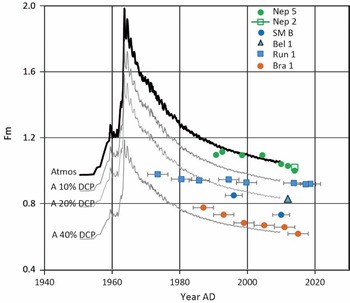
14C (see Figure 4 and Table 2) measured on the USCDs, expressed as Fraction of modern carbon (Fm) ranged from 0.6169 ± 0.0018 to 1.1136 ± 0.0026.
Radiocarbon (as fraction of modern carbon, Fm) measured within layers of USCDs and compared with atmospheric evolution (“Atmos” curve data from Hua et al. Reference Hua, Barbetti and Rakowski2013). For comparison, atmospheric data corrected for 10, 20 and 40% of DCP are plotted (labelled respectively “A 10% DCP”, “A 20% DCP”, “A 40% DCP”), following Macario et al. (Reference Macario, Stríkis, Cruz, Hammerschlag, Alves, Novello, Edwards, Cheng, Andrade, Buarquec and Garbelim2019). Blue symbols are for USCDs fed by water from the perched aquifer (flowing waters), green symbols are for USCDs fed from rapid leaks from a fountain (Versailles Palace), and orange symbols are USCD from dripping water in artificial undergrounds (former quarry).

Radiocarbon data for the USCD samples. Data from samples SM B are from Pons-Branchu et al. (Reference Pons-Branchu, Bergonzini, Tisnérat-Laborde, Branchu, Dumont, Massault, Bultez, Malnar, Kaltnecker, Dumoulin, Noret, Pelletier and Roy-Barman2018).

For samples Bel 1 and Nep 2 (only the top was analyzed), age was determined according to the sampling year and an assumption of a 6-year period of growth for the level sampled, corresponding to a sample of 10–12 laminae. For samples Run 1 and Bra 1, the ages reported are those from laminae counting. The age of the SM B sample is that already published in Pons-Branchu et al. (Reference Pons-Branchu, Bergonzini, Tisnérat-Laborde, Branchu, Dumont, Massault, Bultez, Malnar, Kaltnecker, Dumoulin, Noret, Pelletier and Roy-Barman2018). For Nep 2, we directly correlated the 14C measured on the CaCO3 samples according to atmospheric values.
Accordingly, all the samples analyzed are younger than the year 1970 (see Table 2).
DISCUSSION
14C in speleothems contains atmospheric derived carbon, but also dead carbon from host rock dissolution, and from carbon from decomposition of old organic matter stored in the soil. In speleothems, the range value of dead carbon proportion (DCP) is from 0 to 50% (Hendy Reference Hendy1971), with typical values between 5 and 20% in European karstic systems not covered by a major source of old carbon such as peat bog (Genty et al. Reference Genty, Baker, Massault, Proctor, Pons-Branchu and Hamelin2001). In USCDs, local anthropic carbon (black carbon and Suess effect) could also potentially play an important role as evidenced for atmospheric radiocarbon (Awsiuk and Pazdur Reference Awsiuk and Pazdur1986). Our previous study on USCD from the Belleville aqueduct (Saint-Martin manhole) and Versailles technical gallery that recorded the radiocarbon bomb pulse showed a DCP between 17 and 27%, and fast carbon transfer, but also a damping effect (attenuation of the atmospheric signal), attributed to the presence of a small fraction of carbon coming from old organic matter possibly stored within the soils.
Here, the studied samples, from the same region, cover a large range of contexts and situations, with contrasted water sources and pathways (dripping from the roof of galleries or quarry with different soil and host rock thickness or water from two perched aquifers with identical geological context in a more or less urbanized areas). 14C values for the USCDs were plotted according to their age and compared to the atmospheric 14C values (Hua et al. Reference Hua, Barbetti and Rakowski2013). Following Macario et al. (Reference Macario, Stríkis, Cruz, Hammerschlag, Alves, Novello, Edwards, Cheng, Andrade, Buarquec and Garbelim2019) we drew the atmospheric 14C curve corrected for 10, 20, and 40% of DCP (see Figure 4).
Carbonate deposits fed by dripping water infiltrating through soil or anthropic structures
The comparison between the 14C content measured on USCDs and atmospheric values suggests different behaviors:
-
A similar radiocarbon level and trend in samples Nep 2 and Nep 5 are observed, from the Versailles Palace fountains, to atmospheric data, with very low DCP (ca. 0%). It was not possible to provide an independent chronological constraint to test a possible delay in carbon transfer, but this is unlikely here, due to the very fast water transfer (leakages from the fountain or basin) across a thin soil layer. Slight variations were however observed and could be due to the potential impact of local Suess effect. These USCDs may however not be representative of the mean atmosphere of the year, because the fountains are not operated in winter. Indeed, local atmospheric radiocarbon variations has been observed in big cities due fossil carbon burning (domestic heating or industries, Svetlik et al. Reference Svetlik, Povinec, Molnár, Vána, Šivo and Bujtás2010), with seasonal variations.
-
At the other extreme, Bras 1 speleothem, fed by water dripping from the roof of the former quarry “La Brasserie” covered by 14 m of soil and host rock, has the highest DCP (ca. 40%, see Figure 4), with the shape of the 14C decrease with time (here well dated by laminae counting) very close to that of the atmosphere. This behavior suggests a rapid time transfer of carbon, with a high contribution of carbon from the host rock, but no/a low contribution from the potential pool of old organic matter such as that observed for some speleothems from natural caves overlain by forests (e.g., Rudzka-Phillips et al. Reference Rudzka-Phillips, McDermott, Jackson and Fleitmann2013; Noronha et al. Reference Noronha, Johnson, Southon, Hu, Ruan and McCabe-Glynn2015) or for other samples studied here.
Carbonate deposits fed by flowing water from a perched urban aquifer
USCDs fed by water from a perched aquifer (Belleville aqueduct, north of Paris, samples Bel 1 and SM, and Medicis aqueduct, south of Paris, sample Run 1) display interesting features. Both perched aquifers display a similar geological context with waters infiltrating through Oligocene/Eocene sedimentary layers, but contrasted soil occupation. While the Belleville aqueduct watershed has been highly urbanized since the mid-19th century, with high waterproofing of the surface (Franck-Néel et al. Reference Franck-Néel, Borst, Diome and Branchu2015), this is not the case for the watershed of the Medicis aqueduct, which was urbanized very recently in the upper part of the watershed, during the last 60 years, and not completely: part on it still drains cultivated soils.
For its top half, Run 1 USCD (Medicis Aqueduct) displays higher 14C values than the USCDs from Belleville aqueduct (SM B and Bel 1), suggesting a lower DCP contribution for the recent part (ca. 20 years according to age based on laminae counting). This difference is consistent with the Belleville aqueduct draining waters from a watershed with high waterproofing (and thus possibly low time transfer and more C dissolution from the host rock). The Run 1 radiocarbon record displays however a time record that does not follow the 14C atmospheric trend (see Figure 4) as observed for the other samples.
This may be due to (1) a biased lamina-based chronology, with older sub samples of Run 1 being younger than the proposed age; or (2) the existence of a pool of old carbon (organic matter from the soil) whose contribution becomes lower over time, possibly due to the recent and increasing urbanization of the zone.
In order to mimic the atmospheric tendency with Run 1 data, sub-samples would have to be twice as young; this would suggest a lamina deposition rate of ca. 4 laminae per year for this sample. Even if the hypothesis of a different deposition mode could be proposed to explain this rate, this is unlikely here. We suggest that there is a pool of old carbon stored within the soil which shifts the carbon trend, as shown in Noronha et al. (Reference Noronha, Johnson, Southon, Hu, Ruan and McCabe-Glynn2015) or Carlson et al. (Reference Carlson, Banner, Johnson, Casteel and Breecker2019) for speleothems from caves (old “mean respired carbon ages”—MRCA—as defined in their studies). This is consistent with the presence of historical and present day cultivated fields within the watershed drained by the Medicis aqueduct.
IMPLICATION FOR THE STUDY OF THE SOURCE OF HISTORICAL WATER CONTAMINATION
The use of USCDs in urban underground structures as tracers of past water quality is linked to the knowledge of the interaction of water with soil and host rock and is site dependent. This is of particular interest when studying organic matter content or organic contaminants that could be trapped in these USCDs such as found in speleothems from caves (e.g., Quiers et al. Reference Quiers, Perrette, Chalmin, Fanget and Poulenard2015). In fact, our approach suggests that carbon transfer can be more or less rapid, and the recorded signal more or less buffered by old carbon. Thus, when using USCDs as an archive of past (carbon) pollution, attention should be paid to the possible effect of an old carbon pool stored within soils.
The other important implication is the link between metal storage and transfer from soil to USCDs, in association with organic matter. Here again, a possible delay between pollution emission and its record within some USCDs (as found in previous studies such as the lead historical record, see Pons-Branchu et al. Reference Pons-Branchu, Ayrault, Roy-Barman, Bordier, Borst, Branchu, Douville and Dumont2015) may be possible in some cases.
CONCLUSIONS
USCDs in urban underground structures (galleries, aqueducts, quarries, etc.) are useful for the study of the impact on soil occupation on water quality, but the determination of their precise chronology remains in most cases challenging. Radiocarbon data on recent (younger than the year 1970) carbonate deposits from contrasted locations in the Paris region showed that this method can be used for the post-bomb period, but that it is in some cases hampered by the potential presence of old organic matter previously stored in soil and added to the atmospheric signal and that from host rock dissolution (dead carbon, DCP). The data showed that carbonate deposits from leakages from a Versailles Palace fountain display 14C values very close to atmospheric ones and can be used without correction for dead carbon, while USCDs in a former deep quarry display high dead carbon but no damping effect or effect of an old organic matter pool. The comparison between USCDs deposited by water from two perched aquifers highlights the importance of soil occupation for the water pathway and the geochemical signal recorded. This comparison suggests that USCDs deposited with waters from an aquifer with a partly cultivated watershed contain a non-negligible amount of carbon from old organic matter, which should be considered when reconstructing pollution history using these natural archives.
Acknowledgments
We are grateful to the “Services des Fontaines” of Versailles Palace, to the “Inspection Générale des Carrières” of Ville de Paris, and to ASNEP for site access and discussion. We thank the LMC14 staff (Laboratoire de Mesure du Carbone-14), the ARTEMIS national facility, for the results obtained with the accelerator mass spectroscopy method. This work was funded by the Fondation des Sciences du Patrimoine/LabEx Patrima (ANR-10-LABX0094-01) for the Versailles case study and by the HUNIWERS project funded by ANR (ANR-18-CE22-0009) for the others.