INTRODUCTION
Molecular analysis has been widely used as a tool in recent cetacean studies as it produces answers to some of the crucial issues concerning their biology and ecology. Although photo-identification and behavioural studies have provided us with a wealth of information, more complete and reliable results are produced when these are interpreted together with genetic (Mesnick et al., Reference Mesnick, Clapham and Dizon1999) and toxicological (Metcalfe et al., Reference Metcalfe, Koenig, Metcalfe, Paterson and Sears2004) data. Furthermore, many questions can only be answered through the use of new molecular technology, which will provide scientific support for the elaboration of efficient management and conservation policies (Hoelzel & Amos, Reference Hoelzel and Amos1988; Hoelzel, Reference Hoelzel1991; IWC, 1991).
Small fragments of epidermis provide sufficient genetic material to reveal specific information about individual identification (Paslbøll et al., Reference Palsbøll, Allen, Bérubé, Clapham, Feddeersen, Hammond, Hudson, Jogensen, Katona, Larsen, Larsen, Lien, Mattila, Sigurjonsson, Sears, Smith, Sponer, Stevick and Oien1997), sex (Paslbøll et al., 1992), genetic variability (Jackson et al., Reference Jackson, Patenaude, Carroll and Baker2008) and gene flow (Baker et al., Reference Baker, Slade, Bannister, Abernethy, Weinrich, Lien, Urban-, Corkeron, Calambokidis, Vasquez and Palumbi1994). It allows the investigation of questions on social organization and population structure (Baker et al., Reference Baker, Perry, Bannister, Weinrich, Abernethy, Calambokidis, Lien, Lambertsen, Ramirez, Vasquez, Clapham, Alling, O'brien and Palumbi1993; Cerchio et al., Reference Cerchio, Jacobsen, Cholewiak, Falcone and Merriwether2005), mating systems (Clapham & Paslbøll, Reference Clapham and Palsbøll1997), stock identification and effective population size (Rosenbaum et al., Reference Rosenbaum, Best, Findlay, Engel, Pomilla, Razafindrakoto, Morete, Vely, Freitas, Baker, Jenner, Jenner and Bannister2000), trophic levels (Gendron et al., Reference Gendron, Aguiniga and Carriquiry2001), migration patterns and habitat use (Baker et al., Reference Baker, Palumbi, Lambertsen, Weinrich, Calambokidis and O'Brien1990; Engel et al., Reference Engel, Fagundes, Rosenbaum, Leslie, Ott, Schmitt, Secchi, Dalla Rosa and Bonattelo2008). In addition, studies on toxicology and contaminants (Fossi et al., Reference Fossi, Marsili, Neri, Casini, Bearzi, Politi, Zanardelli and Panigada2000), inferences on feeding habits, nutritional condition (Borobia et al., Reference Borobia, Gearing, Simard, Gearing and Beland1995) and pregnancy (Mansour et al., Reference Mansour, Mckay, Lien, Orr, Banoub, Oien and Stenson2002) can also be conducted through the molecular analysis of blubber.
Standard protocol for biopsy sample collection involves the use of a crossbow or rifle (Lambertsen, Reference Lambertsen1987). Although alternative non-invasive methods exist, such as sampling from stranded animals (Cunha & Sole-Cava, Reference Cunha and Sole-Cava2007), faecal matter (Green et al., Reference Green, Herzing and Baldwin2007) or sloughed skin (Clapham et al., Reference Clapham, Palsbøll and Mattila1993), they can only be collected opportunistically and do not always provide enough high quality DNA (Parsons et al., Reference Parsons, Durban and Claridge2003). Remote biopsy sampling is therefore considered the most efficient, straightforward and ethical method of obtaining fresh high quality samples of specific individuals for any type of molecular analysis (IWC, 1991). However, it is essential to assess the impact of biopsy sampling, which is an intrusive method and may have some negative effects (IWC, 1991).
On-going studies involving biopsy collection have been carried out since 1997 to monitor the humpback whales (Megaptera novaeangliae; Borowski, 1781) that migrate annually to the east and north-east coast of Brazil to reproduce during the austral winter. Remnant of a population extensively exploited until the past century, this stock has undergone a recent population growth (Zerbini et al., Reference Zerbini, Andriolo, da Rocha, Simões-Lopes, Siciliano, Pizzorno, Waite, DeMaster and Van Blaricom2004; Morete et al., Reference Morete, Bisi, Pace and Rosso2008) but remains vulnerable to human disturbances such as entanglement (Pizzorno et al., Reference Pizzorno, Brito, Dorneles, Azevedo, Do and Gurgel1998), noise from vessel traffic (Sousa-Lima & Clark, Reference Sousa-Lima and Clark2008) and direct targeting by whale-watching tourism (Simões et al., Reference Simões, Macedo and Engel2005; Morete et al., Reference Morete, Bisi and Rosso2007). This work has been crucial to determine the genetic variability of this population, its gene flow with other southern hemisphere breeding stocks and has supported South Georgia and South Sandwich Islands as the main feeding area for this population instead of the Antarctic Peninsula (Engel et al., Reference Engel, Fagundes, Rosenbaum, Leslie, Ott, Schmitt, Secchi, Dalla Rosa and Bonattelo2008). Furthermore, information about the social structure and effective population size has been recently analysed (Cypriano-Souza, Reference Cypriano-Souza2008). While studies in other populations showed biopsy sampling to cause minimal disturbance (Weinrich et al., Reference Weinrich, Lambertsen, Baker, Schilling and Belt1991, Reference Weinrich, Lambertsen, Belt, Schilling, Iken and Syrjala1992; Clapham & Mattila, Reference Clapham and Mattila1993; Brown et al., Reference Brown, Corkeron, Hale, Schultz and Bryden1994; Gauthier & Sears, Reference Gauthier and Sears1999) risks may still exist (Bearzi, Reference Bearzi2000), in particular because this is the main breeding and calving ground in the western South Atlantic (Engel, Reference Engel1996; Martins et al., Reference Martins, Morete, Engel, Freitas, Secchi and Kinas2001; Freitas et al., Reference Freitas, Kinas, Martins and Engel2004; Andriolo et al., Reference Andriolo, Martins, Engel, Pizzorno, Mas-Rosa, Freitas, Morete and Kinas2006).
This study represents the most detailed analysis of the short-term behavioural responses of humpback whales to biopsy collection, as it has considered all the potential factors related to this methodology which might affect the species' behaviour, such as shots fired, type of vessels, group size, behaviour of the targeted group and whether samples are collected on breeding, feeding grounds or during migration. Additionally, this is the first effort to clarify these impacts in the western South Atlantic breeding ground.
MATERIALS AND METHODS
Study area and sampling methods
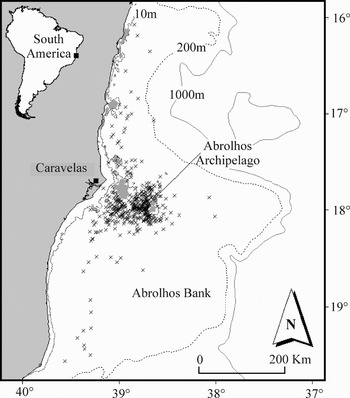
Biopsy samples were collected from humpback whales during the austral winter (July to November), throughout the breeding seasons of 1997 to 2007. The area studied extends across the Abrolhos Bank (16°40′S to 19°30′S, 37°25′W to 39°45W), an extension of the continental shelf on the eastern coast of Brazil, but most samples were obtained near the Abrolhos Archipelago (Figure 1). Four to five-day cruises were conducted weekly along planned routes. Whenever a group of whales was sighted, it was approached to 20 m on a gradually converging course.
Location of biopsy collection from humpback whales along the Abrolhos Bank, between 1997 and 2007. The crosses (X) represent successful shots (when a sample was obtained) and the grey marking represents the coral reefs.

Whales were sampled using a system adapted from Lambertsen (Reference Lambertsen1987): a regular Kantas crossbow (draw weight 150 lbs) with polycarbonate and aluminium darts 55.5 cm long and 0.8 cm in diameter. A custom-built stainless steel tube tip (0.8 cm diameter, 2.5 cm length) was screwed at the end of the dart, inside which three backward-pointing barbs were silver-soldered to hold the sample. The stopper, a flat plastic piece 2.6 cm in diameter at the base of the tip, was used to control penetration to a maximum depth of the tip length and cause the dart to recoil once the sample was taken. Before loading the dart into the crossbow, biopsy tips were sterilized in 92.8% ethanol and, after each shot, they were cleaned and boiled for ten minutes, to minimize wound infection and contamination of the sample. Skin samples for genetic analysis were kept in 70% ethanol or DMSO (Amos & Hoelzel, Reference Amos and Hoelzel1990) and stored at –20°C until processed; blubber for contaminant studies was stored in laminated paper at –16°C.
Only adult-sized animals were sampled, chosen randomly. Multiple sampling of individuals was avoided through examination of identity using dorsal fins. Between 1997 and 2006, priority was given to the photo-identification of individuals, thus the biopsy attempts were only initiated after 30 minutes near the group and in many cases the groups were approached from behind, instead of alongside. The darts were fired from distances between 10 and 25 m, to hit the whale's dorsal surface, preferably perpendicularly, usually when the whale arched its body just before diving. We waited until the whole group reappeared on the surface before turning the vessel back into course. Sampling was aborted in the event of bad weather, poor light conditions or groups that were difficult to approach.
Data collected and definitions
The shot itself includes both hits (when sample was obtained) and unsuccessful shots (hit without sample and misses). Behaviour reactions were collected ad libitum (Altmann, Reference Altmann1974) by two observers on the boat with naked eye throughout the biopsy procedure. These data were categorized hierarchically as follows (see Brown et al., Reference Brown, Corkeron, Hale, Schultz and Bryden1994; Best et al., Reference Best, Reeb, Rew, Palsbøll, Schaeff and Brandão2005): ‘No Response’, when the whale continues its pre-biopsy behaviour with no change detectable; ‘Startle’, when some body part of the whale (other than the flukes) makes a sudden but subtle movement, such as a muscle contraction in the region of hit; ‘Fluke Move’, when a small, non-forceful movement of the flukes was observed—the flukes are moved either dorso-ventrally or laterally without striking the surface of the water and without producing any spray or white water; ‘Immediate Dive’ (Weinrich et al., Reference Weinrich, Lambertsen, Belt, Schilling, Iken and Syrjala1992) and ‘Submerge’ (Gauthier & Sears, Reference Gauthier and Sears1999) were placed in this category; ‘Fluke Slap’, when the whale flexes the caudal region forcefully and strikes the surface of the water with the ventral side of the fluke—spray or white water is produced.
In order to determine which factors may influence the frequency and intensity of immediate behavioural responses, characteristics of biopsy shots, vessels used, approach type, group behaviour and group characteristics were recorded. Influence of study location on the reactions and effects on individual re-sightings were also studied.
BIOPSY SHOT CHARACTERISTICS
The characteristics of biopsy shots recorded were region of hit (anterior, below or posterior of the dorsal fin), depth of sample (skin with blubber samples came from deeper dart penetration than only skin samples), and retrieval system used (with or without tether—a monofilament line connected to a reel and attached to the crossbow). Stronger reactions are expected to hits on the peduncle or fluke, to deeper penetration of dart and to retrieval systems, which can lead to entanglement problems.
VESSELS USED
The vessel characteristics examined were vessel length (small—4.0 to 7.5 m or large—13.0 to 16.0 m), engine horsepower (25 HP to 250 HP) and engine location (outboard or inboard).
APPROACH TYPE
Characteristics examined included speed of approach (0–4 and 5–9 knots), total contact period (the time the vessel remained approximately 100 m from the group to attempt to photograph and biopsy), and pursuit period (the time that the group was pursued by the vessel until the proper distance had been achieved to trigger the dart).
GROUP BEHAVIOUR
The group behaviour was recorded prior to boat approach and during the total contact period by one-zero sampling (Altmann, Reference Altmann1974) on standardized data sheets. These data were placed into three behavioural states: social, travel and resting (as Brown et al., Reference Brown, Corkeron, Hale, Schultz and Bryden1994). Social behaviour included points where more than one animal in close proximity breached, pectoral slapped, peduncle slapped, fluke slapped, rolled or breathed forcefully (Gauthier & Sears, Reference Gauthier and Sears1999), tail breached (Clapham, Reference Clapham, Mann, Connor, Tyack and Whitehead2000), side fluked, head slapped, fluke swished, pectoral waved, fluke waved and/or were oriented in different directions relative to each other (cf. Bryden & Corkeron cited in Brown et al., Reference Brown, Corkeron, Hale, Schultz and Bryden1994). The aggressive behaviour (bubble streams, tail thrashes and tail slashes; Tyack & Whitehead, Reference Tyack and Whitehead1983) and ‘tail up’ behaviour (Morete et al., Reference Morete, Freitas, Engel, Pace and Clapham2003) were also included in this category. Travel behaviour was registered when one or more group members were moving and not exhibiting any of the behaviours listed above for social behaviour. For groups containing more than one individual, all members must have been oriented in the same direction relative to each other (Brown et al., Reference Brown, Corkeron, Hale, Schultz and Bryden1994). Resting behaviour occurred, when one or more members were stationary and not exhibiting any of the behaviours listed for social behaviour or travel. For groups of more than one individual, all members must have been oriented in the same direction relative to each other (Brown et al., Reference Brown, Corkeron, Hale, Schultz and Bryden1994).
GROUP CHARACTERISTICS
Groups were defined as either a lone whale or affiliations of whales within 100 m of each other, moving in the same general direction in a coordinated manner (Whitehead, Reference Whitehead1983). Group characteristics recorded included group size (one, two, three, four, and more than four whales; Brown et al., Reference Brown, Corkeron, Hale, Schultz and Bryden1994); group type (non-competitive and competitive groups—the groups containing three or more adults, with a definite structure of nuclear animal and escorts and exhibiting aggressive behaviour and fast movement; Tyack & Whitehead, Reference Tyack and Whitehead1983); behavioural role of target whale in the group (mothers, member of a pair, member of a non-competitive trio, escort to a mother–calf pair and member of a competitive group); and sex of target animal. In most cases, sex was determined by molecular techniques, which was carried out by PCR amplification followed by TaqI digestion of the ZFX/ZFY region of the sex chromosomes following the protocol of Palsbøll et al. (Reference Palsbøll, Vader, Bakke and El-Gewely1992) modified by Bérubé & Palsbøll (Reference Bérubé and Palsbøll1996) (Cypriano-Souza, Reference Cypriano-Souza2008). Because samples collected in 2006 and 2007 (N = 118) are still being analysed, we determined the sex by the whale's behavioural role in the group: individuals in close contact with calves are invariably females; in competitive groups, nuclear animals are generally females and the other participants are invariably males (Tyack & Whitehead, Reference Tyack and Whitehead1983; Clapham et al., Reference Clapham, Palsbøll, Mattila and Vasquez1992); and a whale in close proximity to a mother–calf pair (‘escort’ is generally male; Medrano et al., Reference Medrano, Salinas, Salas, Ladron De Guevara, Aguayo, Jacobsen and Baker1994).
LOCATION
In order to analyse the influence of study location on the reactions to biopsy sampling, we compared our results with those of studies conducted in different breeding grounds and areas used for other purposes, such as feeding and migration.
As some of them classified the responses differently (Weinrich et al., Reference Weinrich, Lambertsen, Baker, Schilling and Belt1991, Reference Weinrich, Lambertsen, Belt, Schilling, Iken and Syrjala1992; Clapham & Mattila, Reference Clapham and Mattila1993, Gauthier & Sears, Reference Gauthier and Sears1999), we associated the categories according to Brown et al. (Reference Brown, Corkeron, Hale, Schultz and Bryden1994): ‘No Response’ = ‘No Reaction’, ‘Startle’ and ‘Fluke Move’ = ‘Low-level Reaction’, ‘Fluke Slap’ = ‘Moderate Reaction’, and ‘Strong Reaction’ (defined by those authors as a reaction with multiple forceful activities and/or high-energy behaviours) was not encountered.
EFFECT ON INDIVIDUAL RE-SIGHTINGS
Possible long-term effects were inferred from the Humpback Whale Institute's photo-identification catalogue by comparing the frequencies of at least once re-sighted animals for biopsied and unbiopsied whales.
Data analysis
Maximum likelihood Chi-square of log-linear analysis of frequency tables were used for Biopsy Shots Characteristics, Group Behaviour and Group Characteristics. Only the models of interest, i.e. those that had the variable ‘Reaction’, were selected to be tested and the unsuccessful shots were excluded from this analysis. The models were excluded one by one and when a model did not fit the data, we concluded that the variables were interrelated. The Fleiss' Kappa was calculated to determine the degree of similarity between paired frequencies of behaviour prior to boat approach and during contact period. In addition, McNemar's test was used for analysis of behaviour change, comparing the most frequent behaviour state with the remaining, in absence and presence of a boat. Contingency tables and Pearson's Chi-square were conducted to compare our results with the literature including vessels used comparisons and effect on individual re-sightings. Partition Chi-square tests were used to evaluate what levels contributed more to the obtained discrepancies. Approach type characteristics were analysed using ANOVA (the pursuit period) and Kruskal–Wallis test (the total contact period). Percentages were compared by Tukey-type multiple comparisons for proportions and significant results are represented by giving a q0.05,∞,3 value >3.314 and q0.005,∞,2 > 2.772 (Zar, Reference Zar1999). For all tests, a probability of <0.05 was accepted as significant.
RESULTS
A total of 542 shots were fired and 444 samples were obtained between 1997 and 2007. Behavioural reactions were registered for 484 shots: 396 from hits and 88 from unsuccessful shots. The most frequent category for both was ‘No Response’ (53.8%, χ2 = 200.91, df = 3, P < 0.001 and 52.8%, χ2 = 48.27, df = 3, P < 0.001, respectively). Among the whales which did respond, the most frequent category was ‘Fluke Move’ (47.5%, χ2 = 42.00, df = 2, P < 0.00 and 64.3%, χ2 = 21.00, df = 2, P < 0.001, respectively). There was no difference in responses to hits or unsuccessful shots (χ2 = 4.24, df = 3, P = 0.237).
Influence of biopsy shot characteristics
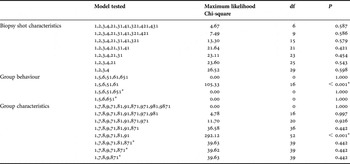
The reaction to biopsy sampling was not influenced by any characteristic of the biopsy shot considered, such as the region of hit (N = 95; 60% of them reached below the dorsal fin, 24.2% posterior and 15.8% the anterior area), the depth of sample (77.5% of N = 222 contained blubber) and the use of tethered darts (N = 149). The exclusion of any one model in log-linear analysis (N = 74) did not result in significant difference (each tested model is in Table 1).
Results of log-linear analysis for ‘Biopsy Shot Characteristics’, ‘Group Behaviour’ and ‘Group Characteristics’. 1 = ‘Reaction’ (four categories), 2 = ‘Region of the Hit’ (three categories), 3 = ‘Depth of Sample’ (two categories), 4 = ‘Retrieval System Used’ (two categories), 5 = ‘Group Behaviour Prior to Boat Approach’ (three categories), 6 = ‘Group Behaviour During the Contact Period’ (three categories), 7 = ‘Group Size’ (five categories), 8 = ‘Group Type’ (two categories), 9 = ‘Sex of Target Animal’ (two categories). Excluded models related to significant results (*) indicate that variables compounding it are interrelated.

Influence of vessels used
The use of vessels of different lengths, power and location of engine resulted in different categories of responses to collection of biopsy (χ2 = 71.14, df = 8, P <0.001) (Table 2). Combining responses registered from large vessels with inboard engines and small vessels with outboard engines, different whale responses were noted (χ2 = 25.64, df = 2, P < 0.001). Darting from small and less powerful boats resulted in higher frequency of more intense responses and lower frequency of ‘No Response’ than from the larger ones (Moderate Reaction = 31.9 and 18.8%, q0.05, ∞, 2 = 12.14, No Response = 45.1 and 53.6%, q0.05, ∞, 2 = 6.83, respectively). In addition, ‘Strong Reaction’ was not registered in any attempts with larger boats.
Different vessel characteristics (location and power of engine and length of the vessel) and the reactions of humpback whales to the biopsy shots.

Influence of approach type
Vessel speed when approaching (0–4 kn: N = 13, 5–9 kn: N = 13) did not influence the response to biopsy darting (due to the small sample size all the reactions were combined in one category: χ2 = 0.15, df = 1, P = 0.695). Contact period had no influence either (µ = 39.9 ± 19.9 minutes, range = 5 to 160, N = 396, H 3, 396 = 4.10, P = 0.250). However, in the period during active pursuit to reach a distance of 20 m (µ = 18.9 ± 10.4 minutes, range = 5 to 40, N = 54), the category ‘No Response’ was more frequent (53.7%, SS = 1072.88, df = 3, MS = 357.63, F = 3.81, P= 0.016).
Influence of group behaviour
The presence of the vessel altered the frequencies of behaviour observed prior to approach (Travel: from 42.91 to 65.20%, Social: from 34.46 to 29.05%, Resting: from 13.51 to 7.43%), thus the degree of similarity between behavioural states observed before and after vessel approach was low (κ = 0.364 ± 0.051, cf. Landis & Koch, Reference Landis and Koch1977). Only travelling behaviour increased in frequency in the presence of vessels (N = 127 prior to approach to N = 185 during the total contact period). Groups exhibiting behaviour other than travel decreased behaviour state frequency in the presence of the vessel (Social: N = 102 to N = 86; Resting: N = 40 to N = 22), reverting mainly to the Travel state (Social to Travel: P = 0.010, Resting to Travel: P = 0.001, McNemar's test).
The combined effect of the group behaviour prior to boat approach and during the contact period influenced the frequency of reaction to biopsy darting, as indicated by the model in which these variables were excluded (N = 326; Table 1). Whales biopsied while travelling and socializing showed ‘No Response’ most often (partition Chi-square: χ2 = 88.92, df = 3, P < 0.001 and χ2 = 78.55, df = 3, P< 0.001, respectively), while resting whales exhibited the ‘Fluke Move’ and ‘No Response’ with equal frequency (χ2 = 8.86, df = 3, P = 0.031).
Influence of group characteristics
Log-linear analysis was applied to the 357 cases in which reaction, group size (µ = 3.0 ± SD = 1.31, range = 1 to 9, N = 396), group type (109 competitive groups) and sex of target animal (165 males and 167 females) were recorded on the same hit. As shown by the model in which the variables group size and group type were excluded, the combined effect of the number of individuals in the target group and its competitive character influenced the reaction to biopsy darting (Table 1). It also indicated that the sex of target animals did not interfere with intensity of reaction.
Furthermore, individuals with different behavioural roles responded differently to darting (χ2 = 46.83, df = 15, P< 0.001—100 mothers, 123 members of a pair, 25 members of a non-competitive trio, 50 escorts to a mother–calf pair, 30 singletons and 126 members of a competitive group). Reaction to biopsy differed between mothers with calves and non-lactating females (χ2 = 9.37, df = 3, P = 0.025). Females with their calves showed no reaction on 59.6% of the shots (N = 109), while non-lactating females reacted more frequently to biopsy (43.1% of ‘No Response’, N = 51). Among those females that did react, the same intensity of reaction occurred in the presence and absence of calves (χ2 = 5.05, df = 2, P = 0.08).
Influence of location
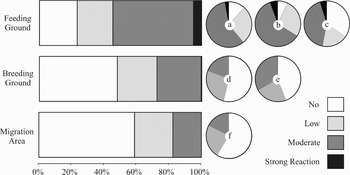
Response frequencies obtained in this study differed from those obtained in similar studies (χ2 = 158.76, df = 10, P < 0.001; Figure 2). Whales biopsied in the western South Atlantic reacted differently from those observed in a western North Atlantic breeding ground (Clapham & Mattila, Reference Clapham and Mattila1993: χ2 = 23.34, df = 2, P < 0.001) and in all feeding grounds studied (Weinrich et al., Reference Weinrich, Lambertsen, Baker, Schilling and Belt1991: χ2 = 79.25, df = 2, P < 0.001; Weinrich et al., Reference Weinrich, Lambertsen, Belt, Schilling, Iken and Syrjala1992: χ2 = 71.28, df = 2, P < 0.001; Gauthier & Sears, Reference Gauthier and Sears1999: χ2 = 41.78, df = 2, P < 0.001). However, our results were similar to those observed in a migration area (Brown et al., Reference Brown, Corkeron, Hale, Schultz and Bryden1994: χ2 = 1.301, df = 2, P = 0.520). The intensity of response to sampling darts was different in areas used for different purposes, i.e. between breeding, feeding and migration areas (χ2 = 111.75, df = 4, P < 0.001). Whales biopsied in feeding grounds responded more intensely than those in breeding grounds and the latter responded more intensely than whales in migration (Figure 2).
Frequencies of humpback whales' reactions to biopsy sampling conducted in areas used for different purposes. (a) Weinrich et al., Reference Weinrich, Lambertsen, Baker, Schilling and Belt1991, N = 103; (b) Weinrich et al., Reference Weinrich, Lambertsen, Belt, Schilling, Iken and Syrjala1992, N = 71; (c) Gauthier & Sears, Reference Gauthier and Sears1999, N= 206; (d) this study, N = 396; (e) Clapham & Mattila, Reference Clapham and Mattila1993, N = 565; (f) Brown et al., Reference Brown, Corkeron, Hale, Schultz and Bryden1994, N = 203.

Effect on individual re-sightings
The Humpback Whale Institute photo-identified 2210 whales between 1989 and 2005, 429 of which (19.4%) have been re-sighted at least once. During our study, we sampled 83 whales that matched this catalogue, 10 of which (12.1%) were re-sightings. Difference in the proportion of biopsied and unbiopsied re-sighted whales has not been detected (χ2 = 2.15, df = 1, P= 0.143).
DISCUSSION
Cetaceans are exposed to numerous human disturbances and generally react to them by avoiding the source of stimulus. Vessel traffic, industrial activities (Richardson et al., Reference Richardson, Fraker, Würsig and Wells1985), whale watching (Bejder et al., Reference Bejder, Saumel, Whitehead, Gales, Mann, Connor, Heithaus, Watson-Capps, Flaherty and Krützen2006) and noise (Sousa-Lima & Clark, Reference Sousa-Lima and Clark2008) result in greater behaviour change than that reported for collection of biopsies. In fact, the impact of remote biopsy sampling has been compared to a mildly noxious stimulus (Weinrich et al., Reference Weinrich, Lambertsen, Belt, Schilling, Iken and Syrjala1992). We documented one more case study where no major disturbance could be detected. The range of behavioural responses observed in our study area is comparable with those reported for several other species (Whitehead et al., Reference Whitehead, Gordon, Mathews and Richard1990; Brown et al., Reference Brown, Kraus and Gaskin1991; IWC, 1991; Barrett-Lennard et al., Reference Barrett-Lennard, Smith and Ellis1996; Jahoda et al., Reference Jahoda, Airoldi, Azzellino, Biassoni, Borsani, Cianfanelli, Lauriano, Sciara, Panigada, Vallini and Zanardelli1996; Weller et al., Reference Weller, Cockcroft, Würsig, Lynn and Fertl1997; Gauthier & Sears, Reference Gauthier and Sears1999; Hooker et al., Reference Hooker, Baird, Al-Omari, Gowans and Whitehead2001; Best et al., Reference Best, Reeb, Rew, Palsbøll, Schaeff and Brandão2005; Gorgone et al., Reference Gorgone, Haase, Griffith and Hohn2008; Jefferson & Hung, Reference Jefferson and Hung2008). Although stronger reactions have been reported under unusual circumstances (Brown et al., Reference Brown, Kraus and Gaskin1991; Weinrich et al., Reference Weinrich, Lambertsen, Baker, Schilling and Belt1991), such as stuck darts or entangled retrieval lines, we did not detect intense behaviours, even under similar situations. In addition, all responses were part of the natural repertoire of the species and may occur in other contexts (Weinrich et al., Reference Weinrich, Lambertsen, Belt, Schilling, Iken and Syrjala1992; Gauthier & Sears, Reference Gauthier and Sears1999). Reactions can be provoked by missed shots too, suggesting that an unexpected disturbance or a stimulus other than the contact with the dart itself, such as the sound of the dart hitting the water or the approach of a boat, can also incite the response (Weinrich et al., Reference Weinrich, Lambertsen, Baker, Schilling and Belt1991; Krützen et al., Reference Krützen, Barré, Möller, Heithaus, Simms and Sherwin2002; Gorgone et al., Reference Gorgone, Haase, Griffith and Hohn2008).
Similarly, lesions caused by the dart are minor compared with wounds from intraspecific interactions (cf. Pack et al., Reference Pack, Salden, Ferrari, Glockner-Ferrari, Herman, Stubbs and Straley1998) or other anthropogenic factors (cf. Pizzorno et al., Reference Pizzorno, Brito, Dorneles, Azevedo, Do and Gurgel1998). Studies carried out on dolphins found no evidence of infection or difficult healing (Krützen et al., Reference Krützen, Barré, Möller, Heithaus, Simms and Sherwin2002; Jefferson & Hung, Reference Jefferson and Hung2008), even with more intrusive procedures than biopsy sampling (Weller et al., Reference Weller, Cockcroft, Würsig, Lynn and Fertl1997). Although non-intrusive techniques, such as skin swabbing (Harlin et al., Reference Harlin, Würsig, Baker and Markowitz1999) and use of a biopsy pole (Bilgmann et al., Reference Bilgmann, Griffiths, Allen and Möller2007), pose lower risk of injury and frequency of responses, they do not obtain blubber samples or, occasionally, sufficient amount of skin. Success rates using remote biopsy sampling are also generally higher (Weinrich et al., Reference Weinrich, Lambertsen, Baker, Schilling and Belt1991, Reference Weinrich, Lambertsen, Belt, Schilling, Iken and Syrjala1992; Brown et al., Reference Brown, Corkeron, Hale, Schultz and Bryden1994; Gauthier & Sears, Reference Gauthier and Sears1999), further attesting to the effectiveness of this technique.
With regards to the characteristics of the shot measured in this study, namely region of hit, depth of sample and retrieval system, there was no variation in the behavioural responses observed. Although the surface just below the dorsal fin is the recommended target region for biopsy collection, in some cases distance and weather conditions did not allow this area to be precisely reached. However, we found that hits anterior and posterior to the dorsal fin did not cause a specific category of response either; similarly, reactions to radio tag implantation also occur independently of the body region hit (Watkins, Reference Watkins1981). A tail flick reaction (Weinrich et al., Reference Weinrich, Lambertsen, Belt, Schilling, Iken and Syrjala1992), equivalent to our ‘Fluke Slap’, could be expected as a reflexive response to a dart hitting the peduncle or fluke. Nevertheless, this behaviour is also exhibited as a result of close approach by a vessel (Watkins, Reference Watkins1981; Weinrich et al., Reference Weinrich, Lambertsen, Belt, Schilling, Iken and Syrjala1992; personal observation), suggesting that this reaction may contain both intuitive and intentional components (Weinrich et al., Reference Weinrich, Lambertsen, Belt, Schilling, Iken and Syrjala1992).
Another characteristic of the shot expected to influence reaction was the depth of the sample, based on studies with small cetaceans whose longer tissue samples were associated to stronger reactions in bottlenose dolphins (Krützen et al., Reference Krützen, Barré, Möller, Heithaus, Simms and Sherwin2002). However, in our study, deeper samples did not trigger stronger reactions, consistent with the low level reactions caused by the much deeper intra-muscular radio tag implantation in other balaenopterids (Watkins, Reference Watkins1981). Similarly, although Gauthier & Sears (Reference Gauthier and Sears1999) suggested the high frequency of response by minke whales (Balaenoptera acutorostrata) to be partly related to the relatively longer samples in their study that compared length of blubber sample to responses in four species of balaenopterids, no significant relationship between frequency of reaction and sample size was found.
In recent studies (Gauthier & Sears, Reference Gauthier and Sears1999; Best et al., Reference Best, Reeb, Rew, Palsbøll, Schaeff and Brandão2005), retrieval line systems have been avoided out of concern for the risk of entanglement and strong responses (Weinrich et al., Reference Weinrich, Lambertsen, Baker, Schilling and Belt1991). However, we found that tethered darts did not increase the response of our study animals. In fact, the use of a tether was beneficial to expedite dart recovery, reducing the number of boat manoeuvers needed and the time spent in the vicinity of the group. Even in cases of contact (N = 2) and entanglement (N = 2) with the line, the responses were low and moderate level (Startle and Fluke Slap), respectively.
Although avoidance reactions to vessel approach are evident with or without biopsy attempts, the presence of a vessel could be associated with darting, increasing avoidance behaviours (c.f. Clapham & Mattila, Reference Clapham and Mattila1993; Gorgone et al., Reference Gorgone, Haase, Griffith and Hohn2008). Whales can evade vessels either vertically, reducing surface time, i.e. dive time and breath intervals increase and speed of travel decreases, or horizontally (the opposite) (Jahoda et al., Reference Jahoda, Lafortuna, Biassoni, Almirante, Azzellino, Panigada, Zanardell and di Sciara2003). Weinrich et al. (Reference Weinrich, Lambertsen, Belt, Schilling, Iken and Syrjala1992) further suggested that boat presence may influence surface interval/dive time rates. As such, another parameter expected to influence reaction to biopsy was the type of vessel and engine used. Studies carried out from smaller and less powerful boats with outboard engines (Clapham & Mattila, Reference Clapham and Mattila1993; Brown et al., Reference Brown, Corkeron, Hale, Schultz and Bryden1994; Gauthier & Sears, Reference Gauthier and Sears1999), registered higher frequency and intensity of responses to biopsy attempts than our observations from larger boats with more powerful inboard engines. Likewise, although the species and techniques used were different, Bilgmann et al. (Reference Bilgmann, Griffiths, Allen and Möller2007) compared small boats (5.6 to 6 m, 90 to 115 HP, outboard engine) to boats bigger than ours (16 to 25 m, 115 to twin 600 HP, inboard engine) when conducting an experiment with biopsy pole on small cetaceans (Tursiops sp. and Delphinus delphis) and found that smaller boats resulted in stronger reactions.
Although all types of vessels produce underwater noise, which may induce avoidance, studies with humpbacks also reported only minor behaviour changes to larger whale-watching boats when compared to smaller, but noisier ones (Au & Green, Reference Au and Green2000). Ross (Reference Ross1976) explained that most of the noise of boats is caused by propeller cavitations and that outboard engines of small boats cause greater cavitations than inboard engines of large boats, thus producing more sound since they need more revolutions per minute (RPM) to get a similar thrust (Au & Green, Reference Au and Green2000).
The types of approach and permanence period with a group of whales are also factors which might influence the probability of reaction to biopsy darting. Especially for lactating females, a slow and patient approach produces less evasion, which increases the sampling success and reduces harassment (Clapham & Mattila, Reference Clapham and Mattila1993). Although the approach speed of up to 9 knots appears not to influence the response to darting, more data are necessary to address this question further.
Behavioural or photo-identification studies prior to biopsy sampling increase the period of permanence of the boat with the whales and thus the potential of disturbance. Brown et al. (Reference Brown, Corkeron, Hale, Schultz and Bryden1994) suggested that the threshold of response to darting may be lower when the whales are previously subjected to other forms of human annoyance. However, in our study, the intensity of response to biopsy procedures was not affected by the period of time our research boat remained near the whales. Moreover, during the active pursuit to get within firing range whales were less prone to react, probably because in this case the stimulus can be anticipated, as was the case with radio tag implants (Watkins, Reference Watkins1981). Repetitive biopsy attempts can also alter the whale's state of alertness, indeed several species showed a less intense or similar response to successive hits (Brown et al., Reference Brown, Corkeron, Hale, Schultz and Bryden1994; Gauthier & Sears, Reference Gauthier and Sears1999).
The presence of a vessel can also alter the whales' essential behaviour states, such as resting and reproduction. In the presence of boats, other studies in the same area verified a reduction of resting in groups of females with calves (Morete et al., Reference Morete, Bisi and Rosso2007) and interruption of the song or evasion by singer males (Sousa-Lima & Clark, Reference Sousa-Lima and Clark2008). Throughout our study, when the boat approached, groups involved in social and resting activities usually changed these states to travel, as a means of avoiding the source of disturbance. Weinrich et al. (Reference Weinrich, Lambertsen, Belt, Schilling, Iken and Syrjala1992), monitored focal groups prior to and after biopsy and registered a slight increase in frequency of agonistic behaviours (hard tail flicks and trumpet blows). Thus the majority of whales might have been sampled in a disturbed state. Since it is not possible to collect samples without a boat, this behaviour change appears to be inevitable.
The tolerance threshold of an individual to a stimulus seems to be also related to the activity in progress at the time of sampling. When feeding or socializing, the animals generally ignore the disturbing stimulus, differently from inactive animals (Watkins, Reference Watkins1986; cf. IWC, 1991). In our study area, travelling humpbacks responded less frequently than resting animals, as observed in animals feeding in the Gulf of Maine (Weinrich et al., Reference Weinrich, Lambertsen, Belt, Schilling, Iken and Syrjala1992), and strong reactions, although rare, were shown by a resting individual in another breeding ground (Clapham & Mattila, Reference Clapham and Mattila1993). Similarly, Barrett-Lennard et al. (Reference Barrett-Lennard, Smith and Ellis1996) noted that resting killer whales show more intense reactions to biopsy sampling than others. However, during migration their reaction to sampling is not affected by the behaviour state (Brown et al., Reference Brown, Corkeron, Hale, Schultz and Bryden1994).
This study, as others (Clapham & Mattila, Reference Clapham and Mattila1993; Cerchio, Reference Cerchio2003; Best et al., Reference Best, Reeb, Rew, Palsbøll, Schaeff and Brandão2005), found that in the breeding grounds, the behavioural role of an individual, determined by group size, seems to influence the reaction to biopsy darting, while sex is not a relevant factor. Population dynamics and group characteristics reflect the competitive character of the breeding grounds (Chittleborough, Reference Chittleborough1965), where large groups are usually involved in violent and fast-moving behaviours (Tyack & Whitehead, Reference Tyack and Whitehead1983; Clapham et al., Reference Clapham, Palsbøll, Mattila and Vasquez1992) with intense contact and agonistic intra-sexual interactions that can have fatal consequences (Pack et al., Reference Pack, Salden, Ferrari, Glockner-Ferrari, Herman, Stubbs and Straley1998). These group characteristics and aggressive behaviour influence the reactions to skin sampling. Lone animals and small groups tend to respond more intensely, while in competitive groups, where the animals are in high excitation and expect physical contact, the brief stimulus of a dart may be less noticed (Clapham & Mattila, Reference Clapham and Mattila1993).
The behavioural role of individuals in competitive groups affected the intensity of response to biopsies as well. Nuclear animals, presumably females, respond more than males which dispute for them. Also, the hierarchy among males may be critical in response intensity: secondary escorts respond more than challengers, and these in turn respond more than principal escorts (Clapham & Mattila, Reference Clapham and Mattila1993). Principal escorts are the focus of the aggressive contact (cf. Herman et al., Reference Herman, Herman, Pack, Marshall, Shepard and Bakhtiari2008) thus they are probably subjected to greater physical contact than that delivered by the hit of a dart. A challenger, which is attempting to displace the principal escort, is prepared for physical contact but probably not as much as his opponent. Finally, the secondary escort appears to be more sensitive to an unexpected stimulus, since it is not actively challenging the principal escort (Cerchio, Reference Cerchio2003).
Mother and calf pairs, in contrast to non-lactating females, also show low response to the dart stimulation during the reproductive season. This observation is typical of breeding areas where constant contact with their calves makes mothers less prone to reaction because they are less surprised by a further tactile stimulus (Clapham & Mattila, Reference Clapham and Mattila1993; cf. Cerchio, Reference Cerchio2003). On one occasion during this study, a calf was witnessed breaching repeatedly on its mother's back, who did not present any response when biopsied between these breaching events. Calves, however, which seem to be naive and probably more sensitive, present the stronger reactions (Cerchio, Reference Cerchio2003). It should be noted though that a study with right whales (Eubalaena australis) in a breeding ground (Best et al., Reference Best, Reeb, Rew, Palsbøll, Schaeff and Brandão2005) found non-lactating females responded less frequently than mothers. This variation may be due to differences in body morphology between the species. Gauthier & Sears (Reference Gauthier and Sears1999) proposed that morphological diversity (body size and thickness of the epithelial tissues) was the main cause of the differences in behavioural reactions to biopsy darting in four species of balaenopterids (B. musculus, B. physalus, B. acutorostrata and M. novaeangliae).
Location can be a main contributor to variation in biopsy sampling responses, resulting in different frequencies and intensities of reaction to darting: whales biopsied in feeding grounds respond with more intensity than in breeding grounds (Clapham & Matilla, Reference Clapham and Mattila1993), which in turn respond more intensely than whales in migration (Brown et al., Reference Brown, Corkeron, Hale, Schultz and Bryden1994).
The humpback whale's migratory behaviour includes more than just travelling and some reproductive behaviours are not uncommon. Throughout the northward and southward migration periods, small groups and male–female pairs are most common (Brown & Corkeron, Reference Brown and Corkeron1995) and mating attempts and mate guarding can occur (Clapham, Reference Clapham, Mann, Connor, Tyack and Whitehead2000). Brown et al. (Reference Brown, Corkeron, Hale, Schultz and Bryden1994) found that gender is the most important factor governing an individual's response to biopsy sampling in a migration area, while group size did not interfere. Since competitive groups and mother–calf pairs are rare in this period, the response threshold of females is therefore more likely to be crossed than that of males.
In the feeding grounds, group compositions are different, dependent mainly on the unpredictable distribution of prey. Solitary whales and small groups are the most common (Weinrich & Kuhlberg, Reference Weinrich and Kuhlberg1991), while some brief cooperation in foraging groups can be observed (Hain et al., Reference Hain, Karter, Kraus, Mayo and Winn1982) but agonistic encounters are rare (Clapham, Reference Clapham, Mann, Connor, Tyack and Whitehead2000) and, consequently, tactile stimulus among the individuals is infrequent. Therefore, Weinrich et al. (Reference Weinrich, Lambertsen, Baker, Schilling and Belt1991) and Gauthier & Sears (Reference Gauthier and Sears1999) observed that neither group size nor gender interfered in the reaction to biopsy sampling. Likewise, mothers and calves biopsied in feeding grounds react as frequently as other groups (Weinrich et al., Reference Weinrich, Lambertsen, Baker, Schilling and Belt1991; Clapham & Mattila, Reference Clapham and Mattila1993; unpublished data). This is probably due to the rapid maturation process of juveniles (Chittleborough, Reference Chittleborough1965), who receive gradually less attention from their mothers and become independent early (Baraff & Weinrich, Reference Baraff and Weinrich1993). As such the calves, who are a few months older in the feeding grounds than in the breeding grounds, receive less intense care from their mothers and therefore the physical contact between them is inferior. The less significant physical stimulus on the feeding grounds may explain why whales are more surprised by the sampling dart there than in any other location.
Although immediate reactions can be observed in every study involving biopsy collection, there is no significant evidence that this procedure leads to any long-term negative impacts on individuals or their populations. Even though low, the rate of photo-identification recaptures of biopsied and unbiopsied animals are equivalent (Weinrich et al., Reference Weinrich, Lambertsen, Baker, Schilling and Belt1991; Clapham & Mattila, Reference Clapham and Mattila1993; Weller et al., Reference Weller, Cockcroft, Würsig, Lynn and Fertl1997; Best et al., Reference Best, Reeb, Rew, Palsbøll, Schaeff and Brandão2005; this study), suggesting that darting does not alter the movements or distribution of individuals. Based on long-term studies of the effects on the reproduction of right whales (Best et al., Reference Best, Reeb, Rew, Palsbøll, Schaeff and Brandão2005), we may also expect no adverse impacts on their reproductive cycles or calf survival.
This study provides new data supporting low level responses by whales to remote biopsy sampling procedures. This method results in only limited annoyance and the behavioural responses observed are instantaneous and comparable to other human harassments. The intensity of reactions to the artificial darting stimulus was influenced by some individual characteristics as well as variables at the time of sampling. The extent of excitation and physical contact between individuals is determined by group size and behaviour, which in turn depends on location and seasonal variations and influences levels of reaction: breeding humpbacks adopt different roles in a group, and thus react with different intensity than migrating or feeding whales. Also, because biopsy sampling is an abrupt stimulus, if the whales are more active prior to the hit then the animals can be expected to react less intensely.
We conclude that the continuation of biopsy sampling studies in the western South Atlantic breeding ground is unlikely to be harmful for this population. From a wildlife conservation perspective, human disturbances are only of concern if they affect survival or fertility, consequently decreasing population size (Gill et al., Reference Gill, Norris and Sutherland2001). Hence, in the absence of these long-term impacts, and bearing in mind all the vital conclusions that can be obtained from biopsy material, the short-term level of disturbances incurred may be considered acceptable.
ACKNOWLEDGEMENTS
Biopsy samples were collected under permission of CMA/IBAMA (03-06 Proc. 02034.000097/01-25). PARNAM allowed the collection within the National Marine Park of Abrolhos (05/2006 Proc. PNA005-06). We thank the staff of Instituto Baleia Jubarte for executive management and the crew, researchers and interns for assistance in the field. We are grateful to Norsul Cia de Navegação for research boat maintenance; Paulo Enrique Cardoso Peixoto for help in data analysis; Jennifer Lewis; Leonardo Wedekin and the anonymous referees for important comments and suggestions; Ana Lúcia Cypriano-Souza for molecular genetic analysis; Leonardo Wedekin for preparing the map; Fernando Guilherme-Silveira for ideas on first drafts; Michelle Borsz and Maria Cecília Magnani for proofreading English; and David Janiger for making several papers available. The Instituto Baleia Jubarte is sponsored by Petróleo Brasileiro S.A. (PETROBRAS).