Introduction
The global population ages rapidly and the prevalence of dementia is expected to increase dramatically to 115 million people in 2050 (Prince and Jackson, Reference Prince and Jackson2009). Additionally, with the expected decline in workforce, the ratio of potential working people to people with dementia will decrease from 69:1 in 2000 to 27:1 in 2050 (Health council of the Netherlands, 2002; Wancata et al., Reference Wancata, Musalek, Alexandrowicz and Krautgartner2003). The major challenge is therefore to provide adequate care for the growing number of persons with dementia, of which 70% will live in the community, often taken care of by informal and professional carers.
Therefore, the importance of the role of Assistive ICT technologies will increase in dementia care. They may support persons with dementia in coping with the disease and improving their quality of life (Lauriks et al., Reference Lauriks2007; Topo, Reference Topo2009), reduce caregiver burden (Gilliard and Hagen, Reference Gilliard and Hagen2004; Beauchamp et al., Reference Beauchamp, Irvine, Seeley and Johnson2005; Smith and Toseland, Reference Smith and Toseland2006; Van Mierlo et al., Reference Van Mierlo, Meiland and Dröes2012) and improve the caregiver's self confidence (Lewis et al., Reference Lewis, Hobday and Hepburn2010). Additionally, they may reduce professional carers’ anxiety (Blackburn, Reference Blackburn1988) and improve their work satisfaction (Engström et al., Reference Engström, Ljunggren, Lindqvist and Carlsson2005). Assistive technologies may enable elderly people with progressive chronic disabilities to stay in their own homes safely for a longer period, and subsequently reduce health care costs.
It is important that assistive technologies are developed that adequately meet the needs of the persons with dementia and carers. Drawbacks of current assistive technologies are that they often aim to support single needs instead of multiple needs in various stages of the disease, they are often developed without involvement of the target group of persons with dementia (Wilkinson, Reference Wilkinson and Wilkinson2002; Bharucha et al., Reference Bharucha2009). They are also often initially designed for younger people, usually with non-progressive, traumatic injuries (Span et al., Reference Span, Hettinga, Vernooij-Dassen, Eefsting and Smits2013), which makes it questionable whether persons with dementia can use them, and whether they will accept them.
In the Rosetta projectFootnote 1 a user participatory design was adopted to develop an integrated system, which combines three previously developed assistive technology systems and is, in close cooperation with the target groups, adjusted to their needs and wishes. The three previously developed systems are the COGKNOW Day Navigator (CDN) (Meiland et al., Reference Meiland2010), the EMERGE system (Storf et al., Reference Storf and Tscheligi2009) and the Unattended Autonomous Surveilance system (UAS) (Jans et al., Reference Jans, Overmars-Marx, Van Hoof and Kort2009).
The CDN supports people with dementia in the early stages of impairment in the unmet need areas of memory, social contact, daily activities, and safety (Van der Roest et al., Reference Van der Roest2009; Meiland et al., Reference Meiland2010). People with dementia use a touch screen computer which offers reminders for activities, a picture dialling system, radio and music button, activity support (e.g. preparing coffee) and safety warnings (e.g. front door is left open), and they have a mobile device with partly the same functionalities on it and a navigation service to help them find their way home. In the Rosetta project the CDN was further developed and called the Elderly Day Navigator (EDN).
The EMERGE system has been developed to support elderly people with monitoring, prevention and emergency response by employing sensors to monitor activities of daily living and vital data (Storf et al., Reference Storf and Tscheligi2009).
The UAS system provides a fully automatic detection of emergencies (including falls and wandering) for independently living elderly by using an ambient sensor network (Jans et al., Reference Jans, Overmars-Marx, Van Hoof and Kort2009).
The functionalities of these systems described above are also proposed in other studies that included persons with dementia, informal and professional carers in the design process. For example in studies by Jones (Reference Jones2004); Sixsmith et al. (Reference Sixsmith, Gibson, Orpwood and Torrington2007); Wherton and Monk (Reference Wherton and Monk2008); suggested technologies with a focus on prompting and monitoring daily activities, support in leisure activities, social contact and participation, and devices to improve safety.
The aim of the Rosetta project is to combine these three systems into one platform, attuned to the needs of people with dementia from the early to severe stages of dementia, and their informal carers.
The aim of this article is to provide insight into the methods used in the participatory design process, by describing the methods for assessing user needs and wishes as well as the results of this process that contributed to the development of this integrated Rosetta system.
Methods
Design
A qualitative, user participatory, research design was adopted with different types of workshops, semi-structured interviews, and expert consultations throughout the development process.
Participants and setting
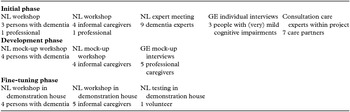
The study was executed in the Netherlands and in Germany where the full Rosetta system was field-tested. Convenience samples were recruited throughout the development process: for an overview see Table 1. Prior experience with assistive technologies was not required. Persons with severe dementia did not participate in the workshops or interviews. Information on their needs, wishes and abilities were collected via dementia experts and care partners within the project.
Overview participants in different phases of development process

In the Netherlands separate workshops were conducted with community-dwelling people with dementia, informal carers, professionals and dementia experts. Persons with dementia and informal carers were recruited from two Meeting Centers for people with dementia and their carers in two regions of the Netherlands (Amsterdam and Tilburg), and via an organisation for transmural care. The dementia experts were two professors (Clinical Health Psychology, Chronic Diseases in Elderly care), one Elderly care manager of a Mental Health organization, one care manager of a residential home for elderly, one neurologist, one program manager on innovations in Psychogeriatrics, and three project partners with expertise in dementia (a professor of Psychosocial care in dementia, a health psychologist and an expert in ICT and dementia).
In Germany individual semi-structured interviews were conducted with persons with (very) mild cognitive impairments, who were recruited from Westpfalz-Klinikum Kaiserslautern and the Red Cross organisation. Also, ambulant professional caregivers of the German Red Cross participated in a workshop on assessment of mock-ups of the Rosetta system.
The dementia care partners within the project (nine persons from Zorgpalet Baarn-Soest, Christelijke Mutualiteiten, Westpfalz-Klinikum, and VUmc) were repeatedly consulted about the design of the Rosetta system.
In total 50 persons participated in different phases of the development of the Rosetta system: 14 persons with MCI/dementia, 13 informal carers, 6 professional carers, 9 dementia experts, 7 care partners, and 1 volunteer.
Data collection
Users were involved in the initial development phase, in the design phase and in the fine-tuning phase. The data were collected between February 2010 and May 2011.
In the initial phase two workshops were conducted in the Netherlands: one with three persons with dementia, and one with four informal carers. Besides these persons, one professional carer working in one of the Meeting Centers participated in the workshop. The workshop was lead by one of the researchers, assisted by another person taking notes. To explain the potential functionalities of the integrated Rosetta system, a written scenario was developed that described the possible use of these functionalities in real life in relation to, and as means to support, activities of daily life. This scenario was read aloud during the workshops. The different functionalities presented in this scenario were discussed among the participants. Notes were made of all suggestions made by the participants. To help people recall their habits and need(s) of support during a normal day, time-specific pictures from waking up until going to sleep were shown in a PowerPoint presentation. At the end of the workshop participants were asked to rank the relevance of the proposed functionalities in relation to their needs. Furthermore, participants were questioned about the user-friendliness and if they felt privacy concerns regarding the technology and hardware to be used (e.g. sensors and cameras in the house). In Germany three individual interviews were conducted with people with (very) mild cognitive impairments in which the same scenario and questions were used.
In the Netherlands, also an expert meeting was organised. During this meeting, the scenario was read aloud to the experts and they were asked to provide feedback on the relevance of the functionalities. Furthermore, the experts were consulted about the behaviours of persons with dementia they considered relevant to monitor for the Early Detection System (EDS) in order to detect deterioration in functioning timely. For this purpose the Dementia expert team was asked to rate the relevance of monitoring each of the behaviours and need areas as described in the Camberwell Assessment of Needs for the Elderly (CANE) (Reynolds et al., Reference Reynolds2000). The CANE is a semi-structured interview to assess (un)met care needs and care use on 24 areas (social, medical, psychological, and (living) environment).
Furthermore, the dementia care partners in the consortium received a ‘long list’ with behaviours that may occur in various stages of dementia (based on the Global Deterioration Scale (GDS) (Reisberg et al., Reference Reisberg, Ferris, de Leon and Crook1982)). The dementia care partners rated two things: the occurrence of these behaviours in the mild and the more severe stages of dementia, and the relevance of monitoring this behaviour to detect changes in dementia.
Subsequently, an Excel file was created with the main proposed functionalities of the Elderly Day Navigator (EDN) and EDS. Care partners within the project were independently asked to prioritize these functions in two separate lists: One list with functionalities that are considered useful for people with mild cognitive impairment to early dementia (Global Deterioration Scale 3, 4), and one list with functionalities that are considered useful for people with severe to very severe dementia (Global Deterioration Scale 6, 7). Stage 5 of the GDS would represent a transition phase in which functionalities both from the mild dementia stage and the more severe dementia stage could be useful. The highest ranked functionalities of each list were marked as having high clinical priority.
Based on the results of the user and expert consultations and the technical feasibility, the to be developed functionalities of the Rosetta system were selected and mock-ups of how these functionalities would look/work were made. These were discussed in a next phase in separate workshops with four different persons with dementia and four informal caregivers in the Netherlands and with five ambulant professional caregivers of the Red Cross in Germany. Notes were made of all feedback suggestions.
After this, the Rosetta system was further developed and a functioning first prototype was installed in a demonstration house in The Hague. Again a workshop was conducted with four new persons with dementia and five informal caregivers who received a demonstration of the system and could test parts of the system themselves. Participants were asked for feedback on usefulness and user friendliness. Also, privacy issues were discussed.
A next adapted version of the Rosetta system was tested by a volunteer who stayed in the demonstration house for three days, used the Rosetta system and was monitored by it.
The workshops and interviews were audio-recorded, except for the workshops in the demonstration house (where people walked around to test functionalities). Several project members were present to take notes during these workshops. The workshops lasted 2 hours for persons with dementia and 2.5 hours for informal caregivers.
Data were collected to improve the system and to develop the final prototype which was field-tested in a later phase of the project in a controlled study.
Data analyses
Notes were taken at each workshop and interview, and the data were analysed qualitatively by categorizing and summarizing the results. Also, the data in the excel sheets on occurrence of different behaviours in dementia and relevance of monitoring them that were provided by individual experts, were analysed qualitatively and quantitatively and summarised. The results were discussed with the technical partners and were used as input for further development of the Rosetta system.
Procedure
The study was approved by the relevant ethical committees in the Netherlands and Germany. In Germany, however, this study was restricted to persons with Mild Cognitive Impairment (MCI), because no approval was obtained from the Ethical committee of the Landesärztekammer Rheinland-Pfalz for participation of persons with a diagnosis of dementia.
All persons with MCI or dementia and informal carers who participated provided their signed informed consent.
Results
Initial workshop and interviews with participants to assess functionalities
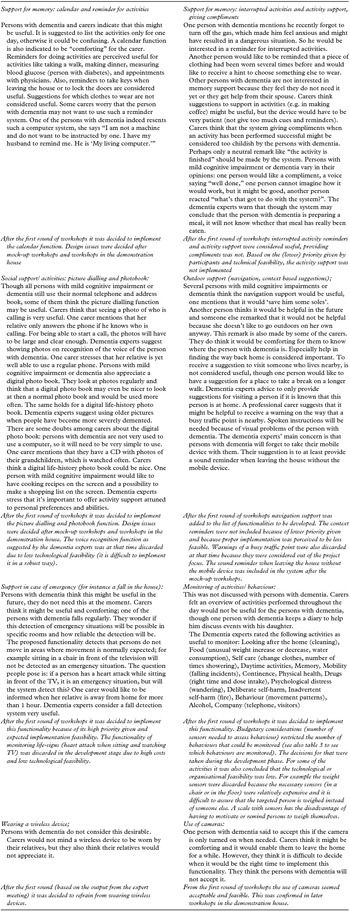
Based on the scenario, several potential functionalities of the integrated Rosetta system were discussed with persons with dementia, informal and professional carers, and dementia experts. Their opinions regarding these functionalities are presented in Table 2.
Opinions regarding proposed functionalities and use of technology in Rosetta

The functionality most often mentioned as relevant and useful by persons with dementia was help in cases of emergencies (with movement sensors). The functionalities most often preferred by carers were support with navigation outdoors and the calendar function.
The least preferred functionalities were activity support and picture phone-dialling. Some functionalities were not considered useful, like providing an overview of activities that were performed during the day. Informal carers pointed out several other issues related to using assistive technologies. For example, they stressed that persons with dementia may have difficulties using buttons and they may have vision problems which could affect the usefulness of some proposed functionalities. The carers also wondered if people with dementia would be able to learn how to use new equipment. A major concern of the dementia experts was if people with dementia would take the mobile device with them when going outside and if it would be sufficiently charged.
Expert opinions on behaviour and activities, relevant to monitoring in EDS
According to the dementia experts in the workshop, fifteen out of the 24 CANE domains of life, were considered relevant to monitor with the EDS (see also Table 2; activities/behaviours).
From the ‘long list’ of behaviours in various stages of dementia (based on the Global Deterioration Scale), dementia experts from the consortium rated 20 behaviours as relevant to monitor because it could provide an indication of deterioration in functioning. These were related to memory (e.g. forgetting appointments and phone numbers that are called frequently; forgetting to switch off appliances; forgetting to wash themselves; not remembering where the toilet is; not knowing (anymore) how to finish an activity) and behaviour related to daily activities (e.g. reduced or higher activity; less watching television; sleeping more frequently or longer; apathy; repeating activities; not eating and drinking enough; trouble getting dressed; not cleaning the house; and not doing groceries.
Based on these assessments a list with functionalities of EDN and EDS was made, of which care partners were asked to prioritize the 10 most important ones for the earlier stages of dementia and 10 most important for the more advanced stages of dementia. The highest ranked functionalities of each list were marked as having high clinical priority. This resulted in two series of 11 prioritized functionalities, e.g. various EDN functionalities, like reminders and a calendar, and EDS functionalities like monitoring meal preparation, and bathroom usage. The technical partners rated the feasibility of these functionalities and the required number of sensors for monitoring this. Based on all this information, the Rosetta system was designed and mock-ups were made.
Results on assessment of mock-ups of the Rosetta interfaces
Persons with dementia, informal carers, professional carers and care partners rated the user-friendliness of the interfaces in Rosetta.
Remarks were made regarding some of the icons used (not clear and familiar enough), the amount of information provided on a screen (e.g. how many days visible in the calendar, how many contacts visible in the address book of the picture dialling function), the content of information provided (e.g. day and date added in the calendar, photos in the address book together with (sur)name, phone number), formulation of reminders (short and in a nice, non-demanding, tone) and multimodal presentation of reminders (text, pictures, voice). Preferences did vary between people with dementia and that is why it was suggested to provide the possibility to individually adjust the lay-out based on personal preferences.
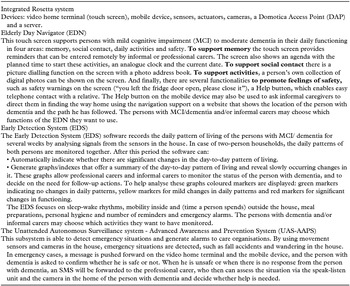
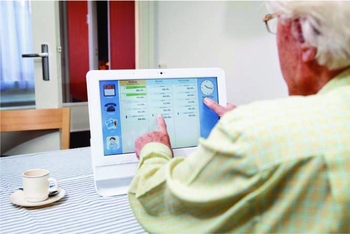
A description of the integrated Rosetta system with the different functionalities is provided in Table 3, a photograph of the Elderly Day Navigator screen is provided in Figure 1.
Description of the integrated Rosetta system with the three subsystems

Elderly Day Navigator screen with agenda function activated.

The first prototype was then developed and shown to persons with dementia and informal carers in the demonstration house. There were some critical comments regarding the EDN user interface, e.g. the size and lay-out of pictures, way of presentation of days in the calendar, and the wish to be able to choose between digital and analogue clock. These comments were used as input for further refinement of the system, though not all comments could be taken into account due to budgetary constraints. The participants did not report privacy concerns with regard to the cameras and sensors during these sessions. Subsequently the prototype was used by a volunteer who stayed in the demonstration house for three days. This resulted in several suggestions for improvement regarding the technical performance of the Rosetta system. The final prototype in the Rosetta project was tested in a controlled trial of which the results will be described in another article.
Discussion
This article describes the participation of persons with MCI or dementia, informal carers and dementia experts in the development of an integrated multimodal assistive technology solution to support community dwelling people with mild to severe dementia in their daily life, as well as their informal and professional carers. Previously developed systems were used as a starting point to develop the integrated system. Most of the suggested functionalities were appreciated by the participants. The most preferred functionalities were help in cases of emergencies (with movement sensors), outdoor navigation support and a calendar function. These functionalities are also proposed or developed in other assistive technology projects (Ikarashi et al., Reference Ikarashi, Magara, Nonaka and Ohno2002; Gilliard and Hagen, Reference Gilliard and Hagen2004; Van Hoof et al., Reference Van Hoof, Kort, Van Waarde and Blom2010) and relate to some needs of persons with dementia with regard to orientation problems, safety and the need for support in structuring the day. Some functionalities were not considered useful, like providing an overview of activities the person with dementia has performed during the day. Also activity support was given less priority, in contrast to for instance the study by Sixsmith et al. (Reference Sixsmith, Gibson, Orpwood and Torrington2007) where the wish-list of technology consisted of various types of support for activities. Informal carers expressed doubts about whether their partners would be able and willing to use assistive technologies. Apart from one person with dementia who did indeed resent technology, most participants with dementia were interested and receptive to new technologies. The dementia experts rated various behaviours as relevant to monitor with the aim to detect changes in functioning. Most of these behaviours were related to memory problems (forgetting appointments, forgetting to switch off appliances) and performance of activities (eating/drinking, repeating activities). A previous review showed that, in agreement with our expert assessment, many devices were developed in the last decade to compensate for symptoms in dementia, mainly for memory impairments, and that they proved to be useful, although it should be noted that the study designs were mostly rather weak (Lauriks et al., Reference Lauriks2007).
The use of different user perspectives (e.g. persons with dementia, informal and professional carers) in the development phase of assistive technologies has been proven valuable (Orpwood et al., Reference Orpwood, Bjørneby, Hagen, Mäki, Faulkner and Topo2004; Wherton and Monk, Reference Wherton and Monk2008). Also, in the Rosetta project complementary feedback was provided by the different participants and it was considered useful to also involve persons with dementia, since they provided relevant feedback for the selection and the technical development of the system. This supports the expectations expressed in a recent review in which it was pointed out that persons with dementia are still hardly involved in the development of assistive technologies, but that this will probably happen more frequently as their involvement clearly has added value and may improve the acceptability of assistive technologies (Span et al., Reference Span, Hettinga, Vernooij-Dassen, Eefsting and Smits2013).
Though research on assistive technologies for people with dementia is growing, there are still few products available to support persons with dementia effectively and to enable them to live longer independently (O'Keeffe et al., Reference O'Keeffe, Maier and Freiman2010). More research is needed to understand the opportunities and limitations of assistive technologies for people with dementia and to provide insight in how to effectively match the characteristics or functional requirements of assistive technologies with the biological, psychosocial and emotional features and needs of people with dementia (LoPresti et al., Reference LoPresti, Mihailidis and Kirsch2004; Topo, Reference Topo2009; O'Keeffe et al., Reference O'Keeffe, Maier and Freiman2010; Meiland et al., Reference Meiland, Wichert, Van Laerhoven and Gelissen2012).
This study had several limitations. The sample size was rather small and consisted of convenience samples, and the sample in Germany could not include persons with a diagnosis of dementia (due to ethical regulations), where therefore persons with Mild Cognitive Impairment were included instead. Strengths of our study are that different types of users were included (participants with dementia, informal carers and dementia experts) and that the users participated in several phases of the development process: the initial phase of choosing functionalities and establishing priorities, the design phase and prototype testing in a demonstration house.
Our study contributes to scientific research by providing insight into the development of technological solutions that are adapted to the needs and wishes of the target group. Focus groups, interviews, and testing with a prototype of the assistive technology to be developed proved to be useful methods to collect relevant data that could be used for further development of assistive technology. The user needs were assessed mainly by means of focus groups and workshops or group interviews. A potential drawback of this method is that people may not express their own needs and wishes but go along with what is expressed by the more dominant participants in the group discussion. However, an advantage of this method is that discussion may be stimulated and more ideas and wishes for assistive technologies may come up. Separate workshops for people with dementia and for carers were conducted to provide an atmosphere where people could express themselves freely; e.g. where persons with dementia were not overruled by carers, and informal carers were able to also express negative aspects of caring without offending their relative.
The proposed Rosetta system is expected to have several advantages compared to existing assistive technologies: it is a modular system, of which modules can be used or switched off dependent on the specific phase of the disease and wishes of persons with dementia. The Rosetta system is beyond the state of the art by integrating different systems that usually are offered as a single system (Lauriks et al., Reference Lauriks2007), making it difficult and expensive to offer a multifunctional solution, and by focusing more on automatic surveillance and alarm systems instead of the traditional alarm systems that need to be worn around the neck or that have a relatively high number of false positive messages that do not relate to a real emergency situation.
From a societal point of view, the Rosetta system will provide an alternative solution to satisfy the needs of the growing number of people with chronic diseases, like dementia. Due to the progressive nature of the disease, people with dementia who live at home have an increasing need for help from their family and professional caregivers. Family carers often feel unable to help and support their care-recipients and thus carry a heavy burden. Therefore, both the person cared for and the carer need increasing support with the progression of the disease. About 70% of dementia patients are eventually transferred to long-term care settings (Health council of the Netherlands, 2002). The overall societal challenge is to postpone, or avoid this admission as much as possible. As soon as proven effective, further implementation of (modules of) the Rosetta system will be promoted as a useful, personalisable, multifunctional assistive technology solution to support the growing number of elderly people with chronic disease like dementia in different stages of the disease.
Conflict of interest
None.
Description of authors’ roles
FM carried out part of the research and wrote the paper, BH, MdB, TOM, PE, SF, and ISC assisted in data collection and reviewed the paper, JvdL co-designed the study, assisted in data collection and reviewed the paper, AJ and IK co-designed the study and reviewed the paper, RMD co-designed the study, supervised the research and reviewed the paper.
Acknowledgments
The project is funded by the EU (AAL project) and national (governmental) institutes of participating countries. Additional funding was received from Foundation Vita Valley.