Introduction
Extensive genetic diversity is present in the Capsicum genepool for cultivated pepper (Stommel and Albrecht, Reference Stommel, Albrecht and Russo2012). This diversity has been utilized to improve pepper disease resistance, fruit quality and varied yield attributes. Genetic enhancement of constituents that are not major yield components take on new importance today in crop improvement programs as market demands support these efforts. The fresh-cut fruit and vegetable industry has expanded rapidly during the past decade, due to freshness, convenience and the high nutrition that fresh-cut produce offers to consumers (Barry-Ryan et al., Reference Barry-Ryan, Martin-Diana, Rico and Barat2007; James and Ngarmask, Reference James and Ngarmask2010). Fresh-cut produce is defined as fresh-cut fruit or vegetable products that have been trimmed and/or peeled and/or cut into 100% usable product that is pre-packaged for retail or food service sales (Lamikanra, Reference Lamikanra and Lamikanra2002).
The minimal processing utilized for preparing fresh-cut fruits and vegetables causes significant tissue injury and renders products highly perishable. Physiological deterioration and greater opportunity for microbial degradation of the product results in degradation in colour, texture and flavour (Barrett et al., Reference Barrett, Beaulieu and Shewfelt2010; Barry-Ryan et al., Reference Barry-Ryan, Martin-Diana, Rico and Barat2007). Maintenance of fresh-cut product quality is critical since consumer's judge quality based upon product appearance and freshness at the time of purchase. Consumer satisfaction in terms of product texture and flavour influence repeat purchases of fresh-cut commodities.
Food safety, nutrition and sensory quality of fresh-cut produce are dependent on multiple factors that include the cultivar, preharvest cultural practices and climatic conditions, maturity at harvest, and harvesting method (Kader, Reference Kader and Lamikanara2002). Post-harvest handling of intact fruits or vegetables, methods utilized for produce processing and subsequent handling also significantly influence quality of fresh-cut products.
Genetic diversity and inheritance of produce quality attributes are well documented in many fresh and processed fruit and vegetable commodities. Considerable research has focused on the physiology, post-harvest treatments and safety aspects of fresh-cut produce (Soliva-Fortuny, Reference Soliva-Fortuny, Martin-Belloso and Soliva-Fortuny2010). Relatively little research has addressed genetic diversity among cultivated forms of the crop, land races and exotic relatives of specific commodities for development of cultivars with improved fresh-cut applications. For example, within fresh fruit commodities, Abbott et al. (Reference Abbott, Saftner, Gross, Vinyard and Janick2004) demonstrated variation in consumer acceptance among fresh-cut apple slices prepared from diverse apple cultivars. Hayes and Luo (Reference Hayes and Luo2008) examined genetic variation for shelf life in salad-cut lettuce and found sufficient diversity to enable selection within breeding populations for extended shelf life. For pepper, varied results have been reported for fresh-cut product shelf life. Shelf life evaluated in a relatively small number of cultivars was influenced by choice of cultivar, the degree of processing, storage temperature and controlled atmosphere packaging (Conesa et al., Reference Conesa, Artés-Hernández, Geysen, Nicolaï and Artés2007; Howard and Hernandez-Brenes, Reference Howard and Hernandez-Brenes1998; Lopez-Galvez et al., Reference Lopez-Galvez, El-Bassuoni, Nie, Cantwell and Gorny1997; Manolopoulou et al., Reference Manolopoulou, Lambrinos and Xanthopoulos2012). Little attention has been dedicated to evaluating the breadth of potential diversity within Capsicum for fresh-cut attributes and genetic enhancement of fresh-cut fruit quality. The objective of our research was to assess the variation available in a diversity of Capsicum germplasm for fresh-cut pepper quality. Identification of germplasm with attributes that contribute to fresh-cut quality will facilitate development of elite cultivars suitable for use in today's fresh-cut industry.
Materials and methods
Plant materials
Seed of commercially available pepper cultivars and Capsicum accessions that were obtained from the USDA-ARS, Plant Genetic Resources Conservation Unit, Griffin, Georgia, were grown from seed in the greenhouse; twelve 6-week old plants of each accession were transplanted following a completely randomized design to field plots at the Beltsville Agricultural Research Center, Beltsville, Maryland, into Keyport fine loam soil. Field-grown plants were spaced at 0.45 m intervals in single rows on polyethylene-covered raised beds positioned on 1.5 m centres with trickle irrigation. Pest control and fertilizer regimes followed standard practices for pepper production in Maryland (University of Maryland, Reference Brust, Everts and Marine2015).
Accessions evaluated were selected based upon pod types, and were comprised of sweet bell, large elongate (i.e. elongated bell to elongate conical), jalapeno and serrano pod types (Table S1, available online). Market maturity for full-size green fruit from each accession was assessed visually via evaluation of fruit development and marketable green fruit was harvested from plants of respective genotypes. Fruit were harvested for replicate samples and stored at 5°C overnight before processing.
Fruit processing
Before slicing, fruit were washed for 1 min in chlorinated water containing 50 mg/l free sodium hypochlorite (NaOCl) and adjusted to pH 6.0–7.0 with citric acid. Using a sharp knife, the fruit stem end, seed and placental tissue were removed. Fruit were subsequently sliced transversely in 0.6 cm thick rings using an industrial slicer (Emura Digisler ECD-302; Emura Food Machine Co., Ltd., Nagoya, Japan) and washed in 50 mg/l NaOCl in water for 0.5 min. Washed fruit slices were centrifuged in a fresh produce centrifuge (Garroutte Inc., Watsonville, CA, USA) for 2 min. at 300 rpm to remove excess water; three replicate 50.0 ± 1.0 g samples of sliced pepper for evaluation at days 0, 7, 10 and 14, respectively, were transferred to 19 × 28 cm heat sealed polypropylene bags (CFS Cellpack Packaging, Illfurth, France) with an oxygen transmission rate (OTR) of 1193 ml O2/m2/24 h. Samples were stored in the dark at 4°C before evaluation (Barth et al., Reference Barth, Zhuang, Saltveit, Gross, Wang and Saltveit2014).
Fresh-cut evaluation
Upon removal from cold storage after 7, 10 and 14 d, package atmospheric composition was evaluated by measuring percent O2 and CO2 in the headspace of sealed bags using a gas analyser (CheckMate II, PBI Dansensor A/S, Ringsted, Denmark). Product quality of samples was subsequently evaluated by at least three to five evaluators using a five-point score for overall visual quality (1 = very good; 2 = good; 3 = acceptable, would eat; 4 = not acceptable, would not eat; 5 = very bad), tissue breakdown (0 = none; 1 = minor, < 10% of tissue; 2 = moderate, 10–25%; 3 = moderately severe, 25–50%; 4 = severe, >50%), firmness (1 = very firm; 2 = firm; 3 = moderate; 4 = soft; 5 = very soft) and off-odour (0 = none; 1 = minor; 2 = moderate; 3 = moderately severe; 4 = severe).
After scoring overall visual quality, weight of the samples in each package was recorded and tissue juice loss calculated as the initial tissue weight minus the end weight. Electrolyte leakage determinations were performed as previously described with minor modifications (Hong et al., Reference Hong, Mills, Coffman, Anderson, Camp and Gross2000; Kou et al., Reference Kou, Luo, Yang, Xiao, Turner, Lester, Wang and Camp2013). Package contents were transferred to 500 ml reverse osmosis quality water, incubated for 30 min and electrical conductivity (EC1) measured. Samples in RO water were frozen slowly to − 20°C for 24–48 h. to maximize tissue disruption, thawed and total product EC recorded (EC2). Repeat freeze-thaw cycles were evaluated until total EC was stable. Percent electrolyte leakage of stored product was calculated as
 $$(EC_{1} - EC_{0})/EC_{2} - EC_{0})\times 100 $$
where EC0= EC of RO water.
Statistical analysis
Data were analysed by the mixed models procedure in SAS, version 12.1 (SAS Institute, Cary, NC, USA). The variables O2, CO2, juice loss and electrolyte leakage were initially analysed as two-factor repeated-measures models with day as the repeated factor. For electrolyte leakage, day 0 was measured in addition to days 7, 10 and 14. Because the variability due to the correlation between days accounted for very little of the variability, the variables were then analysed as two-factor linear models with day as a fixed factor. This model allowed for the use of the variance grouping technique to correct variance heterogeneity. The results from the assumptions of the models were checked and any outliers identified were removed for respective variables to ensure normal residual distributions. Mean comparisons were done with Sidak adjusted P values so that the experiment-wise error was 0.05.
For sensory data, the rater's average subjective value for fruit firmness, off-odour, overall visual quality and tissue breakdown at day 14 was used as the experimental unit. Data were analysed by market class as a one-factor linear model with accession as the factor using Proc Mixed. The model assumptions were checked and the variance grouping technique was used to correct variance heterogeneity. Mean comparisons were done with Sidak adjusted P values to hold the experiment-wise error at 0.05. Regression analysis at day 14 for each fruit class with overall visual quality and electrolyte leakage was done using SAS's Proc Reg. The assumptions of the models were checked and met.
Results
Objective measurements
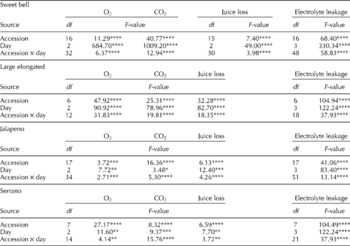
Analysis of package atmospheric composition, pepper fruit juice loss and tissue electrolyte leakage for fresh-cut pepper samples revealed significant differences across sweet bell, large elongate, jalapeno and serrano fruit classes, and days of storage (Table 1). Fruit class × day interactions were significant for O2 and CO2 partial pressures and electrolyte leakage, but not for sample juice loss. The largest differences were for percent O2 and CO2. Within individual fruit classes, accessions, days of storage and accession × days of storage were significant (Table 2). For sweet bell and large elongate fruit classes, days of storage had the greatest overall effect on percent O2 and CO2 in sample packages, sample juice loss and tissue electrolyte leakage. Days had the greatest influence on electrolyte leakage of jalapeno and serrano fruit classes, but lesser influence on O2, CO2 and juice loss relative to that observed in sweet bell and large elongated fruit classes.
Analysis of variance F-values for O2, CO2, sample juice loss and electrolyte leakage of fresh-cut pepper slices across sweet bell, large elongated, jalapeno and serrano pepper fruit classes stored under passive modified atmosphere packaging conditions for 7, 10 and 14 d

****, ***, **, *Significant at P≤ 0.0001, P≤ 0.001, P≤ 0.01 and P≤ 0.05, respectively.
Analysis of variance F-values for O2, CO2, sample juice loss and electrolyte leakage of fresh-cut pepper slices within sweet bell, large elongated, jalapeno and serrano pepper fruit types stored under passive modified atmosphere packaging conditions for 7, 10 and 14 d

****, ***, **, *Significant at P≤ 0.0001, P≤ 0.001, P≤ 0.01 and P≤ 0.05, respectively.
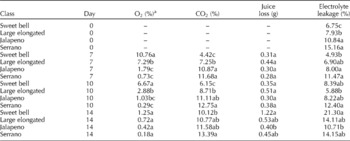
The decline in O2 and increase in CO2 partial pressures were slower in fresh-cut tissue of sweet bell and large elongated accessions and lower CO2 levels were generally maintained in storage bags up to 10 or 14 d storage in comparison to jalapeno and serrano fruit classes (Table 3). In contrast to sweet bell and large elongated fruit types, fresh-cut fruit of jalapeno and serrano accessions largely depleted O2 within 7 d of storage. Consistent with decreased O2 in these samples, percent CO2 in sample gags was generally greater throughout the storage period. After 10 or 14 d of storage, a number of the sweet bell and large elongated fruit accessions maintained both 3–5% O2 and < 10% CO2 considered suitable for fresh-cut pepper, e.g. E44.18 597, E20L.1012857, Rubinne and E49.10 719 (Table S1, available online). E20L.1012857 and E49.10 719 exhibited little change in percent O2 and CO2 over the 14-d storage period. Changes in Holy Mole fruit tissue typified that of jalapeno and serrano accessions and largely depleted O2 by day 7 and maintained 10–13% CO2 throughout the storage period. For jalapeno and serrano fruit classes, only two accessions, Mitla and Tula, maintained both 3–5% O2 and < 10% CO2.
Least-square means for O2, CO2, sample juice loss and electrolyte leakage of fresh-cut pepper slices from sweet bell, large elongated, jalapeno and serrano pepper fruit classes stored under passive modified atmosphere packaging conditions for 7, 10 and 14 d

a Letters denote means comparisons within individual days for respective fruit classes. Comparisons were evaluated using Sidak adjusted P-values so that the experiment-wise error was 0.05.
Overall, changes in juice loss of fresh-cut pepper samples were small and varied little between fruit classes (Table 3). The sweet bell cultivars Special, Healey and Tinsena were notable for significantly greater juice loss over time in comparison to other accessions (Table S1, available online). For sweet bell and large elongate type peppers, sample electrolyte leakage on day 0 when samples were processed and also after 7 and 10 d storage for some accessions was significantly lower than that observed for nearly all accessions in jalapeno and serrano fruit classes (Tables 1 and 3). Electrolyte leakage increased markedly for most large fruited accessions when stored for 14 d. Notable exceptions include the sweet bell accessions E20B.24 966 and E20L.1012857 and the large elongate fruited accessions E49.10 719, Holy Mole, Pizza and Planet that had minimal increase in electrolyte leakage during storage relative to that observed at day 0 (Table S1, available online). In contrast to sweet bell and large elongate pod types, electrolyte leakage in fruit of jalapeno and serrano accessions was higher relative to large fruit classes at day 0 and did not change as markedly from day 0 as days of storage increased (Table S1, available online). Although a number of accessions displayed greater electrolyte leakage at day 14 relative to day 0, electrolyte leakage scores in most of these accessions were unchanged or significantly declined in accessions such as Mitla, Fooled You and Ixtapa X3R with increasing days of storage.
Sensory assessments
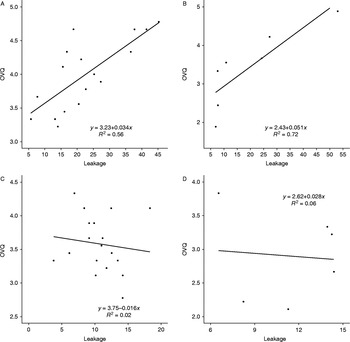
Since tissue breakdown, firmness and off-odour contribute to overall sensory quality and electrolyte leakage is a strong determinant of shelf life, the relationship between overall visual quality and electrolyte leakage was subjected to further analysis. Analysis of variance for overall visual quality after 14 d of storage indicated that accessions were significantly different within sweet bell (P= 0.0044) and large elongated fruit classes (P= 0.0007), but not within jalapeno (P= 0.9321) or serrano fruit classes (P= 0.2683) (Table S2, available online). Regression analysis demonstrated a relationship between overall visual quality and electrolyte leakage at day 14 for accessions in the sweet bell (R
2= 0.562; P= 0.0005) and large elongated (R
2= 0.716; P= 0.0165) fruit classes, but not for accessions represented in jalapeno (R
2= 0.015; P= 0.6247) or serrano (R
2= 0.064; P= 0.5463) fruit classes (Fig. 1). Coincident with a low day 14 electrolyte leakage score for the sweet bell cultivars Inzell and a high electrolyte leakage score for Ferrari means comparisons of overall visual quality identified Inzell (
 $$\bar {>x} $$
= 3.33) and Ferrari (
 $$\bar {>x} $$
= 4.67) as accessions with the best and worst scores, respectively. In the large elongated fruit class, the cultivars Holy Mole (
 $$\bar {>x} $$
= 1.89) and Laerte (
 $$\bar {>x} $$
= 4.89) were identified with the best and worst subjective overall visual quality scores, respectively, coincident with their divergent scores for electrolyte leakage. Divergent overall visual quality for these sweet bell and large elongate fruited accessions were also in agreement with divergent juice loss scores recorded after 14 d of storage. A relationship between overall visual quality and percent O2 and CO2 was not evident for these accessions. Within the sweet bell class, significant differences between accessions for tissue breakdown, firmness and off-odour were observed. However, little relationship between sensory attributes was evident for accessions in this fruit class. Significant differences for these sensory attributes were also observed between accessions in the large elongate fruit class. In contrast to the sweet bell class, a relationship between sensory attributes for accessions at the extremes of the data distribution was evident. For example, Holy Mole had the lowest scores for the sensory attributes, whereas Laerte had the highest scores recorded.
Regression analysis of overall visual quality (OVQ) versus electrolyte leakage at day 14 for sweet bell (A), large elongated (B), jalapeno (C) and serrano (D) fruit classes.

Similar to overall visual quality, significant differences between jalapeno and serrano accessions was not evident for subjective tissue breakdown and firmness assessments (Table S2, available online). Significant differences between accessions for off-odour in these fruit classes were observed. In the jalapeno fruit class, raters scored Mitla as having very little off-odour and Tula and Jaloro as having significantly greater off-odour. Low versus high off-odour rankings are in agreement with low versus high electrolyte leakage observed for these respective accessions. For serrano accessions with significantly different off-odour, a similar association with low and high electrolyte leakage scores was observed.
Discussion
Cutting employed to produce fresh-cut produce results in wounding of plant tissues and increased respiration rates and shortened post-harvest shelf life (Eskin, Reference Eskin and Eskin1990). Tissue electrolyte leakage is closely related to the quality and shelf life of fresh-cut produce (Allende et al., Reference Allende, Luo, McEvoy, Artés and Wang2004; Kim et al., Reference Kim, Luo and Gross2004; Luo et al., Reference Luo, McEvoy, Wachtel, Kim and Huang2004). Electrolyte leakage is indicative of cell disruption responsible for the cascade of adverse changes in fresh-cut product colour, texture, flavour and microbial growth. Modified atmosphere and low temperature storage have been used for many years to reduce respiration rates and the deterioration that occurs in fresh-cut produce (Barry-Ryan et al., Reference Barry-Ryan, Martin-Diana, Rico and Barat2007; Luo, Reference Luo2007; Tareq and Hotchkiss, Reference Tareq, Hotchkiss and Lamikanra2002). Low O2 and high CO2 concentrations are characteristically used to reduce respiration rates and ethylene production.
Pepper fruit are non-climacteric in behaviour and produce very low levels of ethylene (Lee et al., Reference Lee, Chung, Joung and Choi2010). A review of produce fresh-cut storage conditions recommends a controlled atmosphere of 3% O2 and 5–10% CO2 and 1–4°C for storage of fresh-cut pepper (Barth et al., Reference Barth, Zhuang, Saltveit, Gross, Wang and Saltveit2014). However, varied reports indicate a lack of consensus for fresh-cut pepper storage temperature and controlled atmosphere composition (Conesa et al., Reference Conesa, Artés-Hernández, Geysen, Nicolaï and Artés2007, Howard and Hernandez-Brenes, Reference Howard and Hernandez-Brenes1998, Lopez-Galvez et al., Reference Lopez-Galvez, El-Bassuoni, Nie, Cantwell and Gorny1997, Manolopoulou et al., Reference Manolopoulou, Lambrinos and Xanthopoulos2012). CO2 levels greater than 10% in the package for most fresh-cut produce may result in tissue darkening and softening. Excessive depletion of oxygen may result in anaerobic respiration that leads to the formation of off-odours and flavours in fresh-cut fruits or vegetables (Tareq and Hotchkiss, Reference Tareq, Hotchkiss and Lamikanra2002). Off-odour observed in the current study may be attributed to anaerobic respiration in samples where O2 was depleted as well as potential microbial growth that may result coincident with tissue breakdown. Manolopoulou et al. (Reference Manolopoulou, Lambrinos and Xanthopoulos2012) reported that low O2 concentration at 0–5°C storage temperatures did not produce off-flavours in fresh-cut pepper stored in impermeable packaging.
Our data collected from a diversity of pepper germplasm demonstrates that diversity in Capsicum for traditional yield, disease resistance and fresh or processed product quality extends to fresh-cut quality attributes as well. Considerable variation in package atmospheric composition and electrolyte leakage attributed to tissue damage was evident among and within the sweet bell, large elongated, jalapeno and serrano fruit types evaluated for fresh-cut suitability in the current study. A number of sweet bell and large elongate fruited accessions exhibited reduced respiration and electrolyte leakage scores after 10 or 14 d of storage that were equivalent to those measured at day 0 when fruit were processed. Accessions from all fruit classes that exhibited little or no change in electrolyte leakage during storage also exhibited only small changes in sample juice loss when stored up to 14 d. Consistent with tissue breakdown associated with electrolyte leakage, accessions that incurred the greatest electrolyte leakage, also exhibited the greatest juice loss for the period.
Our results suggest that storage conditions must be optimized for different pepper fruit classes, and in some instances, accessions/genotypes within a class. In the current study, O2 and CO2 partial pressures for fresh-cut sweet bell pepper were generally maintained at recommended levels under our conditions for 10–14 d of storage in packaging utilized by food industry specialists for sweet pepper (Enza Zaden, pers. commun.). However, accessions within jalapeno and serrano fruit classes may rapidly deplete O2 during storage and testing of polymer films with greater OTR, film area and/or headspace volume may be required to optimize O2 and CO2 levels and shelf life for these fruit classes. Despite low and presumably suboptimal O2 concentration observed during storage of most fresh-cut fruit of jalapeno and serrano accessions, electrolyte leakage that reduces post-harvest shelf life often did not increase during storage, and for some accessions was reduced during storage. Similar to our observations on fresh-cut cilantro and minimally processed microgreens, this decrease in electrolyte leakage may be attributed, in part, to influx of electrolytes from damaged tissue into metabolically active cells (Kou et al., Reference Kou, Luo, Yang, Xiao, Turner, Lester, Wang and Camp2013; Luo et al., Reference Luo, McEvoy, Wachtel, Kim and Huang2004). Since electrolyte leakage is related to cell membrane integrity (Marangoni et al., Reference Marangoni, Palma and Stanley1996; Murata, Reference Murata and Wang1989), our observations and studies on membrane structural lipids and the membrane ultrastructures of fresh-cut carrots (Picchioni and Watada, Reference Picchioni and Watada1996; Picchioni et al., Reference Picchioni, Watada, Roy, Whitaker and Wergin1994) further suggest the occurrence of a membrane repair process for fresh-cut pepper. Differences in electrolyte leakage and package atmospheric composition observed among divergent fruit classes highlights the opportunity to combine potentially different genetic mechanisms for breeding elite pepper cultivars with improved fresh-cut shelf life.
Electrolyte leakage is a measure of membrane integrity and has been used as an index of tissue damage and quality deterioration of fresh-cut produce (Kou et al., Reference Kou, Luo, Yang, Xiao, Turner, Lester, Wang and Camp2013, Luo et al., Reference Luo, McEvoy, Wachtel, Kim and Huang2004). Pepper fruit classes and accessions exhibited substantial differences in the initial electrolyte leakage immediately after cutting and during storage. In general, the sweet bell and large elongated fruit had relatively low initial electrolyte leakage, but large rates of increase during storage. Conversely, jalapeno and serrano fruit classes had higher initial electrolyte leakage, but the values remained relatively stable during storage. Since the initial electrolyte leakage is often a reflection of tissue damage sustained during cutting, the higher initial electrolyte leakage found in jalapeno and serrano fruit suggest that fruit in these classes may have sustained more tissue injury during cutting, which may be attributable to their thicker and more rigid pericarp tissues. During storage, the gradual increase in electrolyte leakage of sweet bell and large elongated fruit classes correlated well with reduced overall visual quality ratings over time. However, the relative stability for electrolyte leakage in jalapeno and serrano fruit classes resulted in a poor association between electrolyte leakage and overall visual quality. Similar to objective measurements, the range of scores for tissue breakdown, firmness and off-odour was lower for fruit of jalapeno and serrano accessions in comparison to sweet bell and large elongate fruited accessions. Fruit of jalapeno and serrano accessions exhibited less tissue breakdown, were firmer and had reduced off-odour after 14 d of storage.
Subjective evaluation of firmness for fresh-cut pepper slices revealed diversity for this sensory attribute among the diverse pepper accessions that were evaluated. Preservation of tissue firmness is very desirable since consumers associate firmness attributes of freshly cut product with superior culinary and nutritive value (Fillion and Kilcast, Reference Fillion and Kilcast2002). Limp tissue or soft texture can result in rejection of product in the retail market or prevent repeat purchase. Reported influence of polygalacturonase and pectin methylesterase on softening of fresh-cut produce (Vu et al., Reference Vu, Smout, Sila, LyNguyen, Van Loey and Hendrickx2004) suggests that selection of genotypes with reduced activity of enzymatic and non-enzymatic components that contribute to cell wall degradation may provide novel strategies to maintain firmness and texture.
Disagreement between overall visual quality and objective and sensory measures of fresh-cut tissue integrity may be influenced by additional attributes that influence fresh-cut quality. Whiteness of cut pepper fruit surfaces was observed for some samples after storage and may have reduced subjective overall visual quality scores in these accessions. Reversible surface dehydration as well as lignin formation was reported to increase the whiteness of fresh-cut carrot samples but could be reduced by maintaining tissue water capacity or by application of edible coatings (Howard and Dewi, Reference Howard and Dewi1996; Howard and Griffin, Reference Howard and Griffin1993). Testing of similar treatments may reduce whiteness that might occur in otherwise acceptable fresh-cut pepper accessions. Inclusion of additional raters for scoring of sensory attributes may likely improve the precision of sensory scores and agreement between objective and sensory measures. Agreement between electrolyte leakage and objective and sensory scores was possible for accessions at the extremes of the sensory data distributions. Objective measurements are regarded as superior in measuring quality on a routine basis (Shewfelt, Reference Shewfelt, Shewfelt and Prussia1993).
Unique applications for sweet as well as pungent fresh-cut pepper exist in retail and food service markets. Our results for a diverse collection of fresh-cut pepper germplasm stored under passive modified atmosphere packaging conditions highlights the influence of plant genotype and degree of processing. Exceptional accessions in all fruit classes were identified with acceptable overall sensory quality and that maintained tissue integrity and reduced respiration or tolerance to sub-optimal O2:CO2 partial pressures. Breeding programs have a long tradition of exploiting genetic diversity identified in divergent accessions to breed improved cultivated forms of the crop and broaden the relatively narrow cultivated germplasm base. Characterization of these Capsicum germplasm resources facilitates research to better understand physiological and genetic determinants of fresh-cut produce quality and provides opportunities to combine desirable attributes in elite cultivars to enhance shelf life of fresh-cut pepper products.
Supplementary material
To view supplementary material for this article, please visit http://dx.doi.org/10.1017/S1479262115000131
Acknowledgements
Mention of trade names or commercial products is solely for the purpose of providing specific information and does not imply recommendation or endorsement by the United States Department of Agriculture.