

Introduction
The CerradoFootnote * is part of the corridor of xeromorphic vegetation cutting across South America that includes the Caatinga in northeastern Brazil and the Chaco in Paraguay, Bolivia and Argentina (Vanzolini, Reference Vanzolini and Ferri1963). This corridor occupies an intermediate region between the two main humid tropical forests of South America: the Amazon Forest in the north-northwest, and the Atlantic Forest in the east and southeast (Oliveira-Filho & Ratter, Reference Oliveira-Filho, Ratter, Oliveira and Marquis2002; Méio et al., Reference Méio, Freitas, Jatobá, Silva, Ribeiro and Henriques2003).
The Cerrado vegetation is characterised by two layers: the woody layer, which includes trees and larger shrubs, and the herb–subshrub layer (Rizzini, Reference Rizzini1992; Oliveira-Filho & Ratter, Reference Oliveira-Filho, Ratter, Oliveira and Marquis2002). The difficulty of distinguishing tree from shrub species in the Cerrado is notorious: many species can flower and fruit both as small shrubs and as large trees (Rizzini, Reference Rizzini1992). The flora of both layers exhibits typical characteristics of pyrophytic savanna vegetation: the trees are low with twisted trunks and thick cork providing resistance to fire (Ratter et al., Reference Ratter, Ribeiro and Bridgewater1997), while both trees and shrubs have well-developed woody underground organs.
Studies that have tried to determine the main factors responsible for the distribution of this vegetation have to some extent varied in their conclusions, but in general the main factors are precipitation, soil fertility and drainage, fire regime, and the climatic fluctuations of the Quaternary (Eiten, Reference Eiten1972; Furley & Ratter, Reference Furley and Ratter1988; Ratter, Reference Ratter, Furley, Proctor and Ratter1992; Oliveira-Filho & Ratter, Reference Oliveira-Filho and Ratter1995, Reference Oliveira-Filho, Ratter, Oliveira and Marquis2002; Furley, Reference Furley1999). These are the same factors identified as important in the maintenance of savannas worldwide (Cole, Reference Cole1986).
Today it is widely accepted that climate, soil and fire together have an important effect on the Cerrado vegetation. The dry season favours the occurrence of fire that hinders the establishment of forest species and also causes soil impoverishment. Of the chemical elements in the Cerrado soil, one of the most important is aluminium, as emphasised by Goodland (Reference Goodland, Goodland and Ferri1969, Reference Goodland and Ferri1971). This element occurs at high concentration in dystrophic soils and is extremely toxic for the majority of cultivated plants, but, as would be expected, the Cerrado native plants have a great tolerance to it. These tolerant plants are of diverse, unrelated families that accumulate aluminium in their tissues, particularly in leaves, but also in roots (Haridasan, Reference Haridasan1982), such as Vochysiaceae, Rubiaceae, Myrtaceae, Melastomataceae, Symplocaceae, Loganiaceae and Myrsinaceae. Some families, including Vochysiaceae, accumulate aluminium and cannot survive in its absence (Haridasan, Reference Haridasan1982; Oliveira-Filho & Ratter, Reference Oliveira-Filho, Ratter, Oliveira and Marquis2002). On the other hand, species occurring only in areas with higher levels of calcium and magnesium, and lower aluminium levels, are characteristic of the mesotrophic Cerradão (or deciduous and semideciduous forests) and do not tolerate high aluminium concentrations (Ratter, Reference Ratter and Ferri1971, Reference Ratter, Furley, Proctor and Ratter1992; Ratter et al., Reference Ratter, Richards, Argent and Gifford1973, Reference Ratter, Askew, Montgomery and Gifford1978).
The correlation between the physiognomic variation of the Cerrado and soil fertility was first studied by Goodland & Pollard (Reference Goodland and Pollard1973) and Lopes & Cox (Reference Lopes and Cox1977). They found a positive correlation between biomass of woody elements and fertility. However, data from other authors did not show the same correlation. Some works showed the occurrence of Cerradão instead of low density vegetation in areas of lower fertility (Ribeiro et al., Reference Ribeiro, Silva and Batmanian1985; Ribeiro & Haridasan, Reference Ribeiro and Haridasan1990).
Early work carried out by the Anglo-Brazilian Xavantina–Cachimbo Expedition in 1967–69 in southeast Mato Grosso led to the identification of two types of Cerradão determined by the presence of different soil types (Ratter, Reference Ratter and Ferri1971; Ratter et al., Reference Ratter, Richards, Argent and Gifford1973). In these publications the two types were named after their dominant characteristic species: Hirtella glandulosa Cerradão on dystrophic soils and Magonia pubescens Cerradão on mesotrophic soils. The work was continued in 1972 to cover an extensive area of central Brazil and these two types of Cerradão were shown to be widespread (Ratter et al., Reference Ratter, Askew, Montgomery, Gifford and Ferri1977). The publication was in Portuguese and the two types were called Cerradão do tipo mesotrófico and Cerradão do tipo distrófico, which were later modified to Cerradão mesotrófico and Cerradão distrófico (or in English mesotrophic and dystrophic Cerradão).
The present work investigates the effect of soil factors on the diversity and structure of the Cerrado vegetation of the National Forest of Paraopeba, Minas Gerais State.
Material and Methods
Area of study
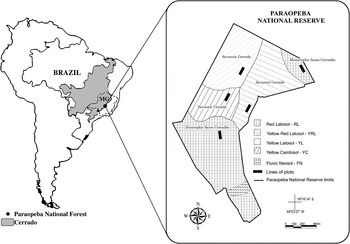
The present study was conducted in the National Forest of Paraopeba (in Portuguese Florestal Nacional de Paraopeba or FLONA de Paraopeba), Minas Gerais (19°20′S, 44°20′W), which covers an area of 200 ha (Fig. 1). The FLONA is a Sustainable Use Conservation Unit, according to the National System of Conservation Units (SNUC, 2000), a work that details the multiple uses of forest resources and scientific research, with emphasis on methods for sustainable exploitation of native forests.
Location of Paraopeba National Forest in Brazil and the areas studied.

The climate of the region is classified as Aw (tropical humid) by the Koeppen system (IBGE, 2007), with a rainy summer from October to March and a dry season from April to September. The annual mean temperature and the total annual rainfall are approximately 20.9°C and 1328 mm, respectively.
According to Silva-Júnior (Reference Silva-Júnior1984) and personal statements from former employees, the FLONA vegetation regenerated after the area was clear-cut in 1952. There are records of fires in 1960 and 1963, but after that, the area has been protected from fire. For this reason we did not include the influence of fire as a factor in our analysis.
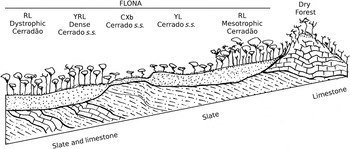
The selection of the studied areas was based primarily on classification of the soils (Neri, Reference Neri2007) and not on vegetation types (physiognomies). The soil–vegetation gradient presents five classes with rather distinct characteristics, ranging from the upper landsurface closest to the calcareous Dry Forest outside the FLONA to the colluvial bottom, where the deepest Latosols occur (Fig. 2):
Transect of soils, vegetation and lithology at the FLONA of Paraopeba, Brazil, illustrating the main soil–landform relationship.

1 mesotrophic Cerradão on Red Latosol;
2 Cerrado sensu stricto on typical Yellow Latosol;
3 Cerrado sensu stricto on Haplic Cambisol Tb;
4 dense Cerrado sensu stricto on Yellow Red Latosol; and
5 dystrophic Cerradão on Red Latosol.
The Red Latosol under mesotrophic Cerradão is located in a pediment approximately 500 m below a prominent crest of limestone outcrop where open, calcareous, Dry Forest occurs. Its colluvial nature suggests an influence of reworked materials eroded from the shallow limestone soils.
Structure and floristic analysis
The survey of the tree–shrub layer was carried out by placing quadrats of 20 × 100 m in each of the areas and then recording all woody individuals with a basal stem circumference ≥ 10 cm.
The classification of species into families followed APG II (APG II, 2003; Souza & Lorenzi, Reference Souza and Lorenzi2005). The nomenclature of the species and the abbreviations followed available information on the Missouri Botanical Garden website (www.mobot.org). Samples of fertile material were lodged in the herbarium of the Federal University of Viçosa (VIC).
Phytosociological parameters (Mueller-Dombois & Ellenberg, Reference Mueller-Dombois and Ellenberg1974; Rosot et al., Reference Rosot, Amaral-Machado and Figueiredo Filho1982) for describing the community structure were determined using the software ‘Mata Nativa 2.0’ (Cientec, 2002).
Soil and vegetation
Each of the vegetation quadrats of 20 × 100 m was divided into five subplots of 20 × 20 m and in each of these a soil sample was collected. These samples were composites of 10 subsamples and were from 0–10 cm depth. The subsamples were collected on the edge of a circle with a 5 m radius centred in the middle of the plot. Soil samples taken for chemical analysis were air-dried and sieved. Chemical soil properties were determined in the Soil Laboratory at the Federal University of Viçosa, following methods described by EMBRAPA (1997). The soil data were correlated with the richness, dominance and density of the vegetation calculated for each subplot (20 × 20 m).
We investigated the influence of edaphic variables on species abundance, using canonical correspondence analysis (CCA).
Statistical analysis
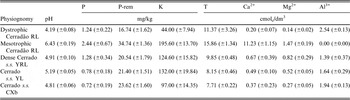
The correlation between the soil variables (pH, K, Ca, P-rem [remaining phosphorus], Al, Mg and P) and the species richness of each studied environment was calculated using Pearson’s correlation coefficient (r s) between the soil variables and absolute density, and absolute dominance was also calculated to study the influence of soil features on community structure (Table 1).
Mean values and standard deviation of soil features of the National Forest of Paraopeba, Minas Gerais, Brazil

pH – active acidity; P – phosphorus; P-rem – remaining phosphorus; K – potassium; T – cation exchange capacity for pH 7; Ca2+ – exchangeable calcium; Mg2+ – exchangeable magnesium; Al3+ – aluminium.
RL – Red Latosol; YRL – Yellow Red Latosol; YL – Yellow Latosol; CXb – Haplic Cambisol.
The 25 subplots were analysed by CCA using PCORD (McCune & Mefford, Reference McCune and Mefford1997). Soil attributes and abundance values for 44 species (those with 20 or more individuals sampled in the 1 ha area) were used for the calculations. Correlations between the species axes and soil variable axes were tested using Monte Carlo tests to estimate the significance of correlations among canonical axes.
Results
Floristics
A total of 4156 individuals were recorded in the five areas sampled; these included 132 species belonging to 47 families. The families with the greatest species richness were Fabaceae (18), Myrtaceae (9), Vochysiaceae (8), Bignoniaceae (7), Malpighiaceae and Rubiaceae (6 each), and Anacardiaceae, Annonaceae, Erythroxylaceae and Melastomataceae (4 each).
Of the 132 species, 14 were considered tolerant of variation in soil conditions, since they were observed in all studied areas: Alibertia edulis (Rich.) A.Rich. ex DC., Bowdichia virgilioides Kunth, Erythroxylum sp., Erythroxylum suberosum A.St.-Hil., Eugenia dysenterica DC., Guapira noxia (Netto) Lundell, Leptolobium dasycarpum Vogel, Machaerium opacum Vogel, Myrcia guianensis (Aubl.) DC., Ouratea castaneifolia (DC.) Engl., Qualea grandiflora Mart., Qualea multiflora Mart., Roupala montana Aubl. and Zeyheria montana Mart.
Apart from the species tolerant of variation in soil conditions, others restricted to specific environments were also observed. Eleven were restricted to the dystrophic Cerradão on Red Latosol: Agonandra engleri Hoehne, Bauhinia rufa (Bong.) Steud., Bauhinia sp., Cabralea canjerana (Vell.) Mart., Cybianthus detergens Mart., Diospyros hispida A.DC., Enterolobium gummiferum (Mart.) J.F.Macbr., Guapira sp., Lacistema hasslerianum Chodat, Pouteria ramiflora (Mart.) Radlk. and Tontelea micrantha (Mart. ex Schult.) A.C.Sm.
The mesotrophic Cerradão on Red Latosol is characterised by the low density or absence of herbaceous plants, probably because of the shade. In its understorey there is a prevalence of Alibertia edulis. Thirteen of the species found are exclusive to this environment: Aspidosperma subincanum Mart. ex A.DC., Casearia rupestris Eichler, Dilodendron bipinnatum Radlk., Guazuma ulmifolia Lam., Guettarda viburnoides Cham. & Schltdl., Luehea divaricata Mart., Machaerium sp., Machaerium villosum Vogel, Magonia pubescens A.St.-Hil., Pseudobombax longiflorum (Mart. & Zucc.) A.Robyns, Pseudobombax tomentosum (Mart. & Zucc.) A.Robyns, Pouteria gardneri (Mart. & Miq.) Baehni and Trichilia claussenii C.DC.
The dense Cerrado sensu stricto on Yellow Red Latosol also showed great richness, a total of 71 species, although only the following five were restricted to this area: Handroanthus serratifolius (Vahl) S.O.Grose, Handroanthus sp., Rourea induta Planch., Vernonia sp. and Zanthoxylum sp.
The Cerrado sensu stricto on typical Yellow Latosol is characterised by the presence of the species Byrsonima cydoniifolia A.Juss., Eugenia dysenterica DC., Miconia albicans (Sw.) Steud., Pera glabrata (Schott) Poepp. ex Baill., Salvertia convallariodora A.St.-Hil. and Trichilia pallida Sw.
The Cerrado sensu stricto on Haplic Cambisol Tb Dystrophic is characterised by well-defined herb–subshrub and shrub–tree layers, and is distinguished by the abundance of Miconia albicans.
Community structure
Mesotrophic Cerradão on Red Latosol
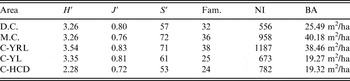
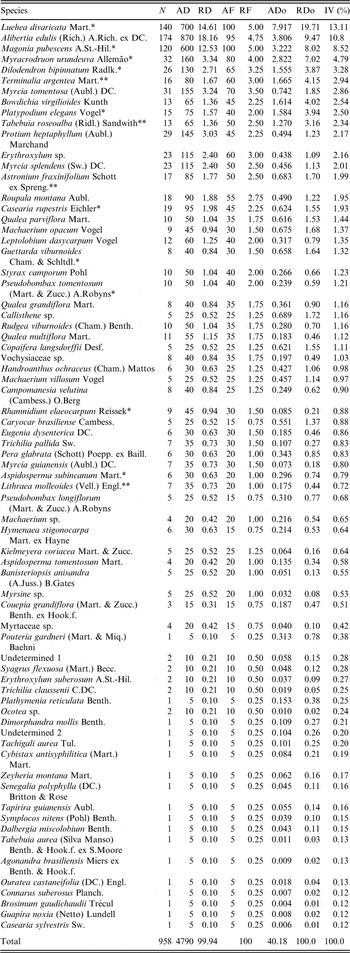
The mesotrophic Cerradão had a large number of individuals, in total 958 (4790 individuals/ha), with a high basal area value (40.18 m2/ha). It was the most floristically rich area sampled, with 72 species from 36 families. The Shannon diversity index (H′) was 3.26 and the equability (J′) was 0.76 (Table 2). This vegetation has a great abundance of Luehea divaricata, Alibertia edulis and Magonia pubescens (Table 3).
Data from the analysis of the structure of vegetation in the FLONA of the Paraopeba, Minas Gerais, Brazil

H′ – Shannon diversity; J′ – equability; S′ – number of species; Fam. – family; NI – number of individuals; BA – basal area.
D.C. – dystrophic Cerradão on Red Latosol; M.C. – mesotrophic Cerradão on Red Latosol; C-YRL – dense Cerrado sensu stricto on Yellow Red Latosol; C-YL – Cerrado sensu stricto on typical Yellow Latosol; C-HCD – Cerrado sensu stricto on Haplic Cambisol Tb Dystrophic.
Phytosociological parameters for the species sampled in mesotrophic Cerradão (woodland) on Red Latosol in Paraopeba National Forest, Brazil

N – number of individuals; AD – absolute density; RD – relative density; AF – absolute frequency; RF – relative frequency; ADo – absolute dominance; RDo – relative dominance; IV – importance value.
* = mesotrophic species; ** = weakly mesotrophic species.
The structure of the mesotrophic Cerradão was very different from the dystrophic Cerradão considering the phytosociological parameters and the species with the greatest importance values that characterise this vegetation: Luehea divaricata, Alibertia edulis, Magonia pubescens, Myracrodruon urundeuva Allemão, Dilodendron bipinnatum and Terminalia argentea Mart. & Zucc.
Cerrado sensu stricto on typical Yellow Latosol
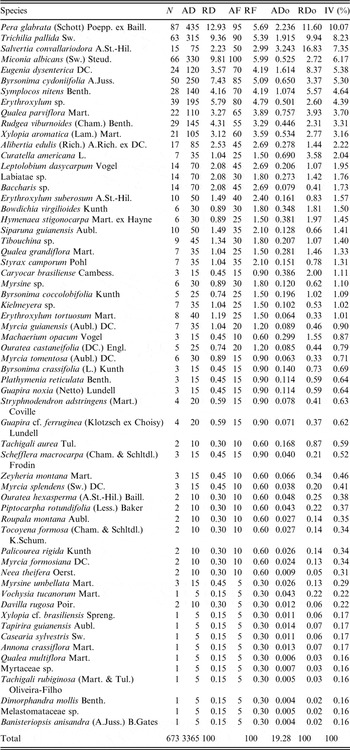
The Cerrado sensu stricto on Yellow Latosol had 673 individuals (3365 individuals/ha). The basal area was small (19.27 m2/ha), around half the basal area of the mesotrophic Cerradão and dense Cerrado sensu stricto. There were 61 species from 25 families. The Shannon diversity index was 3.35, and the equability was high, at 0.81.
Pera glabrata, Trichilia pallida, Salvertia convallariodora, Miconia albicans, Eugenia dysenterica, Byrsonima cydoniifolia, Symplocos nitens Benth., Erythroxylum sp. and Qualea parviflora Mart. are the species with the highest importance values in this vegetation (Table 4). The species list is typical of dystrophic soils, with not a single mesotrophic species present.
Phytosociological parameters for the species sampled in Cerrado sensu stricto on Yellow Latosol in Paraopeba National Forest, Brazil

N – number of individuals; AD – absolute density; RD – relative density; AF – absolute frequency; RF – relative frequency; ADo – absolute dominance; RDo – relative dominance; IV – importance value.
Cerrado sensu stricto on Haplic Cambisol Tb Dystrophic
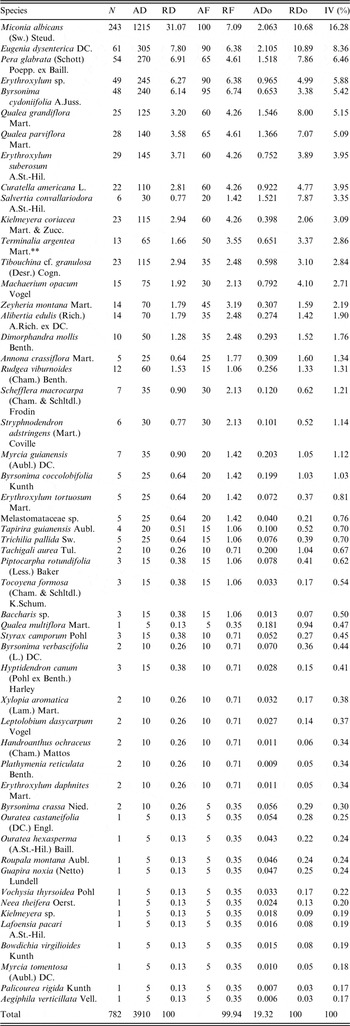
A total of 782 individuals were sampled in this area (3910 individuals/ha) with a small basal area of 19.32 m2/ha, almost the same value as found in the Cerrado sensu stricto under typical Yellow Latosol. The number of species was low: 53 species, belonging to 24 families. The Shannon diversity index at 2.85 and the equability at 0.72 were the lowest recorded. The latter can be explained by the high abundance of Miconia albicans, representing 31% of the total individuals (Table 5). The other species that had high importance values were Eugenia dysenterica, Pera glabrata, Erythroxylum sp., Byrsonima cydoniifolia, Qualea grandiflora and Q. parviflora.
Phytosociological parameters for the species sampled in Cerrado sensu stricto on Haplic Cambisol Tb Dystrophic in Paraopeba National Forest, Brazil

N – number of individuals; AD – absolute density; RD – relative density; AF – absolute frequency; RF – relative frequency; ADo – absolute dominance; RDo – relative dominance; IV – importance value.
** = weakly mesotrophic species.
Dense Cerrado sensu stricto on Red Yellow Latosol
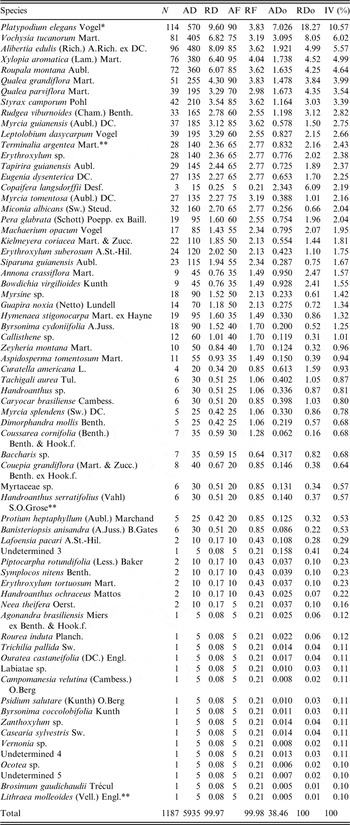
This environment had the highest density, 1187 individuals (5935 individuals/ha). Nevertheless, the basal area (38.46 m2/ha) was smaller than the basal area found in the mesotrophic Cerradão. The species richness was high: 71 species from 38 families (Table 6). The Shannon diversity index at 3.54 and the equability at 0.83 were the highest of the FLONA. The diversity was one of the highest recorded in the Cerrado in general (see Felfili & Silva-Júnior, Reference Felfili and Silva-Júnior2001).
Phytosociological parameters for the species sampled in dense Cerrado sensu stricto on Red Yellow Latosol in Paraopeba National Forest, Brazil

N – number of individuals; AD – absolute density; RD – relative density; AF – absolute frequency; RF – relative frequency; ADo – absolute dominance; RDo – relative dominance; IV – importance value.
* = mesotrophic species; ** = weakly mesotrophic species.
This area did not have any dominant species, but the following had high importance values: Platypodium elegans Vogel, Vochysia tucanorum Mart., Alibertia edulis, Xylopia aromatica (Lam.) Mart., Roupala montana, Qualea grandiflora, Q. parviflora and Styrax camporum Pohl. Platypodium elegans is normally a strongly mesotrophic species and the anomaly of its presence here is discussed later.
Dystrophic Cerradão on Red Latosol
This area had lower density than the other environments – 556 individuals (2780 individuals/ha) – and also low basal area (25.49 m2/ha). There were 57 species from 32 families; the Shannon diversity index was 3.26 and the equability was 0.80.
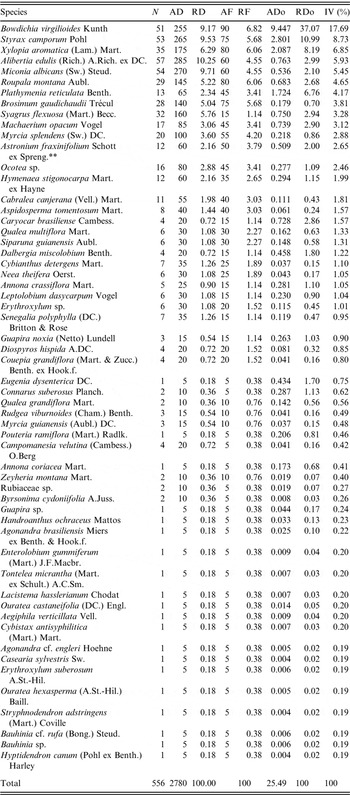
The vegetation is characterised by the presence of Bowdichia virgilioides, which has the greatest importance value and basal area value (Table 7). The other species that have high importance values are Styrax camporum, Xylopia aromatica, Alibertia edulis, Miconia albicans, Roupala montana and Plathymenia reticulata Benth.
Phytosociological parameters for the species sampled in dystrophic Cerradão (woodland) on Red Latosol in Paraopeba National Forest, Brazil

N – number of individuals; AD – absolute density; RD – relative density; AF – absolute frequency; RF – relative frequency; ADo – absolute dominance; RDo – relative dominance; IV – importance value.
** = weakly mesotrophic species.
The inclusion criterion of a basal circumference ≥ 10 cm led to the inclusion of smaller species such as Cybianthus detergens Mart., Bauhinia rufa (Bong.) Steud. and another, as yet unidentified, Bauhinia species.
Soil and vegetation correlations
It was possible to determine a correlation between soil variables and species richness of each environment by calculating Pearson’s correlation coefficient. There was a positive correlation (P < 0.05) between species richness and pH (r s = 0.49), K (r s = 0.43), Ca (r s = 0.57), Mg (r s = 0.58) and P-rem (r s = 0.51), while there was a negative correlation between species richness and Al (r s = –0.41; P < 0.05).
Pearson’s correlation showed that absolute dominance has a positive correlation with soil fertility. The attributes of soil that had the most significant correlations were P (r s = 0.70), Mg (r s = 0.71), Ca (r s = 0.58) and T (base saturation) (r s = 0.64). The correlation between absolute dominance and Al was negative (r s = –0.62).
The correlations between absolute density and soil features were not as strong as those with absolute dominance, but were still within 95% significance. This variable displayed positive correlation with Mg (r s = 0.59) and negative correlation with Al (r s = –0.55). However, the density did not show significant correlation with P and Ca.
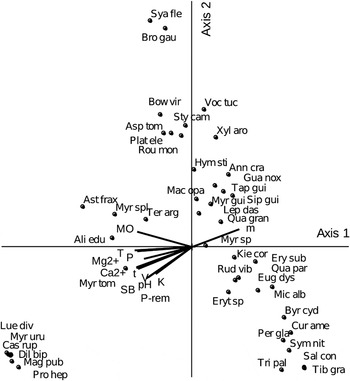
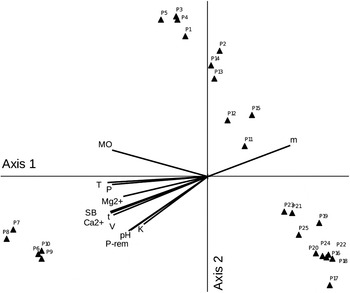
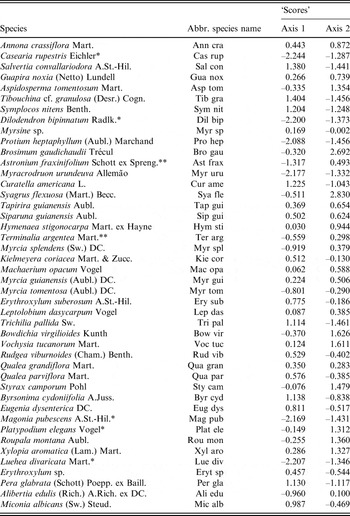
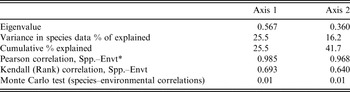
The species and the scores of axes 1 and 2 used in the canonical correspondence analysis are shown in Table 8. In the CCA the first canonical axis explained 25.5% of the variance and the second axis explained 16.2%, together accounting for 41.7% of the total variance (Table 9). In Fig. 3 we show the CCA ordination of 44 species and in Fig. 4 we show the ordination of 25 plots with intra-set correlations of soil properties. The correlation between the two matrices, of species and of soil variables, was measured as axes correlations. Thus, the correlation between the first axis and species–environmental variables was 0.985, and between the second axis and species–environmental variables was 0.968, both highly significant. Monte Carlo tests showed significance (P = 0.01) for the species–environmental correlations between the first and second axes.
Canonical correspondence analysis ordination showing the distribution of species in relation to soil properties: pH – active acidity; P – phosphorus; K – potassium; Ca2+ – exchangeable calcium; Mg2+ – exchangeable magnesium; SB – sum of bases; t – effective cation exchange capacity; T – cation exchange capacity for pH 7; V – base saturation; m – aluminium saturation; MO – organic matter; P-rem – remaining phosphorus. See Table 8 for complete species names.

Canonical correspondence analysis ordination showing the distribution of plots (dystrophic Cerradão: P1, P2, P3, P4, P5; mesotrophic Cerradão: P6, P7, P8, P9, P10; Cerrado sensu stricto on Red Yellow Latosol: P11, P12, P13, P14, P15; Cerrado sensu stricto on Yellow Latosol: P16, P17, P18, P19, P20; Cerrado sensu stricto on Cambisol: P21, P22, P23, P24, P25) in relation to soil properties: pH – active acidity; P – phosphorus; K – potassium; Ca2+ – exchangeable calcium; Mg2+ – exchangeable magnesium; SB – sum of bases; t – effective cation exchange capacity; T – cation exchange capacity for pH 7; V – base saturation; m – aluminium saturation; MO – organic matter; P-rem – remaining phosphorus. See Table 8 for complete species names.

The species, abbreviated species name and scores of axes 1 and 2 used in the canonical correspondence analysis

* = mesotrophic species; ** = weakly mesotrophic species.
Statistical summary of canonical correspondence analysis; 44 species and 25 plots of Cerrado in Paraopeba, Minas Gerais, Brazil

*Correlation between sample scores for an axis derived from the species data and the sample scores that are linear combinations of the environmental variables.
The CCA ordination (Fig. 3) indicates that the distribution of species is correlated with the soil fertility gradient. In this analysis we identified three groups of species: one group of species that correlated with high soil fertility and low concentration of Al, a second with intermediate soil fertility, and a third with low soil fertility and high concentration of Al. The species correlated with high soil fertility are those present only in the mesotrophic Cerradão. On the other hand, the species that seem to be related with intermediate fertility are present in areas of both high and low soil fertility.
Discussion
At landscape level, there is a clear trend of increasing biomass and density of vegetation on the redder soils, both dystrophic and mesotrophic. These soils are influenced by colluvial materials from weathered limestone or in situ alteration of such calcareous rocks. On the other hand, the savannic cerrados are related to either shallow or deep yellowish soils (Cambisols/Latosols) developed from slate, a pellitic Al-rich, nutrient-poor, metamorphic rock. The soil–landform variations are, therefore, closely related to local geological structures that control soil drainage and weathering, since limestone lenses occur throughout the pellitic sequence.
The species that were observed in all the environments can be regarded as generalists exhibiting a great deal of tolerance of soil variation. Because of their ecological plasticity such generalists should be useful in reforestation of degraded areas in the FLONA and in other areas with typical dystrophic soils.
The species of the mesotrophic Cerradão are the most characteristic and exclusive occurring in the study. It has been demonstrated in many areas that the occurrence of these characteristic species of this environment is due to the chemical properties of the soil, providing better nutritional conditions (see, for example, Furley & Ratter, Reference Furley and Ratter1988). This is the most fertile environment in the FLONA with the highest levels of Ca and Mg and lowest levels of Al, and its flora identifies it as a classic example of mesotrophic Cerradão.
Mesotrophic Cerradão was formerly found in a vast Cerrado area. There are studies in the states of Goiás, Minas Gerais, Mato Grosso, Maranhão, Mato Grosso do Sul and Piauí (Ratter et al., Reference Ratter, Bridgewater, Ribeiro, Fonsêca-Filho, Rodrigues da Silva and Milliken2011). It is often associated with the margins of Deciduous and Semideciduous Seasonal Forests and indicates an intermediate condition between soils of dystrophic Cerradão and those of more fertile seasonal forests. Many species indicative of mesotrophic Cerradão also occur in Deciduous Seasonal Forests (Ratter et al., Reference Ratter, Askew, Montgomery, Gifford and Ferri1977; Furley & Ratter, Reference Furley and Ratter1988).
The floristic richness among the studied environments varied from 53 species in the Cerrado sensu stricto on Cambisol to 72 species in the mesotrophic Cerradão. However, this is an exception to the more normal situation as dystrophic cerradões are usually more species diverse than mesotrophic ones. This is because the latter often show dominance of a few characteristic species (Ratter et al., Reference Ratter, Bridgewater, Ribeiro, Fonsêca-Filho, Rodrigues da Silva and Milliken2011).
It was possible to investigate the influence of soil characteristics on floristic composition and vegetation structure in the area studied. Beyond the correlation with species richness, the chemical characteristics of the soil were possibly responsible for limiting the occurrence of some species, such as the absence of Miconia albicans in the mesotrophic Cerradão. This species is common in open areas of Cerrado (Costa & Araújo, Reference Costa and Araújo2001; Neri et al., Reference Neri, Campos, Duarte, Meira Neto, Silva and Valente2005). In Costa & Araújo (Reference Costa and Araújo2001) it was common in disturbed areas of Cerrado and in Neri et al. (Reference Neri, Campos, Duarte, Meira Neto, Silva and Valente2005) it was abundant as homogeneous stands of understorey regeneration in Cerrado. In the present study this species was found in open vegetation associated with low soil fertility and high concentration of Al. It is also an aluminium accumulator (Haridasan, Reference Haridasan1982; Haridasan & Araújo, Reference Haridasan and Araújo1988).
Comparing the density and the basal area in our study with those from other areas shows our values are relatively high (e.g. Haridasan & Araújo, Reference Haridasan and Araújo1988).
The occurrence of species which accumulate Al can be explained by competitive advantage in areas with dystrophic soil. The main accumulator species in Cerrado belong to the Vochysiaceae, Melastomataceae and a number of other groups (Haridasan & Araújo, Reference Haridasan and Araújo1988; Haridasan, Reference Haridasan2000). These plants accumulate Al in leaves as part of their physiology (Haridasan, Reference Haridasan1982). Ruggiero et al. (Reference Ruggiero, Batalha, Pivello and Meireles2002) suggested that the high aluminium concentration in the soil surface is associated with the transference of this element from plant to soil by litter decomposition.
Goodland (Reference Goodland, Goodland and Ferri1969) was the first to point out the relationship between biomass and soil fertility gradient in the Cerrado and emphasised the importance of aluminium in this ecosystem. Subsequent studies showed low nutritional status and high levels of Al in forest compared to Cerrado (Haridasan, Reference Haridasan1982; Silva-Júnior, Reference Silva-Júnior1987; Oliveira-Filho et al., Reference Oliveira-Filho, Shepherd, Martins and Stubblebine1989). Ruggiero et al. (Reference Ruggiero, Batalha, Pivello and Meireles2002) found the converse. Probably the answer to this lies in different forest and Cerrado types being studied by different authors. Comparison of very dystrophic evergreen forest with a richer more mesotrophic Cerrado would give the result found by the first group of workers, while Ruggiero’s result would be replicated by comparing a forest on richer soil with a dystrophic Cerrado. It would not be difficult to find areas that would give either of the two results.
The CCA showed a difference between the dystrophic Cerradão and the mesotrophic Cerradão. In the literature, the difference between these two woodlands has been demonstrated by the presence of indicator species (Ratter, Reference Ratter and Ferri1971; Ratter et al., Reference Ratter, Richards, Argent and Gifford1973; Furley & Ratter, Reference Furley and Ratter1988; Oliveira-Filho & Martins, Reference Oliveira-Filho and Martins1991). The dystrophic Cerradão is widely found in the Cerrado biome and tends to be associated with Cerrado–forest transitions on poor and commonly sandy soils (Oliveira-Filho & Ratter, Reference Oliveira-Filho, Ratter, Oliveira and Marquis2002). This is in contrast to what was found in the FLONA of Paraopeba, where the soil of the dystrophic Cerradão exhibited a high concentration of clay.
The CCA also shows that there is a high correlation between soil variables and vegetation (the abundance of species). Species that were correlated with a high concentration of Al and low soil fertility include obligate aluminium accumulators (Haridasan & Araújo, Reference Haridasan and Araújo1988; Haridasan, Reference Haridasan2000). On the other hand some studies (Ratter, Reference Ratter and Ferri1971, Reference Ratter, Furley, Proctor and Ratter1992; Ratter et al., Reference Ratter, Ribeiro and Bridgewater1997; Oliveira-Filho & Ratter, Reference Oliveira-Filho, Ratter, Oliveira and Marquis2002) have found species that are indicators of high soil fertility in Cerrado; some of these species (Casearia rupestris, Dilodendron bipinnatum, Luehea divaricata, Magonia pubescens, Myracrodruon urundeuva and Protium heptaphyllum (Aubl.) Marchand) were sampled in our study area and correlated with higher soil fertility and lower aluminium concentration.
The overall characteristics of mesotrophic Cerradão were confirmed by the analysis. This vegetation is related to higher soil fertility in the Cerrado and displays a characteristic flora and vegetation structure.
The soil attributes have influenced the diversity and structure of the community. The analysis confirms previous scientific observations indicating a relationship between the vegetation and soil fertility gradient in the Cerrado, well understood by native small agriculturists in the sertão (the Brazilian backlands) in the 1960s, and no doubt for centuries before (J. Ratter, pers. comm.).
In conclusion, the results of the vegetation and soil analyses of the present research conform almost exactly to those of previous works on differentiation of Cerrado communities. They agree with previous descriptions of mesotrophic and dystrophic Cerrado communities.
There is only one anomaly where the present results diverge from those expected. This is in the dense Cerrado sensu stricto on the Yellow Red Latosol, where soil analysis showed a dystrophic soil with low availability of Ca and Mg but the species with the highest importance value (10.57%) and number of individuals (114) was Platypodium elegans, one of the classic indicator species of mesotrophic Cerradão (Furley & Ratter, Reference Furley and Ratter1988). However, there is very little occurrence of other mesotrophic indicator species in the species list and those present are mainly of the weaker type (e.g. Terminalia argentea). A possible explanation is that one part of this plot is composed of more mesotrophic soil and the rest is dystrophic, and the subsequent analysis of mixed soil samples has distorted the overall figures. This situation has been observed in other localities, for example at Fazenda Palestina in the Federal District in an area consisting of a mosaic of patches of mesotrophic and dystrophic Cerradão below a limestone escarpment (J. Ratter, pers. comm.).
Acknowledgements
The authors would like to thank CNPq, CAPES and FAPEMIG for support and grants, and the Paraopeba National Forest Office (ICMBio-MMA/Brazilian Environmental Ministry) for permission for this study and for logistical support. We also thank the anonymous referees for their important contribution.