Central-line–associated bloodstream infections (CLABSIs) have been associated with $45,000 increased incremental cost, prolonged length of stay, and increased attributable mortality.Reference Zimlichman, Henderson and Tamir 1 , Reference Januel, Harbarth and Allard 2 Over the last 10 years, national efforts including public reporting, development of an implementation infrastructure and advances in science have resulted in an 80% reduction of CLABSIs in intensive care unit (ICU) settings throughout the United States.Reference Pronovost, Cleeman, Wright and Srinivasan 3 Despite these advances, CLABSI rates remain significantly higher in burn patients than in other ICU patients.Reference Dudeck, Edwards and Allen-Bridson 4 This vulnerable patient population is susceptible to CLABSIs due to their extended ICU stays, multiple surgical procedures, prolonged need for central access, and reduced resistance to infection from immune dysfunction and breakdown of the protective barrier of normal skin.Reference O’Sullivan and O’Connor 5
The incidence of primary bloodstream infection is reported to be between 17% and 49% in patients with severe burns and multiple episodes of up to 7–10 episodes of bacteremia are common in this patient population.Reference Brusselaers, Monstrey and Snoeij 6 – Reference Wurtz, Karajovic, Dacumos, Jovanovic and Hanumadass 16 Catheter sepsis complicates 6% of central lines placed in burn patients, and this rate increases up to 35% after 10 days of cannulation.Reference Lesseva 10 CLABSI benchmark rates for burn units reported by National Healthcare Safety Network (NHSN) likely underestimate the true rate of infection because many reported burn units are actually mixed trauma and/or burn units with a lower burn acuity than other units caring exclusively for burn patients.Reference Sood, Heath and Adams 17 CLABSIs are common in this patient population and optimal strategies to prevent these infections have not been well studied in this setting.
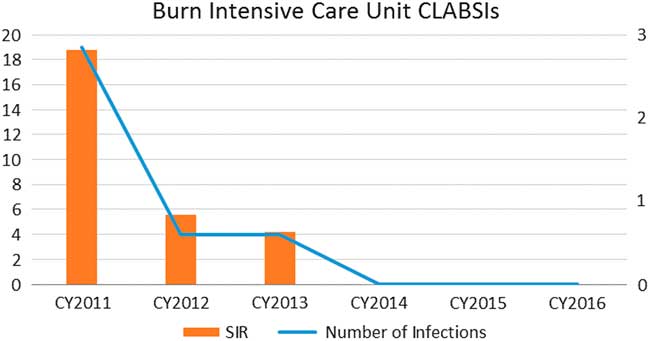
In 2011, the rate of CLABSIs in the burn center at the Johns Hopkins Medicine Bayview Medical Center (JHBMC) was 2.8 times the expected rate of infection based on the Centers for Disease Control and Prevention (CDC) National Health Safety Network (NHSN) burn ICU (BICU) benchmark. This high rate prompted investigation and implementation of CLABSI prevention interventions.
As part of our effort for zero harm across Johns Hopkins Medicine (JHM), JHB Medical Center (JHBMC) leadership set an ambitious goal of a zero-CLABSI BICU. In this manuscript, we report on our multiple interventions in reducing central-line associated blood stream infections in the JHBMC Burn Center.
METHODS
The Johns Hopkins Burn Center is a regional burn center that serves Maryland, Delaware, and Pennsylvania. The unit has 10 BICU beds and serves 300–400 burn patients annually. The study design was an observational interrupted time series without concurrent controls between 2011 and 2016. Time periods are reported as calendar years. The primary dependent variable is CLABSI rate as defined by the NHSN. Surveillance and reporting of CLABSI rates is performed by trained infection prevention staff independent of staff in the burn center.
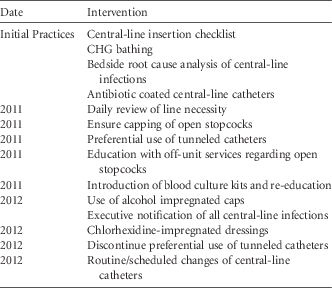
The CLABSI prevention interventions to reduce CLABSI were based on an organizational-level framework and a unit-level framework (Table 2). The organizational-level framework, derived from site visits of hospitals with low and high CLABSI rates has 4 componentsReference Pronovost, Weaver and Berenholtz 18 :
-
1. Declare and communicate a goal of zero infections. Leaders start this communication and it cascades to the local unit level and the frontline staff.
-
2. Create an enabling infrastructure to support the improvement effort. Leaders ensure the organization has the enabling structure to improve. This enabling infrastructure comprises a coordinating team and includes staff from quality improvement, nursing, infection prevention and the burn center. The coordinating team provides project management, analytic support, training, and improvement science expertise and guides the design and implementation of the intervention.
-
3. Engage front line clinicians and connect them in peer learning communities. The front-line clinicians need to lead the effort in their unit and learn from other units.
-
4. Report transparently and create accountability. Performance data are shared widely with all levels of the organization and if performance goals are not met, organizational leaders seek to understand why and ensure and facilitate further improvement efforts.Reference Pronovost, Weaver and Berenholtz 18
The unit-level framework followed the Comprehensive, Unit-based Safety Program (CUSP)/ Translating Research Into Practice (TRIP) intervention that was successfully used to reduce ICU CLABSIs in Michigan.Reference Pronovost, Needham and Berenholtz 19 The CUSP component of the intervention forms a unit-based team and focuses on the adaptive or cultural components of improvement.Reference Pronovost, Needham and Berenholtz 19 The TRIP components seek to identify a checklist of behaviors needed to improve, to identify the barriers to performing those behaviors, to implement process measures to evaluate whether those behaviors were performed, and to change the work system to ensure all patients receive best practice checklist items.Reference Pronovost, Berenholtz and Needham 20
In 2011, our baseline year, there were 19 CLABSIs in our 10-bed BICU; 9 of these infections were recurrent infections in 2 patients.
We created a multidisciplinary coordinating team including burn surgeons, nursing staff, hospital epidemiologist, a microbiologist, quality improvement staff, and critical care physicians to address this issue. We began by reviewing all of the CLABSI cases and examining practices in the care of our burn patients.
At the time of these infections, the burn unit was already using full barrier precautions for central-line placement, chlorhexidine bathing, antimicrobial-coated central-venous catheters, and insertion checklists. Yet CLABSI rates remained high.
The coordinating team began by reviewing the charts of each patient with a CLABSI in the burn center. We found that many patients had bacteremia in the presence of a central line without systemic evidence of infection, suggesting that some of these events were not true infections but blood culture contamination or transient bacteremia. Systemic symptoms associated with infection are common in burn patients after wound care and debridement and are therefore not good predictors of infection.Reference Greenhalgh, Saffle and Holmes 21 Often, however, these signs and symptoms trigger clinical teams to order blood cultures.Reference Hogan, Wolf and Hospenthal 22 , Reference Murray, Hoffmaster and Schmit 23 Burn patients are also known to have a high rate of transient bacteremia with routine care such as dressing changes.Reference Vindenes and Bjerknes 24 – Reference Mamattah, Beard and Jones 27 We hypothesized that many of the CLABSIs were based upon contaminated blood cultures or transient bacteremia and that limiting blood culture collection would reduce reported CLABSIs in the burn unit without causing harm.Reference Keen, Knoblock, Edelman and Saffle 28 To reduce unnecessary blood cultures, we developed a checklist outlining criteria for obtaining cultures in burn patients. This checklist included increasing the temperature threshold for obtaining cultures to 39°C from the previous threshold of 38°C and avoiding blood cultures within the first 24 hours after surgical debridement when patients were most likely to have systemic symptoms related to the procedure rather than true infection.
The coordinating team also reviewed the timing of CLABSIs relative to admission and line insertion and determined that the burn unit’s CLABSI infections occurred a median of 18 days from admission (IQR, 2–59.5) and a median of 6 days (IQR, 3–9) from insertion, suggesting that the cause may have been was more of a central-line maintenance issue than an insertion issue. As such, the team implemented alcohol-impregnated caps to mitigate the risk of hub colonization due to the prolonged venous access these patients requireReference Wright, Tropp and Schora 29 , Reference Oto, Imanaka, Konno, Nakataki and Nishimura 30 and chlorhexidine impregnated dressings to reduce local skin contamination as a source of infection.Reference Timsit, Mimoz and Mourvillier 31 Severely burned patients undergo frequent, often daily, trips to the operating room, and the coordinating team observed that patients returning from the operating room and in the burn center often had stop cocks that were not covered with caps. We hypothesized that lapses in catheter maintenance in the operating room and the burn unit may have contributed to CLABSIs, so training was implemented to reinforce the importance of catheter maintenance and to improve skills in the management of these lines.
To increase the culture of transparency and accountability for hospital-acquired infections, an email detailing the patient’s clinical course and opportunities for improvement for each CLABSI was sent to the executive leadership and the frontline staff. While this was a shift in the culture of the institution and uncomfortable for some of the staff, this intervention emphasized the importance of each CLABSI for all of the staff. A nurse in the ICU was overheard explaining to a resident, “We take CLABSIs very seriously here. Our CEO knows about every infection.” In addition, the infection prevention and quality department created and distributed a graph of the number of weeks without a CLABSI in the burn unit, and senior leaders from JHBMC and JHM celebrated successes with rewards and recognition when the unit reached milestones such as 26 weeks and 52 weeks without a CLABSI.
The coordinating team hypothesized that routinely changing central lines in burn patients would reduce the risk of catheter colonization and infection from transient bacteremia in these patients and implemented routine central-line changes every 7 days in 2013. While routine central-line changes were studied in the 1990s and were found to have a greater risk compared to benefit in the general ICU setting, Reference Eyer, Brummitt, Crossley, Siegel and Cerra 32 – Reference Cook, Randolph and Kernerman 34 the average duration of line placement in the control arm of these studies was considerably lower than the average duration of line placement in burn patients. Additionally, the mechanical risk of complications of line placement in 2016 is likely to be lower than in the previous studies with the use of ultrasound placement, which is routine practice in the burn center. Burn patients are also more likely to have internal seeding rather than skin contamination as the source of their central-line infection. Several surveys of BICUs have found that the majority of burn units perform routine catheter changes.Reference Sood, Heath and Adams 17 , Reference Sheridan, Neely and Castillo 35 This practice change was met with resistance initially, but it has now become an important part of the care of these patients.
The coordinating team also hypothesized that CLABSI could be prevented by preferentially placing peripheral inserted catheters (PICCs) and tunneled catheters rather than nontunneled central lines because tunneled catheters have been shown to have a lower rate of infection in nonburn patients.Reference Maki, Kluger and Crnich 36 We found that PICC lines had an even higher rate of infection in this setting and this practice was abandoned (Table 2).
The statistical analysis is descriptive. The χ2 test was used to compare baseline rates and percentages with postintervention rates and percentages.
RESULTS
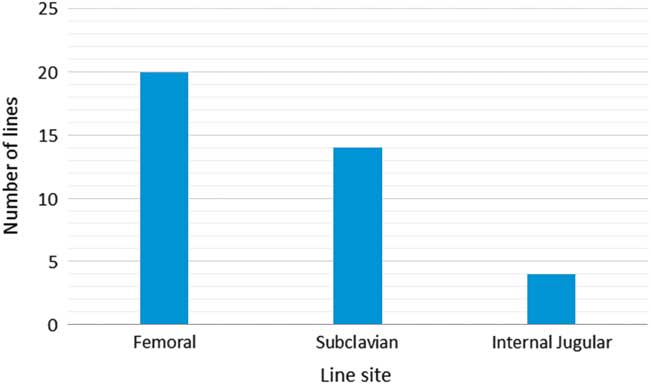
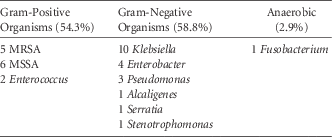
Patients with CLABSIs had triple-lumen catheters in 64% of cases and femoral arterial lines in 30% of cases. CLABSIs were associated with femoral site cannulation in 58% of cases (Figure 1). Overall, 10 patients (58%) had multiple CLABSIs. Prevalence of gram-negative and gram-positive organisms were evenly distributed (Table 1).
Epidemiology of line site associated with burn intensive care unit (BICU) central-line–associated bloodstream infections (CLABSIs), 2011–2013. Patient may have more than one line

Organisms Associated With Burn Intensive Care Unit (BICU|) Central-Line–Associated Bloodstream Infections (CLABSIs), 2011–2013Footnote a

NOTE. MRSA, methicillin-resistant Staphylococcus aureus; MSSA, methicillin-susceptible Staphylococcus aureus.
a More than 1 organism may be associated with a line infection.
During the study period, the median total body surface area burned did not change.
Increasing the blood culture temperature threshold resulted in a reduced percentage of positive blood cultures from 23% to 18%, (RD 5%, CI −0.68–10.59) but did not appreciably reduce the CLABSI rate.
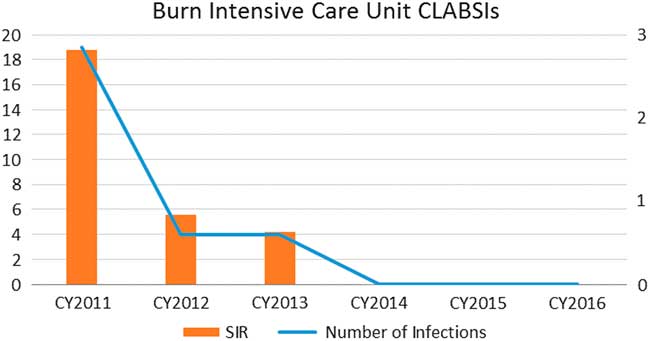
Alcohol-impregnated caps and chlorhexidine dressings were introduced in 2012 along with the educational and cultural changes. These interventions were associated with a reduction of CLABSIs from 15.5 per 1,000 catheter days to 4 per 1,000 catheter days.
With the additive practice of routine line changes, the rate of CLABSI in the burn center decreased from 4 of 1,000 catheter days to zero, which has been sustained for over 3 years (Figure 2).
Burn CLABSI SIR 2011–2016.
DISCUSSION
Our report demonstrates that a multilevel, organizational and unit, and multifaceted intervention was associated with a significant and sustained reduction in CLABSI in the a BICU. These findings suggest that burn centers can achieve the same reductions in CLABSI as other types of ICUs and that despite enhanced patient risk factors, CLABSIs in burn patients are largely preventable.
There have been 2 other reports of reduction in CLABSIs in burn patients.Reference Popp, Layon, Nappo, Richards and Mozingo 37 , Reference van Duin, Jones and Dibiase 38 In the first study, the burn unit had a low rate of infection prior to the intervention, with only 2 infections in 200 patients (1.4 per 1,000 catheter days), and the average burn percentage was only 8%.Reference Popp, Layon, Nappo, Richards and Mozingo 37 In the second study, while there were significant reductions in the CLABSI rate among burn patients, the postintervention rate remained 2.4 per 1,000 catheter days.Reference van Duin, Jones and Dibiase 38 The present study is the first report of a prolonged zero-CLABSI outcome in a large-volume regional burn center.
Our study had several limitations. As with all improvement science, our interventions were additive and evolved over time.Reference Marshall, Pronovost and Dixon-Woods 39 As such, we were not able to study the impact of these interventions individually. However, our primary objective was to achieve zero infections rather than identifying the marginal effect of each component of our intervention. The study setting is limited to a single center, and larger randomized studies would be needed to determine whether these findings are generalizable and reproducible in other settings. Another limitation of our study is that the early reduction in our CLABSI rates may reflect regression to the mean because our initial rates were higher than average, even for burn units. However, the sustained reduction to zero makes that unlikely to be a significant cause of our observed reduction. Lastly, we used an observational design and as such, we cannot establish a causal relationship between our intervention and outcome. Nevertheless, the significant reductions in CLABSIs associated with our intervention and without a change in our patient’s severity of illness, points to the effectiveness of the intervention.
We have learned several lessons throughout this process. One of the earliest lessons was the importance of the spirit of humble inquiry. Initially, we attempted to use standard approaches for CLABSI prevention, only to find after making rounds with the bedside team in the burn unit that it was not always possible to avoid femoral sites and that removing central lines more quickly was often not an option. Through multidisciplinary collaboration and creative innovation, we were able to develop strategies unique to this patient population.
We learned the value of rapid change and evaluation cycles. By trying different interventions, evaluating them quickly and modifying our approach accordingly, we were able to make timely changes and to improve our processes efficiently, as described in our approach of translating evidence into practice.Reference Pronovost, Berenholtz and Needham 20 Gradually, over 2 years, we were able to bring the unit’s CLABSI rate from 15 per 1,000 central-line days to zero.
We also learned the importance of unit-level safety culture for supporting improvement. Members of the burn team who were initially doubtful of the validity of CLABSI metrics and our ability to effect change slowly became advocates of our interventions. Initially, staff felt that they had complied with all of the recommended interventions, yet their CLABSI rates remained high, and thus they concluded that further interventions were futile. By declaring ambitious goals, investigation of every infection by the local bedside team, regular communication and transparency to executive staff, collaborative bedside rounds with the infection prevention staff and transparent data sharing, the culture of the burn unit changed. The teams identified practices, such as catheter maintenance, that contributed to CLABSIs, and staff became more engaged in the effort and hopeful that improvement was possible. This transformation highlights the importance of having organizational-level and unit-level interventions to support improvement. Too often, under-resourced staff in units toil to improve without a clear goal from leaders, an enabling infrastructure, or accountability. It also highlights the importance of unit-level interventions emphasizing the importance of the “engagement, education, execute, and evaluate” cycle in performance improvement science.Reference Pronovost, Berenholtz and Needham 20
Most importantly, we learned the power of beliefs or narratives.Reference Pronovost, Sutcliffe, Basu and Dixon-Woods 40 Early in this process, we were convinced that burn patients had risk factors for infection that would make it impossible to eliminate healthcare-associated infections in this vulnerable, high-risk group of patients. Although other ICUs throughout JHM had realized significant and sustained reduction in ICU CLABSIs, leaders generally felt that CLABSIs in burn patients were inevitable. At the start of this intervention, leaders delivered a new narrative, namely, that these infections were preventable, and they declared a goal of zero CLABSIs for the burn center. Through the dedicated effort and persistence of our team, the BICU has outperformed all of our other ICUs and has accomplished its highest goal.
The use of a multifaceted intervention was associated with a reduction of CLABSI in a burn center from 15 per 1,000 catheter days to 0. The burn center has been CLABSI free for 3 years, demonstrating that CLABSIs in burn patients are largely preventable.
Timeline of Interventions

NOTE. CHG, chlorhexidine gluconate.
ACKNOWLEDGMENTS
Financial support: No financial support was provided relevant to this article.
Potential conflicts of interest: All authors report no conflicts of interest relevant to this article.