1. Introduction
Children are economic assets for most parents of the world, but more so for parents in rural areas of developing countries where production of all kinds is driven by labor. Their importance becomes explicit when rural households heavily base their livelihoods on environmental resources such as firewood, water and fodder. Collection of such resources is from the commons and falls predominantly on the shoulders of children and women (Cooke, Reference Cooke2000). Natural resources scarcity forces such groups to travel long distances, spending considerable labor, time and effort. Deforestation further exacerbates the problem since access to environmental goods is pushed farther away from the households, demanding more and more time for collection. Consequently, children become indispensable for their parents, with high work demand at the expense of schooling. Such a phenomenon subsequently worsens the process of human capital formation (Winkler-Dworak, Reference Winkler-Dworak2003). This provides a channel through which environmental resources scarcity affects children's schooling and resource collection work.
In Ethiopia, forest degradation and deforestation are worsened when fuelwood and dung are used as sources of energy (Mekonnen and Köhlin, Reference Mekonnen and Köhlin2008). Nyssen et al. (Reference Nyssen, Haile, Moeyersons, Poesen and Deckers2004) established that environmental degradation is a real problem in Ethiopia. This problem is severe in Tigray, the most degraded part of the country (Araya and Edwards, Reference Araya and Edwards2006). Natural forests in the region are destroyed due both to the escalating demand by households for firewood, grazing land and cultivable land, and to urbanization. About 50 per cent of the highlands in the region experience severe environmental degradation (GebreMichael and Waters-Bayer, Reference GebreMichael and Waters-Bayer2007). Reduced access to fuelwood, water and fodder is, therefore, reflected by the time spent on gathering such resources. This has considerable implications on the likelihood of children's schooling.
Compared to other regional states in Ethiopia, the Tigray region generally has a good student enrolment record. For instance, the total net enrolment rate at the primary level was about 94 per cent for Tigray, 91 per cent for Benishangul Gumuz, 89 per cent for Gambella, 51 per cent for Somali and 30 per cent for Afar region during 2009/2010 (Ministry of Education, 2009/2010). However, there exists a difference across woredas within the Tigray region. Whereas the national grade 1 net intake rate was about 77 per cent in 2009/2010 (Ministry of Education, 2009/2010), it was found to be around 93 per cent for the Enderta woreda, which is less than the regional average of 97 per cent. Similarly, the grade 3 net intake rate was about 68 per cent both for Enderta and Hintalo Wajerat woredas, whereas the regional average was 77 per cent for the same year. The net enrolment rate falls drastically starting from the first cycle of the secondary school. During the 2009/2010 academic year, the net enrolment rate for grades 9–12 was reported to be 1.58 and 22.63 per cent of the total population aged 15–18 in Enderta and Hintalo Wajerat woredas, respectively. This was considerably lower than the 27.52 per cent average for the Tigray region as a whole (Tigray Region Education Bureau, 2009/2010).
There are several sources of barriers to child schooling. Many authors have identified different factors responsible for the low likelihood of enrolment at school in Ethiopia, of which the influence of child labor, in its broader sense, is the most prominent (Admassie, Reference Admassie2002; Admassie and Bedi, Reference Admassie and Bedi2003; Chaudhury et al., Reference Chaudhury, Christiaensen and Asadullah2006; Woldehanna et al., Reference Woldehanna, Jones and Bekele2008; Weir, Reference Weir2010; Haile and Haile, n.d.). The impact of the scarcity of environmental resources on children's schooling did not receive due attention in the literature of child labor in Ethiopia in spite of the widespread involvement of children in resource collection. For instance, according to a report by the Tigray Agriculture and Rural Development Bureau (2010/2011), about 1,400 donkey-loads of firewood are supplied to Mekelle city on a weekly basis. The report revealed that about 95 per cent of this supply emanates from the farmers in the Enderta woreda of the Tigray region where the majority of the suppliers are children. Natural resources scarcity, mostly caused by environmental degradation, may thus put pressure on children's schooling through the opportunity cost of time spent on collecting firewood, water and fodder. Previous studies in Africa (Nankhuni and Findeis, Reference Nankhuni and Findeis2004; Ndiritu and Nyangena, Reference Ndiritu and Nyangena2010) provide supporting evidence.
However, there exists a dearth of empirical evidence in Ethiopia as to whether natural resources scarcity leads to a lower likelihood of children's enrolment at school. This study presents substantiation from the Tigray region by empirically testing the central hypothesis that scarcity of resources reduces the likelihood of children's schooling. The study also examines whether girls are discriminated against with regard to schooling, due to resource collection intensity.
2. Conceptual framework
Theoretically, this study bases its analysis on Becker's (Reference Becker1965) seminal paper on the allocation of time and its extensions to household behavior. This household production model assumes that parents' utility maximization is constrained by market-purchased goods and time endowment. As per this model, the number of children that a family desires to have and the pattern of household members' time allocation towards schooling, market work and household production demands joint decisions.
In the original specification of the model, home-produced goods (like collected firewood, water and fodder in our case) and market goods (for instance, oil lamps) are perfect substitutes for each other. Gronau (Reference Gronau1977) further developed the model by arguing that a household's home goods production is characterized by the diminishing marginal productivity mainly due to tiredness and limited access to local resources. With increasing local resources scarcity, this may require more helping hands (a larger number of children) spending a considerable portion of their time on the collection of firewood, water and fodder. This is substantiated by Rosenzweig and Evenson's (Reference Rosenzweig and Evenson1977) finding that family decisions on fertility and children's time allocation to school and work are jointly determined.
Parents maximize utility by choosing the quality of their children (measured by investment in human capital formation) and their quantity (measured by the number of children), household leisure and home-produced goods subject, to their income and time restriction in the agricultural sector. In doing so, parents allocate their time between work and leisure. In this paper, parents are assumed to distribute their children's time towards leisure, education and home production activities.
3. Data and empirical model
3.1. Data
The study was carried out in South Eastern Tigray, covering the Enderta and Hintalo Wajerat woredas. We used a cross-sectional data set of 120 rural households. While 42 households are chosen from Hintalo Wajerat, the remaining households are from Enderta. These woredas are chosen on purpose. This is because the relative proximity of the two woredas to Mekelle (the regional capital) increases the demand on children to collect and sell natural resources (firewood and fodder) beyond their family's domestic consumption, although proximity to urban areas may also positively affect interest in education. Evidence showed that about 1,400 donkey-loads of firewood are supplied to Mekelle per week, mainly from farmers in the Enderta woreda (Tigray Region Agriculture and Rural Development Bureau, 2010/2011).
A detailed, structured and close-ended questionnaire was prepared and pre-tested in the study areas. Using a multi-stage sampling, two ‘tabias’Footnote 1 (five villages) from the Hintalo Wajerat woreda and three tabias (six villages) from the Enderta woreda were chosen. A simple random sampling technique was employed to select tabias, villages and households, consecutively.
The survey data collected provide evidence on children's participation in schooling and resource collection, collection intensity, household socioeconomic characteristics, household income, sources of environmental resources and the time spent on other domestic tasks. Focus group discussions were carried out with teachers and students in two selected schools (with one from each woreda) and with firewood distributors in Quiha and Mekelle.
Even though rural children in Ethiopia actually begin environmental resource collection work at early ages, this study focuses on children in the 7–18 years of age category. The lower limit of the age range is chosen because it is the official age for any child to start schooling in Ethiopia (Admassie, Reference Admassie2002; Haile and Haile, n.d.), while the maximum age boundary is used following the International Labour Organization's (ILO) 1999 convention that regards all persons under 18 years as children ILO, 1999. As a result, the sample contains 316 children (175 boys and 141 girls) who fall into this age category. While 184 children belonging to the 78 households are from Enderta, the remaining children belonging to the 42 households are from Hintalo Wajerat.
3.2. Empirical model and issues of estimation
Decisions by parents concerning children's time allocation are likely to consider more than one activity and call for modeling simultaneous equations. The decisions by a parent to send any child to school or work are jointly determined, competing with the time endowments. To this end, the bivariate probit model (Greene, Reference Greene1998; Nankhuni and Findeis, Reference Nankhuni and Findeis2004; Ndiritu and Nyangena, Reference Ndiritu and Nyangena2010) is adopted to trace the resource collection versus schooling interactions.
 $$\hbox{Y}_{\rm 1i}^{\ast} = \beta_1^{\prime} \hbox{X}_{\rm 1i} + \varepsilon_{\rm 1i}$$
 $$\hbox{Y}_{\rm 2i}^{\ast} = \beta_2^{\prime} \hbox{X}_{\rm 2i} + \varepsilon_{\rm 2i}$$
where Y1i* and Y2i* are latent variables observed by the following conditions:
 $$\eqalign{\hbox{Y}_{\rm 1i} &= 1 \hbox{if} \hbox{Y}_{\rm 1i}^{\ast} \gt 0\comma \; \quad \hbox{Y}_{\rm 1i} = 0\comma \; \hbox{Otherwise}\cr \hbox{Y}_{\rm 2i} &= 1 \hbox{if} \hbox{Y}_{\rm 2i}^{\ast} \gt 0\comma \; \quad \hbox{Y}_{\rm 2i} = 0\comma \; \hbox{Otherwise}.}$$
Y1i shows whether the child is currently attending school based on the question: ‘Is [name of the child] attending school at present?’. The value is 1 if the answer is yes and 0 if the child is not attending school. Y2i refers to whether [name of the child] participated in collecting at least one of the resources in the past seven days before the survey. The value is 1 if the answer is yes and 0 otherwise.
Both the schooling and collection participation choices are modeled as a function of some explanatory variables (the complete list and definition of these variables is given in Appendix A). β′i is the vector of coefficients for the explanatory variables. ɛ1i and ɛ2i are the disturbance terms in the school attendance and resource collection participation activities, respectively. They are assumed to be independently and identically distributed as bivariate normal [ɛ1i, ɛ2i, ρ]~bivariate normal. ρ stands for the correlation coefficient between the errors of schooling and resource collection participation equations.
Since environmental resource collection participation and school enrolment are likely to be jointly decided, the bivariate probit model is firstly estimated. If the ρ coefficient is statistically significant, involvement in schooling and resource collection participation are undertaken jointly. On the other hand, univariate probit models are used if the error terms are not correlated (Greene, Reference Greene1998).
Because the children's time spent in collecting firewood, water and fodder increases with natural resources scarcity, their likelihood of attending school may be negatively affected the more time they spend on resource collection. Consequently, resource collection intensity is considered as an endogenous regressor in the schooling model.
 $$\hbox{Y}_{\rm 1i} = \beta_1^{\prime} \hbox{X}_{\rm 1i} + \omega \hbox{Y}_{\rm 3i} + \varepsilon_{\rm 1i}$$
Here, Y3i stands for the collection intensity for child i introduced as a continuous variable in the school participation model and ω its coefficient.
If the resource collection intensity is an endogenous predictor in the school enrolment equation, the Rivers and Vuong (Reference Rivers and Vuong1988) correcting technique – the two-stage conditional maximum likelihood (2SCML) procedure – is preferred to other estimators. Greene (Reference Greene1998) argued that this procedure works well if at least one endogenous and continuous explanatory variable exists in the probit model. The computation of the 2SCML involves two steps. Firstly, a reduced form Ordinary Least Squares regression is carried out on collection intensity as a function of all exogenous explanatory variables, and the instrumental variable (IV), and then residuals are saved. Next, both the saved residuals and the endogenous collection intensity variable are included in the probit for schooling equation. If the standard t-statistics for the estimated coefficient of the residual is statistically different from zero, one can conclude that collection intensity is found to be endogenous in the school probit model (Wooldridge, Reference Wooldridge2002).
The structural form equation for the school enrolment model (equation (3)) and the reduced form equation for the collection intensity model (equation (4)) are estimated, where ‘X’ stands for the common exogenous covariates in both equations and Z is an IV in the collection intensity model with δ its coefficient.
 $$\hbox{Y}_{\rm 3i} = \theta^{\prime} \hbox{X}_{\rm 3i} + \delta \hbox{Z} + \varepsilon_{\rm 3i}$$
While Nankhuni and Findeis (Reference Nankhuni and Findeis2004) used wood and water scarcity variables and own-piped water access dummy as an IV instrument for resource collection intensity, Ndiritu and Nyangena (Reference Ndiritu and Nyangena2010) employed the household energy fuel expenditure and the ratio of children who collect resources in a household to family size as justifiable instruments. However, the number of donkeys in each household is chosen here as a valid instrument for resource intensity to judge the impact of environmental resource collection work on the likelihood of a child's enrolment. Most of the sample households interviewed have acknowledged the importance of such animals on resource fetching. The presence of donkeys is expected to increase the resource collection time as parents may intentionally demand that their children fetch firewood and fodder resources that can be sold in the markets in Quiha town and Mekelle city. When freed from resource-fetching tasks, donkeys also transport cereals to (and from) grinding mills and salt from Arho, a salt-rich area in the Afar region. Hence, the number of donkeys does not directly affect child schooling. This, therefore, justifies the appropriateness of this instrument.
4. Discussion
4.1. Descriptive statistics
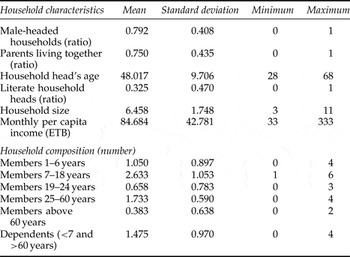
Descriptive analysis (table 1) shows that about 79 per cent of the households are male headed. On average, the age of household heads is found to be 48 years and about 33 per cent of them are literate. In 75 per cent of the households, the parents live together. The mean household size is seven. The composition depicts that each family has an average of three individuals within the 7–18 years age range. The average number of elderly (above 60 years) is one per household. Households have an average monthly per capita income of about 84.7 ETB (Ethiopian BirrFootnote 2 ) from various sources of income.
Summary statistics of households' socioeconomic characteristics

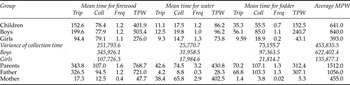
Children on average make three trips per week for resource collection, one trip per each resource. Every week they spend about seven hours on firewood, 1.5 hours on water and 2.5 hours on fodder collection (see table 2). The most variation is noted in the collection time of firewood, followed by the collection time of fodder and water. Moreover, significant variation in collection intensity is noticed across boys regarding the time spent in each resource collection. On average, parents collected firewood two times per week, water three times per week and fodder once per week, spending a total of 25 hours on resource collection.
Weekly time (minutes) spent on resource collection

Notes: For each resource, Trip refers to the double trip travel time per week, Coll to the time spent on resource collection per week, Freq to the resource collection frequency per week, and TPW to the total time spent on the resource collection. Average MPW is used to represent the average mean time in minutes spent on all three resources per week. All times are given in minutes.
Because parents, particularly fathers, collect firewood from the forest areas travelling for a long time, children spend less than half of the time that their parents spend on resource collection. Boys and fathers spent about double the time in search of the resources as compared to girls and mothers, respectively. It is not astonishing for boys and fathers to spend a higher proportion of time on firewood collection, since its sources are the lowland areas adjacent to Afar regional state. Boys and girls spent an almost equivalent time on fetching water. However, the amount of time that mothers spent on this resource is about 14 times higher than that spent by fathers, showing that collecting water is mainly the task of women. Fathers spent more than double the time relative to children on gathering fodder resources. In this case, girls and mothers are almost freed, probably because collecting fodder is considered as the task of male members of the household, as in other parts of Tigray. Here, the importance of pack animals, particularly of donkeys, is significant in transporting these resources. On average, the respondents have about two donkeys.
A focus group discussion conducted with students in selected schools revealed that fathers wake up their children in the middle of night for firewood collection. This is confirmed by a group of firewood distributors in Mekelle and Quiha, who reveal that they receive firewood from farmers mostly delivered by children. Students usually purchase their educational equipment by selling firewood. The marketing channel of firewood passes through many hands, where the lowlanders supply to the highlanders, who in turn deliver it to the main firewood distributors in Quiha and Mekelle.
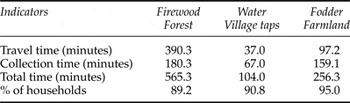
About 89 per cent of the households have identified forests as an important source of firewood (table 3). Households spent more than nine hours on forest firewood, of which the largest proportion (about seven hours) is assigned to travelling. Likewise, 91 per cent of the households have recorded village taps as a dominant source of water where queuing takes more than an hour.
Basic sources of environmental resources and mean time spent

A useful observation is that almost all of the households fetch water from the village taps except in the village of Hilishe, tabia Derge-Ajen in the Enderta woreda. In this village, households fetch water almost entirely from a river.
The regional government of Tigray has constructed 7,241 water sources throughout the region during the last eight years (Tigray Region Water Resources Bureau, 2010/2011). However, there are 1,009 public water sources that are not functioning well. The Bureau claims that 50 per cent of the dysfunctional water taps in urban areas and all of the dysfunctional taps in rural areas have problems that could easily be repaired. This could be one possible explanation for the long time spent on queuing for water (1 hour and 7 minutes, on average). Households are observed fetching water on a three-day round basis and compete for water line-up from 3 a.m. in the morning, particularly during social occasions (wedding and holidays). Concerning fodder, own-farmland is the most common source of fodder for 95 per cent of the sample households, demanding a total time of 4.3 hours.
Parents reported that there exists lack of grazing land in some of the study areas and since livestock demand fodder and water, one can argue that this will exacerbate the possibility of involvement in resource collection. The respondents own an average of five livestock and the amount of fodder (straw, stalks, etc.) they collect from their cultivated farm was about 17 donkey-loads. Households indicated that they expected their total expenditure on fodder resources to be about ETB 401 in the survey year. Households cultivated an average farm size of about 6 ‘tsimdi’.Footnote 3
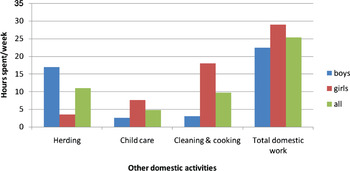
Of the total households interviewed, we found 316 children in the 7–18 years age range. While 75 children (37 boys and 38 girls) are reported to be out of school, we found 29 children (21 boys and eight girls) who did not participate in resource collection during the reference period. Whether children are specializing in schooling, resource collection or a joint combination of the two tasks, or left idle from such activities is an interesting point in the economics of child labor. The majority of the children (about 69 per cent) are simultaneously undertaking both tasks, followed by involvement in collection only (about 22 per cent), schooling only (about 7 per cent), and neither of the tasks (about 2 per cent). About 9 per cent of the male children in our sample were engaged in schooling only, 18 per cent in resource collection only and 70 per cent in both activities. The remaining 3 per cent were neither attending school nor collecting resources at the time of data collection. On the other hand, for the female children the comparable figures were 5 per cent for schooling only, 26 per cent for resource collection only and 68 per cent for both activities. Only 1 per cent were left idle from both tasks. The figures clearly indicate that proportionately more girls are engaged in resource collection than boys. As might be expected, rural children are also involved in other household activities such as animal herding, child care, cooking and cleaning. Children spent about 25 hours per week on all other household activities (figure 1), with the highest portion of time (about 11 hours/week) spent on herding animals, followed by cleaning and cooking (about 10 hours). Female children spent about 29 hours per week on such tasks, where cleaning and cooking accounts for 18 hours per week. Boys spent about 22 hours on these other household activities, with herding taking the largest share – about 17 hours per week.
Mean time (hours/week) spent on other household work by children

Similarly, men and women jointly spent about 60 hours per week on such activities, with the highest amount (38 hours) reported on cleaning and cooking and the lowest (12 hours) amount on animal herding. The time spent by women on those other domestic works outweighs that of their male counterparts by more than three times.
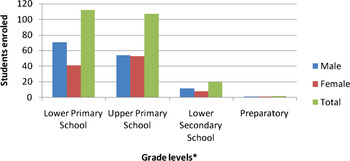
The mean grade attained for school-attending children is grade 5 for the whole sample and is the same across genders. As shown in figure 2, 47 per cent of the students are enrolled in lower primary school, 44 per cent in upper primary school, 8 per cent in lower secondary school, and the remaining 1 per cent in preparatory school level.
Distribution of students across grades

School enrolment declines rapidly in both sexes as one goes to the higher grade levels. A relatively fast decline is noticed among female children; possible explanations may be found in the traditional practices associated with early marriage and the high burden of domestic work. The mean time children spend on school work is about three hours per day which is also equal for both boys and girls.
The survey data revealed that about 24 per cent of the children were not enrolled in school. The reasons given by parents for not sending children to school include huge domestic work burden (16 per cent), resource collection burden (13 per cent), preference for informal education (9 per cent), and others.Footnote 4 The relatively lower rates of enrolment at higher grades indicate that there may be significant dropout and repetition. In our sample, we found 17 children with a repetition experience and 16 children with a dropout experience for at least a certain time. Repetitions and dropouts are higher for girls than for boys: 14 versus three for repetition and 11 versus five for dropout cases, respectively. This is in line with the report at the regional level. A high repetition rate is observed among girls of grades 4–8 and high dropout for girls enrolled in grades 5–8 in Tigray during the 2005/2006 academic year (Tigray Region Education Bureau, 2009/2010).
The focus group discussions carried out with selected teachers and students show that resource scarcity has an adverse effect on school enrolment. Even for those who are already involved in school, many students are not able to do their homework on time due to long hours of work on environmental resource collection. Households with large farm sizes are also reported to reduce their children's probability of attending school through greater demands for farm work.
4.2. Determinants of children's resource collection intensity
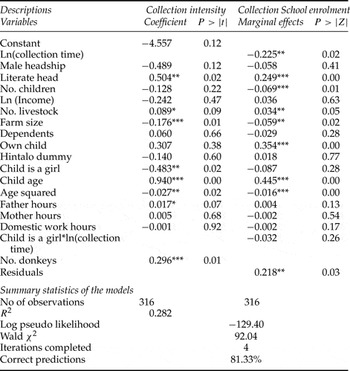
Table 4 reports results from the 2SCML. While the first column shows results from estimating the reduced form of resource collection intensity equation, the second column shows results from the probit model for school enrolment equation. Residuals from the resource collection intensity equation are included as an additional regressor in the schooling model to control and test for the endogeneity of resource collection intensity.Footnote 5
Estimated results of resource collection intensity and school enrolment

Notes: *Significant at 10%; **significant at 5%; ***significant at 1%.
An Ordinary Least Squares regression of the resource intensity model indicates that about 28 per cent of the variation in resource collection intensity is explained by the predictor variables included in the model. Thus, the model fits the data reasonably well.
The first stage estimation (the collection intensity model) in the 2SCML procedure shows that the number of donkeys, used as an instrument for the endogenous ‘ln(collection time)’ variable, is statistically significant at the 1 per cent level. When the household owns an extra donkey, other things being constant, a 30 per cent increase in collection intensity per week is expected by the child. This is not unusual, especially in the Enderta woreda where firewood is continuously supplied to Mekelle city on a daily basis.
The ‘literate head’ variable in the resource collection intensity model conveys that children living in households with literate household heads spend an average 50 per cent more time per week on resource collection compared to children living in households with illiterate household heads, holding other variables constant. This seems contrary to the expectation that educated household heads have a better understanding of the adverse effect of child labor and hence would not involve their own children in such activities. A possible reason is that household heads with some schooling are likely to be occupied by tabia-based government administrative issues in the rural areas. The same holds true for the religious and spiritual leaders (the other group of literate household heads), who are always busy with social issues. They lack time to collect resources by themselves and are often too poor to hire daily laborers on their behalf.
When the number of livestock owned by the household increases by one, holding other things constant, children will spend about 9 per cent more time per week on resource collection. In this regard, the results are inconsistent with Heltberg et al.'s (Reference Heltberg, Arndt and Sekhar2000) report that livestock ownership had a positive significant effect on alternative private energy consumption like animal dung. Even though large livestock size can protect children from frequently collecting firewood through animal dung, it can result in higher demand for fodder and water resources. Thus, the time spend on fodder and water collection may exceed the time saved by using dung instead of collecting firewood. With the prevailing feed resource scarcity (Gebremedhin et al., Reference Gebremedhin, Pender and Tesfay2002), this finding seems valid particularly in Tigray where farmers have started to keep their livestock at home as grazing land is under pressure.
The statistically significant negative coefficient of the ‘Farm size’ variable suggests that a one-fourth of a hectare increase in farm size operated by the household reduces children's expected weekly resource hours' burden by about 18 per cent, with other variables held fixed. This is as would be expected since greater amounts of fodder and crop residues can be obtained with larger farm sizes, thus reducing the resource collection intensity among rural children. These findings are in line with the results of Heltberg et al. (Reference Heltberg, Arndt and Sekhar2000), where larger land holdings reduce resource collection time and increase consumption of private fuels generated from own farmland in rural India.
The child labor literature gives considerable attention to the potential gender-based work differentials and its consequent implication on work hours. Our results reveal that, relative to boys, girls spend about 48 per cent less time per week on collection activities. This suggests that while boys are less involved in resource collection, those that are involved spend more time (hours per week) than girls on environmental resource collection.
As children get older, one can expect that they are more likely to be engaged in firewood, water and fodder resource collection activities. Our findings also reveal that older children spend more collection hours in relation to the younger ones. Previous studies (Psacharopoulos, Reference Psacharopoulos1997; Okpukpara and Odurukwe, Reference Okpukpara and Odurukwe2006; Nkamleu, Reference Nkamleu2009) confirm this finding. On the other hand, our results show that collection intensity per week falls non-linearly with a child's age.
When a child's father increases his weekly resource collection time by one hour, the weekly collection time for his child is expected to increase by about 2 per cent, although this is only weakly significant. While this result contradicts the findings in Malawi (Nankhuni and Findeis, Reference Nankhuni and Findeis2004), it resonates with the results from Kenya (Ndiritu and Nyangena, Reference Ndiritu and Nyangena2010). This is likely to happen because, while their fathers collect high quality firewood, children may collect the ‘thick firewood’ and keep the donkeys for transporting the resources side by side. Fodder resources are also commonly transported by donkeys and, thus, children actively participate in such tasks helping their fathers.
5. Children's resource collection work and school enrolment
The goodness-of-fit measure of a probit model is obtained by using the percentage of correctly classified observations. It shows the number of times the predicted and actual values of the dependent variable match. The overall percentage correctly predicted reflects a weighted average of the two (Wooldridge, Reference Wooldridge2002; Verbeek, Reference Verbeek2004; Cameron and Trivedi, Reference Cameron and Trivedi2009). Accordingly, the probit model for schooling correctly predicts ‘the child attends school’ about 92.12 per cent of the time and ‘the child does not attend school’ about 46.67 per cent of the time. The schooling model, in general, has correctly classified about 81.33 per cent of the observations. Since ‘it gives the rough gauge of the magnitude of the marginal effect’ Cameron and Trivedi, Reference Cameron and Trivedi2009, the interpretations of the results from such models are made using the marginal effect at the mean concept.
Residuals in the school probit model have a positive coefficient and are statistically significant at the 5 per cent level. Hence, there is substantiation to endogeneity of resource collection intensity in the schooling model supporting the use of an IV in our estimation process. The coefficient on resource collection intensity is negative and significant at the 5 per cent level.
A 10 per cent increase in resource collection time is associated with a decrease of approximately 2.3 per cent in the probability of attending school by a child. In other words, an increase of one hour per week on resource collectionFootnote 6 is associated with a more than 2 per cent decline in the probability of school enrollment. When environmental resource degradation causes scarcity of natural resources, the likelihood of not attending school will be aggravated through the opportunity cost of time spent on resource collection. The escalating demand for firewood, land expansion for cultivation, and overgrazed range lands in Tigray region (Edwards et al., Reference Edwards, Gebreegziabher and Araya2010) worsen the problem. The negative effect of collection intensity on schooling is documented from previous research findings as well (Nankhuni and Findeis, Reference Nankhuni and Findeis2004; Ndiritu and Nyangena, Reference Ndiritu and Nyangena2010.
To see whether the impact of resource collection intensity on schooling likelihood differs by child gender, we include an interaction term between child sex and collection intensity in our school enrolment model. The results reveal that the time spent on environmental resource collection does not significantly reduce girls' likelihood of enrolment in school as compared to that of boys. Even though girls are frequently involved in resource collection, the average weekly collection time is lower for girls (seven hours) as compared to boys (14 hours). Therefore, discrimination against girls' schooling due to environmental resource collection intensity is not evidenced by this study. The rest of the results are interpreted as follows.
Household heads who can at least read and write are about 25 per cent more likely to send their children to school, as compared to their illiterate counterparts. This connection has been widely acknowledged in the literature (Admassie, Reference Admassie2002; Nielsen and Dubey, Reference Nielsen and Dubey2002; Gage, Reference Gage2005; Sackey, Reference Sackey2007). On the other hand, an increase in the number of children between 7 and 18 years per family is likely to adversely affect the household's probability of sending that child to school. This indicates the quantity (number of children) and quality (investment on child education) trade-off faced by parents, as poor households may be constrained to cover the school expenses of their children.
An increase by one head in the number of livestock improves the probability of attending school for a child by 3.4 per cent. This shows that, controlling for resource collection intensity, wealthier households are more likely to send their children to school because they can afford it. With regard to their economic incentives, one may argue that with strong social interactions, parents may think that educated children will support them during their old age and, hence, commit to their current enrolment. Thus, they may send their children to school and employ a shepherd for their animals. This is against the findings by Admassie (Reference Admassie2002) and Woldehanna et al. (Reference Woldehanna, Jones and Bekele2008) in Ethiopia, who established a negative relationship between ownership of livestock and child schooling. The exception here is that our model controls for resource collection activities. On the contrary, a one-fourth of a hectare increase in the size of cultivated land reduces the child's likelihood of attending school by about six percentage points. Similar evidence is reported from India (Nielsen and Dubey, Reference Nielsen and Dubey2002), revealing that large farm size reduces the likelihood of school enrolment through increased work demand on the farm.
Relative to other dependents, own child of the household head is about 35 per cent more likely to attend school. This reflects that household heads favor their own children in deciding who should attend school and who should carry out other household tasks. These results resonate with the previous findings by Jensen and Nielsen (Reference Jensen and Nielsen1997) and Admassie (Reference Admassie2002).
The coefficient of the ‘Child age’ variable in the probit model for schooling shows that the probability of school enrolment increases with age until 14 years, after which it starts to decrease with age. This relationship is confirmed by other studies in Ethiopia (Admassie, Reference Admassie2002; Weir, Reference Weir2010).
6. Conclusion
This study examined the relationship between resource scarcity (measured by the weekly hours spent on resource collection) and the likelihood of schooling for children aged 7–18 years. Moreover, it examined any gender bias against girls' schooling due to collection intensity.
Children spent about seven hours on firewood, one hour on water, and three hours on fodder collection per week. The findings revealed that a 50 per cent increase in hours per week spent on collection activities is likely to reduce children's enrolment in school by 11 per cent. Even though girls are frequently involved in resource collection, they spent less time on resource collection as compared to boys. Hence, the results showed no evidence of lower probability for girls' schooling due to resource collection intensity. Compared to illiterate heads of households, literate household heads are more likely to send their children to school by 25 percentage points. They also spend 50 per cent more time per week on resource collection. Large number of livestock owned by households increases the likelihood of schooling. Large size of land significantly reduces the collection intensity, perhaps due to access to crop residues and fodder resources. However, increasing the size of cultivated land by one-fourth of a hectare reduces the child's likelihood of attending school by about 6 per cent through high labor demand for farming, sowing, weeding, and harvesting activities.
The provision of functional adult literacy programs, the proper collection of farm-based fodder resources and strong labor-sharing arrangements among farmers can, therefore, minimize children's burden and enhance schooling likelihood. Repairing the already constructed but currently non-functioning or malfunctioning water sources is a key policy instrument since it minimizes at least the waiting time at water sources. Examination of the link between the intensity of environmental resource collection work, the extent of class absence and presence among students and their academic achievements is left for the future research agenda.
Appendix A. List, definition and observation levels of variables used in the econometric analysis