Implications
Climate change is expected to bring about drier, hotter summers and an increased frequency of extreme weather events across Europe. Here we show that milk yield and quality decline at the upper extremes of temperature and humidity even under conditions currently experienced in Scotland. We identify the values of temperature and humidity, and of other weather elements, at which performance begins to decrease. These estimates could be used in conjunction with climate projections to help policy makers understand the likely economic impact of climate change on dairy productivity.
Introduction
Climate change will have direct effects on livestock performance and welfare, mainly through increases in temperature and the frequency of extreme weather events, and will also affect animals indirectly through changes in the availability of fodder and pasture and the distribution of pests and parasites (Gauly et al., Reference Gauly, Bollwein, Breves, Bruegemann, Daenicke, Das, Demeler, Hansen, Isselstein, Koenig, Lohoelter, Martinsohn, Meyer, Potthoff, Sanker, Schroeder, Wrage, Meibaum, von Samson-Himmelstjerna, Stinshoff and Wrenzycki2013). High temperatures are associated with a greater incidence of heat stress in livestock, which can have negative effects on milk yield (Bohmanova et al., Reference Bohmanova, Misztal and Cole2007; Hammami et al., Reference Hammami, Bormann, M’hamdi, Montaldo and Gengler2013), fertility (Hansen, Reference Hansen2009) and health (Sanker et al., Reference Sanker, Lambertz and Gauly2013), and increase the risk of mortality (Vitali et al., Reference Vitali, Segnalini, Bertocchi, Bernabucci, Nardone and Lacetera2009). Heat stress occurs when animals experience conditions above their thermal comfort zone and are unable to dissipate enough heat to maintain thermal balance (Kadzere et al., Reference Kadzere, Murphy, Silanikove and Maltz2002). This is already costly to the dairy industry in terms of management interventions and lost productivity (St-Pierre et al., Reference St-Pierre, Cobanov and Schnitkey2003).
An animal’s tolerance to high air temperatures depends on the amount of water vapour in the air because this influences the rate of heat loss through evaporative cooling. The association between air temperature and water vapour content can be expressed as a temperature humidity index (THI; Thom, Reference Thom1959). Milk yield in dairy cows, Bos taurus, is traditionally said to begin declining at around 72 THI units based on work carried out in subtropical regions (Armstrong, Reference Armstrong1994; Ravagnolo et al., Reference Ravagnolo, Misztal and Hoogenboom2000). Thresholds of 68 (Renaudeau et al., Reference Renaudeau, Collin, Yahav, de Basilio, Gourdine and Collier2012; Gauly et al., Reference Gauly, Bollwein, Breves, Bruegemann, Daenicke, Das, Demeler, Hansen, Isselstein, Koenig, Lohoelter, Martinsohn, Meyer, Potthoff, Sanker, Schroeder, Wrage, Meibaum, von Samson-Himmelstjerna, Stinshoff and Wrenzycki2013) or even 60 units (Bruegemann et al., Reference Bruegemann, Gernand, Koenig von Borstel and Koenig2012) may, however, be more characteristic of high yielding herds in temperate zones. The genetic relationship between heat tolerance and productivity is negative (Ravagnolo and Misztal, Reference Ravagnolo and Misztal2000), and dairy cattle are becoming more sensitive to heat stress owing to optimisation of breeding and management practices for increased performance (Kadzere et al., Reference Kadzere, Murphy, Silanikove and Maltz2002; West et al., Reference West, Mullinix and Bernard2003). The reduction in productivity in heat stressed cows is largely a result of reduced feed intake, but high temperatures also have a direct effect on reproductive physiology and metabolism (Renaudeau et al., Reference Renaudeau, Collin, Yahav, de Basilio, Gourdine and Collier2012). Cattle generate metabolic heat as a by-product of milk synthesis and so higher yielding animals experience heat stress at lower THIs than lower yielders (Kadzere et al., Reference Kadzere, Murphy, Silanikove and Maltz2002).
An animal’s thermal tolerance is also affected by solar radiation and the velocity of ambient air (Dikmen and Hansen, Reference Dikmen and Hansen2009; Graunke et al., Reference Graunke, Schuster and Lidfors2011; Hammami et al., Reference Hammami, Bormann, M’hamdi, Montaldo and Gengler2013), while increasing precipitation (ppt) is associated with declining milk production (Stull et al., Reference Stull, Messam, Collar, Peterson, Castillo, Reed, Andersen and VerBoort2008). Weather-related stressors could potentially affect performance immediately or have a delayed impact, and yet few studies have explored the time interval between weather events occurring and impacting milk traits (St-Pierre et al., Reference St-Pierre, Cobanov and Schnitkey2003). Among those that have, West et al. (Reference West, Mullinix and Bernard2003) found that the effects of mean daily THI on milk yield were greatest 2 out of a possible 3 days after THI was recorded and Bouraoui et al. (Reference Bouraoui, Lahmar, Majdoub, Djemali and Belyea2002) found that mean daily THIs measured 1, 2 and 3 days before the test day (TD) had a greater effect on milk yield than TD THI. These time lags might be related to the duration of digestive processes (Gauly et al., Reference Gauly, Bollwein, Breves, Bruegemann, Daenicke, Das, Demeler, Hansen, Isselstein, Koenig, Lohoelter, Martinsohn, Meyer, Potthoff, Sanker, Schroeder, Wrage, Meibaum, von Samson-Himmelstjerna, Stinshoff and Wrenzycki2013).
Here we used 21 years’ data from a single herd at two dairy research farms on the east and west coasts of Scotland to investigate the effects of weather on milk yield and composition (fat and protein content). The study evaluates a range of weather variables collected from Meteorological Office weather stations located on the grounds of the farms or in the close vicinity, and two THIs that are frequently used to characterise heat stress in cattle. While the effects of heat stress on dairy cows has been well-documented in tropical and subtropical regions (e.g. West et al., Reference West, Mullinix and Bernard2003; Dikmen and Hansen, Reference Dikmen and Hansen2009), a growing number of studies has also reported associations between THI and milk traits in temperate regions where tolerance to heat stress is lower (Bruegemann et al., Reference Bruegemann, Gernand, von Borstel and Koenig2011; Hammami et al., Reference Hammami, Bormann, M’hamdi, Montaldo and Gengler2013; Dunn et al., Reference Dunn, Mead, Willett and Parker2014). Moreover, temperatures are predicted to increase over the 21st century in southern Scotland, especially in summer, with an expected mean daily maximum temperature increase of 4.3°C by the 2080s with a very slight reduction (0% to 5%) in humidity (Jenkins et al., Reference Jenkins, Murphy, Sexton, Lowe, Jones and Kilsby2009). We therefore aimed to (1) determine the most biologically relevant way to quantify different weather elements and two THIs with respect to measurement timescale and summary statistics (mean, maximum, minimum) and to (2) test how weather currently influences milk yield and composition in cows with and without access to grazing on the TD (management group). We hypothesised that productivity would decline under extreme weather conditions, particularly at the upper extremes of THI, and that the magnitude of the effects would depend on management.
Material and methods
Subjects, maintenance and data collection
We studied the Langhill Holstein Friesian dairy herd, consisting of ~200 cows, between November 1990 and July 2011. The cattle were housed at Langhill Farm, Roslin, Midlothian (55°52'1"N, 3°10'15"W), hereafter ‘Farm 1’, until late June 2002 and then transferred to Crichton Royal Farm, Dumfries (55°02' N, 3°34' W), ‘Farm 2’, a distance of 95 km. The management systems are described for Farm 1 in Veerkamp et al. (Reference Veerkamp, Simm and Oldham1994) and for Farm 2 in Pollott and Coffey (Reference Pollott and Coffey2008). Briefly, two genetic lines were created in 1976: select (S) and control (C). S cows were bred to bulls of the highest UK genetic merit for kg fat plus protein while C cows were bred to bulls that were similar to the national average for these traits. Every year, semen from four to five bulls that were not closely related to the cows nor known to produce calving difficulties was obtained from nationally available stock and used to serve females from the same genetic line. Females from the two lines were managed together and allocated in equal numbers to either a high forage (HF) or low forage (LF) diet system. A total mixed ration (TMR) of blended concentrates, brewers’ grain and silage was offered ad libitum to HF cattle in the ratio 20 : 5 : 75 total dry matter (mean proportions over a full lactation) and to LF cattle in the ratio 45 : 5 : 50. All animals received concentrates in the milking parlour. Females from the same sire were assigned to the two diet groups in equal numbers.
At Farm 1, calving took place between early September and January each year. Cows were kept indoors for ~200 days after calving and then grazed. Those that were still indoors at the end of June were moved outside. Most grazing occurred between April and October, inclusive, depending on the availability of pasture. At Farm 2, the HF group was grazed between April and October, and otherwise maintained indoors; LF cows were continuously housed (CH). Calving took place all year round for both HF and LF cows, and the majority of calves were born during the winter months. Housing at both farms consisted of conventional cubicle stalls within a single building with a corrugated metal roof and no artificial ventilation. At Farm 1, the building had walls of slatted wood and large open doors at each end; an open ridge in the roof facilitated airflow. The building at Farm 2 had open windows along the length of one side and a gated but otherwise open section (~3 m wide) on each of two opposite sides surrounding an indoor loafing area.
Cows were milked twice daily at Farm 1 and three times a day at Farm 2. Milk yield (kg) was measured and summed for each day. Fat and protein content was measured twice (Farm 1, Tuesday post noon and Wednesday before noon) or three times (Farm 2, Tuesday post noon, Wednesday before noon and midday) a week, and expressed as percentages averaged across the two or three milking events. Animals remained in the study for three lactations unless they were culled owing to illness or infertility.
Animal data
We extracted milk records collected on days 4 to 305 of the cows’ first three lactations for animals that were ⩾75% Holstein Friesian (mean 93.0±0.19%), discarding records collected between June 2002 and July 2003 when cows were acclimatising to Farm 2. This resulted in a data set containing 762 786 TD records for milk yield from 1369 individuals on 7073 days and 89 331 weekly records from 1220 animals on 958 days for fat and protein content. The number of records for each animal ranged from 3 to 902 (mean 557.6±10.68) for milk yield and 3 to 129 (mean 73.2±10.09) for fat and protein content. Test day milk yield records were matched with weather data from the same day, and fat and protein records were matched with weather data measured on the Tuesday of the same week.
Weather data
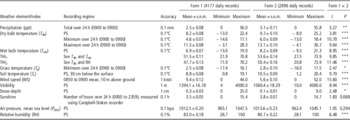
Data on 11 weather elements (Table 1) were downloaded from the British Atmospheric Data Centre website (UK Meteorological Office, 2012). These consisted of point-samples recorded at 0900 h each day and 24 h summaries (mean, minimum, maximum, total). For each element we extracted data from the closest weather station to Farm 1 for the period 1990 to 2002 and to Farm 2 for the period 2003 to 2011. Meteorological Office weather stations that measured most elements of interest were active on the grounds of Farm 1 until 1999 and Farm 2 for the duration of the experiment. An additional five stations ⩽14.4 km from Farm 1 and one station 29 km from Farm 2 were used for the remaining elements and to fill in missing values. Supplementary Table S1 provides the distances that each weather element was measured from the farms, and the elevation at which it was recorded. Using these data, we calculated THI1:
 $${\rm THI}_{1} =(T_{{{\rm db}}} {\plus}T_{{{\rm wb}}} ){\times}0.72{\plus}40.6$$
where T db is the dry bulb air temperature (°C) and T wb the wet bulb temperature (°C), and THI2:
 $$\eqalignno{{\rm THI}_{2} \!=\,(1.8{\times}T_{{{\rm db}}} {\plus}32){\minus}((0.55{\minus}0.0055{\times}{\rm RH}) \cr {\times}(1.8{\times}T_{{{\rm db}}} \,{\minus}\,26))$$
where RH is the relative humidity (%) (National Research Council, 1971).
Weather data collected by Meteorological Office stations near research farms 1 (1990 to 2002) and 2 (2003 to 2011)

THI=temperature humidity index; PS=point-sample.
Descriptive statistics are provided for each farm, and weather between the two farms is compared using separate generalised least squares models fit by restricted maximum likelihood. Averages for THI1 and THI2, which we calculated from Meteorological Office data using equations (1) and (2), respectively, are also given.
Recording regime indicates whether values are PSs taken at 0900 h or 24 h summaries (mean, minimum, maximum, total).
Two-tailed levels of statistical significance are indicated by asterisks: *P<0.05, **P<0.01 and ***P<0.001.
As weather can have a delayed effect on biological processes, and the effects of weather depend on the timescale over which animals experience them (West et al., Reference West, Mullinix and Bernard2003; Renaudeau et al., Reference Renaudeau, Collin, Yahav, de Basilio, Gourdine and Collier2012; Bertocchi et al., Reference Bertocchi, Vitali, Lacetera, Nardone, Varisco and Bernabucci2014), we explored the relationship between milk traits and all weather variables on the day the cow was milked (‘test day’ or TD), the preceding day (TD-1) and for the number of hours of sunshine, which was measured 0000 to 2359 h, 2 days before milking (TD-2). We calculated a ‘moving’ mean for each daily (0900 h) point-sample over the 3 and 7 days before (and including) the TD, and a moving minimum and maximum for the three variables for which 24 h summaries were available (ppt, T db and sunshine). We also noted the presence v. absence of lying snow on the TD and TD-1. These methods allowed us to compare different ways of expressing the weather elements, hereafter ‘weather metrics’.
Statistical analysis
Weather at Farms 1 and 2 was compared using separate generalised least squares models for each weather element or index fitted by restricted maximum likelihood (REML) from the nlme package in R version 3.0.2. (R Development Core Team, 2013). Harmonic regression allowed us to account for seasonal fluctuations in weather and we applied a first-order autocorrelation structure to deal with non-independence of weather values between days.
We used Akaike’s information criterion (AIC) to determine the most biologically relevant way to express each weather element and compare the explanatory power of each element with respect to milk yield, fat content and protein content (models listed in Supplementary Table S2). AIC has been used previously to compare temperature indices in explaining milk traits (Bruegemann et al., Reference Bruegemann, Gernand, Koenig von Borstel and Koenig2012; Hammami et al., Reference Hammami, Bormann, M’hamdi, Montaldo and Gengler2013). As the metrics for summarising a given element were closely correlated, and high proportions of shared variance can lead to unreliable estimates, we fitted each metric in a separate linear mixed effects model (LMM) (equation (3)) using maximum likelihood to produce a series of non-nested models. Information theory is an appropriate method for comparing non-nested models provided that models are fitted to identical datasets (e.g. there are no missing values) (Burnham and Anderson, Reference Burnham and Anderson2002). As the full data set contained missing values where data were unavailable for the closest weather stations to a farm, we created a reduced data set of 659 918 records (86.5% of the total) and 1357 animals (99.1%) for milk yield, and 77 178 records (86.4% of the total) and 1212 animals (99.3%) for fat and protein content by excluding all records with missing weather values. This data set was used only to compare weather metrics. We fitted the following model:
 $$\eqalignno{ y{=}\,{\rm }\mu {\plus}w & {\plus}{\rm feed\ group }{\plus}{\rm genetic\ group } \cr & {\plus}\left( {{\rm feed\ group }{\times}{\rm genetic \ group}} \right){\rm } \cr & {\plus}{\rm management }{\plus}{\rm farm }{\plus}{\rm lactation \ number } \cr & {\plus}{\rm DIM}{\plus}{\rm animal\ id}{\plus}{\rm TD} \cr & {\plus}{\rm ordinal\ calving \ date}{\plus}\epsilon $$
where y is the response variable (milk yield, fat or protein content, all normally distributed), µ the overall mean and w the single weather metric or weather metric plus weather metric×management interaction term; ‘feed group’ (HF or LF), ‘genetic group’ (S or C), ‘management’ on the TD (grazing or housed) and ‘farm’ (1 or 2) were two-level fixed factors, ‘lactation number’ (1, 2 or 3) was a three-level ordered factor, linear and quadratic terms of ‘DIM’ (days 4 to 305 in milk where day 0 was the day of calving) were covariates, animal identity, ordinal calving date and TD (continuous date from the beginning of the experiment, 1 to 7578) were random factors (random intercepts only) and ε was the error structure. We considered farm identity to control for potential changes in management and other conditions between the two farms, and ordinal calving date (1 to 366) to control for the time of year that cows calved. Fitting TD as a random factor allowed us to account for temporal autocorrelation, as well as potential trends related to climate and genetic improvements over the study period. To test the hypothesis that productivity declines in extreme weather conditions, we fitted linear, quadratic and cubic terms for all continuous weather variables (except for snow depth, ppt and visibility, which were expected to have a linear effect on milk traits), retaining lower order terms where higher order terms were significant. All continuous terms were mean-centred to reduce collinearity between polynomial terms of a given variable and to improve the interpretability of the results. LMMs were fitted using the lme4 package (Bates et al., Reference Bates, Maechler, Bolker and Walker2013) in R. We selected the ‘best’ model for each weather element based on the lowest AIC, and considered seven AIC units to be a meaningful difference between models (Burnham et al., Reference Burnham, Anderson and Huyvaert2011). The highest ranked model for each weather element or index was refitted using REML on the same data set to obtain less biased parameter estimates, which were calculated using lmerTest (Kuznetsova et al., Reference Kuznetsova, Brockhoff and Christensen2014).
Next, we tested whether the effects of weather on milk yield and composition depended on the prevailing management type (indoors or outdoors) in a single LMM for each response variable (equation (3)) using REML. To avoid fitting variables with shared variation in the same model, weather variables were limited to ppt, wind speed (WS), sunshine and THI2, based upon exploratory factor analysis (psych package; Revelle, Reference Revelle2013), correlation coefficients (⩽0.33 based on TD values) and AIC rankings (see Results). For each of the three weather elements and THI, the metric belonging to the highest ranked model was used. We tested for linear effects of ppt, and linear, quadratic, cubic and quartic effects of THI2, WS and sunshine. Non-significant interactions were removed from the models (higher order terms before lower order terms) followed by non-significant main effects using backward elimination. For each significant interaction between weather and management, a further LMM using REML was undertaken to examine the effect size and shape of the relationship for the two management groups separately. We used differentiation to calculate the ‘turning points’ where performance began to decline for polynomial relationships between weather and milk traits based on the regression equations of the post-hoc LMMs. For models fitted by REML, we present estimates of the model coefficients (β) with standard errors, t-values and P-values assuming significance at P<0.05. All statistical tests are two-tailed.
Results
Weather conditions at the research farms
The United Kingdom has a maritime temperate climate with mild summers and winters. Descriptive statistics for weather at the two research farms are given in Table 1. THI1 and THI2 showed a strong linear correlation (r p=0.986, t 6873=495.5, P<0.001), although THI1 was higher than THI2 (t 6874=150.2, P<0.001, paired test). THI1 at 0900 h was >60 units across the two farms on 1114 days over the study period (16.2% of TDs), and >70 units on 10 days (0.1%), and THI2 at 0900 h was >60 units on 626 days (9.1% of TDs) and >70 units on 8 days (0.1%). THI values peaked in July and were lowest between December and February, while the number of hours of sunshine was greatest in May and lowest in December and January. The research farms received <1 h sunshine over 24 h on 2343 days (33.4%) and >9 h on 668 days (9.5%), and WS was <5 knots at 0900 h on 2464 days (36.1%) and >20 knots on 415 days (6.1%). Higher values of ppt, T db, T wb, THI1, THI2, T s and T g were recorded at Farm 2 than at Farm 1, whereas WS, visibility, snow depth and relative humidity (RH) were greater at Farm 1 (Table 1). There was no difference in P MSL or the number of hours of sunshine at the two farms. THI increased over the 12 years of study at Farm 1 (THI1: β=0.17±0.04, t=4.34, P<0.001; THI2: β=0.13±0.04, t=2.95, P=0.003), but did not change over the 8 years at Farm 2 (THI1: β=−0.11±0.07, t=1.63, P=0.103; THI2: β=−0.13±0.08, t=1.64, P=0.101). The number of hours of sunshine increased over the study period at Farm 1 (β=0.09±0.02, t=4.85, P<0.001), but did not change over the years of the study at Farm 2 (β=−0.02±0.04, t=0.47, P=0.636). WS decreased over the time at Farm 1 (β=−0.21±0.05, t=3.90, P<0.001), but did not change at Farm 2 (β=0.12±0.07, t=1.80, P=0.072). Ppt did not change over the study period at Farm 1 (β=0.02±0.03, t=0.49, P=0.625) or at Farm 2 (β=0.10±0.06, t=1.55, P=0.122). Daily maximum temperatures exceeded point-samples measured at 0900 h by 3.3°C (t 6919=120.6, P<0.001), and daily minimum temperatures were 3.7°C cooler than point-samples (t 6919=123.0, P<0.001).
Comparing the effects of weather elements and metrics on milk yield and quality
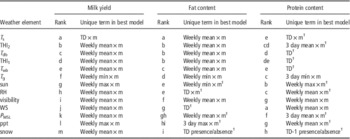
Models testing for the effects of T s provided the best fits to the data for both milk yield and fat content, while WS models provided the best fit to protein content data (Table 2; Supplementary Table S3). Weather elements and indices were ranked in the same order for milk yield and fat content (albeit with ties for THI1, THI2 and T db for fat content), but followed a different order for protein content except at the end of the scale (P MSL, ppt and snow were ranked 11th, 12th and 13th across all three milk traits). Models testing for direct measures of temperature (T s, THI2, T db, THI1, T wb and T g) were ranked above all other models for milk yield and fat content, and in the top 9 of 13 elements or indices for protein content. THI2 showed a better fit to the data than THI1 for milk yield, but the two THIs did not differ in explanatory power for milk fat and protein (Table 2). Among models that did not contain direct temperature variables, those testing for the number of hours of sunshine (seventh) and RH (eighth) were ranked highest for milk yield and fat content, and the model for the number of hours of sunshine was ranked second for protein content (Table 2).
The best models for each weather element or index for milk yield, fat content and protein content based on an information-theoretic comparison of 521 maximum likelihood models per response variable (Supplementary Table S2 shows the full set of models compared)

T s=soil temperature; THI=temperature humidity index; T db=dry bulb temperature; T wb=wet bulb temperature;T g=grass temperature; RH=relative humidity; WS=wind speed; P MSL=air pressure, mean sea level; ppt=precipitation; TD=test day (the day that the cow was milked); TD−1=the day before milking.
All 521 models were based on equation (3) and a single data set of 659 918 records (1357 individuals) for milk yield or 77 178 records (1212 individuals) for fat and protein content. Each model differed from the others in a single weather metric, the presence or absence of the weather metric×management interaction (indicated by×m) or order of polynomial term for the weather metric. Polynomial terms and Akaike’s information criterion (AIC) values are given in Supplementary Table S3. Models are ranked from best to worst (lowest to highest AIC) for each weather element or index; ‘a’ represents the highest rank, and different lower case letters indicate meaningful differences (⩾7 AIC units) in rank.
†Indicates that more than one model had equal support for a given weather variable; equally ranked models are listed in Supplementary Table S3.
Models testing for interactions between weather and management fitted the data better or (for the effects of WS and snow on fat content, and the effects of T db, THI1, T wb and snow on protein content) not significantly worse than models without the interaction term. In all but one case (TD T s), metrics applied over a week’s timescale provided better fits for milk yield than metrics applied over shorter timescales. Similarly, weekly summaries were ranked more highly (or equally highly in the cases of RH, ppt and snow) than shorter-term metrics for fat content, with the exception of WS, where TD was the best metric. TD or 3 day metrics were usually most effective at explaining the effects of temperature variables on protein content, while weekly summaries usually explained the effects of other weather elements on protein content better than shorter-term metrics. For T db, where data were available both as 0900 h point-samples and as 24 h summaries, metrics derived from point-samples ranked more highly than those based on 24 h summaries for all three milk traits. Models containing metrics with higher order polynomial effects usually explained the data better than those containing lower order polynomials for milk yield and fat content, although this was less frequently the case for milk protein (Supplementary Table S3). Although models varied in explanatory power, the best metric for each weather element or index significantly influenced all three milk traits when tested individually using REML, with the exception of snow on protein content, for which no metric was significant (Supplementary Table S4).
How does weather influence milk yield in dairy cattle?
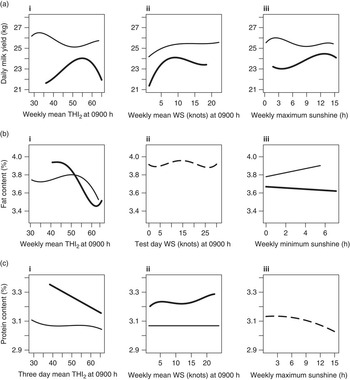
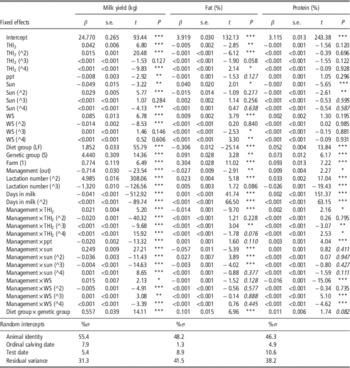
Milk yield was influenced by two-way interactions between management and each of the individual weather variables (weekly mean THI2 at 0900 h, weekly maximum number of hours of sunshine, weekly mean WS and weekly mean ppt), the interaction between diet and genetic group, and main effects of farm identity, lactation number and DIM (Table 3) as follows. When cows were outside, milk yield increased with THI to 24.0 kg at 54.9 THI units, and then decreased as THI continued to increase (Figure 1, Table 3). When cattle were indoors, by contrast, increasing THI values were associated with an overall decrease in milk yield from a local maximum of 26.5 kg of milk at 32.8 THI units. Animals outdoors increased milk yield with WS to 24.1 kg at 9.1 knots, and then gradually decreased milk yield as WS increased (Figure 1; Table 3). Those indoors increased milk yield with increasing WS when WS was low, and showed no change in milk yield at higher WS. In animals indoors and outdoors, milk yield increased and then decreased as the number of hours of sunshine increased (Table 3). Performance began to decline at lower values of sunshine when animals were indoors (26.0 kg milk at 2.4 h sunshine) than when they were outdoors (24.5 kg milk at 12.8 h sunshine; Figure 1). Cattle experienced a decrease in milk yield with increasing ppt, and the rate of decline was greater in animals outdoors (β=−0.02±0.004, t=5.54, P<0.001) than indoors (β=−0.01±0.002, t=4.10, P<0.001). Individuals produced more milk indoors than outdoors, at Farm 1 than Farm 2 and in later lactations than in earlier lactations, and milk production decreased over a given lactation (Tables 3 and 4). Milk yield was greater in S than C animals (effect of genetic group in HF animals: β=4.64±0.31, t=14.74, P<0.001; effect of genetic group in LF animals: β=4.45±0.49, t=9.00, P<0.001), and in LF than HF animals (effect of feed group in C animals: β=1.75±0.03, t=51.39, P<0.001; effect of feed group in S animals: β=2.21±0.03, t=74.67, P<0.001), and the difference in milk yield between LF and HF cattle was greater in S than in C animals.
The effects of (i) THI, (ii) wind speed (WS) and (iii) sunshine on (a) daily milk yield (n=752 674 records from 1362 cows), (b) milk fat (n=85 134 records from 1220 cows) and (c) milk protein (n=87 446 records from 1220 cows) in a herd of dairy cattle on two research farms in Scotland depended on whether the animals were indoors (thin unbroken line) or outdoors (thick line), except where both groups of cattle are represented by a single broken line. Weather values were recorded from the closest outdoor weather station to each farm for each element. All plots are adjusted for the terms in equation (3), where significant, and statistical estimates for the effects presented here are provided in Table 3. Note that plots are truncated to exclude the highest and lowest 0.5% of weather records owing to small samples for extreme weather events. THI=temperature humidity index.

Linear mixed effects models to test the effect of weather and prevailing management group (indoors or outdoors) on milk yield in 1362 Holstein Friesian cows (752 674 records), fat content in 1220 cows (85 134 records) and protein content in 1220 cows (87 446 records) during the years 1990 to 2011

THI=temperature humidity index; ppt=precipitation; WS=wind speed; LF=low forage; S=select.
Linear, quadratic (^2), cubic (^3) and quartic (^4) effects were tested for where indicated.
Two-tailed levels of statistical significance are indicated by asterisks: *P<0.05, **P<0.01 and ***P<0.001.
Non-significant effects that were not components of significant interactions were removed from the final models; their P-values are italicised.
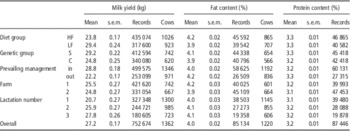
Means±standard errors (s.e.m.) with the numbers of records and unique individuals for milk yield and fat and protein content

HF=high forage; LF=high forage; S=select; C=control.
Significant differences between levels are indicated in Table 3.
The number of animals used for analyses of protein content was the same as for analyses of fat content.
How does weather influence milk fat?
The proportion of fat in milk was influenced by two-way interactions between management and weekly mean THI2 at 0900 h, management and weekly minimum sunshine, and between diet and genetic group, and main effects of TD WS, farm identity, lactation number and DIM, but not by the maximum ppt over the last 3 days (Table 3). Fat content showed an overall decrease with THI for animals outdoors. For animals indoors, milk fat increased to a local maximum of 3.8% at 50.2 THI units, and then decreased with THI (Figure 1, Table 3). Animals outdoors and indoors increased fat content to 4.0% at 14.4 knots and then decreased fat content as WS increased (Figure 1; Table 3). Cattle kept indoors increased fat content as the number of hours of sunshine increased, whereas cattle outdoors gradually decreased fat content as the number of hours of sunshine increased (Figure 1; Table 3). Cows produced milk with a higher proportion of fat when outdoors than indoors (Table 3; Table 4), at Farm 1 than Farm 2, and in later lactations than in earlier lactations. Milk fat decreased during the first days of a given lactation and then increased (Table 3). Fat content was greater in S than C animals (effect of genetic group in HF animals: β=0.09±0.03, t=2.77, P=0.006); effect of genetic group in LF animals: β=0.16±0.04, t=4.17, P<0.001) and in HF than LF animals (effect of feed group in C cows: β=−0.24±0.01, t=18.36, P<0.001; effect of feed group in S cows: β=−0.24±0.01, t=20.19, P<0.001), and the difference in fat content between S and C cattle was greater in LF than in HF individuals.
How does weather influence milk protein?
The proportion of protein in milk was influenced by two-way interactions between management and 3 separate weather variables (mean THI2 over the last 3 days, weekly mean WS, weekly mean ppt), and main effects of the weekly maximum number of hours of sunshine, diet, genetic group, farm identity, lactation number and DIM (Table 3). Protein content decreased as THI increased in animals kept outdoors and indoors, and the rate of decrease was greater when animals were outside than when they were inside (Figure 1; Table 3). Animals outdoors gradually increased protein content as WS increased, whereas protein content was not influenced by WS when animals were indoors. Examining cattle kept indoors and outdoors separately, those indoors showed a tendency to increase protein content with increasing ppt (β=0.002±0.001, t=1.80, P=0.072), but there was no effect of ppt (β=−0.0001±0.0016, t=0.06, P=0.636) on protein content when cattle were outdoors. Cattle indoors and outdoors decreased protein content as the number of hours of sunshine increased (Figure 1; Table 3). Cows produced more milk protein when housed outdoors than indoors, at Farm 1 than Farm 2 and in lactations 2 and 3 than in lactation 1 (Tables 3 and 4). Protein content decreased during the first days of a given lactation and then increased (Table 3). Protein content was greater in select than control animals (effect of genetic group in HF animals: β=0.05±0.01, t=3.48, P<0.001; effect of genetic group in LF animals: β=0.10±0.02, t=5.79, P<0.001) and in HF than in LF cattle (effect of feed group in C animals: β=0.04±0.01, t=7.58, P<0.001; effect of feed group in S animals: β=0.06±0.01, t=11.80, P<0.001), and the difference in milk protein between S and C cattle was greater in LF than in HF animals.
Discussion
A better understanding of the response of livestock to current and future weather patterns is essential to enable farming to adapt to a changing climate (Gauly et al., Reference Gauly, Bollwein, Breves, Bruegemann, Daenicke, Das, Demeler, Hansen, Isselstein, Koenig, Lohoelter, Martinsohn, Meyer, Potthoff, Sanker, Schroeder, Wrage, Meibaum, von Samson-Himmelstjerna, Stinshoff and Wrenzycki2013). We investigated the effects of weather over a 21-year period on milk yield and composition under different management systems in a dairy herd at two Scottish farms. The relative influence of 11 weather elements and two THIs, indicators of heat stress, was compared. Models containing direct measures of temperature provided the best fits to milk yield and milk fat data; the number of hours of sunshine and RH were also important. Models considering WS explained protein content best, while those containing sunshine, humidity and temperature also performed well. The importance of direct temperature metrics in explaining productivity is consistent with a wealth of studies on the impact of heat stress in dairy cattle (Renaudeau et al., Reference Renaudeau, Collin, Yahav, de Basilio, Gourdine and Collier2012). Relatively few studies have assessed the impact of other weather variables on milk traits, but thermal indices that account for WS and solar radiation perform better than those that do not (Hammami et al., Reference Hammami, Bormann, M’hamdi, Montaldo and Gengler2013).
In our study, weather metrics summarised across a week’s timescale from the TD usually explained milk traits (particularly yield and fat content) better than shorter-scale summaries. Previous studies found that weather measured before the TD (up to 3 days before) explained TD milk traits better than weather measured on the TD (Bouraoui et al., Reference Bouraoui, Lahmar, Majdoub, Djemali and Belyea2002; West et al., Reference West, Mullinix and Bernard2003; Bertocchi et al., Reference Bertocchi, Vitali, Lacetera, Nardone, Varisco and Bernabucci2014), which may be associated with the duration of digestive processes in ruminants (Gauly et al., Reference Gauly, Bollwein, Breves, Bruegemann, Daenicke, Das, Demeler, Hansen, Isselstein, Koenig, Lohoelter, Martinsohn, Meyer, Potthoff, Sanker, Schroeder, Wrage, Meibaum, von Samson-Himmelstjerna, Stinshoff and Wrenzycki2013). The higher explanatory power of longer v. shorter timescales may also reflect the greater potential for extreme weather conditions to be captured in the analysis. The pattern was less clear for protein content, with weekly, three day and TD scales performing similarly well. This suggests that weather has a more sustained impact on milk yield and fat content than on milk protein. Although recent studies have used summaries of the 3 days preceding milk sampling to describe weather conditions (e.g. Lambertz et al., Reference Lambertz, Sanker and Gauly2014), our results suggest that weekly summaries may be more appropriate, at least for milk yield and fat content.
The effects of weather (THI2, sunshine, WS and ppt) measured from outdoor weather stations on milk yield depended on whether cattle were indoors or outdoors on the TD. Cattle that were rotated between an indoor and outdoor environment responded according to the prevailing environment and produced more milk when they were indoors than outdoors. Similarly, grazing cows produced less fat-corrected milk than animals without access to grazing in another study (Lambertz et al., Reference Lambertz, Sanker and Gauly2014). We assume that these results are largely a consequence of differences in diet: animals maintained indoors in our study received ad libitum TMR with some forage, while those outdoors ate mainly grass. TMR maximises metabolisable energy and nutrient uptake in high producing cows and can be obtained and digested more quickly than grass (Agnew and Yan, Reference Agnew and Yan2000). Accordingly, many studies show an increase in milk yield with feed intake (Agnew et al., Reference Agnew, Yan and Gordon1998). Further to diet effects on relative productivity, the difference in the shapes of the productivity curves for animals inside and outside is probably owing to the differences in weather conditions experienced by cattle in the two environments.
When animals were outside they produced less milk during extremes of THI than during average conditions, as predicted. Other authors have reported similar declines in milk yield at low THIs or cold temperatures (Rodriquez et al., Reference Rodriquez, Mekonnen, Wilcox, Martin and Krienke1985; Bruegemann et al., Reference Bruegemann, Gernand, Koenig von Borstel and Koenig2012). The rate of decrease in milk yield in our study was greater at higher values of THI than at lower values, consistent with the idea that endotherms are more tolerant of low than high body temperatures (Hansen, Reference Hansen2009). Cows that were indoors showed an overall decrease in milk yield with increasing THI (measured from an outdoor weather station). In northern Europe, temperatures inside cattle buildings are 3°C to 5°C warmer than outdoors (Seedorf et al., Reference Seedorf, Hartung, Schroder, Linkert, Pedersen, Takai, Johnsen, Metz, Koerkamp, Uenk, Phillips, Holden, Sneath, Short, White and Wathes1998). Therefore, animals indoors will be less susceptible to cold stress but may experience higher temperatures than animals outside on the same day. Indoor temperatures are also likely to increase with stocking density, although density will be lower during the summer than the winter in systems with summer grazing. It would be interesting to measure microclimatic conditions inside the barn to determine how closely the animals’ immediate environment is associated with different weather elements, and how microclimate influences performance. Another question worth exploring is whether a carryover effect of weather on performance exists for animals that were recently moved indoors. Similarly, the effects of weather on animals outside may depend on how long they have been outdoors.
Dikmen and Hansen (Reference Dikmen and Hansen2009) observed a weak negative relationship between a dairy cow’s rectal temperature and WS, which together with our results on WS and milk yield, suggests that moderate winds can alleviate heat stress. We observed a decline in milk production with increasing ppt, and the decline was greater in animals outdoors than indoors. Stull et al. (Reference Stull, Messam, Collar, Peterson, Castillo, Reed, Andersen and VerBoort2008) also reported a decrease in milk yield in cattle as ppt increased. Ppt is likely to affect an animal’s thermal and energy balance owing to a reduction in the insulative properties of its coat after wetting and the increased energy necessary to heat a layer of moist rather than dry air trapped within the coat. High ppt and WSs can increase stress levels, thus reducing the availability of energy for milk production (Webster et al., Reference Webster, Stewart, Rogers and Verkerk2008). Beef cattle reduced feed intake but increased rumination during wet weather (Graunke et al., Reference Graunke, Schuster and Lidfors2011), which implies that productivity might also be reduced on rainy days in dairy cows via feed intake. On the whole, milk yield decreased as the number of hours of sunshine increased when cattle were indoors, perhaps in response to increased radiant heat from the roof.
Weather influenced milk composition as well as yield in our study. The proportion of fat in milk showed a sharp decrease with increasing THI in animals outdoors, and was lower at the upper extreme of THI than at low and intermediate THI values when cattle were indoors. Similar to milk yield, fat content was highest at moderate WSs. Most previous studies also report a decrease in the proportion of fat in milk (Bouraoui et al., Reference Bouraoui, Lahmar, Majdoub, Djemali and Belyea2002; Hammami et al., Reference Hammami, Bormann, M’hamdi, Montaldo and Gengler2013; Smith et al., Reference Smith, Smith, Rude and Ward2013) or total milk fat (Lambertz et al., Reference Lambertz, Sanker and Gauly2014) under conditions of heat stress or increasing temperature, although others found no effect (Knapp and Grummer, Reference Knapp and Grummer1991; Wheelock et al., Reference Wheelock, Rhoads, VanBaale, Sanders and Baumgard2010). While an increase in the number of sunshine hours was associated with an increase in milk yield in cows outdoors and a decrease in milk yield in cows indoors, the inverse was true for fat content. More concentrated milk yields can arise where milk production is reduced and fat synthesis remains constant, so one possibility is that sunshine influences milk fat simply through its effects on milk yield. This could be tested by evaluating the effects of sunshine on total milk fat.
Protein content decreased as THI increased in animals kept indoors and outdoors, and the rate of decrease was greater when animals were outside than when they were inside. A decline in milk protein with THI was reported by several other authors (e.g. Bouraoui et al., Reference Bouraoui, Lahmar, Majdoub, Djemali and Belyea2002; Gantner et al., Reference Gantner, Mijic, Kuterovac, Solic and Gantner2011; Bruegemann et al., Reference Bruegemann, Gernand, Koenig von Borstel and Koenig2012; Hammami et al., Reference Hammami, Bormann, M’hamdi, Montaldo and Gengler2013). Our results also agree with those of Lambertz et al. (Reference Lambertz, Sanker and Gauly2014), who reported a more marked decline in total protein yield with increasing THI in cows with access to pasture than those without. The increase in milk protein content with increasing WS when animals were outdoors was probably owing to the action of wind in alleviating heat stress, while an increasing level of radiant heat from sunshine would have contributed to heat stress.
The points at which performance began to decline with increasing THI were lower in our study than in previous work (e.g. Ravagnolo et al., Reference Ravagnolo, Misztal and Hoogenboom2000; Gauly et al., Reference Gauly, Bollwein, Breves, Bruegemann, Daenicke, Das, Demeler, Hansen, Isselstein, Koenig, Lohoelter, Martinsohn, Meyer, Potthoff, Sanker, Schroeder, Wrage, Meibaum, von Samson-Himmelstjerna, Stinshoff and Wrenzycki2013) for two reasons. First, ours were calculated from daily 0900 h point-samples from local weather stations. Temperature values at 0900 h are probably a slight underestimation of the mean temperature over a 24 h period. Second, animals in Scotland are probably less well adapted to heat stress and are thus likely to have lower thermal tolerances than cattle in warmer climates where most work was undertaken.
Climate change models predict that temperatures will get warmer this century, leading to an increased incidence of heat stress. The statistical estimates presented here can be used in conjunction with UK Climate Projections to model the economic costs (or benefits) of climate change to milk yield and quality over the 21st century under different emissions scenarios. Such predictions about future productivity can be an important tool for informing policy. In addition, climate change is expected to bring further changes, such as a longer growing season, wetter soils and a higher incidence of disease (Gauly et al., Reference Gauly, Bollwein, Breves, Bruegemann, Daenicke, Das, Demeler, Hansen, Isselstein, Koenig, Lohoelter, Martinsohn, Meyer, Potthoff, Sanker, Schroeder, Wrage, Meibaum, von Samson-Himmelstjerna, Stinshoff and Wrenzycki2013), and these should be considered. Potential decreases in productivity may be offset through changes in farming practices (adaptation), such as diet, housing or selective breeding. Future studies should investigate how genetic merit influences the effects of weather on performance.
Conclusions
Milk yield and composition were affected by extremes of THI under conditions currently experienced in Scotland, and the shape of the relationship depended on whether animals were inside or outside. Solar radiation also impacted productivity, while moderate winds helped to alleviate heat stress. Metrics summarising weather across the week preceding the TD usually explained milk traits better than shorter-term summaries. A limitation to this study is that food intake and quality can also depend on weather, and animals consumed different diets when they were indoors and outdoors. However, diet and management system are associated under typical farming practices, so this does not reduce the practical relevance of these findings.
Acknowledgements
Scotland’s Rural College (SRUC) receives grant-in-aid from the Scottish Government. This research was funded by the Scottish Government Rural Affairs and the Environment Portfolio Strategic Research Programme 2011 to 2016 (Environmental Change Programme and the Climate Change Centre of Expertise, ClimateXChange). The authors wish to thank the farm staff and data managers at the Dairy Cattle Research Centre for collecting and maintaining such excellent records. The authors are grateful to Prof. Mike Coffey and two anonymous referees for helpful comments on the manuscript.
Supplementary material
To view supplementary material for this article, please visit http://dx.doi.org/10.1017/S1751731114002456