This article seeks to show that strong courts, adherence to the rule of law, and protection of property rights are important factors used by the three main credit rating agencies (CRAs)—Moody's Investor Services (Moody's), Standard and Poor's (S&P), and Fitch Ratings (Fitch)—when assessing the quality of bonds issued by sovereign nations. Building on scholarly literatures that have shown a “democratic advantage” for countries seeking to attract foreign direct investment (FDI) and foreign portfolio investment (PI),Footnote 1 we demonstrate that a democratic advantage also exists for receiving higher sovereign bond ratings. Although our findings contrast with previous studies that suggest the limitations of the democratic advantage argument for sovereign debt repayment,Footnote 2 the honoring by sovereigns of international financial commitments,Footnote 3 and the outcomes of sovereign bond ratings,Footnote 4 such research did not consider institutional characteristics that tend to lower political risk. Put simply, the democratic advantage for obtaining higher bond ratings comes from democratic regimes' tendency to have strong courts, adhere to the rule of law, and protect property rights compared to authoritarian regimes. Our findings, based on regression results for as many as thirty-six developing countries rated by Fitch, Moody's, and S&P from 1996 to 2006, show that countries high on judicial strength, respect for the rule of law, and protection of property rights receive significantly higher bond-rating scores than countries low on judicial strength and rule of law.
The results present important implications. First, and contrary to earlier studies showing that politics and political institutions appeared to have a minimal influence on ratings,Footnote 5 our findings suggest that political factors play a key role for CRAs. Unlike previous research, we find that political institutions tied to political risk, which in this case means strong and independent courts, respect for the rule of law, and protection of property rights, strongly influence bond ratings. Second, the results are consistent with information about methodologies published on CRA web pages and confirm disclosures made by bond raters during interviews conducted by one of the authors.Footnote 6 However, the results do much more than confirm what is publicly known about bond ratings. CRAs are private firms that compete with each other to attract business, and are very guarded about disclosing the weighting they give to the multiple factors they consider in their rating assessments. Our research offers clear evidence that judicial strength, rule of law, and protection of property rights have great significance to the raters. Third, the findings reinforce previous political economy work on the impact of political risk on investment decisions.Footnote 7 Finally, the results provide added incentive for governments in developing countries to do whatever it takes to build respect for rule of law. The work by Tomz,Footnote 8 Simmons,Footnote 9 and MosleyFootnote 10 suggest that a reputation in one area can have spillover advantages in other areas. Hence, a country with a reputation for honoring commitments to the rule of law at home can be seen as likely to honor other commitments, including promises to pay sovereign debts when they come due. Developing countries, especially, should be interested in building good reputations, because, as Mosely argues,Footnote 11 they encounter great difficulties in convincing the international financial system that they make reliable borrowers.
We discuss CRAs' importance to developing countries and propose theories for why judicial strength and rule of law adherence should have positive effects on bond ratings. We then present model specification issues and the results of our data analysis.
CRAs, Bond Ratings, and Judicial Strength and Adherence to the Rule of Law
During the past four decades, bond financing by developing countries has expanded exponentially. In 1983, only 14 countries, nearly all from the developed world, issued sovereign debt, but by 2008, 108 countries issued sovereign bonds.Footnote 12 Corporate and sovereign bond sales for the developing world alone rose from $10.8 million in 1970 to nearly $50 trillion in 1996.Footnote 13 Although bond purchases fell after the 1997 Asian financial crisis, by 2005 sales in the developing world again boomed to record levels, with more than $52 trillion in bonds sold.Footnote 14
The expansion of CRA sovereign debt services mirrors the growth in bond sales.Footnote 15 In 1975, S&P rated only Canada and the United States, while Moody's rated Canada, the United States, and Australia, and Fitch did not exist.Footnote 16 Sovereign ratings, focused mainly on developed countries, grew steadily during the 1980s. By 1990, S&P rated 35 countries and Moody's 33.Footnote 17 The numbers swelled with the entry of emerging countries into bond markets after the turn of the century. By mid-2002, S&P rated 93 countries, Moody's 109, and Fitch 77.Footnote 18
CRAs rate sovereign bonds and provide potential investors with information to assess the probability of debt repayment and hopefully increase prospective buyers' interest.Footnote 19 The value to investors of bond ratings can be seen by the relative fortunes of highly rated countries relative to lowly rated ones. No country receiving an AAA, AA, or A rating from S&P has ever defaulted within a fifteen-year period subsequent to the rating, and nearly 98 percent of countries rated AAA were rated as at least AA fifteen years later.Footnote 20 On the other hand, from 1991 to 2004, sovereign bond default occurred fourteen times, all in the developing world,Footnote 21 increasing the need for CRA ratings by both investors and issuers. Bond ratings thus are especially critical for emerging countries, which in recent years have begun to see sovereign bond debt as a vital component to supply capital. Indeed, as SinclairFootnote 22 notes, CRAs are guardians of the gates of capital to developing countries. As Schwarcz similarly remarks, CRAs have “huge powers to move markets.”Footnote 23
Since sovereign ratings are critical for drawing in foreign capital, the factors CRAs rely on in reaching their determinations are matters of great interest. The challenge for scholars and issuing countries is that it is not obvious how ratings are determined. Although each CRA publicly lists numerous categories and subcategories of political and economic variables that influence its ratings methodology, details about how the political and economic measures are weighted relative to other factors are not made public. Moreover, the stated political criteria are quite vague and not easily operationalized for measurement purposes. Much of the reason for the secrecy and vagueness is that CRAs are for-profit companies largely motivated by the premiums they charge investors for the information. CRAs are often privy to insider information legally obtained from government finance officials, which enables them to offer credible and proprietary information to their clients that each CRA claims is more accurate than its competitors. Based on their contacts, the CRAs hope that their arguably better assessments will attract more clients.
Despite the relative secrecy of ratings methodologies, we do know certain basics about the ratings process. First, the government interested in issuing bonds invites the rating agency (and not necessarily all agencies) to perform a risk analysis to help determine the degree to which the government is likely to fulfill its debt obligations. Such risk analyses affect the interest rate that governments offer potential investors. After agreeing to work with a government, CRAs collect economic data on the country and obtain domestic political and policy information through questionnaires and interviews of relevant government officials and leaders in opposition political parties. From the CRA's perspective, the goal is to assess the investor risk environment and identify problems that might lead to future bond default over a three- to five-year time horizon. The government's goal is to obtain a rating high enough to assure investors about the safety of its bonds and to keep interest rates as low as possible to reduce capital costs.
Given the importance of sovereign ratings for attracting capital, a large literature exists on assessing the determinants of bond ratings, with much of it focused on macroeconomic conditions,Footnote 24 economic reforms (for example, trade commitment), resource endowments, and bond default history.Footnote 25 The economic considerations rest squarely on the factors that influence the likelihood of debt repayment. Research on the effect of political factors on bond ratings, by contrast, has received less attention.Footnote 26 In the political economy literature, much debate has focused on the impact of regime type on government credibility, with scholars claiming there is a “democratic advantage” that supports democracies making good on debt obligationsFootnote 27 while others find that a democratic advantage does not exist.Footnote 28 Beyond regime type, a few scholars have tested several political institutional factors often tied to elections, executive ideology, or other variables identified with political stability that are expected to affect whether a country will likely institute economic policies and reforms that tend to enhance or diminish the ability or willingness of a government to honor debt obligations.Footnote 29
Despite the many political factors assessed in the bond ratings literature, missing from the discussion are those political institutions and practices more directly tied to risk, including adherence to the rule of law and whether a country has in place a politically independent court system that is fair, impartial, and willing and able to protect property rights. We posit that there are theoretical reasons linking judicial strength, rule of law, and protection of property rights to sovereign bond ratings, and by this we mean theory that transcends the mere fact that the rating agencies may say they take these factors into account.
The fact that rating agencies may take judicial strength, rule of law, and protection of property rights into account does not tell us how much the CRAs consider these things, nor necessarily why they do so. While the bond rating agencies in their public statements may hint at some of the why, we want to go beyond this to understand why it would be reasonable for the CRAs to consider these factors if their mission is to assess the likelihood of a country defaulting on its debt. In essence, we are presenting a theory that explains why judicial strength, adherence to the rule of law, and protection of property rights will increase the likelihood that countries honor their sovereign bond debts. We start this process by first looking at what the CRAs say about the factors they consider because this will help make a prima facie case for the theoretical assertions that we advance later.
Moody's, S&P, and Fitch all have published statements on their web pages describing in some detail their bond-rating processes and methodologies. Moody's states that it first assesses the economic strength of the issuing country, focusing mainly on gross domestic product (GDP) per capita as well as diversification and size of the economy and long-term trends. It then examines the country's institutional strength and this is where judicial strength, adherence to the rule of law, and protection of property rights come into play. According to Moody's, “the quality of a country's institutional framework and governance is a key consideration in the rating process…. This factor considers the extent to which a nation's political, social, and legal institutions act as a constraint on sudden and adverse changes in a country's ability and willingness to repay its debt. The stronger the institutions, the greater the constraint.”Footnote 30 Moody's also mentions that it relies on information contained in the Worldwide Governance Indicators (WGI) published by the World Bank, and uses from these indicators three metrics: rule of law, governance, and transparency. Moody's also notes that institutional respect for property rights is important.Footnote 31
Similarly, among the nine separate categories used in its ratings, S&P includes political risk, “which encompasses institutions as well as systems and processes.”Footnote 32 S&P states that, “the stability, predictability, and transparency of a country's political institutions are important considerations in analyzing the parameters for economic policymaking, including how quickly policy shortcomings are identified and addressed. While a democratic tradition is usually supportive of the openness and accountability that preclude political shocks, the most important factors are probably an independent judiciary and a civil society, particularly a free press.”Footnote 33 S&P also states that, “Well established institutions provide transparency and predictability, particularly with regard to property rights, in an efficient manner.”Footnote 34
FitchFootnote 35 similarly lists political risk among thirteen separate areas involved in its sovereign ratings. Under political risk, three things specifically mentioned by Fitch stand out as relevant to our analysis: (1) description of the constitution and the relationship of the principal institutions including the courts; (2) durability of the government's policy directions; and (3) description of the legal framework for private property and contract settlement.Footnote 36 The relevance of the first and third of these is self-evident. We will discuss policy durability subsequently.
Supplementing the foregoing, we also have insights into the ratings agencies derived from interviews conducted in an earlier project by one of the authors with raters employed by Moody's and Fitch.Footnote 37 These raters specifically stated that they consult the WGI.Footnote 38 This is important to know because one of the important metrics in WGI is a rule of law measure, which is (along with judicial strength and property rights protection) a factor of principal interest in this article. Notably, the raters said that they do not give much weight to regime type (democracy or authoritarian) when conducting their assessments. What they want to know is whether a regime is stable, and the mere fact that a country is democratic or authoritarian is not determinative to this issue. Such an approach is in line with the idea that we argue in this article—that institutional strength as nested within democracy is important, not the mere fact that a country is democratic.
From a theoretical standpoint there are a number of reasons why we expect judicial strength, rule of law, and protection of property rights to be important for increasing the likelihood that countries will honor their sovereign bond debts.Footnote 39 First, strong courts and adherence to the rule of law contribute to political stability, a matter of concern for foreign investors of all kinds, including those holding sovereign bonds. Governments subject to political instability are more inclined to engage in policies detrimental to their ability, or willingness, to repay sovereign debt. Two theoretical strands connect strong courts/rule of law with political stability—insurance policy theory and a variation of credible commitment theory. Insurance policy theory suggests that opposing political forces operating under competitive conditions are motivated to install strong and independent courts to enforce a democratic bargain between the governing party and its challengers. Because of competitive balance, even a governing party must contemplate the possibility of some day entering the opposition. It is better for those currently governing to give up prerogatives while in office as the price to pay to avoid having seriously diminished rights in the future when out of power.Footnote 40 This promotes political stability by encouraging both those in power and in the opposition to play by court-enforced legal rules of the game. Commitment theory also comes into play in the form of an agreement between all political participants, backed by the courts (which makes the commitment credible), to continue playing the democratic game rather than defect to extra-legal regime change.Footnote 41
Second, a country less committed to the rule of law is not as prone to repay sovereign debt. Governments that ignore the rule of law are more likely to engage in arbitrary policy changes and politically driven policy choices, especially during election years, that include unsustainable social welfare plans that harm business interests.Footnote 42 Outright corruption is a concern but so are the possibilities that government will impose high business taxes to finance social welfare initiatives or strictly regulate business operations to satisfy populist demands. Systems committed to the rule of law, especially when courts are given effective powers, are expected to constrain arbitrary and extra-legal actions by governmental decision makers and policymakers.Footnote 43 Governments bring credibility to their commitments by delegating to courts the authority to force current and future governments to conduct themselves in accordance with the law.Footnote 44 This does not guarantee that current policies will persist, or that government will totally refrain from enacting policies harmful to business or the economy generally. However, courts can require government to follow established legal procedures when it wants to do something that affects business interests.Footnote 45 It might have to give advance notice of proposed changes, conduct public hearings, make formal findings, get legislation passed, or even in some cases amend the constitution. This court-enforced “constitutionalization” of rightsFootnote 46 makes change more difficult and costly, and tends to slow things down, which supports investor confidence in the stability of policies.Footnote 47 S&P seems to have something like this in mind when describing its rating methodology: “Due to its decentralized decision-making processes, a market economy with legally enforceable property rights tends to be less prone to policy error and more respectful of the interests of creditors than one where the public sector dominates.”Footnote 48 Moody's also takes a similar approach, and “considers the extent to which a nation's political, social, and legal institutions act as a constraint on sudden and adverse changes in a country's ability and willingness to repay its debt.”Footnote 49
A final theoretical reason why countries high in judicial strength, adherence to the rule of law, and protection of property rights are expected to pay back their sovereign debts relates to reputation. TomzFootnote 50 contends that a loss of reputation in one area may have negative spillover effects in other areas of importance to a country. Applying this principle to specifics, SimmonsFootnote 51 writes: “It seems clear that governments that provide for a stable framework of law and system of property rights domestically are more likely to do the same for the purposes of facilitating international transactions.” Thus, we would expect that a country with a reputation for rule of law and protection of property rights will honor its international obligations, including sovereign debts. Adherence to the rule of law suggests a consistent and enduring commitment to honor all obligations. Although a country may encounter unexpected conditions in the future that virtually force it to default on an obligation, at least creditors will know that a country will not even entertain the thought of default except under the most extraordinary of circumstances. Creditors prefer “stalwart” debtors, but at the very least they want to avoid “lemons.”Footnote 52
Based on this discussion, we propose the following hypothesis:
Hypothesis: Countries that adhere to the rule of law and have in place a politically independent court system that is fair, impartial, and willing and able to protect property rights are likely to receive higher bond ratings than countries without such legal protections.
Research Design
We collect annual data for up to thirty-six developing countries from 1996 to 2006. The data represent all years for which data are available for our main explanatory variables of interest (that is, adherence to the rule of law, judicial independence, impartial courts, and protection of property rights) as well as for CRAs. Our coverage of 1996 to 2006 is useful for comparison since bond ratings and global capital markets greatly increased during this period.
For the dependent variables, we use annual bond ratings published by Fitch, Moody's, and S&P. While our data represents all ratings during the years of coverage, not all the countries in our study are rated by all three agencies during the entire eleven years which creates an unbalanced data set.Footnote 53 We follow previous researchFootnote 54 and convert the agency sovereign rating lettering system into ordinal values measured on a seventeen point (0–16) scale, with 16 as the highest bond rating (“AAA”) and 0 as the lowest (“C”). We obtain bond-rating data using the services of Bloomberg International.Footnote 55 In instances where a bond rating changed in a given year, we use the rating that the country held for the most months.
For one of our main explanatory variables, adherence to the rule of law, we employ the WGI. The WGI rule of law measure is defined as the “extent to which agents have confidence in and abide by the rules of society, and in particular the quality of contract enforcement, property rights, the police, and the courts, as well as the likelihood of crime and violence.”Footnote 56 The various measures contained in WGI are derived from “several hundred individual variables measuring perceptions of governance, drawn from 35 separate data sources constructed by 33 different organizations from around the world.”Footnote 57 The data begins in 1996, but until 2002 the WGI authors collected data every two years. To account for missing data, we use a linear interpolation equation to calculate values in 1997, 1999, and 2001. The rule of law measure is scaled from −2.5 to 2.5, with higher values indicating better rule of law outcomes. For our other independent variables of interest, we rely on the judicial independence, impartial courts, and protection of property rights measures contained in the Legal Structure and Security of Property Rights section of the Economic Freedom of the World (EFW) report.Footnote 58 EFW is now published annually, but prior to the 2000 report it was issued every five years only—the last five-year report was for 1995. We use a linear interpolation equation to calculate values for the missing years between 1995 and 1999. Each of these measures is recorded on a 0–10 scale, with 0 representing the lowest performance and 10 the highest.
We also include controls for political factors commonly used in the bond ratings literature such as the democratic advantage, executive party tenure, undivided government, executive ideology, years left in office, electoral year, and honeymoon periods.Footnote 59 Based on limited government and the dangers of lost constituent support if a country neglects to repay its debts, many scholars claim that there is a “democratic advantage” that allows democracies to draw in more capital,Footnote 60 while others question the benefits of democracy for repayment.Footnote 61 Some studies suggest that election cycles and executive ideology are important determinants of bond ratings.Footnote 62 These authors argue that election cycles affect CRA assessments, as incumbents are expected to implement election-year policies detrimental to debt repayment to help win re-election. The authors also claim that the president's ideology matters for CRA assessments—leftist executives oppose economic reforms that may help with meeting debt obligations because such policies weigh most heavily on their constituents.Footnote 63 In contrast, newly elected officials often experience a honeymoon period, where they have more freedom to implement painful reforms. Other research suggests that the executive party's tenure in office and undivided government are expected to affect bond ratings: an executive party that has held power for a long time or is in a situation of undivided government is expected to have fewer veto players that enable them to institute unpopular economic reforms to help avert bond default. To test the “democratic advantage” argument, we use the democracy measure from Polity IV,Footnote 64 rescaled from a 10-point plus and minus scale to 0–20, after which we created dummy variables of 0 for countries scoring less than 17, representing nondemocratic regimes, and 1 for scores of 17 or more, representing democracies.Footnote 65 For executive party tenure, we assess how many years the current executive's party has held the executive branch. For undivided government, we code 1 for undivided governments and 0 for divided government. Presidential ideology is coded 1 for leftist presidents and 0 otherwise. Years left in office counts how many years remain in the executive's term, while the honeymoon effect counts how long the executive has held power, and election year assesses if it is an election year or not. All political variables are lagged a year because it takes time for political issues to filter down to investment policies.Footnote 66
We control for macroeconomic conditions that include GDP growth rates, GDP, GDP per capita, total external debt, inflation, and current account balance. Higher GDP, growth, and income levels suggest more prosperous countries, lessening bond default risk.Footnote 67 In contrast, rising external debt, inflation, and current account deficits increase bond default risk. GDP and GDP per capita (both in constant 2000 dollars), GDP growth rates, external debt and current account balance (both as a percent of GDP), and inflation (using the consumer price index) come from the World Bank.Footnote 68 All economic controls are lagged a year, as is conventionally done.
We also control for bond default history, trade levels, and natural resource endowments. Recent bond default history suggests the probability that a bond issuer will default in the future.Footnote 69 Higher trade and larger resource endowments are expected to increase revenues to support debt repayment. We follow earlier studiesFootnote 70 by measuring default history on long-term foreign currency denominated debt in the last five years (lagged a year) using a 0–1 indicator (1 if default; 0 if no default).Footnote 71 To measure trade level, we use exports plus imports as a percent of GDP (lagged) that is typically used in the literature.Footnote 72 We assess natural resource endowments by adding lagged measures of annual ores and metals exports (as a percent of merchandise exports) to fuel exports (as a percent of merchandise exports).Footnote 73 Trade and natural resource measures are from the World Bank.Footnote 74 We also include a lagged dependent variable on the right-hand side of the equation because bond ratings are notoriously sticky, with previous bond ratings likely to affect future ratings.Footnote 75
We detected heteroskedasticity in our data using the Breusch-Pagan/Cook Weisberg test and therefore use panel-corrected standard error parameter estimates.Footnote 76 We conducted Hausman and Wald tests and determined the need to model for country and year fixed-effects, which we accomplish by including dummy variables for each country and year. Because we noted autocorrelation in our dependent variables, we include a lagged dependent variable in all models, which, as noted before, is reasonable from a theoretical standpoint based on ratings stickiness.
Findings
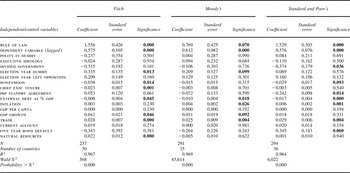
We report findings for twelve separate models, one for each of the three CRAs matched up with each of the four independent variables of interest in Tables 1, 2, 3, and 4.Footnote 77 The independent variable of interest in Table 1 is rule of law. We test this measure in conjunction with dependent variable ratings provided by Fitch, Moody's, and S&P along with the economic and political controls commonly applied in the literature. The results in Table 1 show rule of law is statistically significant for each of the rating agencies. In terms of substantive importance, regarding Fitch, we see a 15.4 percent (0.91 rating point) increase in rating if we increase rule of law by one standard deviation, an 8.4 percent (0.45) increase for Moody's, and 17.0 percent (0.91) for S&P. To clarify further the substantive importance of the results, a one standard deviation increase in rule of law for both Fitch and S&P would on its own move the rating of a country to almost the next highest level. For Moody's, it would move a country halfway to the next highest level.
Rule of law

Note: Bold entries indicate statistical significance of p < .1 or better in two-tailed test.
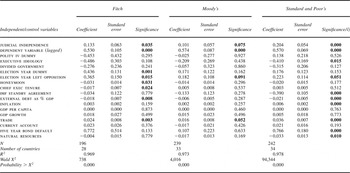
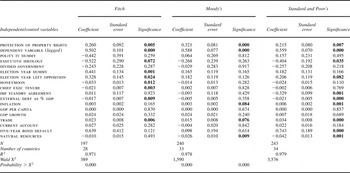
Table 2 contains the results of judicial independence on ratings from the three CRAs. The results in each case again are statistically significant. For substantive importance, a one standard deviation increase in judicial independence means a 4.0 percent (0.24 rating point) increase in rating by Fitch, 3.4 percent (0.18) by Moody's, and 6.9 percent (0.37) by S&P. While these numbers are much less than was the case with rule of law, they still show the importance of an independent court system in the overall makeup of bond ratings. In Table 3, we see that merely having an impartial court system does not in any statistically significant way affect ratings from any of the companies. Table 4 presents the results of property rights protection on ratings. As we see, protection of property rights is statistically significant for each CRA. Substantively, a one standard deviation increase in protection of property rights means a 5.6 percent (0.33) increase in a Fitch rating, 7.8 percent (0.42) in Moody's, and 5.2 percent (0.28) in S&P.
Judicial independence

Note: Bold entries indicate statistical significance of p < .1 or better in two-tailed test.
Impartial courts

Note: Bold entries indicate statistical significance of p < .1 or better in two-tailed test.
Protection of property rights

Note: Bold entries indicate statistical significance of p < .1 or better in two-tailed test.
Among the economic controls, in support of the literature, trade and external debt appear to be most critical and statistically significant in nearly all the models, with higher trade seen positively by bond raters while growing debt is perceived negatively. Inflation is also significant in several models but, surprisingly, it positively influences bond ratings. Among the political controls, few are consistently statistically significant. The election year dummy, which reflects the political business cycle, is significant in half the models. The honeymoon effect and chief executive tenure are significant and negative for all the Fitch models but generally not for Moody's or S&P. Interestingly, the democracy variable is not significant in any of the twelve models, confirming previous workFootnote 78 suggesting that the democratic advantage based on regime type appears to have little influence on bond ratings.
Conclusion
Previous empirical research on the effects of political institutions on CRA bond ratings has generally found that political variables have minimal impact compared to economic factors. However, missing from earlier work is the effect of institutional factors that tend to minimize investor risk, including adherence to the rule of law, strength, and independence of the judicial sector, and protection of property rights. The fact that bond raters in interviews and in written work assert that political risk influences their ratings—and in the case of Fitch and Moody's, analysts even mention that rule of law measures from the WGI are consulted—makes it even more important to assess the effects of political risk on bond ratings.
Our findings indicate that political risk factors strongly influence CRA ratings. Complementing political risk research on FDIFootnote 79 and building on political economy work,Footnote 80 these findings should send a clear message to developing countries of the profound benefits they might realize by reforming and strengthening judicial institutions and otherwise paying heed to the need for respecting the rule of law and protecting property rights. To accomplish change in political risk factors requires that elected leaders be convinced of the payoffs that can be achieved. We know from the judicial literature that survival-minded political leaders will delegate power to the courts for two reasons: independent courts, by protecting everybody's rights, can convince opposition parties to join or continue playing the democratic game rather than attempting to overthrow the existing regime by force; and courts can protect the rights of the current ruling party when they ultimately become the party in opposition.Footnote 81 To these two reasons we can now suggest a third. Economic success goes a long way toward continuing electoral success for those holding political office; economic failure can surely lead to electoral ruin. For developing countries in dire need of outside capital to achieve economic success, the benefit to political leaders derived from moving toward strong and independent courts, adherence to the rule of law, and protection of property rights seems altogether clear. But political leaders need to be convinced of this connection. In an interview conducted by one of the authors with Uruguay's ex-president Julio María Sanguinetti less than three years after he left officeFootnote 82 (who at the time was still influential in politics throughout South America), the former leader dismissed the connection between judicial strength and rule of law and the ability of a country to attract foreign capital. While he admitted that foreign holders of capital made such assertions, Sanguinetti said he strongly believed that such pronouncements were issued as a pretext to extract concessions out of prospective borrowers. Political leaders have to be convinced of the connection between political risk factors and their ability to obtain higher bond ratings before deciding to change things very much. The message for policymakers in the developing world is clear: developing countries need to respect rule of law and maintain political institutions conducive to stable democracies if they hope to attract future bondholders at relatively low capital costs.