Soccer is almost a religion in Spain. Most of the kids in the schools would like to play on their favorite teams someday. From the school playgrounds many children go to the local clubs, and from there some pass to the soccer academies of the Liga de Fútbol Profesional Clubs. Each step means less players competing and the journey is just beginning. Every year some of them will leave the elite academies to come back to local clubs or drop out and only a small proportion will go on to the next step. The last season in academies is vital and depending on the sporting performance during that season the players will have the opportunity of joining a professional team or they will go on to play for non-professional teams. The funnel is narrower every time and only some youngsters will arrive at the last step, becoming a professional in the Liga de Fútbol Profesional.
Soccer has its own exclusive dedication culture. Very few professional soccer players completed higher education or prepared themselves for an alternative professional career. This public image causes young players who advance in their careers to gradually focus mostly on sport, forgetting other aspects of their lives. This study is contextualized at the point in an individual player’s development immediately before the transition to professional soccer, and it explores the differences in passion, motivation, and the satisfaction of basic psychological needs of elite young soccer players, between those focused only on their sport achievements and those oriented to balancing their achievements in other life spheres such as education and private life.
Within the analytic sports career model developed by Stambulova (Reference Stambulova1994), the transition from junior-to-senior sports appears as one of the six normative transitions of an elite athletic career. According to Stambulova (Reference Stambulova1994, Reference Stambulova, Tsung-Min Hung, Lidor and Hackfort2009), the transition from junior-to-senior sports begins when individual sports athletes start to participate in the senior competitions in their sports and team sports players start to practice with a senior team and play for at least some time in senior games. Among the studies of career development, Stambulova (Reference Stambulova, Tsung-Min Hung, Lidor and Hackfort2009) highlighted that athletes generally describe the transition from junior-to-senior sport as the most difficult transition and many of them confess they failed in it, which suggests that the transition to professional level plays one of the most important roles in an athletic career.
Furthermore, the developmental model of transitions faced by athletes (Wylleman & Lavallee, Reference Wylleman, Lavallee and Weiss2004) shows the holistic lifespan perspective in career development and transition research in sport psychology. In this model, stages and normative transitions in four levels of athletes’ lifespan development, namely the athletic, psychological, psychosocial, and academic/vocational, are outlined and roughly aligned with chronological ages. This model provides a holistic view of athletes’ development, considering them not only as athletic performers, but also as people who engage in sports and in other things in life. As shown by this model, in the transition from the developmental to the mastery stage (analogous to the transition from junior-to-senior sports), apart from the athletic transition, young athletes should also face transitions on other levels (e.g., adolescence to young adulthood, secondary education to higher education), which implies additional difficulty to make the different life spheres of an athlete compatible.
In the literature on athletic careers searching for an optimal balance between sport and other life spheres is shown as a strategy in coping with the transition from junior-to-senior and professional sport (Chamorro, Torregrosa, Sánchez-Miguel, Sánchez-Oliva, & Amado, Reference Chamorro, Torregrosa, Sánchez-Miguel, Sánchez-Oliva and Amado2015; Chamorro, Torregrosa, Sánchez-Oliva, & Amado, Reference Chamorro, Torregrosa, Sánchez-Oliva and Amado2016; Stambulova, Franck, & Weibull, Reference Stambulova, Franck and Weibull2012; Torregrosa & González, Reference Torregrosa, González, Stambulova and Ryba2013). A study of 261 elite young athletes by Stambulova et al. (Reference Stambulova, Franck and Weibull2012) reported that they perceived all spheres of the athlete’s life (sporting, academic and private life) as moderately or very important; however according to Cosh and Tully (Reference Cosh and Tully2014) athletes frequently prioritize their athletic career at the expense of academic achievement. In line with these studies, this could be considered as two distinct profiles of young athletes, those who are focused only on their sporting achievements, and those oriented towards balancing sport with their achievements in other life spheres, such as education and private life. With regards to searching for an optimal balance between sport and other life spheres, Aquilina (Reference Aquilina2013) suggested that encouraging athletes to focus on aspects of life other than sport might ease tensions related to the pressure of competitive sport and those skills they learned in other life domains might transfer to the sporting life. This author also explained that the intellectual stimulation provided by, for example academic pursuits, could be valuable in coping with the physical challenges of sports training and competition. This line of argument can be extended to suggest that the importance athletes attach to achievements in other spheres of life might influence their sporting practice as well as their success in managing the transition from junior to senior competition.
It has been shown that passion is related to the ability to avoid conflict between the various spheres of life and manage one’s efforts across multiple domains (Bélanger, Lafrenière, Vallerand, & Kruglanski, Reference Bélanger, Lafrenière, Vallerand and Kruglanski2013). Vallerand et al. (Reference Vallerand, Blanchard, Mageau, Koestner, Ratelle, Léonard and Marsolais2003; Vallerand, Reference Vallerand2008) proposed a theory of passion concerned with the motivational processes underlying heavy and sustained involvement in particular activities. The Dualistic Model of Passion (DMP; Vallerand, Reference Vallerand2008; Reference Vallerand, Olson and Zanna2010; Vallerand et al., Reference Vallerand, Blanchard, Mageau, Koestner, Ratelle, Léonard and Marsolais2003) defines passion as “a strong inclination toward an activity that people like, that they find important, and in which they invest time and energy” (p. 757). Vallerand et al. (Reference Vallerand, Blanchard, Mageau, Koestner, Ratelle, Léonard and Marsolais2003) distinguished two types of passion –obsessive and harmonious- according to how the related activity was regulated and integrated with other life domains. Obsessive passion (OP) was defined as a strong and uncontrollable urge to partake in a given activity. In this type of passion, the process of internalization of the activity into the individual’s identity occurs in a controlled manner and originates in intrapersonal or interpersonal pressure, for example self-esteem or social acceptance, caused by contingencies associated with the activity. This kind of engagement leads to rigid (rather than flexible) involvement in the activity, and as consequence it becomes difficult to regulate the activity and integrate it with the other aspects of one’s life (Vallerand et al., Reference Vallerand, Blanchard, Mageau, Koestner, Ratelle, Léonard and Marsolais2003). Harmonious passion (HP) prompts a strong desire to engage in the activity, like OP; however HP is characterized by a strong desire, which is not driven by instrumental contingencies, to engage freely in the activity and so an activity pursued with HP is regarded as a significant but not overwhelming part of one’s identity. An individual who experiences HP remains in control of his or her involvement in the activity and decides freely whether to engage in it under particular circumstances. This sense of control means that HP activity is experienced as coherent and integrated with, rather than in conflict with, other life domains (Vallerand et al., Reference Vallerand, Blanchard, Mageau, Koestner, Ratelle, Léonard and Marsolais2003). The meta-analytical review of passion performed by Curran, Hill, Appleton, Vallerand, and Standage (Reference Curran, Hill, Appleton, Vallerand and Standage2015) shows studies in which HP and OP have both negatively and positively been related with activity/life conflict, respectively. However, when the HP effect in OP was controlled, the relationship between OP and activity/life conflict disappeared. These findings suggest that the relationship between OP and activity life/conflict is not sufficiently clear, and it may be necessary to explore this relationship further.
Moreover, the two types of passion vary in their influence on athletes’ wellbeing and performance. For example, HP has been found to be positively related to psychological wellbeing, whilst OP is reported to be either unrelated or negatively related to psychological wellbeing (Carpentier, Mageau, & Vallerand, Reference Carpentier, Mageau and Vallerand2012), physical health (Rip, Fortin, & Vallerand, Reference Rip, Fortin and Vallerand2006), maintenance and development of good relationships with other people involved in the activity about which the individual feels passionate (Philippe, Vallerand, Houlfort, Lavigne, & Donahue, Reference Philippe, Vallerand, Houlfort, Lavigne and Donahue2010), and performance of the target activity (Vallerand et al., Reference Vallerand, Ntoumanis, Philippe, Lavigne, Carbonneau, Bonneville and Maliha2008). Moreover, HP and OP were shown to be respectively negatively and positively related to rigid engagement in activity (Rip et al., Reference Rip, Fortin and Vallerand2006). Many of the same variables also influence the transition from junior to senior level in sport (see Ryba & Stambulova, Reference Ryba and Stambulova2013, for a review). Overall, these findings suggest that the two types of passion may play an important role in determining how passionate activity (soccer in this research) is regulated and integrated with other life domains (academic study and private life) and in the adaptation process involved in the junior-to-senior transition.
The DMP (Vallerand et al., Reference Vallerand, Blanchard, Mageau, Koestner, Ratelle, Léonard and Marsolais2003) posits a closed relationship with the Self-Determination Theory (SDT; Deci & Ryan, Reference Deci and Ryan1985; Ryan & Deci, Reference Ryan and Deci2000). SDT differentiates between autonomous or the more self-determined forms of motivation (i.e., intrinsic motivation, and integrated and identified regulation), controlled motivation or non-self-determined types of extrinsic motivation (i.e., introjected and external regulation), and amotivation. Deci and Ryan (Reference Deci and Ryan2008) argued that autonomous motivation is implicated in behavior which is completely voluntary and self-chosen (characteristic of HP), whereas controlled motivation represents commitment to an activity because of instrumental contingencies and external pressure and control (characteristic of OP). Autonomous motivation is related to passion, as both involve interest in, and liking for an activity, however Vallerand (Reference Vallerand, Olson and Zanna2010) pointed out two important differences: (a) autonomously motivated activities are typically not seen as being internalized in the person’s identity (Koestner & Losier, Reference Koestner, Losier, Deci and Ryan2002) and, (b) self-determined motivation leads only to adaptive outcomes (Deci & Ryan, Reference Deci and Ryan2000) whereas the duality of passion leads to both adaptive and maladaptive outcomes. Furthermore, controlled motivation does not entail performing the activity out of enjoyment but rather in order to obtain a reward external to the activity. The fundamental difference between controlled motivation and passion is the lack of a liking for the activity that is present with controlled motivation (Bélanger et al., Reference Bélanger, Lafrenière, Vallerand and Kruglanski2013). Finally, amotivation is defined as an absence of motivation.
Like SDT, DMP proposes that people engage in various activities throughout life in hope of satisfying the basic psychological needs for autonomy (the need to experience volition, self-direction and choice), competence (the need to feel a sense of efficacy), and relatedness (the need to feel loved, valued and connected with significant others). Ryan and Deci (Reference Ryan, Deci, Leary and Tangney2002) stated that the more individuals develop self-determined forms of regulation towards different activities, the more satisfied they feel, and the less likely they are to experience conflicts between those activities. Studies such as Boiché, Sarrazin, and Chanal (Reference Boiché, Sarrazin and Chanal2015), Boiché and Stephan (Reference Boiché and Stephan2014), Guzmán and Kingston (Reference Guzmán and Kingston2012) and Milyavskaya et al. (Reference Milyavskaya, Gingras, Mageau, Koestner, Gagnon, Fang and Boiché2009) support this hypothesis. However, studies such as Gillet, Lafrenière, Vallerand, Huart, and Fouquerau (Reference Gillet, Lafrenière, Vallerand, Huart and Fouquerau2014) and Koestner, Otis, Powers, Pelletier, and Gagnon (Reference Koestner, Otis, Powers, Pelletier and Gagnon2008) have concluded that the impact of goal motivation on goal progress is predominantly determined by autonomous, rather than controlled, motivation. In addition, none of these studies have dealt with the sporting domain in a competitive sporting context. For this reason, it may be useful to test the link between autonomous and controlled motivation, the satisfaction of basic psychological needs and the importance of achievements in different life domains among elite young athletes. Different types of motivation and basic psychological need have also been related with variables that influence the junior-to-senior transition process (Ryba & Stambulova, Reference Ryba and Stambulova2013). Autonomous motivation has been associated with persistence, positive affect, high performance and psychological wellbeing (Deci & Ryan, Reference Deci and Ryan2008), whereas controlled motivation and amotivation have been associated with negative affect and low performance (Gillet, Vallerand, Lafrenière, & Bureau, Reference Gillet, Berjot, Vallerand, Amoura and Rosnet2012). Environment can be a positive or negative influence on the junior-to-senior transition in professional sport (Chamorro et al., Reference Chamorro, Torregrosa, Sánchez-Miguel, Sánchez-Oliva and Amado2015; Chamorro et al., Reference Chamorro, Torregrosa, Sánchez-Oliva and Amado2016). Assessments of basic psychological needs provide information about athletes’ perceptions of their autonomy, competence and relatedness. An athlete’s psychological wellbeing is determined by the degree to which environmental factors (e.g., coaches’ and parents’ motivational style) and personal factors (e.g., goals and type of passion) satisfy or thwart these basic needs. Numerous studies showing a relationship between psychological needs satisfaction and indicators of positive adjustment in sport have corroborated this (see Ryan & Deci, Reference Ryan, Deci, Hagger and Chatzisarantis2007 for a review).
Based on the aforementioned literature, the first objective was to explore differences in how elite young Spanish soccer players value achievements in the various spheres of life (including sport, academic study and private life). According to the conclusions of Stambulova et al. (Reference Stambulova, Franck and Weibull2012) and Cosh and Tully (Reference Cosh and Tully2014), we expected to uncover at least two clusters: (a) a group of young athletes who were primarily interesting in achieving things in athletics and (b) a group of young athletes who wanted to be professional athletes, but also considered their academic education and private life important. The second objective was to explore between-cluster differences in passion, motivation and satisfaction of basic psychological needs. In line with DMP (Vallerand et al., Reference Vallerand, Blanchard, Mageau, Koestner, Ratelle, Léonard and Marsolais2003; Vallerand, Reference Vallerand, Olson and Zanna2010) we hypothesized that the group interested in achievement in multiple spheres would have higher levels of HP than the group primarily interested in sport achievement and, consequently, higher levels of autonomous motivation and satisfaction of basic psychological needs. Due to inconsistent findings concerning the relationships between OP, controlled motivation and achievement in different life spheres, we did not formulate a hypothesis concerning these relationships.
Method
Participants
Study participants were 478 young male elite soccer players (M age 17.42, SD = .705, Range = 15–19) of 27 academy teams of the highest Under-18 category in Spain, called División de Honor Juvenil. This category is divided in seven competition groups with 16 teams each classified regarding the geographical regions of Spain. The teams assessed in the study compete in six of the seven groups, excepting the Canary Island Group. This category is the last step before jumping to the professional soccer. All academy soccer teams belong to clubs compete or have competed in the First and Second Division of the Professional Soccer League in Spain (Liga de Fútbol Profesional), which was an essential criterion to be included in this study.
Measures
Importance of futures achievements in different life domains
To measure how important soccer players found future achievements in their sport, academic and private life spheres, the participants were asked: “How important is it for you, in the future, to achieve…” followed by a list of (a) becoming a professional soccer player, (b) getting a university education and (c) having a family (response scale: 1 = not at all important to 7 = very important). This list of items is similar to a scale used by Stambulova, Engström, Franck, Linnér, and Lindahl (Reference Stambulova, Engström, Franck, Linnér and Lindahl2015) in the measurement of importance of different aspects of studies, sport, and private life of the Dual Career Survey (DCS). The main difference between the two instruments is that in our study we asked about the future importance that athletes attribute to an achievement in different aspects of their life while Stambulova et al. (Reference Stambulova, Engström, Franck, Linnér and Lindahl2015) asked the athletes about the current importance they attribute to these spheres at the moment of assessment.
Passion for soccer
A Spanish version (Chamarro et al., Reference Chamarro, Penelo, Fornieles, Oberst, Vallerand and Fernández-Castro2015) of the Passion Scale (adapted for soccer; Marsh et al., Reference Marsh, Vallerand, Lafrenière, Parker, Morin, Carbonneau and Paquet2013), with six items measuring harmonious (HP; e.g., “soccer allows me to live a variety of experiences”) and six items measuring obsessive (OP; e.g., “I cannot live without soccer”) passion was applied to measure the athletes’ passion for soccer. In addition, at the end of the Passion Scale, four items were used to assess the passion criteria (Marsh et al., Reference Marsh, Vallerand, Lafrenière, Parker, Morin, Carbonneau and Paquet2013; Vallerand, Reference Vallerand, Olson and Zanna2010). In the present study, the alpha value for the passion criteria was .84. These items were used to differentiate between the non-passionate and the passionate athletes, regardless of their type of passion (i.e., harmonious vs. obsessive passion).
Motivation regulations
Behavior regulations were measured by the Spanish adaption (Viladrich, Torregrosa, & Cruz, Reference Viladrich, Torregrosa and Cruz2011) of the Behavioral Regulation in Sport Questionnaire (BRSQ) by Lonsdale, Hodge, and Rose (Reference Lonsdale, Hodge and Rose2008), designed to evaluate the motivation in practicing the sport from a SDT-perspective. Following the stem “I participate in soccer because…”, four items measured intrinsic motivation (i.e., because of the positive feelings that I experience while playing my sport), integrated regulation (i.e., because it’s an opportunity to just be who I am), identified regulation (i.e., because it is a good way to learn things which could be useful to me in my life), external regulations (i.e., to satisfy people who want me to play) introjected regulation (i.e., because I would feel guilty if I quit) and amotivation (i.e., but I question why I continue). Integrated regulation was not included in the analyses, as it is more often encountered among adults rather than adolescents, as younger populations may be too young to have experienced a sense of integration (Vallerand & Rousseau, Reference Vallerand, Rousseau, Singer, Hausenblas and Janelle2001). Consonant with SDT and the approach used in other SDT-based studies in sport and other physical activity settings (Fenton, Duda, Quested, & Barrett, Reference Fenton, Duda, Quested and Barrett2014), autonomous motivation (intrinsic motivation + identified regulation) and controlled motivation (introjected regulation + external regulation) variables were computed and used in subsequent analysis.
Basic psychological needs satisfaction
Satisfaction of basic psychological needs were measured using Spanish adaptations of the: (a) autonomy satisfaction scale by Standage, Duda, and Ntoumanis (Reference Standage, Duda and Ntoumanis2005; Alcaraz, Viladrich, & Torregrosa, 2012); (b) competence satisfaction by McAuley, Duncan, and Tammem (Reference McAuley, Duncan and Tammem1989; Balaguer, Castillo, & Duda, Reference Balaguer, Castillo and Duda2008); and (c) the relatedness satisfaction by Richer and Vallerand (Reference Richer and Vallerand1998; Balaguer et al., Reference Balaguer, Castillo and Duda2008). Following the stem “In soccer…” five items measured autonomy satisfaction (i.e., I can decide which activities I want to practice) and relatedness satisfaction (i.e., I feel understood) and six items measures competence satisfaction (i.e., I think I am pretty good at soccer). Previous research has used and has shown that these scales possess adequate internal structure and internal consistency (Alcaraz, Torregrosa, & Viladrich, Reference Alcaraz, Torregrosa and Viladrich2015; Standage et al., Reference Standage, Duda and Ntoumanis2005).
All instruments were assessed on a 7-point Likert scale (1 = Do not agree at all, 7 = Very strongly agree).
Procedures
First, ethical approval for the study was granted by the authors’ university ethics committee. At the beginning of the investigation, clubs were contacted by phone and the study and its objectives were explained. Once they agreed to participate, the dates were determined for the first author to travel to all clubs within a short period. All clubs were visited and surveyed within only one month. The measuring occurred towards the end of the season. With the permission of each youth academy manager and each coach, all participants attended and voluntarily participated in the study. They were informed about the objectives, were guaranteed anonymity and confidentiality and gave informed consent. All participants signed a consent form in which they were informed that they participated voluntarily and that their data was confidential.
Data analyses
Data were collected and entered into SPSS 17.0. Descriptive statistics (means, standard deviations and sample size) were determined for each measure and internal consistency was calculated for all scales. The relationship among types of passion, motivation and satisfaction of basic psychological needs were examined using Pearson correlation analysis.
A two-step cluster analysis procedure was used to classify participants according to the importance that they attributed to future achievement in the domains of sport, academic study and private life (Aldenderfer & Blashfield, Reference Aldenderfer and Blashfield1984). The analysis followed the recommendations of Clatworthy, Buick, Hankins, Weinman, and Horne (Reference Clatworthy, Buick, Hankins, Weinman and Horne2005). Firstly, we conducted a hierarchical cluster analysis. Ward’s method of linkage and a squared Euclidean distance measure were chosen to minimize the error sum of squares (ESS) within clusters and maximize the ESS between clusters. The agglomeration coefficients from the hierarchical analysis and dendrograms were used to identify the most appropriate cluster solution. The following additional criteria were also used to determine and validate the optimal cluster solution (Morizot & Le Blanc, Reference Morizot and Le Blanc2005). First, clusters should be distinct and theoretically meaningful. Second, the size of the explained ESS should exceed 50% of the explained variance and ideally be no less than 67%. Third, each cluster should contain at least 5% of the total sample.
When the final cluster solution was defined an iterative partitioning method (K-means) clustering was carried out to maximize within-cluster similarity and between-cluster differences. There was also a requirement that the final cluster solution should be internally robust. We examined the repeatability of the optimal solution by randomly selecting a subsample consisting of 50% of the original sample and repeating the analyses (Clatworthy et al., Reference Clatworthy, Buick, Hankins, Weinman and Horne2005). The stability of the cluster solution structure was then assessed by determining the concordance between the two solutions using Cramer’s V test. This test allows one to determine whether similar clusters are present regardless of the algorithm used to derive them (Rebetez, Rochat, & van der Linden, Reference Rebetez, Rochat and Van der Linden2015). The clusters in the final solution should also differ in the levels of variables used as indicators in the cluster analysis. A MANOVA was therefore used to examine whether significant differences existed between the cluster groups on their scores on the life spheres.
Finally, groups were then compared performing a one-way MANOVA (using Tukey HSD post hoc tests) to identify which clusters differed from each other in passion, types of motivation and satisfaction of basic psychological needs.
Results
Preliminary analysis and descriptive statistics
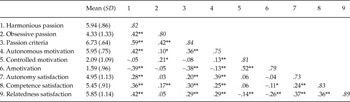
The means and the bivariate correlations of all variables are presented in Table 1. Participants reported high values in harmonious passion, autonomous motivation, competence and relatedness satisfaction. They reported moderated values in obsessive passion and autonomy satisfaction. They also reported low levels in controlled motivation and amotivation. Reliability analysis (Cronbach’s α) revealed that the measurement associated with the instrument used has adequate internal consistency. Also displayed in Table 1 are the bivariate correlations for each variable. The correlations were all in the expected directions.
Descriptive statistics, internal reliabilities and bivariate correlations of all study variables

Notes: The values on the diagonal represent Cronbach’s alpha coefficients. *p < .05, **p < .01.
Cluster analysis
First, scores of perceived importance of sport, academic and private life spheres were used as indicators in a hierarchical analysis. We used Ward’s method of linkage with the squared Euclidean distance as the similarity measure in order to determine the appropriate number of clusters. Inspection of the agglomeration coefficients from the hierarchical analysis and dendrograms suggested that a three-cluster solution was the most appropriate. Post hoc examination of the three-cluster solution suggested that it was theoretically sound and more parsimonious than two-, four- or more than four-cluster solutions. Furthermore, the three-cluster solution explained 53.17% of variance, whereas the two- and four-cluster solutions explained 41.13% and 59% of the variance respectively. In addition, all the clusters in the three-cluster solution contained at least 5% (or n = 24) of the total sample.
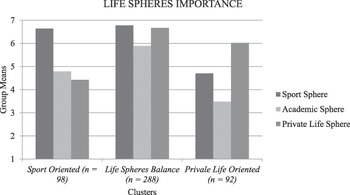
Next a cluster analysis of k-means with three clusters was carried out to determine the pattern of importance of the various life spheres for each cluster. The repeatability of the three-cluster solution was assessed by randomly selecting a subsample (n = 239) of the original sample and repeating all the analysis procedures. The results were consistent with the original solution (90% of the random subsample was placed in the same cluster as in the original three-cluster solution). The three-cluster solution was also supported by analyses indicating good agreement between Ward’s method and K-means clustering (Cramer’s V = .73, p < .001). In the next step, the characteristics of each group were described. The first group labeled Sport-Oriented (n = 98) is characterized by the fact that the members attributed much more importance to reach the professional level in soccer in comparison with achievements in their studies or private life (see Figure 1). The second group labeled Life Spheres Balance (n = 288) is characterized by the fact that its participants consider achievements in the three life spheres as equally important. The third group labeled as Private Life-Oriented (n = 91) is characterized by the fact that all participants consider more important in the future to have a family than getting achievements in the sports or academic sphere.
Results of k-means cluster analysis (N = 478).

Analyses of difference among the importance of the different life sphere across the clusters
A multivariate analysis of variance (MANOVA) was calculated to confirm significant differences existed between the cluster groups on their scores of future achievement importance on life spheres. Results of the post hoc tests (Tukey) to compare the groups are shown in Table 2. The Sport-Oriented group (M = 6.64, SD = .65, η2 = .55), F(2, 475) = 286.089, p < .001 and the Life Spheres Balance group (M = 6.78, SD = .48) shows significantly higher means in sport sphere than the Private Life-Oriented group (M = 4.70; SD = 1.29). However, there are not significant differences between the Sport-Oriented and Life Spheres Balance groups in sport sphere. The Life Spheres Balance group (M = 5.89, SD = 1.10, η2 = .34), F(2, 475) = 212.420, p < .001 shows significantly higher means in academic sphere than the Sport-Oriented group (M = 4.79, SD = 1.45) and the Private Life-Oriented group (M = 3.48; SD = 1.79). In academic sphere, Sport-Oriented and Private Life-Oriented groups show also significantly different means amongst them. The Life Spheres Balance group (M = 6.67, SD = .47, η2 = .56), F(2, 475) = 308.879, p < .001 shows significantly higher means in private life sphere than the Sport-Oriented group (M = 4.43, SD = 1.09) and the Private Life-Oriented group (M = 6.02; SD = 1.06). In private life sphere, Sport-Oriented and Private Life-Oriented groups show also significantly different means amongst them. In sum, the pattern of significant differences between cluster groups supports the interpretation of the three-cluster solution.
Means of life spheres importance across clusters

Note: For each variable different subscripts indicate significant differences at p < .05 on post hoc comparison using Tukey HS. Standard deviation values are presented in brackets.
Analysis of differences between groups of all variables of the study
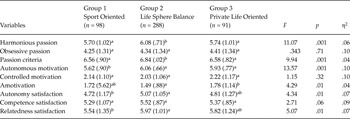
Table 3 shows the obtained results of the variance analysis (MANOVA) using the post hoc test Tukey to compare the groups. The Life Spheres Balance group (M = 6.08, SD = .71, η2 = .06), F(2, 475) = 9.990, p < .001, shows significantly higher means in harmonious passion in regards to the Sport-Oriented group (M = 5.70; SD = 1.02) and the Private Life-Oriented group (M = 5.74, SD = 1.01). The groups Life Spheres Balance (M = 6.06, SD = .66, η2 = .10) and Private Life-Oriented (M = 5.93, SD = .77), F(2, 475) = 13.597, p < .001 show significantly higher means in autonomous motivation than the Sport-Oriented group (M = 5.62, SD = .90). The Life Spheres Balance group (M = 1.49, SD = .88, η2 = .04) has lower means in amotivation that the Private Life-Oriented group (M = 1.78, SD = 1.14), F(2, 475) = 6.665, p = .001. The Life Spheres Balance group shows significantly higher means in autonomy satisfaction in comparison to the Sport-Oriented group (M = 5.07, SD = 1.05, η2 = .07; M = 4.72, SD = 1.17), F(2, 475) = 6.592, p = .006 and in relatedness satisfaction (M = 5.97, SD = 1.01, η2 = .07; M = 5.54, SD = 1.35), F(2, 475) = 5.603, p = .004. In obsessive passion, controlled motivation, and the satisfaction of the need for competence there were no significant differences found.
Means for the study variables as a function of clusters

Note: For each variable different subscripts indicate significant differences at p < .05 on post hoc comparison using Tukey HS. Standard deviation values are presented in brackets.
Discussion
The results of this study show that in young elite Spanish soccer players, a psychological profile characterized by giving importance to future achievements in sport, academic study, and individual private life is associated with a profile more adaptive according to passion, motivation, and satisfaction of basic psychological needs. As hypothesized, the cluster analysis suggested that in the same terms, the participants could also be classified into one group more: Sport-Oriented group. This classification is based on the three main life spheres perceived by athletes to be important during the transition to elite level (Stambulova et al., Reference Stambulova, Engström, Franck, Linnér and Lindahl2015) and it demonstrated clearly the dichotomy between young athletes who are only interested in athletic achievement, termed Sport-Oriented in this study, and those who want to be professional athletes but also consider academic study and private life important, termed the Life Spheres Balance group in this study. However, the cluster analysis also revealed a third group, whose existence we had not predicted. This group was not as interested in a professional career in soccer as the other two groups; instead members of this group considered the private sphere to be the most important life sphere. This group was labeled as the Private Life-Oriented group.
It should be emphasized that the most striking finding from the cluster analysis was the existence of an unanticipated cluster of participants, the Private Life-Oriented group. It seems unusual to find such a group in a high performance context, in which the main objective is to ensure that young soccer players achieve a professional standard. One explanation may have to do with the period in which the data were taken. Data for this study were collected in the last part of the season, during which it would be determined whether the participants would join a professional team the following year. At this point, many of the players know whether or not they will be playing as professionals the following season. Van den Auwalee, De Martelaer, Rzewnicki, De Knop, and Wylleman (Reference Van den Auweele, De Martelaer, Rzewnicki, De Knop, Wylleman and Van den Auweele2004) found that only 17% of 167 young Belgian athletes who competed in the national championships were involved in athletics at the elite level five years later. Finn and McKenna (Reference Finn and McKenna2010) commented that only 10% of English youth soccer players successfully make the transition from academy to first team. If the Private Life-Oriented group is made up of participants who realize that they will not be professional players the following season, this would explain why becoming a professional player was less important to them than to participants in the other groups. In any case, the participants in this group do not perceive becoming a professional in their passionate activity (i.e., soccer) as being as important as the other two groups. This fact could have different implications when comparing the three groups through the variables of passion, motivation, and satisfaction of BPN.
For two of the groups, the Sport-Oriented and Life Spheres Balance groups, becoming a professional in their passionate activity was the most important future achievement at the time we collected our data. Given the context and timing of data collection, this result was expected. However, whilst the Sport-Oriented group was only interested in achieving things in sport, the Life Spheres Balance group also attributed importance to achievements in education and private life. There were important differences between these two groups in terms of passion, motivation, and satisfaction of BPN. The Life Spheres Balance group had a significantly higher mean HP score than the Sport-Oriented group, which is consistent with the dualistic model of passion (Vallerand et al., Reference Vallerand, Blanchard, Mageau, Koestner, Ratelle, Léonard and Marsolais2003; Vallerand, Reference Vallerand, Olson and Zanna2010) and with the study by Vallerand, Ntoumanis et al. (Reference Vallerand, Ntoumanis, Philippe, Lavigne, Carbonneau, Bonneville and Maliha2008), which found that HP was inversely associated with the conflict between passionate activity, in this case soccer, and other aspects of the individual’s life, in this case academic study and private life. Furthermore, Bélanger et al. (Reference Bélanger, Lafrenière, Vallerand and Kruglanski2013) demonstrated that activities related to goal conflict (OPs) were consistently associated with the suppression of alternative goals, whereas activities not related to goal conflict (HPs) were not. This study suggests that in a high performance environment, higher levels of HP are also associated with placing greater value on alternative achievements, and that the integration of a core activity (soccer in this case) with other life domains (academic study and private life) has important consequences for how individuals address alternative considerations (Bélanger et al., Reference Bélanger, Lafrenière, Vallerand and Kruglanski2013).
The participants in the Life Spheres Balance group, similar to the Private Life-Oriented group, also had significantly higher autonomous motivation than the Sport-Oriented group. However, the reasons of these differences in autonomous motivation among Life Spheres Balance and Private-Life groups and Sport-Oriented group could be different. First, the Life Spheres Balance group has higher levels of HP than the Sport-Oriented group and, consequently and according to DMP and SDT, the Life Spheres Balance group has higher levels of autonomous motivation than the Sport-Oriented group. Second, as mentioned earlier, one of the main differences between the Private Life-Oriented group and the other two groups is that the participants in the Private Life-Oriented group do not perceive becoming a professional soccer player as being as important as the other participants perceive it. This could reduce pressure and concern about performance in participants in the Private Life-Oriented group and, consequently, they engage in their passionate activity with more pleasure and enjoyment (autonomous motivation) than the Sport-Oriented group.
Moreover, there are no differences between groups in OP and controlled motivation levels. Studies such as Gillet et al. (Reference Gillet, Lafrenière, Vallerand, Huart and Fouquerau2014) and Koestner et al. (Reference Koestner, Otis, Powers, Pelletier and Gagnon2008) have shown that controlled motivation is unrelated to goal progress and, probably, to the appreciation of future achievements in different life domains as well. Besides, while in some studies OP has been positively related with activity/life conflict, other studies have not found this relationship (Curran et al., Reference Curran, Hill, Appleton, Vallerand and Standage2015). However, this work assesses the importance that individuals place on future achievements in different spheres of life and not activity/life conflict. These facts could provide an explanation for the lack of difference in OP values across groups. In any case, the results of the present study suggest that, whilst self-determined behaviors are positively related with an appreciation of future achievements in highly competitive environments, controlled behaviors are unrelated.
With regard to the importance of passion for successfully making the transition to the professional level, studies have shown that high levels of HP are associated with high performance (Vallerand, Mageau et al., Reference Vallerand, Ntoumanis, Philippe, Lavigne, Carbonneau, Bonneville and Maliha2008), physical well-being (Rip et al., Reference Rip, Fortin and Vallerand2006), and therefore with a reduction in injuries that might interrupt athletic development, and also with psychological well-being (Carpentier et al., Reference Carpentier, Mageau and Vallerand2012). According to Vallerand (Reference Vallerand2012), people with HP for an activity have positive affective, cognitive, and behavioral experiences during and after involvement in it. This suggests that high levels of HP would help young athletes to cope on an athletic, psychological, and social level with the transition from junior to senior sport. However, Amiot, Vallerand, and Blanchard (Reference Amiot, Vallerand and Blanchard2006) found that among 233 adolescent hockey players, those who experienced the highest levels of psychological adjustment were either those who were obsessively passionate and who performed in a highly competitive environment, or those who were harmoniously passionate and performed in a less competitive environment. These findings suggest that in a highly competitive environment, OP could provide better psychological adjustment. Nevertheless, Amiot et al. (Reference Amiot, Vallerand and Blanchard2006) commented that the methodological design of their study could have influenced their findings. These authors hypothesized that harmoniously passionate individuals may become able to derive comparable levels of psychological adjustment in both highly and less competitive environments because of their greater level of flexibility. Furthermore, such flexibility may also help harmoniously passionate individuals learn to adapt to other competitive and/or demanding environments and to re-establish a balance between different activities in their lives. The findings of the present research support the view that in highly competitive environments, HP is also related to the flexibility required to realize future achievements, not only in their passionate activity (i.e., soccer) but also in alternative activities (i.e., academic and private life).
The participants in the Life Spheres Balance group also had significantly higher satisfaction of autonomy and relatedness than the Sport-Oriented group. Numerous studies have highlighted the importance of the environment in determining how well athletes cope during the transition from junior to professional level (Chamorro et al., Reference Chamorro, Torregrosa, Sánchez-Miguel, Sánchez-Oliva and Amado2015; Finn & McKenna, Reference Finn and McKenna2010; Stambulova et al., Reference Stambulova, Franck and Weibull2012). It seems that soccer players in the Life Spheres Balance group feel they have more autonomy and better connections with significant others than participants in the Sport-Oriented group, indicating that their environment better satisfies their basic psychological needs. Recent studies (Gillet, Berjot, Vallerand, Amoura, & Rosnet, Reference Gillet, Berjot, Vallerand, Amoura and Rosnet2012; Gillet, Vallerand, & Paty, Reference Gillet, Vallerand and Paty2013) have shown that both autonomous and controlled motivation are associated with high performance. The authors suggested that high controlled motivation might be beneficial to competitive performance if combined with high autonomous motivation and low amotivation (Gillet et al., Reference Gillet, Berjot, Vallerand, Amoura and Rosnet2012), as was the case with our Life Spheres Balance group. Stambulova et al. (Reference Stambulova, Franck and Weibull2012) reported that athletes cited the motivation to succeed in their chosen sport as one of the more important personal resources during the transition to elite level. Ryba and Stambulova (Reference Ryba and Stambulova2013) recommended including theoretical frameworks from other areas and disciplines in the transition research in sport psychology. This study contributes by drawing on SDT and DMP to describe the process of transition to elite level in sport.
This study shows that in a highly competitive environment, attributing importance to achievements in multiple life spheres is associated with a better adaptive motivational profile (in terms of motivation and passion). However, in the present study it could not be conclusively proved whether it is life sphere balance that causes a more adaptive motivational profile, or the other way around. The study by Belanger et al. (Reference Bélanger, Lafrenière, Vallerand and Kruglanski2013), carried out in a leisure context, suggests that the predictors of achievement in different life spheres could be the motivational variables. However, this limitation of the present work should be addressed in future studies. In any case, it seems that athletes who attribute importance to achievements in multiple life spheres may be better equipped psychologically to cope with the transition to elite or professional soccer. Like the participants in the study of Stambulova et al. (Reference Stambulova, Franck and Weibull2012), the young soccer players in our Life Spheres Balance group (three times more populous than the other two groups) perceived all the spheres of an athlete’s life (sport, academic study, and private life) as moderately or very important. However, in accordance with Cosh and Tully (Reference Cosh and Tully2014), although young athletes see themselves as being capable of achieving academically, they are often unable to achieve this in practice due to their sporting commitments. The transition from junior-to-senior, being a normative transition and therefore a transition that any athlete who wants to be a professional has to face, gives us the opportunity to prepare for and plan it. The results of this study could recommend institutions and sport clubs, as well as academic institutions, can find agreements that facilitate the implementation of EU Expert Group (2012), to help the athlete not only to develop on a personal and vocational level, but also provide internal resources that can be used and mobilized when they reach the transition process to professional sport.
This cross-sectional study of the transition allows us to see in which conditions they start the transition process to elite sport, regarding internal resources such as passion and motivation. Moreover, this work suggests that within the elite context there is a group of young athletes who neither prioritize reaching professional level nor value academic achievements, but keep performing nevertheless. Detecting which causes can influence this fact could be an objective of future research. On the other hand, future studies could focus on how different life spheres are perceived by girls with regard to this transition, or athletes in individual sports, as well as relate other internal or external resources that can mobilize athletes to balance different life spheres in the transition process to professional sport.
In conclusion, this study suggests that the perception that it is equally important to attain future achievements in different life spheres is related to being more resourceful regarding athletes’ internal resources, such as passion and motivation, which help to cope with the transition to elite/professional soccer. In addition, this study suggests two possible further conclusions: (a) controlling behaviors (OP and controlled motivation) exhibit no difference regarding an appreciation of future achievements in highly competitive environments, while self-determined behaviors (HP, autonomous motivation) and satisfaction of basic psychological needs do, and (b) athletes who seek a balanced life (i.e., to combine elite sport with educational achievement and a fulfilling private life) may be more likely to cope successfully with both the athletic transition and the educational transition. This idea breaks down a famous stereotype that to succeed in the transition to the elite sport level athletes must concentrate all their resources just around sport. This conception of the jump to the elite level comes closer to the holistic vision of the athlete during the athletic career proposed by Wylleman and Lavallee (Reference Wylleman, Lavallee and Weiss2004).
This research was in partly funded by The International Centre for Sport Studies (CIES) with the collaboration of the Fédération Internationale of Football Association (FIFA) within of the program Joao Havelange Research Scholarship 2013.