INTRODUCTION
The process of plant litter decomposition is essential for sustained plant growth in forested ecosystems. In particular, nutrients and carbon released from decaying leaves create available nutrient pools for plants, and allow soil organic matter (SOM) formation (Eijsackers & Zehnder Reference EIJSACKERS and ZEHNDER1990). Tropical rain forests generally exist on highly leached, nutrient-poor soils with relatively low SOM sinks, so the process of plant litter decomposition is paramount for continued plant and forest productivity (Swift et al. Reference SWIFT, HEAL and ANDERSON1979).
In Australian tropical rain forests the history of disturbance has varied from clear felling of what are now farming lands, to smaller-scale disturbances such as selective logging, in addition to natural disturbances (Hopkins Reference HOPKINS, Webb and Kikkawa1990). Selective logging was once widespread in north Queensland (Congdon & Herbohn Reference CONGDON and HERBOHN1993, Vanclay Reference VANCLAY1990), and created patches of secondary rain forest, with altered species compositions, partially removed and heavily compacted top soils, and altered nutrient cycles (Congdon & Herbohn Reference CONGDON and HERBOHN1993). Natural disturbance from fire is thought to have been an infrequent, but natural component of the northern Australian environment for millennia (Stocker & Mott Reference STOCKER, MOTT, Gill, Groves and Noble1981), and areas of rain forest often exist within broader communities of fire-tolerant, sclerophyllous, Eucalyptus-dominated forests (Bowman Reference BOWMAN2000). The current boundaries between the closed canopy of the rain forest, and the open, fire-affected expanses of Eucalyptus forests, are dynamic. Areas of transitional forest between the two biomes expand and contract, by the proliferation of rain-forest species in the understorey in the absence of burning, and by fire pushing the rain forest back. Rain-forest areas close to present-day sclerophyll forest boundaries are suggested to be generally only a few hundred years old (Hopkins et al. Reference HOPKINS, ASH, GRAHAM, HEAD and HEWETT1993).
In situ litter decomposition processes are controlled by a combination of climate, plant litter quality, soil composition and the decomposer community (Heal et al. Reference HEAL, ANDERSON, SWIFT, Cadisch and Giller1997, Lavelle et al. Reference LAVELLE, BLANCHART, MARTIN and MARTIN1993). Considering the key role that decomposition plays in the recovery of communities following disturbance (Anderson & Flanagan Reference ANDERSON, FLANAGAN, Coleman, Oades and Uehara1989), the lack of published research into this subject in the Australian wet tropics is notable. Only one decomposition study exists in the literature for the rain forests of north Queensland (Spain & Le Feuvre Reference SPAIN and LE FEUVRE1987); however, this work did not examine nutrient dynamics. It is largely unknown in this region the extent by which in situ leaf decomposition processes differ between primary rain forest, the adjoining eucalypt forests with histories of fire, and patches of rain forest affected by selective logging.
Species of Eucalyptus have historically been considered to produce litter that potentially breaks down slowly, due to poor litter quality and low nutrient concentrations (Adams & Attiwill Reference ADAMS and ATTIWILL1986, Wood Reference WOOD1974), although conflicting evidence exists as to whether or not this is commonly the case (Briones & Ineson Reference BRIONES and INESON1996, Guo & Sims Reference GUO and SIMS2001). Similarly, fast-growing tropical rain-forest pioneer and early secondary species may be disadvantaged by investing energy in secondary compounds and the production of recalcitrant leaves (Coley Reference COLEY1987, Coley et al. Reference COLEY, BRYANT and CHAPIN1985); however, both slower (Barlow et al. Reference BARLOW, GARDNER, FERREIRA and PERES2007, Mesquita et al. Reference MESQUITA, WORKMAN and NEELY1998, Vasconcelos & Laurance Reference VASCONCELOS and LAURANCE2005) and faster (Ewel Reference EWEL1976, Xuluc-Tolosa et al. Reference XULUC-TOLOSA, VESTER, RAMIREZ-MARCIAL, CASTELLANOS-ALBORES and LAWRENCE2003) decomposition rates have been demonstrated in pioneer species, when compared to later secondary species. The work here tests the hypothesis that decomposition rates in the rain forests of north Queensland vary, from slowest to fastest, in the order of: eucalypt litter > primary rain-forest litter > pioneer litter. Discrepancies may be due to poor quality litter and more extreme environmental conditions in the eucalypt forest, and the production of higher quality litter by pioneer species in selectively logged rain forest, when compared to primary rain forest.
MATERIALS AND METHODS
Study sites
This study was conducted in the Mt Spec section of the Paluma Range National Park, part of the Wet Tropics World Heritage area, located approximately 80 km north of Townsville, north Queensland. The climate is tropical, and rainfall is highly seasonal, with generally 85% occurring between the months October to May (Congdon & Herbohn Reference CONGDON and HERBOHN1993). The area is situated at around 875 m asl, on granite-derived soils that are generally oligotrophic (Maycock Reference MAYCOCK1997, Saker et al. Reference SAKER, CONGDON and MAYCOCK1999). Areas of rain forest are characterized by a dense fine-root mat on the soil surface (Maycock & Congdon Reference MAYCOCK and CONGDON2000).
Sites consisted of two rain-forest sites, situated in the upper catchment of Birthday Creek, off the Mt Spec Forestry Road (secondary rain-forest site: 18°59′42.66″S; 146°10′46.41″E and undisturbed rain-forest site: 18°59′32.07″S; 146°09′34.21″E). These plots have been the subjects of a series of nutrient-cycling studies over the past 20 y, quantifying litterfall (Herbohn & Congdon Reference HERBOHN and CONGDON1993, Reference HERBOHN and CONGDON1998), throughfall and stemflow (R. Congdon, unpubl. data), soil fertility (Saker et al. Reference SAKER, CONGDON and MAYCOCK1999) and fine-root dynamics (Maycock & Congdon Reference MAYCOCK and CONGDON2000).
Detailed site descriptions of the secondary rain-forest and undisturbed rain-forest sites are presented in Congdon & Herbohn (Reference CONGDON and HERBOHN1993) where they are referred to as ‘the Gap’ and ‘Cassowary Rd’ sites respectively. Both sites are classified as Simple Notophyll Vine Forest (Tracey Reference TRACEY1982). The secondary rain-forest site was disturbed by the felling of a large tree more than 37 y ago, and consists of a canopy dominated by the pioneer species Alphitonia petriei Braid & C.T. White ex Braid. This species is a dominant component of secondary rain forest in north Queensland (Hyland & Whiffen Reference HYLAND and WHIFFEN1993). The secondary rain-forest site has lower SOM in the topsoil, lower cation exchange capacities, total N, and available P, than the undisturbed rain-forest site (Congdon & Herbohn Reference CONGDON and HERBOHN1993). The undisturbed rain-forest site is characteristic of well-developed rain forest in the area. This site is located within a 180-m2 plot, within which at least four tree species make up more than 4% of the total basal area respectively. The secondary rain-forest site is within a 150-m2 study plot, where A. petriei individuals make up 80% of the basal area (Congdon & Herbohn Reference CONGDON and HERBOHN1993).
The third study site is located approximately 3.5 km to the west (19°01′12.02″S; 146°10′46.41″E), and is classified as Tall Open Forest (TOF) (Specht Reference SPECHT and Leeper1970). This site consists of a 150-m2 study plot, which is dominated by Eucalyptus grandis W. Hill, making up 50% of the basal area, and 74% of the annual litter standing crop (R. Congdon, unpubl. data). Other common tree species at the TOF site are Allocasuarina torulosa (Aiton) L. A. S. Johnson, Corymbia clarksoniana (D. J. Carr & S. G. M. Carr) K. D. Hill & L. A. S. (both 20% of the basal area respectively) and Syncarpia glomulifera (Sm.) Nied. (11% of the basal area). The maximum tree height is greatest at the TOF site, with an E. grandis individual reaching 41 m. At the undisturbed and secondary rain-forest sites, the largest trees when last surveyed were 37 m (2001) and 27 m (1993) tall, respectively. The undisturbed rain forest, disturbed rain forest and TOF sites have total basal areas of 129 m2 ha−1, 43 m2 ha−1 and 70 m2 ha−1.
The soils at the two rain-forest sites are red, melacic Kandosols using the classification of Isbell (Reference ISBELL1996), and type Gn2.14 after Northcote (Reference NORTHCOTE1971). The soils at the TOF site are Chromosols (Isbell Reference ISBELL1996), type Dy5.11 (Northcote Reference NORTHCOTE1971), characterised as having a sharp change from the A horizon, into a clayey subsoil. These soils contain significantly lower total N concentrations in the top and subsoil than both of the rainforest sites (S. Parsons, unpubl. data).
Litter collection
Litter was collected between early September and late October 2003. Mesh sheets in excess of 2 × 3 m were hung between trees, to catch freshly fallen litter. At the secondary rain-forest site, traps were strategically placed to catch A. petriei leaf litter. At the undisturbed rain-forest site, traps were placed under the canopy to catch later secondary/primary species. At the TOF site, E. grandis was targeted. This approach was employed to allow for the greatest amount of litter to be collected within the shortest amount of time, particularly targeting the species of interest. The traps were emptied weekly, in order to limit nutrient leaching and decomposition before collection. Only naturally senesced leaves were kept for use in the decomposition experiments, and for chemical analysis. In addition, leaves that showed signs of decomposition, such as discolouration due to leaching or microbial attack, were discarded.
Climatic data
Three rainfall gauges were placed at each site, consisting of 5-L plastic bottles with funnels attached. The gauges were placed in random positions at the plots, in order to account for variability in throughfall under the canopy. Maximum and minimum thermometers were placed in the shade at each site. These were checked and reset at each litterbag collection time.
Field experiment
In situ leaf decomposition was studied using the litterbag technique (Bocock & Gilbert Reference BOCOCK and GILBERT1957). The litterbags were made from nylon shade cloth of 2-mm mesh. These were stapled together, with gaps of 3 cm left around the edges, to permit access of litter fauna, and were 15 × 15 cm.
Litterbags of A. petriei were placed at the secondary rain-forest site, and E. grandis at the TOF site. At the undisturbed rain-forest site, a mix of primary rain-forest species collected in situ were placed in the bags, in an approximate proportion relative to their contribution to the litterfall into the traps at the time of collection. The relative proportions of each species placed into each bag were: Cardwellia sublimis F. Muell. (20%); Syzygium johnsonii (F.Muell.) B.Hyland (20%); Flindersia brayleyana F.Muell. (10%); Litsea leefeana (F.Muell.) Merr. (10%); Brackenridgea australiana F.Muell. (10%); Symplocos cochinchinensis (Lour.) S.Moore (10%); Cryptocarya leucophylla B.Hyland (10%); Waterhousea unipunctata B.Hyland (5%); and Syzygium endophloium B.Hyland (5%). These species are all characteristic of well-developed rain forests of the region (Hyland & Whiffen Reference HYLAND and WHIFFEN1993).
Leaves were air-dried before 5 g were placed in each litterbag. This amount was chosen as it reflected the amount of leaf material available, and is near the median standing crop of leaf litter of the species at the three sites early in the wet season (R. Congdon, unpubl. data). The initial nutrient and fibre concentrations were determined from four additional 5-g samples that were made up for each litter type and kept aside. On 26 November 2003, the litterbags were placed on the mineral soil surface at each of the sites (i.e. the litter layer was removed from under the bags). This approach enabled the surface to be homogeneous for all samples. The bags were secured in place with paper clips and nylon cord. The deployment of bags at the sites included 50 litterbags, containing A. petriei leaf litter at the secondary rain-forest site, E. grandis leaf litter at the TOF site, and mixed primary rain-forest leaf litter in the undisturbed rain forest. Bags were numbered and removed according to computer-generated random numbers, after 14, 35, 56, 84, 107, 158, 216, 269, 398 and 511 d. For all collections made up until the seventh collection date, four bags of each litter type were removed for weighing and nutrient analysis. The number of replicates was increased to six litterbags for the eighth and ninth collection, and to ten litterbags for the final collection.
Chemical analysis
Following removal from the field, all samples were dried at 60 °C until constant weight was achieved. The contents of the litterbags were then gently brushed clean, and weighed. Samples were ground to pass through a 1-mm screen, using an electric hammer mill (Model 4, A.H. Thomas Company, Philadelphia, USA). Loss on ignition was determined for all samples, by igniting them at 600 °C for 2 h (Anderson & Ingram Reference ANDERSON and INGRAM1989), to determine ash-free dry weights, and to account for inaccuracies caused by any attached soil. Initial samples of all the litter types obtained from the collection traps, and the contents of the litterbags following incubation in the field, were analysed for their chemical compositions.
Total nitrogen and phosphorus, calcium, magnesium and potassium concentrations were determined following digestion in a sulphuric acid/peroxide and Se catalyst solution, as described by Anderson & Ingram (Reference ANDERSON and INGRAM1989). Nitrogen was determined by the colorimetric salicylate-hypochlorite method of Baethgen & Alley (Reference BAETHGEN and ALLEY1989), and phosphorus by an adaptation of the single solution method of Murphy & Riley (Reference MURPHY and RILEY1962) (Anderson & Ingram Reference ANDERSON and INGRAM1989). Atomic absorption spectrophotometry was used to determine potassium, calcium and magnesium concentrations (Anderson & Ingram Reference ANDERSON and INGRAM1989).
The initial subsamples of the litters were also analysed for Acid Detergent Fibre (ADF-lignocellulose fraction), lignin and α-cellulose concentrations, by the method of Van Soest (Reference VAN SOEST1963), as described by Rowland & Roberts (Reference ROWLAND and ROBERTS1994). Samples were refluxed for 1 h in a sulphuric acid/cetyl-trimethylammonium bromide solution, where the ADF fraction is the portion remaining. The ADF portion was then soaked in 72% w/v H2SO4, which removed all α-cellulose. Lignin was determined as the portion lost on ignition at 550 °C for 2 h.
Statistical analysis
Results were expressed as percentage of original dry mass or nutrient concentration to enable comparisons between different species and sites (Wieder & Lang Reference WIEDER and LANG1982). ANOVA was used to test the significance of differences in loss of mass and nutrient concentration of the litter samples. One-way ANOVA and the Kruskal–Wallis test (when homogeneity was not met), were used to test for differences in the initial nutrient and fibre concentrations, in addition to the mass and nutrients remaining at particular time periods. To compare the mass and nutrient loss dynamics of the E. grandis, A. petriei and the mixed primary rain-forest litters, factorial ANOVA was tested, with litter type and time as the factors, and per cent dry mass, or nutrient concentration remaining as the dependent variables (Wieder & Lang Reference WIEDER and LANG1982). Heterogeneity of variance was evident during at least one time period for every variable, so arcsine-transformations were undertaken (Sokal & Rohlf Reference SOKAL and ROHLF1995). This did not remedy such problems; thus, multifactorial ANOVA was not possible. Comparisons of nutrient concentrations were only undertaken using one-way ANOVA when variances were homogeneous, and the Kruskal–Wallis test when variances were heterogeneous, to compare data at particular sampling dates. In all cases, the Tukey HSD was used for post hoc multiple comparisons (Salamanca et al. Reference SALAMANCA, KANEKO and KATAGIRI2003), and Mann–Whitney U-test for comparisons of heterogenic subsets (Sokal & Rohlf Reference SOKAL and ROHLF1995).
Regression models were fitted to the mass loss data. Best fit was tested using three of the models most commonly applied to decomposition data: the linear model (y =at + b), single exponential model (y = Ae −kt), and double exponential model (y = Be−ct + De−ft), where y is the weight remaining at time t, and the other values are constants (Wieder & Lang Reference WIEDER and LANG1982). Adjusted r 2 was used to determine the goodness of fit of data to the models (Ekbohm & Rydin Reference EKBOHM and RYDIN1990).
Stepwise multiple linear regression analysis was used to determine which of the common litter quality variables had the most significant effect on the amount of dry mass remaining after 107, 365 (obtained from regression analysis) and 511 d for pooled data of litter types and sites. Results were assessed as Pearson correlation coefficients and the significance of fit.
All statistical and multiple regression analysis was undertaken using SPSS v11.0 for Windows. Models were fitted to the mass loss data using SigmaPlot, v8.0, which also provided probabilities of each fit.
RESULTS
Climatic data
Over the 511 d of sampling the mean maximum and minimum temperatures between litterbag collection times at the two rain-forest sites ranged from 24.4 °C to 12.8 °C in the secondary rain forest and 24.2 °C to 12.7 °C in the undisturbed rain forest. The mean minimum temperature at the TOF site was 12.4 °C, which had the highest individual maximum temperatures of 43.0 °C, both in December 2003 and January 2004, and a mean maximum temperature of 28.5 °C. The undisturbed rain-forest site had the lowest recorded minimum temperature of 3.0 °C in August 2004, which was generally the coldest time of the year at all three sites.
Substantial rainfall events associated with tropical lows occurred in February 2004 and January 2005, affecting all sites. At the secondary rain-forest and undisturbed rain-forest sites respectively, 3014 mm and 2760 mm of rain fell over the 511 d of sampling. Less rain fell at the undisturbed rain-forest site between August and September 2004 (dry season), when compared to the secondary rain forest (269 mm and 169 mm respectively). The TOF site received 2013 mm of rain over the sampling period.
Initial nutrient concentrations and litter quality
The litter of A. petriei had the highest initial total N concentration (Table 1), followed by the mixed primary rain-forest litter and E. grandis. The mixed primary rain-forest litter had a higher initial total P concentration than the other two litter types, which did not differ significantly. Eucalyptus grandis had the lowest initial K concentration; while there was no significant difference between the K concentration of A. petriei and the mixed primary rain-forest litters. Alphitonia petriei had the lowest initial Ca concentration, followed by E. grandis, and the mixed primary rain-forest litter. There was no significant difference between the initial Mg concentration of A. petriei and E. grandis. The mixed primary rain-forest litter had the highest initial Mg concentration.
Initial nutrient and fibre concentrations (per unit dry mass) of the three litter types studied. Mean ± 1SE from four samples are shown. Significance of differences from one-way ANOVA are shown, along with Tukey HSD multiple comparisons test where means in a column followed by the same letter are not significantly different (P > 0.05).

All three litter types differed significantly in terms of their initial ADF and lignin concentrations (Table 1). Alphitonia petriei had the highest concentrations, followed by the mixed primary rain-forest litter, and E. grandis. In terms of α-cellulose, there was no significant difference between E. grandis and A. petriei. The mixed primary rain-forest litter contained the most α-cellulose of the three litters.
Mass loss
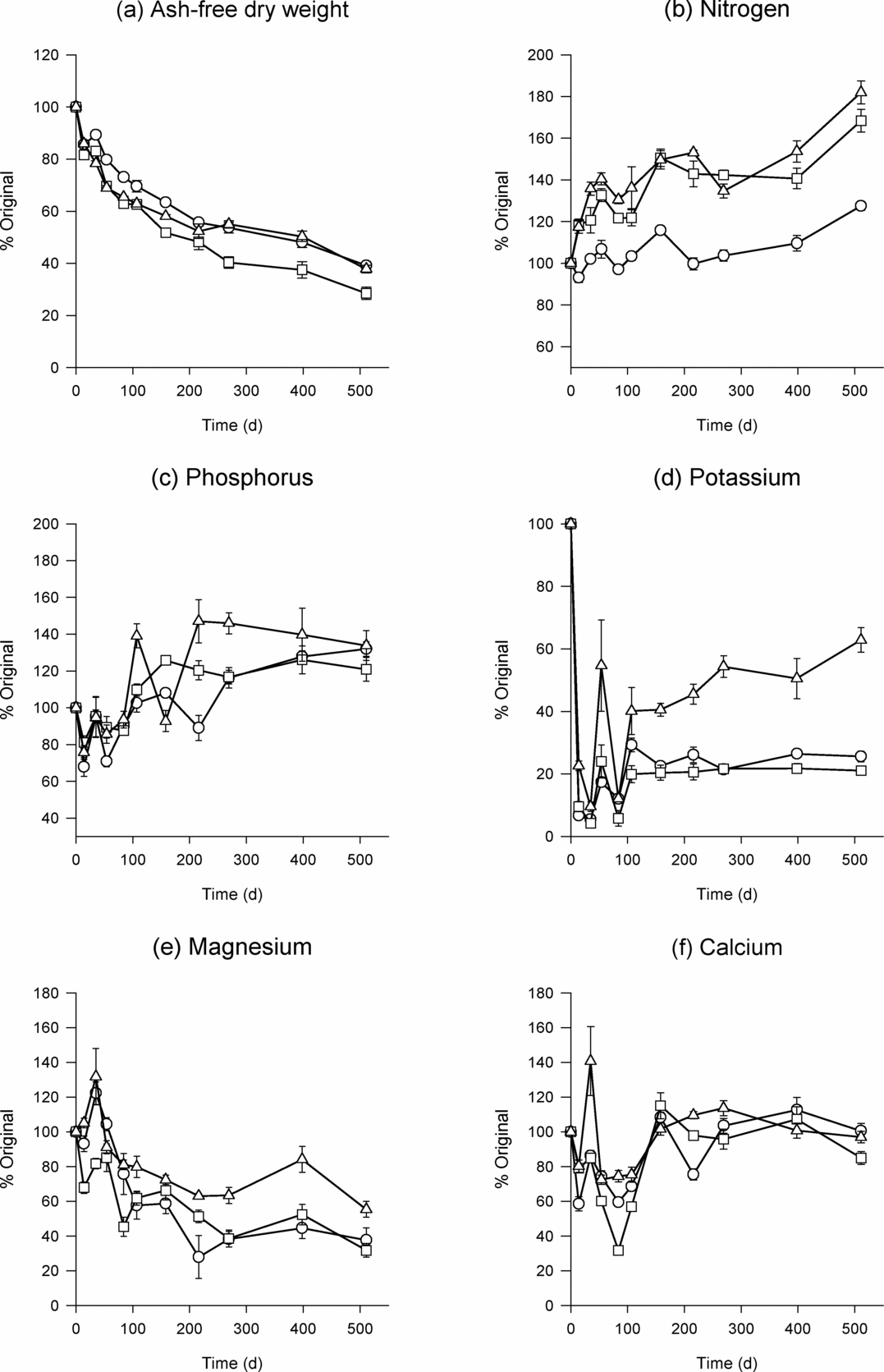
The litterbags became incorporated into the litter layer by the second collection time, and by the end of sampling the bags were generally completely covered with litterfall that had occurred over the study period. Due to significant contamination with soil, particularly for the final three collections, all mass loss results referred to are ash-free dry weights (Figure 1a). Contamination-free ash contents were within the range of 3–4% for all of the three litters. Alphitonia petriei at the secondary rain-forest site and E. grandis at the TOF site both equally lost the least amount of mass after 511 d (39% and 38% remaining respectively). The mixed primary rain-forest litter lost the most mass by the final collection, with 29% remaining (Tukey HSD, F2,27 = 11.6, P < 0.001). In all litter types, the most mass loss over the entire experiment occurred in the first 14 d.
Changes in the ash-free dry weight (a); total nitrogen (b); total phosphorus (c); potassium (d); magnesium (e); and calcium (f) concentrations of leaf litters exposed at three sites in the Paluma Range National Park. ◯ = Alphitonia petriei in secondary rain forest; □ = Mixed primary rain-forest species in undisturbed rain forest; △ = Eucalyptus grandis in tall open forest. Error bars represent ± 1SE from four litterbags collected after 14, 35, 54, 84, 107, 158 and 216 d, six litterbags after 269 and 398 d, and ten litterbags after 511 d.

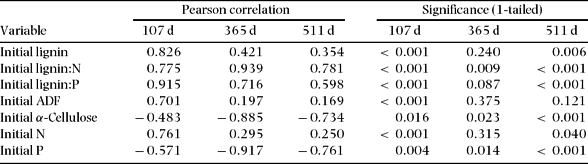
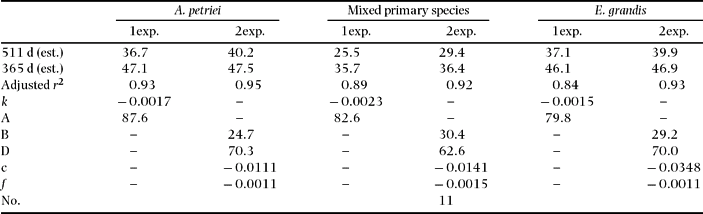
Of the three models tested to explain the mass loss data, the single and double exponential models provided the best fits (adjusted r2 > 0.84, P < 0.001 in all cases) (Table 2). For the single exponential model the rates of change over the course of the experiment were lowest in E. grandis, and A. petriei, compared to the mixed primary rain-forest litter. However, considering the low intercept (A) values (i.e. < 100%) and adjusted r2 values compared to the double exponential curves, this model was insufficient in explaining the data. The double exponential model provided a better fit, with r2 values greater than 0.92 for all three litters, and intercepts approaching 100% (B + D, Table 2). The intercepts and their corresponding slopes explain the size of the labile (A) and recalcitrant (B) fractions of the litter, and their relative decomposition rates (c and f, respectively) (Wieder & Lang Reference WIEDER and LANG1982). Of the labile fractions, this component seemed to disappear the fastest in the E. grandis litter, followed by the mixed primary species litter, and slowest in A. petriei. Additionally, the size of this fraction explained by the model was smaller in A. petriei, compared to the other two litter types. The mixed primary species litter showed the fastest loss of the recalcitrant fraction by the end of sampling, with a greater slope (f) compared to both A. petriei and E. grandis. The size of the recalcitrant fraction (intercept D) explained by the model was also smaller in the mixed primary species litter compared to the other two litter types.
Summary of the results from regression analysis on the ash-free dry weight loss (y), inside litterbags containing three litter types: Alphitonia petriei in secondary rain forest; mixed primary rain-forest species in undisturbed rain forest and Eucalyptus grandis in tall open forest. Actual experimentally determined % remaining after 511 d ± 1 SE were 39.2 ± 3.1%, 28.5 ± 7.5% and 37.8 ± 4.7% respectively. Components of the single exponential model (1exp.: y = Ae−kt) and double exponential model (2exp.: y = Be −ct + De −ft) are shown, along with the estimated % remaining after 365 d and 511 d, and adjusted r 2, as determined by each model. All models provided significant fits (P < 0.001).
Nutrients
Immobilization of N and P was evident in all litters to the final sampling date (Figure 1b, c). No litter type showed significant decreases from their initial total N concentration over the 511 d of exposure (ANOVA, n = 11 respectively, P < 0.001), aside from in the first 14 d for A. petriei, when a slight fall or leaching stage occurred (ANOVA, F1,6 = 3.7, P = 0.01). Some early leaching was seen in the P dynamics of the litters. These early losses had similar effects on the P concentration of each of the three litter types, with no significant difference between the amounts of the original concentration lost in this time period for each of the litters (ANOVA, F2,9 = 3.7, P = 0.135). A steady increase in the total N concentrations of the E. grandis and mixed primary rain-forest litters occurred over the course of the study, with both showing similar dynamics. At the end of sampling there was no significant difference between the per cent remaining of total N for the E. grandis at the TOF site, and the mixed primary rain-forest litter at the undisturbed rain forest (182% remaining and 168% remaining respectively, Tukey HSD, F2,27 = 37.6, P = 0.113). The A. petriei litter at the secondary rain-forest site showed the least changes from the initial N concentration of the three after 511 d (127% remaining). After 511 d there was no significant difference in the change in total P between the three litter types (132%, 121% and 134% remaining respectively, Kruskal–Wallis test, df = 2, n = 30, P = 0.242).
Almost all K was lost from all litter types in the first 14 to 35 d of exposure (Figure 1d). Increases in K concentrations were seen following this, particularly in the E. grandis litter at the TOF site, which showed the greatest increase after this time period, with 63% remaining after 511 d (Tukey HSD, F2,27 = 76.6, P < 0.001), compared to 26% and 21% in the A. petriei and mixed primary rain-forest species, where no difference was evident (Tukey HSD, P = 0.450). Patterns of change in Mg were generally similar to that of mass loss for the three litter types (Figure 1e). Over the study period significantly less of the original Mg concentration was lost from the E. grandis litter than the other two litter types (Tukey HSD, F2.27 = 5.20, P > 0.05). In terms of Ca, the general trend for the three litters was a short initial leaching phase, followed by variable patterns in the middle of the experiment, and flattening off of the curves towards the end (Figure 1f). For E. grandis, a peak in Ca concentration was seen after 35 d (141% remaining), a pattern that was not seen at either of the rain-forest sites.
Litter quality effects on weight loss
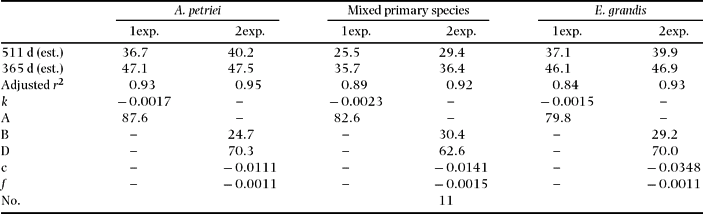
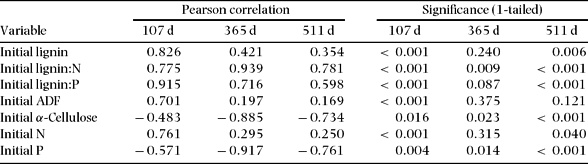
The results of stepwise linear regression for the effect of seven common initial litter quality variables (lignin, lignin:N, lignin:P, ADF, α-cellulose, N and P) on weight loss are shown in Table 3. For the mass remaining after 107 d, all variables were removed except the initial lignin:P, which produced the best fit, with an adjusted r2 of 0.83. For the amount of mass remaining after 365 d (obtained from regression analysis, Table 3), the initial lignin:N ratio of the litters produced the best correlation (adjusted r2 = 0.84). Similarly, for the weight remaining after 511 d, the most significant fit was obtained for the initial lignin:N ratio (adjusted r2 = 0.60).
Results of stepwise multiple linear regression analysis for the initial litter quality on the amount of dry weight remaining after 107, 365 (calculated from regression analysis using the double exponential model), and 511 d. Data were pooled for all sites (n = 32 for 107 d, n = 5 for 365 d and n = 50 for 511 d). Stepwise regression removed all variables except: 107 days, lignin: P (adjusted r 2 = 0.83); 365 days, lignin: N (adjusted r 2 = 0.84); 511 days, lignin: N (adjusted r 2 = 0.60).
DISCUSSION
In this study it was found that the in situ decomposition of leaf litter characteristic of three successional stages of forest in north Queensland occurred, from slowest to fastest, in the order: selectively logged secondary rain-forest (A. petriei) = tall-open forest with a history of fire (E. grandis) > undisturbed primary rain forest (mixed rain-forest species).The slow decomposition in the pioneer species is similar to what has been observed in other tropical forests, particularly in the New World (Barlow et al. Reference BARLOW, GARDNER, FERREIRA and PERES2007, Mesquita et al. Reference MESQUITA, WORKMAN and NEELY1998), and adds evidence contrary to the premise that pioneer species may be disadvantaged in producing leaves of low quality. In addition to the high fibre concentrations of Alphitonia petriei observed in this study, this species is known to contain saponins and other phytotoxins in its biomass (Talley et al. Reference TALLEY, SETZER and JACKES1996), placing further impediments on its decomposition rate by limiting microbial growth. The lasting effects of disturbance at the secondary rain-forest site are primarily altered soil properties and species compositions, with no differences in the total quantity of litterfall between this site and the undisturbed rain-forest site (Herbohn & Congdon Reference HERBOHN and CONGDON1993). The lower decomposition rate of the dominant pioneer species in the area suggests some of the possible causes of the differing soil properties. This species is the major component of the litterfall at the site (Herbohn & Congdon Reference HERBOHN and CONGDON1993), and therefore, makes up the bulk of carbon and nutrients returned to soils through decomposition. Limited decomposition rates slow the replenishment of SOM and nutrients (Lavelle et al. Reference LAVELLE, BLANCHART, MARTIN and MARTIN1993, Swift & Anderson Reference SWIFT, ANDERSON, Lieth and Werger1989). The bulk of litter produced at the secondary rain-forest site is of especially poor quality for soils lacking N and particularly available P. The litter of A. petriei contains a high lignin:P ratio, in an environment where P is exceedingly limiting (Saker et al. Reference SAKER, CONGDON and MAYCOCK1999), in addition to being fundamentally important to the organisms breaking down the litter. The low litter quality of this species appears to make its dominance more of a hindrance to natural regeneration and replenishment of favourable soil characteristics, even nearly 40 y after disturbance.
The similar comparatively rapid rates of change in mass between the mixed primary rain forest and E. grandis litter seen in the early stages and final stages (wet season) of the experiment, and the slowing of mass loss of the latter during the middle to late stages, can be attributed to lower water availability at the TOF site during the dry season (middle stage of the study). The faster overall decomposition of the mixed primary rain-forest leaf litter can be considered to be due to a combination of increased severity of dry-season effects in the TOF (i.e. decreased humidity, increased light intensity to the forest floor/drying out of the litter layer and lower rainfall), and differences in soil biota including the presence of fine roots in the rain forest. Litter quality was likely to be of secondary importance, as the litter of E. grandis was of higher quality than the mixed rain-forest species. Environmental factors such as these may be important determinants of the slow decomposition rates observed in other studies of eucalypt litters, in addition to differences in litter quality occurring within the genus (Adams & Attiwill Reference ADAMS and ATTIWILL1986, Guo & Sims Reference GUO and SIMS2001).
Decomposition rate constants are generally calculated from per cent loss per year data, in order for comparisons to be made between studies that ran for differing time periods (Anderson & Swift Reference ANDERSON, SWIFT, Sutton, Whitmore and Chadwick1983). As this study ran for over 12 mo, these comparisons can be made directly from the data; however, because a collection was not made exactly at 365 d, values need to be interpolated from regression analysis. Additionally, rate constants obtained from single exponential models do not always provide adequate explanations of decomposition (Ezcurra & Becerra Reference EZCURRA and BECERRA1987, Wieder & Lang Reference WIEDER and LANG1982). This was seen in this study, when compared with the double exponential model, which is considered to be more biologically correct, explaining that the recalcitrant and labile components of leaves have separate decomposition rates (Wieder & Lang Reference WIEDER and LANG1982). However, due to the significant contamination by soil attached to the leaves, and the need to present the results here as ash-free dry weights, accurate comparisons can only be made with data presented in the same way. Nevertheless, by taking the ash contents of 3–4 % of the leaves used in this study into account, comparisons can be made with other studies.
The nutrient dynamics observed in this study, especially the build up of N and P, are similar to those seen at other tropical rain-forest sites on nutrient-poor soils (Cuevas & Medina Reference CUEVAS and MEDINA1988, Maheswaran & Gunatilleke Reference MAHESWARAN and GUNATILLEKE1988, Songwe et al. Reference SONGWE, OKALI and FASEHUN1995). The cause of this can differ between sites; however, accumulation or immobilization of N and P is in most cases considered to be due to a combination of translocation and microbial growth (Swift et al. Reference SWIFT, HEAL and ANDERSON1979), and to a lesser extent, atmospheric ammonia (Russell & Vitousek Reference RUSSELL and VITOUSEK1997) and insect frass accumulating on the litters (Aber & Melillo Reference ABER and MELILLO1982). Generally it is thought that this is due to fungi and bacteria taking in and withholding N and P in their biomass while still attached to the litter, and impacting on concentrations with their own ‘foreign’ nutrients coming from outside the litter (Heal et al. Reference HEAL, ANDERSON, SWIFT, Cadisch and Giller1997). Decreases in the ratio of dry mass to N throughout exposure did not occur over the course of this study. For the mixed primary rain-forest litter and E. grandis, microbes are likely to have been colonizing more of the litter and assimilating more N into their biomass compared to A. petriei, seen by the larger increase from their respective initial N concentrations. This may have led to more microbial productivity; and thus, faster carbon mineralization in the litter of these species (Salamanca et al. Reference SALAMANCA, KANEKO and KATAGIRI2003), however, limited somewhat by climatic factors and lower soil N concentrations in the TOF.
Phosphorus showed signs of being limiting to the decomposition process in all three forest types. However, due to the very low concentration of P, both in soils and in the litter shed by plants at these sites, factors other than decomposition are probably more important in P cycling; in particular, substantial retranslocation of P before leaf abscission (Herbohn Reference HERBOHN1993, Weerakkody & Parkinson Reference WEERAKKODY and PARKINSON2006). However, over the three forest types the initial lignin:P ratio of the litters had the most bearing on weight loss in the early stages of the experiment, followed by the initial lignin:N ratio in the latter stages. Intuitively, when microbes were first colonizing the litter, P, as opposed to N, was limiting mass loss the most due to its lower concentration. Following this, when significant microbial growth had occurred on the litter, the demand for N for the continued activity of microbes was higher. In a system where organisms are adapted to a low-P environment, this was followed by the initial lignin:N ratio of the leaves exerting more control on the process in the later stages. Of the common litter-quality variables known to control the decomposition process, phenolics were unfortunately not included in this study. These variables were certain to have had a bearing on the rate of decomposition of the litters, and it would be a necessary extension to include these in similar future studies (Palm & Rowland Reference PALM, ROWLAND, Cadisch and Giller1997).
The loss of K and subsequent gains in concentration in all three litter types can be attributed to leaching, then microbial growth, coinciding with throughfall and stemflow (Gosz et al. Reference GOSZ, LIKENS and BORMANN1973, Schroth et al. Reference SCHROTH, ELIAS, UGUEN, SEIXAS and ZECH2001). The greater accumulation of K occurring in the E. grandis litter may have been due to lower moisture at the TOF, causing less leaching of K from the litter layer into the soil.
Dense fine-root mats, similar to those present in the rain-forest sites in the Paluma Ranges, have been shown to increase rates of leaf biomass disappearance, in addition to Ca and Mg mobilization (Cuevas & Medina Reference CUEVAS and MEDINA1988). In forests with dense fine-root mats, decomposition has been described as a process of ‘direct nutrient cycling’, due to inorganic nutrients released during decomposition being less likely to enter the mineral soil pool before being taken back up into the plant subsystem (Herrera et al. Reference HERRERA, JORDAN and KLINGE1978). This study has shown that even in the presence of fine-root mats, there may be considerable time periods for nutrients to be released from decaying leaves, as has been seen in other studies on similar soil types.
The relatively swift in situ decomposition of the mixed primary rain-forest litter compared with the other two litter types studied here is likely to be largely a consequence of litter quality (i.e. smaller recalcitrant fractions and ratios of these to N and P), particularly when comparing it to that of A. petriei. However, the discrepancies seen may have also been influenced by the mixing of litter of different resource qualities in the primary rain-forest litterbags, and thus, increasing the diversity of the chemical environment, the decomposer community, and therefore, the decomposition rate. Experimental evidence from other studies suggests that mixing of litters can potentially affect litter mass loss, nutrient contents, and decomposer abundance and function during breakdown (Gartner & Cardon Reference GARTNER and CARDON2004), however increased mass loss rates have not always been shown, and differences in decomposer community structure may be determined largely by the species present, as opposed to overall plant diversity within the mixture (Wardle et al. Reference WARDLE, YEATES, BARKER and BONNER2006). Individually, all of the nine litter types used in the mixed primary rain-forest litterbags had lower initial lignin:P ratios than A. petriei, and only three of the nine had higher lignin:N ratios (S. Parsons unpubl. data). It is therefore likely that if studied separately, the majority of these leaf litter types would have decomposed faster in situ, than A. petriei was seen to in this study.
The results presented here have implications for the management of tropical rain forests in Australia, because although the fast-growing pioneer species A. petriei allows for rapid canopy formation following disturbance, the low quality of its leaf litter does not allow for optimal rehabilitation of nutrient cycling or soil processes. In rain forests such as these, with low soil fertility, the competition for litter resources (particularly N and P) causes a significant bottleneck in the cycling of nutrients in the litter layer. The leaf litter of A. petriei further inhibits these processes, increasing the bottleneck effect in regards to resource competition.
ACKNOWLEDGEMENTS
We thank the School of Marine and Tropical Biology at James Cook University for provision of facilities. A/Prof. Ross Coventry, Dr Simon Robson, Cheryl Congdon, David Bates, Richard Cannon, Megan Gall, Steven Gymer, Colleen O'Rourke and Margaret Burton provided valuable assistance with various aspects of this study. We thank Dr Luke Shoo and Rohan Wilson and three anonymous reviewers for their helpful comments on the manuscript. Additionally we are grateful to the Queensland Parks and Wildlife Service for access to the Paluma Range National Park.